Loading summary
Transcript65 lines
- [00:01]
Zibby Owens
Hey everyone, it's Zivi. I am so excited to tell you about something I've created just for you, the Zip Membership Program. ZIP stands for Zivi's Important People. It's for anyone who loves books, stories and wants a little peek behind the scenes at what I'm up to and what's on my mind as a Zip member. You'll get exclusive essays, a new podcast called Zivvy's Voice Notes. No interviews, just usually discounts at Zibby's Bookshop, a free ebook, and more perks. I wanted to create a space to connect authentically and deeply, and I'd love for you to be part of it. If that sounds like your kind of thing, become a Zip today. You're already important to me. Now let's make it official. Go to zibioens.com and click subscribe. And if you already subscribe, you can upgrade to the Membership program. And now onto today's episode of Totally Booked with Zibby. Thanks for listening.
- [00:56]
Capital One Bank Advertiser
With no fees or minimums on checking accounts, it's no wonder the Capital One bank guy is so passionate about banking with Capital One. If he were here, he wouldn't just tell you about no fees or minimums. He'd also talk about how most Capital One cafes are open seven days a week to assist with your banking needs. Yep, even on weekends, it's pretty much all he talks about in a good way. What's in your wallet? Terms apply. See capitalone.com bank capital1na member FDIC.
- [01:26]
Equip Health Advertiser
We live in a culture obsessed with dieting, weight loss and exercise, and that can make eating disorder behaviors easy to miss. But the reality is, eating disorders are serious mental illnesses that take a major toll on your health and your life. But recovery is possible. Eating disorders are more common than you might think. Chances are you know someone who is struggling with one. Or maybe you're struggling yourself. If you're concerned about an eating disorder in yourself or a loved one, I want to introduce you to Equip. Equip is a fully virtual evidence based eating disorder treatment program that helps patients achieve lasting recovery at home. Every Equip patient is matched with a multidisciplinary care team that includes a therapist, dietitian, medical provider, and mentors. And you get a personalized treatment plan that's tailored to your unique goals and challenges. Equip treats patients of all ages and all eating disorder diagnoses. It's covered by insurance and there's no wait list. If you think that you or a loved one could be struggling with an eating disorder. Don't wait to get help. Visit Equip Health to learn more. That's Equip Health.
- [02:33]
Wayfair Advertiser
We interrupt this program to bring you an important Wayfair message. Wayfair's Got Style Tips for Every Home this is Stiles Mackenzie helping you make those rooms sing. Today's Style Tip when it comes to making a statement, treat bold patterns like neutrals. Go wild like an untamed animal. Print area rug under a rustic farmhouse table. From wayfair.com this has been your Wayfair style tip to keep those interiors superior.
- [02:59]
Zibby Owens
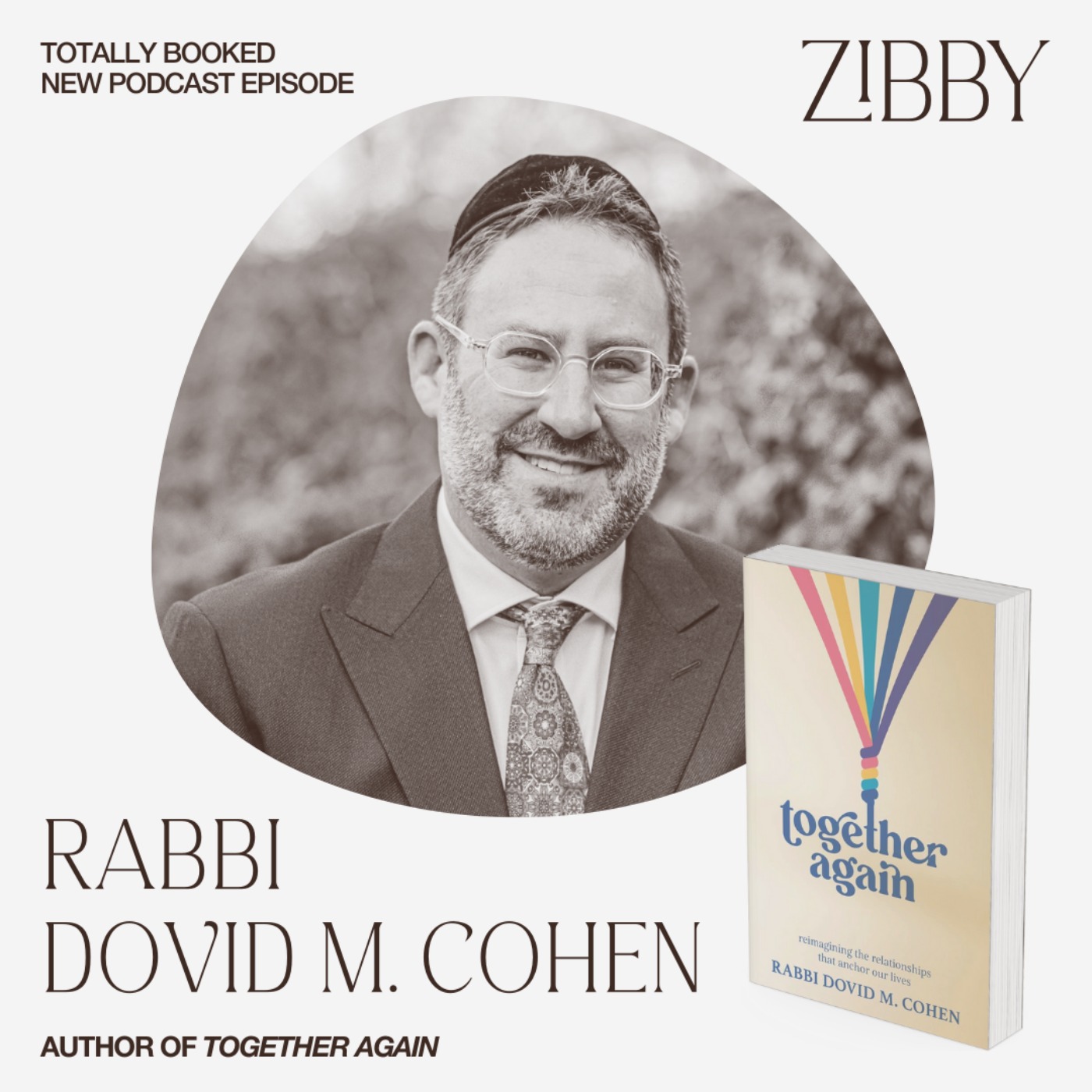
Wayfair Every style, Every Home Hi, this is Zibbee Owens and you're listening to Totally Booked with Zibbee, formerly Moms don't have Time to Read Books in my daily show, I interview today's latest best selling buzziest or underrated authors and stor story creators whose work I think is worth your time. As a bookstore owner, publisher, author and obviously podcaster, I get a comprehensive look at everything that's coming out and spend my time curating the best books so you don't have to stay in the know. Get insider insights and connect with guests like I do every single day. For more information, go to zibbymedia.com and follow me on Instagram at Zibby Owens Rabbi Dovid M. Cohen is the author of Together Reimagining the Relationships that Anchor Our Lives and We're Almost There. Rabbi Cohen is an internationally renowned motivational speaker, spiritual leader, life coach, entrepreneur, and author. His empathic approach has empowered many individuals to achieve success in all aspects of life. His teachings are firmly rooted in Torah knowledge mixed together with contemporary thinking. His listening skills and ability to understand his counterparts in diverse situations is admired, and his expertise is often marshaled in complex situations. He is currently the CEO of the Algeminer. Welcome David, thank you so much for coming on Totally Booked to talk about your two books, We're Almost There and Together Again and also just your Whole Life and the Algo Miner and everything else. So welcome.
- [04:40]
Rabbi Dovid M. Cohen
Zibi. Thank you so much for having me. I'm pumped to talk about my books because it's something I haven't done in recent days or weeks, so I'm excited about it.
- [04:48]
Zibby Owens
Oh well, I feel some sort of pressure because I loved the podcast you did with me so much and you opened it up with such a great thing. You were like, what do you want to talk about that you don't talk about all the time? And I was like, gosh, I don't even know, but I love that question, and you were such a thoughtful, great interviewer, so I don't know, I have to show up and do a good job.
- [05:10]
Rabbi Dovid M. Cohen
I'm flattered, and I have no doubt or concern whatsoever. You will topple my. Whatever prowess I demonstrated. I think you'll be completely fine.
- [05:21]
Zibby Owens
I don't know. Plus, you're a rabbi. I mean, that's so cool. But anyway. Okay, well, why don't we talk first about. We're almost there. Living with patience, perseverance, and purpose. And I was hoping I could just kick it off by reading a passage. Is that okay with you?
- [05:34]
Rabbi Dovid M. Cohen
Remind me what I said.
- [05:35]
Zibby Owens
Okay, I'll remind you what you said. So in the book, you talk about so much, about your life and your family's life and whatever, but the parts you wrote about your firstborn son being born with down syndrome I found so moving, and you wrote about it so beautifully in a way that people can relate to no matter what it is they're going through. So I was hoping I could just read a section about that, please. Okay. All right. You said it's overwhelming to contemplate how transformative a moment in time can actually be, even when just an observer. I experienced my own sudden loss upon the birth of my first child. Yet a d. Did I pronounce that right? Close, close. Go ahead, you tell me.
- [06:11]
Rabbi Dovid M. Cohen
Yedidyya.
- [06:12]
Zibby Owens
Yadidya.
- [06:13]
Rabbi Dovid M. Cohen
I mean, just. Actually, it's worthwhile just to translate. So the word yididya, the name yedidya actually means, if you bifurcate it, yidid ka, which ka yud. Hey, is God's name in Hebrew, and yadid means friend. So the name actually means a friend of God, somebody who's very close to God. That was actually the idea, because he is, as we talk about a little bit in the book, he's a very spiritual Persona. There's a lot in Jewish thought and text about the elevated soul of individuals who have physical disabilities, but they have a greater spiritual side to them. So we named him this name, Yedidya, or Jedidiah would be an English translation of it, because we felt that sense of his closeness to God.
- [06:56]
Zibby Owens
Amazing. Okay. Yedidya. Better?
- [06:59]
Rabbi Dovid M. Cohen
Yeah. That's great.
- [06:59]
Zibby Owens
I don't mean to compare it to Adet. Okay, now you're going to embarrass me. How do you say this.
- [07:08]
Rabbi Dovid M. Cohen
Means like a terror. Like, just like. Like it shouldn't happen. Like a terrible. Like a terrible, like, death. That shouldn't be meaning. Like, it's. It's not right. This is not, this is not that. Like, this is not not a death, it's actually a birth. That's what I was trying to communicate.
- [07:20]
Zibby Owens
Okay. Because this is the furthest thing from the truth. Our special needs child has brought us much life and joy. What we did lose was the child we were hoping for. The idyllic child who would learn in high level yeshivos and make us extremely proud. The one who would marry and produce future generations of Talmudi. Can't even read this. I'm going to say on some level, sudden loss is about shattered expectations and feeling intense vulnerability, realizing that life will now move in a different direction from what we expected or anticipated. And that no matter what we may fool ourselves into thinking, we really have almost no control over life events. Sudden shifts in life are plain hard. Sometimes we see people who have suffered a loss far less challenging than death struggling with it with as much confusion as those who have suffered extreme grief, disappointment, especially of a sudden nature, is of the greatest challenges to adapt to. Unexpected loss jars us from the expectation that we are entitled to another day of life. A perfect child, or any child for that matter, or that fairy tale ending. As we recover, we reorient and begin to appreciate how every moment along the trajectory of an expected lifespan is really an important part of our life journey. After all, no aspect of tomorrow is guaranteed and yesterday isn't proof of a tomorrow. Not bad, not bad. Sorry for messing up all the Hebrew. My school teachers would be mortified. But anyway, tell me, it was beautiful. And the notion that we have to make the best of every day is so important. How has Yedidya really taught you this?
- [08:55]
Rabbi Dovid M. Cohen
So we're very blessed. I mean, Yedidya is 20 years old today. He is a rock star. He is the apple of our eye. And really everybody, the other children in our family truly admire him. And I actually, by accident, I scared him last night. I unexpectedly came into his room and he dropped his phone and he shattered the COVID And he was like, he was very upset at me, which I understand. It's like, dad, you destroyed my phone, so don't do that again. He's a great kid, He's a normal kid. And I think a lot of times when things happen to us in that moment, we just can't fathom what the future is going to bring. There's just a sense of tremendous fear and being overwhelmed. And then as time goes on and things stabilize, at least in our situation, we began to appreciate really the tremendous blessing that we had. And we have. I do think, and I feel like maybe we talked about this a little bit when I interviewed you. We haven't even released that episode yet. But I do think that it foreshadows other events in life. I've had a few events even recently that came out of nowhere and really threw me for a loop. And that, you know, that's a. It's an important training ground where that does happen, because it does happen in a lot of different realms. To be rooted even in prior experiences like that and to know that we're going to get through it or that we'll be able to handle it with time and with the proper amount of healing and investment, that everything is but a moment in time and we can regroup and we can recover from most things. I mean, there are things that are almost non recoverable from. I just was thinking that one of the hostages has been speaking recently. She bravely has come forward. Her name is eluding me at the moment, but she's talked about how she was terribly sexually abused in Hamas captivity. Yes. And you know, she said, how do you ever recover from that? So, you know, some things maybe are not recoverable from. But yeah, but in that sense, yeah, for in our life that was something that was an anchor, ironically, in certain ways for future unexpected events.
- [10:58]
Zibby Owens
And you have how many kids?
- [11:00]
Rabbi Dovid M. Cohen
We're blessed with six.
- [11:02]
Zibby Owens
Amazing. Wow. The unexpectedness of life and this whole notion of being thrown for a loop. I mean, we are all like, who has not been thrown for a loop? And yet we all expect not to be thrown for loops. Maybe that's the problem. Maybe it should be this big reframing, right? That when is my next loop coming? As opposed to like, oh, no, I've been thrown for a loop.
- [11:24]
Rabbi Dovid M. Cohen
I agree, by the way. I agree with that. I think that those of us that are really tuned in and I think life is too busy to do this. But on a higher level of cognition, every day we should wake up or every night before we go to sleep, we should just be like, wow, like, I survived. I made it through. Nothing unexpected happened. Everybody I care about most is seemingly okay. That requires tremendous gratitude because, yeah, nothing is. Nothing should be taken for granted. And I think we, many of us, myself included, take things for granted because it's so expected and it's so. It's. It seems to be that way for a long enough time. You think that's the reality or that's kind of the fallback, but that's actually not really the reality, as is proven when things go awry. So I think, I think with the way you framed it is actually excellent. I think just too many of us aren't always tapped into that or tuned into that.
- [12:13]
Zibby Owens
Well, see, now people listening can just tap into it thanks to this, thanks to your book.
- [12:17]
Rabbi Dovid M. Cohen
Feel it like even tapping into it a little bit is worthwhile. It doesn't have to be always, but just once in a while to appreciate when things are okay and realize it's not. You shouldn't. One shouldn't take that for granted because there's so many people that don't have that reality in their lives.
- [12:31]
Zibby Owens
You wrote in the book also about how difficult, especially the first few years were of becoming a rabbi. And your career path was not that to begin with. And now it has sort of veered off. You're obviously still a rabbi. Once a rabbi, always a rabbi. But you're also now CEO of the Algo Miner, where you're not even practicing. So tell us a little bit about your career path and this stop into rabbihood.
- [12:55]
Rabbi Dovid M. Cohen
Yeah, it's interesting. My parents encouraged me when I was younger to be an attorney. My father was a successful businessman. But when I grew up in the 1970s, 1980s, I think parents always wanted more for their kids. I think it's changed today. But in those days, being an attorney or being a doctor was kind of like the desired career paths. My parents and I like to make a good argument that I liked legal shows on tv and my parents encouraged me strongly. My mother was also the daughter of a rabbi, interestingly enough, and they were not financially well off or comfortable. Many rabbis today, thankfully are much more comfortable than my grandfather was. So that was always a fear, I think that there wasn't enough to eat and my mother really wanted me to have a solid foundation livelihood. So they pushed and pushed and pushed the legal profession. As I began to develop spiritually post high school, I saw that I had a certain affinity for spiritual growth, for inspiration, for the ability to touch other people through communicating stories or content and excuse me, I basically dual tracked for a while the legal profession, studying to be ordained as a rabbi and even practiced as a rabbi, kind of as a junior rabbi concurrently exploring all these different fields. Ironically, at least in that day. It was difficult to be a rabbi with your own congregation, without a partner, without being married. And I didn't get married till my early 30s, which I talk about I think a little bit in the book as well, which was a little later in my community. So I then spent a number of years kind of away from the Rabnet into the legal profession. But Then always wanted to kind of take a stab at the Rabnet. And some interesting things occurred. And I did get those opportunities, but the early years of that were not like, kind of didn't go as smoothly as I had hoped. I kind of entered into an intricate communal infrastructure where there was this older senior rabbi who'd been there for many years and wasn't necessarily so quickly letting go of the pulpit. And there was a little bit tension and friction there at the beginning. And the currents were not exactly what I had hoped or thought would be, meaning they weren't as open as I had hoped they would be to my messaging or it just was kind of fraught with different challenges, as life often is, and then ultimately ended up pivoting to other career endeavors as life progressed.
- [15:25]
Zibby Owens
It sounds like nobody wants this. Season two. Have you been watching?
- [15:30]
Rabbi Dovid M. Cohen
Yeah, I did watch it. Yeah. Yeah, it's true. It's true. It's an interesting. Yeah, it's like anything in life, you really need to. It needs to be a really good. The Hebrew term for it, we call it Shidduch. There needs to be like a good fit. It needs to be a good partnership. Like, I don't care how talented you are, if you're put in the wrong framework or with the wrong, it's not a match, you're not going to succeed. You're not going to do well. And I don't think. I think my situation wasn't so much that it wasn't the right match. I think I had undue or unrealistic expectations or frankly, I was a little immature at that stage in terms of knowing how to handle what was in front of me. And I tend to always try to learn. I have a lot of life experience. I try to, at each stage, learn from previous mistakes. I find myself sometimes even repeating them now, but I try to at least talk them out. And that's like, you're doing that again. Like, let's be aware. Why are you doing that? Like, let's be careful, so on and so forth.
- [16:29]
Capital One Bank Advertiser
With no fees or minimums on checking accounts. It's no wonder the Capital One bank guy is so passionate about banking with Capital One. If he were here, he wouldn't just tell you about no fees or minimums. He'd also talk about how most Capital One cafes are open seven days a week to assist with your banking needs. Yep. Even on weekends. It's pretty much all he talks about in a good way. What's in your wallet. Terms apply. See capitalone.com Bank.
- [16:59]
Equip Health Advertiser
We live in a culture obsessed with dieting, weight loss and exercise, and that can make eating disorder behaviors easy to miss. But the reality is, eating disorders are serious mental illnesses that take a major toll on your health and your life. But recovery is possible. Eating disorders are more common than you might think. Chances are you know someone who is struggling with one, or maybe you're struggling yourself. If you're concerned about an eating disorder in yourself or a loved one, I want to introduce you to equip. Equip is a fully virtual evidence based eating disorder treatment program that helps patients achieve lasting recovery at home. Every EQIP patient is matched with a multidisciplinary care team that includes a therapist, dietitian, medical provider, and mentors. And you get a personalized treatment plan that's tailored to your unique goals and challenges. EQIP treats patients of all ages and all eating disorder diagnoses. It's covered by insurance and there's no wait list. If you think that you or a loved one could be struggling with an eating disorder, don't wait to get help. Visit Equip Health to learn more. That's Equip Health.
- [18:06]
Wayfair Advertiser
We interrupt this program to bring you an important Wayfair message. Wayfair's got style tips for every home. This is Styles MacKenzie helping you make those rooms sing. Today's style Tip when it comes to making a statement, treat bold patterns like neutrals. Go wild like an untamed animal. Print area rug under a rustic farmhouse table. From wayfair.com fierce this is then your Wayfair style tip to keep those interiors superior.
- [18:32]
Zibby Owens
Wayfair Every style, every home. Amazing. So you also now have gone into media. So you're the CEO of the Algo Miner. Tell listeners if they don't already know about it. And you were nice enough to give me the top 100 people in Jewish whatever last year. So thank you so much.
- [18:54]
Equip Health Advertiser
We love you.
- [18:55]
Zibby Owens
Zabby Owens oh, thank you. Tell listeners about it.
- [18:58]
Rabbi Dovid M. Cohen
It's really interesting. I never thought it's. It's kind of. I think it's actually quite interesting from my perspective in the sense that I always was informally in the media space, meaning I was active on social media. Not hugely, but active. I had launched my own podcast in a different realm of Jewish philanthropy where I did over 100 episodes that started during COVID It was kind of a way I was in the fundraising space and it was kind of a way to meet with people during COVID and it kind of just metamorphosize into something else. I did write two books which was a passion of mine in terms of having a platform to communicate. It started really because the. My, my pulpit in Manhattan was very transient and I used to find it like challenging sometimes I put so much into my messaging and into my oratory and then people weren't there and I was trying to find other mediums to kind of share the content. So these were all kind of different platforms where I was kind of informally in media. But if you would have asked me, could you see yourself heading up a media outlet? It was never on the radar. It was really never on the radar. Being a rabbi of a community was, being a lawyer in a firm was being a Jewish non profit communal professional probably was in some manifestation. But to be the head of a media outlet actually never was. But we get guided life sometimes to places that we don't expect or we need to be. And the Algomat is a storied media outlet, the same age as I am, 53 years old. It was founded initially as a Yiddish print newspaper with the blessings of the Lubavitcher Rebbe. Really kind of had chabad origins and it was really meant for a post Holocaust demographic, didn't really have a voice. It was meant to be something for everybody. The word Algomati means universal, means global. It's a whole story that it metamorphosized and morphed into an English online media outlet. Today my personal connection to it really came about being I was recruited for it. But my interest in it really was sparked by October 7 in the sense that I was in a space special needs children, which we started off talking about my son, which I was very passionate about, care deeply about. But I've been doing that for many years. I was already kind of ready for something new. And then everybody's attention of course focused to Israel and the media and how we can defend and fight for Israel and the Jewish people in really some of the most tumultuous times in our history. And this opportunity fell into my lap. And even if it wasn't a natural fit, I felt that kind of my cumulative life experience plus the opportunity to kind of be helpful and use my God given talents in this critical time, in this critical juncture for our people. It was almost too good an opportunity to pass up. So I kind of dove in. I've been doing it for 16 months. It's been a whirlwind, but really, really been enjoying it and I've really learned a tremendous amount and I'm very passionate about kind of what we hope to do. In the coming months and years with our outlet.
- [21:59]
Zibby Owens
Amazing. And you have a big event coming up in March.
- [22:02]
Rabbi Dovid M. Cohen
Yeah, I have to mention that we have a huge event. We have a gala every year, which you alluded to, the J100 Gala. This is our 12th. What's so unique and special I think about this year is we kind of have a slate of iconoclasts. It's just like there's like a theme that runs through all the honorees this year. President Xavier Milei of Argentina, who were really graced. I don't think there are too many Jewish events that he has been present for in this format. Maybe there was one in Florida a couple years ago and this is probably the first in New York. He has really been an unabashed friend of the Jewish people in Israel. A non Jew who really kind of recognizes the truth and the beauty of the state of Israel and what the Jewish people stand for. And we're really, we're incredibly honored that he's going to grace our event in person. David Draiman, who is a renowned musical talent. His band is called Disturbed. He's also been an incredible voice, Jewish voice, defending the Jewish people in Israel throughout his tour in Europe recently when obviously he was confronted with a lot of adversarial forces. And Boaz Weinstein, who is actually an amazing member of the New York hedge fund community finance community an art. And he named his hedge fund is called Saba Capital after his grandfather Saba, his Saba, his deep roots and his Zionism. So we're really honored to have the three of them. We also have Scott Jennings who is going to be the emcee for the evening. Just wrote a brand new book. He's really a voice of reason on CNN and then other forums and platforms and many other incredible surprises. It's going to be Monday night, March 9th in Manhattan. There's a lot of details out there. The website for the gala is AJ Algomet or journal AJ gallard dot com. You can learn a lot more there. You can sign up, make reservations. We're really now we're about a little more than two months out. So really now is the critical push to really make this event. And we're also going to of course reveal our J100 selection list. Zibi was one of the J100 last J1 hundreds as people should know. It's also kind of a list of iconoclasts. It's a list of people who kind of are doing things that are movers and shakers in the Jewish world. They're making an incredible impact. Some of them are Jewish, some of them are not Jewish. And every year we try to recognize new people. You can have the same people on the list every year, because Kazimi, you could be on the list every year. But we really want to expand the community of J100 members. So we're really. Our team is working carefully this year to really hone in on new voices and new people. There's always going to be some repeats in terms of heads of state of that ilk, but we're really looking to really grow our community in terms of the J100 community. We're going to be doing some new things at the gala in terms of that demographic. Hopefully you'll be there as well, and we'll be able to honor you again, Zibby. So it's going to be. It's something I'm very excited about, and it's going to be an event, really, an event like no other. Really. All our events are great and there are many gals in New York and elsewhere. But trust me when I say this event this year is going to be something that is going to be truly talked about and is really going to. I think it's really going to catapult the Algo Miner forward in terms of our vision and in terms of our mission.
- [25:15]
Zibby Owens
Amazing. How are you feeling about life as a Jewish person right now? And you don't have to go into the whole thing, but, you know, I did this book on being Jewish now. What does it mean and how does it feel to be Jewish now? And every day it seems the context and the landscape is shifting and moving and what we have to contend with. How do you feel? How do you keep hope? How do you feel in general?
- [25:44]
Rabbi Dovid M. Cohen
Let's draw a parallel between what we spoke about a few moments ago in terms of what's the de facto default of things are great or being grateful, because don't take that for granted. I think that's very much coming to the fore. I think I'll talk particularly here in America. I think it's a very unique diaspora, a very unique experience for Jews in the world. Maybe we talked about this ourselves also last time. It rings a bell. But I've talked about this with other people for sure, And I do think that we kind of have gotten very comfortable, very comfortable in this particular aspect of our historical exile from our land of Israel. And this has been, you know, it's been golden. It's been really unique and special historically and the American milieu in Terms of the inculcating Jews into high positions of power and influence has been incredibly unique and incredibly special at the same time. There is a principle, it's actually a principle in the Torah that there is always going to be a certain enmity or ill will between the nations of the world and the Jewish people, frankly, that is manifesting itself much more now than ever before. Post 10-7- Certainly now in New York City, I tend to be an optimist because I have grown up in this country and feel very at home here and very comfortable here and frankly have always been treated amazingly well here. At the same time, I don't want to be naive and I don't want to make the mistake that our ancestors made, certainly in Germany and other countries in Europe before World War II. I think everybody needs to be keenly aware of the challenges. I think that we need to speak out, we need to defend our position. We need to use the media effectively and cleverly to communicate with people the rightfulness and the justness of Israel and the Jewish people and our positions. And at the same time, I do think everybody should have an eye on, you know, what's the. What's called escape hatch, but kind of like more Jews should be moving to Israel. I think that's something that everybody should aspire toward. It's something that I know myself and my family talk about, think about. We're not ready to do it immediately tomorrow, but it's not. We don't. We don't want to kind of spend the rest of our lives here in the Diaspora either. Not because it's not an amazing place, just because Jewish destiny calls in the land of Israel, in the state of Israel. And that I think has only been strengthened over the last two years. Post October 7th I know I just said a mouthful, but that's some of my complex feelings on the moment that we're in.
- [28:18]
Zibby Owens
I think many people share your views and also the coming from this golden era to now and that adjustment I think a lot of people have been contending with. Are you thinking of writing another book?
- [28:32]
Rabbi Dovid M. Cohen
I was asked that question. My last book was written actually during COVID and the other one was written before that. That was a common question. I still get that question decently enough, frequently enough. I love to write, but it's not like on the agenda at the moment. It's just not right now. I really want to take the Algo Miner has been around for a long time, but I think that in this unique moment it has a potential to reach many, many more people than it currently is. And I think it's messaging and its authenticity and its unique voice. And it really, I think, is a unique voice in a lot of ways. I want to kind of invest my energy into strengthening the Algo Miner and amplifying its voice to a lot of audiences. So in the immediate term, I'm not really thinking of amplifying my own voice as much as I am thinking of amplifying the voices of the people that work with me and who are not yet hired by me, but hopefully will be and are going to be our voices. And I really want to. We really have a five year plan to kind of really, really raise our impact and raise our voices as one of the defenders of the Jewish people and of the Jewish cause. So that's kind of my immediate focus in the near term. A book one day, maybe. Who knows? I happen to be an avid golfer. I love to play golf. And I always had a dream of writing some sort of book that was built around the 18 holes of a particularly historic golf course. Integrating kind of like Torah messaging, kind of based on the intricacies of each hole. That's so cool with life and some of the complexities that we talked about earlier in this discussion. So that's kind of always been kind of on the back burner in my head. Maybe when I'm. I don't know if I'll ever retire, but if I'm ever, you know, if I'm ever retired, and maybe that's something I would work on playing more golf and also doing a. I think it'd be a super fun project, kind of taking a lot of my passions and my loves and kind of integrating them. But I do find. You're the expert on this. But I do find that it's a lot of things like how do you get. Even if you invest so much in writing a book, but then you have to get people to read that book. And to a degree that it's not. It's. If it's not being. If it's not being consumed, you know, there are many people in my orbit don't even know I've written books, because it's not. Again, I don't walk around all day with this and it's kind of, you know, you kind of promote it more when it comes out, so on and so forth. So do I think it's very valuable? Of course I do. But, you know, how do you get people to. It's a whole. And it's part of our discussion at the outlet too. How do You. How do you get people to consume the content and to read it? So that's always a challenge. I see there's a dog in the background. I didn't realize. Oh, yeah.
- [31:13]
Zibby Owens
Yep. She blends in with the couch.
- [31:16]
Rabbi Dovid M. Cohen
I didn't realize. Literally, like we're talking about. I know. I just said, wow, what's going on over there? Okay.
- [31:22]
Zibby Owens
Well, David, thank you so much. Thanks for writing the book, sharing your inner heart and soul on the page, and then using that talent to usher in more stories through the Algo Minor and being a voice for people in a really difficult time. So thank you so much. And yeah, exciting about the gala. I hope to be there, but I think I have to be out of town. But if I'm in town, I'll come for sure.
- [31:47]
Rabbi Dovid M. Cohen
Let me say one other, if I can, just one quick thing. Just so my second book, Together Again, is actually. It was conceptualized in terms of being apart during COVID and the. And the hope and aspiration of how do we kind of enhance our relationships post the pandemic once we're together again. So just to tie this kind of whole conversation together, I do think that it's something that I think about frequently in terms of. And I think we spoke about this too last time we spoke. Zoom is great or Google Meets or whatever medium you use, but it's not the same as being together in person. Together Again really was written with that in mind in terms of how do we reconnect and how do we reassess and appreciate the critical people in our lives, family and non family, after being separated from them. That's from. Frankly, I think the beauty of the Algomet or Gala and many organizations in the sense that you have a community and it's kind of amorphous community, and you have thousands of people that are engaged with your content, but you have this one platform or context where people can come together in person, touch the flesh of other people, and kind of be united around something they care about and they're passionate about. That's, I think, a beautiful thing that I think we still kind of forget even so many years post the pandemic because we just take it for granted. We kind of have fallen back on the tools that we use then. But I think, although obviously helps in many ways, it also kind of hinders us in other ways. So I just wanted to highlight that construct as well.
- [33:16]
Zibby Owens
Very important. Thank you.
- [33:18]
Rabbi Dovid M. Cohen
Okay. Awesome.
- [33:18]
Zibby Owens
Okay, well, thank you so much for your time.
- [33:20]
Rabbi Dovid M. Cohen
Thank you.
- [33:21]
Zibby Owens
Thank you for listening to Totally Booked with Zibby, formerly moms don't have time to read books. If you loved the show, tell a friend, leave a review, follow me on Instagram ippyowens and spread the word. Thanks so much. Oh, and buy the books.
- [33:43]
Capital One Bank Advertiser
With no fees or minimums on checking accounts. It's no wonder the Capital One bank guy is so passionate about banking with Capital One. If he were here, he wouldn't just tell you about no fees or minimums. He'd also talk about how most Capital One cafes are open seven days a week to assist with your banking needs. Yep, even on weekends it's pretty much all he talks about in a good way. What's in your wallet? Terms apply. See capitalone.com bank capital1na member FDIC.
- [34:15]
Zibby Owens
We.
- [34:15]
Wayfair Advertiser
Interrupt this program to bring you an important Wayfair message Wayfair's got Style tips for every home this is Stiles Mackenzie. Helping you make those rooms sing today is Style Style Tip when it comes to making a statement, treat bold patterns like neutrals. Go wild like an untamed animal. Print area rug under a rustic farmhouse table from wayfair.com fierce this has been your Wayfair style tip to keep those interiors superior.
- [34:41]
Zibby Owens
Wayfair Every Style Every home Lunch was.
- [34:44]
Equip Health Advertiser
Great, but this traffic is awful.
- [34:47]
Zibby Owens
Can we stop at a bathroom?
- [34:48]
Equip Health Advertiser
Are you alright?
- [34:49]
Zibby Owens
And keep having stomach issues after eating like diarrhea, gas and bloating, abdominal pain and sometimes oily stools. Sound familiar?
- [34:57]
Equip Health Advertiser
Those stomach issues may actually be a pancreas issue called exocrine pancreatic insufficiency or epi. Creon pancrelipase may help manage epi. Creon is a prescription medicine used to treat people who can't digest food normally.
- [35:10]
Zibby Owens
Because their pancreas doesn't make enough enzymes.
- [35:12]
Creon Medication Advertiser
Creon may increase your chance of fibrosing colonopathy, a rare bowel disorder. Tell your doctor if you have a history of intestinal blockage or scarring or thickening of your bowel wall. If you are allergic to pork or if you have gout, kidney problems or worsening of painful swollen joints, call your doctor Any unusual or severe gastrointestinal symptoms or allergic reactions. Take Creon as directed by your doctor and always with food. Do not chew capsules as this may cause mouth irritation. Other side effects may include blood sugar changes, gas, dizziness, sore throat and cough. These are not all the side effects of Creon. Call 800-633-9110 or visit creoninfo.com to learn more. That's C R E O N info.com.
- [35:40]
Equip Health Advertiser
I'm asking my doctor about EPI and.
- [35:42]
Zibby Owens
If Creon could help.