Loading summary
Transcript68 lines
- [00:01]
Zibby Owens
Hey everyone, it's Zivi. I am so excited to tell you about something I've created just for you, the Zip Membership Program. ZIP stands for Zivi's Important People. It's for anyone who loves books, stories and wants a little peek behind the scenes at what I'm up to and what's on my mind as a Zip member. You'll get exclusive essays, a new podcast called Zivvy's Voice Notes. No interviews, just usually discounts at Zibby's Bookshop, a free ebook, and more perks. I wanted to create a space to connect authentically and deeply, and I'd love for you to be part of it. If that sounds like your kind of thing, become a Zip today. You're already important to me. Now let's make it official. Go to zibioens.com and click subscribe. And if you already subscribe, you can upgrade to the Membership program. And now onto today's episode of Totally Booked with Zibvie. Thanks for listening.
- [00:56]
Paige DeSorbo
This is Paige desorbo from Giggly Squad. Boost Mobile gives you the same network coverage, speed and service you're used to, just at a more affordable price. Why pay more if you don't have to? Offering reliable nationwide coverage backed by a 30 day money back guarantee. Love your service or get your money back, no questions asked? Visit your nearest Boost Mobile store or head to boostmobile.com to learn more. After 30 gigabytes, customers may experience slower speeds. Customers who cancel within 30 days of activation will have Boost service fees refunded, activation fees if applicable, and phone payments will not be refunded.
- [01:35]
Grow Therapy Announcer
Was January supposed to be your big fresh start? Well, sometimes the pressure to fix everything at once just can leave you feeling stuck. Growtherapy makes it easier to reset at your own pace with therapy that's covered by insurance and built around your life. You can search by what matters like insurance, specialty, identity or availability and get started in as little as two days. And if something comes up, you can Cancel up to 24 hours in advance at no cost. Whatever challenges you're facing, Grow Therapy is here to help. Grow accepts over 100 insurance plans, including Medicaid in some states. Sessions average about $21 with insurance and some pay as little as $0 depending on their plan. So visit growtherapy.com acast to get started. That's growtherapy.com acast growtherapy.com acast availability and coverage vary by state and insurance plan.
- [02:40]
Debbie Millman
Hi, I'm Debbie Millman and I host a podcast called Design Matters from the TED Audio Collective. Every episode I have conversations with designers, writers, artists and other luminaries of Canadian contemporary thought. People like Roman Mars, AI Weiwei, Ethan Hawke, and Ashley Ford. We not only talk about their crafts, but how they design the arc of their lives, what they've learned, what obstacles they've overcome, and how they've done it, and how they see the world. Join us for an inquiry into the broader world of creative culture. Find and follow Design Matters with Debbie Melman wherever you're listening to this.
- [03:24]
Zibby Owens
Hi, this is Zibby Owens and you're listening to Totally Booked with Zibby, formerly Moms don't have Time to Read Books in my daily show, I interview today's latest best selling, buzziest or underrated authors and story creators whose work I think is worth your time. As a bookstore owner, publisher, author, and obviously podcaster, I get a comprehensive look at everything that's coming out and spend my time curating the best books so you don't have to stay in the know, get insider insights and connect with guests like I do every single day. For more information, go to zibbemedia.com and follow me on Instagram ibyoans.
- [04:07]
Grow Therapy Announcer
I was.
- [04:08]
Zibby Owens
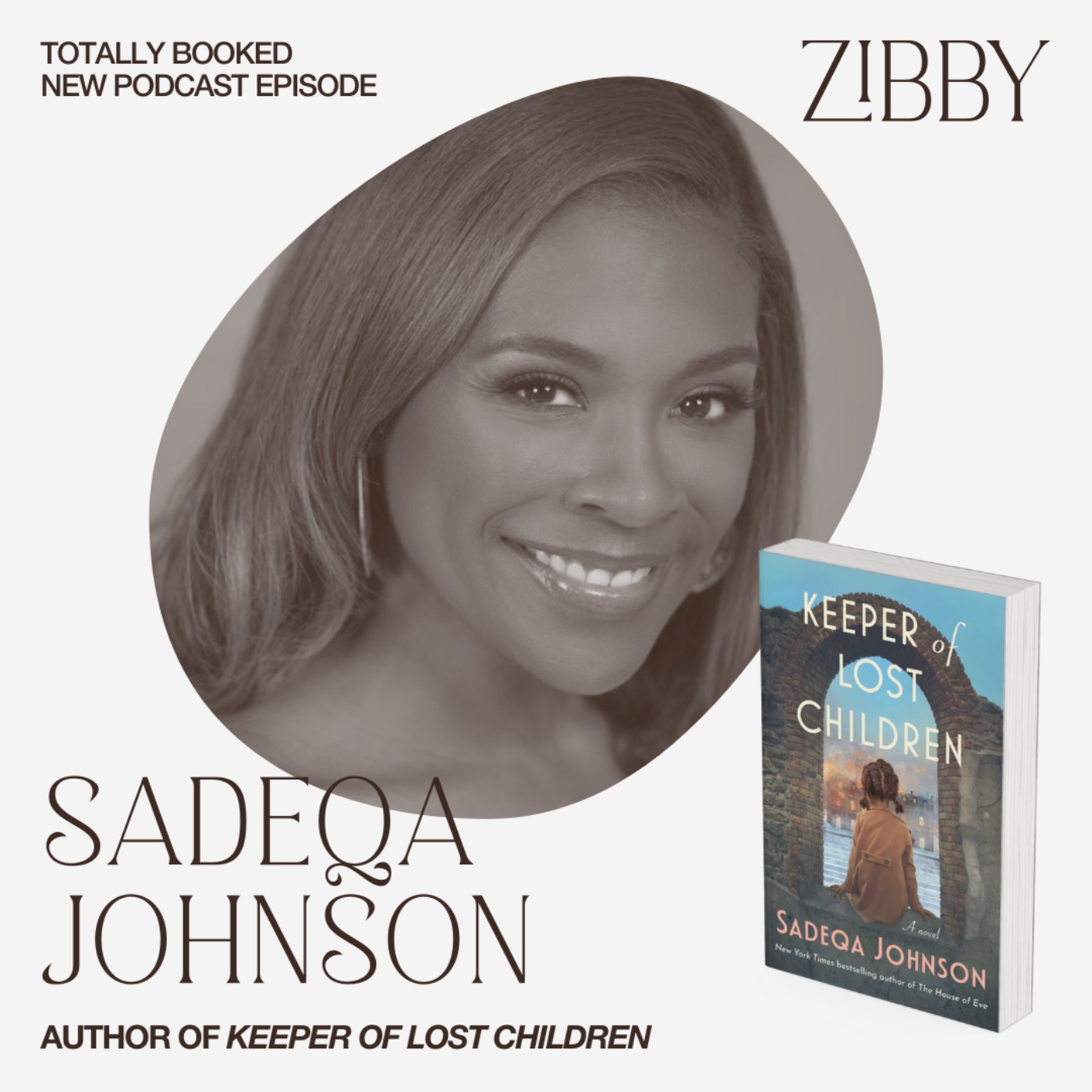
So happy to have Sadiqa Johnson back on my podcast. I feel like I've had her on least two or three other times. We did an event together at the LA Times Book Festival once and she.
- [04:17]
Interviewer (possibly the podcast host or co-host)
Is just absolutely delightful.
- [04:19]
Zibby Owens
And I love her historical fiction novels. This one is Keeper of Lost Children. Sadiqua is the New York Times bestselling author of five novels and her most recent novel. Before this one, the House of Eve, was an instant New York Times bestseller, a Reese's Book Club selection, NAACP Image Award nominee, Goodreads Choice finalist and Target Book Club pick. Her previous novel, Yellow Wife was the Library of Virginia's Literary People's Choice Award, Goodreads Choice Award finalist and more.
- [04:50]
Interviewer (possibly the podcast host or co-host)
Welcome Sadiqa. I'm so excited to have you back on. Totally booked this time to talk about.
- [04:55]
Zibby Owens
Keeper of Lost Children.
- [04:57]
Interviewer (possibly the podcast host or co-host)
Congratulations.
- [04:58]
Sadiqa Johnson
Thank you so much. It was a long time coming.
- [05:01]
Interviewer (possibly the podcast host or co-host)
Tell me everything. Okay, how long, how long did it take?
- [05:03]
Sadiqa Johnson
How long it feels? I mean, I usually try to have a book every other year and this is two years in between because the research was a lot, juggling three point of views, which when I first started off with this novel I thought it was a good idea. And then as I got halfway in I was like, what was I thinking? This is a lot to manage.
- [05:28]
Interviewer (possibly the podcast host or co-host)
Yeah, that was a lot. So why did you pick three and why at the different times. You have a lot of different variables going on here.
- [05:35]
Sadiqa Johnson
I do. I have three different characters and three different timelines. And the way it came was that I had discovered the story of Mabel Grammar, who the novel is inspired by. You know, I always have to find a woman who is ambitious and who is working overtime to do something very meaningful in the world. And when I discovered the story of Mabel Grammar, she was a black American woman who was in Mannheim, Germany with her husband, chief Warrant Officer. And she was lonely and she didn't have children, she couldn't have children. But she discovered this orphanage where mixed race children were living. And they were a product, the consequence of war. There were the black American GIs who went over to Germany to help with the war and also with the occupation. And then there were the German women who were often left without a male counterpart, a German male counterpart because of the devastation of war and the hunger of war. And so these two got together in very unlikely circumstances and children were created. Once the children were born, oftentimes the black American soldiers couldn't marry these German women because of Jim Crow laws. And they were separated and they left the women with the babies. And oftentimes the German government would not support the women and these babies because they were illegitimate. They were mixed race. And so that was sort of the beginning idea of the story was how do I pay tribute to this woman, Mabel Grammar, and this monumental moment in history that no one knew about? You know, it's not something we learn about in social studies, which is the thing that I always find, like, how do we not learn these stories in history class in school? And she really changed the face of adoption overseas, changed the lives of over 500 of these mixed race babies who were left in Germany. And so that was sort of the beginning of, of the story for me was how could I tell her story?
- [07:44]
Interviewer (possibly the podcast host or co-host)
And so then what was your next step and how did you pick the stories and the points of view you picked?
- [07:50]
Sadiqa Johnson
So then my next step was I was thinking a lot about the black men who went to Germany and what America was like for them before they went. I have a great uncle who's still alive. He's in his early 90s and he was in the Air Force during the 40s. And so I was picking his brain to find out, like, what was that? Like there was a lot of freedom over in, you know, that these black American men didn't feel here in America. And so I wanted to show the lives of a black man moving through this new world, wanting Something really significant for his life, right? He wanted to be educated. He wanted to work in intelligence. He was a very smart character. But because of our Jim Crow laws and even after the desegregation of the army, he was still hitting roadblocks. And so I thought his story was really important. I find that men, especially black men, get left out of the narrative. And so bringing light to his story, I thought was really important. And so that is Ozzie Phillips, who starts off in South Philadelphia and finds himself in Germany. And he meets this German woman, and they find each other out of necessity because they're both lonely and hungry, and they have this relationship. And then Sophia is my, you know, she's the third character, but really. And some. Some. Some ways it feels like she is the main character, even though the book was based on Mabel grammar. And Ethel, you know, plays a really big role in some ways. I feel like you're rooting for Sophia's story through the book because she's young, you know, she ends up as a farm laborer, you know, or she's born into this farm family, and she wants nothing more to be educated, but her family wants her to stay as a laborer. And that story came from my research. I found that some of the children that were adopted, in some cases it was, you know, a happy situation, but in some cases it wasn't. And so I thought, let me. Let me pull some strings there and see what I can come up with. I'm also very fascinated with schools and school segregation and desegregation. And I discovered that, you know, Brown versus Board of Education happened in the 50s, but that did not extend to private schools and boarding schools. Those. That didn't happen until the mid-60s. And I thought, well, again, we're not talking about this. This is not something that we've known. And I thought, I want to explore that a little bit. I want to pull on that string. I want to explore what identity feels like, what love, you know, young love feels like, and the search for identity. And so that was how these three characters came into the story. But the tricky part was making these three stories one novel. Yeah, okay.
- [10:43]
Interviewer (possibly the podcast host or co-host)
How do you do this? Because this is an art form that other authors attempt and do often, right? Weaving narratives, different timelines.
- [10:50]
Zibby Owens
Some people have, like, graphs with all.
- [10:52]
Interviewer (possibly the podcast host or co-host)
The dates and times. Like, how did you, from a craft standpoint, accomplish this?
- [10:58]
Sadiqa Johnson
So my approach is to write one narrative at a time so that I could see. Spend a certain amount of weeks with one character so that we are locked in, we are getting to know each other. We are in relationship, we are communing together. And so I. I start off by splitting the novel in either three or four parts, depending on, you know, what book. This book is actually four parts. And so I always wrote Sophia's character first. So I would write Sophia all the way up to, as far as I knew, as close to the end of part one. And then I would let her story sit, and then I would do the same thing for Ozzy, and then I will let his story sit. And then I would go in and write Ethel's story as far as I can to the end of part one. And then I would literally print all three stories and sit on my office floor and line them up by chapters. So Ethel's row, Sophia's Row, Ozzy's row. And then I would just kind of sit there like a jigsaw puzzle and see where the stories intersect, and I would rearrange them by paper and. And then I would read the scenes together as, like, part one to see if it made sense, how I could tighten the strings a little bit. You know, in some places, I felt like my hem was showing. How could I pull the skirt down a little bit just to make sure that everything was unified and felt like a full book? So that was. That was my approach. It worked sometimes. And some. Sometimes it didn't. Sometimes I. You know, I have five extra chapters for one character, and it was like, there's no place for this. You know, what am I going to do? And so I had to figure it out.
- [12:35]
Interviewer (possibly the podcast host or co-host)
And what did you do with the chapters?
- [12:37]
Sadiqa Johnson
I. I took the chapters out of the book, and I figured out a way to tell those chapters and a couple of paragraphs, which, you know, when I'm writing, sometimes it feels like everything needs to be in the book. And then when I sit down with it, it's like, oh, I needed to write all of that because I needed to know it. Now I can say it faster so that the person reading the book will get it much quicker than it took for me to kind of figure out what I wanted to say. So I was able to shrink those down to a couple of paragraphs, but still hold onto that emotion. And that feeling that I had written in those five chapters that couldn't survive in the book, it was just too much. It's already a very long book. It's way longer than my other book. So I really had to be careful with my words.
- [13:23]
Zibby Owens
Today's episode is sponsored by Quince. Quince is all about elevated essentials that feel effortless. Designed for layering and mixing, each piece helps build a timeless wardrobe made to last with versatile silhouettes and thoughtful details. They're the kind of styles you wear again and again. I have not taken off my quince parka this entire winter season.
- [13:45]
Interviewer (possibly the podcast host or co-host)
There's been a huge snowstorm lately.
- [13:48]
Zibby Owens
I wore it in and out of the snow every day. I mean I just wear it every day. It's amazing. Quint has wardrobe staples with quality that is made to last, like 100% organic cotton sweaters, premium denim with stretch for all day, comfort luxe cotton cashmere which blends perfectly for changing seasons and basically everything you need for a wardrobe that last. Quince works directly with safe ethical factories and cuts out the middle mint so you're not paying for brand markup, just high quality clothing. Quince uses the highest quality materials like 100% European linen and organic cotton. Speaking of which, my podcast producer Chelsea, who is undoubtedly listening, got a new comforter off of quints, which she also loves. We are both Quince fans, so refresh your wardrobe with quince. Go to quince.com zibby for free shipping on your order and 365 day returns. Now available in Canada too. That's Q-U-I-N-C-E.com zivi to get free shipping and 365 day returns. Quince.com zivvi Today's episode is sponsored by Wayfair. The new year is here and it is time to get back into an at home routine you love and elevate your space with Wayfair. From bedding and mattresses to storage solutions for every room in your house, Wayfair is your one stop shop. I actually have used Wayfair so much because over the holidays I stayed with my mother in Arizona and told her it was definitely time to redo the guest. She has my kids stay because she hasn't touched it in decades and it needed a refresh and I said you know what Wayfair. So we got beds, lamps, side tables. We've been doing the whole room. It looks amazing. Everything came within a few days in perfect shape. It has been so fun. Wayfair has everything like the most enormous selection of home decor items and exactly what we wanted for the space we had. And it's still a work in progress and and I will share some pictures on Instagram. We're obsessed so you should get organized, refreshed and back on track this new year as well. For way less head to Wayfarer.com right now to shop all things home. That's W A Y-F A I R.com Wayfair Every style, every home.
- [16:20]
Grow Therapy Announcer
Was January supposed to be your big fresh start? Well, sometimes the pressure to fix everything at once just can leave you feeling stuck. Grow Therapy makes it easier to reset at your own pace. With therapy that's covered by insurance and built around your life, you can search by what matters like insurance, specialty, identity, or availability and get started in as little as two days. And if something comes up, you can Cancel up to 24 hours in advance at no cost. Whatever challenges you're facing, Grow Therapy is here to help. Grow accepts over 100 insurance plans, including Medicaid in some states. Sessions average about $21 with insurance, and some pay as little as $0 depending on their plan. Visit growtherapy.com acast to get started. That's growtherapy.com acast growththerapy.com acast availability and coverage vary by state and insurance plan.
- [17:25]
Interviewer (possibly the podcast host or co-host)
I mean, you really wrote three books.
- [17:27]
Sadiqa Johnson
Yes, essentially, right?
- [17:29]
Interviewer (possibly the podcast host or co-host)
I mean, you, you could have had a book with just one character and not intersect at all. And it would. We could also talk about that, right?
- [17:36]
Sadiqa Johnson
It definitely felt like that for Ozzy's character, I think, because I was thinking a lot about my own family history. You know, I grew up in Philadelphia. He was from Philadelphia. I could really feel him in my bones. And I felt, I felt like his story could have gone on and on and on and on and on. And so he was the person who I had to. To trim and cut and fit into smaller spaces. Because at one point my editor said, you know, he's taken over the story. This is, this is not his book. And I was like, oh, my gosh. So that's when I have to go in and figure out how to do a little bit of surgery, take stuff out and stitch it back together.
- [18:13]
Interviewer (possibly the podcast host or co-host)
And what about this whole thing of like, you can only write from your own perspective, right? That's like one of those things floating around the world. And yet you can write from a man's perspective and all this, like, I mean, I don't buy into that. I'm like, you have to use your imagination. Like, that is what fiction is, is made up stories. But talk a little bit about that. And did you even think about that?
- [18:36]
Sadiqa Johnson
You know, I always feel like that stories choose me, and the stories that choose me are rooted somewhere in my DNA. I mean, it could be, you know, ancestral, it could be guides, it could be angels, it could be any of those things. And so I Always feel like when, when the characters choose me, I have to feel them. I have to feel them like in my blood. I have to feel it in my gut, really. And so to answer your question, you know, when I was thinking about Ozzy's story when he meets his German woman, her name is Jouka, I for a minute thought that I wanted to write her point of view because she was the German, you know, she was a German mother. And I thought that in order to tell this story, I needed to give her point of view. But for me, I also felt like she was harder for me to access because, you know, I don't have any German relatives. I went to Germany one time to research the book, but that does not make me. And you know, most of the libraries and museums were in German. So it was only so much that I could learn. I couldn't swallow her whole in my body, which is what I need to be able to do in order to write a book. And so for me it has to be someone who. I feel like that we're walking along side the story together. And that was why I chose the characters that I chose. But you know, I'm like you, I'm open to whoever needs to tell what story. If it's in your bones and you feel it, then I think you should tell it.
- [20:07]
Interviewer (possibly the podcast host or co-host)
Totally agree. Totally agree. Your next book, are you going to alternate viewpoints or are you like never again?
- [20:15]
Sadiqa Johnson
Okay, who told you I had another book in my hand?
- [20:18]
Interviewer (possibly the podcast host or co-host)
I'm just guessing. I'm just going out on a limb here.
- [20:23]
Sadiqa Johnson
Very, I'm at the very beginning stages of. I was telling my agent that before I can write a book, I'm actually walking around with the characters just kind of sitting in my belly. So they almost like they have to like be. They have to grow inside of me before I can birth them. And so I do have a story that's kind of just kind of sitting there. I've been thinking about it, I've been doing a little research on place and it looks like right now that I may be telling the story from two points of view. Which is crazy because when I finished, when I finished the novel Keeper of Lost Children, I said, oh, never again. Like I'm just gonna write like one character's point of view. I think I'm just gonna write a straight up romance. Like, not that that's easier, but it is a little bit easier for me, right that, you know, so I'm like, maybe I'm just going to just, you know, and. And I'm Right back in historical fiction, I'm right back to two character points of views. I'm like, how did this happen? Who am I? When did I become this writer?
- [21:25]
Interviewer (possibly the podcast host or co-host)
Well, like you said, it's like you, you're like a vessel for the stories to come out of. I love, like, all the times you reference them, sort of living in different parts of your body. It's like, you know, this is not. It's almost like you don't even have free will.
- [21:39]
Zibby Owens
You just have to tell them, yes.
- [21:42]
Sadiqa Johnson
That'S exactly how it feels. And when they are going to bed with me and waking up with me and I'm walking around and they're just, you know, they're with me, that's when I know, like, oh, this is the story that I'm supposed to tell. And that's kind of what's happening now. But I need to clean my office first before I can really sit down and figure this thing out.
- [22:02]
Interviewer (possibly the podcast host or co-host)
When you are living with characters like these three and the two upcoming, how much do you talk to the actual people in your life about them?
- [22:12]
Sadiqa Johnson
Oh, so my poor husband, you know, he's. He's first point of contact. I'm like, you know, I'm having this idea, what do you think about, you know, X, Y and Z? So I'm constantly talking to him about it. My kids could actually catch me. They were just all here for Thanksgiving. And, you know, just one little thing will be like, well, did I tell you about the characters that's living in my head right now? And they're like, mommy, what is it? You know, so the people who are around me, they get it. But my agent is really good that we've been working together since my very first novel. My first novel was self published, and she was the editor that I hired to help me get that book out into the world. And so now she's been my agent since.
- [22:50]
Zibby Owens
Oh my gosh.
- [22:51]
Interviewer (possibly the podcast host or co-host)
Wait, what year was that?
- [22:52]
Sadiqa Johnson
That? My first novel came out in 2012. So she and I met probably in 2010, I think about 2010, we met. So we've been working together for over 15 years. So she knows me very well. So what I'll do is we will have a conversation about Keeper of Lost Children, like, okay, what's going on with publicity? And then I'm like, so I was thinking about. And I'll give her little bits and pieces, but then we'll schedule a call once I'm really. Before I'm about to get into it. But I've really spent some time with the Outline and the characters. We'll have about an hour call where I tell her every single thing I think is happening in the story and then she'll help me kind of think it through. She fills in some blanks that maybe I wasn't thinking about or pushes me a little bit to think a little bit differently here or push a little bit there. Once we have that conversation, then I'm ready to like, go and write the novel. So it's a. It's definitely like an internal process that takes a while to rev up. And then when it's just like, I can't wait any longer, I have the conversation with her and then I'm ready to go.
- [23:57]
Interviewer (possibly the podcast host or co-host)
And are you one of these writers who can't read other books while you're writing, or are you inspired by others? And if so, is there anything good you've read lately?
- [24:05]
Sadiqa Johnson
I'm definitely trying to read throughout and I read a lot more. Like right now, since I'm in that in between space. I'm reading a lot more because I want to be inspired. Like, I just finished Broken Country.
- [24:19]
Acast Announcer
Oh.
- [24:19]
Interviewer (possibly the podcast host or co-host)
So. Oh my gosh, I loved that book.
- [24:23]
Sadiqa Johnson
I loved that book. And when I finished it, I sent a message to Claire and I was like, claire, you made me miss. Because I haven't been writing for a couple of months now, right? So I'm like, you really made me miss writing. Like, you have given me the courage to like, jump back in. So that was the last book that I read. I'm currently reading a book called We Don't Talk About Carol, which is kind of like a cozy mystery, which is keeping my interest. But everyone keeps talking about the Correspondent. So I think that's my next read. Yeah, I think that's my next read.
- [24:52]
Interviewer (possibly the podcast host or co-host)
Oh, amazing. Do you have any advice for aspiring authors?
- [24:56]
Sadiqa Johnson
My advice usually is to schedule your writing. Just like you schedule a dentist appointment. Just like you schedule your child, you know, vaccine, Vaccine. Vaccine appointment, vaccination.
- [25:11]
Interviewer (possibly the podcast host or co-host)
In my, in my head, I'm thinking, actually, I need to schedule a dentist appointment. Actually, I need to schedule my kids doctor's appointment. So maybe that's why I can't schedule writing either. Anyway, keep going.
- [25:23]
Sadiqa Johnson
Yes, you need to schedule it for yourself. You know, for people who work outside of the house. Or even if you work from home, get up 30 minutes early and just write for 30 minutes. Or if you're a night owl, write 30 minutes before you go to bed. The thing about the muse is that she comes when you're consistent. I find that she needs to know that I'm serious. When she knows that I'm getting up early and I'm at my computer, I'm a morning writer, I'm at my computer, you know, before the house gets, you know, crazy or whatever. And I keep my appointment with her, then she keeps her appointment with me and she shows up. So I say for writers, you have to keep your appointment with your writing and with your muse and she'll show up for you.
- [26:03]
Interviewer (possibly the podcast host or co-host)
I absolutely love that. And congratulations on the book, on making it through it, on it all coming together so beautifully. So congratulations.
- [26:13]
Sadiqa Johnson
Thank you so much. I'm so excited about this book being out in the world. And so the reviews so far have been great, so I'm excited to see what it does.
- [26:21]
Zibby Owens
Me too. It's going to be great.
- [26:24]
Interviewer (possibly the podcast host or co-host)
All right, I'll leave you to clean your office.
- [26:26]
Sadiqa Johnson
Okay. Thank you, Zibby. So good to see you.
- [26:28]
Interviewer (possibly the podcast host or co-host)
Bye, Gracie.
- [26:29]
Sadiqa Johnson
Take care. All right. Bye.
- [26:30]
Paige DeSorbo
Bye.
- [26:31]
Zibby Owens
Thank you for listening to Totally Booked with Zibby formerly Moms don't have Time to read Books. If you loved the show, tell a friend, leave a review, Follow me on Instagram izibbyowens and spread the word. Thanks so much. Oh, and buy the books.
- [26:54]
Acast Announcer
Acast powers the world's best podcasts. Here's a show that we recommend.
- [27:02]
Brooke Devard
Hello. Hello, it's Brooke Devard from Naked Beauty. Join me each week for unfiltered discussion about beauty trends, self care, journeys, wellness tips, and the products we absolutely love and cannot get enough of. If you are a skincare obsessive and you spend 20 plus minutes on your skincare routine, this podcast is for you. Or if you're a newbie at the beginning of your skincare journey, you'll love this podcast as well. Because we go so much deeper than beauty. I talk to incredible and inspiring people from across industries about their relationship with beauty. You'll also hear from skincare experts. We break down lots of myths in the beauty industry. If this sounds like your thing, search for Naked Beauty on your podcast app and listen along. I hope you'll join us.
- [27:45]
Acast Announcer
ACAST helps creators launch, grow and monetize their podcasts everywhere. Acast. Com.