Loading summary
Transcript84 lines
- [00:01]
Zibby Owens
Hi listeners of Totally Booked with Zibby. This June we have one episode coming out every single day and to celebrate that I've started the June Listening Club. You can sign up on zibbedia.com or you can just keep listening and every day there'll be a little quiz on Instagram. We're giving prizes away every single day this month. You're gonna get amazing stuff. You would all be invited to a party and a zoom at the end of the month to celebrate with a special certificate. So sign up on Zibbe Media today. Make sure following Totally Booked with Zy on Instagram and get ready to listen. Make it a challenge. June is crazy. Find some airtime for yourself. Put it on in the background. Get ready to listen, learn, laugh and enjoy life.
- [00:50]
LinkedIn Ad
Does it ever feel like you're a marketing professional just speaking into the void? Well, with LinkedIn ads you can know you're reaching the right decision makers. You can even target buyers by job title, industry, company seniority, skills. Wait, did I say job title yet? Get started today and see how you can avoid the void and reach the right buyers with LinkedIn ads. We'll even give you a $100 credit on your next campaign. Get started at LinkedIn.com results terms and conditions apply.
- [01:20]
Hannah Berner
Hi guys, it's Hannah from Giggly Squad with some around the corner. I wanted to tell you guys how I'm staying comfy and stylish. Lululemon is my secret weapon. There are plenty of cop out there, but nothing compares to the Lululemon fabrics and fit. I've literally had my pair of Lululemon leggings since college and I'm out of college. I know I don't look it, but I am. The quality is next level. I especially love the Lululemon Align collection. It's made with this weightless, buttery, soft nulu fabric that feels like next to nothing. It's so soft. Whether you're in Align pants, shorts, a bra, tank, skirt, a dress, you get non stop flexibility in every direction so you can stretch the summer limits align even wicks, sweat and as a sweaty girl. I love this. You know it's going to be my best friend when I play tennis this summer. Shop the Align collection online@lululemon.com or your nearest Lululemon store.
- [02:16]
BetterHelp Ad
Better help. Online therapy bought this 30 second ad to remind you right now, wherever you are, to unclench your jaw, relax your shoulders, take a deep breath in and out. Feels better, right? That's 15 seconds of self care. Imagine what you could do with more, visit betterhelp.com randompodcast for 10% off your first month of therapy. No pressure, just help. But for now, just relax.
- [03:01]
Zibby Owens
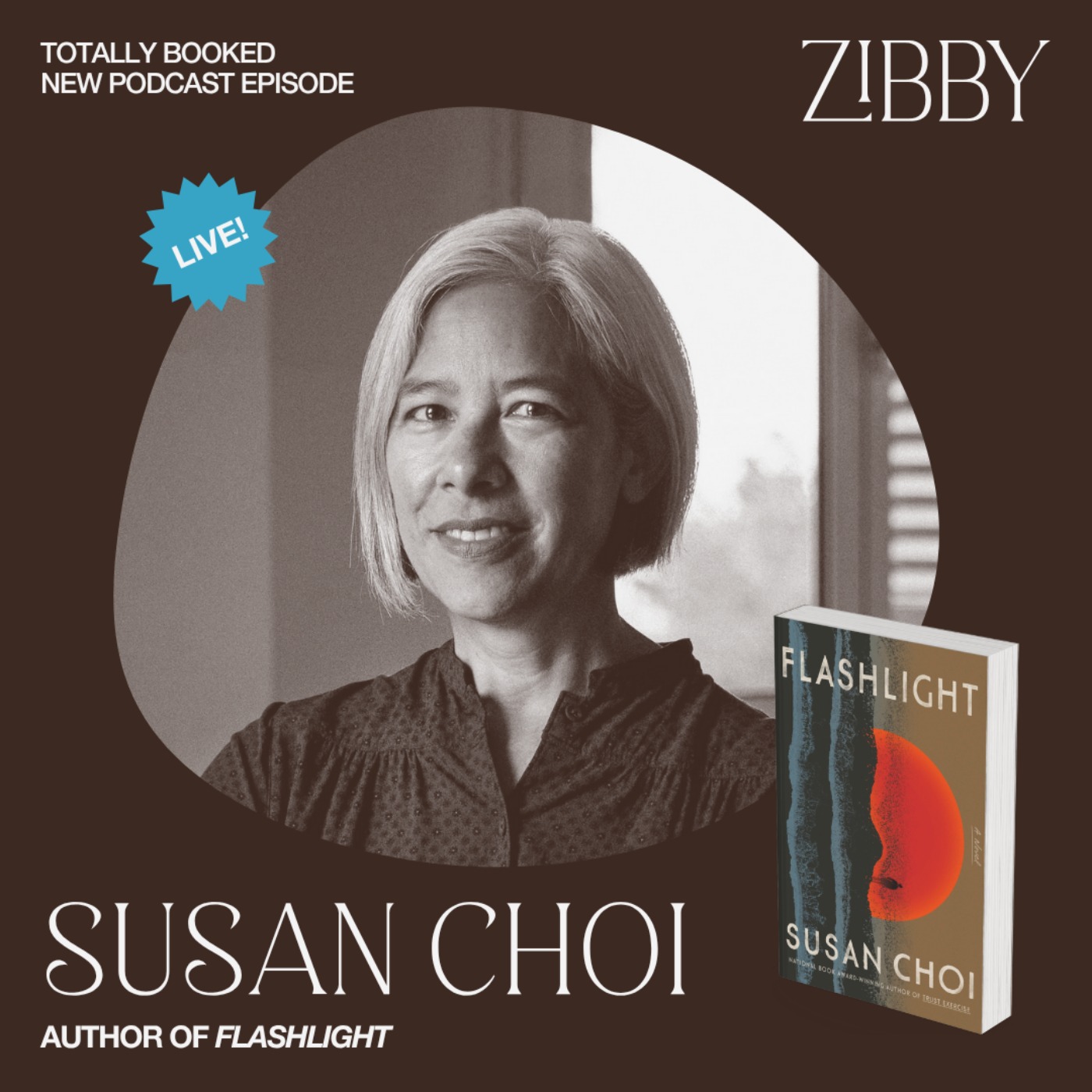
Hi, this is Zibby Owens and you're listening to Totally Booked with Zibby, formerly Moms don't have Time to Read Books in my daily show, I interview today's latest best selling buzziest or underrated authors and story creators whose work I think is worth your time. As a bookstore owner, publisher, author, and obviously podcaster, I get a comprehensive look at everything that's coming out and spend my time curating the best books so you don't have to stay in the know, get insider insights and connect with guests like I do every single day. For more information, go to zibbemedia.com and follow me on Instagram ibeowens Welcome back to Totally Booked. So delighted to have you here and so so excited to be talking about Flashlight, the new book from Susan Choi. Welcome. Thank you for being here.
- [03:54]
Susan Choi
Thank you for having me.
- [03:59]
Zibby Owens
Had a last minute self doubt moment there. I'm going to read you all Susan's bio really quickly and then we'll get into it. Susan is the author of Trust Exercise, which received the National Book Award for Fiction, as well as the novels the Foreign American Woman, A Person of Interest, and My Education. She is a recipient of the Asian American Literary Award for Fiction, the PEN WG Sebald Award, a Lambda Literary Award, the Sunday Times Audible Short Story Award, and fellowships from the National Endowment for the Arts and the Guggenheim Foundation. She teaches in the Writing Seminars at Johns Hopkins University and lives in Brooklyn, New York. Welcome Susan. So Flashlight, we were just talking. We last did an interview during COVID Her book came out in hardcover and in 2019, trust exercise, and we talked about it for the paperback in 2020. And now here after five years is flashlight. So what has happened in between?
- [04:55]
Susan Choi
I know it's like a blink of an eye and also like a thousand years.
- [04:58]
Zibby Owens
Yes.
- [04:58]
Susan Choi
Like was that even this century when we first Talked? That was 2020 when we talked. I think that at that time I was first wrestling with the idea for this book. I had been generating some material, as writers say, that like was shapeless and formless and confused. But by the end of that summer of 2020, I was able to publish a short story called Flashlight, which is actually now the very first pages that you encounter in this novel. It was a short story that was in the New Yorker and it came out of kind of in the course of that year starting to get like a slightly clearer Sense of what the story would be.
- [05:44]
Zibby Owens
And can you share what the story is?
- [05:47]
Susan Choi
Yeah, I don't want to share too much, but the book centers on a small, sad family. It's about.
- [05:58]
Zibby Owens
You're not selling it, you got to start again.
- [06:00]
Susan Choi
Yeah, I know, but I mean, they're kind of riveting people. Louisa is at the center of the story when we first meet her. She's a young girl. She's 10. And in those very early pages, spoiler alert. But this was in the short story. Her father has undergone some serious catastrophe and has just disappeared. He is just gone when we encounter her. She's 10. She and her mother are sort of, like, left reeling by this disappearance. They don't really know what happened. He's presumed to be drowned. And we follow this family of now two as they kind of try to make their way forward when this catastrophe strikes. They're in Japan, but they're Americans. And so they return home and try to put their lives together again. And the short story that I published in 2020 was a real, like, writer's hack, I have to say. I knew the larger world of this story, but I could not quite bring myself to write the eerie and mysterious things. And so I skipped to afterwards. So in the story, you meet her after this bad thing has happened. In the book, you see all the things, all the things that happen.
- [07:10]
Zibby Owens
Do you mind if I just read a paragraph to give them a sense of your. I do not want to give everybody a sense of your writing style, which is absolutely gorgeous.
- [07:18]
Susan Choi
Thank you. And it's a treat for me to hear someone else read my work.
- [07:22]
Zibby Owens
I'll just read this first section to whet people's appetites. Okay. Louisa and her father are making their way down the breakwater, each careful step on the heaved granite blocks one step farther from shore. Her mother is not even on the shore. For example, seated, smiling on the sand, her mother is shut inside the small, almost waterfront house they are renting, most likely in bed. All summer, Louisa has played in the waves by herself because her mother isn't well and her father is unvaryingly dressed in a jacket and slacks. But tonight he has finally agreed to walk the breakwater with her. She has asked every day since they first arrived. Spray from the waves sometimes lands on the rocks. And so he has carefully rolled up the cuffs of his lacks. He still wears his hard, polished shoes. In one hand, he holds a flashlight, which is not necessary. In the other hand, he holds Louise's hand, which is also not necessary. She tolerates this out of kindness. One thing I will always owe your mother is that she taught you to swim because swimming is important to know how to do for your safety. But when she gave you lessons, I thought it was too dangerous. I was very unfair. I hate swimming. They both know the opposite is true. But perhaps her father recognizes her comment for what it partly is a declaration of loyalty to him, as well as for what it mostly is, a declaration by a 10 year old child who is contentious by reflex. Far over the water, far beyond where the breakwater joins with a thin spit of sand, the sunset has lost all its warmth and is only a paleness against the horizon. They'll turn back soon. See, look at that.
- [08:55]
Susan Choi
Can I add something?
- [08:56]
Zibby Owens
And the crowd goes wild. Yes, go ahead.
- [08:59]
Susan Choi
A few paragraphs afterwards, Zibby stopped. Louise's father says something and then the narrative says, these are the last words he ever said to her. Or something to that effect.
- [09:08]
Zibby Owens
Oh, should I have kept going? Do you want me to keep going?
- [09:10]
Susan Choi
No, I think it's sufficient. But they are the last words he speaks to her.
- [09:16]
Zibby Owens
Well, the way that you weave everything together, the trajectory that you take them on and the readers on, and how everything loops throughout their lives and the significance of the flashlight itself and how everybody changes and learns and has to adapt and grow and rebel and grieve and be angry, like all the things are woven throughout the book. There is not an emotion that you do not touch on. Pretty much. Was that intentional?
- [09:46]
Susan Choi
It's so good to hear. I think that the word weave that you used is actually incredibly appropriate because writing this book was so. So it was a journey, I'll tell you. It was really a process. And I did have to do a lot of weaving, so to speak, because I wrote I would just sort of find my way forward with these different characters that these different things had happened to. And then I would find myself at a point where I would think, we don't really know enough about them in this part of their life, or we haven't really seen them being this way, or we don't really understand, like, how these two people are now in a relationship with each other. And so I'd kind of go back and I'd add more and I'd like actually weave it in. The book that you're holding is, you know, the pages are obviously ordered from like number one to whatever the last page is, but they weren't written in that order at all. And this is one of those books where if I thought that I could write it in page order, which I've done with books. I've never been more wrong. This book was written completely out of page order because I kept realizing I needed more of something and then I would weave it in. So thank you for giving me, like, that image. But that's really how it happened.
- [11:01]
Zibby Owens
So it wasn't ever longer and you had to cut it back. This was like the more expanding.
- [11:07]
Susan Choi
Oh, both, both. If you can imagine a situation in which I both had to expand and contract, like, yes, lots was cut out. Lots was added. More cut, more added. It was very.
- [11:20]
Zibby Owens
Well, it wasn't also only about a family. This is about cultures and history, and there's so much more here. How about the research? When did that come into it? Was there research? Did you know a lot of the stuff?
- [11:32]
Susan Choi
Yeah. I mean, again with the weaving. I'm going to stick with your image.
- [11:35]
Zibby Owens
You take it. You take it and run with it.
- [11:37]
Susan Choi
Lots of weaving happened. Or maybe, like, also patchwork. We can have, like, weaving. We can have quilting. I like textile arts. Like, I'm going to use all those metaphors.
- [11:46]
Zibby Owens
I feel the launch party is changing.
- [11:49]
Susan Choi
There's going to be yarn. Yeah. Now, the research was also very, very quilted, I have to say. I started out with a certain amount of research. I would run with the story. I would end up in a place where I'd go, oh, my God, I have no idea what this was like. I'd go do more research. I'd kind of patch it in. I really wanted to, first of all, set this story in Japan. So I kept setting myself challenges that I wasn't totally prepared to deal with. I wanted to set this story in Japan because I spent time in JAP as a little girl, and it made a huge, huge impression on me. But I just did not know that much about the history of the country, so I had to go fill that in. I then wanted my father, character, Louise's dad. I don't know if people could hear this. I hope you can hear this a little in the dialogue, but he's not a native English speaker. He's not American born. He is ethnic Korean, but he was born and raised in Japan. So his Korean parents emigrated to Japan in search of a better life, search of economic opportunity, in search of basically, like a way to put a roof over their heads. And that's all happening early in the 20th century. So their son is born in Japan, but he's an ethnic Korean. And that was a very specific situation which I also really wanted to write about, but again, did not know enough. So I would write and then write myself into a corner where I had just no idea what the facts were. And I would have to kind of put on the brakes and do research and then often go back and rewrite big sections because I would learn things that would make what I had written seem totally off.
- [13:34]
Zibby Owens
Today's episode is sponsored by Quince. As the temperatures start rising, I feel that familiar urge to refresh my closet. But I'm not wasting money on pieces I'll only wear once or for just one season. Quince changes that their clothes are timeless, lightweight, and far more elevated than anything else. At this price, it finally feels like my wardrobe matches my standards. Take their 100% European linen shorts and dresses from $30 Luxe Swimwear, Italian leather platform sandals, and so much more. The best part? Everything with Quince is half the cost of similar brands. By working directly with top artisans and cutting out the middlemen, Quince gives you luxury without the markup. And Quince only works with factories that use safe, ethical and responsible manufacturing practices and premium fabrics and finishes. I use these clothes. I love these clothes. They feel great. They're the best value and I'm obsessed. I just. There's nothing on the website that I don't want. I particularly love the 100% organic cotton gauze smocked maxi skirt which I throw on with a T shirt and the skirt and some sandals and I am good to go for a day of podcasting and mom life. I got it in white, but they also have it in black. Give your summer closet an upgrade with quince. Go to quince.com civi for free shipping on your order and 365 day returns. That's Q U I N C E.com civvie to get free shipping and 365 day returns.
- [15:16]
BetterHelp Ad
Quince.com Zivi BetterHelp Online Therapy bought this 30 second ad to remind you right now, wherever you are, to unclench your jaw, relax your shoulders, take a deep breath in and out. Feels better, right? That's 15 seconds of self care. Imagine what you could do with more. Visit betterhelp.com randompodcast for 10% off your first month of therapy. No pressure, just help. But for now, just. Just relax.
- [16:05]
LinkedIn Ad
Race the rudders. Race the sails. Race the sails.
- [16:09]
Zibby Owens
Captain, an unidentified ship is approaching.
- [16:11]
Susan Choi
Over.
- [16:12]
LinkedIn Ad
Roger, wait. Is that an enterprise sales solution? Reach sales professionals, not professional sailors. With LinkedIn ads, you can target the right people by industry, job title and more. We'll even give you a $100 credit on your next campaign. Get started today at LinkedIn.com results, terms and conditions apply.
- [16:37]
Zibby Owens
Oh, my gosh. And what about how you wrote about it's not always so easy for people to put themselves in the shoes of younger characters and how exactly it feels when you're rebelling and your home life is a mess and this is happening and that's happening and how therapy itself can fail you and all of that and that level of anger, like, what did you tap into to write that?
- [17:00]
Susan Choi
Well, that's a great question, because I think I must have tapped into aspects of myself, although I can't happily. I mean, I'm so happy that these things did not happen to me. You know, my father lived a great long life. These catastrophes are totally fictional, but there must be some source of, like, childhood grief and anger that we all have, regardless of whether our childhood was ideal or really challenging. And I think, think I must have found that, you know, the character of Louisa, I'm really fond of her, but she's difficult. My own mother has just finished reading this book for the second time, which I'm very moved by. But also my mother, after the second read was like, that Louisa, she's obnoxious. And I was like, ow. But I think that. I don't know, I think that I was able to kind of tap into, like, you know, those ordinary woes that we all have, but then try to use my imagination to get a little further in terms of, like, what would it be like if. If your life was like this, if you lost your dad when you were only 10?
- [18:07]
Zibby Owens
Well, there's this whole debate of likable characters versus not likable characters. Obviously. Louisa is also charming and delightful to read, but in. In crafting her. Is that something. How do you feel about likable versus unlikable characters when you read them and when you decide how to make a character seem.
- [18:25]
Susan Choi
Oh, I am so glad you asked. I am really on Team Unlikable Character, I think. I mean, I don't want all characters to be unlikable, and I don't want my characters to be unlikable. I just don't want them to be, like, saintly or perfect. Why would we want to read about someone who's just completely flawless? Or at least personally as a reader, I love when characters are really flawed because hopefully in the story they grow and change and often become better people. And that's so much more meaningful if you can see them in their imperfection first of all. So that's my hope for Louisa. You'll all get to judge and decide. But I really wanted Louisa, in the course of this book to grow and get outside of herself. For that to be meaningful, she has to be kind of a tough one at the outset.
- [19:17]
Zibby Owens
Wow. And there's so much in the book that if I were to discuss would be a reveal because things keep twisting and turning. So I'll leave some of the plot heavy stuff out, but want to talk to you more about how you even got to the point where you could write a big sort of masterpiece, like novel at this stage of your life. Like, did you like to write as a kid? What were you like when you were Luisa's age and when you were 10 and all of that? And how did you get to here?
- [19:43]
Susan Choi
That's such an interesting question, especially bringing Louisa into it, because I did draw on myself for Louise. I was surprised when my mother pronounced her obnoxious. I was like, you know, I'm thinking of certain ways that I was. And of course, being my mom, she was like, you weren't like that at all. Which is sweet. But I. You know, that's what moms are for. I feel like I had a little bit of Louisianess when I was a kid. I was one of those kids who did not want to ever go outside. I had my nose in a book all the time. I was definitely chosen last for dodgeball, always. I was not athletic. I finally joined a soccer team when I was probably in my early adolescence and was one of the many, many, many, many defenders. Because you just sort of run around in the back of everybody else. It's like, you're never gonna.
- [20:39]
Zibby Owens
I played defense and thought that was such an important.
- [20:42]
Susan Choi
Some of the defenders were really important.
- [20:43]
Zibby Owens
It's fun.
- [20:44]
Susan Choi
You were probably an important defender.
- [20:46]
Zibby Owens
I was not.
- [20:46]
Susan Choi
Did you ever notice that there were a lot of extra defenders, though, just kind of running up and down? I was one of the extras.
- [20:53]
Zibby Owens
I'm now going down, like, a very dark path on my whole childhood athletic career. But that's okay. Go ahead.
- [21:00]
Susan Choi
Oh, my gosh. People will be like, how did the interview go? And I'll say, well, I just had caused Zibby to totally question everything about her childhood.
- [21:07]
Zibby Owens
When we left, she was out there with cleats on and, you know, look, cleats on. Strapping on shin guards and getting back into it.
- [21:14]
Susan Choi
Pretty butch. Like, I. I felt good as a soccer player, but. But having perspective. I was not, you know, I was. I was not the most graceful child. And I think that I definitely went through, like, a big, ugly duckling to. I wouldn't say swan exactly, but like, at least to get. Getting the braces off and getting contact lenses. Like, I went through that. So I think that I spent a lot of time as a kid reading and writing little stories and sort of in my own world and banding together with other awesome nerd girls where we would, you know, play Charlie's Angels and, you know, leave reality behind. And I think that it's funny, I loved writing really early and I wrote really early. Like I wrote weird stories. I didn't even know what I was doing. But I. Because I liked books so much, I would, like, make little books. And then I lost that in high school and college. I think I became very self conscious about what do we do with our lives? What's my path? And it didn't occur to me that this could be a path, like, lucky me. But at that time I thought, oh, I have to, I don't know, do something professional. It didn't occur to me that I could do this professionally. So there was a big gap. And it wasn't until I left college, kind of in a state of total confusion, that I went back to writing and really started thinking about whether it could be the thing, you know, not just a thing I'd always enjoyed or a thing I could do on the side, but like, could it actually be the thing that I would do?
- [22:47]
Zibby Owens
And then what happened?
- [22:49]
Susan Choi
Then I did what everyone with a dream does. I went to graduate school. I went to graduate school and realized that it was going to take a lot to really make it as a writer. And I did not really show much evidence of having that in graduate school. I wrote a lot of things that never got finished. I wrote many, many more things that thankfully never got published. And it wasn't again until I left grad school that it was like an. It was like Getting Serious Part two, where I realized that I didn't just have to go to grad school, but I had to actually figure out how to do it on my own. Like, how do you get a job in New York and actually earn enough money to pay your rent and go home every night and try to like, write? So that was hard, but it was also a great time of life. I'm really nostalgic for it.
- [23:46]
Zibby Owens
And how did you achieve your first big, so professional success?
- [23:51]
Susan Choi
With a lot of help, honestly. I was working as a fact checker at the New Yorker magazine, which is like the. Just the best job ever. I was so lucky to have gotten that job. I had gone to the New Yorker, wanted to Wanting to work in the fiction department because I wanted to be a fiction writer. And that seemed logical. I was like, I've. I obviously, like, that's a first step. This was, you know, grad school was in the past, and I got an interview, and I went in to meet the fiction editor and was wearing whatever my impressive outfit was, I think. Does anybody remember Country Road?
- [24:26]
Zibby Owens
Yes.
- [24:27]
Susan Choi
Do some. Some people remember it? Okay, that. That really dates us. So Country Road was like, my first, like, office wear or, like, nice clothing. So I was wearing my Country Road, Country Road outfit. They've gone out of business, sadly, but I didn't get hired. And I was, like, devastated. I sort of thought, well, that's it for me as a fiction writer. If I can't get a job in the fiction department of the New Yorker, I guess I can't be a fiction writer. I was not connecting the dots accurately. Like, that was the way to become a fiction editor. I was trying to become a fiction writer. And a friend of mine said, you know, why don't you try for a different department if you were a fact checker? Like, that wouldn't interfere as much with your fiction writing. Which had not occurred to me that working in the fiction department would interfere because you're putting all of your effort into sort of editorial support for other writers. So I went and got a job in the fact checking department and started working on my book nights and weekends. And by the time I had a manuscript, I also had, like, amazing people at the New Yorker who. I mean, how many times did they hear this? Every day down the halls of the New Yorker. So I just wrote my first novel. You know, I'm sure, like, every day, five people said that. But no one ever lost patience. And when it was my turn to say it, there were people there who said, you know, I think you should try sending it here, try sending it there, try sending it to this person. And eventually, after doing a lot of that, I found an agent, you know, and that person helped me get published. It is amazing, actually. I was really lucky. I was lucky to be here in New York.
- [25:59]
Zibby Owens
I worked. I wanted to be a writer. And so I got a summer internship at Vanity Fair, thinking the same thing. Like, I'll start at a magazine and work my way up. And after, like, a day, I was like, oh, no, no, no. There is, like, literally no path here. Like, I was filing the contracts of all the big deal authors and all the slots, and I was, like, alone in this room, like, pushing the file cabinets in and thinking, I'm not going to get a contract by working here.
- [26:22]
Susan Choi
By working contracts, filing other people's contracts. Yeah, but it's. I completely relate to. Obviously, we made the same misjudgment because it's hard to figure out how publishing.
- [26:32]
Zibby Owens
Although I have yet to get a contract with Vanity Fair, so maybe, maybe plan B was also bad.
- [26:38]
Susan Choi
But anyway, I think Plan B is.
- [26:41]
Zibby Owens
Well, there is no great path to being a writer is really the thing. There is no.
- [26:45]
Susan Choi
I think the truth is there is no. I mean, that was a great path that I ended up stumbling down, but it was so much like luck, really. I was really, really lucky. I didn't really come to New York thinking I have to be here to become a writer. I came because I dropped out of grad school. School and New York was like, you know, at the other end of the bus ride that I'd already been taking every weekend because I was so miserable in grad school that I was constantly leaving to go to New York. So I ended up here, not understanding. I mean, great writers can become great writers from anywhere. But there really is, it has to be acknowledged, a complicated, powerful thing to like being in this city full of people who are really interested in. In writing, in publishing, who are constantly, like, frothing around, you know, talking to each other. It definitely helped me.
- [27:36]
Zibby Owens
So a flashlight, obviously, is something that sheds light on something that was there all along but that you couldn't see without it. What do you think this book does? In the same way, what does it shed light on?
- [27:46]
Susan Choi
I mean, it shed light on what it was about, for me, to be totally honest. Like, that flashlight that appears in the very early pages that Louisa's dad is carrying it because he's very, very cautious. And Louisa is sort of scornful. Like, you read that. She's like, ugh, we don't need a flashlight. Like how, you know, how babyish. I think often I end up writing scenes that I don't fully understand. I mean, there's some. There's definitely some mysterious quality here where. And I write a lot of stuff that you never see that never works. It's just bad. The stuff that I write that for some reason it does work often has these qualities that I didn't plan and, like, the flashlight was definitely one of those things. I didn't premeditate that and think like, oh, it'll be symbolic, or, oh, it's going to tell readers about these two characters, about this man who loves his daughter more than anything on earth, but has had to keep a bunch of Secrets. And so that idea of, like, concealing things, revealing things, being cautious, like, all of the layers of that character, I didn't even know them yet when I wrote that scene. But I think the flashlight was something that. I don't know. I often with my students refer to, like, our writing brain. My writing brain knew something about that flashlight before I did. And later, as I was muddling my way through this book, like, I would experience flashes of understanding, you know, where, like, I would look back at a scene and go, oh, this is about this. That's why this scene works and should stay in the book. And this other scene isn't telling me anything and doesn't need to be here.
- [29:24]
Zibby Owens
Well, I do feel there is a message to this book, too, that in a way, love, not love conquers all. That sounds like cliche, but that you can never. The things that matter most to you, you just never give up. And usually that is someone or something you love. And no matter what gets in the way, you can find a way back.
- [29:44]
Susan Choi
Yeah, I mean, I, you know, said earlier that, lucky me, the catastrophe that befalls Louisa did not befall me. But one of the ways that I feel like I was able to write about it is this book, like, does have a lot of my feeling for my own dad in it. You know, like, I'm so lucky. I lost my dad finally a few years ago. He lived to be 91. He was the most amazing person. And I think that, you know, it was an act of imagination and also kind of, like, staving off fears to, like, think about, well, what would it have been like if he and I had been torn apart by these forces? And so I think that helped me write it, even though, you know, it was all imagination.
- [30:30]
Zibby Owens
Thankfully, sometimes we write into our fear, right? What's the worst thing that can happen?
- [30:35]
Susan Choi
What's the worst thing that can happen? I'm like, how would I respond? Not gracefully.
- [30:38]
Zibby Owens
No. Do you have any advice for aspiring authors?
- [30:43]
Susan Choi
Oh, so much advice. Boy, I have so much advice that I never take, but I always dole it out because it's so good. My greatest advice, which I have been given multiple times, is if you really want to be a writer, write every day. Write every day. It does not matter what it is. It can be an entry in a journal. It can just be disconnected observations. You know, you don't have to be sitting down working on your novel or even working on a story, an essay, anything like that. Just write. Like, sit down and put your thoughts into sentences and see where that leads I tell my students this every single semester when I get a new batch of students. And every once in a while a student will say, do you write every day? And then the excuses start.
- [31:36]
Zibby Owens
No, because I'm teaching this class.
- [31:37]
Susan Choi
No. Yeah, because I'm giving all my time to you young people. But it really does make such a difference when I manage to do that in my own writing life. That's when it happens.
- [31:49]
Zibby Owens
Susan, thank you so much. I'm so excited for you.
- [31:51]
Susan Choi
Thank you.
- [31:52]
Zibby Owens
Thank you for listening to Totally Booked with Zibi formerly Moms don't have Time to Read Books. If you loved the show, tell a friend, leave a review, follow me on Instagram, ibbeowens and Spread the word. Thanks so much. Oh, and buy the books.
- [32:14]
Hannah Berner
Hi guys, it's Hannah from Giggly Squad. With Summer around the corner, I wanted to tell you guys how I'm staying comfy and stylish. Lululemon is my secret weapon. There are plenty of copycats out there, but nothing compares to the Lululemon fabrics and fit. I've literally had my pair of Lululemon leggings since college and I'm out of college. I know I don't look it, but I am. The quality is next level. I especially love the Lululemon Align collection. It's made with this weightless, buttery, soft nulu fabric that feels like next to nothing. It's so soft. Whether you're in Align pants, shorts, a bra, tank, skirt, a dress, you get non stop flexibility in every direction so you can stretch the summer limits. Align even wicks sweat and as a sweaty girl, I love this. You know it's going to be my best friend when I play tennis this summer. Shop the Align collection online@lululemon.com or your nearest Lululemon store.
- [33:10]
Susan Choi
If you're anything like us, you love attention. And my favorite way to get all eyes on me is with Next level shiny glossy hair.
- [33:17]
Hannah Berner
Which is why we're so excited to tell y' all about the new Lamellar Gloss collection from the girlies at Tresemme and Gigglers.
- [33:24]
Susan Choi
We've got you too, because Tresemme partnered with us to bring you 1-800-gloss, a special bonus episode of Giggly Squad, where Hannah and I give advice on all things hair and giving gloss. Check out the episode and grab the Lamellar Gloss Collection today because I'm officially declaring this spring gloss season.
- [33:42]
Zibby Owens
1-800-Flowers.Com knows that a gift is never just a gift. A gift is an expression of everything you feel and helps build more meaningful relationships. 1 800-Flowers takes the pressure off by helping you navigate life's important moments by making it simple to find the perfect gift. From flowers and cookies to cake and chocolate, 1-800-flowers helps guide you in finding the right gift to say how you feel. To learn more, visit 1-800flowers.com acast that's 1-800-flowers.com acastra.