Loading summary
Transcript55 lines
- [00:00]
Thrive Market
Worried about what ingredients are hiding in your groceries? Let us take the guesswork out. We're Thrive Market the online grocery store with the highest quality standards in the industry. We restrict 1000 plus ingredients so you can trust that you'll only find the best high quality, organic and sustainable brands all free of the junk. With savings up to 30% off and fast carbon neutral shipping. You get top trusted groceries at your door and you can stop worrying about what your kids get their hands on. Start shopping@thrivemarket.com podcast for 30% off your first order and a free gift.
- [00:30]
Sarah Gibson Tuttle
Raise your hand if you want your nails to look perfect all the time. Me too. I'm Sarah Gibson Tuttle from Olive and June and this is exactly why we created the Mani system. We wanted to make it possible for everyone everywhere to give themselves a beautiful manicure at home with our tools and our long lasting polish. Each manicure with our Mani system comes out to just $2. That's right, $2. No more. 30, 40$50 manis that you get at a salon and they take hours. Now you can paint your nails on your time and love them more than ever. And by the way, when people ask who did your nails? Where did you get them done? You're gonna proudly say I did them myself. Get 20% off your first mani system with code perfectmanny20@oliveandjeune.com perfectmanny20 that's code perfectmanny20 for 20% off@oliveandjune.com perfectmanny20.
- [01:28]
Jenna Bush Hager
Hey everyone, I'm Jenna Bush Hager from the Today show and I'm excited to share my podcast Open Book with Jenna. It is back for season two. Each week, celebrities, experts, friends and authors will share candid stories with me about their lives and new projects. Guests like Rebecca Yarros, Kristin Hannah, Ego Wodom, and more. Like a good book, you'll leave feeling inspired and entertained. Join me for my podcast Open Book with Jenna. To start listening, just search Open Book with Jenna wherever you get your podcast.
- [02:04]
Zibby Owens
Welcome Debbie. Thank you so much for coming to the first ever live podcast. We're totally booked with Zivi. So glad you're here.
- [02:12]
Debbie Millman
Thank you, Zivi. It's an honor. Thank you. Yay.
- [02:15]
Zibby Owens
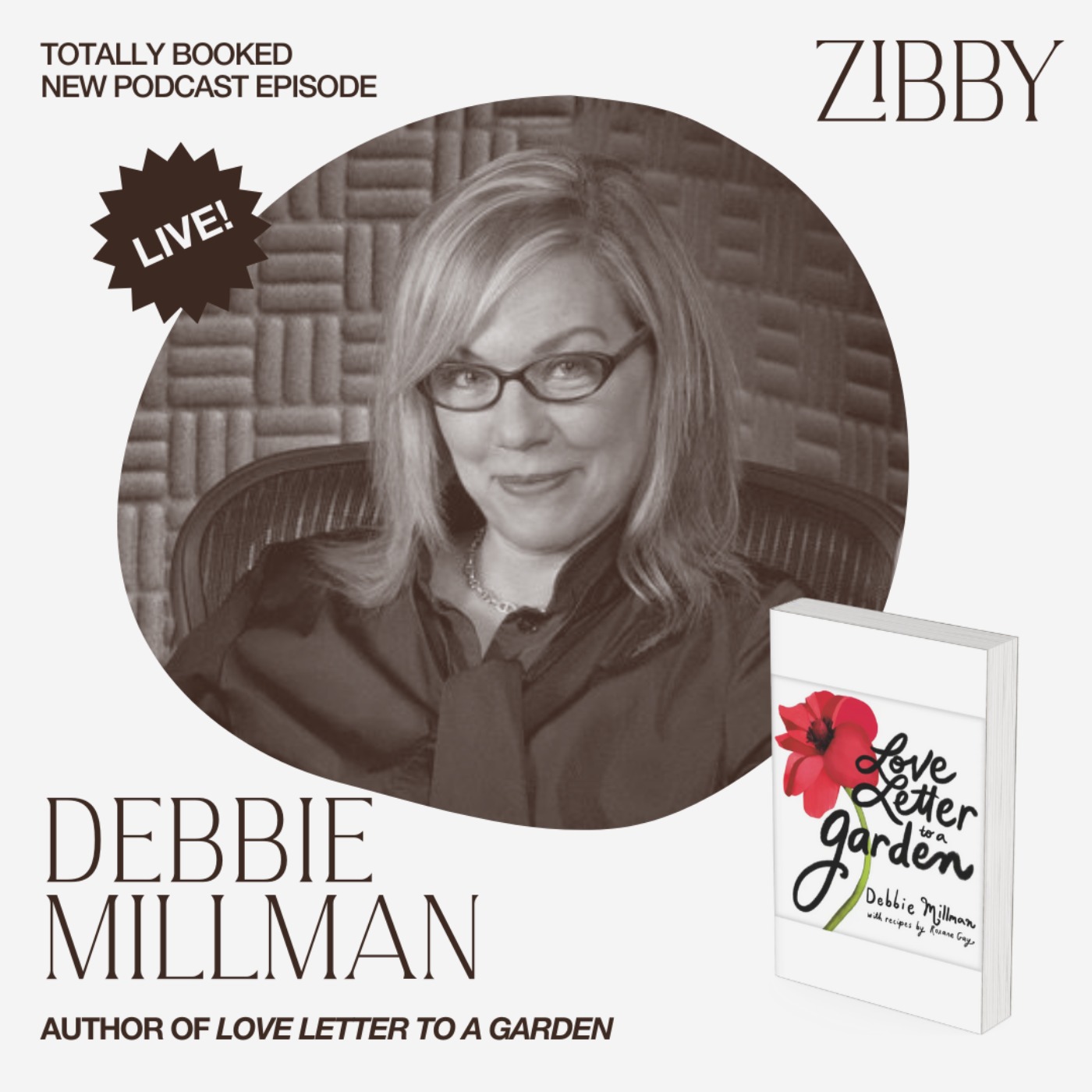
I'm gonna read your bio really quickly for people who are in the audience and listening or watching wherever they may be. So this is Debbie's amazing new book. How cute is this? It's so beautiful. It's called Love Letter to a Garden by Debbie Millman with recipes by Roxane Gay, who's her wife, if you didn't know that. Okay, ready? Debbie Millman Named one of the most creative people in the business by Fast Company, one of the most influential designers working today by Graphic Design usa, and a woman of influence by Success Magazine. Debbie Millman is also the founder of the Masters in Branding program at the School of Visual Arts, partner and editorial director of PrintMag.com, and host of the award winning podcast Design Matters, one of the first and longest running podcasts in the world. No pressure. She is the author of seven books and her writing and artwork have appeared in publications including the New York Times, New York Magazine, the Washington Post, the Philadelphia Inquirer, and many more. And it is illustrated by Roxane Gay. And this is the book. Congratulations.
- [03:21]
Debbie Millman
Thank you, thank you.
- [03:23]
Zibby Owens
Tell everybody all about this little gem. How did this come to be? What is it about? Why are we talking about it?
- [03:30]
Debbie Millman
Well, it's about my quest to become a gardener, and I wrote and illustrated the entire book. It came to be. I got completely out of the blue an email from an editor at Hachette Publications, Hachette Press, one of the big four. And it was from a woman who runs Timber Press, and it's their gardening imprint. And apparently she had seen two things that I had done before during COVID I had created some interstitials for the TED conference back when it went completely online so that they'd have some content in between the talks. And so I made three visual stories that I narrated, so it brought them to life with narration. One on storytelling. So it's called Love Letter to Storytelling, one to traveling, because none of us were traveling. So Love Letter to Travel. And then I made one on gardening. Love Letter to Gardening. Because I had so much free time, I decided to try my hand at making a real vegetable garden. And I had attempted over a good part of my life to have a little garden space of my own in various places that I'd lived in Manhattan. Manhattan isn't particularly conducive to a garden, especially if, like me, you lived in a shady apartment with very little sunlight. And so all of my previous attempts had pretty much failed. But at this point during COVID I went to stay with Roxanne, who I was engaged to at that point, but not married to. We had never lived together, and at that point in our relationship, we had just started to think about actually going back and forth from LA to New York, where she lived more collectively together as opposed to I go there for a weekend, she comes to New York for a Weekend and so forth. At the time, we didn't think Covid was gonna go on for as long as it did. I don't know if anybody remembers, but the president at that time was saying, oh, we'll be back outside by Easter. And this was first in March.
- [05:48]
Zibby Owens
I love in the book that you said you packed underwear for two weeks and then you're like, I needed a lot more underwear.
- [05:53]
Debbie Millman
Roxanne was like, pack for two weeks. That's what we thought. And I did. And then of course, I needed to go to Target and buy a lot, you know, masked and remember we were wearing gloves and go and get the underwear, leave it in the garage for two days to, you know, decontaminate and then wash it all and, you know, whatever. So I had a lot of time and we had a lot of sun. And because I had been attempting over the years, I tried again, but this time I had a lot better results and started drawing about it. I made these visual stories about what I was doing on Instagram. And so the editor at Timber had seen my interstitials for the TED conference, the Instagram stories that I was making about my efforts, and a piece that I had done in a far magazine. I had illustrated a piece about an expedition that I had gone on with roxanne for my 60th birthday to try and see an eclipse on Antarctica. That was my gift to myself. And unfortunately, we didn't get to see the eclipse because of cloud cover. My mother in law was like, do you get your money back?
- [07:08]
Zibby Owens
Best laid plans.
- [07:09]
Debbie Millman
She was really insistent that we try to get our money back because we didn't get to see the eclipse. I'm like, mom, it doesn't work that way. But in any case, I wrote about it. It was still a glorious experience. Going to Antarctica is one of the most extraordinary places on the planet. It's pure. And so she had seen these two or really these three different avenues of my work and reached out and asked me if I'd be interested in writing a book about gardening. And I actually thought it was a prank. First of all, I didn't know the press. Second of all, I was like, somebody wants me to write a book about gardening. I have the opposite of a green thumb. I'm a plant killer. Although I did have some success with the latest effort. I couldn't imagine that, you know, she foresaw me having a sort of gardening platform a la Martha. And so I said any gardener would laugh and roll their eyes at my giving them any kind of advice. And I Said, instead, how about my quest? A quest to try and become something that you're not. And she said, yes. And that's how the book happened.
- [08:13]
Zibby Owens
Well, your book is really not about gardening only. Your book is about life. Your book is about finding meaning, overcoming challenges, learning something new, making the most of the time here, our place in the universe. I mean, you pack a lot into a few beautiful pages, but it's enough to make a reader laugh, cry. You have a scene where you took care of your neighbor is one of the many teachers that you have in the book who taught you how to garden. And it was just on her tiny little balcony. She had some rhododendrons. And then when your neighbor passes away, you inherit the rhododendrons and then plant them in your own yard. And then you said, but they're still blooming. I mean, it's just so poignant.
- [08:55]
Debbie Millman
Thank you. That means a lot to me. I have a very complicated relationship with my biological family and the immediate one. And Maria became my sort of chosen family. She lived two doors down, and I'd seen her for years on my block. She was one of those women that she was elderly, but was very sort of confident and would walk down the street in, like, little shorts and a tube top and a cigarette. And I just found her to be the most fascinating person. She seemed to just ooze self confidence. And I would always sort of wave or say hi, because I saw her a lot on the street. But she never ever paid any attention to me until I got a dog. And then when I got Scruffy, she suddenly recognized me and was like, oh, look at this little dog. Greek. Really wonderful woman. And then she started helping me take care of Scruffy because she walked dogs for a living. And we became very, very close for almost two decades. And she taught me a lot about container gardening in New York City, which is really challenging. And unfortunately, she developed cancer and lost her battle to this terrible disease. And I was very lucky to know her and to have her in my life. And when she passed, I was one of the people that helped sort of organize her things. And I ended up bringing her ashes to Greece for her daughter. But I did get the rhododendron. And this is the time of year when it starts to bloom, and it's blooming. And, you know, the interesting thing about it is that I've taken pictures of it over the years, because one of the other women that was also very close to her was somebody that Maria actually nannied over the years. But, you know, now she's married and in her, probably close to 30 at this point. And every year I send her pictures of the rhododendron. So I have this sort of record of how it's grown, which is remarkable. And nothing that I ever anticipated that would end up in a book, because I wasn't taking the photos for that reason. And in fact, most of the photos in the book, which I then drew, and I used them as reference and made paintings, watercolors, collages, was all because I was documenting things mostly for evidence that I had either been someplace or asking my cousin Eileen, who's a really avid gardener, you know, what's this mold? What's this fungus? What's this bug? Why is this getting this spot on it? And so I would send those pictures to her and she would give me advice. And all of that ended up in the book. Even the dead corn. I tried to plant corn. It worked for a while until it didn't, and then it all died. But I took pictures of the dying corn to try to get some help in trying to keep it alive, which was unsuccessful, by the way.
- [11:54]
Zibby Owens
I read and showed this to my son last night, who's 10, and I was showing him all the pictures. He found the corn part the funniest.
- [12:00]
Debbie Millman
Yeah.
- [12:01]
Zibby Owens
But at the end we put it down and he was like, I really liked that book. It was really sweet. So this has a very wide audience because all of it is quite universal. You talked about your somewhat difficult childhood, which anyone who has done a deep dive into you or followed you for a long time knows you've spoken very openly about it. Would you mind sharing a little more about that?
- [12:23]
Debbie Millman
Yeah, absolutely. Well, I'm a native New Yorker. I was born.
- [12:26]
Zibby Owens
That is not the bad part.
- [12:27]
Debbie Millman
No, no, it's not. It's not. I was born in Brooklyn and then moved to Howard Beach, Queens. So I've lived in all the boroughs except the Bronx at this point. And then we moved to Staten island, and my parents at that point divorced. And that was difficult. And I think it's difficult for any, you know, 8 year old to go through, especially in the 70s when divorce was much more stigmatized. And then my mother very quickly got remarried to somebody who ended up being really, really, really abusive to me and to my brother and to his own biological daughters. But I was the oldest, so I got it first. And he was sexually abusive, physically abusive, beat us and really tortured us a lot. And so that was four years. I call those the dark years. And that was from like 9 to 13. And then, you know, trying to overcome that. You know, initially, I think a lot of people that go through that kind of situation try very quickly to rise above it. Like, that's not gonna kill me. And if you don't deal with it, it will. And so I very quickly had to figure out how to make a life for myself that wasn't only about keeping myself safe. And how do I, how do I live more openly? How do I live able to still love and trust. And that took a very long time.
- [13:58]
BetterHelp
BetterHelp Online Therapy bought this 30 second ad to remind you right now, wherever you are, to unclench your jaw, relax your shoulders, take a deep breath. Breath in and out feels better, right? That's 15 seconds of self care. Imagine what you could do with more. Visit betterhelp.com randompodcast for 10% off your first month of therapy. No pressure, just help. But for now, just relax.
- [14:39]
Sarah Gibson Tuttle
Raise your hand if you want your nails to look perfect all the time. Me too. I'm Sarah Gibson Tuttle from Olive and June. And this is exactly why we created the Mani system. We wanted to make it possible for everyone everywhere to give themselves a beautiful manicure at home with our tools and our long lasting polish. Each manicure with our mani system comes out to just $2. That's right, $2. No more. 30, 40, $50 manis that you get at a salon and they take hours. Now you can paint your nails on your time and love them more than ever. And by the way, when people ask who did your nails? Where did you get them done? You're gonna proudly say, I did them myself. Get 20% off your first mani system with code perfectmani20@oliveandjeune.com perfectmanny20 that's code perfectmanny20 for 20% off at oliveandjeune.com perfectmanNY20.
- [15:35]
Thrive Market
Worried about what ingredients are hiding in your groceries? Let us take the guesswork out. We're Thrive Market, the online grocery store with the highest quality standards in the industry. We restrict 1000 plus ingredients so you can trust that you'll only find the best high quality organic and sustainable brands. All free of the junk, with savings up to 30% off and fast carbon neutral shipping. You get top trusted groceries at your door and you can stop worrying about what your kids get their hands on. Start shopping@thrivemarket.com podcast for 30% off your first order and a free free gift.
- [16:07]
Zibby Owens
And how did you do that?
- [16:09]
Debbie Millman
Therapy. A lot of therapy. Lot of therapy. And then just Continuing to make mistakes, continuing to be destructive, self destructive, and then trying to repair that and then just trying to figure. I mean, it didn't come out until I was 50, mostly because I was afraid of. I had a lot of my own inner homophobia. I was afraid of being judged. I had actually created some success in my life in branding and was running a big agency and at the time was really worried that, like, my clients would reject me. Some of my conservative clients, I was worried, would be just really dismissive of this choice that I'd made in my life. And that didn't happen. It never happened, actually. But I always. For a long time, I came and I write in the book that I had had and really struggled with a sense of the scarcity of my life. That I was always afraid that I didn't have enough, that if I didn't say yes to this thing, I would never have another chance again. This was my last chance for love, my last chance for a book, my last chance for success, my last chance for friendship. And would always get really sort of rigid about being open to sharing or trusting. And over the years, and in some ways through gardening, realized that if I had this stance of there being so much scarcity in the world for myself, there would be. I took a class with Milton Glaser several years ago, many years ago, and he talked about this, his own life, that if you see the world with eyes of. Seeing the world with scarcity through eyes of scarcity, it will be. But if you see your life as one that has the potential for abundance, then you can be more open to sharing. And if you're more open to sharing, you'll get that back. And so that mindset has helped quite a lot. I still struggle with feeling like my last chance for anything, especially since most of my successes come later in life. But I now feel that. And maybe it's rationalization, but I do feel like the longer it takes, the longer it lasts.
- [18:29]
Zibby Owens
Well, this is not the last chance that you have for this show. You can come on as much as you want. I'll just be zippy.
- [18:35]
Debbie Millman
Thank you.
- [18:35]
Zibby Owens
No, I'm joking. But I'm so sorry for everything that you've had to go through. But also just so inspired by your ability to plow through. I mean, in effect, this book is so similar to your emotional journey, so to speak.
- [18:49]
Debbie Millman
Yeah, no getting through. I would agree with that. You know, one other thing that I think has really helped, and if this helps anybody else, I will feel very grateful. But I have been working for the last 10 years with a woman named Mariska Hargitay. She's the star of Law and svu. Longtime star. The show is the longest running drama on television. And I got an opportunity more than 10 years ago to work with one of my clients who had joined a consortium of organizations and corporations. She worked at Kimberly Clark. A woman named Christine Mao, she worked at Kimberly Clark. And she had joined forces with Verizon and Avon and a number of other Viacom to create an organization called no More. And that was about eradicating sexual violence in our culture. And she asked me if I wanted to work on the identity and the positioning. She knew my history and I jumped at the chance, volunteered our agency. We did all the strategy, all the positioning, all the creative work, the identity and advertising and so forth. And through that experience, because Mariska's foundation, the Joyful Heart foundation, was also part of this. I got involved with Joyful Heart. After I finished my work with no More, Mariska asked me if I'd be interested in joining the board at Joyful Heart. And that happened about 10 years ago. And so we've been working ever since to eradicate child abuse, sexual assault, domestic violence, and to eradicate the rape kit backlog, which has been really an epidemic in our country for decades. And now we're also working on combating image based abuse because of how much unsolicited, unwanted photographs and also a lot of deep fakes that are going up without a consent from whoever's being abused in this way. And so the work that we're doing is ongoing. And I had, before I had disclosed, that's what we call it when you share your history. I had been interviewed on the website and when I became a board member and it was like, why are you doing this work? And because I was doing so much of the branding work with my history and branding, I wrote that it made me feel like my life made sense, having this sort of symmetry to what I had been through and now what I was doing and trying to combat for others. And I was interviewed on the Tim Ferriss show. And in his research he came upon that interview. And I had never really been public with my history. And Tim on the air asked me what that meant. What does it mean that it's making you feel like your life makes sense? And so there I was, like a deer in the headlights. Do I sort of say something silly and kind of push it away or do I share really why? And in that moment I jumped in and and said it and it was really like, scary for me. But that experience showed me again, holding it all tight was not helping me. And no one was going to judge me for this except me. And so letting go of that judgment, I'm damaged. I'm not as good as I'm. Nothing helped me overcome that in a really, really profound way. And this book is a journey. This experience of my life has been a journey, and it's all been about growth and recovery. And I think that is a lot of what I've shared in this book through the lens of what it means to be reborn through gardening and how sort of nature is constantly being reborn. And even when it doesn't get reborn, it creates other opportunities for other self, sowing and propagating and continuing on.
- [23:07]
Zibby Owens
The one image that repeats through the book is the sense of time. You have a clock that is sort of ticking our way through the book until the end, the sense of our time here. And then you say, like, but we are here. Like, we are here right now.
- [23:21]
Debbie Millman
Yeah.
- [23:21]
Zibby Owens
What do you want people to know about that? Like, how do you. Are you trying to wake people up and just say, enjoy it?
- [23:27]
Debbie Millman
I don't know if I'm trying to wake people up. Maybe I'm trying to wake myself up. You know, I'm endlessly fascinated by astrophysics. In another life, I would have been a scientist. But you can't really be a scientist unless you have just a modicum of understanding of mathematics and science in which I have zero. Zero. And so I think about it a lot, and I read about it a lot, but I just don't have the capacity to really understand any of it. But I think about it all the time. And we're here for such a short time. And as I'm getting older, I'm much, much more conscious of time. When I was younger, I didn't even think about it. I think I just assumed that we were all infinite and we would all be immortal in some ways. I never really thought about not being here. But once you get into your 60s, you start to think, well, if not now, when do I start to do the things that I really want to do, but maybe I'm afraid to do? When do I learn that second language? Because I've been saying for my whole life, how could I only know one language? When do I start playing the piano? Because I've wanted my whole life to be able to play. When do I start? When do I start? And so the idea of. Of this running clock is about how we are part of time. We move with time. And that we can do. We can try whatever we really want to try, if we want to try it. And maybe we don't want to if we don't do it. Or maybe we're too afraid to do it if we don't do it. And so my life has been this sort of. I don't want to say battle, but this sort of endless struggle between wanting to do things and being afraid of doing them, and then doing them and then wanting to do something and being afraid of it and then tentatively doing it. So it's been this sort of circuitous journey through time, which I try to express with the illustrations.
- [25:35]
Zibby Owens
And speaking of time, you've been doing your show, Design matters for 20 years.
- [25:40]
Debbie Millman
Yes.
- [25:40]
Zibby Owens
You have this giant celebration with all the people. It's so exciting. Tell me what you've learned from that show. You've talked to so many people.
- [25:50]
Debbie Millman
The show started as a sort of inside baseball show about design. I was talking designers, talking about design, graphic design. Big audience turns out.
- [26:01]
Zibby Owens
Yes.
- [26:01]
Debbie Millman
Who knew? Well, it has evolved over the years to a show about how the most creative people in the world design the arc of their lives. How do they make their lives again, sort of fascinated by how does one construct their own narrative arc? How do you create a life of meaning? And I've gotten very lucky because it's been 20 years and sort of momentum builds and you get to interview this person, who then introduce you to this person and becomes this wonderful connective tissue. I have gotten to interview now over 700 of the most creative people in the world, and it's expanded from design to performers, musicians, writers, playwrights, directors, MacArthur winners, Oscar winners, Emmy winners, Grammy winners. And what I've learned is that really the most creative people in the world are. Are always striving to make more things and also have some of the same struggles worrying that their best work might be behind them or worrying that this work might not be as good as that work, or wondering if they can make something again with meaning. And actually, the only two people of all the 700 people I've interviewed that ever were like, I'm good as is. Why worry? Were two white cishet men in their 80s. That's it. Two Massimo Vignelli and Milton Glaser. And they were like, they had no more Fs to give and were really happy with who they'd been and become.
- [27:47]
Zibby Owens
Do you feel like you're happy with who you've become or are you ready to build more things?
- [27:51]
Debbie Millman
I'm always ready to build more things. I mean, I am grateful and I am, I feel very, very, very lucky. But I don't feel like I've peaked yet and I don't want to peak yet. I still have hopefully a couple more decades to do what I do and try to get better at it and try to make more things. One thing I have noticed, another thing I don't know that people are searching for more success as much as they're seeking for more opportunities to make things. And so yes, I'm thrilled that this book is out, but I had the time of my life making it and it made me realize that I am happiest when I'm in the process of making and that's, I think, something that I want to hold onto.
- [28:50]
Zibby Owens
That's amazing. Debbie, thank you so much for coming on the show. Love Letters to a Garden. You think it's just a little book about gardening? It is so much more and it is so beautiful and we are so honored to have had you here. Thank you so much. Thank you Zibby. Thank you, thank you.
- [29:04]
Debbie Millman
Thank you everyone.
- [29:06]
Zibby Owens
Thank you for listening to Totally Booked with Zibby, formerly Moms don't have Time to Read Books. If you loved the show, tell a friend, leave a review, follow me on Instagram, ibbeowens and Spread the word. Thanks so much. Oh and buy the books.
- [29:28]
Warby Parker
What makes a great pair of glasses at Warby Parker? It's all the invisible extras without the extra cost. Their designer quality frames start at $95 including prescription lenses plus scratch resistant, smudge resistant and anti reflective coatings and UV protection and free adjustments for life. To find your next pair of glasses, sunglasses or contact lenses or to find the Warby Parker store nearest you, head over to warbyparker.com that's warbyparker.com Hotels.com knows.
- [29:59]
Debbie Millman
That planning your book club's annual trip can get chaotic.
- [30:02]
Zibby Owens
Self improvement.
- [30:02]
Debbie Millman
Steve needs a hotel, gym and horror. Harriet ghosted the group chat about budget, collaborate.
- [30:08]
Thrive Market
Vote on your favorites and book all in the app. Find your Perfect somewhere with Hotels.com.
- [30:15]
Debbie Millman
Acast powers the world's best podcasts.
- [30:18]
Danny Pellegrino
Here's a show that we recommend. The Real Housewives is a guilty pleasure for most, but if you're looking to not feel guilty about that pleasure, tune in to Everything Iconic with me, Danny Pellegrino, where I break down all the messy moments and behind the scenes antics of Bravo's popular franchise. On everything Iconic I also interview celebrity guests like Kelly Riddle, Ripa, Kiki Palmer, Drew Barrymore, Cameron Diaz and more about their guilty pleasures, their past work and so much more. So if you're pop culture obsessed and find yourself watching way too much reality TV like me, tune in to everything iconic with Danny Pellegrino. Wherever you listen to podcasts.
- [30:56]
BetterHelp
ACAST helps.
- [30:57]
Zibby Owens
Creators launch, grow and monetize their podcasts everywhere.
- [31:02]
Debbie Millman
Acast.com.