← Toure Show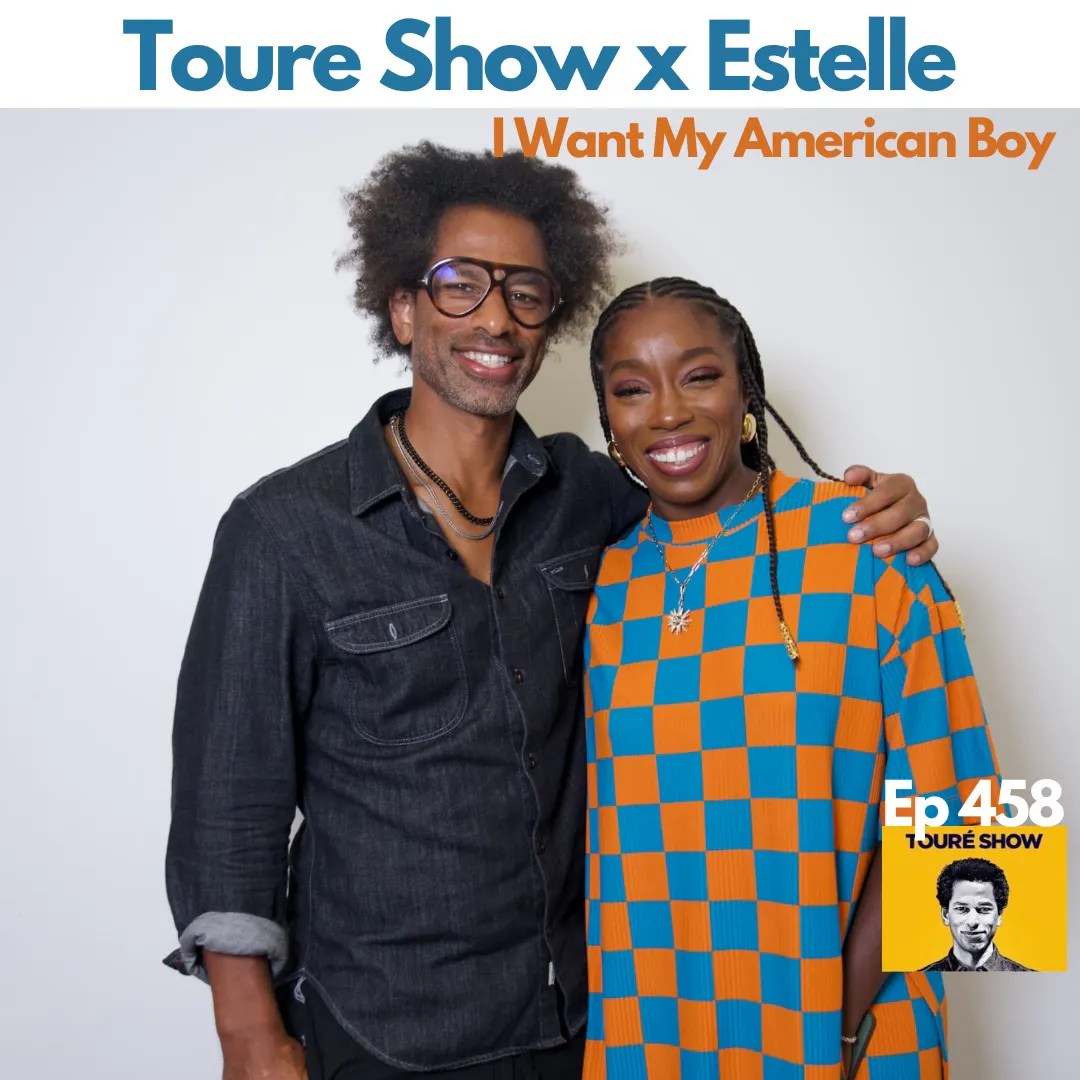
Toure Show
Estelle–I Want My American Boy
00:58:59
Estelle is an amazing singer and a marijuana entrepreneur, too.
Loading summary
Transcript369 lines
- [00:00]
Torre
Want to shop Walmart Black Friday deals first. Walmart plus members get early access to our hottest deals. Join now and get 50% off a one year annual membership. Shop Black Friday deals first with Walmart plus see terms@walmartplus.com there's no better feeling than a personal win. And the State Farm personal price plan can help you do just that. Talk to a State Farm agent today to learn how you can bundle and save with a personal price plan. Like a good neighbor, State Farm is there. Prices are based on rating plans that bear vary by state. Coverage options are selected by the customer. Availability, amount of discounts and savings and eligibility vary by state.
- [00:41]
Estelle
The tour ratio okay though.
- [00:44]
Torre
The tour ratio okay Doe that might be the best question I've ever been asked.
- [00:51]
Estelle
You's a phenomenal person. I mean, you legendary. I am a fan of you, my brother.
- [01:01]
Torre
This album. How are you as a singer different?
- [01:05]
Estelle
Oh, God. Well, the realization that I sound how I sound and I can do and knowing it. So when I'm singing, it's different things in my voice now and also the intent of where it's coming from. For me, this is joy. This just comes from joy. Like, I found the light and the spark and we found the moments that made me feel like they remind me why I started doing this. You know, remind me why I decided one day I was going to say I'm gonna do this for real. I was like, recapturing those moments or going back to it and reigniting it and like lifting it up even higher in myself. And now everything I do comes from that.
- [01:41]
Torre
Estelle is a wonderful person with a gorgeous voice. Perhaps you remember American Boy. I was so excited to have her on the show and to talk about singing. But what I really also wanna know, would she make a song with Kanye? Now we get into that and her whole history as a singer. It's Estelle on Torre's show. Estelle. Hi.
- [02:14]
Estelle
Hello.
- [02:15]
Torre
How are you?
- [02:16]
Estelle
I'm wonderful. How are you feeling?
- [02:17]
Torre
Welcome.
- [02:17]
Estelle
Thank you.
- [02:18]
Torre
You have such a beautiful voice.
- [02:20]
Estelle
Thank you.
- [02:21]
Torre
Tell me about learning that. Like, oh, wow, like, I can really sing. Like, when was that? Like, teenage years?
- [02:30]
Estelle
Nope. That was maybe when I was 38. What?
- [02:35]
Torre
No, it's not.
- [02:36]
Estelle
Real talk backstory. No real talk. I never thought I was a singer. What did you think you were? I just thought I had a distinctive voice. Right. I just knew that my voice sounded different talking. And various people along the way were like, just sing. Just sing like you can. Jon was like, just sing. You can sing. I would go into sessions and be rapping, because I started as a rapper.
- [03:02]
Torre
Can you rap?
- [03:03]
Estelle
Yeah, yeah.
- [03:04]
Torre
Give me a rhyme.
- [03:07]
Estelle
It was so long ago.
- [03:08]
Torre
You're a rapper. You gotta be able to spit.
- [03:09]
Estelle
So long ago.
- [03:10]
Torre
Just give me a little spit.
- [03:11]
Estelle
No, it was so long ago. 1980. You. That God made me. Oh, but I did. I sang like I sing on all my hooks. And my very first song was 1980. And people were. I don't think they took it serious as being a singer because all the talk was centralized on me being a rapper. And I was kind of like, all right, yeah, well, you know, I said, I know I sing. I don't care. You know, I know how to do all the harmonies, and I have to do all the things. I'm good. And as I kept going along, it took. I just was never. I never put too much thought behind it. I just did what I did. I learned what I learned. I practiced with who I love to sing with, which would be, like, Ella Fitzgerald and people like that. It would facilitate between Mary J. Blige and Ella Fitzgerald practicing.
- [03:56]
Torre
You're at home listening to them and practicing and doing those, following them. So that's how you practice with Ella, with Mary J. Blige, who else?
- [04:07]
Estelle
I was at church as a kid, too, so I learned that. I learned how to sing harmony and, you know, black street voice. Every male group, every female group, like, I just. I listened and I learned it wasn't about going to a school, per se, or nothing. It was just life experience. So. But, I mean, it took me till 38 to really be like, oh, okay. I had a conversation with my mom. I was going through my renewal, my reawakening, and I was like. I remember when I was 12, and I had a scenario where I had cried because I was singing, you know, singing for the blood of Jesus in the back of us, in a. In a toilet in one of our bathrooms, I should say. And my mom and my auntie was laughing like, why are you screaming in there? Right? And so, to me, it wasn't a thought that I sounded good or I was trying. And I realized that, like, 38, doing all my therapy and doing all my things, that that kind of stunted my sense of whether I believed I was good or not and had a conversation. My mom. My mom was like, I just always thought you knew you sounded good. I was just like, what?
- [05:09]
Torre
Oh, well, wait, American.
- [05:12]
Estelle
Is that with me? Like the.
- [05:13]
Torre
So wait, American boy. You're 24, 28. 28, 28. It's 10 years before you are admitting to me or yourself that you're. But I mean, like, I mean, it's.
- [05:25]
Estelle
A difference between I believe I can sing and I know I can do this. I know how to do that. I think when you say believe you can sing to me, I don't sound like what you think the singers are supposed to sound like.
- [05:37]
Torre
Do you like. Do you like American Boy?
- [05:39]
Estelle
Yeah.
- [05:40]
Torre
Do you think she's doing a great job?
- [05:42]
Estelle
I think she's doing a great job. I think she did awesome back then and I think she's doing a great job now.
- [05:45]
Torre
For sure. Yeah, for sure.
- [05:47]
Estelle
I love it.
- [05:50]
Torre
When did you first start thinking about. Oh, I'm actually. Let's. Yeah. To take it down. When do you start thinking you're good at singing and rapping? Like, enough to be like, oh, that's what I want to do.
- [06:00]
Estelle
That's it. Oh, well, I knew I was good enough. I believed I had something when I was like 17.
- [06:06]
Torre
Okay.
- [06:07]
Estelle
I feel like I started off. I say I started off as a rapper because I worked in a record shop and I just. It wasn't hard to rap. To me, I knew English really well. Like, it was my favorite subject. I would write all the time, write poems, write books, write rhymes all the time. And I think there's this guy called Fallacy when. Who heard me, like, spitting one of my rhymes, like, oh, listen. And he was like, you're actually good. Like, you should keep doing it. And that put a battery in my back because it was like one of the main rappers at home. And I just kept going. And every time I showed up, it was just like, yo, but where did you come from and why are you so good? And I was just like, well, I don't know. It's talented. It is what it is. But I just kept going at it. I just kept trying to be better and better and better. And then, I mean, look, I look at my life, like, couldn't make this up. There's people I met when I was like 18 and 19 that are superstars and legends and icons in the culture now who I shouldn't even know, you know, but they were at their height. And I mean, I toured and did shows with Chuck D and Flavor Flav and Public Enemy as a child. As an 18 year old, you know, as a 20 year old, I knew most Defin Kweli when I was like 18 and 19. Like, I'd been in and amongst those folks before. 10 years before you knew who I was with American Boy. So there's a certain level that I would hold Myself to cause you, you know, if you're not around being of good for a good reason, like, what are we doing here?
- [07:37]
Torre
But. Okay, help me understand something, because I'm gonna be real American now.
- [07:42]
Estelle
Okay, okay.
- [07:43]
Torre
Because you're from and living in two different worlds as far as British hip hop and British soul music.
- [07:50]
Estelle
Yeah, for sure.
- [07:51]
Torre
And British soul music has had a gigantic impact on America. Right. And it's super beloved and important in America as well. British hip hop is not. It's frustrating the same. It's frustrating, I feel. And it's not like it's just British solo. Because British rock and roll is obviously incredibly important in American music history.
- [08:14]
Estelle
Yeah.
- [08:16]
Torre
What's going on with British hip hop? That it's not commute. I would think there would be more people who were from England, London, who were like, having an impact on the American scene. But there's a couple, but not really.
- [08:30]
Estelle
I don't know. I think so. To me, this is what I observed when I. And it's weird because it feels like I came here yesterday. Right. But also I was part of the scene that. That Americans just don't know about. There is and was a whole purely hip hop, not hip hop with garage and different and grime and all of that that it's become. But there was a whole scene of like, black twang, rodney pee. Like so many hip hop artists from the UK that I don't know whether it was because the accent was different or we were very hell bent on rapping in our accents.
- [09:05]
Torre
But we don't mind when you sing it.
- [09:06]
Estelle
Okay. We don't mind singing. It's just very odd. But, you know, and I think it's a testament at that time too, you know, like, the way things were and what was people willing to like, hang a hat on and be like, that's a star.
- [09:19]
Torre
Is there somebody. You look back on who you and other British emcees were like, oh, well, they did it. If he. No, no, he's gonna make it. And then like, he didn't make it. Like, how could he have? Or she. How could they have not made it?
- [09:33]
Estelle
Oh, no.
- [09:34]
Torre
Like, we thought, like, if anyone's gonna blow.
- [09:36]
Estelle
Are you gay rappers in the uk?
- [09:38]
Torre
From the uk? I mean, you know, I said, I'm being very American. Yeah, you might blow up in England, but really, you want to blow up in America.
- [09:48]
Estelle
There was. There were a couple. But I always look at everybody's. I look at things like everybody's on their journey, right. And everybody plays a real part. For instance, like, I Came here and everyone thought I was gonna rap when I came because they knew me in London as a rapper. And I think after a while, people were like, we're just happy to see one of us go and be. And I appreciate all the support and love because it was hard fought, you know.
- [10:13]
Torre
Yeah.
- [10:14]
Estelle
For someone that looked like me, that felt like me. That is me. To come here and have a record like American Boy and still to a degree, represent like a rapper. Whenever you saw me London, I don't think people at home felt like they lost anything.
- [10:28]
Torre
What do you mean, look like me?
- [10:29]
Estelle
You're like me.
- [10:31]
Torre
What are you talking about? No, as in okay, it's so easy on the eyes. What are you talking about?
- [10:36]
Estelle
Well, at the time, it was. Look, in 2008-2007-2006-2005, it was ever ago. It's really not that far away.
- [10:45]
Torre
Two decades.
- [10:46]
Estelle
Two decades. But at that time, like, we didn't look. There was no. There was no brown girls going to rap in America. Like, it didn't look like us, you know, particularly not from the uk. You know, there was a lot of. It just wasn't that. And I never saw that as a thing to stop me. So I think there was a lot of support for the fact that I wasn't aware or if I saw it, I didn't care about it. And I was just gonna do what I was gonna do. And I didn't forget people. You know, I didn't come over here and not shout out whoever's shoulders I was standing on. And I still to this day do it. Okay, I have to tell you, I was just looking on ebay where I go for all kinds of things I love.
- [11:27]
Torre
And there it was, that hologram trading card. One of the rarest. The last one I needed for my set.
- [11:32]
Estelle
Shiny like the designer handbag of my dreams.
- [11:35]
Torre
One of a kind.
- [11:36]
Estelle
Ebay had it. And now everyone's asking, ooh, where'd you get your windshield wipers? Ebay has all the parts that fit my car. No more annoying, just beautiful. Whatever you love, find it on eBay. EBay. Things people love. Gift the remarkable with Marc Jacobs fragrances this holiday season. From the iconic Daisy and Perfect to the all new Daisy Wilde Marc Jacobs perfume gift sets include everything she needs to feel special from her favorite fragrance, plus the matching travel spray. Holiday gifts don't get much more perfect than this. So if you're looking for a gift inspiration these holidays, gift the remarkable with Marc Jacobs.
- [12:23]
Torre
If you were from New York or la, we could say this out of New York and LA made me who I am as a musician. So what is that for you with London?
- [12:33]
Estelle
Oh, the thing that made me the musician I am from London is I was exposed to so much different kinds of music, so many different genres. I didn't look at it like, I only listen to this, or I'm only. This is where I stand. When you see me pull up, this is it. Like, I'm gonna listen to Oasis and Radiohead as much as I'm gonna listen to Yaz and Big Daddy Kane. And just as long as it was good. That was our motto in our house. Like, we grew up on Dennis Brown. We grew up on, you know, like, everything. You know, like, all of the genres. The rule in our house was, as long as it's good, we can play it. If it's rubbish, we're not playing it. And the rubbish for us was, like, not good lyrics. You know, like, the beat doesn't really do much. And my mom was that person. Gospel to wherever, gospel to jazz to wherever.
- [13:28]
Torre
Like the Beatles.
- [13:28]
Estelle
Yeah, she liked the Beatles. All of it. Like Rolling Stones. All of it.
- [13:32]
Torre
Okay, okay.
- [13:32]
Estelle
Fully in it. And that was our barometer. That's always been my thing, so that's what makes me who I am. And that's the thing. I think with a lot of British artists, we're different in the way that we absorb and put right back out without thinking about it, whether lyrically, whether musically, whether stylistically. All the genres. Like, there's no, you know.
- [13:55]
Torre
But you weren't listening to popular music at home?
- [13:58]
Estelle
Oh, I wasn't allowed to listen to a lot of it at the beginning, so I'd say my mom was, like, in it. But, like, I think between the ages of maybe like, 10 to, like, 13, we became really religious.
- [14:14]
Torre
What religion?
- [14:15]
Estelle
Like Church of God of Prophecy. Pentecostal, Like Holy Ghost.
- [14:23]
Torre
But great music.
- [14:24]
Estelle
Great music. And I learned that entire discipline. I was just like, this is. I felt it, you know? And, yeah, she was really focused about that for a long while.
- [14:34]
Torre
So no popular music for a couple.
- [14:35]
Estelle
Years, like three years. But, you know, we sneak. Went to school, and I listened to all of it. I was in it.
- [14:41]
Torre
When you're sneaking, what are you sneaking?
- [14:44]
Estelle
All right, so, yeah, this is the part where it's like, this is why I'm the slight weirdo. Not slight, actually. Let me rephrase that. I'm not the weirdo. I would listen to Ella Fitzgerald, okay? She's one of the greatest singers that ever lived.
- [14:59]
Torre
For sure.
- [14:59]
Estelle
If I could sound like that for fun. I probably wouldn't buy another album just for what. Cause I done it. Ella, it's me. I would listen to her. I listen to all of the R and B greats. Like, you go all SWV all the way over to Blackstreet, even the ones in between. I'm listening to all of the funk in the 80s that you could think of. Because my auntie was a big Alexander O'Neal fan. And so it was all of that in her house. Stevie Wonder, all of that over there. And you move around different. We parent as a community in ours. So I'm moving around and, like, I could really go over there and hear Stevie Wonder one day and come back home and it's like in the blood of Jesus.
- [15:45]
Torre
Is there a Senegalese influence in all this pride?
- [15:49]
Estelle
Yeah, for sure.
- [15:50]
Torre
What's that?
- [15:51]
Estelle
Listening to, like, Yusundor as a mainstay. Like, there were certain African artists that would come out throughout my life, and my mom was very adamant that we knew them.
- [16:00]
Torre
And they were.
- [16:01]
Estelle
And Yusindor's one. Pepe Kelly's from, like. I think he's from Congo. Fela Pepe Calle.
- [16:07]
Torre
No, I mean.
- [16:08]
Estelle
But also Fela is what we hear for sure. Yeah.
- [16:11]
Torre
Right.
- [16:11]
Estelle
Yeah. And those are like family gatherings. Those are baselines. I just did a. Not a song with her. I just interviewed her. I have her face in my name. I'm sorry, this isn't you. She's really. She's doing things now. Aye, aye. What's her name? Angelique Kijo. That's it. Angelique Kijo. She's another one. And it was more because of the pride of them, you know, like Africans. We're here and no matter what happens there, you know who your root is, you know where you are. That's who we are, you know, so mama would have those. Playing along. All along. All along my childhood, just all throughout my life.
- [16:52]
Torre
Yeah. American boy. Why is this song so great? What are you doing? Right. Cause it's earworm having fun. Right? And she's in there.
- [17:05]
Estelle
She's.
- [17:07]
Torre
I think the high notes are really sugary, like candy. Like, I wanna hear, like, that high part of the chorus is what I want. And I don't even plug into what she's saying. I'm like the melody.
- [17:19]
Estelle
Wow.
- [17:19]
Torre
It's so nice that she's up there. It just feels so nice.
- [17:22]
Estelle
I love that you call that she. I love it. It's just fun and joy. Honestly, every single song that's like, hit a moment with people has been because I've been joyful.
- [17:36]
Torre
Did you do that one at night?
- [17:38]
Estelle
Say that one more time.
- [17:38]
Torre
Did you record it at night? Mm. Mm.
- [17:40]
Estelle
Middle of the day.
- [17:41]
Torre
Yeah.
- [17:42]
Estelle
I was having a ball. I was really, like, literally in Miami looking at boys on the beach. It's a running joke that I wrote them about keeping boys. Cause I did. I was like, this is. We don't have men like this at home in London. This is a good day. I was having a time.
- [18:01]
Torre
Miami beach, looking at boys. Jump in the studio.
- [18:06]
Estelle
John Legend was like, what have you been doing while you been out here? We're out there for a session to do this session with Will. I am. And I'm here. Like, I'm at the beach. Like, while you're in between doing your work. I'm at the beach. Turn up. And he's like, what you been doing? I was like, I've been at the beach looking at all these boys. Be great, like. And he's like, oh, my God, what did I. What did I do? And I was like, no, we good. We good. And he was like, tell me about it. Like, what's been. So we started doing it. He said, that's what we should write about. And then he went in and melodied. Put some words down. I wrote some melody. We did it together. And then. Yeah.
- [18:40]
Torre
So we're hearing this sort of pure feminine excitement about these pretty American boys who. We don't see them just there right at home, right. Like, wow, he's cute. He's cute, right? Like, was there one empty you were thinking about?
- [18:57]
Estelle
No, there were several. It was just. I was 20. Like, what do you do? It's 20 in your mid-20s. On that. Miami. In Miami on the beach. Like, it was just. It was a wonderful time.
- [19:06]
Torre
Were you just watching or were you actually talking to people?
- [19:09]
Estelle
I was talking to some. I was having a ball.
- [19:13]
Torre
Were you just talking or you having.
- [19:14]
Estelle
No, I was talking. I was talking. I was having a ball. I was talking.
- [19:17]
Torre
Okay.
- [19:18]
Estelle
It's just like, it was a different world. Like. And you have to, like, my whole thing was coming from London. I'd already had a career, started off in London. People knew me in a certain space, but coming here, one, it was just like, people were just completely beside. With the accent and all of the Londonism that I brought. But I'm not even looking at that. I'm just like, oh. I'm looking at them in the same way. Like, oh, my goodness. Say words, say things. This is so sexy. Oh, shit.
- [19:44]
Torre
Oh, you think the American accent is sexy?
- [19:46]
Estelle
Yes. All of them. There's so many.
- [19:48]
Torre
No, no, no, no, no, no. You don't think all American accents are.
- [19:51]
Estelle
Sexy that you can find it?
- [19:53]
Torre
Cause some of it.
- [19:54]
Estelle
You can find it. You can find it.
- [19:55]
Torre
No, wait. What are the American accents that you think are sexy?
- [20:01]
Estelle
New Orleans.
- [20:02]
Torre
Okay. The way that black people in New Orleans talk. For sure.
- [20:06]
Estelle
Dear Lord. For sure. Yeah.
- [20:07]
Torre
Sometimes you can't understand them.
- [20:09]
Estelle
That's fine. Just they sound like they Singing.
- [20:11]
Torre
They sound like. Yes, it sounds like a trumpet.
- [20:12]
Estelle
Yeah. It just does this.
- [20:16]
Torre
And it's like they have their own slang.
- [20:18]
Estelle
They do. You just. You cannot be a meanie. If someone in New Orleans stops and says hi to you, you have to say hi and be like, okay, I don't know you.
- [20:27]
Torre
Do you like the New York accent?
- [20:29]
Estelle
I do.
- [20:30]
Torre
Really?
- [20:30]
Estelle
It's great. It's just so, like, walk, walk, walk. It's great. I love it. I'm like. I love it.
- [20:37]
Torre
Do I sound like a New Yorker to you?
- [20:39]
Estelle
I don't know. But you have an interesting accent.
- [20:42]
Torre
Okay.
- [20:42]
Estelle
You do.
- [20:43]
Torre
I don't know that. I mean, wouldn't everybody say I don't have an accent.
- [20:46]
Estelle
You do. You for sure do. You really do.
- [20:50]
Torre
Wow.
- [20:50]
Estelle
I love the way you're. The cadence of your speaking, though. It's definitely. It's. I like it. It's clear, it's precise. It's.
- [20:57]
Torre
But LA has a sound.
- [20:59]
Estelle
Yeah. LA is mixed.
- [21:01]
Torre
Oh, she does not love the LA sound.
- [21:02]
Estelle
It's not as if it was.
- [21:03]
Torre
The enthusiasm went right to LA.
- [21:06]
Estelle
Okay, what's it. No, real LA. Like, real LA. Like south of the 10 LA, like black LA. They got sound and the twang that I think is beautiful, too.
- [21:18]
Torre
You like dc?
- [21:19]
Estelle
I do. What? DC sound a little bit like New York to me.
- [21:23]
Torre
Really?
- [21:24]
Estelle
They swing a little bit.
- [21:25]
Torre
It's a little more of a Southern to them because they're a little closer to the south culture in a lot of ways, because a lot of them, people be. Move. People move up.
- [21:34]
Estelle
Yeah.
- [21:35]
Torre
Nowadays, sometimes people move down to Atlanta, but people move up. So your grandparents lived in the south, and then maybe you went to D.C. and then maybe you went to New York or you went from the south to New York.
- [21:43]
Estelle
Yeah. Migration. The migration.
- [21:46]
Torre
Wait, so. Made this great record with Kanye. It's actually interesting that you're on there with a person who was then a superstar and you're trying to introduce yourself. But the first, what half of the record is all you. We gotta get through a lot of you to get to the Kanye, which normally, you know, the superstar would go First.
- [22:06]
Estelle
Yeah, well, he's on the beginning. Beginning of the record. He's like, on the intro.
- [22:09]
Torre
Yeah, but just, like, just. Just. Just like a little spice. And then we get like.
- [22:13]
Estelle
Yeah, but that's how rap records. That's how records go. So. I remember I started as a rapper.
- [22:16]
Torre
Yeah. Yeah.
- [22:17]
Estelle
Like, my. My arrangements of songs in my head go like that. Like, you put the rapper at the beginning, you do the record, you have the rap in the middle.
- [22:27]
Torre
Right.
- [22:27]
Estelle
Maybe a bridge if there's space.
- [22:29]
Torre
Right.
- [22:29]
Estelle
And then you end the record.
- [22:30]
Torre
Right.
- [22:30]
Estelle
It's traditional to me.
- [22:32]
Torre
Right.
- [22:33]
Estelle
So it wasn't weird to have him, like, do a little piece and then. Yep, yep. And then bop. Yeah.
- [22:39]
Torre
I think about songs where it's this attempt to introduce somebody, and the star goes. And then. So it's like, I gave you my cosign. Look at her. Right? And then he. And then. Right. And then she goes, yeah, well, the.
- [22:55]
Estelle
Difference is that he wasn't introducing me, per se. I mentioned, like. And this is the part that I always want to tell people. I'm like, I was here for a while before American Boy came out. The rest of the world knew me.
- [23:09]
Torre
Yeah.
- [23:09]
Estelle
You know, we just didn't do a good job of marketing. My first time in the world, was.
- [23:12]
Torre
It weird to be like, oh, I am successful and respected in England, and y'all don't know yet? Like, that was.
- [23:20]
Estelle
No, because, look, I think everything has a path and a journey. Like, at the time, I was just like, I'm gonna have to just go and do this from the ground up, and that's fine. And that's why I moved, to be fair, because I realize that America is vast. Like, there are people who have hits, regional hits, that the rest of the Americas don't know. So who do I think I am? Coming from a whole nother country? I had to get real humble, you know, like. Or start this off humbly and get to work. And I did. You know, so when people are talking about it as though, I'm like, I touched every single state, every single radio station, whether they played our music or not, I touched them. I went and said, hi. I spoke to every programmer I could. The team had me working, shaking hands, kissing babies. It was a presidential campaign. That's what I had been told. They were like, yeah, I didn't sleep for the entire time. You saw it working and building and moving. So when people would talk about the amount of work or, you know, it should just be online and it should just go. I'm like, no, no. Oh, I haven't slept for 15, 16, longer than that many years. Hadn't slept until the Panini.
- [24:31]
Torre
To the panini. 2019 was like, wait, would you make a record with Kanye now?
- [24:37]
Estelle
Not the person he is now? I don't think we have too much in common. Yeah. I made that at 28, and we were all seeing eye to eye. The energy was right. It was not right, but the energy was in sync. And I don't think we're in the same space right now.
- [24:50]
Torre
Were you in the same room when you made the record?
- [24:52]
Estelle
No. So I was in the same room when he put his verse down.
- [24:56]
Torre
You were there when he put his verse?
- [24:57]
Estelle
Yeah, he come from.
- [24:57]
Torre
But you'd already done your verse.
- [24:59]
Estelle
I'd done my. The whole song. And the idea was like, how can we superpower this? Like, they were like, this is already fire. How do we. This is going to be a record.
- [25:07]
Torre
You did you encourage or direct? Like, can you talk about this? You can go in this direction.
- [25:14]
Estelle
Yeah. He asked me questions. He was like, what's the drink you guys drink? I was like, I'm not an alcoholic. Oh, girl. Ribena. Cause, I mean, look, I'm truthful. If nothing else on records, I speak my mind. I don't. You know, I didn't drink a lot of alcohol at that point. I wasn't really the vodka girl or the champagne girl. I mean, I'm a champagne girl now, but, you know, growth. But I was like, I drink a lot of Ribino. That's our national drink.
- [25:43]
Torre
Okay.
- [25:43]
Estelle
In London. So he was like, that's the grape. The blackcurrant thing. And I was just like, yeah, you know, it. He's just come back. So it was fresh in his mind, and that was literally it. My friends were like, you got him to say Ribena on a record? I said, do we not ordering Ribena, guys? It's Ribena vibes. They appreciate that. Ribena did, too.
- [26:05]
Torre
But you are different now.
- [26:07]
Estelle
Yeah, growth, man.
- [26:09]
Torre
I mean. Yes, growth, but I'm really talking about. He said all this crazy shit.
- [26:13]
Estelle
Yeah.
- [26:14]
Torre
You know, the music is whatever, but, like, you know, anti Semitic shit. Hitler shit.
- [26:20]
Estelle
Oh, my.
- [26:20]
Torre
And, like, does that make you go, yeah, I'm good. I'm not fucking with you right now.
- [26:24]
Estelle
Yeah. I mean, look, I always want to know people's journeys. I just. I know my journey, and it's nowhere near hate. So that's how. That's my part of it. You know, I stay away from anything that runs in the space of, like, just anti or hate or just I prefer. I should say, I prefer to move in love. And that doesn't feel like love. So it's nothing to do with me, really.
- [26:51]
Torre
Yeah.
- [26:51]
Estelle
Yeah. It's a great song. It was a great moment, you know.
- [26:54]
Torre
Yeah.
- [26:54]
Estelle
And we have more.
- [26:55]
Torre
Yeah. I know. Soul to Soul was important to your development. I loved Soul to Soul first and the second album, especially that first album. It meant so much.
- [27:09]
Estelle
When I told you I was a child when they came out.
- [27:12]
Torre
Yeah.
- [27:13]
Estelle
But again, seeing this black lady on the screen, and my parents at the time had dreads. Right. So seeing these people that look like our family members, like, swinging their dreads, going for it. Right. And then I met her when I moved to New York, I met Karen. Not her. I met Karen Wheeler when I moved to New York. She was at Jo's Pub, just hanging out. And my whole life was just. I don't. I wish I had my old phone. I may have fangirled out, like, it's like, just imagine being like 8 and 9 and seeing this person. And this was the only black representation to a degree, for black R and B music at the time.
- [27:52]
Torre
Those records sounded so different than everything else that was going around. And even when they. When the first album came out, I think I was a teenager. I hadn't been to any clubs, and I felt like this is what it's like to be in a club. The way this record is feeling right now. I mean, I don't even know what I. But it was like, this is so deep.
- [28:14]
Estelle
Like, Jazzy B isn't giving them enough credit.
- [28:19]
Torre
No.
- [28:19]
Estelle
Like, their whole outfit isn't given enough credit for. I don't give them enough credit. I ought to give them enough more credit.
- [28:26]
Torre
And his voice.
- [28:29]
Estelle
Just. And that's the part, because in my head, I'm saying they're going. Distinctive voices. Like, now you're putting two and three together for me right now. Distinctive voices. People with a voice that you recognize. That's been my thing. Yeah.
- [28:43]
Torre
And you talk about India Davenport, brand new Hepbies. She would not remember this. She wouldn't even know what happened. She was the first person who showed me marijuana.
- [28:55]
Estelle
Showed you marijuana?
- [28:56]
Torre
Yes.
- [28:56]
Estelle
She's like, this is weed?
- [28:57]
Torre
Well, no.
- [28:58]
Estelle
How did that go?
- [28:59]
Torre
I was in college. I was a sophomore or a junior somewhere in there for some reason, because I was running a newspaper at school. And so for some reason, I must have been like, well, he's media, so I got to go. It was the first time I went backstage for an artist, especially an artist that I liked. And I remember There was just, like, a party going on. And the way they were consuming the weed was there was a sort of glass sort of thing. Like a big glass thing.
- [29:30]
Estelle
It's a mega bone.
- [29:31]
Torre
Well, kind of. But, yeah, but like. Yeah, you kind of lift up part of it and, like, suck from under it. And because of the whole contraption aspect, I was like, oh, they're doing heavy shit in there. She said, me, oh, I should leave. But heavy rock and roll shit is happening there. And Reginald, like, you're a fucking idiot. Like, they're just smoking a little weed.
- [29:52]
Estelle
Like, you said you were young.
- [29:54]
Torre
I was young and dumb. Oh, my God. But she was there. I was like, oh, my God.
- [29:58]
Estelle
Indeed.
- [29:58]
Torre
Davenport is here.
- [30:01]
Estelle
My whole life, and this is one thing I realize I do to keep myself grounded. I give props to the OGs. And I never worry about feeling weird whenever I see them outside. Like, I walk up on them and be like, you can act like you ain't nobody in this room, or you can be real quiet right now, but, hi, I just wanna give you.
- [30:22]
Torre
But they know who you are and they appreciate that.
- [30:25]
Estelle
But whether they do or not, they don't understand. I'm able to be. Because they exist, you know? And so I don't care. Like one. Mentally, it keeps me grounded, but also, yeah, I'm gonna shout. Like, do you understand that I was 7 or 8 doing a whop in my living room.
- [30:41]
Torre
Yeah.
- [30:42]
Estelle
I'm a grown 44. Like, do you understand? And these people, they're still here. Like, I'm going to give you your props. I'm gonna let you know how you changed my life. You know, like, if I didn't see that, I couldn't see myself doing this.
- [30:53]
Torre
Yeah.
- [30:54]
Estelle
You know?
- [30:54]
Torre
Yeah. So who else did you need to see to visualize it?
- [30:59]
Estelle
I needed to see Moni love.
- [31:01]
Torre
Yeah.
- [31:02]
Estelle
I needed to see her do her thing. I love her. She's great. I just.
- [31:08]
Torre
Moni was always like, one of the boys.
- [31:11]
Estelle
That's the. That was my original thing, Right.
- [31:14]
Torre
Girly. But she's hanging out with the boys at De La Soul or whatever, and you're like, she's the girl who can hang out with the boys.
- [31:20]
Estelle
Yeah, it was often that way. It was just the one girl, right? Yeah, it was like one girl in the crew. I needed to see. To your point. Delassol. I did a record with them before they've passed. Like, again, it's like, so many things, and I'm writing a book. It's gonna come, but there are so many moments where I'VE met my heroes. I met people who, if they didn't exist, I wouldn't be here. And it's. I don't take that for granted. I don't take that lightly. I'm just grateful.
- [31:51]
Torre
So maybe we could argue a little bit.
- [31:53]
Estelle
Go ahead.
- [31:54]
Torre
Cause you also have Jamiroquai on that list.
- [31:56]
Estelle
Yeah. You don't like it?
- [31:58]
Torre
What?
- [31:59]
Estelle
What? All right, all right. It's debatable. Cause of this. I understand.
- [32:04]
Torre
Like, okay, so it's a controversial issue in America.
- [32:06]
Estelle
Tell me why. I mean, tell me.
- [32:09]
Torre
Some people, myself included, found a lot of that music corny.
- [32:13]
Estelle
Okay.
- [32:14]
Torre
There's definitely people who I talked to from that era who like, no, you're wrong. Like, brilliant musician, musical. Oh, you're wrong, Jabirka.
- [32:21]
Estelle
I was the shit. Why was he corny to you? Did he resemble anybody? Was it like, oh, he sound like he's ripping off? Or is it just like.
- [32:28]
Torre
No, I don't think it was that. I don't know. I didn't. I never felt the authentic soul of the music. I felt like he's trying to be something. And there's the hat and there's the weirdo Ness. And I don't know. None of those records ever hit me. And it was like, I'm looking at other people like, oh, wow, that hit you. And you fuck with your music. So how do I bring it up? Cause some people would be like, yeah, she's right. And some people be like, what is she doing?
- [32:52]
Estelle
Why is she going over there?
- [32:53]
Torre
But you rep for.
- [32:55]
Estelle
Please educate.
- [32:56]
Torre
I do.
- [32:56]
Estelle
Look, you have to put it in context. I'm in London. We don't get. We haven't seen that look or not that look. That sound. Seen that sound of singing on mainstream tv, right? You could go to any club and see a black artist, a white artist doing that style of singing. So he was like, the only one that kind of got to push through and do jazz, funk, soul in his way. I know, I know. I understand. Do his version of it in his way. I'm gonna say his version of getting down to therapy.
- [33:34]
Torre
Cause talking it out gets you to. When I see white people I know. Doing black music like that, and it gets my back up, right? I immediately like, mm, you gotta prove it double. Cause I wanna brick you.
- [33:51]
Estelle
That's the thing for me, it's like, prove. I think he did a good job of proving it because he's one of the singers, though that would actually sound like the record to me when I seen him do it. And that's always My thing. If you really do it, I want to see you do it. And he does do it. So to me, I like, no Jamil. Kylie. All right, now, you thought he's one.
- [34:10]
Torre
Of the ones we didn't talk about. Tyler. Tyler, the creator who's like, that's working with him. Cause he's a little crazy in an amazing way.
- [34:18]
Estelle
He's not crazy.
- [34:20]
Torre
He's crazy in a good way.
- [34:21]
Estelle
He's very convicted. I think he's convicted. I think he's spirit led, and I think he's uncompromising. And I love that about him. Yeah, we did a wreck. He called me to sing a little bit on Garden Shed.
- [34:35]
Torre
Yeah.
- [34:35]
Estelle
And that was a sweet moment. He was like. I was like, maybe 37, 36. And he was like, my mom listens to your music. And I was like, oh, God, is this aging me? How old? What is happening?
- [34:49]
Torre
I didn't hear that.
- [34:50]
Estelle
And then I was like, wait, no, that's not bad. Because, you know, I had people in their 20s who were like, shine's my favorite record. And I was like, you were six, you know, when this came out. But this is why we do music for everybody. In every time, in every space. I'm not mad. But his genius is that he's open.
- [35:07]
Torre
Yes.
- [35:08]
Estelle
And he won't stop trying some shit.
- [35:10]
Torre
Yes.
- [35:10]
Estelle
And I'm like, that's what you want to go into studio with or work with in any capacity for me, Like, I don't enjoy working with people who are just stuck in. This is all I can do and sing on my beats. Cause I'm the best at doing just this.
- [35:24]
Torre
I'm like, uncle, tell me about your new album.
- [35:29]
Estelle
I'm so happy. I cannot wait to put this out.
- [35:31]
Torre
Yay.
- [35:31]
Estelle
I made it. I started making it in 2018.
- [35:34]
Torre
What's it called?
- [35:35]
Estelle
Can't tell you that yet.
- [35:37]
Torre
You don't. You're not telling me?
- [35:38]
Estelle
I know. I have to. I have to. I have to finish it first. No, it's finished, but I have to, like, wrap it up. Wrap it up.
- [35:44]
Torre
Is there a name?
- [35:45]
Estelle
Yeah, there is.
- [35:46]
Torre
Okay.
- [35:46]
Estelle
But you're not yet.
- [35:48]
Torre
But you finished recording.
- [35:49]
Estelle
I have finished recording it. The first song, Oi, is out right now, but the whole album came from again, a rebirth. Like 38, 37. Reconfiguring everything. Like, realizing that I like to smoke weed. It's not terrible. Not. The world's not going to crumble.
- [36:10]
Torre
Indica or Sativa.
- [36:12]
Estelle
A hybrid. Okay. I like a Keep Me up hybrid.
- [36:16]
Torre
You know, you smoke joints or you.
- [36:18]
Estelle
I Smoke joints? Well, not joints. I smoke like pre rolls. I don't really like rolling. Yeah, I like rolling. I don't like doing all the manual labor.
- [36:28]
Torre
You get high all day. You get high all day? No, just at night.
- [36:32]
Estelle
Depends. It's very subjective for me. But I like to smoke weed when I have nothing to do. And I want to be in the audience. I just want to observe and be around the things. And it's not cause social anxiety because I do have a little bit of that sometimes. I realized I'm an ambivert. You figured out all these, like, I was just coasting through life raw dogging it, and then everyone was just like, no, there's a name, a label, a space for what you. How you move through the world, by the way. And I'm just like, oh, so 38 years. Okay, it's 38 years. Okay, cool. So. But I was introduced to the term ambivert when I started doing Steven Universe. I played character called Garnet. And one of the guys at one of the cons was like, an ambiva is when you're good, you're up and you're social, and then that just shuts down on you and you have to go be in a room and everyone leave me the fuck alone. And I have nothing more to give. I need to recharge.
- [37:29]
Torre
I noticed that pattern in myself after the panini.
- [37:35]
Estelle
Yep.
- [37:36]
Torre
Before that, maybe I didn't notice it, but it didn't seem like anything. I could go to a party and then another party, whatever. But this is like, okay, after being around a lot of people for a while, I don't have a time limit. But after that ends, then I very much want to be alone for a period of time and recover from having been so super social.
- [37:58]
Estelle
And it's not the standard. Like, everyone needs to recover. Like you do. But there's. You'll notice it with people. And sometimes you get called antisocial or like, oh, she's a weirdo. Or she's. I'm just like, no, I'm just an Amber.
- [38:11]
Torre
Well, I think there's more awareness now that we have social batteries. They are different lengths. You can run out where you're like, I like you, but I need to be alone. I've been out and about for an hour or two or whatever it is. And like, I need to go be. And like, it's fine. It's not, you know, it's not rude. It's like.
- [38:34]
Estelle
And I learned to like, create those boundaries myself. And with people, like, I don't allow it to just run anymore.
- [38:39]
Torre
Yeah.
- [38:40]
Estelle
Like, if I'm done, I'm done. I love you. I have to leave now.
- [38:43]
Torre
Yeah.
- [38:43]
Estelle
And I will hug you and Irish goodbye. I'll be gone. My friends know this about me. This has to be another term for Irish goodbye. I feel like I'm being offensive when I say that.
- [38:52]
Torre
But you're. I know, I know, I know, right? But you. But this album.
- [38:55]
Estelle
Yeah.
- [38:56]
Torre
How are you as a singer different.
- [38:59]
Estelle
Oh, God.
- [39:00]
Torre
Than you are?
- [39:00]
Estelle
Well, the realization that I sound how I sound and I can do and knowing it. So when I'm singing, there's different things in my voice now and also the intent and where it's coming from. For me, this is joy. This just comes from joy. Like, I found the light and the spark and re found the moments that made me feel like they remind me why I started doing this, you know, Remind me why I decided one day I was going to say I'm going to do this for real. You know, it was like recapturing those moments or going back to it and reigniting it and, like, lifting it up even higher in myself, in my body, if that makes sense. And now everything I do comes from that. Like, I don't. It's not even me. I literally will go into a session and pray and be like, what we got to say today, God. And I don't judge whatever comes out of my mouth or melody, lyric wise, none of it. I just let it flow and then I leave it in the hands of the producer. And Keith Harris, I mentioned him before in other interviews, but he was open. Like, he was very much, like, in the same way. Tyler is just very much like, let's see, let's experiment, let's try. You know, Keith Harris is like that. I will walk in and be like, yo, I heard this melody. You know, I was jamming to this the other day and I wasn't. That feel like this and, you know, and he'll come up with a melody on piano and I'd be like, speed it up and I'll sing along to it. Put the vocal down, put the lyrics down. Sing away. Run the track from top to bottom. Run it again, Run it again. Run it again. Stack this session for me. Stack that part for me. All right, see you later. Bye. And I'm gone, like four hour sessions. And he was just so free and open to that way of working where I've done other sessions and prior to this, it was just like, oh, this is long. You know, this is taking forever. And this is too Much talk from the producer or the writers or whoever else is in the room. And I don't relate to none of it, you know, but you force yourself through it. You know, when you don't realize that you are the power, you are the thing.
- [40:58]
Torre
This producer made it better for you to work, to work hard, to.
- [41:05]
Estelle
To try and be and be. You know, it's. It's one thing to have a record like American Boy and it be as big as it is is was. Whatever. And the expectations that now you need to maintain that or that now you need to have 500 people need to come in and make sure that you can have that same. These. I've never met you 500 people.
- [41:28]
Torre
Yeah.
- [41:28]
Estelle
Before. But it's. It's a. On repeat that can dampen your energy towards creating and being an artist, you know, and it works for some people. It just didn't quite work for me, so I had to pull it all back.
- [41:45]
Torre
So you're getting hungry.
- [41:47]
Estelle
Really hungry.
- [41:48]
Torre
Head to JackinaBox and pick up a smashed Jack. It's a juicy, delicious smashed burger topped with cheese, pickles, grilled onions and boss sauce. And it's now available on Sourdough, the Smash Jack. Only a Jack in the box. Order one on the Jack app today. Time to work on your gift list with Black Friday deals at the Home Depot. Right now, get a select tool from top brands like Ryobi and Milwaukee for free. When you buy a select battery kit, choose from reciprocating saws, multi tool sanders and more. Whether you're stocking up on power for your personal workshop or grabbing the perfect gift for someone else's, Get Black Friday tool deals delivered from the Home Depot. Limit one per transaction. Exclusions apply. Full eligible tool list in store and online. So this is the best working experience you've had? And you're like.
- [42:44]
Estelle
And I believe my best work. I believe it's subjective. Best work is subjective. But the most fun I've had, the most joy I've had. And I think you can hear it in the records. Yeah.
- [42:56]
Torre
Beautiful.
- [42:56]
Estelle
I can hear it. I feel it. I danced it.
- [42:58]
Torre
Beautiful. And what you described also was the writing process. But I want to hear you talk more about how you write.
- [43:04]
Estelle
Yeah. With ease. I know, I know. But that's the perfect. With ease. What. What do you mean? Like, it's not. It really isn't hard. I have a bunch of things that I want to say based on a bunch of things that I believe, but also I have a bunch of things that I honestly can say. I pray about it, and, like, it's channeling to a degree. I think every writer knows what I mean when I say channeling. You write, you know, like, the things that come and then you put it out. Sometimes you think about it. Sometimes it's just like, it just. Where did that come from? Like, oh, right. I don't stop to think about where it came from. I know where it came from, and I'm grateful for it. Thank you, God. And I don't judge it, and I just let it go. And that, to me, is where, you know, is how it goes. I don't. I don't think I do anything traditional anymore, per se, more than just go in and just let it go.
- [44:00]
Torre
Mm.
- [44:01]
Estelle
Yeah.
- [44:04]
Torre
I usually ask people who come on the show what being black means to them.
- [44:08]
Estelle
Yeah.
- [44:09]
Torre
And I don't usually have a lot of Brits on the show. And, you know, for Americans, you know, it's always wrapped up in slavery and the legacy of slavery and thinking back to the ancestors. But you guys don't have the same connection to that experience. Right. You're African, you are British. You have oppression, for sure, but you don't have direct connection to the African American slavery. So I'm curious what being black means to you. That you are liberated from that experience that we are tied to.
- [44:45]
Estelle
You know what's weird? What's a strange. I live in between worlds. Baseline story is my mom and my dad emigrated, met each other, had kids.
- [44:58]
Torre
Grenada, Senegal.
- [44:58]
Estelle
Grenada, Senegal. Right. Cervidillo and Senegal. Had kids and had us. So I've known where I'm from.
- [45:05]
Torre
Nine kids?
- [45:06]
Estelle
Yeah. Nine different dads. Two dads. My mom was married to my stepdad, then got back with my real dad, and it was on my last album, Lovers Rock. But, yeah. So their story was varied. But I have to look at this. What? What? I said that wrong. Oh, you haven't? Okay, my bad.
- [45:28]
Torre
God.
- [45:28]
Estelle
Say it again. So they, you know, they got married, they had kids, they met each other, and, you know. And they met each other, they got married, they had kids, they split up, they got back together. My mom got married in between that. My dad had other kids in between that. Two other girls in between that. Nine total. Right.
- [45:46]
Torre
You have eight siblings across three parents.
- [45:50]
Estelle
Two parents? Well, yeah. Mom, dad, and stepdad.
- [45:53]
Torre
Yeah, right. Yeah, right. Stepdad. Right.
- [45:56]
Estelle
But I look at their individual stories, and that's where the connection. I say I live between two worlds because there's a lot of similarity when I think about not. There's no average. Everybody's black American experience. Is wildly different. Your black American experience is different to my managers is different too. But there are similarities where it's like, yeah, there was a lot of skeet. Can I curse?
- [46:20]
Torre
Of course.
- [46:21]
Estelle
There's a lot of fuck shit. And oppression and racism in the UK too. My grandma, my granddad came and my grandma recently passed and she listening to her story, from what we found out and what we knew and hearing from all the people, it's the same thing. It was. My granddad was a black man in the 50s and 60s in London. Definitely got beat up every day by random white people who just decided that they were coming to take the jobs. Same shit, different country. So I walk with all of that too. But coming here. Oh, sorry, one second. But my grandma was super resilient, you know, she was. She pushed through in a way that I'm literally her wildest dream, right? So coming here to the US and living by myself, no crazy. And she was, you know, they were in a very volatile relationship themselves coming here and like having no person being me, you know, I didn't have any kids, like living my wildest dreams, my stuff, doing what I want to do. There are a lot of people who have the same, you know, that can draw the same things that they are their ancestors, wildest dreams. And so I look at it like, maybe it's not the same exact blueprint of a response, you know what I mean? A blueprint of history. But we all have had to go through the same things, different continents in different ways. And it's just frustrating to watch. It's frustrating and annoying and just wild to watch us all beef about that, you know, Racism, racism, colonialism did a job. It did its big one, you know, on a lot of us. And I live in between the two. There's people that don't even know that I'm not from the us and there's people that don't know that I live in la. And there's people that still think I live in London just off of walking up to me and assuming. There's people that, when I lived in Brooklyn were like, assumed I was a young black American woman or black American girl and would give me energy because they just believe what they believed off of just looking at me. And, you know, so to me, it's, It's. I don't think. I think as my statement stands, same shit, different currency, you know, for sure. One second part. Wait a minute.
- [48:46]
Torre
No, you're good.
- [48:47]
Estelle
My granny passed in May.
- [48:49]
Torre
I'm still like, oh, it's still new oh, I'm so sorry.
- [48:52]
Estelle
No, no, no, no, no. I brought her up. I'm just like, I always want to talk about her memory. Thank you.
- [48:59]
Torre
Part of the thing that we have as African Americans is we don't have a direct connection to Africa. And the lack of a connection to another place is very painful. And, like, we know we're from Africa, but can you trace it? Well, no, Right. And you have this direct, vibrant connection.
- [49:22]
Estelle
To Africa when you go. And I'll say this, I love having, being, having actual roots. To say, boom, I'm from there. Doesn't make it any easier when you go there and see what colonization has done still. Like, there was reasons why our parents moved. You know, there's real reasons why we emigrate to other places that we thought were about money or whether we were running from a specific type of way of living. Like, there were reasons why our family members moved. Knowing I say, in one of my first records, 1980, I touched Africa and came back harder, knowing myself and feeling my roots a little bit harder. Came back darker, knowing myself and feeling my roots a little bit harder already. But that was speaking to that sense of self, right? Like, I know myself, I'm good. And then hearing the stories, I'm like, whoa. You know, we still made incredible things out of our life. And I exist again. I'm my granny's wildest dream. But where she was coming from, while there was a rich sense of beauty and joy and history and like, oh, I'm from this place on the planet, there was still a lot going on that was like, you know, we look at it now, we'd be like, this is 1960s anywhere in the world. When she moved and she knows she was born in 1930s, the world couldn't vote, couldn't have a bank account. And this is the world, guys. This isn't like, you know, like, this isn't. So there were some of those things that still, per colonization, made their way to Africa. So while it was. It's great to know, it's great to have that root connection. We were still living a certain version of life, you know, so there's more in common. I would say there's more in common than we think. I don't think it's. I don't think it's a dividing point. I think it's like, you should go. You should go visit. You should go see and touch that red soil. Touch the land and where you can, if you can, buy some land out there, have a place to be.
- [51:24]
Torre
Oh, forget about it.
- [51:25]
Estelle
Have A place to be.
- [51:25]
Torre
I mean, it meant so much to me to go to Senegal and Ghana and to see, you know, what it was like. And I definitely had. I definitely had people say, you know, well, Torre's the last name, not a first name. Freaking idiot.
- [51:49]
Estelle
That's okay.
- [51:50]
Torre
Definitely had people say, call me white, basically, to my face.
- [51:57]
Estelle
Wow.
- [51:57]
Torre
Or behind my back. But, like, right next to me. But like. Cause I learned. Oh, in this culture, this is a word for a white man. It would be Senegal or wherever. I. You know, different places to. And I learned what all them were because I would get called all them. There's. And I remember I was in a. I was in a really rural area. Some. Somebody from one of the cities had taken me, like, way out because, like, everyone living in huts, no electricity and stuff, and they were very cool.
- [52:26]
Estelle
Senegal.
- [52:27]
Torre
In Senegal. Yeah. Yeah. But way out.
- [52:29]
Estelle
Oh, that's gonna be close to Guinea.
- [52:31]
Torre
And I remember this little boy was with three moms, and he was like, oh, white man. In his language. And I said, no, I'm black like you. And the women laughed so hard. It was like I was Chris Rock. It was the funniest thing they ever heard.
- [52:48]
Estelle
Like, oh, this is the thing. I keep saying it like. Colonization has done a number in just division. And it's hurtful to see it. Like, it's. I get in my bag about it. From colorism to, like, even going to Africa and knowing that the way you dress or the way you people are gonna look at you. Crazy. Even if you belong there. And that's just where I'm from. People are still gonna have a. But also, someone from Africa can come over here and we do the same thing versus just like, oh, brother. Or hey, you don't know the city. I'll show you. Like, we find our ways to find division instead of trying to find. You know, again, this is years and years of genetically continued. Like, they press it on us genetically division instead of come together. Hey, you don't know something. I know. Let me show you. You know? Or I don't know. Something, you know, show me. You know, just acceptance. I'm into that world of it all.
- [53:48]
Torre
You know, what's next.
- [53:50]
Estelle
This album comes out. This album comes out in the winter. I've been saying in the winter because I'm one of those artists. It'll come when it's ready. But it's almost there. Yeah. The first song. Oi. Is here. We have another song coming very, very soon.
- [54:04]
Torre
What's that?
- [54:05]
Estelle
Fire.
- [54:06]
Torre
Fire.
- [54:06]
Estelle
Yeah. Yeah. This is this album for me. Is my girl. This is mine. Every album has been for a reason. The first album was coming from London. Had to make my family and everybody proud. Shine was the. I'm gonna go do this in America. True all of me was. Dear God, I'm holding on for dear life to everything I knew. They're taking all of me. God, they're taking all of. There's so much going on in that era. True romance still in the air. Just like, okay, now I'm just floating, you know? Lovers rock was like, back to grounding my parents. That was like a tribute to my parents and what they went through in their whole life. And this one built over the past six years, including the panini, was is about me. It's mine. It's my version of how I move. This is my life. This is. These are my choices. This is how I see the world. This is what I would like for the world to have from me. Yeah. Yeah.
- [55:04]
Torre
Thank you.
- [55:05]
Estelle
Thank you. You made me cry.
- [55:13]
Torre
Thanks so much to Estelle for a great interview and thanks to you for listening to. A show gives you fuel to power your dreams because you can use your dreams like a rocket ship to blast you into a life you never imagined. You can make your dreams a reality. Maybe somehow this show can help. You can find me on Twitter or Torre, on Instagram or show and of course on TikTok or torreshow. Torres show is written by me, Torre. Our producer is Ashley Hobbs. Our editor is Ryan Woodhull. Our booker is Ray Holiday. And we're distributed by DCP Entertainment. And we will be back with more amazing guests next week because the man can't shut us down.