Podcast
Tracing The Path: The Connected 20th Century
Hosted by Dan R. Morris - 20th Century Historian · EN
Tracing The Path explores how ordinary people, products, ideas, and moments unexpectedly shaped the modern world.
Every episode begins with something familiar—a word, a company, a song, an invention, a historical event, or a cultural phenomenon—and follows the surprising chain of connections that made it matter.
Why did a grocery store change the course of the Cold War?
How did a simple greeting become part of everyday life?
What do advertising agencies, world leaders, musicians, inventors, and soft drink companies have in common?
More than you might think.
Hosted by award-winning storyteller Dan R. Morris, Tracing The Path uncovers the forgotten figures, unexpected decisions, and hidden connections behind the people, products, places, and ideas that shaped the 20th Century—and continue to influence our lives today.
Inspired by the storytelling traditions of Paul Harvey, Charles Kuralt, Charles Osgood, and Garrison Keillor, each episode is crafted to leave you with that rare feeling:
"I had no idea."
Whether we're exploring world-changing inventions, iconic brands, cultural turning points, political upheavals, or everyday objects hiding extraordinary histories, you'll discover that history is far more connected than it first appears.
Because the modern world didn't appear overnight.
Someone built it.
Something changed it.
Every path has a beginning.
New episodes monthly, plus bonus Addendum episodes featuring the stories that didn't make the final cut.
Visit TracingThePath.com for episode transcripts, discussion questions, trivia, and additional resources.
23episodes
Episodes
Newest firstAll episodes
Episode 82: When Pepsi Cracked the Iron Curtain
2w ago00:41:42Tap to summarizeThe Cold War wasn't fought only with missiles.It was also fought with supermarkets, television cameras, vodka, and a simple paper cup filled with Pepsi.This month, Tracing The Path follows the surprising chain of events that led an American soft drink behind the Iron Curtain—and a Russian vodka into American liquor stores.Along the way you'll discover the forgotten friendship between Russia and the United States, the invention of videotape by Ampex, the famous Kitchen Debate between Richard Nixon and Nikita Khrushchev, the 1959 American National Exhibition in Moscow, and the remarkable business deal that briefly made Pepsi the owner of the world's seventh-largest navy.It's the story of how commerce, technology, and ordinary consumer products accomplished what politics often could not.And why, decades later, Vladimir Putin chose to reverse nearly all of it.
Transcribe →
Episode 81: The Hero at the Edge of the Map
Jun 3000:27:35Tap to summarizeNo matter what hero story you read or hear, the location it takes place will be in total alignment with the era it was written. And it has changed over time because society always pushes the hero to face the unknown at the edge of the map. In today's episode we cross paths with Homer, Daniel LaRusso, John Steinbeck, Edgar Rice Burroughs, George Lucas, HG Wells, Joseph Campbell, Shrek and Galileo.
Transcribe →
Episode 80: One Step Leads to Another
May 3000:31:32Tap to summarizeToday's episode is Part 3 of our Origin Story Series about the start of Tracing The Path. Today's story touches on Russia's Yuri Andropov, Mark Twain, Bram Stoker, Nicolae Ceaușescu the Austro Hungarian Empire, the University of Nebraska, Auschwitz, the Sound of Music and the concept of manifestation.
Transcribe →
Episode 79: The Conversation: Yeltsin's Grocery Revolution
May 200:28:17Tap to summarizeIn today's episode we discussion the evolution of grocery stores, as discussed in Episode 78. Life in Romania, automatic sliding doors, Walgreens lighting, Rachel's dads inventions and the plight of A&P.
Transcribe →
Episode 78: Yeltsin's Grocery Revolution
Apr 3000:40:26Tap to summarizeWhen Boris Yeltsin came to the United States in 1989 to speak, visit with the President and see the Statue of Liberty, his entire outlook on the world changed in one :20 minute moment. But it wasn't NYC or Miami or President Bush. It was Randall's Grocery Store in Webster Texas. This is the story of the history of that moment. In this episode we cross paths with Marjorie Merriwether Post, IBM, Spectra-Physics, Wrigley's Gum, James J. Hill, Clarence Saudners, Williams Leslie Maxson, Boris Yeltsin and Grape Nuts.
Transcribe →
Episode 77: The Conversation: World's Best Music
Apr 100:33:23Tap to summarizeAre those really the world's most famous tunes? Rachel and I discuss the "easter eggs" of the show, whether they are songs and more ludicrousness. Foreigner, Twinkle Twinkle, Happy Birthday . . . what do you think?
Transcribe →
Episode 76: The World's Most Famous Music
Mar 2900:34:26Tap to summarizeCan you believe the world's most famous music is 3,000 years old? Not necessarily from the first note written, but from the idea that created it. In this episode we cross paths with Thomas Edison, Stanley Kubrick, Walt Disney, The Lone Ranger, Richard Strauss, Johannes Brahms, Charles Darwin, The Who, Edvard Grieg, Peer Gynt, Freidrich Schiller and Friedrich Nietzche and many more.
Transcribe →
Episode 75: The Conversation: The Real Forrest Gump
Mar 1100:24:15Tap to summarizeWe're taking "the cutting room floor" to a new level. Rachel and I go over all the stories we couldn't fit into "The Real Forrest Gump" story. Enjoy this new series and a full conversation, including Josh Norton: The Emperor of the United States.
Transcribe →
Episode 74: The Real Life Forrest Gump
Mar 100:39:24Tap to summarizeBefore there was a movie, there was a man who lived it. We all know the story of the accidental hero who wandered through history, rubbing elbows with presidents and changing the world by mistake. But what if that story wasn't fiction? In this episode, we trace the impossible footsteps of a figure who defined the 19th century.Follow the journey of a man who: Survived the rugged Oregon Trail during the height of the expansion. Navigated the treacherous Mississippi as a high-stakes steamboat captain. Chased a fortune as a silver and gold miner in the wild West. Crossed the Atlantic Ocean six times, becoming one of the first true global celebrities. Revolutionized modern life by inventing and patenting the everyday bra strap clasp. He wasn't just a witness to history—he was the one writing it. Join us as we peel back the layers of a life so cinematic, it’s hard to believe he was ever real. You might think you know who we’re talking about, but the final destination is a name you’d never expect to find sitting on that bench.
Transcribe →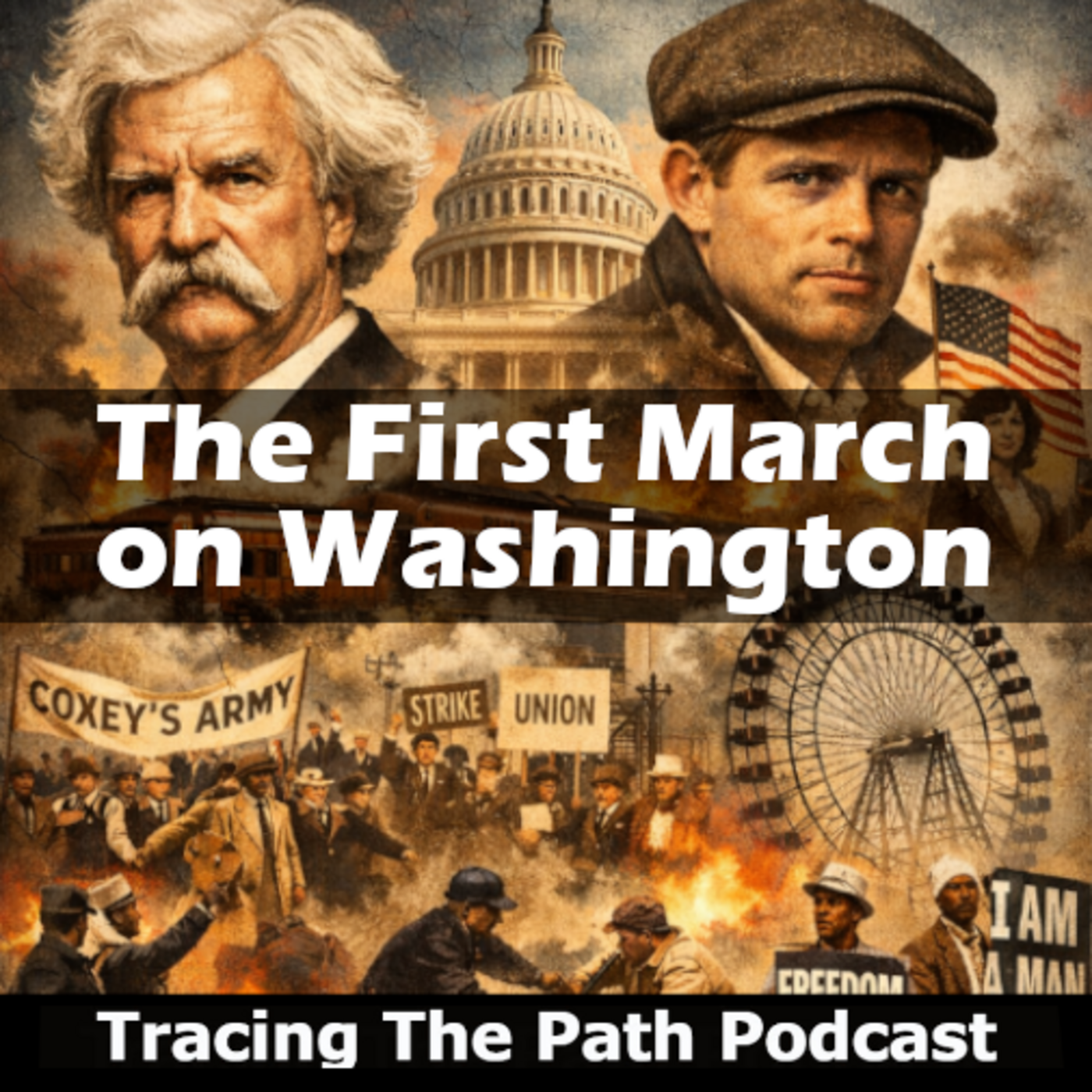
Episode 73: The Gilded Age: First March on Washington D.C.
Jan 3000:36:26Tap to summarizeIn 1894 Jacob Coxey decided to take thousands of unemployed and March on Washington. Well, that was just the prequel to 1964 March for Civil Rights. But it's how A. Philip Randolph was indoctrinated to the idea. And crazily this store involves both Mark Twain and Jack London, in addition to Pullman Porters, the Ferris Wheel, Eugene V Debs, the May Day Riots, Frederick Douglass, and even the Statue of Liberty.
Transcribe →