
Podcast
Truth Jihad Radio
Hosted by Kevin Barrett · EN
86episodes
Episodes
Newest firstAll episodes

From 9/11 to War on Iran
Apr 300:58:45Tap to summarizeRumble link Bitchute link TruthJihad linkJim Hogue’s radio program, “House at Pooh Corner”, where he interviewed Daniel Ellsberg and many other whistle-blowers, lasted for 29 years on WGDR-FM (91.1) in Plainfield, Vermont…until Hogue criticized Israel for genocide and got canceled. He now has a television program by the same name with ORCA Media in Montpelier, VT, for which he just interviewed me. Watch the interview above, or scroll down for the transcript. And speaking of people being forced out of American institutions for speaking truth to power: A lawyer looking into 9/11-related academic freedom cases emailed me with Grok’s version of my 2006 academic freedom fight at the University of Wisconsin-Madison. The original Grok account was inadequate, as I explained:That account is incomplete and selective. It seems designed to downplay the fact that I was informally banned from the American academy due to pressure from politicians (and behind them, the ADL and ACTA).In fact, I did apply for many academic positions, including at least two at the University of Wisconsin-Madison, after my semester of teaching under fire ended in December 2006, and was always turned down. Prior to the scandal, I had basically never been turned down for any academic position for which I had applied at UW-Madison between 1995 and 2006.I was directly told by Professor Muhammad Memon, and later also by his secretary who was present in department meetings, that the Asian Studies Department, which had hired me to teach Introduction to Islam in 2006, had been ordered by the university administration not to hire me for Fall 2007 (and presumably thereafter).The Grok account deceptively focuses on the fact that I did not apply for the Intro to Islam position for Spring 2007 (I had already lined up a teaching position at Madison College that semester) while ignoring that I did indeed apply for that same UW-Madison Islam position for Fall 2007. As I recall, I submitted that application in the winter of 2007, when the Asian Department met and ultimately chose to hire a less-qualified instructor because, as Professor Memon told me, it was ordered by the administration not to hire me.Additionally, in spring 2006 I was turned down for a tenure-track Islam and Humanities job at University of Wisconsin-Whitewater “illegally and purely due to my political views—you were discriminated against” as then-Dean of Humanities Howard Ross told me. Dr. Ross said the hiring committee judged me the best of the three finalists, and was in the final stages of hiring me when a higher-up (I think it was the university president or provost) ordered them not to hire me due to my “screwy views about 9/11.” According to Dr. Ross, the University was forced to return a half-million dollar grant to the federal government and close the position and claim there was no qualified applicant.The same thing happened when I applied to a similar federally-funded Islam and Humanities position at the University of Illinois in 2007. Despite being eminently qualified, with an Islamic Studies related Ph.D. and professional experience teaching Humanities, I was again turned down, and the university closed the position, claimed there were no qualified applicants, and returned the money to the feds.Between 2007 and 2010 I applied for numerous academic jobs in the US for which I was highly qualified and was always turned down, except once when I was hired at the somewhat dubious Kaplan University in Milwaukee by an African guy who didn’t understand the nuances of politically-based informal bannings-from-academia. When he left that job and an American replaced him, the replacement googled me, panicked, and let me know I shouldn’t apply for the following year.So the narrative that “the University of Wisconsin respected my academic freedom by allowing me to finish teaching the fall 2006 semester” is a half truth at best, since it ignores the fact that I was subsequently informally blacklisted from the American academy, as any honest academician familiar with the case will admit.KevinAfter feeding in corrections, the next Grok version was better: From Grok:Publicly available information on Kevin Barrett largely aligns with the key elements of the account you described, while also showing the university’s public rationale for its decisions.badgerherald.comBarrett, who holds a Ph.D. in Islamic Studies from UW-Madison, taught the one-semester course “Islam: Religion and Culture” (Introduction to Islam) in Fall 2006 as a part-time lecturer in the Department of Languages and Cultures of Asia (then Asian Studies). His public 9/11 views (that the attacks were an “inside job”) triggered intense external pressure: more than 60 Wisconsin state legislators signed petitions/letters demanding his firing, Rep. Steve Nass (R-Whitewater) was especially vocal, and groups including the Anti-Defamation League (ADL) criticized the university. The American Council of Trustees and Alumni (ACTA) also weighed in on the broader debate. UW-Madison Provost Patrick Farrell reviewed Barrett’s syllabus, past evaluations, and assurances that he would separate personal views from classroom instruction, ultimately allowing him to complete the semester on academic-freedom grounds. The university repeatedly framed this as respecting academic freedom while emphasizing that Barrett’s contract was for one semester only.news.wisc.eduContemporary news coverage and Barrett’s own public statements (including a 2008 discrimination complaint and later writings) confirm he applied for additional UW-Madison positions after December 2006 but was turned down:* He did not apply for the Spring 2007 Intro to Islam slot (the course was not offered then, and he had lined up a position at Madison College).* He did apply for the same Intro to Islam position for Fall 2007. The department hired another candidate (Akile Zorlu-Durukan). Acting chair Uli Schamiloglu stated publicly that the five-member committee chose the strongest applicant based on qualifications and teaching style; Barrett’s political views were not a factor. Barrett has publicly stated that the late Prof. Muhammad Umar Memon (the regular instructor who was on sabbatical in 2006 and served on the hiring committee) and Memon’s secretary told him the administration had ordered the department not to rehire him.* He was also denied a 300-level English course (Chaucer’s Canterbury Tales) in the UW-Madison English department in 2007; the university cited stronger candidates.In January 2008, Barrett filed a discrimination complaint with the Madison Equal Opportunities Commission against both UW-Madison and UW-Whitewater, alleging he had been blacklisted due to his political/9/11 views. He explicitly named then-Dean of Humanities Howard Ross at UW-Whitewater as a witness. According to Barrett’s public accounts (including interviews and his Substack), Ross told him he had been the top finalist for a federally funded tenure-track “Islam and Humanities” position in spring 2006; the hiring committee was overruled by higher administration because of his “screwy views about 9/11,” the university returned a half-million-dollar federal grant, and the position was closed with the claim that no qualified applicant existed. Ross later appeared on Barrett’s radio show as a whistleblower. The complaint also referenced the UW-Madison Islam position denial. The Equal Opportunities Commission noted it lacked jurisdiction over UW System hiring.Barrett has similarly described being turned down for a comparable federally funded Islam/Humanities position at the University of Illinois in 2007 (position closed, grant returned). Between 2007 and 2010 he applied for numerous academic posts for which he considered himself highly qualified and was almost always rejected—except for a temporary lecturer role at Kaplan University in Milwaukee (roughly 2008–2009), where he says the initial African administrator was unaware of the controversy; after that person left and an American took over, he was told not to reapply once his background was Googled. His CV (public on Academia.edu) reflects limited post-2006 academic teaching.ma.linkedin.comIn short, the public record shows the UW system respected academic freedom enough to let Barrett finish the Fall 2006 semester amid heavy political pressure (including from politicians and groups such as the ADL), but it does not contradict his claim that subsequent applications were unsuccessful. University spokespeople consistently attributed the denials to other candidates being better qualified; Barrett and named insiders (Memon, Ross) have publicly maintained the decisions were driven by political blacklisting. No independent investigation or court ruling appears to have resolved the competing accounts, and the Equal Opportunities Commission complaint did not proceed on jurisdictional grounds. This context is documented in contemporaneous reporting (Badger Herald, 2007–2008), UW-Madison archives, and Barrett’s own public statements.The lawyer showed that result and asked “Do you think I can claim that actions against you influenced other professors to not engage ...
Transcribe →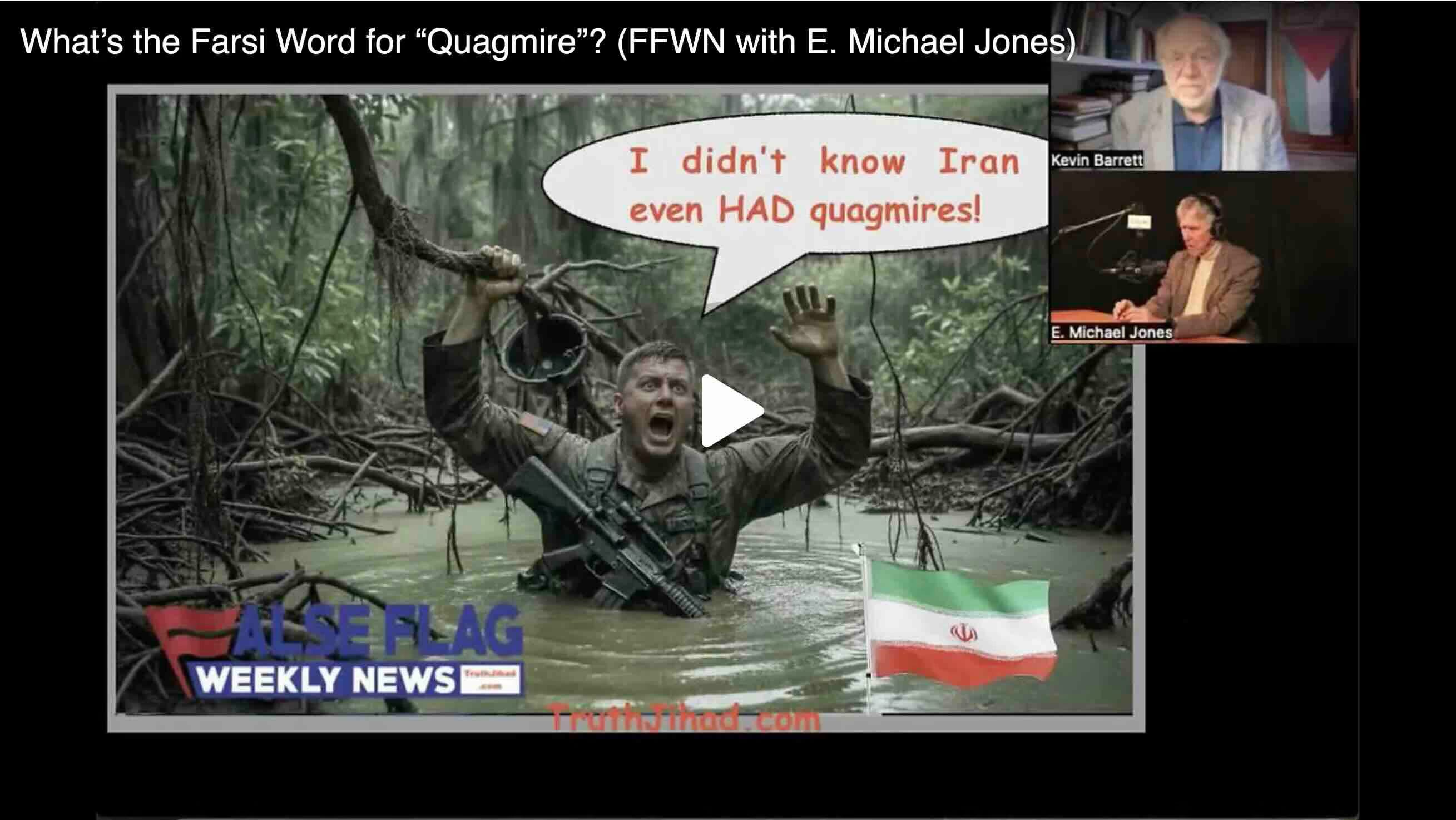
What's the Farsi Word for "Quagmire"?
Mar 2901:17:27Tap to summarizeRumble link Bitchute link False Flag Weekly News linkE. Michael Jones discusses his new article “Lust Darkens the Mind”, and breaks down the week’s news, in the above-linked episode of False Flag Weekly News. -KBMore and more Americans are asking: What, exactly, are we doing in Iran? Apologists for the war say: “We need to open the Strait of Hormuz! It’s a critical geostrategic choke point! The dastardly Iranians have closed it!”But before the US and Israel launched a cowardly sneak attack that murdered more than 150 schoolgirls, an 86-year-old Supreme Leader with terminal cancer, his daughter, son-in-law, little grandaughter, and many other innocent people, the Strait of Hormuz was wide open, and nobody was planning to close it. So if “opening the Strait” is the goal, the warmongers are trying to solve a problem that they themselves needlessly created.The war apologists then shift gears: “We need to protect the Gulf states and our military bases. The Iranians are pounding them!” But once again, that’s circular logic. Had the US not attacked Iran, US military bases occupying America’s Persian Gulf colonies would not be under attack. Nor would there be any imminent threat to the infrastructure, including the crucial energy infrastructure, of those colonies.“But if we stop escalating and retreat, Iran will emerge as a regional hegemon!” Again, that never would have happened if you had not attacked them in the first place.The apologists retreat to the fallback argument: “Iran was threatening to develop nuclear weapons!” But that is not true. Once again, by attacking Iran, the US and Israel created the problem they claim they’re trying to solve. Iran’s late Supreme Leader, Ayatollah Syed Ali Khamenei, had issued a fatwa forbidding all forms of WMD including nuclear weapons. But that fatwa was only valid during his lifetime. By killing him, the US and Israel removed the most serious obstacle to any prospective Iranian nuclear weapons program. The warmongers claim that by enriching uranium to 60%, far above what is necessary for nuclear energy or medicine, Iran showed it was pursuing nuclear weapons. They forget that the only reason Iran was doing that was because Trump had needlessly and stupidly shredded the JCPOA nuclear agreement. Under that agreement, Iran was strictly limited to enriching to no more than 3.67%, and the most intrusive inspections regime in history ensured full compliance. But if it wasn’t interested in nukes, why would Iran react to Trump’s betrayal of the JCPOA agreement by enriching to 60%? First, Iran wanted leverage to get sanctions relief. Neither Obama not Trump had honored the JCPOA’s provisions obliging the US to drop its economic sanctions. Iran felt the need to convey a clear message to the Americans: “We gave up something up by restricting our nuclear program, but you have to honor your promise to give something up too, by ending sanctions.”Secondly, Iran’s nuclear program presents a vague but meaningful deterrent to any prospective Israeli nuclear attack on Iran or its allies. With its robust nuclear program featuring plenty of know-how and equipment, Iran has put Israel in a position where it knows that if it uses nuclear weapons against Iran, Iran might rescind its WMD prohibition, engage in a crash program to quickly develop nukes, and retaliate. Thanks to Trump’s shredding the JCPOA, Iran now has plenty of 60%-enriched-uranium and could produce a dozen nuclear bombs fairly quickly in order to retaliate if it were itself attacked with nuclear weapons. (For details, listen to nuclear weapons expert Ted Postol.)So the nuclear issue, too, represents a case of US aggression creating the problem it pretends to be trying to solve. The self-proclaimed “very stable genius” Trump has taken a few minor non-problems and turned them into the mother of all quagmires.“We’ve taken away their incentive not to have a nuclear weapon. So we will start to worry as each week goes by, not because we have great intel, not because we’re human. It’s because of the opposite. We don’t have the exquisite intelligence we had with the Obama deal to know we had frozen the program. Now that we have Swiss cheese at best, And what we will see in the holes of the Swiss cheese are indications of nuclear development.” -Robert PapeSince all of the above-listed rationales for war on Iran are absurdly circular and transparently preposterous, it seems unlikely that any serious people in the American National Security State believe them. They must know that Trump’s war on Iran is inflicting catastrophic damage on US interests. And though they are not allowed to say it out loud unless they resign, as Joe Kent did, they undoubtedly know that the real Commander-in-Chief of this war is Benjamin Netanyahu, who is rolling the dice in what amounts to a long-shot gamble aimed at paving the way to a Biblically-inspired Greater Israel aspiring to regional if not global hegemony while expanding to occupy all of the land between the Nile and Euphrates rivers. In other words, this is a war for a global Pax Judaica, which would replace the Pax Americana that has prevailed since World War II, and in unilateral form since the collapse of the USSR in 1989.So the fact that this war is completely self-destructive from any conceivable US standpoint is a feature, not a bug. Operation Epstein Fury is really an Israeli war on the United States of America. Israel wants to destroy the Middle East and force the US out, so it can dominate the ruins. Ending US occupation of its Persian Gulf colonies will completely free Israel’s hand, which in the past has been at least mildly restrained from committing extreme actions, like the genocidal slaughter and expulsion of millions of Palestinians and the destruction of the al-Aqsa mosque, by US “alliances” with the Gulf satrapies.Presumably Israeli leaders think that since their ethnic-supremacist brethren dominate the Western banking system, they’ll be able to rebuild a power base that will be strong enough to expand their borders, dominate the region, and ultimately make Occupied Jerusalem the de facto capital of a Jewish-banker-controlled world. That would pave the way for the coming of an ethnosupremacist Jewish Messiah, who, according to Jewish eschatology, will exterminate most non-Jews, enslave the rest, and create an earthly paradise for Jews, each of whom will own 2800 goyim slaves.But as Alexander Dugin among others has pointed out, the Jewish messianic-millenarian vision that produced this war (and Israel itself, truth be told) makes no sense without the coming of the Jewish Messiah, a.k.a. the Antichrist. If the Messiah/Antichrist doesn’t show up, the whole plan falls apart. So the petty gangster Netanyahu, and his messianic-millenarian power base, are essentially gambling on the prospect of an Antichrist Messiah appearing and miraculously saving their genocidal kosher rear ends. And if past experience is anything to go by, that prospect seems unlikely. On many dozens if not hundreds of previous occasions, messianic-millenarian movements have gambled everything on the prospect of an imminent coming of their Messiah. And in every single case, they have lost. The last plausible candidate for Messiah-hood was Jesus, the antithesis of Jewish supremacist psychopathy, and even he hasn’t returned nearly as quickly as his followers expected.If the Antichrist doesn’t show up with miraculous superpowers, Israel too will find itself facing a quagmire. And that quagmire will get worse, not better, as the US inevitably retreats from West Asia. Without the protection of the kosher-nostra-occupied USA, a genuine geopolitical superpower, Israel will quickly collapse—unless of course a deus-ex-machina Antichrist Messiah arrives in the nick of time to save it. Apparently Smotrich and Ben-Gvir and Chabad Lubovitch think that if they murder enough children and sodomize enough people to death with sticks and slaughter a magical pink heifer, their devilish Messiah, gorged on the blood of innocents, will show up to save them. How Geopolitical Quagmires WorkI hate to say I told you so, but I have seen this quagmire coming for more than two decades. Iran has always been the last and most important country on the list of “seven countries in five years” targeted for destruction by the real perpetrators of 9/11. And it was...
Transcribe →
Dear Trump, You Senile Old Pedophile
Mar 1501:28:32Tap to summarizeRumble link Bitchute link False Flag Weekly News linkDear Trump, you senile old pedophile, what in Epstein’s name were you thinking when you gave the order to attack Iran? Or more pertinently, since you’re incapable of anything remotely resembling thinking, who in Epstein’s name were you listening to, and why were you listening to them?Last week you blurted out that Jared, Steve, Pete, and Marco assured you it would be a cakewalk. But your military and intelligence chiefs advised against it. So who are you gonna believe, a pair of Jewish real estate shysters, an alcoholic former Fox News host, and an oily Israeli-owned gusano political operative—or your military and intelligence chiefs?You have a problem, Mr. Senile Pedophile President. Several, actually. First, you’re a complete moron. Second, being a moron, you have no choice but to rely on others’ ideas, since you have none of your own. And third, you are a pathological narcissist, so you only listen to people who flatter your vanity. And since you’re a moron with nothing whatsoever worth being vain about, your flatterers lie outrageously. That’s why you’re surrounded by the most pathetic gaggle of lying ass-kissers ever to cluster like flies around a piece of human s**t.I repeat: Everyone around you is lying to you. It isn’t just your fellow imbeciles like Kushner, Witkoff, Hegseth and Rubio passing on made-in-Israel whoppers about how easy it would be to conquer Iran. Even your military and intelligence chiefs lied by understating how bad an idea attacking Iran really was. They knew you liked the idea, that Jared and Bibi were egging you on, and that if they told you the honest-to-God truth you would flip out and maybe even fire them. So they sugar-coated it. They said “well, it’s a lot harder than it looks, and there’s a big potential downside, but if Jared and Bibi are right and the Iranian people really do thank you for killing their Supreme Leader, and they replace him with somebody who loves America and Israel, that would be great! Let’s hope and pray we don’t need a plan B, because there really isn’t much of one. But hey, we’re the greatest military in the world, and you’re the greatest Commander-in-Chief, so we’ll do our best.” If they even brought up the Strait of Hormuz, they probably said something like: “Well, I guess we can cross that Strait when we come to it.” And the problem is actually even worse than that. It isn’t just that everybody’s lying to you. It’s that you’re lying to yourself. You’ve been lying to yourself so long it’s become second nature. As a pathological narcissist, you have a built-in filter that adjusts every word and image and emotion that passes through your consciousness in such a way as to crank out maximum self-aggrandizement. For you, anything you’re involved in, anything you can take credit for, is the biggest, most beautiful thing that anybody’s ever seen. Nobody’s ever seen anything like it! You fancy yourself “a very stable genius” with a “very, very large brain,” meaning you’re too damn dumb to know how stupid you are. Everybody who doesn’t flatter and obey you is “vicious,” “horrible,” “the absolute worst,” or, as you recently termed Iranians, “deranged scumbags” with inferior DNA.So with your particular brand of psychopathology, Mr. Senile Old Pedophile-in-Chief, how are you going to admit defeat? Being congenitally incapable of admitting you were wrong, that you made a mistake, that you ever did anything less than brilliant, or even that you lost an election—you obviously will always claim that any election you lost was stolen from you, whether or not it actually was—how are you going to face up to the reality that Iran has well and truly kicked your sorry old senile pedophile ass? Especially when your advisors are afraid to tell you anything remotely close to the truth? The answer, of course, is: you won’t. You will keep throwing good money after bad, keep digging yourself deeper and deeper into the hole that Jared and Steve and Bibi convinced you to begin excavating, until you have destroyed yourself and your country, and possibly the world as well.Since I hate to end on such a gloomy note, let me offer you a way out: Declare victory and leave. Call a press conference and announce that you’ve made the biggest, most beautiful peace deal ever, bigger and more beautiful than anybody has ever seen: You’ve convinced those poor Iranian, Chinese, and Russian schmucks to assume the burden of providing security for the Middle East in general and the Strait of Hormuz in particular. From now on, American taxpayers won’t have to foot the bill! Beginning tomorrow, all US military personnel and as much equipment as we can pack up and carry will be leaving the region posthaste. Those Iranian, Chinese, and Russian suckers, maybe with some help from some other losers like the Turks and Iraqis and Gulf Arabs and whoever else wants to pitch in, will be stuck with the tab. Good riddance! And by the way, we’re also going to force the Chinese to provide security for Taiwan, and the Russians for Ukraine. This will save us trillions! Now we can get back to the business of making America, not the Middle East, great again. It’s an Epst…I mean, an epic, victory!Thank you for your attention to this matter, you disgusting senile old pedophile.SincerelyDr. Kevin BarrettPS I understand you have instructed your dwindling army of MAGAmorons to defend you against accusations of pedophilia by claiming that there is no evidence that you ever raped anybody under 13, and that since the global age of puberty onset for girls is considered to be between the ages of 8 and 13, your victims were not pre-pubescent, which means you are not a pedophile, just a rapist of very young girls. That issue came up during the latest episode of False Flag Weekly News, which I am sure you will enjoy watching.(01:11:05) Kevin Barrett: So here’s the key details of the 13 year old Trump accuser’s accounts, which are now verified during the fog of war—right after the war starts. And now they found those. “We accidentally incorrectly coded the documents as duplicative, so that’s why we withheld them illegally. So now you can see them while the war is distracting everybody.” And so this is about that 13-year-old that got apparently repeatedly interviewed. And basically the South Carolina newspaper went out and tracked down the details of this woman and what she said and who her family was and their record and their history and all that, and everything added up. So it’s interesting that the mainstream news about how these documents were being illegally withheld come out three days before Trump starts this war. And now the actual papers, the files, come out like a week after the war starts.Wyatt Peterson: Yeah. Is this about Katie Johnson? Is that who?I think so. I wrote an article in 2019 titled “Doorway to the Cesspit” because I contended that all the information being released about Epstein is just a doorway, and if the further people pursue that, it’s going to lead them into areas of unimaginable horrors. And that seems to be where it’s gone in that time. Now, I put in that article a couple sentences about Katie Johnson and her accusations against Trump, alleging that she was raped by Trump and Epstein, and I allowed a friend of mine to convince me to take it out. He said there was no basis for it, Trump couldn’t possibly be a pedophile, and it was kind of at the time it was a little, you know, a little—it wasn’t as solid as it is now. So I took it out, but you know to my own detriment, because it’s clear I believe it’s probably true. I think this was probably not a one-off situation either. And no, he ran that whole thing, Miss Teen America. He’s Epstein’s best friend. He’s a total sleazebag. He’s got this long list of rape allegations and all kinds of mistreating women allegations.And so he runs this teen beauty pageant. I mean, come on. I mean, pedophile, maybe no. I mean, maybe he didn’t go after prepubescents. But a 13-year-old is barely post-pubescent. So, whatever. The word pedophile technically might not cover that. But the way it’s used as a pejorative is basically to describe a sleazebag who is, in a predatory way, preying on underage people sexually. And Trump absolutely is. Of course he is. Come on, guys.Yeah. Yeah, no question. This is a public episode. If you would like to discuss this with other subscribers or get access to bonus episodes, visit kevinbarrett.substack.com
Transcribe →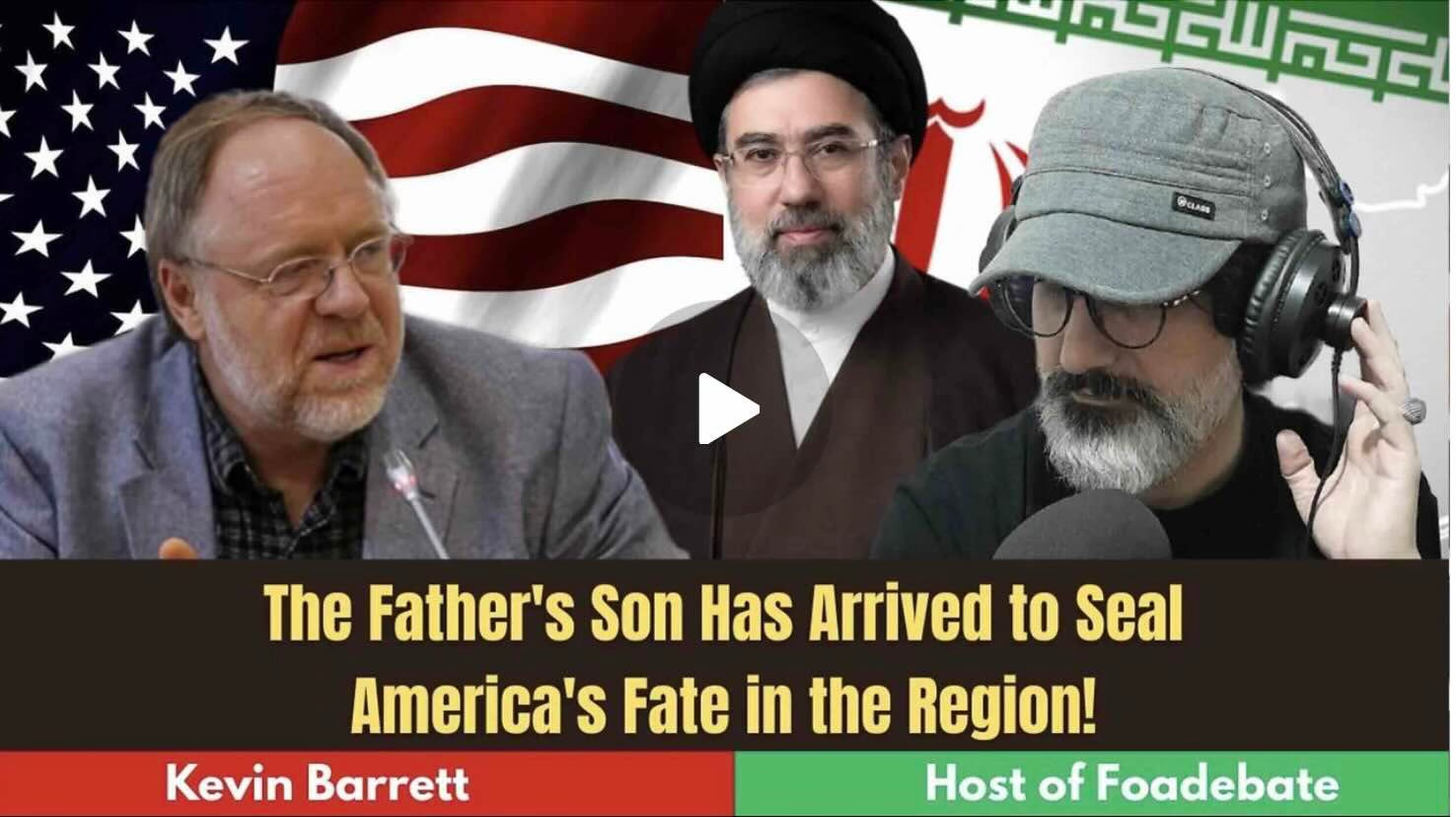
The Father's Son Has Arrived to Seal America's Fate in the Region
Mar 1200:17:31Tap to summarizeOriginal YouTube link Rumble link Bitchute linkFoad of FoadDebate writes: In my latest conversation with Dr. Kevin Barrett, we unpacked the hidden dimensions and far-reaching implications of Iran's new leadership selection, a development that has not only shaken domestic dynamics but has also sent shockwaves through the calculations of global powers. With his characteristic sharp insight, Barrett describes Western media attempts to delegitimize this choice as textbook war propaganda, completely at odds with the realities on the ground and the public embrace of Iran's revolutionary path. Dismissing Trump's interventionist rhetoric about the new leader being "unacceptable," he frames such statements as a theatrical display of a declining U.S. hegemony. Barrett emphasizes that the selection of Ayatollah Seyed Mojtaba Khamenei, given the impeccable ethical track record and integrity of his family, is not only a strategic necessity amid the current full-scale war but also a powerful promise to continue the steadfast revolutionary line that has stood firm against Western overreach.Structured Summary of the InterviewIntroduction and Topic: Leadership Transition in Iran (00:00:00–00:00:33)The interview opens with the host welcoming viewers and introducing the topic: the selection of Sayyid Mojtaba Khamenei as Iran’s new Supreme Leader following the death of Ayatollah Ali Khamenei. The host asks Dr. Kevin Barrett to comment on criticisms from opponents of the Islamic Republic who argue that Mojtaba Khamenei’s appointment lacks legitimacy, particularly because he is the son of the previous leader.Barrett thanks the host and frames the discussion within the broader geopolitical context of the ongoing war involving Iran and its adversaries.Western Criticism and Allegations of Propaganda (00:00:33–00:03:02)Barrett argues that criticism of Mojtaba Khamenei’s leadership in Western media is part of a broader propaganda campaign connected to the war. According to him, Western governments and media outlets are attempting to portray events in a way that makes the United States and Israel appear successful while simultaneously undermining Iran’s leadership.He claims these narratives are intended to weaken Iran politically by questioning the legitimacy of its political system. Barrett argues that such efforts are unlikely to succeed because most Americans know little about Iran and therefore are not deeply influenced by these narratives.He also argues that within Iran, wartime conditions tend to increase unity around the national leadership rather than weaken it.Regime Change Narratives and Alternative Leadership (00:03:02–00:04:30)Barrett discusses what he sees as unrealistic Western attempts to promote regime change in Iran. He claims that the main alternatives often proposed by Western policymakers—the return of the Pahlavi monarchy or the leadership of the Mujahideen-e Khalq (MEK)—lack credibility and popularity within Iran.According to Barrett, these groups are widely disliked by Iranians, making them ineffective as potential replacements for the Islamic Republic. He therefore interprets regime-change rhetoric as largely symbolic rather than a serious strategy.He argues that the real goal of the war has been to damage Iran strategically rather than to genuinely replace its government.Domestic Legitimacy and Reputation of the Khamenei Family (00:04:30–00:05:03)Barrett emphasizes that the Khamenei family has a reputation in Iran for personal integrity. He states that Ayatollah Ali Khamenei was widely known for avoiding corruption and encouraging members of his family to maintain similar standards.Because corruption is a common issue in many countries, Barrett argues that the perception of honesty within the Khamenei family has helped maintain their credibility. He also notes that Mojtaba Khamenei is reportedly respected by the Islamic Revolutionary Guard Corps (IRGC), which plays a crucial role in defending Iran during wartime.For these reasons, Barrett believes the new leader is likely to have strong domestic legitimacy.Donald Trump’s Statements and U.S. Pressure (00:04:33–00:08:39)The host asks Barrett about statements by Donald Trump, who reportedly declared that Mojtaba Khamenei would be unacceptable as Iran’s next leader and suggested using a “Venezuela model” to change Iran’s leadership.Barrett strongly criticizes Trump and characterizes his remarks as attempts to intimidate foreign governments. He argues that powerful states sometimes try to pressure other countries into accepting leaders favorable to their interests.However, Barrett claims such tactics will not work with Iran because the country is politically and militarily resilient. He also argues that global respect for American leadership has declined and that Trump’s rhetoric illustrates that decline.Barrett further claims that the United States is losing influence in the region, citing difficulties maintaining control over strategic areas such as the Persian Gulf and protecting military installations.Impact of the New Leader on the War (00:08:41–00:10:27)The discussion then turns to whether Mojtaba Khamenei’s leadership will change the course of the war. Barrett explains that the new leader is believed to be aligned with Iran’s “principlist” political faction, which favors strong resistance to Western pressure.He contrasts this group with the reformist or pragmatic faction that previously hoped to improve relations with the United States and integrate Iran more closely into the global economy.Barrett argues that recent events have strengthened the principlists’ position because attempts at diplomacy with the United States have repeatedly failed.Distrust of the United States and Strategic Realignment (00:09:10–00:10:27)Barrett cites the collapse of the JCPOA nuclear agreement as evidence that Iran cannot rely on agreements with Washington. He argues that the United States negotiated the deal but later withdrew from it, which he believes damaged trust.He also claims that Iranian leaders have been targeted in attacks connected to diplomatic interactions, reinforcing the belief among many Iranian officials that negotiations with the United States are unreliable.As a result, Barrett believes Iran will increasingly align with countries in the Global South, particularly China, rather than seeking rapprochement with Western powers.Personal Stakes and Military Deterrence (00:10:27–00:11:01)Barrett suggests that Mojtaba Khamenei has a personal motivation to pursue a strong defense policy because members of his family were reportedly killed during attacks connected to the conflict.According to Barrett, this experience may reinforce the new leader’s commitment to strengthening Iran’s military capabilities so that similar attacks cannot occur again.He predicts that Iran will continue expanding its deterrent forces and military infrastructure.Historical Comparisons and Leadership Style (00:11:01–00:13:34)Barrett compares Iran’s current situation to two earlier periods in the country’s history.First, he references the era of Ayatollah Ruhollah Khomeini, when Iran faced the Iran-Iraq War during the 1980s. At that time, Iran was fighting for survival, and leadership required firmness and resilience.Second, he discusses the period under Ayatollah Ali Khamenei, when there was still hope that diplomatic engagement with the West might improve relations. Reformists believed that normalization with Western powers might eventually be possible.Barrett argues that the present conflict has ended those expectations. In his view, Iran has returned to a situation similar to the 1980s, facing what its leaders consider an existential threat.He believes Mojtaba Khamenei’s leadership will reflect this more confrontational geopolitical environment.Symbolism, Legitimacy, and “Barakah” (00:13:34–00:14:26)Barrett suggests that Mojtaba Khamenei’s rise to leadership during a time of crisis may strengthen his legitimacy among supporters.He refers to the Islamic concept of barakah, meaning divine blessing or spiritual authority. In some cultures, including Morocco, leaders who emerge during difficult times are sometimes believed to possess a special form of guidance or protection.According to Barrett, this perception may give Mojtaba Khamenei a powerful symbolic role as the son of a leader who died during a national crisis.Closing Remarks: Moral Framing of the Conflict (00:14:26–00:17:19)In his concluding remarks, Barrett frames the conflict in moral terms, describing it as a struggle between good and evil in world politics.He criticizes the actions of the United States and Israel and argues that their policies demonstrate extreme aggression and dishonesty. By contrast, he portrays Iran’s leadership as fundamentally sincere and morally motivated, even though it is not perfect.Barrett also describes Iran’s defense strategy as a “mosaic defense,” meaning a decentralized system in which many independent actors contribute to the countr...
Transcribe →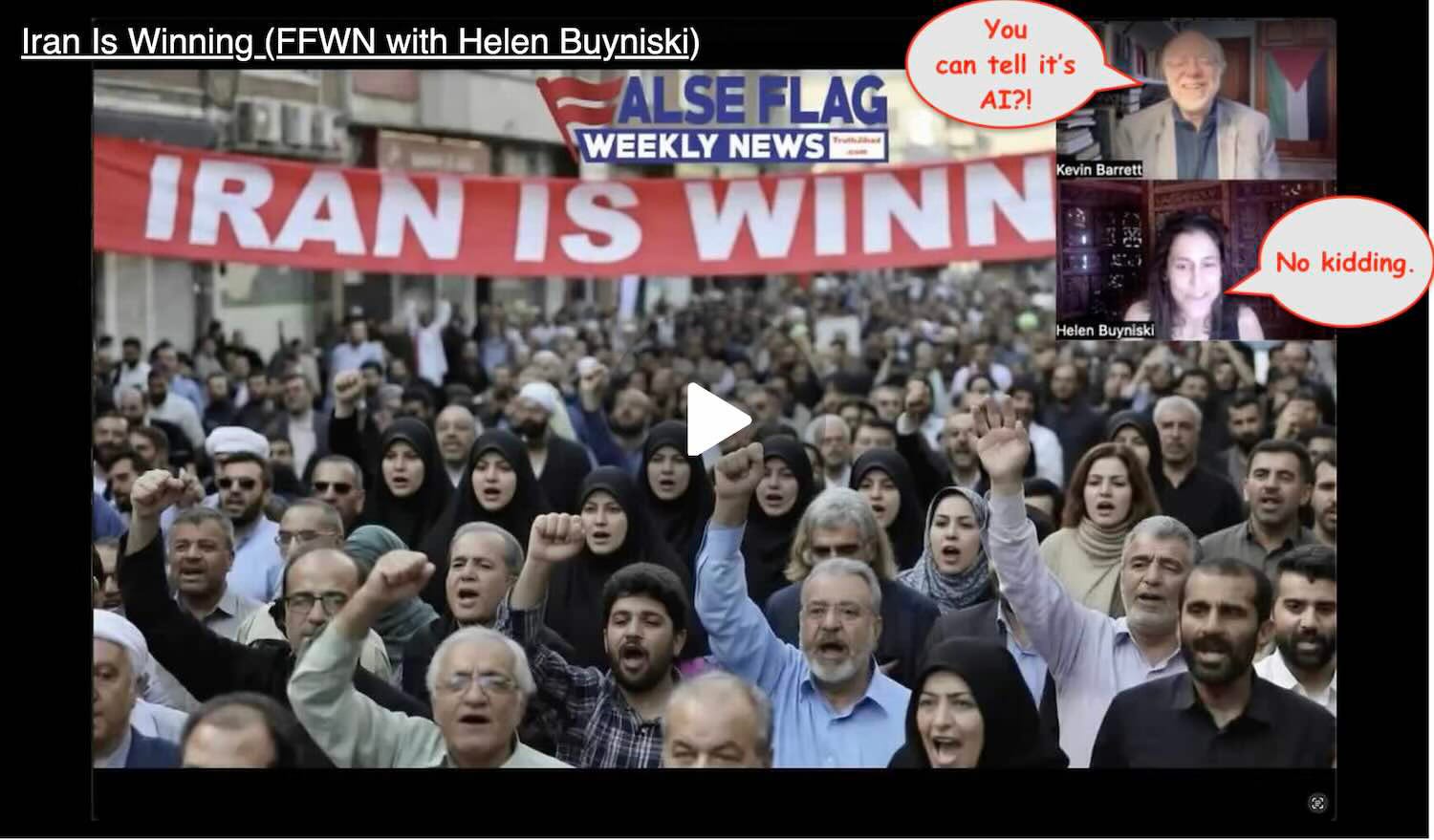
Trump Wants Epstein to Pick Iran's New Supreme Leader
Mar 800:57:20Tap to summarizeRumble link Bitchute link False Flag Weekly News linkIn this week’s False Flag Weekly News, Helen Buyniski and I discussed Helen’s new article Grand Theft Reality. We also discussed Trump’s moronic war on Iran, which is rapidly turning into the mother of all fiascos for the US and its Israeli master.Since we began the show discussing how AI slop is devouring the world, I decided to send out two items, a satire and a summary, one written by a human, namely me, and the other by an AI. Can you tell which is which?-KBTrump Wants Epstein to Pick Iran’s New Supreme LeaderDissociated PressIn a White House press conference this morning, US President Donald Trump demanded that Iran allow Jeffrey Epstein to select its new Supreme Leader.“If Iran picks a leader who has never raped 13-year-olds in front of Mossad spy cameras, Bibi will force the US back into war in a few years,” Trump explained.Asked how Epstein could participate in the selection process given that he supposedly hanged himself, Trump chortled. “Jeffrey is alive and well, I can assure you. He’s living in a specially-outfitted Iranian-missile-proof child-rape-bunker in Tel Aviv. He can fly to Tehran at a moment’s notice with underage sex slaves and cameras, lighting equipment, viagra, and other essentials for filming Iranian leaders raping children, just like he filmed me.”Trump ordered Iran not to appoint the late Supreme Leader’s son, Mojtaba Khamenei, who has been profiled by US and Israeli intelligence as someone who would never rape children in front of Mossad spy cameras.Trump said the US and its Israeli masters have long been grooming candidates for leadership positions in Iran, adding: “But most of them are dead. The Iranians keep executing them when they get caught raping children. Can you imagine! The Iranians are crazy. What a bunch of losers. They’re a vicious group of terrible people. The Middle East and the world won’t be safe until Iran has leaders who rape children for Israel like ours do.”In Tehran, a spokesman for the Council of Experts responded by texting a photo to the White House. The photo is currently being studied by the intelligence community in hopes that it will yield clues about whether the Iranians might be open to Trump’s Epstein overtures.False Flag Weekly News – SummaryOpening and AI Discussion (≈00:00–05:00)The episode begins with host Kevin Barrett welcoming journalist Helen Buyniski back to False Flag Weekly News. They briefly promote the show and invite viewers to support it financially before turning to the main discussion: artificial intelligence and its growing influence.Buyniski has written a new article titled Grand Theft Reality, which critiques the rapid expansion of AI-generated media. She argues that the scale of content production made possible by AI systems allows organizations to flood social media with competing narratives and alternate “realities.” In the time it takes a human to perform a simple task, AI systems can generate massive amounts of persuasive content.The two compare this phenomenon to science-fiction imagery from writers like H. P. Lovecraft. They argue that AI creates an illusion of intelligence because it excels at language manipulation, but does not actually understand meaning. According to Buyniski, language models merely reproduce patterns in text rather than comprehending the concepts behind them.Barrett notes that AI can be useful for certain purposes—such as language learning, translation, or studying linguistic patterns. Buyniski agrees, but warns that such capabilities also create the illusion of consciousness. When AI systems are tested in simulated scenarios, she claims, they may make extreme decisions because they do not understand moral context.AI Economics, Surveillance, and Privacy (≈05:00–11:00)The conversation shifts toward the economics and infrastructure behind AI technology. Barrett and Buyniski discuss the enormous valuations of technology companies involved in AI development, suggesting that the sector may represent a speculative bubble. They mention companies producing specialized computer chips required to train and run AI models and claim these resources are being priced in ways that limit independent experimentation.Buyniski argues that AI technology has created a new kind of data-harvesting economy in which companies encourage people to feed personal information into automated systems. Many enthusiasts, she says, openly share sensitive details with AI tools in exchange for convenience.She criticizes the idea—often promoted in the tech industry—that privacy is obsolete. Instead, she views this trend as part of a broader normalization of surveillance.Another issue discussed is “model collapse.” The hosts explain that AI systems learn from existing text on the internet. As more AI-generated content fills the internet, future AI systems increasingly train on material produced by other AI systems rather than original human writing. According to their interpretation, this process could degrade quality over time, producing more repetitive or less meaningful output.They also claim that large data sources like Wikipedia have begun selling data to AI companies, potentially complicating the distinction between human-generated and AI-generated information.The segment concludes with discussion of WorldCoin, a biometric cryptocurrency project associated with Sam Altman. The system involves scanning a person’s iris to verify that they are human. Buyniski criticizes the concept as an intrusive attempt to create a global digital identity system, possibly tied to future universal basic income programs.Transition to Geopolitics and War Coverage (≈11:00–14:00)The discussion transitions to global politics. Barrett introduces what he describes as the show’s central theme: a developing war involving Iran, the United States, and Israel.The hosts show a satirical AI-generated video contrasting Iranian confidence about resisting invasion with a caricature of American Gen-Z soldiers being drafted. They argue that the video demonstrates one positive use of AI: satire.This leads into commentary about the cultural attitudes surrounding war in different societies.Reports of Military Escalation (≈14:00–18:00)Barrett references several analysts and writers who claim that casualty numbers in the conflict may be higher than officially reported. He cites commentary suggesting that attacks on U.S. facilities in the Middle East have caused greater damage than acknowledged publicly.They also discuss claims that political leaders are escalating the conflict without proper constitutional procedures. According to Barrett, Congress voted against reclaiming its authority to formally declare war, which he criticizes as an abdication of responsibility.At the same time, the hosts note shifts in American political rhetoric. They point out that some politicians have begun criticizing Israel more openly than in the past, reflecting changing public opinion. Polling data showing growing sympathy among Americans for Palestinians is mentioned as evidence of this shift.Economic and Strategic Implications (≈18:00–23:00)The conversation turns to economic consequences of the conflict. One major issue discussed is the Strait of Hormuz, a crucial shipping route for global oil supplies. If the strait were effectively blocked, oil prices could surge dramatically, potentially disrupting the global economy.Barrett and Buyniski argue that the war could strain American military resources. They discuss the heavy use of missile defense systems such as Patriot and THAAD interceptors and speculate that stockpiles might be depleted quickly in a sustained conflict.They also debate political leadership and decision-making. Buyniski suggests that leaders surrounded by loyal advisers may develop unrealistic beliefs about their own power or military capabilities.Broader Geopolitical Effects (≈23:00–27:00)The hosts expand their analysis to the broader geopolitical environment. They suggest that other global powers—particularly Russia and China—may benefit strategically from a prolonged conflict in the Middle East.Higher oil prices could strengthen Russia’s economic position, while American military resources might be diverted away from other theaters such as Ukraine.They also discuss reports that Iran has targeted regional radar systems and military infrastructure, which could degrade U.S. and allied defensive capabilities.The hosts argue that Iran’s decentralized military command structure may make it difficult to defeat quickly. Rather than collapsing if leadership is attacked, they claim the system allows different units to continue operating independently.Damage, Propaganda, and Economic Strain (≈27:00–29:00)The conversation ends with discussion of damage inside Israel and the economic impact...
Transcribe →
West Asia on Fire
Mar 401:05:26Tap to summarizeRed Pill Diaries Youtube link Rumble link Bitchute linkLast night’s interview with Rasheed Muhammad of The Red Pill Diaries covered the background, current status, and likely future of #OperationEpsteinFury. Audio and video above, transcript below. -KBWe are now live, and I want to thank each and every one of you for joining me on another edition of the Red Pill Diaries. I’m your host, your brother and your friend, Rasheed. And without any further ado, I’d like to bring in a person that I personally think knows a lot about the situation with Iran because he’s done a lot of guest appearances on Press TV, and he’s done a lot of writings and everything. I gotta bring in Professor Kevin Barrett, and I’d like to say to you all, Bismillahirrahmanirrahim.As-salamu alaykum, Rashid. How are you doing?I’m doing pretty good. Yes, sir. And shukran for joining me today on the platform. I know there’s a lot going on, but I know that you can probably make a little heads or tails of what’s going on. Could you please give us your perspective on what is taking place in West Asia right now?Well, this looks like it could be the big one. That is, the war that brings down not just the U.S. empire, but 500 years of European world hegemony. I wrote an article to that effect a few days ago. I think that the Zionist crazies have bit off more than they can chew this time. And basically what we have is Operation Epstein Fury with blackmailed child rapist Trump being pushed into a politically disastrous war that’s also going to be militarily and economically disastrous.It comes at a moment that the United States empire is facing a crisis. It’s been eclipsed by China in terms of manufacturing, economy, technology. And its vassal states in Europe have been killed off by the stupid American war on Russia through Ukraine. And there’s a huge economic bubble that’s about to pop. This AI bubble is looking extremely fragile. And you put all this together and then you have this war that they can’t win because Iran can shut down the Gulf and keep the oil from flowing, drive the oil prices higher, higher and higher, and keep pounding American bases. The Americans are going to run out of ammunition in a couple of weeks. And at that point, Iranians can just finish off all those bases. And so it’s a completely bizarre situation. It’s a head scratcher as to how the strategic geniuses have managed to march Western civilization over the cliff. But there you have it.And, you know, I remember when we’ve talked several times and we’ve had multiple conversations together. And I remember one time on the first show that we did, first or second show, you were telling me just how filthy Trump is and how in bed he is with all of these, quote unquote, people from the swamp. Why do you think that nobody tried to pay heed to you when you were telling the people how Trump made his money? How did he rub elbows with all of these other people? Because you said this on my show. You were telling people about Hillary Clinton. You were telling them about Joe Biden, and you really told them about Trump. Why didn’t they take heed? Why did they believe in the no more wars, no more eternal wars, and that I’m going to make America great again? And when you answer that, I’m going to get off the screen for a minute. I hear my car alarm going off, and I want to shut it off while you’re talking.Okay, great, I’ll do a monologue for you then, and you can get that alarm taken care of.Yeah, so why won’t the Trump fanboys wake up and figure this out? Well, a lot of them are. More and more of them are. But I’ve been screaming from the rooftops about 9/11 since the end of 2003, about Epstein since 2008. Catching on to things a little bit before most people do is, I guess, part of the job description. So, but yeah, with Trump, it was pretty obvious that there was a huge swamp issue around him from early on.And I have to credit my colleague, Gordon Duff at Veterans Today, for this. Gordon is kind of all over the map on a lot of things. And I don’t agree with him about certain things. And he’s got a bit of PTSD from a very crazy career in the Marine Corps and the CIA Black Ops Division. And he’s for real. I’ve seen his Rolodex. I’ve seen him pull up these high-ranking people for me to talk to on Skype and stuff. So he’s not like some crazy guy pretending he’s a CIA vet. He’s a real CIA vet.And anyway, back in 2015, when Trump started running for office, Gordon just pulled up all this stuff. And then Katie, the 13-year-old that Trump so brutally raped, sued him. And that court case was there in like 2016, 2015, or 16. And the story of Roy Cohn and how he created Donald Trump as a made man in the kosher Nostra Jewish Mafia was being splashed all over the pages of Veterans Today back then. So I’ve got to credit Gordon for pointing me in the right direction there. But it’s really all out there. That information is not a secret.It’s just that when you find mainstream sources about Trump being formed by Roy Cohn, a precursor to Epstein, about Trump going to parties with Roy Cohn when Trump was in his 20s, and Cohn was in his 50s or 60s or something. And at those parties, Cohn was systematically raping children. J. Edgar Hoover and his boyfriend, Clyde Tolson, were at some of those parties, and they would be raping little boys. And Trump was at these same parties. And I don’t know which sex he was raping or what precisely he was doing. I don’t think I really want to know. But the fact is that the mainstream sources will tell you that Roy Cohn was Donald Trump’s mentor. He taught Trump everything Trump knows about both how to operate as a money launderer for the kosher Nostra, which has been Trump’s job description forever, and also about how to never back down, but just attack, attack, attack, and then make sure that you win the game by stabbing your opponents in the back through nefarious means, like using the mafia to kill them, threaten them, et cetera, et cetera.That’s how Trump, or rather how Cohn, operated. He was a lawyer, but he won his law cases not in the courtroom, but by seeing to it that people were murdered and threatened. And J. Edgar Hoover actually would get orders from Meyer Lansky that he would then relay to Roy Cohn. And Roy Cohn would order the takedown or sometimes the killing of high-ranking American politicians. So that was who Cohn is, and he’s Trump’s mentor. So Trump is as dirty as they come. And, you know, Trump’s beauty pageant, Miss Teen America beauty pageant, was obviously an Epstein-type thing. The mainstream exposed that Trump would walk into the dressing room to see the 15-year-old girls nude. But what the mainstream wasn’t telling you was that he was inviting them along with Jeffrey Epstein to Mar-a-Lago. I would be very surprised if Katie is the only 13-year-old that Trump brutally raped. I would be very surprised if there weren’t many dozens of them. And they’ve been terrorized and silenced and killed off and things like that. But yeah, Trump is filthy. And he always has been.And he talked a good line. But he talked a good line because he was, as the FBI file says that was released just recently in the Epstein article, “Jared Kushner is the brains behind Trump’s presidency.” Not just Kushner himself. Kushner is part of the Jewish organized crime syndicate that dominates America. His father went to federal prison. These people are gangsters. And Kushner works with these people, Chabad Lubovich, Jewish fanatical Zionist extremist gangsters. Those people created Donald Trump. They gave him his lines, scripted the lines for him. And he’s politically talented, so he winged it a lot and did pretty well with saying the things that would make him look like a populist. So he’s always been just a phony, a fake populist created by the same Jewish organized crime syndicate that did 9/11 and that’s running the U.S. empire into the ground.I was watching a video where his funders, Madeline, I think, um, um, I can’t forget her husband. I can’t remember her husband’s name, but he was a billionaire and she’s a billionaire. Sheldon and Miriam Adelson.And he was saying how many times that they would visit the White House. And then she said that he was the first Jewish president and that he puts Israel first. And I mean, it seems like with this right in your face, it seems like his base should have had a lot of blowback against him.Yeah, well, his base is waking up. Parts of it are waking up. There are more and more people who used to be in the general Trump world camp who have turned against him. I think Tucker Carlson was MAGA-congruent there for a while, and now he’s telling the truth. And same with Candace Owens. Even some folks at Infowars are starting to scratch their heads and wonder about this. I know some Infowars people have been putting out some good stuff. I don’t know if Alex Jones is ever going to break out of his trance and break his Zionist control. But anyway, the base is waking up, though there’s a certain element of the base that has fallen for Trump’s cult of personality. It’s just like with Stalin and Mao and Hitler and Napoleon and these leaders that cast a sort of a spell. And Trump casts a pretty stupid spell. And you have to be pretty stupid, really, to totally fall for it. But, you know, people do.I have a few friends who have. I don’t know if my good friend Rolf is going to be like the last ...
Transcribe →
Epstein-Class Media LIES About Iran
Mar 300:33:56Tap to summarizeRumble link Bitchute linkI joined the Richie Allen Show last night to talk about #OperationEpsteinFury.Transcript:Richie Allen: I need to go back to my history lecturers and demand my money back. Really? In 1953, the UK got involved. My God. Just listen to that again. I can’t believe it. I mean, this guy will be earning £200,000 to £300,000 a year for this. It is staggering.Interviewer: The history of Iran. Who put the Shah in power? British official: In 1953 was when the United Kingdom got involved and voted out the Prime Minister. That’s how it is reported. I didn’t realise the United Kingdom had the power to vote out Mohamed Mosaddegh in 1953.Let’s welcome back to the programme a broadcaster, writer and former lecturer. Our friend Kevin Barrett was in Morocco today. Kevin, welcome back. How are you?Kevin Barrett: Hey, I’m doing okay, Richie. I’m foregoing some body surfing to be on your program. It’s a windy, wild day here at the Mediterranean coast in Saidia, and I body surfed yesterday, but today here I am for you.Richie Allen: Thanks, mate. Appreciate it. And it is the holy month of Ramadan as well, so I know you’re busy.Did you ever hear anything like that from a commercial national broadcaster? The UK got involved and helped to vote out the Iranian Prime Minister? Is that how you remember it, Kevin? When you went to school, when you learned history? Is that what happened in 1953 in Iran? It’s astonishing, isn’t it? This really is it now, isn’t it? We really have arrived here.Kevin Barrett: It should be astonishing, Richie, but it doesn’t astonish me much because the tapes that you played had so many other outrageous lies. Basically everything that the media says about Iran is at least as big a lie as the claim that the UK voted out the Prime Minister of Iran in 1953.You know, I’ve been to Iran many, many times. I think nine times, actually, starting in 2013 and most recently, I think, like two or three years ago. The reality there is so completely different from the media portrayals that it’s just completely stunning.This notion that it’s a dictatorship is a joke. It’s vastly more democratic than any Western nation, just night and day. The freedom to express and hold different opinions is off the charts, vastly beyond anything in the West. There are a lot of different opinions, but basically at least about a third of the population is really hardcore, well-organized supporters of the purest version of the Islamic Revolution. Fifty percent of the population is more or less kind of, hey, we’re patriotic Iranians and we have this or that issue or what have you. Maybe twenty percent are somewhat at least open to the idea that we would like a more westernized country. But of that tiny twenty percent minority, which is mostly rich people in North Tehran and places like that, only a minuscule fraction is in any sense actively involved in joining in with the Americans and the Israelis in their terrorist assaults on the Islamic Republic.Just wrap your mind around this, Richie. There are basically two groups that the West is trying to regime change into power in Iran: the Pahlavi dictatorship that ninety-five percent of the people in Iran absolutely hate, and the MEK terrorist cult that makes Charlie Manson look like Mother Teresa. Ninety-nine percent of the Iranians in Iran hate the MEK. It’s as if somebody was trying to regime change America and put ISIS into power or something. Americans obviously would roll their eyeballs, and that’s exactly how Iranians react to all of this propaganda that’s being beamed into Iran through CIA media, where they hire these Iranian gusanos from the Shah’s family and other Epstein-class people and try to propagandize the Iranian people. It doesn’t work. They’re drinking their own Kool-Aid, swallowing their own propaganda, believing this nonsense that people in Iran would like to change their form of government, which they absolutely will not. Now that they’ve been attacked like this, that just gave the Islamic Revolution, the most hardcore possible version of it, a new fifty- or hundred-year lease on life.Richie Allen: Kevin has written about this in a very interesting and well-written, thought-provoking article on his Substack page, kevinbarrett.substack.com.Kevin and myself are not going to butt heads today. People will be listening to this and you will have heard me criticise a BBC reporter earlier for not challenging her guest. I don’t need to do what Kevin and myself have done many times before. I wouldn’t characterize life in Iran as Kevin has. Now, I’ve not been there. He’s been there. He’s experienced it. You should go there. Do you know, I’d love to someday, and I do mean that. But I’m not going to waste any time getting into the ins and outs about what life is like for people in Iran, secular people or non-religious people, because for me that’s a discussion for another day.Kevin Barrett: It’s fine. I hang out with secular people in Tehran. My friend’s family is secular Armenian Christians in Tehran and they strongly support the current government, as do almost all of the secular people and the Christians and the Jews in Iran, who are free to practice their religions.Richie Allen: You know what I mean. We’re not getting into it because I want to talk about the actions of the Israeli regime. We’re on the same page here, one hundred percent on the same page. Iran is a sovereign nation. If the people of Iran determine for themselves they want to change the way the country is run, it is up to the people of Iran to do that without any need or justification for outside interference. What has happened over the weekend in Iran is a crime. It’s an outrageous crime.I’m just making the point that for listeners who are new to this, there are things that go on in Iran that I really don’t like. But then there are things that go on in this country that I equally don’t like. We’ll do that another day, Kevin. We’ve done it before; there’s no need to do it today.What I’m interested in is your thoughts, your learned and educated thoughts, on what this means, what has happened. As we speak, I believe that Tehran is being carpet bombed by Israeli and US jets, not being reported on the BBC or on CNN, but being reported by people who are managing to get pictures out of what looks to be a terrifying bombing campaign going on at the moment.You write in your excellently written piece on Substack that you believe this could be, I’m going to paraphrase now, a Waterloo for the Trump slash Netanyahu regimes. Why do you believe that?Well, I think it’s more than that, Richie. I think it’s likely to result in the end of Western civilization as the dominant civilization on Earth. At the end of five hundred years of Western dominance, we’re going to see a complete disaster.There are all sorts of ways of coming at that argument. You can talk about the spiritual and psychological level. The Iranian people are not afraid to die. They embrace martyrdom. The supreme leader of Iran was a really beautiful human being. I didn’t know him personally, but I know people who did. He was the kindest, gentlest, most selfless, loving kind of person you could ever imagine. Extremely erudite as well, the equivalent of a PhD plus. He stayed home knowing what was likely to happen. He hasn’t been hiding at all. The leaders of the Epstein class who rule the West scurry like cockroaches at night from place to place, afraid of the light being turned on because all they have is their miserable lives.In Iran, their particular take on Islam, which is really not that far from mainstream Islam, puts an extra accent on martyrdom and the willingness to do the right thing even if you’re martyred, like Imam Hussein was at Karbala. Iran cannot lose. They cannot lose this war because they can accept any level of punishment. They will not just accept it but embrace it because it’s the best thing that could possibly happen to them. When you’re fighting people like that, you’d better have a plan.Iran has stockpiled many tens of thousands, hundreds of thousands actually, of short-range missiles that can take out everything anywhere near the Persian Gulf. They will just keep firing them until everything’s done. They already hit Ras Tanura, the big Saudi oil port. (Note: Turns out it was an Israeli false flag! -KB) They can bring the entire global economy to a screeching halt with one hand tied behind their back.No matter what the Americans do, and they are already losing their bases, evacuating and moving out to safe distance, they’re going to have all kinds of military problems. Both on the spiritual level and the strategic or military level, this is a total losing cause. The Americans are going to run out of ammunition somewhere between within one week and maybe three we...
Transcribe →
Epstein’s War on Iran
Feb 2301:03:19Tap to summarizeRumble link Bitchute link False Flag Weekly News linkState Department whistleblower Dr. J. Michael Springmann joins FFWN to break down the week’s news.Transcript:Kevin Barrett: Welcome to False Flag Weekly News, the weekly news show that plows ahead with more evil Epstein–Iran news. That’s our big theme this week, and lots of other interesting—and worse than interesting—stuff. I’m Kevin Barrett with Dr. J. Michael Springman. How’s it going, J. Mike?J. Michael Springmann: Oh, I’m quite happy to be here. The snow has finally melted and they’re predicting five more inches starting on Sunday, so we shall see.Okay, I will think of you while I’m running on the beach and frolicking in the Mediterranean. It’s a little chilly for Morocco here, but chilly for Morocco is nice and balmy for America. Well, here’s the fleet steaming towards Iran, flying their Epstein flags, I guess. That’s a nice touch, Trump. So that’s our image of the week.So here we are: war on Iran. Well, hopefully we’re not quite at war with Iran yet, but it’s looking pretty touch and go at this point. Iran closed the Strait of Hormuz a couple of days ago for drills. They ran drills with Russia. I was on Press TV talking about those drills. Meanwhile, there may be a diplomatic way out. Mike, could Iran send enriched uranium to Russia? Could they figure out a deal?The nuclear issue is not even an issue. Iran doesn’t even really want to build nuclear weapons. They’re happy to let the inspectors inspect. So it comes down to whether Trump is controlled by the Israelis and is forcing these non-negotiable, totally non-starter offers on the Iranians—like “give up all of your missiles, basically have no more military defense, and break all your ties with your regional allies.” We all know that countries are not allowed to have allies! Of course, the Iranians are rolling their eyeballs at that stuff. What do you think, Mike? Are we going to get a deal or not?No, not at all. The Wall Street Journal’s headline was denied this morning by Al-Mayadeen English. Quoting Iranian government sources, they said no, we’re not going to ship our refined uranium to Russia. We’re going to keep it here in the bomb-proof bunkers that TrumpleStiltskin and his magnificent B-2 bombers suddenly couldn’t do anything with. All they did was rearrange some rocks on top of the entrances and maybe bomb whatever was above ground.I don’t think they’re going to ship uranium out of the country this time. They might have done this a couple of years ago if Trump, to use Wayne Madsen’s word, had a thought in his head, or if his controllers or advisors had three brain cells to rub together. But they pushed the Iranians to the point where they’re going to be cooperative on nothing—particularly on things they believe go to their signature on the Non-Proliferation Treaty, which the Israelis flatly refused to sign. The Saudis, with their four to seven nuclear bombs presumably bought from Pakistan, did in fact sign. So it’s going to be an interesting situation when TrumpleStiltskin and his idiots want to cross the Iranian red lines, which they’ve been making very clear for the last several years.As our theme image of this week suggests, it seems like the Epstein affair spinning out of control may have something to do with Trump’s willingness to risk World War III as a diversion. We’ll get more into those details. Here’s what Trump was saying less than a year ago, last summer. This was put out by the White House: “Iran’s nuclear facilities have been obliterated, and suggestions otherwise are fake news.” Why do we have to go back and obliterate them again?Well, he doesn’t know what he’s talking about, and he likes to make these outrageous statements in the vain hope that more than three people will believe him.He’s getting bored of peace, I think. Here he is at the board of peace meeting a couple of nights ago, in a phase of the Gaza peace plan, ensuring a lasting peace. But falling asleep in his own board of peace meeting does make you want to misspell the word “board.”The Ayatollah Khamenei, the Supreme Leader of Iran, is warning that the U.S. warships are basically sitting ducks. They’ve got missiles that can break through any missile defenses, as they showed when they busted through the Iron Dome last June. These aircraft carriers are really kind of asking for trouble, aren’t they, Mike?They sure are. They’re sitting ducks. They’re fat targets. They have to keep a steady course when launching and recovering aircraft, which of course will never reach any significant point in Iran. They have to refuel and refuel and refuel because carrier aircraft have short legs and have to be heavied up because of their essentially controlled crashes and folding wings. If you refuel, you’re flying slow and steady and making a great target for anti-aircraft weapons, whether artillery or missiles. Unless he can make his ships amphibious and walk all the way to Tehran, he’s not going to get very far.Most of the smarter military people have been saying for decades that a war with Iran is a guaranteed loser. That’s what you wrote in “Trumpelstiltskin’s Toy Navy.” Summarize your key points.Basically, aircraft carriers and warships striking Iran have to come close inshore, where they are absolute targets for anti-ship missiles. Those missiles are pretty much scattered all over the country, but I would imagine there’s a concentration along the southern shores of Iran in the Persian Gulf, the Arabian Gulf, and the Sea of Oman. They have good range—up to 2,000 miles for some of them, especially the Mach 15 hypersonic missile. They can carry a 4,000-pound warhead.The ships, as I noted earlier, are not amphibious. If they get too close to launch aircraft, they’re marvelous targets. Ansar Allah proved that in the Red Sea over the last few years by flooding anti-aircraft defenses with cheap, low-cost, throwaway drones and missiles. They exhausted the anti-ship missile batteries and had to return to port to reload. Finally, Trump got to the point where he realized they couldn’t overcome this and withdrew his Navy.That’s going to happen if he dares to attack with his huge armada of four ships. Granted, the three Arleigh Burke–class destroyers displace about 8,000 tons, about that of a pre-war heavy cruiser. But he’s got a limited number of missiles, mostly Tomahawks to hit non-existent nuclear weapons facilities. So Trump is essentially going to send a lot of iron, and a lot of sailors and Marines, to the bottom of the ocean. And then what does he do? I don’t know how they’re going to take that loss very well. He’ll have to explain why he attacked Iran and got nothing. Or if he withdraws and gives up, he’ll have to explain why he wasted billions sending ships, aircraft, and refueling tankers to West Asia at fantastic cost.It does seem like a fool’s errand from an American perspective. The pressure to do this is coming from Israel, and the speculation is that Israeli assets basically own Trump because they’ve got a lot on him.There was more news along that line this week. We learned that the DOJ just scrubbed records of interviews with Trump accusers from the Epstein files, and this made it to The New Republic. It appears these accusations relate to that Katie case. You can watch Katie talking about Trump assaulting her when she was 14. Apparently there were witnesses supporting her testimony, and she was believed to be a credible witness by the FBI. All of that then just got scrubbed from the Epstein files that were released. Half a million files or so just disappeared overnight—but they had already been downloaded by researchers. The whole situation is a total fiasco, almost as big as the one brewing in the Persian Gulf.But Attorney General Pam Bondi wants us to sing along with her: “It’s the Dow! That’s what we should be talking about!”The Department of Justice and Kash Patel are going to be working overtime to scrub these files. They’ve released three million unclassified documents, and from what I understand, there are three million more classified documents. If they’re trying to scrub anything incriminating to the current leadership, that’s going to be a big task—even with AI helping.Here’s Ted Lieu, the representative from California, saying Republicans focus on Bill and Hillary Clinton to distract from the fact that Donald Trump is in the Epstein files thousands of times. <a target="_blank" href="http...
Transcribe →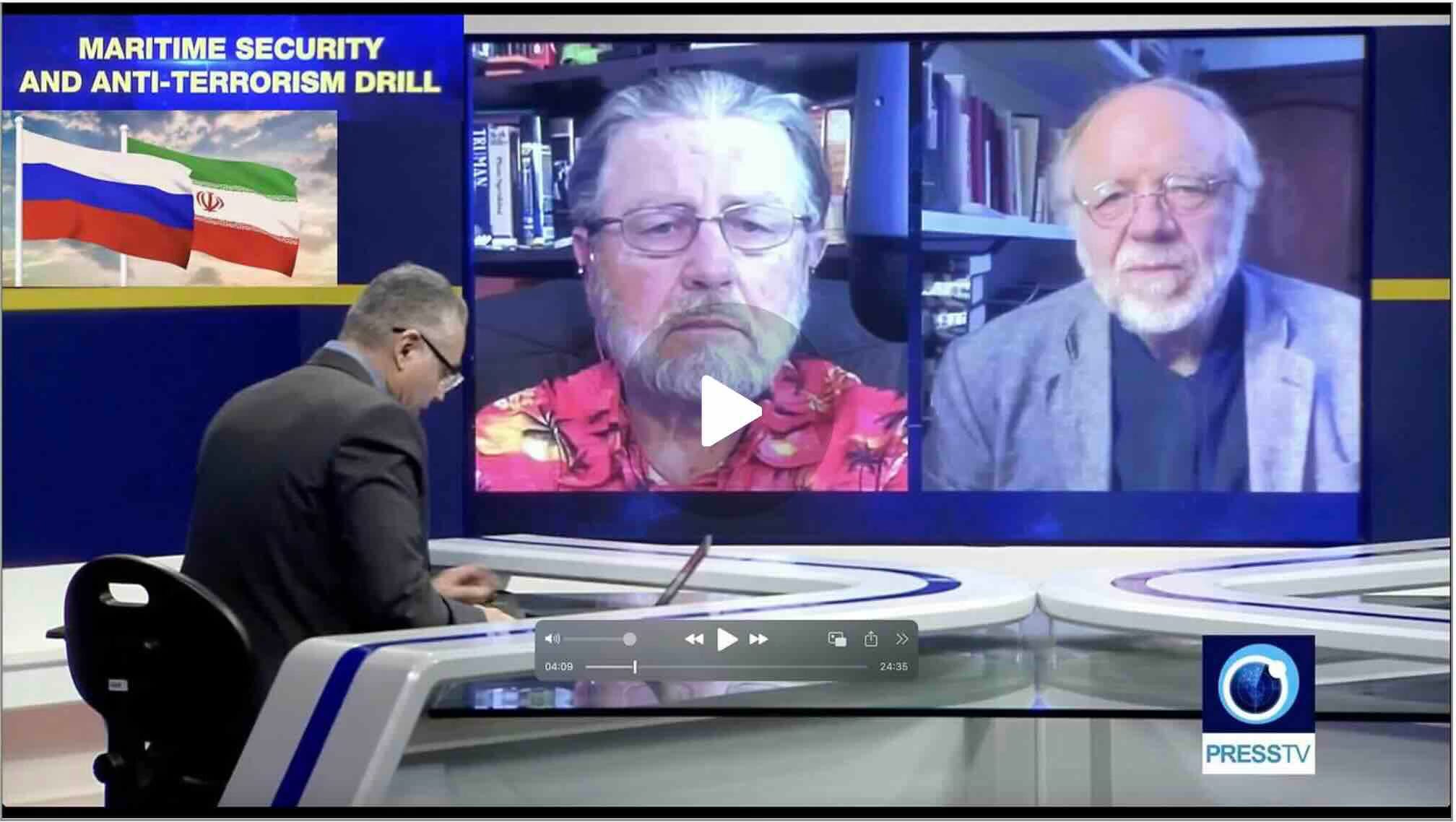
Joint Russia-Iran Naval Drills as US Attack Looms
Feb 2000:24:35Tap to summarizeRumble link Bitchute linkFormer CIA analyst Larry Johnson joined me on Press TV’s Spotlight program to discuss the latest Russia-Iran naval drills and the likelihood of another major US attack on Iran. Transcript:Welcome, everyone. Iran and Russia have held naval exercises in the Sea of Oman and northern Indian Ocean to boost military cooperation and regional security. And topping the drills, maritime counter-piracy and counter-terrorism operations, IRGC forces also closed the Strait of Hormuz for a brief episode during their exercises just a day earlier. Annual drills are meant to send a clear message that the region is capable of providing its own security and stability and does not need or welcome, in fact, foreign players or intervention in this regard. In fact, this Moscow to Iran cooperation is also giving way to the south north south transit corridor, a revolutionary transit route on land to run from St. Petersburg, Russia to the middle of India. And it runs primarily right through Iran, an economic game changer. But first, let’s start with this quick report. Iran and Russia have wrapped up a series of joint naval exercises in the Sea of Oman and the northern Indian Ocean, aimed at boosting military cooperation and maritime security across the region. The drills focused on expanding operational coordination between the two navies, particularly in planning and executing combined missions. Special operations units from the Iranian Army, the IRGC, and the Russian Navy carried out a complex simulation to retake a hijacked vessel. In a coordinated air and sea assault, special forces boarded the target ship, detained the mock hijackers, and secured the vessel.Military officials say the exercises were designed to improve joint readiness in countering maritime threats, including piracy and terrorism.Rear Admiral Hassan Mafzoudlu, spokesperson for the Iran-Russia joint drill, said all planned objectives have been successfully achieved.In the end, all the objectives planned by the designers in the operations room were successfully achieved.The Islamic Republic of Iran Navy routinely participates in various defense diplomacy exercises around the world. Joint exercises with Russia in the Caspian Sea and in southern waters are also part of Iran’s annual defense diplomacy planning. As defense ties between Tehran and Moscow continue to deepen, Russian naval official Alexei Sergeev emphasized that the two countries are capable of addressing a wide range of maritime challenges together, highlighting a growing atmosphere of trust and cooperation. The level of interaction and cooperation between Iran and Russia shows that together we can manage and resolve many maritime and coastal challenges.Moscow is ready to hold joint exercises in any region, including specialized drills such as maritime counterterrorism operations carried out by naval vessels and patrol boats from both countries. With Iran and Russia expanding collaboration across multiple sectors in recent years, the latest Navy drills underscored deepening strategic partnership between the two countries. The exercises also demonstrate the ability of both countries to safeguard regional maritime security without reliance on outside powers. The drills come at a time of heightened tensions in the region, as the United States has stepped up its threats against Iran in recent weeks. Tehran has asserted that it is fully prepared to respond to any force threatening its sovereignty and territorial integrity.And now for our guests for our program. Joining us, Mr. Larry Johnson, former CIA analyst from Florida. And also Kevin Barrett joining us from Saidia, Morocco. Gentlemen, pleasure to have you both. Welcome to our spotlight program. I guess Mr. Johnson, we’ll start with you down there in sunny Florida. Your initial take, please, on these naval drills between Moscow and Tehran and what they signify, especially in the scope of recent tensions.Well, I think it’s important to understand that it’s not just with Russia. China’s also been involved. I mean, China, Russia, and Iran started a series, an annual joint naval exercise. They started that back in 2019. It’s always been scheduled around mid-February to mid-March. And anybody that’s ever been involved with military exercises before knows that the planning for this, they didn’t come up with this because of recent tensions with the United States. These exercises are usually planned days to months in advance.And so it’s a reminder that now because of the tensions, it does take on added importance. It’s possible that they added in an additional dimension to this with just Russia. But you know the Chinese are also in the area. They have a an intelligence ship tailing the US aircraft carrier Abraham Lincoln. So I think it’s important to understand that unlike what happened in June’s surprise attack by Israel, Iran now enjoys the full backing of Russia and China, based in part on a trilateral agreement that was assigned at the end of January of this year.Thank you there, Mr. Johnson. Dr. Kevin Barrett, pleasure to have you join us, sir. And thank you for your presence, in fact. And your opening thoughts as well on these annual drills that we witnessed. And to Mr. Johnson’s point, he’s very correct on that, that it’s been Russia, Iran, and China. And even China was supposed to be part of this, and it just opted out in the last minute. But nevertheless, the timing of the drills, the geopolitical relevance, and the message they sent this year, forget about the other years, but this year, with the buildup of tensions.Well, first, I’d like to say it’s an honor to be on the show with Larry Johnson. He’s doing great work. I wish we had more government service people in the United States with his analytical skills and integrity. So yeah, these drills show that this time this is yet another aspect of the way that Iran is prepared now in a way that it wasn’t last June. That is, Iran has had more than half a year to figure out what went wrong, what went right in June, and to coordinate its response with Russia and China.And of course, Russia is the world’s leading nuclear power with a lot of battle-tested people. They’ve been fighting a very serious war now that’s dragged on. And so they’re used to fighting an existential war in a way that the United States, of course, is not.China is the world’s biggest economic and technological power by quite a bit now. And China has, according to many analysts, made a lot of progress in the intelligence fields relevant to the Iranian response to any US attack. We know that Iran now has access to radars that are specifically directed to going after stealth aircraft. And China, of course, had with its technological edge in many fields, is known not only for their ability to deal with cyber communications and satellite communications, but of course, also they’ve been apparently involved in helping Iran develop its missile technology. I believe there were Sunburn missiles more than two decades ago that already at that point could have shut down the Persian Gulf. So Iran is totally prepared for this. Dick Cheney backed off. Obama didn’t even want to think about it. And now we’ve got an apparently Epstein-blackmailed Zionist stooge lunatic in the White House who is willing to gamble with the future of the region and the world. And so it’s a very, very dangerous situation. And with Russia and Chinese involvement, this of course sets the stage for escalation that could get out of control.And thank you there, Dr. Barrett. And Mr. Johnson, Iran said time and again that the anti-terror operations and anti-piracy operations and other dimensions to the drills are meant to convey that, hey, we have regional players that can handle regional security and do not need, in fact, do not want outside forces in the region for any assistance in this regard. But is anyone listening when it comes to this point being driven home?Well, the only terrorism threat that Iran has really faced has been that which has been ginned up by the United States and Israel. In particular, let’s recall that in after the United States invaded Iraq in 2003 and identified the MEK, the Mujahideen al-Khalq, they then, in 2004, realized, “hey, we can use these guys to attack Iran.” And even though the MEK was still on the list of international terrorists that my old office used to classify as organizations that were bad, the CIA and the US military started working with these guys. They weren’t removed from the terrorist list until 2012. And yet they became US proxies.So to my knowledge, the MEK has never been responsible for carrying out a maritime attack. I think the maritime platform is, I’ll call it an excuse, to bring Russia and China together. What happens in these exercises is the officers, they get to know each other. You develop friendships. You learn how to communicate. You learn what kind of systems work best, and you try to simulate a crisis situation. And can you communicate in that situation? And if there’s a breakdown, what kind of workarounds do you come up with?So they used the anti-terrorism thing as sort of the script, but that’s not the real purpose of this exercise. The purpose of this exercise is to ensure that Russian military personnel, Chinese military personnel, and both the c...
Transcribe →
Dean Radin on "the Science of Magic"
Feb 1900:49:27Tap to summarizeRumble link Bitchute linkDean Radin is the English-speaking world’s leading popularizer of the science of psi and its implications, and the author of many books and scientific papers. He is Chief Scientist at the Institute of Noetic Sciences (IONS), Associated Distinguished Professor at the California Institute of Integral Studies, and cofounder and chairman of the neuroengineering company, Cognigenics. He earned a BS and MS in electrical engineering and a PhD in psychology from the University of Illinois, Urbana-Champaign. In 2022 he was awarded an Honorary DSc from the Swami Vivekananda University in Bangalore, India. He has worked at AT&T Bell Labs, Princeton University, University of Edinburgh, and SRI International. Welcome to Truth Jihad Audiovisual. I’m Kevin Barrett getting visual here for the first time with Dean Radin. I’ve had him on a few times on audio. And here we are doing actual video and talking about his great new book, The Science of Magic. And the subtitle is How the Mind Weaves the Fabric of Reality. It basically starts with the science of psi, leads us up to magic, and the notion that we’re actually all sort of co-creating the universe through paranormal means. It used to be known as magic. Anyway, it’s a good book, and it’s good to have you back, Dean Radin, welcome.Thank you. It’s good to be here.It’s another fascinating book. I’ve been interested in these topics since high school when I discovered the Encyclopedia of Philosophy’s entry on Psi, which shockingly basically said that, yeah, this has been proven. Unless there’s something very strange going on, clearly Psi has been proven scientifically. This was back in the mid-1970s. And so I looked into it. Wow, that’s interesting. That’s not what I’ve heard from everybody else. And I looked into it and it was true. So I’ve been sort of following that ever since and also have been aware of the fact that we’re sort of influencing reality psychically all the time. And that’s that’s where your book gets to in this kind of second half or third third. So, yeah, let’s talk about that and the wild and crazy implications. Where should we start? You tell the story of how you got into this field in the book. So maybe you can give us the short version.Well, the short version is that like a lot of kids, usually, who start reading science fiction and fairy tales, you can’t help but start wondering if any of that stuff is true. And then you get a little bit older and you start learning about science and you hear pretty uniformly that none of it is true. And so it depends on whether or not you remain with childlike enthusiasm and imagination, or if it gets squashed when you’re a little bit older. So for a lot of people, it gets squashed pretty quick. For some, they never break out of the squashiness and their imagination begins to fail. But for others, many scientists, actually, you’re driven by curiosity, as I am. In which case you simply want to know what’s real, what’s true. And so when you start looking at the scientific evidence, which has been around since the late 1950s, it’s very difficult to reach a conclusion that the phenomena that we’re talking about, psychic phenomena, does not exist or is impossible, because it’s quite clear that it has been happening all the time in human experience, and you could even see it in laboratory tests. So anybody who pays attention to that, as you just said, you are then presented with what amounts to a kind of a paradox, a contrast between we are being told, and yet the evidence is clearly not saying that. This is real. So other questions arise like, well, why are we not being told this? What is something being hidden from us? And so I generally don’t go in that direction. I simply say that science tends to be very skeptical and conservative in terms of what it accepts as being true, which is fine. But once it accounts certain kinds of anomalies, which history again and again shows that’s where the future of science always is, there’s two ways you can respond to it. One is to go with the status quo, so it doesn’t disrupt the possibility of your future employment, and just agree with what everyone else does and says; or follow the anomalies, which entails some risk, but also offers a lot of rewards. So I decided the risk was worth it. So here I am years later, and finding it as interesting and as thrilling as I thought when I was a teenager.Yeah, I agree. Your book is really kind of exciting to read. For somebody like me who’s known about this for a long time, it really is inspiring. It’s actually kind of thrilling to know that we’re somewhere near the edge of a radical change in worldview. Because this can’t be ignored forever. And there are signs, even though it hasn’t exploded into public consciousness the way I expected it would. When I first looked into this in the 1970s and early 1980s, I kind of thought, “well, by the turn of the millennium, this will be pretty widely accepted.” And it seems like it kind of stalled. The Encyclopedia of Philosophy was a very mainstream publication. And they were unequivocal that “this stuff is real. It’s been proven seven ways from Sunday. Get used to it.” But somehow the consensus view in the academy has managed to keep sticking heads in the sand. How have they kept a lid on this?Yeah, in many ways, that’s really the interesting question, because the answer is that it’s partially culture-bound. So within, as a broad umbrella term, Western academia, it is thought that because these effects are impossible, then the only evidence can be interpreted as flaws or fraud. If you look at Wikipedia, that’s sort of the way that is presented. Well, that partially becomes a theoretical problem. If you can’t immediately think of an explanation, you say, well, it doesn’t exist. But as sociologists of science have pointed out again and again, that is always how anomalies are presented. That there must be something wrong because we can’t possibly change the dogma, which is what we are accepting as being true. And eventually, if something is real, it will penetrate. So why has it not penetrated yet into the mainstream? Well, one possibility is, without going too far into conspiracy theory, is exactly the same reason why UFOs have only recently, like within the past five years or so or six years, have come out of the closet as far as the U.S. government has presented. And other governments have been way ahead of this. So... There are those who perceive that UFOs, psychic phenomena, and a whole bunch of other things are simply declared as demonic. We don’t understand it. We don’t like it. It’s uniformly presented as demonic or as horrific in our entertainment. And so we simply come away with an idea that we don’t want this to be real. And so there’s a huge push from a religious perspective: Don’t pay attention to this. Don’t look at it. It’s bad. There’s the other push from science, where the science spokespeople, many of them, are saying that this stuff can’t possibly be real, and then give a bunch of reasons. So you have pressure from both of those directions, which is pretty strong. You may also have pressure from government. The government doesn’t want people to know that this is actually real too, partially because with things like remote viewing or clairvoyance in general, the possibility arises that not only are we in a surveillance state, but the kind of surveillance that literally can look at anywhere in space or time by people who are adept at doing that. And so maybe there are people in government that don’t want to know that that’s possible. It’s even worse than Snowden said.You can understand that there’s multiple pressures that combine to push the idea of these kinds of phenomena to the fringe. So that’s a big part of it. But again, it’s culture bound. So you go to India, you go to Asia and so on. These things are so well accepted that people say, well, why are you even bothering to study it? Like, what are you studying? That’s the kind of attitude I’ve encountered in India for sure, but in other countries as well. So this is a culture bound problem. Absolutely. I moved to Morocco two and a half years ago, and I can tell you that it is a culture where people basically accept the worldview that you’re presenting. Nobody, only maybe a very minuscule percentage of people here who’ve been overly indoctrinated in Western education, might agree with the Western consensus. But the vast majority, not at all. And that’s one of many things I like about Morocco.So you mentioned science and religion both kind of working in the same direction to keep this suppressed. I wonder…it seems to me that years ago it was more the religion side that was doing it. And now we have the tools of science proving that it’s real. And I think one of the reasons that many people in the scientific establishment don’t want to admit it’s real is that it challenges scientism as a dogmatic substitute for religion. And indeed, it opens the door again to a more religious worldview. I thi...
Transcribe →