
Podcast
Tumble Science Podcast for Kids
Hosted by Tumble Media · EN
A Common Sense Selection! Exploring stories of science discovery. Tumble is a science podcast created to be enjoyed by the entire family. Hosted & produced by Lindsay Patterson (science journalist) & Marshall Escamilla (teacher). Visit www.tumblepodcast.com for educational content.
16episodes
Episodes
Newest firstAll episodes
The Secret to Cheetah's Super Speed [Encore]
6d ago00:18:24Tap to summarizeHow do cheetahs get their super speed? We talk to a cheetah scientist to find out why a spotted cat is the fastest animal on Earth. Cheetahs are literally built for speed! Anne Hilborn spent months scoping out cheetahs on the hunt in the grasslands of the Serengeti. We’ll discover how cheetahs’ incredible speed is linked to their survival - and what they do when being fast isn’t enough. On our special bonus interview episode - available to our Patreon supporters - Anne shares the amazing story of how being photographed while dropping cheetah poop on herself became both her most embarrassing and her proudest moment. Photos on the blog! Pledge at patreon.com/tumblepodcast. Only $1/month gets you double the Tumble, and $5/month comes with a shoutout on the show, a birthday greeting, and opportunities to be on the show! Want to learn more about cheetah science, and reputable conservation organizations? Check out our blog at www.sciencepodcastforkids.com
Transcribe →The Plastic Pollution Patrol [ENCORE]
3w ago00:21:28Tap to summarizeThis is a rebroadcast of one of our favorite episodes from last season, and one that is particularly timely for the summer! What if you found out that there was a tiny, nearly invisible type of plastic pollution that’s found nearly everywhere… but you’d never heard of it! That’s what happened to environmental scientist Jace Tunnell several years ago, and he’s been on a great nurdle hunt ever since! This episode on fighting plastic waste comes with a special bonus: the opportunity to enroll in a “Nurdle Patrol” and lead the Nurdle search in your community! Join the Nurdle Patrol Special Agent Training Course at sciencepodcastforkids.com/nurdles If you want to support Tumble on Patreon, just go to patreon.com/tumblepodcast. Ad-free early access to episodes is just $1/month, and for just $5/month you can get a birthday shout out on our feed! T-shirts and other merch (including merch specific to this episode) are available at the Tumble merch store, at tumblepodcast.dashery.com.
Transcribe →Are there atoms in a black hole? ... and other questions about space - Summer Mailbag!
Jun 2600:21:06Tap to summarizeWhat would happen if the Moon disappeared? How big is the universe, really? And what happens to atoms inside a black hole? Marshall and Lindsay get the answers to some cosmic questions in this special mailbag episode! If you want to have your comment or review read on our show, leave one! Write a review on Apple Podcasts or comment on Spotify. Join on Patreon to help us continue to make Tumble and be featured on future episodes, and help us decide on Season 12 topics: patreon.com/tumblepodcast Shop official Tumble merch: https://tumblepodcast.dashery.com/ Submit a science question: https://www.sciencepodcastforkids.com/contact Watch the Joke-ha-thon here! Other Tumble episodes mentioned in this mailbag: "What Would Happen If There Was No Moon?" (in Spanish). "The Quest for the Edge of the Universe with Katie Mack" "How Big is the Universe?" Cataloging the Universe - Audio Course
Transcribe →How Were Dinosaur Tracks Made?
Jun 1200:22:43Tap to summarizeThis is a rebroadcast of one of our favorite episodes from season 10! Ever wondered how dinosaurs left their footprints behind millions of years ago? We embark on a prehistoric adventure with renowned paleontologist Paul Olsen! Discover the secrets behind dinosaur tracks and how these ancient prints can tell us incredible stories about the lives of dinosaurs. From the science of fossilization to what these footprints reveal about dinosaur behavior and habitats, Paul Olsen will guide us through the fascinating world of these mysteries left in stone - and share how he discovered thousands of dino tracks when he was just a kid. Join us on a Dino Map Adventure at nepm.org/dinomap! We’ve created a free audio tour to explore the science and history of dinosaur tracks in the Pioneer Valley of Massachusetts. Lindsay and Marshall will guide you through the place where dinosaur footprints were first discovered - and put you on the path to becoming dino track explorers! Dinosaur Adventures in the Pioneer Valley are supported by The Bement School, The Center School, and HCS Headstart. If you like this episode, consider supporting Tumble on Patreon by going to patreon.com/tumblepodcast. Get ad-free episodes for just $1 a month!
Transcribe →Could a Peacock and Platypus Be Friends? Mailbag + Joke-ha-thon!
May 2900:25:22Tap to summarizeYou asked, we answered! In this mailbag episode, we're tackling three big kid questions: why does the ground keep spinning after you stop? Do magnets work in space? And could a peacock and a platypus ever be BFFs? We get answers from real experts, as well as reading your reviews and comments! Also, the Joke-ha-thon is coming up on June 3rd! Go here to donate and pick your champion, and also win some amazing, amazing prizes for yourself and your school. If you want to have your comment or review read on our show, leave one! Write a review on Apple Podcasts or comment on Spotify. Join on Patreon to help us continue to make Tumble and be featured on future episodes, and help us decide on Season 12 topics: patreon.com/tumblepodcast Shop official Tumble merch: https://tumblepodcast.dashery.com/ Submit a science question: https://www.sciencepodcastforkids.com/contact
Transcribe →Pluto and the Planetary Pandemonium - Encore
May 1500:24:02Tap to summarizeThis is a rebroadcast of one of our favorite episodes from the past! It’s a scientific controversy of planetary proportions! Is Pluto a planet, or not? You decide, after we present two sides of an epic astronomy argument. Back in 2006, the International Astronomer’s Union voted on a definition of the word “planet” that excluded Pluto and other newly dubbed “dwarf planets” from planethood status. Astronomers - and everybody else - quickly chose sides. We dive deep into the debate and learn that Pluto’s not the only Space Object Formerly Known As A Planet. Then we’ll ask you to weigh in with your opinion, and see if you can find “consensus” on what should be called a planet. Featuring planetary astronomer Kirby Runyon. We have a present for your birthday!! We’ll be doing birthday shoutouts for our Patreon members, beginning next month. Want to hear a message on the podcast just for your special day? Pledge at the $5 level at patreon.com/tumblepodcast. You’ll be helping us make the show, and we also have extra audio goodies for you. Hear more from our interviews with scientists! For this episode, Kirby Runyon expands on the different types of planets, and the fascinating features you can find on each one. There’s more about planets, on our website at sciencepodcastforkids.com. Don’t forget to subscribe to Tumble and tell your friends! See the new "Eight Planets in the Solar System" video here.
Transcribe →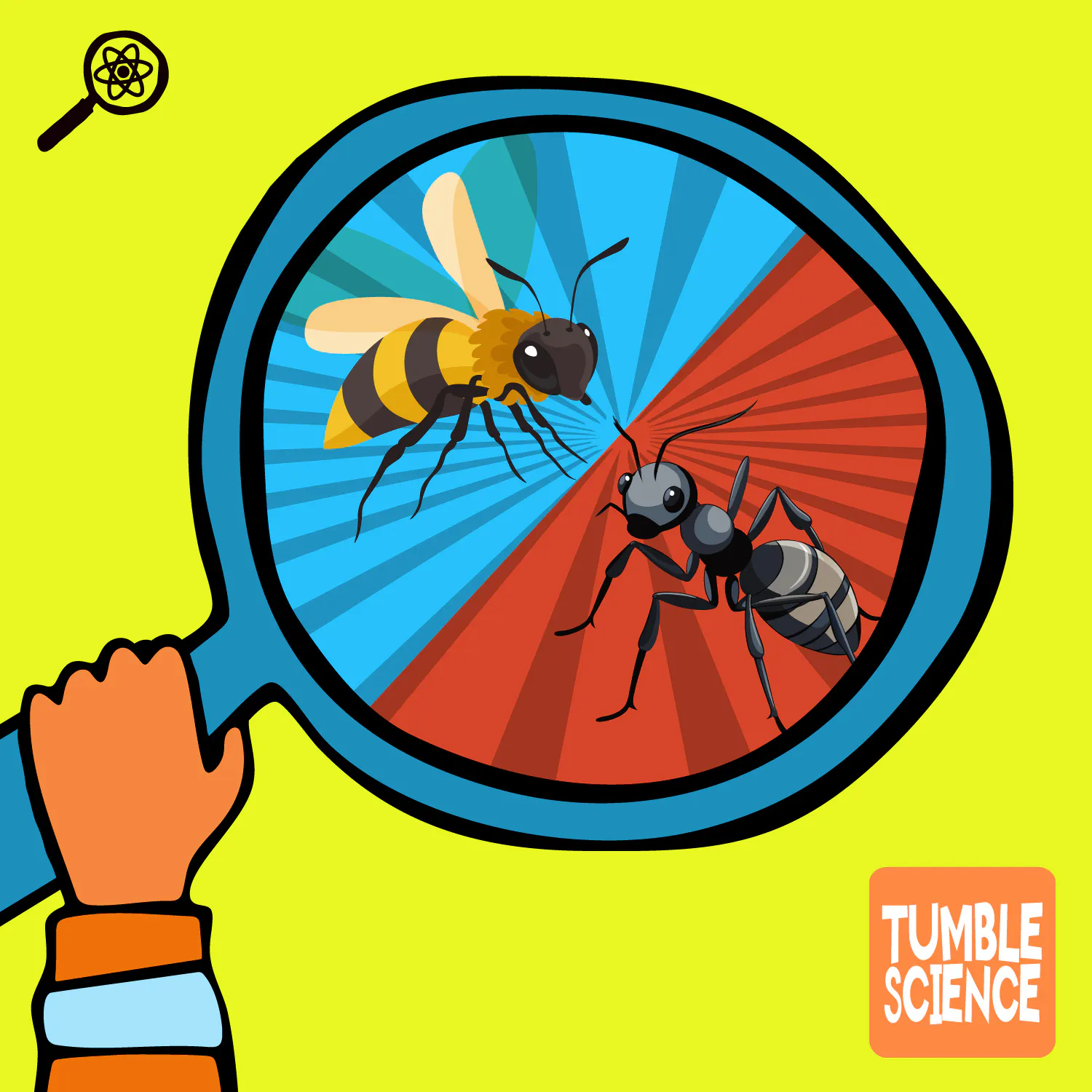
Who Works Harder: Ants or Bees?
May 100:27:18Tap to summarizeBoth ants and bees work hard. So which one works harder? That’s what our listener Hadi wants to know! So we’re pitting insect against insect in a battle of industriousness. Ants or bees: Who will win?! Tune in as we attempt to crown the Hardest Working Insect! To help, we’ve recruited Dr. Sammy Ramsey, an entomologist, National Geographic Explorer, and host and producer of the Disney+ documentary, “Secrets of the Bees.” In a series of very competitive rounds, Dr. Sammy shares the research to stack up the habits of ants and bees. Plus, Tumble Patreon members weigh in with who THEY think should win! When you’re done listening, tell us if you agree with the results! Write a review on Apple Podcasts or comment on Spotify. Join on Patreon to help us continue to make Tumble and be featured on future episodes, and help us decide on Season 12 topics: patreon.com/tumblepodcast Shop official Tumble merch: https://tumblepodcast.dashery.com/ Submit a science question: https://www.sciencepodcastforkids.com/contactAlso go donate to our Joke-ha-thon fundraiser by May 27th at 9 am ET to enter a drawing for AMAZING prizes! https://tumble.science/joke2026
Transcribe →Are Animals Ticklish? (Mailbag + New song!)
Apr 1700:20:52Tap to summarizeA special “tickle attack” Mailbag edition of Tumble! We’re tackling your questions about whether animals can be tickled, and why we laugh when we’re tickled. David Leavens, a professor of psychology, helps us break down the not-so-silly science of tickling. Plus, a brand NEW SONG from Marshall based on a listener request! Want to be on a future mailbag episode? With an adult, leave a review on Apple Podcasts, a comment on Spotify, or email us at tumblepodcast@gmail.com! Join on Patreon to help us continue to make Tumble: patreon.com/tumblepodcast Shop official Tumble merch: https://tumblepodcast.dashery.com/ Listen to Tumble en Español: https://pod.link/1521514886Submit a science question: https://www.sciencepodcastforkids.com/contact
Transcribe →
Do Trees Think?
Apr 300:24:26Tap to summarizeDo trees think? That’s what our listener Alden wants to know. He has an idea that scientists might study mushroom roots to find out if trees are sending messages. Is that true? And if so, what do trees have to say?!We travel deep into the forest with a young soil scientist named Natalia Mondi from the Mother Tree Project, to find out how and why trees communicate through the ecosystem. Along the way, we’ll discover what trees are asking for, how their “forest buds” help them out, and how Natalia is using this knowledge to restore a forest in Canada, guided by the Kwiakah Nation. Join on Patreon to help us continue to make Tumble: patreon.com/tumblepodcast Shop official Tumble merch: https://tumblepodcast.dashery.com/ Listen to Tumble en Español: https://pod.link/1521514886 Submit a science question: https://www.sciencepodcastforkids.com/contact https://tumble.science/JokeContestant
Transcribe →
What's Dark Matter?
Mar 2000:25:14Tap to summarizeWhat is dark matter? Why do scientists think it exists? How are they searching for it, and why are they doing it in an underground lab?! Join us on the search for dark matter with Alvaro Chavarria, a physicist running a dark matter detector underneath a mountain in the French Alps. We’ll take you inside the lab to visit the detector, and find out why everything we think we know about dark matter… could be wrong. For more, visit our website! Our question comes from Jeronimo, a Tumble en Español listener! To listen to Tumble en Español, use this link to subscribe wherever you get your podcasts: https://pod.link/1521514886 Join on Patreon to help us continue to make Tumble: patreon.com/tumblepodcast Shop official Tumble merch: https://tumblepodcast.dashery.com/ Submit a science question: https://www.sciencepodcastforkids.com/contact . . . . . Shhh! This link is TOP SECRET: https://tumble.science/JokeContestant
Transcribe →