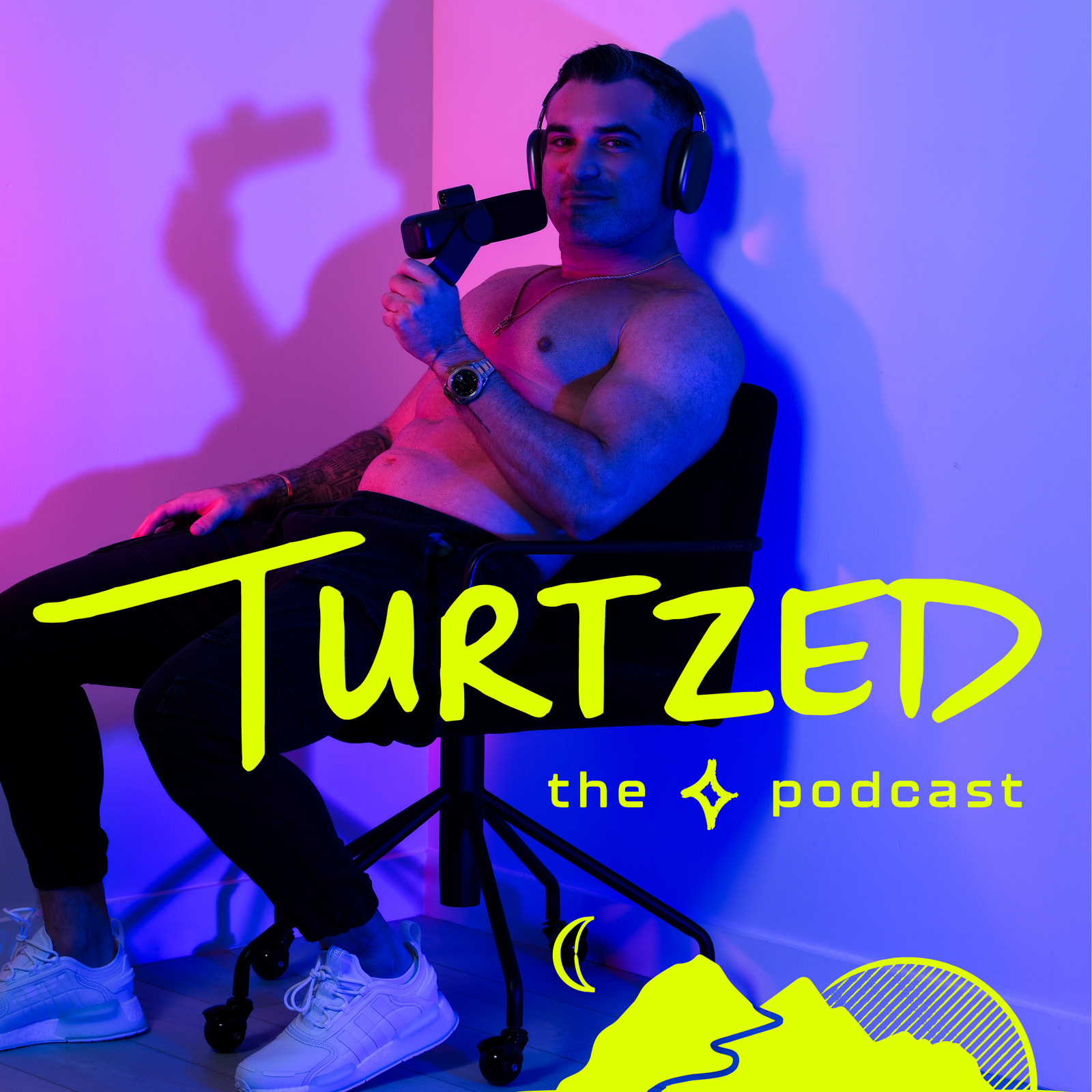
Podcast
TURTZED
Hosted by Charles Turtz · EN
TURTZED is where real stories meet deep growth. Hosted by Charles Turtz, this podcast dives deep into the moments that define us—grief, trauma, identity, coming out, rebuilding, and the wild mess of healing. Through unfiltered conversations and vulnerable solo episodes, TURTZED helps you own your story, find your voice, and build a life aligned with who you really are.
From navigating mental health and family wounds to rediscovering self-worth and purpose, each episode explores the bridge between surviving and truly living. Whether you’re unpacking your past, questioning everything, or chasing clarity in your career or relationships, this space is for you.
No fluff. Just truth, growth, and the kind of talk that hits deep.
21episodes
Episodes
Newest firstAll episodes
Todd Glass: Breaking the Silence on Homophobia in Comedy | Ep. 69
Jun 1700:57:27Tap to summarizeHow long can you survive living a lie before the weight of the closet finally breaks you? In a comedy scene where homophobic and sexist jokes ran rampant, legendary comic Todd Glass chose to bury his true self, believing he would keep his secret forever. This raw conversation exposes the devastating reality of masking your identity in a toxic environment, the moment of absolute breaking that forced a reckoning, and why true cultural evolution requires us to push boundaries forward instead of pulling humanity backward.In this deeply moving episode, host Charles Turtz sits down with celebrated stand-up comedian Todd Glass to unpack his historic 2012 coming-out story on Marc Maron’s podcast. Todd Glass shares his journey from navigating undiagnosed dyslexia as a teenager to opening for musical icons like Patti LaBelle, explaining how those early experiences shaped his deep reverence for live production and audience escapism. Listeners will experience a powerful transformation in how they view cultural complacency, discovering how to critically audit their own social stances, drop the fear of being wrong, and understand why choosing empathy over cheap punchlines is the ultimate mark of artistic growth.How to Navigate Homophobia in the Comedy IndustryLiving closeted in the 1980s comedy scene meant constantly enduring rampant homophobic and sexist material. Todd discusses how this toxic environment drove him deeper into hiding and forced him to build a completely separate public persona.The True Impact of Coming Out Later in LifeTodd reveals that he never intended to come out publicly, even planning to hide behind fake relationships forever. He breaks down the heavy psychological toll of keeping his personal life bottled up until a sudden emotional breaking point altered his path at age 28.Why Diversity in Comedy Benefits the Art FormRather than viewing representation as a mere favor or corporate checkbox, Todd argues that bringing diverse voices to the stage fundamentally elevates the quality of live performance. A lineup reflecting different backgrounds and identities directly mirrors the true landscape of the world, resulting in sharper comedy and better audiences.How to Identify Complacency in Social ViewsComplacency acts like a drug that makes people comfortable with harmful behaviors simply because change requires hard internal work. Todd challenges listeners to audited their long-held stances and actively investigate if their views are inadvertently making someone else's life more difficult.Links & NetworkingTodd GlassCharles TurtzTURTZEDFor Coaching, Consulting, Advertising, or Press Inquiries inquire here.Disclaimer: The TURTZED Podcast reflects the opinions of Charles Turtz and his guests. Content is for educational and entertainment purposes only and is not a substitute for professional medical advice. Always consult a qualified healthcare provider for advice tailored to your individual needs. For the full disclaimer, visit our website.00:00 – The joke a bully would do01:23 – Escapism inside the showroom02:29 – Dyslexia and the open mic discovery04:17 – Learning from legendary music icons07:02 – Curating a speakeasy vibe09:46 – Refusing the "get out" lights11:58 – The reality of the 1980s comedy scene15:04 – The terminal illness escape plan18:12 – Pulling over on the side of the road20:26 – Hidden closets straight people carry24:30 – Do it before you are ready27:17 – The post-Maron car ride relief29:31 – Rage against punching down33:44 – Feeding the wrong people in the crowd37:32 – The safe haven of the roast format42:52 – Complacency is a drug49:27 – If it's mentionable, it's manageable54:06 – Having a fake life for your life
Transcribe →Danielle Tudahl: How to Deal with Cyberbullying & Make Trolls Face Real Consequences | Ep. 68
Jun 1000:42:23Tap to summarizeHow do you reclaim your power when thousands of anonymous internet trolls weaponize the comment section to tear you down? In an era where online harassment can feel inescapable, learning how to deal with cyberbullying isn't just about protecting your peace—it's about holding digital cowards accountable for the vitriol they spew with their chests out.In this raw and eye-opening episode, concert promoter and creator Danielle Tudahl shares her powerful journey from surviving a traumatizing public court case in college to systematically taking down the "incels" and trolls polluting her social media pages. Listeners will discover the distinct boundary between revenge and true accountability, walking away with a practical roadmap to reclaim their voice, protect their mental health, and transform digital darkness into a movement for real-world change.How to Identify and Combat Organized Online HarassmentOrganized groups, such as incel forums, frequently target confident women and survivors speaking out online. Recognizing that these coordinated attacks are a reflection of the perpetrators' insecurities—rather than your truth—is the first step toward building an emotional shield against the noise.The Blueprint for Holding Anonymous Internet Trolls AccountableYou do not have to let disgusting comments simply sit on your profile. By compiling public evidence and forwarding digital harassment directly to a troll's employer or university, you can initiate real-world professional consequences that force cowards out from behind their burner accounts.How to Distinguish Between Accountability and RevengeThere is a profound difference between lashing out in anger and calmly presenting the truth. True accountability involves stepping into the light, stating exactly what occurred, and letting the appropriate channels or employers deal with the reality of the bad actor's behavior.Why Online Anonymity Causes Psychological DamageSocial platforms currently protect bad behavior by allowing users to operate completely decoupled from their real-world identities. Requiring social media accounts to be a direct extension of a person's legal identity is a critical step toward restoring safety and digital decency.Links & NetworkingDanielle TudahlCharles TurtzTURTZEDFor Coaching, Consulting, Advertising, or Press Inquiries inquire here.Disclaimer: The TURTZED Podcast reflects the opinions of Charles Turtz and his guests. Content is for educational and entertainment purposes only and is not a substitute for professional medical advice. Always consult a qualified healthcare provider for advice tailored to your individual needs. For the full disclaimer, visit our website.00:00 – The Hidden Danger of the "User 12345" Phenomenon01:11 – Why Your Digital Footprint Never Truly Vanishes02:03 – The Real Cost of Speaking Out in Corporate Entertainment03:12 – The Three-Month Video Routine That numbed the Backlash04:02 – The "Me Too Deejays" Forum That Changed Everything05:23 – Surviving a Sixty-Witness Nightmare in College06:57 – The Surprising Freedom of Letting Go of Shame08:21 – Reading Through Your Closest Friends' Secret "Burn Book"09:28 – The Disturbing Anatomy of an Incel Comment Rampage11:53 – Using Canva to Unintentionally Go Viral on Instagram13:53 – The 6 AM Corporate Email Blitz That Got Trolls Fired16:46 – Slashing Tires vs. Stating Facts: The Line of Retribution19:57 – Why Digital Harassment is Spreading to Smaller Creators21:55 – The Shocking Inability to Hold Two Thoughts at Once24:06 – The Double Standard of Bikini Photos and Corporate Hiring25:23 – Tracking Down a Canadian DJ's Secret Burner Email28:42 – Handling Direct Death Threats and Digital Stalkers31:17 – How Constructive Gray Areas Differ From Raw Internet Vitriol34:05 – The Childhood Promise That Steers Danielle's Brand Today36:40 – The Twisted Algorithmic Value of Receiving Hate Comments39:43 – Transitioning the Digital Audience Into Real World Spaces
Transcribe →Kyle Thomas: How Psychological Astrology Unlocks Your Hidden Intuition | Ep. 67
Jun 300:50:50Tap to summarizeCan the stars actually help you heal your deepest childhood wounds and break toxic relationship patterns, or are we just searching for order in the chaos? Many people view horoscopes as simple entertainment, but when approached through a clinical and narrative lens, psychological astrology becomes a profound diagnostic mirror for the subconscious mind. By merging the ancient art of cosmic mapping with modern behavioral insights, we can shift from passively receiving a "destiny" to actively orchestrating our lives with strategic intention.In this raw and illuminating episode, globally recognized astrologer Kyle Thomas breaks down how your natal chart serves as a psychological blueprint rather than a rigid script. Drawing from his distinct background as both an English and psychology major, Kyle Thomas explains how understanding planetary energies can empower you to conquer destructive habits, navigate heavy karmic cycles, and safely step into authentic personal growth. Listeners will walk away with a completely redefined perspective on free will, a deeper connection to their own intuition, and a roadmap for alignment in love, career, and self-actualization.How to Blend Psychology and Astrology for Self-HealingAstrology acts as a visual tapestry of our psychological upbringing, capturing the exact snapshot of the universe at our birth. By treating planetary placements as archetypes rather than absolute fates, individuals can unearth deep-seated family dynamics, identify dominating parental influences, and consciously break cycles of trauma.Why Free Will Dictates Astrological PredictionsA birth chart highlights open doorways and energetic transits, but human agency determines whether we step through them. Predictive insights show when the universe aligns for romance or career success, but remaining passive guarantees missed opportunities—proving that destiny requires active partnership.Understanding the Scorpio Rising Ascendant PersonaYour rising sign acts as the psychological mask or persona presented to the world, heavily dictating first impressions and the types of partners you naturally attract. Those with a Scorpio rising possess an undeniable magnetic intensity and deep emotional strategy, often navigating profound relational losses early in life before finding ultimate stability.Links & NetworkingKyle ThomasCharles TurtzTURTZEDFor Coaching, Consulting, Advertising, or Press Inquiries inquire here.Disclaimer: The TURTZED Podcast reflects the opinions of Charles Turtz and his guests. Content is for educational and entertainment purposes only and is not a substitute for professional medical advice. Always consult a qualified healthcare provider for advice tailored to your individual needs. For the full disclaimer, visit our website.00:00 – The Cosmic Storybook00:35 – Predictive vs. Productive Art02:35 – The Traditional Catholic Psychic04:15 – The Core Human Hunger05:40 – Beyond the Doom and Gloom07:15 – The Closed-Door Warning08:50 – The 15-Year Love Predictions10:55 – Choosing a Harder Adventure13:10 – The 12-Episodic Hero's Journey15:45 – Hidden Houses and Missing Water17:10 – The Addiction to Meaningful Pain20:45 – The Self-Engagement Ring Ritual22:50 – The Luckiest Day of the Year24:10 – The Scorpio Rising Soul Mirror26:15 – The Game of Thrones Chart Strategy28:45 – The Early Partnership Loss Rule31:40 – Healing Through the Rose Thorns33:15 – The 25-Day Relationship Window
Transcribe →Dr. Nicole Bryant: Intellectualizing vs. Feeling in Therapy | Ep. 66
May 2700:42:28Tap to summarizeAre you actually healing, or are you just getting really good at explaining your trauma? For many high-functioning people, intellectualizing vs. feeling in therapy becomes a sophisticated safety net—a way to "word vomit" the right answers while keeping the actual pain safely tucked behind a curtain.In this episode, Dr. Nicole Bryant joins Charles Turtz to pull back that curtain. As a therapist who went viral for calling out the "rigidity" of the clinical process, she explains how to move from simply managing your symptoms to experiencing the emotional release that leads to true transformation.How to Tell if You Are Intellectualizing Your ProgressIf you find yourself "beating the therapist to the punch" by providing all the solutions before they can ask the questions, you may be using logic as a shield. True progress requires moving past the "why" and into the "how it feels," allowing yourself to be seen without the performance of being a "good patient."Identifying a Safe Therapeutic RelationshipSafety in therapy isn't just about professional credentials; it’s about "humanness" and whether you feel seen as a person rather than a case study. A safe space allows for the "dirty laundry," the humor, and the raw disagreements that mirror real-world relationships.The Difference Between Managing and HealingManaging often looks like a weekly "offloading" of mental pressure to survive another seven days, whereas healing involves taking one "brick" off the wall at a time to build long-term self-awareness. True healing requires the application of insight into your daily life to break generational cycles.Links & NetworkingDr. Nicole BryantCharles TurtzTURTZEDFor Coaching, Consulting, Advertising, or Press Inquiries inquire here.Disclaimer: The TURTZED Podcast reflects the opinions of Charles Turtz and his guests. Content is for educational and entertainment purposes only and is not a substitute for professional medical advice. Always consult a qualified healthcare provider for advice tailored to your individual needs. For the full disclaimer, visit our website.00:00 – The difference between talking about it and feeling it.00:54 – Why high-functioning people use "rigidity" as a shield.02:14 – The "exhale" that comes when you stop taking care of business.03:01 – The "misfire" of feelings that have been stuffed down.04:05 – Are you "beating people to the punch" with your word vomit?05:04 – Is going to therapy just "cool" now or is it working?06:36 – Why your perceived reality might make you feel "crazy."08:15 – The "humanness" factor you should look for in a consultation.10:41 – The "Hey Girl" moment: When the magic occurs.13:22 – Offloading pressure vs. removing one brick at a time.16:36 – What to do when you "don't know what you need" in a session.20:33 – Giving yourself approval to scream and start over.25:56 – Why random strangers are sending voice memos to a TikTok therapist.27:49 – The "Eyebrow Test" for receiving therapist feedback.31:21 – The realization that your therapist isn't going to get you to the next step.34:14 – Why "ghosting" your therapist is a missed opportunity for growth.37:16 – The one sentence that dismantles generational over-functioning.
Transcribe →Patricia Noelle: Repressed Childhood Trauma & Psychedelic Healing | Ep. 65
May 2000:54:25Tap to summarizeHow do you heal from a past you can’t even remember? Repressed Memories and Trauma Recovery often feel like navigating a dark room without a flashlight, where the body keeps the score of abuse that the mind has worked desperately to forget. When the traditional "pink bubble" of perfectionism finally bursts, the journey to the other side requires a radical confrontation with the truth.In this powerful episode, Patricia Noelle shares her harrowing and hopeful journey from a restrictive upbringing to a "knees-on-the-floor" moment of spiritual and psychological reckoning. As a survivor who lost two sisters to the cycle of trauma, Patricia Noelle details how she utilized indigenous medicines and psychedelic therapies to open the "360-degree curtains" of her consciousness, allowing her to transition from a state of dissociation to a life of health, happiness, and service.How to Identify Maladaptive Coping StrategiesMany survivors of childhood trauma adopt "perfectionism" as a shield, using success and education to protect themselves from reliving painful experiences. Understanding that these behaviors are actually survival mechanisms is the first step toward reclaiming your authentic self.Why Do Memories Surface Later in Life?Traumatic memories often remain repressed until a specific "inciting incident"—such as a major life change or the return of a family member—forces the psyche to confront what has been hidden. These "flashbacks" are not signs of losing your mind, but invitations from the soul to begin the healing process.The Role of Iboga and MDMA in Trauma WorkWhile traditional talk therapy is vital, some trauma is stored so deeply that it requires an intervention capable of bypassing adult defense mechanisms. Therapeutic doses of medicines like Iboga can facilitate a "life review," allowing survivors to witness family dynamics and traumas with newfound clarity.What is Psychedelic Integration?Having a mystical or breakthrough experience is only half the battle; the real transformation happens during integration. This involves working with skilled guides to turn "aha moments" into clear life directives and therapeutic support for unearthed wounds.Patricia NoelleCharles TurtzTURTZEDFor Coaching, Consulting, Advertising, or Press Inquiries inquire here.Disclaimer: The TURTZED Podcast reflects the opinions of Charles Turtz and his guests. Content is for educational and entertainment purposes only and is not a substitute for professional medical advice. Always consult a qualified healthcare provider for advice tailored to your individual needs. For the full disclaimer, visit our website.00:00 – The moment the teacher appears01:43 – The midnight confluence that brought Patricia to her knees02:42 – Why dissociation is the brain's most powerful survival tool04:11 – The building fall that thinned the "veil" to the universe08:22 – The tragic cost of "getting lost" in the trauma cycle10:03 – Why traditional therapy wasn't reaching the root cause12:27 – Perfectionism: The high-functioning mask of a survivor13:16 – The knock on the door that flooded the basement of memory14:42 – Does it matter if the memory is "accurate"?17:28 – Walking through your own birth canal: The Iboga life review20:36 – Why you shouldn't start your journey with the "Big Bang"22:24 – The danger of opening Pandora’s Box without a guide31:12 – When the host becomes the student: A live activation34:33 – The graph of healing: Why the wound never truly hits zero41:15 – The "Intention" hack for high-stakes conversations46:24 – Why healing is the application of love to the places that hurt
Transcribe →Alex Montesantos: Fostering Dogs for Mental Health & Healing | Ep. 64
May 1300:41:53Tap to summarizeHow can saving a life actually end up saving your own? When we pour love into creatures that have been discarded by the world, we often find the very pieces of ourselves we thought were lost forever. Fostering dogs for mental health isn't just about providing a temporary home; it's a mirror for our own recovery, teaching us the difference between love and the harder, more essential work of building trust.In this episode, Alex Montesantos joins Charles Turtz to share his journey from the shelters of Atlanta to becoming a cornerstone of Second Chance Rescue in New York City. Alex dives deep into how the "revolving door" of fostering helped him navigate a difficult period of isolation and emotional healing, offering a raw look at why the most "damaged" dogs are often our greatest teachers in patience and self-worth.The Difference Between Love and TrustWhile love can be given freely, trust is a "completely different plane" that must be earned through consistency and safety. Alex explains that while a human can love someone and still treat them poorly, true trust creates a secure environment where healing can actually begin.Fostering as a Mirror for Self-LoveBy providing care, patience, and decompression for anxious dogs, Alex realized he was subconsciously giving himself the same grace he had previously denied himself. Fostering became a vehicle to move from being "hard on himself" to appreciating his own journey.Overcoming the Fear of Being AloneFor an extrovert used to validating himself through others, the quiet responsibility of a foster dog provided a "healthy distraction" that allowed him to become content with his own company. The dog acts as a "submissive and receptive" presence that fills the void while you do the hard work of internal growth.Why Your Home is Always Better Than a KennelThe "perfect foster" doesn't exist; what matters is the individualized attention of a home environment. Even a busy apartment or a two-week commitment provides a dog with the warmth and safety necessary to rebuild their foundation for a forever family.Links & NetworkingAlex MontesantosCharles TurtzTURTZEDFor Coaching, Consulting, Advertising, or Press Inquiries inquire here.Disclaimer: The TURTZED Podcast reflects the opinions of Charles Turtz and his guests. Content is for educational and entertainment purposes only and is not a substitute for professional medical advice. Always consult a qualified healthcare provider for advice tailored to your individual needs. For the full disclaimer, visit our website.00:00 – The hardest sentence to memorize01:27 – The "sad scene" that sparked a movement03:03 – Meeting Sybil: The hoarding situation "monster"03:48 – The "Revolving Door" philosophy of detachment04:11 – Finding self-worth in a New York isolation06:10 – Why New York shelters are harder to join than Atlanta08:05 – Projecting personal healing onto shelter animals11:02 – Breaking the cycle of "relationship hopping"13:21 – Learning to "crack yourself up" in solitude18:26 – Why love alone won't fix a traumatized dog22:25 – The dog that slept facing the door26:11 – The "Higher Plane" of trust vs. love32:03 – The logistical "win" of not foster failing41:13 – The danger of the "Checklist" growth mentality54:02 – The "Tattoo Rule" for choosing the right dog59:25 – The "Stepwise" trick for sobriety and success61:30 – Grandpa’s advice: "Safe and Fun, but not in that order"
Transcribe →Helena Woods: Astrocartography for Beginners & Finding Your Power Places | Ep. 63
Apr 2200:48:49Tap to summarizeIs it possible that your "bad luck" in a specific city is actually written in the stars? Astrocartography for beginners is more than just a map; it is a tool for understanding how your unique birth chart interacts with the energies of different locations around the world. Whether you are feeling stagnant in your current hometown or a mysterious pull toward a foreign country, your map can reveal why certain places activate specific life lessons, challenges, or successes.In this episode, Helena Woods, an expert in astrocartography and ancient astrology, explains how to navigate your personal "treasure map" to find groundedness and clarity. She shares her transformative journey of moving to France and provides a live reading for Charles, showing how planetary lines can predict career breakthroughs, relationship shifts, and even physical health transits.How to Find Your Best Place to LiveYour birth chart is essentially a blueprint that can be projected onto a map of the world to show where planetary influences are most pronounced. By looking at specific lines—such as a Venus line for love or a Sun line for visibility—you can identify which geographical areas support your current goals or emotional needs.The Truth About Challenging Saturn and Mars LinesMany people fear "heavy" planetary lines, but these locations often offer the greatest opportunities for personal growth and authority. For example, a Saturn line might bring challenges, but it also helps you step into your purpose and develop professional expertise.Connecting with Global Energy Without MovingYou don’t always have to get on a plane to experience the power of a specific location. Through "remote activation," you can tap into the energy of your planetary lines by engaging with the food, music, culture, or even people from that part of the world.Using Astrology for Career and VisibilityAstrocartography can pinpoint the most optimal locations for specific professional milestones, such as publishing a book, public speaking, or launching a business. These lines indicate where you are most likely to experience high visibility and a sense of accomplishment.Helena WoodsCharles TurtzTURTZEDFor Coaching, Consulting, Advertising, or Press Inquiries inquire here.Disclaimer: The TURTZED Podcast reflects the opinions of Charles Turtz and his guests. Content is for educational and entertainment purposes only and is not a substitute for professional medical advice. Always consult a qualified healthcare provider for advice tailored to your individual needs. For the full disclaimer, visit our website.00:03 – The "treasure map" hidden in your birth date03:10 – Why France felt like "home" before she even unpacked04:53 – Are you choosing your city, or is it choosing you?06:41 – The hidden meaning behind your obsession with foreign cultures08:02 – Why "tough" planetary lines are actually your secret weapon12:12 – The social media "fear-mongering" trap in astrology15:31 – The 19-year karmic cycle you need to know about20:49 – The "Retirement Line": Where to find ultimate tranquility23:01 – The eerie accuracy of Charles’s Dutch border callback27:44 – Tapping into Sydney’s energy from your living room33:41 – Why knowing the future requires a "surrender" mindset37:35 – The "Lightning in a Bottle" energy that causes Miami chaos41:32 – Why home is always at the end of your curiosity45:12 – The pessimistic reason we might actually end up on Mars
Transcribe →Pat Jackman: Emotional Release Therapy for Trauma & Somatic Healing | Ep. 62
Apr 800:38:00Tap to summarizeWhy does the body remember the traumas that the mind tries so desperately to forget? We often carry "pollution"—layers of suppressed anger, fear, and grief—that manifest as chronic physical pain, yet we struggle to find the key to letting it go. Using Emotional Release Therapy for Trauma, you can begin to navigate the "wound road" to uncover the joy and peace that have been buried under years of survival.In this powerful episode, Pat Jackman explains her unique approach to somatic healing and the profound connection between physical ailments and the "inner child" calling out for expression. With over 30 years of experience, Pat Jackman shares how opening "heart points" in the body allows individuals to safely process childhood neglect and abuse, moving from a state of frozen survival to one of courageous, heart-centered living.How to Identify Emotional Pain in the BodyPhysical symptoms like neck pain, headaches, or "stuck" points in the mid-back are often the inner child’s way of signaling for attention. These areas act as doorways that, when opened through breath and presence, allow suppressed emotions to finally surface.The Importance of Opening Heart Points FirstIn Emotional Release Therapy, the heart point on the back is considered the primary gateway; if this point remains closed, emotional energy cannot be fully expressed or released from other parts of the body.Why We Suppress Joy and "Negative" EmotionsAs children, many of us "froze" or clamped down on our true feelings—whether anger or even joy—to remain "good" and safe within our family dynamics. Over time, this creates a layer of "pollution" on the body that obscures our natural state of love and peace.Healing the Inner Child Through Somatic SafetyTrue transformation happens when you can look into the eyes of your younger, wounded self and offer them the comfort and love they were denied in the past. By providing this safety as an adult, you bridge the gap between past trauma and present-day freedom.Links & NetworkingPat JackmanCharles TurtzTURTZEDFor Coaching, Consulting, Advertising, or Press Inquiries inquire here.Disclaimer: The TURTZED Podcast reflects the opinions of Charles Turtz and his guests. Content is for educational and entertainment purposes only and is not a substitute for professional medical advice. Always consult a qualified healthcare provider for advice tailored to your individual needs. For the full disclaimer, visit our website.00:00 – The body remembers what the mind forgets00:30 – The Christmas Day catalyst for healing01:14 – Opening the "doorways" of the body01:45 – Why physical pain equals emotional weight02:40 – Why the heart must be opened first04:18 – The "tiptoe" test for childhood trauma06:03 – Meeting your five-year-old self07:07 – The secret to bringing wounded parts home09:56 – How parents "slap" pollution onto our bodies12:12 – The specific burden carried by men15:25 – The "back heart" and the path to joy19:22 – Giving yourself the comfort you never got22:36 – Growing up in a family of "perfect" orphans28:26 – 15 minutes of "waking up" in 30 years31:47 – Crawling through the "muck tunnel" to safety35:16 – Reshuffling the puzzle pieces of your life
Transcribe →Andrew Cavanaugh: Marine Corps Veteran Mental Health & Overcoming PTSD | Ep. 61
Mar 2500:58:12Tap to summarizeWhat happens when the "stoic hero" identity you’ve built your life around is shattered by a single medical diagnosis? For many, the transition from the front lines to civilian life is a silent battle against an invisible enemy that doesn't follow the rules of engagement. Marine Corps Veteran Mental Health is more than just a clinical term; it is a raw, lived experience of navigating the heavy "backpack" of trauma long after the uniform is put away.In this episode, Andrew Cavanaugh shares his profound transformation from a 9/11-inspired enlistee to a combat veteran grappling with a chronic PTSD diagnosis. He reveals the specific "method to the madness" of Marine Corps training and the pivotal moment a simple question from his wife shifted his perspective from a lens of destruction to one of humanity. Listeners will discover how to reframe their own "lived experience" and find the courage to prioritize human connection over stoic isolationHow to Transition from Combat Stoicism to Emotional HealingThe military trains individuals to push down fear to accomplish the mission, but this survival mechanism can become a barrier in civilian life. Learning to "unpack the backpack" of trauma requires moving past the stoic mask to address the deep-seated emotions that were deferred during active duty.The Impact of a Chronic PTSD Diagnosis on IdentityBeing labeled with a disorder by a medical professional can feel like being "punched in the stomach," often causing veterans to adopt a "hero to zero" mentality. True recovery involves recognizing that a diagnosis is a human response to extreme events, not a permanent definition of one's character.Finding Hope Through Positive Reframing and ConnectionHealing often begins by asking a different set of questions, such as "Did anything good happen?" to break the cycle of remembering only the worst moments. Reconnecting with those who shared the experience provides the "closure" and "language" necessary to move toward a life lived to the fullest.Links & NetworkingAndrew CavanaughCharles TurtzTURTZEDFor Coaching, Consulting, Advertising, or Press Inquiries inquire here.Disclaimer: The TURTZED Podcast reflects the opinions of Charles Turtz and his guests. Content is for educational and entertainment purposes only and is not a substitute for professional medical advice. Always consult a qualified healthcare provider for advice tailored to your individual needs. For the full disclaimer, visit our website.00:00 – The "Right Now" Phone Call That Changed Everything02:27 – Watching 9/11 from an Alternative High School03:57 – The "Superman" Myth: Why We Seek Stoicism05:49 – No Time for Goodbyes: Heading to San Diego08:17 – The Yellow Footprints and the "Last Time" You’re a Civilian10:34 – Method to the Madness: Why Drill Instructors Act Like "Demons"13:58 – The Seven-Day Out-Processing Trap17:42 – The Eight-Page Report That Felt Like a Punch in the Stomach20:56 – From Hero to Zero: Wearing the PTSD Identity24:12 – The One Question from His Wife That Broke the Darkness29:53 – The Box of "Marine Stuff": A Family’s Incredible Act of Respect32:19 – Breaking Bread in a War Zone: Humanity Under Fire37:02 – The "Foreign Country" Feeling of Long-Term Isolation44:34 – The Jordanian Special Forces Message: Finding True Closure51:43 – The 90/10 Rule: How Attitude Dictates Survival53:54 – The Saturday Text Message That Saved a Life
Transcribe →Bettina Gordon: How to Heal Your Body with Your Mind & Reverse Biological Age | Ep. 60
Mar 1800:32:51Tap to summarizeCan your mind truly command your biology to repair itself from within? Most of us view health as something that happens to us, but the truth is that your body possesses an incredible, untapped agency to overcome even the most daunting physical challenges. In this episode, we dive into the radical realization that the same body that created a condition often holds the exact blueprint required to heal it.Join us as Bettina Gordon shares her profound insights on the intersection of mindset, resilience, and the science of aging. Bettina Gordon explains how shifting from a state of self-critique to one of radical self-love can actually trigger biological age reversal. You will walk away with a reclaimed sense of power over your own health journey and a "one step at a time" strategy for long-term vitality.How to Trigger Biological Age ReversalBiological aging isn't just about the passage of time; it is deeply influenced by your internal environment. Bettina Gordon highlights that shifting your mentality to one of self-love and support rather than constant critique can actually help with biological age reversal.The Strategy for Self-Healing and AgencyWe often feel like victims of our health, but we actually have immense agency over the next season of our lives. By adopting the right strategy, you can improve your strength, power, and resilience, recognizing that your body has the innate capability to heal what it has created.Using Travel and Nature for Mental RejuvenationRejuvenation often requires finding specific environments that allow for peace and "reshaping" your thoughts. Whether it's the warmth of the sun or the physical challenge of skiing, identifying the elements that revitalize you is essential for pushing through difficult life moments.Links & NetworkingBettina GordonCharles TurtzTURTZEDFor Coaching, Consulting, Advertising, or Press Inquiries inquire here.Disclaimer: The TURTZED Podcast reflects the opinions of Charles Turtz and his guests. Content is for educational and entertainment purposes only and is not a substitute for professional medical advice. Always consult a qualified healthcare provider for advice tailored to your individual needs. For the full disclaimer, visit our website.00:00 – The "little things" that pile up into massive energy.00:10 – Why you actually have two different ages.01:34 – Redefining aging: Battle vs. Alignment.03:02 – The "ticking time bomb" myth for women over 35.05:41 – The moment a "healthy" person gets an invasive diagnosis.07:41 – Why "longevity" isn't enough without optimal health.08:18 – The hidden danger of the "Cancer Warrior" mentality.10:14 – What your body is actually saying when it gets sick.11:51 – How your biological age can move backward.14:15 – Why fixing the "facade" won't save your foundation.17:37 – How to avoid the "slow death" of chronic disease.21:15 – The shocking results of the Counter-Clockwise study.23:44 – The surprising link between travel and younger cells.26:31 – Simple steps to stop your energy from leaking.28:25 – The one sentence that changed Bettina’s healing journey.31:50 – Why sharing your pain is a vital part of the process.
Transcribe →