← Twenty Thousand Hertz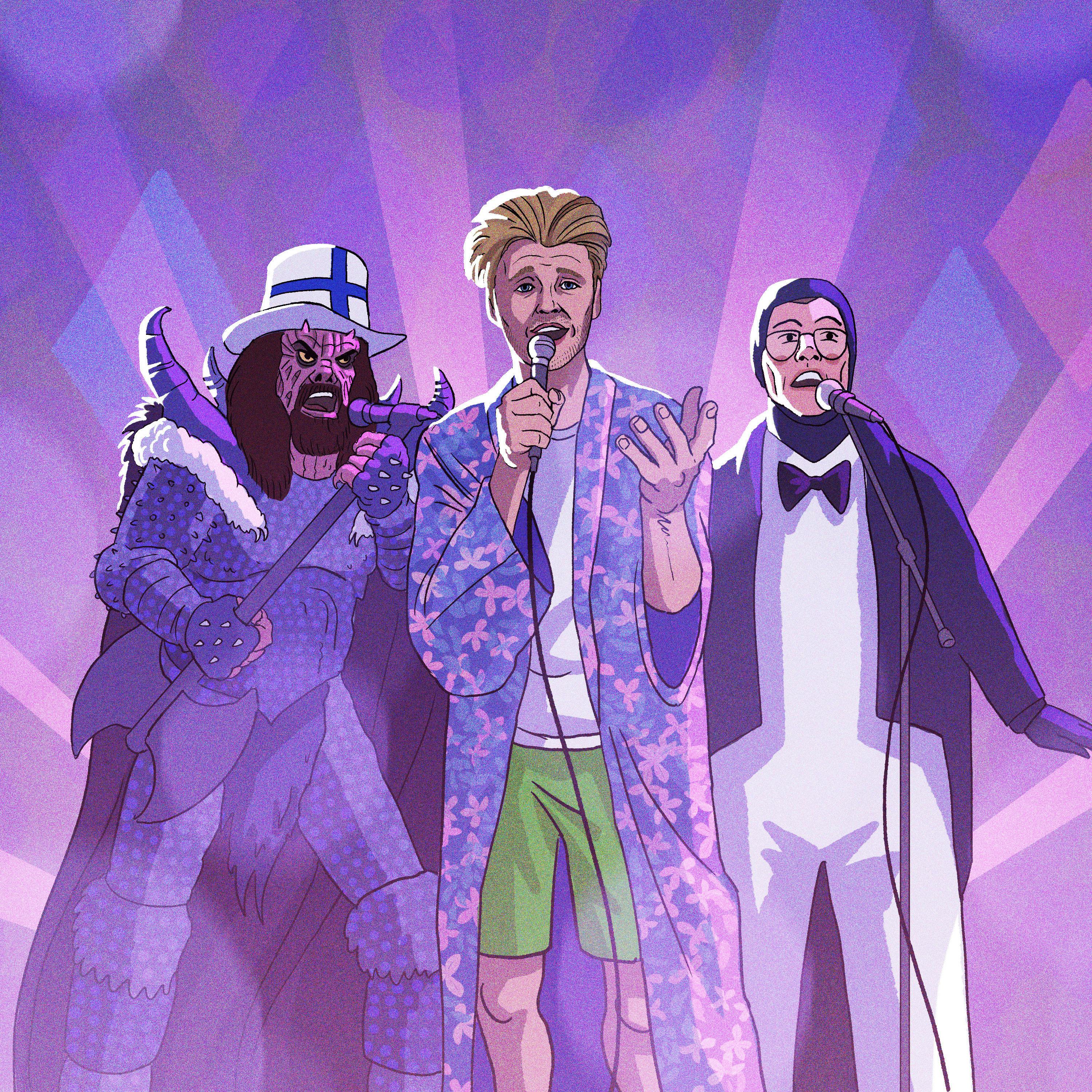
Twenty Thousand Hertz
Eurovision Song Contest: Inside the Gimmicks & Glamour
00:33:56
The silly, surprising history of “Europe’s Super Bowl.”
Loading summary
Transcript164 lines
- [00:00]
A
You're listening to 20,000 hits, the stories
- [00:06]
B
behind the world's most recognizable and interesting sounds. I'm Dallas Taylor. A while back, I sat down with Grace east, our producer here at Defacto Sound, and Andrew Anderson, our resident European producer. Andrew grew up in England and loved sound and music from a very young age. For grad school, he moved to the us, specifically, Indiana. There he worked in public radio, even hosting a local segment, All Things Considered. Then back in the uk, he was the editor in chief of an arts magazine, which is how I met him. Eventually, with his wife, he moved to Bulgaria, where he opened a local bookshop and became the lead singer in a post punk band that was even featured on Bulgaria's Got Talent. But the purpose of this meeting was for Andrew to try and teach us bumbling Americans about something that we just can't grasp, but that millions of people across the pond are obsessed with, and that's Eurovision. So, Andrew, you have been trying to convince the 20,000 Hz team that we should care about Eurovision, is that right?
- [01:12]
A
Well, for me, it's just one of those things that is so present. Growing up now, as a European person that lived in America for a while, I kind of have some experience with some of those things. Like, I wasn't really aware growing up about what the super bowl was or the huge impact of it, and I kind of see Eurovision as being our Super Bowl. So this is kind of a cultural exchange where I'm going to give you our super bowl, which is Eurovision.
- [01:36]
B
And what's your hope for how we feel about Eurovision once we finish this episode?
- [01:41]
A
My hope is that you'll grow to love it, but maybe you'll also be inspired America to start adopting some of the Eurovision practices within the Super Bowl. So I'm thinking more glamorous costumes for
- [01:54]
C
the players, 100% on board.
- [01:56]
A
You've got the halftime songs, fine, but what if some of the players did some numbers? What about when you score a touchdown, you have to break out into a rap track? So I think my hope is that you'll kind of have an appreciation both for the glory and pain that I had to live through hearing all of these songs over the years and having this as my cultural touchstones, but also that it maybe will have some positive influence of not taking things too seriously and kind of embracing the sillier side of pop culture for Americans.
- [02:26]
C
Totally.
- [02:27]
A
We should start by me asking what each of you knows about Eurovision. So the first person I want to turn to is our super producer, Grace. Grace, can you tell Me what you know about Eurovision.
- [02:37]
C
Sure thing. I have kind of a funny story about Eurovision, which is that my boyfriend and I were like, let's watch the Eurovision movie and, like, see what it's all about. It looks kind of silly, but, like, who knows?
- [02:52]
A
All right, everyone. I am Lars. This is secret we are Fire Saga.
- [02:57]
C
Who wants to hear Eurovisions are. Plot twist? I was, like, crying by the end. It was way better than I expected. And then we had so much fun watching it. We were like, let's go watch the 2021 season on YouTube. And so I watched a ton of music videos from artists that I'd never heard of. And then we voted. Like, my boyfriend and I voted who we thought were the winners.
- [03:27]
A
And did you get it right?
- [03:29]
C
I was like, the Italian punk band was the best, but I don't think they're gonna win. And then they did, and I was like, okay, that's pretty cool.
- [03:41]
A
Dallas, how about you? What do you know about Eurovision?
- [03:44]
B
I just think of tights and big hair and the 80s theatrical flamboyance.
- [03:52]
A
You're very on the right track there. I think all of those things do count as Eurovision.
- [03:56]
D
I think describing Eurovision is really difficult because it's something that in Europe, we've all grown up with, and if you say the word Eurovision, people exactly know what you mean and they love it or they hate it. So my name is Paul Jordan. I'm also known as Dr. Eurovision, and I'm an expert in the Eurovision Song Contest. To describe Eurovision now is very different to how it was back in the day. So back in the day, I would say it was unique. It was chaotic. Now, I think it's a very, very slick show where countries enter, they compete in a friendly way to try and find the best song in Europe for that year. I think Eurovision, part of the appeal is looking at the best and the worst of what Europe has to offer. It's gimmicky, there's loads of costume changes, there's lots of novelty acts, but there's also a lot of great songs.
- [04:47]
A
The original idea was actually shared understanding, shared languages, and to prove that television could actually work as an international medium.
- [04:57]
D
But it was actually an experiment in terms of broadcasting. Eurovision was founded in 1956, which was
- [05:03]
A
actually before what we now know as the European Union. So it's even older than the European Union.
- [05:08]
D
Looking back, it was quite ambitious, really. Television was very much in its infancy. International broadcasting was non existent, really.
- [05:16]
A
All these different national broadcasting agencies were like, what if we could create content and then share it across Europe. We just finished fighting each other for a second time in a catastrophic way. So why not have something that unites us?
- [05:29]
D
It was basically founded to unite countries, but also to pioneer new broadcasting techniques.
- [05:36]
A
Originally they were like, hey, what we should do is to share the talents of Europe. We should have composers come up with a song so each country has a different song and share them. So it wasn't like the format now where it's like pop stars writing songs or like it was really composers that were given the task. The first competition took place in Switzerland and seven countries took part. And their first winner was a Swiss person. She actually there at the. You hear she actually makes a mistake and they go back and start the song again and she still won. And another thing to say is that it was always with a live orchestra, right up until very recently. One of the stipulations was you had to have an orchestra play with you.
- [06:35]
C
Wow.
- [06:36]
D
In the early years you had kind of serious singers taking part. The kind of music was very highbrow, if you like. But eventually songs which were reflecting, I think the charts of the day started entering. In 1965, Luxembourg won and it's credited as the first kind of pop song.
- [07:21]
A
Back in the day. The competition was seen as a place that discovered artists. Especially in the 60s there were a lot of British pop artists and European pop artists that did have successful careers off of it. So it was kind of a prestige thing to take part in and it could make careers. People like Cliff Richard, who I guess you wouldn't have heard of in America, but he was sort of our much paler version of Elvis. Like Elvis with all of the testosterone removed. Congratulations and celebration When I tell everyone that you're in love with me. But then in the 80s, it sort of started to get campier. Like whose idea was this song? Let me play you a great example of that. Papa Penguin. The song is Papa Penguin by Sophie and Magalay. It's from 1980 and it was Luxembourg. And also there was a man, a full grown adult man dressed as a penguin walking around the stage pecking at the singers as part of the performance.
- [08:37]
C
I love this aesthetic. I'm looking for.
- [08:41]
B
I'm looking it up too.
- [08:42]
C
Yeah. Importantly, the person dresses of penguin has like, oh my goodness, a sparkly tuxedo.
- [08:52]
B
It's like two people in the front wearing bright pink with really big shoulders. And then there's one big penguin with a big belly. And then there's like three attractive penguins over on the right.
- [09:03]
A
The singers outfits kind of look like If Elton John's costume designer did the Star wars outfits, that's what the singers look like they're wearing.
- [09:09]
C
I know. This is so great.
- [09:12]
A
It's kind of questionable with Eurovision how much musical impact it's had. A lot of the biggest songs don't tend to win. I wonder if. Could you name me or do you know of any artists that you can think of that have won Eurovision?
- [09:24]
B
Nope.
- [09:26]
C
The only band that I know was the 2021 Italian punk rock band, but I could not tell you their name exactly.
- [09:36]
A
Well, there is one. When we, as Europeans, think of Eurovision, there's one act that comes to mind that won it. And I think you probably will know the song. It's almost repeating its, in a way. Waterloo, I was defeated, you won the
- [09:54]
C
wall
- [09:57]
A
Waterloo, Promise your love.
- [10:01]
C
Whoa.
- [10:03]
A
That was how ABBA broke through. That was their first big hit and it was because they won Eurovision.
- [10:08]
C
No way. I can't believe I didn't know that.
- [10:10]
A
Yeah. Everyone, if you could Google abba. Eurovision. Just check out the trousers they're wearing.
- [10:17]
C
Oh, yeah. I love the bell bottoms that begin at the knees.
- [10:21]
A
They begin at the knee exactly like bell bottoms for days.
- [10:26]
C
It's incredible.
- [10:28]
B
Oh, my God, those boots are tall.
- [10:29]
A
Yeah. Seriously. So that's a rare example of a big song that many people know all over the world at one, but really there aren't that many that really have stuck around beyond mainland Europe, and sometimes famous songs are in the competition and don't win the most. I don't know how much of it I saw that this, like, reached number 10 in the US charts, so it might not be a song you guys all know, but this is a. In England, this is like a really, like one of the essential 90s songs. And it was in Eurovision, but it didn't win, but then became a huge, massive hit.
- [11:07]
D
Ooh.
- [11:08]
A
Ah. Just a little bit, a little bit more. You know what I'm looking for. Little bit more, a little bit. Can't ignore.
- [11:24]
C
I need Andrew to cover all of these songs.
- [11:26]
A
I mean, I love that. That's Gina G with. Ooh. Ah.
- [11:29]
C
I love it.
- [11:30]
A
So who can take part in Eurovision? Any nation who is a member of the European Broadcasting Union can take part. In today's world, there's never been a more pressing need for media that puts purpose above profit, the very thing the European Broadcasting Union exists to champion. With more than 100 members in over
- [11:48]
B
50 countries, here's Dr. Eurovision again.
- [11:52]
D
The EBU, the European Broadcasting Union, do a lot of great stuff in terms of public service media. They train journalists, they do a lot of stuff around freedom of expression. And often when there's a breaking news story, whatever's happening around the world, you know you've got that live feed that often comes from the Eurovision network. So very much Eurovision is part of that. But Eurovision is a sideline to the main business of the day, which means
- [12:17]
A
you actually don't have to be a European country. For example, Israel, Azerbaijan and Russia have all taken part.
- [12:23]
D
Interestingly enough, Australia is part of Eurovision.
- [12:26]
A
Each nation has its own system for picking an entrant. Some places have like, they'll play the songs on the radio and they'll have a vote. Some countries have their own, like, mini Eurovision competition.
- [12:36]
D
Sweden is a really good example. So they have a national selection called Melody Festivalen. The winner of that, they go to Eurovision. But it's almost not the point. Most people who take part in that show, there's 40 odd artists, have a hit from it. So Eurovision is not the end goal. It's taken part.
- [13:02]
A
Then the format is they go through, there's two semi finals which you can watch, and the ones that get the most votes at that stage go through to the final and the final broadcast. They rehearse it really intensely, especially these days, to make sure it's a really tight show. It's a bit like the Oscars or something like that. Welcome to Vienna. This is the grand final of the Eurovision Song Contest 2026. So there's these two presenters from the local country who introduce all of the acts and then they introduce the voting and they. They do little jokes and skits and bits that link it all together. Welcome Europe. Are you saying no, Stop it. No, no, no. Oh, no, not Europe. The band Europe. The continent. Oh, that was embarrassing. We apologize. The way it's done is basically all of the songs are performed and then at the end they go round all of the member nations and like calling London. Give us your scores now. We're going over to Sweden. Bukwell Jakob. No. Good evening, Europe. Thank you so much, Vienna, for a hot and steamy show. Almost as hot as Sassa. Oh, yes. And the way it works is that each country gets to award 58 points. So it's kind of a strange system. You basically give a one to eight. So one point goes to Belgium, two points goes to Great Britain and so on up to 8. Then you give one country 10 points, that's your second favorite and the song you like best, you give 12 points. Our 12 points go to Dramatic past Poland. So the idea is, by the End. The song that gets the most points wins. And what's traditional is that the winning country gets to host it the next year if they want to. But let's hear the winning song from the 2023 competition, which was someone called Loreen, who has actually won twice and she is Swedish. So this is called Tatt.
- [15:31]
C
Once again, for four easy payments of $19.99, you can get the full Andrew Anderson collection.
- [15:39]
A
So the song that does win will have hundreds of points. Usually, for example, that Lorene, she had about 560something points by the time the competition was done. But what are those scores? Who decides them? Back in the day, it was always judges. So you would have like a panel of experts, you know, maybe someone that works for like a licensing body, someone from a record agency, perhaps a famous composer. And what you would get a lot of the time is you would get some really strange decisions. And you would also get countries voting in blocs.
- [16:06]
D
Countries do have voting tendencies and voting blocs, and that's been very well established. The Scandinavian bloc, the Eastern European bloc, the Mediterranean bloc. Eurovision voting has always been controversial. Certainly there's allegations of political voting or cultural voting.
- [16:22]
A
This has led to a lot of tension in some situations. So one year Norway hosted it and they were a little. The presenter was a little bit annoyed with how many points Sweden was giving them. Will Sweden give us any points this year?
- [16:42]
C
Just a minute.
- [16:43]
A
Hallowing wild. Yes, just wait a minute because I have to tell you something, that the statistics show that over the years we have given you sweets 156 points, while you have given us only 82. So you are.
- [17:02]
C
We can change that tonight.
- [17:04]
A
Yes, because you are 76 points. So maybe we can get them tonight.
- [17:08]
C
Right. I love that. It's like subject to, I don't want to say negotiation, but there's like a playful, like banter that happens. I love that.
- [17:20]
A
The way they do it now is because there used to be all of those controversies. They now do a sort of mix of jury plus public vote. So as you're watching along, you can vote for which song you like the best. Always remember, the jury points are only
- [17:33]
D
half of the final result.
- [17:34]
A
The other half comes from your votes.
- [17:37]
D
It's kind of really the first interactive show, if you like. And that really was, I think, before reality TV in the sense of what we know it now as an opportunity for the public to give their voice, to choose their winner.
- [17:51]
A
And in countries where it's popular and it matters, it really matters. Like you're a celebrity if you Win.
- [17:57]
C
Right.
- [17:57]
A
But not everyone is so lucky. And actually there's something that Eurovision is known for a dreaded score. Nulpoix zero points Nul pois. This has actually become like a meme within culture to be like nul pois. That's like something that's really bad is nulpois. It's really the worst thing that can happen to you. But on the other hand, it's surprisingly common. 41 songs since it started have not received a single point. Britain has had a really big run of nul points in the last decade or so. We've had a few, but Norway has had the most, which is probably why they were asking Sweden for those points. They've had four nolpoints.
- [18:38]
D
But then there was a guy in 1978 and he got nilpois for Norway. And he ended up becoming kind of so notorious in the country, actually relaunched his career and he made kind of resurgence on the back of it. So I think for some it can be devastating, but for others, you know, it's an opportunity to kind of become notorious. The UK in 2003 got nilpois and came last for the first ever time. So that was a big, big moment in the UK media.
- [19:17]
A
So here is a song by a band called Gemini from the uk and this song was called Crybaby that received Nulpois.
- [19:32]
B
That bass sounds like a frog.
- [19:36]
C
I was ready to be forgiving, but I also would give that Nulpoix.
- [19:40]
A
Nulpoix Nulpois.
- [19:42]
B
I mean, I would listen to that at the beach.
- [19:44]
C
Oh, okay.
- [19:45]
A
I'm not going to the beach with you then. Dallas.
- [19:48]
B
I gotta be honest, I don't see the difference in that. And what we heard that won the like Europop stuff, I have no ear for it.
- [19:57]
A
I see what you're saying.
- [19:58]
B
So the Euro pop stuff, do people listen to it ironically or is it just. Oh, this is just joy music.
- [20:04]
A
It's just really great music to dance to. It's like joy music. And the difference, I guess, is that like that Gina G Oo Ah1 it's really hooky and it gets into your brain and it's got like a. Even though it's very cheesy and simple. And so this is. A lot of the Nulpoix ones are just a bit meh. It's not that there's anything inherently bad with them. It's just kind of like. Doesn't really have anything to make it special.
- [20:24]
C
Yeah.
- [20:24]
B
When it comes to that Euro pop music, why isn't that like Europop? Sound. Why has that not resonated with Americans?
- [20:32]
A
Hmm, good question. I guess you have other genres that would have been around at the same time that would have just been taking up that space, like R and B rap, which really wasn't so big in, like, you would get rap artists rapping over Eurobeat tracks. Like in the 90s, that tends to be a good format for doing the verses, but the rapping is very much of the like. And you've got to move so fast and slow because you're dancing along. Hey, hey, let's all go now. It's very much like that style, so I think that's part of it.
- [21:02]
C
And that's Bulgaria's entry into Eurovision.
- [21:07]
A
Exactly. I wish Eurovision in the 80s and 90s, it got really brutally cheesy. I think the low point was the 2000s for Eurovision. That was when it was like people spent more effort on the costumes and the gimmicks. It wasn't taken as seriously as you can imagine. That led to both good and bad moments. So here is a song that I just can't get my head around. So this is Lithuania's entry from 2000. And maybe this will give you some clue as to the kind of things that people like to write lyrics about. We are the winners we are, we are, we are the winner that's Nana
- [21:44]
B
nana boo boo Nana Nana boo boo
- [21:53]
A
we are the winners of Eurovision we are, we are. They did a song called we are the Winners of Eurovision and over the years there have been a bunch of songs called like Nulpoix or like we're going to Win or like self referential, kind of meta. So things have started to turn around again. For example, here's Lordy, they're from Finland, so this is their song that won in 2006.
- [22:21]
B
It's a little Castlevania.
- [22:23]
C
Yeah,
- [22:25]
A
we've not even got there yet. Ooh, ooh, ooh Hallelujah Hard rock Hallelujah
- [22:36]
B
Hard rock Hallelujah Hard rock Hallelujah Rock Hallelujah. I have never heard this in my life.
- [22:46]
A
Oh, yeah. So they all dressed as zombies like corpses that have climbed back out of the ground. And when this was in Eurovision, this was one of the first times that it's kind of hit national news and people started paying attention to Eurovision again. Like, it really broke through that win and people really loved it and it's so over the top and it's actually really fun. Here's another one. This was a Ukrainian entry from a few years ago that it's very catchy. This one, I really like it.
- [23:17]
C
This is a vibe. So great.
- [23:35]
A
That's what Balkan music sounds like. Or like Eastern European stuff. And this, like, mixture of pop, punk and folk is called turbo folk. And it's huge.
- [23:44]
B
Here I am, Eurovision, tone deaf. So I. I may have missed this. I don't know if you said this, but was that a no points or winner? Cause I can't tell.
- [23:55]
A
These are just. What I'm playing now is all of the stuff that kind of leaned into that let's just make things as weird as possible, which is so what the show became. So here is a picture of Wertke. That's the outfit he was wearing during the performance. And everyone else was dressed like this as well.
- [24:10]
B
That's playful. Imagine Elton John even more sparkly.
- [24:14]
C
I was just gonna say that. Yeah, Wearing a star on his head, no less. Incredible.
- [24:19]
A
And Ukrainian, playing, like, polka music while at the same time singing in German.
- [24:24]
C
Oh, that's so cool. Oh, I like that.
- [24:26]
B
Respect.
- [24:26]
A
But then there's songs that are just truly nuts and can almost be respected. I mean, if I was to tell you that jazz funk could be fused with rap and the person performing it was called Rambo Amadeus. And yes, he is named after Rambo, that Rambo. And yes, he is named after Amadeus, that Amadeus, what would you have in mind? Maybe something a little bit like this.
- [25:00]
D
Don't be dogmatic.
- [25:01]
A
Bureaucratic.
- [25:01]
D
You need to become pragmatic to stop change. Climatic automatic need. Contribution.
- [25:06]
A
Stop that climate change.
- [25:08]
D
To find solution for pollution. To save the children of the evolution.
- [25:14]
A
Do you feel like children of the evolution?
- [25:18]
B
Gosh, that did put me in a musical part of my brain. I don't think I've ever been in before, and I kind of liked it.
- [25:25]
A
So I'm gonna first this time because they're such lovely people. I'm gonna send you a picture of the band first. So take a look at this picture.
- [25:34]
B
They. I don't know, they kind of look like they would make a really great soup.
- [25:39]
A
Yeah, they're called. They're basically called like the singing Grannies. Or like the grannies from, like, a particular part of Russia.
- [25:45]
C
And they absolutely ferment cheese in a shed behind their house. That is so great.
- [25:51]
B
So to paint a picture, it looks like grandmothers in their maybe 60s and 70s, maybe even 80s.
- [25:56]
A
Plus some of them are in their
- [25:57]
B
80s for one or two, in very traditional dresses and dress.
- [26:02]
A
Yeah, and those are the traditional costumes from the region they actually came from. Well, let's hear them drop in some electronic groove.
- [26:10]
C
No way. Sorry. I'm not ready.
- [26:18]
B
Come on.
- [26:19]
A
Party with the grannies Obsessed.
- [26:26]
B
I would hang out. That sounds like a blast. These ladies, right?
- [26:30]
C
It sounds delightful.
- [26:31]
A
Okay, so we're almost at the end now. We're talking a little bit about winners. So in terms of the famous acts that have won, obviously you knew abba, but there's one other that you would probably recognize. I'm going to play you the song and I'll see if you guess from her voice who it is that won in, I think, 1988.
- [26:50]
D
Ooh.
- [26:59]
B
Celine Dion.
- [27:00]
A
It's Celine Dion. Dallas.
- [27:01]
B
Yes.
- [27:02]
C
Nice, nice. Dallas did not skip a beat.
- [27:06]
A
She won for Switzerland. Her husband was.
- [27:09]
C
So you can enter if you aren't.
- [27:12]
A
Yeah, you can. Well, she would have had nationality, but you can also just basically import someone and have them do it for you. Yeah, it's not really that strict about where you actually have to be from. One of the most famous winners was, like, a guy in his. He was in his 50s at the time. He was from Aruba. Dave Benton was his name. He lived in the United States and became a US citizen at one point, and then he moved to Estonia because he married an Estonian, and then he won Eurovision for Estonia, the only time they've won. And he's like a national hero in Estonia.
- [27:51]
C
That's so cool.
- [27:52]
A
There's all kinds of stories like that. It probably depends on the country, but, I mean, you Americans, you'll relate to this. You always love having competitions where you're like, yeah, this is the World Series, and no one else is allowed to take part, so. So, obviously, I'm sure you imagine that an American has won Eurovision. And you know what? You're absolutely right, because Katrina Lascanich. Any ideas what band she might be in?
- [28:22]
C
No, no.
- [28:24]
A
The clue was in the name.
- [28:35]
C
Ow. No way.
- [28:44]
A
I used to think maybe you love me.
- [28:48]
C
That's a great song.
- [28:50]
A
That wasn't the Eurovision winner, but that's Katrina and the Waves, and they did win Eurovision. She's American. The rest of the band is English, and this is their song from a long time after Walking On Sunshine, which is obviously like a bit of an early hit. This is from 1997, their song that actually did win Love. Shine a light in every corner of my heart Let the love light carry Let the love light carry.
- [29:15]
B
That keyboard sounds like the default preset.
- [29:18]
A
There's a lot of default preset keyboard sounds in Eurovision.
- [29:24]
B
Another question I have for you is, why should Americans, like. What do you hope Americans would get out of watching and learning about this European super Bowl and music.
- [29:40]
A
I think there's one of the things that I notice with some of the stereotypes that maybe Americans have about Europe is they tend to be quite serious ones, that the French always sort of have this particular, like, certain personality, or the Germans are a certain way, and it's quite serious stuff. And the way that we interact culturally tends to be, you know, when a big political situation arises in Europe, that's what you tend to hear about in America. And what I'm kind of hoping is that this shows that at the very core, Europeans are actually extremely silly. I don't know if you can stereotype an entire continent, but definitely pop culture tends to be sillier in Europe than it is in America. And there's a much more embracing of, like, the ridiculousness of things and things that can just be trashy and it doesn't have to have any upside to it, it can just be trashy, and that's okay. There doesn't have to be any more profound reason for it. I think maybe Americans aren't always as aware of that aspect of European culture. You think of the great classical music, the amazing painters, the architecture and all of this old Europe stuff, but really it is just silly songs, crazy outfits and a good fun time.
- [30:45]
D
What appeals to me about Eurovision is the idea of, you know, I'm there in the audience or I'm sitting at home, but somehow, you know, someone's auntie is in Slovenia, someone's cousin's in Iceland, but they're all sitting down at that moment watching television. I think that's incredibly powerful. I think we're actually really lucky in Europe to have this.
- [31:03]
A
It's kind of like a chance to catch up with your old friends and see what people are doing. I think of it a little bit like a school trip or like a summer camp where you would all go and meet up with loads of different people that you don't see for the rest of the year. You kind of have, like, a reunion, you catch up, it's fun. There's a song, a dance, a drink, whatever, and then you go away and then kind of forget all about it and then reconvene again in a year. So I think that's kind of part of the love of it getting together, but without the weight of, you know, it's not like when there's a big international political conference and it's all very serious and we have to discuss these big issues. It's much lighter than that. And as a result, I think in some ways it can be a little bit more honest, which is nice.
- [31:45]
B
It's like the opposite of politics in a way.
- [31:48]
A
Yeah, it's very anti politics, for sure. I mean, there's countries that have issues going on, but people forget their differences when they see singing grandmas on stage and when they see dancing penguins. It's kind of hard to be enemies when your guard is so down and everything is so silly and fun and carefree.
- [32:12]
B
Now, silly, fun and carefree is the perfect way to describe Andrew Anderson. And we're very sad to share that. Andrew recently passed away. He was a brilliant writer, a bold musician and a wonderful friend. Most importantly, he was a loving husband and father. In every meeting we had over the years, he would gush about his wife and his young daughter, who we got to see grow up on Google.
- [32:40]
D
Meet.
- [32:40]
B
We're all better people because we knew Andrew and we will miss him dearly.
- [32:59]
A
Well, thank you all so much for sharing Eurovision with me. And I hope, I think I can officially call you honorary European citizens for the next 24 hours until the effect wears off.
- [33:11]
C
I'll wait for my passport in the mail.
- [33:13]
A
Please use it wisely.
- [33:20]
C
Sa.