← Twenty Thousand Hertz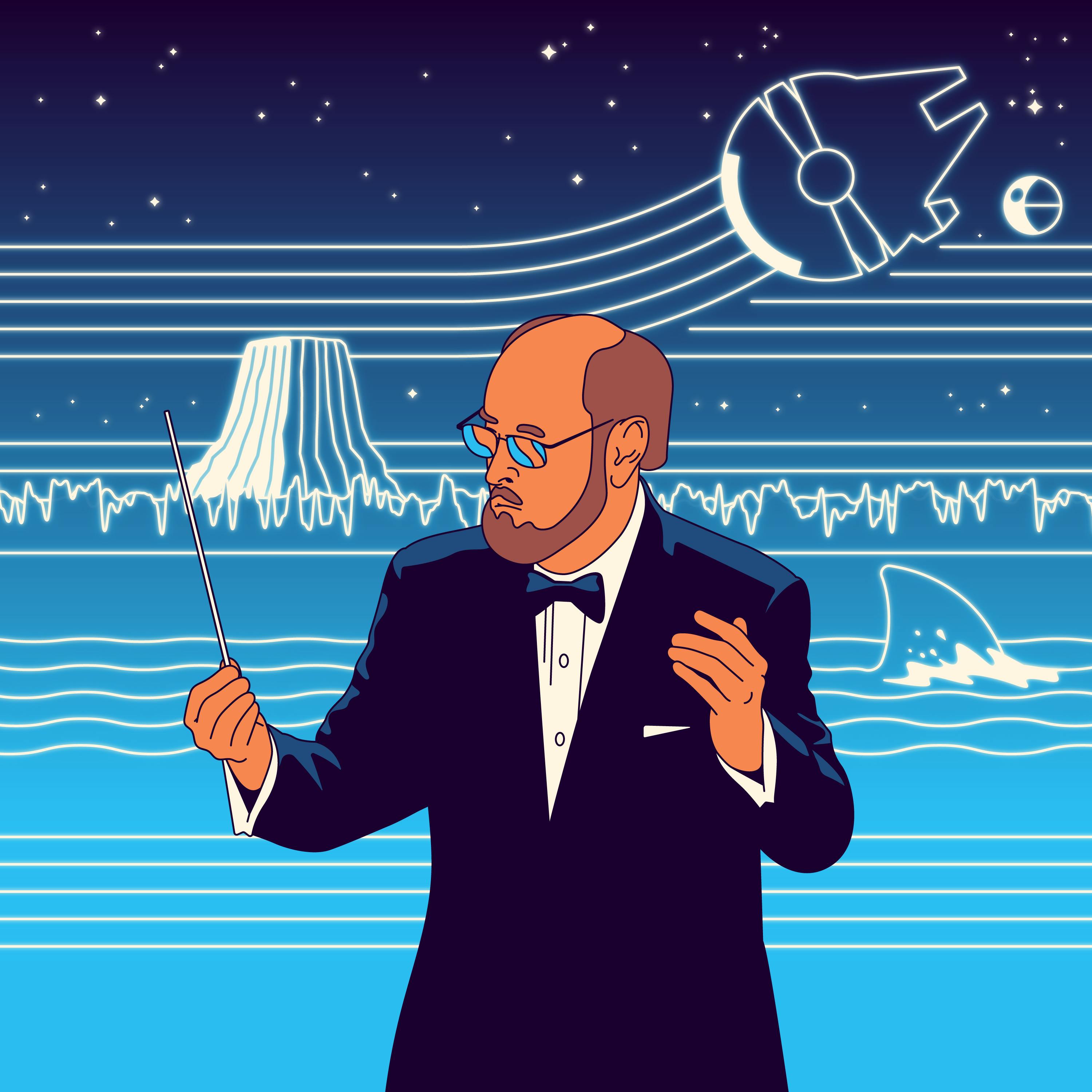
Loading summary
Transcript124 lines
- [00:01]
A
Summer is when we share more time, more memories, and More photos at, at and T. The iPhone 17 Pro is your summer essential. Its center stage front camera auto adjusts the frame to fit everyone into group selfies. You don't even have to turn your phone and AT and T makes sharing those pictures with everyone easy. Right now at, at and t ask how you can get iPhone 17 Pro on them with eligible iPhone Trade in any condition requires trade in of iPhone 15 or higher excluding iPhone 16e and 17 requires eligible plan terms and restrictions apply subject to change. Visit att.comiphone or visit an ATT store for details. You're listening to 20,000 hertz.
- [00:50]
B
The stories behind the World's Most Recognizable
- [00:53]
A
and Interesting Sounds I'm Dallas Taylor. When it comes to film composers, there are a few names that stand out above the rest. People like Ludwig Goransson, Danny Elfman, and Hans Zimmer. But the most well known film composer in history has to be John Williams. Incredibly, he's been scoring movies since the 1950s and he's still working today at 94 years old. Over the last 70 years he's scored over 100 films including many of the biggest blockbusters of all time like Jaws, Star Wars, Indiana Jones, ET Home Alone, Jurassic park and Saving Private ryan. He's won 27 Grammys, three Emmys and five Academy Awards and he's toured the globe conducting world class orchestras. But despite all of that success, the story of John Williams life has rarely been told because while John has done lots of interviews, he doesn't talk much about his personal history. But in 2025, the first official biography of John was published. It's called John A Composer's Life by
- [02:02]
B
Tim Grieving My name is Tim Grieving. I am a film music journalist and historian and I just wrote a book about John Williams, who is my favorite artist of all time.
- [02:13]
A
Working on the book gave Tim a unique window into the life and work of this musical icon.
- [02:24]
B
John Williams was born in 1932, which means he's older than Elvis Presley. He grew up in Queens, New York during the Depression, but his family was comfortable because his dad was always busy.
- [02:38]
A
John's father, Johnny Williams, was a successful jazz percussionist. For a few years he played with the Raymond Scott Quintet, who had multiple hits. This is a song that Johnny played on called Powerhouse, which later appeared in Looney Tunes, Ren and Stimpy and the Simpsons.
- [02:58]
B
The Raymond Scott Quintet were contracted by Fox to come out to Hollywood and so when John was five years old, he found himself playing on the Fox lot with Shirley Temple and things like
- [03:08]
C
that on the good ship Lollipop.
- [03:13]
D
It's a sweet trip to a candy shop.
- [03:16]
B
So he was always surrounded by show business and musicians. And he started learning music as a kid from all these great teachers that his dad played with.
- [03:26]
A
Here's John talking about his childhood in an interview with Variety.
- [03:30]
E
Music has been with me all my life. It was there when I became conscious, when I woke up as a child. And it was what adults do in their profession because my father's friends were all musicians.
- [03:43]
A
Specifically, John and his three siblings all learned to play piano. Here he is in the Disney documentary Music by John Williams.
- [03:51]
E
My practicing had to be done in proportion to playing baseball. If I played baseball for an hour, I must have to practice the piano for half an hour.
- [04:01]
B
He moved to LA with his family when he was 15 and went to high school out here.
- [04:06]
A
By then he was already writing his own music.
- [04:09]
B
Even when he was a teenager, he was arranging music for different ensembles, like little friend groups or jazz combos or whatever. So he was inventing music in his own way.
- [04:21]
A
After high school, John enlisted in the US Air Force. He was eventually stationed at a base in Newfoundland where he played piano and bass for an Air Force band.
- [04:35]
B
So he was playing flag raising ceremonies and also at society dances and stuff like that. But he was an arranger too, so he'd do a lot of arrangements of tunes and marches and whatever Air Force bands play. He also scored his first film, quote unquote, in the Air Force. He scored a travelogue for Newfoundland.
- [04:54]
A
Here's a clip of that film, which is basically a 22 minute tourism promo for the music. John woven melodies from Newfoundland folk songs that he found in the library. For instance, this melody is based on a folk song called Lots of Fish in Bonavist Harbor.
- [05:14]
E
There's lots of fish in Bonavist Harbor Lots of fish riding around here Boys and girls are fishing together 45 from Carabineer.
- [05:23]
A
John had gotten his first taste of film scoring, but it wasn't what he wanted to pursue.
- [05:29]
B
He never really had aims to be a film composer, even though he was in that world a lot since he was a kid. But he wanted to be a classical pianist. So he was studying and practicing the piano really intensely in his teenage years. And as he got out of the Air Force, he went and studied with the best teacher in the country at Juilliard.
- [05:51]
A
Now, John didn't attend Juilliard, but he took private lessons from a renowned piano teacher at the school, Rosina Levine. At the time, two of her other students were John Browning and Van Cliburn, who would both become really successful pianists. This is Van Cliburn playing Rachmaninoff's Piano Concerto no. 2 with the Chicago Symphony. In an interview with npr, John said that when he heard these players, I
- [06:22]
F
thought to myself, if that's the competition, I think I better be a composer.
- [06:26]
A
And his teacher agreed.
- [06:28]
B
She recognized that he wasn't destined to be like a concert piano player, but she saw that he had a gift for composing and arranging, and she really encouraged him in that direction.
- [06:38]
A
So he started pursuing composition while still playing piano under the name Johnny. Like his father, he was a session
- [06:45]
B
pianist here in Hollywood. Played on a bunch of film scores, including the Big country, the original west side Story. He also played on albums for Frank
- [07:03]
A
Sinatra, but now all is Gone.
- [07:10]
B
Harry Belafonte.
- [07:12]
E
Ever since the world began, Roman was always teaching madman.
- [07:18]
A
But as time went on, John found playing other people's arrangements less fulfilling.
- [07:24]
B
I think it was him sitting in the sessions for other composers in Hollywood where he's playing the piano. He was kind of bored doing that, and he realized he could do what the composers were doing, maybe even better than they did.
- [07:35]
A
But those experiences taught him how to get the best from these musicians in his own work. As he told npr, the instrumentalists at
- [07:43]
F
that time, as now, were outstanding, world class players. And my advantage was that I'd been playing with them for three or four or five years as a colleague in the orchestra. I would go over to a horn player and say, have I got this too high or is this trill a little awkward? Would you rather play it here or there? Just from one friend to another without any particular professional pressure. And they'd also, oh, put it here, put it there.
- [08:07]
A
In 1956, John got married to Barbara Ruick, who he had known since high school. By this time, Barbro was an actress and singer. The year they married, she starred in the film adaptation of the musical Carousel.
- [08:20]
C
When I married Mr.
- [08:24]
A
Snow about a year later, John and Barbara had their first of three children, a daughter who they named Jennifer or Jenny. In an interview with composer Andre Previn, John described this as the event that really pushed him into film scoring.
- [08:40]
F
And the event was the birth of a little girl. And the birth of a little girl caused the need to earn some money, which everyone in the audience will understand.
- [08:49]
E
I had to go to work.
- [08:51]
A
So he threw himself into composing. He also started going by John instead of Johnny, which he thought would seem more professional. One of his early scores was for the anti war film none but the Brave, which starred and was directed by Frank Sinatra. He also did a lot of television work and composed the music for sci fi shows like Land of the Giants. And lost in space. It was an exciting time for John and his family. Here's John's daughter, Jenny Williams, describing her childhood in the Disney documentary.
- [09:43]
C
My parents were very glamorous and they went out a lot. They threw parties. I remember that my father played a lot of show tunes. He and my mother would rehearse and have fun together and play songs. And we were able to entertain each other and make each other laugh and have so much fun together.
- [10:07]
A
By the early 70s, there was a new crop of adventurous young filmmakers in Hollywood. This included people like Martin Scorsese, Francis Ford Coppola, Brian De Palma and Robert Altman. And many of their films were moving away from the sweeping orchestral scores that most classic films had. Instead, they wanted music that felt more modern and avant garde. And it turned out that John could do that too.
- [10:31]
B
He'd kind of been on this interesting Jag where he was working with Robert Altman, who was a much more experimental, adult kind of filmmaker. They'd done two pictures together. One was called Images, which was this crazy score for like, sounds like these sculptures that you bang on and, you know, throwing a rock into a piano and groaning and all this weird modern stuff.
- [10:58]
A
The movie is about an isolated woman who starts seeing a double of herself and loses her grip on reality. And John's score reflects that paranoia.
- [11:08]
B
And it's kind of this what if situation of this is the kind of path John Williams could have gone down if he'd stuck with people like Robert Altman, where it's like, let's do unconventional, break the mold kind of stuff. But he meets Spielberg right around this time. And I kind of see this as a fork in the road of his career. Obviously he chose Spielberg and these more kind of family oriented, popcorn, blockbuster kind of projects, and I think for the better. But it was this interesting moment in his career where he could have gone one way, he chose to go another.
- [11:39]
A
It was in late 1972 that the Stars aligned for John Williams to meet Steven Spielberg. Here's John describing that meeting to Stephen Colbert, who interviewed him and Spielberg together.
- [11:51]
E
Somebody set up a meeting, a lunch meeting for us in some fancy restaurant in Beverly Hills. And the head waiter came and he said, I was bringing to Mr. Spielberg. And I saw this teenager. I thought, you gotta forgive me, Steven, tell this story.
- [12:05]
D
I'm not even here.
- [12:06]
E
So I thought, maybe that's Mr. Spielberg's son, where's Spielberg?
- [12:11]
B
It's important to remember that John Williams was 40, almost 41 when he met Steven Spielberg, and Spielberg was only 25. So John Williams had already lived this kind of first phase of life and been pretty successful and was kind of a veteran. And Spielberg was just a kid getting his first shot at directing a feature film.
- [12:30]
A
Despite their age gap, the two men connected instantly.
- [12:33]
E
Within a minute or two, I realized this is somebody very, very special with a keen and bristling dazzling intellect who remembered everything I'd ever written.
- [12:44]
B
Spielberg was a soundtrack nerd who collected film scores, and he collected this score by John Williams for a film called the Reavers and loved the music.
- [12:59]
A
As Spielberg told Colbert, when I heard
- [13:02]
D
John's score for the Reavers, I said to myself, if I ever get a chance to direct movies, I want this guy to score all of them.
- [13:12]
B
Spielberg loved old fashioned orchestral, kind of the kind of film music he grew up listening to, as well as like great classical music. And that's the kind of music he wanted in his movies. So that's why he reached out to this older, more experienced composer to try to hire him for his first film, which was the Sugarland Express.
- [13:30]
A
The Sugarland Express is a crime drama about a Texan couple trying to get their son back before he's put in foster care. Steven Spielberg imagined scoring it with an 80 piece orchestra. But after John saw the rough cut, he convinced him to pare it down, saying, quote, it's a very simple story. The music should be soft, just a few violins, a small orchestra, maybe a harmonica. This is the title theme that John composed for it. A few weeks before the movie was released, John's wife Barbara traveled to Nevada to shoot her first movie in over a decade. It was a Robert Altman film called California Split. But while she was there, Barbara suffered a brain aneurysm and died suddenly at only 41 years old.
- [14:29]
B
It was this horrible tragedy of losing his wife, his childhood sweetheart, the mother of his three children who are now teenagers. It was this really cataclysmic, disruptive thing.
- [14:40]
A
Here's John in the Disney documentary.
- [14:43]
E
It was an unbelievable event. A perfectly healthy, gorgeous young woman suddenly gone from an aneurysm that we couldn't have predicted. I was suddenly in my early 40s with three teenage children to deal with this very tough situation, sometimes very difficult to talk about.
- [15:08]
A
Barbara's father had been a violinist, and she always loved the violin. So after she died, John composed a violin concerto in her memory. This is the second movement of that Concerto, performed years later by the Boston Symphony Orchestra. After taking some time to grieve, John re immersed himself in his work.
- [15:39]
B
The death of his wife really shook his world, and he became much more kind of just all about the music. And that's maybe the biggest change that happened in his life.
- [15:48]
A
Here's their daughter Jenny again, followed by John.
- [15:51]
C
After she died. There was some kind of feeling that he had that she was by his side.
- [15:57]
E
I felt like she was helping me. It was just a funny kind of feeling that I had, and I still have it.
- [16:06]
A
And John would need all the help he could get because he was about to begin one of the most legendary runs of any film composer in history. It started with a little film about a big fish.
- [16:17]
E
You advertise or you advance the thought that the shock is there just by hearing the music.
- [16:24]
A
And it took him to a galaxy far, far away.
- [16:27]
E
I finally worked out this thing which jumps the fifth dome. Da da da da.
- [16:32]
A
That's coming up after the break. You know why I love Summer? All those plans we made. Finally make it out of the group chat and into the real world because there's more time to fit everyone in. Whatever you've got in store this summer, capturing those memories with your crew is a must. And the iPhone 17 Pro from AT&T helps you do just that. Its center stage front camera Auto adjusts the frame to fit everyone into group selfies. You don't even have to turn your phone. That means no awkward cropping or asking strangers to take it. Just the perfect group selfie every time. And ATT makes sharing those moments with everyone easy because you have to share the picture or or it didn't happen right? Right now at ATT ask how you can get iPhone 17 Pro on them with eligible iPhone. Trade in any condition requires Trade in of iPhone 15 or higher, excluding the iPhone 16e and 17e requires eligible plan Terms and restrictions apply. Subject to change. Visit att.comiphone or visit an ATT store for details. Congratulations to Alex Zaleski for getting last episode's Mystery Sound right. Those snarls and barks came from a group of Tasmanian devils. These creatures make a wide variety of aggressive sounding noises, but most of it is bluffing, and they usually try to avoid actual fighting. Unfortunately, they don't actually sound like the Tasmanian Devil in Looney Tunes. And here's this episode's mystery sound. If you know that sound, tell us at the web address mystery.2000. Anyone who guesses it right will be entered to win a super soft 20,000 Hz T shirt. In May of 1974, Steven Spielberg started shooting his follow up to the Sugarland Express. The film was based on a best selling book about a killer shark. It was called Jaws and John Williams was on deck to write the score. Initially, Spielberg wanted something similar to what John did for the Robert Altman movie Images.
- [19:00]
B
Spielberg had it in his head that Jaws needed a strange avant garde, creepy score like images. And he put images music on the rough cut of Jaws as like a reference for John Williams. And John Williams said, this is all wrong. This is not some cerebral intellectual drama. This is a popcorn movie is what he said. So he came up with that simple repeating kind of brainless motor. For the theme for the shark.
- [19:48]
A
Here's John on the late show.
- [19:50]
E
I was thinking, what could be the simplest possible thing? It has to be low because the shark is very deep. It has to be something that when it's approaching you, it is completely unstoppable.
- [20:02]
A
With this theme, John proved that two simple notes can be a lot more malleable than you might expect.
- [20:09]
B
You can speed it up or slow it down to indicate that it's getting closer to you or it's retreating from you. It was a really effective psychological and dramatic device that then he explored throughout the rest of the score.
- [20:21]
A
But at first Spielberg didn't get it. Here he is on the Late Show.
- [20:25]
D
I thought it was a joke when Johnny played that for me on the piano at his house. And he takes a couple of fingers, not all 10, just a couple. He didn't need all 10. And he goes, dun, dun, dun, dun, dun, dun, dun, dun, dun, dun, dun, dun, dun dun, dun dun dun dun. I started laughing, I started laughing. Johnny said, no, I'm serious, I'm serious.
- [20:50]
A
John was confident that once they tried it with the orchestra it would work. And of course he was right. While filming Jaws, the mechanical shark kept breaking down because of this. There are lots of scenes that were supposed to include the shark but don't. But even when you can't see it, the music tells you when the shark is close and builds that sense of dread. Here's Spielberg on the Late show again.
- [21:30]
D
Johnny sort of saved the movie because he became the shark and the music substituted for the absent shark, which made it scarier and more suspenseful than had. I had the shark working perfectly.
- [21:43]
A
With the release of Jaws, John became the John Williams.
- [21:47]
B
Jaws was the biggest hit of all time when it came out and the music made it as scary and powerful as it was, the two really fed off each other. So Spielberg And John Williams rocket to global fame at the same time, they become kind of the hottest duo overnight. And everybody knows who John Williams is. So even though John Williams had been working and was somewhat successful for quite a while before Jaws, this is the score that really pushes him to being like the top composer in Hollywood. It really changes his career.
- [22:19]
A
Amid the success of Jaws, Spielberg introduced John to a friend of his, a fellow director named George Lucas. Lucas was in the middle of an ambitious project. It combined elements of Flash Gordon serials, westerns, samurai films, and World War II aviation movies into a big sci fi spectacle. At the time it was called the Star Wars.
- [22:40]
B
Lucas was looking for kind of old fashioned orchestral, classical type music for his film. And Spielberg said, I know just the guy. This is the greatest composer. He's basically like the resurrection of old Hollywood composers.
- [22:54]
A
But John took a little convincing.
- [22:57]
B
He almost turned it down partly because it seemed like a just a kid's movie, a clunky kids movie, which if you ever look at Star wars with the music out of it, it is kind of silly looking and the dialogue's kind of funny and there's a guy walking around with a big dog costume on and you know, look, your worshipfulness.
- [23:15]
A
Let's get one thing straigh, take orders from just one person, Me. So wonder you're still alive. Will somebody get this big walking carpet out of my way?
- [23:24]
B
So you can imagine John Williams screening this and being like, I think I might be better served doing a drama for adults or something. But he decides to do it. One interesting thing behind that score is George Lucas was thinking about doing something similar to what Stanley Kubrick did in 2001 and just using existing classical pieces.
- [23:46]
A
2001 A Space Odyssey included music like the Blue Danube by Johann Strauss.
- [23:56]
B
And so the temp track, the temporary soundtrack for Star wars was full of the Rite of Spring and Gustav Holst's the Planets, Familiar classical pieces. And John Williams basically convinced Lucas, no, I'll give you original themes, original melodies, and make it all sound of a piece while kind of referencing or paying homage to these classical pieces.
- [24:29]
A
This fit in perfectly with Lucas's vision for the story, which begins with a long time ago in a galaxy far, far away.
- [24:37]
B
The idea was that this was a futuristic unfamiliar world and characters. But George Lucas wanted it to feel like a long time ago. He wanted it to feel lived in and ancient and familiar.
- [24:49]
A
Here's John describing the music of Star wars to composer Andre Previn.
- [24:53]
F
And the simple idea is this, that behind this unfamiliarity of terrain and of character, we'll place something that's emotionally very familiar. What's that going to be? It's going to be a symphony orchestra playing, if you like, almost 19th century, like tunes.
- [25:09]
A
For instance, here's the ending of the first movement of the Planets by Gustav Holst. And here's a section of the Star wars title theme. Now here's a section of the Rite of Spring by Igor Stravinsky. And here's a Star wars piece called the Desert and the Robot Auction,
- [25:56]
B
Which leads to people accusing Star wars and John Williams more broadly of plagiarizing. They're like, hey, I hear the thing you're referencing in the Star wars score. But what I always try to tell people is that was very intentional. It was part of the whole concept for that score. And even when you hear the references to other classical pieces, John Williams transforms it and metamorphosizes it into something original and something like he would have come up with.
- [26:20]
A
But there's one piece in Star wars that doesn't sound anything like classical music. It's the song played by the alien band in the crowded cantina on Tatooine. When they shot that scene, there was no music, just creatures holding instruments and dancing around. John had no clue what kind of music to write for it. But as he told NPR in the early 80s, George Lucas had an idea.
- [26:42]
F
He said, just imagine that these four or five little musicians are wandering around this dusty little planet off in space somewhere, and they find under a rock, the sheet music for one of the arrangements of Benny Goodman's great swing band of the 1930s, Earth Time.
- [27:00]
A
Benny Goodman was a band leader and clarinet player who was called the King of Swing.
- [27:14]
F
And they pick up this little sheet met music, which they obviously had never heard, and they look at it and they try to play it in their own style. And so I said, oh, that sounds. That's as plausible as any other thing we could come up with. And that was the kind of genesis of this silly little piece.
- [27:31]
A
They rewatched the scene with a click track to figure out the tempo of the dancing aliens. Then John wrote this jazzy piece. The iconic Star wars theme was actually the last piece of music that John wrote for the movie. He wanted a distilled heroic theme and spent a long time struggling with it. Now, George Lucas had said that with Star wars, he wanted to evoke the sound of classic film composers like Eric Wolfgang Korngold. Here's Korngold's theme for a 1942 movie called King's Row. And just like those classical pieces. It's very possible that John had this in mind when crafting the Star wars theme. Here's John Williams on cnn.
- [28:32]
E
I finally, in desperation, really worked out this thing which jumps a fifth Dom beam do soul tether Zati jumping up to do again an octave higher. That seemed to me to be a direct, strong, heroic, clear, sonorous sound from the orchestra. And it is a particularly electrifying brass interpretation. The great brass section of the London Symphony.
- [29:21]
B
Star wars takes John Williams into the stratosphere. The film was a phenomenon. It smashed whatever box office records that Jaws had made, which continued to happen. John Williams kept scoring these movies that were the next biggest blockbuster of all time. But Star wars was on this level that no one had ever seen before. And his music was such an integral part of the phenomenon. Everybody remembered that music came out of the theater humming that music, wanting to buy the soundtrack. There was this two disc LP that came out with like a black cover, the white Star wars font on the front. It became the best selling non pop album of all time. So it was a hit. It was like a genuine musical hit.
- [30:03]
A
Later that year, a producer named Miko put out a disco version of the Star wars music that was also a pretty hit.
- [30:18]
B
So Star wars just took John Williams into another strata of fame and popularity and success and financial success too, because he owned a piece of the film, thanks to George Lucas giving points to some of his key collaborators.
- [30:32]
A
Points refer to percentage points of the movie's profits. And another person with points of Star wars was Steven Spielberg. Before it came out, Lucas and Spielberg actually traded points on their upcoming films because Spielberg was working on his own alien movie. It was called Close Encounters of the Third Kind. And it was also scored by John Williams. In the movie, when the mothership arrives on Earth, it communicates with humanity using music. And they needed a short, punchy melody for the aliens to play. So John wrote about a hundred options which he played for Spielberg on the piano. Here's the two of them talking about those variations in an interview with Deadline.
- [31:20]
E
And I remember you and I circled this one. And Stephen said, I think that's the best one.
- [31:27]
F
I said, I think so too, for some reason.
- [31:29]
E
Very simple, but also very strong intervolically.
- [31:34]
A
Here it is in the movie. As John told Stephen Colbert, he likes how the melody feels unresolved.
- [31:47]
E
Why those notes? Di da dum. That's the finish. Di da dum. It's over. That's a resolution. Now we go do so. So is like the word and or. But it's a conjunction so you have an ending and a starting. Da da da da bom. Yeah, you gotta do it again.
- [32:04]
B
That's a continuing story.
- [32:05]
E
Yes, it is. I mean that is an after the fact rationalization. Or that's what it feels like.
- [32:14]
A
At the end of Close Encounters, Richard Dreyfuss character Roy boards the mothership to go explore the galaxy. And as he does, a melody from a classic movie plays in the score. Did you catch that? It's when youn Wish Upon a Star from Pinocchio.
- [32:53]
B
Who you are.
- [32:55]
A
Here's Close Encounters again. Listen to the strings over on your right. It might seem like a random choice, but it makes thematic sense. Like Pinocchio, Roy dreams of bigger and better things and the answer to his wish comes from the literal stars. In fact, earlier in the movie, Roy comes across a Pinocchio music box that's playing the same song.
- [33:28]
B
All this stuff is coming down.
- [33:35]
G
All gonna be like. Like it was.
- [33:41]
A
Here's Spielberg discussing the score in a behind the scenes featurette.
- [33:46]
D
All that is such a great symphony that John has written. It was almost an opera. Just a wonderful emotional opera with a little bit of when you wish upon a star disguised inside some of the notes.
- [33:57]
A
Close Encounters wasn't as huge as Star wars, but it was another big hit. And it wouldn't be John's last iconic score. In fact, he was just getting started. That's coming up next time. 20,000 Hz is produced by my sound agency, Defacto Sound. Hear more@DefactoSound.com or by following Defacto Sound on Instagram. This episode was written and produced by Casey Emerling with help from Grace East. It was sound designed and mixed by Brandon Pratt, thanks to our guest, Tim Grieving. Tim's book is called John A Composer's Life. You can find it wherever books are sold. And there's also a link in the show notes. Think of someone out there, you know who would love the story of John Williams. Maybe they're a massive Star wars fan or just a film buff or musician. Then tap the share button on this episode and send it to them. Finally, if you'd like to see my face and follow me around. As I explained, explore sound stories around the world. You can also find me on YouTube, Instagram and TikTok under the name Dallas Taylor MP3. Thanks for listening.
- [35:51]
G
Hi, this is Robert Margaleff. I'm a Grammy Award winning engineer, record producer, electronic music pioneer and filmmaker. And throughout my career I've crossed paths with some of the most influential artists of our time. I introduced Stevie Wonder to the world's largest synthesizer, which I helped build and worked with him on four of his albums. Andy Warhol's superstar Edie Sedgwick once moved in with me after she accidentally set fire to her apartment while we were filming a movie. I even got to crack a whip down a back alleyway when I produced Stevo's hit song Whip It. In my new audio memoir, Shaping Sounds, I share these stories and many more about what it's like to push boundaries and transform the sound of pop music. Find Shaping Sounds at Pushkin FM Audiobooks or at Audible Spotify or wherever you get your audiobooks.