← Unashamed with the Robertson Family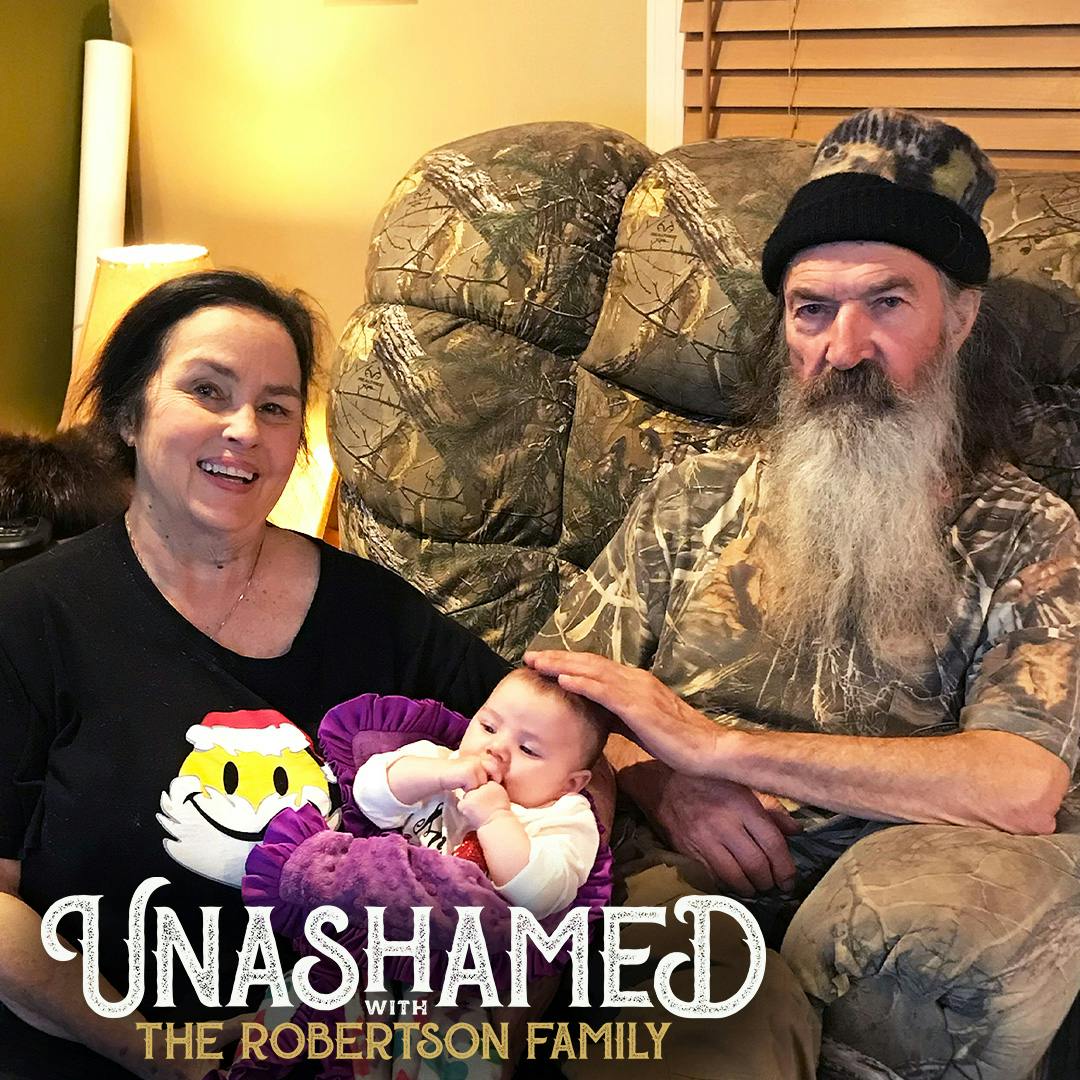
Unashamed with the Robertson Family
Ep 1164 | Phil’s Legacy Shines Through His Youngest Family Members
00:51:55
Loading summary
Transcript239 lines
- [00:02]
Al
I am unashamed.
- [00:04]
Host (possibly John or main speaker)
What about you? Well, welcome back to the not yet. Now.
- [00:11]
Christian
Was that a joke?
- [00:12]
Host (possibly John or main speaker)
Another podcast I'm on.
- [00:14]
Al
No, I know.
- [00:14]
Christian
I just didn't know if you were joking or not.
- [00:16]
Host (possibly John or main speaker)
I forgot. Ready?
- [00:18]
Al
Oh, that's when you know you've done a lot of podcasts.
- [00:21]
Host (possibly John or main speaker)
Welcome back to Word that.
- [00:22]
John Luke
Wait, no, that's not that one either.
- [00:23]
Host (possibly John or main speaker)
Well, guys, welcome back. We are here. The Unashamed podcast again. Hillsdale.
- [00:28]
Al
What podcast is this?
- [00:30]
Host (possibly John or main speaker)
It's the. It's Unashamed Academy, powered by Hillsdale. Al's got some merch.
- [00:36]
Al
We got merch. I mean, here I am, now that I've got a T shirt body again. Christian, I'm back to my college weight, so.
- [00:44]
Host (possibly John or main speaker)
You shouldn't have wore that.
- [00:45]
Christian
You look really good.
- [00:46]
Host (possibly John or main speaker)
He does look good. He shouldn't have wore that six months ago, but now you can pull it off.
- [00:51]
Al
Oh, if I'd have wore it six months ago to been like, ooh, that's the college student I try to avoid. Yeah, yeah.
- [00:56]
Host (possibly John or main speaker)
And you get your certificate there.
- [00:57]
Al
So you graduated. So.
- [00:59]
Host (possibly John or main speaker)
Yeah.
- [00:59]
Al
So I learned Christian was walking by today, and he saw that I had printed out my course when I completed the course, which means I aced the test, and everything went well. And Christian said, oh, you printed it. He said.
- [01:13]
Host (possibly John or main speaker)
He printed it.
- [01:15]
Christian
Generation Mine was a screenshot.
- [01:17]
Host (possibly John or main speaker)
This is a screenshot.
- [01:19]
Al
What is this strange thing you call printer? It prints paper. What is this?
- [01:25]
Host (possibly John or main speaker)
Well, we. Look, we do this every Friday. This is. It's powered by Hillsdale. Our partners at Hillsdale College thank these guys for and the. The donors that make this possible because we don't have to do any ads, which is great. Now we'll. We'll drop in a few little plugs because we want you guys to take this with us by going to unashamedforhillsdale.com and you can sign up and take the course with us. We're doing Genesis right now. You started out as a complete nerd, right?
- [01:50]
John Luke
You were the only one that I had my book.
- [01:53]
Al
What do you mean, started out? He still is.
- [01:56]
John Luke
Genesis and the commentary.
- [01:57]
Al
And then look.
- [01:58]
Host (possibly John or main speaker)
Look what we got.
- [01:59]
John Luke
Yeah, everyone's got it.
- [02:00]
Christian
I didn't bring mine today.
- [02:01]
Host (possibly John or main speaker)
I didn't just get the commentary. I've got this little. This big boy right here.
- [02:06]
Christian
I got that one, too.
- [02:07]
Al
Maybe we might do Exodus one day.
- [02:09]
John Luke
I'm hoping.
- [02:09]
Host (possibly John or main speaker)
Oh, I hope we do do Exodus.
- [02:10]
Christian
I just figured I would just bring my Bible. I didn't see myself skimming through this.
- [02:14]
John Luke
That is awesome.
- [02:15]
Al
But you brought your Bible. This Time. Last time he's brought your phone.
- [02:18]
Host (possibly John or main speaker)
Making progress.
- [02:19]
Christian
And then John Luke went from a plastic fork to a shredded piece of paper.
- [02:23]
John Luke
Upgraded to a shredded piece of. Yeah, shredded piece of cardboard.
- [02:28]
Al
It's got a piece of gum at the bottom.
- [02:29]
Host (possibly John or main speaker)
Yeah. John Luke's bookmarker in the last couple episodes was a plastic fork. So now he has upgraded.
- [02:36]
John Luke
I've upgraded to a shredded piece of paper from a bag that I found on the ground this morning.
- [02:41]
Host (possibly John or main speaker)
Well, I think this is important that we're doing this, guys, and hopefully it'll help us teach our kids about Jesus too. And I had an encounter with Ruth recently. That was my four year old that you guys might find interesting. She's four years old.
- [02:56]
Al
The fact you have a four year old is interesting.
- [02:58]
Host (possibly John or main speaker)
She was adopted because These guys have.
- [03:00]
Al
4 year olds, but they're supposed to.
- [03:03]
Host (possibly John or main speaker)
Yeah. In fact, my daughter's the same age as. Yeah, y'. All. Wow. Yeah, Think about that.
- [03:08]
Al
You're a lot older.
- [03:09]
Host (possibly John or main speaker)
Yeah. Yeah. It is a young man's game.
- [03:11]
Al
Yeah. You should be a grandpa now, but you're a dad. Okay, go ahead.
- [03:14]
Host (possibly John or main speaker)
So I'm praying for one of our pastors who was about to go have a meeting, and I was praying with him over the phone and. And Ruth comes up to me and she puts her hand on me at the end of the prayer, puts her hand on my knee and says, you forgot to pray for Phil. And I just. That is so sweet. Uncle Phil, you know, my uncle. And. But she's so confused because she goes, you know, he died on the cross. I said, no, no, no.
- [03:43]
Al
He was Christ like.
- [03:44]
John Luke
He was.
- [03:44]
Host (possibly John or main speaker)
He was Christ like. But he. He didn't die on the cross.
- [03:48]
Al
Take the turn.
- [03:49]
Host (possibly John or main speaker)
There's a lot. There's like a lot to unpack there. So I' Are we gonna do like. I don't know, you know, this whole thing is a little bizarre, but it is interesting that you think about, you know, the offspring lineage or kind of in that part of.
- [04:03]
Al
I love to what kids think. Because, like, so I mentioned this last time I preached because I got my two of my grandkids, my youngest, to do the scripture reading because we have kids every week do it. And it was great because it was exciting for me. My grandkids had never done it, and so they split the verse, you know. And so Pearl, my youngest granddaughter, she's seven now and she's just discovered Star Wars.
- [04:28]
Host (possibly John or main speaker)
Oh, yeah. I was at your house the other night.
- [04:30]
Al
Oh. And she knows all the. Zach was asking her question. She's very well Versed. So we're down at the. Down at my southern lair in Gulf Shores, and I come by and she's sitting in my chair and she's not looking at a device, you know, because they love the devices. And she's not watching tv. And so I walked by and she's just looking at the ceiling. And so I stood there for a minute and I'm watching. I could see she's like, she's processing something. She's thinking hard and so she's looking and then she notices me looking at her. She looks over at me and I said, what are you thinking about? And she looked up at me and she said, the Star wars timeline.
- [05:10]
Christian
Is that something you would do, John.
- [05:12]
John Luke
That I think about all the time yesterday?
- [05:15]
Host (possibly John or main speaker)
Yeah, he kind of laughed. He's like, I don't get the joke. Yeah.
- [05:20]
John Luke
Everyone'S laughing, so I'll laugh, I guess.
- [05:23]
Al
So I asked her on stage, I was like, so who's your favorite Star wars character? Because, you know, I was trying to engage him in, which I do when I'm up front. And she said, she said Grogu from the Mandalorian series. But she has a little bit of a speech impediment. So I.
- [05:39]
Host (possibly John or main speaker)
That's the ba. Is that the Baby Yoda?
- [05:41]
Al
Baby Yoda. If she said Baby Yoda, I would have gotten it. But. But it's not Baby Yoda, which she will be quick to tell you. That's a misnomer.
- [05:48]
Host (possibly John or main speaker)
It's not Baby Yoda.
- [05:48]
Al
It's not baby. It's its own person. You know, Baby Yod. Yoda is Baby Yoda. But anyway, so she says this Grogu. I missed the Grogu part. I just heard the Mandalorian series. So I said, somebody from the Mandalorian said, who did you say it's go to? She said, Grogu, like, you know, you idiot. So it's nothing like being called out front of your own church by your granddaughter over not knowing the Star Wars.
- [06:13]
Host (possibly John or main speaker)
Now these kids are interesting though, because like Ruth also says she want to get baptized. And so I was just thinking like in her mind, you know, she's kind of sat in church, she's heard me.
- [06:23]
Al
Talk, she's soaking up stuff.
- [06:25]
Host (possibly John or main speaker)
And I've told her that God's your heavenly father and she was adopted. So I'm not her biological dad. And we've talked about you have a biological father. Trying to explain that to a four year old though, is kind of difficult for her to grasp. She also was at Phil's funeral. She Saw him in the casket. She was there, saw the reverence that we all had for him. Knows that you got to get baptized, because she's watching people get baptized at church, and that's Somehow you get connected to the father. So she's kind of. The pieces are kind of, like, muddy. But it's kind of funny that, like, he's my biological father. Okay. He must be Jesus. I got to get baptized. Just trying to figure it out.
- [07:01]
Al
It's all rolling in.
- [07:02]
John Luke
It's all the theology.
- [07:03]
Host (possibly John or main speaker)
It's all that's in there. But it's like. And I think that's why I love this course.
- [07:06]
Al
But it is interesting because it does tie into the course because, you know, for our. For my grandkids, which was Dad's great grandkids, and then all these great nephews and nieces and great grades. So dad, like, is our patriarch figure, you know, in our family. I mean, you know, he's always been. He was always larger than life, but then, like, he is. He was the man, and he's even got the long beard and everything. We're reading. You imagine looking a little bit like that. And so for the kids to see that passage and to see that happening and to see our reaction to it, it is. It's a huge thing for them, like, in their mind to sort out. So I do think this shows not only what we're talking about in Genesis, in terms of the promises of God and all that there, but really it's just a family and a patriarch and us respecting that. And then how you go forward, I mean, just the human part of what we see in this text is really powerful.
- [08:02]
Host (possibly John or main speaker)
I think it's kind of like our origin story as Christians, too. Like, everybody kind of wants to know, where. Where did I come from? Like, you know, we all want to kind of know that, right? Inherently, where did I come from? And. And for us as believers in Jesus, I mean, this is part of the origin of our entire faith, in us being kind of grafted in. So we're in Genesis 22:2, which is episode four in. In the course. If you're. If you're. If you're not. By the way, if you're not taking the course, go take the course. Because the lectures are only, like, 25 to 35 minutes long. They're excellent. It'll give you context for what we're talking about here. We're all taking them.
- [08:38]
Al
Zach. I'm a graduate.
- [08:40]
Host (possibly John or main speaker)
Yeah, we got a graduate over here.
- [08:41]
Al
I have graduated from the course.
- [08:43]
Host (possibly John or main speaker)
I've graduated too you haven't taken the quiz yet, have you?
- [08:45]
John Luke
I have not graduated yet, which is classic John Luke, come taking the courses. I've taken the courses, but I have not taken the final test yet, which is the same as my college experience.
- [08:58]
Christian
The final quiz is really just all the other quizzes just kind of.
- [09:02]
Al
Didn't he say that he's still in college? Now we get it.
- [09:05]
Host (possibly John or main speaker)
Okay, if you want to take this with us, which we highly Recommend, go to unashamedforhellstone.com, sign up. It's no cost. And we're on lecture four, which is the introduction of. Well, Isaac is here.
- [09:19]
Al
But he kind of mentioned Isaac in the last lesson because, you know, he. He titled it Abraham, Sarah and Hagar. But obviously, childbirth and the patronage was such a big focus point there that you had Ishmael, which was Hagar's son, and then you had this sort of rivalry that happens between the moms, but it really becomes a rivalry of the sons, which to this day still carries on, which is pretty amazing.
- [09:43]
Host (possibly John or main speaker)
So, yeah, that rivalry continued. I thought that was interesting point that he made. But. But there's this really wild scene in Genesis chapter 22 where Abraham is called to offer up his son Isaac as a sacrifice, or offer him up, rather. We'll get into some of that in a little bit. And it's one of the key texts of kind of a precursor of the coming of Jesus. A lot of parallels here, but I'd love to get you guys thought on anything pop out for y', all, you know, on this Genesis 22 part.
- [10:19]
Christian
Yeah, I think there were so many things. One of the things that he said that I thought was really interesting was he kind of made the correlation between Abraham and Hagar and how they both were going to sacrifice their sons. So Abraham on the altar and then Hagar when she was, you know, kind of wandering around the wilderness and then saw the. The spring of water. I never made that correlation between kind of both of them and this and the sacrifice. And there's something else he said that was interesting, and I was going to see what y' all thought about this. But when he made the comment about the. The binding of Isaac was the most commented story in Genesis, like, throughout, like, just contextually, I was like, that's really interesting. I don't know what I would have thought would have been the most, like, commented portion in the Old Testament, but I don't know if I would have thought about the binding of Isaac. So I thought that was interesting. Which also disproves, like, how pivotal like this story in Abraham's faith here. It really is for the whole.
- [11:15]
Host (possibly John or main speaker)
It's a key text.
- [11:16]
Christian
It's a really key text. Yeah.
- [11:18]
Al
And I would say part of the reason he said that was it's a very controversial text because from most people's perspective, it really puts God in a bad light. Why would he ask a man to sacrifice to slaughter? He kept using the word slaughter. You know what, you take a knife. That's the idea. But I mean, so that part is like, well, how. I'm sure that's a bone of contention for anybody that whether they believe in God or not, especially the God of the Bible. So that's another reason why I think which he brought out and talked about that, that that's so controversial. I mean, just the setup for him.
- [11:54]
Christian
I love her too. The fact that like, basically when, when God would ask Abraham to do this, it wouldn't have been like, it wouldn't have been that weird for Abraham because all the other gods at this time did things like this.
- [12:10]
Host (possibly John or main speaker)
Yeah.
- [12:10]
Christian
So it wasn't like, like, so I think it's for us reading it, it's why would God.
- [12:14]
Al
Which is kind of your point in an earlier podcast about the Eastern mindset versus the Western. Same thing.
- [12:19]
Christian
Because like when God asks Abraham to do this, you know, last podcast we talked to Abraham's father and how he worshiped different gods. Like, this was a common, like, you.
- [12:27]
Host (possibly John or main speaker)
Know, you sacrifice your sacrifice. That's what you do.
- [12:30]
Christian
Yeah. So it wasn't like this. So I think that's. It's interesting think viewing it from the fact that Abraham. It wouldn't have been kind of the way we view it today of how could we do that? Because it was. All the other gods at this time would have demanded things like that.
- [12:45]
John Luke
I think it was still a. I. I've heard that before and I totally agree. And I think that is something that in Abraham's mind, why he was like, okay, I'm going to do this because it. That is something he's seen other gods do. So it wasn't that like out of his mindset, but it was still a tough decision, a difficult decision, and one that he probably would have wrestled with, which we'll talk about in a minute. Backing up before that, one thing I'd never thought of talks about Abraham. Here I am. Take your son and your one and only son whom you love, Isaac, and go forth. And in the commentary from Altar, it talks about this midrash, which is like a story extra story about the Bible. Like this Take from a rabbi.
- [13:35]
Host (possibly John or main speaker)
And.
- [13:35]
John Luke
And he talks about how Abraham brings up Esau and Sundays, I have two sons. I love Esau as well. And that's just something I'd never thought about. Like, once Esau leaves the picture, you just. You really don't think about him again until much later. But just that thought that, oh, Abraham, he did love Esau. He didn't want to send it away in the beginning. And now he's got Isaac and Abraham still is.
- [14:00]
Host (possibly John or main speaker)
Ishmael.
- [14:01]
Al
Ishmael.
- [14:01]
John Luke
Oh, sorry, sorry, sorry.
- [14:02]
Host (possibly John or main speaker)
Yeah, yeah, we've been on the descendants.
- [14:06]
John Luke
Sorry, I got confused. Abraham didn't want to send Esau away in the beginning.
- [14:12]
Host (possibly John or main speaker)
Ishmael.
- [14:13]
John Luke
Ishmael. Abraham didn't want to send Ishmael away in the beginning. But now thinking about sacrificing Isaac is remembering, like, oh, I did have two sons. Like, there is the other son out there too, which just brings another element into it.
- [14:30]
Al
And the. And the depth of love he had for him.
- [14:32]
John Luke
Right.
- [14:33]
Al
Because. And remember, he was, as we talked about before, he was 13 years old, so he had completely. Almost raised him up completely before Isaac even finally came onto the scene.
- [14:43]
John Luke
Right.
- [14:44]
Al
Which is. Which. So, you know, that depth was there.
- [14:46]
Host (possibly John or main speaker)
Yeah, he makes it. Then he make the point, though, that Isaac was.
- [14:50]
Al
He said it was potentially in his 30s, which I had never heard. I never heard that either. But also, you know, to help you on the languaging, he. He. He set it up. And this is why it's good to take courses like this, because you get a little bit better understanding of sometimes because something's translated a certain way. There's. There are multiple ways you can look at things in Hebrew or Greek. One of the things he talked about here was, did he really say slaughter him or did he really say prepare him?
- [15:19]
Host (possibly John or main speaker)
Yeah, that was a big deal.
- [15:20]
Al
Out of the room, which. Out of the word. Which was interesting. Because in other words, if his job is just prepare him for the sacrifice, that's a little bit different command than actually make the sacrifice. Even though Abraham totally understood.
- [15:36]
Host (possibly John or main speaker)
I would probably push back on that point. I think it was a call to kill him.
- [15:43]
Al
Well, I will say this. I agree with you that Abraham thought the same thing because he did have the knife.
- [15:48]
Host (possibly John or main speaker)
Because I think that. I think what you get in Genesis 22, that's probably the most important part of Genesis 22 is the idea of a substitutionary atonement. Right. That Christ dies in our place. And so you see that in the text. But I've actually preached this text a lot. Have you?
- [16:06]
Al
Oh, yeah.
- [16:06]
Host (possibly John or main speaker)
I mean, this is like. So when you mentioned that earlier, that this is one of the Most cited. When Dr. Jackson mentioned this is one of the most cited texts in Genesis, I could tell you I have preached this text a lot. And I would tell you that this text is an anchor text for how I understand what the word faith means. He mentions this, which I thought was a great point, that there's two different interpretations of the binding of Isaac in Genesis 22. One is what he calls the Kierkegaardian, which y' all rejected it because you couldn't pronounce it. One of y' all said. Who said that?
- [16:44]
Al
I said that.
- [16:45]
Host (possibly John or main speaker)
Yeah. Al said, I just.
- [16:45]
Christian
Kierkegaardian.
- [16:47]
Al
I don't follow anybody. I can't pronounce ye.
- [16:49]
Host (possibly John or main speaker)
So, hey, Al, was that.
- [16:51]
Al
That's my litmus test.
- [16:52]
Host (possibly John or main speaker)
Yeah. Kierkegaardian. He was out, I'm out, which is. Kierkegaard was a philosopher, Soren Kierkegaard. And his contribution, really, to Western philosophy was that. So if you think of the idea of faith being I'm on a cliff or I'm in a burning building, and I just. Or I'm on a cliff and I jump off. I'm on a cliff. I'm on a cliff, and I jump off and I cross my fingers, and I just have faith that I'm going to survive the fall. That's blind. That's like a blind leap of faith. We call it a leap of faith, and that's a term that we've all used. We've all heard it. What does it mean? A leap of faith is a leap. It's basically, you're leaping into the unknown, and the greater the risk is for that leap than the greater the faith is. And that came from Kierkegaard. And so the reading of the text would be that. That Isaac is. Or Abraham's called to offer Isaac up as a sacrifice, as a blind leap of faith. And that's one reading of the text. The way that this played out in my life, this understanding, because I grew up thinking about faith this way. This is what I thought faith was. And then I reach a place in my life where I'm like, I don't know if the Bible's true. Like, I had that thought. I mean, I really struggled with a lot of big questions, and a lot of people do, oh, my gosh. I mean, I was like. And I was like, I mean, did God really create the Earth in seven days? Is the Earth really only 6,000 years old? When science is showing that it's 4.5 billion years in the universe, maybe 14.5. Or was it a global flood? You get into all the questions, right? And there's a whole branch of Christian theology called apologetics that gets into this.
- [18:40]
Al
And Genesis is a hotbed for a lot of those.
- [18:43]
Host (possibly John or main speaker)
Well, particularly the first 11 chapters. But. But yeah, even beyond that, Genesis is a hotbed of that activity. And when I would present those questions that I was having those objections that I would have to pastors that I respected, their response would be, well, you just got to have faith. That's where faith comes in. And I'm like, gosh, that's so dissatisfying. And at our church when we lived here, I did a monkey survey. Is that what they call it? Monkey survey?
- [19:16]
John Luke
I think, I think. Wait, no, go ahead. Like males. Is it like a specific survey or is it.
- [19:24]
Host (possibly John or main speaker)
It's like a survey, like an online. Like a text that everybody sends in. I forgot what it is. I think it's a monkey survey. Whatever. It's a survey. I had all the youth group do it one night and I said, what is the word used for a belief that you have no reason to believe that it's true? And 98% of the students, somewhere about like upwards of 90 plus percent said faith. I was like, no, no, the word for that is stupidity. Yeah, but the thing is, is that Kierkegaard, like that, this is what he brought to the table. And I think he was wrong in this. And there's a guy named Francis Schaefer that I read everything he wrote that helped me see that the other interpretation of this is what he calls the Hebrews 11 interpretation.
- [20:05]
Christian
Yes.
- [20:06]
Al
My Bible's already turned. There was yours too. Yeah, yeah.
- [20:08]
Host (possibly John or main speaker)
What? You what? Yeah, read that.
- [20:09]
Christian
Well, no, you can. I. I just had it. The.
- [20:13]
Al
So that, to me, that's what really brings this text to light, obviously. And by the way, there's like a whole section about Abraham earlier in Hebrews 11. But then he gets to verse 17 of Hebrews 11. He says, by faith, Abraham, when God tested him. Here's the way the Hebrew writer characterizes the story. Offered Isaac as a sacrifice. Interesting. He says the Hebrew writer says he actually did offer. Yeah. As a sacrifice. He who had received the promises was about to sacrifice his one and only son, even though God had said to him, it is through Isaac that your offspring will be reckoned. So that's the tension, John, like you were mentioning earlier, the idea is that God's already promised that everything was coming through this son. And now I'm told to sacrifice the one and only son. Abraham reasoned, this is where you get the insight from Holy Spirit thousands of years later that God could raise the dead. And figuratively speaking, he did receive Isaac back from death.
- [21:13]
Christian
There's a midrash that actually believes he actually did sacrifice Isaac and then three days later, Isaac was resurrected.
- [21:22]
Host (possibly John or main speaker)
That's interesting. Yeah.
- [21:24]
Christian
I don't know if y' all have ever heard that.
- [21:25]
Al
I never had.
- [21:26]
Host (possibly John or main speaker)
Yeah, I hadn't heard that.
- [21:27]
Al
But certainly we made that connection with. The connection is made between the Father and the Son.
- [21:34]
Host (possibly John or main speaker)
But that's a big difference. I mean, think about how Hebrews starts. Hebrews 11. Yeah. That chapter starts with a definition of faith. It says this. Now, faith is the assurance of the things hoped for, the conviction of things not seen. So it's not a leap into the unknown. It's assurance. It's texture, it's context. It's something you can sink your teeth into. It's tangible. That's quite the difference than what Kierkegaard was pushing.
- [22:01]
John Luke
Yeah.
- [22:02]
Christian
Can I get my last midrash thing real quick?
- [22:03]
Host (possibly John or main speaker)
Yeah.
- [22:04]
Christian
So one of the other things, too, it talks about how. Because if you can imagine, if you truly, if you are in your 30s, like, how traumatic this would be if you're going to be sacrificed. So. Which this could be true. Cannot be true. But it goes on to talk about, you know, because with Esau and Jacob, how Isaac's eyesight is so bad, but it calls back to this moment and how something happened here in this moment that kind of just scarred him, which is why his eyesight was really bad. So, yeah, just a little side tangent thing could have any.
- [22:33]
Host (possibly John or main speaker)
Was that course. Are you getting that somewhere else?
- [22:35]
Christian
I was just getting that somewhere.
- [22:36]
Host (possibly John or main speaker)
I was like. Well, I was like.
- [22:38]
Al
I didn't remember.
- [22:40]
Christian
I've heard that before. Because it. Because it's interesting. It's.
- [22:43]
Host (possibly John or main speaker)
If you. By the way, make sure you sign up for the course, too. I want you guys to hear. Dr. Jackson's course is amazing. We're in lecture four. Unashamedforhillsdale.com you can sign up for free. Take the course with us. What were you going to say?
- [22:56]
John Luke
Another thing I hadn't thought about is that Abraham was around 100 years old or over at this point. And when he says that. And I thought, oh, Abraham has spent his whole life sometimes trusting in God a lot of the time not. He had lied, he had cheated, he had done all the things. Like the chapter before. This was one of the many times he lied to the Pharaoh and so you, you have this whole life of struggling with faith until he gets to the end and he. Then he believes he has faith. Like God calls him to something more difficult than he's done for the last hundred years in Abraham. It doesn't talk about that, him having that struggle. Like he says, okay, I'm going to believe. I'm going to give him sacrifice. Yeah, here I am. It made me think about just in my own life, that walk in faith to God is a lifetime of growing in faith before you get. Or God's gonna act or you get hit with something that's like, wow, that's so far. Because if God asked him to do this 50 years ago, Abraham would be like, I don't know about that.
- [24:12]
Host (possibly John or main speaker)
Well, even when he graded point. Well, think about what he did do whenever he made the promise. You're gonna look up in the sky. What was the promise? Right. That the whole thing that this faith is hinged on the faith of Abraham. It's faith in God to deliver on the promise that he made to Abram at first, who later became Abraham. What was the promise? Look up in the sky, count the stars. Can't count them. That's right, you can't count them. And that's how many grandkids you're going to have. And so at first, as we've learned in the last three lectures, there was a lot of laughter. Whether that was maybe laughter of joy and laughter of skepticism. We know that Abraham did not fully trust in the plan of God or he would not have submitted to his wife's plan to have Hagar as to take Hagar as his wife, thus creating.
- [25:03]
Al
Plus there's other storyline that they don't. That Dr. Jackson doesn't deal with in, in this text between 12 and 22 about. Remember when they went through Egypt and he didn't trust that, you know, he was. Sarah was there and the king wanted her. Oh yeah. I mean, he showed signs as John, like the same.
- [25:21]
Host (possibly John or main speaker)
And Isaac did the same thing.
- [25:22]
John Luke
Exactly.
- [25:23]
Host (possibly John or main speaker)
Yeah.
- [25:23]
John Luke
Abraham is doubting this entire time.
- [25:25]
Al
Exactly.
- [25:26]
John Luke
And then until he gets to this end and God puts it to him like, do you believe me? Do you believe this promise? And he does.
- [25:32]
Al
But look, in practice, just being 100 practical here and authentic. I mean, I made a lot of faith decisions from 18 until I was in my 30s and loved God and trusted God. But then when I got faced in my case, it was mine and Lisa's marriage when it fell apart. And all of a sudden I was looking at everything I thought that was Real. That all of a sudden wasn't real. Because, like, my whole life had been built on a faulty foundation. Trust me, my faith was put to the test. Do I really believe this? Is this really real? Is God powerful enough to put things back together again? So I've experienced it. I realized you can think, man. I'm just Ro rolling along here, and life seems to be pretty easy. And then all of a sudden, you're hit with something that's way bigger than what you imagine. And then you have to do it.
- [26:20]
Host (possibly John or main speaker)
That's so good. I think that what's encouraging for me is that the faith that God calls us to, the faith of Abraham, is certainly a broken, tattered faith. And the verse that I immediately think of when I think of faith like that, like, how much do you have to have? Well, Jesus says, you got to have. It's got to be like the size of a mustard seed, which is not a lot.
- [26:45]
Al
You can't even see it in the palm of your hand.
- [26:47]
Host (possibly John or main speaker)
Yeah, it's like the faith of a mustard seed can move a mountain. And I think you see that in the story of Abraham or Abram then becomes Abraham. But I think that I want to unpack this Hebrews 11:17 narrative and motif, if you will, because I think that is, for me, that's the core of understanding Genesis 22 of this sacrifice of Isaac. And I think you see it as opposed to that blind leap of faith. One of the things that Dr. Jackson brought up that I thought was a very great point that I had never really considered this, but the. Let me read it here. He names the place Yahweh Yaira, which means on the mount of the Lord there is sight. So if you think about whatever's happening up there, if it's a blind leap, then why does he name it the place where you get sight? It's not a blind leap. It's actually the place where you receive sight and understanding and like, oh, this is what's happening. And so when you look at the story here, there's some things that happen that I think are super interesting that give us little nuances into the mind of Abraham. And I love it because he actually got it wrong. But he got it right at the same time. Because when Abraham is called to sacrifice Isaac, he says, gather the wood up, essentially, let's get everything. Let's go. And then he says something interesting. He says, me and the boy are going to go up the mountain to make the sacrifice. And he says this, and then we'll come back. Well, hold On a second, I thought you were going to sacrifice your son. And without Hebrews 11, we don't really know what he's thinking. Right? We're just like, what was he thinking? What do you mean? How would you sacrifice your son on an altar? And then you'll come back with him? Don't you understand how the sacrifice works?
- [28:46]
Al
Which is why a lot of people missed it, because they said, well, he wasn't really going to sacrifice him, because he said, we're going to come back. But we know from the Hebrew writer that, no, he really thought he was. He just thought God was going to raise him up.
- [28:57]
Host (possibly John or main speaker)
Now, because we know that from Hebrews, but you don't really know that from Genesis 22. So it's interesting that. And then the second thing is, whenever he was talking to Isaac, Isaac's like, I see the burnt wood for this, I see the burnt wood, but where's the sacrifice? And then what does Abraham say? The Lord will provide. And so we know that, like Abraham going up that mountain to make this sacrifice, that in his mind, he has a plan in his mind of how God's going to do this. We think, why does he have that plan? Why would he assume that they're going to come back down? Because God had already made him a promise. And the promise was that through Isaac shall your offspring be reckoned. In other words, look up in this guy again. Oh, yeah. How many stars are there? More than I can count. That's how many grandkids you're going to have. And guess what? They're going to come through this guy right here. And he points at Isaac. So that was the promise. So at this point, Isaac didn't have any kids. He hasn't been married yet. So the logic of this whole thing is, if Isaac's going to be the way that I'm going to have a bunch of grandkids, and you want me to kill Isaac. Almost like God. Okay, let me explain to you how the birds and the bees work. What happens is, if you kill him, then he's not going to have any. How will I get grandkids? But Abraham's faith was that God is going to deliver on the promise. Now, what he doesn't understand is, and he actually gets it wrong the way that he had reasoned, he's. I guess God has just raised him from the dead. But that's not really what he does it figuratively. Yes, of course. But that's not what Abraham thought. And what actually happened are two separate things.
- [30:50]
Al
Well, and Dr. Jackson didn't go into this, but I love the idea that he used the word worship there. And I've got this idea of a book noodling in my brain about weaponized worship. And I got it from the destruction of Jericho. But every time you see that word pop up in these weird settings, like when Job lost his family member, he fell down and he worshiped. You see this idea of how faith allows us to fight battles in our everyday lives because of our worship of the Almighty, that people that don't have that have no way to fight. That's why they're such victims without that which is so powerful. So this is another instance I like. He says, we're going to go worship. I mean, I don't know that I would view this as my idea of worship, but that's exactly what Abraham called it.
- [31:37]
Host (possibly John or main speaker)
The offer your bodies is a living sacrifice to God. This is your spiritual act of worship. You see that again in the New Testament.
- [31:45]
Christian
What was the part that was significant again, about when Abraham, when Isaac mentioned the wood and the fire but didn't talk about the knife?
- [31:53]
Host (possibly John or main speaker)
I think he was making the point that potentially maybe that this. That the sacrifice wasn't necessarily about, like, a death. And he did make a great point, though. I think that. And maybe I got that wrong, but that's how I interpreted what he was saying. When we have him on the podcast. We need that because he's going to come on our last episode of the.
- [32:17]
Al
Genesis series and correct all our mistakes.
- [32:19]
Host (possibly John or main speaker)
Yeah, yeah. So we'll have a good debate now. We'll ask him then, because that's. I think that's a good. A good question. But the.
- [32:26]
Al
And you remember what Christian is talking about.
- [32:28]
Host (possibly John or main speaker)
He.
- [32:28]
Al
He repeats everything that Abraham says, but he leaves the knife out.
- [32:32]
Host (possibly John or main speaker)
Well, he doesn't say. Yeah, he didn't say, where's the knife?
- [32:34]
Al
We got. We got the wood, we got the fire. You know, we got everything.
- [32:37]
Host (possibly John or main speaker)
Yeah, where's the knife? You know, but what he did ask is, where's the sacrifice? And then, you know, Abraham could have said, well, yeah, you want the good news and the bad news? You're kind of the sacrifice, buddy.
- [32:51]
John Luke
Abraham hadn't told him until, you know, presumably the last day.
- [32:55]
Al
You know who else we didn't read that he told was the wife.
- [32:58]
John Luke
Yeah.
- [32:58]
Al
No, he had done it almost always. That was interesting. It's not like he had to sit down with Sarah and says, oh, by the way, you know, we went through this whole thing, but here's what we're going to do. We don't See any mention of that in Dr. Jackson? Didn't comment on it. That's another question I want to ask him. Do you think he tells Sarah what he was doing?
- [33:16]
Host (possibly John or main speaker)
Yeah. And if you're confused, you're like, what are you guys talking about again? Go to unashamedforhillsdale.com Sign up and listen to Lecture 4. Listen to all of them, but listen to Lecture 4 for sure. And there's a part in there where he talks about this. I think, though, that when you think about Abraham's belief, Romans 4 talks about this as well. He uses Abraham as a prototype for our faith. I think the key point here is that Abraham. Here's a bumper sticker. Abraham did not know how God was going to fulfill the promise. Abraham knew that God was going to fulfill the promise. He actually got the how wrong. So what kind of faith do you have to have? You don't have to understand the ways of God. How could you? But you can understand that he is faithful and that God will accomplish what he said he will accomplish. And for me, that has been the struggle of my life is honestly just believing that I want God to run his plans by me first. Tell me the plan again. Let me make sure. I could check off on the plan to make sure that God's sovereignty is lining up with my sovereignty. And that's not what faith is. Faith is trusting in God, but it's not a leap into the unknown either. I mean, Abraham had a. Had a lot of reasons to believe that God could accomplish what he said he was going to accomplish.
- [34:39]
Al
Well, Christian brought up earlier about his supposition, and they get it from a little bit later texts about Sarah's age that maybe, you know, because all the pictures you see of this setting through the, you know, Middle Ages and all that, he's like a boy, you know, but then he was making the point, based on the age of Sarah that's mentioned right after this, that perhaps he was in his 20s or even 30s. And so he made the point, which I thought was really interesting because we're studying John on the Unashamed podcast, and that the test was not just for Abraham, but also for Isaac. Because he made the point that if he was certainly the age that he thinks he was, that he wouldn't have been. I mean, Abraham wouldn't have been able to do this without his willingness to be sacrificed, which I thought was interesting, because when you read sort of the whole going forward into what God the Father and God the Son Jesus do, very similar to this, and the giving and the sacrifice, it really is. You can tell Jesus is saying, this is why I came here. He kept coming back to that it was his test as much as it was the Father's. And so I thought that was really interesting point. I had not thought about, obviously, that Isaac was. Had a test as well. Would you give yourself if your father said it was best for you to give yourself? I mean, that's pretty powerful.
- [36:02]
John Luke
Yeah. And I think the idea that God provided there. Provided the ram is what we base our whole theology on, that God provides a sacrifice like this would be. We would have a whole different way of thinking about God and salvation. If Abraham would have killed him and then he would have brought him back to life. Because that would mean we do bring the sacrifice, we make the sacrifice, and then God redeems it. But it's not even that. It's that God provides the sacrifice. All we have to do is just show up and believe that he is.
- [36:37]
Al
Going to fulfill the promise and embrace that. That's exactly right. No, that's an excellent point.
- [36:40]
Christian
Didn't he make a point about maybe the devil trying to hide the ram from him when he was going up the mountain? Didn't he say something about that?
- [36:50]
Host (possibly John or main speaker)
I don't remember that.
- [36:51]
John Luke
Oh, yeah, he did. He said there was. Yeah. Story or commentary. That it was the devil that tried to hold up the ram in the thicket. In the thicket. Like the ram was coming up to be the sacrifice, but the devil held it up. And so then when Abraham. So Abraham didn't see the ram until like the last minute. But yeah.
- [37:14]
Christian
Yeah, I thought that point was interesting.
- [37:16]
Host (possibly John or main speaker)
Well, there's another motif, the temple motif that you see here as well. So when you think about the temple, the temple was like kind of the prototype. I mentioned it in one of our previous podcasts about the first temple being Eden, the garden. And then you had Moses will build a temple, a mobile temple called a tabernacle, which happened in Exodus 25. And then first Kings 6, you have the temple that Solomon built, which is a permanent structure. And in second Chronicles 3:1, Solomon began to build the house of the Lord in Jerusalem. And guess where he built it? On Mount Moriah, which some people believe was the same geographical area, but maybe even the same exact mountain where this is happening. And so when you think about a temple, why build it on a mountain? Well, the mountain is like, it's high up to the heavens. And so think about, like where heaven and earth meet. Right. So they meet on, like at the top of a mountain that's why, like, idolatrous places are called high places in Scripture, because the Tower of Babel, what are they? What's the idea? We're going to build the Tower to get up to God. We're going to reach up to heaven. But the way it works is in the temple, heaven and earth meet, which. Which we know from the first podcast that we did on our Hillsdale Friday episode, that man occupies that space, right. That he's the mediator between heaven and earth and between the created realm and the spiritual realm. And we know that because I'm a body, physical body, that has DNA with a spirit. So I mediate. But we won't really figure out until much later that our bodies are going to become the temple in which the Holy spirit will live. 1 Corinthians 6. There's a lot of other passages in the New Testament, but I just found that interesting, that the way God accomplishes living in human bodies is those bodies have to be consecrated, those bodies have to be purified, those bodies have to be cleaned from sin. And so when you think about what's happening on this mountain, they get up there and it's like, somebody's got to die. There's got to be a sacrifice. And then as the knife is about to plunge into the heart of Isaac, that's when God stops Abraham and he says, hold up. Turn and look. Behold a ram caught in the thicket. So the ram then becomes a substitution for Isaac, and they sacrifice the ram instead. And that's the idea that Christ will substitute. He'll be substituted in our place. So when we go to die to ourselves, God stops. That says, well, hold on. Actually, this one is the one that took on the penalty of your sin. And the way that we enter into that kingdom is we get connected with Jesus. Death, burial, and resurrection. It's what baptism represents. Romans, chapter 6. And that's why in Acts 2, repent and be baptized, every one of you, in the name of Jesus Christ, for the forgiveness of your sins. And what do they receive? The gift of the Holy Spirit. What does that mean? God's going to live in you now. You're going to be a temple. All of that is in this text right here.
- [40:33]
Al
Yeah.
- [40:33]
Host (possibly John or main speaker)
In Genesis 22.
- [40:34]
Al
Right. Because it brings it to us.
- [40:36]
Host (possibly John or main speaker)
Yeah.
- [40:37]
Christian
That's good. Yeah. And. And some scholars believe that Jesus was crucified on Mount Moriah, which is interesting.
- [40:42]
Host (possibly John or main speaker)
Oh, yeah, this. Oh, yeah, yeah. I didn't bring that up. Great point. Well, think about the. The. The. The implications of that. By the way, it's understand for hillsdale.com, no cost, guys. Go sign up. You can get paid into this with us. But that is a key point because that's where Solomon built the temple, and then that's where Jesus. Same area where Jesus is then later crucified. And what did Jesus say in John 2? He said, Destroy this temple, and I rebuild it in three days, talking about his body. So Jesus's body then becomes the cornerstone of the temple. We are the living stones built upon the cornerstone, growing into a holy temple. I mean, you can't make this stuff up, even.
- [41:22]
Al
Even things outside of what we're looking at through the lens of the Bible and Christianity, Judaism, spiritual lens. You know, I thought about this when he was describing about the knife. I thought for some reason, it popped into my brain, you know, whenever a person, and this has been going on for hundreds of years, is going to be knighted, say, in England, you know, what do they do? They bend down on their knees and someone takes a sword and they, you know, which is an instrument of death, you know, and to. For them to be a son of the realm, they tap them on the shoulders and they make this big public display. And I thought even in situations like that, which have nothing to do, seemingly, with what we're talking about here, it has everything to do with it. The idea that I'm willing to give myself fully. You hold the power in your hand, and you're saying you now are a son of the realm. I mean, just. Even through. Just things that have happened throughout human history. Yeah, that's how powerful the symbolism here. Because this was so early, you know, and yet that lives on and permeates through cultures, societies, regimes, all of it. I mean, it's there.
- [42:35]
Host (possibly John or main speaker)
Have you got. Do you guys. Do y' all use the study notes? Have y' all download those, though, on the courses yet?
- [42:43]
John Luke
No, I haven't used those.
- [42:44]
Host (possibly John or main speaker)
So if you go on the course, you can actually hit, like, the study guide. It has a study guide with it. I found this interesting in the study guide that.
- [42:53]
John Luke
Oh, yeah, I do have the study guide. Yeah, that's what. Yeah, no, I like looking at the study guide. I haven't used, like, the notes part, but I do read the study guide.
- [43:00]
Host (possibly John or main speaker)
Read the very last question right before the notes, because I think this is interesting.
- [43:05]
John Luke
All right, here's the last question. Is Isaac oblivious to the approaching act of sacrifice? If not, how does he willingly participate in offering himself up to God in that way? Is this an active passivity?
- [43:20]
Host (possibly John or main speaker)
In what way is this an active passivity? Which is so interesting because I used that phrase in a previous podcast, and I had not taken this part of the course yet. I got that phrase from Francis Schaeffer, who wrote a lot on. He really helped me understand this concept of faith very well. And. And. And that's the first person I heard even talk about Kirk Guard and. And Emmanuel Kant and Jean Jacques Russo.
- [43:46]
Al
And, and see, I thought all those people were bond villains. That's why it threw me for a.
- [43:51]
Host (possibly John or main speaker)
Loop, because I thought the same thing. I was like, they occupied a regular real speaker. But, but, but, but Schaefer was the one that talked about this active passivity. Because. But those two words seem like they contradict each other. Right? Because if I'm active, I'm not being passive, but in Christ and how we respond to Christ. This is exactly how we respond to Christ. We are actively passive. Because the big debate is, is it works or is it faith? That's always been like the big debate in the church, right? And the Reformed Calvinists, it's all faith, no works. And then the Arminians, oh, it's all works, you know, no faith. I'm neither. I would probably say that like that, but I'm just trying to make the point. But it's. But it's both. Right, but how is it both? How am I active and passive? And I think that's what you're seeing here. Like, Abraham didn't do anything to manufacture it. God provided the substitute. God did all that.
- [44:52]
Al
James seems to back up your point. In James, too. What does he say by using Abraham?
- [44:57]
Host (possibly John or main speaker)
Abraham as example.
- [44:58]
Al
Exactly.
- [44:59]
Host (possibly John or main speaker)
Yeah. He actually uses Abraham and Rahab. Yeah, yeah. And Romans 4, I think talks about it too. What is it? Read the James 2 passage. I'm curious. I know what you're talking about, but I like to hear that.
- [45:09]
Al
All right, so in James 2, he says, what good is it, my brothers, if a man claims to have faith but has no deeds, can such faith save him? Suppose a brother or sisters, without clothes or daily food. If one of you says to him, go, I wish you well, keep warm and well fed, but does nothing about his physical needs, what good is it? Same way faith by itself, if it's not accompanied by action, is dead. But someone else will say, you have faith, I have deeds. Show me your faith without deeds, and I will show you my faith. By what I do, you believe that there is one God. Good. Even the demons believe that and shudder. And then he says down in verse 21, he says, was not our ancestor Abraham considered righteous for what he did? When he offered his son Isaac on the altar, you see that his faith and his actions were working together and his faith was made complete by what he did and the scripture was fulfilled that says Abraham believed God and it was credited to him as righteous. That's also mentioned in Romans 4 and he was called God's friend. You see that a person is justified by what he does and not by faith alone. And then.
- [46:19]
Host (possibly John or main speaker)
Yeah, it's not saying that the, it's not. He's not saying that the, that he earned.
- [46:23]
Al
Yeah, that was based on his works. Right.
- [46:25]
Host (possibly John or main speaker)
He's just making the point that they go together. Well, if faith is really. I believe that God has the power to do what he said he's going to do, and I believe that he's has the integrity to actually deliver on his promise, then yeah, I'm going to act on that because I believe it. So. So it turns out that faith is not a jumping off of the cliff. Oh, God, I hope you catch me. Faith would be more like this. I'm standing up on a burning building that I know if I stay right here, I'm going to die. I'm going to burn to death. And then a bunch of firemen come out there with one of those big trampoline things. You know what I'm talking about? Like you see in the cartoons, and they hold the trampoline out. They're like, jump, jump. And I'm scared, but I'm going to take the leap. Now if I don't take the leap I don't have, then I'm saying I don't believe you're going to catch me at the bottom. I actually think you're going to move it and everyone's going to laugh. You're going to like move out of the way. I'm going to hit splat on the ground. Everyone's going to laugh at me. I look at the idiot, he jumped. I don't believe the fireman is going to do that. So that, that's a better picture of faith that I. But I'm still not doing anything. I'm not catching myself. I'm not saving myself.
- [47:31]
Al
Depending on something 100 dependent on the.
- [47:33]
Host (possibly John or main speaker)
Fireman and the trampoline, now they could move it, you know, and I may not jump because I. Because I'm so skeptical that I. So faith is. I actually believe that two things, that the fireman and the trampoline have the power to catch me. That trampoline's gonna hold. I believe that. And two, I believe they have the good intention to follow through with it. That's really what faith is, is to believing that God has the power and that God has the good intentions. And Abram, Abraham believed that in Genesis 22, he didn't even know how he's gonna do it.
- [48:06]
John Luke
He just knew. That's what. You see that with Abraham. Because he could have just not gone. He could have said, oh, well, I think God will save him and the sacrifice and raise him from the dead. So let's just not go to the mountain.
- [48:22]
Al
Which he had done before, by the way, when he avoided Abimelech or avoided the situation before. Yeah, good point.
- [48:29]
Christian
Have you ever heard Rich Wilkerson did this sermon years ago? It's called the Life in the Wheelbarrow. It's one of my favorite illustrations. So it's this.
- [48:39]
Host (possibly John or main speaker)
Is that the guy from New York Times? New York. From New York knew.
- [48:43]
Christian
He's in Miami.
- [48:43]
Host (possibly John or main speaker)
Oh, okay. Yeah, that's his granddad. There's another Wilkerson.
- [48:47]
Christian
Yeah, Rich Wilkerson Jr. Yeah, he's in Miami Vue Church. But he gave this. This. This message, and it was this, like, this slackliner, which, you know, the people that walk across these ravines, like, on the little tightrope thing. It's crazy. So this guy did, you know, did it. There's, like, a whole crowd of people there. It's like people are going crazy. So then he gets this wheelbarrow, and he, you know, he asks them this question, who thinks I can, you know, make it across this ravine in the wheelbarrow? And, like, everyone's going crazy, and they're, you know, like. They tell him that, I believe you can do it. Like, you can do it. And then he says, like, how many? Like, who wants. Like, if you believe I can do it, who wants to get in the wheelbarrow with me? And no one. No one would get in it. So it's kind of that distinction of like, well, we believe you can do it. Like, you know, because you just did it with nothing. But then no one actually would offer themselves to go do it with Risky. Yeah, so it was just the cool distinction. It created such a cool visual of, like, you had to actually truly believe it and give yourself up to it. So it's one of my favorites.
- [49:50]
Al
Even people that claim to not have faith, the faith that we're talking about here, they have it because I see it every time I crawl into an airplane. We all have faith. We have faith that the people that put this together did it. Well, the people who are up front know what they're doing. And the people that are telling people where to fly know what they're doing. So we, we are very much depending. Yeah. On faithful action that someone is going to do what they said they were going to do. So that's what this is.
- [50:18]
Host (possibly John or main speaker)
Unfortunately, we're out of time, but we're going to come back again. Guys, we do this every Friday. So join us every Friday for Unashamed Academy powered by Hillsdale. You're going to get a lot out of this. I know we are. You can go to unashamedforhillsdale.com sign up for free, no cost. That's unashamed for hillsdale.com no cost. Hillsdale takes zero federal funding, which I found just fascinating. This is an incredible institution. These guys are amazing. They don't take one red cent from the federal government completely self sustained. So we want to thank the Hillsdale donors for making all of these courses that we're going to take. We're doing Genesis now. I want to thank you guys, if you're a donor, for making that possible. And free online for everybody. Over 4 million people have already taken these free online Hillsdale courses. They have over 40 of them right now. 40 free online courses taught by Hillsdale faculty on literature, theology, politics. Want to encourage you guys. Jump in with us. So next time we will be in.
- [51:16]
Al
Jacob Beniso, Jacob and Esau, the twins.
- [51:19]
Host (possibly John or main speaker)
Which is why Abraham, I think that's why you kept saying Esau, because I just. Because you see this repetition.
- [51:25]
John Luke
Right.
- [51:25]
Host (possibly John or main speaker)
And so, yeah, like there's a lot of repetition, repetition, some more rivalries. Yep. So we'll come back next time for Jacob and Esau. Join us every Friday for Unashamed Academy powered by Hillsdale College. Make sure to go to unashamed for hillsdale.com and sign up. It's no cost to you. That's unashamed for hillsdale.com and don't miss an episode of the Unashamed podcast by subscribing on YouTube. And be sure to click the little bell and choose all notifications to watch every episode.