Loading summary
Transcript60 lines
- [00:00]
Psychology of Your Twenties Host
This is an iHeart podcast. Guaranteed Human.
- [00:05]
Grainger Commercial Announcer
This is the story of the One. As a maintenance tech at a university, he knows ordering from multiple suppliers takes time away from keeping their arena up and running. That's why he counts on Grainger to get everything he needs, from lighting and H vac parts to plumbing supplies, all in one place. And with fast, dependable delivery, he's stocked and ready for the next tip off. Call 1-800-GRAINGER Click grainger.com or just stop by Granger for the ones who get it done.
- [00:34]
Robert Smigel (Humor Me Podcast Host)
Another podcast from some SNL late night comedy guy not quite on Humor Me with Robert Smigel and Friends. Me and hilarious guests from Bob Odenkirk to David Letterman help make you funnier this week. My guests SNL's Mikey Day and head writer Streeter Seidel help an acapella band with their between songs banter.
- [00:53]
Pod Meets World Hosts (Rider Strong or Will Friedle)
Where does your group perform?
- [00:54]
Richard McLean Smith (Unexplained Podcast Host)
We do some retirement homes.
- [00:56]
Robert Smigel (Humor Me Podcast Host)
Those people are starving for banter. Listen. Humor Me with Robert Smigel and friends on the iHeartRadio app, Apple Podcasts or wherever you get your podcasts.
- [01:05]
Psychology of Your Twenties Host
Your twenties can be so exciting, but they can also be really overwhelming, confusing, and honestly, just kind of lonely. May is Mental Health Awareness Month and the psychology of your twenties is breaking down the science behind the biggest roadblocks we face.
- [01:21]
Psychology of Your Twenties Guest
I was six years into my career, the 80 hour weeks and just the first one in, the last one out and I ended up burning out. There was a large chunk of my twenties that I like was just so wanting to be out of that phase, out of my skin and I just like really regret not living in the present more.
- [01:36]
Psychology of Your Twenties Host
You don't need to have everything figured out right now. You just need to understand yourself a little bit better. Listen to the psychology of your 20s on the iHeartRadio app, Apple Podcasts or wherever you get your podcasts.
- [01:48]
Dr. Maya Shankar (A Slight Change of Plans Host)
Hey, I'm Dr. Maya Shankar, a cognitive scientist and host of the podcast A Slight Change of Plans, a show about who we are and who we become when life makes other plans.
- [01:58]
Pod Meets World Hosts (Rider Strong or Will Friedle)
I wish that I hadn't resisted for
- [02:01]
Dr. Maya Shankar (A Slight Change of Plans Host)
so long the need to.
- [02:03]
Richard McLean Smith (Unexplained Podcast Host)
We have to be willing to live
- [02:05]
Pod Meets World Hosts (Rider Strong or Will Friedle)
with a kind of uncertainty that none of us likes.
- [02:09]
Richard McLean Smith (Unexplained Podcast Host)
You can have opinions, you can have
- [02:12]
Psychology of Your Twenties Host
like a strong stance. And then there's your body having its own program.
- [02:19]
Dr. Maya Shankar (A Slight Change of Plans Host)
Listen to A Slight change of plans on the iHeartRadio app, Apple Podcasts or wherever you get your podcasts.
- [02:25]
Richard McLean Smith (Unexplained Podcast Host)
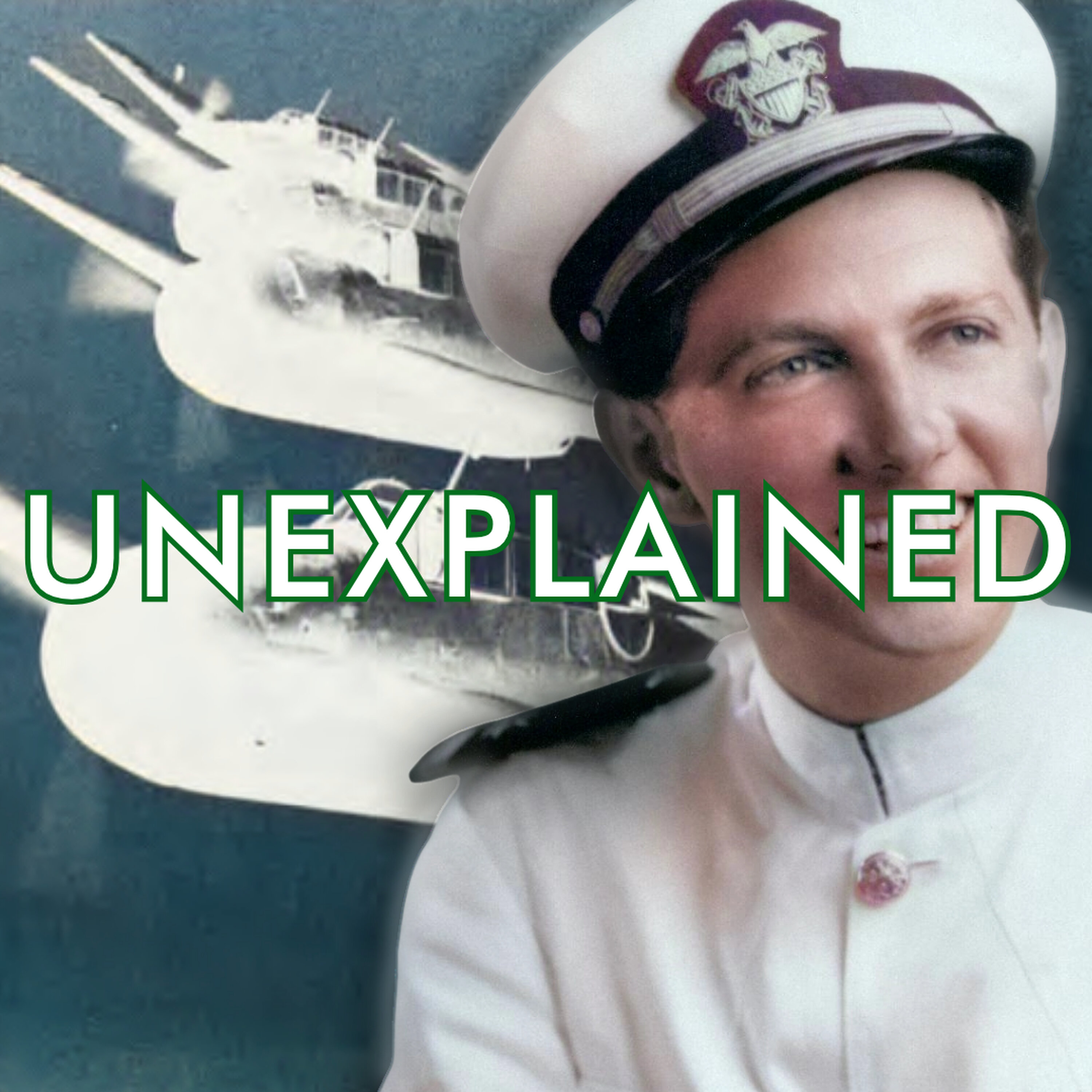
Hello, it's Richard McLean Smith here. Very excited to announce that this May I'll be heading to CrimeCon 2026 in Las Vegas, the world's number one true crime event and I'd love to see you there. From May 29th to the 31st, thousands of true crime fans, investigators, journalists, podcasters, experts and survivors will gather at Caesar's palace in Las Vegas for an unforgettable weekend of live talks, exclusive panels, deep dives and behind the scenes conversations. I'll be appearing throughout the weekend on Creator Own, so please come and say hello and if you'd like to join me for my live session, Treasure, Betrayal and Death in Vegas, the Ted Binion Mystery. I'll be speaking at 10:20am on the Saturday morning. To get tickets, head to crimecon.com and use promo code unexplained for 10% off. I hope to see you there. For centuries, a large stretch of the North Atlantic Ocean from Florida's east coast to Bermuda and the Greater Antilles Islands was known to mariners as stormy and hurricane prone, but also as a place where weird things happened, where sailors might lose contact with the natural world and disappear without a trace. There's a story that in 1881, the crew of the Ellen Austin, a cargo ship sailing from Liverpool to New York, spotted a seemingly abandoned vessel in the area emerging from a thick bank of fog. Some of the Ellen Austin's crew are said to have boarded the ship and confirmed that it had indeed been abandoned, but all its cargo was still aboard. Having commandeered the mysterious ghost ship, a plan was made to take it with them to New York alongside the Ellen Austin. But then a bad storm blew up, separating the two ships for 24 hours. When the ghost ship reappeared the next day, so the story goes, there wasn't a trace of its new crew. It's said that the Ellen Austin's captain then attempted to commandeer the vessel himself, but no sooner had he boarded, another thick and blinding fog rolled in, separating the two vessels once again. When the fog finally cleared, the ghost ship had vanished entirely and was never seen again. In 1918, the giant transport ship USS Cyclops vanished sometime after departing Barbados, taking all 306 crew members with it. Its final transmission to shore before it vanished, was weather fair? All well then. In 1941, the Navy ship USS Proteus, carrying 58 passengers and a cargo of ore from The Caribbean island St. Thomas to Portland in Maine, was lost in the same area. Only a month later, its sister ship, the USS Nereus also disappeared, along with its 61 passengers, while traveling the same route, defined as anywhere between half a million and one and a half million square miles in size. This infamous region of the Atlantic has been credited with the deaths of over 8,000 people since the mid 19th century. At least 50 ships are known to have been lost there, often in ways that defy explanation. This stretch of sea has had many names over the years. The Devil's Sea, the Hoodoo Sea, or the Graveyard of the Atlantic. You might know it best as the Bermuda Triangle. When aircraft started to routinely fly over the area, they also began to disappear. In 1948, a DC3 commercial flight headed for Miami went missing while flying over the area with 29 passengers and two crew members on board. In the same year, a British Avro Tudor plane called Star Tiger also vanished there with 31 people on board. No wreckage or hint of what happened to either plane was ever found. Another plane called Star Ariel, en route from Bermuda to Jamaica, lost communications with air traffic control over the very same treacherous section of ocean. The weather had been fine and there were no indications of any problems on board. And then there is the story of Flight 19. You're listening to Unexplained and I'm Richard McLean Smith. It was a cold and gloomy December afternoon in 1945 in Corpus Christi, Texas. Down at the high school, rows of teenagers sat quietly at their desks as their teacher, Mrs. Taylor, chalked up the key points from the lesson on the blackboard. The calm was suddenly pierced by a knock on the classroom door. The students looked up to see a school administrator hurriedly open the door, then dash over to Mrs. Taylor. She had a small envelope in her hand and handed it to the teacher. A look of concern spread across Mrs. Taylor's face as she took the envelope and pulled out a thin piece of paper from inside it. The students watched in silence as the teacher's eyes quickly scanned the note. Then something seemed to fall inside her and her knees buckled. Catherine Taylor's eyes began to dampen and she turned away from the class. Turning back a moment later, in a shaky voice, she informed her students that regrettably, their lesson would be ending early that day. Then she quickly gathered her belongings and hurried out of the room. Catherine Taylor's son was Lt. Charles Taylor, a seasoned 28 year old pilot in the US Navy. The telegram she received informed her in stark, simple detail that earlier that day, while undertaking a routine training flight, her son had been lost at sea and wasn't likely to ever be seen again. What exactly happened to him is considered by some to be one of the strangest aviation mysteries of all time. On the morning of December 5, 1945, conditions at the Naval Air Station in Fort Lauderdale, Florida were calm, with only a few isolated showers breaking to the east over the Atlantic, although weather reports warned of an incoming storm front. Lt. Charles Taylor, who had accumulated over 2,500 flying hours, including 61 on combat missions in the Pacific theatre during World War II, had been put in charge of a squadron of five Grumman TBM Avengers, a three person torpedo bomber plane. The mission of Flight 19 was to undertake a routine navigational training flight over water from their base at Fort Lauderdale. Before takeoff, a senior operations officer briefed the crew on their exercise. It consisted of a practice bombing run over a small group of rocks near the island of Bimini in The Bahamas, just 56 miles from base. After that, the crews were instructed to fly up over the northern islands of the Bahamas before turning east and returning to Fort Lauderdale. But Lieutenant Taylor wasn't feeling right, having arrived late to the briefing. When it was over, he asked if he could drop out of the flight and have someone else take his place. When asked why, he didn't know exactly what to say, only that he'd just rather not be in the air that day. Perhaps it was just because he'd had a late one the night before, as some have suggested, or perhaps it was something a little less tangible that had rattled him. Despite his efforts to sit the operation out. Since Lt. Charles Taylor was the only qualified instructor on the base that day, there was no other option but for him to lead the exercise. It was Taylor's job to assess the performance of the 13 students flying the other aircraft and be there to help guide them back on course if they became lost. It was a fairly straightforward exercise, given that the trainees weren't novices, but experienced fliers who'd all accumulated more hours in the air than the Federal Aviation Administration requires today for a commercial license. This exercise would mark the end of their training. Before takeoff, the planes were fuelled and checked for any maintenance issues, with each plane getting a clean bill of health. Except for one strange detail. All five of the bomber planes were missing their clocks. But since all the pilots were thought to have their own watches, it was decided this wouldn't be a problem. And so, at 2:10pm One by one, Flight 19 lined up at the end of the naval air station Runway at Fort Lauderdale and took off into the skies. Their crews, a mixture of Marines and Naval aviators, followed a course that took them south east over the Atlantic to the Hens and Chickens Shoals in the Bahamas. There they completed the practice bombing run without incident. Then they set a course heading south east. They were to follow this for 67 miles, then turn and head northwest for another 73 miles, which would take them past Grand Bahama island en route back to Fort Lauderdale. Lieutenant Taylor gazed out of the cockpit with concern at the fast approaching dark clouds that had just appeared on the horizon. Before long, the storm front was upon them, bringing heavy rain and strong westerly winds. The cloud ceiling dropped to around 1,000ft and the visibility became limited to eight nautical miles, while underneath them the darkening sea began to froth and churn. After 67 miles, the squadron made their final turn and began to head back northwest. Or did they? It was around 3:10pm when Lt. Taylor reported that one of his compasses had begun to malfunction. Then the other stopped working too. Taylor radioed Marine Captain Edward Powers, the trainee pilot who is the acting flight leader, to confirm their location. But Powers, whose compass also didn't seem to be working, didn't know either. Then the compasses in the other planes began acting strangely too.
- [13:36]
Grainger Commercial Announcer
This is the story of the One As a maintenance tech at a university, he knows ordering from multiple suppliers takes time away from keeping their arena up and running. That's why he counts on Grainger to get everything he needs, from lighting and H vac parts to plumbing supplies all in one place. And with fast, dependable delivery, he's stocked and ready for the next tip off. Call 1-800-GRAINGER click granger.com or just stop by Grainger for the ones who get it done.
- [14:06]
Robert Smigel (Humor Me Podcast Host)
Another podcast from some SNL late night comedy guy not quite on Humor Me with Robert Smigel and Friends. Me and hilarious guests from Bob Odenkirk to David Letterman help make you funnier this week. My guests, SNL's Mikey Day and head writer Streeter Seidel help an a cappella band with their between songs Banter.
- [14:25]
Pod Meets World Hosts (Rider Strong or Will Friedle)
Where does your group perform?
- [14:26]
Richard McLean Smith (Unexplained Podcast Host)
We do some retirement homes.
- [14:28]
Robert Smigel (Humor Me Podcast Host)
Those people are starving for banter. Listen to Humor Me with Robert Smigel and friends on the iHeartRadio app Apple Podcasts or wherever you get your podcasts.
- [14:41]
Pod Meets World Hosts (Rider Strong or Will Friedle)
Hey everyone, it's Rider Strong and Will Friedle from Pod Meets World. And now the Pod Meet Twirled podcast. We're two men who were completely clueless to reality TV who now have covered Dancing with the Stars, Traitors and we're gearing up for the season finale of Survivor. So yeah, now we're experts. I know we annoyed a lot of our listeners by our severe lack of Survivor knowledge. That is the point of the show. I'm just gonna remind you I have watched some Survivor. I obviously haven't watched enough. Did people not like like what was. Yeah. Just because we. Yeah. We'll be recapping the big conclusion of the 50th season. From the final attempts at gameplay to the desperate pleas of finalists to a bunch of ha. Who? Ha ha. Ooh, ha. Who. Again, we are experts, so make sure to tune into Pod Meets Twirl for all our Survivor 50 takes. Listen to Pod Meets Twirl on the iHeartRadio app, Apple Podcasts, or wherever you
- [15:34]
Cultivating Her Space Podcast Hosts (Dr. Dahm or Terry Lomax)
get your podcasts Agency the ability to know that we're the experts in our own body on the podcast. Cultivating her space Dr. D and Terry Lomax create a space where black women can show up fully and be heard. I wholeheartedly think, you know, you hit 30, you shouldn't have to share a room with anybody.
- [15:55]
Cultivating Her Space Podcast Co-Host
From navigating friendships and healing to setting boundaries and prioritizing your mental health, these are real, honest conversations we don't always get to have out loud.
- [16:06]
Cultivating Her Space Podcast Hosts (Dr. Dahm or Terry Lomax)
Totally unreasonable with different parts of life. Right. Like, oh, we'll have all three meals. And make sure you're mindful during all of them. Absolutely not. During one meal, I'm standing realistic. I'm standing and handing my children food.
- [16:18]
Cultivating Her Space Podcast Co-Host
Because healing, empowerment and resilience aren't just ideas, they're practices. And this Mental Health Awareness Month, there's no better time to pour back into yourself.
- [16:29]
Cultivating Her Space Podcast Hosts (Dr. Dahm or Terry Lomax)
Listen to Cultivating her space on the iHeartRadio app, Apple Podcasts, or wherever you get your podcasts.
- [16:42]
Richard McLean Smith (Unexplained Podcast Host)
Around 3:40pm Lt. Robert Cox, a senior flight instructor flying with a different squadron on an unrelated mission close to Fort Lauderdale, heard an unexpected crackle over the radio, followed by voices he didn't recognize. Confused, Lieutenant Cox asked the voices to identify themselves. This is FT28, came back the reply. Lieutenant Charles Taylor's call sign. As Cox later recounted, Taylor explained that his squadron was currently flying over some broken land, which he identified as the Florida Keys. But their compasses were malfunctioning and they needed help getting back to Fort Lauderdale. Cox advised him to keep the sun to their left and just continue up the coast until they saw Miami. After that, it was an easy 20 miles further up to Fort Lauderdale. Cox offered to fly down to chaperone them home, but Lt. Taylor said there was no need. I know where I am now, he said to reassure him. Don't come after me. A short time later, Lt. Cox noticed to his dismay that that Flight 19's radio transmissions weren't getting Stronger, as they should have done if they were heading in the right direction, they were fading. He realised then that whatever islands Taylor said he and his squadron had been flying over, they weren't the Florida Keys. Around 4:25pm, a flurry of confused messages were exchanged between Flight 19 and the Fort Lauderdale base. An increasingly panicked tailor asked if anyone had radar that could pick up the group's location to help guide them home. With no such technology available at the base, 20 other facilities were contacted, from land bases to Coast Guard vessels, to see if anyone else could help. But thanks to some communication issues and static interference from Cuban radio stations, no one could get a handle on the planes. Around 4:30pm, Lt. Robert Cox lost contact with Taylor's plane. About the same time, Air Sea Rescue Task Unit 4, a specialised unit for rescuing naval seamen at Fort Everglades in Florida, picked up Taylor's transmissions. By now, Taylor had taken over the lead of Flight 19 and had instructed the squadron to fly 9 north to see if they were over the Gulf of Mexico. They continued on that heading for 30 minutes, until Taylor conceded that they likely weren't over the Gulf of Mexico at all. And now night was descending and neither Lt. Taylor or anyone else had any idea where they. As the naval base at Fort Lauderdale, scrambled to get some assistance out to Flight 19, Lt. Taylor was asked to switch his radio to the Search and rescue frequency, which would make it easier to track them. But Taylor refused, since any change of frequency ran the risk of him losing contact with the other planes. At 6:04pm, believing they needed to go further east before trying to head north to Fort Lauderdale, Lieutenant Taylor was overheard telling his pilots to turn around yet again and head east once more. Meanwhile, ground units were finally beginning to piece together where the squadron might be exactly. It appeared they had somehow ended up well north of the Bahamas and a long way out to sea. But by then, Flight 19's radio transmissions were growing almost too faint to hear and their fuel supplies were dwindling. At 6.20pm, another message came through from Lieutenant Taylor. All planes close up tight. We'll have to ditch unless landfall. When the first plane drops below 10 gallons, we all go down together. Then his radio went silent. Just after 7pm, one final message was picked up coming from one of the trainee pilots. Everything looks strange, he said. Even the ocean. It looks like we are entering white water. Then all communication with Flight 19 was lost. But things were about to get even worse. Just before 7:30pm, two PBM Mariner planes, specially equipped to land on water, were dispatched from a base roughly 150 miles north of Fort Lauderdale in an effort to try and locate the lost squadron. Twenty minutes into its flight, as it neared the edges of the Bermuda Triangle, one of the mariners and its 13 man crew suddenly fell off radio contact. A ship in the vicinity would later report seeing a sudden burst of flames in the sky reaching about 100ft in height. By the time a search team arrived at the site, there was no trace of the mariner or its 13 man crew. The second mariner was ultimately forced to return home empty handed. Over the next five days the Navy, along with the army and Coast Guard mounted what became the largest air sea search rescue that had ever been conducted. At that time, hundreds of ships and planes covered more than 200,000 square miles of the Atlantic Ocean and the Gulf of Mexico looking for any sign of the 27 missing men. Various reports of flares, strange lights, life jackets, oil slicks and rafts being found all turned out either to be non existent or unrelated debris. No traces of Flight 19 and its 14 crew members or the Mariner and its crew were found. Within days of Flight 19's disappearance, the Navy convened an investigation board which focused on the testimony of those involved in the search. A central question was how could such an experienced pilot as Lt. Charles Taylor have so badly mistaken where he and his squadron was? The investigation concluded that somehow the compass equipment of Taylor's plane, along with at least one of the others, had failed and that the worsening weather meant the flight crews were unable to determine their position by sight. They decided that the planes eventually ran out of fuel and ditched into the rough seas, the conditions of which were unfavourable for survival. But the report also criticised Lt. Taylor, concluding that he became hopelessly confused, suffering something akin to a temporary mental aberration, and was guilty of faulty judgement. What made it all the worse was that some of the lost crew were just teenagers and many, including Taylor himself, were veterans of World War II, which had only ended three months earlier. Catherine Taylor, Charles Taylor's mother, was extremely unhappy with the Navy's official version of events. Determined to get to the bottom of the mystery, she posted a thousand dollar reward, almost $20,000 in today's money, for information leading to the recovery of her son, wrote over 200 letters and conducted 48 interviews with people involved with the rescue effort. She discovered not only was there a standby plane which could have been sent out quickly from Fort Lauderdale, but also that Lieutenant Cox, the pilot who'd first realised Flight 19 was in trouble, had immediately requested on returning to base that he be allowed to take the plane and fly north east, confident that he could locate the squadron. His request was denied by Lieutenant Commander Donald Poole, the officer in charge of the training flights. Commander Paul had been unconvinced of the severity of the situation and thought that sending an additional plane without an accurate fix on Flight 19 would only complicate matters. In 1947, Catherine Taylor brought her information to the Board for Correction of Naval Records and was rewarded for her tireless lobbying. The findings of of the official report were changed. Lt. Charles Taylor was cleared of personal blame for the disappearance, which was instead attributed to reasons or causes unknown. It has been the official word on Flight 19 ever since, and for a while the public forgot about the tragedy. That is until 1964 when an article was published by American Sci fi authorities author Vincent Gaddis in Argosy Magazine which noted some unusual findings.
- [25:58]
Grainger Commercial Announcer
This is the story of the one As a maintenance tech at a university, he knows ordering from multiple suppliers takes time away from keeping their arena up and running. That's why he counts on Granger to get everything he needs, from lighting and H vac parts to plumbing supplies all in one place. And with fast, dependable delivery, he's stocked and ready for the next tip off. Call 1-800-GRAINGER click granger.com or just stop by Granger for the ones who get
- [26:27]
Robert Smigel (Humor Me Podcast Host)
it done Another podcast from some SNL late night comedy guy not quite on Humor Me with Robert Smigel and Friends. Me and hilarious guests from Bob Odenkirk to David Letterman help make you you funnier this week. My guests SNL's Mikey Day and head writer Streeter Seidel help an acapella band with their between songs banter.
- [26:47]
Pod Meets World Hosts (Rider Strong or Will Friedle)
Where does your group perform?
- [26:48]
Richard McLean Smith (Unexplained Podcast Host)
We do some retirement homes.
- [26:50]
Robert Smigel (Humor Me Podcast Host)
Those people are starving for banter. Listen to Humor Me with Robert Smigel and friends on the iHeartRadio app, Apple Podcasts or wherever you get your podcasts.
- [27:03]
Pod Meets World Hosts (Rider Strong or Will Friedle)
Hey everyone, it's Rider Strong and Will Friedle from Pod Meets World. And now the Pod Meets Twirled podcast where two men who were completely clueless to reality TV who now have covered Dancing with the Stars Traitors and we're gearing up for the season finale of Survivor. So yeah, now we're experts. I know we annoyed a lot of our listeners by our severe lack of Survivor knowledge. That is the point of the show. I'm just gonna remind you I have watched some Survivor. I obviously haven't watched enough. Did people not like what? Yeah, just because we, yeah, we'll be recapping the big conclusion of the 50th season. From the final attempts at gameplay to the desperate pleas of finalists to a bunch of ha oo ha ha ooh, ha oo. Again, we are experts, so make sure to tune into Pod Meets Twirled for all our Survivor 50 takes. Listen to Pod Meets Twirl on the iHeartRadio app, Apple Podcasts, or wherever you get your podcasts.
- [27:59]
Cultivating Her Space Podcast Hosts (Dr. Dahm or Terry Lomax)
Agency the ability to know that we're the experts in our own body on the podcast. Cultivating her space Dr. Dahm and Terry Lomax create a space where black women can show up fully and be heard. I wholeheartedly think, you know, you hit 30, you shouldn't have to share a room with anybody.
- [28:18]
Cultivating Her Space Podcast Co-Host
From navigating friendships and healing to setting boundaries and prioritizing your mental health, these are real, honest conversations we don't always get to have out loud.
- [28:28]
Cultivating Her Space Podcast Hosts (Dr. Dahm or Terry Lomax)
Totally unreasonable with different parts of life, right? Like, oh, we'll have all three meals and make sure you're mindful during all of them. Absolutely not. During one meal, I'm standing realistic. I'm standing and handing my children food.
- [28:40]
Cultivating Her Space Podcast Co-Host
Because healing, empowerment and resilience aren't just ideas, they're practices. And this Mental Health Awareness Month, there's no better time to pour back into yourself.
- [28:52]
Cultivating Her Space Podcast Hosts (Dr. Dahm or Terry Lomax)
Listen to Cultivating her space on the iHeartRadio app, Apple Podcasts, or wherever you get your podcasts.
- [29:04]
Richard McLean Smith (Unexplained Podcast Host)
In his 1964 article, Vincent Gaddis connected a long chain of mysterious disappearances involving ships and aircraft within the triangle bounded by Florida, Bermuda and Puerto Rico, arguing that the previous 150 years revealed a disturbing pattern of unexplained events. It was titled the Deadly Bermuda Triangle, and the name immediately took hold in the public imagination. The region's eerie reputation was boosted again in 1974 when Charles Berlitz, a chronicler of supposed paranormal phenomena, published the Bermuda Triangle, which quickly became a bestseller. It proposed that the mysterious ship and aircraft disappearances were linked to a portal used by aliens to travel between different dimensions, and that these aliens deliberately abducted ships and planes from the Triangle for study. Most incredibly of all, he claimed the activity was linked to the remnants of an ancient yet advanced civilization from the lost island of Earth, Atlantis. Berlitz's claims were challenged by a number of writers, not least of all his bogus claim that one of Lt. Taylor's messages to Lt. Cox had included the line, they look like they're from outer space. Regardless, in 1984, Charles Berlitz doubled down Publishing a follow up book titled the Lost Continent Revealed, which proposed that Atlantis had been in the middle of the North Atlantic. He alleged that a diver had located a massive submerged pyramid near the Bahamas, but would not reveal the coordinates. He also claimed that an island had emerged from the Atlantic Ocean in 1882, complete with bronze artefacts, but the log of the ship which discovered it had been destroyed in the London blitz during World War II. His outlandish claims were based on evidence that was flimsy at best and non existent at worst. But by then, outlandish speculation surrounding the Bermuda Triangle were embedded in the Zeitgeist. In Steven Spielberg's 1977 film Close Encounters of the Third Kind, the crew of Flight 19 was shown reappear, appearing after being abducted by aliens decades after their disappearance without having aged. The so called Bermuda Triangle also became the subject of numerous television programs and appeared in the lyrics of songs by artists ranging from Fleetwood Mac to Barry Manilow. The story of Flight 19 even featured in an episode of Scooby Doo. Then, in the summer of 2019 90, it seemed as if the mystery of Flight 19 had finally been solved. In 1990, former helicopter pilot, Vietnam veteran and aviation investigator John Meyer believed that he'd found one of the missing Avenger aircraft from Flight 19. Starting out in 1982, Meyer scrutinised the squadron's flight plan, radio transmissions and the weather on the day of the disappearance, convinced that he could find the sunken airplanes. Part of his conviction came from reports by two ships that claimed to have seen distress flares within five hours of each other. The sightings occurred in an area where no search aircraft were believed to be operating. Shortly after Flight 19 vanished three days later, another ship spotted some blinking lights on the water, but discounted them as coming from another vessel. Meier believed they were from Flight 19 and calculated that one of the planes came down into the sea 30 miles off the Florida coast near Cape Canaveral. Meier also discovered that one of the Flight 19 planes, piloted by Captain William Stivers, had been taken out in the morning before taking off again as part of Flight 19 without being completely refuelled, meaning it may well have ditched in the ocean before the other four planes. Meyer also speculated that at least some of the crews had ditched successfully and were alive in the water for some time. But it was only after the space shuttle Challenger exploded shortly after liftoff from Cape Canaveral in January 1986 that the possibility of finding a Flight 19 aircraft became a reality. Some of the shuttle debris had fallen in the same area where Mayer believed The first Flight 19 plane had ditched, NASA was forced to launch a massive underwater search and salvage operation to recover the wreckage of Challenger. During that operation, the recovery team detected what appeared to be the wreck of an aircraft submerged beneath 400ft of water. However, believing it to be a twin engine DC3, they ignored it. But for John Mayer, it was just too much of a coincidence. And so, in August 1990, Meyer and an associate, Larry Schwartz, formed Project 19. Together with the assistance of the NBC TV show Unsolved Mysteries, they convinced Harbour Branch Oceanographic, who'd overseen the search for the Challenger, to take another look at the apparent plane wreck. This time, they sent a camera down to investigate it properly. Incredibly, it wasn't a DC3 after all, but a TBM Avenger, like the planes of Squadron Flight 19. HBO also succeeded in bringing the casing of one of the plane's engines to the surface, but sadly, no identifying marks could be found on it. But on reviewing the footage, something was found etched onto one of the plane's wings. What looked like the number 209. Captain Stivers plane was numbered 73209. The similarity was striking, but not enough to convince Ted d', Arcy, an ocean salvage specialist who was brought in to provide a second opinion. Although he confirmed it was indeed an Avenger from the era of Flight 19's disappearance, D' Arcy suspected it was a plane that was known to have crash landed on the aircraft carrier USS Solomons before later being dumped overboard. But when Meyer looked into the history of the USS Solomons, he was convinced Darcy was wrong. Not least of all because the crash on the USS Solomons didn't happen anywhere near the area in question. In August 1991, a year after discovering the Avenger off the coast of Cape Canaveral, John Mayer and Project 19 were broke. After a decade investing everything he owned in pursuit of solving the Flight 99 mystery, he had exhausted all his money and energy. The only thing that could make any of it worthwhile was to prove once and for all that he really had found one of the missing planes. To that end, he and Larry Schwartz convinced Marineland, a local marine park, to fund a complete extraction of the mystery plane wreck, with the intention of clarifying the exact number etched into the wing on the one condition that it was indeed the plane that Meyer believed it to be. And so John Mayer returned with Unsolved mysteries and Project 19 to that spot, 30 miles off the shore of Cape Canaveral, and watched with excitement as the wreck was steadily brought up from the ocean floor, but just as it was nearing the surface, a cable snapped, sending it plummeting back down into the ocean depths. As it sank, the wing snapped off, never to be seen again. What was left of the plane was eventually secured and brought back to Marineland. For the next few weeks, John Mayer spent 12 hours a day combing every inch of the wreckage for any identifying marks. But after the best part of 50 years lying on the ocean floor covered in coral sponge and barnacles, anything that might prove it was Captain William Stivers plane had long since disappeared. Eventually, John Mayer was forced to concede that it probably wasn't Stivers plane after all. And that might well have been that, until something else extraordinary came to light in 2021, in an episode of the History Channel's Greatest Mysteries, it was revealed that in December 1945, like all the loved ones of the men who disappeared with Flight 19, the family of Sergeant George Benessa received a telegram to say that he had been lost at sea and was presumed dead. But then, a few weeks later, they received another telegram, this time supposedly from George himself. It said, you've been missing from informed about me. I'm very much alive, Georgie. George Pennnessa was never heard from again. Had he made it back alive and then for some reason disappeared into a life of anonymity? Was he communicating from another dimension or was it simply a hoax? It seems for now at least, the answer to that question and what exactly happened to the rest of Flight 19 remains unexplained. This episode was written by Diane Hope and Richard McLean Smith. Thank you, as ever, for listening. Unexplained is an AV Club Productions podcast created by Richard McLean Smith. All other elements of the podcast, including the music, are also produced by me, Richard McLean Smith. The book and audiobook is now available to buy worldwide. You can purchase from Amazon, Barnes and Noble, Waterstones and other bookstores. Please subscribe to and rate the show wherever you get your podcasts, and feel free to get in touch with any thoughts or ideas regarding the stories you've heard on the show. Perhaps you have an explanation or a story of your own you'd like to share. You can find out more at unexplainedpodcast.com and reach us online through X&BLUESKY at unexplained pod and facebook@facebook.com forward slash unexplained podcast.
- [40:25]
Robert Smigel (Humor Me Podcast Host)
Sa.
- [40:53]
Dr. Maya Shankar (A Slight Change of Plans Host)
This is the story of the One As a procurement manager for a hospital system, she keeps every facility in her network stocked and ready. That's why she counts on Grainger to be her single source for thousands of products, from disinfectants to lighting, air filters and more. And with fast, dependable delivery, Grainger helps her keep every facility stocked, safe and running smoothly. Call 1-800-GRAINGER Click Ranger or just stop by Granger for the ones who get it done.
- [41:22]
Robert Smigel (Humor Me Podcast Host)
Another podcast from some SNL late night comedy guy not quite on Humor Me with Robert Smigel and Friends. Me and hilarious guests from Bob Odenkirk to David Letterman help make you funnier this week. My guests SNL's Mikey Day and head writer Streeter Seidel help an acapella band with their between songs banter.
- [41:40]
Pod Meets World Hosts (Rider Strong or Will Friedle)
Where does your group perform?
- [41:42]
Richard McLean Smith (Unexplained Podcast Host)
We do some retirement homes.
- [41:43]
Robert Smigel (Humor Me Podcast Host)
Those people are starving for banter. Listen to Humor Me with Robert Smigel and friends on the iHeartRadio app, Apple Podcasts or wherever you get your podcasts.
- [41:52]
Dr. Maya Shankar (A Slight Change of Plans Host)
Hey, I'm Dr. Maya Shanker, a cognitive scientist and host of the podcast A Slight Change of Plans, a show about who we are and who we become when life makes other plans.
- [42:03]
Pod Meets World Hosts (Rider Strong or Will Friedle)
I wish that I hadn't resisted for
- [42:05]
Dr. Maya Shankar (A Slight Change of Plans Host)
so long the need to change.
- [42:08]
Richard McLean Smith (Unexplained Podcast Host)
We have to be willing to live
- [42:09]
Pod Meets World Hosts (Rider Strong or Will Friedle)
with a kind of uncertainty that none of us likes.
- [42:13]
Richard McLean Smith (Unexplained Podcast Host)
You can have opinions, you can have
- [42:16]
Psychology of Your Twenties Host
like a strong stance, and then there's your body having its own program.
- [42:23]
Dr. Maya Shankar (A Slight Change of Plans Host)
Listen to A Slight Change of plans on the iHeartRadio app, Apple Podcasts, or wherever you get your podcasts.
- [42:30]
Psychology of Your Twenties Host
Your twenties can be so exciting, but they can also be really overwhelming, confusing, and honestly, just kind of lonely. May is Mental Health Awareness Month and the psychology of your twenties is breaking down the science behind the biggest roadblocks we face.
- [42:46]
Psychology of Your Twenties Guest
I was six years into my career, the 80 hour weeks and just the first one in, the last one out and I ended up burning out. There was a large chunk of my twenties that I like was just so wanting to like be out of that phase out of my skin and I just like really regret not living in the present more.
- [43:00]
Psychology of Your Twenties Host
You don't need to have everything figured out right now. You just need to understand yourself a little bit better. Listen to the psychology of your 20s on the iHeartRadio app, Apple Podcasts or wherever you get your podcasts.
- [43:12]
Cultivating Her Space Podcast Hosts (Dr. Dahm or Terry Lomax)
This is an iHeart podcast, Guaranteed Human.