Podcast
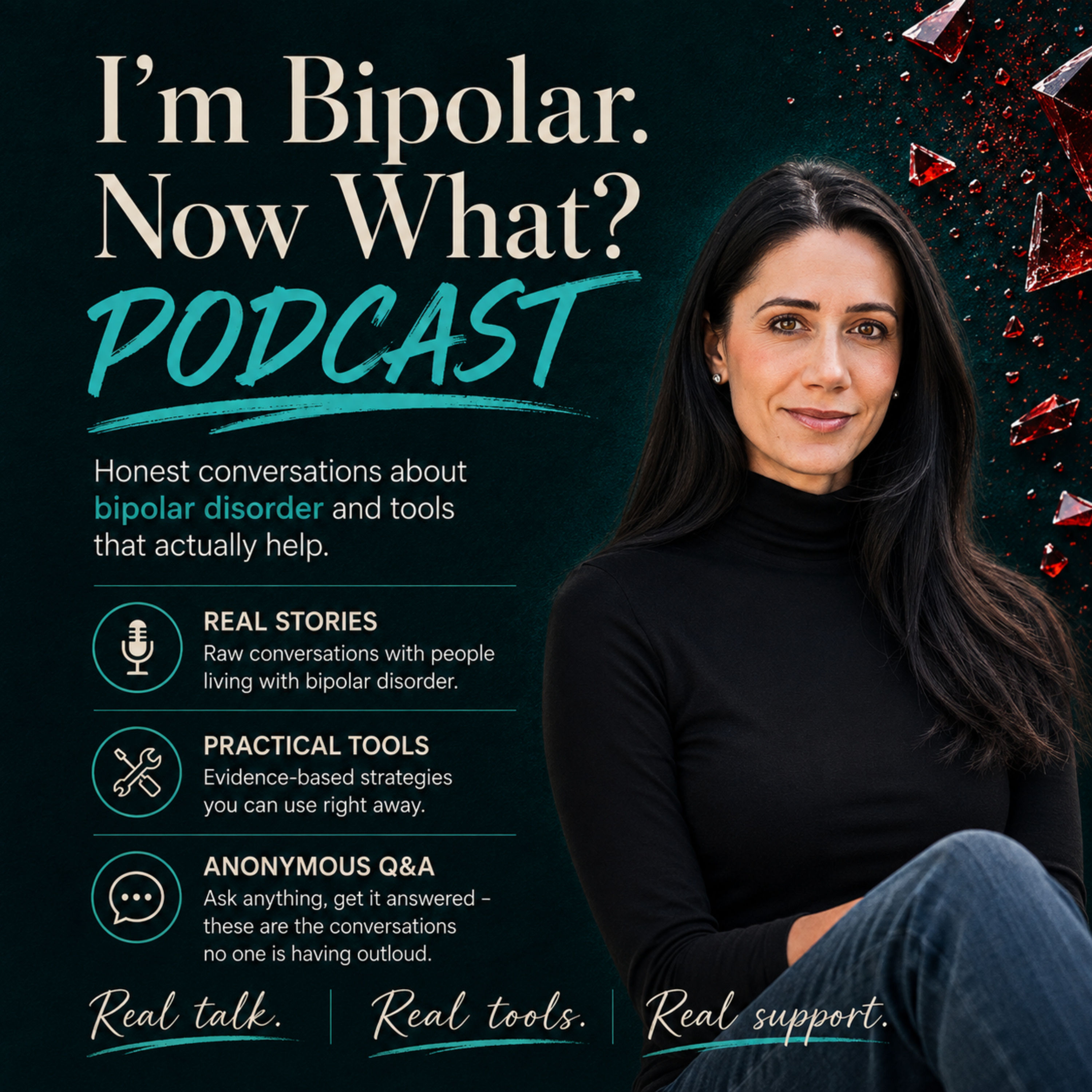
I'm Bipolar. Now What? Recovery, Stability, and Living Well.
Hosted by Louise Barnett · EN
I'm Bipolar. Now What? is the podcast for anyone living with bipolar disorder and wondering what comes next. Hosted by Louise Barnett, a Jay Shetty Certified Life Coach and author of Tainted Love: A Bipolar Memoir, this show combines lived experience with practical tools for addiction, recovery, stability, and living well. Each week, you'll find honest conversations about bipolar disorder, medication, therapy, routines, relationships, sobriety, and building a life worth living. Recovery is possible. Stability is possible. Living well is possible.
33episodes
Episodes
Newest firstAll episodes
126. There's a Reason Your Meds Aren't Working: Pharmacogenetic Testing with Kristen Ruth Davis
2w ago01:01:03Tap to summarizeWhat if the reason your psychiatric medications haven't worked isn't that you're "too complicated"... but because they're the wrong medications for your genetics?In this episode, Louise sits down with mental health advocate, speech-language pathologist, Founder of the I’m Not Crazy project, and author Kristen Ruth Davis, whose life changed after pharmacogenetic (PGx) testing finally matched her with medications her brain could actually use.Despite growing up in a loving family with two physician parents, attending Duke University, and doing everything "right," Kristen spent years battling treatment-resistant depression, multiple psychiatric hospitalizations, involuntary holds, self-harm, electroconvulsive therapy (ECT), and countless medication trials that left her believing there was something fundamentally wrong with her.Then genetic testing changed everything.Together, Louise and Kristen unpack why some antidepressants fail, why treatment-resistant depression deserves a deeper conversation, and why pharmacogenetic testing should be a standard part of psychiatric care—not a last resort. They also discuss the dangers of trial-and-error prescribing, the stigma surrounding mental illness, the importance of trusting patients, and why praise and validation can become powerful tools in recovery.The conversation ends with a thought-provoking question: What does "crazy" actually mean?Whether you're living with depression, bipolar disorder, supporting someone you love, or simply curious about the future of personalized mental health care, this episode offers hope—and a reminder that sometimes the problem isn't the person. It's the treatment.In this episode, we discuss:Treatment-resistant depressionPharmacogenetic (PGx) testing and personalized psychiatryWhy SSRIs and SNRIs don't work for everyonePsychiatric hospitalization and involuntary holdsSelf-harm and suicidal ideationElectroconvulsive therapy (ECT)Medication stigma and shameThe importance of patient advocacyWhy "crazy" deserves a new definitionIf you or someone you know is struggling with depression or suicidal thoughts, please reach out to a trusted mental health professional or local crisis services. You don't have to do this alone.Learn more about Kristen and the I'm Not Crazy Project:Website: https://imnotcrazyproject.orgInstagram: @imnotcrazy.projectFacebook: /imnotcrazyprojectLinkedIn: Kristen Ruth DavisTikTok: @kristenruthwrites
Transcribe →125. The Most Dangerous Lie About Mental Health with JeNoah Lee
4w ago00:59:15Tap to summarizeIn this episode of Unmasking Sobriety & Mental Health, Louise sits down with JeNoah Lee — a 20-year-old entrepreneur, fashion creator, and mental health advocate whose life was shaped by severe racial bullying at just 10 years old.What began as emotional trauma and suicidal ideation became the catalyst for something bigger: healing, therapy, self-discovery, and ultimately a mission to create change.JeNoah opens up about:The invisible damage of racial bullyingWanting to change who he was to fit inThe role therapy played in saving his lifeHow fashion became his outlet for healingWhy mental health warning signs are often missedWhat parents need to know when their child is strugglingThis conversation is raw, powerful, and necessary — especially for parents, young people, and anyone who has ever felt like they didn’t belong.Because sometimes survival is just the beginning.Connect with JeNoah:Instagram: @whoisjenoahleeLinkedIn: JeNoah LeeWebsite: whoisjenoahlee.com
Transcribe →124. This Will Change How You Think About Recovery with Jeanne Foot
Jun 2900:53:16Tap to summarizeWhat if recovery isn’t about addiction at all… but about the human experience?In this episode of Unmasking Sobriety & Mental Health, I sit down with Jeanne Foot, founder of The Recovery Concierge, to challenge everything we think we know about healing.Jeanne shares how her own journey through trauma, suicidal ideation, and traditional recovery led her to discover a deeper truth: abstinence isn’t the goal—emotional sobriety is.Together, we unpack:Why willpower alone rarely creates lasting changeHow trauma lives in the nervous systemWhy healing must go beyond the mind and into the bodyThe role of attachment wounds in addiction, relationships, and identityWhat it actually means to redesign your life in recoveryThis conversation is for anyone who has ever felt stuck, masked, or like the outside looked “fine” while the inside was falling apart.Because recovery isn’t just for addiction.It’s for all of us.More from Jeanne:https://therecoveryconcierge.com/https://www.read.ai/pp - FREE RESOURCESInstagram: https://www.instagram.com/therecovery_concierge/LinkedIn: https://www.linkedin.com/in/jeanne-foot-the-recovery-concierge/Facebook: https://www.facebook.com/therecoveryconcierge/ Jeanne’s Podcast, Naturally High:On Apple: https://podcasts.apple.com/us/podcast/naturally-high/id1585263254On Spotify: https://open.spotify.com/show/7LWUXpejsTxwYvzXOPHshA
Transcribe →123. When the Diagnosis is Wrong with Ginger Smith
Jun 1500:46:20Tap to summarizeIn this powerful episode, Louise sits down with Ginger Smith, author of Dementia Denied, to explore a story that challenges everything we think we know about mental health, diagnosis, and recovery.A retired speech-language pathologist who worked alongside neurologists at Stanford and UCSF, Ginger spent her professional life helping others understand the brain. But her most profound lesson came when her own mind was called into question.Diagnosed with dementia and placed on hospice, Ginger was never expected to recover. But she did.In this conversation, Ginger opens up about surviving an abusive childhood, living with bipolar disorder and complex PTSD, and finding her way through addiction to 35 years of sobriety. She shares what it was like to be misdiagnosed, to lose everything—including relationships and stability—and to slowly rebuild a life grounded in truth.Together, Louise and Ginger explore trauma, resilience, neuroplasticity, and the possibility of healing—even when the odds say otherwise.This is a conversation about questioning assumptions, reclaiming your story, and discovering what’s still possible when everything seems lost.Dementia Denied: https://www.amazon.com/DEMENTIA-DENIED-Surviving-Diagnosis-Reclaiming-ebook/dp/B0F2WGRV6CFacebook: https://www.facebook.com/trek1937 IG: @Gingersmith104
Transcribe →122. Parental Alienation, Narcissistic Abuse, and the Path to Sobriety with Alicia
Jun 100:54:53Tap to summarizeIs it possible that anyone else is living this insane double life? 💔For years, Alicia was living a reality that many women secretly recognize: A Master’s degree and a career on the outside, but a "war zone" of a divorce on the inside.To cope with the narcissistic abuse, financial intimidation, and the agony of parental alienation, Alicia turned to wine as a sedative. It wasn’t a choice; it was survival. But as the "mommy wine culture" took hold, she found herself losing the very things she was fighting for—including her kids and her sense of self.Today, Alicia is 6 years sober, a She Recovers® Professional, and a light for women trapped in the same cycle. In our latest episode, she shares: ✨ Surviving high-conflict divorce and legal abuse. ✨ The truth about "drinking AT" your pain. ✨ How she rebuilt her life from rock bottom to a successful coaching practice.🎧 Tap the link in bio to hear Alicia’s incredible story of reclamation.Parental Alienation, Narcissistic Abuse, Substance Use Disorder, She Recovers, High-Conflict Divorce, Mommy Wine Culture, Recovery Coaching, Financial Abuse.
Transcribe →121. The High-Achiever’s Mask: Radical Awareness with Ellen Frazier
May 1801:00:17Tap to summarizeWhat happens when you’re #1 on the leaderboard but #0 in your own heart?Ellen Frazier spent over 20 years perfecting the role of the "Powerhouse." As a top-tier mortgage professional and entrepreneur, she knew exactly how to perform, how to excel, and how to win. But for decades, that success was fueled by a "forced confidence" and a sophisticated relationship with alcohol that allowed her to stay in the race while ignoring her own soul.In this episode, the founder of Booze Free Babes pulls the mask off the high-achieving lifestyle. We explore the dangerous intersection of "Success" and "Survival," and how Ellen finally chose radical self-awareness over social performance.Inside the conversation:The "Star" Program: How being programmed for excellence at a young age created a lifelong need to "excel" even in rehab.Sophisticated Lies: The specific ways high-performing women use status, diet, and busy-ness to deny their addiction.The Gender Gap in Power: Moving away from being "directed" by men in recovery to finding your own agency within a female sisterhood.Self-Parenting: The moment Ellen stopped looking for external validation and started believing she was worthy of her own protection.The ROI of Sobriety: Why quitting drinking was the ultimate business move for her clarity, her relationships, and her bank account.This is a deep dive into who you actually are when you stop performing and start living.Connect with Ellen Frazier:Website: EllenFrazier.comInstagram: @boozefreebabeschsFacebook: ecfrazierLinkedIn: ellen-frazierTikTok: @theellenfrazier
Transcribe →120. Manic About Healing: Rewriting the Bipolar Narrative with Ana
May 400:56:36Tap to summarize"I am not going to end up like this."In 2006, Ana sat in a psychiatric ward, clouded by the haze of medication and the weight of a Bipolar 1 diagnosis. As she looked at the walls around her, she didn't just see a hospital; she saw her mother’s life—decades of suicidal ideation, depression, and a future dictated by a "permanent" chemical imbalance.In that moment, Ana made a choice that defied medical convention: She refused to accept that her diagnosis was a life sentence.In this episode, we sit down with Ana, a Bipolar Healing Coach who has moved from the trauma of 10 hospitalizations to a life of stability and self-mastery. We dive deep into the parts of bipolar disorder people rarely talk about: the hallucinations, the grandiosity, and the terrifying reality of setting a bedroom on fire during a manic episode.The Root Cause: Why bipolar is often a symptom of a severely dysregulated nervous system and unresolved childhood trauma.The Myth of the "Cure": What Ana tried (energy healing, homeopathy, yoga) and why she eventually looked toward neuroscience and polyvagal theory.The Power of Partnership: How finding a secure attachment helped her stabilize and heal her abandonment wounds.The "Nervous System" Shift: How understanding neuroplasticity allowed her to catch mania and depression before they took over.Medication & Tapering: A candid look at her experience with Lithium and the journey of training the brain to stay on the tracks.Ana is now dismantling the belief that you can only "manage" bipolar. She is living proof that through somatic experiencing and shadow work, you can rebuild your relationship with yourself and find true peace.Facebook: Bipolar Healing Coach AnaInstagram: @bipolar.healing.coach"Healing isn't just about fixing what's broken; it's about grieving the stories we were told so we can finally write our own."
Transcribe →119. Anonymous' Story: Two Ways Out: Breaking the Silence Around Suicide
Apr 2701:01:46Tap to summarizeShe shares her lived experience with PTSD, dissociation, and suicidal thinking — and the moment she realized there were only two ways out.Today’s guest is the founder of My Truth Memoir Writing Services, where she helps others tell their stories with honesty, compassion, and courage.But her work didn’t begin as a profession. It began as survival.After a tragic loss in childhood and years of silently carrying trauma, she was later diagnosed with PTSD and panic disorder — conditions that shaped her inner world while she continued to build a life on the outside. For more than twenty years, she worked as a special education teacher, raised three children, and did what so many people do: she kept going.Until she couldn’t anymore.In this deeply personal conversation, she shares the lived reality of dissociation, panic, generational trauma, and the moment she realized she believed there were only two ways out.Her memoir, Two Ways Out: A Memoir of Then and Now, was written to break the silence around suicide and normalize the conversations so many people are afraid to have.We talk about what it means to lose yourself — and how you begin to find your way back.This episode is about survival. About truth. And about choosing to stay.If you’ve ever struggled in silence, or loved someone who has, this conversation will remind you that you are not alone.
Transcribe →118. A Parent Took My 12-Year-Old to a Dive Bar—What Would You Do?
Apr 2000:18:54Tap to summarizeMy 12-year-old daughter ended up at a dive bar—and I didn’t know until it was too late.In this episode, I share what happened, how I handled it, and the bigger questions it raises about parenting, trust, and letting go.No judgment. No perfect answers.Just the reality of navigating moments that don’t come with a playbook.
Transcribe →117. Palliative Care: When the Outcome is Decided
Apr 1300:55:32Tap to summarizePalliative Care: When the Outcome Is Already DecidedWhat happens when healing is no longer the goal?In this episode, I sit down with Anne, a licensed psychotherapist and palliative care social worker, to explore the emotional and psychological realities of end-of-life care—where addiction, mental health, and dignity intersect in ways we rarely talk about.Through powerful real-life stories, we unpack what it means to support someone when the outcome is already known… when sobriety isn’t always possible… and when the focus shifts from fighting to acceptance.This conversation challenges everything we think we know about recovery, control, and what it means to truly care for someone.If you’ve ever struggled with letting go, with needing to “fix,” or with redefining what healing looks like—this episode will stay with you.Get in Touch with Anne:TikTok: AnnefrontlmftWebsite: www.annefront.comSubstack: Annefrontlmft.substack.com
Transcribe →