← Unsung History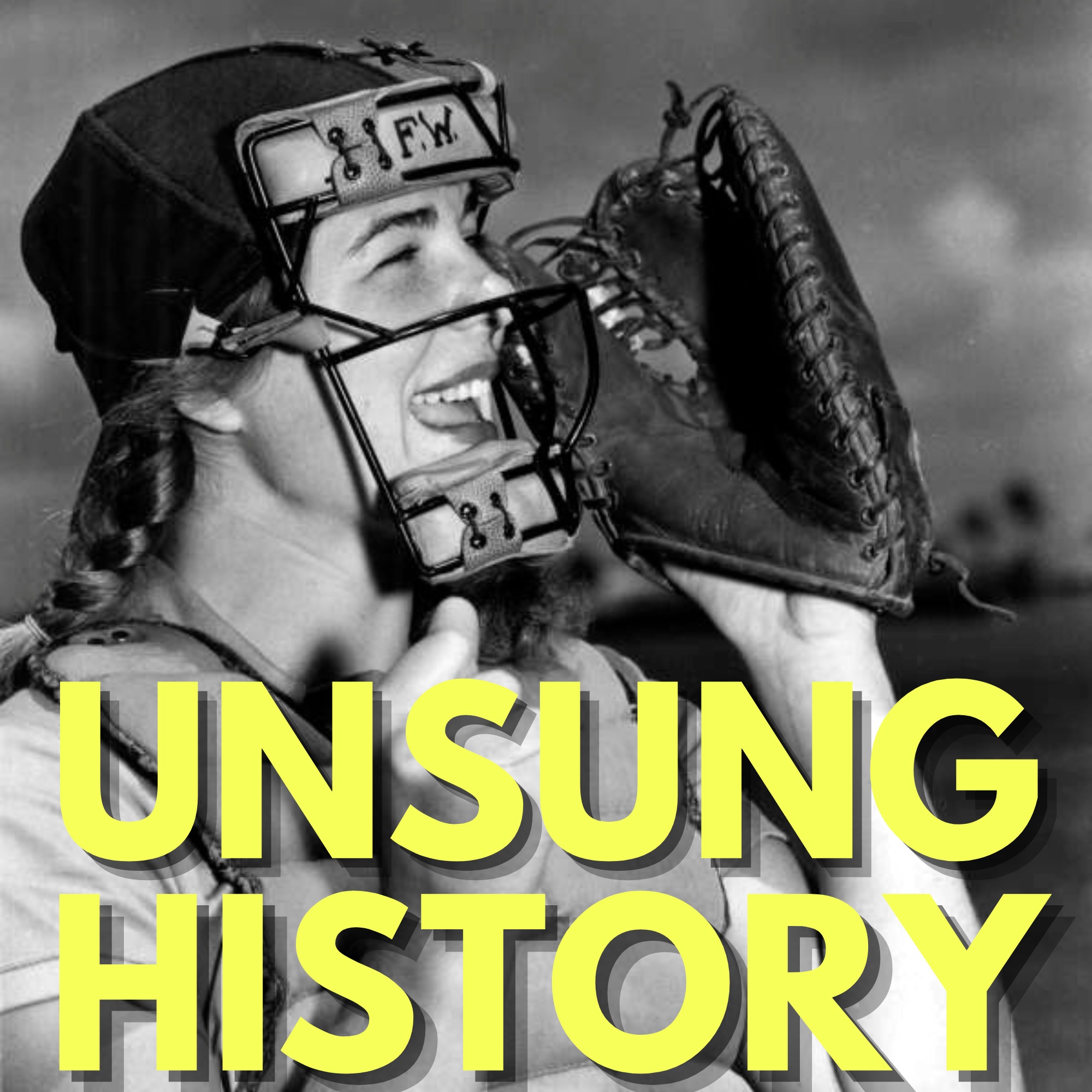
Loading summary
Transcript140 lines
- [00:00]
Kelly Therese Pollack
This is Unsung History, the podcast where we discuss people and events in American history that haven't always received a lot of attention. I'm your host, Kelly Therese Pollack. I'll start each episode with a brief introduction to the topic and then talk to someone who knows a lot more than I do. Be sure to subscribe to Unsung History on your favorite podcasting app so you never miss an episode. And please tell your friends, family, neighbors, colleagues, maybe even strangers to listen to. On Sunday, May 30, 1943, the South Bend Blue Sox faced the Rockford Peaches and the Kenosha Comets faced the Racine Belles in the first games of a new professional ball league, then called the All American Girls Softball League. The United States had entered World War II in December of 1941, and by 1943 young men were being drafted into the military in large numbers. Philip K. Wrigley, owner of the Chicago Cubs, was concerned that Major League Baseball would fold for the duration of the war, and he asked for suggestions for alternatives. A committee led by Ken Sells, an assistant general manager for the Cubs, proposed a girls softball league that could play
- [01:38]
in major league parks.
- [01:42]
Sells became the league president and Wrigley bankrolled what was then a non profit organization which started with the four teams in South Bend, Indiana Rockford, Illinois, Kenosha, Wisconsin and Racine, Wisconsin. The league sent scouts around the United States and Canada and held tryouts in major cities to find the women who would be the league's players. 75 women were invited to Chicago for a final tryout at Wrigley Field and 60 were selected, 15 for each team. Many of the women had experience playing competitive softball, not baseball, and the games played in the All American League started as a hybrid of the two. They used 12 inch softballs thrown underhand, but with baseball base running rules like being able to lead off and steal bases like baseball. There were nine players on the field, not the 10 that softball had at the time. In the middle of the first season, the league changed names to the All American Girls Baseball League to reflect the baseball rules that they were using. Each team had a woman chaperone who traveled with the team and the league set rules of conduct for the players, including an admonition to appear in feminine attire, not slacks or shorts, at all times, with well groomed, preferably long hair and lipstick. Smoking and obscene language were prohibited. Players who broke the rules were fined and a third offense could result in suspension at the league's beginning. Players were even sent to charm school classes at Helena Rubinstein's beauty salon and received beauty kits. On the field, the players wore uniforms that always reminded the fans that these were women playing with short dresses under which they wore satin shorts and knee high socks. They may have looked nice, but the uniforms were not ideal for playing baseball. As player Doris Sammy Sams recalled, believe me, you haven't lived until you've slid on skin. In exchange for following the rules and acting ladylike, the women were well compensated, earning 45 to $85 a week, which was more than they would have made in many other professors. After a successful first season, the league expanded by two teams, adding the Milwaukee Chicks and the Minneapolis Millerettes to fulfill Wrigley's dream of having the league play in major league ballparks. That experiment failed, though, as the league wasn't nearly as popular in major cities that had other entertainment options and the Chicks and the Millerettes later moved to other cities. After 1944, Wrigley lost interest in the league and he sold it to advertising executive Arthur Meyerhoff, who reorganized the league so that representatives from each franchise would have a say in the league operations. It wasn't only the leadership that changed over the years of league play. The ball got smaller and smaller and smaller and the base paths got longer and longer. By 1946, sidearm throwing was permitted and in 1948 they switched to overhand pitching. By the last year of the league, the ball they used was 9 inches, the base paths were 85ft and the pitching distance was 60ft, making the game nearly the same as men's professional baseball. The name of the league changed several times too, and in 1950 it became the American Girls Baseball League, although people continued to refer to it as the All American League. When the Players association formed in 1987, they adopted the name All American Girls Professional Baseball League aagpbl, reflecting their status as professional ballplayers. For Several years after 1943, attendance continued to grow with the league drawing peak crowds in 1948 with over 900,000 fans coming out to see the 10 teams that were then in the league. All of the teams were located in the Midwest and except for the short lived Minneapolis team, they were all located in Michigan, Indiana, Illinois and Wisconsin. After the 1950 season, the league organization changed again with individual team directors buying the league and then operating as independent teams. As a result, though, they could no longer rely on centralized publicity or the talent equalization that they'd previously had. With dwindling attendance and no Central League management to keep things afloat, teams started to fold in the 1952 season, there were six teams left, and by the 1954 season, only five teams remained in the league. In 1954, the Fort Wayne Daisies finished the season in first place with 54 wins and 40 losses, but the Kalamazoo Lassies won the postseason playoffs. After that season, the league folded for good. After the league folded, though, the league's most successful manager, Bill Allington, a former minor leaguer, kept women's baseball going for a few years, forming two barnstorming teams called Allington's All Stars that played against men's teams across the U.S. canada and Mexico from 1955 to 1958. In November of 1988, the National Baseball hall of Fame in Cooperstown, New York, opened an exhibit dedicated to the All American League. Among the early visitors to the exhibit were about 150 former players and Hollywood director Penny Marshall. Marshall was inspired by a documentary about the league and by her conversations with players to make a movie about the All American Girls Professional Baseball League. A League of Their Own opened in theaters in July 1992, and it grossed $13.2 million in its first weekend. Several of the actual players from the league appear in scenes of a reunion game and at the hall of Fame. Joining me in this episode is baseball historian Dr. Leslie Heaphy, Associate professor of history at Kent State University, Stark Campus, Chair of the Women in Baseball Committee of the Society for American Baseball Research, an editor of the Encyclopedia of Women and Baseball.
- [10:12]
Background Vocalist or Chorus
Oh oh that sliding baseball rag Sees a pitcher throwing flank em out you got him going oh oh that sliding baseball drag don't you be a quitter show em you're a heavy hitter Some classy coyote pitcher twirling Go on kids send one out of whirling hey, soak it out, soak it out Make a home run ball strike stay pimp
- [10:34]
Kelly Therese Pollack
Hi, Leslie.
- [10:35]
Thanks so much for joining me again.
- [10:37]
Dr. Leslie Heaphy
Thanks, Kelly. I really appreciate the opportunity. I'm always, always happy to talk baseball.
- [10:42]
Kelly Therese Pollack
Yes, me too. Could talk baseball all day, every day. But today we're going to talk about women's baseball specifically. So let's start by talking about kind of early history of women's baseball. The All American Girls League was certainly not the first time that women had ever played baseball. So what does the earlier history look like?
- [11:04]
Dr. Leslie Heaphy
Well, the earlier history of women's baseball actually mirrors just baseball history in general. And that's what people don't realize.
- [11:11]
There are actually references to women playing the early versions of what we know to be baseball in the late 1700s. And so right from the very beginning, both here and of course, the origins, regardless of whether people believe it or not, are English. And they were playing in England as well. So I always like to say, whether people know it or not, women have always been involved in the game of baseball. Baseball. And so we've got references then. And then, you know, the first half of the 19th century is very much an amateur game. So there, there's not a lot of documentation on either side until the 1830s and 40s.
- [11:45]
So for women, in terms of being able to document it, we really see it after the Civil War as players certainly. And so in the late 1860s, just as men's baseball was starting to turn from the amateur to the professional, we see that. And so it starts in colleges. And so we start with women playing in the all female colleges, starting with Vassar and then spreading from Vassar to East coast, but also out to the west coast where there were also women's colleges. So it didn't stay in one spot. And so they played pretty much against one another, starting, I mean, playing internally and then going to playing cross colleges. And then you start to move into the 1880s and we start to see the development of what were originally called red and blue teams. Nothing real fancy. And usually that meant either the color of their caps or the color of their socks. It was that simple. You couldn't really see their socks most of the time. So I don't know why they would say the socks because they wore laced up boots like they would have worn when they were walking around. It wasn't anything because they wore the long skirts, the whole deal. You read some interesting descriptions in the newspapers of them tripping over their skirts, all of those kinds of things, because they were long and bulky and. But the reds and blue teams then morph into the more well known bloomer teams.
- [13:02]
And so by the late 1880s, early 1890s, all the way through into the
- [13:06]
1930s, you have bloomer teams playing all over, of varying quality, just as the red and blue teams were early on.
- [13:13]
They were often described as more entertainment and more like sort of vaudeville shows. And whether that's true or not, or whether that was just the way the newspapers chose to portray them, is always up for a little bit of debate. But that's the sources we have. So based on those, we have to accurately say a lot of it will. And that's not really a surprise. They didn't have much opportunity to practice or to do any of those kind of things. It wasn't even encouraged that women should be doing those kinds of things in the 19th century. But in the middle of that interesting mix, I always have to mention that in 1883, 1884, we have a professional, two African American women's teams playing. They're called the Valley Vardens, and they played in the Philadelphia area in 1883 and 1884, which is the earliest that we have women professional players. And so that's kind of a unique opportunity. And so the bloomer teams is really where things take off. And at the same time that you have the bloomer teams, by the 1880s and 90s, you start seeing some individual female players playing on men's teams. And that will continue right up with some interruptions right up to the present day. So, you know, you could argue for over a century, women have been playing at least minimally on men's teams as
- [14:28]
individuals, always playing against men's teams. You know, everybody from Lizzie Arlington, Lizzie Murphy, Wad Nelson list goes on. And then you hit the 1940s, of course, and that's when you have the All American League. And in addition to players, there are female owners, there are a couple of female umpires, there are female journalists, right? So are involved in the game on lots of levels. Everyone in the owner's side. Helene Britton with the St. Louis Cardinals, all the way up to Ethel Manley with the Newark eagles in the 40s, Amanda Clement being one of the first umpires, Eloise Young being one of the first journalists. So there's lots of participation by women beyond just the players themselves.
- [15:11]
Kelly Therese Pollack
In the 40s, the All American League forms. And this is like many women's opportunities as a result of war and men going off to fight war and, you know, women getting new opportunities at home. So tell me a little bit about the formation of the league and sort of the thinking behind it.
- [15:34]
Dr. Leslie Heaphy
The league officially starts in 1943, and the main founder of the league, he certainly wasn't alone, but he's the key figure in all of it, is Philip Wrigley of the Cubs. And for Wrigley, it was very much
- [15:47]
about the concern that men's baseball was going to grind to a halt because of the war. And he wasn't. It wasn't a totally wrong thought initially, because ultimately There are over 570 ballplayers from minor league and major league baseball who will be drafted and serve in World War II. And of course, there was concern over the gas rationing, those kinds of things that that would put a halt to, as it was doing in other things,
- [16:13]
what he didn't anticipate was that fdr,
- [16:15]
of course, would exempt baseball from that, from that gas rationing. And so ultimately that's going to hurt his interest in this league. But that was his initial thought, was he wanted to create something that would provide a necessary entertainment release for people during a time of war. And so women's softball, girls softball, very popular. And so he thought that he would develop a version of that that would allow people to be entertained. And so his idea was to create a league that would be first and foremost a reminder to people that these were women playing whichever version of the game that they were playing, and that it was only temporary. That was the thinking that it would only last as long as the war. And then when the war was over, there would be no more need for it because the men would come home. And so that was his thought process. Keys to his thought process were that that it was going to be temporary, that the fans would never lose sight, that these were women they were watching. And that leads to one of the other early decisions, which is he basically gives the go ahead, I guess, would be to his wife and a designer at the time, a gentleman by the name of Otis Sheppard, to basically come up with the uniform that would be appropriate. And from my reading and from the research that's been done, it appears that they may have been inspired and used Sonja Henning, the skater, her skirt, as sort of the model or the inspiration for the skirts that the women were expected to wear playing. And initially they did make some adjustments over because the skirts were a little too long to begin with. Skating and baseball, very different entities. But that was one of the other
- [18:02]
very early key decisions that was made, and it fit the thinking. It's kind of like for people who think, who aren't familiar with baseball, it's the same thought process that went into Rosie the Riveter. Right. It was meant to be an opportunity for women that was necessary but not permanent. And so when you look at the Rosie the Riveter picture, right, yeah, she's wearing her coveralls and bandana, but she's got her makeup on, the whole deal. So it was a reminder that, yes, she's doing this work on airplanes and things like that, but she's not going to lose her feminine because that was the big fear that they'd be playing and doing these male tasks and they would suddenly become less female. And so they wanted to remind people that, no, that's not going to happen. And so as a consequence, in that first year, the other decision that wrigley made, which was an interesting one, was to create the charm school that everybody remembers from the movie, but that only lasts for the first year. It's not a permanent. But that was part of that design of teaching them how to walk, how to behave, how to dress, so that both on and off the field, they were presenting the image that Wrigley wanted. And it's all about that image to begin with. And so that. And that original league was not the way people refer to it today as the All American girls Professional Baseball League. That word professional was never in there. That comes later. They went through a number of changes from All American girls Baseball League to the American girls Baseball League, even though it was referred to. But it was initially meant to be primarily softball, but a sort of merger of softball and baseball to. And the goal was to make it what they thought would be a little more entertaining than a typical softball. And so the vol was.
- [19:50]
It was 12 inches. So it sort of fit between the
- [19:54]
typical softball and certainly a baseball.
- [19:57]
They went with the shorter bases thing, and it was still underhand pitching when they started, because, again, that's what women were. They had for most. For most of them, that's the only opportunity they had was playing softball.
- [20:09]
Kelly Therese Pollack
So, you know, I think people who think about major league baseball today think about separate teams, separate franchises with owners making decisions. But this league, as it starts, is very much centralized, that there's central decision making about which players go where and how things are done. Can you talk some about that? And there are real advantages to that model in terms of success in the league.
- [20:35]
Dr. Leslie Heaphy
Yeah. And so the league structure in that first year, it is Philip Wrigley that runs the show. And so all. And there are only four original teams. And so there are only four teams. It's a much smaller league. It hits its high point in. I think it's 48 with 10 teams, but there are only four to begin with, so that helps as well. It would be harder to have one person overseeing. So smaller league with four teams, very centralized in the Midwest, because the four original teams are South Bend, Racine, Rockford, and Kenosha. And it never moved out of the Midwest ever. So they're fairly centrally located. They did travel between the different parks where they're going to play. And Wrigley, as a consequence of the way he set it up, basically could make the decisions like the uniform, without having to consult anybody else, could decide on which ballparks they were going to play in. And there was great debate. And certainly by the second season, Wrigley had. I had some different ideas, but the idea was he wanted initially for them to play in the major league stadiums when the major league teams were not playing. Very quickly, that morphed into organized baseball, which meant minor league stadiums, that kind of thing. And then it dropped down from there to more local stadiums, things like that. But again, decisions he could make, all
- [21:54]
of the marketing decisions, things like that, it lessens, of course, the overhead and staffing and all of those kinds of things that you don't have. And so I think those are all advantages in terms of, you know, how the money flows and the amount of money needed to get it up and running and to kind of ensure. And you also only had 15 players on the teams and minimal coaching staff. So there wasn't a lot of overhead there. And so I think, you know, that's your advantage. One of the obvious disadvantages that everybody can think about immediately is exactly that same thing. One person is basically making all the decisions. He's like, God, right, The czar of baseball. And so there's no. If you don't like the decision, you don't who do. There's nobody to appeal to. There's nobody, right? It's. It all goes through essentially, for the most part, one person. And so that doesn't allow for any kind of real discussion or changes in thought and things like that. And I think ultimately that's one of one of the reasons, because Wrigley's only there in the very beginning and he will leave in 44, and he's going to sell his. The whole league to his. One of his people, the guy who did all the Chicago advertiser by the name of Art Meyerhoff. And part of the reason that Wrigley decides is it didn't turn out on every level quite the way he expected, including. And one of the bigger ones was major league baseball didn't disappear. They were exempted from gas. And so he kind of lost interest because he thought it was going to be something that was necessary. And then it became, in his mind, not necessary. So he really wasn't as interested as he was because he went back to all the cups are playing and they're doing their thing. So I don't really need this extra over here. And so he then sells the league who to Meyerhoff.
- [23:45]
And from that point forward, over the next 10 years, the league structure will shift and change and come to move away from that centralized ultimately to. By 1950, you're going to have individual investors in each of the teams. As the league continues long Past when Wrigley. I mean, in his mind it should have ended it in 45 and it didn't.
- [24:06]
Kelly Therese Pollack
So you noted that the word professional was not originally in the name of later been added. But these were absolutely professional baseball players. They were paid. So who were these women and girls? I should note some of them were quite young. And what did this opportunity to play sports professionally mean to them?
- [24:27]
Dr. Leslie Heaphy
Yeah, was made up of primarily women between the ages of this will surprise people. Some of them 14 was the youngest, so they could be up through and into their 30s when they were starting. The vast majority of them came from the United States, but we do have a fairly large contingent that also comes down from Canada. And they varied in terms of their backgrounds. Some of them had played softball, some of them had not. Didn't have any softball, you know. And what advantage disadvantage? Not sure. But they all played came from backgrounds that were in most cases, they had some athletic background. Some of them played basketball. Some of them, you know, just local kinds of things.
- [25:12]
But they were all recruited and scouted. There were tryouts at various places across the country, even in that first year and those various tryouts, sometimes it was somebody local who was sort of the point person and they would go out looking for or they'd heard about particular women that they wanted to invite. But anybody technically could have gone with a caveat here, though it's never really officially stated. We are going to see that there are no women of color that are ever going to play in the league. And so that would be one of the caveats to that. We do know some, at least a couple attempted to tryout and were sent away. And so the women are invited to those tryouts and then those that are selected are all going to get sent to a second set of tryouts in the initial in Chicago. And then they get pared down to ultimately, in that first year, there's going to be 60 young women. And in a lot of cases, because of the age of some of the young ladies and women, they had to get their parents permission to be able to go. And usually what convinced most of the parents was they're going to get paid. And so there's. They're making money. And there were. It was $45 up to $85 in terms of paycheck. And and so in the 40s, even for young men, that was a lot of money. And so that was the convincing factor for often. And we've heard stories of sometimes initially parents actually saying no until they found out that they were how much Money they were gonna make. And then they're like, okay, yes, we'll help you pack. And they were often reassured by the fact that in those first years, and
- [26:47]
this was again a Wrigley idea, was
- [26:49]
that the teams had a female chaperone. And that was partly because of the age of son. And that was to reassure parents as well. There were very strict rules put in
- [26:58]
place and fines if you broke those rules, and those fines went up and could lead ultimately to suspension if you continued to break the rules. Because it was again, all about that image idea. But for these young ladies and women
- [27:13]
who got the opportunity to play, whether
- [27:15]
it was one year or six years or 10 years, as some of them did, it ultimately became something that changed their lives. I mean, you hear that from any
- [27:24]
of them that have ever been interviewed,
- [27:25]
talking about just the doors that opened, the opportunities that come from the travel, from seeing the world, from making their own money, to even just something as simple as realizing it was possible to do something that they hadn't known was possible.
- [27:43]
Right.
- [27:43]
And so it's amazing the number of them that go on to get not just bachelor's degrees, but Master's degrees and PhDs to become the first women to work their way up through major companies into high positions and all saying without this opportunity to play baseball professionally, they never would have thought some of these things would have been possible. And so when you think about the larger impact on these women, that's really what you see. Lois Youngin is a great example. She played from 51 to 54. She was a catcher. She went on to get her PhD from the University of Oregon in 1971 and had a long time career at the University of Oregon. And she's just one example of many
- [28:28]
who that was true for.
- [28:30]
Kelly Therese Pollack
Have you met some of these women? Some of them are still alive, right?
- [28:33]
Dr. Leslie Heaphy
Yeah, I think there's 23 or 24 still alive. And they're actually having their reunion here coming up in two weeks. They have an annual reunion and they're expecting 13 of them, hoping to travel. But yes, I have met a number of them over the years. They all, to a person, talk about the opportunities, talk about what a difference this made in their life. Just the opportunity to see the. And it wasn't just to see this country because they had spring training when here in Cuba, they did a trip through Latin America in one of the winter seasons. So they traveled outside of the country as well.
- [29:11]
And.
- [29:12]
And then in 48 or 49, can't remember off the top of my head now. Which one? But they brought in the eight women from Cuba who came to play in the league and so getting that opportunity. Right. And so making their own money. Some of them will also talk about the fact that, you know, at the time they realized they were getting to do something that most people. But they didn't realize how important it really was. And that comes later when, you know, the attention. And they realized that they really did do something that opened up opportunities for women, and it was much bigger than just baseball.
- [29:47]
Kelly Therese Pollack
So, as you mentioned, the league went longer than Wrigley initially thought it was going to, but it did eventually fold. What were some of the reasons that kind of led to its downfall?
- [29:58]
Dr. Leslie Heaphy
So the league lasted till 54. It really took a big change in leadership in 1950 when it went to individuals investing in the teams. And so. And in 1950, the league went back to. They were still at eight teams. And then in 1952, it goes down
- [30:15]
to six, and then it ends with five.
- [30:16]
So it starts with four and it ends with five.
- [30:18]
Right.
- [30:19]
So you could sort of see the dwindling.
- [30:21]
And part of that, I think, is easy to see.
- [30:24]
The initial first part is simply the war is over.
- [30:27]
The men come home, and that presents that challenge for women to be able to stay doing anything that was considered a man's job. And some are going to be able to, but a lot of them are pushed out and back home. And so you start the 1950s with that whole desire. Right. Which is reinforced by television, things like that, that the ideal home is dad working, mom at home, and.
- [30:51]
Kelly Therese Pollack
Right.
- [30:51]
Dr. Leslie Heaphy
All of those kinds. And so there's that effort to sort of. And so that certainly doesn't help. But I think, ultimately, I believe that one of the biggest causes for the end of the league is the advance of television. Television simply makes it so that people have a choice. Do you want to sit at home and watch the major league ballplayers or go out to a tiny little park and watch women play baseball? Or even some of the. I mean, it has the same effect on some of the lesser minor league and independent men's ball teams.
- [31:21]
Right.
- [31:22]
Because that's sort of the choice. And for a lot of them. And we're also talking about a time period in 1953 and 54 for people thinking about it. There aren't a lot of other options, and there's not a whole lot of other. And television is relatively new. And so do you want to watch, you know, the Stan Musials and things like that that you get to read about in the Newspaper or. And so I think ultimately, television is the biggest factor in bringing an end to the league. After the 54 season, by the end
- [31:51]
Kelly Therese Pollack
of the league, they're fully playing baseball. You noted that it started as kind of this hybrid, but at the end, like, it's. It's baseball. They're playing with a smaller ball, overhand pitching. But after that, you know, with exceptions, of course, a lot of women in this country only ever get the opportunity to play softball.
- [32:09]
Background Vocalist or Chorus
How.
- [32:10]
Kelly Therese Pollack
How does that come about? Like, why is there this. It's the only sport where there's this true distinction of, like, men play this and women play this totally different game.
- [32:19]
Dr. Leslie Heaphy
It's interesting that when the league ends, Bill Allington, who was one of the managers in the league, he actually will continue to play with the women's team, called the Bill Allington all stars through 58, 59. So there are going to be some that travel the country in that immediate aftermath, but for the most part, we're not going to. We see it when the league ends, those opportunities. Certainly there are no professional opportunities again until the 1990s for women to play. And then those are minimal in the 90s, and then hopefully now this year here in 2026. And so this is always the question that people wonder what happened? Well, gotta remember that this league was born out of what a small group of individuals thought was a necessity. There was a need. And when that need disappeared, right. We went back to. And so I always tell my students, it's interesting to look at that and say, okay, if you're wanting to look to see if permanent change is being made, that's how you look at it, right? It met a need. And when that need went away, what happened? If the league and opportunities had continued, we could argue that more substantial change has been made. Clearly, that was not the case, because when the league goes away, that's pretty much the end of these opportunities. And it reverted back to, well, you've got an alternative. And that alternative is softball. And softball had been the alternative to some degree since the 1930s, when Little League is created and it's Little League, really, that solidifies all of this, unfortunately, because they were initially still able to
- [33:59]
play at that younger age and then get pushed into this game that was
- [34:03]
created in the 1890s. Ironically, softball's origins, of course, are in Chicago.
- [34:09]
And it was originally created in the
- [34:12]
1890s to be an indoor sport to give men, mostly firefighters and things like
- [34:18]
that who were playing, a way to practice and a way to play in the awful winter season when they couldn't play outside in Chicago. And so that's why the whole idea of a softer ball, right, came into play, because they were playing indoors. In fact, a lot of times in the 1890s, the newspapers would refer to it as kitten ball and not softball.
- [34:39]
So it wasn't.
- [34:40]
It's got an interesting origin that has nothing to do with the way it evolves right into this idea. But with the creation of Little League and then American Legion ball and things like that, as they solidify, it became easy to use that as a way
- [34:54]
to push women out of this sport.
- [34:57]
They were never really welcome in to begin with.
- [35:00]
And then the question becomes, well, why weren't they welcome to begin with? Because basketball, right when it totally the opposite, when it starts in the 1890s, within six weeks of the original game, starting with men, women's rules are created, and they're playing, yes, they're different, but they're playing with the same ball, right? And so. So right from the beginning. And so it really has to do, I think, with the uniqueness of baseball's history in this country and being seen from the. Really the 18, late 1830s onward, when baseball starts to develop into a more organized amateur game. And then by the 50s, you've got a national organization. And then by the 60s, the professional side of things, right. By the late 1850s, moving into the 1860s, it has already earned the moniker of America's national pastime. And so as soon as you add that to it, what it then becomes is it reflects the society, at times, views of what they want this nation to be. And of course, it's the 19th century, and that is all about male strength. Think about the cowboy. Think about all of those kinds, right? There's a certain image that many people don't fit, hence the reason you have immigrants being pushed out of the. And African Americans, right? Because they don't fit that American national ideal. And so I think it's that unique history that baseball has from almost the very beginning, and then add to it, right at the turn of the century, there is a desire to sort of establish officially baseball as an American sport and not having any origins and ties to England, because we're trying to. Right? And so they create a commission, literally, that is basically ordered to find the evidence and issue a report that says, this is an American game. And that is exactly what they did. And so it is then in writing. And that's when you really solidify then the Doubleday myth that it was born in Cooper. Stan.
- [37:04]
Right?
- [37:05]
With Abner Doubleday, who goes on to become a Civil War Jack. So it just reestablishes this whole American
- [37:11]
ness of the game.
- [37:12]
None of our other sports, they didn't need to because we already had a national pastime, right?
- [37:17]
And so that's the uniqueness of baseball's history. And so as a consequence, I think that whole approach makes it something that says, well, it's. It's a men's domain.
- [37:27]
And. And so once softball began, literally, they're
- [37:31]
like, okay, well, if they want to play, they can just play softball, because after all, it's the same game, right? And when you tell people, they're like, no, it's not.
- [37:38]
They share a bat and a ball,
- [37:41]
but the ball isn't even the same size base pattern. I mean, all those, you know, so. And as a consequence of the rules, and they're both wonderful games, but the idea that one should serve as the equal substitute for the other so that there's no reason for women to want or need to play baseball. And that's what has caused, you know, and so we have this one moment in time where there was a need. And of course, think about it, that need was created by a war where the men were going off to do that important kind of duties. And so Wrigley's own idea was to create something that wasn't permanent and that would remind people that these are still women playing. So even then, and they started as a softball, right. It wasn't to play baseball. That evolves. And that really takes place when the women and the individual people who. And some of them are some of the women themselves who invest in the league, make that full transition over to baseball.
- [38:38]
Kelly Therese Pollack
So it's 2026. Finally, we're going to have a women's pro baseball league. I am super excited you're on the advisory board for the league. Can you talk some about how it came about and what the opportunities are here?
- [38:52]
Dr. Leslie Heaphy
Yeah, it's been a long time coming. And I do always like to point out to people because there's been a lot of discussion that we jump from 1954 to 2026, and there's no professional league and no professional baseball. There is. It doesn't last, but there are. And I always, like you want to be accurate. So in the 90s, we have two couple things happening. There is a women's professional single baseball team established from 1994 to 1997, the Colorado Silver Bullets. But they are one single team playing men's teams, amateur minor league, college, all of that for four years and they played about 60 games a year. But there is that opportunity for a small group of them. In the 1990s, out of that interest, grow two attempts, one in Florida and one in California, to start a league. Neither one of them lasts more than a season and a half. And. And they were fairly localized. That doesn't mean that there weren't a few players that came from other places to play. And each of those leagues, I believe they both had four teams in them and technically they were paid. So. And they played I think 30 or 35 games, something like that in, in the one league. So there were a couple small attempts which I think just continued to show the growth and the interest and the challenges to this idea that softball should be the only option. And I think that's important to how we get to where we are today. Because then as you move into the 2000s, you start to see a number of other attempts to try to build
- [40:30]
and to grow this interest and grow opportunities.
- [40:33]
Everything from the beginnings of what have now become the World cup, because they actually started in 2002. And so that was to open up
- [40:41]
opportunities for women to play at the highest level of competition against other women from around the world. Because baseball in other countries doesn't have
- [40:50]
the same history it has here.
- [40:52]
And so women.
- [40:54]
There are women baseball players all around the world. And so you start to see some
- [41:00]
young ladies from the starting actually as
- [41:03]
early as the 80s, but a few
- [41:05]
playing at the college level.
- [41:07]
And then as you move through the
- [41:09]
decades of the 2000s, you start to add organizations like Baseball for All that
- [41:15]
has allowed young girls to start playing on teams all over the country, starting as early as, you know, the eight and under and up. And then you have a group, the Pawtucket Slaterettes on the east coast. And they've been around for. They just celebrated huge anniversary. And I don't want to get the years wrong, but I want to say it's been over 40 years that they've been around giving opportunities, but again localized. And then other leagues have popped up in tournaments and then Major League Baseball has started to do some development and all of those things combined have started to create a true pipeline of women who are getting the opportunity not just at the seven and eight year old age. And then they get pushed over into song. But. But there's been. They can play at 9 and 10 and 11 and 12 and some of them are now playing high school baseball and there's even some college club teams and they have for the last couple of years they've had their own tournament and then champion. So that's I think how we end up where we are today is this growth coming from all different areas leading up to the desire to create a women's champion professional baseball league. I think it's also had the opportunity to build off just the growth in general in the last five to 10 years of women's sports. And you have to acknowledge that a lot of that comes from the WNBA and in most recent year Caitlin Clark and the others that have come in and just sort of exploded the interest. And so it seems like an opportune all these things coming together and an opportune moment to finally see the fruition of all of this work in the creation of a interestingly a four team league, much like the All American League when it started with one person providing most of the financing. So it's got a little bit of that, that structure. Difference is they do have a commissioner in Justine Siegel. So there's the finance and then there's the other side of that. But it still is a very limited overall structure on purpose. Again with that idea of trying to keep the expenses, which is a big part of the success of any startup. Right. And then the four teams, the, you
- [43:25]
know, the another big decision to make was do they play all over the country or do they. And so the decision ultimately was made so they're going to be playing at Robin Roberts Stadium in Springfield, Illinois. So one single place.
- [43:40]
And again you could argue and people have and you've. We've seen is that a good idea or not a good. I guess we'll find out. We don't know.
- [43:49]
But you can see the thinking behind it, which is that immediately cuts down on all your travel expenses, accommodations, all of those kinds of things, which means that you can put all your money into paying the players and that a wage that makes it possible for them. In this particular case, unlike the All
- [44:07]
American League for the most part, these
- [44:09]
are all women who are either in college or those who are older already have full time professions and they're leaving those for this time period of 35 games plus then playoffs and. Right. To take a chance on this. And they can't do that without getting paid. And so. Well, part of the issue here is making it worth enough for them. And yes, most of them probably taking a huge pay cut. Yeah, absolutely. And so that was the real reason behind this notion of putting it all in one place. But they then made it also, I thought a fascinating decision to the even though they're all the four teams will play in one place, they named them for four big cities to create a national excitement, to create connections to those cities. And they started, I thought, fascinatingly by just naming the cities. And then just yesterday, they actually gave the names of the teams. So the Boston Hunters and the New York Heights. Right. And all the names were chosen with a connection to a single individual female who is important to women's history, civil rights activists, baseball. Right. And they aren't just baseball. They took a broader look and said, we want to connect this to the larger opportunity, which I think was really smart in terms of thinking about, again,
- [45:34]
what this means in larger opportunity. Right. And they're going to be. The teams like the All American League have 15 players on them to start with. Unlike the All American, there are. They're sort of waiting in the wings. There are a whole bunch of women who were drafted out of the tryouts last fall where they had nearly over 400 women. And they narrowed that down. But those women are all sort of available who got drafted. So if somebody gets hurt and things like that, they've got a pipeline to fill in, which I think is important to the potential, the overall success of this league. And it's ongoing, moving beyond this year. And they brought in a big marketing firm. Fremantle is the marketing firm. And so, you know, I think that has been the other big focus and the realization that's the difference in the world from the 40s to now is it's still all about, you got to get the fans, you got to get. To put it bluntly, right? Butts in the seats, you got to get people watching. And so in today's world, that comes through the social media, that comes from the marketing. And so they. I think that was another big decision they made early on was to invest in a. Rather than trying to do it themselves, small scale. And so that has resulted in regular marketing of the league, very timely announcements like yesterday, building some excitement and then instead of revealing it all at once. And again, people like that don't like it, but seems to be working. I saw that yesterday after the announcement made was made, and I don't know the numbers, but on their website you went on to look at merchandise and two of the jerseys were already sold out.
- [47:15]
You know, and so that kind of stuff creates excitement, but it tells you that people are watching and waiting and paying attention. They've also done a smart thing in
- [47:24]
connecting and using some of the women
- [47:28]
ballplayers who've been playing on the. For years on the women's national team
- [47:32]
or more recently, the four Women who've
- [47:35]
been playing in the banana ball kingdom, right.
- [47:38]
To use them as the face of
- [47:39]
the league so that you can start. We all know fans connect with play, but they also connect with the players. And so they don't know who the players are.
- [47:48]
There's no ability to start to connect.
- [47:50]
But, you know, Kelsey Whitmore, Ashton Landon, Danae Benitez, these are all people who've been playing in for a long time. And so they have a reputation and they have started to build. And then when they went to banana ball, they built it on a national scale. And so, you know, Monae Davis is another one. And people remember her from her Little League fame. Right. And so bringing her back in and her opportunity to be there. And so I think all of those things are big decisions that they have made that so far seem to. And now we get to see in just a few weeks, August 1, being the opening, how this is all going to play out. And hopefully it will be the great success that we all think it will be.
- [48:32]
And it'll provide an opportunity moving forward for girls from every age on up to realize that. That there is an actual place for them to play and not just hoping that someday they can finagle a way to make a career. They can look at this and say, it's there, it exists.
- [48:54]
Kelly Therese Pollack
Yes. I am super excited we'll be at the first two games. And I strongly encourage anyone who lives in the Midwest to come to Springfield. Amtrak goes right there. I'm really excited about the launch of this league.
- [49:10]
Dr. Leslie Heaphy
Yeah. Well, and, and, and just to that point, if people are thinking about and you really want to make a trip of it for a few days, literally July 22nd to the 26th is the women's World cup group stage, which is in Rockford, Illinois, which is only a couple hours from. So we have a lot of people, including many of the players who are playing on the various national teams who
- [49:30]
are going to be playing in that league.
- [49:31]
Cause that's the other difference in this league. This league is international. There are players from 10 countries who will be playing in this profession.
- [49:39]
And that just tells you the growth of women's baseball. But a lot of them are playing
- [49:42]
in the World cup the week before for their various national teams and then heading to Springfield. And so for a lot of us,
- [49:50]
that's what we're doing.
- [49:50]
We're going to see them in Rockford
- [49:51]
and then we're going to follow them to Springfield and watch. And so that's, I think, an exciting point about this pipeline and the opportunities that are there. Because, you know, the World cup has six teams playing here in Rockford from around the world. And then there are six other teams playing in Tainan, China. So there's 12 women's team national teams that. That won their regionals around the world. Right.
- [50:16]
To make it. So that tells you there's a current
- [50:19]
ranking of the top 30 countries, national teams, that's how many. And it grows all the time. And it's. It's very. And so all of this is sort of in this perfect moment this year. And I think that helps as well. You've got all of these pieces and then to add another piece to it. Just the same week that the World cup is taking place, Baseball for all is hosting their 10th nationals. And they started in Rockford way back when. And so this is them returning to Rockford because they're going to be in Rockford as well.
- [50:51]
And they're going to be over.
- [50:52]
When they started it, there were a little over 400 girls. This year there's going to be over 900. Ranging in age from. They have an 8 and under category up to the 18 and under. So there's a variety of ages in tournaments. But think about that. In 10 years, they've grown from maybe 400 or somewhere between 3 and 400 to over 900. Including. There's at least. There's some. I don't know if it's a whole team coming from South Africa to participate in the Baseball for All Nationals, which is really exciting. And so, you know, when you see a pipeline like that gives you hope
- [51:27]
that this structure is there because it needs the underpinnings as well to make the league a success.
- [51:35]
Kelly Therese Pollack
Well, Leslie, it was really fun to talk about both the history and the future of women's baseball. So excited about all of it. Where can people learn more about the Women's Pro Baseball League and World cup and other things that are happening?
- [51:49]
Dr. Leslie Heaphy
Sure. So the easiest things is the WPBL has their own website. And that's all it is, wpbl.org and then the World cup, there's two places. The IWBC, the International Women's Baseball center, which I'm the president of the board. We have our own website. It's iwbc.org and you can find all of the World cup including. And you can still sign up if you want tons and tons of opportunities to sign up to come and volunteer. Because this tournament is a nightmare of big proportions in terms of people. We need like 600 volunteers. And so it's Kind of crazy for the World cup overall, the overarching organization is the World Baseball softball confederation, the WBSC. And they have similar wbsc.org and then baseball for all for the Nationals has their.
- [52:36]
And it's Baseball for All.
- [52:37]
So their individual websites are going to give you all of the. All of the. If they're not all linked, they're eventually going to be.
- [52:44]
So if you go to one, you'll
- [52:45]
get all of them. A couple of them are right now,
- [52:47]
but they're pretty easy to find. If you just look up the wpbl, you'll find it immediately.
- [52:52]
And then same thing with the, with the World cup, you do have to remember to put in baseball because otherwise
- [52:58]
it comes off as soccer.
- [53:00]
Kelly Therese Pollack
Yes. And the WPBL and some of the players are all over Instagram. So if you're on Instagram, follow them there as well. That's actually how I learned about the leagues.
- [53:10]
Dr. Leslie Heaphy
Yeah, all the player, I mean, from the top player, Kelsey Whitmore, all the way down to, you know, the Maggie Fox and Addie Franks. And they all have a social media presence today. So if you go on there WPB and you just look at the rosters and then you go look them up on Instagram and Facebook, they have their own social media stuff as well. And it's kind of fun to watch as they all are making their names for themselves and putting themselves out there. And you get to sort of see a little bit of the personalities of the various players and things, which is a lot of fun.
- [53:41]
Kelly Therese Pollack
Leslie, thank you so much for speaking with me.
- [53:44]
Dr. Leslie Heaphy
Oh, thank you for asking and giving us this opportunity. It's been a lot of fun.
- [53:49]
Background Vocalist or Chorus
First base. Make seconds. You're a first. Keep it going, sonny. Make me win a lot of money. Don't until you're trucking. Third, you're a holy terrorist playing the field and made an era slime slide. You made a good beginning for you know that your team always makes a winning while you play ball and swing that baseball rag.
- [54:08]
Podcast Outro Narrator
Thanks for listening to Unsung History. Please subscribe to Unsung History on your favorite podcasting app. You can find the sources used for this episode in a full episode transcript@unsunghistorypodcast.com to the best of our knowledge, all audio and images used by Unsung History are in the public domain or are used with permission. You can find us on Twitter or Instagram @UnsungHistory or on Facebook @Unsung Historypodcast. To contact us with questions, corrections, praise or episode suggestions, please email kellynsunghistorypodcast.com if you enjoyed this podcast. Please rate, review and tell everyone you know. Bye.