Loading summary
Transcript280 lines
- [00:00]
Kelly Therese Pollack
This is Unsung History, the podcast where we discuss people and events in American history that haven't always received a lot of attention. I'm your host, Kelly Therese Pollack. I'll start each episode with a brief introduction to the topic and then talk to someone who knows a lot more than I do. Be sure to subscribe to Unsung History on your favorite podcasting app so you never miss an episode. And please tell your friends, family, neighbors, colleagues, maybe even strangers to listen to.
- [00:37]
Narrator
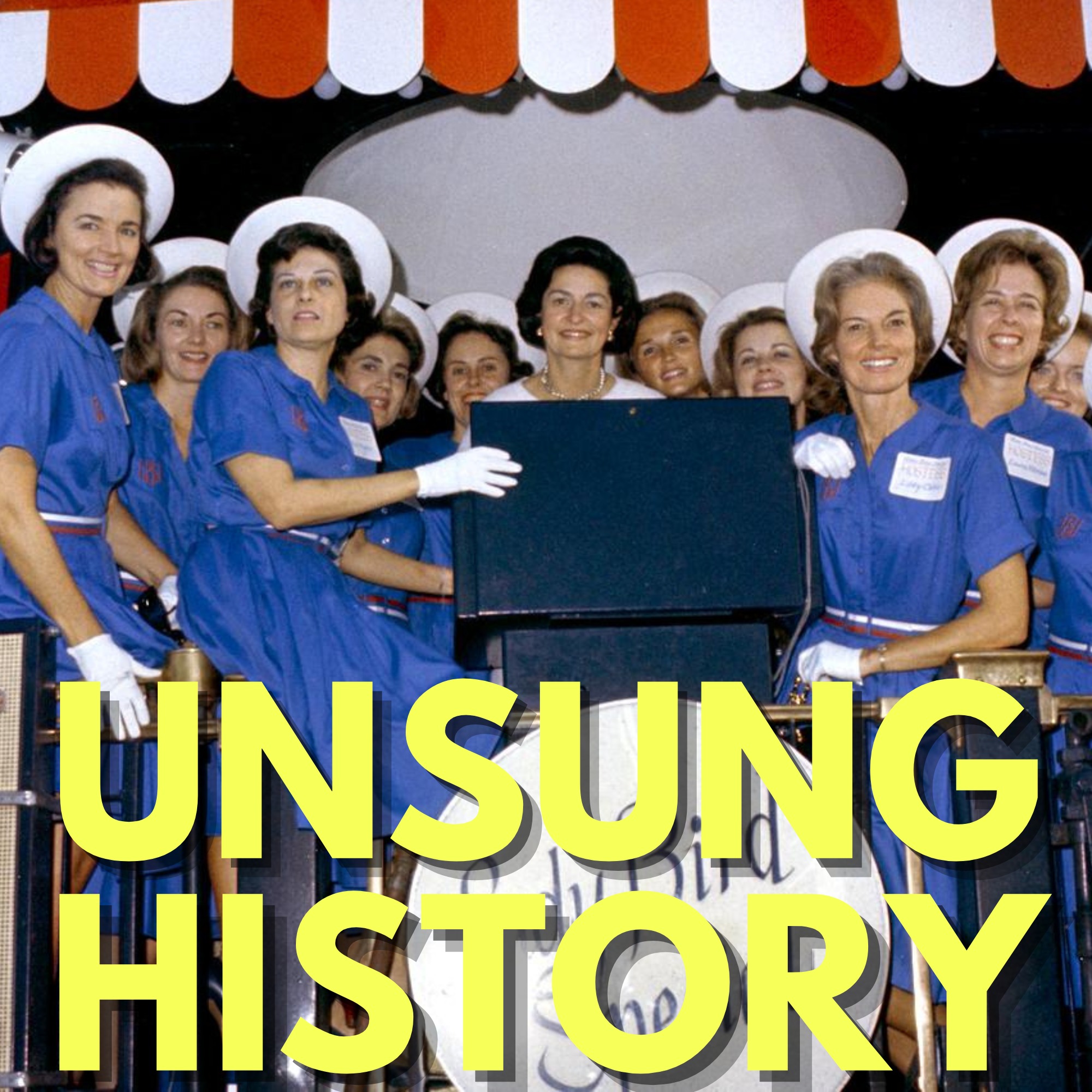
Claudia Alta Taylor was born in Karnak, Texas on December 22, 1912. According to legend, it was her nursemaid who gave her her famous nickname, declaring that baby Claudia was as purdy as a ladybird. Ladybird graduated from the University of Texas at Austin in 1934 with a BA in History and Journalism. Shortly before graduating, she was introduced to Lyndon Baines Johnson and they married in November 1934. When Lyndon first ran for Congress in a special election in 1937, it was Lady Bird who provided the initial campaign funds from an inheritance. During World War II, while Lyndon was active duty military in the Navy, Lady Bird ran his congressional office. In 1943, she purchased a struggling Austin radio station and turned it around. In 1960, Democratic Senator John F. Kennedy asked Lyndon, then the Senate Majority Leader, to be the VP candidate on his ticket in a bid to win votes from the South. Because Jackie Kennedy was pregnant at the time, Lady Bird played an outsized role in the campaign. Traveling 35,000 miles across the country, Kennedy won, narrowly carrying seven Southern states. When Kennedy was assassinated in Dallas, Texas on November 22, 1963, LBJ assumed the presidency and Lady Bird was unexpectedly thrust into the role of first lady. On July 2, 1964, President Johnson signed into law the Civil Rights act of 1964, legislation that had originally been championed by Kennedy. The act passed overwhelmingly in both houses of Congress, but only after overcoming a 72 day filibuster in the Senate led by Southern Democrats. Later that day, LBJ remarked to journalist Bill Moyers, quote, well, I think we may have lost the south for your lifetime and mine, unquote. The following month, the DNC nominated Lyndon as their presidential candidate. LBJ was heavily favored to win over Republican nominee Senator Barry Goldwater, but the Civil Rights act had alienated swaths of the south which were threatening to leave the Democratic column. LBJ could have ignored the Southern states in his campaign plans and won without them. But LBJ and Ladybird themselves Southerners refused to write off the South. They developed a plan for Lady Bird to take a Whistle Stop Train Tour of the Southern States As Lady Bird later reflected, I have a strong sentimental family, deep tie to the south, and I thought the south was getting a bad rap from the nation and indeed the world. It was painted as a bastion of ignorance and prejudice and all sorts of ugly things. It was my country, and although I knew I couldn't be all that persuasive to them, at least I could talk to them in language they would understand. Despite the reluctance of LBJ's principal campaign advisor, the President approved of the trip and the first lady, joined by her social secretary, Bess Abel and her press secretary Liz Carpenter, forged ahead with planning the 1,682mile October train trip from Washington, D.C. to New Orleans. Several congressional wives helped, and Lady Bird's friend Virginia Russell moved to the White House for three weeks to join the planning. They rescued an observation car from a Pennsylvania junkyard and redubbed it the Queen Mary, painting the exterior red, white and blue and installing a brass platform with a podium on the back from which Lady Bird and other guests could give speeches. Because there was no air conditioning in the Queen Mary, blocks of ice needed to be loaded on at each stop to cool it. The Queen Mary was the last car in the 19 car train, which boasted room for security personnel, lodging for journalists and campaign staff, a dining car and a reception room. The Ladybird Special began its journey on Tuesday, October 6th, departing D.C. just before dawn. This whistle stop tour was the first time that a First lady had campaigned alone without her husband, But LBJ did join for the first short leg to Alexandria, Virginia, where 5,000 people came out and high school bands greeted them with the strains of the Yellow Rose of Texas. LBJ returned to the White House by helicopter and the Ladybird Special continued on its route through Virginia. Most stops were short, just five to 20 minutes, with the speakers never even leaving the train. Journalists who hopped off the train to watch the speeches or to interview people in the crowds had to listen for the whistle to jump back on or risk being left behind. For the final stop on Tuesday, 14,000 people joined Lady Bird and LBJ, who flew in for a rally at the Reynolds Coliseum at North Carolina State College. On Wednesday, October 7, the Ladybird Special headed from North Carolina into South Carolina, where Goldwater supporters began to show up in larger numbers. On Thursday, October 8th, the train crossed into Georgia and 15,000 people showed up for a lunchtime rally in Savannah, including folks carrying this is Goldwater country banners and shouting, we want Barry. Despite a bomb threat in Florida, the Ladybird Special avoided violence. And on Friday, October 9, they traveled through the Florida panhandle, through Alabama and Mississippi, on the way to their final stop in New Orleans. Lady Bird had invited Democratic senators and governors in the states they visited to join the train and to speak. Although some of them enthusiastically joined, others were reluctant, either because they had split with LBJ or because they worried about their own political perspectives if they aligned too closely with him. Segregationist Alabama Governor George Wallace, unsurprisingly, did not join the train. But he did send a bouquet of roses to her Flomaton stop where Lady Bird reminisced about the summers she spent there with relatives while growing up. The journey ended in New Orleans, where LBJ was again waiting. 40,000 supporters joined the final rally. Ladybird told the crowd that she and Lyndon had too much respect for the south to take it for granted and too much closeness to ignore it. There was one more stop that evening, a campaign fundraising dinner in New Orleans
- [09:35]
Kelly Therese Pollack
where lbj, against the wishes of his advisors, declared,
- [09:41]
Narrator
if we are to heal our history and make this nation whole, prosperity must know no Mason Dixon line and opportunity must know no color line, as he promised to enforce the Civil Rights Act. After 47 speeches in front of 200,000 people, Lady Bird's whistle stop campaign was over. LBJ was so delighted by the reception of the Ladybird special that he asked the first lady to go out on more campaign stops in the final weeks of the campaign. On November 3, 1964, LBJ won re election with 61% of the popular vote, carrying all but six states, five of them in the South. Joining me in this episode is returning guest Shannon McKenna Schmidt, author of youf Can't Catch Us, lady bird Johnson's trailblazing 1964 campaign train and the women who rode with her. But first, please enjoy a little audio from the Lady Bird Special stop in Ahoskie, North Carolina on October 6, 1964.
- [11:06]
Announcer
And now it is my pleasure to welcome to North Carolina and to present to you the first lady of the land of Lady Bird Johnson.
- [11:17]
Lady Bird Johnson
Governor and Mrs. Sanford, Mrs. Dan Moore, Senator and Mrs. Jordan, Congressman and Ms. Bonner and all you friends out there. I just can't tell you how happy this makes me and how wonderful it is to be greeted by such a big crowd. I know we have kept you waiting and I'm sorry, but we kept you waiting for a mighty good reason. We found so many people back up the railroad tracks that we wanted to greet and the crowds everywhere all through Virginia this delightful day have been wonderful. I understand a husky began as a railroad town and I was advised the best thing I could do was to bring along a train load of passengers. Well, I've done my best. I'm sorry we can't stay long enough to visit nearby Chowan College. I see they've come to visit us. Good. I have enjoyed so much meeting and riding through the state with your many able public officials. We have come here today not just because we enjoy an autumn train ride across this Southland, but because we believe that North Carolinians are interested in good government, farsighted government, and we believe that the party with the most heart, the most vision, the most stability is the Democratic Party. All of us are here to say what I suspect you have already guessed, that we hope you will place your confidence in the President again in Dan Moore, in Bob Scott, in Herbert Bonner and right on down the line.
- [13:23]
Kelly Therese Pollack
Hi Shannon. Thanks so much for joining me today.
- [13:27]
Shannon McKenna Schmidt
Hi Kelly. Well, thank you so much for having me back on the program.
- [13:30]
Kelly Therese Pollack
Yes, I am excited to talk to you again. Want to hear a little bit about what got you started on this book. This is I think, your fourth book. And of course I spoke to you about your most recent book before this one, Eleanor Roosevelt on a Pacific Tour. So what got you launched on this one?
- [13:48]
Shannon McKenna Schmidt
Well, after I wrote that book about
- [13:50]
Eleanor Roosevelt, the first lady of World War II, about her trip to the Pacific theater, I was curious to find out what other momentous journeys first ladies might have taken. And there was Lady Bird Johnson Whistle Stopping down the tracks during the 1964 election season on a campaign train.
- [14:08]
And she actually made history to do it.
- [14:10]
She was the first first lady to take a leading role on the campaign trail.
- [14:15]
And what I didn't know at the time, but was a neat connection is that Eleanor Roosevelt was Lady Bird's role
- [14:23]
model as first lady.
- [14:25]
So I loved that connection between the of them.
- [14:29]
Kelly Therese Pollack
You for this book had an abundance of sources because there are many, many, many newspaper articles about this tour. Talk to me a little bit about sorting through all the sources, figuring out how to piece this story together.
- [14:44]
Shannon McKenna Schmidt
Well, one of the early indicators for me, because this was a four day
- [14:48]
journey and the train campaign went from
- [14:52]
Washington D.C. to to New Orleans. And at first I thought, well, how could four days cover an entire book?
- [14:59]
And one of the early indicators of
- [15:01]
what a momentous journey this was was the amount of media coverage. Some 225 reporters rode along on this 19 car train. So they made sure they had plenty of room for them.
- [15:14]
I could track the train basically all along the Line from newspaper articles in small town papers to ones that articles
- [15:23]
that went out over the wire nationwide, written by reporters like Helen Thomas.
- [15:29]
So that was enormously helpful and I
- [15:33]
love doing the research.
- [15:35]
And I went to the LBJ library and got into their archives. There is wealth of information. Lady Bird was well known for being very well prepared.
- [15:46]
Her advance notebooks are there with all of her notes in it. Many, many folders, letters sent to Lady
- [15:53]
Bird from people who saw her along the route.
- [15:57]
Files that were open to a researcher for the first time, which was very
- [16:00]
exciting for me, and a woman named
- [16:03]
Liz Carpenter, who was Lady Bird's press secretary, first East Wing staff director and a key orchestrator of this trip.
- [16:10]
She wrote a memoir, very funny, called Ruffles and Flourishes, if people want to check that out. So it really was an astonishing amount
- [16:22]
of resource materials available to me for this.
- [16:26]
Kelly Therese Pollack
Did you, like, have a big poster board where you were trying to track what the schedule actually looked like? What did that look like for you?
- [16:34]
Shannon McKenna Schmidt
I didn't have a big poster board,
- [16:36]
although I do love that idea. I have a friend who writes narrative nonfiction and she does that. And it sounds very intriguing to me. I knew that I was going to set this up chronologically, so that was very helpful. But I do.
- [16:51]
I do outline. So I did outline each chapter before I started writing.
- [16:57]
Kelly Therese Pollack
Let's set the stage a little bit. It is 1964. This is fall, shortly before the election. Things are at a fever pitch in the country in terms of things like race relations. Johnson is not liked by parts of his own party, especially in the South. What were the considerations that the first lady and her staff needed to make? Thinking about whether to do this trip, what the trip would look like, what security concerns there might be.
- [17:28]
Shannon McKenna Schmidt
Yes. So this is October 1964.
- [17:31]
LBJ is in a race for the
- [17:33]
presidency against Republican candidate Barry Goldwater. LBJ would like to win in a landslide victory to prove to the American
- [17:41]
public that he earned the presidency and that he didn't just inherited. After John F. Kennedy's assassination and three
- [17:48]
months earlier, LBJ signed into law the Civil Rights Act.
- [17:52]
So much of the south is seething, they hate him.
- [17:55]
He's being called a traitor to the south because he himself is from Texas. He threw his political weight behind the Civil Rights act to help get it passed.
- [18:04]
And the fact is, he doesn't need
- [18:07]
the south to win the election. And a lot of his advisors are
- [18:09]
saying, we don't need it.
- [18:11]
Why waste the resources? Why waste the money? You're likely to win anyway. But Lady Bird and the President, they're having none of this. Lady Bird is also from the south, from Texas, with deep Alabama roots.
- [18:25]
And she and her staff, they look
- [18:28]
for a way to campaign into the south. And they come up with this campaign
- [18:33]
train that I said will go from
- [18:35]
Washington D.C. to New Orleans and cover nearly 2,000 miles.
- [18:40]
So it's this women led endeavor, which was another history making thing at the time.
- [18:46]
And they put this campaign train together
- [18:49]
in a matter of weeks and there was some danger involved, but the danger
- [18:54]
also was not going to dissuade Lady Bird. She was going to do this.
- [18:59]
Kelly Therese Pollack
This just. I hate event planning anyway. But this whole thing feels like a logistical nightmare. Trying to figure out where all the train is going to stop along the way, for how long, in each place, what that looks like when you get off the train, when you don't, who's joining. Can you talk some about the, the preparation, the figuring all that out, who the key players were?
- [19:22]
Shannon McKenna Schmidt
That is absolutely true.
- [19:24]
And one of the things that I kept thinking about is the fact that
- [19:27]
they didn't have email, then we had
- [19:28]
telephones, we had telegrams, and that was how they were getting this done. And as I said, they did it
- [19:34]
in a matter of weeks.
- [19:35]
And, and more than a thousand people
- [19:38]
pretty much came together to make this happen. There were a team of key orchestrators who worked out of the East Wing.
- [19:44]
They worked with the Democratic National Committee. There were advance men, advance women who worked in every community down the line. They in turn would gather together people in every town who would help with
- [19:58]
the preparations, get people to the station,
- [20:01]
decorate, you know, whatever it is that they, that they needed to do to drum up excitement. So it really was this extraordinary team. And I was very much struck by
- [20:13]
the camaraderie of all of these women
- [20:15]
and how they came together to support each other and to support this endeavor.
- [20:22]
Kelly Therese Pollack
How did they make decisions about. There are obvious places you're going to want to stop. Like, they're really big cities that you need to hit with a lot of supporters and donors and things. But all along the way there are, I think, 45 stops. You know, there's. Some of. These are tiny little towns. There's like a thousand people in the town, but they're making a stop. But some places, of course, they need to go straight through. They can't stop at every possible place. So what did that decision making process look like?
- [20:52]
Shannon McKenna Schmidt
Primarily, a couple of things. Where, where the train could reach by nightfall, which towns were the gathering places
- [20:59]
of the counties, and they were likely
- [21:00]
to get more people out where they thought that the President and his running mate Hubert Humphrey would most need the votes. And Liz Carpenter, she was very funny and she said that they would send
- [21:13]
Lady Bird into places where LBJ wouldn't
- [21:16]
be able to get in and out
- [21:17]
with his hide on.
- [21:19]
So she wanted the tough towns. Ladybird asked for the tough towns, small towns. Also places like Charleston, which was very, very much steeped.
- [21:29]
It was Goldwater territory.
- [21:31]
So Lady Bird asked for the tough towns. And six different railroad lines came together to make the route from Washington D.C. to New Orleans. And there was a town called Ahaskie
- [21:45]
just over the North Carolina line. And they sent a telegram to the White House asking to have the train stop. And they said no important person has stopped here since Buffalo Bill brought his Wild west show. And they said that no passenger train had come through in 12 years.
- [22:03]
So they stop in a Hoskie and they get 10,000 people there. So it was kind of a piecing
- [22:10]
together of like a quilt to put together this route.
- [22:15]
Kelly Therese Pollack
And Lady Bird doesn't give the same speech every time. It's not like she just gets up and is like, here's my five minute spiel that I'm giving 45 times. She's actually personalizing it. That seems like a huge amount of effort.
- [22:28]
Shannon McKenna Schmidt
It is. And that was very much Lady Bird Johnson.
- [22:32]
For state dinners, she would read the
- [22:34]
briefing books that the President was given
- [22:36]
by the State Department. She would learn facts about people so that she could make a personal connection
- [22:42]
with everybody in a receiving line.
- [22:44]
And, and she brought that same kind
- [22:46]
of sincerity and personal connection to everything that she did.
- [22:51]
And the same with this tour.
- [22:53]
She talked about a lot of the same points, LBJ's experience, his administration's initiatives.
- [23:02]
But every single speech was customized along the route for all of the stops.
- [23:08]
And people noticed.
- [23:11]
I think it was after Fredericksburg, Virginia where a newspaper had the headline that said Lady Bird Johnson did her homework for tour.
- [23:18]
So people recognized that. And I think that that's what made her very effective is that people knew they were getting sincerity and they weren't getting canned political talking points from her.
- [23:33]
Kelly Therese Pollack
That sincerity also shows through in the speeches that her daughters gave. So what did that look like to involve the two daughters on the route? What did they bring to the tour?
- [23:49]
Shannon McKenna Schmidt
So 20 year old Linda and 17
- [23:51]
year old Lucy, the Johnson daughters. Linda rode along for the first two
- [23:55]
days, Lucy for the second, and they were amazingly poised and funny and they
- [24:04]
were enormously popular with everybody along the
- [24:07]
route and especially with the great number
- [24:10]
of young people who turned out.
- [24:13]
And they, like Lady Bird, ended up doing. They faced down hecklers with poise. They gave speeches.
- [24:20]
Something that Linda said at one of
- [24:22]
the stops actually became the title for
- [24:24]
the book, you Can't Catch Us.
- [24:26]
And the train was leaving a station in North Carolina, and some boys ran
- [24:29]
after the train waving Barry Goldwater signs. And Linda flips on the loudspeaker, and very cheerfully, she says to them, you're running after the 20th century. You can't catch us.
- [24:42]
And it was that kind of energy that the train campaign embodied. And I feel that they contributed to. And I love that as the title, because I felt that it reflected the
- [24:54]
forward momentum of the train, but also the surrounding social progress and civil rights and women's rights that were taking place.
- [25:02]
Kelly Therese Pollack
And you had a chance to speak with Linda and Lucy, Right?
- [25:06]
Shannon McKenna Schmidt
I did.
- [25:07]
So I spoke to each of them
- [25:08]
on the phone, and I've since met Linda in person as well. And I just.
- [25:14]
I was so appreciative of the fact
- [25:16]
that they took the time to talk to me about their experiences riding on the campaign train. So they would have been among the youngest people to have ridden on the train. And. And when I spoke to Linda, when I.
- [25:31]
We first.
- [25:32]
I answered the call, and the first
- [25:34]
thing she says to me is, I've been doing my homework.
- [25:37]
And it just. It made me smile because as.
- [25:40]
As we just heard, Lady Bird was. Was very known for doing her homework. And Linda had been calling up other
- [25:46]
people who had been on the train
- [25:48]
to prep for talking with me.
- [25:50]
Kelly Therese Pollack
That's fantastic. You mentioned hecklers. What did that look like? It obviously wasn't the same in every single town, but in a lot of places, especially as they got to Alabama and Mississippi, there was a fair amount of Barry Goldwater fan presence there.
- [26:09]
Shannon McKenna Schmidt
So through Virginia and North Carolina, there
- [26:11]
were always, at every stop, Goldwater supporters. Through Virginia and North Carolina, they would have their signs. They were largely respectful.
- [26:20]
The train gets into Columbia, South Carolina, and the mood changes. There's a big crowd. I think it was 8,000 people, cheering, supporting. And then, as Liz Carpenter explained it,
- [26:34]
she said it was so surprisingly ugly, it left us all aghast.
- [26:38]
What happened next?
- [26:40]
And it was a relatively small group of hecklers. But what these groups would do to
- [26:45]
maximize their disruptiveness is they would surge the back platform on the train where
- [26:51]
Lady Bird and the other people were
- [26:52]
speaking, and they would heckle, they would
- [26:56]
cat call, they would give crude gestures,
- [26:58]
and they would wave really terrible signs. And so this happened for the first time in Columbia, South Carolina, that same day. Day two, the train goes on to Charleston.
- [27:10]
Some of these same people followed the
- [27:12]
train from Columbia to Charleston.
- [27:15]
And there was an even more disruptive group there in Charleston.
- [27:18]
And back in Columbia, Lady Bird, she addressed the hecklers.
- [27:23]
She held up her hand, and she very politely admonished them. And they were quiet for the rest of her speech.
- [27:31]
Not so in Charleston. They continued to be disruptive there.
- [27:34]
But a reporter asked Lady Bird at
- [27:37]
the end of that day about these
- [27:38]
hecklers, and she just had a great perspective.
- [27:41]
And she said, you know, we need
- [27:43]
to just remember that thousands and thousands
- [27:46]
of people have come out to greet
- [27:47]
us, shown us such support and love,
- [27:50]
and that it's just dozens of people who have done the heckling. And just one more quick thing on the hecklers. So Mobile, Alabama, they had the second largest crowd of the whole trip, 20,000 people. And Alabama is one of the states that most hates lbj. As Lady Bird said, it was a
- [28:12]
state that she had the deepest ties to, family ties, and it was also the state most adamantly against them. There were hecklers in Mobile, but they also got this amazing crowd of 20,000
- [28:23]
people really showing love for this daughter of the South.
- [28:29]
And a reporter said that if white backlash was going to ruin this trip, Mobile gave the answer.
- [28:35]
And Lady Bird ended up saying, despite a bit of contentiousness at that stop,
- [28:39]
that it was her favorite stop of the trip.
- [28:43]
Kelly Therese Pollack
One of the things I found so fascinating was this idea that, you know, so many people in the south are, as you said, think LBJ is a traitor to the South. A lot of the Democratic politicians who may have otherwise been part of the trip are reluctant to do so because of that. And yet there is this sense that, well, it's the South. We need to be hospitable. We need to welcome the first lady, whether or not we agree with her. What are some of the ways that that sort of tension plays out?
- [29:16]
Shannon McKenna Schmidt
Yeah, so that's an excellent point, because the organizers did, and a lot of
- [29:21]
Lady Bird's team, there were 15 ladies for Lyndon. They were the official hostesses on the train.
- [29:27]
They were all from the south, and they wanted to go into the South.
- [29:32]
And there was this.
- [29:33]
They were leaning into the fact that you wouldn't.
- [29:38]
You couldn't be considered a Southern gentleman
- [29:40]
if you weren't gonna give gallant escort to a lady.
- [29:43]
So they very much did lean into that.
- [29:45]
And it was actually very effective because
- [29:48]
as the train traveled further south, it gained momentum.
- [29:53]
And so what happened was even people
- [29:56]
like Paul Johnson, the governor of Mississippi,
- [29:59]
who called LBJ and Hubert Humphrey the
- [30:02]
most dangerous duo in the country because of their advocacy for civil rights. Even he got on the train, and when it was in Biloxi, the only
- [30:13]
stop in Mississippi, he got on that
- [30:15]
train and he praised Lady Bird and gave a speech.
- [30:18]
So they did lean into that. And I think that an instance like that, and that wasn't the only time
- [30:25]
it happened, shows the power of the Lady Bird Special and Lady Bird herself.
- [30:32]
Kelly Therese Pollack
One thing that really shines through in this story is how much respect and love LBJ has for Lady Bird, how much it means to him that she is willing to do this trip. Of course, he also famously cheated on her. But what. What does their relationship look like?
- [30:53]
Shannon McKenna Schmidt
Yes. And you know, LBJ wasn't always the greatest husband, as you said, he cheated on her.
- [30:59]
He would often treat her terribly in public.
- [31:02]
And I thought about all of that. And what I came down to for this story is I focus on the
- [31:09]
aspects of their relationship that gave rise to the Lady Bird Special.
- [31:13]
And again, I think that might surprise people. So at this point in 1964, Lady Bird has been with LBJ for, I think, 27 years in politics. And something I found very interesting is
- [31:28]
that he gave her public credit at the time.
- [31:31]
So this was very well known that
- [31:32]
they had this political and personal partnership. And in 1960, LBJ first ran for
- [31:39]
the presidential nomination and then he ended up as the VP on the ticket.
- [31:43]
But he told a reporter in 1960 about Lady Bird. She has made my career possible.
- [31:49]
And she, of course, became a really wonderful campaigner and politician in her own
- [31:57]
right as well, always in support of his endeavors.
- [32:01]
But I do think that that might be a lesser known aspect of their relationship. And he also advocated for women in government. And that was. Lady Bird pushed that agenda.
- [32:15]
And so did Liz Carpenter, who worked
- [32:17]
with him on projects when he was president.
- [32:19]
And that was one of them.
- [32:21]
So I loved that women powered aspect of the story.
- [32:25]
All around.
- [32:28]
Kelly Therese Pollack
We've been talking about the ways that Lady Bird changed the role of first ladies in campaigns, but she also had an effect on the way we think about the role of the first lady generally. What did that look like? And of course, we can't talk about the East Wing without being a little verclempt that there is no East Wing now. But how did she professionalize the role?
- [32:51]
Shannon McKenna Schmidt
Yeah, so.
- [32:51]
And this was something that I liked about because we know that Eleanor Roosevelt moved the needle, the bar forward for
- [32:58]
first ladies in very instrumental ways. And Lady Bird Johnson did as well as you said she was the first First Lady. To professionalize the role, she hired Liz Carpenter, who was the first East Wing staff director. And Liz Carpenter was also the first First Lady's press secretary to have been a professional newswoman.
- [33:18]
So one of the things that Lady Bird did was she instead of pushing the media away or thinking that they're prying, and she embraced them, and she
- [33:29]
really worked with them to get her
- [33:32]
messaging out, the administration's messaging out. And she said that she considered being
- [33:39]
First Lady a daily working job. And I also love that she referred to herself as.
- [33:46]
As a wife, mother, businesswoman, and politician, because in addition to being involved in
- [33:53]
LBJ's political career, she also bought a rundown Austin radio station in all of her spare time, and she turned it into a media conglomerate.
- [34:03]
Kelly Therese Pollack
Yeah, it's really. It's a fantastic story. I want to ask if we can figure out anything about whether this train trip had an effect on the 1964 election. Of course, you mentioned LBJ wanted to win in a landslide. He did. He did not win all of the states that. That the Lady Bird Special went through, but what can we sort of figure out about whether it was effective?
- [34:31]
Shannon McKenna Schmidt
So in terms of the actual campaign,
- [34:35]
the governor of Virginia before the Lady
- [34:39]
Bird Special came through the state, he
- [34:41]
thought the state was gonna go for Goldwater. One day after he rode the Ladybird
- [34:45]
Special, he had changed his tune and said that he thought that LBJ would now win Virginia. And in fact, they did win Virginia. The Democrats same in North Carolina.
- [34:56]
When Liz Carpenter advanced the route, she
- [34:59]
found that North Carolina was a mess.
- [35:01]
The Democratic Party was in shambles.
- [35:04]
The person running for governor didn't want LBJ in the state because he thought it would hurt.
- [35:09]
He was Democrat. He thought it would hurt his chances to be aligned with this pro civil
- [35:14]
rights campaign train or this president.
- [35:19]
Well, the Lady Bird Special appears to
- [35:21]
have helped with North Carolina because they
- [35:24]
also took that state.
- [35:26]
And my favorite, though, is Florida. So one day before the Lady Bird
- [35:32]
Special set out, there was a memo
- [35:35]
circulated in the West Wing saying that
- [35:37]
only a miracle could deliver Florida for lbj. And in fact, Florida went for lbj. So that miracle appears to have been the Lady Bird Special.
- [35:47]
So they ended up taking three of the eight states.
- [35:49]
And I'm not sure that they ever
- [35:51]
thought that they were going to win
- [35:54]
all of them, certainly.
- [35:55]
But Lady Bird's goal was to Garner votes for LBJ's reelection, but also to
- [36:03]
help bridge this animosity, bridge this divide,
- [36:06]
and tell people in the south, hey,
- [36:08]
we didn't forget, you we're not leaving you behind.
- [36:10]
We're trying to sweep everybody up and make life and the region and economic
- [36:15]
prosperity better for everyone.
- [36:18]
And also, the other interesting thing about the campaign train is how Lady Bird
- [36:25]
was a role model at the time.
- [36:27]
And this is one year after the
- [36:29]
Feminine Mystique was published in.
- [36:31]
And there is a serious lack of role models for women looking for something other than fulfillment solely in domesticity. And there's. Margaret Mead was a columnist for Redbook at the time, and she said, Mrs. Johnson is giving us a model of what other American women can do and be in the mid 20th century.
- [36:58]
So the Lady Bird special did have this. This ripple effect.
- [37:01]
And it was the Democratic. Major Democratic campaign effort in the south
- [37:08]
during the 1964 election.
- [37:11]
And it was a serious campaign strategy. And one of the things that I found is that it was recognized as
- [37:18]
such by the media. And yes, there was misogyny along the route, but there were also a lot of even veteran male political reporters who recognized this serious campaign strategy for what it was.
- [37:31]
Kelly Therese Pollack
I just have visions of something like this happening today. I think, you know, we now campaigns, it's so easy to fly that, you know, especially presidential campaigns are usually flying from stop to stop, which means, of course, you're only hitting bigger cities, places that are easily accessible by airport. And I just, I, you know, I wonder if something like this trip would be possible or effective today.
- [37:58]
Shannon McKenna Schmidt
Yeah, you know, I actually think it would be really brilliant for a politician who's somebody who's campaigning to do a
- [38:05]
train trip like this, because 1964, we're
- [38:08]
now in the jet age. And I do think it was very effective for them to go and stop
- [38:14]
in communities like a huskie that felt underserved or underrepresented.
- [38:20]
And I think even a politician today
- [38:23]
could look back and take some lessons from this.
- [38:26]
Kelly Therese Pollack
Absolutely. It is a really fun read. Can you tell listeners how they can get a copy of the book?
- [38:34]
Shannon McKenna Schmidt
Well, the book should be available at
- [38:37]
your favorite online retailer, your local bookstore.
- [38:40]
If they don't have it on hand, you can order it. And if you'd like more information, my
- [38:45]
website is shannonmkennashmidt.com is there anything else
- [38:49]
Kelly Therese Pollack
you want to make sure we talk about?
- [38:52]
Shannon McKenna Schmidt
Yeah, I keep thinking, you know, because
- [38:55]
when I started writing this book several years ago, we were not in the climate that we are now, and now
- [39:01]
we're seeing some kind of similarities between
- [39:05]
the issues that they were.
- [39:06]
They were addressing then and now in
- [39:10]
terms of women's rights, civil rights.
- [39:12]
And I keep thinking about maybe what people could take away from this story and certainly myself. And I think about how Eleanor and
- [39:22]
Lady Bird both took their trips, World
- [39:25]
War II and this great turmoil in civil rights in the United States, and
- [39:31]
how they took their trips during these
- [39:32]
times of upheaval, and how they really rose to meet the moment despite the danger and the discomfort that that it had for them, and how they really
- [39:44]
illustrated their courage and their compassion.
- [39:48]
And if there was something that I thought people might take away from this book is to address injustice, to take action. And this is something I've been thinking
- [40:02]
a lot about myself, the power in
- [40:05]
the collective to make change and achieve historic undertakings.
- [40:11]
And Lady Bird said at one of
- [40:12]
her stops to it was primarily a group of college students.
- [40:16]
She said, never stand on the sidelines.
- [40:19]
And it was true then and it's true now.
- [40:23]
Kelly Therese Pollack
Shannon, thank you so much for joining me again on Unsung History. I really loved reading this book.
- [40:30]
Shannon McKenna Schmidt
Oh well, thank you so much for having me back on the program. I could have gone on all day
- [40:34]
about the extraordinary Lady Bird Johnson.
- [40:37]
Kelly Therese Pollack
Thanks for listening to Unsung History. Please subscribe to Unsung History on your favorite podcasting app. You can find the sources used for this episode in a full episode transcript@unsunghistorypodcast.com to the best of our knowledge, all audio and images used by Unsung History are in the public domain or are used with permission. You can find us on Twitter or Instagram @UnsungHistory or on Facebook @Unsung Historypodcast. To contact us with questions, corrections, praise, or episode suggestions, please email kellynsunghistorypodcast.com if you enjoyed this podcast, please rate, review and tell everyone you know. Bye.