← The Daily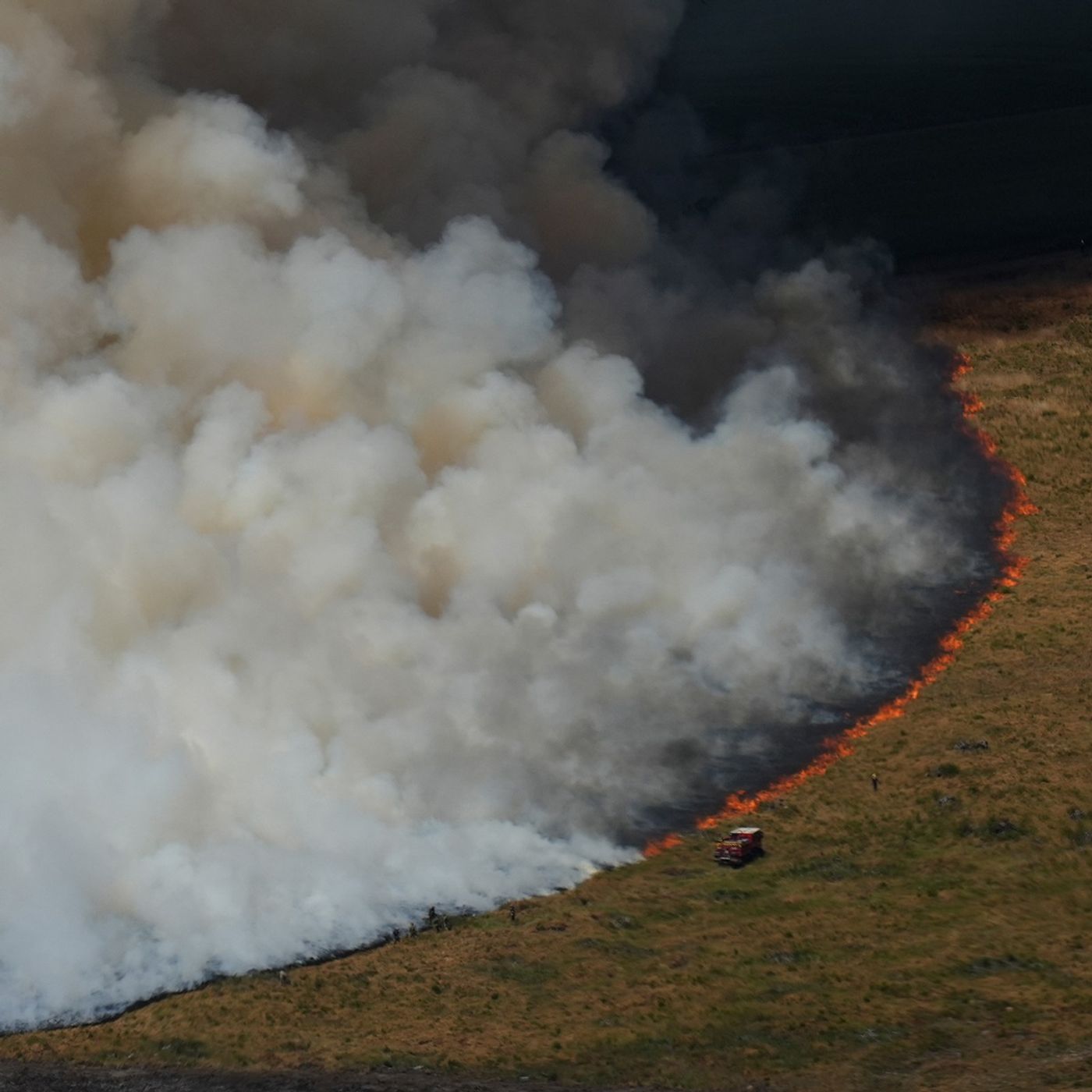
The Daily
Europe Is Burning
00:29:49
Hundreds of thousands of people in France and Spain have been forced to evacuate from blazes fueled by soaring temperatures and dry conditions.
Loading summary
Transcript90 lines
- [00:00]
TikTok Narrator
On TikTok, entire communities are turning curiosity into connection. History lovers share stories that bring the past into focus. Scientists and educators break down big ideas with experiments and insights that make discovery feel approachable. And across art, language, and everyday tips, people on TikTok give fresh perspectives on the world we share. TikTok is a place for curiosity where learning is fun, connection is meaningful, and discovery is never stops.
- [00:30]
Zolinkano Youngs
From the New York Times, I'm Zolinkano Youngs filling in as host. This is THE Daily. Tonight, relentless walls of flame raging across Europe.
- [00:47]
Chico Harlan
Firefighters say as David versus Goliath. A week after it started, they're still
- [00:52]
Zolinkano Youngs
struggling to contain massive wildfires burning out of control in France and Spain this summer. Wildfires have been raging across Europe with France and Spain particularly hard hit.
- [01:04]
Mark Landler
More than 360,000 residents and tourists have now been evacuated.
- [01:08]
Zolinkano Youngs
It feels like we're in a war zone, the words of one woman living near Bordeaux. As flames get ever closer, hundreds of thousands of acres incinerated, villages destroyed, and entire communities upended by the fires, police
- [01:23]
Mark Landler
come and started screaming in the neighborhood like, you have to get out.
- [01:27]
Zolinkano Youngs
Get out.
- [01:27]
Mark Landler
You have 20 minutes. Evacu.
- [01:30]
Zolinkano Youngs
Today I talked to my colleagues Chico Harlan and Mark Landler about why this fire season has been especially devastating for Europe and how when it comes to climate change, the continent is grappling with just how much it may need to adapt. It's Thursday, july 30th. Chico, welcome to THE Daily.
- [02:00]
Chico Harlan
Thank you so much for having me.
- [02:02]
Zolinkano Youngs
Of course. This is your first time on the show.
- [02:03]
Chico Harlan
It is.
- [02:04]
Zolinkano Youngs
Well, I am glad to have you here. You're the global climate correspondent at the New York Times and you're based in Europe. So help us make sense of these fires that are sweeping across France and Spain. What's your understanding of how both these countries get fires this big and destructive at the same time?
- [02:24]
Chico Harlan
Well, you're right. These fires are simultaneously unfolding as the largest ever in France and the largest in Spain. They're both unfolding on the outskirts of major cities, Madrid and Bordeaux. And there have been large scale evacuations. And in order to really understand how you get two fires that are both historic, kind of have to go back all the way to May when it wasn't even summer yet. Europe is bracing for its first major heat event of 2026. That was the that Western Europe was hit by a heat wave and it is punishingly hot.
- [03:00]
Mark Landler
People are scurrying for shade.
- [03:02]
Zolinkano Youngs
I'm taking a shower right before bed. I'm sleeping with wet towels over me just to Try to survive honestly, and just try to sleep.
- [03:09]
Chico Harlan
And then came the big one. Just a month later in late June,
- [03:12]
Zolinkano Youngs
the Eiffel Tower closed early due to safety concerns. Temperatures in parts of France hitting 111 degrees.
- [03:19]
Chico Harlan
And if you just look at France for a second in the span of three days, they set the hottest day in national history back to back to back.
- [03:28]
Narrator/Announcer
These are unprecedented times, said the French president.
- [03:32]
Chico Harlan
And if that had just been a three day thing, that alone would have been remarkable. But the unusually hot temperatures stayed and then they let up for a few days and then they came roaring back through July.
- [03:43]
Narrator/Announcer
This morning the death toll keeps climbing due to the brutal heat wave gripping Western Europe.
- [03:48]
Chico Harlan
It was very lethal. A public institute in Spain says there were more than 1,000 excess heat related deaths this June. Some estimates say 10,000 extra deaths because of heat. Some have said 20,000. But what you can say for sure is that this was a highly deadly event across Western Europe.
- [04:09]
Zolinkano Youngs
Wow. Okay, so you're saying tens of thousands of people are dying in these heat waves. In the US we often see a couple thousand people die annually and that's awful. But what you're describing is striking here. Why is this toll so big?
- [04:24]
Chico Harlan
There's a couple reasons for that. One is Europe has buildings that are older and that were not built for this climate. They're built for colder temperatures and they were built to retain heat. In Paris, these famous beautiful homes, apartments are under zinc roofs, which basically are like ovens. Then of course there's the air conditioning factor, which is a big one. Still a minority of Europeans have air conditioning. And then during heat waves, people who can will scramble for anything during a daytime, they'll go to a mall, they'll jump in a pool. But people who are elderly or have pre existing conditions can be stuck in apartments that just never cool down and stay hot in the night. And after days their bodies break down. And that's how these deaths happen.
- [05:11]
Zolinkano Youngs
God. So people are literally baking right now. And it's because of a lack of air conditioning and the architecture of buildings. I'm gonna ask and understand this the most American question, but I do think it's a question that's on the minds of many listeners. Why not use more air conditioning? I, I get there are environmental concerns, but explain this to me. This situation seems dire.
- [05:36]
Chico Harlan
Well, it just requires money and time. And in some cases the design of the buildings presents a problem for installing air conditioning. There's also widespread in France, especially a philosophical opposition to air conditioning. But you have to remember that the idea was look, this intense discomfort is a couple nights a year. Like we can deal with it when it gets bad, the rest of the year, there's no need for air conditioning. What's happened this summer is that these periods of discomfort, and now deadly discomfort are lasting for weeks, not just a couple days and go away.
- [06:08]
Zolinkano Youngs
Okay, so I just want to zoom out. Why is it so much hotter? Obviously, climate change, I assume, is a big part of this answer, but just explain what is making this heat wave so acute in these particular areas.
- [06:22]
Chico Harlan
Climate change is the global answer, but there is a more Europe specific answer too, which is how climate change is playing out there. A big part of the reason that Europe is warming faster is because of proximity to the Arctic. The Arctic is the fastest warming part of the whole planet. And why is that? It's because this place that had snow cover and ice basically was like a white reflecting sheet. And that whiteness is now being lost and gradually turning into more darker surfaces, dark waters, places where there's no longer ice or snow. And now, whereas the sun used to bounce back up, now that radiation heat is being absorbed into the waters. You can think of it like a T shirt on a hot day. We wear a white T shirt. It bounces back the heat.
- [07:05]
Zolinkano Youngs
You wear a black T shirt, you're extremely hot.
- [07:07]
Chico Harlan
Yes, right, right now the Arctic is that black T shirt and that is causing these ripple effects. What it adds up to is that Europe has been warming by about 0.5 Celsius, which is almost a degree Fahrenheit per decade. That doesn't sound like a big number, but you spread that out and aggregate it over a couple decades and all of a sudden you have a climate that feels different than even what you remember 20 years ago.
- [07:33]
Zolinkano Youngs
Okay, so let's talk about these fires. We've got this intense heat. Is it as simple as that? It's a lot hotter, so things will burn more easily.
- [07:42]
Chico Harlan
It is pretty straightforward. And that's especially true when heat lasts for a long time. There's a big difference between a one day spike and a spike that goes on for weeks. And there, there are other factors at play too that are a little bit more in the background. I mean, one is just depopulation of rural areas, more intensification of agriculture, but, but smaller plots of farmland that are being used. And so more of Europe is being overtaken by forest. And that is definitely what happened in this part of southwestern France. That area that's burning used to be swampland. And in the 19th century the government planted pine forests there and these monoculture forests, as they're called, often burn more easily than ones that are mixed. This is the kind of decision that's not so consequential when France has the climate that it had historically. But you combine that with what's changing because of climate change, and all of a sudden having pine forests becomes a huge liab.
- [08:36]
Zolinkano Youngs
Okay, so they planted a bunch of trees, and in the process, it seems like they inadvertently created a tinderbox.
- [08:44]
Chico Harlan
That's right. And I think the conclusion that you get from that and from so much else that you're seeing here is that Europe simply had built itself up in the natural world and in the physical world for an environment that no longer exists. You just think about the cities alone and the consequences and problems that can come from thinking about how do we make the cities more livable during periods of intense heat? And indeed, like Paris has been a pretty good example of a place that has gone all in on trying to better equip itself by cutting the number of vehicles in the city, by expanding green space. All these things have essentially made Paris the best in class example in Europe. And yet these heat waves are still extremely deadly. So this is where you start to see these compounding challenges add up. And the bigger point is that this is a global problem and Europe is at the mercy of the bigger emitting countries, China, India, the United States, not to mention fast growing developing countries where there's huge energy demands and those demands will continue to be growing. So these are the places that are going to be determining the trajectory for the world with their decisions. How much solar, how much coal? These are really complicated questions. And at stake is how quickly we change the industries and societies we've built up based on fossil fuels. So that's not a question where Europe has primacy to make a determination, and it is the definition of a global issue.
- [10:23]
Zolinkano Youngs
Well, Chico, thanks for explaining how we got here. Appreciate you.
- [10:27]
Chico Harlan
Happy to do it. Thanks.
- [10:32]
Zolinkano Youngs
After the break, I talked to my colleague Mark Landler, who was on the ground in France about how the country is reckoning with the toll of these disasters.
- [10:47]
TikTok Narrator
Watch Disclosure day at home now with exclusive bonus features. If you found out we weren't alone, if someone showed you, proved it to you, would that frighten you? Now the truth belongs to 7 billion people in an original event film directed by Steven Spielberg, from a screenplay by David Koepp, starring Emily Blunt, Josh o', Connor, Colin Firth, Eve Hewson and Colman Domingo. Find Disclosure day on major digital platforms now with no subscription required. Also in theaters this podcast is supported by Vanguard. To all the financial advisors listening, let's talk bonds for a minute. Capturing value in fixed income is not easy. Bond markets are massive, murky and let's be real, lots of firms throw a couple of flashy funds your way and call it a day. But not Vanguard. Vanguard bonds are institutional quality. Institutional quality isn't a tagline, it's a commitment to your clients. It means top grade products across the board. The Lineup includes over 80 bond funds. They're actively managed by a 200 person global squad of sector specialists, analysts and traders. The bond market is complex and it's not something one person or a small team can realistically keep up with. Vanguard's been in the game a long time and their scale gives them a serious edge. They're able to invest across all kinds of sectors, maturities and geographies. So if you're looking to give your clients consistent results year in and year out, go see the record for yourself@vanguard.com audio that's vanguard.com audio all investing is subject to risk. Vanguard Marketing Corporation Distributor Vanguard
- [12:22]
Zolinkano Youngs
Mark, my friend, I'm glad you're here.
- [12:24]
Mark Landler
Great to be with you, Zolan.
- [12:26]
Zolinkano Youngs
We just talked to Chico Harlan about how we got to the point of this record heat wave and subsequently these devastating wildfires. But you, sir, are bearing witness and I want you to tell me what you have seen. What does it look like from the ground in a place like Bordeaux?
- [12:43]
Mark Landler
So I arrived in Bordeaux last Sunday at around 3:34 o'clock in the afternoon. And that was a particularly bad day because the wind was blowing from the west to the east. So all the smoke from the fire was blowing directly over the city from a distance of about 20 miles away. So as the train pulled into this very beautiful old soaring station, there was a really apocalyptic scene. A sort of a deep yellow orange cloud that was sort of hanging over the entire city. You couldn't see the sun. It really had blotted out the sun. The spires of the cathedral, which are a real landmark in Bordeaux, you could sort of barely pick them out in the distance. And then when the train pulled in and we all stepped off and walked down the platform, you instantly smelled this kind of deep, smoky smell in the air. And then as you walked out of the station and into the street, you actually began to see before your eyes these tiny pieces of ash floating in the air. And you instantly felt it in your throat, you felt it on your eyes. It was like walking into a sort of a very dystopian kind of landscape. And it sort of very instantly brought home that this is an atmosphere in a city that was in a lot of distress.
- [14:19]
Zolinkano Youngs
Okay, you're at the train station, you're going towards Bordeaux. But I'm imagining most of the people that you're seeing, they're trying to get out of Bordeaux, they're trying to flee the area. Right.
- [14:28]
Mark Landler
There were a lot of people in the station making plans to leave the city. My goal was to get as quickly as I could to one of these huge evacuation centers that had been set up around the city to accommodate people who'd been forced to flee their houses. So that was my first sort of destination as I began reporting the story.
- [14:51]
Zolinkano Youngs
Okay, so you're at the evacuation center. Tell me about the stories you heard while you were there.
- [14:56]
Mark Landler
First of all, just to set the scene, you walk into this enormous airplane hangar sized room where there are hundreds and hundreds of cots in rows, and people either lying on the cots, sitting on the cots, some of them are playing cards, a lot of them are sitting in groups. So I sort of walked around, I brought a news assistant from our bureau, and the two of us began talking to people. Two people that we encountered were a younger woman and an older woman, both of whom had fled their apartments in the middle of the night. They'd been rousted almost literally out of bed by the police knocking on their doors, telling them they had to leave. Now, they knew the previous evening that things were getting dire. One of them told me that she stood on the balcony of her fifth floor apartment and sort of could see the wall of flames only a mile or so from her apartment. And so these women were really, truly worried about what they would find when they got a chance to go home, whether their apartments would still be intact. And so these were the kinds of stories and they were reflected really over and over and over again. As you looked out across this cavernous room, there were a lot of people who were feeling really in a very exposed and dangerous position, filled with fear about the future, about the state of their houses, the things they left behind, and how difficult it would be to pick up the pieces.
- [16:24]
Zolinkano Youngs
This sounds devastating. I mean, the world is getting a glimpse of this devastation. We're seeing these scattered videos of people fleeing their homes. I've seen residents that are choosing to jump in and fight these fires and help firefighters, but you're really painting a full picture of this. And so far, specifically with France, what's been burned in the path of these fires, what has been ultimately destroyed, just
- [16:50]
Mark Landler
to give you a couple sort of headline numbers, we're talking about over 100,000 acres of property. Many, many, many villages have been damaged. One village in particular, La Porges, which is west of Bordeaux, has suffered catastrophic damage, with some 150 homes utterly destroyed, and something in excess of 240,000 people were forced to evacuate their homes. That makes this the largest peacetime ev modern French history. And so we're really, you know, talking about a magnitude of natural disaster that may be familiar to people in other countries, but in France, it is really, truly something that no one has ever seen.
- [17:38]
Zolinkano Youngs
So given that this is much bigger than past fires, do they have resources? Do they know how to fight this thing? Are they fully equipped in this moment?
- [17:46]
Mark Landler
Well, France has invested a fair amount in firefighting capacity, in part drawing on the experience of some of the bad fire seasons that they've had in the past. So, yes, they do. They have canadair planes that are capable of spraying fire retardant on the forests. They've also had some very large planes loaned to them by some of their European neighbors. So there are a great deal of resources in the region. But it has to be said, despite all that power they're bringing to this, the fires continue to burn out of control. So it's a pitched battle. They're bringing a lot to it, but it is, you know, far from under control yet.
- [18:30]
Zolinkano Youngs
And we often see that there's real challenges when it comes to these responses to wildfires, about where to prioritize your resources. Right. Have there been some of those points of tension when it comes to this response?
- [18:43]
Mark Landler
Well, yeah, there have. And the reasons for that are that the region around Bordeaux has a lot of different sort of elements to it.
- [18:51]
Narrator/Announcer
Okay.
- [18:52]
Mark Landler
There is a peninsula out by the ocean that's called the La Frere peninsula, that is very popular with holiday makers, and people have vacation homes out there. There are already some complaints from residents of this little town. I mentioned La Porges, which was so heavily damaged that they were sort of essentially left to fend for themselves and that other areas, perhaps more economically advantaged areas, had more protection. We haven't confirmed those reports yet, but those are the types of things that. That you're beginning to hear about. Then, much closer to town, you have a series of very sensitive military installations where French companies manufacture components and propellant for the nuclear missile arsenal of France.
- [19:40]
Zolinkano Youngs
Wait, time out. I'm sorry. That we're talking about. When I think of Bordeaux, I definitely think of the wine industry. I think of tourism. You're saying that there's actually a nuclear facility in this area as well that could be in the line of these wildfires. That seems terrifying.
- [19:55]
Mark Landler
Yeah. I'm gonna get to the vineyards. Don't worry about that. But, yeah, there are, in fact, factories that make rocket fuel not far from Bordeaux and which lie in the path of these fires. So you can imagine that for the authorities, the top priority is preventing the fires from getting close enough to these factories that it would raise a question about causing explosions. Cause that would, of course, take this into a very, very different magnitude in terms of a civil emergency would say.
- [20:27]
Zolinkano Youngs
So. Okay, so that's obviously a concern on its own. But let's go back to what you mentioned before. Let's get back to the wine. We know this is something that's incredibly important to the local economy in this region. So tell me how the fires are impacting the wine industry, the vineyards in this area.
- [20:42]
Mark Landler
It's an interesting question, and the answer might surprise you a little. None of the vineyards so far have been directly affected by fire.
- [20:51]
TikTok Narrator
Really?
- [20:52]
Mark Landler
And there are a number of reasons for that. Part of it is geographic. A lot of the wine industry in Bordeaux is actually on the east side of the river, and the wildfires are on the west side of the river and indeed on the west side of the city of Bordeaux.
- [21:06]
Zolinkano Youngs
Okay. So it's got a buffer right now.
- [21:07]
Mark Landler
There is a buffer. There is also a separate issue, which is that vineyards can often act as a fire break, because the nature of vineyards are. There's very little brush. They're very well tended. The soil around them tends to be fairly dry, and as a result, they aren't a particularly great accelerant for fires. So the long and short of it is no vineyard has erupted in flames during the course of these wildfires. But that isn't the end of the problem for the wine industry, because what has happened is that the vineyards, like the city itself, have been covered with this very dark smoky cloud. And the big question, and it's an unresolved one so far, is whether the smoke will hang over the vines long enough to permeate into the grapes themselves. And if it does do that, will it leave this vintage when these grapes are harvested? Will it leave this vintage with a kind of a smoky taste that could actually ruin the vintage were it strong enough?
- [22:15]
Zolinkano Youngs
I just want to clarify if what you're describing actually happens. This isn't just like a blow to wine lovers. Like, this would be a major economic blow to the region. No.
- [22:26]
Mark Landler
Yes, it would. I mean, wine is one of the most important industries for Bordeaux. It's also the industry that has put Bordeaux on the map.
- [22:33]
Zolinkano Youngs
Sure.
- [22:34]
Mark Landler
And even before these fires, the wine growers were facing a confluence of problems. President Trump's tariffs on French wine, an issue that you know well. Zolin, of course. And not just the fires, but successive summers of extreme heat, which have changed the harvest cycle. They've also changed the nature of the grapes in a way that makes it harder to produce the kind of finely balanced wine that Bordeaux is so famous for. So I think the people who live there recognize that the natural habitat that they live in is no longer well suited to the kind of climate that they now face. This is just a much more hostile and unforgiving climate, and one for which they're not particularly well suited, and one that will make it harder for them to make a living way that they have for generations.
- [23:30]
Zolinkano Youngs
What you're describing is, is a longer term struggle. There might be those who are waking up and asking, what the heck is going on? How'd we get here? But you're more so saying there's been a series of steps over years that brought us to this point. And I know we're talking about Bordeaux right now, but I should note there's also fires in Spain, devastating fires. We're seeing this heat wave impact the European region more broadly. And then I guess the question is, is this a tipping point not just for Bordeaux, but for the country or even Europe in general?
- [24:01]
Mark Landler
Well, as I'm sure Chico said earlier, Europe is in a particularly exposed position because it's warming faster than any other continent on the planet, and because it is not suited historically to these kinds of dry, hot climates. I think that Europe is facing a moment where people are really saying to themselves, we can't keep living the way we have. It simply doesn't work in the world that we are now entering. And this comes at a time when, at a European level, there's quite a lot of backsliding on the ambitious targets that Europe set for making its economies a net zero that is taking out as much greenhouse gases as they are putting into the atmosphere. Climate policy has become controversial, particularly on the political right in France and other countries. And so, even as the evidence grows ever more dramatic of the changes to climate and the impacts of those changes, the political will to really confront climate change head on is actually weakened somewhat. And that's a real paradox.
- [25:12]
Zolinkano Youngs
This is fascinating. I literally think of France as a leader in this area. Paris climate accords.
- [25:17]
Chico Harlan
Right.
- [25:17]
Zolinkano Youngs
Why are we seeing this shift when it comes to the Public?
- [25:21]
Mark Landler
Well, there are a number of factors, the most important of which is the economy. Economic growth has, has been sluggish in France and other European countries. There's also a great deal of energy insecurity as a result of the war in Ukraine and more recently, the closing of the Strait of Hormuz. And in that kind of anxious environment, having a very aggressive green policy, net zero targets, seems to many like a luxury that Europe can't afford right now.
- [25:51]
Zolinkano Youngs
Right. On one hand, you're describing a situation where economic anxiety is trumping all. It's, it's shaping the public's attitude towards some of these ambitious goals when it comes to the climate. On the other hand, this region is burning right now. And this would be the exact right time to recommit to some of these policies and goals.
- [26:13]
Mark Landler
Well, indeed. And I think that political leaders are, in fact, hoping to seize this moment to do that, to perhaps turn the debate around a little bit. You saw that in Spain with the Prime Minister, Pedro Sanchez, who has declared what he calls a climate emergency. You know, I think you'll hear more voices like that in the coming days and weeks. But while this great debate plays out, people need solutions now. They can't wait for three, four years. They need to learn how to live with and cope with this heat in the short run. So what you're hearing a lot about in Europe these days is adaptation. How do you adapt cultures and countries and societies to hotter climates? And so clearly, one of the easiest remedies is air conditioning. And that's not to say that there's no air conditioning in France. There's plenty of air conditioning, particularly in the southern part of the country. But as a general principle, France has moved more slowly and more reluctantly toward the widespread use of air conditioning, particularly in homes. And I think what's happening now, and you're seeing it play out politically, culturally, is also a kind of a reckoning, a recognition, recognition that perhaps the French are going to have to get over this. They're going to have to simply accept that widespread home air conditioning is going to be a reality in this country, just as it is in large parts of Spain, just as it is in Dubai, just as it is in the United States. And I think, based on my own reporting, that France will get there another couple of summers like this, and it may get there sooner than we might expect. I think that for the moment at least, Europe is caught in a situation where it's going to be thinking much more short term about how do you cope with the next month two months. And then let's address that epic issue of can we get back to some really ambitious net zero targets?
- [28:25]
Zolinkano Youngs
Well, Mark, I hope you stay safe and cool. Appreciate you.
- [28:30]
Mark Landler
Thank you very much, Solon.
- [28:36]
Zolinkano Youngs
We'll be right back.
- [28:42]
Narrator/Announcer
This podcast is supported by Good Rx. Summer always flies between vacations, summer activities and weekend getaways, keeping everyone healthy while staying on budget can be a challenge. With Goodrx, you can find big savings at the pharmacy for you and your family pets too. Compare prescription prices at over 70,000 pharmacies and instantly find free coupons. Goodrx is not insurance, but it may beat your copay price. If you do have insurance save at the pharmacy this summer, go to goodrx.com
- [29:12]
Chico Harlan
thedaily today, opportunity could begin here and take you anywhere at hsbc. We're here as your banking partner to help shape what's next and we're there to help you navigate new markets.
- [29:27]
Mark Landler
From Seattle to Singapore, London to New
- [29:30]
Chico Harlan
York, HSBC brings strategic insights and a global perspective to give you an edge wherever you go. HSBC we are here
- [29:44]
Narrator/Announcer
now streaming on pbs. Before the dinosaurs walked the earth, life was thriving on the supercontinent of Pangea. But dark times were ahead. The biggest mass extinction of all time, the Great Dying. Join us as we explore the Permian period, how it started, how it ended, and how life recovered eons. Life, Life and Death on Pangea, now streaming on pbs.
- [30:18]
Zolinkano Youngs
Here's what else you need to know today.
- [30:20]
Mark Landler
The only conclusion I can reach is
- [30:24]
Zolinkano Youngs
that the sole reason he is calling me before this committee is to get me to say something, anything that could
- [30:33]
Mark Landler
vindicate his repeated public pledges that I end up, in his words, quote, behind bars, unquote.
- [30:44]
Zolinkano Youngs
Appearing before a Senate committee on Wednesday, Dr. Anthony Fauci, the face of the government's response to the COVID pandemic, accused the committee's Republican leader, Senator Rand Paul of Kentucky, of being on a crusade against him and refused to answer any questions. Therefore, although it pains me to do so because of the respect I have for the legislative branch of government, under the advice of my attorneys, I will invoke my right under the fifth Amendment of the Constitution to refrain from answering your questions. The decision to not testify marked the latest turn in a feud between Dr. Fauci and suddenly Sandra Paul, who has accused Fauci of lying to Congress, an allegation Fauci denies. Over the weekend, Sander Paul released to the public Fauci's diary entries in which the doctor reflected on the origins of COVID and mused over his own fame. And during the hearing, an irate Senator Paul kicked Fauci's attorney out of the hearing room. Look, this is the way Anthony Fauci wants to be remembered. For a lawyer not listening to the record rules, that's the way you want to be remembered and that's what you're going to do. You are not recognized, sir. Security, please remove him from the room. And the US Began a new wave of attacks on Iran and what the Trump administration described as retaliation for attempted attacks against US Forces. The barrage came hours after American and Saudi fighter jets attacked Iranian linked militias in Iraq, while Iran fired missiles at military bases in Jordan used by U.S. forces. The strike sended a days long pause in fighting between the United States and Iran and widened the scope of the war. Today's episode was produced by Lexi Diao, Jack Deciduro, Carlos Prieto and Adrian Hurt. It was edited by Devin Taylor with help from Paige Cowitt and contains music by Dan Powell and Marion Lozano. Our theme music is by Wonderly. This episode was engineered by Alyssa Moxley. That's it for the day Daily. I'm Zolinkano Youngs. See you tomorrow.
- [33:22]
Narrator/Announcer
Now streaming on pbs. Before the dinosaurs walked the earth, life was thriving on the supercontinent of Pangea. But dark times were ahead. The biggest mass extinction of all time. The great dying. Join us. Join us as we explore the Permian period. How it started, how it ended, and how life recovered. Eons. Life and death on Pangea. Now streaming on pbs.