← Victor Davis Hanson: In His Own Words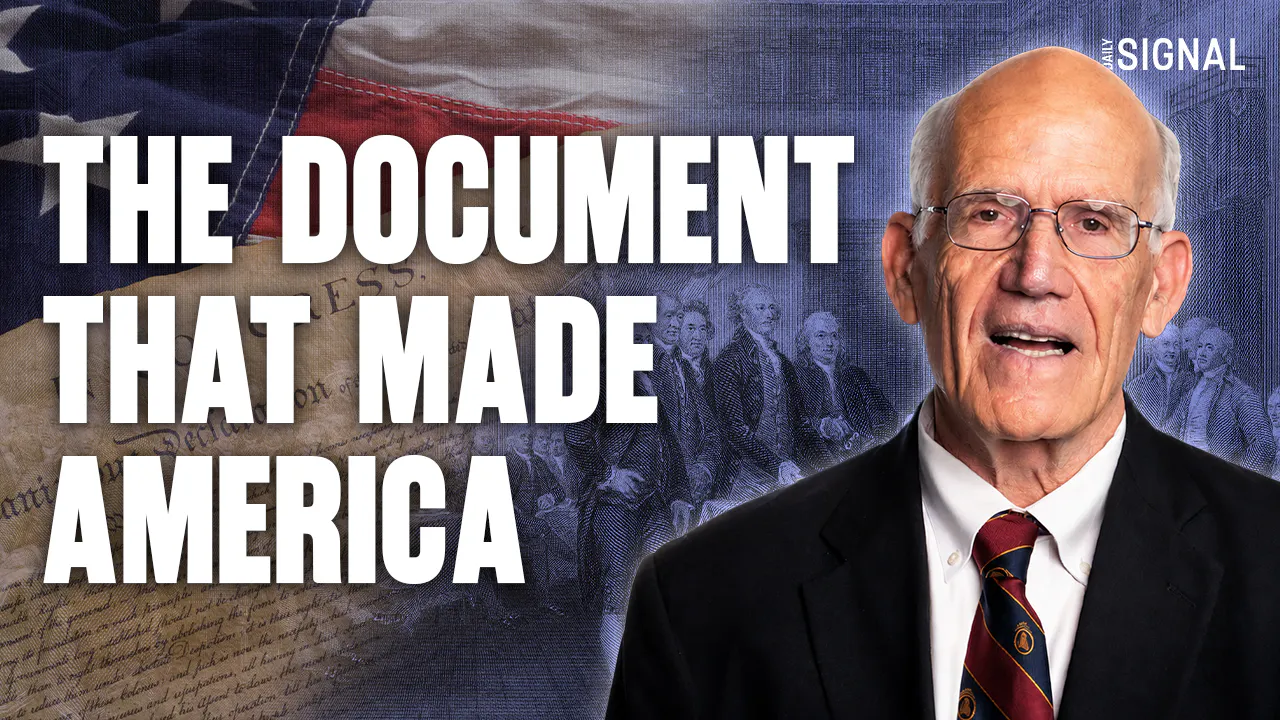
Victor Davis Hanson: In His Own Words
The Untold Story of the Declaration of Independence | Victor Davis Hanson
00:53:46
It’s a miracle the Declaration survived 250 years. It was rolled through battlefields during the Revolutionary War, nearly destroyed when the British burned Washington in 1814, and spent decades being moved from city to city before becoming America’s most treasured national document.
Loading summary
Transcript55 lines
- [00:00]
Michael Oslin
I mean, it's a miracle it exists. Congress was running away from the British during the Revolutionary War and the document went on the road with them. And there's, you know, there's no guards for it. There's no, you know, there's no secure storage for it. They're simply throwing it into. We don't even know because they don't tell us. But they're either throwing it into sacks or chests, they're putting it on the carts, they're taking it out in the middle of winter, in the middle of summer. Of course, the greatest threat is in 1814. And by the, you know, just the skin of its teeth, 24 hours less, it escapes the British, who march into Washington. They defeat a ragtag American force at Bladensburg in Maryland and then march into the city. And right next to the White House is the Department of State where the Declaration was. And it's burned to the ground. So if not for the incredible foresightedness of a clerk named Stephen Pleasanton and James Monroe, Secretary of State, who says you might want to think about taking these documents out of the city, really an afterthought, the British almost certainly would have burned it.
- [01:12]
Victor Davis Hanson
Hello, everybody. This is Victor Davis Hansen. For the Victor Davis Hansen In His Own Words podcast. I'm doing solo today. Jack Fowler and Sammy Wink are not with me. It's one of our frequent interviews. But I am talking to Michael Oslin. He's a colleague of mine at the Hoover Institution and his formal title is Payson Treat, distinguished Research Fellow at Stanford University's Hoover Institution. And you know him probably from Op EDS and the Wall Street Journal. And he's got a brand new book out from Simon and Schuster called national how the Declaration of Independence Made America. Thank you for being with us. If it's all right, I'll call you by what I know you as Misha rather than Michael, and I'm happy that you're with us. Michael miss you.
- [02:04]
Michael Oslin
Thank Victor. Thanks so much for having me and it's great to see you.
- [02:07]
Victor Davis Hanson
Yeah. And we're going to take a quick break and we'll be right back with an interview with Michael Oslin. His new book, National Treasure.
- [02:13]
Tony Kennett
If you enjoy Victor Davis Hansen, you might enjoy the Daily Signals flagship show, the Tony Kennett cast, the same common sense perspectives you love. Weekdays at 7pm Eastern. And unlike some of the other evening shows, we work up until showtime to bring you the latest breaking news, analysis and good old American sarcasm. Tom Tillet, I'm pretty sure, might have been useful at one Time as a doorstop. Find the Tony Kenneth cast on YouTube, X radio, TV, or wherever you get your podcasts.
- [02:42]
Victor Davis Hanson
And we're back. Misha, why don't you just explain why you wrote the book on the. I know it's the 250th anniversary, and maybe why people in this generation need to reread the Declaration of Independence, and then I can ask you some questions about it.
- [03:04]
Michael Oslin
Well, yeah, you know, Victor, a lot of folks who may have occasionally seen something I did that was mostly about Asia, and it was usually America in Asia. And that was, you know, what I taught and spent three decades on. And I guess at a certain point, you know, I was looking for answers abroad, you know, trying to understand the world, understand America abroad. You know, growing up in the Reagan era, that was a big. It was a big thing. And we were winning the Cold War, and so we were going to, you know, change the world, which we did in many ways. But at a certain point, you know, maybe, at least for me, I sort of felt like I wanted to come home and ask the same questions I was asking about America abroad, you know, what our interests were, what our history was, why we were doing what we were doing, but try to understand our own story better, which is something I just professionally had never focused on as directly, you know, indirectly. So I started looking at a project on the history of Washington, D.C. in the 20th century, trying to. Because I live in Washington, not California, and trying to understand how Washington became the imperial capital. So part of it's an urban history, and urban history has just simply interested me. So I went down to the National Archives. It's a significant building in a significant part of the city, federal triangle. And I was talking to the archivist who was telling me these stories about the Declaration. I didn't know any of them, was a little embarrassed. So I thought, you know, I'll go buy a book on the Declaration in the gift shop. And they didn't have one. And they. What they didn't have was the one that I wanted to read. They had actually, at that point in time, literally, they had none. But, you know, there are books. There are books that are on the political theory and the philosophy and trying to understand, you know, was it John Locke or Scottish Enlightenment that influenced Jefferson. But I was more interested in sort of our. Our daily encounter with the Declaration through our history, how Americans, you know, engaged with it, thought about it, and, you know, commemorated it. But, you know, what it made them think about the country. Now, honestly, it was a book I wanted my Parents to read and that I wanted to read. And so before I knew it, that's what I was doing. And we were about two years away from the, from the semi quincentennial, and I found out that no one else was writing a book quite like that. There are other books coming out, but nothing that takes it from 1776 to today. So that's really why I did it.
- [05:24]
Victor Davis Hanson
And everybody should be aware that it's not just the content and the environment or the atmosphere in which it was written, but you. You have some fascinating information on the Odyssey or detail of the actual document, and maybe you could enlighten us on some of that. That in times of conflict, people were very worried that it might vanish or something.
- [05:47]
Michael Oslin
Yeah, absolutely. I mean, it's a miracle it exists. And in fact, because I started this at, or came up with the idea at the National Archives, my original plan was just to do a really quick book on the material history of the parchment, the one you go see with your kids at the National Archives. And, you know, why is it here after 250 years in, in really bad shape. But you know, why is it still here? And it actually grew from that. And, and I talk about three Declarations. The first one is this relic that you've just mentioned, the, the, the sort of official Declaration of Independence. And I'll come back to that in just a second. The second one is the symbolic one, the one that most academics will write about trying to understand what all men are created equal meant in 1776 and 1861 and today. And then the third one, which no one had written about is the Declaration as a cultural object. You see behind me three different printings of the Declaration. And so I go through the history of why do we hang the thing on our walls, why do we put it on ball caps, so on and so forth. I'm happy to talk about that. But to go back to your first question, or the question you asked, is really the first Declaration, the relic. And it's an incredible adventure story. It's also an incredible scientific story that this, this parchment, which no one at the time really thought was going to become an icon of any sort, and was just rolled up among all the other papers of the Continental Congress survived and, and actually from 1776 on, it had a very harrowing life that the Congress was running away from the British during the Revolutionary War document went on the road with them. And there's, you know, there's no guards for it. There's no, you know, there's no Secure storage for it. They're simply throwing it into. We don't even know because they don't tell us. But they're either throwing it into sacks or chests, they're putting it on the carts, they're taking it out in the middle of winter, in the middle of summer. They're in Maryland, Pennsylvania, New Jersey. So right from the beginning, this document that's going to become an icon is really battered about even after the war, when there's no more threat, let's say the British will take it back to London. Let's say government's still moving around, it's moving around Pennsylvania, it's in New York, it's in Philadelphia. It finally gets to Washington D.C. but even there, it's not settled buildings the way we have today. So the thing is still being moved around constantly. They're moving it out of the city. When there's yellow fever, they're bringing it back into the city. So it's just in terrible shape, even just a few decades after it is signed. Of course, the greatest threat is in 1814. And by the just the skin of its teeth, 24 hours less it escapes the British who march into Washington. They defeat a ragtag American force at Bladensburg in Maryland and then march into the city. We don't think that they knew where the Declaration was. And they weren't stopping really to loot. They were just, they were burning straight off the bat. And when they burned the White House, they burn what's called Executive Square around it. And right next to the White House is the Department of State where the Declaration was and it's burned to the ground. So if not for the incredible foresightedness of a clerk named Stephen Pleasanton who got his, got his, you know, sort of official orders and James Monroe, Secretary of State, who says, yeah, you might want to think about taking these documents out of the city. Really an afterthought, the British almost certainly would have burned it. And so it's, it's thrown into a cart, it's rushed into the Virginia countryside, it's thrown into a cellar, it's left there unguarded. You know, today, you know, it's the most scientifically advanced casing with guards and security systems and the famous vault, they just threw it into a, into a brick cellar for, for weeks.
- [09:39]
Victor Davis Hanson
So when, when, when do you think it obtained a sacred status where people were aware that the original copy was sort of our national Bible, so to speak?
- [09:48]
Michael Oslin
Yeah, it was right after that, in fact. And, and, and remember, most Americans didn't even know that this existed because it was. It was first secret, and then it was just a paper of state. So it wasn't. People knew the Declaration and it had been printed, but that there was this parchment, beautifully engrossed and then signed by everyone. Nobody really knew, once the story got out that it had been saved in the War of 1812, suddenly Americans went, that's great. What was saved? And so it became more popular that people now wanted to see it. And so we have accounts of those who, either they had influence or they were simply, you know, they had enough gumption to try to get the Secretary of State to show them that they're rolling and unrolling the thing all the time. And so people now really want to see it. So two things happen in the late 1810s. First, a couple of guys come up with the idea that we can make money off of making artistic reproductions of the. Of the Declaration. What they didn't do was redo the script entirely, but they did very faithfully redo the. The signatures. And that was the first time Americans had ever seen the signatures. So from 1818 on, they're fascinated with the signatures and then with the lives of the signers that they had never really talked about. But. But the text was very artistically done, and it would have, you know, facsies, and they would have cartouches, and they would have all sorts of, you know, bells and whistles. But then in 1821, John Quincy Adams, the Secretary of State, he's looking at the document. He realizes it's 45 years later and it's going to disappear. It's just not going to last much longer. They don't know how to save it, but basically says, let's take a snapshot of it. So he gets an engraver, William Stone, takes him three years, and whenever you see a Declaration today, like the one in the middle, over my shoulder with the full script. And it's beautifully done, whether it's the crinkly antiqued copy or a very nice printed copy that's from the stone engraving. And that became, by the 20th century, that became the iconic vision or representation of the Declaration. But all through the 19th century, people are making different types of. Of reproductions of it, some very fanciful, some very faithful. We had over a hundred of them by the turn of the 20th century. And then the stone comes up. But at that point, it has become this icon for Americans. And as I'm doing right now, we're hanging it on our walls or putting it in school rooms, goes into city Halls and churches and the like. And we do that really, with no other document.
- [12:28]
Victor Davis Hanson
So the Declaration has all the variants. Accurate, faithful, textual, or were there some modifications that people wanted to add or subtract?
- [12:37]
Michael Oslin
Some. Some were less faithful only because they were working off of corrupted printed block copies sometimes. Well, first of all, one thing is that orthography was. Was, you know, not a scientific, you know, science at the. At the time. And so different. Different capitalizations and sometimes different punctuation. Mostly the words are. Are there. But there were some done in the late 1800s where they tried to clean up some of the language. You know, usually that was fairly quickly discovered. And then they would, you know, they would try to go back to the original, but what they would do was, was put different things around it. There are some, you can see in the Library of Congress that have statistical, sort of statistical tables of population in the states and economic information all around the text. There's beautifully done. You know, again, they have fascism as sort of borders. You know, Romanesque figures, you know, liberty, it's surmounted by eagles. Everyone would have a little bit of a different take on it. And, of course, in 1876, the centennial, there are dozens and dozens of reproductions that they're selling, and it's this wonderful marriage of civics and commerce, and they're making money, but they're telling people, this is your charter of freedom, as Abraham Lincoln said. So put it on your wall. Tell your kids that this is their birthright, but, you know, pay us for the privilege.
- [14:02]
Victor Davis Hanson
I remember in high school, the first time we had it, and I'm doing this by memory, we all thought that all of the luminaries were going to be the signet tours. So there's Franklin and there's Adams and Jefferson, but is that. I'm not mistaken, there's not Hamilton or Monroe or Washington. What. What. Why was that? Were they not at Philadelphia? What was it?
- [14:25]
Michael Oslin
They weren't. So Washington's in the field. He's up in New York at the time. And in fact, he reads what was printed right away, by the way. And you can see them over my shoulders here were called broadsides. The first one, it was done by John Dunlap in Philadelphia on July 4th. And this was. This was an official announcement. It was commissioned by Congress, and then it was sent to all of the state, you know, the colonial assemblies was sent to significant leaders, but it was sent to Washington. And he reads it as soon as he gets it. So up and down the colonies, it's being read on different Days as the post riders get there. So, pardon me, the first reading, Philadelphia on July 8th. Then it gets up to New York on July 9th. Washington reads it, eventually gets up to Boston. It takes two months to get down to Georgia, and it's not read in Savannah until sometime in August or later. Later August. So everyone's hearing it at a different point in time or seeing it at a different point in time. It's not signed until the beginning of August. You know, they got a lot of other things to do and they really didn't. Again, it's. It's fascinating because we, you know, get. To me, this is the national treasure. They didn't think, you know, we're gonna. We're gonna, you know, immortalize this. And people 250 years later are going to line up for hours to see it. But they do decide we need a more permanent version than the broadsides. So they. They commission Timothy Matlak, who's probably their top. Sort of their top calligrapher. He engrosses it, and they begin signing it on August 2nd. So the interesting thing is, first of all, only those who were delegates to the Continental Congress signed. So Alexander Hamilton's not. James Madison is not. James Monroe, who's very much younger at the time, he's not, Washington's not. But also, many of the members who had been in Philadelphia on July 4 had already left by August. The Declaration Independence was declared. They had other things to do. Congress is still sitting, but they're coming and going. So some who were there, like Philip Livingston, who was actually on the committee. I'm sorry, Robert Livingston, who was on the committee to write the Declaration, doesn't sign it. He's back up in New York. Others don't sign it because they're opposed to the idea at the time. And that's someone like John Dickinson of Pennsylvania. But he. He goes and joins the army to fight. You know, he doesn't, you know, sit home and sulk. He's just saying he didn't think it was the time for independence, but now that it's been decided, so there's a lot of people who aren't on it. And it's actually funny if you roll forward. We were just talking about the facsimiles. The second facsimile to come out, but the first that was proposed was by a guy named John Bins. And he does this really elaborate, really beautiful one, and he has three cartouches on the top. In the middle is Washington, then Jefferson, and then John Hancock. So he sends these when he gets them to prominent Americans, including John Adams. And John Adams sends his back with a note saying, thanks very much, but I don't need it, and please don't send another because he didn't include Adams as, as, you know, as one of these pantheon of gods of the Declaration. So there's this, you know, there's. As the Declaration becomes the icon, the battle over its past over who signed it, who didn't sign it, who was responsible for it, Thomas Jefferson or not, becomes an object of battle in the 1800s. It's, it's this new. It's the last gasps of the old generation. So Adams and Jefferson are feuding over who's responsible for it, and it's the new gasps of the first generation trying to lay claim to it for their own purposes.
- [18:11]
Victor Davis Hanson
The one that is signed, though, and you discuss there's iterations that Jefferson met some opposition about outlawing the slave trade. And how many copies or how many versions did he have to get by the committee before they agreed on this standardization of one copy?
- [18:29]
Michael Oslin
So it's a fascinating question because they weren't taking notes. Now, in part, everything that Congress did was under a cloak of secrecy. Secondly, they knew it was treason. And third, I. They just literally didn't think it was that important. We know what Congress did because they have the journals which say Congress did such and such. What wasn't recorded were the debates, the arguments. The only record we have, even of the most critical debate of all over independence itself, are private, contemporary notes by Thomas Jefferson. So that's all we have. We, you know, we don't know how faithful it is to what was being said, we assume. So what happens is Congress adjourns because they want to get all the colonies on board for unanimous vote. They adjourn on July. I'm sorry, on June 11th. They're going to reconvene on July 1st to be ready for the vote. They know they're going to get a majority, but they want the unanimity. But so to be ready for the vote, they appoint a committee to draft this announcement. There's also other committees that are appointed to make model treaties with France and Spain and to come up with articles of confederation amidst all the other regular committees. So Jefferson gets the pen. He writes it out, writes it pretty quickly, probably 10 days or less, more like a week it takes him. He sends it to the committee, and we don't know what the committee says. What happens is he has his rough draft, which still exists. It's in the Library of Congress. And as the committee. And then later, Congress is going through this process. He's making edits following what they're doing. But then much later in life, as far as we can tell, he then annotates it. So he says, oh, this change was made by Franklin, this change was made by Adams. But many of the changes, there's no accounting. We don't know who made them or suggested them or who said what. We know some of them, or we believe we know based on what Adam said. Very crucially in the first line, Jefferson wrote, when in the course of human events, it becomes necessary for a people to separate themselves, so on and so forth. And it's Franklin in Jefferson's hand says Franklin changes that to one people, which is really critical, you know, because they're thinking of themselves as 13 sovereign states. But already it's the Declaration talking about unity among these very different colonies. So. So Jefferson on June 28, has shown it to the committee. They've made some of these changes. We're not exactly sure about all of them. And he writes out what he calls the fair copy. It's just a clean copy. He brings that to Congress. It's that moment that John Trumbull mythologizes and immortalizes in his painting later in the 1810s. And it doesn't happen like that at all. It's a completely made up scene. But he gives this copy to Congress. We don't think any other copies of it are made officially by Congress to give to delegates, but they're all arguing over it. And they cut about a quarter of it. There are dozens and dozens of changes. Jefferson is so upset at what they're doing to it that he rewrites his own draft in about five different copies and sends it to friends and partisans saying, see, this is what it really should be. Meanwhile, in Congress, they're taking out his passionate condemnation of the slave trade. They're also taking out a brutal ad hominem attack on the British people themselves. They're condensing some of the charges they're changing. They're. They remove a reference to inciting slave rebellion because they're very nervous about that. In essence, they're actually making it better. And by the end of his life, Jefferson recognizes that. And it's why he has the request that on his tombstone, one of the three things that will be inscribed is author of the Declaration of Independence. He knew that the editing job was a pretty good one.
- [22:29]
Victor Davis Hanson
We have a colleague, and I think all of our listeners know him very well, a wonderful Andrew Roberts in his Biography of King George. He dissects the Declaration and from a British point of view, and he dismisses many, but not all of the complaints that prompted the Declaration. Did people at the time in Britain reply formally to this, or was it, was it considered just pro forma, or do they actually see this as a legal document that they were going to try to refute?
- [23:00]
Michael Oslin
There were dozens of replies. The King himself, and Andrew notes in his wonderful biography of George iii, probably never read it and never referred to it directly. He obviously referred to the rebels and referred to what they did. But he never, he never talked about the Declaration. But there were dozens of responses, some of them full books going point by point, much like what Andrew does in his biography. They go point by point. Point. One of the most famous was by an author named John Lind, who literally goes point. I actually just saw the original copy or an original copy up at the Yale Beinecke Library. And he starts off with, with the very beginning and goes through each phrase and each charge, or 27 charges altogether against the king, refuting them all. And, and most scholars, you know, agree that Jefferson was, he was certainly passionate and somewhat hyperbolic in some of them. But many of them, obviously, the taxation charge, the quartering of soldiers charge, the making it difficult for assemblies to meet for not assenting to laws, most of those are legitimate. Sometimes what Jefferson would do is say he has done X when he really did. The king may have done it once and it's not continuous, but you read it and you think, oh, he's never assenting to laws, as opposed to, there were times he didn't assent to law. So, so that's where, you know, our friends on the other side of the pond, you know, get, you know, a little touchy about, you know, whether this was really a legitimate set of grievances. But, you know, Jefferson is approaching it with a legal cast of mind. And what we read today, you know, Victor, the, the preamble, we hold these truths to be self evident, or the wonderful peroration of, you know, we pledge to each other our lives, fortune, sacred honor. That was more or less window dressing in 1776. That was not what the people focused on, what the people focused on, because the whole issue of the revolution was protecting their rights was grievances. The grievances laid out how their traditional rights as British Americans were being taken away in a conspiracy by the king, his ministers and Parliament. So they really cared about, about these charges. And today we barely read them. But I'll just say really quickly this funny, if you read through them, your eyes glaze over after a certain point. But some of them even have a resonance to today. So there's one where he says they don't number them, but one of them says the king has sent hither swarms of officials to eat out our sustenance. And you read it and you sort of. It resonates with sometimes what people say about Washington, D.C. today. Swarms of officials not doing anything but eating out our sustenance. You know, you can see that some of these same debates are going on, like, what is bureaucracy? How should it run our lives? Are they necessary? Are they a waste? And, you know, can we cut bureaucracy? And that's really what that charge was. So some of these things, you really do sort of stop and you go, wow. You know, it's. We have some of the same concerns today, I think.
- [26:19]
Victor Davis Hanson
I'm trying to remember which of these sort of radical populist movements about open ranging and things. They mentioned quartering of troops when they said that when people were trying to arrest them, they used a barn or something that was theirs. Or, you know, every once in a while that comes up that.
- [26:37]
Michael Oslin
Yeah, that one I don't. I don't know as well. There certainly are. So, you know, some of the things they really were concerned about was taking away law, legal processes from the colonies and moving it to Britain. So, for example, the British officials charged with murder in particular would be tried in Britain and not. And not locally, but. But interfering with the legal processes and the legislative processes was really the thing that most animated the colonists. And, you know, they called it. They were unwritten, but they called these their constitutions. This is what they felt they were. They were defending. And, you know, for Jefferson, by the way, what he really wanted to do was write a constitution. He didn't want to write this administrative paper that was. He was the youngest guy on the committee. So it's sort of forced on him. Right. He wanted to write a declaration. He wanted to write a constitution for the state of Virginia. And in fact, had started that right before being called to Williamsburg, called to Philadelphia. He wanted to stay in Williamsburg. And he brought with him the charges that are in the declaration. He had started writing those for the Philadelphia. I'm sorry, for the. For the Virginia Constitution. So to them, this is what's really critical. It's. It's laying out now in 1776, eight of the 13 colonies are actually writing constitutions to. To formalize, in a way that hadn't been done before, their ancient rights, because that's what they felt was being taken away. Jefferson, transpose that to the Declaration so we can see through that. What really was the issue at all these local levels, which was self governance.
- [28:20]
Victor Davis Hanson
We're with Michael Oslin. He's got a new book out by Simon and Schuster, national how the Declaration of Independence Made America. We'll be right back after we hear a word from our supporters.
- [28:35]
Bradley Devlin
Hey, I'm Bradley Devlin and just like you, I'm a huge fan of Victor Davis Hansen, whether it's his long form podcast, Victor Davis Hansen in his own words or his short form content for the Daily Signal. Victor Davis Hansen, in a few words. I always leave an episode learning something new.
- [28:49]
Victor Davis Hanson
I think they forgot the 1982 Falklands War.
- [28:52]
Bradley Devlin
And in the age of clickbait and rage bait, that's a really good feeling right?
- [28:56]
Michael Oslin
The media. Thank you. You can leave now.
- [28:59]
Bradley Devlin
Well, if you agree, you might like my show, the Daily Signals long form interview podcast called the Signal. Sit down. Every week we take you behind the scene scenes of the biggest battles in Washington D.C. as they happen with some of the biggest names in politics. We explore big ideas and we analyze the policy making process from an unabashedly and unapologetically conservative perspective. And that's important now more than ever with the Trump administration back in office, because in 2024, you sent Washington a message it couldn't ignore. It's your government and together we're taking it back. So check us out on YouTube, Spotify, Apple Podcasts, wherever you enjoy. Victor Davis Hansen or there too. And drop me a follow on X Radley Devlin to stay updated with what's happening on the Signal.
- [29:42]
Michael Oslin
Sit down.
- [29:42]
Victor Davis Hanson
And we're back with Michael Oslin and National Treasure. I have a question. When the Civil War broke out, people like John Calhoun and John Breckenridge and Jefferson Davis, they looked at this and there were so many Southerners that light horse Harry Lee and people like that had signed it and they felt almost as if they had that. They interpret it in a way that made almost the Union play the role of Great Britain, it seemed to me. And they were the true inheritors. I didn't realize that in the 1850s there was a debate over the Declaration in the context of the north south rivalry that was heading toward war.
- [30:24]
Michael Oslin
Absolutely. And it was exactly that. And later in the midst of the war, Jefferson Davis, the president of the Confederacy, says that what you just said, Victor, explicitly, we are the inheritors of freedom and, and of the spirit of 76. They appealed to it for one of the two major claims in the Declaration. There's the equality claim. All men are created equal. And that, of course, is what animated Abraham Lincoln and, and, and formed his entire political philosophy and program. And then there's the liberty claim. Government is only legitimate with the consent of the governed. And in 76, these states have a right to do all these things as free and independent states do. When it comes to the crisis, the south does appeal to the liberty claim in saying, we no longer consent to this government. In their own declarations of Independence, the first one is South Carolina In December of 1860, they state this explicitly, we no longer consent. And then they repeat verbatim from the Declaration, stating, we have all the rights to do what free and independent states can do. Even Northern newspapers up to the war supported this position. And I quote one in the book that says, yeah, the south is right. This is the central claim of the document. It's what gave it its force in 1776, consent of the governed. So if they no longer consent, they can leave the Union. But the catch is you have to do it peacefully. And of course, they didn't do it peacefully. And that's how Lincoln was able to deny that claim. But there's no question that the south felt as passionately attached to the Declaration as the north did. It was just a different interpretation, and in fact, within the south, different interpretations even of the equality clause. Some, like Jefferson Davis, said, no, not all men are created equal, and therefore we no longer adhere to a government that's trying to enforce that, even though Lincoln made clear he was not going to get rid of slavery in the South. But then there's others, like Alexander Stevens, the Vice President of the Confederacy, who writes that, no, they were right. That's what they meant. They meant that all men are created equal, but we no longer believe that that is the right way. He's not denying that all men are created equal. He's saying, but we don't want to honor that. And so we're going to act in this way to maintain our, as they called it, the peculiar institution. So I think that's a part that the Northerners, I mean, I'm a Northerner, didn't really understand. It's not that the south hated, you know, the Declaration and what it stood for. They passionately believed they were living up to the Declaration. And so it is. It remains our great tragedy. And it's very moving on both sides. It's moving that the south has to come to a new understanding of the Declaration after the war, because their understanding has Been refuted. And for Lincoln, of course, the great tragedy is, you know, as he's going to Washington for his inauguration, 1861, he stops at Independence hall, talks about the Declaration, says, I've never had a feeling that didn't emanate from the Declaration. And then he says, and I would rather be assassinated than give up its principles. And four years later, he is what
- [33:55]
Victor Davis Hanson
is today in contemporary ideologies at war with each other. It seems to me that people on the left, maybe because of the later role of the influence of the French Revolution, but they seem to think that is the sacred document, maybe because all men are created equal, where the Constitution, Bill of Rights, even though they're. They're welded together, but it's more Madisonian and was. It is. Do you feel today that. That there are people on ideological grounds that gravitate toward the primacy of one document over the other, or do they see them complimentary?
- [34:34]
Michael Oslin
Yeah, I think. I think. Well, you know, the big debate, of course, with the Constitution is, is it, you know, a living document? Is it originalism? How, you know, how much can you change it? I think there is, interestingly, and has been through our history, a debate over the Declaration with these two claims that I mentioned, the liberty claim and the equality claim. I think for the first 50, 50, 60, 70 years, it was a liberty claim, meaning when people referenced the Declaration, they usually referenced it as our great charter of liberty, or this was the document that essentially set us free. Lincoln recasts it in terms of the equality claim, that all men are created equal. But he does that because he's saying, without all equality, you really don't have liberty. First of all, I think to Jefferson and the signers, they were two sides of the same coin. But Lincoln very much says, we are, through the Dred Scott decision and through the Kansas Nebraska act of 1857 and 1854, respectively, that we are mutilating the. In the meaning of the Declaration and how the Constitution is actually, you know, how the governing role of the Constitution. But of course, his goal is to. Is to preserve the Union. I think for us, since the Civil rights movement, we have largely looked at the Declaration as an equality document. You know, that was the whole.
- [36:01]
Victor Davis Hanson
That's what Frederick Douglass said. I'm not. I'm not inventing our freedom. I'm just demanding that you man up to what you said in the Declaration.
- [36:09]
Michael Oslin
Absolutely. All of the abolitionists did. That's right. That's right. And that's. And that's why when you ask this question, I Actually see, separate from the equality and liberty claims, I see an umbrella of a unity claim over the Declaration. When Frederick Douglass or David Walker, the abolitionist, or William Lloyd Garrison or Susan B. Anthony or Elizabeth Cady Stanton or immigrants, Swedish, Polish, Greek in the turn of the century, when they all appeal to the Declaration, when they're translating it into their languages or they're making up their own declarations of independence, all of them are trying to claim their rights, their full rights as Americans. They're not talking about separating from the country. They're not talking about creating ethnic, gendered, racial, economic enclaves. They're talking about being fully Americans and being accepted as Americans. And again, that's why I think that one people in the first line, or we pledge to each other our lives, fortune sacred. They didn't pledge it to the new country or to their states. They pledged it to each other. I think there is a unity claim that is the proper reading of the document, that is an umbrella over both. I do think since the 1960s and the Civil rights movement, we have been more prone to read it simply as an equality document. But if you look at how Martin Luther King talked about it, even at the famous speech in front of the Lincoln Memorial, he's making very clear that equality is a means to an end. The end is liberty, right? At that point, they did not have their full freedom. And so he, I think, has that Jeffersonian and certainly Lincolnian understanding that it's not one or the other, but it is that the two come. Come together.
- [37:57]
Victor Davis Hanson
It's. It's very different. And I think you can see the Rousseau, Voltaire and the French Enlightenment effect on the French Revolution when they have these. Even the slogan, fraternity, egalitarianism, that's a lot more holistic. It's almost a quality of result. Whereas the Declaration, it does mean equality. But it's very clear from the Declaration and the Constitution, it's talking about equality of opportunity and liberty. And that seems at the very beginning of the revolution and then the early nations, we were very different than what the European continental philosophers and the French revolutionaries thought. They really did want to have a year zero. We're going to remake, you know, year zero. We're going to rename the names of the months, the year, days of the week. We're going to go after the church. But we were very fortunate that that's not in there. There's no indication that this is a cultural, social, economic, military, political. It's more just a political revolution and said, we're going to let you be Free. And then you're going to determine your own ability based on equality of opportunity. That seems, that seems to be very important that even today distinguishes us from the European idea of government and freedom.
- [39:18]
Michael Oslin
I think that's absolutely right. Gertrude Himmelfarb wrote a wonderful book called I think it's Three Roads to Modernity, the French, British and American Enlightenments. And you know, we, we were thankfully children of the English Enlightenment and the Scottish Enlightenment. And that's exactly. And critical in there, I think, is the religious element that these were seen as natural rights, natural laws that had to be obeyed, had to be brought into balance with how peoples govern themselves so that you had limits. And that's why Congress puts in more references to God than Jefferson had in there. But clearly the Declaration is a covenant. It's a covenant among Americans we pledge to each other, but it's also a covenant between Americans and God. And I think that more moderate and congenial British Enlightenment, the Scottish and English elements of it, combined with English common law and these concepts of natural right in natural law, did mean that there was a breaking mechanism on our revolution that the French did not have. And you're exactly right. This year, zero. You know, Thomas Paine tried to get us there a little bit, right where he says, we have it within us to make the world anew. And I think most of the colonists would have said, no, no, we don't want to make the world anew. We want to save the old world that's disappearing, meaning the world of our British. Right. You know, maybe, yeah, you're making it anew with a new country and a new government. But, but they felt that they were conserving, not, you know, revolutionizing or maybe the old, the actual old concept of a revolution. They were going back to where they felt they, they should have been, but we're very lucky. And Jefferson is in Paris, by the way, during the revol. The French Revolution. And he's. And he's talking with people like, like the Marquis de Lafayette, and he's saying, you know, this declaration that you're coming up with is going too far. He wants to talk only about inalienable rights that can't be given away. And so he doesn't like the idea that you're putting property in there because property can be given away, it can be alienated. And so he already sees that they're going farther.
- [41:43]
Victor Davis Hanson
We're talking with Michael Oslo. He's got a brand new book, National Treasure. We'll be right back and we'll sum up our Discussion today has been fascinating
- [41:54]
Narrator
since the founding of America 250 years ago. Many things have changed, but some things never do. The commitment of husband and wife, the importance of passing along our values to our children, the faithfulness of God. Some wonder how we can ensure America will continue to thrive as long as we keep first things first. We've only just begun. America the Beautiful.
- [42:24]
Victor Davis Hanson
And we're back with Michael Oslin, a national treasurer. When you look back at the Declaration, you. Every once in a while you get. And I think we're in a period now where one of the political, all both political parties are changing. But it does seem that the Jacobin view in the French Revolution is now sort of the base. When I hear people in the Democratic Party talk about a quality, you know, quality of opportunity, a guaranteed income, a guaranteed this, a guaranteed that, and reparations and this entire French Revolutionary view. Do you have. And you feel that there's more criticism of these foundational documents today or people attacking the Declaration or when you were doing your research, is it just a given that all Americans. It's not a given. They know what it is. But to those who know what it is, maybe in the universities are. As a level of criticism of either constitutional declaration increased lately, I think there's
- [43:30]
Michael Oslin
still the debate over, you know, when it says all men are created equal, what does that mean? I think there's no question that from the point of view of men as children of God, Jefferson and all the signers felt that everyone was equal. The problem was, did they have the same rights in a political community? And there, the answer is clearly no. They didn't put it in these terms. I think what you're getting at, this question of equality of opportunity versus equality of outcome, is really the one that we have come to this point, or many have come to this point of saying, well, it's not just enough to have opportunity. The outcome. The outcome must be the same. Sorry for the noise in the background there. The equality of outcome must be the same. And they, they didn't, they didn't put it in those terms. But, but for them, we, we, you know, we are now sort of on these battlefields of it. And so the Declaration, I think, does get drawn in. It's really more the Constitution, you know, as. As the formal legal battlefield that must,
- [44:38]
Victor Davis Hanson
you know, the three fifths clause about, you know, three fifths has been misinterpreted. It was actually kind of a liberal effort to compromise so that the south couldn't get away with the idea that African slaves were not people, but they were going to be counted as people if it got them greater congressional representation. So then the north, to save the Constitution, said, well, we'll give you some representation, but we have to signal that you're not allowing these people to be completely free. So the three fifth. And when you take that three fifth clause and you compare it with all men are created equal in the Declaration, you do get some kind of friction, I guess, in the modern world, at least.
- [45:23]
Michael Oslin
Yeah. And in fact, also just very briefly, in Jefferson's condemnation of the slave trade and his draft of the Declaration, he clearly states that what is being done to this distant people, meaning the people from Africa being brought here is against the moral law. And he's making clear that they have rights as humans not to be captured and enslaved and brought across an ocean. That question of how do you deal with those. Here was a different one. And again, the political community, but women weren't having, you know, didn't have same legal. Political rights. Or. Legal rights. Or political rights. And of course, the Indians in America were treated literally as a foreign nation. We made treaties with them as if they were a foreign nation. And so. But what I think, you know, to sum it up, that the greatness of the Declaration is that all of these silences in the 18th century could be filled over time. And I think those who deny that the Declaration was the means by which we could come to a modern understanding of equality of all people, of what liberty means, I think they are misreading the document or reading into it things that really aren't supported because the document itself is enough. The document has a greatness to it that allowed it not to just be forgotten on July 5, 1776, but to inspire everyone, up to and including us.
- [46:55]
Victor Davis Hanson
Today we're talking with Michael Austin. I got two final questions. The first is, how can people. What's the best way to get a hold of National Treasure?
- [47:05]
Michael Oslin
Oh, I mean, it's on everywhere. Amazon, Barnes and Noble. Yeah, just. Just when you. When you Google it, you'll probably come up with the movie first. So you can get the movie, but then keep looking for the book. You can also go to Simon and Schuster's own page, and they have links to all these different. These different sites, but it's sold everywhere.
- [47:22]
Victor Davis Hanson
Now, I know you're doing a lot of interviews and public appearances. Do you have any lectures that are open to the public?
- [47:27]
Michael Oslin
Oh, yeah.
- [47:28]
Victor Davis Hanson
Schedule. Give us a couple of examples where they could come.
- [47:31]
Michael Oslin
So we're going to be. So let me see. We have the Nixon Library in California. I just did the JFK Library two nights ago. That's where we kicked off the book. We're doing the Nixon Library in on May 27, June 11. I'll be doing the National Archives in, in here in Washington, D.C. actually tonight. So it's probably not going to get in time with the podcast is at Mount Vernon. There are a lot of different. There are a lot of different things that are going on. But. Oh, and then in Philadelphia, Carpenter's hall on June 9th is 1. And I have to look. There's actually a lot. And I'm, I'm just trying to keep them straight, make sure I show up to them all.
- [48:13]
Victor Davis Hanson
Yeah. And finally, what are you working on now? You finished this? This was a little. Everybody, I think I should remind you what Michael said. He lived in Japan a number of years. He's fluent Japanese among other languages, and he's, he's known as a scholar of Asian studies in general and particularly with a specialization in Japan. But what are you, what do you plan or what are you working on now, Michael?
- [48:37]
Michael Oslin
Well, you know, other than trying to
- [48:39]
Victor Davis Hanson
keep up with it.
- [48:40]
Michael Oslin
Yeah. There's been a bit of a whirlwind for two years and, and focus. But I, I think, you know, going back to that Washington book of trying to really understand how an imperial capital comes to be and, and sort of the, the, the people and the ideas and the infrastructure that all makes it possible. So I think that's at least something I'll be going back to, to look at once I, once I get past this. But at least for a little while, I'll, I'll try to focus more on getting the word out about this book because I think, you know, what I hope we don't do is end our celebrations for the 250th on July 5th. I think it should go forward and we should be recommitting ourselves to its principles, as President Truman and President Ford and others asked us to do that. We should be going forward, talking about these things, and hopefully this book will get people thinking about the long sweep of American history and why. It's an honest look. It's not a naive look, but it is, you know, it is a joyous look in many ways and a celebratory look at what we've accomplished and how at the core of it, through whether It's World War II or the Cold War or the Civil War or whatever it is, the Declaration's been there for us. And in a way, we've been there for it.
- [49:47]
Victor Davis Hanson
I hope everybody hears that and abides. So I went to school about two miles from where I'm speaking, a rural squirrel from Keithu 6 and I can remember in almost all the classrooms there was a picture of the Declaration, you know, an engraving, and then one of the preamble of the Constitution. And then they had the silhouettes of pictures all the way around. And I remember my first grade, it was Eisenhower stopped and then jfk. But it was. Everybody was acquainted with it and it was kind of a. And I happen to be so called white. And it was mostly a Mexican American, but it was a melting pot experience. Everybody took part of it and there was no distinction about your background or where you came from, but it was, it was a very deliberate effort at assimilation, acculturation, integration of immigrants. And I think that's important. And any case, Michael, it's been a pleasure and I hope we can get you back on maybe later and you can tell us how everything went during the year.
- [50:53]
Michael Oslin
I would love to do that. Victor, thanks so much for having me.
- [50:56]
Victor Davis Hanson
Thank you. Thank you for tuning in to the Daily Signal. Please like share and subscribe to be notified for more content like this and also check out my own website@victorhansen.com and subscribe for exclusive features in addition.