← Victor Davis Hanson: In His Own Words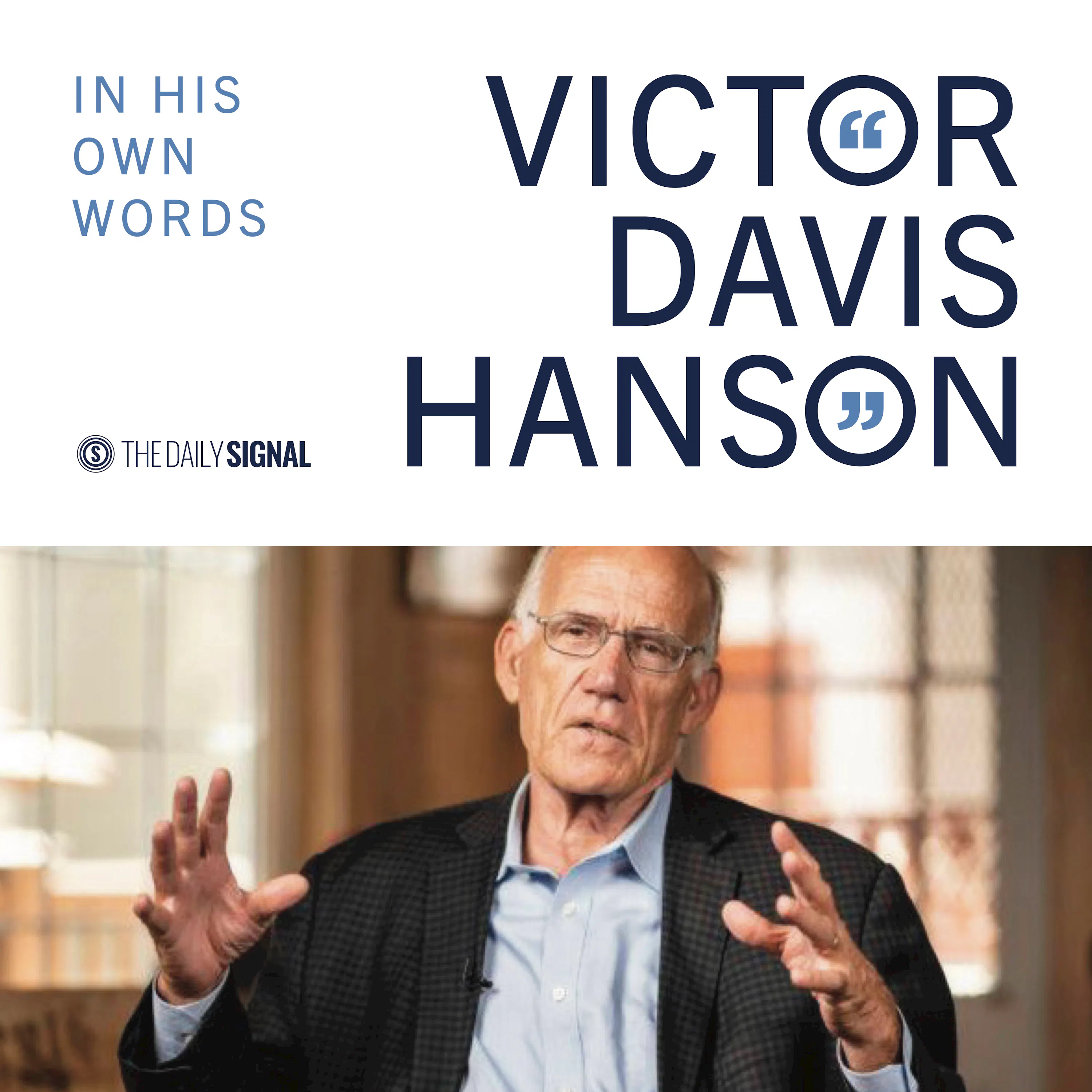
Victor Davis Hanson: In His Own Words
Victor Davis Hanson: AOC Makes Kamala Harris Sound Like Socrates, Cicero
01:14:44
Loading summary
Transcript65 lines
- [00:00]
Victor Davis Hanson
In the social media circles this week was they asked her what would be the American reaction to a Chinese invasion of Taiwan. And she has a couple of tics. She always talks about herself personally. Personally, in my opinion, as far as it concerns me, I, I we don't want to hear all that. It made Kamala Harris, as I said to Jack, sound like Socrates or Cicero. No, all she had to do was just take one minute, go on Wikipedia if you have to go anywhere else and just memorize what the cat response is.
- [00:34]
Sammy Wink
Talk a little bit about Mondami's 9.5% tax.
- [00:37]
Victor Davis Hanson
He inherited the city that was this blue chip cultural financial capital of the world. And the first thing he did was raise spending by $11 billion. Second thing he did was prove that he couldn't get the trash or the snow off the street during a storm. Third thing he did was very hard to find an appointee had not issued or written something anti Semitic. His message is, I'm not Lenin and Trotsky or Stalin. I'm the nice, happy f Communists. The whole core of socialism is I work hard and no one knows how I suffer at my job. And I believe in the labor theory of value. That's not fair. They don't think about supply and demand expertise, educa nothing. They run on this envy that we work hard and we get up and we do things and therefore we should be compensated. And that's what a socialist is. Everybody said, what happened to the Democratic Party? The Democratic Party, if you look at their position, 92, 96, Democratic convention, what was their platform? Go back and listen. Listen to Bill Clinton, Hillary Clinton, Chuck Schumer.
- [01:39]
LifeLock Advertiser
Someone's in the country illegally. After six months of tracking them down, the INS catches up to them. And all of a sudden that person says asylum and gets another two years to go through this. That has not been addressed here. And I think that's a major problem.
- [01:53]
Victor Davis Hanson
Even Barack Obama in his campaign of 2008 was on that mess. Foreign.
- [02:09]
Sammy Wink
Welcome to Victor Davis Hansen in his own words. This is our Saturday edition, and as we used to do always, we did something a little bit different in a middle segment. And this week we're going to start that again. And Victor will be talking about the Greek mythology. In the middle segment. We're going to look at some of the gods and our curiosity will probably be how did the Greeks, ancient Greeks themselves, see these gods? So stay with us for that. But we'll start with the current news. And we have the security conference in Munich. And I know that Victor and Jack talked about Rubio's speech, but there was a panel that was had during that security conference with AOC on it, Gretchen Whitmer and Ambassador Matt Whitaker. And we wanted to say a few things about that first, and then we'll turn to Mondami's New York City. So stay with us for those open stories and we'll be right back.
- [03:07]
LifeLock Advertiser
Since the founding of America 250 years ago, many things have changed, but some things never do. The commitment of husband and wife, the importance of passing along our values to our children. The faithfulness of God. Some wonder how we can ensure America will continue to thrive as long as we keep first things first. We've only just begun. America the Beautiful.
- [03:37]
Sammy Wink
Welcome back to Victor Davis Hansen in His Own Words. Victor is found at on social media at his X account. D Hansen is his handle and on Facebook at Hanson's Morning Cup. And you can come join us at his website, VictorHanson.com is the URL and it's called the Blade of Perseus. And we'd really love to have everybody join us there and see what's on the website. He's got lots of free things. His article that he writes these podcasts, you have links to them, and then he has VDH Ultra material that you can get for a subscription fee of $65 a year or 650amonth. And we'd love if everybody come try it. So, Victor, I know that there was a lot of talk about Marco Rubio's speech, which was fantastic, and I know you and Jack already addressed it, but there was this panel that everybody's been looking at, the AOC response to Taiwan. But I thought that the panel and the discussion between AOC Gretchen Whitmer and Ambassador Matt Whitaker was a little bit more interesting than just her word salad. That sounded a lot like Kamala Harris with the Taiwan. But I was wondering if you had any reflections on that. I was very impressed with Matt Whitaker, to be honest.
- [05:00]
Victor Davis Hanson
Yeah, he's very stable and he's very workmanlike, and he always has the facts. He's professional in contrast to the. I guess we use the outnumbered guests. Two liberal women, and he was by himself. The sad thing about all of this is this was an occasion, supposedly, where these leaders would show their security fides, their knowledge, their expertise that would qualify them not just as regional representatives, but to represent the entire United States or indeed the whole world. And it was a complete disaster. If you take Gavin Newsom, he just kind of straddled around and, you know, talked in this, but he didn't say anything. And he attacks Trump. He gets on social media. He wasn't a serious person. Kamala Harris wisely didn't show up, I think, because she hadn't. That would have been embarrassing. So then you had AOC that everybody's talking about, either as a Senate rival to Chuck Schumer or to run for president. And she was on this three person panel and they asked her a number of questions. The most notorious in the social media circles this week was they asked her what would be the American reaction to a Chinese invasion of Taiwan. And she has a couple of ticks. She always talks about herself personally. Personally, in my opinion, as far as it, as far as it concerns me, I, I, we don't want to hear all that. You know, it was just, it made Camilla Harris, as I said to Jack, sound like Socrates or Cicero. So she didn't know anything. And all she had to do was just take one minute, go on Wikipedia if you have to go anywhere else and just memorize what the canned US Response is. She could have said, well, the United States doesn't disclose strategically exactly what it's going to do. And we trust in strategic ambiguity. However, we are committed to the full defense of Taiwan in every sense of the word. And I'll leave that at that. 10 seconds. But she couldn't say anything. And then she got, she talked. I'm talking about an international relations major at Boston U. Who bragged about it and said she was an honor student. All this, she mentioned that we don't have any business removing the heads of state in countries south of the equator. Now, I don't know what that meant. That means it's okay to go to Panama and take him out. It means okay to go to Costa Rica, but we can't go to Bolivia or Chile. But she included Venezuela. Venezuela is the only large country in South America that is not above the, it's not below the equator. It's above it. The Guayas, the three of them are two. And then of course, Colombia has a section below the equator. But she, that was just crazy. It was just a politically correct thing. Oh, you know, these are indigenous peoples or these are Third World peoples and they're below the equator. It's very condescending, but she doesn't seem to know that Mexico and, and Central America and Venezuela are all above the equator. And then she said something even sillier. They asked her to comment on JD Marco Rubio's. And it was a brilliant speech. So she couldn't say anything other than she was taken back because he praised the tradition of American cowboys as originally originating with our European brethren in Spain. Perfectly logical. And she said, well, I don't think. I think the indigenous peoples and black slaves would say something. I don't know what that means. The caballeros. But if she's talking about the caballeros, that's a Spanish descent. More important, horses were introduced into the Western Hemisphere on the mainland, on the mainland in Mexico in 1519 by Hernan Cortes, a Spaniard. And anybody who reads Bernald the Conquest of New Spain will know that horses were integral to the conquest of the Aztec empire. And they didn't know really what they were. They thought that originally they were centaurs, that the rider and the horse were one person. So foreign. And then if you read about subsequent accounts of the history of Mexico in the 1540s, 1580s and in the 17th century, that is where the idea of cattle raising, they introduced cattle as well to the New World. Cattle raising, cowboy, it all came from Spain, and then it was by osmosis, it filtered into the northern part. That's the older tradition. At the same time that was happening, the Americans from the Anglo Saxon tradition of horsemanship, cattle raising, were moving westward. And so what happened was those two traditions met and we made the American cowboy. Indigenous people were not cowboys. The Apaches were not cowboys. That was just a. And there were African Americans, but very few of them in comparison. So that was just another stupid thing to say. Venezuela, Taiwan, you can't get anything right. Then Gretchen Whitmer, the governor of Michigan, didn't even want to talk. She was just kind of like, I'm here to be a candidate. I'm not here to comment on foreign policy. When they asked her about the Ukraine negotiations or something, all she had to say was, well, we all know the contours. Ukraine will not be a NATO A. And Ukraine will get the full support of NATO members, not as a member, but as an ally. And we will prevent Russia from advancing further east, further west into Ukraine. And Vladimir Putin will be punished because he's not only lost a million and a half casualties, but we are now sanctioning him. And so the peace negotiations are pretty clear. Ukraine won't be in NATO. It will not be defeated. But we will have to find out where the battle line, where we adjust the permanent border from the current battle line. And that's what the rub is. That's all she had to say. She couldn't say that. She just fobbed it off and Then there was a third person there from the left, fourth if you count Gavin Newsom, that was Hillary Clinton. And she got in an argument with a Czech minister who said, you really don't like Trump or you're obsessed. And she started just blah, blah, blah, blah, blah about something. And then he said, there's two sexes, there's not 10. And she said, you don't like women. And she is really, I don't know if the word she's deteriorated, but she just sits there like, I don't know, I mean, I could be very cruel and I won't, but like Jabba the Hutt or something and just says things and they're snarky and they're rude and they're ill informed. And we're supposed to say she was Secretary of State, she was a US Senator. But for someone who occupied the White House for eight years and was told, we were told, was the brains behind the Clinton, which he wasn't, but we were told that and she was a US Senator and she was Secretary of State, my gosh, she's very unimpressive.
- [13:17]
Sammy Wink
I don't think you're being cruel. I think she was the closest thing I've ever seen to Java the Hutt. So. But Victor, let's welcome back one of our sponsors, Pure Health Research. If you want to drop extra pounds, boost your energy levels or reduce swelling in your legs and feet, this message is for you. Pure Health Research is on a mission to make America healthy again. And two of their best selling health supplements are leading. The first is Liver health formula. Over 100 million Americans have a sluggish liver riddled with fatty deposits. This can kill your metabolism, build up on the pounds and make you feel tired. Liver Health Formula takes care of all that. It supports thriving liver health with special nutrients like artichoke extract and milk thistle. This is one of the easiest ways to slim down and revitalize your energy. Next is lymph system Support. If you struggle with fluid buildup in or swelling in your legs, ankles or feet, this one's for you. The natural ingredients in lymph system support help gently flush extra fluids and toxins out of your body. And right now, for a limited time, you can get 35% off liver health Formula and lymph system Support along with all 50 plus health supplements pure Health Research has to offer. Head over to PureHealthResearch.com and use the coupon code VICTOR at checkout. That's PureHealthResearch.com with coupon code VICTOR to save 35% on your order today. And we'd like to thank Pure Health Research for sponsoring the Victor Davis Hansen Show. For you who are new, I haven't introduced Victor. Victors, the Martin and Neely Anderson Senior Fellow in Military History Classics at the Hoover Institution and the Wayne and Marcia Buskey Distinguished Fellow in History at Hillsdale College. So I wanted to mention that. Well, Victor, you mentioned the Russia discussion on the panel, and I thought Whitaker did the best with that discussion or he did something interesting with that discussion. I was expecting him to say that there would be some demarcation line that was agreed to finally between the two, but he seemed to say that he couldn't see Russia ever making a deal. He sounded like the Ukraine's ready to make a deal. But Russia, since it partly because it's China's support of its war effort, the fact that it's not worried about how many of its citizens it kills is. There's no, there's no stopping it. No expectation. I was wondering your thoughts.
- [16:01]
Victor Davis Hanson
Well, he's right about that. Although it contradicts the Wellkoff Trump scenario that they will get a deal. But there is a magic line, and we don't know where it is, that Vladimir Putin has been told probably by his generals and the oligarchs that are the power in Russia, that if you invaded this country and you cost us a million and a half dead, wounded and missing Russians and you destroyed our economy and our GDP has crashed and now they're embargoing all of our oil with secondary bomb and we're broke. We want to know what was it worth it? And we had Crimea, we had the Donva. So you pushed the boundary westward 50 miles, some places 670. What is it, Vladimir? Where is it? We want to see if it's 3 or 400 miles. Do we get to get Kiev? Are we halfway to Kiev? And he can't do it. And so he's thinking, if I cut a deal, everybody will be excited and then I'll have to go back and explain to the Russian people, you lost more people than any war since World War II. You lost a Stalingrad worse than Stalingrad. For what? This is what I'm giving you. And that's not going to go well. And so he's going to keep fighting. And Ukraine is now in the fifth year and they're not doing dumb things anymore. They're not trying to listen to Western advisors. We got to get armor and get your Leopard tanks and your Abram tanks. We're going to have A big offensive, which was a disaster the second year of the war. What they're doing is rope a dope. They've got a flexible defense, they're fortified in, and they're mastering drones. And they're getting the ability not only to stop infantry with drone attacks, but they're starting to hit targets deeper inside Russia. And that's important because Russia will then pull back some of its logistics and that will be more transportation and communication problems for the front. And so it's just. And then we have the eu, who is spending, now it spends more money, the, the whole EU than does China on defense, about $340 billion. And now they're going to double that. And so Russia's saying, well, wow, we got in this war, we didn't get much. And now all of Europe is rearming. The United States spends a trillion dollars. They're going to spend. They're spending 340, they're going to spend 700 or 800 billion. And they're spending, if you add India and Russia and China, the EU and the United States alone, not counting Japan, are spending about almost three times as much on defense. So this has been a disaster for Russia. And it's not that Ukraine can win, it just can't. It's shown an ability not to lose, and Putin can't tolerate that. So he's putting good money after bad, so to speak.
- [19:15]
Sammy Wink
Yeah, that's just a sad situation. So many young men dying for so little. It seems like nothing. Yes. Okay, well, let's turn to Elon Musk. There is an executive, she's a venture capitalist, Kathryn Boyle. And she was being interviewed. She's Silicon Valley and she's a partner at the Andreessen Horowitz Company. And she was praising Elon Musk for something very interesting. She said that he has really become, she called it the school of Elon. But he has been training engineers to particularly focus in the computer age and with computer technology on producing products that can then be mass produced or produced for the better good of everybody. So I was wondering, I think her
- [20:08]
Victor Davis Hanson
wider point was that we got completely infatuated with just computer engineering and we made fun of brick and mortar. And then we live in the real world. So this week, the incompetent government in Washington, D.C. the DI, politically correct, has the largest sewage leak in modern history in the United States. They need to have a civil engineer on that panel. But we neglected civil engineering. I'm speaking six miles from high speed rail. We could just bring some civil engineers out of the 1960s. These old guys would teach these people how to do it. They don't know how to do it. We don't have good chemicals engineers, electrical engineers, civil engineers, mechanical engineers. And we put. And what Elon is doing with his boring company, with Tesla, with designing this complex rocketry system to go to the moon, with building a whole new town with all of these physical concrete things, and that requires a whole traditional pool of skilled engineers. And he's training them and he's trying to convince universities to. We need people who can build bridges and roads and homes and buildings. We don't just need computer where the supposed money is. So I think it's very welcome. And as I said earlier, he's an old time person. He's an old time American. Not that he's been an American for very long, but he's like Thomas Alva Edison or Graham Bell or the Wright brothers. He really wants to create something that changes the lives of everybody and he wants to make it their lives easier. And he is a nationalist. He wants to improve life in America. So he gets criticized all the time. Without Starlink, I don't think Ukraine would make it in the war. And during the LA fire, he brought in Starlink on his cyber trucks everywhere. So he's, he's, he's not like the other people there. He's very concrete.
- [22:21]
Sammy Wink
He's making everybody's lives better.
- [22:23]
Victor Davis Hanson
I think I was thinking that the other day I, I looked out the window and there was a Tesla in our driveway. And then I looked out and I said, I'm doing this podcast on Starlink, you know. And then I started to think that I was reading that morning about a moon mission. And then of course I was posting on X and I said, this one man has affected my life in five or six different ways this morning. And they've all been positive. And I thought GM couldn't make a competitive electrical electric car. They've lost 26 billion. Stellantis has. And I've had I think 1, 2, 3, 4, 5 Internet companies out here in the middle of nowhere. They're all terrible. Only Starlink was good. And I remember what X was under the prior Twitter leadership. It was just a censored propaganda comb. Government enterprise. You know, it fused with the government, the Biden administration, especially to go after people in the 20002020 election. Not the Biden administration, the Biden people. I mean they were going after, they were trying to silence the Hunter Biden laptop story. They were not allowing certain things be reported about COVID that's all gone. So he's a remarkable individual.
- [23:57]
Sammy Wink
Victor, let's take a break and then come back and talk a little bit about Mondami's 9.5% tax. Stay with us and we'll be right back. Welcome back. This is Victor Davis Hansen in his own words. Our mothership now is the Daily Signal. That's an association with the Heritage Foundation. So please go check out the Daily Signal and the other things that are available at their website. Victor does do shorts and you can so find him on specific topics there. Well, Victor, I thought there was this is two things came together for me. One was Mondami's 9.5 increase in the property tax for New Yorkers, but not that alone. I'm sure our audience has read about that. But I was looking at Powerline. I always like to give a shout out to them because they have some great articles. And they were comparing New York State's budget versus Florida's budget. And they came up with, well, it's only half in this at the state level. So I thought, well, let's look at the city level, New York City versus Miami. And while the billions that each of them has to spend is not meaningful in and of themselves. So, for example, New York City's budget is 127 billion, while Miami's is only 3.4. But that being said per citizen, what has to be paid into these cities? And so for Mondami, each of his citizens has to pay $14,431 in for his budget. And in Miami, it's just half of that at just under $7,000 per citizen.
- [25:45]
Victor Davis Hanson
That's more disproportionate because in New York, the number of people who are actually paying taxes is a much smaller percentage than in Miami. So he inherited the city that was this blue chip financial market, this cultural financial capital of the world. And the first thing he did was raise spending by $11 billion. Second thing he did was prove that he couldn't get the trash or the snow off the street during a storm. Third thing he did was very hard to find an appointee who somewhere in their dark history had not seen, issued or written something anti Semitic. And all he does is smile and try to be. He's basically, his message is, I'm not Lenin and Trotsky or Stalin. I'm the nice happy face communist. And you're going to like me and you're going to like my communism. We're all going to get along. And he's going to I mean, if you're in New York. If you're in California, you got a choice. If you're in California and this millionaire, excuse me, billionaire tax passes and you've got to come up with $50 million, you're going to flee. If you're in New York and they're going to raise your property tax on these multi, multi million dollar buildings, you're talking could be 20 or 30, 40, 50 million more a year, then you're going to flee. Get out. If you don't, they're just going to keep doing it. They're going to keep targeting you because they have an idea. I don't think people realize that the socialist mind. I knew a lot of socialists in the universities and some friends of mine, and they always think that the whole core of socialism is, I work hard and no one knows how I suffer at my job as a nurse, as a foreign whatever, and I believe in the labor theory of value. Why is it that when Victor had a PhD but he was pruning vines and he was only making $4 an hour? I was for three years. And then all of a sudden, five years later, he's an academic and he's sitting in between classes and having coffee and he's making $50 an hour. That's not fair. And then, so they don't think about supply and demand, expertise, educate, nothing. And somebody would say, well, when Victor was pruning vines, a lot of people could not only prune them, they could probably prune them better when he was teaching a particular Greek literature class and they thought that was an important class to offer. Questionable, but that's what they said. Very few people could do it and they don't accept that. And so they run on this envy that we work hard and we get up and we do things and therefore we should be compensated. And that's what a socialist is. And they're going to keep raising taxes. The other thing about it is when they raise taxes, they don't ever say, thank you, Gavin Newsom, Nancy Pelosi, Diane, even Diane. They're all wealthy, but they never said, we want to thank the people in California that are the 1% that are paying 50% of the income tax. And by the way, the 50% of the income tax in California, there's only about, I don't know what. There is 250 billionaires, they, they usually pay capital gains tax. They pay it about, I don't know, 28%. The people in that 1% of Californians are highly compensated professionals and small business people who make a million or 2 million, 3 million. And then they get hit with a 13% tax rate, 0.3 plus their federal, plus Medicare. So they're paying 55% of their income and they don't get. Nobody ever says, thank you for doing that, you people. We have a very skilled elite that allow us to have this huge budget. They don't. And the attitude is always, They have to pay more. I remember in 1991 there was a fiscal crisis in California and the state was broke. Well, it's always broke. It always has a deficit. But this was a really bad deficit. So they decided to go after all state agencies and one of them was the csu, California State University System. So they laid off, and in the past you always could lay off part time lectures. But then they got the idea, well, we exploit those people so well. We pay them so little that by laying them off we really reduce about 40% of our classes, which are big money earners and they don't cost us anything. We exploit them no benefit. But the ones that really are the high priced assets, if you're going to go after budget cuts, are the tenured full professor, top step in fields that we feel are not essential. I disagreed with that. So they started laying off Russian professors, classics professors. I was on leave that year, classics professors, dance professors, which was bad. It was really bad. But when you listen to them, and I knew them very well, they'd say, well, these people can pay. Why don't we pack anymore? Why don't we raise tax? I said, we already have the highest income tax. Well, they have a lot of money or they wouldn't be able to pay what they do. But they never made the connection that their job was dependent on somebody being willing. So they had just contempt for the people that were already paying their salaries. And some of these classes had three and four people in them. But it was just outrage. It was never, we're going to, why don't we cut our expenses and save the taxpayer? It was always, ah, they owe us, they owe us. And that's the attitude of the left.
- [31:51]
Sammy Wink
It sure is the attitude of a thug stealing from a little kid in the park. Wow, if you can pay that much, you probably can give me more anyway, Victor. So let's turn to Greek mythology. And you know what I was wondering is we listened to mythology, the ancient Greek mythology told to us, and it's usually kind of in a vein in which you would tell about a Christian God or something. So this sense that they're powerful and important in our lives And I was just wondering if in ancient Greece would an average individual, what did the gods mean to them, if you can, after you've kind of given us an overview of it?
- [32:38]
Victor Davis Hanson
Well, they had many more rituals than we did. Sacrifice, sacrifice before a battle, sacrifice before in a festival, honor the gods before a play, etc. But their notion of the gods were not in the same way as the Christian or maybe even the Buddhist and maybe even the Islamic idea. They were not considered in a 360 degree dimension as moral character. They were big humans that didn't die. They were nourished on ambrosia and nectar and e core was their blood. And so they were just young all the time and they were, they were deathless and they, they were the gods of certain things that were physical. Zeus, thunderstorms, thunderbolts, Poseidon, earthquakes and the ocean, tidal waves, Hestia, the hearth inside, Apollo, wisdom and things like that. So they were the anthropomorphic representations, the human shaped representations of things that were necessary for society. Themis, the God of fair dealing. You have to have Zeus the God also of oaths. But they, they killed each other, they were promiscuous, they committed adultery, they committed incest. There was no idea that they were going to be models as in the Christian sense to form and advise and judge your own behavior. It was only about the society. They did have an idea of that and that was hubris and excess and things that wouldn't make society like lying or stealing. That was all divinely enforced. The next question is where did they come from? We know that the Mycenaean Greeks, the palatial cultures at Mycenae and, and Tiryns and Gla and throughout the Greek world basically from about 2500 BC until the late Mycenaean 3b or 1200 that were catastrophically destroyed by either the so called Dorians or the Sea peoples. I don't believe it was climate change, but that was the last generation. And we know on Linear B tablets of Mycenae they had the names of these gods, Zeus. But they were, we don't know how they interacted other than it was very Near Eastern that they were considered divinities that were to worship before war or during meals, sort of like the Greeks. But they had no that what we know, they had no detail. There were no 12 labors of Heracles or Jason and the golden fleas or Perseus and the Gorgon. Those tales emerged at the beginning of the city state. So the Mycenaean palaces are destroyed let's just say 1150, they're gone. Then 1050, 950, 850, 750 BC you have a dark age. And population declined by about 90%. It was in this period that people took those Mycenaean gods and slowly over illiterate. The writing of linear B was lost. They slowly started to try to make sense of the world. They were an illiterate society. There was no science, there was no ability to build the lion gate of Mycenae. They couldn't build a Tholos too many kind of like our society Dark age. I don't think we could build high speed rail anymore. We couldn't build the aqueduct. I don't know if we can even build a nuclear reactor. So they started to idolize rather than damn the ancestors as we do. We look at the Hoover Dam and we don't say, man, those guys were gods, we say, ah, they were exploiting the inner. You know, they destroyed the Colorado River. Not these Greeks. And they would run into things. You know, you'd be in a shepherd and you'd fall through a hole and you were in a Tholos tomb or you were farming, you turned over stone and they were writing on linear B. So they made myths about these supernatural people that used to be on Ur. And that was the beginning of the creation or the genesis of the mythology. And then when the city State came around 750, all of a sudden you had this renaissance. Fertility went up, oceanic navigation, people could go on the sea and trade. A new Alphabet was brought in for the Greek language. The Phoenician Alpha, the Alpha, beta Gamma. So what I'm getting there very quickly is in that point people began to write again. And now we got all of these details of what we call Greek mythology or contemporaneous with the city state. And that's the period when the gods changed from just sort of, you know, there were the first, there were Kronos and Rhea and then their children, Zeus and his five brothers and sisters. And then it was more. Apollo is a God of knowledge, Athena is the protectress of Athens. And each they became very detailed and they became very specific as representing the culture of this very new and dynamic version of Greece that was very different from both the Dark Ages and the Mycenaean eastern influence palace palatial civilization. And then they were very decentralized. So there were 1500 city states. So each city had their own particular God. So the Thebans always had the club of Heracles on their shield. Athens of course was Athena Propolis, they had little epithets. Hera was the goddess of Argos, Artemis, it was a Sparta. And Zeus was the protector of the Panhellenic sanctuary at Olympia from his home very far away, not to be confused, Mount Olympus in northwestern Greece. But each of the 1500 city states took one of the 12 Olympians and they had a sub cult of him. And each God then had an oracle. Zeus's oracle was at Dodonna. Apollo's is famous at Delphi and elsewhere in Asia Minor, for example at Didymo. And so when you say Greek mythology you're talking about the city state and the beginning of western civilization codifying these oral myths and then embroidering them with detail that represents what was necessary in their own lives as a sophisticated, you know, Hermes might have been a messenger God, but in the city state mythology he was very important for not only fertility but for communications and relations between city states. And so they all. And where do you find the myth? There's nothing in Greek literature called the myths of the Greeks that's contemporary. You can find them In Hesiod's poem 700 B.C. the theogony, the Birth of the Gods. Homer, Iliad and Odyssey has a wonderful corpus of anecdotes or short little vignettes on Ares and Aphrodite and Zeus. And then later in the Hellenistic and especially the Roman period there were compilers like Apollodorus has said, or Ovid's Metamorphosis. Roman and Hellenistic they would say I've got to make a. Where. Where. What are all the myths of Hesiod? They're late, they're, they're scholastic, they're not literary. But you can find those handbooks especially of Apollodorus. And finally. It's funny how at the beginning of the western they recalibrated the pre Olympians so there were the so called Titans that was Zeus's father and the race of the original deities. And then they were dethroned by the Olympians. Poseidon, the sea God was the. There were six siblings, Zeus, his wife Hera, his two brothers, Hades, God of the underworld, the really important things. And the sea God Poseidon and then Hestia and there was another Eleuthania or something, there were six of them. And then they had their progeny, Zeus mostly, you know, with, with Leto, he has Artemis and Ares. And of course the point that I'm making is that this generation then represents civilized society and it's always going to be attacked by barbarians and pre civilized people. So no sooner does Zeus kill his father. The old giant generation, which represents, I guess, the dark age past. And then they have to defend it from assaults. And the first one are giants that try to attack them. They have to get Heracles to help them, son of Zeus, half God, demigod. And then they have to deal with centaurs and you know what I mean? So there's all these bestial people who represent the wild fringes of the Greek world. And they're trying to fight the Olympians. And by fighting the Olympians, they're trying to fight civilized Greek, the world of the polis. And this lasts very quickly, this Olympian religion lasts from about 750 all the way down to about 450, 500. And then you know what's going to happen. There's a rational enlightenment and people, you know, some of the Greek philosopher Pythagoras, or even Socrates to an extent, he was killed for supposedly introducing new gods, wisdom or logos. And there are people who are saying, well, wait a minute, I don't think that when I see thunder and I hear lightning, it's Poseidon. There must be atoms. If you're democritous. I have a theory that atoms are rubbing each other. And so they start to find a scientific method and that starts to break down the popular religion of the masses. And so I think you could argue by the 4th century, the wealthy elite felt like the Olympian, the Olympian religion, as say a stockbroker in New York does about his Baptist upbringing. It's just a formality, but he doesn't believe in the divinity of Jesus Christ or God in the same way that his grandparents did. And a lot of people have talked about to later poets like Horus in the Roman period, they identified the secularism of the complex Enlightenment. Both the Roman and the earlier Greek was sort of a loss of vitality that you didn't believe in the Olympian gods and their moral code.
- [45:01]
Sammy Wink
And that was being lost at the same time that the polis was in decline as an independent entity to.
- [45:09]
Victor Davis Hanson
Yes.
- [45:09]
Sammy Wink
And the Hellenistic period, armies. Yeah.
- [45:12]
Victor Davis Hanson
People argue when the polis, the city state, ended as a free and autonomous entity. An argument can made in 338, Alexander and Philip destroyed Greek freedom at the Battle of Chaeronea. So all of the city states then were under Macedonian, Cassandra, Antipater, people like that. Following the death of Philip and then following the death of Alexander, there were periods of Greek freedom and independence, but mostly they were going to be either ruled by Hellenistic dynasties or then the Roman Republic.
- [45:50]
Sammy Wink
And so the average person probably lived in a city state and had a kind of like a primary God to some extent for their city state. But then they participated in festivals, the Olympics, for example.
- [46:05]
Victor Davis Hanson
So just take a city state that people don't say Argos. I'm just taking it off the top of my head. If you lived in the central Peloponnese, there would be a Argive Horaem, a complex of temples dedicated to your patron saint or patron saint God Hera. And there'd be a. You go into this Doric style, it would look something like the Acropolis, the Parthenon. And then you would have a statue not of Athena, but of Hera. And on your shield you would have an emblem of Hera. And then in your daily life, you probably would have an image of her in your house with some of the other Olympics. And then when you did certain things, if you were going to plant, and as you drop seeds into the soil for your winter wheat or something, you would pray to Demeter that those magic seeds would turn into wheat stalks in a few months. If you were going to get on a horse and ride, you might pray to Poseidon, who was also the God of horses. And there were regional deities, the demigods and smaller gods that were half divine in your area. So the whole world is full of categories, hierarchies of the Olympians and then regional gods and then half gods and then things like nymphs and kind of weird.
- [47:39]
Sammy Wink
So you had a panoply of gods you could cling on to depending upon what you were doing.
- [47:44]
Victor Davis Hanson
I think most people believe, most rural people, that was about 80% of the population, believe that there were divine reasons for everything that happened and you had to offer a sacrifice. Usually that would be, you know, you killed a lamb or something and you got all the good meat for yourself and your friends and you gave the entrails and the bones to the gods.
- [48:09]
Sammy Wink
Well, Victor, let's take our last break and then come back and talk about a little bit of the excesses of the left and their new ideas about things. Stay with us and we'll be right back. Lifelock, how can I help? The IRS said I filed my return, but I haven't.
- [48:23]
LifeLock Advertiser
One in four tax paying Americans has paid the price of identity fraud.
- [48:27]
Sammy Wink
What do I do?
- [48:27]
Victor Davis Hanson
My refund, though.
- [48:28]
Sammy Wink
I'm freaking out. Don't worry, I can fix this.
- [48:31]
LifeLock Advertiser
LifeLock fixes identity theft, guaranteed, and gets your money back with up to $3 million in coverage.
- [48:36]
Sammy Wink
I'm so relieved. No problem. I'll be with you every Step of the way.
- [48:39]
LifeLock Advertiser
One in four was a fraud paying American. Not anymore. Save up to to 40% your first year. Visit lifelock.com podcast terms apply
- [48:50]
Sammy Wink
welcome back. This is Victor Davis Hansen in his own words and it is a subsidiary of the Daily Signal. Victor, so just a couple of things. This week we had a governor in Maryland. His name was Wes Moores and his resume has all sorts of lies about himself. For example, that he got a bronze star for service in Afghanistan, that he was part of the Maryland College Football hall of Fame, which doesn't exist, and that he was born in Baltimore. And all of these things are demonstrably not true. Quite easily we wonder why all these lies that people can go out on the Internet and find the truth about them. But what is up with the license?
- [49:36]
Victor Davis Hanson
Well, he is very well educated, he's very well spoken, he's a very handsome, charismatic guy. He's African American, he's mayor of a big city, governor of a big state. Excuse me. So he's a logical national figure according, but. And he didn't really have to embroider any of this. I mean he did go to Oxford, he did serve in Afghanistan, but he did, he had to say that his thesis was a cutting edge work on radical Islam and they can't find it. You know, Oxford can't find it or won't produce it because it doesn't exist or it's just a term paper. And then he said his grandfather was driven out by the Klan and forced to go to Jamaica. And this was lynch because they were going to lynch him. And they went through all the contemporary accounts and the papers. There's no evidence of that. Then they found out he was a Jamaican and then the preacher at his church in Jamaica had died, so they needed somebody who had been an expatriate. So his grandfather very carefully and slowly repatriated back to where his family came from and that somehow got transmogrified into evil white people killing blacks and lynching people. So there is a common strain and that is twofold unfortunately given the status of post Obama racial relations. And one is that if you were on the date oppressed side of the DEI ledger, remember the world now in the United States is divided between oppressors, 70%, 30% oppressed. But if you're going to be in that category, you have to have some oppressed grievance. And if you don't have any grievance and he's very well paid, very well compensated, upper, upper middle class person, then you have to mine your Ancestry to find a victim or say that you yourself were a victim of some type of. And so when. What was his answer to all this? His answer was. His team's answer is. So you say West. Westmore. Westmore, yeah, Westmore. So you didn't get a medal in Afghanistan. Your grandfather was not. So you're questioning the oral tradition of the black culture. And you don't understand how it works that we were denied proper representation in newspaper and chronicles and universities. So we kept alive our own personal narratives from father to son and handed them down. And that's what I heard. And it's just as valid as your white narratives are. So you're questioning a man who goes all the way over to Afghanistan in battle, and you're wanting to know the intricacies of whether he got the medal in Afghanistan or he got it later. And the whole idea is that. That all detail and factuality is a white created obsession of these anal retentive, compulsive, obsessive people. But more fluid cultures that value justice and morality and truth. They don't worry about the details because they have their truth. This is my truth. That's kind of what he's done. And he gets away with it. I was driving, oh, about six months ago, back from work, and I was on this lonely road, and he was being interviewed by Will Kane, you know, on Fox. And he was very. Will was very fair, but he just kept. He basically smiled. I mean, I couldn't see him. I was on the rail. But he basically said, you're a liar, aren't you? And he got mad more, just said, I came on your show. But he just. Here's what you said. Here's the reality. Could you help me bridge the difference? Well, I guess you're very hostile to people of color. That kind of stuff. It's like Jasmine Crockett.
- [53:44]
Sammy Wink
Yeah, it is.
- [53:45]
Victor Davis Hanson
It's just the antithesis, whatever Shelby Steele or Tom Sowell stood for wrote about, basically, I don't want any help. I want to be able to do what I think I can. And if you allow me an equality of opportunity, then you will see shortly see that I am as gift as anybody. You will see that not on my color of my skin, but on the quality of my work and mine. And so, as I said earlier, when I got to the Hoover Institution, those two guys were the most astute that I met. Not that there weren't brilliant people there. There are today, a lot of them. But I don't remember them ever saying, I need to be here. Because I'm black. You know what I mean? It was kind of the opposite. Don't pick me up just because you think I'm black. I wouldn't want it. And that's so foreign now today.
- [54:40]
Sammy Wink
Yeah, it sure is. Left seems to have some sort of issue with what truth is and what truth is not.
- [54:48]
Victor Davis Hanson
Well, the Democratic Party is. Everybody said, what happened to the Democratic Party? The Democratic Party, if you look at their position, as Fetterman has reminded us, I've mentioned it a lot on our podcast. 92, 96, Democratic convention. What was her platform? Go back and look. Listened to Bill Clinton, Hillary Clinton, Chuck Schumer, and Nancy Pelosi. It was, we need to have closed borders. We're not going to have cheap imported labor uncuttering our union workers. And what is it about illegal? You don't understand. Even Barack Obama in his campaign of 2008 was on that message. And then the numbers, the sheer numbers and the constituency grew. And the same thing with the African American movement. It was integration, integration, assimilation. Then all of a sudd. We had the Black Panthers and we had Black Lives Matter. All of this separatism and that won over youth. And these politicians said, I don't want to go. I don't want closed borders because there's too many people now here that came in illegally. Da, da, da, da, da, da. And there's now, it's like Representative Wu said, you know, we outnumber you. Now he doesn't. But the funny thing about this will be because the Democratic Party is so racially fixated, you know, the Jasmine Crockets. White, white, white, white, white. What does she do when she's running in the primary in Texas, of all places, and she needs an overwhelming white liberal vote? Does she think they're all Karens? They're going to say, insult me. I really enjoy it. I'm an awful white person. There are a lot like that, but not the majority. She can't win unless she drops that. And I don't think she understands that. Same thing with aoc.
- [56:36]
Sammy Wink
Yeah, I was going to say right back to aoc.
- [56:38]
Victor Davis Hanson
Yeah. She was talking about indigenous people and people of color. And she said, she said not too long ago, the only problem that I have if I were to run for president is white men hate women of color. White men hate women of color. I don't think so. There's a lot of people who are not white in the Trump administration who are women. Harmet Dhillon is one of the most brilliant lawyers I know in the office of Civil rights in the Department of Justice. So I don't know. I think everybody has got fatigue, racial fatigue.
- [57:17]
Sammy Wink
Yeah, we sure do. Well, Victor, let's then just turn for two last things, right. Stephen Colbert doesn't think he needs to give equal time to all parties, although his parent company has told him he can't just bring on one Democratic candidate for office of the senator. And the strange thing is is that he brought on, let me see, it was James Talarico and Jasmine Crockett is also running for it. And I don't know, maybe I'm wrong about this, but it seemed to me that when they asked Jasmine Crockett about the fact that she wasn't getting time on Colbert, she said, oh, well, that's okay. That's, you know, a strategic situation.
- [58:00]
Victor Davis Hanson
She's all over the moun on that because I noticed that it was reported that she agreed with Trump when Trump criticized that. What the criticism is isn't that you have to examine the exact political allegiance and degree of activity of every candidate or non candidate who's a politician who comes on your entertainment show. It is instead if you're going to bring in a candidate from a, a major, you know, it's not going to be school board somewhere, but a major race, you should get both candidates. And this is not Democrat, Republican, conservative, liberal. This was a matter that a primary. And people said, well, if you're going to bring in him, you should bring in Crockett much. And then in the general election they should bring in the Republican. And that's a. That was something that the Republicans Trump administration tried to bring back that said we're going to have the equal time clause. And that was kind of ignored or thrown out because it's really the left. You can't really monitor the left. If you said you're going to have two candidates, they'll find a way to have one with two minutes. Or it's like what you just mentioned when we were talking about the Munich security conference. They had both voices. Yeah, they had Matt Whitaker and then they had AOC and Governor Gretchen.
- [59:26]
Sammy Wink
It was very European. You could tell, like we're going to get two lefties and one person on the.
- [59:31]
Victor Davis Hanson
It's like saying we're going to get a disinterested. The Waltz Vance debate will have a wide variety of views on CBS and they're going to stack it. That's what the left does. It believes that morality is whether you are on the side of the week and you want to redistribute money and Anything goes. If you're on the right side of that moral ledger, any means necessary for those exalted ends are justified.
- [59:59]
Sammy Wink
Yes. And it also tells you that they know they're on the side of the weak in debate fashion because they have to have two against one. So. Well, Victor, I just have one last thing because we have and I know the audience is looking forward to this. Donald Trump will be giving the State of the Union on Tuesday of next week. And I was wondering if you had any pre thoughts. I know we'll talk about it later,
- [60:22]
Victor Davis Hanson
but it I am mystified. I looked at his poll ratings. They're in the around 40, 42, although the Rasmussen Daily Report had him up to 47. I can't figure, I don't know quite what's going on. But if you look at the last 13 months and you look at what he said he was going to do or implied he was going to do, he said he was going to get the economy booming. We've gone from an average of four year average per year of 5.2% down to 2.4%. I think the latest, the GDP in the fourth quarter was estimated at 5.4%. Maybe that'll be adjusted. If you look at the unemployment rate is still pretty much it hasn't gotten worse. Even though you were cutting a lot of federal jobs. He's cut 300,000 federal jobs. And then more importantly, we've increased energy production. We've deregulated, we're cutting. It's going to boom. If you look at crime, the murder rates are lowest. It's been, I don't know if that's correct, but the administration says 100 years, maybe 30 or 40 years, but maybe it's roughly. And then in addition to that, there is no illegal immigration, new illegal, it's sealed. They said that you had to have comprehensive immigration reform. You didn't. Nobody thought he if I said two years ago, hey, everybody, vote for Trump, there won't be more than 100 illegal aliens a month come through. They thought you were crazy. And now he's deported 500,000 criminals, which has really affected the crime rate is west. And then you look at abroad. He inherited two wars, one in the Middle east and one in Ukraine. The one in the Middle east is quiet. I mean it's not resolved yet with Hamas. He inherited an Iran that people on the left said you can't stop them. They're 60 days away from getting a bomb. They're not going to get a bomb. It's a question Whether they're going to survive. He is dealing with the Ukraine war. Biden never with dealt did a thing with the Ukrainian war. All he said was, as long as it takes. Well, we're at five years, Joe, what's the next step? So he's got a great foreign policy. He got rid of Maduro. Everybody said, you can't get rid of Maduro. That's a problem. He cut off Russian oil and Chinese oil shipments from Venezuela. It's really a good record, but he's not getting credit. So then the question is why? And the why has to be couched in traditionally, does Trump ever poll 52 or 3? Not without media and not with that hysterical left. I mean, they detest Donald Trump. They get up every. They hate everything about him and that, you know, it's not just Rosie o' Donnell or, you know, Stephen Colbert. It's all of them hate him, not just Hillary or everybody. And then you have this legacy media that has all of the network news. I know everybody said, well, vicar, we're in a world podcast. And they still have the dominant voice, all of the corporate boardroom, academia, the traditional and new. So all of them the big money. So it's very hard for him to, to pull well. But then I think part of the problem is they have what I would call cul de sacs, dead ends. So just when they start to get on message, somebody knows how to go Trump or something happens. I'll give you a couple of examples. He doesn't really need to go after Bill Maher. He got very angry at Bill Maher and said he was a talentless, low rating and he had invited him to the. Trump's idea is like, like a traditional, what they call in Greece, zinnia. You invite somebody over to your house for dinner and then you have cordial relations in public. So Bill Maher comes over to Trump, he gets trashed by everybody and he feels like he has to attack Trump. Then Trump said, you can be you and grateful that ungrateful. And that took a day. And when Rob Reiner died, he said something that was on tour that took a day. And when you. The Obama. I know we've talked about the Obama primate mem. And that was probably not. It was just you just, you know, he saw this funny thing with Lion King and all these different politicians and Joe Biden had a primate body, but he really. I don't know if he even saw that. He just said it. And that was kind of an advert. That's what the argument was. But that took a day or two and those days or two are numbered. So you got to stay on economy, economy, economy, economy, Foreign policy, foreign policy. Crime down, crime down, crime down. Border secure, border secure. And then when the left does its no kings or starts to firebomb Tesla, you got to play rope a dope with them. You got to find a way to make them look ridiculous. And they need, they really do need to just quietly stay in the purple and red states and keep deporting as many criminals as possible, make them safer. And then just say we'd love to go into Michigan, we'd love to go in Minnesota. These were our fellow Americans suffering under these high crime. But these are renegade insurrectionist, Jefferson Davis like places. And until they come to their senses, I'm not going to expose our hard working ICE agents. A great majority are Mexican American, my fellow Mexican American and poor people who are trying to help us. And they have the most dangerous job from affluent left wing elites who gratuitously attack them with the support of Democratic officials. Just get that narrative out and he can still win and he can outraise them. I think they already have twice as much money as the Democrats. Nobody wants to vote for open borders and high crimes crime. And then you know, you can also those other issues don't help them. The trans issue and men and women's sports doesn't help them. If they just did a commercial and they just said do you really want to go back? And then there was mayorkas on a podium saying the border is secure. And then show 10,000 people swarming it. Or one of those drag shows in a library with little kids.
- [67:13]
Sammy Wink
Or the Algerian male beating the heck
- [67:17]
Victor Davis Hanson
out of that Italian girl boxer. Yeah, that was disgusting. And put that in. And then show some of the illegal aliens ramming ice cars and then show gruesome scenes from wars. Or these are what happens when you do not have deterrence. And when you let the Houthis and Hamas and you back down from, you have something like the Afghan pullout, you destroy deterrence. And these are the people who get killed. They would win. They need to get, they need to get a tough take no prisoners campaign group that knew how to do commercials like the tank commercial.
- [68:01]
Sammy Wink
Well, it sounds to me like you will be happy if Donald Trump does a State of the Union much like last year. I mean he really pounded as long
- [68:10]
Victor Davis Hanson
as everybody was right. He enumerated, he needs to go. I'm going to tell you things that you never believe would happen. Here it is. Bam, bam, bam. And then he needs to play rope a dope with the left. They want him to have head to head fights and then they're going to just attack him and distract him and he has to kind of lure them in and then let them punch themselves out or something. Because in his State of the Union he said, I wanted to help our liberal cities. They are Americans. I love our liberal cities. I was feeling so terrible. It's true too, that they were plagued by these high crimes. I knew that if I went in there I would get no credit, but I didn't care. I just wanted to help Americans. So we went in there and guess what? Here's a crime rate in Washington D.C. and we now here's 4,000 criminals that I took out and they don't like that. Maybe you guys can explain it. I can't. I want to go into California. Gavin, I appeal to you. Tonight you have 30,000 criminals that are illegal aliens. Please don't let them out on the poor and the defenseless in California. Why would you do that? Just that instead of, you know, instead of saying, why I inherited this from Sleepy Joe. You know what I mean? It's just you've got to play Jo Zitsu or Zen or I don't know what term you call it.
- [69:36]
Sammy Wink
Yes. Okay. Well, Victor, we are at a hard break, so we're going to have to call it an end today. We'd like to thank our audience for joining us and thank you for all of the great commentary and the good advice on the state of reunion.
- [69:50]
Victor Davis Hanson
Yes, seven weeks ago I had a successful yesterday, last night I woke up seven weeks ago, today, next morning, and I had my lower lobe taken out. And you were alive. And I was alive. Somebody wrote me and I'll just finish on that. That's why I mentioned Arnold Schwarzenegger. He had a valve replacement. It was a congenital defect at Cedars Sinai. I remember when it happened maybe four years ago and it was supposed to be kind of very smooth and then he bled or something happened. He almost died. And I was thinking somebody wrote and said, you remember that? And I said, yeah, because I had another three or four hours subsequent operation for an aneurysm or bleed. And 99% of my challenges right now are not from the first operation, but
- [70:44]
Sammy Wink
from to take the lung out. No.
- [70:46]
Victor Davis Hanson
Yeah, that went smooth. It was the half your blood volume, five transfusions, anemia, which I'm dealing with, dizziness, the medic for afib, and that's going to take longer and then I still have to face the cancer diagnosis and see how to deal with that.
- [71:05]
Sammy Wink
We'll see how that goes.
- [71:07]
Victor Davis Hanson
This type of mutation does tend to come back a lot.
- [71:11]
Sammy Wink
Yeah. Very much. Courage, young man. You can do it.
- [71:13]
Victor Davis Hanson
Not today. Not today.
- [71:16]
Sammy Wink
What do we say to the God of death?
- [71:18]
Victor Davis Hanson
Not yet.
- [71:20]
Sammy Wink
All right, thanks to everybody. This is Sammy Wink and Victor Davis and. And we're signing off.
- [71:25]
Victor Davis Hanson
Thank you, everybody, for watching and listening. Thank you for tuning in to the Daily Signal. Please, like, share and subscribe to be notified for more content like this. You can also check out my own website@victorhansen.com and subscribe for exclusive features in addition.