← Victor Davis Hanson: In His Own Words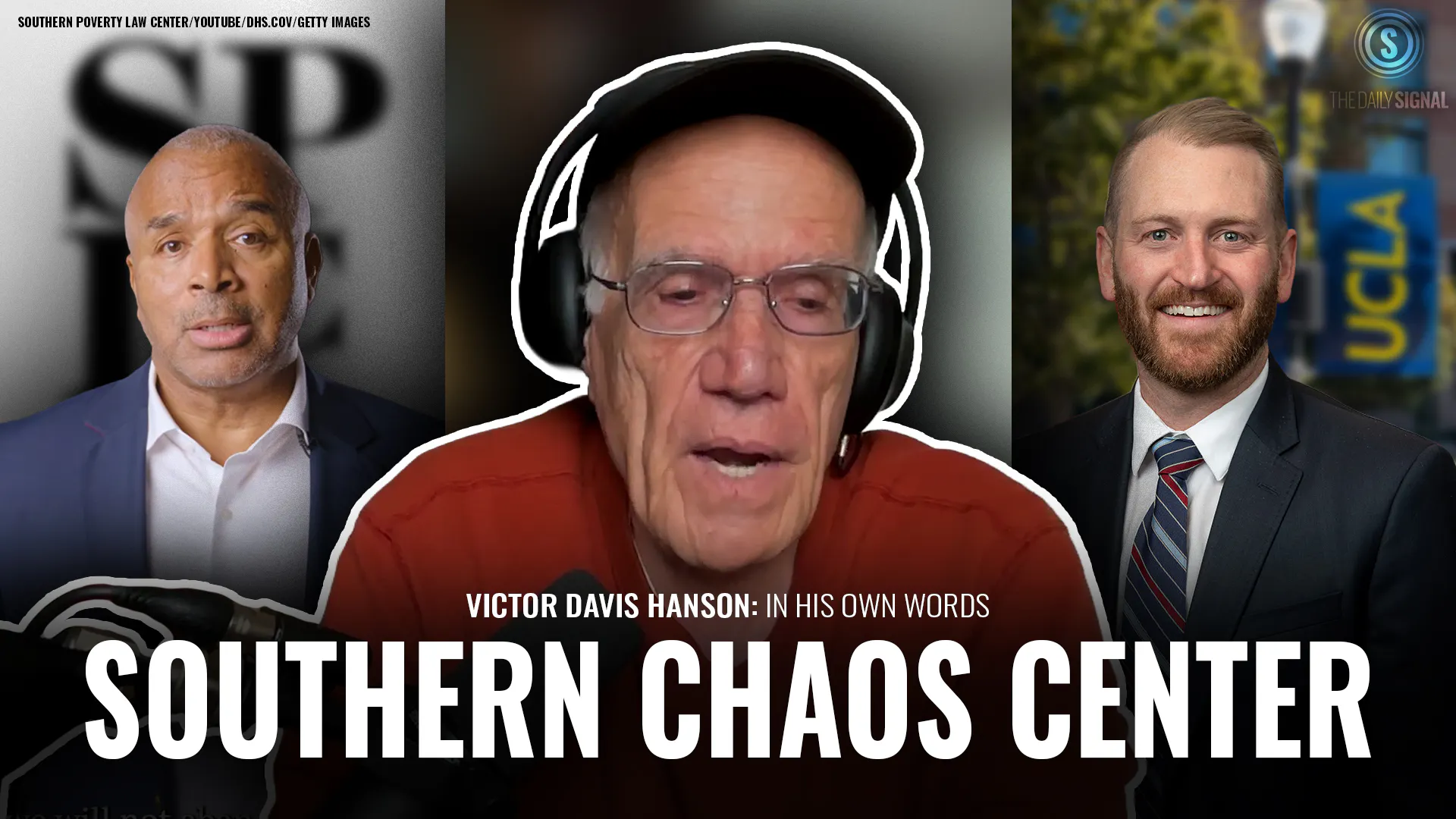
Victor Davis Hanson: In His Own Words
Victor Davis Hanson: UCLA Mob Tactics, Crime Culture, and the Southern Poverty Law Center’s Influence
01:27:24
Victor Davis Hanson and Jack Fowler react to a disrupted UCLA Federalist Society event featuring DHS General Counsel James Percival, arguing elite law schools now reward activist intimidation and vulgarity while teaching critical legal theory.
Loading summary
Transcript192 lines
- [00:00]
A
Let's talk a little more about crime and the Southern Poverty Law Center.
- [00:04]
B
I think the only thing I would say for them, it is a center of something. But, you know, it's not Southern, it's not poverty, and it's not law. But maybe it is a center of chaos.
- [00:15]
A
While it's still going on, there's still slavery, act of slavery in Africa. But we won't talk about that in the media. We won't talk about the slaying of Christians in Nigeria or we hardly talk about it.
- [00:27]
B
No, we only talk about the Jews. That's what they say, the Jews, the Jews in Bethlehem, the Jews here, the Jews in Gaza, the Jews, Jews, Jews, Jews, Jews, Jews, Jews, Jews, Jews, Jews, Jews. That's all that these people talk about. But limbo was a better designation than purgatory, right?
- [00:44]
A
Yeah, I guess. Although purgatory. See, purgatory is a place of pain. Hello, Hugo. We're all in sight. I don't think I'm coming in.
- [01:00]
B
Limbo is just in limbo. Yeah, I'm in limbo right now. I'm waiting to find out if this aggressive cancer came back because there's no treatment for it.
- [01:08]
A
Well, that's one kind of limbo.
- [01:10]
B
But I'm not in purgatory. I haven't. I don't think I earned it.
- [01:24]
A
Well, hello, ladies, and hello, gentlemen. Welcome to Victor Davis Hansen in His Own Words on the Daily Signal Network. We are recording on Saturday, April 25th, 2026. This particular episode will be up on Tuesday, April 28th. Victor is the Martin and Ely Anderson Senior Fellow at the Hoover Institution. Wayne and Marcia Busky, Distinguished Fellow at Hillsdale College. And you can see by that really cool black baseball cap he's wearing, he's a senior contributor at the Daily Signal, which just reads.
- [01:58]
B
And Jack, author of the forthcoming the Counter Revolution, the Fall and Rise of Donald Trump and His MAGA Movement.
- [02:10]
A
And is it a finished book yet?
- [02:11]
B
Yes, I'm doing the galleys right now. The only problem is that news is so rapidly developing. So I'm going to have a postscript and I'll have to write that, but everything has to be due by May 1, apparently.
- [02:27]
A
We will look forward to the paperback edition that will come out in early 2027 that will have even a further update, given everything Donald Trump will have done between now and then. Victor, you and the great Sammy Wink talked the other day on the last episode of the podcast about the Southern Poverty Law center, but there's more to talk about on that topic. And also the UCLA law students at a Federal Society event. Just echoes of what we saw at Stanford University a couple of years ago. Millionaire it's okay to be a thief and be a millionaire. Now it's cool. According to certain lefties. We have Chris Caldwell, a great, you know, conservative writer, but critiquing Donald Trump again in the Spectator. And we'll get maybe your thoughts on that and other things. VICTOR we'll do all that when we come back from these initial important messages.
- [03:25]
B
Since the founding of America 250 years ago, many things have changed, but some things never do. The commitment of husband and wife. The importance of passing along our values to our children.
- [03:41]
A
The faithfulness of God.
- [03:43]
B
Some wonder how we can ensure America will continue to thrive as long as we keep first things first. We've only just begun. America the Beautiful.
- [03:55]
A
We're back with Victor Davis Hansen in his own words. I forgot to mention Victor's website, the Blade of Perseus. We have a lot of new viewers and listeners, so if you're not familiar with it, go to victorhansen.com tons, tons, tons of free stuff. But you'll also see this little black box on certain articles. It's ultra. And those are the pieces Victor writes exclusively for the Blade of Perseus and exclusively for its subscribers. So I recommend you do subscribe. It's $65 a year. If you want to just try it out for a month or two, it's 650amonth, but discounted for the full year. The Blade of Perseus. VICTOR Hansen so Victor, I'm reading. Let me get my notes together here from the Volok. I never could pronounce that conspiracy, which is now housed at Reason magazine. And this headline is UCLA Students Protest FedSoc Event with DHS General Counsel James Percival. Josh Blackman has written this. And in case folks have not heard of this story, on Tuesday the 21st this event took place place unfortunately I'm reading from the blog post. Unfortunately, there was a massive protest that disrupted the speech students consistently disrupted by booing and heckling the speakers. There was a non stop cacophony of ringtones and other sounds again which were intended to disrupt the event. And further on down, I saw a video of it. A lot of kids were holding up kids, they're adults. They're holding up signs. Really vulgar. How's Trump's block? Blank taste, et cetera. Things true vulgarity by people who I think will someday think believe that they deserve to be on the Supreme Court or some court. So your thoughts about this?
- [05:52]
B
VICTOR well I mean, the thing that's so bad about it, it's so asymmetrical. If there was a liberal justice and he went to the Federal Society, they would not boo him, they would treat him with respect. So they think they can do this because from time eternal the left has started out with this deductive premise that they are more moral because they believe in mandated quality of result and therefore any means necessary or justified. And that's what we saw with that Hasan Piker in the New Yorker interview, that it was legitimate to steal from the Louvre, to steal from people. Of course, all these people have locks on their doors and they're multimillionaires, billionaires. He is got a very nice digs in la. So what isn't, at least Karl Marx was not so much a hypocrite. I mean, he was a hypocrite. He was supported by Engels and stuff. But at least he said when you come into his house, he has a little pan of gold coins and everybody would put each according to their means and needs. So you would put a little gold coin in. And then when you left, if you had to see how much you needed, you would just take what you needed. And he quickly discovered that people were putting in very little coins and taking a lot, given human nature. But at least Piker and these people in that law school, they could follow their own ideology in their real life. I mean, anytime they would go anywhere, people could scream and yell at them for what they say, but nobody ever does. So they think they take that magnanimity as weakness and they exploit it. And they're spoiled rotten. They're all the elite of the elite. I said not too long ago, Stanford Law School, I think it was four years ago, only 83% of the number one. It was along with Yale, the number one rated law school, 83% passed the bar on its first attempt. San Joaquin law in Fresno had a higher that year, I think it was four years ago, had a higher pass rate than Stanford. So they're not teaching law as we knew it. They're teaching critical legal theory law, critical race theory law. And you saw the result of that. That's why I mentioned Piker. He's a result of that ideology of the new law. Critical legal theory says that the laws are not based on either moral codes across eons, nor are they based on statutes. They're based on a small clique of white Christian male heterosexual oppressors who make laws to cement their privilege. So Hassan Parker is saying you can go into Whole Foods and steal a bunch of wine because it's the type of wine they don't drink. So they made a law that says you don't. It's against the law. Or you can go into some kind of sports locker or sports department store and steal sneakers because Ken Griffith and doesn't wear sneakers. Or steal. You can steal candy bars because rich people don't eat Snickers. And they made laws therefore to outlaw it because it doesn't affect them. That's how that theory goes. It's a simplification reduction, but that's what it is. And all these people, it's so funny, they're all so wealthy and they enjoy such privilege. Mandami, Spanberger, all of them. You know, when I would walk through the Stanford faculty housing, I have an apartment there and I walk to get walks. It was amazing on the Ukraine, this house they went from, this house doesn't. This house does not tolerate racism with George Floyd stuff and all that. And then it was Ukraine flags and then it was Di. And now when you go by, it's mostly ICE stuff. This is an ice no go zone and stuff like that. But they're all those homes, they're very modest looking. If they were in Indiana or Ohio or Wyoming, they would probably go for $300,000, but they sell for 3 to 5 million dollars. And the people are very, very affluent. But they have this boutique leftist radical ideology because it never affects them. It never affects them. Their only experience with illegal immigration is a little pick, a little kind of irritation that Juanita or Geraldo want cash when they mow their lawns or clean their toilets rather than, you know, checks. And they kind of, kind of go along with it, but it bothers them. They're breaking the law by doing that. And I say that because almost every nominee from the left that had some problems with paying people in cash that were here illegally and doing their domestic chores for them, but they don't live in the real world. And it's frightening everybody and all, you know, to put this little civil war on the right in context. You can say that you don't support the war or Tucker's right or this or that, but the alternative nobody seems to see is this institutionalization of this stuff. And the reason that San Francisco was destroyed and downtown LA is destroyed and Seattle, downtown and Portland are destroyed is because. Because that filters down and sends a message to the criminal that people feel so guilty about their civilization and culture, they won't enforce the law. And therefore, if they don't enforce the law, it's prima facie a sign that they're guilty of exploitation, class warfare. When we started this, Jack, if we said about five years ago, we said, you know, I bet there's going to be mainstream people on the left and they're going to be patronized by the New York Times, the New Yorker, and they're going to come just go right out and say it's okay to shoot an executive and murder him. Nobody. They would have said, oh, that's divisive. That's such a lie. And that's what this Hassan Piker said about Luigi Mangione. In other words, the left can pick and choose. They can go through the panorama of names and say he, it's exactly right out of the Soviet Union. He is a nail that sticks up too high. So I'm going to hammer him down and that guy and that guy. And with no evidence, no court trial, you just go shoot him. And then society approves that you took out an enemy of the people. Yeah, so boring. I heard it all when I was 18 at UC Santa Cruz. Same old stuff. But now, as I said to Sammy, the Democratic Party is the guard dog of hell. It's Charybdis with three heads. And one of them is the socialist communist, mandatory equality. The second head of that raging beast is DEI and race, race, race, race and oppressor, oppressed. And the third is neo colonialism, radical Islam and Muslims. And they all intersect because they all have the enemy of white males, Jewish people, Western civilization, successful people among their midst. And it's a nexus. And that's the new coalition of the Democrats. People who hate Israel, people who are immigrants from the Middle east, people who say that their race is essential to who they are and they're not white. And then in addition to that, people who believe that they have a right to take things from others who have been more successful.
- [14:00]
A
Yeah, I think we forget, Victor. Our first war was with the Barbary pirates, by the way,
- [14:08]
B
how it's very similar, wasn't it? Because Jefferson was sort of a maga, neo isolationist, you know, when he and Adams, all of them didn't want to go anywhere. And finally, it was such an insult and the United States Navy was going to be preyed upon that he ordered these, the raids to, you know, go try to recover these people. It's another thing that people don't realize. If you look at the number of people who were captured by the North Africans or the Ottomans in the Balkans, and that's where we get the word Slave, It's Slav for white Slavic people. It was in the many millions, many millions. And the Ottomans for the harem in Constantinople. They had a particular like for Circassians, southern Russians, around the Black Sea and even they even went up the coast of Italy on occasion to kidnap women, slaves, etc. To put them in the harem.
- [15:14]
A
Well, it's still going on. There's still slavery, act of slavery in Africa. But we won't talk about that in the media. We won't talk about the slaying of Christians in Nigeria or. We hardly talk about it now.
- [15:27]
B
We only talk about the Jews. That's what they say. The Jews, the Jews in Bethlehem, the Jews here, the Jews in Gaza, the Jews. Jews, Jews, Jews, Jews. They got Jews. Jews, Jews, Jews, Jews, Jews. That's all that these people talk about.
- [15:40]
A
Well, there's more on crime to talk about and there's a little more in ucla. But first, to our viewers and listeners, if Flint, Michigan taught this country anything, it's that the government's word on your water is worth exactly nothing. And Flint wasn't a one off. The problem is everywhere. And that's why you should switch to Cove Pure to purify your water. If you're watching this podcast, by the way, over my left shoulder, there's my covp Pure. So that's what we're talking about. There are still millions of lead service lines actively carrying water to American homes. Millions. Millions. Many were installed before your parents were born. And here's what the government doesn't tell you. The testing method that utilities use to check lead levels is specifically designed to collect. Collect the least contaminated sample, not the worst. EPA scientists have confirmed this. The most recent federal data shows that water systems serving more than 250 million Americans detected lead during 2021-2024. Lead has no taste, no smell, and it doesn't change the color of your water. But here's the scary part. There's no safe level of lead exposure. None. Even low levels are directly linked to brain damage, learning disabilities, and irreversible developmental harm in children. Cove Pure removes it. It's certified to eliminate up to 99.9% of contaminants. That includes lead, but also PFAS, fluoride, pharmaceuticals, schmutz, junk, whatever, and setup couldn't be simpler. No plumbers or drilling. You just put it on your counter, fill it up and plug it in. That's what I do.
- [17:21]
B
It's there.
- [17:22]
A
It's not. There's no water connection in there. It's Just. It's very convenient in my office. I love that. Cove Pure gives you water at the temperature you want and you get it as soon as you want it. You don't have to wait for cold water or hot water anymore. You press a button and it's there in a flash. It always tastes the way water should taste like water. Pure and clean. And I will add, refresh it. So your city probably tested the water and said it was fine. So did Flint. Cove Pure is what you put between the track record and your family's water. So go to covpure.com VDHnow and because you're a listener of this show or a viewer of this show, you can get $250 off for a limited time. That's covpure.com let me spell that for you. Get my Bronx accent out of the way. C O V E P u r e coveppure.com BDH and we thank the good people from COVID Pure for sponsoring Victor Davis Hansen in his own words. And Victor, I'm going to drink a little Cove Pure filtered water and appreciation.
- [18:33]
B
So you're getting better and better at this.
- [18:35]
A
Am I? Yeah. Did I tell you?
- [18:37]
B
Did I tell you you have a career? Art. I can't because I'm not very good at it. I don't mean that in a condescending way either. I just don't. I wouldn't be good at it.
- [18:47]
A
Well, I think you'd be exceptional victim. But hey, before we get on, I want. I just want to let you know since we'll get back to some vulgarity at ucla. I was at the Encounter Prize. I was at the Burke dinner the other night where you. You've won that prize yourself in the past. I know you're very connected to Encounter in Roger Kimball. A new criterion. Everybody there, everybody wanted to know how is Victor? How's Victor? The love for you, the concern for you is just immense. And I do have to add two things. John and Liz Soriano, who are my hosts. I had never met him before, but oh, my gosh, they love you. And then I got a call yesterday from a neighbor, Andy Bugay. He's like, you know this Victor guy? How's he doing? Okay. So anyway, Victor.
- [19:43]
B
Yeah. I had my Signa terra blood biopsy draw yesterday. I'm now in a period of intense stress because I will find out. The first one was negative, but that was the long one. It took a month to get the mutations, 16 of them. So this is the one that is the most important because it'll tell you if you have any cancer recurrence in your blood. I'm hoping on the logic that this thing was here from what some people had said for a year and not diagnosed. So if I took a test right after my surgery, it would have picked up, which I did take, it was negative. It would have picked up any cancer outside the lung. Right. They would just been hanging around with that mutation and it didn't. So then the question is, has any reappeared or become stronger to shed after the operation? So did any get out? So I think this test will be really. This is the really important one. And the next one, if you have three of them every 120 days, negative, then your odds go from like 40% chance down to 20 down to 10.
- [20:59]
A
So we're talking on Saturday, the 25th.
- [21:01]
B
You're. Yeah, I should know then. Yeah, I might know that. And then I.
- [21:05]
A
But also, I'm sorry, when do you know the results from this?
- [21:09]
B
Should be a week from. It should be this coming Friday. Okay. And then I've been warned that the muconus adenoma carcinoma sheds DNA a little bit more slowly. So they double check were the places that it would metastasize given the mutation, and that is the pancreas, the brain and the lung. So I have those scans as well in two weeks. But I think I'm getting. I don't have that cough like I did. And I talked to my wonderful internist, Dr. Bill Chu, and Palo Alto, and my EKG is normal now. Wasn't prolonged. It's normal. My blood pressure is 115 over 65. My heart rate's 58. Resting. And when I'm walking, if it's not spiking and the spikes are much less, it's about 75 and my oxygen's 97 or 98. So I think at 14 weeks, even after all that, five transfusions and three liters of blood loss, I'm getting back. And if I can get negatives and the, the last bit of spiking leaves and I can get back to cleaning out the garage, cleaning out the barn, doing all the things that have been neglected.
- [22:30]
A
But no more airplanes.
- [22:31]
B
Still no more airplanes. I'm not going to be flying. My career is over. By the way, a year ago, 50 trips in 20, 25, that was normal. Every year, 50 jet trips.
- [22:46]
A
About a year ago, we were not talking about cancer. We were talking about your sinuses. And is that cleared up, by the way? Yeah.
- [22:56]
B
That was a good surgeon, too. He's A really good surgeon. And he widened the sinus passages very big, but there was a bone blockage, so there was a little bit of difficulty, but he couldn't address the whole problem because I had a size of a baseball in my lung that was what they call mucanous. And it was shedding mucan. And I don't know whether some people have argued that as a reaction to that irritation, it creates greater mucus in your sinuses, too. And so I don't have the hoarseness as I used to have to the same degree. I still have post nasal drip, but not nearly as bad. But that operation helped me, but it didn't solve the problem. Last year, on March 1, I got the flu, and then I had, I think, seven rounds of antibiotics and PET scan, mri, MRI and ct. And not until Thanksgiving did somebody spot the cancer. They spotted the big mass, but they thought it was either valley fever or Covid or pneumonia. So that's just the way things go. You can't look back. But I'm hoping that if this test is. My theory is that maybe in 30 days, if any had got out of the lung, it would have showed up. And the first one was negative after 30 days. And that would mean that there was nothing in the body for the last year. Because that would have showed up. Right. Because that had plenty of time to show up. So that's what I'm hoping.
- [24:39]
A
Well, people still pray and keep it up, folks.
- [24:42]
B
You just have to keep up. As they said, keep trucking. Yeah.
- [24:49]
A
I do want to mention, by the way, the Daily Signal. Richter's got that lovely hat on. It just redesigned its website. It's rolled it out the last couple of days. So check out the Daily Signal. Victor, before we take a break, a regular break, I do want to go back to UCLA and vulgarity, and then we'll get on to back to crime. And the. The vulgarity was just like really, really vulgar outside of some actual pornographic acting at the event. And this is. It's a staple of all liberal events and leftist events.
- [25:28]
B
Yeah, it's a crude movement. Remember, they had the plastic phalluses. They were waving at the ice people. When this crew showed up at Stanford, one of them yelled out, I hope your daughter becomes raped to a federal judge. And they disrupted it. Thank God. That led to the firing of the DEI law administrator who hijacked that lecture and then lectured the judge, a federal judge, on how he was incorrect. And we had Hassan Piker at the Stanford campus, and he was spouting this hate stuff that he usually does. And he's crazy and he's a big hero on campus.
- [26:11]
A
But with the law school stuff like what happened at ucla, I thought maybe I'm wrong for you to pass the bar, but for you to get your license, your temperament and morality, so to say I thought was a criteria.
- [26:30]
B
No, it's the American Bar Association, California Bar. I don't know why something that we all share on is outsourced to this private entity called the American Bar association with its state chapters, and they adjudicate whether somebody's activity is beyond the pale and is disqualifying. So if you were a lawyer and you defended Donald Trump on an arcane theory. Right. Yeah. You know, they would, they would disbar you, but not other people who have been, you know, actively involved in crime or left wing causes that were criminal, like trying to, you know, break into ICE or something, an ICE facility. They don't care about that. Yeah.
- [27:16]
A
Well, let's talk a little more about crime and the Southern Poverty Loss center, and we will do that when we come back from these important messages. If you enjoy Victor Davis Hansen, you might enjoy the Daily Signals flagship show. The Tony Kennett cast the same common sense perspectives you love. Weekdays at 7pm Eastern. And unlike some of the other evening shows, we work up until showtime to bring you the latest breaking news, analysis and good old American sarcasm. Thom Tillis I'm pretty sure might have been useful at one time as a doorstop. Find the Tony Kenneth cast on YouTube, X radio TV or wherever you get your podcasts. We are back with Victor Davis Hansen in his own words, talking on April 2025. It's a Saturday and this episode will be up on Tuesday the 28th. The year is 2026. Victor, you've mentioned Hassan Piker and two things I want to bring up. One is my old colleague and yours too. Rich Lowry had a column about this and Gia Tolentino, the New Yorker writer who was talking about how cool it was, oh yeah, I stole some lemons, et cetera. And it turns out she lives in a $2 million brownstone in Brooklyn, was confronted by reporters outside of her house and she went nuts on them. But it's the cool thing to do to shoplift. And then one other crime story, but I'll just throw them both together. Headline Not a single Michigan Democrat in the House Judiciary Committee voted for a bill which would ban sex offenders from working near childcare facilities. So this is not only crime glorified, but it seems like the Democrat party is becoming the actual party of crime.
- [29:12]
B
It is. And you can see that the gay movement has transmogrified into the radical trans movement. And there have been legislature tours in the California assembly, for example, in the Senate, that have actually tried to mainstream the age of consent and what we would call pedophilia, the relationships between men and boys. And that's destroyed the Boy Scouts. I'm not suggesting it's pedophilic, but the idea that they've had scout masters that have been dismissed and you can have homosexual or trans scout masters take a lot of young, you know, boys out on nature hikes for two weeks or whatever. So it's lowering the bars. And now they're going to have these efforts in California to make polyamory, you know, multiple partner marriages. That's big now. Threesomes, foursome. I don't know how many sums, but
- [30:15]
A
three men and a baby. Yeah, yeah.
- [30:17]
B
So the idea is there are going to be no rules on sexual expression. And what's different about the 60s? The 60s was just a self indulgent, crude appetite. Satisfy the appetites ad hoc, instantaneous. What did Stephen still say? Love the one you're with. But this thing is kind of like a Stalinist, predetermined, legalistic. We've got to go to the law, we've got to get this normalized, institutionalized mainstream so that we can do these things. So it's the weaponization of crime. So if you're a guy with a wife beater T shirt and you're drinking beer and you've got a grizzled thing and you have molested a underage kid, they will still throw the book at you. However, if you're an upscale professional and you have a suit and tie and you're a left wing activist and you have had a relationship with, let's say, a young man that might have been 16 or 17, then they think that should be discussed in Socratic terms as what the Greeks called the erastes and the eromenos, the male lover and the beloved on the reciprocal side. So it's very dangerous how they're incrementally, insidiously. They have the Sauron red eye that never blinks.
- [31:53]
A
Can you see them, Victor, taking this multiple men in a marital relationship and then using it essentially as a crime syndicate with spousal privilege. You can't talk hiding behind that. I could see them just contriving all this for not only the destruction of
- [32:15]
B
marriage, it doesn't ever work. When I was in the dorm my first year, there was a young man With a girlfriend. And it was kind of scandalous because she had a girlfriend. And then the three of them moved into the dorm together and everybody was curious about it. There were normal people there, a few. But I said to all the guys that were trying to figure out what was going on, I said, well, I don't know what's going on, but I can tell you one thing. They're all going to hate each other within six weeks. And that's exactly what happened. They all, they all hated each other. Well,
- [32:55]
A
okay. Well, there's no level, the depth of the depravity that we're, I think we're going to see experimented on or actually adjudicated in America. Let's return to Southern Poverty Loss center, which you and the great Sammy Wink talked about the other day at some length. But one of the aspects of this is the corporate involvement with this institution. And actually I forget where I picked this up from. It may have been Capital Research Center. Yeah, Capital Research center is a great resource for investigating these left wing nonprofits. But Apple made a publicly reported $1 million donation to the center in 2017 following the Charlotteville Unite the Right rally. JP Morgan Chase gave 1 million in 2017. Google gave 250,000 in grants. Then also the Clooneys, George and whatever her name is. Amal Clooney also gave a million dollars. And that's just a tiny slice of Victor corporate America. Whether it's Southern Poverty Law center or Black Lives Matter or ESG or the, you know, changing the rule, the rules of how we're going to invest your money. They have, they are so deeply involved in so much that's, that's wrong.
- [34:33]
B
I don't think anybody understands that we, I'm on the Bradley Foundation, a center right conservative organizations mostly for free markets. But we have, I think about a $1.2 billion endowment. And we had a presentation about four years ago where somebody very brilliantly, I won't mention who showed us the top foundations in the United States based on their endowments. Jack, the top 50. There was no conservative there. We were like 200. I mean when you look at the Rockefeller or the Gates or the Tides foundation or the MacArthur, all of this money, it's huge. It's 5, 10, 20, $50 billion. And the left has. And then they're not satisfied with that. And then they become the receptacles, the revolving door for retread bureaucrats in USAID who give government contracts. So they call her friend up and say, can you give us 10 million for transgendered homeless people's operations.
- [35:45]
A
Yes.
- [35:45]
B
And then when that person retires, they say, can you get me a job for 500,000 as a case officer? And that's what they do. And Trump tried to break that up. And the Southern Poverty Law center, it was really, I mentioned to Sammy the Wigilis in Rome, these were the later fire brigades that would show up conveniently at a fire. They just happened, kind of sort of knew where the fire was because they kind of sort of lit it. Marcus Licinius Crassus had, as I said earlier, had done the same thing, but wasn't sure whether he lit the fires. People had accused him of that, but he showed up as their house was burning down and bought it at a cheap price. But these guys would light the fires, like the Southern Poverty Law center, and then show up and say, we can give you a remedy. We will put the fire out for either signing the house over to us or paying us money. So there wasn't enough. Everybody knows until Obama, that racial relations had almost reached what we would call equilibrium. And Obama didn't like that because the Democratic message was not resonating. So he wanted to divide the country between victim, as the old Marxist, victim, victimizer. And that was going to be based not on class, like Marx, but it was going to be based on race. And it wasn't going to be black, white. It was going to be anybody who wasn't white, regardless of their social status or economic status. And that's what he did. He did that. And so when he did that,
- [37:26]
A
the
- [37:26]
B
victimization, the oppression, it was like an epidemic. All of a sudden we heard all these different groups who had. That was when the reparations movement, to take one example, was dead after 9 11. Remember that? David Horowitz wrote a good book right on the eve of 9 11. And then it was over with. And as soon as Obama came in, it started to creep back in. Now we have a California Council on Reparations, et cetera, et cetera. And the Southern Poverty Law center knew that. They knew that there was not enough victimized people. So they started to cede the kkk, all of these white supremacist groups, and unite the right at Charlottesville. This is very, very important because most of those groups were defunct, they were decentralized, they were irrelevant. But they actually funded one of the people, allegedly who was the transportation coordinator, to make sure that all these different groups of showed up. And when they did, no single thing had hurt Donald Trump more than that riot. When one person was run over because at that point he said there were fine people on both sides. And he meant, if you listen to them, he qualified that. Which they always left out. He said, I'm not talking about the racism, etc. But they took that out of context. And they said there was a big white, racist, predetermined riot and Donald Trump took the side of the Klan. And that really haunted him. Even though people tried to explain that. They cut off the second part of the qualifier, the sentence. And now we know that the Southern Poverty Law center was worried that there were not enough victims around that they could justify their fundraising to their donors. They needed a lot of Charlottesville, they needed a lot of Michael Browns, they needed Trayvon Mars. Every one of those was not as it was. As everybody knew. Michael Brown did not say, hands up, don't shoot. We know that Trayvon Martin was not a little innocent teenager in a football uniform. Somebody pointed out, you can take a picture. The left would take Charles Manson and show those 12 year old pictures of him if they wanted to. That's how they operate. But the point I'm making is that. But once they started funding those people, it was burning down the house. And then they showed up with a cure. Well, these people are organizing Unite the Right. They're really getting out of the hand. We're following, we're tracking them. We need money. We need money. We need money because it's going to be like 1960s in the racist South. And there was no threat that they hadn't ginned up, up. And it's. And so the other thing about them is they're insidious, they're everywhere. I was giving a lecture to the late Avi Davis. Remember him? Jack? Yeah, he died prematurely, but he was the head of something called the American Freedom Alliance. And they asked me to speak on immigration maybe 10 or 12 years ago. It was a very moderate. I said, if you have immigration that is illegal, not diverse, too large to be assimilated, and people who are coming impoverished, assimilation will be almost impossible and integration. And the next thing I knew, the Southern Poverty Law center had a big article, but Victor Hanson went to this right wing organization and was spouting a neo Nazi stuff. And there was a person in the audience who came up to me, she was very nice and she said, let me get this straight, I heard you and you think that immigration should be diverse with different. I said, yes, it makes it like the country itself. Not all from south of the border. Not because that's. I'm picking on them just the More different types of people we have, the more opportunities people have to come to America. And they need skills so we don't endanger our poor citizens with an overtaxed social services system. And they should come only legally and they should know English. Oh, okay. Next thing I knew, Southern Poverty Law center had me on their website. And they do that to everybody. They did that to Aon. They do that to everybody. And you know what Voltaire said about the Holy Roman Empire? It wasn't holy, it wasn't Roman, and it wasn't an empire. And the same thing is about the Southern Poverty Law Center. It's not Southern at all. It's really white liberals all over the country, but not so much in the South. And I encountered them in California. So it's not the Southern. And there has nothing to do with poverty. They have probably a near billion dollar endowment. They were getting million dollars, as Jack pointed out, donations their head was making, I don't know, 500 or 600,000 a year. They were paying out to this white racist, what was it, $220,000 to cause mayhem. So come in as the fire brigade to put out the fire they lit and make a profit out of it. And they're not anything to do with the law. They're about breaking the law. Southern Poverty Law. No, you break the law, that's illegal for a private organization to pay people to cause havoc and then to defraud their donors by suggesting that that was a spontaneous event that they cooked up and to gin up their receipts. I think the only thing I would say for them, it a center of something. But, you know, it's not Southern, it's not poverty, and it's not law, but maybe it is a center of chaos.
- [43:21]
A
They're very important, Victor, to the whole leftist project, because. Because not only is this, you know, funding the Ku Klux Klan and these things, but I don't call it an anecdote, but they, they will then say, you know, you're. You, Victor, are racist. Or this nonprofit, this, you know, is. Is a racist. And there. And then foundations will not give.
- [43:43]
B
That's what they do. That's a good point. They use their staff as a litmus test. And if you get on the wrong side of the litmus test, that goes into a computer and you'll never get a grant from these multi, Multi billion dollar foundations or your career. Oh, he's been identified by the Southern Poverty Law Center. So what? That's a joke. And it's kind of like the aclu, American Civil Liberties Union. They used to be actually. There were moments in their history when they were actually defending really unpopular people for free speech. And they got criticism. Remember that Nazi march in Stokoe? Right. I don't think they should have, but they did. And they said we have to because we have to support the principle of free speech when no one likes free speech. And the people who are expressing themselves freely are odious. Not now. Now they have boot camps to train people how to be activists on the left. Left. So everything has changed with the left again. I think it was because the country moved to the right, especially after Reagan, and they tried to resurrect the left and they got frustrated and all of the. So they, they outsourced their entire agenda to areas that were not contingent on politics. So the foundations, academia, Hollywood, popular culture, professional sports, they infiltrated all of that. The corporate boardroom, and they controlled that. And they said, we're going to change the culture and civilization of this country within the military, within the corporate boardroom, within the university. And we won't have to have actual power. It'll be good when we do. And eventually it'll result in actual political power because these institutions will change the balloting laws and, and states. They'll call you a racist if you think you need an id. They'll open the border. They'll help open the border, but we don't need them. We don't need them to get our hard left message that everybody doesn't like through. We're going to do it without the people's consent. And that's how they got the transgender men and girls restroom. Nobody wanted that. Nobody wanted biological males competing in women's sports. But they had the ability through all of these institutions to make it very hard on people who spoke out. Look at Riley Gaines. So if she spoke out, the operatives of the left in the university, almost they tried to kill her. Almost. She was trapped in California.
- [46:27]
A
Was she in San Francisco?
- [46:29]
B
Yeah, San Francisco State, I think it was. She couldn't get out of the room and she stalked. He had to have security and that's what they do.
- [46:39]
A
Well, corporate again. It's not my hobby horse. I'll just send this. The role of corporate America in all of this. You think Facebook this, which was just, oh, nice little collecting your fellow students at UConn or whatever college. That's how it began. And then 20 something years later, it's spending hundreds of millions of dollars to disrupt the 2020 presidential elections. Corporate America is the only strange thing
- [47:08]
B
about corporate America is they can Be as left wing as they want, but they'll never. The left still hates them. And that famous little interview that Marc Andreessen said was absolutely brilliant when he said, these people come into our corporation, they hate us, they hate capitalism, they're working against us. And then Mark Zuckerberg found that out and Elon Musk found that out, and now they're all finding it out because California's going to have a billionaire tax and they're going to destroy the golden goose of Silicon Valley. And it's all being orchestrated in the state by the SEIU, teachers unions, etc. Etc. Etc. And funny thing was Tom Steyer was on a commercial, he's running for the 9th nth time for governor and he thinks he's going to be finally a legitimate candidate. We can talk about that debate about the driver's licenses.
- [48:05]
A
Yes.
- [48:06]
B
Yeah, we will. It was very funny. I watched part of it. But he offshores his money, allegedly in offshore investments that are subject to little or no tax in some cases. He started out investing in coal plants in Indonesia, so he pays about as little tax as he can. And then he was there saying this billionaire wants to pay his fair share. It's like the Pelosi's. We don't like multi, multi billionaires, but we have advanced knowledge about what a government policy will do to the stock market well before the law is even discussed. If it's mentioned privately in back rooms of the Democratic Party. She's there and she tells her husband, there's going to be something big going down that might affect this particular sector of the stock market. So left wing people, that is a psychological. It's the same thing with race. Joe Biden was, I think, demonstrably true, the most racist of any president in the last hundred years. I'm basing that assertion pretty broad. With the corn pop stories, with calling two of his assistants who were black boy, with using the word Negro repeatedly with Barack Obama is the first articulate black man that ran for president. Remember, he called Charlemagne the God, a junkie.
- [49:46]
A
You ain't really black. Yeah.
- [49:49]
B
You ain't black.
- [49:50]
A
Is that to him or to somebody else?
- [49:52]
B
No, it was him. You ain't black and you're a junkie. And then he had that room of accomplished black professionals. He said, they gonna put you all back in chains. So to hide that, he created this facade of the liberal fighter for equal rights, even though he was Talking in the 70s about a racial jungle. Remember that? And his poor mother, he started to call Donald Trump a racist, racist, racist. It's the same thing with the left, who are billionaires to protect their billions. They all say that these people are enemies of the people, they're scavengers, they don't pay their fair share, and then they get an exemption from the left. People should not underestimate the psychological repercussions of getting an exemption from the left. From the left. I can tell you that when somebody on the left praises you and you're a conservative. I wrote a book, Fields Without Dreams, about small farming and the end of agrarianism. And the left wing novelist Jane Smiley asked if she could write the foreword. After they did a thing and the New Yorker ran something and for a brief moment people thought, wow, he's an agrarian leftist. And then it was near to the time of the Bush administration. George Bush was elected and I supported George Bush and all of a sudden I got this fanatic and I supported the war on terror, the Iraq war, at the beginning in Afghanistan. And I got this insane call from this novelist and said she wanted to take her name off the foreword. I said, it's been in print for 3 years. She said, I want it off, I want it all. I said, promises, promises, get it all. And she said, what do you mean? And I said, do you think that I'm proud that your name is on my book now? And she said, what do you mean? And I said, well, I followed your career as closely as you follow mine and it's in deep dissent and your public proclamations are hysterical. So I don't feel honored anymore that your name is on it. So if you can get it off, it'll be a gain to me. But the point I'm making is that they don't. It's a big temptation for people if you are. And I think that's happened. The other day, Tucker had Jeffrey Sachs on that weirdo leftist. And there's a big temptation for people on the right who feel they're apostates to be. It's kind of like the Spy who Came out of the Cold. It's so lonely here and we're getting attacked by all these left wing tentacles that I might want to make a deal with the octopus and just say, don't squeeze me anymore. Review me in the New York Review of Books. Let me come on npr, let me interview a big leftist. And then you won't attack me and I'll be. And maybe I'll get a Pulitzer Prize or a National Book Award or a Grammy or Tone. That's what happens. Michael Steele, have you seen him lately, the head of the Republican Party. At one point.
- [53:04]
A
Yeah. National Review Cruiser at one point too. Do you remember? I don't know.
- [53:07]
B
You'll never live that down. If Jack
- [53:11]
A
the Thing, you know the movie the Thing up in the Alien up in the Arctic. And I think towards the end of the movie when the scientist tries to buddy up up with the monster, you know, that's kind of the analogy I'm thinking of. He's sucking up to your enemy. And what does he monster do? He just karate chops them.
- [53:35]
B
Yeah, that's the left Borg. You can't make a deal with the left Borg. They see you as weak and they'll use you. Use you. That's what happened to the Net. Ask Bill Crystal and Mona Charon how that went.
- [53:47]
A
Yeah. Oh, poor Mona. I love Mona. All right, well. Yeah, it's Victor. We have to return to a topic in a second. Talk about that debate. But first to our listeners and viewers, if you've studied enough history, you start to see a pattern. Nations don't lose their way overnight. They drift through debt and division until one day you realize the foundations you thought were permanent were never permanent at all. Today, America is spending at levels once reserved for wartime. We've normalized deficits that would have stunned earlier generations. And policymakers now debate whether the only path forward is more intervention, more printing, more distortion. But here's the historical truth. Every society that pushed its currency beyond discipline eventually paid a price. The wise never waited for collapse. They prepared for the correction. And that's why so many thoughtful Americans, especially those nearing retirement or in retirement. And we think those who listen to this show and watch the show are reallocating part of their wealth into something that has outlasted every path, paper, experiment in human history. Physical gold, not as speculation, but as insulation. Our reputation matters here at Victor Davis Hanson, in his own words. Which is why we're partnering with Allegiance Gold, a company distinguished by integrity, reliability and an A rating with a Better Business Bureau. For years, they've guided Americans through transparent education and long standing relationships built on trust. And right now, they're extending a special liberty offer for our listeners and viewers to help you get started with real gold, whether your funds are in a retirement account or sitting in the bank. If you believe as we do that the best time to reinforce your position is before the storm becomes obvious. Call 8447-909191-84479, 09191 or visit protectwithvikdor.com that's 844-7091-9184-4790-9191 or visit protectwithvictor.com History rewards those who take the long view. And we thank the good people from Allegiance Gold for sponsoring Victor Davis Hansen in his own words. I think I'm going to play those numbers, by the way. 844-790-9191. I'm going to do that, Victor. Maybe I'll win Powerball.
- [56:09]
B
I'm trying to adjust my hearing aid when I'm looking down.
- [56:12]
A
That's okay.
- [56:13]
B
It's on my phone.
- [56:15]
A
Hearing aid. Oh, my gosh.
- [56:16]
B
Yes. You knew that I got. When co I had that long covet bout and I. The next thing I knew, I went. I had very high glaucoma and I had eye pressure and I was deaf. But I was too vain to get Costco hearing aids. So I finally did. I went to Costco and I got some. That's okay. Okay. Goodness.
- [56:39]
A
So vain. Maron. All right, Victor, that debate. I wanted to talk get your view on Katie Porter, who I think you might have said this once. This was somebody else that she comes off as that character Large Marge in the Peewee Herman movie, but she's driving a truck. Large Marge was in that.
- [57:00]
B
She reminds me of a character. She's an obscure character. You remember Lonesome Dove?
- [57:07]
A
Yes.
- [57:08]
B
And do you remember the guy who's supposed to his wife, he's in a little town and he's the sheriff and he's completely incompetent.
- [57:17]
A
Oh, sure. Yes.
- [57:18]
B
And when he goes out, when he finds out his wife is actually married to somebody else and she's pregnant. So he's gonna go find her and he's told about how an awful by this big woman. You remember him. And she's the town. She looks just like Kathleen Porter and she talks like her and she screams like her. And that debate.
- [57:42]
A
Well, talk about the illegal. She talked about the question. There was a question about illegal truckers. Okay, let me read. Do you believe that English proficiency, language proficiency, proficiency, if I could be proficient, should be strictly enforced for truck drivers? And she writes, she responded, I would absolutely fight the Trump administration because the job of the California governor is to protect California, blah, blah, blah. Nothing about these madmen driving the roads and killing.
- [58:08]
B
Yeah. I mean, what they're saying is, well, if a truck driver is coming from India or Mexico and he doesn't know English and all of a sudden he's getting on an on ramp and it says yield. Well, who's to say he needs to know what yield Means he can just plow right ahead. Or if it says speed limit 65, why should he have to know what speed limit means? He could think 65. You know, it's his own truth. He has his own highway truth. It's no better or no worse than yours. And his highway truth is he's going to follow the laws in Mexico or India or England if he wants to. Maybe he wants to drive on the left side of the road, but we should not force our values upon him and demand that he know our particular language. Language. And then the second corollary of that from that debate was, and it was the subtext. I think everybody who may have heard about it knew what it was. It was sort of like George c. Scott in Dr. Strangelove. I'm not saying we're not going to get a nuclear war. I'm not going to say it's not going to muss up our hair. I'm not going to say that if we let 40,000 truck drivers here that don't know English, we're not going to have a little collateral damage, few deaths here and there. But you know, but we're not going to be called racist. And of course we, my family, we will not be on those roads. We will be either flying with our private jet or we will be on our 50 foot long limo. So that's the, that's what they were. Yeah, that's. And I love that. I love the question about how would
- [59:48]
A
you grade
- [59:50]
B
Gavin Newsom on homelessness? And he spent 10 billion bucks as lieutenant governor and mayor of San Francisco and it almost doubled. And we have about 45% of all the homeless. We have one sixth the population of the country and 40 to 45% of all the homeless people. And all these Democratic people said, well, I thought, I guess I have to give them a B. On the other, I think Becerra said I'd give him an A for effort. Effort. And Steve Hilton was really good. He said, I'd like to be in your class where you just kept everybody an A. Yeah, but it's.
- [60:30]
A
Is he still atop the polls? I haven't seen anything.
- [60:35]
B
Yes.
- [60:36]
A
With Swalwell pulling out, how is it recalibrated?
- [60:40]
B
I haven't looked at him this week, but last week it was something like Steve Hilton, 18%, 19. And then Bianco, 17, 16. And then the Steyer has been the beneficiary and he's like, I think 13. Porter's about 10. The Hispanic vote has been broken up between Becerra and Village Rosa. And neither one of them are viable candidates.
- [61:13]
A
But.
- [61:13]
B
But California, trust me, is not going to let two Republicans be in that race by themselves. They won't stand for it. They will have a recall election in 30 days with one candidate with a trillion dollar war chest.
- [61:32]
A
Well, Victor, let's take. First of all, I want to commend you for that. His highway truth. That's a great line. I mentioned Chris Caldwell's article. Let's hold off on that. We're going to have another episode.
- [61:44]
B
You like Chris Caldw. He's a good writer, but he seems to have fixated on Donald Trump. I'll just say in passing, he had a line there that I didn't quite understand. He said he was talking about J.D. vance, whom apparently he's very fond of, as all of us are. But he felt that Vance may have been. What's the word? Compromised or diminished by Trump's new, more activist role.
- [62:15]
A
Can I just say, he says whether Vance is the mo, The Larry or
- [62:18]
B
the Curly of this truth, that was kind of cruel. Yeah. But then he said no one has ever been. No one has ever been better off or benefited by a close relationship.
- [62:29]
A
No one has ever saw his standing enhanced by a close association with Trump.
- [62:33]
B
Yeah. I say Marco Rubio has. Marco Rubio went from being a very good senator to probably the best secretary of state we've had in a long, long time. And he serves a vital role for this country right now.
- [62:48]
A
And that's saying that Pompeo was a good secretary of state.
- [62:50]
B
He was, too. Pompeo was a great secretary of state. And Pompeo would have probably been a high official. But there were two or three things, and this is just my own speculation. After January 6th, he's said that Trump shouldn't have done that. And then at Mar a Lago, he condemned the raid. But he said it wouldn't have been prompted had he turned over all the docs. And after that, you know, it was. Yeah, he was not going to be appointed. The other thing, very quickly, the Democrats are saying, Jack, that Trump never fires men, only women. But our favorite cabinet officer, what's Secretary Rawlins of secretary, you know, the Secretary of agriculture.
- [63:40]
A
Right.
- [63:41]
B
She's doing well. She's doing quite well. And I would make the argument to our feminist friends that Donald Trump must hate men because that's all he fired, fired Rex Tillerson, he fired John Bolton, he fired Jim Mattis, he fired my friend HR McMaster. He was just on a jihad against me, men. So it just happens that these first three to depart are women, but.
- [64:05]
A
Yeah, well, secretary will not depart.
- [64:08]
B
She's not going to be fired.
- [64:09]
A
I think she's even going to be a guest on the show someday.
- [64:12]
B
I hope so. And I hope Tulsi. I don't think Tulsi is going to be fired. I know there's people that want to fire her, but I don't think she will.
- [64:19]
A
Well, let's mention J.D. vance. So let's end on getting your take on this, Victor, which is a headline from the Daily Mail, JD Vance sidelined for Iran peace talks as Trump sends Jared Kushner and Steve Witkoff to Pakistan. So I'm not gonna quote from this, but the essence of this is Vance was sent over and he didn't get the job done. That's the headline. I'm not saying that's what happened. I'm not saying that's Donald Trump's view of things. But how do you think J.D. vance stands now regarding his role in the Iran peace talks? Or just comprehensively, how's his statement put it this way?
- [65:08]
B
I think Donald Trump has got so many things going on that he doesn't have time to calibrate the actual job. He doesn't say JD. Let me get JD's report card. What he looks at. And he doesn't listen to the fake news, but he does listen to the news that is more credible. And if that comes from the conservative side and it's negative, then he wants to know why one of his guys is earning negative criticism, which is not good for him. So when JD went to help Viktor Orban, who was going to lose, and Magar, the guy that was going to replace him is not some left wing communist. I mean, he's kind of a modern moderate. But there were people on the conservative side said that was a mistake. Or when he went over to negotiate, there were people on the conservative side that said, well, he'll try to be more sympathetic because he's a neo isolationist. Or there were people on the conservative side who said he's got to get rid of Tucker's son as his public relations person. And that meant, I think if I were Trump and I thought, like Trump, he'd probably say, why? JD is a great guy. Why is he getting all this negative publicity? And so I think he didn't want to put him there. And I think from what I understand, Carolyn Levitt's going to go on maternity leave. I have never heard of a vice president having that much of a role to be right out there every day. He's going to be the press secretary and he'll be point man to explain every position on this war. So it's not that he's been diminished. I think that, I think Trump is just saying, I used you as a point man and you're getting the brunt of everything and we've had dissension on the right and you're right in the middle of it. So it's better for you and your career and me as your president if you came back and just were the voice of this administration for a while and you, you would not have to take sides or get in these positions about Iran. And you'll just defend us and that will enhance your. And the other thing is he's very good at what? At that. You saw how he dismantled Tim Waltz. It was that, oh my gosh, the thing was funny. Not funny, but yeah. I mean, he had his proverbial boot on Tim Waltz's neck from the first minute and he could have crushed that neck and he kind of felt bad, but he would let him up a little bit and he'd say, you know, I'm not here to embarrass you and stuff like that. So it was a stunningly good performance and he is actually going to be the face of the administration for a week or month or what. He'll do an excellent job. So I'm not worried about him. There are people in the movement, the larger MAGA Republican movement, that felt that once Tucker became an apostate and Tucker was closely identified with J.D. vance, that at some point J.D. vance had to separate himself from Tucker, the Tito, I mean, the Nick Fuentes and Candace and all of that lunatic fringe revenge or he would be hurt by it. And so. And he had, I think it did hurt him somewhat. Yeah. And he needed to. J.D. vance is not anti Semitic, but when you have people who are giving platforms that are good friends of yours who giving platforms to not just anti semitic people, but virulently anti Semitic, then you've got oppressors problem. And I think he's, I think it, it'll be resolved. And I don't know what happens to. I don't know. I know there of all those people, Jack, I think, I don't know what happens to Candace Owens, but she's Persona non grata permanently because she's completely, she's gone. I think Tucker is Persona non grotting. This will be his third. Remember right after January 6th, he was on record, he said, I hate Donald Trump and he broke with him and then he Got back in the fold, and now he broke with him. I don't know. And Elon Musk has done that. Elon Musk is back in the fold. Sort of. Kind of. I don't know the fate of Megyn Kelly. She was, as you saw in the 2006, she wasn't a big supporter of Trump, and then she became a supporter of Trump, and now she's. She's very critical of him.
- [70:01]
A
Yeah, she spoke at the Madison Square Garden rally. She did right before the election. Yeah.
- [70:08]
B
But I think that she and Steve Bannon, the others are in. Well, they're in hell as far as Trump's concerned. And I think you can make the argument that Meghan might be in purgatory. If you're in purgatory, you have a chance to climb out, don't you?
- [70:31]
A
Well, you. Yes, and depends on how many people like me are saying rosaries for you down here.
- [70:36]
B
Yes, but limbo doesn't exist anymore.
- [70:38]
A
I will find out, Victor, when we.
- [70:40]
B
No, but I mean, in church doctrine, has limbo kind of been correct?
- [70:45]
A
Yes, because it's a thought of like, well, where does the.
- [70:48]
B
Where does limbo was for people like the poet Virgil who were Christian, like, but they were born without baptism or without the Elysian.
- [70:58]
A
That was called the. That was, I think, remembering my Dante, the Il Nuave, that they were so despised that neither heaven nor hell wanted them. So that's not equal to limbo. Like limbo is. My baby died and wasn't baptized, so still has original sin, but didn't. Does they go to hell, you know,
- [71:21]
B
but limbo was a better designation than perhaps purgatory, right?
- [71:27]
A
Yeah, I guess. See, purgatory is a place of pain.
- [71:33]
B
Yeah. Yeah. Limbo is just in limbo.
- [71:36]
A
Yeah.
- [71:36]
B
I'm in limbo right now. I'm waiting to find out if this aggressive cancer came back because there's no treatment for it.
- [71:41]
A
Well, that's one kind of limbo, but not in purgatory.
- [71:45]
B
I don't think I earned it,
- [71:48]
A
Victor. The only alternative to purgatory is there's only one worse alternative, and that's hell. And. And, you know, you shouldn't. It's something. My line on my Facebook page. What's your quote? I went on to get the. I hope I at least get the last seat on the last train to purgatory, because the alternatives are really bad. But purgatory itself is. Could be pretty excruciating by church teaching and tradition. So I will bring some props for the next episode of that. Okay. I didn't know I was gonna have to defend church teaching today. All right, Victor, we're at the end here. But I've got a couple of great comments from people. I mean, just so many comments out there on the YouTube page. Here they go. Petrushka13 writes, I disagree. I think Victor is immensely handsome and sexy. A younger photo? No, no, a younger photo I saw of him looks like a close double for my first husband, a superb musician. So you remind people of their first husband.
- [73:03]
B
It's worse than that. I had a picture when I had. I used to be called Cactus Hair. I had very thick hair. My brothers would call me cac c a cuz I never combed it. But
- [73:17]
A
I've seen pictures on Facebook in the Victor Davis Hansen fan club. Somebody in there went to Selma High School and has pictures of you being the class president as a freshman.
- [73:30]
B
I was freshman class president and I was vice president.
- [73:35]
A
You're a good looking boy, Victor, so don't sell yourself short, okay?
- [73:40]
B
I was the vice president of the student body.
- [73:43]
A
Yeah. Glory days. All right, a few more here. David Goodman writes, oh, Jack. And Victor, I am a little relieved that you have been drawn into watching those pullover videos about the cops. I feel guilty for wasting time, but I'm so bewildered by watching these officers tiptoe around such egregious people. I have found them useful for showing my kids how not to behave. Customer service is MIA, writes, Victor, you're the one voice I trust and listen to. Please stay well and healthy and I hope you continue to improve. So you're 100%. Rosemary Whiteley writes, so many people have written something short and sweet like this. I love listening to you. Donald Olson, 9571 writes. Thank you, Victor. Donald J. From Bergen, Norway, but born and raised in the usa.
- [74:28]
B
Norwegian.
- [74:29]
A
Yeah. I'm so impressed with your knowledge. Based in facts, history, all based on your life as a historian. And that's to show how interesting you're.
- [74:38]
B
My grandfather would always say something that was really fun, funny. He had a very thick Swedish accent. He said, you know, Victor, that man down the road, that man down the road, he. He turns. He turns his tractor too close to my place and he drags dirt on the road. And then he. Then this is the key word. And you know, he's Swedish too. Can you believe it? And I said, what does that mean? Are you surprised that Sweden. Well, you know, Kingsburg's a law bu in a beautiful town. We have a man over here who takes his disc and he drags the Dirt across the road and then somebody has to clean it up. And he's Swedish. He's Swedish.
- [75:24]
A
In grandpa's lifetime, I assume Sweden and Norway were still were one country. Norway did not become separate until sometime 1912.
- [75:35]
B
I can't remember.
- [75:36]
A
Yeah, something like that.
- [75:37]
B
Yeah, I know it. And they had all these rubrics for different Scandinavians. As I told you. Danes were the smartest and craftiest, sneakiest. And Swedes were very hardworking, but kind of brainless. And drinking. And Finns were completely drinking. And Norwegians were just, you know, kind of boring. But that was predicated on the fact that of all that diaspora, the two groups that came to the United States were not Finns and Norwegians, they were Danes and Swedes.
- [76:11]
A
Yeah.
- [76:12]
B
Believe it or not, Selma at one time was a Danish town. It had a majority Danish.
- [76:16]
A
Yeah.
- [76:17]
B
And Kingsburg was Swedish. And they were rival. This was in the 20s and 30s. And then it became, you know, I think it's 95 Hispanic now, but there's still Danish names and people around.
- [76:30]
A
Well, it's Mother's Day is just two weeks or so away. And one of my favorite movies is I Remember Mama, which is.
- [76:37]
B
That's a great movie. That's George Stevens wrote that. Wasn't he their director?
- [76:41]
A
I don't know. I don't know.
- [76:42]
B
Was it William Wellman? I think it's either William. You know, I think it's either the guy that did the best Years of Our Lives.
- [76:50]
A
Yeah. William Wyler.
- [76:53]
B
Wyler. Or it's George. I think it's George Stevens that did Shane.
- [76:56]
A
Shane.
- [76:57]
B
Yeah. That's a great movie.
- [76:59]
A
Oh, it's. I love it.
- [77:00]
B
Yeah, I like that movie.
- [77:03]
A
Drink the coffee. All right, one last quote here from Janice Q2I. You're the best. I, too, traveled to the Valley, from the Valley to Silicon Valley to work. Buying a house was too expensive, but only one worked, and I was in college. Two different worlds. Silicon Valley with fairytale incomes, their mindset, legends in their own mind. I'm glad I moved out of California. It's too crowded now and I wouldn't want to move back. It's such a shame. I still visit family because I have a family and best friends there also. But I don't know. That's wonderful. I think about legends in their own mind, but there was a little bit of Yogi Berra there, too. Like, nobody goes there anymore. It's too crowded.
- [77:45]
B
I'm living very vicariously now because my daughter and her three kids, one who's disabled and has kind of Meltdowns and her husband. They were living in a small house in Santa Cruz. 1,100 square square feet. So I helped them get a place in Newcastle. That's in the Sacramento foothills, right off Highway 80. And they have five acres with a kind of a view. And the house needed some work, but I've been. So that's my whole. My wife and I live very frugally, but we use our income to fix that. It's been really. It's kind of a project of mine. So we got. The house is now remodeled. It's of kind got. Well, it was a nice house anyway, but it's got solar panels. I just built a big deck and it's just absolutely beautiful in that area. If I was younger, I would move there, but maybe I'm.
- [78:41]
A
You can just visit often.
- [78:43]
B
Yeah, I like to visit there. It's so. It's such a nice area. The Auburn Corridor to, you know, Grass Valley, Auburn, Newcastle, Loomis all the way.
- [78:55]
A
Imagine what Grandpa Victor was visiting. Your grandkids must love you, Victor.
- [79:01]
B
They don't know what I do. Nobody knows what I do. No, they don't. My son said to me about 10 years ago. No, it was about eight years ago, somehow I was on Ben. I think it was Ben. He goes, dad, do you know Ben Shapiro? And I said, yeah. I like. Well, he mentioned you were going to be on a show. Are you sure? I said, yeah, yeah, I am. Well, how come? And I said, well, I kind of do stuff. Well, I thought you were kind of a professor at Stanford. I said, yeah, but I have a secret life. Wow. And then he would say things like, wow, Dennis Prager. I listened to his videos. He mentioned. I said, dennis is a very good person. I really like him. Have you ever done a video? I said, yeah, I did a couple. So they don't know. My daughter does. My daughter, who passed away was the one that was very. And then. My older daughter's been wonderful. She's helped me a lot. My son. I worship my son. He's a great guy. He's running the marathon tomorrow. The Big Sur marathon.
- [80:09]
A
Oh, well, we pray to the patron saint of marathons, by the way, um, Norm MacDonald, God rest his soul. I hope he's not in purgatory. Followed me.
- [80:23]
B
The comedian.
- [80:24]
A
The comedian. He followed me on. On Twitter. And my nephew saw that and. And I so changed in his eyes. Oh, my.
- [80:33]
B
He was done a real disservice at the. Remember, he was a really good guy and he offended somebody. He said something politically incorrect.
- [80:40]
A
Well, the president of NBC News, whose name escapes me this minute, was A friend of O.J. simpson.
- [80:45]
B
Simpson, yeah.
- [80:46]
A
And Norm MacDonald used to make fun of Jay Simpson. So he was kneecapped effectively. I don't know if that's what you're talking. He was bounced off of Saturday Night Live because of that. Is that what you're thinking of? Or was there another.
- [81:05]
B
No, no, I don't know. I know that one. But there was one, right? That was. He said something. It was kind of. You remember the guy that was on Saturday that was on Seinfeld, and he got into. In front of the audience and he said the.
- [81:18]
A
Yeah, Michael. Yeah.
- [81:19]
B
Right. Did he say the N word or did he just yell it?
- [81:22]
A
He did. He was. He. He was. He was. Right.
- [81:25]
B
Michael Richards, he became a Persona non grana forever.
- [81:30]
A
Yeah, yeah, yeah. So I. I think Seinfeld had him back on his show. He had a. Comedians in Cars, Drinking Coffee.
- [81:37]
B
He.
- [81:38]
A
He had him on there.
- [81:38]
B
But, yeah. Gibson, when he said that, the whole thing about the Jews.
- [81:43]
A
Well, Mel Gibson did come back.
- [81:45]
B
I like Mel Gibson. I've always liked him. I didn't like what he said, but I like him. Yeah.
- [81:51]
A
Have you hung out with him ever, or.
- [81:53]
B
No, but I know people who know him pretty well. I think he's. I think because he's so accessible and he's every man. Nobody really ever appreciated his genius, but that Apocalypto was a brilliant movie, and so was Braveheart. And those very few people in life can produce, direct. And then the Christ movie was very good, I thought.
- [82:22]
A
Yeah.
- [82:22]
B
Yeah. And he's making a sequel. Right. Is that still going on?
- [82:25]
A
He is, yeah.
- [82:27]
B
And I'm glad that he's back because he's. He's a very talented guy.
- [82:32]
A
Yeah, well, hopefully he is.
- [82:35]
B
I hope he's.
- [82:38]
A
Yeah. Yeah. I apologize for the sound of dogs here, but Grandpa is.
- [82:43]
B
We have no grandfather anymore, Jack. Our six dogs, all rescue dogs that trampled their way into our house after being dumped at the road. Spotty died at 15. Sport died at 14. Gracie died just recently. She got confused and went out, tried to make it into town. Firecrackers last Fourth. And then Lucky died, too. So we're down to Cash, who was a. He came in, it's a little dachshund, half Chihuahua. And we got crazy Spike. Spike is about 12. He's showing it and we haven't. Because, you know, we're getting older, but we haven't been. We're getting rescued. I mean, dogs show up. Yesterday I was walking around the house and a stray dog showed up, so I don't know, we're gonna.
- [83:34]
A
Mrs. Hansen is the female version of St. Francis. She's got a reputation.
- [83:40]
B
She adopts. Yeah, I think we do. She immediately takes them in shots. Distemper shots, vaccinations, collars. And they've all been so poorly treated, it's very hard for them to recover their post traumatic stress. Stem grown.
- [83:55]
A
Yeah. Well, on that note, I just want to say Victor for Jack Fowler. That's me. I write Civil thoughts for the center for Civil Society. Comes out every Friday. 14 recommended readings. It's an email. Sign up for it. Go to civilthoughts.com. we're not charging, we're not selling your name. You are going to love it. Victor. You have been, as ever, terrific. And thanks for all the wisdom you shared. And thanks, folks, for watching. Thanks for listening and we'll be back soon with another episode of Victor Davis Hansen in His Own Words on the Daily Signal Network. Bye. Bye.
- [84:33]
B
Thank you everybody for listening and watching. It's deeply appreciated. Thank you for tuning in to the Daily Signal. Please, like share and subscribe to be notified for more content like this. You can also check out my own website@victorhansen.com and subscribe for exclusive features in addition. Hey, sweetie. Your mother showed me this Carvana thing for selling the car. I'm gonna give it a try. Wish me luck. Me again. I put in the license plate. It gave me an offer. Unbelievable. Okay, I accepted the offer. They're picking it up Tuesday from the driveway. I haven't even left my chair. It's done. The car is gone. I'm holding a check anyway. Carvana, give it a whirl. Love ya. So good. You'll want to leave a voicemail about it. Sell your car today on Carvana. Pickup fees may apply.