← We Can Do Hard Things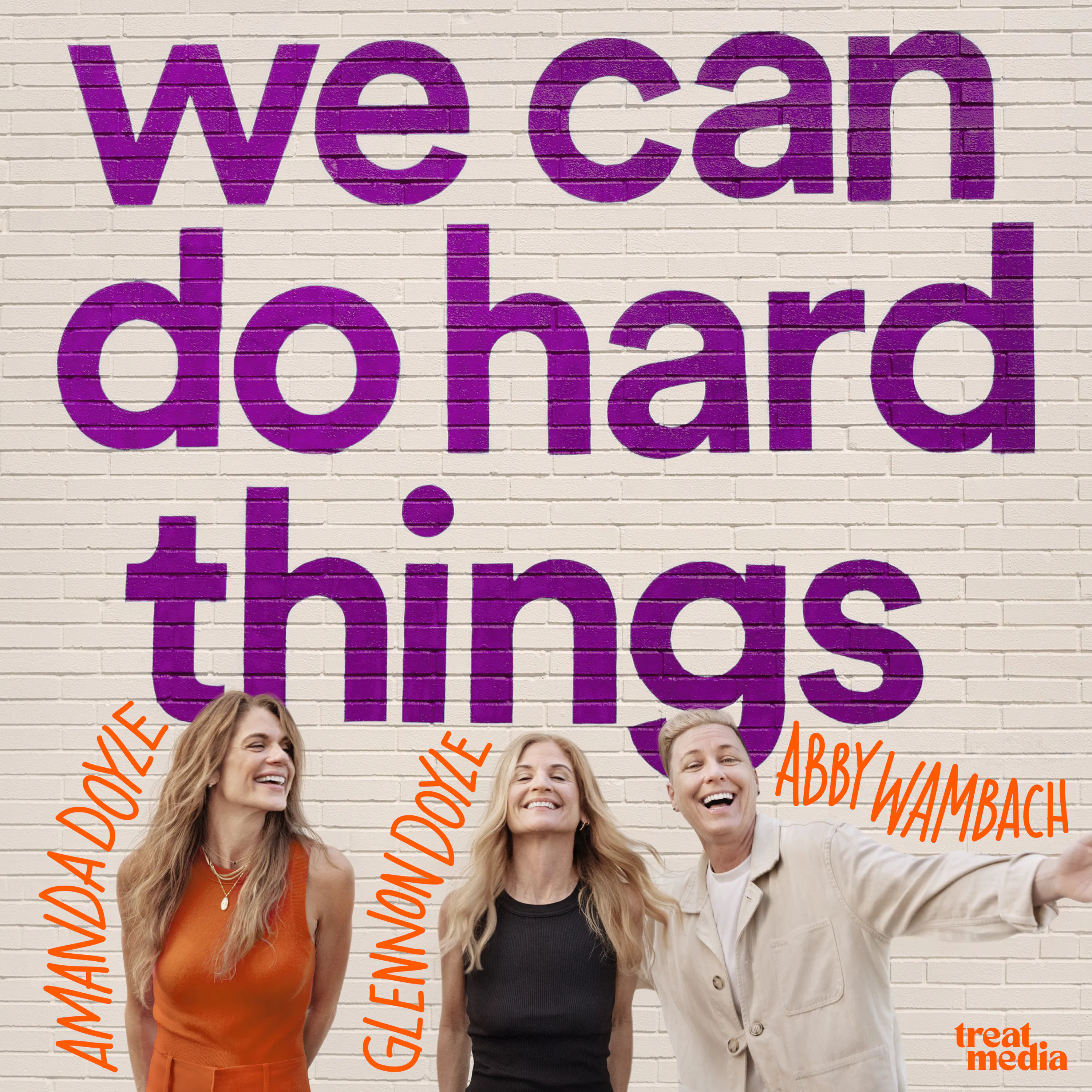
Loading summary
Transcript137 lines
- [00:08]
Glennon Doyle
We've begun. Hello. Welcome to we can do hard things right now. Before you, we were live, which we're not. But we're.
- [00:16]
Abby Wambach
They get them dyed.
- [00:18]
Glennon Doyle
Abby was picking an unreal. An unruly eyebrow off of my eyebrows. And then I asked of her and my sister, how do people not have gray eyebrows? All I have are some eyebrows that have been over tweezed from the 80s and never grew back. And then now they're just like mostly brown with 12 or 13 long gray ones sticking out. And I don't understand what other people are doing.
- [00:48]
Amanda Hirsch
They're dyeing them.
- [00:49]
Glennon Doyle
How are people dyeing their eyebrows?
- [00:53]
Amanda Hirsch
When you go to get your hair done, you ask them to do your eyebrows and it takes literally five minutes. I think that is malpractice on the part of your person.
- [01:05]
Glennon Doyle
Do you do that? I do. I've never seen anyone in any hair salon getting their eyebrows dyed. Did you know that was a thing?
- [01:14]
Abby Wambach
Yeah. And I think you've done it before.
- [01:16]
Glennon Doyle
I've never gotten my eyebrows dyed. Oh, I've gotten my eyebrows. I have gone to a place that is an eyebrow place, and I have laid down this.
- [01:27]
Abby Wambach
Have you ever had your eyebrows tinted a different color?
- [01:30]
Amanda Hirsch
No.
- [01:31]
Glennon Doyle
I've had things carved into my eyebrows. Carved? Yes. I've had a knife.
- [01:37]
Abby Wambach
Microblading? Yes.
- [01:39]
Amanda Hirsch
Is that the blade part of microblading? They blade into your skin? Yes.
- [01:44]
Glennon Doyle
And honestly, it was a bridge too far.
- [01:46]
Abby Wambach
I don't know if you know what you're talking about. I don't think that's it.
- [01:50]
Glennon Doyle
That is possible.
- [01:51]
Abby Wambach
They literally put individual hairs in.
- [01:54]
Glennon Doyle
Honey, that is not what happened. I was talking to the person. She said, this is a small knife. This is like tattooing something onto your.
- [02:01]
Abby Wambach
Oh, so they were tattooing you. They weren't blading you?
- [02:05]
Glennon Doyle
I think they were. I think it was a very small knife.
- [02:08]
Amanda Hirsch
Okay, well, someone who knows anything about anything we're talking about, because clearly we do not tell us the options available to middle aged women about their eyebrows. It's also an option just to keep them gray. It's beautiful. For me, I feel like it's a little Frida revolution that every time I go and to a place and they say, would you like us to clean up your eyebrows? As if. Of course you should clean up your eyebrows. I say, no, thank you. Is there any way you could make them bigger and more prominent? Because I feel like it's a little revolution. So I get them dyed so. So that they leap off of my face into other people's faces. But we should Know the blading? Because that sounds aggressive and violent, frankly. Violent. I don't think that needs to happen anymore.
- [02:56]
Glennon Doyle
I'm thinking right now that I'm kind of annoyed with everyone who's ever done my hair that they don't tell me about this. But then I also think it's a tricky position to be in for them because I'm thinking about it, and now I'm thinking of every time I've ever gotten a manicure, and the person doing the manicure looks at me and says, would you like me to add an appointment for your chin hairs? And I'm like, I didn't bring that up. Like, I didn't know about it. Maybe they think I'm doing this on purpose.
- [03:22]
Amanda Hirsch
Right, right. They're like, that's her trademark. Her chinny hair, Mark. Trademark.
- [03:26]
Abby Wambach
Okay.
- [03:27]
Glennon Doyle
Speaking of Webbies, this is a cool morning because we woke up and went about our little day and had our coffee, and then Allison wrote us a text.
- [03:42]
Abby Wambach
Alison from our team.
- [03:43]
Glennon Doyle
Everyone knows Alison. Right?
- [03:44]
Abby Wambach
But I don't know. I just want to make sure that
- [03:46]
Glennon Doyle
Alison wrote to us and said, you guys, we just won a Webby, which a Webby is kind of like the Oscars for the Internet. Right.
- [03:57]
Amanda Hirsch
I love that. Which, remember, we didn't win. So this means even more.
- [04:02]
Abby Wambach
Yes, we lost the Oscar, but we won the Emmy.
- [04:05]
Glennon Doyle
Wait, no, we didn't win an Emmy.
- [04:07]
Abby Wambach
Webby.
- [04:07]
Glennon Doyle
We won a Webby.
- [04:08]
Abby Wambach
Misspoke.
- [04:09]
Glennon Doyle
And since we won a Webby, we are only four steps away from an egot. Okay. There's many reasons why we think this is cool this morning. Honestly, we are not good at celebrating anything that happens to us. Okay.
- [04:22]
Abby Wambach
No, you are not.
- [04:24]
Glennon Doyle
Right. So over the last lo so many decades that we have been working, we have gotten awards before. We have lost a lot of awards, but we've gotten awards, and we just don't necessarily, like, feel them or they don't matter to us.
- [04:42]
Abby Wambach
They matter to us. But I think that you specifically. And Amanda, I don't know if you relate to this, but, like, I don't know if it's an expectation or you're too afraid to be vulnerable to celebrate the thing because that proves that you actually cared about the thing and it was important to you. I. I think it's a test of vulnerability. The folks that struggle a lot to receive presents or celebrate, like, awards or whatever they are.
- [05:08]
Glennon Doyle
Yeah, I think that's probably true. And I think I don't ever celebrate things publicly because I think I have learned over the previous aforementioned lo so Many decades, that sometimes it's hard for the public to celebrate a woman who's winning.
- [05:29]
Abby Wambach
Right.
- [05:29]
Glennon Doyle
That it's much easier for people to feel comfortable when a woman is not saying, yeah, here's a good thing I did.
- [05:39]
Abby Wambach
Yeah.
- [05:40]
Glennon Doyle
Or is proud, right?
- [05:41]
Abby Wambach
Proud.
- [05:42]
Glennon Doyle
Like, I think a proud woman is very hard for people to celebrate. Yeah, I get that. I'm not even, like, completely judging it. I think it's in the air. It's in us.
- [05:51]
Abby Wambach
It's Amanda. How are you celebrating? Because I feel like you might be along the same lines as your sister Glennon.
- [05:57]
Amanda Hirsch
I feel grateful and gratified when things like that happen, but I think it's two parts. I think it's like, whatever's happening today is the thing that's more pressing. You know, that's just like, well, that happened. That's great, and what are we doing today? Kind of a vibe. But I also think it's. I think it's maybe kind of a leveling thing, because I also don't ever get upset if we don't win anything. I feel like it's like you put out what you can. You do your best to put out the thing that you think is what you can do that is also what the world needs, and then you have no more control over it. So I don't feel like it means any more that you got the award than that you didn't get the award as long as you're putting out the thing that you feel good about. So I don't know. I. I feel proud of what we've done. I think that in this case with the webby, this time, it feels special because of two reasons. One, that all of that effort that we made to be independent, it feels like kind of a referendum on that because we did all that work to become independent. We were able to put out a lot of different type things that we couldn't before, which feels like maybe this webby is a response too. And that feels very gratifying because it's connected to that particular thing. And then it also feels like, wow, we've been at this for five years, and it still means things to people. That feels encouraging and exciting.
- [07:33]
Abby Wambach
What if we're doing this when we're 70?
- [07:36]
Glennon Doyle
Let's get specific about what Amanda was just referring to, which is the going independent. We haven't talked about that a lot, and I do want our content community to understand a lot was going on behind the scenes that we weren't talking about up front. Because sometimes when things are, like, in the stage where they're falling apart. You have to just keep toeing the line until you can understand or keep, keep moving until the new thing is formed and then you can see it clearly. And basically what happened over the last few years is what has happened to a lot of people in this space, which is that we had been for a long time tied to a large corporate media company, okay, who was like producing the things we put out in the world. And this podcast, what we found over time, through many different small and big instances, was that people who are committed to speaking what is true to them and what they see in the world that is true and are not able to censor themselves or adjust themselves in a way that matches the wind of the moment were having to make a decision which they were having to sort of quiet themselves or realign themselves with. People who were saying, we need you to tone it down. We need you to not say that word. We need you to stop saying fascism. We need you to not say Palestine. We need you to stop. And that was said to us in overt and covert ways. Over time, we realized we had no choice but to remove the middleman between us and you, because the middleman needed to make the message different in order to kiss the ring of the fascist wind that was blowing. So what we did was spent a solid year, maybe longer, just learning every single thing we could about what these actual middlemen do, what a media company does, what they were trying to convince us we needed them for. And. And then we just slowly and messily figured out how to become it ourselves. And it was messy and long and painstaking and it was me and Abby and Amanda and Valerie and Audrey and Allison. And we just kind of figured it out and cobbled together something the best we could. We named it Treat Media because we were just like in a three day slumber party trying to figure out what the name is. Cause that's always the fun part at the end. And, and we loved the word treat number one because we felt completely committed to creating art that is healing, but also that is delightful art that delights and heals. And treat means both of those things. And then also Alison, who has since the beginning of this whole public journey, for 20 years, however long this has been, you know I'm not good at time Forever, for millennia has been the most solid, steady, creative force, anchor, caretaker, wind of this whole frickin operation. Alison's mom, kp. Every time as Allison was growing up, every time something good happened or Allison's mom wanted to give her something special, she would say, this is going to be a real tr. And that was how she said, treat. This is going to be a real treat. But it's kind of weird because it's longer than Treat. It's like a nickname that's actually longer. Anyway, so over time, Alison would always say to us every time something good happened, like Wenowebby, this is a real tr. The word treat also has TR in it, which is Together Rising, which was the activism arm behind our operation for so long. It also has the word eat in it, which it's always helpful for me to remember. There was a lot of. Of things we liked about it. You guys jump in. What are you thinking about this?
- [11:39]
Abby Wambach
Well, I think all of what you're saying is really so true. I think one of the most important things for me when we decided to do this is looking out in the media landscape, we just felt like we could figure this out. And not because we didn't enjoy some of the people that we worked with, because some of the people were great. But to have your own thing means that you're the ones that get to decide things, whether it's what you put on, whether it's who you're advertising with. It also gave me an incredible opportunity to start my own show with Julie
- [12:20]
Amanda Hirsch
and Billie Jean called Welcome to the Party, available wherever you listen to podcasts.
- [12:25]
Abby Wambach
Thank you. Thank you, Amanda. And I think that with the way that the world kind of was feeling a year ago and the distrust that people are feeling so much with the media landscape, we just didn't want to have any barrier between us and our pod squads. Right. Or party people, like we call on. Welcome to the Party. What we have found, though, it was a lot of information that we were learning, and it was hard to figure this all out. I've been, like, really impressed by all of us and proud of all of us, because oftentimes what these middlemen do is that they pretend that it's really complicated behind this door.
- [13:04]
Amanda Hirsch
Yep.
- [13:05]
Abby Wambach
And that we'll never be able to figure it out, and it's just too hard and it's too complicated and that we will never understand. And what we have found is it is not too hard and it is not too complicated. Yes, it took time and effort, but by the three of us. But we have figured this thing out in a way that feels, like really natural and true to all three of us, because now we're not at the mercy of anybody else. This is us. And we are not in a contract with a production company that forces us into publishing 1 million episodes a week to come to make that contract solid. You know what I mean? So it's just. I just feel happy and approving.
- [13:47]
Amanda Hirsch
I mean, really, I think that systemic piece you just named is huge because it does feel like it mirrors a million times over in personal life and business life for people. But specifically, that is the thing that the few things that you mentioned were, you know, what we could talk about and what we couldn't talk about, which we were constantly railing against. I mean, we weren't saying, okay, that sounds good. And so that was creating a lot of frustration and animosity and just resistance on all sides. Then, okay, downloads need to be X, so you need to put up Y number of episodes. And the constant pressure of that, where there's some kind of contractual obligation where that was not within our control of what we wanted to do and what we thought the audience wanted to receive. And then third, the approvals on ads, like what percentage of ad offers you need to accept. And so that's like the real nitty gritty behind the scenes. And so I think opting out of that and it needs to be named because we have the privilege to do so, because we have enough resources, because we are in a position to have a higher level on our integrity of what we wanted to talk about than we had a need to receive the money from those advertisements that we wanted to be in a position to say, if that person doesn't want to pay us to do the ad, that's fine. We don't want to have that money as opposed to this person's offering. And therefore, you have to accept it. And that is a very privileged position, a privilege that, you know, we have worked really hard to cultivate. But since we are here, it didn't make any sense to be playing by rules. That literally cost us too much in the integrity piece to deal with. So I think getting to this place where we can say, you know, if it's something we want to do, we'll do it, is the greatest kind of freedom and liberty you can have. And we were privileged enough to have that. So what we needed to build around us was not, there's someone holding all the cards. The cards are the production of your podcast. The cards are the ad sales. The cards are, you know, the amount of money that we are going to pay you for doing your podcast. In exchange for that, you give away all of these rights, and you have all of these obligations. What we said is the we want to take all of the risk and all of the rights on ourselves. And then we want to choose who we work with. So we want to find, you know, initial who is producing our podcast in a beautiful way. We want to find an ad sales team that knows that they could bring us a thousand ads a week and we could accept all of them or none of them, and they wouldn't have anything to say about it. So we started working with that ad sales team. Like, we could pick who we wanted, and the risk is it doesn't work. In which case that's fine, because the other way was not working even more. And I think that does happen over and over and over again. To say, like, okay, here's someone who has solved all the problems for you, whether it's a business or an employer or a partner. You don't have to think about anything. But there is always a cost to that. There is always an implicit or explicit bargain that you are making that curtails your choice and that forces you into things. And so that was, I think, the beauty of this, of being able to be in a position to be like, we don't want to have everything you're offering. And we can take the risk of figuring it out knowing that whatever we decide, we can bear the consequences of.
- [17:32]
Glennon Doyle
And, you know, there's just this constant recurring theme that I have certainly noticed throughout my career where there's like, a locked door of people who are like, just do your thing. You need us in this room to do this thing for you. And there is the repeated suggestion that the reason I shouldn't go into that room and ask questions about what's going on in that room is because it's just too complicated. The more times it becomes so uncomfortable that I actually have to go in that room and say, what I realized is that the door is usually closed, not because what's going on there is too hard, but because what's going on there is too easy. Because the people at that table, they're so wise and skilled and doing things I can't understand. It's. They have to keep me away because it's easy to understand what they're doing there. Because if I dug in and rolled up my sleeves and asked enough questions and stayed really awake and learned, we wouldn't need anyone at that table for all the suggestions that we weren't going to be able to do it, that so much would be lost. I just want to say that the year and a half since Treat has been created, we launched the We Can Do Hard Things book, which was a New York Times bestseller. We made our first co produced, executive produced our first film, which was nominated for an Oscar.
- [19:05]
Amanda Hirsch
Come see me in the good light.
- [19:06]
Glennon Doyle
Come see me in the good light.
- [19:07]
Amanda Hirsch
Go see it in the good light. Beautiful on Apple.
- [19:10]
Glennon Doyle
We for the first time really completely took the reins of producing this podcast. We were just nominated for a webby we launched welcome to the Party, which has been a phenomenon in the sports space and will continue to grow.
- [19:28]
Abby Wambach
And by the way, I just want to thank you both for that because I was thinking about this the other day. I didn't realize how much I missed the home that I built for myself called women's sports. And what you both offered me was this ability to create this thing and find the right people, which I did in Julie and I did in Billy and the whole team at welcome to the Party is just so phenomenal. And I love going to meetings. I cannot believe I'm saying that out loud.
- [20:03]
Amanda Hirsch
I can't either because Abby hates a meeting, y'.
- [20:06]
Abby Wambach
All.
- [20:06]
Amanda Hirsch
Yes, it's the only thing she hates, really.
- [20:08]
Abby Wambach
I know I have a content meeting in a couple hours and like, I'm excited to like, see my co workers and friends and talk about all the things that are going on in women's sports. And I just didn't know that I needed this 10 year break away from women's sports to heal in a way that when I walked back in the door of women's sports, I was a different person. I've been able to soak up all the goodness, the incredible, I don't know, it's just home. And I'm grateful to you both.
- [20:37]
Glennon Doyle
It's so beautiful.
- [20:49]
Ad Voice 1
This episode is brought to you by MIDI Health. If you've recently gone from freezing to sweating in under four minutes, listen up. Because so many women hit this stage of life and get told their symptoms are no big deal. And that is exactly why MIDI exists. MIDI Health is a virtual care clinic built specifically for women in perimenopause and menopause. It was created by women for women and they're really focused on getting people actual support instead of making them suffer through it and call it normal. They offer personalized treatment options including safe, effective, FDA approved hormonal and non hormonal medications, depending on what you need. And it's all online, super convenient, available 247 and covered by insurance. So if you're ready for some actual answers, MIDI is a really great place to start. Book your virtual visit today@joinmidi.com that's join M I D I.
- [21:52]
Ad Voice 2
Hiring isn't just about finding Someone willing to take the job. It's about finding the right person with the right experience who can actually move your business forward. And that's why, when it comes to hiring, I trust Indeed Sponsored Jobs. With Sponsored Jobs, your post gets boosted to reach quality candidates who actually meet your criteria. Skills, experience, location, all of it. So if you're hiring, stop spending time searching and start spending more time actually interviewing candidates who check all your boxes. Less stress, less time, and more results with Indeed Sponsored Jobs. And listeners of this show will get a $75 sponsored job credit to help get your job the premium status it deserves. Indeed.com podcast just go to Indeed.com SL podcast right now and support our show by saying you heard about Indeed on this podcast. Indeed.com podcast terms and conditions apply. Hiring do it the right way with Indeed Disclaimer this is a paid endorsement.
- [22:58]
Glennon Doyle
Today's episode is brought to you by Alma. A year from today, who do you want to be? Close your eyes for a second. Who is she? Is she less anxious? Does she actually sleep? Does she stop replaying that conversation at 2am I spent so many years thinking I could just will myself into being that person alone, with enough discipline, enough podcasts and enough books and enough pretending. And then I found the right therapist, and many things changed. Not because she fixed me, but because I finally stopped carrying all of it by myself. Alma makes it possible for you to find that person. Their directory has over 20,000 therapists, different specialists, backgrounds, identities, and 99% of them take insurance. You can even use their free insurance cost estimator so you know exactly what you'll pay before you book. A year from today isn't that far away, but it starts today. So get started now@helloalma.com we can. That's helloalma.com we can. What has happened with Amanda's podcast? It's everything that she was meant to do on the planet, and it's 100% why we won the Webby.
- [24:19]
Abby Wambach
I agree.
- [24:20]
Glennon Doyle
Like, all I had to do was shut the fuck up
- [24:27]
Abby Wambach
and we win.
- [24:29]
Amanda Hirsch
We're winning.
- [24:31]
Glennon Doyle
But I mean, seriously, watching Amanda do what she was meant to do, just be. Chase and Abby and I were talking about it for an hour last night on the couch. It's just so special. It's something no one else is doing. It's the way that you see the world and dig in and show us what's underneath. Like, you're like picking up a rock and showing us all the cockroaches that are running around and then showing us the way out. And the thing we were talking about last night is that there are other people doing, like, hard hitting, world changing, like pushing us forward. But it always feels like it's also kind of being done for the interwebs. Like it's being done for like the likes, the viral moments or the like to really nail it in a sound bite. That's not what you're doing. You're like going head to head, toe to toe with these politicians, with these people. And you are like billionaires holding them to account and letting us see things in a way that causes us not just to say yeah, but causes us to say what next? Like, people are. I don't know.
- [25:39]
Abby Wambach
There's investigative journalism inside of it, but also with the spirit and the righteousness and the fucking rage of a middle aged woman who has children. Do you know what I mean? Yeah. And it's so fucking good. And also, by the way, you're a lawyer and you're smart as fuck and you're you. The way you present it, it's like so creative and it's so crafty and it's so smart. And like to be interviewing Representative Ronna and to be able to like really go toe to toe with this guy who is incredible on camera and has all the talking points. I don't know, I just was like, please don't run for office because we need you to do this thing. Because this thing is just as important as, and I think even more important to hold the feet to the fire of folks in Congress and our elected reps. Wow.
- [26:28]
Glennon Doyle
Thank you. It feels as if what has happened with Treat Media, what has happened with what you're doing now, what Abby's doing now, I remember at some point someone saying to me, since you all three are working together, the evolution of your work together will be a direct reflection of the three of yours relationships. And the three of your relationships will be a direct reflection of the work each of what you do internally. It feels to me like when you take a step back, it is all of that. We have looked at the systems we were involved in, looked at our privilege, looked at all of it and said, actually, it's time to grow up. We don't need Daddy. We don't actually need this person who's patting us on the head and telling us he knows more than we do and trying to tell us to be good girls. Mm. We're not gonna be Sleeping Beauty anymore. We're gonna wake up, we're gonna learn this shit. We're gonna just assume that we are as capable and smart, certainly, as the next guy, and that we can handle this. Not only did that happen, but the three of us did our individuation work. We always talked about love as being both held and free and also being fully free to be ourselves without stopping each other from being each other's selves. And I don't know how it happened, but it does look like that's happening. Like you're off doing your thing, which none of the three of us can do.
- [28:01]
Abby Wambach
Totally.
- [28:02]
Glennon Doyle
You're off doing your thing in a new, healed, beautiful way that clearly neither of us can do. I'm writing again.
- [28:10]
Abby Wambach
Every morning, she is in the chair writing. It's so fun. She won't tell me a single thing about the book, though, which pisses me off.
- [28:18]
Glennon Doyle
I haven't spoken a word about it to anyone for the first time, and I'm like 60,000 words in. But do you see what I'm saying? That it feels like everything happens and you can't see any of it, but that every once in a while you can stop and say, oh, my God, it looks like what happened looks like a manifestation of all of the things
- [28:37]
Abby Wambach
that we've been talking about on the podcast. Exactly. We can do hard things. It's like we all are doing our hardest thing right now.
- [28:45]
Amanda Hirsch
I know. I think that without the first four years of the pod, which felt to me like intensive therapy, I mean, all of those books that we just bathed in and marinated in and were like,
- [29:02]
Abby Wambach
we have absorbed your lesson.
- [29:04]
Amanda Hirsch
All of the wise people we talked to, all of the kind of questions that we pushed up against and the conflicts we had with each other as a result of those things, all of the. That I feel like made us in a position to be able to be blooming in different ways. I mean, I am an inertia queen. Like, I would have been like, okay, you're gonna be sitting there editing Glennon's books for the rest of your life. I would have been like, sounds great. It was all of the things, the conversations we were happening with on the pod and what that forced us all to be thinking about so much that I think led to, you know, Abby knowing that she could go do that, me being curious about what I'm curious about now, and you, Glennon, not feeling like you had to keep doing everything to keep us having something to do, you know? So I think that's very interesting, and it makes me feel really hopeful because it makes me think, like, I wonder if that is what it's done for Our community. I hope that's true. I hope that if it's happened for us and if people have been along the ride with us and thinking about and absorbing and confronting the same things, I mean, maybe it really has done that for a lot of people and that feels so special to me.
- [30:30]
Glennon Doyle
That would be amazing.
- [30:31]
Abby Wambach
We've really done a lot of codependency work over the last year without really talking about it.
- [30:36]
Amanda Hirsch
We've done a lot of codependency and a lot of codependency. Codependency work, yes, that's what we've done.
- [30:40]
Glennon Doyle
Abby talked for a minute about how it felt for her to be because she's kind of back in the sports world but as a new self and you're doing this whole thing kind of just in a completely new way with this new, like, how does it feel to you to be doing the work you're doing? What, what is the experience like?
- [31:01]
Amanda Hirsch
I mean it's been different with each episode. So we've done the billionaire one, the two part Epstein series, the Jared Kushner CIA, Iran one, and then the one on Tuesday about Congress's dereliction of duty with Rep. Khana. It feels cathartic and therapeutic to me. It feels very strongly about some things. And I feel like I see, it's like see something, say something. It's, it's like I see it, but then I never really know how it's gonna be received because it makes, I just have to trust. If it makes a lot of sense in my head, then maybe it makes sense, but I don't always know that it will. And so it's been encouraging to have people respond so strongly. Like I just feel like we live in such, such a tremendous overpowering force of gaslighting right now where if you have eyes to see, you can see that. Of course, of course 12 people shouldn't have the same amount of money as half of the US population. Of course those people didn't get there by hard work. Of course it's from this tax subsidy that you middle class person paid for and we can point to it and show, but yet we tell ourselves that they got there because they're super clever. When I can literally point to the part of the tax code that says that you paid for them to get rich, like, of course that doesn't make any sense. But we live under these stories that are so strong and so pervasive and it makes sense that the stories are so strong and pervasive because there is a very compelling interest on us continuing to tell ourselves those stories, because those stories are. Are how the people in power not only got to that place, but keep that place. And so it makes sense that there are not as pervasive a counter story to that. And so I just feel excited. You know, I. I keep thinking of it like a Jenga set, where it's like each little thing might be so little. It's just a little bitty thing in the scheme of things. But when you pull it out and look at it, the rest of the structure gets a little less impenetrable. And there's just like a nerdy piece of it too. You know, I sort of resent that. There's so much on fire. Because what I really want to do is like, have you ever realized how half of the language and the words we use are results of, like, colonialism? Did you ever think about why marriage as an institution exists? Do you ever think about, like, like all these little things that I think are so, from a nerdy perspective, fascinating, and how they just kind of inserted themselves in our lives and then we just built our lives around them without questioning any of them and without thinking about how they reify our oppression every single day. And we actively participate in that. And so like, when you're sitting with
- [34:25]
Glennon Doyle
your husband and you're like, trying to figure out whether you're going to go by Ms. Ms. Or Mrs. And you're like, how do you figure it out, dude? How do you decide between whether to go by Mr. Wait? So you don't choose your prefix based on your relationship status. So you just stay a full person your whole. Wait.
- [34:48]
Amanda Hirsch
Well, you stay a whole person and you stay the person you were born as.
- [34:53]
Glennon Doyle
They sure do they. Which is hell do.
- [34:55]
Amanda Hirsch
Which is keeping your last name. I mean, that's a whole nother thing. It's like, okay, so you get there and you're like, we think of it. It's just like a thing where it's. You're just deciding that based on, I don't know whether you're a feminist or not. Like, it's a feminist litmus test. But we don't think about the fact that, like, that literally makes you untraceable to half the people you've made contacts with, to half of your resume, to half of your whole corporate or, you know, career structure. I mean, this is what I'm talking
- [35:24]
Abby Wambach
about, the way that I think about what you do, Amanda. And this is because I'm like a little bit of a crime junkie. You know how, like, the detectives put up like on the wall, all of, like the tax and all of the perpetrators and all of the things and maybe even a little map of some sort. And. And then they try to connect with rope or like, you know, colored rope from one thing to the other. And it feels like there are a million tax on your wall and that you're just looking at it going, okay, but how does this connect to this and what you do with each of your episode is like you really like get the red color rope and you're like, this is why this is happening. And to me, it just creates this nice, easy to understand approach to really complicated subject matter. And the connecting of the pieces is what is so fascinating to me because that takes an extraordinary amount of work, like a breadth of knowledge. And also the thing that you're saying is like, that it fascinates you, but it also, like, it irks you. They're like, why does this even exist? And so I just want to say that like, what you do is like, so what's the word? Like, you really try to dissect our culture in a way that's so cool.
- [36:44]
Glennon Doyle
It's really beautiful. Sissy. Also, we need a new name for it. I can't believe this is not bullshit. This is. You're not going to believe this bullshit is too long.
- [36:51]
Amanda Hirsch
You're not going to believe this bullshit is how we started. Yeah.
- [36:53]
Glennon Doyle
If anyone has any ideas that them.
- [37:04]
Abby Wambach
Parents know that every so often the universe likes to send you a day where everything happens to go a little bit wrong at the exact same time. Someone couldn't find their shoes, someone else decided they hated breakfast, and I hadn't even had coffee yet. Okay, so now when life gets crazy, doordash helps bring some order to it. I've learned that having something like that in your back pocket is so important. Where you can just take one thing off your plate can completely shift your day. Because sometimes the win isn't doing everything okay. It's just making things a little easier so you can actually be there for your family. And don't even get me started. And how you can order medicine on doordash. It's not even a question for me anymore. If I'm sick, I'm getting the cough medicine or whatever it is I need just sent straight to my doorstep. They are lifesavers in those moments, especially when life gets crazy, doordash helps bring some order to it. Order.
- [38:05]
Amanda Hirsch
Now, have you noticed that no matter how carefully you plan for the week ahead, there is always things you find out your family needs about 30 seconds before they definitely, absolutely need them. Instacart enables delivery by superheroes who swoop in and save the party, the diorama and the sandwiches for tomorrow. Whether you are looking to meet those surprise needs without upending your schedule, or
- [38:28]
Ad Voice 1
whether you want to give yourself back the entire day it apparently takes to
- [38:31]
Amanda Hirsch
go grocery shopping, you can use Instacart
- [38:34]
Ad Voice 1
to get exactly what you need without
- [38:36]
Amanda Hirsch
sacrificing quality or specificity. That's why I really love using Instacart. I can go in the app, take my time, get exactly what I want, and no, I'm not sacrificing quality just because I need the convenience. Delivery through Instacart makes that whole process feel so much easier. Everything shows up on your schedule and it saves you so much time and mental energy.
- [38:55]
Ad Voice 1
And the best part is that Instacart offers delivery in as fast as 30 minutes.
- [39:00]
Amanda Hirsch
Instacart brings convenience, quality and ease right to your door so you can focus on what matters most. Download the Instacart app now and get groceries just how you like.
- [39:11]
Ad Voice 1
If you've always wanted that ever elusive flexible capsule wardrobe, now you can finally have it because of Quints.
- [39:19]
Amanda Hirsch
If you haven't heard of them, they
- [39:21]
Ad Voice 1
are an online retailer with clothing priced 50 to 80% less than similar brands. They work directly with ethical factories and cut out the middlemen so you're paying for quality and craftsmanship, not brand markup.
- [39:34]
Amanda Hirsch
My favorite new arrival from them is the stretch cotton jersey mock neck midi dress in Kalamata olive color. It's perfect for travel or work things. It's so cozy and comfy but looks very put together like you really tried and it's under 50 bucks.
- [39:52]
Ad Voice 1
Quince uses premium materials like 100% European linen, organic cotton and ultra soft denim. Their clothes best of all start at just 30 bucks. Refresh your everyday with luxury. You'll actually use head to quince.com hardthings for free shipping on your order and 365 day returns now available in Canada too. That's Q U I n c e.com hard things for free shipping and 365 day returns. Quints.com hard things.
- [40:40]
Amanda Hirsch
This is so funny because this whole episode was going to be a reaction to Rokana. Do you have any reactions to the rock?
- [40:45]
Glennon Doyle
Reactions?
- [40:46]
Abby Wambach
Yeah. Wow.
- [40:47]
Glennon Doyle
First of all, it was amazing. Your part we've already discussed. I mean the amount of times that he seemed stunned by you and was like actually maybe you should run for office. And I was like stay the fuck away from my sister. Not Today, Satan. Also, I did notice some things that I was like, okay, wait, why won't he answer? Like, why isn't he saying true things about Jeffreys? Why is he glossing over this part about why they didn't bring the vote to end the war to the floor and trying to distract us from that.
- [41:17]
Abby Wambach
Get it on the record.
- [41:19]
Glennon Doyle
The thing that drove me the most nuts, by the way. Love him, will vote for him, all the things. But I think I'm into the whole one foot in this world, one foot in the next. I want to be like, I've learned this from the last election. I feel like I did a lot of. We're just not talking about these things. We got to get through. We got to get through. We got to get this person in and we're not going to talk about the thing. And that was, I think, a mistake. Not in what, what I did, but the way I did it. And I want to do it different now, which is I still want to have one foot in this world and in reality and understand this is the system we live in. And encourage people to vote for harm reduction when it's too late, to have another option that's viable. But also tell the truth the whole time, just be like, this is our best option and these are the five reasons why this person sucks. Now go vote for them. Like, I don't, I don't know what else to do than that. So I have those questions. I still felt like he was evasive on several things that made me wonder. The part that bothered me the most was when you were talking about how these people, these Democratic congresspeople who are being so wishy washy, who are not doing the hard thing, who are not saying probably even what they really believe, and the only explanation we have for that is that they are valuing their security. They're still just reading the room, doing the math, and they're going to keep saying the thing that is least likely to get them ousted from their seats until that thing changes, and then they're going to say the next thing. This is how it works. There's no other explanation for that other than especially now at this time when the country and planet is in so much peril because of these madmen. The fact that they're doing it cannot be explained as anything else other than an absolute decision to protect their own tiny, ridiculous positions in power, to place that above their own children and grandchildren's future and the planet. It's a decision that they're making every single day. And when he Said, yeah, they're protecting their own comfort and their position. And it's sad because these are good people. That is where I wanted to stop everyone and say, what does good mean? What do you mean? That is our problem. Where's the goodness? Point to me, to the person who has been elected, who swore to protect our constitution and the future of our children, and yet is doing nothing. Point to the goodness. Where is this earned goodness that we are. No, no, that is not a good person. That is not a good leader. That is bad. It is bad and treason to protect your own tiny comfort instead of doing the job that we elected you to do, that you swore to do. There's no goodness in that. So that really bothered me. It was a small thing he said that I think points to the root of a lot of shit.
- [44:17]
Amanda Hirsch
I don't even know what good is. Like, I don't even know what that word means. And also, by the way, I don't need my electeds to be good. I need them to do their goddamn jobs. I don't care. Like, I don't know what good is. I know what your votes have been. I don't need that. And I don't even know what anyone's definition of good is. Like, are you really nice to your grandkids? Do you buy Girl Scout cookies? Do you not yell at people at baseball games? Does that make you good? Because I don't give one flying fuck about that. Like, I need you. I mean, I do want you to be nice to your grandkids, but like
- [44:58]
Glennon Doyle
nice to your grandkids to let their planet go up in smoke. I don't think that's nice to your grandkids.
- [45:03]
Amanda Hirsch
Not for nothing, the idea of good, I think that you've identified something that is just endemic. Like the every time someone accuses someone of assault or of harassment or the invariable response from everyone who knows that person is, but he's a good man. Yeah, but. But it doesn't matter. I literally. Your perception of this person is irrelevant to anything that we're talking about.
- [45:40]
Glennon Doyle
So I don't think it's even personal perception. It's like how people think white means neutral or good. I think people just naturally defer to a man who is doing nothing or doing bad things. It's like that himpathy that Kate Manne talks about, this like natural instinct for us to ascribe goodness or pity upon men that we just think good is this thing we ascribe to all of them.
- [46:05]
Abby Wambach
It's like their get out of jail Free phrase. Maybe you're nice to your grandchildren, maybe you tip Your service people 20%, and then you don't vote in a way that's going to protect us. All of that is just lip service. It's a political tact and a ploy to make us be like, look over there, an eagle. You know, and it's just this politeness,
- [46:27]
Glennon Doyle
this, like, idea of civility or like, an act as goodness that says, look at what I look and say and the words I use, and don't look at what I do or don't do to measure me.
- [46:39]
Abby Wambach
I also think what Amanda's saying is very true for me, too, that it's like, I don't care about your personal life. They agreed to swear an oath to this country, to their constituents, that they would make the best decisions for their people. And the problem that I have with all of this is that it's just so dishonorable.
- [47:01]
Amanda Hirsch
The only oath they make has nothing to do with their constituents. It has to do with the Constitution. That is the oath that they take. So, like, in this situation, it couldn't be more obvious. It would actually be more understandable for people to be making the weird decisions that they're making, the weird votes they're making, if it was to the constituents, because constituents could agree that we should throw immigrants into concentration camps without due process. The constituents could agree that Trump should be able to federalize and nationalize the elections. It's actually even more simple than that. The Constitution says that Congress has the exclusive power to declare war, that Congress has the exclusive power over the purse. That Congress has, like, it is black and white and literally written on a piece of paper. So when we're talking about how people are voting and more specifically, how leaders are giving cover to those people by not calling votes so that they are on record for either voting or not voting a certain way, then that is a direct dereliction of their duty. And in this case, in this constitutional crisis world we're living in, it's a direct violation of the highest duty, which is to uphold the checks and balances that undergird and stabilize our entire nation. So it is the ultimate treason, in my view, to place your own political aspirations to keep your job secure while you jeopardize the future of the Republic.
- [48:46]
Abby Wambach
I think what you just said is actually really important because I didn't ever think about it this way or know about that. Like, I didn't realize that their oath is to the Constitution and to the nation. And what I am now just realizing is that when they are trying to appease the constituents, that's all about getting reelected.
- [49:04]
Amanda Hirsch
And it's triple worse than that because it's often not even the constituents. It's the people who are funding their reelections. They're trying to make it seem that this is what their constituents want. Or if it's not what the constituents want, they're explaining that actually, constituents, you do want it this way. And let me explain it seven ways to Sunday that don't make any sense. So you convince yourselves you wanted this thing that is really in the special interest of the super PAC that is funding my reelection. So it's actually not even cowering to constituencies. In most cases, it's to the their funders.
- [49:40]
Glennon Doyle
No, that's how you get a Cory Booker who's constantly just coming on Instagram and saying, trump, we hate Trump. You hate Trump, I hate Trump. We all hate Trump. Using Trump as a galvanizing thing to make people feel good about him while consistently voting with aipac, that is an appeasement of the constituent while actually acting on behalf of the donor again and
- [50:02]
Amanda Hirsch
again and again and again. And that's Jeffrey's issue. The reason that Rep. Khana can be so overt about Schumer needing to go is because Schumer is the Minority Leader of the Senate and Rep. Khanna is in the House, and the Minority Leader of the House is Hakeem Jeffries. But if you look at the APAC record, Schumer has taken over 1.7 million of APAC money. And Hakeem Jeffries has also taken 1.7 million in Israeli lobby money and 850,000 from AIPAC itself. So he is compromised for the same reasons. And this is where politics gets dirty, right? This is where it gets confusing because Rep. Khana wants to be part of a progressive leadership that can get things done in the House. He wants to be able to push his billionaire tax forward, which I fully support. He wants to be able to do a lot of really important things, which if he gets sidelined by Jeffries for calling Jeffries out, he will be less likely to be able to get done. So it's a very confusing situation, but that's how we ended up with all of this just wishy washy, don't feel good about anything issue. And it all comes down to money. It all comes down to the Supreme Court Citizen United ruling, which said that any amount of money from any corporation can come into elections. And I just want to say one thing about APAC because it's really interesting the way that, like, things have changed over time. So aipac, as if everyone doesn't know, is the Zionist, Netanyahu aligned regime lobby effort. They have given, I think $217 million to politicians in the last few decades. It's interesting to watch Democrats kind of step a little bit back from that when they've always been all in. And I just want to say something about that because there is this perception from some groups that to say that AIPAC money needs to get the hell out of politics is somehow anti Semitic. And I just want to address that head on. Because first of all, foreign interference in any regime, like if there was a pro Russia lobby group that was the highest funder of half of our Congress, we should be very worried about that. Okay. Any foreign influence, it's literally in the Constitution that we're not supposed to have foreign influence over our politicians. Secondly, there is a huge distinction between anti Zionist Israelis and the Zionist regime of Netanyahu. The same way there's a distinction between anti Trump Americans and. And the MAGA regime of Trump.
- [53:10]
Glennon Doyle
That's right.
- [53:11]
Amanda Hirsch
And it's an act of generosity. When the people around the world can look at us and say, I know that you, American, is not synonymous with Trump and maga. I feel grateful. I feel safe, safer. I feel as it is an act of generosity toward me. I also know that I am imperiled and the future generations are imperiled by what he is doing. And what I would say is I too know that Jewish people are not represented by Netanyahu.
- [53:57]
Glennon Doyle
Absolutely.
- [53:58]
Amanda Hirsch
And I will continue to rail as aggressively against Netanyahu and the right wing, dangerous Zionist regime as I will against Trump.
- [54:15]
Glennon Doyle
Yes.
- [54:16]
Amanda Hirsch
And I would welcome others to do so.
- [54:19]
Glennon Doyle
That's right. And it also has to do with religion, the separation between discussing religions or discussing nations. I would never say to a group of people, stop criticizing Trump because that's anti Christian. I'm a Christian. I can see that what Trump is doing is not Christian just because he says it is just because he's rallying the Christian nationalists like all of these land hungry, power hungry men do they know that the only way that they're missions will be sanctioned is if they call it God's will. And so they rally their religious troops around their thing. And those of us who also share the name, because I am a Christian, I must loudly denounce what Trump is doing as not Christian, but anti Christian. And I will never turn to anyone who is resisting what Trump is doing and saying, don't you do that. That is anti Christian. Because the most Christian thing that anyone in this nation can do is all they can do to stop fascism. We Can Do Hard Things. We'll see you next time. We are proud to say that We Can Do Hard Things is an independent production brought to you by us, Treat Media. Treat Media makes art for humans who want to stay human. And you can follow us at We Can Do Hard Things on Instagram.