Loading summary
Transcript79 lines
- [00:02]
Brooke Devard
ACAST powers the world's best podcasts. Here's a show that we recommend hello hello, it's Brooke Devard from Naked Beauty. Join me each week for unfiltered discussion about beauty trends, self care, journeys, wellness tips and the products we absolutely love and cannot get enough of. If you are a skincare obsessive and you spend 20 plus minutes on your skincare routine, this podcast is for you. Or if you're a newbie at the beginning of your skincare journey, you'll love this podcast as well. Because we go so much deeper than beauty, I talk to incredible and inspiring people from across industries about their relationship with beauty. You'll also hear from skincare experts. We break down lots of myths in the beauty industry. If this sounds like your thing, search for Naked Beauty on your podcast app and listen along. I hope you'll join us.
- [00:52]
Jack Lawrence
A Better Help Ad hold on one
- [00:56]
Brooke Devard
second, I just need to. What if you had a room where no one interrupts? No notifications, no expectations, just space to talk with BetterHelp therapy happens in a space that's yours. Visit betterhelp.com randompodcast for 10% off your
- [01:21]
Jack Lawrence
first month of online therapy.
- [01:24]
Brooke Devard
This is a Monday.com ad, the same Monday.com helping people worldwide, getting work done faster and better. The same Monday.com designed for every team and every industry. The same Monday.com with built in AI scaling your work from day one. The same Monday.com that your team will actually love using the same Monday.com with an easy and intuitive setup. Go to Monday.com and try it for free. Yes, the same Monday.com.
- [02:03]
Jack Lawrence
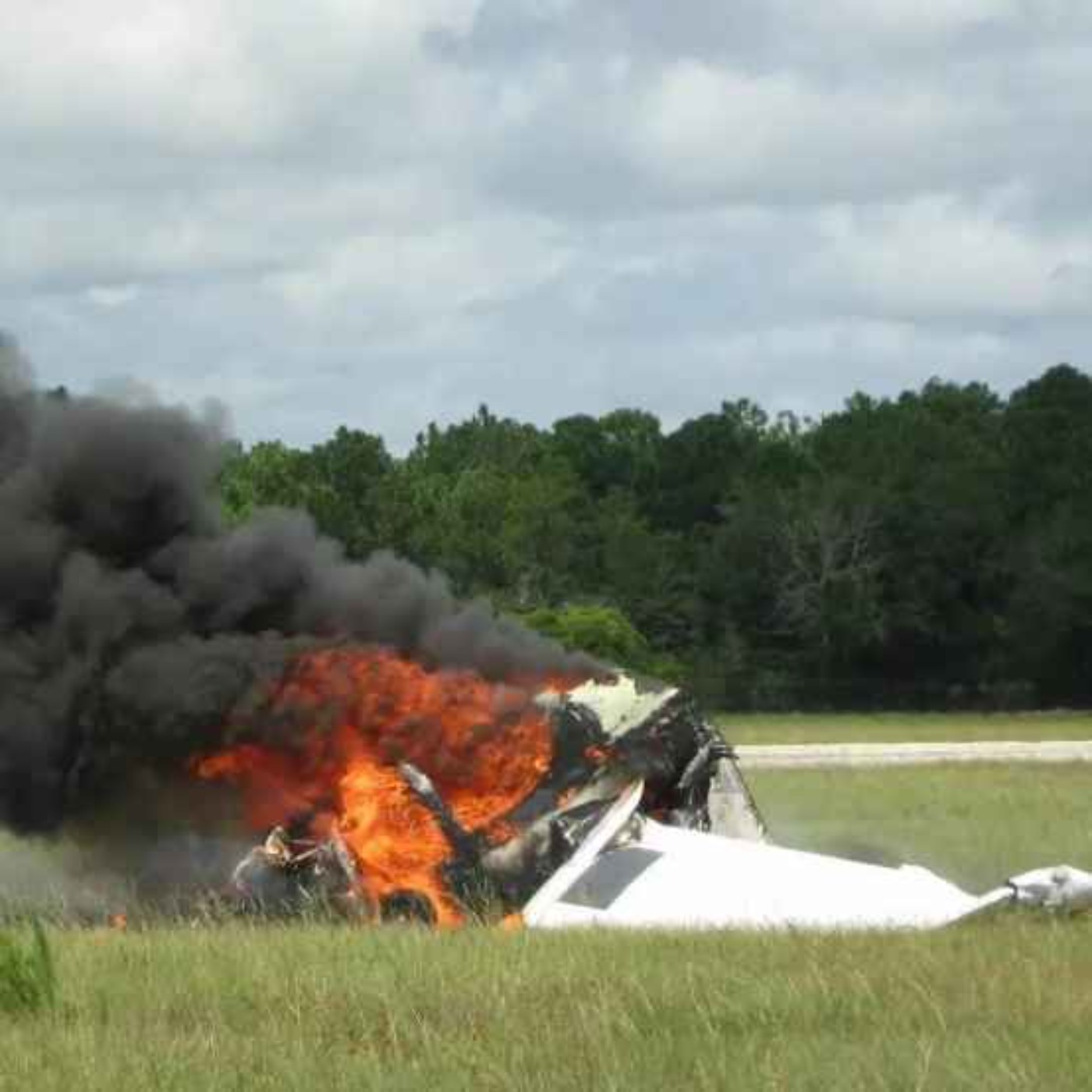
They say learning to fly isn't just one of the most difficult things a person can do. It's also one of the most freeing. The experience of piloting a plane solo, thousands of feet in the air, looking down on the world below is like nothing else. And that was a dream for Jamie Hull. One that he'd carried since childhood and one he would later work hard to make a reality. But the dream that so many people chase each year, that feeling of total freedom above the clouds would very quickly become Jamie's living nightmare.
- [02:38]
Jamie Hull
I noticed my first alert. If you were looking at left hand canopy window, saw a thin streak of visible yellow orange flame. I'd looked and looked again. I thought, this is what I think it is. I've got to get this aircraft down.
- [02:50]
Jack Lawrence
Thousands of feet above the ground on a solo training flight, Jamie was facing quite possibly the worst case scenario imaginable.
- [02:58]
Jamie Hull
The only option I had was to try to Shut the aircraft down, steer it in, and then set myself up for exit, which is exactly what I did next.
- [03:06]
Jack Lawrence
His small plane had caught fire, and it was now a race against time to get back on the ground, not just safely, but alive as it breached.
- [03:17]
Jamie Hull
As I turned into wind, I looked down at my feet on the rudder pedal and I could see the flames starting to lap around my feet and my ankles.
- [03:26]
Jack Lawrence
Jamie would survive that fire, but the real fight had only just begun.
- [03:32]
Jamie Hull
There was a switch in my mind. Cognitively speaking, it went from abject anger to the most hideous grief imaginable.
- [03:42]
Jack Lawrence
But of course, before we get to all of that, we need to start at the very beginning. My name's Jack Lawrence. Welcome to what I survived.
- [03:52]
Brooke Devard
Moon in the sky I'm looking at the moon in the sky this shouldn't come as a surprise but I can't
- [04:02]
Jack Lawrence
sleep
- [04:05]
Brooke Devard
War in my mind I'm trying to fight a war in my mind I don't know who's the winner tonight but it ain't me.
- [04:24]
Jack Lawrence
Chapter one, the Very Arduous Pea company Jamie Hull has always been an adventurous guy, something that would later see him take on some of the toughest challenges the British armed forces had to offer. But as a youngster fresh out of school, he decided to do what many Brits do in their later teens and early 20s and headed off into the world to go backpacking.
- [04:48]
Jamie Hull
And I bought this round the world ticket, sort of 19 to 20 years of age. When I actually left and I'd saved up a load of money, it was about £6,000, which was probably 2 to 1 on the dollar back then. So he's probably talking 12,000 Australian dollars in 1995. That was quite a lot of cash.
- [05:07]
Jack Lawrence
Yeah, big cash there.
- [05:08]
Jamie Hull
And I actually went to Africa and mostly Australasia on that trip. I mean, I spent just over a year of my life down under and I flew into Perth and I sort of went across that the Nullarbor from Perth to Adelaide, but I went all around Australia. I worked in, in the north as a diver.
- [05:28]
Jack Lawrence
Being the adventurous bloke he was when he traveled north in Australia, he got himself work on a dive boat, first as a volunteer. But taking advantage of the opportunity, he quickly got himself up to speed with his diving. He got qualified as a dive instructor and then spent the next year enjoying the clear blue waters and beautiful sunshine that North Queensland had to offer, until eventually it was time to head home and find himself a career. And again, his thirst for adventure and something a little more fast paced would lead him to a career in policing.
- [06:00]
Jamie Hull
I joined a unit, a group called the Thames Valley Police, which occupies the west side of London predominantly. And that was me screaming around the sort of force area, lights and sirens that is, you know, 24, 7 on a rotational shift pattern. And I did that for a good few years in my sort of early 20s when I got back from my backpacking. Never necessarily planned to do it, it was just something that felt right at the time and, and I was chasing my tail. It felt like, you know, responding to emergency calls all over that force area eventually. And I was, I specialized as a medic. It's just typically sort of fast and furious and you're dealing with all sorts that are coming in the door, particularly in an urbanized kind of city, kind of built up environment. So that was me and that's what I did in my younger years. That was my initial career.
- [06:50]
Jack Lawrence
After a few years working in the police, Jamie felt drawn again to do more exploring. The backpacking had given him a taste for more adventure. And so he takes a sabbatical from the police and heads off overseas yet again to work as a diving instructor.
- [07:04]
Jamie Hull
And I went to work in the Caribbean, I went to work in Egypt, all over Egypt and the Red Sea. I went to work on a big expedition in the Philippines, very remote in the middle of the South China Sea. And then, you know, that journey took me far and wide, sort of Thailand, but I've since kind of like dived all over the world, including as far north as the Arctic Circle and, and in much more tropical locations as far as Malaysia, Truck lagoon in, in Micronesia and other parts of the Pacific. The world is what you make it. The world is your oyster, so to speak, but it takes a bit of effort and you've got to get out there. And I did a lot of that in my younger years. So that was the journey. But then I came back, right. I did a lot of this dive travel when I was younger on the sabbatical, and then I actually went off to university and that was quite late on because I figured, well, now might be a good chance to kind of consider, you know, utilizing the sabbatical for perhaps more academic purposes and boost my education and so on. I thought maybe the degree will be handy one day and so on. That was kind of like the thinking. And then when I went to university, I ended up joining. I did a, I did a sort of a full on languages program for about four years and ended up in Norway in my second year working in the mountains. It was all quite Random and remote work that I was doing there. But the joy of it was for me, and the way the story goes, that was when I joined the army.
- [08:34]
Jack Lawrence
While at university, Jamie found himself at the Freshers fair. It's that chaotic first week marketplace where clubs and societies, student groups, all compete for your attention and your signature on a sign up sheet. And as he's walking around taking it all in, he sees a man in an army uniform with a big handlebar mustache pointing straight at him.
- [08:57]
Jamie Hull
It's like that, that famous poster, hey, we need you, World War II, you know, your country needs you. But it was almost like that, you know, he's pointing this big index finger in my face as I'm walking along, but with a bit of a wry smile on his face. He said, you look like the material for the Officer Training Corps. And I'm like, what? What officer what? And he said, he's explaining it to me and I'm like, okay, okay, right, that sounds quite interesting. You know, he's trying to sell the concept of the army on a weekend club to me while I was a university student. And he said, guess what? You even get paid for this. And we've even got a bar, so subsidized beer on the weekend. And you know, when the activities are finished, you know, we often go to the bar and it's all fun and games and you know, it's very like minded with the colleagues that you're working alongside. And he said, and also we pay you a few quid, few pounds, you know, for your duty over the weekend. He said, you do drill nights and that's all we ask if, you know, turn up on a drill night on a Wednesday night and then you do the weekends. And he said, you don't always have to turn up to everything. You just do what you can outside of your sort of scheduled study. Anyway, this sounded too good to be true. And I guess I was quite a motivated student. Remember, I'd already done professional work as a diver, professional work as a police officer. So I was kind of used to, you know, if the alarm goes off, I've got to get up, right? But I just loved it. I just thought it was really social. I loved what the army had to offer. I loved the discipline.
- [10:27]
Jack Lawrence
And that was it. In many ways, it was everything. He'd been looking for something where he could get his hands dirty, achieve, push himself and come away feeling accomplished. And so he threw himself into it feet first.
- [10:52]
Jamie Hull
And then literally by the end of the first year, I'd done the equivalent of a green army soldier. Basic training as my first year for University Officer Training Corps with Cambridge. So it was wonderful experience. And again, I was only like mid mid twenties, I was 25 at the time when I joined and I just thought it was an amazing opportunity. And then in year two I was in Norway, so I kind of had to kind of step aside from it because my language is program and the degree took me there. But year three, I came back and I just plowed my heart and soul into it again. And then literally, I kid you not, but by the end of year three, because I was an exceptionally motivated officer cadet, I had already done by then, two Cambrian Patrols. These are elite patrolling competitions hosted by the British Army.
- [11:44]
Jack Lawrence
Now, to understand the kind of person Jamie was becoming, you need to understand what the Cambrian Patrol is. It's an annual military exercise run by the British army, widely considered the toughest patrolling test in NATO. Eight person teams are dropped into the rugged mountains of mid Wales and have just 48 hours to cover roughly 40 miles of some of the most punishing terrain on earth, carrying up to 70 pounds of kit on their backs. To give you some idea of what sort of conditions they're dealing with, Wales is the training ground for the famed sas. Along the way they face simulated enemy attacks, medical emergencies, water crossings and basically no sleep. It has been held every year since 1959 and soldiers come from more than 30 countries to take part. Finishing it at all is considered an achievement. Finishing it with a gold medal puts you in an elite category altogether. This was the world Jamie was moving in.
- [12:48]
Jamie Hull
And the weather was shit. I mean, this is Wales. Yeah, in November. The. The weather system is largely low pressure and horizontal. Rain, sleet, all the shit coming at you for 48 hours predominantly. And that is the worst ebb, trust me, of what the army can throw at you and you deal with it as a course of survival. But there was something in me innate that somehow would switch on to that. I guess the old saying goes, when the going gets tough, you know, and, and I just, something in me like, just switched on and I thought, you know what? This is a piece of me. This is. And for some reason is kind of perversely sort of sickening. The torture of it all was, you know, the pain and suffering of these patrol competition. You'd finish it, you know, feet blistered, back was covered in sores, your skin was like, was, was in state because of what you put yourself through, you know, malnourished, sleep deprived. A week later, you'd forget about all the pain. You'd heal, you'd recover. And then I wanted more. And that's why I kept coming back for more. Whether it was the next kind of big event, whether it was another Cambrian like I mentioned. So I guess it was no surprise. By the end of year three, I volunteered as an officer cadet. This was to put myself through the very arduous P Company known formally as
- [14:15]
Jack Lawrence
Pegasus Company, or simply pecoi. It is the British Army's pre parachute selection course and the mandatory gateway for anyone who wants to serve with a parachute regiment. It's widely considered one of the toughest selection processes in any military on earth. The course builds to a brutal test week. Eight events in five days. Candidates face a log race carrying a telegraph pole with seven others across nearly two miles of rough terrain. A steeple chase, a timed cross country run through water obstacles done in boots and a helmet. An assault course built 60ft off the ground, specifically designed to confront the fear of heights. And then there's milling. 60 seconds in a boxing ring where the only rule is that you keep moving forward. Judges aren't looking for skill, they're looking for controlled aggression and the refusal to stop. The whole thing ends with a 20 mile march with full pack to be completed in under four hours. Those who make it through earn the right to wear what is known as the maroon beret, the symbol of the British paratrooper. And Jamie was taking this on as his next challenge.
- [15:41]
Brooke Devard
ACAST powers the world's best podcasts. Here's a show that we recommend if you've ever dreamed of quitting your job to take your side hustle full time, listen up. This is Nikayla Matthews Akome, host of side Hustle Pro, a podcast that helps you build and grow from passion project to profitable business. Every week you'll hear from guests just like you who wanted to start a business on the side. If you can't run a side hustle, you can't run a business. They share real tips and so I started connecting with all these people on LinkedIn and I saw target supplier diversity was having office hours. Real advice. Procrastination is the easiest form of resistance and the actual strategies they use to turn their side hustle into their main hustle. Getting back in touch with your tangible cash and sitting down and learning to give your money a job like it changes something. Check out side Hustle Pro every week on your favorite podcast app and YouTube. Acast helps creators launch, grow and monetize their podcasts everywhere. Acast.com While every other channel is Fighting for your customers attention. Podcasts are where they've already given it. No one accidentally listens to a podcast for 45 minutes. They choose to be here. They trust the voice in their ears. And when that voice talks about your brand, it doesn't sound like advertising. It sounds like a recommendation from a friend. ACAST gives you that trust at scale digital precision host read authenticity and performance data that proves it worked. Don't fight for attention. Buy it with Acast. Learn more by visiting acast.com advertise.
- [17:24]
Jack Lawrence
Chapter two I got away with that stunt by the skin of my teeth.
- [17:29]
Jamie Hull
My hat goes off to any paratroopers out there because historically that in itself goes back to World War II and it's designed to select the teeth arm of British forces. So the guys that they were going to put in first during World War II to take on the brunt of the fight wherever they needed to put those guys.
- [17:50]
Jack Lawrence
Yeah.
- [17:50]
Jamie Hull
And they still do to this if they need to put in the teeth arm of the, the combat force if you will. That's the, that's the front line fighting force of certainly the, of the, of the armed forces in general or the British army. They put in the powers and the reason they know that they're gonna just not even hesitate, they just don't hesitate because of the way that selection is geared up to select those, those guys.
- [18:14]
Jack Lawrence
Now here's a thing worth understanding. Jamie was doing all of this as a reservist, not a full time soldier, a part time one. Someone with a civilian life, a job, responsibilities outside the military. He was choosing to spend his spare time completing some of the most demanding and arduous physical and military tests in the British Army. Think of it like the US National Guard or the Australian Army Reserve. Soldiers who serve alongside their regular counterparts, trained to exactly the same standard, but fitting it all around the rest of their lives. For Jamie, the military wasn't his day job. It was something he chose to push himself through on top of everything else.
- [18:52]
Jamie Hull
It's certainly one of the hardest things that I ever did in my younger years and I was very privileged I guess to be on the program and even just to be selected to get onto it and then obviously to be able to carry myself through that process. I feel very proud about that and that and I was, and I was very proud that by the end of it especially that I did get the stand up pass, albeit by the skin of my teeth. And by the end of it I was a mess. I mean I was concussed from the recent milling which is like the boxing event that I'd done.
- [19:21]
Jack Lawrence
Yeah.
- [19:22]
Jamie Hull
And I felt heavily concussed. I think my opponent was complaining of a broken rib, but that's the nature of the beast. Yeah. Just a horrible event. And it teaches you a lot about character.
- [19:32]
Jack Lawrence
Kind of. It kind of feels like, eerily, this is all really setting you up to be utterly prepared for what would happen to you later down the track, you know, putting yourself through extreme situations where you have to keep, you know, thinking on your feet. Even the officer training of making decisions in tough situations. All of these bits and pieces, you know, even down to how healthy and fit you were.
- [19:57]
Jamie Hull
In a nutshell, when I look at my early life, that was exactly what it was. It was. It felt like I had so much fight in me, not just those army years, but even if I turn the clock back as a kid, I had a strong fight as a kid because my. It's no sob story, this. And I've said this many times in. In various conversations, but youth got cut short because my parents separated about the age of 12. I was. And so my mum actually moved away at the time, but I chose to live with my father and for that period and because I was closer to school and it was just going to be easier and didn't want that change. The downside was my youth was cut relatively short and I had to largely kind of get on with it, pull my socks up and, you know, there I was kind of getting home from school and having to do domestic work, you know, hoovering, dusting and cleaning the house and kind of making dinner and helping prepare some. Some meal time for my. For my younger brother. My younger brother was always with me. He was 10. So, of course, from a young age I had more fight than sort of fun, if you know what I mean. Everything about me in all of my work days was about hard graft, perseverance and sort of pedal to the metal.
- [21:10]
Jack Lawrence
And that pedal to the metal mentality would lead him first to tackle SAS selection, another grueling test of endurance, willpower and determination. But it would also lead him somewhere else entirely, somewhere that had nothing to do with the military, really, and everything to do with the dream that he carried since he was a small boy.
- [21:31]
Jamie Hull
And I did have a big ambition, like you said, and that came from an early age, very young age, actually. My late grandfather trained as a pilot towards the end of Second World War. And as a kid, I'm talking like five, six years of age, I distinctly remember my grandfather literally sitting me on his knee and he Would talk to me about all things kind of space, you know, space exploration. Because by then he was like a raving spotter. And the reason was his day job. He was an engineer for the former English Electric and also British Aerospace Engineering, which it became.
- [22:08]
Jack Lawrence
Jamie grew up near Luton Airport. Airport in the 1980s. Back then it was a relatively modest airfield, a fraction of the busy international hub it is today. His grandfather worked for British Aerospace Engineering, and on the weekends he would take young Jamie to the perimeter fence at the airfield where the two of them would stand and watch the planes take off and land. It was there at that fence, as a child, pressed up against the wire, watching those aircraft climb into the sky, that the seed of a dream was planted. A dream that one day he too would be up there, and he never forgot it.
- [22:50]
Jamie Hull
And that really inspired me as a kid. And so one day I'm like, I'm going to learn to fly, you know, no matter what it takes, I'm going to learn to fly, even if I've got to put my money where my mouth was and do that myself. So it's exactly what happened. And there I was, I guess, by this stage, mid to late 20s, kind of thinking about it in earnest. So rather being about. Rather than be that. That gentleman down the pub sort of flexing bicep, sort of talking about it. I wanted to walk the walk on that. So I literally went to the US Embassy in London, persuaded them that I wasn't a security threat because this was post 9 11, got my visa and passed the sort of interview, sort of criteria there, and they were kind of satisfied, got the visa, went to Florida. I went to Florida. Reason being was because I was enticed by the prospect of better, if you like, meteorological weather conditions.
- [23:40]
Jack Lawrence
Yeah.
- [23:41]
Jamie Hull
And, and, and in Florida, you know, it's ideal, you know, good sun. I mean, it's sun practically 365 days a year, although you get sweeping kind of weather fronts that come through that on a daily basis. That's not uncommon. And I was then, you know, doing the business for a period of about one month. So with the. That was the course that I was doing and it was a comprehensive flying training program that I'd signed up for. Again, because of good weather, I'd gone to Florida. Chance to fulfill it in a relatively short time frame because of that. And, and I'd been doing the business with various US flight instructors and everything was going, you know, really well. And then towards the end, I'm now piloting command, so solo. I think it was My eighth day of solo work in the afternoon, so I'd already been up in the morning and then I'm operating in the pattern again in the afternoon. So just flying a small sort of rectangular pattern within that, that local Florida airspace.
- [24:44]
Jack Lawrence
Yeah.
- [24:44]
Jamie Hull
And my engine flared up externally. I noticed that my first alert, if you were looking at left hand canopy window, saw a thin streak of visible yellow, orange flame. I'd looked and looked again. I thought, this is what I think it is. I've got to get the. This aircraft down.
- [25:03]
Jack Lawrence
To understand exactly what Jamie is currently facing in that moment, you need to understand where an engine fire sits on the scale of things that can go wrong. When you're alone in a small plane thousands of feet of above the ground, well, it sits at the very top. Pilots train for engine failures, they train for instrument malfunctions, they train for bad weather. These are emergencies, serious ones, but they are emergencies where time is generally on your side. An engine fire is different. Fire does not wait, it does not plateau. Left unchecked, it can burn through the engine casing, through the firewall and into the cockpit itself. Even worse, into the fuel lines and the wing. When that happens, the aircraft does not just fail, it comes apart. And unlike a large commercial jet, Jamie's small training aircraft had none of the sophisticated fire detection systems on board, no suppression equipment that the airline pilots usually rely on. He simply looked out the window and saw his engine on fire and immediately jumps into action. Little did he know, but his years of hard physical and mental tests were about to save his life, barely.
- [26:21]
Jamie Hull
And as I made my final turn into wind now towards the active Runway below, but in the distance, the fire breached the cockpit internally, deary me, and I'm really having to think on my feet. My mind is racing initially and there's a bit of, a little bit of initial panic going on. And I'm descending, descending. I'm watching.
- [26:40]
Jack Lawrence
Could you see, like, could you see anything with the flames in the, in
- [26:43]
Jamie Hull
the cockpit now as it breached? As I turned into wind, I looked down at my feet on the rudder pedal and I could see the flames sort of starting to lap around my, my feet and my ankles. So that's what I first saw down below. And, and I'm having to think on my feet, but literally I got to the drop, if you will, the descent on to about 500ft. So I dropped from 1,000ft, indicated in the pattern, down to about 500ft. And the fire, I kid you not, was about halfway up within this small chamber of the cockpit.
- [27:12]
Jack Lawrence
Bloody hell.
- [27:13]
Jamie Hull
So I'm like, jesus. I'm like, I've got to get this aircraft down. And literally what I'm thinking is I've got to get it down quicker than the norm. Right? Literally. I mean, I've got a deb. I've got to try and formulate a plan to get it down quickly. There's not much, you know, I managed to slip the aircraft down a fraction, but I've got to be conscious of the speed approaching the active Runway and, you know, otherwise I'm setting myself up for certain sort of failure. So what I was able to do was actually formulate a plan to glide away to my left. And I just pulled the stick just a few degrees to my left, headed towards a stretch of grass, and I ran towards that grass. I stayed fixated and focused on the grass. I'm moving a few degrees left, away from the concrete Runway. At the distance to my right, I'm heading towards the grass because I knew the grass would afford me potentially a softer landing. And what I was about to do was not actually land the aircraft in the conventional sense. I then followed nothing but emergency drill or emergency protocol that I'd been taught. Yeah, so again I. I steered the aircraft to the left slightly, heading towards the grass in the distance. Turn the key to the ignition. Off. Metal key. The red switches to magnetos alpha and Bravo. Off. Off. Master switch, off. Strobes off. Lights off. Fuel pump in the center column.
- [28:54]
Brooke Devard
Off.
- [28:54]
Jamie Hull
Rotate fuel selector valve through 90 degrees. Off. Everything off.
- [28:59]
Brooke Devard
Off.
- [29:00]
Jamie Hull
Off. In sequence, following the dashboard from left to right, just as I'd been taught again and again and again. It was a drill that I'd done many, many times, but dry with the instructors.
- [29:16]
Jack Lawrence
Think about that for a moment. Not panicking, not screaming, but working through a checklist because he understood, perhaps instinctively, perhaps through everything the military had built into him, that the only way out of this was to keep flying that plane and getting it on the ground. In that moment, something happened inside Jamie's body that scientists have spent decades trying to fully understand. The adrenal glands, two small organs that sit above the kidneys, flooded his bloodstream with adrenaline. And what adrenaline does to the human body under extreme threat is nothing short of extraordinary. It sharpens your focus. It accelerates decision making. It increases blood flow to the brain and muscles. It dilutes the pupils to sharpen vision. And critically, especially in this situation, it can dramatically suppress the sensation of pain. Adrenaline can transiently reduce the sensation of pain by inhibiting signaling pathways, intercepting and blocking pain. Signals traveling through the brain and spinal cord, while a flood of endorphins act as a natural painkiller. It is the same biological mechanism that allows a person to carry someone out of a burning building, lift a car off someone who's crushed, or keep running on a broken leg. The brain, in effect, makes a decision. Pain is a distraction that we cannot afford right now. And so Jamie's body, trained by years of military selection and physical endurance, made a decision all on its own. It went to work. I mean, was the adrenaline so much that you couldn't feel, you weren't sort of feeling any pain?
- [31:12]
Jamie Hull
Yeah, absolutely. I mean, I did feel kind of the heat most definitely, but I didn't really feel pain. My lower limbs, I should have been feeling pain because my lower. My shin area got burned tremendously. I mean, it was down to the bone. It was fourth degree on both legs. So my tibia bone, that's the shin bone, was exposed from depth of burn and if you like, the severity of burn, so much so that both tibia bone was exposed on both sides. Now, that tells you that my shins took an absolute battering the upper body. So face, neck, scalp was still burned, but not so bad. It was bad on one side, but not so hideously burned as the lower limb. My rationale on this is that I was in such a desperate situation, firing the cockpit at altitude, that there was nowhere to go. The only option I had was to try to steer the aircraft in, shut the aircraft, shut the aircraft down, steer it in, and then set myself up for exit, which is exactly what I did next. So having shut the aircraft down, I removed the headset, threw it in the opposite footwell, opened the left hand canopy door and unbuckled my harness. And then I was able to clamber onto the seat, very low level, having judged it purely by eye, so sort of hand eye coordination, if you will, and then watch the altitude as I'm coming in just by good old fashioned Mark 1 eyeball to study, you know, distance from height above ground, in other words. So as I'm. As I'm still dropping, you know, 200ft, 100ft, 50ft, 40ft, 30ft, 20ft. I was like jack rabbit at 20ft. I knew that was me onto the seat. It was my only chance. Clamber over through the open door aperture because I've already opened the door, unbuckled the harness, get onto the left wing, feet shoulder width apart, approximately. And then I just went for it. I just took a giant leap. The trailing edge of the back wing, snapped my feet and knees together in the air, clapped my hands above my head in the jump and I went for it and I made the jump. I got away with that stunt by the absolute skin of my teeth.
- [33:36]
Jack Lawrence
Jamie Hull has just leapt from a burning plane 20ft in the air to the ground below as his plane, engulfed in flames, goes on without him. He's alive, but barely.
- [33:49]
Jamie Hull
I'm hanging on for, you know, every thread of life that I can possibly muster, every fight that I have ever had. I'm talking over the Cameron patrols, the P Company special forces selection. Nothing came close to how hard I had to hold on.
- [34:03]
Jack Lawrence
He may have survived the fire and the fall, but the next fight had only just begun.
- [34:09]
Jamie Hull
There was a switch in my mind. You know, cognitively speaking, it went from like abject anger to the most hideous grief imaginable.
- [34:19]
Jack Lawrence
Next time on what I survived.
- [34:23]
Brooke Devard
Moon in the sky. I'm looking at the moon in the sky this should been have shouldn't come as a surprise But I can't sleep War in my mind I'm trying to fight a war in my mind I don't know who's the winner tonight but it ain't me. Acast powers the world's best podcasts. Here's a show that we recommend if you've ever dreamed of quitting your job to take your side hustle full time, listen up. This is Nikayla Matthews Akome, host of side Hustle Pro, a podcast that helps you build and grow from passion project to profit business. Every week you'll hear from guests just like you who wanted to start a business on the side. If you can't run a side hustle, you can't run a business. They share real tips and so I started connecting with all these people on LinkedIn and I saw target supplier diversity was having office hours. Real advice. Procrastination is the easiest form of resistance and the actual strategies they use to turn their side hustle into their main hustle. Getting back in touch with your tangible cash and sitting down and learning to give your money a job like it changes something. Check outside Hustle Pro every week on your favorite podcast app and YouTube. Acast helps creators launch, grow and monetize their podcasts everywhere.
- [36:04]
Jack Lawrence
Acast.com now at McDonald's a McDouble is
- [36:08]
Jamie Hull
250 so you can get your gym
- [36:09]
Brooke Devard
gains on or just get lunch for only 250.
- [36:14]
Jamie Hull
Get more value on the under three dollar menu.
- [36:16]
Jack Lawrence
Limited time only.
- [36:17]
Jamie Hull
Prices and participation may vary.
- [36:18]
Brooke Devard
Prices may be higher for delivery. Acast powers the world's best podcasts. Here's a show that we recommend. Do you want to know the best part about being married to a woman? That there's no man involved. I mean, true, but I was gonna say that it's a sleepover every single night with your best friend. Oh yeah, that part's cute.
- [36:39]
Jamie Hull
Cute, too.
- [36:40]
Brooke Devard
I'm Taryn. She's Cami. We're married. And staying up is our weekly pillow talk out loud with you. We're giggling, we're gossiping, we're arguing. Classic marriage stuff. Just having fun being wives while we navigate growing up and building a family together. Then our sleepover grows. Our listeners call the PP hotline with their own gossip, burning questions, late night spirals, all the stuff they'd only tell their best friends. So it's a private sleepover, but you are invited. Staying up with Taryn and Cammy New episodes weekly for follow wherever you listen. ACAST helps creators launch, grow and monetize their podcasts everywhere. Acast.
- [37:16]
Jack Lawrence
Com.