Loading summary
Transcript89 lines
- [00:00]
Hayden
Howdy, howdy ho, and welcome to Fantasy Fan Fellas. I'm Hayden, producer of the Fantasy Fangirls podcast and your resident lover of all things Sanderson.
- [00:08]
Stephen
And I'm Stephen, your bookish Internet goofball. But you can call me the Smash Daddy.
- [00:12]
Hayden
And we are currently deep diving Brandon Sanderson's fantasy epic Mistborn. But here's the catch. Steven here has not read Mistborn before.
- [00:21]
Stephen
That's right.
- [00:21]
Douglas Robinson
Hey.
- [00:21]
Narrator
Hey.
- [00:22]
Stephen
So each week you'll get my unfiltered raw reactions to every single chapter.
- [00:26]
Hayden
And along the way, we'll do character deep dives, magic explainers, and Steven will even try to guess what's next. Spoiler Al he'll be wrong.
- [00:33]
Stephen
News flash. I'm never wrong. Episodes come out every Wednesday, and you can find Fantasy fanfellas wherever you get your podcasts.
- [00:40]
Howie Mandel
Hey, it's Howie Mandel, and I am inviting you to witness history as me and my How We Do It Gaming team take on Gilly the King and Wallow267's million dollars gaming in an epic global gaming league video game showdown. Four rounds, multiple games, one winner, plus a halftime performance by multi platinum artist Travy McCoy. Watch all the action and see who wins and advances to the championship match against Neo right now@globalgamingleague.com that's globalgamingleague.com everybody.
- [01:09]
Paragould Representative
Games Discover Heirloom quality at Paragould, the destination for luxury home. From furniture to decor, our pieces are meticulously made by design's best brands to be lived in and loved for a lifetime. Shop in store and online@paragould.com.
- [01:41]
Narrator
There's a particular kind of terror that comes with vastness. Of course. Not the claustrophobic fear of walls closing in, but the complete opposite. The sickening realization that there are, in fact, no walls at all, just endless, indifferent space in every direction. We can talk about feeling small in the world, standing at the edge of, say, a canyon, or looking up at the night sky scattered with stars. But most of us will never truly comprehend what it means to be genuinely, catastrophically alone in an environment that simply doesn't care whether you live or die. The ocean is deceptive. From shore, it's beautiful, romantic even. But out there, past the sight of land, past the shipping lanes, past any hope of stumbling upon help, the Pacific becomes something else entirely. Not an adventure, not a challenge to overcome. Just pure mathematics. You, a tiny speck of flesh and bone adrift in millions upon millions of square miles of water.
- [02:45]
Douglas Robinson
He's actually telling me to abandon. I Couldn't take it in, you know. And I thought, no, no, no, no, this is a dream.
- [02:54]
Narrator
And the questions that follow aren't philosophical, they're brutally practical. How long can a human survive without fresh water? What happens when the body starts to shut down? How far are you willing to go? What lines are you willing to cross when survival stops being hopeful and starts being desperate? For the Robinson family, those questions were no longer hypothetical.
- [03:21]
Douglas Robinson
A Dougal appeared on the deck. I said, what are you doing? I said, I'm taking the sails down. And he said, get the life raft over the side.
- [03:31]
Narrator
The Lucette was going down, five of them. One small life raft and a dinghy and an expanse of ocean so enormous that its surface area is larger than the total land area of all continents and islands combined. Meaning, quite simply, all land could fit inside the Pacific Ocean with room to spare.
- [03:55]
Musician
Moon in the sky I'm looking at the moon in the sky this shouldn't come as a surprise But I can't sleep War in my mind I'm trying to fight a war in my mind I don't know who's the winner tonight but it ain't you.
- [04:28]
Narrator
Chapter Six. Dougal, are we going to die?
- [04:33]
Douglas Robinson
I switch then from being in that dreamlike mode to being thoroughly practical. You know, I got the life raft over the. I could put the dinghy over the side, tag the rail. I put the oars in. I got the life raft and threw it over the side and pulled in the cord and thank God. Thank God. Thank God it inflated, you know, because there was always a risk, isn't there, that it's not actually going to work on the day.
- [04:57]
Narrator
Yeah.
- [04:58]
Douglas Robinson
And. And then I was washed off the deck and the waves came onto my legs and just took my legs from under me and, and, and, And I was over the side. And that was the end of our Lisat. And that was the end of our trip and the start of another trip that we had no idea how it was going to end. In fact, we could not see how we were going to survive. You know, that was my story of how I got off the Lucette. I got to the raft, the dinghy was. The raft was still tied to the Lucette.
- [05:41]
Interviewer
Oh.
- [05:41]
Douglas Robinson
At this time.
- [05:42]
Interviewer
And it's going down.
- [05:43]
Douglas Robinson
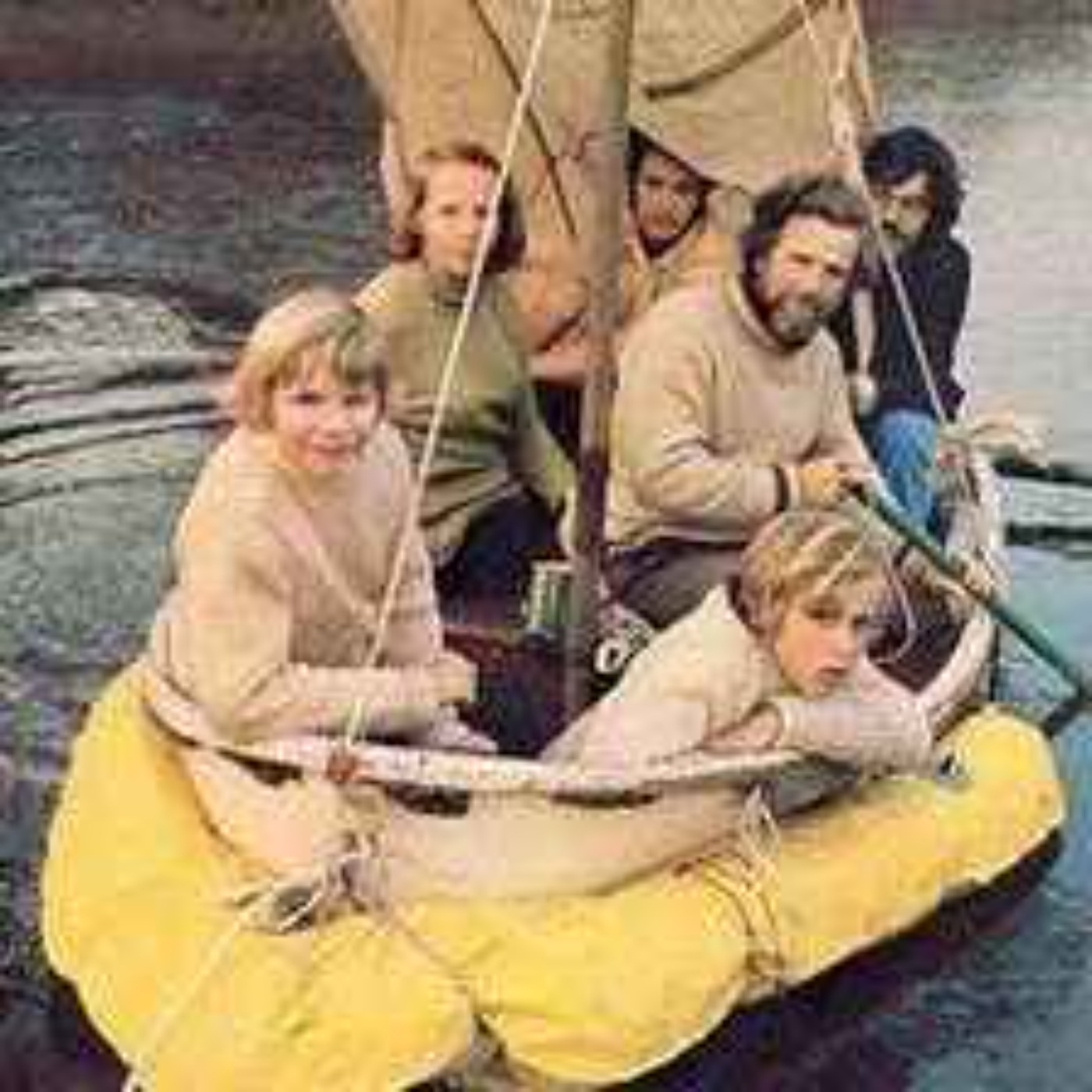
Well, you can never be quite sure whether things are good luck or bad luck, can you? You know, until you get to the end of the story. And this was good luck. This was good luck because the wind was quite strong, but the raft couldn't get away from the Lucette because it was just tied to the Lisette, right? So. So we could all get to it. We could all get to the raft because the raft would have been blown away, plus the dinghy was over the side. But there was a bit of confusion in the after deck with my mother and my brothers and getting life jackets on and, you know, I mean, you can't blame me. Everybody was waking up, you know, Robin had been working from a deep sleep and the twins were, you know, that they were doing what they were told to, grabbing. Sandy had a bag of onions and that my mother had given him, and they put life jackets on and Neil had rescued their puppets, their teddy bears. We wanted to make sure that they survived. And Robin, being unfamiliar, he was a student. He joined us in Panama. Never been to sea before. He put his foot down on the gunnel of the dinghy and sank it. So we now have a sunken dinghy, a raft that was inflating, and killer whale swimming around in the water around us. And the Lisette had come head up into the wind and stopped, but she was still upright, but she was sinking fast. Dougal shouted across the Robin, make. Make for the life raft. Make for the life raft. So Robin swam to the life raft and he was the first one to get in the raft. I was at the raft, but I thought it was leaking. It was leaking and I was trying to fix the leak, but little did I know that the rafts have enough CO2 in them to blow up and to fully inflate in the cold regions of the world, the Arctic and the Antarctic. So when they're in the tropics, they've actually got an excess of CO2 and it just leaks off. I didn't realize that was what was happening. All I could see was CO2 leaking out of the raft. So I was trying to fix it. I was in the water then, and the twins then made it across to the raft. My dad got to the raft. He must have been the fourth one on the raft. My mum got caught in the rigging of the Lisette as she went down, and she was still trying to get things to bring with us that would be useful, but she'd left it too late. But she did get off the Lisette and I met her in the water and said to her, mum, have you got a patch or something I can fix this leak with? And she handed me an orange and that was floating in the water. And I thought, my God, how am I going to fix that with an orange? But my mum must have got under wrath then. So she must have been the next last. And. And my brother reminded me the other day that I was helping people on. I was helping people onto the raft. Once the leak had stopped, the CO2 pressure had come down and just stopped leaking. I was helping the others get onto the raft. I was giving them an arm up. And then my dad or my mom said, come on, Douglas, get on board. And I remember getting into the raft and seeing everybody was sitting there, orange, you know, from the canopy of the raft that was just like an orange color. And that I just thought to myself, I can't believe this. I can't believe we're here now and I'm looking at this scene and I just don't know where we're going to go from here, you know? To me, it seemed impossible that we would survive the day, let alone what was to come.
- [09:45]
Fin AI Representative
AI is transforming customer service. It's real and it works. And with fin, we've built the number one AI agent for customer service. We're seeing lots of cases where it's solved, solving up to 90% of real queries for real businesses. This includes the real world, complex stuff like issuing a refund or canceling an order. And we also see it when FIN goes up against competitors. It's top of all the performance benchmarks, top of the G2 leaderboard. And if you're not happy, we'll refund you up to a million dollars, which I think says it all. Check it out for yourself at fin.
- [10:14]
Narrator
AI.
- [10:15]
Hayden
Howdy, howdy ho, and welcome to Fantasy Fan. Fellas, I'm Hayden, producer of the Fantasy Fangirls podcast and your resident lover of all things Sanderson.
- [10:23]
Stephen
And I'm Stephen, your bookish Internet goofball. But you can the smash daddy.
- [10:27]
Hayden
And we are currently deep diving Brandon Sanderson's fantasy epic Mistborn. But here's the catch. Steven here has not read Mistborn before.
- [10:35]
Stephen
That's right.
- [10:36]
Douglas Robinson
Hey.
- [10:36]
Interviewer
Hey.
- [10:36]
Stephen
So each week, you'll get my unfiltered raw reactions to every single chapter.
- [10:40]
Hayden
And along the way, we'll do character deep dives, magic explainers, and Steven will even try to guess what's next. Spoiler alert. He'll be wrong.
- [10:48]
Stephen
News flash. I'm never wrong. Episodes come out every Wednesday, and you can find Fantasy Fan fellows wherever you get.
- [10:53]
Whimsound Advertiser
Your podcasts bring incredible sound into every corner of your home with the new Whimsound smart speaker. Get high resolution audio with a 1.8-inch touchscreen, smart control and modern design in one powerful speaker for just $299. From Quiet mornings to lively family gatherings, Whimsound makes every moment sound better and feel better, too. Create a home filled with sound you love. Ready to upgrade your sound? Shop now at Amazon and search Whimsound. That's W I I M S O U N D.
- [11:35]
Narrator
The Pacific Ocean is the largest and deepest ocean on Earth. It covers more than one third of the planet and contains some of the most remote stretches of water anywhere. In many parts of the Pacific, the distance to the nearest land can be measured in thousands of kilometers. For people stranded on its surface, survival is never a given. In fact, it's almost impossible. Even when a disappearance is noticed, search and rescue efforts face enormous limitations. Aircraft can only scan narrow corridors. Ships can pass within a few miles and never even see anything. A life raft or small boat sits low in the water and blends almost completely into the surrounding sea. In the 1970s, the odds were even worse. There were no satellite beacons transmitting precise locations, no real time tracking. Searchers relied on estimates, weather patterns and currents that could move people far from their last known position in a matter of hours. Once adrift, there is no control over directional speed. You go where the ocean takes you. And for the Robinson family, that meant facing a night, and far more than a night, in one of the most unforgiving environments on Earth, with no certainty that anyone would ever find them. However, Douglas says it wasn't all doom and gloomy.
- [13:08]
Douglas Robinson
There were some good looks in this. Dougal had tied the dinghy that was sunk to the raft. So we had the raft and the dinghy. I had managed the handle where the Lucette tied to Lucette had come away from the coach roof. So the dinghy, the raft had started to blow away from the wreckage, but the dinghy was now holding it back. So the dinghy, full of water, was acting as a sea anchor and keeping the. The raft on the wreck side. And that enabled us to collect some things. My mother's sewing basket, the sail, the genoa sail in my mum's sewing basket was a load of treasures. You know, that would be very useful to us in the days and weeks ahead. You know, it gave us time. And if you go from when the whale struck to when we were sitting in the raft looking at each other, I think about 15 minutes had gone past. But the Lucette herself had stayed upright and afloat for two minutes. Lisette went straight to the bottom. You know, that was our home. That was our adventure, that was our life. All our economic wealth was tied up in that, and that was gone. We were very, very sad, very sad, unhappy. And this was going to take some getting over it. If we were going to survive, we had no idea how we would, what the next step was going to be.
- [14:46]
Interviewer
Well, I mean, I'd imagine just those next few hours would have been just, I don't know, was anyone even talking? I mean, what.
- [14:54]
Douglas Robinson
Well, we were talking because only me and Sandy had seen the killer whales. We were recounting to the others what we, what had happened and we were exploring the raft. I mean, you know, if you've never been in a raft, it's quite a strange experience, you know, There was a booklet, a survival manual. There was an inventory of things in the raft. Sugar tablets, sugar tablets, fortified bread, 18 cans of water. There was a heliograph, there was some other things in the raft itself, but nobody was talking about the elephant in the room, Nobody. We were all very frightened because we were worried about the killer whales coming back to get us. We thought that, you know, they've hit us in the Lucette, how can we be safe here? And there was a lot of trepidation, waiting for them to come back and reappear, but they didn't. It was my mum that asked the question, dougal, are we going to die? Dougal had to come up with an answer for that question. And Dougal explained that he considered lying to us, that everything will be all right. But then he thought that he owed us the truth and if we were going to die, that we needed to prepare for that and he mustn't shield us from that. But he didn't want to alarm us either. And it was then that we had a long conversation about where we were 200 miles west of Cape Espinosa, 2 degrees south of the equator, what we had, what tools and effects that we had, how much water we had, what our possible sources of rescue were really pretty grim, I've got to tell you, you know. But as we talked about this, slowly, slowly, a plan came together about how, well, look, we're 2 degrees south, the wind is blowing out the southeast, blowing us to the northwest. You know, what routes are open to us. You know, we were sailing to the Marquesas. Can we still sail to the Marquesas? Downwind and down current, effectively, but it was 45 days on the Lucette, it would have been 80 days on the raft and we only had water for 10 days and it doesn't rain very much in the trade winds, so that was a non starter.
- [17:48]
Narrator
This is now quite possibly the worst case scenario. They could be In Douglas, his father, Mother, his two twin brothers, and a man named Robin, a student hitchhiker they picked up in Panama, are now all crammed into a life raft. You may have seen them before in movies or pictures. They're generally orange in color and have a canopy to try and protect you from the elements. This one was apparently built to hold 10 people, but Douglas said in reality, it would only ever fit five comfortably. They'd also managed to secure the small dinghy that was attached to the loose set. Most sailboats dragged behind one of these small sailboats, more so to be able to move from moorings offshore to land. Certainly not designed for surviving in the middle of the Pacific Ocean, but it's all they had, and it was certainly better than nothing. But they still needed a plan. Their father, Dougal, considered the option to row back towards the Galapagos Islands. The issue was they couldn't see them. They were over 200 miles away from them, upwind and up current, and the current was definitely their biggest challenge.
- [19:08]
Douglas Robinson
We would have to do 2 knots just to stay still. 50 miles a day just to stay still and to make some headway, we'd have to do four knots. That's 100 miles a day. I would have to row that where they have to separate the raft from the dinghy. And, you know, but. But it was still there at the moment. And. And then I said, look, dad, you know that we need water. Water is the key to this survival. We need to get water from somewhere. And the Doldrums contain water. It rains heavily in the Doldrums. We. We know that because we've just come through the Doldrums not a month before, and it rained very heavily. If we sail to the Doldrums, we can get more water. And with more water, we can make another plan.
- [20:03]
Narrator
Fresh water is the first thing that determines whether you live or die at sea. A person can survive weeks without food, but only days without water. In the heat of the Pacific, dehydration can set in, quickly weakening judgment and accelerating exhaustion. The Robinson family knew that if they were going to survive, they needed a reliable way to collect rain. And that meant reaching the Doldrums, More formally known as the Intertropical Convergence Zone, sits near the equator, where the trade winds from the Northern and Southern hemispheres meet. Instead of a steady breeze, this region is characterized by still air, oppressive heat, and frequent heavy rainfall. Warm, moist air rises constantly here, forming towering storm clouds that can release sudden downpours. For sailors, the Doldrums are infamous ships can sit motionless for days. The sun can be brutal, and then, without warning, rain can fall in sheets. For most mariners, it's a place to avoid. However, for the Robinson family, it could be a lifeline. By moving toward the doldrums, they weren't chasing wind or progress, they were chasing water, the single resource that would decide whether they could endure what lay ahead. However, it wouldn't be the only discussion around survival that the family would have.
- [21:34]
Douglas Robinson
Whilst we were discussing this, we hadn't reached a conclusion yet about how we would. What we would do. We discussed other things about survival and about food and about water and about tools that we had. And I always remember a flying fish jumped out of the sea and the frigate bird swooped down and picked it out of the air and flew off with it as if to take the piss out of us, you know, look what I can do, you know. And I looked at that frigate bird and I said to my dad, they've got millions of years on us, dad, they've got millions of years on us. And Dougal said, yes, Douglas, but we have tools and we have brains, and with those brains and those tools, we can bridge that gap. We will learn how to catch fish. And I just thought, that is so far away. There's not a ch. Yeah, think about catching a fish with you, you know, yourself. I mean, it's bad enough when you've got.
- [22:42]
Interviewer
You've got a rod and a hook and everything. You're still standing there for hours going, there's nothing here,
- [22:49]
Douglas Robinson
you know, I mean, it just seems so impossible. And we were still thinking we should stay where we are too, because rescue would come. That's what it said in the survival manual. But we didn't get an SOS off because the Lucette had sank too quick. So that wasn't really a reasonable proposition. We would just stay there. We were dressed off to the west, out the Pacific Ocean. That would be the end of us. And. But we made three important promises to ourselves, to each other, in that moment. And I'll tell you what they were. The promises were. It was Dool who made these promises. He said that whatever happens, we will not eat each other. I will not stop trying to get us home, get us to land, and I will not stop looking for a rescue ship to pick us up. So with those three promises as the foundation for our new future, we. We came up with a plan, an absurd.
- [24:09]
Narrator
And the plan started with Douglas doing something he had never done before, and that was to stand up to his father and tell him, no My dad
- [24:20]
Douglas Robinson
was a very tough character, very hard, hard man. And he asked me outright, douglas, will you take the dinghy and row to the Galapagos Islands? And raised the alarm. And I said to him, dad, where are the Galapagos Islands? I can't see them. Over there. Go that way. I'd be rowing backwards at four knots. Four knots, Dad, I would need all the water that we have got in order to. He says, you can take half the water and half the rations and it will rain. I said, dad, no, no, dad, I'm not going to do that. I'd rather die here with you than us all die alone. I'm not going to do it. And you know what? That's the first time I'd ever stood up to him, obviously. I was 18 and a half. I was a man already, you know, but he was a very tough, tough character. And Dougal melted. He said, I'm sorry. Sorry, son, I should never have asked. It was a fool's mission, you know, I should not have asked. But what does that leave us? That only leaves us one option left. To sail to the center of the Pacific Ocean, pick up rain. It wouldn't get there in 10 days. We've got 10 days supply of water. We can get to the Dolbroms and we can catch the. And this was Dougal, we can catch the countercurrent back. So the current flows in a westerly direction across the Pacific at the equator. But much like the Bath, when you're in the bath and you, you push all the water to the end of the bath, it flows back, it finds a route and flows back round down to the other end of the Bath. And the Pacific Ocean does exactly the same. It shoves all the water off westerly and it mounts up and then it flows back down through the doldrums in what's called the counter current. The counter current is one and a half knots. That's 30, 40 miles a day. He says, we'll catch that. And with the help of the sail, we might make 100 miles a day back to the east. So we'll sail through the doldrums, collect water and sail east until we hit the American coast. So suddenly, we had a plan. We hung everything on that plan. This plan had to work. And so we're in business in lots of ways. By the end of the second day, when we'd finally made this resolution, we had a plan and we felt much better about that. My mum summed it up. She said, dougal, we would rather die Trying than sit here and wait for death to come. So we made these huge decisions that a family shouldn't have to make and you know, we got down to the business of survival.
- [27:21]
Narrator
Chapter 7 I read in a book we can eat turtles.
- [27:32]
Douglas Robinson
It was hard work. It was bloody hard work non stop. The raft was leaking, licked air, it licked water. They were bailing, we were bailing all the time, blowing the raft up by mouth because it kept deflating non stop, non stop bailing, non stop blowing. And we were looking for a rescue ship that was not to be found. You know, scanning the horizon and gradually coming to terms with what happened and what we had to do to get home.
- [28:07]
Interviewer
There must have been so many occasions during that plan that people probably threw their hands in there and said, this is pointless, we're not going to make this.
- [28:16]
Douglas Robinson
Yeah, I mean I felt that every minute of every day.
- [28:19]
Narrator
Yeah.
- [28:19]
Douglas Robinson
You know, this was, this was a fight against the odds. I used to watch the sun go down at night and wonder if we'd still be around in the morning to see because the nights were worse. You know, you couldn't see where the weather was coming from. It was more difficult to manage things in the darkness. Another day would come and suddenly a week's gone by. It actually rained on the sixth day as well. The first rain that we got. We managed to save some water, you know, and replenish our water stump. We'd had a flying fish jump into the dinghy. I'd bailed the dinghy out. We started towing the raft with the dinghy. We made a sail out of that genoa sail that I'd caught. And with that we were, we had a little operation going tugboat. We had a raft and we were sailing towards the north to the doldrums where water was. We were carefully consuming our water with sips. Only it wasn't rationed, it was self rationed, which was even worse. You know, you have as much as you want but as little as you need. Please be careful with the water. We would take just a sip of water. We would just have a little tiny bit of food, a little bit of fish, a little that had jumped in. They're flying fish. Between six hours and, and slowly we made our way to the north. We thought we were headed to the north at about 25, 30 miles a day. We thought we were making about 30 miles a day and the water would last till we got to the doldrums. Just, it would just last. So there was a big gamble on that of course, because if it didn't rain in the doldrums, then game over, we were stuck. That would be the end. But so we had lots of fears, uncertainty and doubt. We had whales, visitors on the raft and swim round us. They scared the hell out of us, you know, we had sharks. They weren't as scary as the whales. We had sharks in constant attendance. But we did also get visits from turkeys. And I remember telling my dad I'd read in a book somewhere that you could eat turtles. I didn't tell him it was a. It was a novel written by Alastair Maclean called South by Java Head. It was a fictional novel, you know, I didn't mention that bit. I just said I read in the book we could eat and a bit of fake news, you know, and we did eventually learn how to kill these turtles. It took us the third one. And we found that they had red meat in them. They had blood. We could drink their blood. I'll tell you. We became experts in our environment. We learned how to catch fish. We were catching fish. We were catching those big dorado sports fish.
- [31:04]
Narrator
The once farming family that turned into a sailing family were now a survival family and a family that against all odds, had made it to their planned destination of the doldrums.
- [31:27]
Douglas Robinson
It didn't rain for three days and we thought, we've really blown it. We can't sail back, we can't go anywhere else. We've just got to wait here for the rain. Anyway, on the third. Third day of waiting there, it rained heavily. And we were so grateful. We were so happy, You know, I mean, everybody else would have been saying, oh, no, it's raining.
- [32:02]
Interviewer
It was a gift from the gods.
- [32:06]
Douglas Robinson
From the gods. You know, we tucked all our water cans up and bottles, we. We just looked up into the sky with our mouths open and let the rain rain into our mouths, you know, and it was fantastic. But then we lost the. We lost the raft. The raft sank under us. It was falling apart anyway from the biting, constant biting of the fish from underneath. And the fact that bellows, the inflation bellows had broken and I was having to blow it up by mouth. And that constant blowing, I just couldn't keep it inflated yet. We all took turns. My mum took turns, the twins took turns. My dad did a bit of it, Robin did a bit of it. And we tried to keep the dinghy, the raft afloat, but we couldn't. And it just gradually deteriorated and we were so wet. We were up to our chests in water inside the rat because our bodies displaced their own weight in water. So we were, we were cold, we were wet, we were miserable. We were covered in seawater boils. We had the immunization foot. It's like when you get in the bath for a long period of time you get that crossled effect on your hands and feet. It's like that on steroids, you know, it cuts the blood supply after your hands and feet and they go cold, you know, and you can't move them. And that's because you're constantly immersed in water. And that life on the raft was miserable. And on the 17th day we made this decision that we would leave the raft and go on the dinghy alone. And that was full of risk because if the, if we, if the dinghy sank we couldn't get back on it. And you know, if it was swamped by a wave or something like that and we were open, we had no protection. We had a canopy that protected us in the, in the raft. But we made this big decision to leave the raft and, and go it alone on the dinghy. And so for the majority of the trip we were on the dinghy and we sailed 750 miles on that dinghy and raft. We sailed 300 miles to the Dolbrams and we sailed 450 miles to the east. And unbeknown to us, although we had a rough idea where we were, we were only seven days off the coast of America when we got picked up, you know, we would have made it. But you never know. Death hung on every wave. Never knew whether you were going to make it, you know, for sure. When the nighttime came, would you still be here in the morning? We just didn't know. We had invented this kitchen, this cafe that we would open when we got home. And it gave us the excuse to talk about food. And we talked about food constantly. You know, real survivors, real survivors talk about food all the time. Pretend survivors think about camps and fires and hunting and exotic formulas. But real survivors who have met quite a few, all they have this strong visions of food. It, like, just like a, a jelly and ice cream will appear in your mind's eye and won't go away, you know what I mean? And you, you might not even like jelly scream, you know what I mean? But it's, you know, and then, and then just when you get rid of the jelly and ice cream, a lamb joint will appear with roast potatoes and, and, and, and vegetables, you know what I mean? You can't get rid of it. It's these images are so strong and powerful. And you can smell them and you can taste them. You know, they're so powerful. And we talked a lot about that.
- [36:07]
Narrator
And funnily enough, it would be while they were all sitting there discussing what food they would love to eat, what they might serve, and they were literally tasting the food in their mouths that all of a sudden they saw what they'd been looking for for almost six weeks. Help.
- [36:29]
Douglas Robinson
We knew we had come to terms with our environment. We'd been catching turtles, we've been catching dorado, we've been catching rainwater. And we were still here, we were still alive. And we knew time had gone by. We were trying to keep a track of the days. We'd worked out. We'd been adrift for 36 days. As an actual fact, it was the 38th day. On the 30th day, a fishing boat appeared on the horizon.
- [36:56]
Interviewer
Oh, my God. I can't imagine how that would have felt, saying that.
- [37:00]
Douglas Robinson
Yeah, well, that was to be the end of our ordeal. We couldn't be sure, we could not be sure that she had seen us. She alter course dramatically. And we did have some flares left. We had two hand flares left and we cleared the decks, we lowered the sail. Dougal stood on the thwart and we. And I went forward. I was at the forward end of the dinghy to make sure the trim of the dinghy was kept stable. It's easier to adjust the trim of a dinghy or a boat from the bow than from the stern. You've got much more response from the bow, you know. So I sat in the bow and I shifted my weight as Dougal shifted his weight and he hung onto the mast and he lit the flare my mum had handed up to him and he couldn't hold it, it was so. It was so hot. And he threw the flare out of the ocean and it was that arc of light that the Japanese fishermen had seen. And they altered course towards us, but not at us. And then they altered course. When it seemed like they were about to sail past us, they altered course straight towards us. And Dougal flopped down on the thwart and he said, our ordeal is over. Our ordeal is over. We knew. Knew we were going to be rescued. And, you know, that Japanese fishing boat stopped, came alongside us and stopped. They looked at us sitting in that raft like a bundle of fragile humanity, clinging to life, like, barely alive, really. I mean, we thought we were doing all right. We didn't realize how much weight we'd lost or how decrepit we looked. You know, we had no idea that we're covered in blood and turtle blood and fat. And we were naked and, you know, they looked upon us and one of them threw a heaving line across us, a dirty, oily, heavy line, and I grabbed it with my hands and hung onto it. And I knew that this rope, dirty, oily, smelly though it was, was not from our world, it was from another world, and that this was our link back to humanity. This rope was going to save our lives. And I hung on and another rope came across and Dougal caught that in the aft end of the.
- [39:57]
News Reporter
It was before dawn this morning when the Tokabaru birthed at the quayside in the Panamanian port of Balboa. The Robertson family were finally back to safety after one of the most harrowing ordeals in the annals of the sea. The family were picked up from this dinghy by the Tokabaru on Saturday. Incredibly, they survived for five weeks on water they'd recovered, supplemented by turtles and fish.
- [40:19]
Douglas Robinson
Before we knew it, we were alongside, rolled out of the dinghy and Dougal asked them to save the dinghy. Don't sink the dinghy, he said. And they said, why not? You've finished with it, you know. And Dougal's response was just typified the way that we thought. He said, all our food and water's on the dinghy that was so precious to us. And the captain said, we have food,
- [40:52]
Narrator
We've got some for you. And the dinghy was saved. And in fact, it now sits as a relic in the Maritime Museum in the uk.
- [41:09]
Douglas Robinson
And if you do go and see it, look upon it with amazement that six people would have possibly survived in such a small dinghy. A small dinghy that had three completely different worlds going on within it. My dad and the twins in the bow, it had me and Robin and my mother on the stern, and it had the watchkeeper on the thwart, who was looking out, looking for a rescue ship, looking for turtles too, and other fish that we could catch. So there were like three wheels and steering, steering the. The dinghy as well. We could steer it about 45 degrees across the wind. And, you know, as I say, if you go there and see it, you will be just amazed that. That people could survive in something like that in the Pacific Ocean for so long. You know, that is my message that I pass on with this. Where there's life, there's hope. Never give up hope. If you've got life, you've got hope. You can make something happen. And to us, when we were at the moment of shipwreck, it seemed impossible to us that we would ever survive, that we would ever get back to land. And. And yet it happened. I've got to say that you touched on a point there, that if you needed to advertise in the Sunday Times for a man to survive in a life raft for 38 days, D would have been the man to pick, because he never gave up. He was strong, brave, courageous, a leader. He was a leader of men. And he never, never stopped thinking about getting his family home here.
- [42:59]
Interviewer
I'm sure in his mind, he was like, well, I've got my family into this. I have to get them out of this. You know, this is.
- [43:05]
Douglas Robinson
He said, I got you into this. I need to get you out. But, you know, it would be so easy to just say, well, I don't know, mate. You know, we're all going to die, aren't we? You know, it would have been so easy to say that. But not Dougal and. Nor my mom. Given. Given that Dougal then. Then took on that leadership. My mum was right behind him, looking after her family, taking care of the twins, taking care of us, sacrificing her own comfort for. For us and, And. And making sure that we came first. That. That. That's how my mum was. And, you know, the two together. The reason, you know, people ask why is the story lasted for so long, you know, well, the dinghy itself is in the Maritime Museum, which is a place where people can go and see it and the artifacts and the stories tell their. But also this story of survival is different because my mum and dad were not trying to survive for their own sake. They were trying to save their family and their own survival didn't matter. They needed to save their kids and they didn't let us down. They stuck to their words, those promises that were given, those three promises that were given right at the outset. And Doug will never stop trying, never, ever stop trying to get us home.
- [44:27]
Interviewer
I do wanna focus just briefly on the. On the after, because obviously this is quite an incredible situation that you've been through as a family, and it's a traumatic experience. You've stared death in the face. You've had conversations about not eating each other, which is a conversation families will never have. Obviously this would have had a. I'm sure, a severe effect on you guys as a family.
- [44:49]
Douglas Robinson
Well, I'll tell you about what my brother said about it. They went back to school, and two months after we were picked up in the Pacific, they were back in the school classroom. With kids who'd never left Leek in Staffordshire, sitting looking out of the window, thinking, what the hell are we doing here? How did it come that we're in this classroom? And they never got over it. They never got over what had happened to them. They were very young, even though they were. They never properly figured in the survival, the trial of the survival, you know, because they were too young. They were being looked after by, by everybody else. They kept us honest. They gave us a reason to survive, a reason to get back home. We had to save them because they were so young. They were only 12 years old, you know, I was only 18 and up. I hadn't lived a life, you know. Robin was 23. He hadn't lived a life either. We were young and our parents, even Robin, we regarded as a brother, a son. My dad did not regard him as an outsider. He said, he's here with us, he is a part of the family. And. But, you know, we were adventurous and adventurers take their chances. And so our lives afterwards was a bit like that. This had happened to us. We had survived. We felt extremely lucky, incredibly lucky that we'd survived that, that we were very proud of the fact that it was largely due to our own devices that we had survived. We had tried, we'd taken it on and succeeded. So we were quite justifiably proud of that. But we had lives to lead. I always wanted to go to sea. I'd always wanted to go to sea. I didn't want to be a farmer. I wasn't going to go back to that offer of John Richardson and his farm. I'd left farming. I wanted to join the Merchant Navy and become a deck cadet and a ship's officer. That's what I wanted to be and that's what I did. And so I never left the sea. I went back to sea and I was shipwrecked again in 1975 aboard the the British Ambassador, a tanker in the North Pacific Ocean. But the twins, they had the hardest, the hardest time of get coming to terms with what had happened. My sister wasn't there. She'd left the trip around the world, she fallen in love with some chap and gone her own way. But my mum and dad never really came to terms with it. You said the words, you know, that they realized the risks they're taken with their children's lives and they've gotten away with it. They felt they'd gotten away with it this time and they should never have taken those risks. But we said, no, dad, no, no no, no, you succeeded.
- [47:40]
Narrator
Yeah.
- [47:41]
Douglas Robinson
We had the greatest experience that people could hope for, you know, and we survived. And that was down to you, dad. You did that. He said, no, I should never have taken you, and the guilt. But that affected my mum and dad after that. But my dad, Rose Bouc, survived the Savage Sea. It became a worldwide bestseller. He made a lot of money from that, and he never really worked again for the rest of his life. He bought a yacht, lived in the Mediterranean. My mum bought a farm with the proceeds of the book. We still have that farm in the family today. The twins never really recovered, but they've been successful. They work. They work. Neil's a farmer. He doesn't own the farm. He works on a farm, but he's happy working there as a farmer. Sandy's an engineer. He works in engineering. And still working to this day. But we all have that attitude. That was my dad's attitude about when we sailed around the world, that nothing, we've survived worse than this and nothing can really shake us. You know, we're unflappable when it comes to discussing things.
- [49:16]
Narrator
When the Robinson family found themselves in a life and death situation, they were on the ocean when the ship that was keeping them alive failed, not by any fault of its own, but when a force of nature struck it. And they then had to spend the next almost six weeks trying to stay alive. But what happens when the thing that's keeping you alive fails? Not when you're on the ground or in the water, but when you're 15,000ft in the air and instead of weeks to survive, you have a matter of seconds and survival is completely out of your hands.
- [49:55]
Skydiving Survivor
And just a split second flash, I'm not able to really look up because with the two parachutes tangled, it just leaves us shaking. My tandem instructor is just yelling at me to keep my feet down so we can stay strapped together. And that is the moment that the panic started to set in.
- [50:11]
Narrator
Next time on what I Survived.
- [50:14]
Musician
Moon in the sky. I'm looking at the moon in the sky this shouldn't come as a surprise, but I can't sleep. War in my mind I'm trying to fight a war in my mind I don't know who's the winner tonight, but it ain't.
- [50:48]
Hayden
Howdy, howdy ho, and welcome to Fantasy Fan.
- [50:51]
Douglas Robinson
Fellas.
- [50:51]
Hayden
I'm Hayden, producer of the Fantasy Fangirls podcast and your resident lover of all things Sanderson.
- [50:56]
Stephen
And I'm Stephen, your bookish Internet goofball, But you can call me the Smash
- [51:00]
Hayden
Daddy and We are currently deep diving Brandon Sanderson's fantasy episod epic Mistborn. But here's the catch. Steven here has not read Mistborn before.
- [51:09]
Stephen
That's right.
- [51:09]
Douglas Robinson
Hey hey.
- [51:10]
Stephen
So each week you'll get my unfiltered raw reactions to every single chapter.
- [51:14]
Hayden
And along the way we'll do character deep dives, magic explainers, and Steven will even try to guess what's next. Spoiler alert. He'll be wrong.
- [51:21]
Stephen
News flash. I'm never wrong. Episodes come out every Wednesday, and you can find fantasy fanfellas wherever you get your podcasts.
- [51:28]
Howie Mandel
Hey, it's Howie Mandel and I am inviting you to witness history as me and my How We Do It Gaming team take on Gilly the king and wallow. $267 million gaming in an epic Global Gaming League video game showdown. Four rounds, multiple games, one winner, plus a halftime performance by multi platinum artist Travy McCoy. Watch all the action and see who wins and advances to the championship match against Neo right now@globalgamingleague.com that's globalgamingleague.com everybody games with Verbocare.
- [52:00]
Douglas Robinson
Help is always ready before, during and after your stay. We've planned for the plot twist, so support is always available because a great trip starts with peace of mind.