Loading summary
Transcript192 lines
- [00:00]
Progressive Insurance Announcer
This episode is brought to you by Progressive Insurance. Do you ever think about switching insurance companies to see if you could save some cash? Progressive makes it easy to see if you could save when you bundle your home and auto policies. Try it@progressive.com Progressive Casualty Insurance Company and affiliates. Potential savings will vary. Not available in all states.
- [00:20]
Ryan Reynolds
Ryan Reynolds here from Mint Mobile with a message for everyone paying big wireless way too much. Please, for the love of everything good in this world, stop with Mint. You can get premium wireless for just $15 a month. Of course, if joy over paying, no judgments.
- [00:33]
Faye Seymour
But that's weird.
- [00:35]
Ryan Reynolds
Okay, one judgment anyway. Give it a try@mintmobile.com Switch upfront payment
- [00:42]
Mint Mobile Terms Announcer
of $45 for three month plan equivalent to $15 per month required Intro rate first three months only, then full price plan options available, taxes and fees extra. See full terms@mintmobile.com.
- [00:55]
Gatorade Announcer
You do it all. So why not get all the electrolytes hydrate better than water with new Gatorade lower sugar now with no artificial flavors, sweeteners or colors. And 75% less sugar than regular Gatorade. New to the fridge. All the Gatorade electrolytes you love. Gatorade lowers sugar.
- [01:15]
Faye Seymour
Is it in you?
- [01:16]
Gatorade Announcer
Now available nationwide.
- [01:23]
Faye Seymour
Super real. And the captain said, I am not going to take these people through a hurricane. He said, then I will. So he decided we're going to go through this hurricane. And we did. And it was terrifying. The swells were huge. Lightning360. There's no way we were going to make it. But we did. And after that was over, we realized he was so focused on his hypothesis and his book and his results that he didn't care what he did to us or anybody or himself.
- [02:02]
Podcast Host (Interviewer)
What was your suggestion for murdering him?
- [02:05]
Faye Seymour
Inject him with something.
- [02:07]
Podcast Host (Interviewer)
Hey, I'm Julian Morgans, and you're listening to what It Was like, the show that asks people who have lived through big dramatic events what it was like.
- [02:20]
Faye Seymour
Foreign.
- [02:30]
Podcast Host (Interviewer)
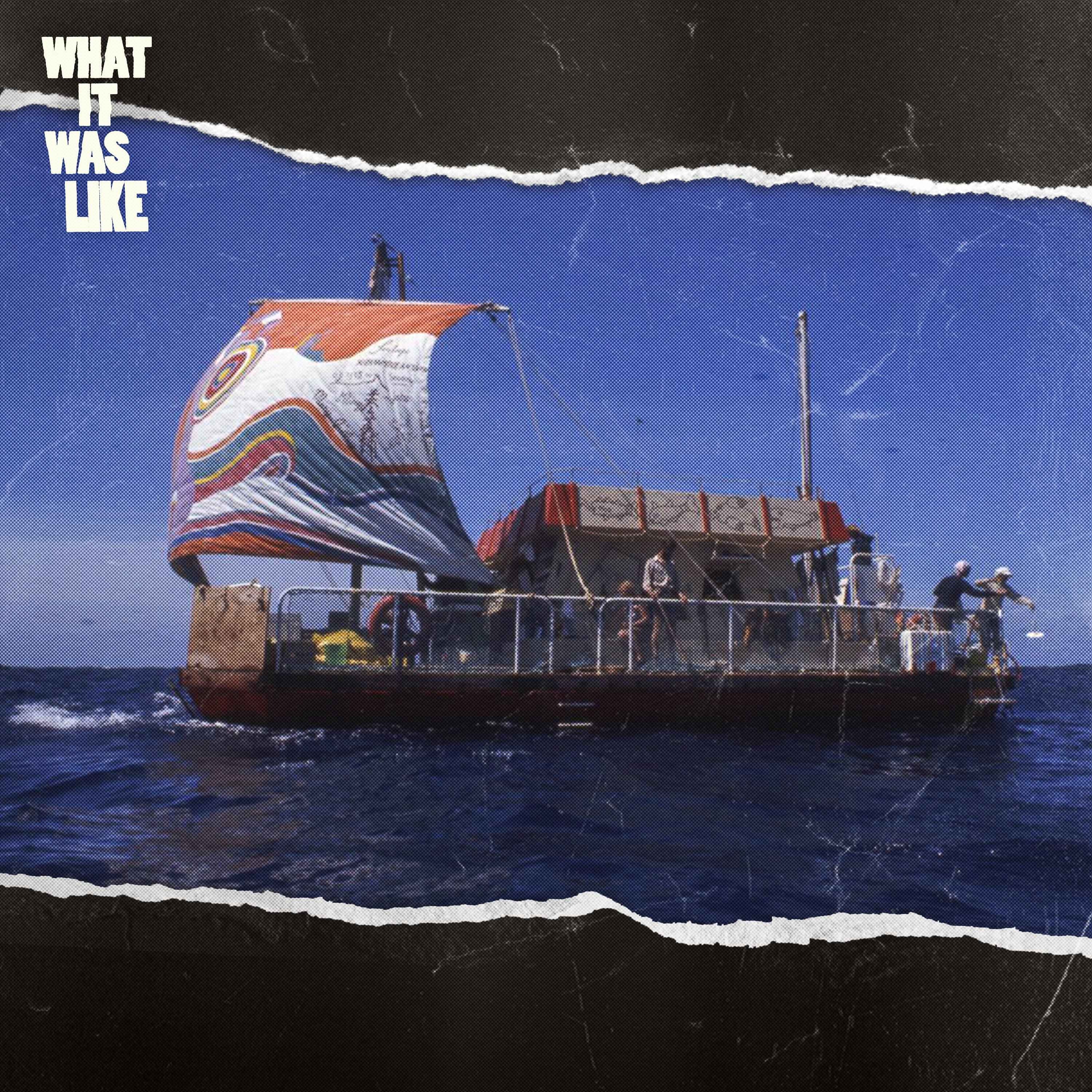
Hello and welcome back. So we've been doing a lot of oceanic stories recently. We did that thing last week about orcas attacking boats. We did that other thing a few weeks ago about people surviving on life rafts. And this week we're going to stay with the water, but we're going to swap out the whales for something even weirder. This is the story of the Akali raft experiment, sometimes also known as the sex raft. And the story goes like this. So in 1973, a Mexican anthropologist named Santiago Genoese set out to test a theory that human aggression, think war, violence, just all of it is driven by sexual tension. And he designed an experiment to test that hypothesis. He placed 11 strangers, five men and six women from different countries on a small raft, and he set them adrift across the Atlantic from the Canary Islands, just drifting on the currents all the way to Mexico. And his thinking was that in cramped, isolated conditions, sexual tension would build among the five men and the six women, and it would eventually build, boil over into conflict. And Santiago planned to sit back and to study what happened. But it didn't quite unfold that way. Instead, the group formed a kind of gang. And there was some romance, sure, but it wasn't anywhere near the Love island chaos that he predicted. And if anything, it was Santiago who actually became the source of the tension, leading basically to a mutiny after he forced them to sail through a hurricane. It's a wild story. It's. It's part 1970s whimsy with part freaky science. But I think what really makes it is today's guest, Faye Seymour, is an American woman, and she was in her early 20s when she joined the raft. And she actually looks back on that experience not as a disaster, but as one of the more meaningful adventures of her life. So she's going to tell us that story, and afterwards, stick around for the subscriber episode, because I'm going to speak with a filmmaker by the name of Marcus Lindeen. He's the one who actually found this story in the first place. To be honest, I'm just riding on his coattails, and he's telling me about what happened to all of the other crew. He actually went out and tracked them all down. Anyway, that is for subscribers only, but let's get on with this episode for everyone. So here is Faye Seymour. Hey, Faye. Welcome to the show.
- [04:59]
Faye Seymour
Hello. Thank you for having me.
- [05:03]
Podcast Host (Interviewer)
So let's start this story by talking a little bit about where you grew up and where you're from.
- [05:08]
Faye Seymour
My father was a career army officer. We did not get along, but he loved me. But he told me he wanted a son. And so that kind of made me kind of want to prove myself. I remember going to school, enrolling in 63, walking up the stairs to Westmore High School in Daly City, California. 2000 white kids, and me and my dad walking up in his, you know, in his dress greens, and back straight, head up, you know, and I just did the same thing. Back straight, head up. You know, I just imitated him. But I learned a lot. I love science. They had a great science program at the school. A lot of things I kind of compartmentalized that were like the bad things, so that I could make room for the good things.
- [05:59]
Podcast Host (Interviewer)
And so take me to 1973. What was happening in your life at that time?
- [06:04]
Faye Seymour
1973? I didn't really have a plan. I met someone when I was 18. He was 24. He was older. We got married, we had a couple of kids, and my husband worked at a halfway house. And the lady who managed it had been friends with Santiago. She told him about me, and he decided to interview me.
- [06:30]
Podcast Host (Interviewer)
Do you remember your first impressions of him?
- [06:33]
Faye Seymour
My first impression was that he was a serious scientist, a researcher. He had a valid question that he was putting to test. You know, what is the nature of violence? What can we do? I mean, what makes people hate each other? He did not strike me as a manipulator. And I've always studied science, scientific background, so he kind of appealed to that side of research.
- [07:02]
Podcast Host (Interviewer)
Were you really hoping that you'd get picked for this mission?
- [07:06]
Faye Seymour
I knew I would be picked.
- [07:07]
Podcast Host (Interviewer)
Why?
- [07:08]
Faye Seymour
Odd as this may sound, but I knew he would never meet anybody else like me. As an African American in San Francisco at that time who came from the background that I did, because I'd never met anybody like me. You know, I was articulate. You know, that old fashioned trope you speak so well for a black person, you know that one.
- [07:29]
Podcast Host (Interviewer)
Right.
- [07:29]
Faye Seymour
But because I was articulate and I didn't mind expressing myself. Some people are very reticent to share, but I was not reticent. I would say what I thought, but I wasn't overbearing. You know, I was respectful.
- [07:45]
Podcast Host (Interviewer)
So were you excited when you were chosen?
- [07:47]
Faye Seymour
Oh, I could not wait. Yeah, I could not wait. I was so excited.
- [07:53]
Podcast Host (Interviewer)
I think some people would be a little trepidatious.
- [07:56]
Faye Seymour
Yeah, yeah.
- [07:57]
Podcast Host (Interviewer)
How did your friends and family respond?
- [08:00]
Faye Seymour
My parents were not impressed. They were not hostile. They weren't happy. But the man I was married to loved the ocean. He was adventurous. He said, I'll take care of the kids. You know, you should do this. This is a once in a lifetime experience.
- [08:16]
Podcast Host (Interviewer)
I mean, I think a lot of men would have been a little nervous about this arrangement. I mean, there's an undercurrent of sex that runs through this story.
- [08:25]
Faye Seymour
That's true.
- [08:26]
Podcast Host (Interviewer)
And, you know, Santiago chose, you know, young, good looking men and women because he wanted this innuendo to be sort of woven through the whole thing. And then your husband was. Was very supportive. Your husband's like, yeah, sure, go for it. Go on this sexy mission.
- [08:41]
Faye Seymour
But up front, it was not A sexy mission. At front. There was no mention of sex. It was all pure science. We didn't know about the sexual innuendos until 3/4 of the way through the trip. No mention. We didn't even know that we were being selected because we were good looking. Nobody told me I was good looking. So for me, it was just like adventure research. The ocean. Let's do this, you know?
- [09:07]
Podcast Host (Interviewer)
And do you remember meeting the others for the first time?
- [09:11]
Faye Seymour
Yes, I was as we all were. We were intimidated because we couldn't talk to each other. Three major languages. French, English and Spanish. Santiago could speak all three. He could talk to all of us, but we could not talk to each other.
- [09:29]
Podcast Host (Interviewer)
Was that a deliberate measure to keep people siloed?
- [09:32]
Faye Seymour
Yes, it was a perfect way to manipulate us through language.
- [09:38]
Podcast Host (Interviewer)
And do you remember seeing the raft for the first time?
- [09:41]
Faye Seymour
Yes. After we left Madrid, they flew us to Gran Canaria, Las Palmas, and it was North Africa. We saw the raft that first time after we landed, and it was still pretty skeletal at that time. It had been painted. I mean, it was structurally ready, but it hadn't been outfitted while we just sort of sat around and watched.
- [10:04]
Podcast Host (Interviewer)
It's quite a square little thing. I mean, when I look at photos of it, you know, it's like a cube on three pontoons.
- [10:10]
Faye Seymour
Yes, it's a cube on three pontoons with a huge mast in front and a platform. Raised platform. With the compass And a rudder. Yes, with a handle.
- [10:21]
Podcast Host (Interviewer)
Okay. Okay. So tell me about the day that you took off into the open ocean.
- [10:26]
Faye Seymour
Oh. As we are leaving, the captain's boyfriend is on the towboat and he lost his cheese. I don't know how else to put it. He got on the radio and said, maria, did you read the contract? Do you realize that Santiago Owens, you body and soul? And she said, I read the contract. He doesn't own anything. He was. He had, you know, he got the jitters. He got scared. And she's a captain. She's the first woman captain in Sweden. She's not made out of flimsy stuff, you know, so she's. She's embarrassed. But she told Santiago she would take us across. And she said. He said, will you defy me and go? And she says, I'm going. But I knew he just had the jitters. I mean, to me, it's like show business. Like, you get the jitters before you go on stage. I don't know how he got the idea, because there was a no contract about owning anybody's body or soul. Or anything. It was just a contract that we agreed to sign up. They paid us. We would sail on the raft and we would be good. Basically. It was very simple.
- [11:33]
Podcast Host (Interviewer)
Yeah. And they paid you $3,000 per person,
- [11:37]
Faye Seymour
which my daughter says in current money is about $20,000.
- [11:41]
Podcast Host (Interviewer)
Does that seem like a good deal to you?
- [11:43]
Faye Seymour
Awesome. It was really. It was a generous. I thought it was very generous.
- [11:48]
Podcast Host (Interviewer)
This is all quite a expensive expedition. This Mexican TV station really threw some money on it.
- [11:55]
Faye Seymour
And the University of Mexico, because he was from the University of Mexico and they also underwrote a lot of it.
- [12:01]
Podcast Host (Interviewer)
Wow.
- [12:02]
Faye Seymour
He was under so much pressure.
- [12:04]
Podcast Host (Interviewer)
Yeah, right. He had to deliver some sort of exceptional results. Awesome. Something really exciting.
- [12:10]
Faye Seymour
He did okay. Unfortunately, he had his results in his head before he left.
- [12:15]
Podcast Host (Interviewer)
Yeah. It's not really scientific.
- [12:16]
Faye Seymour
Yeah.
- [12:18]
Podcast Host (Interviewer)
So tell me about the first week at sea.
- [12:21]
Faye Seymour
It took about six weeks before we started to be able to actually talk to each other. But not one language. We borrowed words from different languages. And the next thing you know, we could talk to each other about sophisticated things. Like we saw some things that made no sense. You're all six or seven people are looking up in the sky. You see this weird looking thing, yellow on one side and it's blue on the other side. Is it a weather balloon? Is it a spaceship? And you're all just looking at it and you're all trying to understand what it is. But everybody's looking at it and everybody's talking about it the same thing. And next thing you know, you're all communicating with each other. What do you see? Well, I see this. What do you see? I see this. About six weeks we started being able to communicate sophisticated ideas. I don't like this. I don't like that. I'm sick of this. I'm sick of that.
- [13:12]
Podcast Host (Interviewer)
I mean, there's two wild things here. First, you develop this kind of like pidgin dialect all of your own, native to this raft. But the second thing is it sounds like you saw a ufo. Is that what happened?
- [13:25]
Faye Seymour
We know we did, but we couldn't prove it. But we all saw it and we all confirmed. Yes, it is. And what are you going to do about it? You're going to watch it till you have to go do something else? You know, we confirmed that it was there and you just wait. You know, when you're out there, there's no backup. There's no one to talk to. There's only each other. Once you've confirmed that yes, it is a ufo, then you just go on about Your business. Because what are you going to do? You're going to move on? Yeah.
- [13:53]
Podcast Host (Interviewer)
I mean, a lot of people would find that really hard to digest. You're out in the middle of the ocean seeing unexplainable aerial phenomenon, but it's
- [14:03]
Faye Seymour
not coming for us. Why worry? Yeah, there's nothing we can do.
- [14:11]
Podcast Host (Interviewer)
So let's talk a little bit more about Santiago's questionnaires, because I know that they were a big part of the whole mission, was sort of built around these things. So at the start, what kind of questions were you being asked? And then how did those evolve?
- [14:26]
Faye Seymour
Who's your favorite person? Who's your least favorite person? Who would you like to sleep with? Who do you not want to sleep with? Do you like the food? What do you think of the captain? You know, just probing. Just probing, probing, probing, probing. Kind of find a baseline for each of us.
- [14:44]
Podcast Host (Interviewer)
How would you answer some of these questions?
- [14:46]
Faye Seymour
I would usually say I was truthful. I'd say, I really like Maria, and I have a problem with Eysuke, the photographer, because he was mean to me. He didn't like me.
- [14:58]
Podcast Host (Interviewer)
And how did you answer the. The sort of more sexual questions about who you wanted to sleep with and that kind of thing?
- [15:04]
Faye Seymour
Well, I'll be honest. The question was put to me, would you step over the line? And I said, you know, I'm not saying I would. You never know what would happen. But then after I saw the men, I said, no, no, no, no, no. It's never going to happen. These are not men that attracted me. Not one of them.
- [15:25]
Podcast Host (Interviewer)
Yeah. Why is that?
- [15:29]
Faye Seymour
They were spineless, kind of. To me, there were no men on board. You know, Santiago, to me, was not a man. He was like a figurehead.
- [15:39]
Podcast Host (Interviewer)
Yeah.
- [15:39]
Faye Seymour
So there was nobody that, you know, made me feel anything.
- [15:43]
Podcast Host (Interviewer)
Yeah. And how did you feel about being asked these questions? I mean, you know, where was your faith in the mission at this point?
- [15:52]
Faye Seymour
At the get go, it seemed logical. He's trying to form a baseline of how we work, and he knows who likes who, who doesn't like who, who's, you know, attracted to who. And I had a notion that because his. His notes were meticulous and it was very exacting, I thought he might actually be able to put something together. But I could see after a short amount of time that he was collecting data and he had an affair with one of the people. And that told me that he's no longer a scientist, he's a participant. And I lost faith with his record collecting, because you can't have it both ways.
- [16:34]
Podcast Host (Interviewer)
Yeah, yeah. I mean, just on a logistical basis, you know, how. How was he able to have an affair on essentially a one room cabin? There's not even a private toilet.
- [16:45]
Faye Seymour
Easily. Go on with impunity.
- [16:52]
Podcast Host (Interviewer)
Okay.
- [16:53]
Faye Seymour
He didn't care who saw.
- [16:55]
Podcast Host (Interviewer)
Right. It was just very public, very public.
- [16:58]
Faye Seymour
Nobody really cared. It's just that it seemed like a line that a researcher should not cross. If you're doing real research, you can't be doing that.
- [17:06]
Podcast Host (Interviewer)
Yeah. I mean, look, on the one hand I'm impressed with your faith in this mission as a sort of scientific endeavor, but then there's a part of me that feels a bit cynical. Just from the get go. I read about this the first time and I thought to myself, there's so many holes in this thing. Like get a bunch of sexy young people and put them in isolation in sort of claustrophobic conditions and see if they fight each other or have sex with each other.
- [17:32]
Faye Seymour
That's an observation after the fact that there was no mention of. He was talking about violence. He only spoke of violence about men wanting to fight men for women. But I missed the sexual message because he did not present it as like, we're going to see who hooks up.
- [17:51]
Podcast Host (Interviewer)
I mean, I think what you're getting at here is something that really attracts me to this story in general. This is a very 1970s story. This sort of idea that we can solve conflict forever if we just understand it. We can solve it. And the way to understand standard is to, you know, sail this like rainbow colored sailboat across the ocean. And my grander point is that it was a very 70s science. Science experiment.
- [18:14]
Faye Seymour
Yeah, yeah. There was a lot of hope involved in the culture of my culture at that age. You know, there's a lot of possibility, a lot of thinking we can do something different, we can change something. We can do something, you know, that doesn't exist anymore. That's gone.
- [18:32]
Podcast Host (Interviewer)
The hope's gone.
- [18:33]
Faye Seymour
The hope's gone. After the assassinations and then the 80s and the conservative movements came and sucked the joy out of so many things. It died. That moment in time is gone. But in that moment in time there was possibility. But I don't think Santiago reaped the benefit of the sexuality on the raft because he was so hell bent on his own interpretation, you know, that he wasn't able to parse the subtleties and people stopped being honest. It didn't take very long to figure out that these results are not bonafide. He's got his own agenda and all he wants us to do is fit into it for his paper, for his movie, for his book.
- [19:17]
Podcast Host (Interviewer)
But at a certain point anyway, he decided that there wasn't enough sizzle on this boat or there wasn't enough controversy, not enough conflict. So what did he do to try to ratchet up the tension?
- [19:29]
Faye Seymour
Well, he started sharing our results with each other. He started pitting people against each other. Well, Edna wants to sleep with Jose Maria, but Jose Maria doesn't like her because she never stops talking. And you know, just he we'd have these meetings up on the top of the the little house because it's a flat area and we'd have our meetings up there. And he was just trying to get the conflict going, but he's trying to get the conflict going with the wrong people because by then we could talk to each other.
- [19:58]
Podcast Host (Interviewer)
Hey, we're going to take a quick ad break, but stick around because we'll be back with more what it was like.
- [20:09]
Progressive Insurance Announcer
This episode is brought to you by Progressive Insurance. Do you ever think about switching insurance companies to see if you could save some cash? Progressive makes it easy to see if you could save when you bundle your home and auto policies. Try it@progressive.com Progressive Casualty Insurance Company and affiliates. Potential savings will vary. Not available in all states.
- [20:28]
Ryan Reynolds
Ryan Reynolds here from Mint Mobile. I don't know if you knew this, but anyone can get the same Premium Wireless for $15 a month plan that I've been enjoying. It's not just for celebrities. So do like I did and have one of your assistant's assistants switch you to Mint Mobile today. I'm told it's super easy to do@mintmobile.com
- [20:46]
Mint Mobile Terms Announcer
Switch upfront payment of $45 for 3 month plan equivalent to $15 per month required intro rate first 3 months only, then full price plan options available, taxes and fees extra. See full terms@mintmobile.com does your day move
- [21:00]
Gatorade Announcer
faster than you can keep up with new Gatorade Lower sugar My family and I can stay at the top of our game. No artificial flavors, sweeteners or colors. 75% less sugar and all the electrolytes of regular Gatorade.
- [21:12]
Blinds.com Announcer
Now available nationwide@blinds.com, it's not just about window treatments. It's about you, your style, your space, your way. Whether you DIY or want the pros to handle it all, you'll have the confidence of knowing it's done right. From free expert design help to our 100% satisfaction guarantee, everything we do is made to fit your life and your windows. Because@blinds.com the only thing we treat better than Windows is, is you visit blinds.com now for up to 50% off with minimum purchase plus a professional measure at no cost. Rules and restrictions apply.
- [21:49]
Podcast Host (Interviewer)
Just tell me about that dynamic. Like, how did he behave as his popularity dropped?
- [21:54]
Faye Seymour
Well, after he became. How do I describe it? After we were able to talk to each other about six weeks in, after about two months, we were much more fluent and we were discussing, you know, the results of the tests. And he was becoming more upset. He was spending more time writing, less time interacting. He became very aggressive about the captain. We had some incidences, you know, where he thought, I guess I'd have to take it to the Liberian freighter because that's where the big shift happened.
- [22:29]
Podcast Host (Interviewer)
Yeah, tell me, walk me through it.
- [22:31]
Faye Seymour
We're all asleep. But the person on watch saw a freighter coming at us coming out of Liberia. It's like a mountain of rust, a block long mountain of rust. And it was coming right at us. We could not get out of the way. So the captain got us all up, assigned us to do things. The navigator was on flares, I was on the radio. Somebody was on this great big horn thing. We all had a job to do to try to get the attention of these people. When these freighters come out of port, they work 30, 40 hours straight and they collapse when they're at sea. And they rely on whoever is on watch. Whoever's on watch is asleep at the wheel too. But fortunately, at the last minute minute, they saw us and they veered off. In the meantime, Santiago became hysterical. He was running around and, like screaming, and he lost his cool. And we're all doing our jobs, staying focused, getting. Yeah, we might be dying. Yeah, you can see the foam. You can see the foam of the wake of the blade of the ship. It's coming at us. If we go, we go. But we are still going to do our jobs to the end, you know, with some dignity. And he lost his dignity along with his buddy Charles. And he'd had a conflict with the captain and he'd said, you're not the captain anymore. And they had a conflict. But after that, everybody ignored Santiago as a power player and he withdrew. And then he became sick. And I thought it was just a way of withdrawing without trying to lose faith, but he lost all faith. That lasted for a few weeks.
- [24:01]
Podcast Host (Interviewer)
So his social currency, he lost it all by really just embarrassing himself.
- [24:07]
Faye Seymour
He was not a leader, as it turns out. He was powerful, but he was not a leader. He didn't Know what he had. He didn't know the value of what he brought. He deliberately picked valuable people and then failed to see the value of them. He used them. Another example of one of the reasons we thought he was a danger to us. Something broke under the ship. It needed fixing, and he decided he didn't want the diver to fix it because she's a woman. He was going to fix it. So he goes in the water, he gets geared up and he's flailing and he can't swim. And we had to haul him out of the water. He can't function. Next morning, the diver goes down before everybody wakes up, fixes it in a couple of minutes. She comes back up, goes to bed, all done.
- [24:47]
Podcast Host (Interviewer)
Wow.
- [24:48]
Faye Seymour
When he finds out the next morning that she fixed it, he got so angry. He got so angry with her. And that was his main squeeze, you know, that was his girl, and he did not treat her well. And I lost a lot of. Everybody lost a lot of respect for him because he brought her there to be a diver, and then when she did her job, he didn't like it. So that was one of the stepping stones for him going downhill. But there were a lot of other things. Like, he was the only one that could talk on the radio because he spoke all the languages of all the ports that we would communicate with. So he was telling people that could speak French and Spanish that we didn't know where we were. The captain and the navigator knew exactly where we were, how fast we were going, our direction. It was a lie. He was lying to juz up his. His game to create tension. He was lying to whoever they were talking to. And when we found out, because we could all talk to each other, we said, this is dangerous.
- [25:50]
Podcast Host (Interviewer)
Yeah.
- [25:51]
Faye Seymour
Why would you lie about our location? And he was. He was becoming so desperate. And we started thinking, this man's dangerous. And so he started, you know, like just the anger and resentment was building up. And so several of us were up top in saying, what do we need to eliminate the threat? We started just tossing it around. How would you do it? Everybody had a different idea because we didn't know what he was going to do next.
- [26:17]
Podcast Host (Interviewer)
What was your suggestion for murdering him, Ray?
- [26:20]
Faye Seymour
Edna's medicine cabinet? Inject him with something. Other people thought, just throw him overboard on a stormy night. There was a lot of ideas. There was a lot of ways it could have happened very easily. But the bottom line is, yeah, we could do it, but we couldn't get away with it as much as it was tempting.
- [26:39]
Podcast Host (Interviewer)
It's so interesting to me that he was becoming desperate because he felt like his study was falling apart.
- [26:44]
Faye Seymour
Yes.
- [26:44]
Podcast Host (Interviewer)
I mean, he was under a lot of financial pressure. I understand. The university also let him know that they were withdrawing their support of the entire project. So he'd been cast adrift in every sense of the word. But then he's accidentally created the conflict that he set out to create, and it backfires because you guys want to murder him. That's. There's a. There's a few layers of irony here.
- [27:08]
Faye Seymour
Well, he. He found our level of violence, but we were not the people who would let the violence rise above our rationale. But we did entertain it.
- [27:25]
Podcast Host (Interviewer)
We kind of skipped over it, but I think it's an interesting beat. I understand that there was a hurricane that also played a role in everyone losing faith in him.
- [27:36]
Faye Seymour
We came into the Caribbean in the hurricane season, and the captain wanted to pull into, I think Barbados or one of the islands waited out. And he insisted that we were not going to do it. And the captain said, I relinquish responsibility. I am not going to take these people through a hurricane. He said, then I will. I'm the captain now. You relinquish responsibility. And she just went shut down. Because that's not what a captain does. You do the right thing for your. For your ship. So he decided, we're going to go through this hurricane. And we did. And it was terrifying. The swells were huge. Lightning, 360. I mean, we've got a metal pontoon underneath us, a huge mast and metal railings all over. We were going to die. It was just a matter of which one and when. And we're on, you know, got a little raincoats on with our little bathing suits underneath them. And, you know, we're just waiting to die, just waiting for wind. We didn't think it was possible to come out of it because it's illogical. The swells were so deep that you'd be at the bottom of them and you'd look up and be, like the captain said, about 60ft tall. And then you'd be at the top of them, and you look down 60ft down. And it just kept on and on and on and just. It was rocking and rocking and just waiting. There's no way we were going to make it. But we did. And after that was over, another reason we realized that he was a threat. You know, the captain was right, and he put us through that. And we went with it because we were there. And we realized he was so focused on his hypothesis and his book and his results that he didn't care what he did to us or anybody or himself.
- [29:30]
Podcast Host (Interviewer)
Yeah. I mean, it's for the sake of a story. It's amazing. But, God, I would have not wanted to go through that.
- [29:37]
Faye Seymour
I'd go back in a minute.
- [29:40]
Podcast Host (Interviewer)
Wait, wait, what?
- [29:42]
Faye Seymour
Well, we survived, you know, and it was the adventure of one of the adventures of a lifetime, One of the biggest adventures of a lifetime, and I wouldn't have missed it for anything. And, you know, my philosophy is I'd rather go down by nature than to go down by some random thing. If nature takes you, it just seems different, cleaner, better.
- [30:08]
Podcast Host (Interviewer)
Yeah, I agree. I agree. I mean, given an opportunity to get taken out by a bolt of lightning in a hurricane at sea or, you know, die in a hospital bed from cancer or something, I'd take the lightning bolt any day of the week.
- [30:23]
Faye Seymour
At least you went out, you know, searching. One of the things I learned about the ocean, too, is I learned what a siren song was, because the ocean really does call you into it. One of the jobs was sitting in front of the mast because you couldn't see in front of the mast. So you had to physically go and do your watch in front of the mast, sitting on the sail locker. So you sit on the sail locker and just wait, watch for boats. And after two or three hours of watching for boats, you know, and you look in the ocean and it's just calling you. Just calling you. Jump in. Jump in. I thought this must be what the sailors talked about, because I'm from San Francisco. We don't jump in things like this. But out there, after months, you know, and listening to it and watching it, the hypnosis of it, the way it calls, it's like it really calls you in.
- [31:23]
Podcast Host (Interviewer)
Hey, this bit of music means it's time for an ad break. But please don't go anywhere. We'll be right back.
- [31:35]
Fin AI Announcer
AI is transforming customer service. It's real and it works. And with fin, we've built the number one AI agent for customer service. We're seeing lots of cases where it's solving up to 90% of real queries for real businesses. This includes the real world. Complex stuff like issuing a refund or canceling an order. And we also see it when FIN goes up against competitors. It's top of all the performance benchmarks, top of the G2 leaderboard. And if you're not happy, we'll refund you up to a million dollars, which I think says it all.
- [32:03]
Podcast Host (Interviewer)
Check it out for yourself.
- [32:04]
Fin AI Announcer
At Fin AI, ActiveCampaign is the marketing
- [32:07]
Bleacher Report Announcer
automation platform built for big swings and big dreams. Generate ideas in seconds, import your brand, and create full campaigns with simple prompts. Get started for free@activecampaign.com.
- [32:27]
Podcast Host (Interviewer)
And I understand you had a bit of a experience thinking about the transatlantic slave trade.
- [32:33]
Faye Seymour
Oh, boy, did I. When I were sailing into the current, I hadn't really known about that, but somehow or another was mentioned, I think navigator. I don't know who mentioned it, but this is a transatlantic slave trade route. A little while later, I'm sitting on watching the same spot on the boat locker in front of the mast. I'm looking down. I realize we're 18 inches above the water. And so everybody who went over the boat, one of the 2 million who went over the boat, who was alive, this was their last moment alive before they went down. And I'm sitting right here where they were now. I know lots of us go across the ocean plains, but nobody's 18 inches above the surface of the ocean where these people went in. And I got this feeling like the aurora borealis in the north and the southern borealis, you know, how that you can see the whole planet is reacting. I felt this static energy come up from the ocean. I could feel these people reaching up to me. I could feel them. I knew it was happening. And they were, like, touching me, and I said, we're alive. It's like they knew we survived. And they were just going through me. And I let them. I just let them go through me. And the joy and like, the shock of my body receiving this, like, northern lights, you know, from these millions who were down there, just, you know, the gratitude that we survived. And, you know, here's one coming back, you know, to verify we made it. We made it. We made it. We made it. We made it. We made it. We made it. And that lasted for a long time. It was. I couldn't tell these people. These people. You can't tell these people this kind of stuff. They don't believe you. They think you're full of bullshit. But it was so powerful that it changed my life because it was true. They lived again for a short time. And I got to. I got to be. I got. My heart got to beat for them, you know, they got to feel it. Got to feel it, you know, their children, whoever they lost, whoever made it to the shore they made was one of the best things that's ever happened to me.
- [34:58]
Podcast Host (Interviewer)
It sounds really moving.
- [35:00]
Faye Seymour
Oh, it was crippling moving.
- [35:03]
Podcast Host (Interviewer)
And you didn't Share this with the other people on the. On the boat?
- [35:07]
Faye Seymour
No, you don't tell people things like that, especially white people. They just. You just can't take that kind of stuff. I mean, you can't even talk to them about basic stuff in the real world. You know, it's already difficult enough, let alone things that you can't put your finger on and measure, you know, demographics don't fit. It's like, yeah, I felt them. They were there. It's true.
- [35:38]
Podcast Host (Interviewer)
And you said before that this moment changed your life. How so?
- [35:45]
Faye Seymour
Because I felt that I'd been given a gift that was so unique and so profound that my responsibility was to do everything I could to make their sacrifice worthwhile. I didn't always hit the mark, drop the ball a lot of times, but it was always there. I'm going to do it. That's one of the reasons I moved to Alaska, because it was another adventure, and I could bring my children here, and they would be strong. They wouldn't be suburban kids. They had chore. They had a job. They had a life. They had acres to play with. They had. They grew strong. They grew strong here, and that's what I wanted. And because of that experience, I felt like I could go on to the next adventure. You know, I could. What they did helped me get to the next adventure, which is to raise strong children in Fairbanks, Alaska.
- [36:44]
Podcast Host (Interviewer)
It sounds to me like in some ways, the raft was a really positive, empowering experience for you.
- [36:50]
Faye Seymour
Oh, without doubt. I wanted it to be. I chose it to be.
- [36:54]
Podcast Host (Interviewer)
Yeah. Despite the fact that you and all the negative things. Yeah. There's a lot of negativity on that boat.
- [37:01]
Faye Seymour
Know there comes a point. We just let it go. I learned a lot about the negativity. I mean, but it didn't poison me.
- [37:08]
Podcast Host (Interviewer)
Yeah.
- [37:08]
Faye Seymour
I thought that what Santiago missed, the whole point of what his brilliant idea could have been, was how we united and became a tribe and very functional without even being able to talk to each other day 1. And how we seamlessly fit together to make something very strong. So stronger than him, certainly, and stronger than the experience. And he missed the whole point. If he'd been able to capitalize on what happened with what you could do with people, you could just get them to learn to talk to each other. What you could build, what you could overcome, what you could survive. But all he cared about was sex and guys hitting other guys for women. He couldn't get out of that. Just couldn't get out of that. And he missed the more important point of what we became.
- [38:06]
Podcast Host (Interviewer)
Yeah, I mean, I mean, in some ways what you became was such a beautiful affirmation of like humanity, you know, the human ability to get along, a potential.
- [38:18]
Faye Seymour
It's not potential. We had the potential. There were some building blocks there. Yeah, I couldn't articulate them that well, but I could see it and I couldn't understand why he couldn't see it.
- [38:30]
Podcast Host (Interviewer)
Yeah, he sounds like a really bad scientist.
- [38:33]
Faye Seymour
Well, he already had his mind made up. And that's not how you do research. You have to observe.
- [38:39]
Podcast Host (Interviewer)
Yeah, that's not the whole point of science. So how did this journey end?
- [38:46]
Faye Seymour
Well, you know, at the end, we were so used to being with each other that we moved around like a clump. We never left each other's sides. We wound up in Kozumel when it was first being developed. It was a hotel, the first hotel, and they had a big room. We all slept around in a circle of sleeping bags. We wanted to be touching each other because we were so used to being shoulder to shoulder. We were all like held up with each other and we went to elevator. We all went to the elevator together. We just moved around like an organism, you know, because we hadn't been broken apart yet and we didn't want to be away from each other. I mean, we're like, you know, a bunch of amoebas that had joined at the tentacles were together. It was really hard to be apart. You know, we. We functioned well as a little pod.
- [39:38]
Podcast Host (Interviewer)
That's adorable.
- [39:40]
Faye Seymour
It was, it was. I don't think you'll ever see that again.
- [39:46]
Ryan Reynolds
Yeah.
- [39:47]
Podcast Host (Interviewer)
So you guys got off the raft all really close and feeling good.
- [39:52]
Faye Seymour
Yeah, we survived. We helped each other. Even those of us who weren't close, we still belong to each other in some way. I mean, shoulder to shoulder where we are in the elevator, you know, looking around at all the weird people out there, you know. Yeah. But eventually, after a couple of weeks and we went to another super fancy hotel in Madrid and we got separated and spouses came and, you know, we dissolved. We also survived, I think, an 8.2 earthquake that devastated people outside of Mexico City. And my husband and I were in a hotel, glass hotel, El Presidente, watching the glass wall slide, thinking, well, we're going to die, we're going to die here. And we're just standing there, just like we did on the raft, just waiting because there's nothing you can do. Geez.
- [40:44]
Podcast Host (Interviewer)
There's a few near death experiences in this story.
- [40:48]
Faye Seymour
Yeah. Thousands of people were killed in this earthquake. Yeah.
- [40:53]
Podcast Host (Interviewer)
Geez. And I mean, how did the mission end for Santiago?
- [40:59]
Faye Seymour
Oddly enough, one of the things we're supposed to do is we all supposed to have a one on one with Santiago where we all talk to him together. But he did not. I was the only one who did not get a one on one with him because he didn't want to talk to me. But at the end, before we were leaving, he says, I want you to write me letters. I said, why would you want me to write you letters? I want your experiences. I want to know what you were thinking. And I said, santiago, we had months and you never once wanted to know what I was thinking. Why now? He said, well, now I think you're probably mature enough to be able to express yourself better. I thought, you'll never see a letter from me ever. You know, he was just. He just had no clue.
- [41:42]
Podcast Host (Interviewer)
Yeah, that's so rude as well, isn't it? Yeah. He's a strange man. Yeah, as it turns out, really complicated.
- [41:50]
Faye Seymour
Yes. He had so many gifts, but he just couldn't get out of his own way.
- [41:55]
Podcast Host (Interviewer)
Yeah. I mean, just the fact that he got this project off the ground is really impressive.
- [42:01]
Faye Seymour
It was. If you could see it, see the design, you know, see the effort, outfitting the raft and all the fine details and the press, I mean, it was so unique. And especially back then, nothing like that had been done.
- [42:18]
Podcast Host (Interviewer)
And what did this project mean for his career in the years afterwards?
- [42:23]
Faye Seymour
It torpedoed his career.
- [42:25]
Podcast Host (Interviewer)
Did it?
- [42:25]
Faye Seymour
His book came out and it was bad. It was bad. He basically falsified a lot of information. He reiterated all of the negative stereotypes about people. He interpreted things to fit his hypothesis. And then after nothing happened, he started blaming us because we didn't behave the way he expected. They should have taken people that were sexier and less responsible and would be more exciting and more reckless. And then he would have had his conflict. He should have taken some more. He needed more testosterone and less reason.
- [43:08]
Podcast Host (Interviewer)
His instincts and his skill set were. They're all really honed to, to basically producing reality tv. But he chose the wrong people. Yeah. Yeah, that's right.
- [43:18]
Faye Seymour
He chose the wrong people.
- [43:19]
Podcast Host (Interviewer)
The casting was off.
- [43:20]
Faye Seymour
The casting was off. Yes. I found out later that he wrote and did research, but he didn't ever come, you know, to the level that he was. He kind of retired, you know, and kind of faded away. Yeah, just faded away.
- [43:37]
Podcast Host (Interviewer)
That's sad. And did you remain friends with the. The other crew members?
- [43:43]
Faye Seymour
I kept in touch with Marie and Mary a little bit, Sirvon, a little bit. But we've kind of drifted apart.
- [43:51]
Podcast Host (Interviewer)
Yeah.
- [43:52]
Faye Seymour
Over the years.
- [43:54]
Podcast Host (Interviewer)
Yeah. And I guess that's just because, you know, it's been a long time.
- [44:00]
Faye Seymour
40 plus, 45 years. 40 plus. Yeah. Long time.
- [44:05]
Podcast Host (Interviewer)
And you told me before we started recording this that up until a few years ago, up until this documentary came out, no one had really mentioned this to you. You know, your. Your parents didn't want to talk to you about it. Your. Your family, they weren't really interested in hearing your story of. Of this. This raft. Why is that?
- [44:24]
Faye Seymour
What's.
- [44:25]
Podcast Host (Interviewer)
What's your read on that?
- [44:26]
Faye Seymour
Apathy. It takes somebody like. You take somebody who's inquisitive and like, what the heck was that? That is not common. Most people don't care about your adventures. Most people don't care. They care about their adventures. They don't seek stories of other people's adventures. You're one of those people, you know, your crew. What was it like? You actually asked the question, what was it like? Nobody says that.
- [44:55]
Podcast Host (Interviewer)
That blows my mind. You live through one of the most interesting things that has ever happened, I think, and not many people ask you about it. That's. That's terrible apathy.
- [45:05]
Faye Seymour
Nobody cares. Just a few individuals who share adventure, share passion, share pioneering. I mean, it's a certain personality, and it's just few and far between.
- [45:17]
Podcast Host (Interviewer)
Do you find yourself thinking about this adventure a lot?
- [45:19]
Faye Seymour
All the time.
- [45:20]
Podcast Host (Interviewer)
All the time?
- [45:21]
Faye Seymour
All the time.
- [45:22]
Podcast Host (Interviewer)
How does it bubble up in your day to day life?
- [45:26]
Faye Seymour
I'm grateful. I remember things, I laugh about things, I'm sad about things. But it's always there. It's like an experience you had that took you from one place to another place. I learned a lot about the world I didn't know that shaped what I learned, you know, for life.
- [45:44]
Podcast Host (Interviewer)
Yeah.
- [45:44]
Faye Seymour
The most important thing, I mean, that I feel sometimes was going over the slave trade route and having been a conduit for dead souls to come through me, to be a conduit for dead souls, I mean, it happens to other people when they go to church. I'm not that sensitive anymore, but I was young and still sensitive. So when I felt that coming up from the ocean, I thought, this is real. You know, that's one of the most powerful things for me. I carry that through my life like a talisman. Okay. Down here.
- [46:19]
Podcast Host (Interviewer)
That's great. And you do it all again in a hot minute. Well, Fay, I have absolutely loved this conversation with you. Thank you so much for taking me through it.
- [46:30]
Faye Seymour
This has been wonderful. Thank you so much. I appreciate it.
- [46:36]
Podcast Host (Interviewer)
Stick around for the survival subscriber episode because I'm going to speak with a filmmaker by the name of Marcus Lindeen. He's the one who actually found this story in the first place, and he's telling me about what happened to all of the other crew. He actually went out and tracked them all down, all of the people from the 1970s where they've all ended up in their lives around the world. So spoiler not everyone was happy about how the Voyage of the Sex Raft ended up. What It Was like is produced by Rachel Tuffery. This this episode was edited by Ellie Dickey, who also does our research. Our cover art is by Rich Akers, our theme music was produced by Jimmy Saunders, and this whole thing has been a super real production.
- [47:32]
Gatorade Announcer
All right, ladies, when you've done the work, you want your hydration to do the same. Introducing new Gatorade Lower Sugar. Now with no artificial flavors, sweeteners or colors, and 75% less sugar and all the electrolytes of regular Gatorade now available
- [47:46]
Bleacher Report Announcer
nationwide, the Bleacher Report app is your destination for sports. Right now. The NBA is heating up, March Madness is here, and MLB is almost back. Every day there's a new headline, a new highlight, a new moment you've got to see for yourself. That's why I stay locked in with the Bleacher Report app. For me, it's about staying connected to my sports. I can follow the teams I care about, get real time scores, breaking news and highlights all in one place. Download the Bleacher Report app today so you never miss a moment.