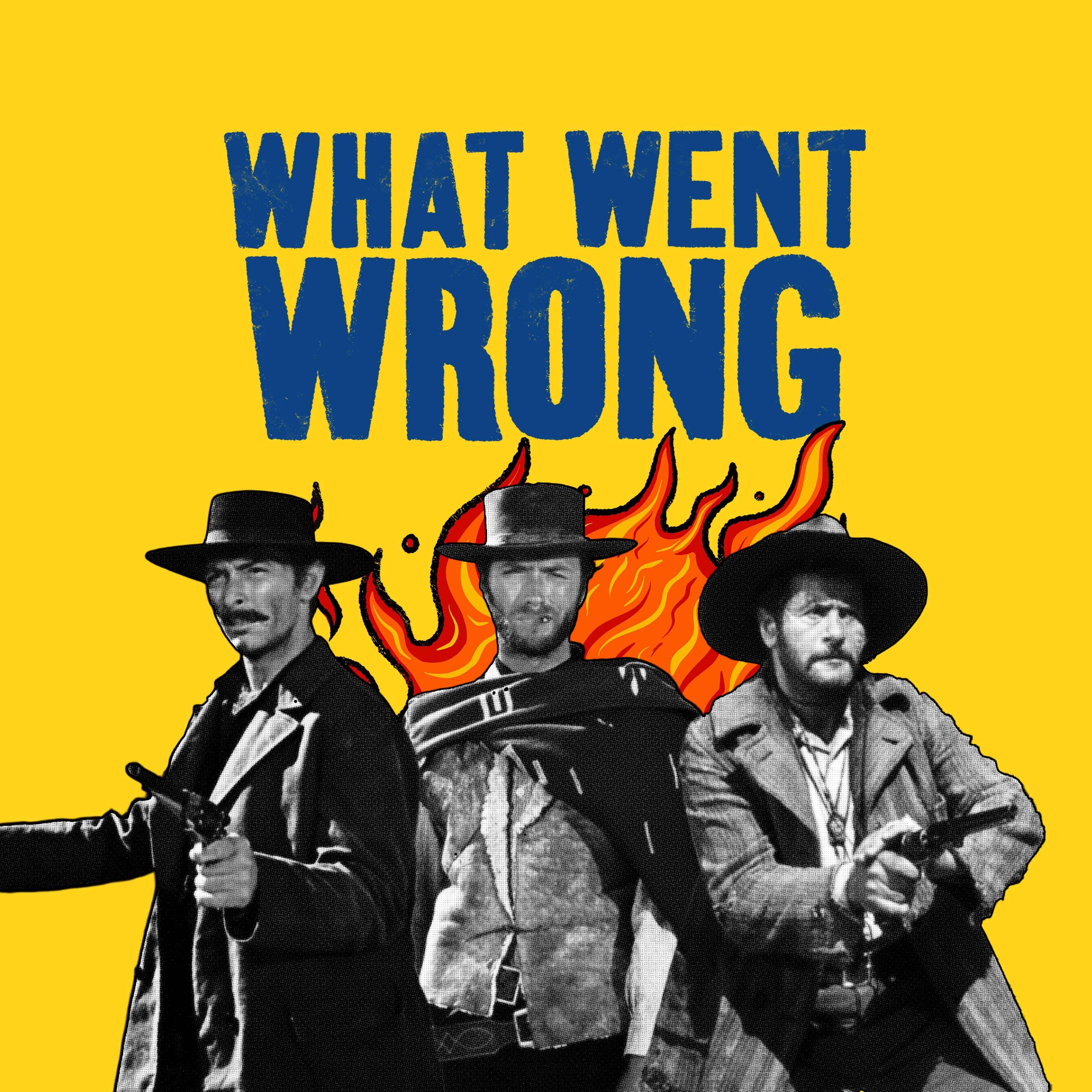
Loading summary
Transcript371 lines
- [00:22]
A
And action.
- [00:24]
B
Hello, dear listeners, and welcome back to your favorite podcast, Full Stop that just so happens to be about movies and how it's nearly impossible to make them, let alone a good one, let alone one of the most influential westerns of all time that just so happens to be made by an Italian. We have a lot to get into today, but first, this episode is very appropriately brought to you by Brahmi protein pasta made in Italy from only two old world ingredients, Italian wheat and lupini super beans. No fillers, no shortcuts. Real pasta that actually tastes like pasta with more protein and fiber built right in now. Now, if you listen to Friday's Primer, you're welcome, Chris. You know, Sergio Leone was a man obsessed with westerns who dared to ask, why don't we do this the Italian way? Brahmi saw the other protein pastas on the market and said, why don't we do this the Italian way? Strip it down to two ingredients, let the quality speak for itself, and throw in an anti hero. Okay, maybe not that last part, but they nailed the quality. We were big fans of Brahmi long before they sponsored this podcast and more from Brahmi at the end of the episode, including something new they're launching this summer. But in the meantime, let's dive into the Good, the Bad, Bad and the Ugly, led by Chris. Chris, Lizzy, what do you have for us today?
- [01:34]
A
I got the good, I got some bad, and it's going to get ugly. But before we dive into that, I have to ask you, what were your thoughts about the Good, the Bad and the Ugly upon watching or rewatching it for IL Podcast?
- [01:48]
B
Well, Chris, I'm embarrassed to say I had never seen this movie before we were doing this episode. And part of that is sheer stubbornness because when I worked at IMDb, every year, the founder and then CEO of IMDb, Col Needham, would host a dinner and part of that dinner would be that you would have to go around the table and everyone had to answer each question individually. A single threaded conversation, if you will. It was actually pretty fun. And all of the questions were of course movie related. And one that he asked every single year. And somehow I always got seated at his table. He would ask me every year, what's the first movie on the IMDb top 250 list that you have never seen before? And the answer, if you look at the list number 10, is the good, the Bad and the Ugly, which is the first one on the list that I had never seen. And every year I would say, I haven't seen it. And he would say, well, that's your homework for next year. You have to watch the Good, the Bad and the Ugly. And it turns out Lizzie Bassett doesn't like homework. Cause I did never watch it. And every year I would think, well, certainly they won't seat me at the CEO's table again. And then they did. And. And every year I'd have to tell him I did not do my homework and I didn't watch this movie. And you know what? I was dumb. He was right. I should have just watched this movie because it's fantastic. I absolutely loved it. It is three hours long, which is, you know, always a daunting task when we're going to cover a long movie on this podcast. Although I will say, almost all of the super long movies we've covered have actually been some of my favorites. And I very much appreciate that, especially with this one.
- [03:22]
A
It.
- [03:22]
B
You cannot be on your phone. Not that I'm ever on my phone watching movies for this podcast, but, like, it requires a different level of attention that I think modern movies do. If you haven't listened to Chris Primer on Friday, there's a lot of discussion about how Dashiell Hammett was an inspiration, a direct inspiration for the Fistful of Dollars trilogy. And you can really see that here. It's very complex. The character dynamics are very complex. If you're not paying attention, you're not gonna know who these people are or what is going on or who they're hunting or why or why does have an eye patch now. You just aren't gonna know. You gotta pay attention. My first thought when watching this movie was, oh, Quentin Tarantino saw this and said, I could do that. The influence is so much stronger than I ever realized. Obviously, I knew it was a big inspiration. I mean, you can hear it. Inglourious Basterds is probably the most direct one, but I don't think I realized how heavily he is pulling from this movie. In particular, even in something like Pulp Fiction, it's so very much ingrained in the DNA. So that was really cool to see. And I just thought it was so surprisingly funny, which I was not expecting. It is very violent, although not gratuitously so. I don't think I loved Clint Eastwood in this, but I loved Eli Wallach and Lee Van Cleef so, so much. You know, we also talked about this a bit in Friday's Episode, which go back and listen if you haven't. But the way that the two of them moved, the way that their Faces work in this, especially Lee Van Cleef. It's almost like a mask. And it really did remind me a lot of Commedia dell'. You know, if you're not familiar, is an Italian theatrical comedy format that is extremely physical and involves masks. And I just thought that what he did. The stillness that Lee Van Cleef has in this movie is so spooky and awesome. And I just. He's got the best look ever. Visually, it is so sumptuous in a genre that I feel like usually, at least before this could look very flat, just because the American west is. It's kind of brown. It's dry, famously. And yet Sergio Leone really brought it to life in this movie, of course, which is not shot in the American West, I am aware. But all to say, I loved it. It made me laugh, it held my attention, no problem, for three hours. You know, say what you will about Clint Eastwood, he's very clearly a movie star. But I think for me, the person that I came away loving the most in this movie was Eli Wallach. In a weird way, he's the heart of it. Even though he's not a particularly good person or a trustworthy one, none of them are. That's my only qualm with this movie. I think it's very rude to call Eli Wallach the Ugly, because he's not ugly. He's actually a very handsome man. And second of all, how is Clint Eastwood? How is Blondie good in this movie? He's just blond. He's just hot. He's just Clint Eastwood.
- [06:10]
A
Anyway, that's what we'll get to. I think that's part of the point of the movie is the cosmic joke is none of these people are actually the thing that they say they are. None of them are just shades of gray.
- [06:18]
B
Yeah, it's so good.
- [06:20]
A
I do agree. I think it's rude to call Eli Wallach ugly. However, by the standards set by Lee Van Cleef and Clint Eastwood. Sorry, Eli.
- [06:26]
B
Sure.
- [06:27]
A
I would say the good, the bad, the mid would be the. Perhaps a better way to put it.
- [06:31]
B
The good, the bad.
- [06:31]
A
The attractive, the good, the bad. The Kansas City 7.
- [06:36]
B
But the Chris coming in with the hot takes.
- [06:39]
A
Cut that. No, leave that in. I say that as a Seattle 5, so I agree with everything you said. I had seen the Dollars trilogy when I was young. I was not into Westerns growing up. I was more into science fiction. I was into. I mean, Star wars, obviously took a lot of elements from Westerns. And then I liked more modern action movies, which I mean, again, so many action movies, especially of the 80s, pull from these movies in so many ways.
- [07:02]
B
Yeah, big time.
- [07:03]
A
Edgar Wright is another director who I think is so deeply influenced, especially by A Fistful of Dollars and For a Few Dollars More, the way that he integrates music into the movements of his actors and timing with his edits, especially in the Cornetto trilogy, more than his later work. And obviously, as you mentioned, Quentin Tarantino, what Tarantino did, in my opinion, he cribbed Leone's style and then added this kind of punk American dialogue on top of it that's missing from Leone's films, which are much more visual. And so Tarantino's like the talkie Leone in a way, in my mind.
- [07:35]
B
Yes. But then, of course, he also goes and borrows from, like, Kurosawa and.
- [07:39]
A
Of course. Yeah. I mean, you mentioned Yojimbo, which, obviously a Fistful of Dollars remake of Yojimbo.
- [07:44]
B
It's all pastiche soup, you know.
- [07:46]
A
Yeah. And then the moment you talked about in Kill Bill where she spanks the Yakuza.
- [07:50]
B
Yeah.
- [07:50]
A
I mean, that's just lifted from Yojimbo. That is the final scene of Yojimbo. So, yeah, they're all pulling from each other. I think these movies are weirdly underrated, broadly speaking. I know that the Good, the Bad and the ugly is number 10 on the IMDb top 250. And yet I feel like in broader conversation, these movies are not given their due in terms of how influential they are.
- [08:08]
B
I agree. I think my reluctance to watch it speaks to that. But in my head, this was like, okay, yeah, it's a Western. Sure. It might be the greatest Western ever. I don't know why I have this stuck in my head that I don't like the genre, because obviously I do.
- [08:21]
A
Yeah. And I am not a big Western. I do like Western, a lot of Western films. However, it's not a genre that I'll go to to just watch. Like, an okay example, you know, you mentioned you'll watch any vampire movie. I'm not gonna watch any Western movie, so. Although any vampire. Western movies shout out Near Dark. But I think this is one of the best movies ever made.
- [08:40]
B
I agree.
- [08:41]
A
I love this movie. I watched the Dollars trilogy in a row for this episode. So we just went three nights in a row. Fistful of Dollars for a few dol. The Bad and the Ugly. It's so fun. I highly recommend it. They were all released in the same year as we'll get to, so you almost could have done it in the theaters in 1960. Seven in the United States, at least. If you like Lee Van Cleef, who I think is wonderful in this movie, yes, For A Few Dollars More is an even better performance in my opinion. He basically plays a good guy in that movie. I mean, if there is a good in any of these three movies, it's Lee Van Cleef's the Colonel and For A Few Dollars More. I also think the music that Morricone does is brilliant in this movie. And we'll talk more about it. The decision not to use Ecstasy of Gold until you're two into the movie, that's the famous da da da, da, da da. When Eli Wallach is running through the cemetery. That's an incredible musical and directorial decision. That's one of the best pieces of music ever put to film.
- [09:32]
B
Also that shot, and you know you
- [09:33]
A
have it, and the shot's amazing. The crane shot that booms up that reveals the scope of the cemetery and you save it for that moment. And it's a wordless three minute scene of a selfish, as we know, rapist running through a cemetery. And yet I'm like tearing up watching it. And yes, as you mentioned, I do think that Eli Wallach is the heart of this movie. He's such a good actor, he give such a good performance. The scene with his brother at the monastery is surprisingly moving. I have a theory that to me that Eli Wallach is as close as we've gotten to Leone, putting himself in one of these movies in a weird way. His manic energy, the way he shifts from humor to menace, et cetera. To me he has qualities that evoke Leone and I think Leone is a complicated person and he was a complicated person to work with as we'll get to. Anyway, I think this movie is great. I can't wait to talk about it. Because, Lizzie, the story is pretty wild and pretty fun.
- [10:21]
B
Great, let's get in.
- [10:22]
A
All right, so let's get into the details first.
- [10:24]
B
Saddle up.
- [10:25]
A
Saddle up. The Good the Bad and the Ugly is an epic spaghetti western film. I think anything over 2 hours and 30 minutes has to be by default called Epic. Yes, directed by Sergio Leone. It was written by Sergio Leone, Agenore Incrocci Furio Scarpelli Luciano Vincenzoni From a story by Sergio Leone and Luciano Vincenzoni I will do my best on the Italian name pronunciations today, guys, but apologies to anybody in Italy or our Italian American friends. With dialogue by Mickey Knox, an American. We'll get to him. Produced by Alberto Grimaldi, it stars, of course, Clint Eastwood as Blondie or Il
- [11:04]
B
Buno or Light Brown Haired Man. Anyway, continue.
- [11:07]
A
Light Brown Haired Man, Blondie by Italian standards, I suppose. El Buono the Good, Eli Wallach as Chucco or Il Bruto the Ugly and Lee Van Cleef as Angel Eyes or Il Cativo the Bad. It was released in Italy on December 23, 1966, and in the United States one year later on December 29, 1967 by United Artists. The IMDb logline reads a bounty hunting scam joins two men in an uneasy alliance against a third in a race to find a fortune in gold buried in a remote cemetery. I think this is a terrible logline and I would like to propose an alternative. Lizzie Great, a fraudulent bounty hunter and his duplicitous partner in crime race a deadly dastardly gunslinger across the Civil War scarred American Southwest to find a fortune in gold.
- [11:57]
B
Perfect. Nailed it.
- [11:58]
A
Take that. IMDb sources for today's episode include, but are not limited to, Sergio Leone, Something to Do With Death by Christopher Frayling, the Good, the Bad and Me in My Anecdotage by Eli Wallach, who's very funny, the Life and Legend by Patrick McGilligan, Clint the Man and the Movies by Shawn Levy, and many, many more documentaries, articles, retrospectives and interviews with those involved in the making of the film. Now, Lizzie, as you mentioned, we did a primer, an antipasto of sorts on spaghetti Westerns on Friday in the episode prior to this one in our feed. I highly recommend you guys listen to it. We try to make these episodes standalone. However, I do think listening to that will really enhance your experience listening to this episode, but it's not necessary. And so, Lizzie, let's begin. The Good, the Bad and the Ugly begins and ends with Blondie and Tuco splitting their plunder. Four for you, four for me. And you might think that Sergio Leone would be doing the same thing with the producers of A Fistful of Dollars after its release. As we discussed, it was made for only $200,000. It had initially received negative reviews from Italian critics, and it was kind of left for dead in a late summer release. But like the man with no Name, this no Name director Sergio Leone, credited as Bob Robertson on that movie, had a remarkable eye for violence. A Fistful of dollars grossed over $4 million in Italy, it sold millions of tickets across France and Spain, and it eventually would clean up in North America. And yet, Sergio Leone, at least he says, was not seeing much by way of profits. In fact, he believed that the Italian production company behind the movie Jolly Film was withholding his fair Share. So he sued them to break his contract. According to Leone, A Fistful of Dollars is the only one of my Westerns which earned me nothing. Wow. In the end, according to Leone, he received, quote, the Mexican rights, the one place the film has never done well, because the Mexicans are the bad guys. End quote. It was a classic double cross, and Leone wasn't going to let it happen again. Meanwhile, back in the United States, Clint Eastwood also wasn't exactly enjoying the fruits of his labor. A Fistful of Dollars was tied up in litigation with Akira Kurosawa because Leone had pretty much copied Yojimbo for that movie and it had not been released in the United States. As Eastwood later put it, not only was there a movie prejudice against television actors, he was one of the stars of Rawhide. But there was a feeling that an American actor making an Italian movie was sort of taking a step backward. Very true. Ratings for his TV show Rawhide had continued to plummet. But luckily, Leone had another project for him. He teamed up with a new producer, Alberto Grimaldi, who founded the Pea Film Company, which is the European production associate film company. I'm going to skip the pronunciation on that one. Can't do it. The follow up to A Fistful Of Dollars was going to have nearly double the budget. Lizzie. $350,000. And Leone was getting a 60% stake in profits.
- [14:56]
B
Wow.
- [14:57]
A
He also hired a new writer, Luciano Vincenzoni. They'd worked together on La Grande Guerra, which is the Great War. With Vincenzoni as a writer and Leone as an assistant director. Vincenzoni wrote the script for For a Few Dollars More. In nine days, they brought back Eastwood's mysterious stranger, created a new villain for actor Gian Maria Volonte. Indio. He's a great villain. He also plays the villain in A Fistful of Dollars and added a more sophisticated bounty hunter, the Colonel, aiming for Lee Marvin.
- [15:28]
B
Oh.
- [15:29]
A
But eventually they landed on the more affordable Lee Van Cleef. More on that in a moment. For a Few Dollars More was released in Italy in late 1965 to even greater success than A Fistful of Dollars. And the spaghetti Western revival was ratcheting up. Nearly 500 of these movies would be made across the 60s and 70s in Italy. But Leone's work had yet to be released in the United States. So producer Alberto Grimaldi got to work trying to sell For A Few Dollars More in the US and Canada. But it was actually screenwriter Vincenzoni who eventually made a deal. He spoke English. This is very important to our story. He was friends with an executive at United Artists A man named Ilia Lopert. Sometime in early 1966, Vincenzoni convinces Lopert to gather up some of his United Artists executives in Rome and bring them to a screening for A Few Dollars More at a super cinema. Also in attendance, Sergio Leone and Alberto Grimaldi. According to Vincenzoni, inside it was an orgy of laughing, screaming and yelling. When the United Artists people came out, they said, how much?
- [16:30]
B
Hell, yeah.
- [16:31]
A
And Vincenzoni said, a million dollars. And they said, done. Plus 50% of the profits outside of France, Germany and Spain. Plus Vincenzoni was going to get a percentage for himself. Apparently, this was three times the payday that Alboso Grimaldi had been hoping for. Wow. So contracts are signed and the inevitable next question is, what's next? They had no idea. So Vincenzoni made one up. It's a film about three rogues who are looking for some treasure at the time of the American Civil War, in the same kind of spirit as La Grande Guerra, which you just distributed in America. And then the poster just appeared in his mind. Il Buono, il Bruto, il Cativo, which is actually the Good, the Ugly and the Bad. And we'll get to the ordering later,
- [17:18]
B
which I figured, because that's the order in the movie, and you're kind of like, oh.
- [17:23]
A
As he later put it, there was no book, there was no screenplay, just those three words. And UA had five words in response. How much does it cost? Now, Lizzy, as the story goes, this conversation has been happening entirely in English. Uh oh. So Vincenzoni turns to Leone and says in Italian, how much? And Leoni says, how much for what? And Vincenti says, how much for the movie? I just sold them. And then he pitches the movie in Italian to Leone and says, give me a number. And Grimaldi says, 800,000. And Vincenti turns to UA and says, A million dollars. Again, great. UA agree. Wow, a million dollars. And if this story is to believe, on the one hand, they just secured three times the budget of their last film. However, UA just secured a $1 million Western at a time when these movies are starting to balloon in the United States. How the West Was Won, for example, which was an epic, was made for $14 million.
- [18:23]
B
Yeah, 1 million is not very much.
- [18:25]
A
It might have been a win on both sides for all we know. Okay, that is an incredible story and I had to share it, but it may have been a bit more complicated than that. Sergio Donati, an uncredited writer on the Good, the Bad and the Ugly, said that there were a few more steps in between. He said that for Example, Grimaldi might have actually been in New York trying to sell the North American rights when he learned about Vincenzoni's discussions with United Artists. And Leone says that he was the one who came up with the idea for the third movie. He said that it has its roots in an old Roman poem. A cardinal is dead who did good and bad things. The bad he did well and the good he did badly. Leone claims that he was reflecting on the story For A Few Dollars More and what made it work when he found the center of the third film, the good, the Bad and the violent did not exist in any absolute sense. It seemed to me interesting to demystify these adjectives in the setting of a Western.
- [19:13]
B
Great.
- [19:14]
A
As we'll get to, there's a lot of disagreement over where credit is due on this movie. However it came to be. Leone, Vincenzoni and Grimaldi are on the hook for a third movie. They have a million dollars to make it, five times the budget of A Fistful of Dollars, and they get a $500,000 advance from United Artists. Plus they're going to be getting 50% of the box office receipts outside of Italy. The only problem is, Lizzie. They don't have a star. So let's talk about Clint the squint Eastwood. When he had first come to Rome to shoot the Magnificent Stranger, which was renamed A Fistful of Dollars, he really was the man with no name. Nobody in Italy knew who he was. When he came back a year later to shoot For A Few Dollars More, he was mobbed. I'd walk down the Via Veneto and people would come up and ask for my autograph. I was wined and dined and treated like a king. At the Paris premiere For A Few Dollars More, Italian director Vittorio De Sica introduced him as the new Gary Cooper. This is a stark contrast to his status in the United States, where nobody
- [20:14]
B
knows who he is still as a
- [20:16]
A
TV actor on a currently being canceled Western TV show.
- [20:20]
B
Yeah.
- [20:20]
A
In fact, the first Western that Clint Eastwood had acted in, 1958's ambush at Cimarrone Pass, was the low point of his career. When he saw the movie, he thought it was so bad he nearly quit acting. But then he landed the role of rowdy Yates on CBS's Rawhide. He broke through at nearly 30 years old. But Rawhide, as we discussed on Friday, Lizzie was a bit of a cage. The scripts got stale, the characters got old, and the producers wouldn't even let him direct an episode. In Italy, though, his star wasn't just rising, it was exploding, which is why he might have bristled a bit when Leone explained that for the third film, he'd need Eastwood to share the screen even more than he had in the second. So, Lizzie, how much screen time would you say Eastwood has in the Good, the Bad and the Ugly? Do you think it's more than his co stars or roughly equal?
- [21:08]
B
No, he's a little bit more, I think, than Lee Van Cleef, but he's less than Eli Wallach for sure.
- [21:13]
A
That's exactly, exactly what I thought. Wallach almost feels like the main character to me.
- [21:18]
B
Yes, he is.
- [21:19]
A
Apparently, after reading the script, Eastwood said to Leone, in the first film, I was alone. In the second, we were two, here we are three. If it goes on this way, in the next one, I'll be starring with the American cavalry. It sounds like he was starting to think, this town ain't big enough for the two of us. Had to do it. But it wasn't the bad that was bothering Eastwood. To your point, Lizzie, it was the Ugly. He may have felt threatened by Tuco. Leone told him, look, this movie is much longer than the other two, so you can't be alone and Tuco's necessary to the story. You must understand that he is your water carrier, and the moment you appear, it is the star who is making his entrance.
- [21:54]
B
Okay, that's a complete lie.
- [21:56]
A
Eastwood was not convinced. Yeah, the negotiation stalled out, so Leone and his wife Carla fly to la. I believe that Carla is acting as his interpreter. I don't know that, but I believe she is. They met up with Eastwood and his then wife Maggie in person. According to Carla, eventually in the discussion, Sergio says, if he plays the part, I'm very glad about it. But if he doesn't, well, since I invented him, I'll just have to invent another one like him tomorrow.
- [22:22]
B
Uh oh.
- [22:23]
A
Such tactics always seem to work with Americans eye to eye, like a matador with a bull. And this may not have been entirely bravado. Vincenzoni says that Leone told him, don't worry, I have Charles Bronson in my mind and I don't want to have Clint Eastwood again. He also said that Leone was considering Steve McQueen.
- [22:41]
B
Yeah, I mean, that would have worked too. Although Clint Eastwood does have a particular something within this genre that works very well.
- [22:47]
A
A couple days later, Eastwood signs on. Now, it's possible that Leone's tactic worked.
- [22:52]
B
Wow, so you can neg Clint Eastwood into a movie.
- [22:55]
A
Or it's possible he changed his mind because his longtime publicist, Ruth Marsh, was telling him, hey, you should really do this movie. Now, Marsh had been a huge advocate of Eastwood's for years before he was ever a huge name. And in fact, Lizzie, if you remember, on Friday, we mentioned that a reel of Rawhide was sent to the William Morris Agency in Rome. We discussed this in our primer, and that led to him getting the role in A Fistful of Dollars. Marsh claims that it was her and Clint Eastwood's wife that sent it there and got Eastwood's name into consideration for that movie, which would land him the role that would change his career. So maybe Eastwood took Marsh's advice. Yeah, what we do know is that he then fired her.
- [23:37]
B
Oh, okay.
- [23:37]
A
Apparently, the agents over at William Morris, along with Eastwood's business manager, Irving Leonard, pressured him to let Marsh go. They felt threatened by the amount of influence she had on him. But perhaps the only reason we got this version of the Good, the Bad and the Ugly is. Is due to that influence. Now, I believe that Eastwood and Leoni needed one another, and Eastwood would be getting a much more fair share of the loot this time. $250,000, 10% of the back end from the Western Hemisphere distribution and a Ferrari.
- [24:06]
B
Hell, yeah.
- [24:07]
A
Eastwood was in.
- [24:08]
B
Yeah, that's a really good deal. I mean, how much money was $250,000 in 1965?
- [24:14]
A
I think it's 10 to 15x that to now. So somewhere around that's a lot. Yeah, two and a half, four million.
- [24:20]
B
Great.
- [24:20]
A
I need to do the math. According to both Donati and Vincenzoni, though, Leone was not happy. Eastwood cost them 25% of their budget and they still needed the Bad and the Ugly first on the list, Lizzie Charles Bronson. Now, if you guys remember back when he was making A Fistful of Dollars, Bronson had been at the top of the list for the lead role, but he turned it down because he thought the script was terrible. Now, he later said he realized the script didn't matter. Leone's direction did, and he wasn't going to make the same mistake twice. He was in, but he had a conflict. He just signed his contract to make the Dirty Dozen and the dates conflicted. So Bronson was out and Leone went with another American TV actor turned Italian superstar, Eastwood's co star on For a Few Dollars More, Lee Van Cleef.
- [25:08]
B
Oh, so Bronson would have been the bad.
- [25:10]
A
Bronson would have been the bad.
- [25:11]
B
Interesting. Okay.
- [25:12]
A
Do you know anything about Leigh Van Cleef, Lizzy?
- [25:16]
B
Only because I looked up a little bit. I don't want to step on your
- [25:20]
A
toes, but you're not going to step on my toes. Go ahead.
- [25:21]
B
I believe he was. Well, he's American, obviously, of I think Dutch heritage. And he was an actor who was maybe doing sort of smaller parts on TV and then got into an accident that caused a lot of scarring, thought his career was over and then was offered the role by Sergio Leone that would change his life.
- [25:40]
A
Yeah, I'll fill in some of the details, but that is the general trajectory. So he was in the Navy?
- [25:44]
B
Yes, that's right. He was an awarded like war hero in World War II.
- [25:48]
A
Yeah, Minesweeper. I believe he landed a small non speaking role as a villain in High Noon opposite Gary Cooper. Actually, according to one of his biographers, he'd been up for the role of Deputy Marshal Harvey Pell, which would have been a bigger role, a speaking role, but when producer Stanley Kramer asked if he'd be willing to, quote, fix his nose. He has a very distinct hawk like nose.
- [26:08]
B
Don't you dare. He has such a good face.
- [26:10]
A
He told him to go screw himself in a slightly more direct manner.
- [26:13]
B
Good.
- [26:14]
A
He still got the role of Jack Colby, a member of the Frank Miller Gang. And then he was in 50 movies, 150 episodes of TV. A lot of them were westerns. He often played the villain. He has great, as I mentioned, hawk life features. He self described, you know, his quote, beady eyes. I don't think that's a fair description, but that was what he said. As you mentioned though, his career really plateaued and then it nearly ended. In the late 50s. He was in a car accident coming back from set. I believe he shattered his left kneecap and he had a compound fracture in his left arm. He actually had to have a steel rod put in his arm that I believe was there for the rest of his life. There were rumors that he'd never ride a horse again, that he'd never run again. I do think those may have been overblown. But it's clear based on his biography that he was in pain. Walking caused him pain for the rest of his life. You know, he was in the man who Shot Liberty Valance in 1962, for example. And the role he plays in that movie is almost identical to the role he played in high noon, basically 10 years earlier. So he had made almost no progress. He actually called the era from like 1958 to 64 as, you know, his quote, lean times. And he said that the offer to do For A Few Dollars More came at a, quote, low period in his life where he really needed a job. And the added Bonus Lizzie was that he would not be playing a villain. So for a Few Dollars More, he plays a good guy. He couldn't believe it. Quote, people were actually going to like me and no one was going to spit on me and kick me into the dust. And there's a great story that I have to share because according to Vincenzoni casting, Van Cleef was like a scene out of a spaghetti western. They were five days out from the start of production on that second film. They'd come to LA to recruit a different actor, Robert Ryan, I'd read for the role. Leone goes to a bar for a coffee with his production manager, Ottavio Oppo, who speaks English. He's acting as his translator. And in stumbles this tall man in a black raincoat and a black hat, completely drunk. And Leone recognizes him. It's Lee Van Cleef. And Leone tries to talk to him, but he doesn't really speak English. And Van Cleef thinks that Leone's teasing him, grabbing him by his jacket. And so Van Cleef grabs him and then the bartender intervenes and says, hey, no, no, I know this guy. He's an Italian film director. Maybe there's a job for you. So then they call Van Cleef's agent from the bar. The agent comes to the bar and they sign a deal for nine weeks work for a few dollars more at $1,000 per week. Oh. The next day, Van Cleef and Leone are on a plane together to go to Rome.
- [28:29]
B
That's amazing.
- [28:30]
A
It's a great story. Also, there's another version of the story that Leone says they met at the bar through Van Cleef's agent, and it was an arranged meeting, but I do believe it was a last minute hire and it changed the trajectory of Lee Van Cleef's career. Now Van Cleef would be returning to his roots as the Bad. In this movie, all that's left is the Ugly. Enter Eli Wallach. Sorry, Eli, you're not ugly.
- [28:55]
B
Thank you.
- [28:55]
A
But you're the ugly in this movie.
- [28:56]
B
Sure.
- [28:57]
A
Leone had apparently considered casting Gian Maria Volonte, I believe, who plays the bads in both A Fistful of Dollars and For A Few Dollars More. He's great. According to some sources, he actually turned down the role. According to others, Leone decided not to hire him because he wanted someone who could really do comedy.
- [29:13]
B
Yeah.
- [29:14]
A
And I do think his strength as an actor is giving a very somber weight and almost a sadness to truly sadistic characters. There's not really a lightness to it. I also read that he was very difficult for Leone to work with and that Leone did not want to repeat that experience. Meanwhile, Wallach, on the other hand, is a veteran actor of the stage and screen. He's in his early 50s. He'd done Westerns, including the Magnificent Seven. But what sealed the deal for was a small scene in how the West Was Won. And I watched this, and it is this epic Western. I actually really liked it. Directed primarily by Henry Hathaway. It's five different chapters. Henry Hathaway does three of them. John Ford does one, George Marshall does one. It's long. It's nearly three hours long, $14 million budget. It's got everybody. Everybody's in this movie. It's the crazy Gregory Peck. Everybody's in this movie. Made $50 million at the box office, gets nominated for eight Oscars, wins three. It's got fantastic cinematography. I really feel like, for example, the cinematography of I know this Is tv, but Better Call Saul and Breaking Bad, for example, is really influenced by this movie. There's a train heist sequence towards the end of the film that I feel like George Miller pulls so much from in Mad Max, for example.
- [30:18]
B
Oh, yeah.
- [30:19]
A
And Wallach, in this movie, plays Charlie Gant. He's the head of an outlaw gang and he's trying to pull off a gold heist on this moving train at the end. But there's a small moment before the heist when Wallach is meeting with his gang and he catches sight of your favorite actor. Lizzie, who's your favorite actor from Breakfast at Tiffany's?
- [30:35]
B
Mickey Rooney?
- [30:37]
A
No, your other favorite actor.
- [30:39]
B
Oh, gosh. George Peppard.
- [30:42]
A
George Peppard. So George Peppard plays Zeb Rawlings, who, at this point in the story is an Arizona marshal. And these two have history. And so as Eli Wallach, he kind of goes up to Peppard, he threatens him a little bit, and as he's walking away, he looks over at Peppart's two sons, his young sons, and he makes finger guns and, like, pretends to shoot them. And then he does one at Paparid for good measure. And it's so off the cuff, and it's so funny, but it's also so menacing at the same time. It's perfect. You can just see, oh, man, why this guy would be so good as Tuco.
- [31:14]
B
And of course, as we learned on Breakfast at Tiffany's, nobody can suck the comedy out of a room like George Peppard.
- [31:20]
A
He's actually. He's the perfect straight man opposite that's a good combo opposite Eli Wallach in this movie. They have a great dynamic. So Wallach says yes to the role of Tuco very quickly, and then just as quickly, he may have started to regret it. So Wallach, Leone and an interpreter met at Paramount, and before they discussed the script, Leone made Wallach watch the opening credit sequence for A Few Dollars More. Which, Lizzie, if you haven't seen it, it's this wide shot of a plateau. It's actually. They use this exact location and almost this exact shot in the Good, the Bad and the Ugly, during the sequence where Tuco is leading Clint Eastwood's Blondie through the desert.
- [31:52]
B
Got it.
- [31:53]
A
Just this wide shot, a man is approaching us on a horse. He's tiny in the frame. A gun goes off, the man falls off, his horse dies. The horse runs off, and then the credits run over this unmoving wide of just this man dead in the desert. It cool. It's very iconic. And Wallach asks the interpreter, where and when does he need me? And before the interpreter can answer the question, Leone says, aroma. And then Wallach goes back to his hotel room. He cracks open the script for the Good, the Bad and the Ugly, and he's like, oh, I don't really like this title. And then he starts reading it and he starts to question himself. And I wonder again if the translated versions of these scripts are just not the best. He's like, why did I want to do this? Why does Leone want me for Tuco? I'm playing a Mexican outlaw. What am I doing here? One of the reasons, though, that he was so taken by the credit sequence is that it seemed to imply something admirable about Leone's personality. So in the credit sequence, you see Leone's name appear and then it's followed by gunshots and the letters get shot down. The name basically gets shot down. And Wallach later said, I thought, that's very interesting. It shows that he has an ego, but he's willing to be shot down. I'm guessing Leone just thought it looked cool.
- [32:52]
B
It does look cool.
- [32:53]
A
It looks super cool, but it's. The people who worked with him knew Sergio Leone did not like getting shot down.
- [32:59]
B
Yeah.
- [33:00]
A
The credited writers on this movie are Leone, Vincent Vinceni and a writing duo who went by. I believe the name is Age and Scarpelli, and that's Agenore in Croce and Furio. And I love the name Furio because of the Sopranos, Scarpelli. And the writing process was simple. Izzy, they'd all chat, then Vincenzoni would do all the work and write, and then Leone would read it, ask for changes and repeat. It really reminds me of the Kurosawa stories of writing Seven Samurai, for example. Apparently, very little of what Ajay and Scarpelli wrote actually made it into the movie. Leone later said there were jokes and nothing else. It was the grossest deception of my life. I had to take up the script with some ghost writers. End quote.
- [33:37]
B
Okay.
- [33:38]
A
It's all very dramatic, of course. So let's talk about the main ghostwriter on this movie, Sergio Donati. He was a law student turned novelist turned screenwriter, and Leone had tried to hire him as ghostwriter on A Fistful Of Dollars. Leone had called him up and said, go see Yojimbo. We're making it into a Western.
- [33:52]
B
But also, we're not because we don't have the rights. It's something else. It's an Italian novel.
- [33:56]
A
And Donati was like this. This guy's crazy. And he actually told his wife, if a man named Leone calls, tell him I'm not home. At this point, he didn't want to write for the movies at all. It was a period when Italian film was in the midst of a crisis. I didn't get paid all the time. I was rather disgusted by the film industry. So I decided to move to Milano, I believe, instead of Rome, where all the movies were getting made. I started a career in advertising. For five years, I didn't even think about films. But Leone kept calling. Finally, Donati goes back to Rome to work on rewriting For A Few Dollars More. After that, Donati said, Leone kept insisting that I write more for him. He kept calling me his writer, to be clear. His uncredited writer.
- [34:33]
B
Yeah, I was gonna say.
- [34:34]
A
So Donati says he worked on the Good, the Bad and the Ugly for about eight months, including all the way through the editing process. And we'll talk about. He was involved in the dubbing of the English version as well.
- [34:43]
B
Yeah. That is one thing with this movie. You can tell I assumed that all of the incredibly handsome Italian men were speaking Italian, which makes sense. But then I was like, well, why are the.
- [34:54]
A
Some of them are. And some of them are kind of phonetically speaking English. Some of them are saying completely different things entirely. As we'll get to.
- [35:01]
B
Well, that's what I was gonn say is you can tell that with the people who it looks like are speaking English, that sometimes they are not speaking the English words that are coming out of their mouth, including the American actors. I'm very curious about that.
- [35:11]
A
Let's get Back to Vincenzoni and Leone and the writing process for a moment. So Leoni claims that he discovered that there had been a battle in Texas during the Civil War, fought over gold mines. And he has a very long winded quote that I'm going to paraphrase. He claims that he went to the Library of Congress, goes up to the Librarian and says, I want everything you have on this battle over gold mines in Texas during the Civil War. And the Librarian says, I'm sorry, sir, you must be mistaken. There were no battles over gold mines and the war didn't reach Texas. There were only a couple land battles in Texas. Most of the battles in Texas were, I believe, around Galveston, and they were naval battles around ports. Leone assures him, sir, there was a battle. And he returns two or three days later, and the Librarian looks at him like he's seen a ghost. And he says, I have eight books that reference this incident. I am stunned that a man who can only read Italian could discover this quote. Now I understand why you Italians make such extraordinary films. 20 years I've been here and not a single American director has ever bothered to inform himself about the history of the West. End quote.
- [36:15]
B
My grandfather, on my mother's side, by marriage, not by blood. I'm not Italian. Was first generation American. His parents were Italian. His name was Alfredo. Rosie, Shout out Grandpa Fred. This reminds me so much of the way that he would tell every single story where it's grand, it's epic. Somehow they had never even seen someone like me until I had walked into the room. I love it.
- [36:39]
A
There's only one problem with this story. There were no Civil War battles over gold mines in Texas.
- [36:45]
B
It didn't happen.
- [36:46]
A
The incident I believe Leone is referring to, and that the movie is very loosely incorporating, is.
- [36:53]
B
Is the Mask of Zor.
- [36:54]
A
Yeah, it's the Battle of Glorieta Pass in New Mexico. Okay, so this was the culmination, and we're going to go deep into the Civil War history here, because my understanding, generally speaking, is great movie, not great history with the Good, the Bad and the ugly. We'll talk about some anachronisms later. This was the culmination of the Confederate New Mexico campaign. They wanted to control this kind of choke point at the base of the Rocky Mountains, you know, to control mines and railroads and a few towns, et cetera. They were commanded by Brigadier General Henry Hopkins Silby, who is name checked in the movie, and Glorietta and Santa Fe, all these names are in the movie, so it's clear he's referencing, I believe, this event in campaign.
- [37:29]
B
Yeah.
- [37:29]
A
I think the confusion stems from the fact that apparently his brigade consisted of regiments from Texas. The 4th, 5th and 7th Regiment's Texas Mounted Rifles.
- [37:40]
B
Got it?
- [37:41]
A
That's my guess. It's also possible that the confusion is Vincenzoni was actually doing the research. He claims that Leone was with him when he was at the Library of Congress, but that Leone mainly stayed in the hotel while Vincenzoni was at the library working. And what's funny is the story keeps changing. So in interviews over the years, Leone has also said that the Good, the Bad and the Ugly was inspired by the Charlie Chaplin movie Monsieur Verdure, a dark comedy about a man who supports his wife and kids by marrying and killing wealthy women. Wait for it. It was supposed to be a social commentary. There's a scene in which the man defends himself by saying, as for being a mass killer, does the world not encourage it? Is it not building weapons of destruction for the sole purpose of mass killing? Which Leone compared to his film later, in which, quote, we find two killers who are confronted by the horror of an entire war, and one of them says, I've never seen so many men wasted so badly. It just feels like he's making the connections after the fact. To me personally, it's possible. Again, Vincenzoni said, I wrote the Good, the Bad and the ugly in 11 days. I have too much respect for Charlie Chaplin to involve him with Sergio Leone Westerns.
- [38:44]
B
Wow. Okay.
- [38:45]
A
It's also possible, Lizzie, that the Good, the Bad and the Ugly was inspired by Leonel favorite book. It was called Journey to the End of the Night by Louis Ferdinand celine. Published in 1932, it follows the life of a World War I veteran from Europe to Africa to the US and things are just terrible everywhere. It's a dark comedy that critiques war and colonialism. The only problem, Lizzie, is it doesn't seem like it was actually Leone's favorite book. It seems like it was actually Vincenzoni's favorite book.
- [39:10]
B
I'm noticing a pattern here.
- [39:12]
A
Donati later said that Vincenzoni knew the book by heart and would read excerpts to Sergio, who never read a word of it. According to Donati, when Leone was later, quote, treated by cineasts in France as if he had an honorary doctorate of letters, they would ask him what his bedside reading is and he would say, soline, Journey to the End of the Night. And Vincenti later said, sergio never read a book in his life. He never even read his own id, but he had a great sense of and passion for the Movies.
- [39:40]
B
Here's the thing. He's got a style.
- [39:42]
A
He's got a style and he'd need passion to get through this one. So, Lizzy, let's talk a little bit about the scope of the Good, the Bad, the Ugly. It's huge. This movie is massive. Every time we get to our next Civil War set piece, the camera booms up and we just see more and more, more and more soldiers.
- [40:01]
B
They're going Gone with the Wind with it. And also there's one sequence which was funny by the end of it, but the number of cannons that are going off is insane. They fire one cannon, you're like, whoa, they're really firing that cannon. They fire another one, you're like, damn, they're really blowing up trees. And then it just goes like, ha, boom, ha boom.
- [40:22]
A
Ha boom, ha, boom.
- [40:23]
B
And it's like, close up on the cannon, close up on this cannon. It's insane.
- [40:28]
A
Well, those cannons were stockpiled from the nearby Museo de in Madrid. Also, the guns in the movie. And yes, a lot of the weapons in the movie, including I believe one of the Gatling guns and also dynamite, were not yet invented at the time of the Civil War.
- [40:43]
B
You know, I don't care.
- [40:45]
A
All due respect though, to our Civil War devotees, yes, the Spanish army helped build the sets and Leone claims two hundred and fifty soldiers built the cemetery, complete with 10,000 graves. Wow. The Sad Hill Cemetery at the climax of the film.
- [40:59]
B
Yeah.
- [40:59]
A
Again though, to Leonie's exaggerations, other sources say it was 5,000 graves.
- [41:03]
B
It's still a lot of graves.
- [41:05]
A
I know. Leonie just say 5,000.
- [41:06]
B
No, it's a 10,000.
- [41:08]
A
They spent a month building the bridge that features towards the end of the film.
- [41:12]
B
Yes, indeed, that busted janky ass bridge that they blow up. You could have taken that thing out with golf clubs, but sure, go ahead.
- [41:19]
A
Wow. Well, we're gonna get to that explosion in a moment. They added a dam to add more depth to the stream beneath it. Eli Wallach said he hated guns and he didn't know his way around them. And there's a pretty funny story about Leonie's style of direction. As we mentioned, Lizzie, he would physically act out how he wanted things done. So he said he had very specific direction for how Tuco should wear his gun. Tuco's not gonna use a holster. He's gonna have the gun dangling on a rope at the end of his neck.
- [41:43]
B
Yeah, it's a purse. He got a little gunpowder, but it
- [41:46]
A
was going to be no purse. It was just going to be attached to a rope around his neck.
- [41:49]
B
No, no, the gun is the purse, Chris.
- [41:50]
A
Yeah, yeah. And Wallach says, so the gun dangles between my legs. And Liana says, oui. They spoke in, like, broken French, these two. You twist your shoulders hard, I cut to your hand. There's the gun. The idea is like, he flips the gun into his hand from. Got it just by shaking his shoulders. And Wallach says, I can you show me? I don't know how that's going to work. And Leonie picks up the gun, puts it over his head, whips his shoulders around, and according to Wallach, the gun hits him straight in the balls. Leona catches his breath, hands the gun to Wallach, and says, just keep it in your pocket. So shooting begins in mid April of 1966, and it goes through mid July. So shooting in the middle of the summer, it was a much longer shoot than the previous two movies, but much shorter than American counterparts. April to July, that's a pretty tight shoot considering the scope of it, the amount of scope that they have in this movie. Movie, they're using a lot of the same locations from For a Few Dollars More and A Fistful of Dollars, including where they started, Chinacita Studios in Rome. Now, there was an interpreter on set who helped Leone communicate with the three American stars. Wallach, as I mentioned, said that he primarily communicated with Leone via broken French. And he also claims that Leone knew more English than he let on. But not everybody agreed. Cinematographer Tonino Delicali said Sergio was incapable of uttering a single word in English. He pretended he could read it, but he was never able to speak it. He said that Leonie got by because he was a good mimic. Quote, if the other guy smiled, he would smile. If the other guy looked sad, he would look sad. To make the other guy think he understood, but he understood nothing. He's basically Leonard Shelby in Memento. Yeah, just like, faking his way through every conversation.
- [43:29]
B
I love him.
- [43:31]
A
If we've learned anything on this podcast, and we like to think that we have, it's that when you're making a movie, you need to know your audience, but you also have to stay true to your roots. I'll give you the perfect example. Spaghetti Westerns. It's kind of the most American genre, but with a delicious Italian twist. Brahmi took pasta, one of Italy's greatest exports, and adapted it for an American audience. Brahmi is a new kind of protein pasta made from only two Old World ingredients, Italian wheat and Lupini super beans. More protein, more Fiber, same Italian roots and obsession with flavor. The number one best thing about this pasta, My kids like it. My daughter in particular, has gotten so picky that dinner is my least favorite part of the day. Day, every night is basically a showdown to get her to try something Western style. But not with Brahmi. She loves the shapes, she loves the taste, and she actually finishes most of it before asking for dessert. And this summer, Brahmi is introducing their newest pasta shape, exclusively at Whole Foods, called Cubetti, which is normally really hard to find in the US and it's delicious. Brahmi makes pasta that's worth slowing down for. So take your time, turn on a spaghetti Western and enjoy. Visit enjoybrahmi.com and find Brahmi at your nearest retailer. And make sure you try all new Kubetti, exclusively at your nearest Whole Food. Brami pasta Perfetta. In addition to English, Italian and French, there were cast and crew speaking Greek and German. It was a multilingual set and it was very loud because they were going to dub everybody's voices anyway. Wallach said they didn't stop for anything. They didn't stop for planes, they didn't stop for wind. They didn't stop for a crew member cursing somebody out, which is actually probably one of the reasons they were able to move so quickly.
- [45:04]
B
I was gonna say, yeah, if you're not having to do anything with production sound, that saves an enormous AM God.
- [45:10]
A
If you're shooting a movie in la, hold for Plane is just. It's a nightmare. Yeah, it's a nightmare.
- [45:15]
B
You cannot get away from airplanes in la.
- [45:17]
A
There were stagehands arguing about football scores, and there were crew members off camera feeding lines to the less experienced actors. And sometimes Leone wouldn't even have the actors recite their actual lines. Yeah, to your point, Lizzie. So there's one scene in particular where this is really noticeable. Wallach recounted it later. There's an Italian man who's playing a minor role as a soldier. He actually was not an actor. He was a World War II veteran, and he got visibly angri angry while shooting a scene, saying he didn't like Americans because he'd lost his arm in the war. It's possible to me that this is the scene, if you remember, when Corporal Wallace is taking him to the train and they're on the platform, they walk past a soldier, and Tuco actually lifts the soldier's sleeve up to show that he only has one arm. I think it's probably that actor, but I couldn't confirm it. So instead of reciting his lines, Leone Told the man to count to 10 in Italian. And that's what you end up seeing. And they dubbed over that. And this may have happened more than once.
- [46:09]
B
I'm so sorry. You're too angry. You're just gonna. To 10.
- [46:13]
A
Yeah. Which I cannot do in Italian.
- [46:15]
B
Nope.
- [46:16]
A
Leone also was blasting Morricone's music on set. So Morricone actually wrote some of the music before. He wrote a lot of the music afterwards, but he wrote some of the music before production began, and Leone would play it on set. And my understanding is he would actually like stage camera movements and action based on the music, which I think is really cool. But not everybody appreciated on set. For example, cinematographer Tonino Dellecalli did not like this because it was so loud. He actually couldn't communicate effectively with his electrician. But Leonie liked to create an atmosphere. Lizzie, he wanted to give it a feeling. Yeah, he was a little eccentric.
- [46:49]
B
He's about the vibe.
- [46:50]
A
Clint Eastwood was also a little eccentric. He was getting more comfortable shooting spaghetti westerns. So we don't think he was verbally abusing the camera anymore. Lizzie, have you ever heard about how Clint Eastwood got himself calmed down before shooting?
- [47:02]
B
No.
- [47:03]
A
Apparently, he used to go up to the camera when no one else was around and call it a dirty son of a bitch and all sorts of names to dominate it. He would neg the camera great. And then he'd be like, okay, I'm good. And he wasn't in tune by it anymore. And then he'd walk away and he'd be ready to shoot.
- [47:19]
B
Is this the inspiration for the empty chair speech later on?
- [47:21]
A
Oh, maybe. Yeah. Yeah, it's possible. So he got used to working with the camera, but he never got used to working with a cigar. According to Wallach, after two or three takes, he would say to Leone, you better get it this time, because I'm going to throw up. He hated the cigar.
- [47:36]
B
I don't know how he did this. Like, there's basically not a shot in this movie that he doesn't have that cigar in the left side of his mouth.
- [47:43]
A
I would have such a headache and I would vomit.
- [47:45]
B
I've smoked a cigar once in my life and I genuinely thought I was gonna throw up. I don't know how you do this.
- [47:50]
A
Yeah, I think if you're not used to it. It made me very lightheaded. I was surprised at the effects.
- [47:55]
B
Yes.
- [47:55]
A
You know.
- [47:55]
B
Yeah, it's strong.
- [47:57]
A
My understanding is that Lee Van Cleef smoked a pipe religiously. So, ironically, he's not really smoking much on camera, he's the one who can handle it. Eastwood's not. In fact, actually, Leoni says that when he offered Eastwood For A Few Dollars More, Eastwood said he would only do it if he didn't have to smoke a cigar. According to Leoni, he said, clint, we can't possibly leave the cigar behind. It's playing the lead. Just him. According to Wallach, though, at this point, Eastwood was actually openly talking about this being his last spaghetti western. And so on the production of this movie, he said that he wanted to form his own production company and get into directing. And Wallach apparently remembers thinking, oh, sure, that'll be the day. More on that later. So once filming wrapped in Rome, they moved to the location shooting, which was in mostly in Almeria, Spain, which is where they shot some of Lawrence of Arabia, as we discussed.
- [48:45]
B
Yes. Which sort of was the jumping off point for that area becoming kind of a Hollywood destination.
- [48:50]
A
Y On this drive, Clint and Wallach are driving together to go to location. Clint fills Wallach in on the lowdown on how spaghetti Westerns are made. No unions. You shoot sunrise to sunset six days a week. Don't eat the food or you'll fall asleep by mid afternoon spaghetti. Don't volunteer to do any dangerous stunts. Let the stuntmen do the tricks. And Wallach said, hey, I've made Westerns before.
- [49:16]
B
No, listen to Clint.
- [49:17]
A
He'd made more western movies than Clint, technically, at least American ones. I know how to do, do this. And Eastwood said, no, you've never made a western like this. Uh oh, don't show off. So comes the scene where Ntuko is on a horse and set to hang. You remember this, Lizzie?
- [49:32]
B
Yes.
- [49:32]
A
Eastwood's supposed to shoot the noose. Wallach was nervous, maybe not because of the horse, maybe because the dynamite on the noose.
- [49:41]
B
Oh my God.
- [49:42]
A
The plan is for Eastwood to pretend to shoot the noose, then a special effects technician is gonna press a button, trigger the dynamite, which is gonna snap the. The rope. Apparently, Wallach told Leonie, hey, you should put cotton in the horse's ears because that's what everybody in Hollywood does to keep the horses calm when there's a loud noise.
- [49:57]
B
Oh, no.
- [49:58]
A
Wallach actually later said that he made that up, but it sounded good and it actually is a real practice today. Leone brushed him off, though, and they go ahead with the scene. Lizzy, can you guess what happened next?
- [50:09]
B
Yeah, the horse ran out from under him before the rope snapped.
- [50:13]
A
It actually didn't, but pretty close. The dynamite exploded, the rope snapped, the horse took off like a bat out of hell while my hands were tied behind me. I kept yelling at the horse to stop, using my knees to try to control him, but it was no use. It took about a mile before the horse stopped.
- [50:29]
B
I can't believe he was able to stay on it.
- [50:31]
A
I can't believe it either. With no hands.
- [50:33]
B
That is crazy.
- [50:34]
A
Hands tied behind his back.
- [50:36]
B
Oh, my God.
- [50:37]
A
And then Leonie said, let's do it again.
- [50:39]
B
No, no, my God.
- [50:42]
A
Wallach said, Lanie was always asking him to do it again. Wallach went back to his room that night, pulled out the Scream script and goes, God damn it. Because he realizes there are three more hanging scenes in the movie.
- [50:52]
B
Oh, God.
- [50:53]
A
But those were not the only dangerous bits. So apparently Wallach used to complain to Leone that he couldn't focus on his acting, because Leone, I think he had ADD or something. He was always fidgeting off camera. He was, like, opening and closing his hands and ripping up little bits of paper. And then Leone surprises Wallach in one scene by releasing a trained dog on him when they were filming to break the dramatic tension and capture his real surprise. And then William Friedman was like, I got you beat. Let me get a shotgun.
- [51:19]
B
Yeah, I guess I'll take the dog over the shotgun, actually. I don't know.
- [51:23]
A
I don't know. Trained dog is scary.
- [51:24]
B
Yes.
- [51:25]
A
So let's talk about. Actually, I think one of the most impressive stunts in the movie. And then the following shot. So, Lizzie, the scene where Tuco handcuff jumps off the train, pulling Corporal Wallace with him.
- [51:35]
B
Yes.
- [51:35]
A
That's a real stunt done at real speed.
- [51:37]
B
Oh, yeah, yeah.
- [51:38]
A
You can tell onto a rocky scene slope. I believe that that is stunt doubles jumping off the train. But in the following shot or the following beat, Tuco hears another train coming. He lays Corporal Wallace, played by Mario Brega, on the track. Oh, and Mario Braga's in For A Few Dollars More. I can't remember if he's in A Fistful of Dollars. Great character actor.
- [51:57]
B
Yeah, he's awesome.
- [51:58]
A
He lays him on the track with the handcuffs across the rail. So the train's going to cut the handcuffs. They made these, like, soft stunt handcuffs. They really do this. It's amazing. They really run a train over the dummy box with Eli Wallach lying in the dirt next to the train tracks.
- [52:14]
B
He's like, a foot away from the
- [52:15]
A
train track because Leonie wants him to turn toward the camera during the stunt so the audience knows it's him. Sir, there's a funny story also from Hot Fuzz. I don't know if you remember that movie, Lizzie, the Edgar Wright film.
- [52:27]
B
Vaguely.
- [52:28]
A
There's a scene where Simon Pike's character is jumping over fences.
- [52:30]
B
Yes, yes.
- [52:31]
A
And then Nick Frost follows him and, like, topples the first fence. And he gets up and he looks back at the fence as he's going. And when they were doing the scene, Edgar Wright said, make sure you look back at the first fe after it falls. And he goes, why should I look back? And he goes, I want people to know you did the stunt. And this is not dissimilar, except they shoot the scene and Wallach realizes that each train car has a small iron step on the side, and if he raised his head just a few inches too high, he would have been decapitated. So Leonie says, let's do it again. And Wallach says, no. And Leonie keeps pushing. And Wallach says, fine, but only if you dig a deeper ditch for me to lie in. I don't want my head that close to the iron stack. So they dig the ditch and they start filming again. Then Leone and Delicali start arguing again in Italian. And finally Leone goes up to Wallach and he says, look, your head's too low. No, he can't see you in the shot. You gotta do it again. And Wallach just said, no.
- [53:27]
B
Yeah.
- [53:27]
A
Just refused.
- [53:28]
B
Yeah.
- [53:28]
A
And that was it.
- [53:29]
B
Good.
- [53:29]
A
You have what you have and that's it. And that's what's in the movie. And Delhi Coley said that this perfectionism at all costs is really what made Leone hard to work with and probably a little unsafe to work with.
- [53:39]
B
Yeah. I mean, that shot was crazy. We were watching this, and our who and our nieces kept running into the room, and they're very little. And, you know, we were like. We kept trying to stop the movie, start the movie, stop the movie. And of course, we restart it as he's about to run over a body on the train tracks and both nieces run in. And we were like. Cause it's a very upsetting scene.
- [54:01]
A
Yeah, I mean, it's.
- [54:02]
B
It's crazy.
- [54:03]
A
I don't condone the lack of safety, but it's an amazing sequence.
- [54:07]
B
Oh, yeah.
- [54:07]
A
Now, Leone apparently would not leave set until he had completely finished what he was doing. In America, that would mean extra hours, which would mean overtime on a paid union.
- [54:16]
B
Not in Italy.
- [54:16]
A
Not in Italy or Spain. In this instance, this was often unpaid work. And because it was summer, Lizzy, there was light. They would continue to shoot extreme close ups. Right. That they could light without, you know, Seeing the sun down in the background. And so you have from dawn right until. So 7:30 in the morning till 9:30 at night, for example. That's 14 hours that he's forcing you to shoot six days a week. And Leone himself has said it took an entire day to shoot the first three close ups you see in the final showdown between Angel Eyes, Blondie and Two Tuco. And I mean, it looks amazing.
- [54:47]
B
It does.
- [54:48]
A
Okay, we have to talk about the story perhaps most told about this production, which is when Tuco and Blondie blow up the popsicle stick bridge. It is a popsicle stick bridge they're fighting over. So as they're preparing the scene, Eastwood asks Leonie, where do you want Eli and me to be when you blow up the bridge? And according to Wallach, Leonie points to a small ditch about 10 yards from the dam. And then Eastwood says to like, Leonie, where will you be? And Leonie turns and points at a hill 200 yards away where he's going to shoot the scene with a long lens. There's a long pause, and then Eastwood says, I think Eli and I will be standing right at the top of that hill with you. We want to see the dam blow up, too. And Leonie starts staring, but. But he tries to explain, I want to pan down the hill, show you guys lying in the ditch, then pan back up to the bridge as it explodes. And Eastwood says, no, Sergio, we will stand right up here by you.
- [55:36]
B
Yeah, that's.
- [55:37]
A
That's it. And it's a good thing that he did because this was not an airtight operation, Lizzie.
- [55:42]
B
I could tell that by the large chunks of debris that fly directly at the camera. Yeah, we'll get there.
- [55:48]
A
So when it's time to detonate the dynamite, which I have read One source said 400 kg of dynamite. I don't know if that's accurate. However, that explosion is enormous.
- [55:57]
B
It's big.
- [55:57]
A
It is one of the most impressive on screen. I mean, it honestly makes the bridge on the River Kwai explosion not look that big in comparison, which is quite crazy. The special effects technician turns to the Spanish army captain who's helped set everything up and says, why don't you do the honors? I believe the Spanish army guys are the ones that built the bridge. So he's saying, you know, your team built the bridge. Why don't you do the honors? You can push the button to detonate it. And the Captain Defers says, no, no, it's all you. The technician says, no, I insist. Look, it's easy. All you have to do is press the button when I say via. I've also heard some people say vai, vai, which would be Italian, but I think because it's a Spanish, via would mean go in Spanish. So I think it's via anyway. Unimpair. Important. According to Wallach, down below, one of the crew members asked if he should turn the slow motion camera on cc. The special effects man said, Other sources claim the man says, yes. Vi. Fine. What matters is something comes through the radio and the captain thinks he hears, oh, no, via. So he pushes the button and the bridge explodes without cameras rolling. According to Wallach, the special effects technician jumped into his jeep and headed straight for the airport as Leonie cursed in Italian with his megaphone. The Spanish captain then walked over to Leoni and fessed up, told him what happened. He says, look, me and my soldiers, we will rebuild the bridge for you in three days so you can get your explosion only if you bring the special effects technician back and give him his job back. Aww. And Leone agreed. Both men kept their words. Three days later, the bridge is back up, the technician's back in, the scene goes off without a hitch. Except Lizzy, as you mentioned in the final shot, over the shoulders of, and I believe that's Wallach and Eastwood's stunt doubles. They cut from them, returning to close ups and then they reverse. I don't think it's them.
- [57:42]
B
Clint Eastwood. The shape of the shoulders didn't look right. When they dive over the thing, there
- [57:46]
A
is a very large rock or piece of debris that hits a sandbag two feet from Eastwood's stunt double with enough force that is at least a 20 pound, if not a 40 pound sandbag. It lifts it off the ground.
- [58:00]
B
Yeah, that could have killed it.
- [58:02]
A
I mean, at minimum, concussion.
- [58:03]
B
Oh, yeah. A serious injury for sure.
- [58:05]
A
If not like cave in your skull.
- [58:07]
B
Yeah.
- [58:08]
A
If you guys haven't seen it, I will post the clip at the time on our Patreon that you can watch. You can also just Google Good, Bad and the ugly bridge explosion. It was a very close call. It's also an amazing shot. A very close call. Clearly unsafe at some level.
- [58:21]
B
Yes.
- [58:22]
A
Filming wrapped in mid July 1966. The movies scheduled to hit theaters in less than six months
- [58:31]
B
now.
- [58:32]
A
Good thing Ennio Morricone, as we mentioned, had started before filming began. Tarantino would later claim, as I mentioned, that Leone was, in a sense, treating Morricone's music like needle drops. And there's not a ton about this score available online as we'll get to later. Morricone doesn't really like talking about these movies and we'll talk about why later.
- [58:50]
B
Can I ask you one question, please? Is the wa wa wa. Is that just a person?
- [58:56]
A
The waz are a person, but there are three versions of the fifth interval that. So we'll talk about that right now. Let's talk about it right now. So shout out. The iconic whistling was performed by the guitarist from Morricone's band, Alessandro Alessandroni. And then the soprano vocals that I just love, especially in Ecstasy of Gold. Those are Era del Orso. And again, for my money, Ecstasy of Gold is maybe the greatest piece of music ever put to film. I think it's perfect. I think that scene is incredible. The arpit piano that he lays in earlier in the movie and you kind of. I kept thinking, oh, he's gonna play XC of Gold here, here. And then you realize he doesn't actually use it until the end of the film. And it's the restraint that that requires is amazing. But the main theme that you're talking about, that da da da da that was inspired by the howl of a coyote. That kind of psychedelic.
- [59:44]
B
That's what David said when we were watching it.
- [59:46]
A
Yeah, yeah. It's like a psychedelic yodeling is what one reviewer said, you know, and woo hoo hoo. The wah wah wah. There's a version.
- [59:55]
B
It's a person.
- [59:55]
A
That's a person. There's also versions that are like distorted electric guit run through all this processing and stuff. So there's a number of versions, the da da that you hear at the beginning, though, in the credits, there are three versions that happen back to back over three silhouettes for the Good, the Bad and the Ugly. Presumably like the three men. And according to one article I read, and I do believe this, it's kind of. There are three instruments representative of each character. So there's the flute rendition for Blondie. Then there's a human voices version for Tuco. That's two men, one singing the. A, one singing the. And then there's an ocarina version for Angel Eyes.
- [60:33]
B
Got it.
- [60:34]
A
And then you hear those like that leitmotif throughout the movie.
- [60:36]
B
What made me think of it was because it sounded sort of busted on Tuco's. Like it sounded like people, which made me kind of laugh. And then I. Tuco's is like,
- [60:46]
A
yeah, that's intentional. That's like for the Ugly.
- [60:48]
B
So funny because when that happened, I was like, wait a minute now. And then you don't hear that again. For the rest of the movie. So I was like, I must have been hearing things.
- [60:55]
A
No, no, you heard it correctly. I think that's very intentional. Intentional. Now, the movie was edited by Eugenio Alabiso, who had helped edit For A Few Dollars More and Nino Baragli. Hope that I got that pronunciation right. Nino called Leone the Pulverizer because he reduced you to a pulp when the editing begins.
- [61:11]
B
Cool.
- [61:12]
A
According to Nino, Leone shoots a lot of footage for two main reasons. Number one, he wants to get the most out of his actors. And number two, he wants to cover his ass. So there are a lot of ways to edit his movies. Movies. Vincenzoni said that he used to drop into the editing room, too, and each frame was a fight. In fact, it was during editing that he and Leone had their first major blow up. I think tension had been building between these two since Vincenzoni pitched the movie to United Artists without any input from Leone. And now the issue was the length of the movie. So the problem is United Artists, at least for the US Distribution or the portions of the distribution that they control.
- [61:54]
B
Control.
- [61:54]
A
They don't want anything longer than two hours.
- [61:57]
B
Yeah, this is the classic. This happens every single time. Anybody wants to push the length of it, it's because it's happened with Titanic. This happened with something like Avatar, everything. They don't want to exceed that runtime, because if you do, it reduces the number of screenings you can pack into a theater during a day, which then, in theory, reduces ticket sales. Of course, we've seen for things like Titanic that wasn't actually the case, but yeah.
- [62:20]
A
So apparently. Apparently, the first fight was basically, Vincenzoni sees a cut of the movie and sounds like maybe he's acting as UA's advocate in here, but appeasing UA would require cutting 45 minutes from the movie version that he saw. And so they have this big fight. They also have uncredited screenwriter Sergio Donati there, and he's trying to help make a shorter version of the movie make sense. He said that Leone would prefer to take out entire chunks of story rather than abbreviate sequences or alter the rhythm. And then he would create scenes that would be like, the necessary lengths to bridge the broken portions of the story. Like, in another interview, he says, they cut more than half an hour of film. And I wrote a scene covering everything that was missing in those 30 minutes, and we dubbed it into a shorter scene. Dunasi said that in the end, he felt that Leone was, quote, not living up to his own reputation. In his heart of hearts, he was aware of his Limitations. And he was continually plagued by self doubt. He also claims that Leone tried to delay the release. So what's really interesting is, so this movie released on December 23rd, and that on basically that night, like they finished the last mix right before this movie released, there was champagne brought in to celebrate. Everybody's emotional and Sergio just says, okay, good night, and he leaves. And that's. It doesn't even celebrate it. And in fact, they actually premiered eight days before he finished the final film. So they premiered in Rome on the 15th of December, and he kept working until the 23rd, basically. So the Italian release clocked in at just under 180 minutes.
- [63:49]
B
That must be what I watched.
- [63:51]
A
It's not exactly. It is very close.
- [63:53]
B
Okay.
- [63:53]
A
I believe the Italian release is now referred to as the International. What we've watched is called the extended cut. And the difference is mostly in the way it's dubbed. And we'll talk about it in a moment. So for the US release, at the time, Leone says, quote, they took away 20 minutes to make people go and buy popcorn. The actual difference, I think, is roughly 16 minutes. 177 in Italy is what I read, and 161 in the US. We'll talk about the scenes that were added back in later that you saw Lizzie, and I'm curious your thoughts about them, but let's put a pin in that to talk about dubbing this movie. So the movie opens in Italy. They have not done an English language version of it yet. So this movie's been released, but they
- [64:30]
B
have dubbed Eli Wallach, Lee Van Cleef and Clint Eastwood in Italian.
- [64:34]
A
I would imagine they've dubbed them in Italian for the Italian release.
- [64:38]
B
Right, right.
- [64:38]
A
So they then are dubbing Fistful of Dollars for a Few dollars more across 1966. 1967, basically. And it's not until the fall of 1967 in New York, under the supervision of American actor Mickey Knox, that they are going to dub the Good, the Bad, the Ugly. Knox was also responsible for writing the script that the actors were going to use in their dubbing sessions. And here's how Knox put it. Sergio had a very poor translation from the Italian. And in most cases, the American actors changed the dialogue when they were doing it. Meaning on set.
- [65:09]
B
Yeah.
- [65:09]
A
So what this means is they did not record sync sound, so he did not have reference sound from the set. So he's just reading their lips.
- [65:17]
B
Oh, wow.
- [65:17]
A
And sometimes what they're saying isn't matching what's in the English translated script he's been given. I knew what they were supposed to be saying because I had the Italian script, but I had to find out the right dialogue, not only in terms of moving the story along, but also to fit the lips. It's not an easy thing to do. As a matter of fact, it took me six weeks to write what they call the lip sync script. So he's not only reverse engineering the dialogue, he's creating new dialogue effectively to both, again, move the story forward and fit their lips. Eastwood was working on another movie, so he couldn't come to the dubbing sessions as skipped scheduled. Sergio didn't want to pay for Knox to wait around for Eastwood. So Mickey Knox apparently left, and then Sergio Donati, who is still there, runs the sessions with Eastwood. Eastwood comes in with the original English translation of the script that he had from the shoot. He starts reading from that and says, I don't want to use this new dubbed version. These are the lines I said on set. I'm going to say these ones. Which then wouldn't match Wallach and Van Cleef, who are working off of the new version. So apparently one of the United Artist executives had to step in and threaten him into reading the new dubbed vers. Basically, if you don't cooperate, you're not gonna make another movie in the United States. Apparently, things between Leone and Eastwood had just reached a real low point by this point in time.
- [66:31]
B
I can see these two not getting along, especially knowing that Clint Eastwood is going to become an extremely accomplished director in his own right later in his career.
- [66:39]
A
And how would you describe Clint Eastwood's directorial style?
- [66:42]
B
It's very staid. I mean, it's very controlled and efficient. Efficient, yes. Yeah.
- [66:47]
A
The one take wonder, you know, I mean, it's the opposite of Leone in so many ways.
- [66:52]
B
Yes, I do. I mean, I want to shout out Mickey Knox for the script that he wrote here because I have to say, like, I actually think a lot of the dialogue in this movie is very good and feels very natural and American, which I was wondering about when you're watching it, because clearly these are not mostly not Americans saying this stuff. So I actually think he did a pretty incredible job.
- [67:15]
A
I agree. So it's important to note that Eastwood, Van Cleef and Wallach only dubbed their scenes for the US release cut.
- [67:23]
B
Right.
- [67:23]
A
So for the 161 minute version, we'll come back to that. So United Artists handles the marketing in the United States. They intentionally packaged the first three spaghetti westerns, right, the Dollars trilogy, similar to how they packaged the Bond franchise and all three movies as we mentioned, are released in the US in 1967, which is actually a great opportunity to really hit the market hard, hard. So A Fistful of Dollars comes out in January for a Few Dollars More in May, the Good, the Bad and the Ugly in December. And a United Artist spokesperson told the press that Leone's movies were supported by, quote, an ad budget several times more than anyone expected us to spend on a foreign made western. But there was a glaring mistake in the US trailer for the movie, a translation error. So Lizzie, as we mentioned, the movie in Italian is El buono il bruto, il cativo, the Good, the Ugly, the. The Bad. In the trailer when the narrator says the Bad, Wallach's face is shown. And when he says the Ugly, Van Cleef's face is shown. Apparently because of this, Van cleef was coined Mr. Ugly in future ad campaigns for his Italian movies. Oh, no. And I have one right here for the big Gun down. It says, Mr. Ugly Hits Town.
- [68:32]
B
Mr. Ugly Hits Town.
- [68:34]
A
So in the US, Fistful of Dollars grosses roughly $3.5 million against a $200,000 budget. For a Few Dollars More does $5 million against its $350,000 budget. And these movies have already made as much in Italy, to be clear, and they've done well in Europe. And the Good, the Bad and the ugly did roughly $6 million against its million dollar budget. For reference, the 10th highest grossing film in the US box office in 1967 was Hombre, a revisionist western starring Paul Newman, who was nearly a decade into his stardom, and it only made $6.5 million last year.
- [69:07]
B
Wow.
- [69:07]
A
So these movies were very financially successful. They were a hit, but the reviews were surprisingly mixed. The New York Times called the Good, the Bad and the Ugly, the Burn, the Gouge and the Mangle. They said it must be the most expensive, pious and repellent movie in the history of its peculiar genre. Near the end of the movie, the writers and the director, Sergio Leone hoped that it might pass for anti war. Never so many men who were wasted so badly, Eastwood says. And there is a completely meaningless sequence with a bridge, as though it might pass for San Luis Re, or Kwai, meaning bridge on the River Kwai. Sometimes it all tries to pass for funny.
- [69:44]
B
Why is the New York Times wrong so frequently? So frequently, like almost always when we
- [69:49]
A
read their reviews, except when they reviewed Moonshot, which they gave a good review,
- [69:53]
B
to which they were very correct about exactly.
- [69:57]
A
They also said Eastwood's face and voice are expressionless throughout. A word that Came up in a lot of reviews, was sadistic. Several critics found it technically impressive, but too violent or too long or too boring. Eli Wallach's acting was generally praised, sometimes Van Cleef. But the critics were kind of unimpressed.
- [70:14]
B
With Eastwood, that's crazy.
- [70:16]
A
And Lizzie. A few reviews ragged on Morricone's score. What, quote, a bizarre score, unsparing photography accentuate the film's brutality. Ennyo. Morricone's musical background, compounded largely of musical shrieks and screams, is poor.
- [70:32]
B
Sit down.
- [70:34]
A
A review from a paper in Ohio wrote, if this is the alternative to American Westerns, let's make more American Westerns.
- [70:41]
B
No, please don't. I had to watch a bunch of
- [70:43]
A
them when I was little, but Roger Ebert was on the right side of history. The Good, the Bad and the ugly is probably 30 minutes too long, but it's filled with good stuff like that for those who treasure Westerns. He gave it three out of four stars and wrote that all three of Leone's movies had been tremendously popular. And curiously enough, all three have been pretty good. I think one thing that's interesting to note is that the film was more positively reviewed outside of the United States, although also outside of Italy. Most of these movies were pretty poorly reviewed by Italian critics who were like, these are trashy imitations of Hollywood movies.
- [71:12]
B
That makes sense on a certain level, because I am sure that there was more sensitivity then than there would be now with something like this, where you are taking, you know, the most American genre and you're doing something people had not seen before. And, of course, they know this is an attempt Italian and, you know, Spanish production of this. So I understand that Americans might not be as welcoming towards this, particularly American film critics. Now, are they wrong? Yes.
- [71:39]
A
One English paper argued certain kinds of screen violence, like certain kinds of sick jokes, have a thoroughly therapeutic effect. If we have to live in a world of menace and social taboos, we might just as well lay the ghosts once in a while by turning around, staring them straight in the face, and having a nervous connection of giggle. And I can't help feeling that Sergio Leone's brand of cynical violence falls into the same category. Frankly, the Good, the Bad and the Ugly must rank as the nastiest, goriest, and fragrantly brutal of the three produced to date. Yet what a superb piece of film.
- [72:08]
B
Yeah.
- [72:08]
A
A Toronto newspaper, this is actually about A Fistful of Dollars wrote, leave it to a European filmmaker to strip away all the moral window dressing which usually disguises the Western hero to stress the capacity for violence, which ultimately is the hallmark of that hero. And I completely agree with that.
- [72:23]
B
Yes.
- [72:24]
A
Now, Leone told journalists he was done with Westerns, but that's the only kind of movie producers wanted him to make. His next movie was actually supposed to be Once Upon a Time in America, based on the Hoods by Harry Gray, but it would become Once Upon a Time in the West. He was stuck with Westerns for now. Casey tried to bring Clint Eastwood back into that film. I wanted to say farewell to the three characters from the Good, the Bad and the Ugly, and to do so in some style, I wanted to say farewell to them and the rules of the game which I had imposed. So I hoped that the three pistoleri who are killed by Charles Bronson at the beginning of Once Upon a Time in the west would be Clint Eastwood, Lee Van Cleef and Eli Wallach. The other two agreed, meaning Van Cleef and Wallach. But Clint was the only one who didn't want to do it. So there wasn't any point in using Van Cleef and Eli Wallach. It wasn't a question of expense. He just couldn't see the funny side of it. I think this quote's really important because I've seen a lot of speculation online that Leone offered Eastwood the Charles Bronson role. Harmon Once Upon a Time in the West. I do not think that's true.
- [73:26]
B
No. Seems like he was interested in working with Charles Bronson for years before Clint Eastwood.
- [73:30]
A
He'd offered him the lead role in Fistful of Dollars before Eastwood. I think these men were kind of done with each other. I do think he wanted to say goodbye to the character. I think Eastwood had no interest in returning. I also read speculation that the reason that Eastwood didn't do it was budgetary concerns that he was going to be too expensive. But Leoni says in this quote, it wasn't a question of expense. Eastwood just didn't want to come back. And Eastwood never made. He did not continue with spaghetti Westerns. He came back to America after this. So I believe this quote entirely from Leonie.
- [73:57]
B
Yeah, I do, too.
- [73:58]
A
So Eastwood, for his part, did not experience as much of an immediate boost as you might think. I think a lot of people assume he became the star we know him as now immediately after these spaghetti Westerns. I actually think that didn't fully happen until we get to Dirty Harry in the 70s.
- [74:13]
B
That's what I thought, was that Dirty Harry was the big break.
- [74:16]
A
I think so. This was a big break. But Dirty Harry, I think was More the big break. But this did lead to a really important transformation in his career. So his next movie was called Hang Em high, released in 1968. And I believe that his agents actually wanted him to do a different Western. I'm forgetting the name right now, but it had bigger names involved and they thought it would be more prestigious. But Hang Em High, he would get a salary bump on it. He'd still have to smoke a cigar, which sucks, but he'd get more points on the back end. He'd get a salary bump, he'd be the lead. And the other perk is that it was going to be the first joint production between United Artists and the Malpaso Company, which was named after Malpaso Creek, which flowed through Eastwood's property in Monterey County. So using the money from the Dollars trilogy, he and his business partner set up his production company that he had told Eli Wallach about while making the Good, the Bad and the Ugly. And he made his directorial debut three years later with Play Misty for Me in 1971. His 40th movie, Juror Number Two as a director, was released in 2024. So Lee Van Cleef, in stark contrast to Clint Eastwood, stayed in Europe.
- [75:16]
B
Yeah, he was a spaghetti western king.
- [75:18]
A
He's a Spaghett king. The Big gun down in 1966, Day of Anger, 67, Death rides a Horse beyond the Law. He was in dozens of these movies, oftentimes playing the good guy all the way into the mid-70s. But by then, you know, his career was in decline, at least in part because spaghetti westerns were in decline. This genre really died out and he was tied to them. He said in an interview in 1979, I am an actor. I enjoy what I'm doing and want to continue doing it. I'll never quit until I'm dead. Now, Lee Van Cleef had a lot of health problems. I have read there's a lot of speculation that he had a drinking problem, that he did suffer from alcoholism. He died of a heart attack in 1989. He continued working, you know, almost until this point. He was only 64 years old. He is actually only five years older than Clint Eastwood. So if you were to watch For a Few Dollars More, they kind of dye his hair gray, and because he's balding, they present him as the old man relative to Eastwood's young buck. They're only five years apart.
- [76:15]
B
That's not so surprising having watched the Good, the Bad and the ug.
- [76:18]
A
Yes, he looks younger in the Good, Bad and the Ugly than He does For a Few Dollars More.
- [76:21]
B
Well, and Clint Eastwood is mature. Like, it is interesting when I try to think of, like, oh, what did a young Clint Eastwood look like? Honestly, I see his son, because who, by the way, looks like.
- [76:30]
A
I mean, Scott Eastwood looks exactly like
- [76:32]
B
him, which is crazy. But he was. I mean, he was very clearly in his 30s and was a mature looking, you know, obviously extremely handsome, but, like, yeah, they don't look too far apart. They're very physically different. But age wise.
- [76:46]
A
Yeah, I think if you were to watch For A Few Dollars More, you would see a bigger gap. But I agree. You know, I read that one of Van Cleef's, I believe, agents or managers lamented that he stayed in Europe after making this movie.
- [76:59]
B
It seems like he loved it, though.
- [77:01]
A
He did. But he said, you know, he really felt this rep that if he'd come back after the Good, the Bad and the Ugly, he could have been as big a star as Eastwood. He really felt like he was that talented and charismatic and he could have made it in Hollywood. And who knows if that's true. But what, what I will say is I love Lee Van Cleef in these movies. I think he is so unbelievable. I mean, he's so handsome, he's got such a unique look and he's so charismatic.
- [77:25]
B
That's the thing. I actually don't think you can equate him to Clint Eastwood. Because the look.
- [77:30]
A
No, they're very different. I think the rep is just from the looks.
- [77:33]
B
They're so different that, you know, could Lee Van Cleef have come back and had some kind of career in the U.S. especially in the 70s, when you're looking at, like the Scorsese's and people, the auteurs that start to rise. Yes, I think definitely he. He could have. But would he have had as much fun? I don't know.
- [77:49]
A
We don't know. Ennio Morricone, of course, continued to work with Leone. But over the years he would get very annoyed when journalists would only want to talk about his work on spaghetti Westerns. As he later said, Only 8% of my film scores were for Westerns. Most people only remember me for those films. So sometimes I'm quite disappointed because I've written for so many other types of films. As recently as 2015, he relayed the story to a journalist of how he still regretted not getting to score Stanley Kubrick's A Clockwork. So as the story goes, he just finished working on a Leone film. I'm assuming duck, you sucker, because that was the same year as Clockwork Orange. But it's possible it was Once Upon a Time in the West. Kubrick apparently called up Leone and said, look, is Enyo available? And Kubrick, My understanding is he was trying to be polite. He wanted to reach out director to director first, so he wasn't stepping on his toes. And Ennio was. His part was done. Leone was in the mix at this point. But Leone told Kubrick that Morricone was busy with his. His movie. And Kubrick never called back.
- [78:45]
B
Wow.
- [78:46]
A
Vincenzoni had his own gripes with Leoni. He said that there was a different Good, the Bad and the Ugly sequel that Leone refused to make, quote, mainly because he was angry with me. The producer offered him $1 million only to put his name as Sergio Leone Presents. He didn't want me to make money, so he refused. Now, Leone only directed three more films, Once Upon a Time in the West. Duck, you sucker. Which he actually had not intended to direct. I think they were 10 days into shooting when he got pulled in to direct that movie. We'll talk about that in its own episode. And then, after over a decade hiatus and false starts on other projects, Once Upon a Time in America. And of course, he didn't pass up the opportunity to insult Clint Eastwood while working with Robert De Niro, calling Eastwood, by contrast, a block of marble. I have read that the two had dinner in Rome at some point in the late 80s, but it's unclear where they left things. Clint Eastwood did meet Akira Kurosawa, I believe, in the early 1990s, late 1990s, 1980s. And they both had a good laugh over A Fistful of Dollars, being a direct rip off of Yojimbo and starting his career. Leoni passed away from a heart attack in 1989, the same year that Lee Van Cleef died. Vincenzoni passed away in 2013. A year later, we lost Eli Wallach, who, of course, did star in the Holiday. The most important role in the Holiday.
- [80:02]
B
Yes, he does.
- [80:03]
A
And then Ennio Morricone died in 2020. But, Lizzy, let's talk a little bit about the version of the movie that you watched, the extended cut, which is what you'll watch if you re on pretty much any platform.
- [80:13]
B
Yes.
- [80:14]
A
So it does restore scenes deleted from the international cut. And it was assembled in, I believe, around 2003. But there was a problem. They didn't have the English dubbing for deleted scenes, so they brought Wallach and Eastwood in for these sessions. But Eastwood was in his 70s and Wallach was in his 80s, and Van Cleef had passed away. So they actually hired a voice actor to replace Van Cleef.
- [80:35]
B
Okay. I wondered. Cause there are some lines that don't sound quite right.
- [80:39]
A
It's Simon Prescott. I actually think he does a really admirable job, but it's still noticeable.
- [80:43]
B
Yeah.
- [80:44]
A
So the scenes in particular, and I'm curious if you had any reaction to these scenes. The one is called Il Grotto. It's the grotto scene. It's basically when Tuco has a duck or the white chicken, and he walks in to the well or the cooking area and he's plucking the duck and he's saying, oh, if I could find this man, I'll have $4,000. And his buddies come down from. They rappel down from the ceiling, basically. And he recruits them. That's one.
- [81:08]
B
So he's the least. I think, no Eli Wallach. The only thing is you can tell that the mouths don't match. So yes, I did notice that in there. But in terms of his voice, it didn't sound wrong.
- [81:17]
A
Then the fort scene, this is when Van Cleef's Angel Eyes visits the blown up fort where the Confederate hospital is set up.
- [81:25]
B
Yeah.
- [81:25]
A
So that's all Simon Prescott.
- [81:27]
B
Okay. Yeah.
- [81:28]
A
That's not Van Cleef. The sun bath scene, which is Tuco, is torturing Blondie. So this is like Eastwood and Wallach. And then there's a number of other scenes just with Tuco and Eastwood. They're mostly interstitial scenes connecting certain moments, like going to the monastery, et cetera. You know, there are a lot of people online who feel that the additions are unnecessary and diminish the quality of the cut since the dubbing is different. I disagree. I actually am glad that we have them in there.
- [81:52]
B
I think I do too. Everything you just mentioned, I think you need in the movie.
- [81:56]
A
Yeah. So, for example, the fort scene, I think gives wonderful context to the Civil War elements of the movie. But also, I think it would be confusing if, as it was in the Angel Eyes just shows up as an army captain, you know, miraculously at this next location. Yes, I think those are important scenes.
- [82:15]
B
They are. And also what I'll say about the dubbing is that I think, honestly, because in the cut that we both watched, it happens early and often. That the lips don't match.
- [82:26]
A
Yes.
- [82:27]
B
You just kind of give over to it pretty quickly.
- [82:30]
A
It takes about 10 minutes for me. And then all of a sudden I'm locked in and it doesn't bother me anymore.
- [82:34]
B
Exactly.
- [82:34]
A
But it's always noticeable. When you start the movie.
- [82:36]
B
Yeah, yeah.
- [82:37]
A
And then you kind of. You lock in the Good, the Bad and the Ugly, as I said, up top begins and ends with Tuco and Blondie divvying up the loot. Four for you, four for me. And I think for a number of people on this movie, they feel like they got their fair share. I think Van Cleef got the second act he was yearning for. Eli Wallach got a chance to do some crazy shit in Europe. Cool. Clint Eastwood got the money to fund his production company. But for Leone and so many of the Italian folks behind the camera on this movie, I just have this feeling that they all somehow felt like they were stiffed, or at least a lot of them felt stiffed by Leone. But I want to end with a quote relayed through Chris Frayling, who has written several books about Leone and his work. He said that the last time he spoke was Vincent Vincenzoni. Vincenzoni said he wished he'd made peace with Leone before he died. In fact, Freling says that Vincenzoni cried on this call and said something along the lines of, I just wish I had shaken Leonie's hand before he died because there was bad blood between us. We both behaved like idiots. As the more cultured man, I should have known better. That brings us to the end of the Good, the Bad and the Ugly. Lizzie. So I. I gotta ask you, what went right?
- [83:54]
B
Great job this episode. Very fun, very entertaining. Before I say what went right, I do want to say one thing about the anti war elements of this. I think it's interesting that he chose the Civil War as a war to demonstrate sort of the pointlessness of fighting, because that actually feels to me like one of the least American things about this movie of the many wars that the US has engaged in. I think if you. You grew up in America, depending, I suppose, on which side of the Mason Dixon line, but the Civil War most certainly was not fighting for nothing. So that was one thing that struck me about this movie as interesting. Obviously, I understand the point being, like, the lives lost, it's never worth the lives being lost. But then I kind of caught myself feeling like, well, if there was one war where it maybe was worth the lives being lost, it was probably this one. And so I did think that was interesting. And that, to me, was one of the few things that took me out out of this a little bit. But that being said, I think what went right here, even though perhaps the ghost of Sergio Leone will haunt me for this is the collaboration, it is the number of people that had to come together on this, whether it's his poor uncredited ghost writer or, you know, the cinematographer Ennio Morricone. It just the number of people that worked on this movie is stunning. And, you know, no one can ever take sole credit for it. Obviously you had Sergio Leone at the helm of this with his vision, which is uncompromised, for better and for worse. But as we always say here on the podcast, filmmaking is one of, if not the most collaborative art you can possibly have. And so I will just say, yeah, it's the collaboration.
- [85:36]
A
I think it's great. On the one hand, Eli Wallach, I think is fantastic in this movie. Yes, I wish I had more Lee Van Cleef in my life. I want to give mine to Ennio Morricone. I just think his music across all three of these movies. And yes, I know beyond these movies, the Mission, another great one, for example, is wonderful. But I think what he does in these movies in particular is so ahead of its time. And the composer who came to mind listening to it this time is Cristobal Tapia de Vil, who does White Lotus.
- [86:05]
B
And I feel like did the White Lotus.
- [86:07]
A
Did the White Lotus also the girl with all the gifts and a lot of other great stuff. And his use of vocalizations feels so inspired by Morricone. And Morricone was just nobody was doing to my knowledge. No one was really doing anything quite like this at the time.
- [86:21]
B
No.
- [86:21]
A
And it's so wonderful. And yet it played with elements that already existed in westerns. But he made it so his own. So I'll give it to him.
- [86:27]
B
All right. Well, a huge thank you to Brahmi for sponsoring today's episode. If the Good, the Bad and the Ugly taught us anything, it's that the right two ingredients, Sergio Leone and Clint Eastwood, among many others, can go a long way toward making something incredible. And that's exactly what Brahmi is about. Protein pasta made in Italy from only two world ingredients with zero trade offs on taste. Pasta perfetta. And if you haven't tried it yet, this summer Brahmi is launching Cubetti, their newest pasta shape. Tiny hollow cubes for perfect for soups, salads and easy weeknight dinners. Find Cubetti exclusively at Whole Foods and shop the full brahmi lineup@enjoybrahmi.com that's enjoybrahmi.com Brahmi Eat well, live well. And Chris, if folks are enjoying this podcast as much as they perhaps are enjoying Brahmi's Cubetti and they would like to support us, how can they do that?
- [87:13]
A
Just a few easy ways. Tell a family member or friend check out what went wrong. They just did some Spaghetti Westerns Leave us a rating and review on whatever podcast you're listening to us on that helps us with discoverability. You can follow us on social media, on Instagram, Instagram for example. Or if you'd like even more from this podcast, you can get bonus episodes. You can sign up through Spotify or through Apple for our special features or you can go to Patreon. It's $5 a month on whatever platform you sign up for. And for $50 a month you can get a spaghetti Western style dubbed Shout out Just like one of these Shout em out Shout em out Full stop Full stop Shout Em out Shout Em out Full stop full stop Once there was was a man by the name of Sergio Went in Sakura saw a film called Yojimbo Said his wife caught a think I'll go and make my own Plagiarized the whole damn thing but somehow he'd struck ghost. Kurosawa sued his ass from here to Timbuktu Clint the squint walked off and said as financing fell through all wild Morcone wrote the tunes to make it fly Then Sergio told Stanley Kubrick back off and yo's money the whole thing's ugly it all went bad for leaving Cleave it's the best he ever had Eli Wallach doubted Eastwood's dreams But I'll enjoy the ecstasy of all the good they put on screen Shout em out Shout em out Full stop Full stop Shout Em out oh it's me, Clint Eastwood here for my dub session and I'm going off my script. Adrian Pankorea, Alex Barrett, Angeline Renee Cook, Ben Shindleman, Blaze Ambrose, Brian Donahue, Brittany Morris, Brooke Cameron Smith C Grace B Chris Gallagher the second G is Silent Chris Leal, David Frisco, Lanti Darren and Dale Conkling Don Scheibel M. Zodia, Evan Downey, Felicia G Film It Yourself Frankenstein, Galen and Miguel the Broken Glass Kids the cast and crew have win a trip to Browntown Half Greyhound I have the biggest man crush on Chris Winterbauer, James McAvoy, Jason Frankel, J.J. rapido, John D. Wiltshire, Jory Hill Piper, Jose Emiliano Salto Del Giorgio, Karina Canaba, Kate Elrington, Kathleen Olson, Amy Olga Saga McCoy, Lena LJ Lousy Susan, Lydia House, Mark Bertha, Matthew Jacobson, Michael McGrath, Nate Ashley, Nate the Knife, Rosemary Southward Rural Juror Sadie Just Sadie, Scott Oshida, Salman Chainani, Covidiner, Suzanne Johnson and the Provost family Where the O's sound like O's. I know what you're thinking. That don't sound quite like Clint. Well, don't forget, he's old as shit. That for sure was the squint. Okay, you caught me. I was dubbing Eastwood's line, but that's the way we do it when we're on spaghetti Western time. Shout em out, Shout Em out, Full stop, Full stop Shout Em out, Shout Em out, Full stop, Full stop. All right, Lizzy, what do we have next week for the fine folks listening at home?
- [90:41]
B
Rolling, rollin, rollin Keep them doggies rolling. We have not Rawhide, but we have one of my favorite movies directed by, as we have learned, a complicated man, starring two complicated men. We have Jake and Elwood, the Blues Brothers.
- [90:58]
A
Can't Wait. A long requested title that we've put off until now.
- [91:01]
B
Very excited.
- [91:02]
A
Can only do so much John Landis a year.
- [91:04]
B
Yeah.
- [91:06]
A
All right, guys, thanks so much for listening. We'll see you guys in a week. For Blues Brothers. We hope you're having a great summer.
- [91:13]
B
Bye.
- [91:15]
A
What Went Wrong is a sad boom Podcast presented by Lizzie Battle and Chris
- [91:18]
B
Winterbauer, post production and music by David Bowman. This episode was researched by Jesse Winterbauer
- [91:24]
A
and edited by Karen Krepsaw.