Loading summary
Transcript2 lines
- [00:00]
A
And we're live from the living room as Doug eyes up the Match Day spread. He's reaching for the buffalo wing. Perfect. Hang on. What's this? Oh, he's gone for a can of Pepsi too. Incredible. What a finish. Sensational combination. Look at the delight on his face. There's no doubt about it. It just tastes better. Match days deserve Pepsi. Food deserves Pepsi. Grab a pack of Pepsi. Zero sugar for today's match. It's poetry in motion.
- [00:30]
B
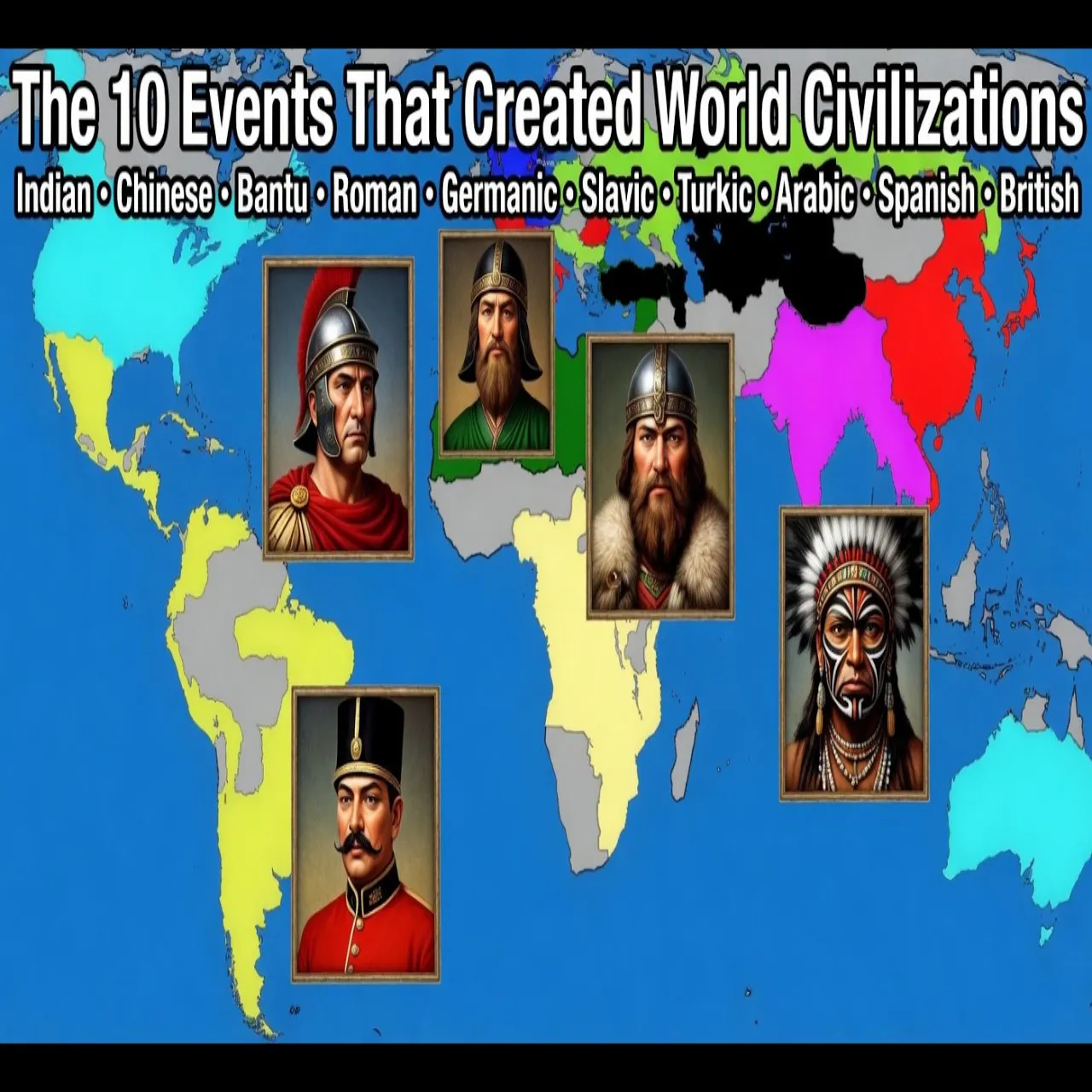
When I was hiking the Appalachian Trail six years ago, when I was 18 years old, I was camping. After a long day's hike, I remember waking up and putting together the maps I kept in the little notebook I brought with me. I had spent my earlier arduous walks trying to create sort of anthropological maps in my mind to just avoid the boredom. And so I put together the maps from different continents showing the originating historic event for their underlying culture. I had realized that every major world culture and entire regions of the world drew their culture back to shared events in world history, that these events continued to shape their culture until the present. That these countries, cultures, and motivations did not make sense without seeing the era of history which had formed them. I drew maps of each continent independently in my notebook. And I was surprised that almost all cultures in the world came from one of 10 historic events. This video has been stewing in my mind for a while, and I'm not really sure why I didn't make it earlier. This is a video to cover what are the 10 historic events which created the world's cultures today for a frame of reference. The thing I'm measuring here is not intuitive to most people. If you're wondering why I put Britain and America in different categories even though they're culturally and genetically very similar, it's that I'm not measuring the thing you think I am. I'm not measuring cultural difference in itself in that. I've already made loads of videos on that topic, predominantly my civilization videos. What I am measuring is the historic moment in time and the shared impetus or flash which created these societies, which I think is valuable in its own right. Modern England formed its identity from the Germanic migrations during the fall of Rome, and it shares that with much of Northern Europe. This informs their language, legal code, identity, national borders, or anything else. America was formed as a side effect of the British Empire, which it shares with the rest of the Anglosphere and much of the Third World. We're going to look here at the historic events themselves as a frame of anthropological analysis in their own right. I'VE posted this map a few times online, and for some reason people, even when I go out of my way to explain what I'm trying to show here, purposely misunderstand it. That's why you'll spot weird details like Pakistan being part of the Turkish bloc, since their identity as distinct from India formed as a side effect of the Turkish migrations into the region, even though Pakistanis are not ethnically Turkish. With historic shifts like this, they form a single, often small, coherent geographic area. A certain culture cultural operating system is developed there over the course of centuries, which fits the people, geography and context very well. There is a particular historic spark in that moment, which then triggers what's basically a historic virus, which then spreads those cultural forms across an entire, much larger region, normally forming a new ethnic identity among people ethnically close enough that they can form a new macro ethnicity. And the empire that formed this initially will often die out, but some descendant of the ethnic identity will survive, such as the Spanish in Latin America, the Arabs in the Middle east, or the Latins in Western Europe. Let's look at the 10 historic events which generated the world's major cultures today. There are a few exceptions, but almost all of the world's population stems from one of these ten. As you can see from the map, There are genuinely 10 of these in that there aren't really any hidden or secret ones. I'm not adding to get a nice number. Honorary mentions could go to countries like Persia or Greece, but they've been so worn down by history that they're just in their home stations now. With that out of the way, let's get started. Cultures around the world struggle with the uncertainty of a changing world, and oftentimes decisions are made by elites with no real stake in their choice. But you could get some certainty and make some money. An opportunity polymarket provides polymarket is the world's largest prediction market. Traders put real money behind their beliefs, so the odds you're seeing with reflect actual, informed conviction. Priced in real time, polymarket covers everything politics, economics, sports, culture and more. For example, say Polymarket has Will Russia and Ukraine agree to a ceasefire in 2026? Listed at 38%. A trader who's been following the peace talks thinks that's too low, so they put 1000 on yes at 38 cents a share. If they hold and the ceasefire happens, the market resolves at 100% and their $1,000 stake returns $2,600, a $1,600 profit based entirely on their read of the situation. But even better, they don't have to wait. Two weeks later, a framework agreement is announced. Odds jump from 38% to 62%. The trader sells their position right away, walking away with $1,600 on on a $1,000 stake before the event has even resolved. No lockup period and no fees. You're trading on your information edge in real time. If you're well researched with strong convictions on what's happening, there's finally a way to profit off your knowledge without fees or restrictions. Polymarket is a great way to make some money by investing in things you're interested in. So click the link in the description and start trading today. Part 1 Greater India it's often funny to compare cultural diffusion or change in the Orient versus the West. Cultural change west of the Indus river normally comes at the expense of titanic historic events like Islam, European colonialism, Rome or Christianity. The west of Eurasia is a constant grand strategy game of brutal Darwinistic competition, which is all also why the west conquered the world. Meanwhile, east of the Indus, it's more like a sort of eternal fantasy novel like Avatar the Last Airbender, where the lands and cultures say, constant between the fire or the earth or the water or whatever nations. India is India and China is China. The cultural changes that do occur were largely peaceful. This creates a completely different air and vision of the world than what you'd see in the West. India is a prime example of this, a nation which is one of the Eurasian Great four civilizations and which is the only one that has never really invaded outside of its current borders. I have a rule that India is the civilization which breaks all the rules for how civilizations should operate. Watch my video on Indian civilization if you want to know more. India is the only major civilization which kept polytheism as an example. It was the only major Asian civilization totally colonized by Europe. It industrialized recently without even industrializing and read this text wall for more. India is one of the oldest civilizations on Earth, with the current rendition stemming from the period after the Bronze Age collapse when the older Indus Valley civilization was totally destroyed. India formed a coherent urban advance civilization by 500 BC by the time of the Buddha and one of my favorite authors on this topic, Amaury Duriankur, in his wonderful book the Soul of India, talks about how India before the birth of Christ had their own lengthy historic anime arc. An important theme is that India was a society where the religion was the unifying principle rather than the state. India never went through a lengthy centralized universal empire like the other great civilizations, but the all encompassing Hinduism Filled the same cultural void. The priest class or Brahmins held enormous power in historic India. This centralized Indian culture spread across the entire broader region peacefully through Indian merchants. Indian civilization was significantly more attractive to the neighboring peoples than the Chinese was with Tibet in Southeast Asia taking in Indian governments under rajas, Indian religions like Buddhism or Hinduism and an Indian worldview or concept of life. Tibet, high up in the mountains, about as far as you can get climactically from the burning plains of India, took in the form of Buddhism, integrated with shamanism, turning into a Buddhist theocracy over the course of the Middle Ages. Southeast Asia became an Indic civilization over the Dark age period, with places like Angkor and modern Cambodia being very clearly Indic derived in every way possible. You'd look for with Hinduism as the dominant religion then and Buddhism as of now. This included great dynasties like the Srivajaya, Ava, Taungu or Majapahit, controlling what was potentially the wealthiest trade system on earth through the Spice Islands. During the Middle Ages, the Southeast Asian kings would style themselves with Hindu titles, replicate India's caste system through the mass slave states of pre modern Southeast Asia and read the Hindic classics to educate themselves. That being said, Southeast Asia has a habit of imitating other cultures without losing their character, which is what they also did for China, the West and Islamic. One of the interesting things you spot here is through the divide of Southeast Asia and India, which were both parts of the same broader Indic civilization is India is very much a society weighed down by history, with innumerable sub castes, ethnicities, languages, religious rituals in the open source toolkit that is Hinduism, While even before the birth of Christ, India had so much history. Meanwhile, in Southeast Asia you have the opposite. With a lot of Southeast Asia developing at the same time as America in the early modern period, with Thailand developing in the 16th and 17th centuries and Indonesia even later. Indonesia is a weird asterisk in this 10 part system. Read the text wall if you're interested. We have a record of a king in South India sending a letter to the king of Thailand during the 17th century saying you may control a lot more land than me, but I control actual subjects and your empire is all mosquitoes. The issue with the old premodern Indian civilizational arc is that it was quite prone to stagnation and decadence. Indian philosophy taught that reality was a dream by the gods that wasn't real, while they maintained a highly rigid caste system where social mobility was one of the worst evils. Every major historian I know of who studied India On a civilizational basis, all from the last century said that India had scarcely any social changes from the time before the birth of Christ to European colonialism. The straitjacket provided by the highly rigid culture, religion and caste froze Indians in robotic daily rituals. With no place for freedom, the best Indians fled into religion or the forest, leaving the society itself in decay. By the time of the High Middle Ages when Muslims invaded India, the local rajahs would build palaces to the gods rather than funding their militaries, which lost to the Muslims, outnumbering them 10 to 1. Hinduism made sailing the salt sea or meeting foreigners taboo, which had the effect of turning the merchant societies of Indonesia into Muslims, now the most popular populous Muslim nation on earth. When the British conquered and subdued India for centuries, it was a continuation of this trend. That being said, India has made a valiant effort to integrate with the modern world and are one of the most hopeful nations on earth today. India is trying to make a heroic struggle to integrate their old thousands of year old culture into a modern society that can work with democracy, capitalism and technology. I'm really curious to see what they do next. And India is one of the nations most prized to dominate in the 21st century with a real phoenix moment part two. The Chinese empire China is a sort of reverse mirror image of India in these regards. Both of them are Jupiters of the Orient, sucking everything else east of the Indus into their orbit. Both are collectivist, traditional, non warrior shame based culture cultures. But besides that, they are completely and utterly different. China is what if the Roman Empire survived into the 21st century where rather than the religion which was dominant in India, China, rather like the Greeks, transmuted their religious impulse into philosophy. While their unifying principle was a great state the size of America that stretched across their entire temperate zone. China and India are roughly as old as the other, stemming back to like 1500 BC with China being a little bit older. But the current Chinese trajectory also stems from the period after the Bronze Age collapse, when the frontier warlord the Duke of Zhou established the mandate of heaven for the Chinese emperor by launching a coup d' etat against the corrupt earlier Shang dynasty. Modern China's social institutions stem from the period of chaos that came after the collapse of central authority for the Zhou and before the rise of the qin dynasty around 200 BC that reunified China. This is when China's religions like Confucianism, Daoism, legalism and the cult of the Emperor emerged. The Qin and the Han established China's long lasting ruling class or the Mandarin bureaucrats Much like India, China's social structure largely did not change in the 2,000 years before the birth of Christ to European colonialism. The government is vital to China as a civilization. It isn't in many other places around the world. The Chinese orient their sense of self off the government, which means under eras of pressure like the Warring States Period, the Dark Age, Mongol invasions and the Century of Humiliations, the Chinese will form under a single cruel emperor who crushes weakness, unites the lands, and then China enters into a new golden age when they morally loosen up enough that it allows a collapse into decadence. This has been a trend in Chinese history they've been self aware of since the Duke of Zhou over 3,000 years ago. China has gone through many different phases of largely alternating between disunity, unity and barbarian invasions. The goal is always a unified ethnically Han China, even if they haven't attained that for a majority of the time. China has consistently been the most advanced, largest, wealthiest and most populous nation on earth for most of the last 3,000 years. So it's a strategy that has worked. But much like India, the cost has been stagnation, decadence and later humiliation by the Mongols, Japanese and Europeans. The Chinese could not keep up in the last 1000 years. Confucianism is to China's sphere what Hinduism is to India or what Christianity is to the West. That's why this area is also often called Confucian civilization. Outside the central orbit of China proper, you see three nations which took on the Chinese operating system without being Chinese. Those are Korea, Japan and Vietnam. Vietnam and Korea were formerly partially colonized by China, so that makes sense. China is also the only major operating system in East Asia, so they don't really have another choice here. Japan, the only one you could call a distinct civilization, is also out there. But it's still part of a broader Confucian world which incorporated Chinese religion, politics, culture and civilization on their own terms. These societies often oscillate between pro and anti Chinese faces over the course of their history. Part three the Roman Empire. It's interesting how the Romans once had one of the greatest empires in history, only to fall and then Balkanize. You can see how the three great civilizations of the region that came afterwards, such as the West, Islam and Orthodox, or the heirs to Rome in their own ways. Rome supplied us with so many things between an empire stretching from Scotland to Iraq, so many great authors, incredible architecture, history and culture. For thousands of years afterwards, Rome was the beckoning call that all the great powers of that region of the world between the Holy Roman Empire, Spain, France, Britain, Russia, the Turks, Byzantines and so many others openly tried to imitate the idea of Rome over history has been more powerful than Rome itself. Here we're going to look at the places whose ethnic identity only makes sense, stemming from Rome, even though Rome has given the world so many gifts in other ways. When you look at the fall of Rome, you see the empire split into Eastern or Greek speaking and Western or Latin speaking halves. The Eastern half survived as a legitimate empire and was the true heir to Rome, while the west fell to barbarians. However, I have the Latin peoples as descendants of Rome on this map in the west, but not the east since the Byzantines were conquered by the Turks. While modern Greece has had to build a distinct identity since the 19th century, resurrecting classical Greek culture to do so much like the Israelis did with Hebrew. When you look at nations like Italy, France or Spain, these places are cultural descendants of Rome in a way that English speakers aren't. For us, our language, legal code, social structure, genetics, values and other things are of Germanic origin. So for us, the Romans are inspirational in politics or philosophy. For the Latin peoples, the Romans are their very visceral ancestors, since all of those things for them are are of Roman origin. This created an issue during the Middle Ages that these people had to draw a line that they were now French or Italian, since the language and culture they had had deviated too far even from the rural dialects of Latin that were their ancestors. It was controversial when Dante in the 14th century wrote in Italian, not Latin, two largely mutually intelligible languages, since it was a visceral disconnect from the past. The reason the Renaissance happened in Italy is that since the memory and heritage of their pagan ancestors runs very deep in Italy, the Romans, stemming from the horse trading village of Rome, were the Mediterranean people who did the best job of structuring their constitution and culture in a way that allowed other peoples to integrate into their coalition very easily, which was a huge issue with the ancient Greek city states. While also the Romans had a deep toughness in morality, which meant they could beat nearly any other nation in a battle of sheer force of will. The Romans were considered the most moral and noble people of the Mediterranean. And largely by accident, the Romans conquered a huge empire. Being a Roman went from meaning the inhabitant of a specific city in central Italy to later Italians in general. And then calling yourself Romanitas could signify an identity that stretched from Britain to Syria. Greeks under Ottoman governance called themselves Romanitas into the early 20th century Rome went through their own historic arc that culminated in Caesarism, socialism and then Rome's collapse and conquest by the Germanic peoples. The areas that became the modern Latin bloc were largely populated by peoples ethnically close enough to Italians that they could feel at home in the same identity. But to the west of Italy, they did not have pre established civilizations that were stronger than Rome's. The Gauls went from Rome's greatest enemies to the strongest Latin nation. After Rome's fall, the different provinces became different nations. Romania is the outlier where during Trajan's reign, the Romans genocided Dacia, populating it with Italians who now make up a third of Romania's genetics. The wallocks, or another term for Romanians survived as Latin speakers while the rest of the Balkans did not. For reasons I do not understand, the Latin bloc has a relationship with the government closer to what China's is where these societies don't remember a period before the state. This means that when they're not monarchies, they have a tendency to devolve into socialism. Latin nations tend to be quite intelligent and often brave, but lack an underlying determination, work ethic and derangement that you see with the Germans or other North Europeans, which has caused the Germanics to gradually beat them over the last millennia. Latin regimes tend to have a profound instability alternating between monarchies, Caesarism, republics, socialism, dictatorships or other systems. The Latins compensate with this by having the highest degree of artistic, civilizational and cultural development of any society in the world. This was a better strategy in the pre industrial world than it is today. Latin Europe never fully entrenched individual responsibility and so it ends up being dependent on cultural authorities like the government, the Catholic Church or the feudal lord, which has made them quite uncomfortable with the overt competition of capitalism and has also weakened their self governance where they have largely cared more about equality than freedom. So as the populations get power, they choose to vote in a huge state that tramples freedom under the name of equality. The greatest issue of the Latin world is immaturity, Something which you can see spill into Latin America. As a final note, it's impossible to split up the impact of the Roman Empire on the development of Latin Europe from the Catholic Church's influence. The Catholic Church was built off the Roman imperial structure and both were centered in Rome. The Catholic Church kept the city of Rome, a world city, millennia after the empire itself fell. The Catholic Church was the dominant religion in this entire region besides Romania, and acted as an extra Roman derived cultural layer in this whole mix. It's hard to overstate the importance of the Catholic Church on Western civilization's development. It made Christianity a religion for Roman people. Part 4 the Greater Bantu Greater Bantu is a term I love, since it's a way of short circuiting the normal nerd criticism of the Bantus are just in the region from Cameroon to South Africa. That is factually true. But the peoples of West Africa are also linguistically, genetically, economically and culturally similar enough with comparable levels of civilizational development that I put them together. When I say the Greater Bantu region, I mean what people in the last century called Black Africa or people who look African in the way Americans would understand that which does not include large regions of Sub Saharan Africa which has multiple genetic groups like the Bushmen, Pygmies, Kushites and Nilotes, to say the least, that are more genetically different from Black Africans than East Asians are from Europeans. The Greater Bantu region were the most advanced group of Africans south of the Sahel, which is why they populated an enormous region of the world. Two distinct innovations in the swamps of South Nigeria or the area around Cameroon occurred around 1000 BC which set into motion huge variables that changed the entirety of African history. The first was the introduction of iron working across the Sahara, which allowed farmers for the first time to clear the dense jungles of Central Africa, thus making the land farmable. The second innovation was the introduction of germs that allowed these Africans to be resistant to malaria. This was sickle cell anemia, which comes at a horrible cost to Africans with childhood mortality, but suddenly made tropical Africa habitable on a greater scale than the most lightly populated previous hunter gatherers. Keep in mind that for building large populations in Africa, the consistent issue has always been disease for either the local Africans or the European colonizers. The Bantu punctured across sub Saharan Africa, finally reaching South Africa around the time the Roman Empire fell. The Bantu sailed across the strait to Madagascar around 1000 AD. Lots of South Africa was populated by Europeans before the Bantu. We know from genetics that this wasn't a totally clean process, often with genocide of the local Pygmy, Khoisan or Nilot peoples of Africa. Africa at the time was incredibly lightly populated and no one could put up a fight against the Bantu. By the time of European colonialism, there had been a handful of states in Bantu Africa, like Zimbabwe or Congo, but most of it hadn't progressed to that level. In Bantu Africa, the frontiers had a higher quality of life, greater freedom and treatment of women than the areas back further north. The Bantu societies were largely a mix of herding, where cattle was the currency and women did the farming with hoes. Bantu Africa later became totally dependent on slave trading, either between the Muslims in the east or north, the Europeans in the west, or a larger internal African slave trade. European colonialism is a strange topic to cover here, since I would normally say the states in sub Saharan Africa were built off European colonialism, since that's very clearly true for the governments where these nations, borders, militaries, railroads and capitals were all built by the Europeans in the brief 60 year period when Europe held most of Africa. However, I'm talking about culture here, which is clearly of Bantu origin. European colonialism is a huge honorary mention for this video in that it generated the modern global order. And whether or not we like to say that it's still true as of now. Bantu Africa exists in a precarious place with its population having gone up five times over since the 1950s, with very rapid economic and urban development, while at the same time remaining the poorest place on earth, with deep intractable issues that will not go away soon. There's an interesting phenomena in Africa and a lot of the Third World where their cultures themselves stem from the Bantu migrations which occurred thousands of years ago. But these societies only attained national and global consciousness due to European colonialism. So they have two births, one in the distant past and one within living memory. Number five, the Volkerwanderong. I love the term Volkerwanderong, and it's a German word for people's migrations to signify an era of European history which occurred after the fall of Rome and before the high Middle Ages, which completely changed Europe's ethnic map. The next four slides here are all in the era of the Volkerwanderung, but that term is normally used for the Germanic migrations that went with the fall of Rome. People talk a lot about how Western civilization stems from Athens and Jerusalem, or symbolic for the Greco Roman and Abrahamic roots. And while those are undeniably real, I think it leaves out a third strand which matters just as much, if not more, because it's our native hardware, that being the Sund or the area in Denmark where the Germanic people stemmed from. The Roman author Tacitus referred to it as the womb of nations, since so many peoples between the Germans, the Danes, the Nordics, the Geats, English, Lombards, Cimbri, Teutones, Vandals and so many others, stemmed from this small area of swampland. The hard land bred hard people and the Germans are originally from Scandinavia, not Germany proper. Their chronicles said they were founded by the prophet, God, adventurer and King Odin, who guided them from Ukraine to Scandinavia thousands of years earlier. Fathering their dynasty's religion, culture, laws and social structure. Odin was considered to be the highest of men, and Norse manhood, intelligence and morality was based off distance from him. Around 500 BC, they started spilling south, eventually driving the Celts out of everything east of the Rhine river and the Danube. To the south, they butted up against the Roman Empire, slaughtering multiple Roman field armies. And Roman authors remarked upon their savagery, but also their honor. The Germans were one of the very few peoples the Romans didn't conquer. The Germans even populated most of Eastern Europe before the Slavs residing in Poland, Hungary, Belarus, Romania and Ukraine, even with peoples in the Caucasus. Fusing with Germanic culture, the Germans used the fall of Rome well, becoming the rulers of the entire former Western half of the empire, including North Africa. Under many barbarian kingdoms. This was part of a titanic process in which the even more savage Huns came off the Asian steppes, driving the Germans of Eastern Europe into the Roman Empire, ultimately killing it, while demographically creating space for the Slavs to populate Eastern Europe. The effect of the fall of Rome, demographically was to turn England from Celtic to Germanic, culturally move the Germans further into the Alps or the Rhineland, while trading all of Eastern Europe to the Slavs. Latin Europe maintained a predominantly Germanic nobility through the Middle Ages. The Germans have generally been the people on Earth who score highest on cultural metrics, which is the origin of the meme that Denmark will always score highest of any nation on Earth for any given stat. The Germanic peoples can take pride in a very strong argument to be the most successful and important people in history. Until recently, Germanic peoples have been more immune to decadence than any other large population, not succumbing to tyranny as quickly being less tyrannical. And this region has been fairly consistent in its military or technological dominance as any society in the world has been. The Germans went from conquering the Roman Empire, then becoming Vikings, crusaders, and later conquering the world through European colonialism. This population simply cannot stop doing stuff and they need someone to conquer for their own sanity's sake. As Spengler said, Germanic culture put a huge moral taboo on lying, which was seen as unmanly and the worst thing in their moral code. One of the top principles Odin taught was that you had to follow rules and have set rule of law even when you didn't like the results. This culture created a high trust Truth seeking societies, while the manly culture demanded personal responsibility and thus heroic individualism. This created freedom as a concept stemming from the Germanic tribal concept of Freyacht. Our modern democracy is from the Germanic parliamentary tradition, often called the all thing. And during medieval Europe, almost every nation had their own parliament. Germanic culture put a high premium on discipline, precision, coherence and stubbornness, which I think has become their core advantage against the Latins, their great partner in Western civilization. It's interesting to compare socialism's takeover of the Latin world. The Germanic and they're both socialist, but in very different ways. The Germanic version of socialism, which you can see in places like Scandinavia, which are the most functional socialist societies on earth due to their high social cohesion. But these societies have still seen radical decline. And socialism in the Germanic concept is dependent on a concept that's called Jante's Law in Scandinavia. And Yonte's Law is the idea that you should never deviate from the group. You should never try to show that you're special. You should never pretend that you know more than the group. And it's really remarkable to see a culture that started with the anarchic heroic individualism of Odin become its exact opposite. Or Jante's Law. And Yonte's Law is the core issue of Germanic societies today. Number six, the Slav migrations. The Germanic migration so cleanly dovetail with the Slavic, with one leading to the other. The Hunnish invasions created a huge void of Germans who migrated west into the Roman Empire. And so Eastern Europe was very lightly populated, creating a huge vacuum pressure. The Huns also genocided the Byzantine Balkans, which may be one of the most important events in history. By gutting the Byzantine Empire's strongest region and then creating a void for the Slavs to puncture into the Balkans, settling most of the region going as far as the bottom of Greece. The Slavs populated a huge region stretching from eastern Germany to Russia and then down to Balkans, almost like a rolling tide forever taking this entire region ever since. The Slavs were the most primitive major people in Europe, being illiterate and semi nomadic, originally stemming from the Pripitmarsh region of North Ukraine. This continues with the theme these peoples tend to emerge in geographically harsh regions. The Roman authors, when they did mention them, did so with utter contempt. Thus it's profoundly impressive how the Slavs have dragged themselves up out of this state to become one of the most powerful and influential ethnic groups in history. The Slavs tenacity is one of their best traits, which you can see from them. Holding onto this huge region they got in a brief time window after the fall of Rome. The pagan Slavic peoples were then divided up between the western Byzantine and later Islamic civilizations or religions. The Slavic peoples faced up against the Frankish Empire in the west, where the Poles and Czechs converted to Catholicism. Due to that, Russia was established by Swedish Vikings conquering the region on their way to Byzantine or Islamic trade. They converted to the Byzantines Eastern Orthodox religion. The Slavs were often the henchmen of powerful nomadic confederacies like the Huns, but also populating the Balkans through the Turkic Avar confederacy. The Finnic Hungarians are genetically identical to the neighboring Slavs. For this reason, the Slavs often did not have good places in these relationships, with the word Slav being so similar to the word slave. Because they were widely used as slaves. The Slavs have been stuck in a weird position where they're simultaneously the conquerors and conquered in one of the most contentious regions on earth. Thomas Sowell, in his best anthropology book Conquests and Cultures, talks about how this changed the character of Slavic society. There were certain times when the Russians were under the heel of the Mongol tyranny, one of the worst ever others where hundreds of thousands of Russians were sold into slavery in the Muslim world. But at the same time, Russia is one of the greatest empires in history, controlling a region stretching from California to Warsaw at different points. Most of modern Russia was populated in the early modern period after gunpowder opened up the Asian continent to settlement. As of now, a quarter of Russia's population is in Asia. The Slavs are one of the people's most driven by political history, where when you look to the polls, a people who are culturally and ethnically very close to the Russians, but who chose Western rather than Byzantine civilization. Poland was an aristocratic republic, one of the most democratic societies on earth, while Russia was the most autocratic on earth at the time. Poland is also a demonstration of the principle we articulated earlier with at some points being the largest nation in Europe, while at others being repeatedly raped, raped by neighboring nations. For centuries straight, the Slavs have done a tremendous amount and they have a lot to be proud of. At the same time, whenever you read Slavic history, there is this degree of potential that's been lost compared to Western Europe. I believe that the Slavic world could have been of equivalent importance to America, but largely due to domestication by cruel autocratic states, the Elon Vital has been squeezed out of this region of the world, which is why outsiders often comment on how depressing Eastern Europe is. That being said, I wouldn't give up on the Slavs since history has shown their toughness and adaptability time and time again. Number seven, the Arab Caliphate. The Middle east is the graveyard of civilizations. It wouldn't surprise me if a majority of civilizations which have ever lived were in the Middle east, since the region was the incubator for the civilization simulation before it went somewhere else. However, over the course of thousands of years, the region had worn itself down. By the time Alexander the Great conquered the greater Middle east, the region had already had civilizations for 3,000 years already. Time like that will wear a land down as every act feels futile and as the weight of your ancestors intimidates into paralysis. Europe is facing this now. By the time of the Prophet Muhammad, the Semitic peoples of the Fertile Crescent, who were the original developers of civilization, had been under the governance of the Aryan Greeks and Persians for a thousand years. Their local branches of Christianity were suppressed either by orthodox Christians or by Zoroastrian fire worshippers. This is where the Prophet Muhammad showed up. He came from Arabia, a neighboring desert region which never faced the same civilizational effects as the Fertile Crescent did. He generated a cultural system which would allow the Semites to once again attain civilizational dominance for centuries afterwards. The Prophet Muhammad, whether or not you like him, was one of the most impressive figures to have ever lived in human history. He single handedly created a civilization in a way basically no other historical figures did. He built a religion, legal code, empire and way of life. Muhammad was born an orphan and died a prophet who unified Arabia for the first time ever in human history with an already successful religion. And he had armies that were already shattering those of Byzantine Syria and Persian Iraq. The Prophet Muhammad created the shared glue to unify the vigorous but proud and independent Arab tribes into what then became the largest empire in history. Up to that point, the Arab Caliphate stretched from Portugal and the Atlantic to the Indus river in modern Pakistan. Arab armies made it to Central France and Arab fleets deep into Africa or to China. The Arab Caliphate was the wealthiest, most technologically and socially advanced of any place on Earth. During the European Dark Ages, the Arab identity went from a sort of half baked concept among a series of disunited city and desert tribes into the overarching ethnic identity of a huge region stretching from Morocco to Iran and deep into Black Africa. From this shared Islamic glue, Arab has become a sort of macro ethnicity. In the same way Hispanic is in the New World where the blackest people on earth in Sudan call themselves Arabs. And there are lots of people in the Middle east who could pass For English who do the same. This was since as these people converted to Islam, they did so with the Arabic language and Arabic culture, which was stronger than the older dying ones. The Arab men had enormous harems which produced sons who all claimed to be Arabic. And Arabic tribes would migrate across the whole Muslim world to Central Asia or the Maghreb. Persia is a weird side note here, where they had their own distinct civilizational identity which went back thousands of years before Muhammad. However, the Arab conquest was a huge watershed in Persian history where the modern Persian identity is predominantly Islamic. As a Shia theocracy, reality doesn't have to fit into our boxes. And Iran is a nation torn at a fundamental level in two between their huge Arabic influence, which permeates every element of Iranian society, but an older, deeper identity which is rooted to just them. It makes Persia a paradoxical nation. And I won't group them in with the Arabs here, but I wouldn't fault someone else for making that call. It makes the map look a lot better if I'm honest. The Arab identity has broken up into distinct regional dialects that are mutually unintelligible. The Maghrebis are totally different from Syrians, but they're all Arabs on paper. Part of what's going on here is that the Arab migrations almost perfectly layer onto the prehistoric migrations from the Middle east outwards. With the spread of agriculture. This makes it really hard to figure out the scale of genetic impact for the Arab migrations since they're so muddled with this earlier prehistoric migration. The desire for pan Arab unity has been a powerful motivator for the Arabic peoples, but has largely proven to be an illusion due to the scale and differences across the Arab world. After the first 250 years of energy provided by the Prophet Muhammad, the normal period empires tend to last. The Arab world fell into decadence, proving that the Muslims could not totally override the earlier trend. The Muslim world then went through a period of profound chaos between economic and demographic collapse, intellectual degradation and as we'll see next, invasion by the Turks. I call this time period the Islamic Dark Ages. And the Arabs have been scarcely independent since until the Europeans gave them freedom recently. The Islamic Dark Ages are a huge event no one remembers and their why. At the time of the Crusade, the Franks were in awe of how advanced the Muslim world was. But the syria of the 20th century was a barely inhabited backwater. However, our next chapter is on the Asian Arabs New master the Turks, the Turkic migrations. Everyone thinks about the Mongol invasions first, but I would argue that the Turkish migrations which occurred a century or two before, were significantly more important to world history, and yet no one talks about them today. The Turkic migrations were the second act of Islamic history, after the Arabs grew decadent and the Turks dominated the Middle east for the vast majority of the last 1000 years, only ending in the 20th century with a defeat of the Ottoman Empire against European colonialism. The Turks were the founders of many great dynasties between the Ottomans, who of course dominated a region stretching from Algeria to Iraq and from Ukraine to Somalia. Then you have the earlier Seljuks, the first great Turkic dynasty, which controlled the entire Middle east out to Egypt and Constantinople, coming off the Eurasian steppe. The first great Muslim conquerors of India were the Ghaznavid Turks. There are so many minor Turkic dynasties, they were imported at the time but forgotten, like the Gok Turks who ruled Central Asia, or the Mamelukes, who ruled Egypt, India and Iraq, who were heavily ethnically Turkic. The Turks are to Islam what the Germans were to the Latins. And in the same manner that the first few fused to create the last, over a millennium of Western history, the Turks and Arabs did. For the last thousand years of Islams, however, you would never realize the Turks would be these great world conquerors coming from such humble roots. Unlike the Mongols, the Turks were one of the very few Eurasian steppe peoples like the earlier Aryans, who were able to seamlessly transfer into being a new, large, sedentary, civilized people. There are hundreds of millions of speakers of Turkic languages, stretching in a region from the Uyghurs of western China to the Turks of European Istanbul. Strangely enough, for a people now hugging the Aegean, the Turks are originally from the mountains of North Mongolia. Mongolia is to Asia what the Sund in Denmark is to Europe. Mongolia is a font of nomadic peoples who fight their way out of the harsh climate between the Huns, Turks, Mongols and so many others much like the Mongols in their mythology, the Turks said they came from the wolf. They rose to prominence after the Chinese waged a lengthy war against the Huns, which drove them west towards Europe. The Turks, starting in Mongolia, fought the Chinese once again, only to be defeated by the Tang dynasty's dominance and then headed west. They formed the Gokturk State, which dominated much of Central Asia. And the religiously Jewish Khazars of modern southern Russia were ethnic Turks during the same time period. The Turks later conquered the Middle east, since their savagery made them useful slave mercenaries for the decadent Arabic monarchs. The Turks conquered the Middle east either by infiltrating through the royal courts as Mamelukes, or invading through the Eurasian steppe. The first great Seljuks destroyed the Byzantine base in Anatolia, effectively relegating that great civilization to eventual extinction. The Turks were also able to use the grasslands like terrain of the Anatolian plateau as a surrogate grassland where they could repopulate as Turks. They used Sufi mystics to convert the local Greek speakers to Islamic Turkish culture in Central Asia. The rural Turks gradually outbred the urban Persians over the medieval period until they gain demographic dominance. Like the Arabs, the Turks are highly ethnically differentiated between some peoples who look identical to Europeans along the old Greek coast, to others who look totally East Asian or Native American back in Siberia or Central Asia. This migration was recent enough that Turks in western China and Anatolia are still largely mutually intelligible. Side note, the Turks also reached the Arctic Sea near the Pacific with the Akut people. The Seljuks fell apart pretty quickly and the Middle east for the next few years was governed by these petty Turkic states, with one of my favorite ones being the black and white sheep Turks. One of these petty states on the frontier with the Byzantines became the great Ottomans we spoke of earlier. This era saw the Mongols totally ravaged the eastern regions of the Turkish bloc, with some Turkic states surviving with the Delhi slave sultanates in Anatolia and Mameluke Egypt. However, the Mongols became totally dependent on ethnic Turks to conquer the West. And so when the Russians or Egyptians were fighting the Mongols, they were really fighting armies that were majority Turkic. A lot of the Eastern Turks started identifying predominantly as Mongol for a while. After the Mongol tide pulled back, the Turks dominated most of the Muslim world. Besides the Ottomans, the Persians were also ruled by a Turkic Qahar dynasty. The Mughal dynasty that dominated India were founded by an Uzbek, a form of ethnic Turk, and they heavily used Turkic soldiers. The reason I mark Pakistan in the Turkic category is that none of Pakistan speaks a Turkic language. But the medieval Turkic conquerors are the reason Pakistan has developed an identity distinct from India, which it was part of for thousands of years. The earlier Arabs stayed behind the Indus, but the Turks made it nearly down to Tamil Nadu at the bottom of India in the 14th or 17th centuries. Pakistan is a ghost of an earlier Turkic invasion. During the High Middle Ages, the Turks were good at maintaining enough savagery to rule while also using civilized methods. However, like every other empire, they grew decadent between the fall of the Mughals or the Ottomans devolving into the humiliating sick man of Europe. The Turks did not do well in the era of European colonialism with Turkey narrowly surviving as the only Turkic speaking nation. However, with the fall of the Soviet Union, the Turkic nations of Central asia are now free. 9. The Conquistadors I think a lot of white Americans sort of write off Latin America as brown and a failure. But they fail to realize that at its core, the shared identity of Latin America is Western civilization. That's not to say that Latin America is actually cleanly a part of Western civilization. Reality doesn't have to fit inside easy boxes. The best way to understand this is that when you look at the Hellenistic Middle east before the birth of Christ, the shared identity was Greek. But that didn't mean that the people beneath the Greek conquerors were culturally Greek. Latin America and the British Diaspora are extensions of earlier European civilizations, which went on a growth spurt during the age of European colonialism that gave these older society's new breathing room to experiment in Latin America. Behind the native tribes, Africans, mestizos, creoles and so many other ethnic groups is a Hispanic Catholic culture stemming back to Mediterranean Europe, which unifies these different discordant elements. Spanish in Latin America is similar to Arabic in the Middle east in that it's more so a cultural in only only vaguely ethnic identity. Latin America is the most racially diverse place on earth. Between Argentina and South Brazil, which are whiter than America, to a nearly pure native area like Bolivia or the Maya land, then you have lots of blacks, Asians and even Lebanese mixed in there as well. However, all of these nations have largely the same issues, which suggests that the things holding Latin America back are cultural or institutional, not purely demographic. The Argentines are descendants of the Romans, but act more like the modern Sicilians. One of the points my friend Samo Bergia has made is that Latin America is a descendant of a much older, already decadent Mediterranean civilization which went back thousands of years. The builders of the Spanish empire were some of the most educated people on earth, with constant references to either the Bible or the Greco Roman classical heritage. Latin America's municipal structure and social class structure were based off the Spanish town system, a close relative of the Italian Renaissance city state or the Greek polis. Carol Quigley is a term called the Peru Pakistan axis, which looks at a broader Mediterranean culture that has similarities between between Latin America and Islam. To briefly compare the Ottoman Turks and the Spanish, the two great powers who divided up the early modern Mediterranean. You have a huge centralized empire, a hyper regulated economy, a stark class structure, corrupt elites crusading religion as the unifier, banning the printing press or new ideas, large bureaucracies a few noble families owning most of the economy, government monopolies, and a strong warrior people holding an empire of disaffected peasants together. I've made a variety of videos on this topic. But the reason for Latin America's poverty is that it has exploitive institutions which create low trust cycles. Spanish America skipped out on science, the Reformation, the Enlightenment, the Industrial Revolution, and when it did get these, it was a lot later than the rest of the west, since in an extractive system there is no incentive to work since it will all get stolen by either the cartels, the government or corrupt local elites. This has mired Latin America in constant regime shift and decay. The Spanish also gave the local whites zero self governance, which means that when the region got independence after the Spanish conquest of Mexico, the region has spiraled into borderline failed state status for the last 200 years. It's really remarkable how the Spanish were so great at first conquering a region stretching from New Mexico to Patagonia in a little bit more than 50 years. Pizarro and Cortes stand in the greatest ranks of conquerors in history, taking down the Aztec empire of 20 million and the Inca of 11 million with less than 1000 or 300 men respectively. Columbus shattered the world by crossing the Atlantic defines the Americas as funded by the Spanish Crown. The Spanish Crown also funded the first circumnavigation of the world by Magellan. The Spaniards proved themselves to be a great people, but much like the Turks, they were domesticated by their own state, which meant that they spent centuries and humiliating decline against North Europe. I want to point out two outliers in the Hispano world. One is Brazil, which much like how you could vaguely categorize Persia as part of the Arab world, you could for Brazil with the Spanish. That being said, I think Brazil is a much easier shoehorn given Portugal was part of a joint monarchy with Spain for 80 years during the colonial period and both regimes were Iberians with an enormous amount of similarities. The Portuguese governance of Brazil was quite similar to the Spanish, except they were generally more chill. And Brazil is by far the blackest place in Iberian America. It was a saying that the Portuguese as a people combined the toleration of the English without the moral puritanism and the work ethic of the Spanish without the Crusader spirit. I periodically thank the simulation for the Philippines, since it's a test case of what happens when you shove Latin America into a different continent. The Philippines were tribal jungle peoples before Magellan that the Chinese had never conquered. The Spanish did all the Same things they did in Latin America to the Philippines, placing a colony in Manila as early as the 16th century. The Philippines does not follow the growth curves or political issues of the rest of Asia, but rather Latin America. Which proves my point that Latin America's issues are structural, not totally racial. It goes unsaid how global the Spanish Empire was. They had consistent trade with China and Japan with an Asian diaspora in 17th century Mexico, with Mexican nobility obsessed over artisanal Japanese prints. The Spanish had a colony on the Solomon Islands and invaded Cambodia with Aztec soldiers fighting against samurai mercenaries who were fighting for the local Kamay people. The Spanish had colonies on every continent, including ships at Antarctica. By the year 1700, though, Spain was a joke, being one of the most radical imperial collapses in history with the Austrians and French French openly dividing up the Spanish Empire in front of them. A great empire who was overshadowed by its own decay. Number 10, the British diaspora. This is the group I'm a part of, and I would guess would be for a plurality of this audience. I sometimes feel like the story of the British Empire is written in my blood, since over 90% of my ancestry is from the British Isles. My father's side of the family are potato Irish who came over with the famine, while my mother's side is mostly from northern England and Scotland who came over to America in the 17th century. The Irish and colonial stock Americans are two demographics, both from the British Isles, one of which faced the greatest brunt of the British Empire of any people, and the other who used it to take over the world. The British Empire's training wheels were in Northern Ireland. The British conquest of Ireland was brutal, demanding complete subjugation of its people and culture. Cromwell had killed one third of Ireland's population in the 17th century and enslaved a lot of the rest, sending them to the Caribbean to work as slaves, which one of my favorite Irish metal songs, Flogging Molly's Tobacco island is about. And they had to go to these levels to get Ireland to submit. After the centuries of fighting back, the English initially intended to totally genocide Ireland, but instead just imported enough Scots to turn old Ulster majority Protestant. This was during the 17th century, at the same time as the settlement of America, with Ulster being the first major British diaspora. It later devolved into an intractable clan conflict like Palestine or Kosovo, with the IRA being the bloodiest terrorist group in history who fought to bring the north back into Ireland. This demographic in turn, or the Scots Irish became one of the most important groups in the settlement of America, making up a larger amount of American ancestry than black people and creating a cultural region that stretched from Pennsylvania to Texas and then different regions of the West Coast. A majority of all British blood on earth is in America. This is one of those things where the old census data here is beyond awful. But around 60% of non Hispanic white ancestry is from the British Isles, around 40% is English and a majority of white American ancestry is from the modern United Kingdom. Most of the rest of non Hispanic whites such as the Germans, Irish or Scandinavians were one Dark age boat ride from being English and were close enough that they could get folded into the Britain identity quite easily. I've spoken before about how different subgroups of British people populated different regions of America, creating wildly different subcultures which still manifest in America today in a variety of ways between politics, economics, genetics, culture, values or architecture. This is true of the entire British diaspora which you can see with Oceania as well as Canada. I'm considering making a video making an anthropological analysis of the global British diaspora. Soon after America, the British also populated Canada, Australia, New Zealand and parts of South Africa. These societies are anthropologically almost entirely extensions of European societies. White Americans are over 98% European ancestry and if you mapped American culture onto the European map it would be somewhere around the Irish Sea. Since America is more Celtic than England is. America is the manifestation of an older European type of society like Iceland which was a Viking aristocratic democracy built to escape the Norwegian monarchy with total freedom or the Germanic all thing parliament in charge. The American Constitution was built off the Holy Roman Empire on purpose since America was built by rural Britons trying to escape the centralization and standardization that was occurring back in Europe. America is a European society, but it's an arcane form that could never truly manifest in Europe's spiritual soil still held down by the Middle Eastern like peasant cultures, the overshadowing Mediterranean myths of grace, Rome and Israel and the atheist uniformity stemming from the central bureaucratic governments. America and the British diaspora in general are a forgotten North European spirit trying to inhabit wild continents. The Albion Seed author who talked about the regional colonial migrations which made modern America wrote another book called Fairness and Freedom. It's about comparing how the era that produced America versus New Zealand showed wildly different Britons. 17th century Britain cared about freedom since it came out of the petty tyranny of the wars of religion. America in this way is a Fossilization of 17th century Britain with the capitalist, scientific, religious, gun and freedom loving culture. Meanwhile, New Zealand was populated by 19th century Britons who cared more for social justice, fairness, equality and reason. This made the antipodes for Australia was also populated at the same time by convicts have a more woke culture today than America. There's a weird element to the British diaspora in that we are talking about a cultural or demographic identity here. But there's also the political or institutional which paints a radically different picture picture of the world. The creation of the modern Indian state, for example, will in the grand scheme of history, be potentially as important as the creation of America. Modern India is a British creation between its government, science, worldview, railroads, agriculture, military and borders. They seethe when you say it because it's true. The same is also true in Africa, the Caribbean or parts of Asia. In each case, the Europeans were the creators of the modern world order and the third world would simply not be here in the current state of modernity, wealth or population without European colonialism. The vast majority of nations on earth were built by Europeans. I want to state that this really does matter and will compound in mattering more as the third World developer develops. The areas that were part of the British diaspora are now the most promising region on earth today. America is obviously the world's great power, leading in almost every field. But the rest of the Anglosphere has potential that they haven't tapped yet. Canada or Australia were backwaters until very recently. This is the area in the world where great historic shifts are most likely to start today. But the British diaspora is stocked by two great European spirits, those being equality and freedom. The reason the British Diaspora is great is due to freedom. Either because it allows the search for the truth, make your own business, property rights and discover things. Equality illegalizes that. And the day Europe stopped being free is the day that continent died. The region supporting equality will die and those that support freedom won't. If we choose equality, we will lose all of this as our nations die, which the current elites of the British Diaspora are actively trying to do.