Loading summary
Transcript261 lines
- [00:00]
A
Hey there, everyone. I have a few announcements before we get into today's episode. The first one is I'm going to be actually heading to Costa Rica, which is wonderful. I'm going to head there for 10 days, and then I'm going to do some traveling to see some family. And so there's going to be a little bit of a break in recording the episodes for the podcast. So don't fear. There will be new episodes coming down the road. I don't have any scheduled right now, so I'm going to have to work on doing that and taking care of all the stuff that has to happen to make a new episode. So just please be patient. New episodes are on the way. So that's the first thing. All right, now on to the second thing. And it's something I don't like doing at all, but it feels like it's finally time to do this, and that is I am accepting donations for support of the show and continued upcoming episodes. I realized I've been doing the show for six years, just shy of 250 episodes, and I've done all of this for for free. Now, that is my own choice. And I do love doing the show. I love all the guests that I get to talk to and the wonderful conversations I get to have. But there is no denying that this podcast is a lot of work. The most amount of work I spend time on is actually finding guests, scheduling them with different time zones and the time zones I'm always moving and changing into, which, again, is my own issue. I understand that, but I figured it's time to go ahead and give everybody the opportunity, if you so choose, to be able to donate and support the show. And I can say straight up front, it will help continuing to the show. I'm going to continue to do it regardless, no matter if nobody donates anything. But episodes may get further apart and there may be some gaps. And I can also say if this podcast starts making some money for me and gives me some financial motivation to do it, it would prioritize this podcast over some of the other things I do. So that's just kind of the way it works. You know, this is my business. This is what I do to make a living. And again, I'm not trying to say anybody has to donate in order for this show to continue. It will continue in some way, shape or form, but to keep things more consistent and more regular, yeah, it'd be great to get some donations and some support for the show. So that's pretty much it. Again, I really don't like doing this and it's not something I want to do continuously or often. But if you are interested in supporting the show, if you've been listening to just a few episodes or you've been listening since the beginning and you get a lot out of the show, I would be so incredibly grateful for any donation. And if you're interested in donating, you can just go to wildlife photochat.com that's it. Or just head to my website, Ray hennessy.com and find the podcast there. There's an easy way to donate. You can do a one time donation, a reoccurring thing. Any amount means a lot to me. It really does, folks. So I just wanted to put that out there. That's the second announcement and without any further ado, on to this week's episode. Hey everybody. Welcome to another episode of Wildlife Photo Chat. Today I have the incredible Maceo Susie on the show. How's it going, Maceo?
- [03:17]
B
Good, good. How about you?
- [03:19]
A
I'm good. Dude, I am tired today, man. I had a hell of a day. I woke up at like 5 o', clock, went out and hiked into Bryce Canyon national park, which I'll share about that in a little bit. And then I did a 15 mile bike ride with like almost 2000ft of elevation gain. And then I came back and had three client sessions and now I'm doing this podcast.
- [03:45]
B
That is a packed day.
- [03:46]
A
I had a busy day. How about you?
- [03:49]
B
Yeah, no, honestly today I was just at work, but I'm very excited this weekend. I should have a couple days open for, for some free shooting.
- [04:00]
A
Nice.
- [04:01]
B
Yeah, I'm thinking of going to this, this like rocky intertidal beach. It's pretty intense and have you been before? Yeah, yeah, yeah. It's one of my favorite locations to shoot at. I, it's, I think I mentioned it was the one, one of my like eyeder photos you commented on. It's that beach.
- [04:19]
A
Okay.
- [04:20]
B
Yeah, yeah, yeah.
- [04:22]
A
Speaking of which, we're gonna get into that photo for sure. So I definitely want to hear a little bit more about that. But is that what you're going to be targeting again? Is it eiders or just whatever's around.
- [04:46]
B
At that beach, there's like probably like thousands of sea ducks, so I'm going for literally anything that'll sort of line up with the, the waves in a cool way. It's typically eiders though.
- [05:00]
A
Yeah. Nice, man. Does it matter if it's like a calm day or a rough day? Do you prefer one way or the other or just shoot differently.
- [05:10]
B
Honestly, I've. It's kind of weird. I've almost found that if you're in the right, like, I don't know if you're in like a. If you're looking at a very, very specific location, it could be a calm day or a super rough day. And it can work. It's just on the calmer days, you're going to want something like closer to the shore where the waves are sort of rolling a little more.
- [05:31]
A
Yeah.
- [05:31]
B
So it's easier on like one of those like really rough days. But yeah. Yeah, there's a lot of different stuff to work with on different days.
- [05:39]
A
I feel like sea ducks is one of the only kind of waterfowl where you kind of want rough seas and like crazy conditions. I feel like every other waterfowl, if there's just a ripple on the water, it's like this sucks, you know?
- [05:51]
B
Yeah. You. You like have to embrace it. If you're on the ocean, it's going to be. It's going to be at least somewhat rough.
- [05:57]
A
So you might as well.
- [05:58]
B
Yeah, yeah, yeah. Might as well get the crazy waves
- [06:01]
A
and you're always on the ocean side. Not like a bayside or anything. Did you mix it up?
- [06:07]
B
Mm, I'm usually on the ocean side of this beach. I don't think there really is a bayside. I feel like Massachusetts doesn't really have a ton of those.
- [06:18]
A
Oh yeah, that makes sense. Yeah.
- [06:21]
B
Yeah, there's. There's a couple beaches. I go on the bayside for shorebird migration.
- [06:26]
A
Okay.
- [06:26]
B
Yeah, that's really good.
- [06:28]
A
Yeah, that makes sense. So back to this sea duck location. Um, it's a. Is it a, like an inlet that goes in at all? Is there like. Because it's, it's got the. I've seen like the rocks. Is it natural rock formation or is it like a man made jetty?
- [06:44]
B
I. I'm pretty sure there's a quarry nearby where they used to take out granite. Yeah, I'm pretty sure a lot of the rocks are deposits from there.
- [06:53]
A
Okay.
- [06:53]
B
But at the same time, the entire coastline is kind of rocky at the same time. So I think it's like a combination. It's really interesting. There's a lot of rocks. Yeah, there's a lot of rocks that are like super solidified into the ground. And I'm sure that wasn't put there. And then there's just these huge like cinder blocks that clearly there's like marks drop there.
- [07:15]
A
Yeah, exactly. Dude. I always used to be Jealous of like the, the Massachusetts and Northern, like further up photographers. Because I always, you know, when I lived in New Jersey, I always shot Barnegat in. And it's great, it's amazing, but it never, like we had eiders there, but they were never that I would. I shouldn't say they're never that numerous. They were just. It was super rare to get them close. And I feel like in Massachusetts they just for whatever reason, like, came in closer and so I was always jealous of it. Is that your experience? Like, do they consistently come in close or is it just sometimes they do and sometimes they don't.
- [07:57]
B
I find them like, they're a little weird. They're not like skittish. But I find that they nonchalantly, like, start swimming away.
- [08:08]
A
Yeah, totally.
- [08:09]
B
I don't know how to explain it. They're not gonna like fly away immediately. And if you chill somewhere, they'll probably swim up to you.
- [08:15]
A
Yeah.
- [08:16]
B
And recently I've had a lot of luck with them, but it took me a while to get like one of those like standard eye level portraits. And then ever since then I was like, yeah, whatever. Now I'm just getting really creative and it felt a lot easier. I honestly, it's kind of funny because I've. I've been the opposite where I was always really jealous of like, like down south and. But it was kind of funny because I actually went to Barnegat last year and I got some. Some photos of some really chill Harlequin ducks.
- [08:49]
A
Yep.
- [08:49]
B
But I. There was this group of birders who were. They excitedly were like, there's a common iter out there.
- [08:55]
A
Uh huh. See, that's what I'm talking about.
- [08:58]
B
Yeah.
- [08:58]
A
Yeah.
- [08:58]
B
So I'm not gonna lie. In that moment I was kind of appreciative. I'm like, okay, like, maybe this is like, not. Maybe it's not so bad up by me.
- [09:07]
A
Yeah, no, it is always like we yearn for what we don't have as much. Right. Or we think it's like better. Which makes sense because it's like you struggle like up by you. You might be struggling for harlequins. And then you go to Barnegat and they're just so easy, you know, most of the time.
- [09:22]
B
Yeah. Yeah. It's also like the type of photographer I am. Like most of my portfolio is me trying to capture like a huge diverse array of different types of wildlife.
- [09:34]
A
Yeah.
- [09:34]
B
So I'm like, I'm particularly inclined to be like, I want what they have over there.
- [09:39]
A
Yeah.
- [09:41]
B
Yeah. But it's also interesting how many little, like, pockets of animals are just around you that you didn't even realize lived by you.
- [09:50]
A
Of course. Yeah, yeah, yeah. That's like a fun part of learning it, isn't it?
- [09:56]
B
Yeah, it's great. I oftentimes I'll go on this app, inaturalist, and I'll just be. Sometimes I'll go on a deep dive for like, I don't know, something random. Like what Longhorn beetles live here. And there's always like. Like I've never thought about longhorn beetles here. And then Suddenly there's like 10 species I could go after that. Look. Crazy.
- [10:17]
A
Cool. That's brilliant.
- [10:19]
B
Yeah, yeah. It's just like over time, you, no matter how much you think you know, there's always going to be a huge pocket.
- [10:25]
A
Of course I know. Yeah. That. And that's part of the great, like a wonderful thing about this hobby. Right. It's never ending. There's always somewhere to push. Whether it's pushing with the same species photographically, like just on the photo side, or learning about new species or learning more about a species you already know. It's just, it's never end.
- [10:43]
B
Yeah. Yeah. I don't. I truly don't think I'll ever get bored of this hobby. Like, I think animals will be my life for, for its duration. It's just.
- [10:53]
A
That's awesome, man.
- [10:55]
B
Yeah.
- [10:56]
A
There's so much. And you are one of those photographers that seems to sort of lean in on all the different stuff, right. Like you just said, you know, working with birds and beetles and amphibians and reptiles, all this stuff. Right? You just kind of, you're. You're going for it all, aren't you?
- [11:15]
B
Yeah. I mean, my whole life I've. I've been really obsessed with a lot of animals, particularly those that, like, people didn't really know much about. Like, one of my favorite animals, probably my first favorite animal I ever learned about was the, the mudskipper, which is a fish that can. They could jump around on land. And it's like, it's so weird. And a lot of people don't know about them, but that's what drew me to them. I'm like, there's this little. There's this animal that lives this really bizarre life that's somehow managed to like, evade the knowledge of like, a lot of people. And so I, most of my life, I was actually up until today, been like, really fascinated by those, those beautiful and like, magnificent animals that if people were just more aware of, they might care even more about the natural world, of course.
- [12:06]
A
Yeah, yeah, definitely. That's really cool. When did photography start becoming a component of your interest in nature and wildlife and animals and that sort of thing?
- [12:18]
B
It's actually really interesting. My. My dad and my mom are both artists. My dad was a designer and my mom was a. My mom was a stop motion animator. And so. Yeah. Yeah. So I've always grown up with art being like, like a secondary hobby. Kind of like, I love jarring, but it was always like animals were the big thing. And 2020 was a year where I was actually given more opportunity to like, explore nature. I guess because I had less time in like school and stuff. I. Yeah, for some reason, remote learning just felt a little more intuitive for me, so I. I had more free time to just explore. And I went with my niece and my dad to this pond by my house and there were these garter snakes and northern water snakes and they were pretty, like pretty chill. It was early in the season, so they're. They weren't like too active and they're a pretty common species, but by being so close to them, I. Something about just being able to see their details with my own two eyes was like, wow, this is. This is so cool. And I took some photos with my phone and later I was looking back and I'm like, damn. Like, this memory is like super vivid. And it like. Yeah, it technically always can be because I can always just look back at these images. And then I started discovering how much you can play with and break the rules and do all these different things to create these artistic compositions. And just became amazing that I can show my love for nature, like not through my words, but through these, these art pieces.
- [13:57]
A
Yeah, absolutely, dude. And share knowledge about it. Spread awareness, like you said earlier, you know, like there, there definitely can be that component as well, which I know you really lean into.
- [14:11]
B
Yeah, yeah. I oftentimes will write a lot in some of my captions because I. I do like teaching a lot, so.
- [14:19]
A
Yeah, that's awesome, man. Well, you know, I think that's a perfect segue to go back to that ITER image I just commented on the other day. And I think it's definitely something you've been exploring for some time now, which is the slower shutter speed movement sort of thing. So with a photo like that, was that in your mind when you went out there, what you were going to try and work on and capture, or did it happen in the moment? How did that come about?
- [14:52]
B
I honestly, it was a little while ago that I took the image But I think my mindset that year was that there's a lot of animals that endure these really crazy environments. And, yeah, I want to capture that in some way. So there was some, like, purple sandpipers flying, and I got photos of them with, like, the waves in the background and all sorts of stuff. And there was this one day, I think I was super, super honed in on the eiders. I think I had gone there looking for purple sandpipers, and then I saw, like, these waves are crazy. And there was this one eider that, like, slipped into this inlet. And first of all, I knew I couldn't get eye level. But secondly, the waves were just so insane that I was thinking, why would I get eye level? These waves are crazy.
- [15:40]
A
Not safe.
- [15:42]
B
Yeah, exactly. And they're also just super, super visually appealing. So I. And I knew that if I had just frozen the waves, it would look kind of weird. And one of the best ways to create this really powerful, like, subject. Background contrast is having some kind of, like, blur with the subject being sharp. And panning works extremely well for that. So. And it creates all these leading lines and stuff. And I particularly like leading lines. I think rhythm is really fun to play with in compositions. So, yeah, it was sort of spontaneous, but the second I saw the waves, I knew I had to go for something like that.
- [16:17]
A
That's the direction you were going for. All right, so how many freaking frames did you have to take to get one sharp like that? Because, dude, when they're bouncing around in waves like that, like, listen, flying shots, panning. Flying is one thing, because there's, like, a consistent movement to follow, but bouncing around in waves like that is like. I mean, that's got to be crazy hard.
- [16:37]
B
Yeah, it might have been like, a couple thousand images, and then, like, two came out decent.
- [16:42]
A
Yeah, that sounds about right. Okay. Yeah, that's what I was expecting. Yeah.
- [16:46]
B
Do you remember, like, I. Yeah, yeah. Oh, it's one of those things where it's like. Like, I knew it was a cloudy day. I knew if I stayed there, like, I was going to get something. Maybe I'd have to go it another day. But, like, at least one image would kind of be like, here's a proof of concept.
- [17:04]
A
Sure, yeah. Yeah, totally.
- [17:06]
B
Yeah.
- [17:07]
A
I was lucky. I was gonna ask, do you remember what shutter speed you used on that?
- [17:12]
B
Mm, no. But the other day I was doing something similar with harlequin ducks, and I was shooting at, like. I think it was like, 1 8th or 1 16. No, I think it was an eighth.
- [17:24]
A
Okay.
- [17:24]
B
Yeah.
- [17:25]
A
Nice. Yeah. That's really cool, man. I, I, it blew my mind how good these birds are, specifically waterfowl, but I think it's really any bird at holding their head still when all kinds of crazy stuff's happening. I was in Oregon a couple years ago and I was photographing goldeneye on like a rapid river, you know, so like, it's like full on rapids, crazy fast. They're moving down there, or sometimes they're swimming against the current, like staying static in a spot, you know, but like the water's doing all this crazy stuff around them and same thing, Right. I was shooting, I'm pretty sure it was like 10th of a second and I had to take a bunch of images, but I have somewhere their head is just, I'm not saying like a little sharp, it's like tack sharp. And I'm like, how does this bird hold its head completely perfectly still for a tenth of a second while it's in this crazy water moving its body around and everything? Like, it's just so impressive to me how good like the stabilization is on their heads, you know?
- [18:32]
B
Yeah, it's like a, it's like a gimbal. I know, Absolutely. Yeah. It's. Birds of prey do that. Waterfowl do that.
- [18:39]
A
Totally.
- [18:39]
B
It's like super, super weird how, how accurate it is, but they, they really have to have that because they need to like, be able to track their, their prey, which is just really interesting.
- [18:54]
A
Yeah. And I think it even, I assume, you know, I've never researched it myself, but I assume it really boils down to flight as well. Right. Because like, these birds are flying around, they're flapping their wings and their bodies are twisting and turning and they got to see where they're going and they're, most of them are moving pretty freaking fast, you know, and so I think anything that flies has to have that kind of stability in their head just to be able to track where they're going and not run into stu, things like that. Because it's like, it's just crazy what they do, you know?
- [19:24]
B
Yeah, no, that would, you're, you're probably right. That must be like, super disorienting if you, if you didn't have that mechanism.
- [19:30]
A
Exactly. Yeah. It probably wouldn't work out so well.
- [19:34]
B
Yeah, I'd be thrown up every time.
- [19:37]
A
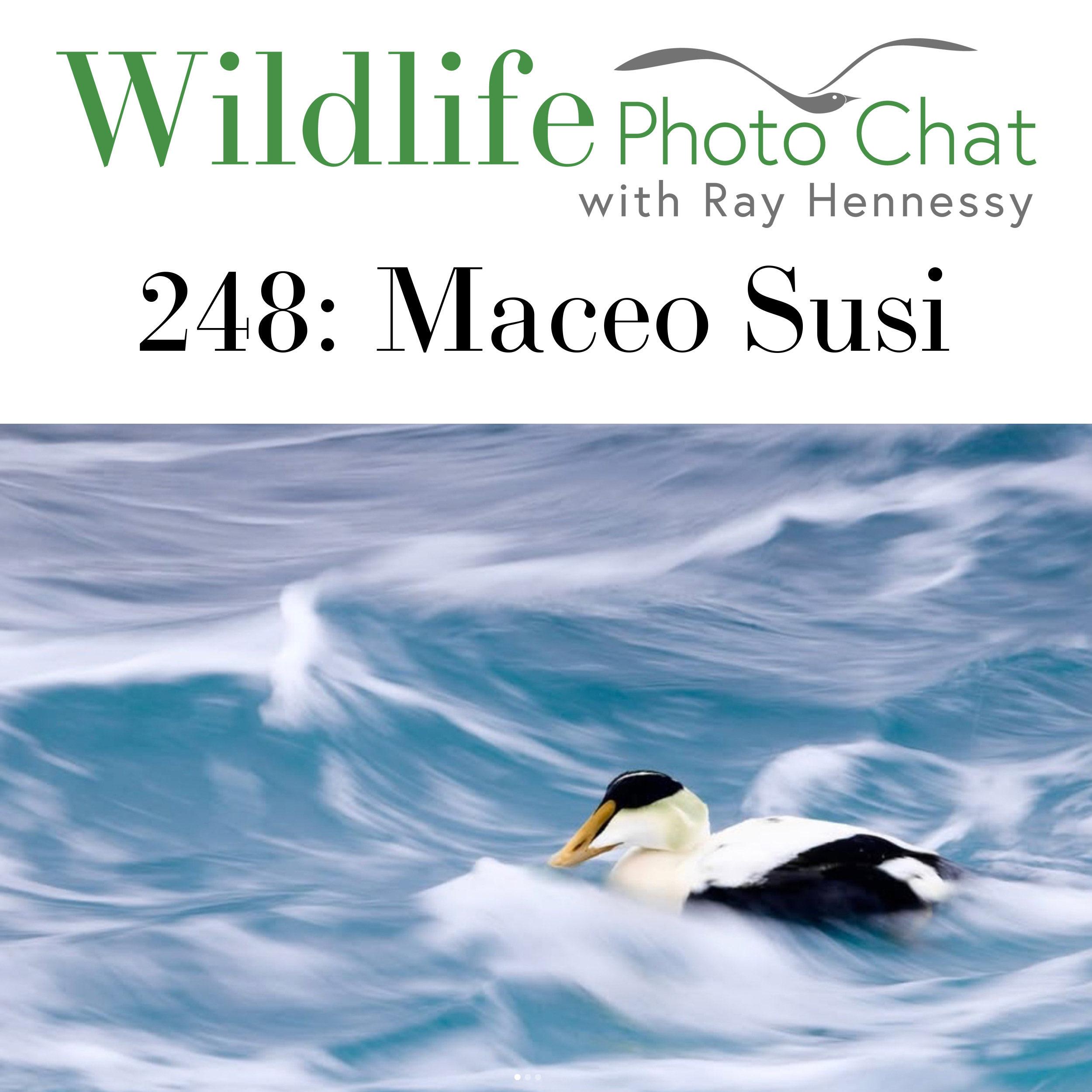
Yeah, exactly. Yeah. So now once you have a shot like that. Right. Super creative. And for everybody listening, I know it's an audio podcast. Right. But this is a shot of a common eider in swirling waves, slow Shutter speed. The bird's nice and sharp. The water's rich, beautiful. I'll include a link in the show notes so you can go check it out and, and see the photo while we're talking about it. But my next question for you at Maceo is like, you have a shot like that and you've got a handful of creative shots like that, does it ever dissuade you from going and working with that species again? Do you ever feel like there's this sort of like, oh, how am I going to top that? Or do you like that challenge of what else can I do?
- [20:16]
B
That's a. I think it's. It gets to that point where it's. I got. I hear that. I hear this term a lot where someone will say, like, who do you think is like, the best in this field? Or this will connect to the image, I promise.
- [20:31]
A
Sure.
- [20:31]
B
They'll say, like, who do you think is the best at this? Or like, what do you think the best is here? And I think, like, the best way to look at it is it's. There's a certain point when you've gotten to a level of mastery and it becomes this subjective difference between these two people, or in this case, these two images. So I. I feel like maybe I'll take a break after that species. But I always know that, like, there's probably going to be something else I can do that'll be different, but equally as good. Recently I was doing some, like, flight panning shots with the eiders, and I feel like, yeah, it's always different with those, like, slow shutter speed shots. You could always. Something crazy could happen. I don't know.
- [21:16]
A
Totally. Yeah. With their movement and stuff like that. But even just aside from, you know, only shooting at slow shutter speed. Right. Like, there's an infinite number of possibilities of things. You could try compositions, focal lengths, lighting, scenarios, behavior. Just, you know, the list keeps going on and on. But, you know, the. The more difficult a photo is to capture, the more rare that something special like that's going to happen again. And I've totally found myself in scenarios where, you know, I've. I've captured something unique of a species. Whether it just be like, the condition, the lighting conditions went nuts, or the bird went into the perfect position and I just, I got lucky and lined everything up. And then it's like, I have this feeling of like, all right, well, that's going to be really hard to top. And then, I don't know, there's. There's sometimes with some species where I found myself being out again with those species, and I'm just kind of like, I'm uninspired. Right. Because I can't see anything in the moment that sort of will top what I've already done. And it. It sort of, in a way, it takes away, like, my drive a little bit. But then if something happens, whether it be condition, like weather conditions, lighting conditions, behavior or whatever, that all of a sudden, like, flips that and turns it from. Yeah, I can't see any potential here. Into seeing the potential. Then it's like, game on. You know what I mean? Does that ring true to you at all?
- [22:48]
B
Yeah, no, I definitely think it does. I mean, the second I. I feel like the way I take a lot of photos is I. There's a species I'm really interested in, and this might not be the most efficient way to, like, take photos, but, like, I'll try to get like, a portrait of some weird animal first. And the second I get that portrait, I'm like, I'm just gonna go wild with whatever I can.
- [23:07]
A
Yeah, yeah, totally. Huh?
- [23:09]
B
No, no longer about the species at all. I'm just gonna go for some crazy cool composition or something.
- [23:14]
A
Yep.
- [23:15]
B
And then. And then you're right. There is a point where it's like, if you've taken so many, like, different photos that are also pretty good at that same species, and you're looking at that species, and there's gonna be a moment, at least for me, where I'm like, well, like, what now? Like, what. What can I do? And usually I end up focusing on, like, a different species.
- [23:37]
A
Totally.
- [23:37]
B
Sometimes it's like, too slow of a time of year to do that. But, like, I feel like I'll always come back to appreciating that animal again. At some point, I guess I kind of just get to this point where I am like, okay, like. Like I'm satisfied with what I've got. I can't really think of anything else I can get. Let me just stick through the rest of this photo shoot and then what's the next thing I can go to?
- [24:02]
A
Yeah, absolutely, man. No, I totally feel you on that. And that is what happens, right? It does always come back for me, even with those species, you know? And I think over time I've gotten better at just appreciating. Like, you know what? It's fine. I can just be out here and enjoy just watching them. Like, I don't have to take a quote unquote better photo every time. You know what I mean? Because that's the longer you do something like this, the more sort of impossible that becomes. Right. If you're always just trying to top yourself, which I think is important for drive to keep pushing yourself and be more creative. Right. I think having that concept of I'm. I always want to try and get something more unique and different and better is great. But also accepting and understanding, like that's not possible every time.
- [24:51]
B
Yeah, it's. I think actually one thing that's interesting about photography as an art medium is you can like output like thousands of potential compositions within a couple of hours. I think the problem with that, it's like it's different than painting because you spend hours on a painting and then you have to spend hours on the next one. And so when you're able to output so many different compositions and peek through all of those thousands of different ones to find the perfect one to you, it's, it's a lot easier to burn out. And you have to find ways to like, find, find it enjoyable, find it fun. For me, it's switching up species or maybe finding something unique about a species that's different than the one you're focusing on or maybe something similar. I don't know. Like a lot of the time I might go for like, I don't know, the things I can think of with like a certain subject would be like behavioral, some type of like textural, like plumage type thing.
- [25:54]
A
Yep.
- [25:55]
B
Some type of like abstract movement based thing with like motion blur or something like that. Like there's a lot of things you could do with one subject, of course, and. But yeah, it's one of those mediums where you can put out so many compositions.
- [26:08]
A
That's a good point. That's a good point. But then I also realized like, there is something to be said for sticking with the same subject for a long period of time. You know, even, even the same individual sometimes in the same exact location and just refining and kind of just the more time you're there, the more opportunity something crazy could happen and you could be ready for it as well. Right. So there's, there is an interesting balance there. And I think, you know, when I think back on these times where I was just feeling sort of unmotivated, I'm like, oh, you know, I've already photographed this thing so times and just not feeling it. I think it's more of a reflection of just my mood at the time than anything else, you know?
- [26:57]
B
Yeah, no, I, I definitely agree. I actually find those shoots, those repeated shoots with an individual subject to be like super super sentimental to me. Oh, I love a certain point when you're like, like I know this guy. Like this, this one, like pin tail or something. Or this, this one particular night heron. Like, I know figure out behaviors. Yeah. And it's like, I don't know, you can to an extent. Like when you're hanging out with these animals for a long time and they're up close, like, you can, you can feel their, like their sentience in the way that they're engaging and understanding the world around them. And I find that to be really
- [27:33]
A
cool to get acceptance of you as well. Right.
- [27:37]
B
Yeah. Like, you worked hard and because of that, this animal doesn't mind your presence. They're no longer. You're a part of their life. And it's not necessarily a positive, but it's for them. It's like, this is okay, like I can be here.
- [27:51]
A
There's. Except that's for sure. Yeah, absolutely. Yeah. No, totally. And you know, I love this about it. And I think this is the thing that took me a long time to sort of understand and realize this. And it's something that I think nothing other than experience can teach a photographer this. And that is especially when you're in the beginning of doing bird and wildlife photography, everything seems random. It all just seems so absolutely random. And then when you do something like we're talking about, like spend a significant amount of time with the same species or even more importantly, the same individual, you realize that so little of it is random, that so much of it is a repeated pattern or has a reason behind it, you know, and it's usually right, like, like food based survival based courtship, mating. Like there's these handful of things that like, just drive animals to do whatever behavior it is. And then this is the fascinating part, when you learn about that species and start to understand what drives it and motivates it and causes it to do these things, it's like, oh, this isn't random at all anymore. There's such a pattern to it. And boy, does that help photography.
- [29:10]
B
Yeah, I. It's also like such a fun, like random, like a party trick to learn. Like, like I'll be with, I'll be with friends just casually walking around and I'm like, that duck's gonna flap their wings and then they just do. Or like these hoodies are gonna start courting in like 10 seconds and then they do and it's, it's. I don't know, I just find it so cool. But yeah, it really is like clockwork. Like purple sandpipers if a big enough wave hits, they're probably gonna fly or. Yeah, it's really fun learning that and it's incredibly useful. And I definitely agree. When I started off, I was kind of just pointing my camera anywhere, just taking photos of anything in any way I could. And it's really interesting how many, like, little things over the years, like, we've been able to learn about photography. And it almost seems in a lot of instances to like, feel kind of like easy. But it's like a million tiny things that you're piecing together into this, this art form. And it also really isn't easy. Like the amount of stress that comes with it sometimes can be. It's definitely not easy. It's just you can like, delude yourself into thinking it might be.
- [30:21]
A
Yeah, well, it gets easier over time. Right. When you can start predicting that stuff. But you're right, easier does not equate to easy overall.
- [30:33]
B
Yeah, I think it's. It might just be like, I've got the hang of this. So like, therefore it must be easy. Like that type of. That type of thing, you know, you got the ritual down, you know.
- [30:41]
A
Yeah, totally.
- [30:42]
B
How you're supposed to line up.
- [30:44]
A
Yeah, exactly. All right, so here I got a question for you. What do you think has improved your photography more since you started? Is it more tied to field craft and understanding your subjects or more tied to creatively, like, like your knowledge gained about the camera and the gear itself?
- [31:06]
B
I think fieldcraft.
- [31:09]
A
Me too. 100%.
- [31:11]
B
Yeah. Because for wildlife, like the whole thing that makes it difficult that you have an incredibly uncooperative subject that does not want to do what you want it to do.
- [31:20]
A
Yeah,
- [31:23]
B
yeah. I feel like your settings are like. I mean, especially with mirrorless, it's mostly just going to tell you if you're exposed properly and stuff. And I feel like there's definitely a lot of skill to it, but compared to the field craft, like, trying to work your way around like a colony of like breeding like Dunlens or something is so much harder than getting your, like, ISO right for that photo.
- [31:47]
A
Yeah. And I think, I feel like there's so much about wildlife photography is odds based, you know, and all we're ever doing is trying to increase our odds to be able to capture either what we envision or to react quickly enough or whatever your approach is. Right. Because some photographers really sort of plan out their shots and are more methodical and then others are just more like, you know, going out and reacting and looking for action or whatever it may be. But in any case, it's all trying to increase your odds. So the more you learn about your camera gear and the faster you are at changing settings and achieving focus and acquiring the subject in the viewfinder in the first place, or changing your composition, all of that, the quicker you can do that. It increases your odds. Right. Because most birds and wildlife don't give you a ton of time and opportunity.
- [32:36]
B
Yeah.
- [32:37]
A
And then the same thing goes with field craft. Right. The more we learn about our subject, the more we can predict what they're going to do and put ourselves in the right place. And so both of these things are trying to increase our odds. But I feel like the field craft thing increases your odds so much more than just the gear based odds increase.
- [32:55]
B
Yeah. Especially if your goal is like a specific thing. Like if you're just like trying to get like anything compositionally good. I don't know, it might be a little different. Like you could probably find some chill subject. But if I'm trying to get like a banking flight shot of a specific bird, like I better be going to a location where that's like a repeatable, predictable behavior. And to do that I have to know what would cause that to be repeatable or predictable.
- [33:22]
A
Absolutely.
- [33:23]
B
And so like, yeah, if you're trying to do anything more advanced than like the most basic possible portraits, then. And even in the case of a lot of basic portraits, you're going to have to understand how to, to act around wildlife and how to understand wildlife.
- [33:39]
A
Yeah. Because if you know your settings really, really well, but you don't know your subject at all, you can get lucky sometimes. Right. So like you'll just stumble into the subject that just is cooperative in the right place, the right time and all that. But if you don't know your settings that well and you're kind of okay, but you know your subjects like crazy. I mean, you're going to give yourself so much opportunity that it's like, I just feel like that's the better thing to learn is just spend more time on the field craft. But yet in this industry as a whole, I feel like there's so much of a, more of a focus, especially in the teaching world and like the YouTube video world and all that stuff. There's so much more of a focus on the gear side of things and it's so lopsided to me, but I understand why. It's just kind of a shame, I think.
- [34:28]
B
Yeah. I also feel like a lot of that is like they're probably going to
- [34:31]
A
get a sponsorship or something. To be fair.
- [34:34]
B
But, yeah, actually, that's really, really interesting, now that you mention it. Like, there definitely should be more content about how to, even if you're not in photography, like, how to be able to, like, coexist with and how to, like, be respectful of wildlife and all that stuff, but especially in the. The photography field, like. Like, why isn't there more of that? That. That is very interesting because I think.
- [35:01]
A
I don't know. How do you present that as an engaging thing to watch. Right. Or learn about? Like, it's just. I feel like it doesn't connect with as many people, and so therefore it doesn't get the eyeballs, and therefore there's not a lot of it out there, you know? But if somebody could figure out how to make it more interesting, then maybe there would be more of an audience for that kind of stuff, you know? I also think it's just harder to teach.
- [35:28]
B
No, you're definitely right. And there's no, like, hook. Like, there's nothing you can say. There's no.
- [35:33]
A
Do this. Yeah.
- [35:35]
B
Like, you could say, like, these are the settings you need to take this photo. Or you could say, like, I don't know, like, this is the best way to, like, approach, like, these animals. It just sounds really weird. Like, one is just much more engaging.
- [35:49]
A
Yeah, agreed. But you know what's fascinating me, and, you know, we've been talking a little bit about waterfowl, but, like, they're one of the ones that I think are just so across the board consistent. And I've, you know, I've been lucky enough in my life to travel around the US And Canada a ton and photograph in all kinds of different places. And what's so cool to me is, like, I can roll up on some waterfowl, a species I've never photographed before in a place I've never been before. And I can just use the same field craft techniques and approaches that I've really honed over the years to approach them. And not 100% of the time, but a high percentage of the time it's gonna work. It's gonna put me in the right place at the right time, with the right light and the right perspective, and give me a close opportunity to get at least a portrait or some kind of photo that I'm after. And to me, that's, like, so fascinating that that can just. I can pick up those skills from New Jersey and then drop them into North Dakota and just make it work and. And come away with a shot most of the time, you know?
- [36:54]
B
Yeah. No it is kind of interesting. I do personally in Massachusetts, I kind of struggle with some of like the, the diving ducks in particular. But even though I say that it is, it is very consistent. Like they do the same thing.
- [37:10]
A
Yeah, yeah.
- [37:11]
B
The same few things. I need to work around.
- [37:13]
A
Yep.
- [37:14]
B
And I know, I know how to. I just need to get better at it. But yeah, yeah, they are particularly consistent. Whereas like, I feel like shorebirds can act. They could either be really easy sometimes they're like really annoying and kind of weird.
- [37:29]
A
But yeah, there's definitely some differences. But in general, right, Same thing, right?
- [37:33]
B
Yeah, yeah, yeah.
- [37:34]
A
If you, if you know enough to keep your perspective low and not show your human silhouette, you don't just walk up on subjects and you move slow, stay low, go at the right time of day. In general, most shorebirds are going to be somewhat tolerant. There's always exceptions, of course, but that's going to get you pretty close to most different shorebirds no matter where you are, you know?
- [37:58]
B
Yeah, yeah, Surebirds. I've honed in a lot more than waterfowl. They seem to be. I think I might just spend more time with waterfowl. I mean, with shortbirds.
- [38:10]
A
That's exactly it.
- [38:11]
B
Right.
- [38:11]
A
That's what we've been talking about. Right. It's that time spent. You've learned more about shorebird behavior as a whole, so you have a little bit more of an understanding of what they're doing. You have, you have better field craft with them and that lets you be more consistent with them.
- [38:26]
B
Yeah, for sure.
- [38:28]
A
It's just pretty cool how that works, you know. And again, it's such a bummer that like there's not more focus on it, but. Yeah, that's the way of the world, you know, that's how it goes. So to switch gears a little bit, you talked about Massachusetts a lot and I know you've shot around there a lot. Do you travel much? Do you get to travel much for your photography?
- [38:50]
B
Recently I've been doing it a lot more, mostly because I've now like I've started working more and doing stuff like that. So I'm able to channel like most of my expendable income on like trips and stuff.
- [39:05]
A
Nice.
- [39:07]
B
Yeah, it's pretty much like eat, sleep and then every couple of months trip.
- [39:12]
A
That's remind me of me back in the day.
- [39:16]
B
Yeah, I, that's cool. Yeah, I just love it. Like there's so many cool things to see around the world and I. Yeah, yeah. I'm gonna spend my whole life chasing a never ending List of wildlife.
- [39:34]
A
So that brings up the. The obvious question. Do you prefer photographing locally or prefer photographing when you travel, like, different locations or a location you've never been?
- [39:45]
B
Oh, that's actually. That's really interesting. I don't know. I think I. I think. I think I prefer going somewhere, but, yeah, I think I ultimately get the best photos locally. But, like. Well, actually, I don't even know. It's kind of interesting. Like, I feel like I go to, like, I went to Texas recently, and I was shooting these tree frogs, and recently I posted, like, some of my most boring tree frog photos that I got on that trip. But there was so many different fun opportunities to work with within these, like, tropical plants and, like, the leaves they had. And we don't get those in Massachusetts, but there's, like, leading lines everywhere. It was crazy. And there is so much to play with. And so I feel like if you go far enough, you're gonna be presented with an environment that's so different that it, like, completely rekindles your passion for wildlife photography.
- [40:39]
A
You are speaking my language, dude. Like, that's how I live right now, you know? That's what it's all about for me. I love the travel because of that. I absolutely do. That change of habitat means a lot, doesn't it?
- [40:53]
B
Yeah. Yeah, it's so great, dude. Especially the difference between, like, temperate and polar and, like, getting towards, like, the tropical regions. I don't think I've actually been in the tropics that much, but I've been, like, close. And I don't know, just the differences between those, like, larger regions is crazy. And there's absolutely. It's such a different style to work with, I feel.
- [41:19]
A
Yeah. Have you done desert yet?
- [41:22]
B
No. That sounds fun. I'm not gonna lie.
- [41:25]
A
Yeah, it's. It's amazing, man. I just spent, I don't know, five days in Moab, Utah, and, like, all the red rock formations and Arches national park and just that sort of like. Just absolutely, like, the vastness, you know, that's out there, just the scale of it all. And, you know, going back to kind of what we were talking about earlier, of sticking with a subject, and this is what I think is really fascinating. I got there the first day and went to this one spot and stumbled into two different canyon wrens, Two different individuals that I could walk to. They were, like, 10 minutes apart, you know, each in their own little kind of cluster of this amazing habitat. And, you know, I mean, these parks are huge. There's tons of area for Me to explore. And what did I do for the next four days that I was there? Five days I was there, I went back to that same exact spot every single morning over and over again. And just kept working them, you know, just kept trying to iterate. And I got my favorite shot, like, the last morning, you know, just the weather, the conditions were incredible. And I got. It was funny because day one, I didn't find him until after the sun got a little harsh, so now I knew where it was. Day two, go back and nail it at sunrise. And both mornings have, like, a ton of encounter with it. Third outing a little bit less. He's just like, yeah, I think he had enough of me. Not. Honestly, I don't know what. What it was, but it just. I didn't get as much opportunity. And then the last morning out, I took maybe I had two encounters with it, like, two chances to take a photo. And I took maybe like 10 photos all the other day, shooting like, hundreds of photos, and I took maybe 10. My favorite photo was that last day with one of those ten photos.
- [43:16]
B
Yeah, that's. That's always how it ends up on these trips. It's like tooth and nail, like, last moment. Yeah, it's always one thing for me. It's like, one thing. I had a rattlesnake I was really going for when I was with my girlfriend in California. And literally last second of the. Last night, one went right behind my girlfriend. And I was. I was. I had fully given up. I was just talking about something else. And then I was. I turned around and I'm like, oh, my God, is that a king snake? And then I was like, oh, my God, is that a rattlesnake? And it was just so crazy.
- [43:51]
A
That's wild.
- [43:52]
B
And the same thing happened with, like, armadillos in Texas.
- [43:55]
A
And armadillos are so cute.
- [43:58]
B
They're so cool. People don't photograph them enough. They're so weird. It's like an armored anteater.
- [44:04]
A
I know. And they're like. They don't know you're there half the time, you know? Yeah. Just keep it, like, dancing around. They're like, yeah, whatever. And then all of a sudden, they run. They're so bizarre.
- [44:16]
B
I've had them. Like, they were, like, one foot away from me.
- [44:19]
A
Yeah.
- [44:19]
B
They'd look up and they'd be like, oh.
- [44:22]
A
And then they just totally.
- [44:23]
B
They'd, like, jump and run away.
- [44:25]
A
I know. I. I wish I get to spend more time with them. I've only spent a little bit of time in South Carolina with them. And I've seen them once or twice in Florida, but every time is just an absolute blast. They're such a unique critter. And you're right, man. Like, how many photos of them have you seen? Not many.
- [44:42]
B
I've. I've gone on deep dives and I found, like, three, like, skillfully taken photos and, like, that's it.
- [44:51]
A
How did you make out with it?
- [44:53]
B
Honestly, every single photo I took there was like, something slightly off. But I think I came out with a few that were like, like, good enough. Right.
- [45:04]
A
Okay.
- [45:04]
B
I think some of them, like, worked, but it was like I had spent so much time on, like, going for them that I was like, can it just be, like, like a little more perfect? But I think that's just because I. I had spent so much time that it was like my standards had, like, raised because of how much incrementally better I was getting throughout the. The trip. But I think I came with with a few that were pretty solid.
- [45:30]
A
That's cool, man. I'm glad to hear it. Did you share them?
- [45:34]
B
No, not yet.
- [45:35]
A
What's. What's with your delay here? Come on. You said you took this eyeder photo forever ago and you're just sharing it now? No, I'm just playing with you. But is that. Is that kind of normal for you?
- [45:45]
B
I feel like I. I'm super, like, like, really, really particular about the way I post things. I don't, like. I don't like posting too many of, like, a certain group of animals too much. Like, I used to be birds. It was really weird. It used to be birds, which makes sense because birds are. I personally feel like one of the easier, like, wildlife subjects to focus on if out of all the groups. Right. But not that they're easy, but, like, generally it's easier to A photo of some type of bird. Yeah, exactly. And then. Yeah, so. So I was like, okay, I need more other stuff. Right. And recently, it's weird, it's been getting really cold out, but I've been getting like 90% insect photos.
- [46:28]
A
Oh, wow.
- [46:29]
B
Like, and it's really weird because it's like, that's the last thing you'd expect. And I'm like, come on. Like, why am I, like, just now getting only, like, insect photos? And so I'm very particular about that. And so I think what happens is I'm like, I need a bird. Like a reptile, a mammal, something. Mix it up a little bit. Maybe it's not that particular. I don't need to, like, hit Every group. But, yeah, vary it enough that it seems like I'm properly representing, like, the wilderness. And then what ends up happening is I forget about some of the other images or sometimes there's an image I like a lot and it's like one tiny thing. I'm like, I need to get back to this and, like, fix up this one thing. Something doesn't feel right here. And then like, months pass and I'm like, oh, like. Like I forgot about this image. And so then I post it.
- [47:15]
A
Okay, yeah, that's fine. Nothing wrong with that. We all have our own ways, don't we?
- [47:20]
B
Yeah. I also, like, I have myself on a schedule. I'm just trying to post somewhat consistently. And because of that, I feel like I'm like, sometimes, like, last second I'll be like, oh, my God, what do I do? Like, there's like 10 different photos and I'm like, this one's too similar, this one's too similar. And I just randomly spitball a couple of things, but I shoot so much that, like, I'll spit, like, out, like, a random one that looks different. It's not necessarily the best of the collection, but it's just a little different. And then I get a bunch of photos and then I. And then that new set of photos is the new. The new concern.
- [47:57]
A
Yeah.
- [47:57]
B
And then my editing has gotten so much better that when I scroll to look at older photos, I'm like, these. Well, these clearly weren't edited. Right.
- [48:06]
A
Like, I'm just not gonna do these.
- [48:08]
B
Yeah. So it.
- [48:09]
A
Does that bother you?
- [48:11]
B
Not like, I guess, kinda. Yeah. Because I'll, like, it's not. It's not too much of a bother. But yeah, sometimes I'll be like, man, like, I don't want to go all the way back to this, like, folder I have on one of my hard drives and yeah, find this one image just to fix it up. I mean, typically my field craft has improved too. Enough that it's like, at that point, it's like, I probably have something better or I guess probably more commonly, I'm like, oh, well, I could just do better now. And so then that's another thing that delays. It is. I'm like, now I've gotten better. So, yeah, absolutely, I could do it better.
- [48:53]
A
Yeah, I know. But then you can't get caught in the trap of, well, I can always improve this. I'm never going to share it. You know what I mean? Like, a certain point, you just gotta say, all right, this is good enough. It's going to make the cut, I'm going to share it because if you get stuck in that trap, then you'll never share anything because we're always improving, you know.
- [49:09]
B
Yeah, yeah. I mean that's part of the reason
- [49:11]
A
I have myself on a schedule.
- [49:12]
B
Like get something out.
- [49:13]
A
Yeah, I gotcha. Force your hand a little bit.
- [49:17]
B
Yeah, yeah. Like I have to. And it's like it's always last minute that I'm like, what am I gonna do?
- [49:23]
A
Is it? No, it's funny, man.
- [49:26]
B
I do have a couple of photos I've been holding onto from the Cape. Like the salt marshes on Cape Cod.
- [49:33]
A
Yeah.
- [49:33]
B
And it's a portfolio. I was working on a project with one of my friends and I was on like an NDA for a bit, but now I'm able to post them. And so I've just been trying to get all the photos tweaked perfectly so I can like put like a whole portfolio and then I might share some of the individuals later. That's what I've been holding on to that like I didn't want to be holding on to. I'm like, I want this out there.
- [49:57]
A
Yeah, no, I get that. Do you like working on a project based like thing like that where everything's focused in on one, one sort of, you know, species or concept or anything like that versus just photographing random stuff, you know,
- [50:11]
B
it's interesting. I think it helps when I'm focused on like maybe I have a central target but I have to provide context with other stuff.
- [50:20]
A
Yeah.
- [50:20]
B
Like I could see myself doing like a grant to like document like, I don't know, fish or something in the Appalachians. Because it's like if I miss like this one fish, I have like 10 salamanders, like 30 different frogs. Maybe some animal incidentally shows up. So I think I like working on something with like a main target and then a couple like time killer things around it, I guess.
- [50:45]
A
Yeah, yeah, yeah. No, no, I get that.
- [50:47]
B
Yeah, yeah.
- [50:49]
A
I haven't done the project thing very often. I've only got hired for assignment stuff like once or twice. But it was always I loved it. I love the concept of it, like the, the focus that it gives you as a photographer and you know, sort of the like you said, trying to kind of capture everything around it to tell the story and support it as well, you know. Whereas like I feel like most of my photography is just so individual photo based, you know, it's just like this one photo, I'm working on this and trying to capture that and that's. That And I think it's just really neat when you can kind of get the whole collection of supporting images and, and tell a story like that on, on a project based thing, you know?
- [51:36]
B
Yeah. I mean the end results of these projects are so cool. You have this whole, like, it's just so interesting to be like, someone asked me about waterfowl and I'm like, oh, here's some images or something like that, blah, blah, blah. And then someone asked me about a salt marsh and I'm like, I've got the whole thing, like everything here.
- [51:54]
A
What part do you want?
- [51:55]
B
Yeah, yeah, we were, we were focused on diamondback terrapins, which are, they're really cool.
- [52:02]
A
Yeah.
- [52:03]
B
And in a lot of salt marshes they consume almost exclusively snails which would consume the peat in the salt marsh. So they're super important, like regulatory predators.
- [52:12]
A
Yeah.
- [52:12]
B
And then you have fiddler crabs, which if the salt marsh is damaged, they can be harmful because they spread like crazy and they take advantage of the damaged marsh. But if they're in low enough numbers, they circulate nutrients in a really healthy way. And there's just all these like, interesting dynamics that are all interconnected within this one ecosystem. So being able to encapsulate all of that into one story.
- [52:37]
A
Yeah.
- [52:37]
B
Is in my opinion like a much more satisfying long term goal than any like individual photo. But I do love, I do love also just getting like a really cool compositional photo, like something really interesting or creative.
- [52:54]
A
So. Of course, yeah, absolutely. Yeah. No, I get that. But it's so funny, man. My. One of my main projects was Salt Marsh Base. It was on the Salt Marsh Sparrow. And I worked with, you know, scientists that were studying them and finding out about all the stuff with, you know, just how they're being affected with rising sea levels and other species that aren't just because of one little behavior adaptation and like all this stuff that just, you know, if it wasn't for being focused in on this and being around these people, I would have never had a reason to learn all this stuff. But it was also fascinating, you know, Absolutely fascinating.
- [53:32]
B
That's, that's a really, really interesting subject to focus on. I think it's a very, I don't know how to explain. They're like a, they're a good role model for conservation, I guess. They're, they look pretty likable, they're really cute and like the effects are very, very obvious when you, like, once you know about it, it's like very easy to represent visually.
- [53:54]
A
So.
- [53:54]
B
Yeah, that's a cool.
- [53:55]
A
And the Story. Right. Like, these birds have to build a nest, lay their eggs, hatch the eggs, raise their young, all within a less than 30 day tidal period, or else those babies will flood at the next extreme high tide on a new moon. You know, like what a story, you know, like, that's just crazy.
- [54:16]
B
Yeah. And I think that's what resonates with people the most.
- [54:19]
A
It's got built in drama.
- [54:21]
B
Yeah, yeah, exactly. Some of my favorite, like, photo stories are the ones where I, in the moment was like losing my mind because it was like there's so much work you have to put into it.
- [54:34]
A
Yeah.
- [54:34]
B
And so you create this story. But I think it's even more powerful to have like an animal centered story in your projects.
- [54:42]
A
Yeah, yeah, yeah, definitely. Yeah. That's really cool. All right, so I have another question to kind of bring our conversation to a close here, and it's one that I really admire you about because I've never been the type of photographer able to pull off this achievement. And that is you photograph all kinds of different stuff. So you're doing bird photography, you're doing the macro stuff, the reptile, the herp thing, you know, all of these in and of themselves, I feel like, are incredibly challenging and require a lot of time and dedication to really hone and get to a certain level. And yet you seem to have done it with all of these different sort of genres within wildlife photography. And my question to you is, do you think that focusing on all these different things, pardon the pun, helps elevate your photography as a whole? Or do you sort of feel that effect of like, oh, maybe if I just did this one, I could kind of really improve that genre better if I wasn't focused on doing all these other things. How does that work for you?
- [55:58]
B
Oh, I think it's a little of both. I think short term it's probably hindering my progress on all of them. But I think long term, each, each one of these animals has like a different, like general, like quote unquote conflict involved with it. Like, birds tend to be a little more skittish. Reptiles tend to be like, somewhat hard to find. You have to learn their microhabitats. Like, there's all these different things between these different groups of animals. And, and long term, I think that's super, super beneficial and I've seen it improve my photography. But very short term, if I had just focused on like, I don't know, backlighting a bunch of birds, I'd probably have like a cooler general portfolio. But ultimately my goal is for that long term, that long term improvement. And I think being able to capture all these different animals in a way creates a potentially more powerful portfolio in regards to like the message I'm trying to deliver. So I feel like, yeah, I feel like short term it's going to be, it's going to make it a little harder for me because I'm trying to, I'm trying to adjust to all these separate challenges. So I'm working on each challenge a little less at a time. But ultimately long term, if I come across a bird that might be harder to find based on micro habitat, well, I've honed in those like reptile skills or like, I don't know, maybe there's a skittish reptile and I've honed in the bird skills and yeah, some, a lot of it's actually composition.
- [57:29]
A
What a great answer. What a great answer. Yeah, man. Yeah, I like that. I totally makes sense number one and I can see the benefit there. And I like, I kind of like how you phrased or framed it, I should say, you know, that it isn't just all good or all bad. There's, there's benefits and disadvantages to both. And it is interesting to, to hear you talk about how it's based on sort of a timeline of things. And is that the same even with like, you know, you, you kind of just answered with a little bit more of the, the fieldcraft connection. But even the photographic side of it, you know, like there's, there's absolutely different gear, different approaches, different lighting, different everything about just the, the technical side of photographing all of these different, different wildlife. And I would think it's probably the same thing there, right. Like maybe the growth is a little bit slower on each individual style of wildlife photography, but collectively over the long term it's all going to add up and improve all of your photography as a whole. Wouldn't you agree?
- [58:40]
B
Yeah, yeah. And I think speaking to the like the composition and like the, just the artistic side of it, that there's also like pros and cons to each one. Like birds are pretty easy to get eye level with and you can get some good like foreground and stuff a lot of the time, but with insects a lot of the time, what it means to be like ground level with an insect, if you're working on a macro level. Yeah. You're like the equivalent of like if you're putting your lens on the same ground the insects on, you're basically like a foot off the ground overhead.
- [59:13]
A
Yeah, yeah.
- [59:15]
B
So you have to like, work around objects, which is weird or like. And then with birds you have the problem of, like, you have to really quickly compose things.
- [59:25]
A
Sure.
- [59:27]
B
Behavior with insects can be a lot harder to predict. There's a lot of different things. But yeah, yeah, I think it's a fun journey doing that. And I never get, like, fully demotivated doing that. Like, worst case, it's a little slump. But sure, I'll just wait for it to become spring and then there'll be salamanders or.
- [59:46]
A
Yeah, yeah, totally. No, I just, I really admire it, man, because, like, I, I did. I, you know, when I was kind of learning and trying new wildlife photography, I did same thing. I did some macro stuff and some insects. I even did a workshop. I had a workshop photographing frogs. I had a workshop photographing, you know, butterflies and insects on flowers. And I would bring out like, you know, I'd bring in stuff for my portrait skills. Right. I bring out an actual reflector and use that kind of lighting because people could see it and it was easier to work with than flashes because half of the people didn't have flashes and stuff like that. But. And I enjoyed different aspects of all of these things, but I always. For myself, and this is why I'm saying I admire that you're able to do this. I always felt like I just wasn't quite getting there with some of these other genres and. And I always just generally like, leaned birds anyway. Like, I just was more connected with them and fascinated by them and just enjoyed that photography more. So that's kind of where I just generally ended up going. But I do certain, there's certain times where I do miss those other genres of photography and, and tell myself, like, I should. You should get the macro lens out and try this more often. And. And I don't, you know, but I, I really think it's cool that you stick to doing all of this stuff and keeping that diversity there and haven't just sort of fallen into only one grouping of wildlife photo. I think it's really impressive, man.
- [61:13]
B
Thank you. Thank you. I appreciate that a lot because that's, that's really like my goal to showcase a little bit of everything. Honestly, dude, I feel like if you, if you just like had a macro lens on you or something and like the moment hit you, like, you might find like a spark frog or something. I don't know, like something like, click. I don't know. That's what happened.
- [61:35]
A
I mean, we have, we have a macro lens in the van all the time. We have a 50 millimeter macro. And, you know, and I've. I understand some of it. And, you know, it's funny, man. The last time I, like, remember really dedicating some time to do macro was just like, I was working with some butterflies and moths and stuff like that. But it was all the same thing. I was trying to do, like, small in frame. I'm, like, showing off, like, these crazy patterns and stuff, and they're, like, really tiny. I'm not, like, actually getting close. Like, that's why I still managed to put that into the macro side of things, you know, funny enough, which makes sense, right?
- [62:12]
B
Yeah. But, like, I think that's cool. A lot of what I did when I was approaching these new styles of photography is I'd look at, like, a lot of, like. A lot of, like, macro photos. For instance, it's like a focus stack of a headshot with, like, a colored card behind them or something. Yeah, yeah, that's really cool. But I looked at that and was like, this doesn't really exactly speak to what I want to show.
- [62:32]
A
I want you. Yeah.
- [62:33]
B
I want an insect photo that looks like the bird photos I took.
- [62:37]
A
Yeah.
- [62:37]
B
And so that was actually kind of hard because there wasn't like, a lot of, like, guides on, like, how to take macro photos but make it look like good people's bird photos or something. Like, it was like I had to figure it out for myself. But I feel like those, like, small unframe butterfly photos, they sound cool. Like, I feel like that's. It's really interesting showing them in a different way than most people see it like that. Well, to me, it sounds really unique.
- [63:04]
A
Yeah. And. And there's definitely. There's certainly a handful of photographers I follow on Instagram that kind of work with that style. And they use, you know, they use these, like, donut bokeh lenses that I have now and stuff like that, and do all these crazy, trippy backgrounds and, you know, just make the. They make these things look like they're in, like, these fantasy worlds too, which kind of appeals to me as well. So maybe when we're done, I'll send you a couple of those shots that I had taken and. And see what you think. But yeah, man, what a. What a great approach that you're doing to everything. And so the last question I have for you to wrap up our conversation is, going forward, like, in the next year, a couple of years, where do you see yourself going as far as you know, because this is like, the main topic of this podcast, is how do you See yourself continuing to push and get more creative with your photography. Is there something in the near term that you're, like, really excited to work on or a general direction that you go the area that you'd like to go to just continue to push that creativity for yourself?
- [64:06]
B
I mean, I'd like to get underwater really bad.
- [64:11]
A
And also you're like, yep, a whole other genre. That's it. I mean. Yeah, that's a perfect answer for you. Yeah.
- [64:16]
B
Can I get another genre? There's that. And then also, like, I do want to start doing more, like, feel like I don't do enough, like, backlit stuff. I don't do enough, like, more abstract stuff. I mean, I know I do the slow shutter speed stuff a lot, but, like, I want to get more stuff where it's like, whoa, like. Like this makes, like this. Like, this looks like a fantasy world. Like, like you were just saying with, like, the donut bokeh and stuff like that, like, that stuff looks crazy cool. I love those. Like, there's like, some of these people will shoot, like, mantises during, like, monsoon season, like, back with flashes and stuff. And I'm like, oh, my God, that looks crazy. Yeah, like, that type of stuff seems fun.
- [64:58]
A
Excellent.
- [64:59]
B
So, yeah. And then rear flash, like, I want to start getting more, like, technical.
- [65:05]
A
Okay. Interesting. Yeah, that sounds fun. Have you messed with flash stuff much on any of your macro?
- [65:11]
B
Not. Not much beyond, like, just making sure, like, a salamander is well lit. Like, I haven't done, like, rear curtain or anything. It seems scary.
- [65:20]
A
Yeah, yeah, it's. I mean, I think it's pretty straightforward, you know, but I learned a lot of it in portrait days, and I'm sure it's something that as you experiment with, you'll figure it out. It seems like you figure out most things here with the incredible diversity in your portfolio.
- [65:37]
B
Thank you. Yeah, I just have to try it, like, to get my feet wet.
- [65:42]
A
Yeah, totally. That's how it all starts, right? And the next thing you know, you'll be underwater.
- [65:48]
B
Yeah.
- [65:50]
A
Oh, man. Well, that's awesome. Well, great answer. And I look forward to seeing what you continue to keep coming up with. I really do love your photography. I love your approach to it all. And it was really nice to get to cross paths when Emily and I were coming through your area and get out and hang out for a little bit. That was a really fun time.
- [66:09]
B
Thank you so much. That means a lot coming from you. And yeah, it was really fun meeting up with you guys. I feel like I don't know if anyone's told you this, but you sound like you're really genuine. The way you sound online, it fits your IRL Persona very specifically. I feel like. I don't know.
- [66:29]
A
Well, that's good to know, man. Yeah, I don't know how to do it any other way, so that's all I got. That's good.
- [66:37]
B
That's good.
- [66:38]
A
Yeah. Macia, where's the best place for people to follow your photography online?
- [66:43]
B
I would say probably on my Instagram @maceosucy.m A C E O S U S I and then my website, I don't update that much. Yeah, that. That's mostly where it'll be. I might expand from there, but you'll. You'll hear it from me if I.
- [67:02]
A
Excellent. Excellent. All right, well, I'll make sure to point everybody to that. Maceo, thank you so much for taking the time to chat, man. It's been a great time. And yeah, as always, keep at it, man.
- [67:12]
B
Thank you so much. Nice talking with you.
- [67:15]
A
Hey, this is Ray Hennessey. Thanks so much for listening. I hope you enjoyed the conversation and got something helpful from it. I also hope you join me for the next episode. Please subscribe in your favorite podcast player and help me spread this podcast around by sharing with your friends and fellow photographers. It would also be a huge help for the podcast if you could give it a five star rating and possibly, possibly a review wherever you listen to the podcast. Thanks again and I'll see you on the next episode.