Loading summary
Transcript123 lines
- [00:00]
Roberta Dombrowski
But a lot of what happens with trauma is that it ends up disconnecting us from other people. We heal in community with others. So getting the therapist, maybe going to a support group, connecting with other leaders as well, it really can be life changing and energy giving and you're dismantling the shame that you might have from the traumatic event too.
- [00:30]
Katie Weber
Hello and welcome to the An ADHD Podcast. I'm your host Katie Weber.
- [00:35]
Podcast Guest/Co-host
I was diagnosed with ADHD at the
- [00:37]
Katie Weber
age of 45 and it completely turned my world upside down. I've been looking back at so much
- [00:44]
Podcast Guest/Co-host
of my life, school, jobs, my relationships,
- [00:48]
Katie Weber
all of it with this new lens and it has been nothing short of overwhelming. I quickly discovered I was not the only woman to have this experience and now I interview other women who, like
- [00:58]
Podcast Guest/Co-host
me, discovered in adulthood they have ADHD
- [01:01]
Katie Weber
and are finally feeling like they understand who who they are and how to best lean into their strengths, both professionally and personally.
- [01:10]
Podcast Guest/Co-host
Hello, hello, hello.
- [01:11]
Katie Weber
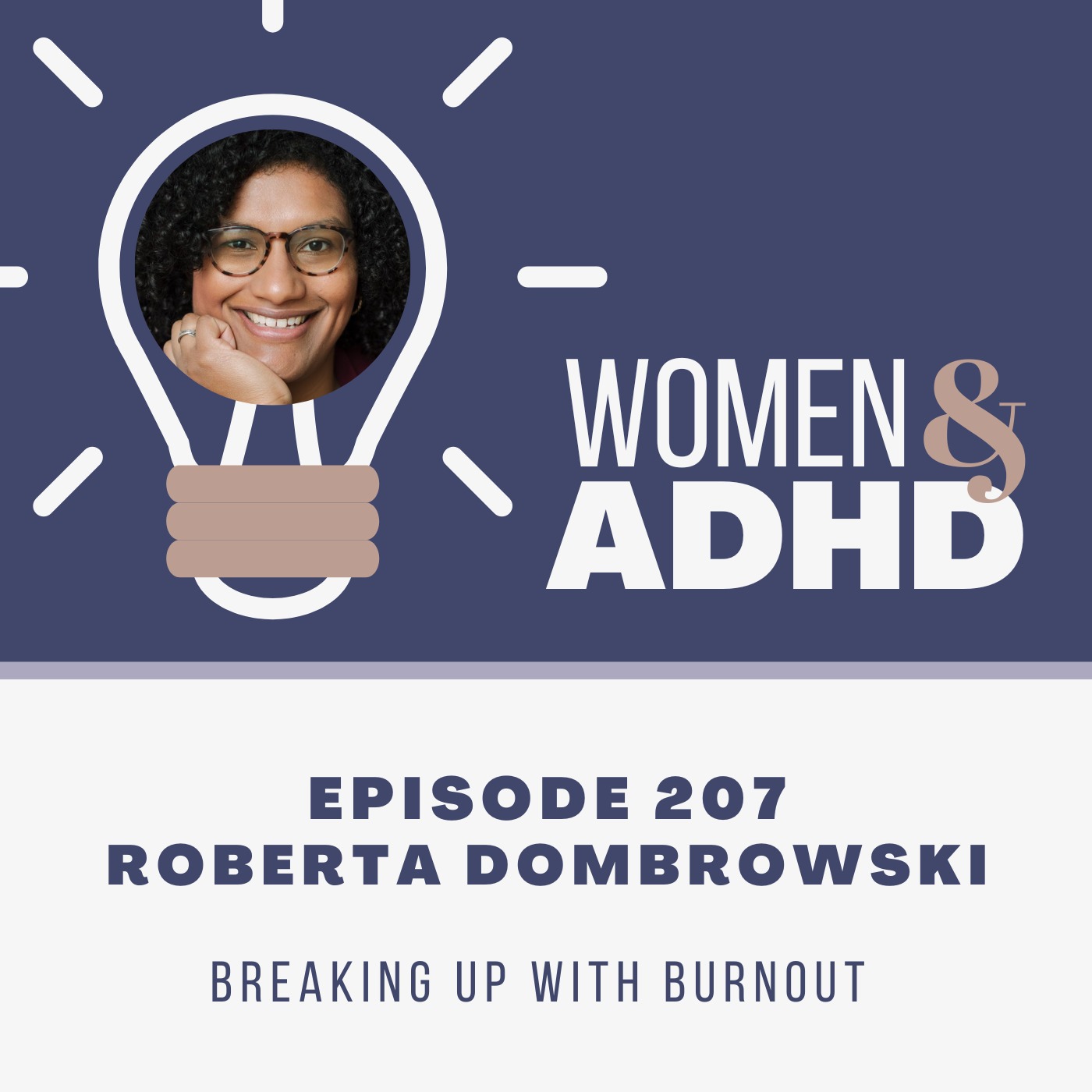
Here we are at episode 207 in which I interview Roberta Dombrowski. Roberta is an executive coach and founder of Learn Mindfully, where she helps leaders and teams thrive from the inside out. After rising quickly through leadership roles to becoming a VP in the tech world at age 29, Roberta realized her success
- [01:32]
Podcast Guest/Co-host
was coming at a cost.
- [01:33]
Katie Weber
She found herself burnt out, anxious and physically impacted by the pressure of constantly proving herself. On the outside she was the high performing executive. On the inside she was white, knuckling her way through burnout, complex trauma, and the isolation of often being the only
- [01:49]
Podcast Guest/Co-host
woman or person of color in the room.
- [01:51]
Katie Weber
In this conversation, Roberta and I dig into how her late ADHD diagnosis helped her finally make sense of her brain, her childhood and her experiences at school and work. The overlap between ADHD trauma and burnout, especially for high achieving women, mothers and entrepreneurs.
- [02:09]
Podcast Guest/Co-host
We talk about what trauma informed leadership
- [02:11]
Katie Weber
actually looks like from day to day,
- [02:13]
Podcast Guest/Co-host
why work is one of the only
- [02:15]
Katie Weber
socially acceptable forms of addiction, and how to step out of that cycle and how to start loosening your grip on
- [02:22]
Podcast Guest/Co-host
control, micromanagement and over functioning without letting everything fall apart.
- [02:27]
Katie Weber
If you've ever felt like your success
- [02:29]
Podcast Guest/Co-host
is actually built on over functioning, perfectionism and people pleasing and you're desperate to break up with burnout, but you're not sure how, this episode is definitely for you. Well, welcome Roberta. It's so great to meet you. Thanks for being on the podcast.
- [02:44]
Roberta Dombrowski
Thanks for having me. I'm really excited.
- [02:47]
Podcast Guest/Co-host
Why don't we start with your adult ADHD diagnosis? How long ago were you diagnosed and what was happening in your Life where you started to think I should really. I should really look into this.
- [02:59]
Roberta Dombrowski
Yeah. So it was 16 years ago. It was actually when I went to undergrad. So I started college at rit Rochester Institute of Technology. First time being away from home in my life. And I was starting classes, and I remember it was, like, hard for me to stay organized. Like, I love education now. Like, I love it. I'm all about learning and everything. But even when I think back to, like, childhood education was really tough for me, and I didn't know this at the time I learned this after I got diagnosed is that my teachers growing up actually told my mom. She was like, you know, you should really get her tested for adhd. And my mom didn't want it on, like, my record. She didn't want it to be like a scarlet letter that would be held against me in any way. So I went through all of, like, undergrad, like, middle school, high school. I used to lock myself away to focus. Like, I would lock myself in my bedroom, and, like, everything had to be really silent for me to focus. And then I would get, like, into hyper focus. And so those are, like, coping skills that I had growing up. But then when I went to undergrad, I was like, you know, my normal approach isn't really working. I'm trying to lock myself away and, like, study, and something's going on. I think I need to talk to someone. And I spoke to someone in disability services because I was talking to them about getting potentially extended testing time, and they were like, you need the formal diagnosis first. And so I met with a psychiatrist there. They did all the testing and everything. And then I also started medication as well. And that was like, wow, things are so much easier now. Who knew life was like this? And, yeah, it's been a journey since then, for sure.
- [04:53]
Podcast Guest/Co-host
Yeah, I totally relate to your mom, too. Right? That idea that, like, there is a scarlet letter. I mean, I live and breathe adhd, and I was very, very nervous about approaching the school when it came to my kids and how they, you know, being really, really worried about how they were going to be treated and what classrooms they were going to end up in. And it's really complicated. What was it like talking to your mom after you did get the formal diagnosis?
- [05:21]
Roberta Dombrowski
She was like, all for it. She, like. I talked to her about it, and she's like, oh, yeah, we knew that you probably had it this whole time, and I'm glad you're getting the help that you need. And it's been really interesting lately because I Actually gave birth to my son a year ago. And so I went off of my medication during pregnancy and then the whole first year of postpartum and, and that was the longest that I had been off of my medication since I got diagnosed actually. And going through that like ADHD postpartum, that was something I never expected. And like, looking back, I realize now, like, oh, it makes sense. Like it, it's, it would have upended a lot, but it was like my executive functioning skills were basically non existent for the last year of my life while I was helping, growing my son, raising my son, growing my son. And my mom's actually been really supportive with like, maybe you should, you know, stop breastfeeding and go back on your medication at this point in time. Like, it really works for you. And so we, we're at this point now, we can have these conversations and she understands like the impact that the diagnosis and medication has had on my life in general. So it's, it's a really interesting dynamic to be in now. I also think just the climate of when I was in school growing up to now, just embracing neurodiversity and ADHD and stuff like that, it's more, it's more open and talked about now. There's still definitely like biases and misunderstanding, but it's just different than it was so many years ago.
- [07:06]
Podcast Guest/Co-host
Yeah, that's what I was going to ask you because I, you know, I've been diagnosed for six years at this point and I'm always fascinated when I meet women who have been diagnosed first, you know, before the like, TikTok Covid revolution that happened around ADHD diagnoses, which is like, how have you see what has changed about the way that we talk about neurodivergence and ADHD since the time that you were first diagnosed?
- [07:33]
Roberta Dombrowski
Yeah, it's interesting because I was in college when it happened and I also ended up working in disability services during undergrad too. So there's like just terms that we use are just completely different. Like I remember we used to use terms like Asperger's and stuff like that, and now we don't. It's like we talk about neurodiversity and the spectrum and it's just different language now that's even being used. But I remember when I was in that environment of working in disability services, it was the first time that I was surrounded by so many different people who, their brains worked differently and there was no shame in it. There was no shame. Everyone was in there getting the support that they needed. And it was really beautiful thing. I think now with the, like, expansion of TikTok, it's delivered to you more. Like, it's just everyone's talking about it. Like, even my sister now, she. She talks about how she believes she's neurodivergent. She's not diagnosed officially, but. But like it came through her watching TikTok and becoming self aware and now being able to speak about it. And I'm like, yeah, I think you're right. Like, I never thought of it that would make sense. Looking back at our childhood, so much you look back and so much more makes sense now. So I think a lot of people, especially with TikTok and self education, look back and they're like, oh, it's just a different lens of looking at life now.
- [09:06]
Podcast Guest/Co-host
Yeah, right. Well, and not only that, but I think it's, you know, not only looking back at all the different family members and being like, oh, yeah, if I have this, you definitely have this. But also just sort of the impact of like, how does stress and self image and, you know, it's so nuanced in terms of, like, would we even have ADHD if this was just thought of as neurodivergence? Right. This is sort of a question I ask all the time, which was like, is if we looked at ourselves as neurodivergent or looked at. You know, I think I'm getting all mixed up already, but I'm like, you know, one of the things, I feel like the conversation has changed a lot in recent years is this emphasis on the societal accommodations versus the individual diagnosis and that this is like a you problem. This is more of like, what can we do in our workplace? What can we do at school? How can we accommodate neurodivergent thinkers? And also talking about the fact that everybody benefits when we accommodate neurodivergent thinkers. Right. And so I think that's sort of. I feel like the conversation is. Is switching more to that idea of like, well, what if way more than 5% of the population were neurodivergent thinkers? And what would that look like? And then, you know, let's put the, let's remove the emphasis from, like, your diagnosis is based on how much you're struggling or how much you are needing to fix or change or, you know, shift. And let's look at this more of like a. With a wider lens.
- [10:38]
Roberta Dombrowski
Yeah. What's coming to mind as you say that is I think it takes it from the individualistic lens where it's like, something's wrong. With you, you need to fix it. Which can also be very shame inducing where it's like, oh my God, I'm broken. What do you mean I'm not normal? Like, there's a lot of shame in that to now. It's. I think there's a holistic, There's a systemic lens of like, what can we do for everybody? How can we kind of level the playing field a little bit more and just make it an experience where everyone can learn or everyone has different ways of learning and how can we collaborate and embrace creativity and embrace these different ways a little bit better? I think that there's so many different flavors of neurodiversity. I have some friends who are ADHD coaches and some techniques that they use with their clients, they don't work for me. Like, some of my kind of habits and ways of adjusting for myself are just ingrained from myself and what I learned through high school and what I had to do to survive and mask and accommodate for myself, basically. So, yeah.
- [11:50]
Podcast Guest/Co-host
Now, when you talked about looking back over your childhood with your. Your sister, what were some of those things growing up that you're like, oh, yeah, the signs were there all along.
- [12:02]
Roberta Dombrowski
My sister. So she doesn't identify as adhd. She identifies as being on the autism spectrum. For her, it's. Our personalities have always been very different. I've always been like the loud, outgoing, emotive child. Like, I want to talk about emotions, feelings, all of those things. Sister has been the complete opposite, where she's been very logic based. Like, if I ever talk to her about emotions or anything like that, she kind of didn't get it or want to engage in any type of way. She's like, let's stick to the facts. And so that is just kind of a big difference between us. And so when she came to me about, oh yeah, you know, she posts about the autism spectrum and all this stuff, I'm like, oh, wow. Yeah, that makes sense. Like, I, I couldn't believe that I didn't connect the dots soon. Especially as someone who worked in disability services too. I was around so many different people and I, like, I know the patterns and the behaviors, but it's like I. It's almost like I was too close to my sister to be able to see it for myself, if that makes sense. I just. Yeah, that's how she is. So.
- [13:14]
Podcast Guest/Co-host
Yeah, well, and I think that's where masking comes in too. Right. Which is like, how much of this is present it in a way that is disabling as opposed to just like you said, like this is just who you are, so why would I try to even diagnose you with anything? And I think that bring, you know, that's why this conversation about like the importance of diagnosis versus not diagnosis or pathologizing. Not like I'm so fascinated by all of it. Like I was talking to a friend whose five year old recently they were diagnosed as sensory seeking. And there was sort of this pause of like, huh, okay. And it was basically they were, you know, we were having this very awkward dance around, like we didn't want, you know, they weren't diagnosed as being on any sort of spectrum. And I was like, huh, this feels very ableist all of a sudden. But then it was also like, huh, interesting. Maybe if we did focus more on traits and looking at different traits and how we can accommodate those preferences, I don't know. It was very interesting. Reminded me of that idea of like that we can change the language around, around diagnosis in terms of, you know, I guess being strengths based or looking at it as, you know, less of something like you said earlier, like less of a you problem and something that you have to be ashamed of.
- [14:37]
Roberta Dombrowski
Yeah, I think that's something that really I feel like I've learned to embrace over the years. Like there I did have a lot of shame growing up in school. I always thought I was stupid. Like I did math was my worst subject to this day. I hate math. I am like a thoughts, feelings, emotions kind of girl. Which led me to like my career in research and coaching and all of these things. And I used to have so much shame around the fact that like the logic, the analytical side because of math and numbers and all of those things. Like I was just like, I cannot focus my brain enough to be good at these things. Something's wrong with me. And I think when I got into later 20s, 30s, I realized like, no, like I don't need to keep trying to smush myself into this box that's not my box in the first place. Like my strengths are inherently different than everyone else's and that's okay. And I embrace that. I love it. I don't want to do that stuff. It's not interesting to me. It's not what engages me now. But I think it took a long time to get to that. More strengths based perspective versus shame.
- [15:55]
Podcast Guest/Co-host
Oh my God. Same right? I mean I feel like, yeah, I had a lot of shame growing up too, even though I was in the gifted program. And I just, but I had, you know, there were a lot of Things that were very difficult for me that I was hiding and felt like I was lazy and stupid and somebody was gonna find out what a fraud I was. And I always thought I had some kind of learning disability because similar to you, I had a lot of issues with reading and I had a lot of issues with math and studying. And so all of these things where I was like, I feel like I had some kind of learning disability. And so I often wonder, like, had I been diagnosed as a child, would it have been different? Because I would have known these things. But I don't know. Like, I meet so many kids who are diagnosed with ADHD who just basically were diagnosed because they couldn't sit still.
- [16:40]
Roberta Dombrowski
Right.
- [16:40]
Podcast Guest/Co-host
Or there was like, it's the explanation for why they are a bad student, you know, and we're not looking at ADHD through a strengths based lens. So if, if we're not looking at it that way, then there's no. I mean, you're still basically giving kids a reason to feel ashamed about how they are and how they think and how they operate and that there's like a right way and you're the wrong way and like.
- [17:01]
Roberta Dombrowski
Yeah.
- [17:02]
Podcast Guest/Co-host
So, yeah, I don't know anymore if that would have helped.
- [17:06]
Roberta Dombrowski
Yeah, hindsight's always 20 20.
- [17:10]
Podcast Guest/Co-host
So I'm curious, like, with coaching and you mentioned on your website, like a trauma informed approach to leadership. And so I really resonated with that. Mostly because I work with a lot of business owners who are dealing with like stress and burnout of like over functioning like you talked about, but also like micromanaging and, you know, not really kind of embracing leadership. And then the executive functioning is affected by the stress. And so, like, we really work on a lot of like trauma symptoms of stress. And so I thought it was so fascinating that you've really, like put a language to this idea of trauma informed leadership. And so I guess from your perspective, how did you get into this and how do you even describe trauma informed leadership coaching?
- [18:06]
Roberta Dombrowski
Yeah, it's been a journey. It's been my. It really started with my own journey. I worked in the tech space for over 13 years, made it all the way to executive level. I was VP of User research at a small startup. And I loved working with people, but I just burned out. Like, I, I burned out by every sense of the word. And I was working with my own coach and my own therapist and really digging into things about my own past and childhood. So, like, when I talk about my coaching, like I was my, my prime, like, client, like I was over functioning. There were patterns and habits that I had picked up into childhood that I was still carrying into the workplace of like, be a good performer, don't complain, put your head down, do all these things. And all of those beliefs led to the burnout for me. Over time, it was like I was trying to be perfect in the workplace as this executive. When it's like, you can't do it all you can. And so that really led me into my experience with coaching. When I was an executive, I actually went through a coaching certification program, and then I ended up doing another program that focused on relational and workplace trauma. A lot of people that I ended up working with went through workplace trauma. They were going through layoffs, all of those things. And the thing with trauma is that everyone has experienced it typically in some way. It might be adverse childhood events that many of us experience, but it could be things like a layoff. A layoff is very traumatic, could be losing a parent. It's really any time that we encounter some type of stressor and it overwhelms our nervous system in some way. Over time, the more traumas that we encounter, it can lead to things like cptsd. And so that's usually when you are encountering multiple traumas, multiple stressors, and it begins to overload the body. That is something that I have. I have CPTSD just from childhood. And all of those things adding up. Many other people may be undiagnosed because they just usually when you're going through trauma, your nervous system has these fight, flight, freeze, fall responses. They just keep going most of the time. A lot of executives, leaders that I work with, they are amazing at what they do. And often it is a result of the trauma. So the trauma they experienced in childhood, adulthood, for some reason it led them to overperform or to do really well, excel, to be super autonomous and take charge and lead in certain situations. These are all really beautiful qualities that they gained for survival. There's also negative impacts where you're not taking breaks, you're not listening to your body, you're operating on that fight or flight all the time. And then you just kind of collapse and burn out. And so it can be unsustainable over the long term if you end up operating at that level for a really long time.
- [21:33]
Podcast Guest/Co-host
Yeah, right. I call it white knuckling. But just the way in which your body holds onto that stress in a way that then it's like this domino effect of the more stress you're holding, the more you're pushing through the Less you're paying attention, then your interoception becomes non existent. And so then it's just self perpetuates this idea of, oh, I'm just gonna push through, I'm gonna push through, I'm gonna push through. And now I feel like I'm seeing so many of the connections around neurodivergence and white knuckling it and kind of the physical elements, the hormonal elements. So it's like, you know, the, the rise in autoimmune disorders in women.
- [22:14]
Roberta Dombrowski
Cortisol. Yeah, Right.
- [22:16]
Podcast Guest/Co-host
And just seeing how like what comes with prolonged trauma and stress held in the body is disease and you know, the way in which disease is showing up in women, you know, from anything from like hearing loss to fibromyalgia and you know, endometriosis, everything in between, it's like, it's feels like, you know, I feel like the red strings are there and they're all connecting and I'm like, dude, like, we really need to reevaluate how we are dealing with, like you said, relational and workplace stressors. And like, where do we even begin with that one? Like, it just feels so huge.
- [22:55]
Roberta Dombrowski
Yeah, I, When I work with clients, one of the. I just recorded my own podcast episode yesterday and one of the things I always tell clients and I said in the episode is work is one of the only socially acceptable forms of addiction. So many of us work because we work one in order to survive. Some of us work because we enjoy it, we love it, but we end up getting like this high from it. We're productive, we're proving our worth, our value. And then it becomes a cycle where you're rewarded for the work that you do. You're rewarded for not having boundaries, for taking on more things. And there it's, it's the system. There's never enough. There's never enough. You're. You're never going to get everything on the list done because we're not robots, we're holistic humans. We need breaks. But yeah, it is just this, this system that we're in, it's been designed this way and it really is going against the system and really embracing like a new way of being, new way of being at work, slowing down, listening to yourself, listening to your body, showing up in different ways, teaching yourself boundaries and turning off, shutting off the computer, the phone, all of those things. So when I think about tackling it on a systemic level, it becomes very overwhelming. And that's why a lot of the time I work one on one with Individuals sometimes group coaching, organizational and stuff like that. But I always say like, I know little by little when I work with someone one on one, they're learning the tools that they need to be able to shift for themselves and how they're showing up.
- [24:49]
Katie Weber
There is no shortage of ADHD advice online right now, and it can be difficult to know who or what to trust. That's one of the reasons I appreciate Inflow. Inflow is a self help app designed specifically for adults with adhd, especially women who are late diagnosed or still making sense of how ADHD actually shows up in real life. Think of it like Duolingo for adhd. Every day you get short interactive lessons you can complete in about five minutes. I really appreciate the compassion and thoughtfulness
- [25:16]
Podcast Guest/Co-host
that goes into this app.
- [25:17]
Katie Weber
They have learning modules, recordings from experts in the field, and an active, supportive community. For me, what really sets Inflow apart is trust. The content is grounded in evidence based psychology, not hacks or TikTok trends. It was founded by a psychologist who specializes in ADHD and has ADHD himself. The app has been evaluated through formal research and is an official partner of organizations like ada, the Attention Deficit Disorder association and Attitude magazine. After years of sorting through ADHD advice and tips and tricks, it feels good to find an app that helps me understand my brain first traits like procrastination, emotional overwhelm, time blindness and negative self talk so I can make informed decisions about what strategies actually work for me without the shame. If you're looking for ADHD support that's thoughtful, relatable and research based, you can start with Inflow's free ADHD Traits Quiz at womenandadhd.com Inflow again, that's womenandadhd.com inflow.
- [26:20]
Podcast Guest/Co-host
This is the other thing I have a really hard time figuring out too, because I feel like in trauma spaces it feels like everybody is neurodivergent. And I'm like, I don't know if it's because trauma and stress also lead to executive dysfunction. Like that's the thing where I was. There's like a chicken egg thing there. But I'm like, is it because of
- [26:40]
Katie Weber
neurodivergence and ADHD that we end up
- [26:43]
Podcast Guest/Co-host
in these, you know, situations of complex PTSD and that white knuckling it. Yeah, you know, this idea that like, you know, it just feels like we're like moths to a flame when it comes to that kind of thing. So I'm like, is it the ADHD that's causing it or is ADHD being caused by these environments? Like, I think, I don't know.
- [27:06]
Roberta Dombrowski
It can be. It can be. I think that's where I. Yes. And I'm like, I, I think about causality and stuff like that and I'm like, does it matter?
- [27:22]
Podcast Guest/Co-host
I know, I know. I get, I get that response so often and I'm like, I don't know why it does. Yeah, no, I, Well, I think a lot of it is that just, is that like wanting to solve the problem part of me.
- [27:36]
Roberta Dombrowski
Yeah, you want a reason, you want a source, you want that?
- [27:40]
Podcast Guest/Co-host
Yeah. I think that those are like, I've learned that this is a reminder to like, okay, that's where I need to slow down and like get back to the breath and like you were saying that kind of bottom up approach to stress. It's like, slow down even. You know, I've been working with it with my own coach who has been talking about this. I, you know, I feel like a lot of us have this notion around white knuckling it that like comfort, safety, safety, relaxation is somewhere down the line and we keep pushing the needle further and further along and then it's like we crash. Right. And so our, our cycle is burnout, crash, repeat. And so she's been working with me personally just on like, how do I make myself comfortable every day, you know, in the moment as opposed to thinking it's something later. And it's been really, really difficult, but obviously very helpful to think about. Like, it's, it's not this thing that is in the future. Right. Comfort, safety, it's right now always absolutely central.
- [28:41]
Roberta Dombrowski
Yeah. And I, I haven't done much research into it, but I have a guess that many people with ADHD probably feel like there's ADHD burnout probably higher statistically. Happens in populations because we're going through the cycle of like novelty, something new, and then we repeat again and then we kind of collapse and then we recover and all of that. But my guess is that it is probably more high prevalent with folks with ADHD and burnout.
- [29:13]
Podcast Guest/Co-host
Yeah, right. Yeah. So. So how do you feel like trauma shows up in leadership behavior? I know you kind of mentioned some of those traits, but like, what's the connection there?
- [29:24]
Roberta Dombrowski
So with trauma, people who have experienced trauma, they usually have a high sense of autonomy and control. Usually they've been in these systems environments where things have happened to them and so they want to take control of things. This ends up showing up as like a lot of ambition, taking charge. It can also show up as things like micromanagement. If you've Had a boss who is super micromanaging, do as I say, do things this way. Or they're actually delegating things to their direct reports and then they're going back and fixing and editing because it's not up to their standards in some way. It's really, really hard for to like loosen their grip and let go and let somebody else take charge because they're usually used to doing things on their own. It's something they had to do in order to survive. So it can definitely manifest in those ways. There's also people who don't want to pursue leadership. Like they've been through traumatic events and instead of being the hyper arousal, their hypoarousal so conflict comes up at work and they're like, nope, nope, nope, nope, nope, nope. And they have people pleasing tendencies. They're like, yeah, yeah, I'll do anything for you. They're working overtime. They don't have boundaries, all of those things. So that's another kind of example as well. But it really depends. It can be all of the above.
- [30:50]
Podcast Guest/Co-host
Yeah, well, I think there's a connection there too in terms of like, like it was like a big aha moment for me when I realized that like perfectionism people ple that these were basically forms of hyper vigilance. These were forms of controlling how I'm being perceived and like you said, trying to control the environment around me as much as possible. And so when I started looking at that as hyper vigilance and a trauma response, it was like, whoa. So I think, you know, even that avoidant behavior is the fawning. Right. So how do we then translate that into still leading? Because that's an. I feel like another thing that a lot of ADHD entrepreneurs work with, or at least the ones who end up with working with me, is that like they started out as a one man band, as a solopreneur and they were really into something and they weren't even thinking about like growth or sustainability. It was all on impulsivity and dopamine. And then next thing they know, they have a staff of 12 people and they are still trying to do everything and everybody seems miserable and you know, they're burnt out. And like we get into this, like, how do we start to like loosen the reins and loosen the grip a bit but also still have a functioning company and like, I don't feel like that's a skill a lot of entrepreneurs learn.
- [32:14]
Roberta Dombrowski
No, I've done business coaching with folks before and that's usually a lot of what it focuses on. Is first, like reconnecting to that vision. So people with adhd, very creative, large visions typically. But reconnecting with that vision, like, here's where the business is, like now what you originally started, where do you want it to be? And then what do you want life outside of the business to look like too? Do you want to be working heads down, using that hyper focus, always being on 60 hours a week, or do you want it to look like something else? And then from there it's usually a conversation about, like, what do you want your team to look like? I always ask people, I introduce this concept of like an executive team. So if you're an executive at an organization, you have an executive team. It could be your boss, it could be your therapist, your partner, et cetera. Every single one of us has our own executive team too. We typically just don't think about it that way. And so I'm like, who's on your team? Who do you need to be on your team to be able to get where you want to go? And a lot of the times it is starting to introduce like maybe a chief of staff, depending on the organization, or an executive assistant, somebody who can come in and keep the wheels turning as things are going on in the business. A lot of executives that I've worked with love having executive assistance because they can hand off all the stuff they hate, the budget, the accounting, all of those things, and stick to the more creative vision, setting, or even sometimes sales work that they love doing. So it really depends. It might just be creating a system for yourself too and working with a coach on that as well. If it depends on the scale of the business that you're in, right?
- [34:01]
Podcast Guest/Co-host
Yeah, I feel like it's like, how do I stay out of the weeds? Because I think a lot of business owners, their strengths or their asset is strategy and idea generation. And so like, how do I like, sometimes I feel like your full time job is to stay out of the weeds, to get other people to do it. And you know, I always use the, the analogy of parenting, right? Which is like our contract as a parent is to teach this little human how to do things for themselves. And so like, yes, it would be a lot easier for all of us if I continued to like wash their hair for the rest of their life because I'm better at it and I know what I'm doing. But at some point I have to let them like go into the shower by themselves and wash their own hair and do a really crappy job of it and then send them Back over and over and over again until they figured it out. And it's like that kind of is, I think, one of the hardest things to let go of as a business owner for sure.
- [34:56]
Roberta Dombrowski
Oh, definitely. It's something I struggle with all the time. Like especially this year, coming out of postpartum and running my business and not have it, being on medication and like no executive functioning. Like I have usually I have a notebook that I use like every day and I'm like, here are my tasks. Last the last year, like it was just ideas and I was like jumping from one thing to the other to the other. And I'm like, why? Like I would have moments of being awareness when I'd be like, why am I working on this again? Like this strategy that I've already done like before. And it's like I would just have to be like, stop, stop, Roberta, just stop touching it. It's good enough. That's usually the thing that I tell myself is, is this in a good enough spot of where it needs to be, especially as a solopreneur. And then I'll usually move on, transition to the next thing.
- [35:50]
Podcast Guest/Co-host
And so how do I guess, how do leaders know how to use trauma informed practices on themselves versus that feeling of like, just work harder, just keep at it. Just, you know, you'll get this. All of the things with all of the like messages I think we've internalized.
- [36:09]
Roberta Dombrowski
Yeah, I would say the first things first. You don't have to do it alone. Like, go ahead, it's okay to go out. Look for a therapist, look for a coach to be able to support you and to talk about these things with. I think that's usually the best way to get exposure, especially if you've experienced trauma before. Because sometimes you might like, for example, I'm a meditation teacher as well. Sometimes when I do like intro to mindfulness sessions with people, if it's their first time they have experience with trauma, it can be triggering. They can have a trauma response depending on their background. Because connecting to the breath or doing a body scan is not safe. It doesn't feel safe to them. And so usually when you're working with like a coach or a therapist, they can walk you through different techniques. So for example, if I was working with someone, mindfulness is always one way to kind of reset your nervous system. If I'm working with someone with a trauma background, I probably won't use the breath. I might use sound, maybe I'll use smell or scent potentially. But those are all things we would be able to talk about. Usually there's like an intake portion. We talk about experiences and then we'll talk about, I call it designing your self care menu. And so we'll usually run through things and oftentimes it's talking to people about things that they already enjoy or have done in the past. Like maybe it's a bubble bath or coloring or there's a hobby that you had when you were a kid that you love doing. It's really introducing those sorts of things again back into your life so that you have the ability to reset your nervous system as well. So but I would say you don't have to do it on your own. For a lot of people, they're like, I'll figure it out, I'll do it on my own. But you don't have to. There are people out there who are able to support you and help you set up, set up the systems behaviors that you need to be successful. Right.
- [38:05]
Podcast Guest/Co-host
And I think also like you said earlier, that we don't have to be good at every single thing, like lean into the things that feel easy for us or effortless and outsource the things that drain us. Is. I was actually really impressed. I just finished reading Brene Brown's most recent book, Strong Ground. I don't know if you've read it yet, but it was like. Or if you're a fam. It's I for a lot of it. She talks a lot about like C Suite and it was a bit like I didn't really feel like her target demographic anymore. But one of the things I really loved was she talks about the importance of coaching and how she was like going on and on about how amazing coaches is. And she's like, we expect athletes and you know, there's certain people we just expect to have coaches and then there's other people where we've sort of the narrative around certain positions is like, oh, you have to do it on your own. You have to exhaust all avenues on your own. But of how dare you call yourself a leader and not figure everything out on your own. And it was like, we need to absolutely dismantle this idea that leaders should be able to do it all. Because that's terrible, terrible advice.
- [39:11]
Roberta Dombrowski
Yeah. I think it's also probably a result of us based leadership to the rugged individualism that we have going on. Whereas other cultures are definitely can be more community based. Just I always say that we heal in community. And so that's been really an important part of trauma Informed leadership too is we go through trauma Typically it can be done collectively. Like there is collective trauma going on in the world right now. But a lot of what happens with trauma is that it ends up disconnecting us from other people. We disconnect from ourselves, we disconnect from others, and so we heal in community with others. So getting the therapist, maybe going to a support group, connecting with other leaders as well, it really can be life changing and energy giving. And you're dismantling the shame that you might have from the traumatic event too. Yeah.
- [40:12]
Podcast Guest/Co-host
And I think that's another thing that has resonated from Brene Brown's work too over the years is this idea that vulnerability is central to leadership and growth. And like there no empowerment without vulnerability. I don't know if she would have said that quote, I have to look it up. But you know, this idea that like we, when we are not vulnerable, we are disconnected, we are alone, and that the real strength is in being vulnerable and eliminating that shame. So, yeah, the group work, I'm sure, must be really, really empowering too.
- [40:47]
Roberta Dombrowski
Yeah. I have a group that's actually kicking off next month, so end of February. It's been, it's actually my first time running it in three years. I'm really excited to do it, but usually it is getting together a group of women around 6 to 10 people, and it's exactly what we're talking about. The people who are the high performers, they're burning out. They are good at what they do, but they want to do it in a different way moving forward. And so we focus a lot on vision, values. We do nervous system exercises. I even have a somatic coach come in and yoga teacher come in too to teach practices and stuff like that. So it's been a really lovely environment. I love one on one work, but there is so much lessons just to be shared, wisdom to be shared within the group setting of being able to learn from each other and collaborate too. So it's like really beautiful container that I love putting together. Well.
- [41:50]
Podcast Guest/Co-host
And I think also seeing other women especially who are brilliant and powerful and also vulnerable and accepting help, I think is probably very rewarding too. Right. Like, like a lot of the time it's just like, how do we find ways to give ourselves permission to lean on others and.
- [42:11]
Roberta Dombrowski
Absolutely, yeah, absolutely.
- [42:13]
Podcast Guest/Co-host
But no, you're right, I think. Well, I mean, I mean, I feel like all I ever talk about on this podcast is like the intersection of, like, is this, am I struggling because I'm a woman? Am I struggling because I live in America? Am I Struggling because I have adhd.
- [42:28]
Roberta Dombrowski
All of the above.
- [42:29]
Podcast Guest/Co-host
Right. So, yeah, I think it's definitely that individualistic nature of like, you know, our entire sense of self worth is wrapped up in how well we do things on our own and also how productive we are.
- [42:43]
Katie Weber
Right.
- [42:43]
Podcast Guest/Co-host
Like, our identity is so ingrained in our work and what we do and what we produce, which I think is also very, you know, unique to this culture.
- [42:53]
Roberta Dombrowski
Yes.
- [42:54]
Podcast Guest/Co-host
Has your perspective changed since you've given birth and become a mom? Like, since the last time you ran? This has. Has what has changed for you?
- [43:03]
Roberta Dombrowski
A lot has changed. For me, I. I would say one of the biggest changes for me is asking for help. Help. I've always been a planner. That's kind of how my trauma response comes up, is in planning. And so, like, even going into postpartum, I was like, I got my list. Here's what I'm gonna do with postpartum. And then like, being dropped into as, like, the list is gone. Like, none. The list is not happening. That's not what I need right now. And so it's been a journey of like, slowing down and listening to myself and acknowledging what I need in the moment. So the whole first year that I was talking about where I was breastfeeding and now on my medication. Typically when I'm on my medication, I love, like, the written word. I'm a huge writer. I love blogging, I love writing. I couldn't like, get executive functioning to like, sit down and like, write at all, but I could talk a lot. I could talk so much about things. And so it's like I even shifted mediums that I was using for myself to with interact, express myself. I ended up starting my podcast at that point because I was like, I can talk to people all day. This is great. And so it really is like a slowing down, trusting yourself. One thing that's also come up too is my son. So he's turns a year later this month is just seeing the milestones. You get these list of milestones as a parent that they have to hit by specific, like, times. And then it's like there's a lot of pressure. And so, like things like crawling or transitioning from sitting to crawling, he was a little delayed on. And so going through the process of like having an early intervention assessment for a little baby, like he's a little baby, is something that put me face to face with some of the feelings around my ADHD and stuff like that of just like, I want him to have the support that he needs in order to Be successful versus my mom was very much like, like it was a closed off growing up. She was like, no, I don't want you to have the Scarlet Letter. And I'm like, do all the assessments for this baby. Get him the help that he wants, he needs. And he's fine. He's on his own schedule. Like, he just started crawling and doing, set to stand. Like he's all over the place, but he's just doing it on his time frame.
- [45:36]
Katie Weber
So.
- [45:37]
Podcast Guest/Co-host
Yeah, Yeah, I love that. Well, and I think sometimes we confuse, like when we talk about strengths based approaches. Like, you know, I think sometimes that can get conflated with like toxic positivity. Like, no, ADHD is a superpower. You've got this, nothing could ever go wrong. You're not having trouble. And it's like, no, actually, like, find the support you need so that you can lean into your strengths is really, you know, that idea of, yes, nothing is wrong with you, but at the same time, like, if you can make your life easier, go for it.
- [46:10]
Roberta Dombrowski
That's the thing, I think, like from being the, the teenage girl in her bedroom trying to focus on homework and like shutting out everything and like all this stuff, like, I went through that experience. I also have gone through the experience of like taking my ADHD medication and knowing that, like, I can do it the hard way of like isolating myself and trying to focus, or I can take this thing that can help me and make it a little bit easier. I want to go with that. Like, I want to have the help and support that I need. It doesn't have to be so hard. Which is, I think, a good reminder. I think with the, like we said, the rugged kind of individualism that we have in the U.S. women, men too, it's like, oh, it has to be hard. That's kind of the main belief system that a lot of people have. But one of the things that I really love working on with clients is like, what does it mean to be easeful? It doesn't have to be hard. It can be easeful. Easeful doesn't mean that it's not difficult. It can still, you can still encounter difficulties, but it's not this, like, intensity along with it. It's like, oh, like, yeah, that's difficult. I'm testing myself. But it's not heavy.
- [47:35]
Podcast Guest/Co-host
I love that. Yeah. And I think that's a much better way of saying what I was trying to say earlier, which is like, lean into the things that feel effortless because those are your strengths. And don't spend A lot of time and frustration on the things that other people could do with ease.
- [47:52]
Roberta Dombrowski
Exactly, exactly.
- [47:54]
Podcast Guest/Co-host
I love that it's easeful doesn't necessarily mean. Oh, I already screwed it up. Wait, what did you just say? You said easeful doesn't necessarily mean.
- [48:04]
Roberta Dombrowski
I think I said easeful doesn't necessarily mean easy. It can still be difficult and be easeful. Yeah, right.
- [48:11]
Podcast Guest/Co-host
Yeah. Oh, yeah. It doesn't mean it's not difficult. Right. Anyway, I have a. I have a flair for butchering other people's brilliance. So. Okay, so if you were. If there's a woman listening to this podcast right now and she's an entrepreneur or you know, has a team and she's really struggling right now with like feeling, oh, like she's over functioning and she's in that cycle of burnout and not knowing how to unclench and delegate. You know, a lot of the things that we struggle with. Like what. What's the first step? What's kind of the. Where does sheep start?
- [48:45]
Roberta Dombrowski
One of the first exercises that I do with people is called an energy audit. So I. It's one of my favorites. If you go on my website @learnmindfully co I have it there. It's a free resource you can download, but essentially it asks you to just throughout your day track and I ask people to write down like, what are you doing? So that's usually what people, that's usually what we default to is it's the task based, analytical, the intense. And then who are you being as you're doing it? So what's your energy like? Do you enjoy it? Do you feel rush and hurried? Are there certain activities that are draining your energy more than giving you energy? Certain groups that you're meeting with that are draining versus giving. And so usually that's the first thing that I, that I give to people because it helps them slow down and also start to gather the awareness around where changes might need to take place. And then usually from there we focus on values and vision and then designing some boundaries for them. So those things that you don't want to do that are draining your energy, can you give them to somebody else in your team and teaching them techniques of how to delegate and how to not kind of, once they've delegated, jump back into micromanaging and stuff like that. So there's a lot of mindset work that ends up being involved because some of the blockers are. I got here by doing it all by myself. Well, that's great. That's not going to get you where you want to go moving forward. So it is usually like this ladder or I will describe it sometimes as onions layer on oven onion where we're kind of peeling back things. So.
- [50:24]
Podcast Guest/Co-host
Right. Or at least thinking about like what are the long term benefits versus the short term benefits and you know, and thinking like is, is, you know, is this aligning with my long term values by micromanaging right now? No.
- [50:37]
Roberta Dombrowski
Y. Yep. Exactly. Exactly. And a lot of people, a lot of business owners I work with, like I had one business owner, he runs two businesses. He's a real estate owner. He owns his real estate company and then he just started another business. He was already burned out before he even started the like second business. But long term vision is like he wants to be there for his kids, his grandkids, he wants to go on vacations and stuff like that. And when the day to day, the burnout keeps coming up, it's usually let's connect to that vision. Your why it makes the decisions easier to make moving forward.
- [51:16]
Podcast Guest/Co-host
Now do you work with clients who aren't necessarily in charge, who are kind of feeling burnt out by an overbearing, over demanding boss?
- [51:26]
Roberta Dombrowski
I do, yeah. So I work with individual contributors. They're usually like, like senior level. So like senior ICs all the way up through executives, founders as well. I always say. I think therapists say the same thing. It's like usually the people who are getting help are going there for the people in their lives who are not getting help. So a lot of the times, some of the techniques that I'm teaching, like the senior ICs and even some of the managers too, it's how to have, have like conversations with difficult people. Unfortunately, a lot of patterns too are. There are not a lot of narcissists in leadership that are in leadership for the wrong thing. And so how do you deal with those people? For some folks it ends up being transitioning to different workplaces or even starting their own businesses too. So yeah, it really depends.
- [52:22]
Podcast Guest/Co-host
Jumping from the frying pan into the fire.
- [52:24]
Roberta Dombrowski
Yes.
- [52:24]
Podcast Guest/Co-host
But yeah, right. So you have a lot of really great free resources on your website too. I mean you also have your podcast in her words, right?
- [52:32]
Roberta Dombrowski
Yes.
- [52:33]
Podcast Guest/Co-host
Which is phenomenal. And keep doing that. I know podcasting is a one way ticket to burnout, but. But that's a really good lesson in like outsourcing, the stuff that is frustrating. Frustrating versus doing the stuff that's fun. Which is the talking.
- [52:50]
Roberta Dombrowski
Yes.
- [52:50]
Podcast Guest/Co-host
Where I'm like, I figure I found my groove when I decided that the only thing I wanted to do was the fun parts and outsourced all the stuff that stopped being fun.
- [52:59]
Roberta Dombrowski
Yes, yes, yes.
- [53:01]
Podcast Guest/Co-host
But yeah, you also have the reclamation journal too.
- [53:05]
Roberta Dombrowski
Yes, that is a great first resource for anybody. If you are feeling burned out, you're over performer, you're highly ambitious, but you're feeling burnout. This is just some prompts to help you reflect on why are you motivated to work in the first place and then some of your values envisioning work like you talked about. And so that's a really great first exercise too. In addition to the energy audit that I mentioned.
- [53:31]
Podcast Guest/Co-host
Yeah, that's interesting because I just finished reading another book called Trauma Stewardship, which is a very popular book for therapists who work in, you know, in crisis. You know, basically like I lost the word for it but vicarious, you know, experiencing vicarious trauma through therapy and kind of self how to. How to have sustainable self care. And it's one of those books where I'm like, God, I feel like every woman I've ever met needs to read this. This because being a woman is so traumatic that like, you know, there's such an emphasis on self care. But one of the, one of the first questions she asks people in the helping professions because it's not just therapists, it's really anybody, you know, er, work. All of that is like get really clear about why you do what you do, you know, and then move from there. And that's a really big. It was a really hard prompt. Like it was a hard question to be like, why are you doing this? Yeah, because I had to face a lot of like people pleasing and you know, I felt like I had to face a lot of those uncomfortable like micromanagement and like desire for, you know, proving my worth and you know, a lot of that stuff that was like, oof. It was some good prompts. So I think, yeah, really getting clear about like why, why you're doing what you're doing is important.
- [54:45]
Roberta Dombrowski
Yeah. A lot of leaders and workers in general don't stop to slow down and ask themselves that or they, when they did ask themselves that, it was a really long time ago. It was like when they first started their career, not where they are now. And so some of the activities, reflection prompts that I have, I usually tell clients like hey, like add just a calendar reminder, you can revisit it. We have different seasons of life and things that come up and your values and all of these beliefs will shift over time depending on the season that you're in. So I had that season where I was like, super intense executive. I have the season where now I'm a mom and I have a business and life shifts along the way.
- [55:30]
Podcast Guest/Co-host
I love that. And I needed that reminder too, because I've sort of, you know, I went back to grad school and basically threw a grenade into the middle of my business by doing this. And I've been really kind of allowing myself to be in this season while trying to, like, hold on to everything that was. Was already taking up so much time and effort. And I was like, yeah, I could just throw this into the mix and really having to see priorities and let go of things and shifting. But also it's like priorities are shifting and things are moving into backburners, but they're not necessarily going away forever. But it's really hard to kind of hold onto that. And I think with ADHD and even just executive function around working memory and that fear of focus, forgetting things exist. Right. With our to do list.
- [56:16]
Roberta Dombrowski
Yeah. Yeah.
- [56:17]
Podcast Guest/Co-host
Has shown up in really fascinating ways. So I just. This has been an amazing conversation. Thank you so much, Roberto. I'm like, I can't believe this hour flew by. So thank you for your time and I love what you're doing and what you're putting out there. So is there anything else that you want to make sure we. We mention before the end of the. This episode?
- [56:38]
Roberta Dombrowski
Yeah. Thank you so much for having me. If you want to learn more, you can go to learnmindfully. Co. Yeah, I have free resources, articles and stuff like that, but would love to hear from you.
- [56:51]
Podcast Guest/Co-host
Yeah. And. And the. I'm assuming you are gonna. You're gonna have more group sessions in the future for 2026.
- [56:58]
Roberta Dombrowski
Yes. The group program will be kicking off at the end of February. I'm not sure when this episode will come out out, but I will have another group later in the end of summer, early fall as well.
- [57:10]
Podcast Guest/Co-host
Awesome. Okay, great. Well, yeah, I'll have all the links to your website and the audits and the reclamation journal and everything. So that's all on your site. So thank you. This has been really lovely. Thank you so much.
- [57:25]
Roberta Dombrowski
Thanks so much for having me.
- [57:32]
Podcast Guest/Co-host
There you have it. Thank you for listening and I really hope you enjoyed this episode of the
- [57:36]
Katie Weber
Women and ADHD podcast. If you'd like to find out more about me and my coaching programs, head over to womenandadhd.com if you're a woman who was diagnosed with ADHD and you'd
- [57:46]
Podcast Guest/Co-host
like to apply to be a guest
- [57:47]
Katie Weber
on this podcast, visit womeninadhd.com podcastguest and
- [57:52]
Podcast Guest/Co-host
you can find that link in the episode show Notes. Also, you know we adhders crazy brave feedback and I would really appreciate hearing
- [57:58]
Katie Weber
from you, the listener. Please take a moment to leave me a review on Apple Podcasts or Audible.
- [58:03]
Podcast Guest/Co-host
And if that feels like too much and I totally get it, please just take a few seconds right now to give me a five star rating or
- [58:11]
Katie Weber
share this episode on your own social media to help reach more women who maybe have yet to discover and lean into this gift of neurodivergency. And they may be struggling and they
- [58:20]
Podcast Guest/Co-host
don't even know why. I'll see you to next time when
- [58:22]
Katie Weber
I interview another amazing woman who discovered she's not lazy or crazy or broken, but she has adhd and she's now on the path to understanding her neurodivergent mind and finally using this gift to her advantage.
- [58:34]
Podcast Guest/Co-host
Take care till then.