← Women Designers You Should Know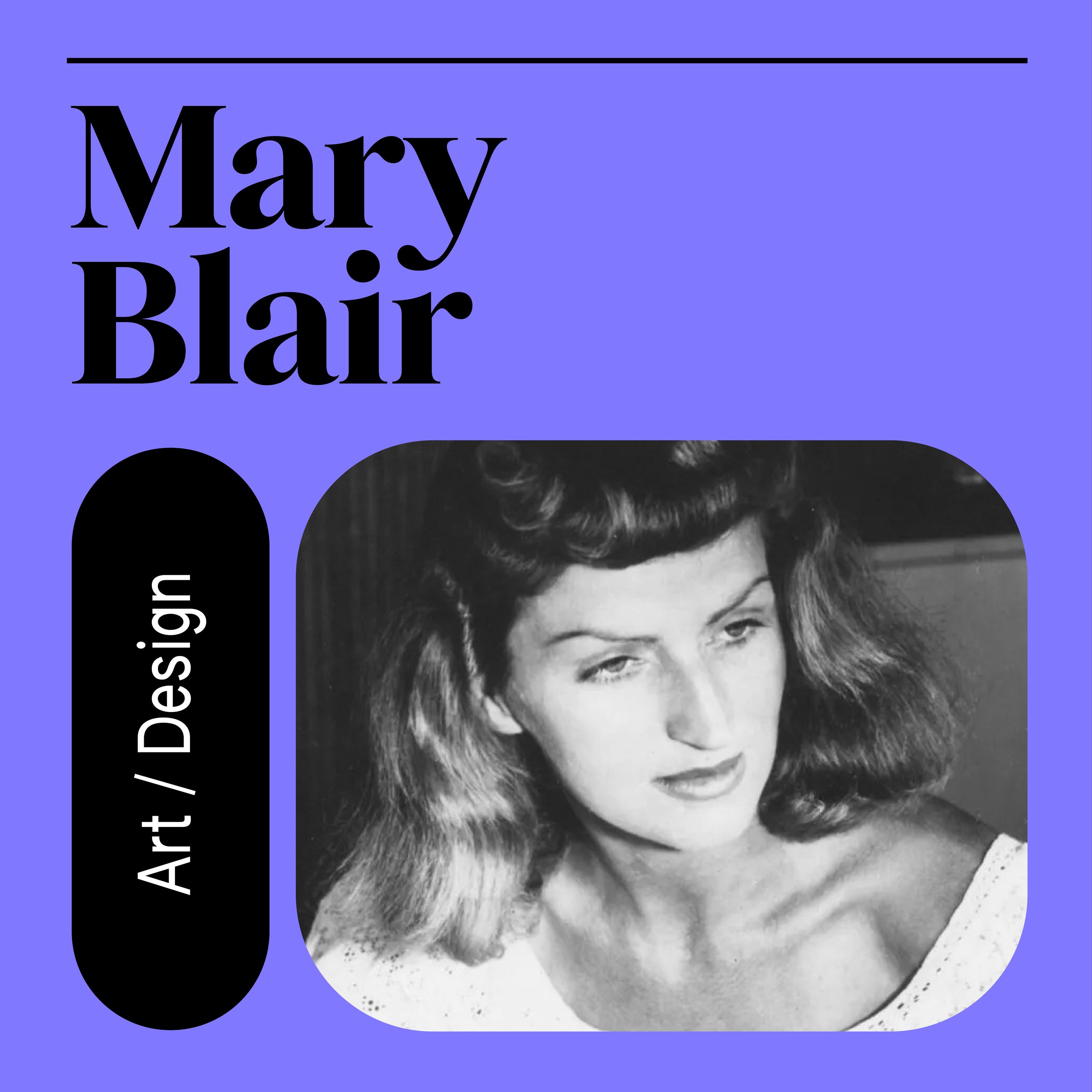
Women Designers You Should Know
030. Mary Blair: Designing Disney’s Worlds (w/ Mike Asay)
00:37:46
Explore the extraordinary life and career of Mary Blair, the visionary artist behind Disney classics like Cinderella and It’s a Small World, whose bold use of color and modernist style transformed animation and design history, with special guest, Mike Asay.
Loading summary
Transcript104 lines
- [00:00]
Mary Blair
Foreign.
- [00:04]
Amber AIs
Welcome back to Women Designers. You should know the podcast where you get to meet the brilliant minds behind some of the greatest designs. I'm your host, Amber AIs. And today I'm shaking things up a bit because instead of a designer or historian joining me, I've got a very special guest, my husband, Mike Ac. Not only is he an incredible artist and illustrator in his own right, but. But he's also a lifelong Disney enthusiast who's as obsessed with Mary Blair's whimsical world as I am. Actually, I think he was the one who introduced her to me. So together we'll dive into her bold use of color, groundbreaking career at Disney, and the magic she brought to films like Cinderella and Peter Pan. Let's dive.
- [01:00]
Mary Blair
Him and wait for you and me and her and she Breaking boundaries, building better world. You should know.
- [01:37]
Amber AIs
Hi, welcome to the podcast.
- [01:39]
Mary Blair
Hey. Fancy meeting you here.
- [01:43]
Amber AIs
So I'm so excited to dive into Mary Blair. We've talked about her a lot.
- [01:49]
Mary Blair
I was just looking back in my phone because I was taking some pictures of books that I was reviewing leading up to this. But then I remember that we've also been to an exhibit of her work back In August of 2019, I think in Santa Ana or Orange.
- [02:05]
Amber AIs
I totally forgot about that.
- [02:06]
Mary Blair
Yeah, there's a lot of photos of a lot of her original work and quotes from her and from other artists. So that was fun to see again as well.
- [02:16]
Amber AIs
Should we give a backstory on us at all? We both were art majors. We both met being art students in illustration classes, art classes, design classes.
- [02:28]
Mary Blair
And just like Mary Blair and her husband.
- [02:32]
Amber AIs
Are we looking into a mirror here? And we also lived in Florida. Is that worth mentioning?
- [02:40]
Mary Blair
Depends on what part of Florida we're talking about.
- [02:43]
Amber AIs
Orlando, where Disney is, and worked there for a couple of years. And we've also been to the Walt Disney Family Museum in San Francisco. It's one of our favorites. We've been there a couple times, and that dives into a lot of Disney history. So I think we are very, very well versed in a lot of those things, especially you.
- [03:02]
Mary Blair
Yeah. And I think I've dragged you to a lot of Disney history, things that you may or may not have wanted to go to, but went along with anyways. The book that we're probably going to be referencing a lot today is Magic Color the World of Mary Blair, written by John Kanemaker. And this was accompanied an exhibit that was put on at the Walt Disney Family Museum. But Don Kanemaker is an Academy Award, Emmy Award, and Peabody Award. Winning animation director and designer. His book definitely seems to be one of the most comprehensive books about Mary out there.
- [03:40]
Amber AIs
So let's go way back to her early life and education. Mary was actually born as Mary Robinson in 1911 in Oklahoma. And her family moved shortly after that to Texas and then shortly after that to Central California, where her artistic talents began to really flourish.
- [04:02]
Mary Blair
Several different family members recall that she was very single minded and very like self determined to paint from an early age. And although the family was quite poor and it was the late twenties leading into the Depression, sometimes her family would go with a little bit less food just so that she could buy paints and that she would have to like argue for a portion of the family income to make that happen. Kudos to her parents for really recognizing a talent that was born within her and really giving her the space and opportunity as much as possible within their means to help her pursue that path. But I think it also speaks a lot to her own self determination to really buckle down and make herself do that.
- [04:55]
Amber AIs
So after high school, she originally started at San Jose State College where she majored in fine arts. And she flourished there so much that she ended up getting a scholarship to the next place that she went to school, which is Chouinard Art Institute in la. And this was a huge hub for aspiring artists where she studied under influential instructors like Pruitt Carter. And she developed a dynamic style emphasizing drama and emotions, which is very much a theme in the rest of her work.
- [05:29]
Mary Blair
Yeah. And Pruitt Carter was her favorite instructor there. And she did a lot of one on one, like tutoring under him as well. And he really emphasized narrative and infusing an illustration with a narrative. She was praised by Carter for her work and he really put her on a pedestal even then.
- [05:53]
Amber AIs
Do you think it's still here?
- [05:55]
Mary Blair
Yeah. So Chouinard remained a very prestigious art school up until 1961, when it was actually combined with the Los Angeles Conservatory of Music under the guidance of Walt and Roy Disney, to become CalArts, or formerly California Institute of the Arts. That's up in Valencia now, which is.
- [06:15]
Amber AIs
Like where a lot of animators go.
- [06:17]
Mary Blair
Yeah, like basically anyone who's working at Pixar, or especially all the lead artists who have gone up the ranks in Pixar through the 90s and 2000s and are now like directors and producers there, they've all gone through CalArts. In fact, there's a lot of quotes in some of these books that I've been reading in preparation for this where Mary Blair remains a huge inspiration at CalArts. And a lot of younger animators that are working on popular films today were inspired by Mary Blair's work for Disney and also her Golden Book illustrations.
- [06:55]
Amber AIs
And so it was during her time at Chouinard that she also met her husband, Lee Blair. It was actually Lee and his brother were both wanting to be animators and so they both went to that school and both ended up going into animation later too, which is really interesting. Mary and Lee Blair ended up getting married in 1934. And then it was in the later 30s that they ended up both joining the animation industry. And Lee ended up securing a position at the Walt Disney Studios in 1938. And then Mary ended up following him in 1940. And she initially started there working on a few projects like the concept art for Dumbo and planning the 1941 version of Fantasia for a segment that was called Baby Ballet. So she was actually not even there for that long when she worked on those. She also worked on an early version of lady and the Tramp and it was probably less than a year. She ended up deciding to leave because she was artistically restrained and unsatisfied with the work that was given to her. Her. So she basically, she wasn't even really.
- [08:14]
Mary Blair
Excited to go work for them in the first place.
- [08:16]
Amber AIs
Why did she accept the job?
- [08:18]
Mary Blair
It was still the tail end of the Depression and Lee had been working at a different company doing color direction for like a smaller animation studio. And so when he left to join Disney, he left a hole in the staff and nobody else could do it. So they brought her in to take his place.
- [08:37]
Amber AIs
What's interesting about this era of Disney to note too is they're still really young. They didn't really have that much done. So maybe she wasn't that excited to work for them too because it was just another animation studio that had. They had received Academy Awards for Snow White.
- [08:53]
Mary Blair
Yeah, Snow White and Pinocchio had both come out and I believe Dumbo was the third feature.
- [08:59]
Amber AIs
And so, yeah, it was a very male dominated environment. And she probably quickly got over it and was like, this doesn't feel like the place for me and I don't feel seen here and I'm going to move on. So it was while she was away from the studio that they actually invited her to travel to South America for kind of this artists on a research tour.
- [09:23]
Mary Blair
Yeah, it was called El Grupo and the government had actually asked them to go down on like a goodwill ambassador program touring different South American countries. And Mary Blair, her color sensibility really exploded and changed forever as a result of this trip. And I think she was so captivated by just all the different natural colors of the landscape and the vibrancy of the culture there and really transformed her personal style. And, of course, she was a key designer in some of the films that the studio created as a result of that trip.
- [10:06]
Amber AIs
But I think one thing that is worth noting is that it was this trip that was a turning point for Mary Blair, because she caught the attention of Walt Disney on this trip, who then became an advocate for her for the rest of her life.
- [10:21]
Mary Blair
Yeah, I think her early year or so working for Disney in the 40s, she wasn't really making waves in the same way that she would in the 50s and especially in the 60s. And so I think this really catapulted her to stardom within the studio and was on Walt's shortlist of his go to artists.
- [10:45]
Amber AIs
She had her short moment at the Walt Disney Company, she took a break, she went on this trip. And then it was in 1943 that she decided to go back to the studios. This was when she worked on major films like Cinderella, Alice in Wonderland, Peter Pan, and working on the concept art for that. So maybe you can explain a little more of what exactly she did with those projects.
- [11:12]
Mary Blair
Even though her artwork isn't seen in the finished versions of the film, she brought her sense of narrative very expert simplicity, but effectiveness of character design and like character poses and staging of the action, or her gift for creating a great visual composition, which is so essential in animation.
- [11:37]
Amber AIs
What she was doing was basically being an art director and setting up the stage for what the overall tone of those movies was gonna be. Right?
- [11:48]
Mary Blair
Yeah. Here's a quote from her circa 1944, where she says, this is an idea creating position. As it really depends upon the individual's ability to produce. Plus the background training involved. You either have it or you don't. And that's her describing a Disney art director's responsibilities.
- [12:05]
Amber AIs
She was essentially setting up the visual direction for each of those movies and saying, we're gonna do these colors. These are the clothes or the defined colors that each person is gonna wear. Here's what the environments are going to look like and the colors and tones of the environments, things like that.
- [12:26]
Mary Blair
Seems like a lot of animators wish that she was able to be integrated or even more involved in translating these concept stages into the actual finished animation work. Because what some people would describe as a tension or a frustration between her and some of the animators was the animator's inability to translate her Very stylized, two dimensional art compositions into what had by then been established as a Disney style of rounded, full of life, three dimensional seeming characters.
- [13:10]
Amber AIs
Yeah. In fact, that initial resistance was a really big deal during this period too. I would say. This is probably where the gender dynamics came into play, where she's this woman who's telling all of these animators what to do, how to do their work. And they are obviously all men with egos that really know a lot about animation and are basically rolling their eyes at her work and saying, well, that's not an accurate body or things like that. Right. Because they get very detailed about making sure that the body figure is composed correctly and all of that.
- [13:56]
Mary Blair
There's a very famous book, especially within animation, by legendary animators Frank and Ollie called the Illusion of Life. And the animators at the time definitely found it frustrating or difficult to reconcile Mary's stylized designs with the rounded Disney style of believability that Walt and his audience had expected. A quote from Ollie Johnston said that Walt told us to get Mary Blair's stuff on the screen, but it was impossible. Her stuff is very flat. And Walt thought a great deal of her work. A production manager said, but he always hoped that he would somehow bring Mary closer to the animation problems, but he was not able to explain how that might happen. And so I think the desire was there to somehow capture her style in the final animated forms.
- [14:46]
Amber AIs
And it seemed that Walt was basically an advocate for her, was really pushing her work on the animators too, which is really nice to hear about and really nice to know, in fact, isn't it said that she was one of Walt's favorites?
- [15:02]
Mary Blair
Yeah. There's a studio nurse named Hazel George, who is also a friend to Mary and a confidant to Walt, who said that Walt's continual support of Mary and her work engendered jealousy in some co workers and they felt she was taking unfair advantage of Walt because she was a woman. After saying that, Hazel says, but that's the usual attitude towards women artists. So I think even back then, women could clearly see the sexism that was just part of society and the culture. And especially it being such a boys club with all of the leading animators being men.
- [15:40]
Amber AIs
It's interesting to me, especially like in the broader context of all of these women designers that we talk about that back then, it became the thing you just shrugged off. Like when that happened or when sexism was at play, then the women, all they could do was shrug it off and be like, well, it's because we're Women, and they don't value us. Like, for someone like Mary and her friend Hazel, that is their reality. There's not much they can do about it.
- [16:08]
Mary Blair
Yeah. She wrote to a friend, Ross Care, talking about how she just did her work in her own way and took cues from Walt. She said that Walt had a strong feeling of likes and dislikes. And one could always sense when Walt didn't like something, he usually didn't say anything. Feels like a very devil. Worse. Prada. At those times, I would just keep quiet. But when he liked something, he was all smiles. All I know is that he liked what I did, and I got along with him. All right. So I think she acknowledged and could discuss some of the pushback and possible sexism from her male co workers, but just knew that she was there to do her job and that she felt confident in her own abilities. And she knew that she was able to produce work that Walt was happy with. At the end of the day, that's who's signing the paychecks, and that's what she really cared about.
- [17:00]
Amber AIs
Now let's talk about her artistic style. And her work was definitely characterized by colors we've talked about, but also simple shapes. She had a way of taking something complex and simplifying it, which I think is very much a design capability.
- [17:17]
Mary Blair
Yeah, I think you and I both, in our art classes in college, that was a recurring theme.
- [17:22]
Amber AIs
It's like when you're designing a logo, you're gonna take something like a tiger or whatever it might. A house or whatever it might be. And you have to reduce it down to the basic shapes and forms that you're really getting out of that. And she had a way of doing that with all of this stuff. And I think you see that in her later work. Even more so when she had even more liberty to do whatever she wanted to do. But you definitely see that in some of this Disney work as well.
- [17:54]
Mary Blair
It's interesting to recognize about her artistic style and how it evolved over the years. Was that coming out of high school, going into college, and at first, she was pursuing a very serious technical degree in fine art. And her medium of choice often was watercolor. And she was a very accomplished watercolorist along with her husband. And even then, it wasn't overly complex. And of course, working with watercolor, you can't be that complex. So although her early watercolors showed great skill and the simplicity of form, I think after the El Grupo trip to South America is when her style really dramatically shifted into what we now think of when we think of a Mary Blair style with the very flat, 2D, much more graphic shapes.
- [18:47]
Amber AIs
Yeah. Wasn't she part of the California Watercolor society in the 30s?
- [18:53]
Mary Blair
Yeah. And they would have exhibitions all around the state and they would go to, like, large national exhibitions in Texas. There was definitely a California style of watercolor that was much more broad and unstructured compared to maybe a more classical tradition.
- [19:12]
Amber AIs
And then one last thing to point out about her artistic style is she had a very whimsical style, too. And this is. This very much helped take her into the world of children's books because of the way that she would simplify things, make them whimsical, and have personality and character. And that really brought stories to life and was accessible for younger readers and was full of charm and creativity. And so I think that's why so many people love her work to this day, is because it felt very human and it was something you can connect with.
- [19:49]
Mary Blair
Yeah. And I think that is due to her just excellence at infusing all of her works with a strong narrative and really wanting to create a character that feels relatable, even if it's just a design on a handkerchief or on a ceramic tile. Like everything to her stems back from her early education at Chouinard and setting that tone or that approach to her work for the rest of her career.
- [20:21]
Amber AIs
So then she was at Disney for a good 10 years or about a decade before she decided to resign. This was after Peter Pan that she.
- [20:31]
Mary Blair
Resigned John Kanemaker that we've been referencing throughout. It does say that despite all the creative expression that she enjoyed in her role at Disney, Mary Blair and the studio amicably parted company in February of 53. She wanted to spend more time with her family, which now included two children, Donovan and Kevin, and a focus on her burgeoning commercial art and illustration career.
- [20:53]
Amber AIs
So the life of a freelancer was what she sought after.
- [20:56]
Mary Blair
But it does say that Walt gave his blessing for her to leave and kept the door open for her return.
- [21:02]
Amber AIs
So her advertising work is really interesting, too. I hope there's a lot of this out there that I can showcase or show on Instagram. But she worked for Nabisco and Maxwell House and Beatrice Foods and Pepsodent.
- [21:20]
Mary Blair
Yeah, she created more than 20 semi abstract designs for handkerchiefs and scarves manufactured by Carol Stanley Studios, and they sold on Lorde and Taylor. And I know that she also did paper sculptures for window displays for department stores.
- [21:36]
Amber AIs
And that probably was a segue into more of the theater sets that she did because she was also working on Christmas and Easter sets for Radio City Music Hall. And she worked in graphic design and animation along with set design, which is like really cool that she was spreading her wings into all of these areas.
- [21:59]
Mary Blair
Yeah. And then of course she also designed TV commercials for Hepzodent toothpaste, Meadow Gold ice cream and other products throughout her husband's film production company. And a former Disney animator, David Swift, who would later direct other live action films, hired her as a color designer for the live action film adaptation of the Broadway hit musical how to Succeed in Business Without Really Trying.
- [22:22]
Amber AIs
So if she was doing this commercial work, does that mean she was an art director showing what the overall vision of that commercial would be?
- [22:31]
Mary Blair
I know a lot of commercials back then were also animated or would have voiceover over different graphics and things. I don't know that a lot of commercials were the heavily directed mini films that we see today.
- [22:45]
Amber AIs
Another thing to point out about her work is it's actually very quintessential mid century modern. Like when people think about that era of work and design, they think about Mary Blair because she really was speaking within that trend and that era of pops of color and really interesting visuals coming to life and yeah, like the advertisements of the time and like basically what really centered pop culture at its core. She was a part of all of that.
- [23:18]
Mary Blair
Yeah. And I think because she was working for huge national brands like Nabisco, Johnson and Johnson, Maxwell House Coffee, Metal Gold Ice Cream, Baker's Instant Cocoa and like Pall Mall cigarette ads, it's like a self perpetuating artistic cycle of this is the art that's popular, this is the modern art of the era. Let's apply it to these eye catching advertisements and commercials then. This is what the general public is seeing and this is what's connecting with them. And so they're in turn becoming more enamored with that style and really adopting it into their lives.
- [23:54]
Amber AIs
I kind of imagine that this 10 year stint of freelancing and everything that probably Walt was watching what she was doing. And so 10 years after working at Disney, this is when Small World happens. Walt reaches out, points out that they're going to do a 1964 New York World's Fair attraction and that he wanted her work, her use of color and shapes and cultural motifs to be a part of this attraction and to make it this very celebratory. All these children coming together. And I imagine he was probably watching all of her children's books too and wanting the Mary Blair child to be in this because she Has a very iconic child design.
- [24:44]
Mary Blair
It was in 1963, the year before the fair, that he offered Mary for the next three years a series of creative challenges that would bring her art to a new and literally large level. She did the New York World's Fair and there's on Disney. I was watching a little documentary about It's a Small World. In the process of that. Mary Blair was definitely Walt's first choice. And he personally chose her because of her iconic style. And he knew from years of experience that she was the best at what she does.
- [25:19]
Amber AIs
Yeah. So I imagine Small World as she's got her children's book style, she has her set design style. This is all coming together in an attraction. And it. She clearly had the design acumen or whatever you'd call it, to really set this attraction up for success. Because of that experience that she had. It wasn't just a whim like, what do you think? Can you do something like this?
- [25:45]
Mary Blair
Well, yeah, he trusted her wholly and gave her like carte blanche over the whole style. And so she designed all of the figures of all the people. And the original facade when it was at the fair is very different to what we think of today when we see it at Disneyland. But she did design the facade for when it moved to Disneyland as well.
- [26:07]
Amber AIs
Yeah. In fact, I think the way that process ended up working was she laid down the groundwork and then handed it over to them and they took it from there. Is that right?
- [26:16]
Mary Blair
Yeah. I think she wanted to move on to some other projects. But Roly Crump, who is still alive today, he's one of the oldest living original imagineers, really respected Mary and her unique style and wanted to make sure that got built out to her specifications and her original vision.
- [26:35]
Amber AIs
So if someone has never been on Small World, how would you describe it?
- [26:39]
Mary Blair
It's a boat ride. It's like riding through a scrapbook of sorts or a whimsical real life storybook of children all over the world. And they are all dressed in typical cultural clothes from their home countries. And.
- [26:58]
Amber AIs
And it takes you country by country too.
- [27:00]
Mary Blair
I think for some of the larger countries, they are country by country. And then a lot of sections are grouped by region or continent.
- [27:08]
Amber AIs
I looked it up and it says that it features scenes that collectively represent over 100 countries. Way more than I thought.
- [27:16]
Mary Blair
Yeah. And originally when they were designing the attraction early on, they wanted like the national anthem of each country to be played in that section. But they really found out that was a terrible idea because it was just a cacophony of competing sounds that did not go well. So Walt had the Sherman Brothers, who also wrote music for Mary Poppins and all these other big, huge Disney songs. They came up with It's a Small World theme. And so as you move through, everyone's singing the same song but in different languages. As you travel through those areas, do.
- [27:48]
Amber AIs
You think their creative brief was create a song that people will never be able to get out of their head?
- [27:55]
Mary Blair
Well, I think more technically they were directed to create what's called a round style song that can be repeated over and over. And as you go through, there's no like end to the song or necessarily a beginning to the song. As you're going through, the kids can come in in their respective language. And as you keep going, it just transitions seamlessly into a different language.
- [28:18]
Amber AIs
That must be the type of song that gets stuck in your head then. Yeah, the song that never ends.
- [28:23]
Mary Blair
It goes on and on, my friend.
- [28:24]
Amber AIs
There's so many songs like that are the ones that get trapped in your head.
- [28:28]
Mary Blair
Yeah. Because it is so repetitive and like simple by design.
- [28:31]
Amber AIs
Another thing I think about when I think about Mary Blair are other women designers who have very similar design and aesthetics and approaches to their design. I think about Ray Eames. She has a very Mary Blair style to some of the graphic design work she does, or shapes and colors and even three dimensional things. They have a three dimensional elephant chair that I think could very much translate to Mary Blair's work. I also think about Evelyn Ackerman, who we cover in episode two, where she has a lot of interesting people and does a lot of mural work and mosaic work that Mary Blair does and has a very similar style. And both of those very much come from that mid century era in the same time period and the same location. They're all coming out of la. Was there anything else you wanted to say?
- [29:24]
Mary Blair
So, yeah, I mean, the Small World was an immediate success and was one of the most visited attractions at the World's Fair. And as soon as the fair closed in 1965, it was moved to Disneyland with a brand new facade that was a Mary Blair design itself. And that opened in 1966, also in November of 66. So just a month before Walt Disney died, Walt got her signed up to do a big mural at the Jules Stein Eye Institute at the UCLA center for Health Sciences in the children's section of the outpatient clinic. She did a huge 220 square foot mural with clay tiles in different transparent colors. And so that was a big project for her as well.
- [30:08]
Amber AIs
Cause then after that, she does the Tomorrowland mural, which is now covered up by other artwork. But we're all pretty sure it's still underneath that in Tomorrowland. It used to be two murals on either side of you as you walked through that promenade. And then she also did the mural at the Contemporary Resort at Disney World. And that one's a 90 foot high mural and major focal point.
- [30:35]
Mary Blair
Yeah, it is the huge central atrium of the Contemporary Resort. And that mural is definitely very well preserved and still on display.
- [30:42]
Amber AIs
It's so beautiful. I've always loved looking at that. Going up close to it. It is like. It is definitely an experience to be part of.
- [30:50]
Mary Blair
Yeah, it's 90ft tall and just enormous, but gorgeous. Even though Walt Disney had passed away in 66, construction on Walt Disney World and a lot of those plans were already underway and had already been decided. So even though the Contemporary Resort didn't open until the 70s, several years after Walt's death, she was still involved with that because it was under his prior direction.
- [31:16]
Amber AIs
He originally hired her for those projects.
- [31:18]
Mary Blair
Knowing that was going to be something that he wanted in place at this forthcoming huge resort in Florida.
- [31:25]
Amber AIs
But then once he died in 1966, the incoming projects her way from Disney basically stopped.
- [31:33]
Mary Blair
Because I think they had such a personal relationship in that professional, artistic sphere. And he was really a champion for her to the end of his life.
- [31:43]
Amber AIs
Isn't that interesting that no one else after him wanted to bring her back for more stuff? She lived a good 12 years after him.
- [31:52]
Mary Blair
Yeah, Well, I think because his death was so unexpected, his older brother had already retired. And he came out of retirement just to get Walt Disney World completed. And then he died two months after Walt Disney World opened. So both Disney brothers who had started and led the studio were now dead.
- [32:10]
Amber AIs
And so her big connections to Disney.
- [32:13]
Mary Blair
Yeah, and leadership at the studio was up in the air. And I think they were just so worried about keeping the company afloat and who's gonna be the president now and who's gonna lead this company. That I think any kind of, like, ambition or special direction to keep getting Mary Blair involved probably fell by the wayside because they had other priorities that were more pressing to them. In her last seven years, she did make some small personal artworks that she called semi dimensional paintings, which were part painting and part construction. She said that she had plans when she had made enough of them to exhibit them, possibly in San Francisco. But that never happened because illness and personal problems took a toll. And she eventually passed away because of a cerebral Hemorrhage in July of 1978 with just the age of 66. Yeah, but, yeah. So even then, in her later years, I believe she probably would have still been having a lot of other commissions and being hired by other companies for different things. But she had basically totally moved away from watercolor, which, if you remember, was her original medium of choice. Starting out in her 20s, she almost exclusively did watercolors. But in her later years, she told her brother in law, I don't think I could draw another watercolor if I wanted to. And she had become so accustomed to design and she was so successful at it, and she just wasn't interested in watercolors. But she loved all the different other fields that she had become so prolific in.
- [33:47]
Amber AIs
Yeah, she was so good at it. And I think she loved that reward.
- [33:50]
Mary Blair
Yeah. And I think like many people, when you're so young, you don't even know that career even exists or is a possibility. So as a young person, she thought, I'll study fine art and I'll be an art instructor, because that was her worldview at the time. But then in Chouinard, she really wanted to become an illustrator. And I think her teacher really helped open her eyes to the possibilities within illustration. And she loved directing action and infusing narrative into all of her compositions. And then that kind of led her into the world of design and everything else that we've covered. So it's interesting that she continued to keep her eyes open or, you know, her mind open to changing directions or focuses in her career. And so by the end of her career, she had went way beyond just illustration and she had a huge career throughout the areas of film, costumes, set design, fine art, animation concepts, advertisements, books, theme parks, attractions, ceramics, sculpture and collages.
- [34:56]
Amber AIs
That is an incredible list of things. Oh, another thing to note too. She was posthumously honored as a Disney legend, of course.
- [35:07]
Mary Blair
Very, hugely deserved.
- [35:09]
Amber AIs
Yes, I want to end on this quote by John Kanemaker from his book. He is such an admirer of Mary Blair and I really love his perspective of her too. He said, Mary Blair's fearless artistic sensibilities and magical paintbrush created an intense reality all her own, no matter the subject matter or medium. The feeling of joy that she took in her limitless creativity is palpable, and it continues to communicate and fascinate viewers of all ages, all over the world.
- [35:42]
Mary Blair
But yeah, it's clearly impossible to encapsulate Mary's huge career into one episode of a podcast or even into just one book. But luckily, because of, you know, in large part her work with Disney, but of course in all other aspects of her career. She has become immortalized in different publications and there are a lot of ways to learn even more about her. So if any part of her life has spoken to you, definitely encourage you to continue reading more, learning more about her life. And I have even a renewed fascination or urge to go back through this book and to read it cover to cover, just because there's only so much that we'd have time to talk about today.
- [36:25]
Amber AIs
Cheers to Mary Cheers to Mary Blair. Thank you for joining us today as we explore explored the vibrant and whimsical world of Mary Blair. Her bold use of color, modernist vision and undeniable influence on Disney's most beloved projects continue to inspire generations of artists and dreamers alike. If you want to dive even deeper into her story, I highly recommend the book Magic Color the World of Mary Blair by John Kanemaker. It's a stunning collection of her work, filled with insights into her life, her creative process, and the magic she brought to everything she touched. It's truly a must have for anyone passionate about design or animation or even the history of Disney. As always, thank you for listening to women designers. You should know. Happy New Year. I hope you all have a wonderful 2025. I'm excited for covering even more women ahead. Don't forget to leave a review, share the podcast with a friend, and follow along on social media for more behind the scenes and visuals of the women that we're covering. And as always, let's redesign history by celebrating women.