← Wretched Radio with Todd Friel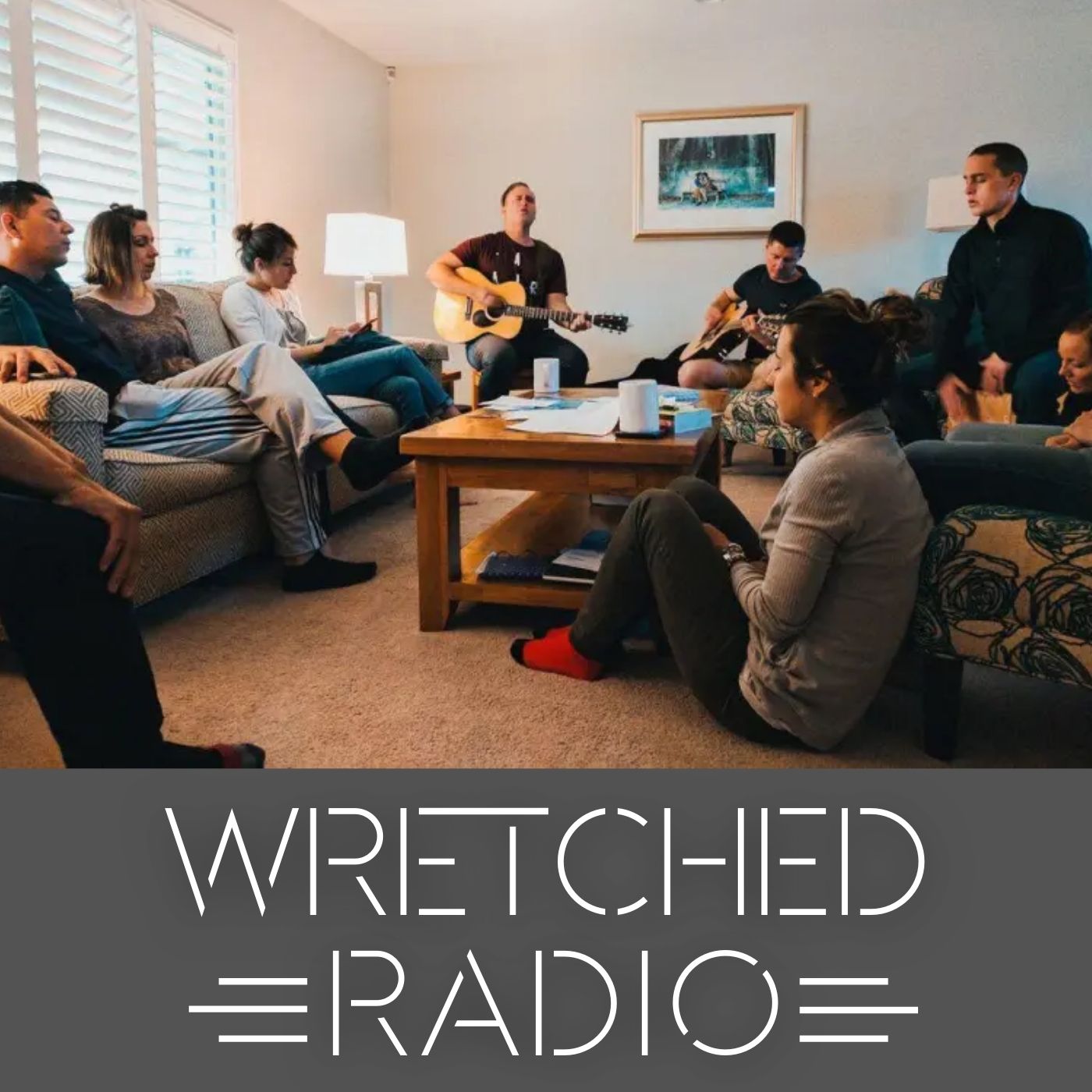
Wretched Radio with Todd Friel
The House Church Myth + Why Parenting Feels Harder Than Ever
00:54:59
Segment 1 • The push to abandon church buildings for “first-century house churches”: admirable or misguided? • Did the early church reject formal worship spaces, like church buildings? • Old Testament and synagogue patterns challenge the mo...
Loading summary
Transcript43 lines
- [00:02]
Todd Friel
Wretched radio begins in 3, 2, 1.
- [00:07]
Jimmy Hicks
Your first mission is to keep yourself happy. It's living for self that is so exhausting and frustrating. Cause you were made to live for him. So when you begin to please him, you begin to thrive. It's not a burden, it's not a duty, it's a joy. I come alive. This is what I was made for.
- [00:27]
Todd Friel
It's time for Wretched Radio with Todd. Fr.
- [00:35]
Jimmy Hicks
Story time. Going back to the first century, or should we. This is Wretched Radio. The house church movement. It has been kind of a thing in evangelical Christianity for a couple of decades now. Originally, I recall Frank Viola, George Barna, they were proponents of people meeting not in a big building, but in the home. Francis Chan, he's leading another movement encouraging people start meeting in your homes. It's better. It's first century. The question though is, is it, should we be meeting in buildings? Is that an aberration of the original intention of the first century church? Or is it possible that the first century Christians met in churches, typically, or synagogues, and then were forced to worship in their homes? In other words, all of the times that we read, for instance, Romans 16, I believe the greeting from Prisca and Aquila to say that they and the people who meet in their home, no. 1 Corinthians, it's in the New Testament where we read about people meeting in homes. Indeed we do, and we can't ignore that and we can't brush it away historically as perhaps tidily as we would like to. But the question is, why were they meeting in those homes? Were they setting a precedent for you and me? I think to answer that question, we can actually go back further than the first century. We go back to the Old Testament. Where do we see the saints assembling in the Old Testament? Not in their homes, in a building, one big building in one big city called Jerusalem. The concept of a separate building that is constructed by believers for the setting apart of a worship center has Old Testament precedent. This is not just a New Testament churchy thing. We see the Temple setting a pattern that God has dedicated spaces for worship. Now, when we do get to the first century, we still have the Temple in Jerusalem, but we've got Jewish people scattered all over the Mediterranean. Where do they meet? They aren't getting to Jerusalem as frequently as they would like. And so they set up synagogues. These were local. We'll call them mini temples. Now, of course, they weren't designed exactly like the Temple, but they did have temple like furniture. They did have dedicated elements. They would have an altar, they would have a table. They would have a facility that was set apart for the exclusive purpose of worship. And we see that in the New Testament, if you recall, Jesus went preaching where in a synagogue. That was the infamous. He was going to get thrown over a hill because he announced to them. The scriptures that I just read have been fulfilled in your hearing. Gulp. What a moment that would have been. I gotta tell you, if you had to pick one of the moments, you could go back in time. You jump in the DeLorean with Michael J. Fox. You can only go back for like 10 minutes. Of course you'd go to the time of Jesus. The question is, which Bible story would you insert yourself into? That might be one of them. Hearing Jesus read about himself, announcing to them, I'm fulfilling what was written 700 years ago. Jimmy, what moment would you pick?
- [04:37]
Jimmy
That's a tough question. You know, I really don't know.
- [04:42]
Jimmy Hicks
Well, think about it, man. It's important. We've got to have answers for these types of questions. It's hard to know. Raising of Lazarus from the dead. How's about the crucifixion? I think that would be a hard one.
- [04:55]
Jimmy
Yeah, that's the first thought that comes to your mind.
- [04:59]
Jimmy Hicks
But then, do you really want to see that resurrection.
- [05:03]
Jimmy
That's the difference.
- [05:04]
Jimmy Hicks
How's about the walking on water? Oh, man. Because we read about it, we believe it. It was an actual miracle, a setting aside of natural law. But to see it tell me that this is why the disciples, when they were in the boat and he calmed the storm, they were originally afraid. They saw his divine power and they were very afraid. I don't think we'd see Jesus walking on the water and go, cool, look at that. Miracles could be kind of scary. Hmm. That's interesting. Tishradin, isn't it? That's okay. You're looking for a way to actually fellowship at church. Because fellowship isn't just hanging out with Christians. Fellowship, biblically understood, is hanging out with Christians talking about Christian things. Now, it doesn't need to be the entire conversation, but genuine fellowship is surrounded in conversation about our Savior. This could be a good conversation starter. Hey, got a question for you. If you could go back for 10 minutes to the New Testament, where would you inject yourself? No, that gets you doing a good thing talking about Jesus, and that will grow you because that is a means of growth, fellowship. Now, the question is, watch this segue, Jimmy. Where would the first century Christians have asked that question? Let me take you to see. I just. She gets back to first century here. This was a test. Everything.substack.com I don't know what that means. I'll be honest with you. The House Church myth by Michael J. Lilly. He's talking about the history of what drove early Christians to indeed worship in their homes. But here's my question for you before we dive into this retelling of first century church history. How do you envision the home church in the first century? What does it look like? You probably think it's like, well, what do you think, Jimmy? Should we do it at your house this weekend?
- [07:21]
Jimmy
That's right.
- [07:21]
Jimmy Hicks
And then we just walk in and that's that. Or was it something different? Let me take you back. We imagine a small group of believers gathered in a cozy living room. Sitting in a circle, someone strums a liar. Not like your pants on fire, but a guitar. Prayers are spontaneous. Everyone shares equally as the Spirit leads. No clergy, no liturgy, and no religious structure. Not every house church is like that. But I think that represents a pretty fair sector of the house church movement that encourages us. Let's sell the buildings, be done with the buildings, and start worshiping at home. They call that the pure church of the apostles. Just simple, relational, and not corrupted. Like the institutions brought corruption into the church. There was no hierarchy, and then it was perfect is what it was. The only problem is, according to Michael J. Lilly, that just isn't historically accurate. The theological concept of the house church being this unstructured, without any hierarchy, spontaneous, is more of a modern invention projected backward onto history. Because the reality is the early church was liturgical, it was structured, and it was born out of the synagogue, not somebody's living room. Michael J. Lilly writes, the scriptural defense for this view often rests on selective citations. We read in Acts 2:46 that the believers were breaking bread in their homes. That's true. But the question, of course, is, what was going on in Acts 2? When you read 2:46, you think, oh, they were doing house church. But if you go back to the first half of the verse, every day they continued to meet together in the temple courts, and then they were going to their homes to continue fellowshipping, to continue breaking bread, to continue listening to teaching. It was not a rejection of the Temple. Even we don't see that it is rejected in the first century now. It was destroyed in 70, but it wasn't rejected. We see references to the house church of Nympha colossians 4:15. And so the logic is, if the apostle, if they were meeting in homes. Well, then we should be doing that too. But that just isn't the whole story. The temple and the synagogue phase is phase one. From AD 30 to 70. Where were they meeting? Well, the Christians maintained kind of a dual life. They attended the synagogue for the reading of scripture and the Temple for prayer. Acts 3:1, Peter and John going up to the Temple at the time of prayer. They weren't abandoning the institution. They actually thought, we're going to. This is where we belong. Because it's not like they thought that the church is this new creation. Jesus was a fulfillment of all of the Jewish prophecies from the Jewish holy book. And so it was quite natural for them to actually worship in the temple. They didn't reject it. They were also meeting in synagogues. And then they would also get together for fellowship in the homes. Paul's missionary strategy, where did he go? He went to synagogues, didn't invite people over for Bible study. And just a sharing time. And if anybody has a testimony, no, the structure of the synagogue readings. It had presidents, there were prayers, there was a hierarchy in the synagogues. But then there was a turning point. Next on Wretched radio.
- [11:29]
Jimmy
Be honest. When's the last time you shared the gospel with a stranger? Not posted something online, not like the Christian meme, but actually opened your mouth and told someone about Jesus? If your stomach tightened just a little bit, you're not alone. Most Christians would rather do almost anything than evangelize. It's terrifying. What if they get mad? What if I say something wrong? What if they ask me a question I can't answer? Our resource terrified 2. It exists because Jesus gave us the Great Commission, not the great suggestion, and he actually gave us the tools to obey it. And this resource will walk you through how to share the Gospel with strangers, even family members, without needing Pepto Bismol to get through it. You'll still be nervous. That's normal. But you'll also be equipped. And equipped beats terrified every single time. Terrified2 it is streaming right now for free on Fortis Plus. Download the app right now on your smartphone, on your smart TV or head to fortisplus.org
- [12:30]
Jimmy Hicks
Is it possible a Christian university can actually be ranked high when it comes to preparing students for for the real world? Hat tip to Masters University. You want to send your kids someplace where they actually still teach the Bible? Not just based on a document that they may be having a file cabinet someplace, but they actually use the Bible there. The education at the Master's University, not only biblical, but oh so practical courses, diplomas, degrees, they can be achieved online or of course, on their beautiful campus in Southern California. Would you like to learn more about the Master's university To prepare you or your child for the future, I encourage you to visit Masters. Edu Wretched Masters. Edu Wretched.
- [13:29]
Jimmy
Ask most Christians what they know about hermeneutics and you'll likely get. Herman, who? That sounds like somebody's uncle. Is that the guy that always comes and just stays quiet in the back of the small group? Hermeneutics is actually the art and science of interpreting scripture. And if you don't know how to do it rightly, you're going to read the Bible wrongly. Worse, you're actually going to be an easy target for every false teacher with a podcast and a proof text. Herman, who is basically a master's level education and how to read the Bible correctly and it's condensed into something you can actually finish. You'll learn how to interpret a 2000 year old book in a 21st century world without twisting it into something it was never meant to say. By the end of it, you'll never read Scripture the same way again. And you'll never have the wool pulled over your eyes by someone who sounds confident but doesn't know what they're talking about. Herman, who? It is streaming right now for free on Fortis. Download the app on your smartphone, on your smart TV or just simply go to fortisplus.org.
- [14:33]
Todd Friel
Know your church fathers Theophilus of Antioch lived a pagan lifestyle until he was converted by reading the scriptures. His most notable work, Apology, was written to an unbelieving friend to show that the scriptures were self authenticating and argued that the antiquity, clarity and consistency of the Scriptures prove their divine origin. This is Wretched Radio with Todd Friel.
- [14:59]
Jimmy Hicks
There is no right answer. No, we just didn't become postmodern. This is Wretched Radio. The question before us, if you could go back in time 10 minutes, New Testament, where would he go? What Bible verse would you jump into? Jimmy, you think you got it sorted?
- [15:15]
Jimmy
Well, you know, because if you do go back, and I guess I put a lot of analytical thought into it, but if we were to go back.
- [15:22]
Jimmy Hicks
Wait a second. How much analytical thought could you put? You've had like four minutes to think it through. But I mean, I guess these days that's a long time to think something through, isn't it?
- [15:31]
Jimmy
True? That's absolutely right. But if we could go back, I mean we would have their minds then, so. Okay, well, I mean we're not going to look at it on this side of everything.
- [15:43]
Jimmy Hicks
Well, I didn't say you get a brain swipe when you go back in the DeLorean.
- [15:47]
Jimmy
Well, that makes everything different. If you have what we know now on this side of it, then you'd
- [15:53]
Jimmy Hicks
have to know because then you couldn't pick where you're going.
- [15:57]
Jimmy
But you just said, if I could go back, I think I would go back to the upper room where he opens their minds to understand the Scripture.
- [16:07]
Jimmy Hicks
How do you pick? Really? How do you pick? Because when you really take the time and you don't want to get carried away and start, I don't know, doing something like the Chosen, you don't want to start imagining things that are ridiculous or that could cause confusion or put words into somebody's mouth. But to think about what it would have been like when you do ponder it a little bit, it does bring it alive in your mind's eye, doesn't it? And it helps you to perhaps move it from head knowledge to heart, experiencing it by thinking it through. That's what a good sermon should do. It should paint a picture that causes you to stare at it and go, whoa, I didn't just learn something, I actually just felt something. So you're in the upper room. This would be John 13 through 17. That was a long discourse. Is that the one you're thinking of?
- [17:03]
Jimmy
No, I'm thinking in Luke 22, when he comes in and they wanna see the holes in his hands after the resurrection.
- [17:09]
Jimmy Hicks
Oh, after the. Oh, right, right.
- [17:11]
Jimmy
He opens their minds to understand the scri.
- [17:14]
Jimmy Hicks
What would that have been like? Yeah, he was dead. I mean, there was no question in anybody's mind that he was dead. Now the swoon theorists of the 20th century have come along to claim, well, he didn't really die, so he wasn't really resurrected. And those are purported Christians. Why they want to do that? Well, because they're not. At any rate, that would have been magnificent. Seeing him resurrected. It's hard to go back to the birth and you would see God in flesh. And your mind should have been blown. Infinite is smashed into the finite. What a miracle. And you've seen this is the longing of every Jewish heart being fulfilled. Wait a second. Here in this dump. He should be in Jerusalem. No. What a mind blowing experience that would have been. I can't think of a Bible verse where it wouldn't have been mind blowing. We'll have to ask the disciples. What were you thinking when you were seeing all of this? When you were hearing all of this and apparently they would say, we were thinking it would be nice if we had our own worship center so we didn't have to worship in houses. A segue. Get us back to the story at hand, which is the history of the house church. Now, do I think somebody's sinning if they worship in a house? No, but the point of this exercise is to make sure that people who worship in house churches don't think that those of us who assemble in a more formal institution, in a formal structure are sinning either. Because I think we have Old Testament historical precedents. We are not. Furthermore, we have the first century church prior to 70 AD, the synagogues would be utilized by Christians. Paul would go into a synagogue, people would get saved and they would do Christian worship in the synagogue, or they would go to the temple in Jerusalem for prayers. They would go for the celebrations, even for the festivals. So I don't think that we can say that they were immediately meeting in house churches. What changed it? Two major events. The Jewish revolt, the destruction of the Second Temple, 70 A.D. it was obliterated by Rome. They couldn't meet there. And then you had the birkat ha minim, late first century. It was a curse added to the synagogue liturgy targeting heretics, specifically Nazarenes, which basically excommunicated Christians from Jewish life. There was a gradual parting that took place now as both sides, by the way, it was the Jews with the Christians, but it was also Rome with the Christians as they increasingly became what would be called a sect. These people don't receive Jewish protection. They're different than those Jewish people. So the Christians found themselves on the end of persecution. That's what First Peter is about. They were dealing with persecution. It was heating up, there's no question about it. Probably starting in about the mid-50s or early-50s, but definitely with Nero in the mid-60s. Simultaneously, Christianity was declared religio illicita, an illegal religion. And so you couldn't meet in public, you could be arrested, you could be executed. And so what did they do? They moved to private homes so they wouldn't die. They didn't go because they thought we shouldn't be a part of an institution that's corrupted. We need to do this because otherwise we'll be executed. And so the house church movement was driven by persecution, not an ecclesiological ideal. This is what it should actually look like, that it should look like. It should be this intimate, calm, quiet, non hierarchical setting, even when forced into homes. This is from the document, the name of the fellow who put this together, by the way, is Mr. Lil Michael J. Lilly. Thank you for that, sir. Even when forced into homes, the early Christians did not adopt the organic style of worship that's often promoted today. They didn't sit in circles sharing feelings. They renovated their homes to mimic synagogues that looked very much like churches today. And I wish you could see it. He's got a picture of one that was discovered, a third century church at Dura Europos. They redecorated the courtyard. There's a teaching area, there's an assembly room, think sanctuary. There was a baptismal, a baptistry, because they designed the home to actually look like the synagogue. It was designed to look like the churches that we inhabit today. In other words, there's really a 2000 year history of the church. Archeological proof. The church that I just described, AD233, it's in Syria. It's the oldest identified Christian house church. It was in a private residence to be certain, but it wasn't a living room. They knocked down walls to create an assembly hall. They built a platform for the leader or the bishop to stand and preside. In other words, there was a hierarchy, there was a separation between clergy and laity. And then they had of course, the baptistry. Now liturgical scholars have pointed out that the term house church is misleading. A better analogy might be the modern storefront church. They converted something into what we would identify today as a church. That is the house church movement. It's not the same thing that Francis Chan is promoting from the article. Perhaps the deepest part of the myth is the idea of egalitarian worship, that in the early church everybody shared no leaders. But that's just not history. Clement of Rome. This is around 96 AD. This is most likely the Apostle John was still alive. He wrote about order in the church and he used Old Testament Levitical analogies to describe Christian worship leaders saying worship must be done at the appointed times and hours and by the appointed ministers. Hmm, that sounds pretty organized and formal. Ignatius of Antioch 107 was more blunt. Let no one do anything properly belonging to the church without the bishop. Justin Martyr in 150 gives a detailed outline of Sunday worship. Remember, this was going on in a house. Readings from the apostles and the prophets, a sermon by the president or the bishop, pastor, intercessory prayers, the kiss of peace, presentation of bread and wine, a prayer for the table, and then they would take communion. The article writes, this isn't some free flowing Kumbaya session. It's structured, hierarchical. It's liturgical. That's remained virtually unchanged for 2,000 years. That's the history of the local church. I think there's a practical aspect. When you start meeting in a home, what happens? More people come to your home and then you outgrow the home. What do you do? You rent the hotel room, the banquet hall at the local Holiday Inn. But then you get tired of setting up the sound equipment. So what do you do? You start a building fund. It inevitably leads to just a bigger space. But it's more than practical. It's also historical. Meet in your home if you choose. But let's not make a law where there is no law and forbid people from worshiping in a big old building. This is Wretched radio,
- [26:01]
Jimmy
And it's now time for your daily Fortis News break, a production of Fortis Institute. Senator Josh Hawley has introduced a bill to ban the abortion pill. Mike Prestone, pointing out that there are now more abortions in America than when Roe vs. Wade was the law of the land. The drug was used in 63% of all abortions in 2023, a year that saw over 1 million unborn children killed. Meanwhile, in Indiana, Attorney General Todd Rokita is appealing a ruling that it granted two women a religious right to abortion under the state's Religious Freedom Restoration Act. The judge ruled the abortion ban couldn't apply to plaintiffs whose personal beliefs hold that life doesn't begin until birth. Indiana's right to life called the ruling a perversion of of the law's intent. The Daily Wire has exposed a growing black market for homemade transgender hormones being shipped across the country by activist groups. These homebrews, estrogen compounds cooked up in basements and sold for cryptocurrency, are reaching gender confused individuals with essentially no age verification beyond a checkbox. One expert compared the safety of these compounds to basement cooked meth. Vendors ship into discreet packaging with fake labels in one site openly encourages others to start brewing themselves, saying it only takes a few hundred dollars to get started. On the political front, South Carolina Democrat Gilda Cobb Hunter called Moms for Liberty a terrorist group during a House floor debate on education policy. When challenged on decorum, she doubled down. Moms for Liberty, the grassroots organization of parents who want to know what's being taught in their children's classroom, now apparently shares a threat category with isis. And when asked to clarify her statements, Cobb Hunter's office didn't respond. It's funny how people who spend most of their time talking about democracy are always the quickest to label concerned parents as extremists The FBI has issued a warning that Iran may be planning drone strikes against targets on America's west coast using unmanned aerial vehicles launched from vessels on offshore. A separate bulletin flagged uncorroborated reports that Mexican cartel leaders authorized drone attacks carrying explosives against US Law enforcement along the southern border. Both threats remain unconfirmed, but they paint a picture of a homeland facing dangers that would have been unthinkable generations ago. And speaking of unthinkable, London's Transit authority has unanimously approved putting deep wound stabbed kids on city buses. Across town, the bank of England announced it's removing Winston Churchill from the five pound note, replacing historical figures with wildlife chosen by a panel that includes a celebrity bird watcher. The man who saved Britain from the Nazis swapped out for a nice picture of a bird. And that wraps up today's Fortis newsbreak. I'm Jimmy Hicks. If you want more, you can download Fortis or sign up to become a Fortis Insider. Free Exclusive daily content. Both of those things can be done right now@fortisinstitute.org Also, don't forget, you can subscribe to Fortis News on your favorite podcast app in order to get these updates daily. And until tomorrow, go serve your king.
- [29:03]
Todd Friel
Important Dates in Christian history 1830 Charles Finney's urban revivals begin and introduce techniques that decisive affect later mass evangelism. In America, Finney's innovations included the anxious bench, a forerunner to autocalls, and the use of emotional manipulation to elicit a decision for Christ. This is Wretched Radio with Todd Friel.
- [29:33]
Jimmy Hicks
Guess what decade we're gonna visit? This is Wretched Radio. We're actually going to go visit the DeLorean. Well, sort of. Let's go back to the 80s. But before we take that trip, I'm sorry, I have to interrupt myself. I received two emails today regarding a subject that I think hits home for far more Christians than most of us are aware of. And I do believe we have a resource that will help those Christians who are struggling with assurance. The specific variety of assurance struggle that many people possess is just this nattering, intrusive thought. Hey, you don't believe enough. Hey, you didn't repent enough. And there are. I meet people so regularly. I hear from people so often. To give you an idea of what this is like for people, let me just share with you a couple of. Let me just share one. I'm going to leave names out. This is from an individual who's 17 years old. 17 years old. I'm emailing you because I've been watching your YouTube channel for a while, especially your videos on assurance of salvation, and I found them very helpful. By the way, Jimmy, this young man watching the YouTube videos. Yeah, I had a dagger put in my heart the other day. So Al Mohler is gonna be joining us. I'm probably gonna share that next week. Gonna spend an hour with him discussing Israel. What constitutes modern day Israel? Who has the deed to the land? Is Genesis still applicable to Jewish people today? Is the land deeded to Israel? And so working with his assistant Caleb.
- [31:33]
Jimmy
Okay.
- [31:36]
Jimmy Hicks
He said, hey, I just wanted to let you know we're working on the details and the arrangements and the timing. Just want to let you know that growing up, watched wretched TV all the time. Oh, so I Trust he's like 17 too. What I'm hoping for, right there. Back to the email from a 17 year old who writes, When I was 13 to 14 years old, I constantly struggled with whether I was really saved. I would question whether my repentance was sincere enough, whether my prayers were sincere enough, and whether my emotions were genuine. When I was 15, I came to realize something important. My repentance and prayers would never be enough. Excellent. Jesus alone is enough. Excellent. Salvation is not based on my crying out to him or my turning from sin. It's based on Christ and his finished work. That is a most excellent revelation, young man. Since then, I understand the Gospel more clearly. However, despite understanding the gospel intellectually, I still struggle deeply with assurance. My mind constantly turns inward, asking whether my faith is real. I find myself thinking, what if I'm not truly looking to Christ? When that happens, I experience intense anxiety and scrupulosity and my nervous system becomes very activated. And these emails, they echo the same sentiment. I'm not sure because I keep rethinking it. Would like to point you to a resource. It's not gonna perhaps settle everything for you, but if you listen carefully in your context to what you're dealing with, with scrupulosity, intrusive thoughts and constantly questioning, the same event, the same belief, the same repentance, the same assurance. Greg Gifford on his Transform podcast, the Last Jimmy. It was actually the last two. Now it's gonna sound like an odd title. It's Embarrassment is the title. Parts one and two. But earlier in Transformed, you can also go look for the lessons on the conscience, because you can have a conscience that is a little hyper. We'll call it a hyper conscience. And it's scrupulosity, if you will. If you listen to those presentations, it will at least contribute to some of your strengthening of that muscle of assurance. So go to the Transform podcast, which is growing leaps and bounds, and there's good reason for it. All of our podcasts are. I'm telling you, if you haven't checked out our podcast, go to Spotify, go to Apple, go to The Fortis app, fortisplus.org, totally free. You can see all of our Libby is crushing it. Jon Kratz, Adam Tyson, Brad Bigney. All of these podcasts are so helpful, but particularly I would point you to Greg's podcast on embarrassment and the conscience to help you deal with this issue. Now, I think that there's a couple of components, and it really depends on the individual and the circumstances. I think biblical counseling. There are books on the subject. I've got one on my nightstand about ocd. It's very short. It's Ed Welch, I believe, wrote it. There are other books that treat the subject. I know that Libby is going to be working on treating the subject because she's going to be, I hope, writing a book that will include ocd, scrupulosity, intrusive thoughts that just drive people bonkers. Hopefully, Greg's podcast will help you in your walk toward assurance, because it's. You need to understand it generally, but then you probably need somebody to help you specifically to deal with it, because I think that there's probably bits of information that are missing and some personalized practices that can be put into place that would help you very specifically, because I think that this is so commonplace and this is a mystery of the mingling of brain and heart, the difference between the inner man and the outer man. That one can affect the other. That's most certain. The intrusive thought issue is so commonplace. It happens so often. And these are good believers. You can see them growing and they're participating in the life of the local church, and they're just haunted by it. You need some disciplines to stop it in its tracks, and I think that has to be done on a customized kind of basis. Let's go back now to the 80s, shall we? Huey Lewis lost his voice. Did you know that?
- [36:51]
Jimmy
I did not.
- [36:52]
Jimmy Hicks
That was a real sad sort of deal. I saw some sort of thing on the TV once where Huey Lewis, because I don't know that he's got perfect pitch, but he can clearly sing on pitch. And they were doing concerts and it was like, yo, Huey, what key are you in? Wait, you're in another key? No, you're totally fine. He was losing his hearing and didn't even know It. And with that, I hope the fellow can hear now. I don't think he can sing anymore. That's. That's rough. The Power of Love was happens to be the theme song or one of the theme songs to Back to the Future, which is where we're finally going to go. We're going to go back to the 80s. This is from newsbreak.com the author is Alexandra Blogier. You may disagree with some of these, but these are 11 ways. Parents in the 1980s had it way easier than parents do now. I'm not a fan of that title in that parenting is never easy. It's not like, oh, you lived in that decade changing diapers. You only had to do that, like, every month. No, parenting is always hard. Every decade is hard. Every decade has unique challenges. So why am I sharing this? I think that it gives us some insight so that we can better minister to parents today. This is the dynamic that I think should be alive and well in every single church, that there is intergenerational discipleship going on. This is something that we're working on cultivating at Alpharetta Bible Church. I'm telling you, if you are a software designer, we need this church software that sets it up so that people can list, hey, here's the stuff that we can do that we know about, that we think we could download to others and bless them, and it's listed there. So if you've then got an issue, you just go to the church website and you look for the person who can help you with parenting, communication, anger issues, because it's listed there. And older people who have wisdom that came through experience can help you fast forward your sanctification process. That's the way that it should be working. So grandparents in the church can be discipling parents, who then can be discipling newlyweds. Everybody can disciple somebody younger than themselves. Everybody can do that. You can find somebody younger, you've got more wisdom, you can help them advance and maybe save them some of the pain that you had to experience to get your wisdom. So that's the purpose of this, that we understand what they're up against. Because parenting is always hard. Every generation, it's hard. But there are some unique pressures that I think every generation feels. For instance, if you were living In World Wars I or 2, that would have brought a different dynamic to your parenting, wouldn't it? Especially if you had teenage boys. And so I think that we can, without getting carried away and without comparing decades and generations, even though it's just, I think this is just factual and historically known. The 80s were the best decade. The point is, let's see if we can understand today's generation of parents based on 80s parenting Next on Wretched Radio.
- [40:25]
Jimmy
Hey, thanks for listening to Wretched Radio today. Now be honest with me for a second. Is your marriage thriving or is it just surviving? Are you and your spouse building something together or are you just really trying to get through another week without another major blowup? At Fortis Institute, Fellow pastor Brad Bigny hosts a podcast called Thrive. And that's exactly what it's all about, what it looks like for marriages and families to actually flourish instead of just holding it all together. Brad is a pastor, he's a certified Biblical counselor and as I said, a Fortis Institute fellow. And he brings decades of experience to helping real couples work through the real stuff. And this is the kind of Christ centered content that we're producing every single day here at Fortis Institute. And it's only made possible because of our gospel partners. And if our ministry has helped you in any type of way, we would love it if you would prayerfully consider joining us as an ongoing monthly gospel partner. Help us reach more families with the truth of God's word. You can find out how right now@fortisinstitute.org Ratched Amazing Grace Amazing Gospel Your son asked to use your cell phone yesterday, and for just a split second your heart stopped. And it wasn't because of what you thought he might find. You're careful about that, but because because of what you knew he wouldn't find. Evidence of a man actually living for Christ. See, our kids don't care about our Sunday morning Christianity. They watch us when we think no one's looking. They notice when dad disappears into his office and locks the door. What if your son could actually see a father who's genuinely free, a dad whose private life matches up with his public faith? That's not a fantasy. It's an actual reality. Because men experience that transformation every every day when they stop trying to manage their sin and let Christ kill it instead. Todd Friel's play the man shows you exactly how that works. There's no gimmicks. There's no quick fixes. It's just full of biblical truth about how God transforms men. Play the man by Todd Friel. It's available right now as an audiobook and ebook and video series only@fortisplus.org hey look. Some battles, they're just too important to lose. Well, you can't judge me. Yeah, you've heard that a thousand times. It's the verse people quote when they don't want to be corrected, even people who've never opened a Bible. But here's the Is that actually what Scripture teaches? Or have we been misreading one of the most misunderstood commands in the entire Bible? Thou Shalt Judge is a 13 lesson series with Todd Friel and Justin Peters that sets the record straight. They demonstrate why failing to discern truth from errors error doesn't make you loving, it makes you dangerous. Righteous judgment isn't hateful. It's one of the most loving things you can do because it protects people from the damage of false teaching. This series even includes a free study guide. It's perfect for your family, your youth group, or just working through yourself. If you've ever been told that calling something wrong makes you the problem, this is one you'll want to watch. It's streaming free on Fortis right now. Download the app where you download apps on your smartphone, your smart TV, or just simply go to fortisplus.org.
- [43:29]
Todd Friel
Books of the Bible Philippians was written by Paul from a Roman prison. It is often called the Epistle of Joy for its encouraging tone. In this letter, Paul encourages the Philippians to live in a manner worthy of the gospel by steadily steadfastness and humility in Christ and cheerful obedience to God, who is working in us to bring about his good pleasure. This is Wretched Radio with Todd Friel.
- [43:59]
Jimmy Hicks
That's the live version. Thanks, Todd. This is Wretched Radio. What happened to the saxophone? When did the saxophone get fired? I'm looking at the Huey Lewis concert from 1989 and I'm noticing the saxophone gets played a lot you to 80s music. There's a ton of sax. And it wasn't just David Sanborn. Which brings back a memory. Todd, do you have to share it? Yes, apparently I do. Jimmy. I opened for David Sanborn. I believe it was at the Orpheum Theater on Hennepin Avenue in Minneapolis, Minnesota, back when it was safe to actually go to downtown Minneapolis and attend the theater. David Sanborn was the sax player guy.
- [44:44]
Jimmy
Oh, okay.
- [44:45]
Jimmy Hicks
Don't confuse him with. Who was the clarinet guy with the long black hair? You know, the curly hair? The, you know, the clarinet guy. Okay, Kenny G. Okay. Who can forget the Kenny G? So I meet David Sanborn. It was just like he didn't care. I was just that town's opening act. I shook his hand, you know, like church folk do. He's a slight fellow. I heard his hand crack. That was Very bad. He actually kind of like did kind of pulled it back. Dude, I kind of need this for a living. Let's go back to the 80s without the saxophone or thankfully the clarinet. I like the clarinet a little. I just. It can just get a little. It's not like bagpipes. That's like a whole nother level. I'm just saying. Little sprinkle here, little sprinkle there. Let's see if we can help parents of today by going back to understand parenting in the 80s. You may or may not agree with this list that was compiled by one Alexandra Blaugier. 11 ways parents in the 80s had it way easier than parents do now. 1. Kids had simpler schedules. That's probably true. There are so many events, so many things going on these days. Kids in the 80s also had more time for unstructured play. I think kids have plenty of time for unstructured play. The problem is the social media just sucks them right into a black hole and they can't find their way out of it. They sit with the digital games. They could be doing unstructured play. Playing tag, swimming and jumping can help kids learn to take risks and manage their emotions. That's true. They learn social relational skills by interacting with other kids and having to negotiate disagreements. That's also true. And much of that gets missed because they don't have that sort of play time. I think they've got the free time, mom and dad. I know it's a challenge, I know it is. But I think that you're going to have to do what your parents did to you. You are going to have to regularly utter the words that you no doubt heard if you grew up in the 80s. Go outside and play. Just go outside and play. You don't see it anymore. We drive through neighborhoods and it's crickets. Where are the kids these days? Without those opportunities, parents have to absorb most of those responsibilities. Teaching all of those lessons that life and interaction with other kids can teach them. Their kids often end up feeling sad, depressed because they're lacking the connections they need. I think that the moral to the story if you're a modern day parent is you need to get them out there. You need to get them interacting especially. This would also be a good word to homeschool families. You gotta get the kids interacting with other kids or they will become geeky and probably depressed. Number two, what way? Number two. Way. The second way. That's the word I'm looking for. The second way. Parenting in the 80s was different. They didn't have to deal with online mom shaming. Well, there's a way to deal with it. Don't go looking for it. Just don't go. Apparently there's a culture out there where people, they comment on other people's parenting and they make you feel terrible if you're not doing this or if you're doing that and so you're becoming toxic and blah, blah, blah. And that can be a pressure. We didn't experience that back in the 80s, did we? Not that we had kids in the 80s. The point is, number three, parents didn't have to micromanage their kids. Well, they don't have to micromanage their kids today either. But that is the pressure, isn't it? I think, once again, that social media, specifically cell phones, have contributed to that. They've got to have a phone. I've got to know where they are. What if something happens to them? We've got to be able to communicate. Now, I'm all for phone safety. That's cool. But I remember you didn't have to know where your kids were every second of the day. You might argue and say, but it wasn't as dangerous then. Okay, maybe, perhaps that's true. Depends on the age of the child. Of course. I get that. But there was a day when kids would be gone and they could be up to mischief. That is most certainly true. But they weren't micromanaged just like they are today. There's a balance, and I think it's safe to say these days that the balance has swung too far into hyper protection. Believe me, I get it. It is dangerous out there. I do get it. But you could at least take a look at it and ask. Can we dial it back a little bit? Number four, kids didn't have to get straight A's to be successful like they do today. Jimmy did that. You feel that pressure? You had to get A's?
- [49:50]
Jimmy
No, Not at all.
- [49:55]
Jimmy Hicks
So many things that could be said right now. I recall there was some pressure, but I don't think it was as intense as it is today because these days I've heard some, okay, somebody had like a 4.8 GPA. It's like 4.8. I didn't even get a 4.8. It's because apparently if you get like 100% on stuff, it counts like an A or something like that. And there could be more intense pressure. Maybe it's for getting into school, but they do feel that pressure to make sure that their kids are keeping up. College has become unaffordable for most families. According to one study, considering student loan interest and lost potential income, investing in a bachelor's degree can ultimately cost in excess of $500,000. What are they feeding these kids at these schools? Do they get a manicure and a pedicure every day? $500,000. That just seems. That's pressure. That's pressure. And by the way, there is an economic pressure that I think younger parents are feeling today that we probably didn't feel as much. It was there, but not as much. Number five. Parents in the 80s had a lot more community support. Families weren't as scattered, lived a little closer together. There was community support. You could have the kids be parented by the grandparents when you had to do something. Not so much these days. Our culture has changed. It's made it harder. I think for parents today. Some of our just built in social safety nets. I'm not talking about welfare programs. We've torn them asunder. And I think young parents do pay for it. Parental anxiety was much lower in the 80s. Screen time only meant time watching TV. Number eight, it cost less to raise kids. I don't know if you adjust for income, but I don't doubt it. The cost of things these days. Jimmy, has the golden age hit your gas station yet? Because parents had actual free time. And one of the reasons that is cited in this article is because today they're very busy helicoptering their kids. There's a fine line here. It's the same thing with the safety issue. You never want to put your kid in danger. That's obvious. But I wonder if sometimes we overprotect. If we're micromanaging everything the kid does and not letting them ever skin their knee, that's not a good thing. Number 10. Parents rarely felt guilty back then. Not sure how that study was performed to come to that conclusion from the article. So many parents today feel inadequate. They wonder if they're making the right choices for their kids. Can't help but wonder if it is because they don't have grandparent involvement in the raising of their kids to say, hey, how did you do it? Hey, how do you think I'm doing with it? Finally, number 11, parents saw a bright future for their kids. They don't today. And I understand that. Why? They're very concerned about what's going to happen to children, which I think is keeping a lot of young couples from actually having children. And I think that there's a balance of wisdom and optimism that we can't lose sight of. We don't want to let what we think could happen in the future dictate how many children we have today. I don't think, however, we want to be unwise, but I don't think that we want to be a part of the fear monger club that just everything is going to be terrible in the future. Kids are a massive blessing and we should be optimistic. And hey, maybe, just maybe, our kid will be the one who does usher in the golden age of economics. Maybe our kid will help with fill in the blank problem. Our kid will do good things for the world because we're going to raise them up to be like Jesus to help do good things for people. We're optimistic about the future. So if you're a young couple and you're considering not having children because of the future, be careful. Again, there's some wisdom. I understand you've got considerations. I'm not saying don't work through those, but I am saying be optimistic. Because the reality is parenting has always been hard. But simultaneously, I double dog dare anybody to identify any sort of activity, object or relationship that is deeper, richer and grander than the one you will have with your little God glorifiers. And until tomorrow, go serve your king.