← WW2 Pod: We Have Ways of Making You Talk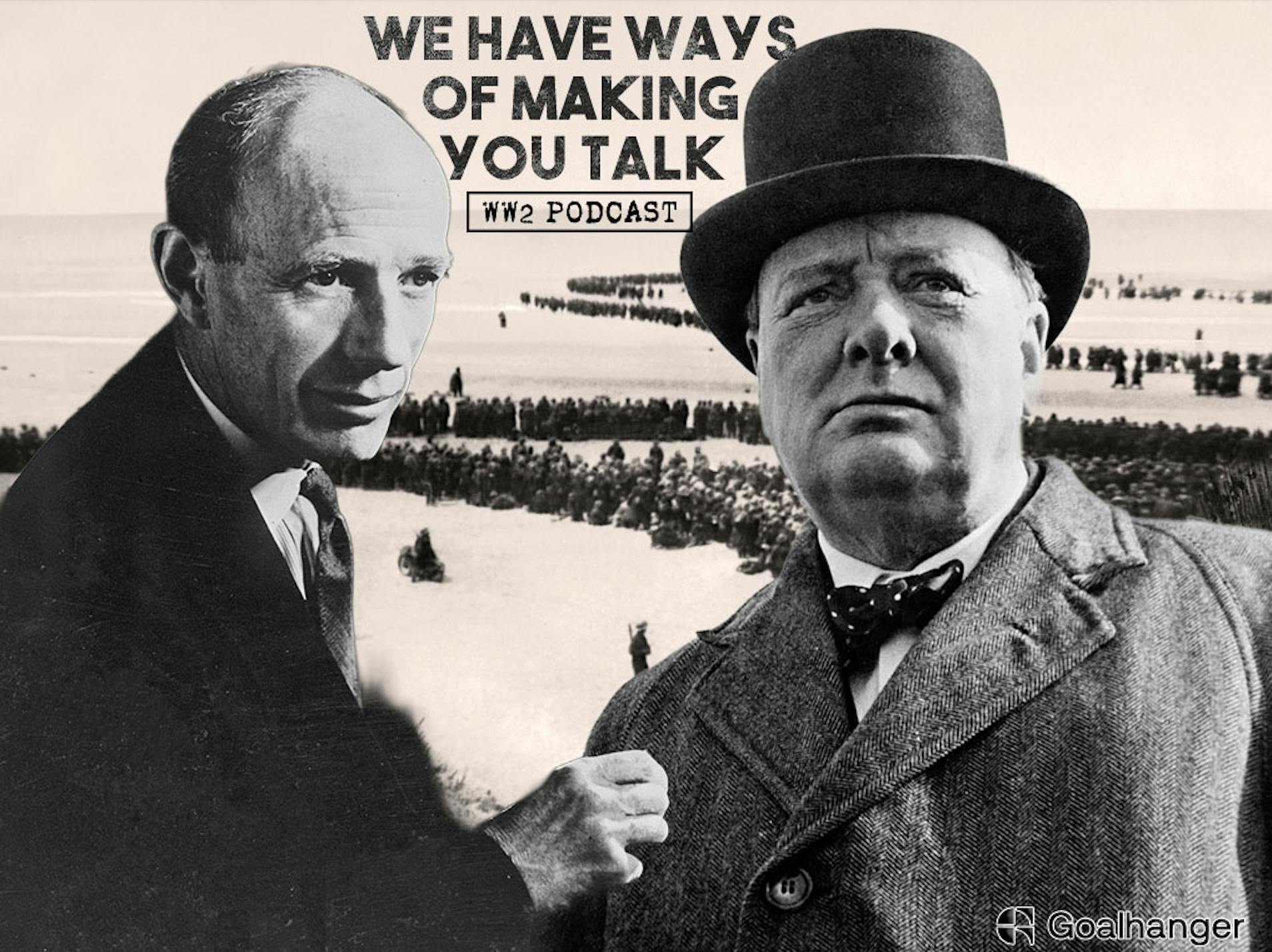
Loading summary
Transcript164 lines
- [00:02]
Al Murray
Thank you for listening to we have ways of making you talk. Sign up to our Patreon to receive bonus content, live streams and our weekly newsletter with money off books and museum visits as well. Plus early access to all live show tickets. That's patreon.com we haveways.
- [00:25]
WhatsApp Advert
On WhatsApp no one can see or hear your personal messages. Whether it's a voice call message or sending a password to WhatsApp, it's all just this. So whether you're sharing the streaming password in the family chat or trading those late night voice messages that could basically become a podcast, your personal messages stay between you, your friends and your family. No one else, not even us. WhatsApp message privately with everyone.
- [00:54]
Abercrombie and Fitch Advert
This message is brought to you by Abercrombie and Fitch I've been ready for summer for a while and now it's finally time for summer outfits. With a trip coming up, the A and F Vacation Shop has me covered. Abercrombie really knows how to do a lightweight outfit. Their tees, sweater, polos and linen blend shorts never miss. I wear Abercrombie denim year round. Their shorts are no different and have the comfort I need for summer. Prep for your next trip with the A and F Vacation Shop. Get their newest arrivals in store, online and in the app.
- [01:25]
State Farm Advert
This episode is brought to you by State Farm. Knowing you could be saving money for the things you really want is a great feeling. Talk to a State Farm agent today to learn how you can choose to bundle and save with a personal price plan. Like a good neighbor, State Farm is there. Prices are based on rating plans that vary by state. Coverage options are selected by the customer. Availability, amount of discounts and savings and eligibility vary by state.
- [02:00]
Al Murray
Late in the morning of the 23rd of May Monday, Churchill told the War.
- [02:04]
Winston Churchill
Cabinet the whole success of the counter attack plan agreed with the French depended on the French forces taking the offensive. At present they showed no sign of doing that. If General Weygan's plan succeeded, and we.
- [02:17]
Al Murray
Now know that wegor never had such.
- [02:19]
Winston Churchill
A plan, it would mean the release of 35 allied divisions from their present serious predicament. If it failed, it would be necessary to make a fresh plan with the object of saving and bringing to this country as many of our best troops and weapons with as little loss as possible.
- [02:36]
Al Murray
With as little loss as possible. Churchill knew that that was almost impossible. His household diary records that he then returned to his quarters in Admiralty House for lunch and that dinner on 23rd of May was short. Later, after dinner, he went to Buckingham palace to see The King. At half past 10, he told the King that if the French plan failed, he would have to order the BEF back to England. This operation would mean the loss of.
- [02:59]
Winston Churchill
All our guns, tanks, ammunition and all stores in France.
- [03:03]
Al Murray
The King recorded in his diary the question was whether we could get the.
- [03:07]
Winston Churchill
Troops back from Calais and Dunkirk.
- [03:09]
Al Murray
The very thought of having to order.
- [03:11]
Winston Churchill
This movement is appalling, as the loss of life would probably be immense.
- [03:16]
Al Murray
And that was an extract from John Lukash in Five Days in London, May 1940. And welcome to. We have ways of making you talk with me, Al Murray and James Holland. This is about the five days in May that changed British history. And that is Saturday 24th May through to 28th May, which is of course the beginning of. Well, it's Dunkirk. Right. All of which happened around 85 years.
- [03:36]
James Holland
Ago, as we're recording and focus in this series. Yeah, yes, A little bit on some of the participants who are taking part in all this. But really this is, this is high level stuff and really kind of dig down into those high level cabinet meetings, what's going on in Hitler's headquarters, but also more importantly, what is going on with the French and what is going on within Whitehall in London.
- [03:55]
Al Murray
Yeah.
- [03:56]
James Holland
As well as what's happening across the Channel. It is just incredible drama in these few days where the stakes are immense, where the outcome of the war hangs in the balance. I would argue one of the only times it really does. And these events are all happening 85 years ago and, you know, we've become very, very used to peace and stability and the assuredness of our future and all the rest of it. And we've forgotten. The memory of the actual living memory is slipping away and with it, so has our concern for the fragility of peace and all the rest of it. And going back to this moment where Britain was unquestionably, deeply imperilled, I think is timely.
- [04:43]
Al Murray
Well, also, I mean, having just completed a load of stuff about the end of the war in Europe, we've talked an awful lot about. By the last year, the Allies was this sort of steamroller that overpowers and crushes the Germans wherever they find them. You know, five years prior to that is quite the opposite. I think if the war is a foregone conclusion, well, it certainly didn't feel like it at this point. And if you want to understand the relief that's in London and the feeling of recovery and bounce back and a feeling of we've, we've escaped the worst thing that could possibly happen to us, and the exhilaration that looks forward to the future that, that is, that is present on VE Day. Again, we've talked about, in our episodes about the khaki election, the political fallout of the war. Dunkirk is absolutely central to that picture and to that story. While we were doing the VE Day coverage, obviously, we found ourselves with the endless problem of piling up anniversaries that someone said to me when I was on 5 Live, one of the forces personnel who came in to talk to us said, well, you know, it's Dunkirk 85 in three weeks time, two weeks time. And it is. And that's the amazing thing about the cycle of the war. In five years. We could play a little memory game, a little timing game here. You know, if the Boris Johnson landslide election is the end of 2019, let's have that stand in for the beginning of the war, then May 1940 is the second or third month of the pandemic. That's how long ago it was from now. And here we are in May 2025. That feels like an extremely long time ago, but also a thing that we've put behind us and tried to, you know, we've literally tried to put upon us and escape and run away from the consequences of. In lots of ways, politically, that's the Time sp plan we're talking about here. That's the gap. And I think, remembering that, bearing that in mind, having done all this victory stuff and to come back to the day of the halt order, because you say, you say, Jim, that it's the day where this war, where the war really was in the balance. Well, imagine the other war that would have followed, whether there would have been other days that would have been in the balance. The other massive turning points beyond the halt, had there been no halt order.
- [06:42]
James Holland
Yes.
- [06:42]
Al Murray
Had the British army, had the British army gone in the bag, then you've 300,000 hostages that the Germans are holding essentially as a negotiating tool for whatever a Churchill government then decides to do. He has a much, much stickier wicket politically. If the Germans. Oh, I would say that's the end of that war. And then there's another one to follow, you know.
- [07:07]
James Holland
Well, it's a brief euro, it's a brief European continental war, isn't it? But, you know, in isolation, in the same way that sort of Japan and China is in isolation, I honestly think that these four days that we're going to be describing, the 24th to the 28th, that's five days actually, I think, are the most consequential yeah, in the Second World War and the most consequential in British history, arguably, you know, after 1066 or something, because. And I think by the end of the 28th, well, we'll get to that. But it's all top level, top drama, super tense stuff, and I think it'd be exciting and exhilarating to come back to that. So very, very brief recap. Chamberlain's government. Neville Chamberlain, Prime Minister of Britain. His government falls on the 9th of. Churchill replaces him on the 10th of May. The same day Hitler orders the launch of Case Yellow, the assault on the West. Two major thrusts. Army Group B surging through the Low Countries into Holland and towards Belgium. Army Group A hurtling through the. Through the Ardennes forest, Dent Ardennes forests in a giant pincer movement. And the Allies are not prepared for this. They haven't anticipated this. They've discounted any chance of the Germans going through the Ardennes. The Germans managed to cross the river Meuse on 13 May, and a huge hole is banged through the southern part of this northern half of the French line. And by 15 May, it's clear that defeat is inevitable. By 20 May, German troops in the south, in Army Group A have reached the Atlantic coast. Incredible. The unthinkable now has to be absolutely faced squarely. France is going down. There is a plan. General Gamelin is the overall commander in chief of French forces, is sacked. General Weygan, aged 73, replaces him. There is the Weygan plan, which is a major counterattack which doesn't materialize. And that's what Churchill was talking about in that opening bit, which you read out. So by the 24th, British troops, which have been in line with the Belgians on their left, the French on their right, have been pushed back into a lozenge shaped pocket around the Channel ports of Calais and Dunkirk. And they're almost entirely surrounded, apart from this narrow stretch of about 50 miles of the Channel coast. And it is looking very, very dire indeed. And no one is expecting the Germans to do any other than complete the encirclement in very quick order.
- [09:24]
Al Murray
Exactly.
- [09:25]
James Holland
So that's where we're at. And this is prompted massive panic in France. They are politically fractious anyway. Paul Reynaud is the Prime Minister of a coalition government which is at sixes and sevens and is completely thrown by this catastrophe. Churchill, obviously, is completely new to the premiership. He's only two weeks into his being Prime Minister, and panic is starting to make itself felt.
- [09:50]
Al Murray
But luckily for the Allies, someone comes to their rescue. Adolf Hitler of all people. Because this is the, the most extraordinary moment in, in this campaign. Well, it's fantastical from a German point of view. The French and the British do absolutely everything the Germans need them to do. They give them everything they could possibly hope for. But by this point, we're two weeks in and there's an awful lot of friction on the German side. The men are exhausted, gear's starting to fall apart. Blitzkrieg relies on not really worrying about your own casualties and pressing on. So although the war, although, I mean, I think that's one of the interesting things about the war in France is it is over quickly, it's still bloody on the German side. So there's this, there's this feeling, isn't there, that things are starting to catch up with the Germans after two weeks of absolutely incredible, isn't there?
- [10:39]
James Holland
Yes. Unbelievable speed and, you know, 250 miles in 10 days and all the rest of it. I mean, it is remarkable, although it is bettered by the Allied armies leaving Normandy in August 1944, but unprecedented, I would say, in, in 1940. And what, what's happening is on the northern side of this lozenge, you've got the French first army at the kind of right eastern end of this lodging lozenge. Then you've got the BEF and you've got the BEF and the Belgian forces who are being kind of pushed back towards the coast. In, in the Belgian coast on the southern side, the Allies have helpfully got a canal which is the Le Bassey Canal, which links to the River Aar south of Saint Omer and then joins the La Basset Canal. And this is known as the Canal Line. And this is protecting the southern or right hand flank of the BEF and the French First Army. And by the morning of the 21st of May, General Heinz Guderian, who has got the leading Panzer corps in Army Group A, his first Panzer Division, has reached this line and by midday has secured bridgeheads across it in three separate places. In other words, the canal line's already screwed, it's broken. As had been the case at the Meuse on 13 May, getting safely across the water feature is key to the whole thing. You know, it is a big natural barrier. So if you can bridge this, you're.
- [12:02]
Al Murray
In the driving up to this point as well. When people have had those opportunities, they've taken them rather than dithering about them.
- [12:08]
James Holland
Yep, exactly.
- [12:09]
Al Murray
And what we have here, it is the most remarkable turn of fate, isn't it. Because at 12:45pm, Guderian then receives an urgent order from the Fuhrer himself, which is northwest of Arras. All German forces are to stop along the line of Lens, Bethune and Aixinthe Omer Graveling. So in other words, the canal line. There's been a lot of debate about what this signifies or the Hitler. Hitler's reasoning. But yeah, in a way that. That just doesn't matter what the reasoning was. Did he do it as a, you know, an olive branch? The British? No. Did he do it because, you know, there's the other school of thought says he's doing it to show the generals who's in charge. Because the last thing he, you know, this campaign has been so spectacular, he needs to be in control of it. And yeah, that's exactly what's happening. He put his footprint on it. I think it's hard to argue that that isn't what's happening. But basically, Guderian's speechless.
- [12:56]
James Holland
Yeah, he goes Viva. Utterly speechless. But since Viva not informed of the reasons of this order, it was difficult to argue against it. So in other words, he has to hold it and he only that they have to pull their troops back across the canal.
- [13:08]
Al Murray
Yeah, yeah, yeah, yeah. I mean, the end shows that if there's one person who understands blitzkrieg in as much as it exists, because after all, there's another debate in as much as it exists. It ain't Hitler who understands blitzkrieg.
- [13:19]
James Holland
No, that. That is certainly, certainly the case. But the origins of his order come the day before the 23rd of May, when von Kleist, who is the commander of. Of Panzergruit Kleist, which is the main spearhead. So. So the main thrust of Army Group A is under Kleist, von Kleist's control, but Guderian is in the spearheading core of that. So that's what's going on there. And von Kleist tells Army Group A and the OKH Oberkommando de Heerer, which is the army, that his units are quite widely spread. And the problem is the spearheads, the panzer spearheads are actually quite few in number. There's only 16 motorized divisions, well, 16 panzer divisions and one mechanized division in the whole of the 135 divisions strong German armed forces that are involved in Case Yellow. So the others are just using their feet and horses. So in other words, there's nothing like as mechanised as everyone makes out. But this, this spearhead has done all the running. And the problem is, is the infantry divisions which are following up behind, are way behind. And von Kleist tells von Rundstedt, who is the commander in chief of Army Group A, that his panzer strength is down to 50%, which actually isn't the case. They're actually holding up really well, not least because the panzers they're using are very simple and basic and, you know, not as complicated as Tigers and Panthers and don't break down as much. So he warns, you know, the enemy counterattacks in strength and then, you know, they could be in trouble. And they've definitely been knocked sideways by the British counterattack at Arras, which takes place on 21 May, which doesn't achieve all it's supposed to, but certainly gives the Germans a bloody nose and gives them sort of pause for thought. However, at this point on 23rd May, there is no sign of any major counterattack from the Allies whatsoever and nothing to suggest is imminent.
- [15:00]
Al Murray
And there is, there isn't going to be one. It's way beyond anything the Allies are capable. Capable of. Yeah, I mean, it's interesting really because up to this point the Germans have, they've arrived at this decision the same, they've arrived at all their other decisions, which is basically, you know, licking their finger and holding up to the wind. They don't know the state of Allied dispositions in the way that later in the war, when we talk about intelligence pictures later in the war you might have an appreciation of what the other side are up to. But really no one really knows what's going on is where this decision comes from.
- [15:23]
James Holland
Right, yeah.
- [15:24]
Al Murray
And generals thinking, my boys have been at it a fortnight, we're all a bit tired, I need to take stock, I need to get my head around what's going on. And we are massively extended. They're right in a sense that they are at great risk. Risk. It's just the fact there is no risk that they don't know. So it's an unknown. Unknown, isn't it, basically that makes this decision?
- [15:41]
James Holland
But anyway, at 4:40pm on the 23rd, General Gunther von Kluge, who's commander of the 4th army, which now includes temporarily Panzer Group Kleist, he speaks to von Rundstedt and suggests a close up order be issued halting the fast moving mobile forces while the infantry divisions, and this includes 87th Division, which and various others, catch up. And of course this is the same old concern that have repeatedly reared its head ever since plans for the offensive have first been drawn up, that there is difference within you know, not all German commanders are buying into the same theories of warfare. You know, a lot of them are a lot more cautious. Guderian is really the driving force in this style of, you know, striking forward with rapid Panzer divisions. He's got some acolytes in people like Rommel, who's commanding the 7th Panzer Division, for example. But there are a number of old school, sort of Prussian conservative types, and then there are progressives, you know, Guderian, Holder, who's the Chief of Staff, Reinhardt, Rommel and so on. But von Rundstedt is very much a conservative. So is von Kluge. And von Rundstedt agrees with von Kluge that they need to close up a little bit. So he issues the order to halt at 8pm on the 23rd and announces that the following day the panzers to interrupt further advance for at least 24 hours. But the people on the ground, the people at the Canal ground, the Canal.
- [17:00]
Al Murray
Line, can't believe it.
- [17:00]
James Holland
They can't believe it. You know, they're through. You know, the route to Dunkirk and Graveline and Calais is absolutely wide open.
- [17:08]
Al Murray
They know this because they have control of the air as well. They can see what's going on on the ground. By this stage, the BEF is only going in one direction, right?
- [17:16]
James Holland
Yeah. But while the order has come from von Rundstedt and while it's come from von Kluge, Guderian feels sufficiently emboldened to just ignore it. Which is why on the 24th, he's across the Canal Line. He's been told not to. Yeah, And Hitler wouldn't have come involved in it at all had Halder, who's the Chief of Staff, and von Brauchitsch, who's the commander in chief of the army, not become embroiled as well. Because what happens is when Halder hears of von Rundstedt's decision, he then thinks, well, that's an insane decision. So he then changes it around. And so he says, okay, right, I'm going to put all the panzer units under the command of Army Group B and Army Group A can then henceforth concentrate on confronting the French to the south. But obviously the problem is that Rundstedt doesn't take a very dim view of this. And when Hitler visits him on the morning of the 24th of May, he makes his disgruntlement very, very obvious. But Hitler goes, well, I don't know anything about this. What's going on? And so von Runsd then explains what has happened. He said, well, you know, I wanted the infantry to close up with this. And, you know, von Brauchitsch and Halder have responded to this by taking away my spearheads and handing them over to Army Group B and to von Bock. And Hitler just goes absolutely apeshit. How dare they make such a big decision without consulting me and countermands it.
- [18:33]
Al Murray
What you've done there, Jim, is you've explained that there is only one explanation for what the halt order is. This cascade of rival generals agreeing with each other, disagreeing, disobeying a muddle over orders, and Hitler needing to express his authority. There's no military reasoning in his decision at all, is there? It's about being top dog. No two ways about it.
- [18:52]
James Holland
Absolutely no two ways about it. Yeah. Hitler's acting out of spite. You know, he's acting out of spite. He's showing von Brauchitsch who he absolutely loathed.
- [19:00]
Al Murray
You say Hitler was acting out of spite. That applied to basically everything. Right. He's motivated by spite. So, you know, Occam's Razor offers us the simplest explanation here. It's Hitler throwing his weight around, because that's what Hitler does, basically. Someone's come to him and grasped the boss because he doesn't like the way things are going. That's what you've also got, isn't it, boss? They're not doing what I want, boss. I don't like it. Right, okay. In which case, let me get started.
- [19:24]
James Holland
Well, yeah, exactly. But the point is, there is this golden opportunity for Guderian's leading panzer divisions to hurtle straight to Dunkirk and cut off the British retreat. Because although there are British and French troops in Dunkirk, they're not very many at this point. There's no sense of a perimeter. There's no sense of defenses being built or anything like that. There's no evacuation plan in place. At this moment, the door for complete encirclement of the British Expeditionary Force and the whole of the French first army is wide open. And what they've done is they've just closed that door by not pursuing the bridgeheads across the Canal Line. It is an insane decision. And what von Rundstedt and von Kluge are doing are demonstrating what they have made absolutely clear all along, which is that they don't understand or approve of this modern, newfangled way of doing things. The conservatives have outmanoeuvred, albeit briefly, the progressive.
- [20:17]
Al Murray
The traditional soldiers have taken back control. So with that decision made, let's just round up what's going on In London, before we take a break, because there's panic growing in London, isn't there? Is the simple truth. Churchill, of course, has rearranged things since he's become Prime Minister. You have the Ministry of Information. You have Duff Cooper, who's a solid chap, that part of Churchill's circle, a.
- [20:35]
James Holland
Diplomat as well as an mp.
- [20:37]
Al Murray
He's made a broadcast admitting that not only was the situation grave, but it was also a fact that the enemy's intention was to take the Channel ports and from there launch a war upon this island. Now, he doesn't know that for sure, but the fact he's saying that in.
- [20:47]
James Holland
Public is in public on a public.
- [20:49]
Al Murray
Broadcast, the only public broadcast.
- [20:52]
James Holland
People get ready for invasion.
- [20:53]
Al Murray
On the 23rd, the king broadcast to the nation and calls for a national day of prayer held on the coming Sunday, the 26th of May.
- [21:00]
James Holland
Because if all else fails, let's pray to God. I mean, you could argue it did.
- [21:07]
Al Murray
The following day, Friday the 24th, the Times runs the headline, Germans on the coast. Beaverbrook's Evening Standard says, we would do better to prepare for the worst. Given Beaverbrook doesn't want to have fought this war. I mean, he's really putting it out there. I mean, generally, though, the newspapers try to stay upbeat now.
- [21:22]
James Holland
The RAF are causing lots of havoc.
- [21:24]
Al Murray
France will rally, don't worry, and all that sort of thing.
- [21:28]
James Holland
You know, reading all this, hearing all this, that's not exactly emitting a picture of confidence, is it? Put it mildly. The King is feeling that the only course open to them is an appeal to God, which is sort of positively medieval in this approach. I mean, you've got to kind of face up to the reality that, you know, that Britain is staring down the barrel. And that is how it seems. You can be wise after the event, but right there in this last week of May, that is what it looks like.
- [21:53]
Al Murray
I know we live in a very different country now, but imagine if the King came on the news tonight and said. Said, we're gonna have a day of prayer on Sunday because we're really in trouble. You're like, Jesus Christ. You'd sit up. Yeah, just imagine up and notice that, wouldn't you? It's interesting because people are maintaining their cool. So who's Daddy Penner? Jim, let's just remind us, Dady Penner is.
- [22:11]
James Holland
Is one of the mass observation diarists. And this is. This is a person that University of Sussex got very cross of me about, because you're not supposed to reveal their real names, but I found I Worked out who it was. And I thought, I don't want to put a fake name in because that's not her name, you know, she's called Dady Penner and she's Cornish, though she was living in suburban London. She takes her sons down to Cornwall, you know, on the 23rd, she seems a little bit brighter, you know, and she says, you know, she meets one man who said, yesterday we reached rock bottom, now the tide will turn. And by the 24th, despite all this headlines and calls for national days of prayer, she feels a bit more encouraged. News fairly good, she writes in her dialogue. Apparently we're holding them again. And also cutting in on the spearhead of their attack. Well, I don't know.
- [22:58]
Al Murray
Where'd you go that Twitter?
- [23:00]
James Holland
Because that ain't happening. Yeah, got it from Twitter. You never trust it, can you?
- [23:04]
Al Murray
If you are someone who knows what's going on, if you're closer to the intelligence there is, you are thinking, this is. The writing's on the wall here, you know, it's 1588. It's a worse threat than Napoleon's France. Deputy Director of Air Intelligence at the Air Ministry is Group Captain Tommy Elmhurst. He's running. He's running the German section.
- [23:23]
James Holland
He's a splendid fellow. He later becomes Mary Cunningham's sidekick at the desert Air Force top fellow.
- [23:30]
Al Murray
And his job has been trying to sort of keep tabs on the Luftwaffe strength and power. And he's saying, we're really in trouble here. The Luftwaffe seems to be very strong, running rampant. And he is not encouraged, is he? The RAF's got the Y service that she's listening to stuff. There is some. Some decrypting going on at the gcsc, the government code and cipher school at Bletchley Park. We'll refer to that for as Bletchley for now. And rather than gcse. I always think that the.
- [23:56]
James Holland
I know it's really hard to say.
- [23:57]
Al Murray
The government taste for acronyms in the. In this particular branch of intelligence is not good. And they've been starting to break Enigma traffic since Norway in April. And they've got into the Luftwaffe key since January. One of the things. Luftwaffe have been broadcasting an awful lot right at the beginning of the war, so there's lots to get stuck into. And Elmhurst and his team, they know roughly what's going on. And he also. I mean, it's interesting. His assessment is that if the RAF has to tackle Luftwaffe on its own, it'll do it, but it's a slim chance, which is which is interesting, you know, it's informed by the fact that everything's been a calamity so far. It must have felt like we cannot get anything right. If you're one of those people in that situation, our army can't fight our air force, we can't get it right yet. We just can't answer what the Germans are doing, you know, in the modern province. They're completely inside our Ooda loop out thinking us the entire time, you know.
- [24:47]
James Holland
So he is there with all the, all the collected intelligence chiefs getting these daily briefings, you know, and on the back of this, you know, he knows what the King has written. He doesn't know what the King has written in his diary, but he's getting the same message what the King has heard from Churchill and that realistically, the only way they're going to get out of this complete pickle is by evacuating the bef. But how the hell do you do that? He just cannot imagine this happening. And he goes, it looked as if the whole British field army, men, guns, vehicles, ammunition, tanks, everything would cease to exist.
- [25:17]
Al Murray
Well, and at that point we shall take a quick break. We'll return on Saturday 25th May, the halt order's now in effect and find out what happened next. Because they didn't know. That's the thing to remember. No idea.
- [25:32]
Discover Advert
Are you still quoting 30 year old movies? Have you said cool beans in the past 90 days? Do you think Discover isn't widely accepted? If this sounds like you, you're stuck in the past. Discover is accepted at 99% of places that take credit cards nationwide. And every time you make a purchase with your card, you automatically earn cash back. Welcome to the now it pays to Discover. Learn more@discover.com credit card Based on the February 2024 Nielsen report.
- [26:04]
State Farm Advert
This episode is brought to you by Amazon Prime. From streaming to shopping, prime helps you get more out of your passion. So whether you're a fan of true crime or prefer a nail biting novel from time to time, with services like Prime Video, Amazon Music and fast free delivery, prime makes it easy to get more out of whatever you're into or getting into. Visit Amazon.comprime to learn more.
- [26:31]
Winston Churchill
The new McCrispy Strip is here.
- [26:33]
James Holland
Dip approved by Ketchup Tangy Barbecue Honey Mustard.
- [26:36]
Winston Churchill
Honey mustard, Sprite McFlurry Big Mac Sauce, Double dipped in buffalo and ranch. More ranch and cream creamy chili McCrispy strip dip now at McDonald's.
- [26:53]
Al Murray
Right. Saturday 25th May, Dady Penner says in her diary was Another glorious day, if one really noticed the weather. So she's obviously got other things on her mind. Maybe this is a mark of the depth of the emergency here in that a British person is no longer noticing the weather. I mean, that's the.
- [27:11]
James Holland
It's that bad.
- [27:13]
Al Murray
What's. So what's happening in Cabinet?
- [27:15]
James Holland
Well, also, I do just one other point on this is just that I think what Daidi Penner is writing in her diary on the 25th on Saturday 25th May, is reflective of the fluctuating emotions and thoughts that the public are having. You know, the day before, she's sort of thinking, well, maybe we'll hold the line. The next day she's going, I'm, you know, effectively saying, I'm so distracted I can't even notice the weather. You know, I think one has to try and put oneself in the shoes of those people there in that third week of May 1940 and just the huge strategic earthquake that's taken place, you know, people will just be in disbelief. The speed with which this has happened, the speed with which the great alliance of France and Britain is completely unraveled, is shocking everyone. And now the fact that the Minister of Information is preparing the nation for potential invasion by German, Nazi, German forces, it must have just seemed absolutely incomprehensible. And for the ministers and the thing.
- [28:06]
Al Murray
That is important to bear in mind that that's the legacy of the summer of 1940 is basically everything has been turned upside down. It's completely, in a sense, a completely revolutionary moment. It. A lot of the old certainties have been kept going. Despite the First World War, despite how the disaster that is the First World War, there are still things people believe in, like British power and the fact that the Empire is our greatest resource, blah, blah, blah. But if we can't defend ourselves in Europe, what's the point of having an empire? What's the point of any of it? Must be what's part of what people are thinking. And when we talked about the Blitz, you know, London, the center of global power, being attacked from the sky, these are absolute psychic body blows to the way that people view themselves and the country.
- [28:46]
James Holland
Absolutely. So Saturday 25 May first war cabinet meeting is in the morning. Then there's various Chief of Staff meetings, reports, messages arriving. And then finally there's a Defence Committee meeting which is a kind of sort of a combination of the Chiefs of Staff and the War Cabinet. And General Dill is the. Is the Chief of the Imperial General Staff already, I think at this point Tiny Ironside's been sacked. His report shows that while Gort has been keeping General Blanchard, who's one of the. He's the French army group commander, keeping him informed of all his decisions, the French haven't really been doing the same to the British. You can see that the French are looking for an excuse to cancel the Weygand Plan, which is this huge, great counterattack, and then turning the blame on Gort. And Chamberlain says the information given to us by Weygand himself as to the capture of Amiens, Albury and Peron on May 23rd turned out to be false.
- [29:39]
Al Murray
Well, I mean, yeah, the truth is the French don't know what's going on either. So anything you're getting from them is.
- [29:45]
Winston Churchill
Is crap.
- [29:46]
Al Murray
Yes, there is this growing scent that the French are pulling the rug from under them. Although the French also probably thinking, well, the British look like they're about to bugger off. I mean, you know.
- [29:56]
James Holland
Yeah, put it from there. Marechal Petan has. Has joined. Has been brought into the government. He is the. He's now the new defense minister. And he is. He's the hero of Verdun from the First World War and all the rest of it. Now in his 80s, Vagand was his chief of staff. I remember rightly at Verdun, know the two are old colleagues and friends and they're clearly in this together, and neither of them are very keen on continuing well.
- [30:20]
Al Murray
And the French army is a gerontocracy, which is part of the problem, isn't it?
- [30:23]
James Holland
He's not defence Minister, he's vice prime minister. That's what he.
- [30:25]
Al Murray
Lots and lots of old, old, old blokes. I mean, in a way, bringing Pettan back is sort of like, say there were a national emergency in 1960, getting Churchill out of retirement and putting him in charge, isn't it? Yeah. You know, and Petan wants to. Wants the war over. He doesn't want to fight. I mean, if you're the. If you are the hero of Saviour Verdun, fine. But you know exactly what that entails. That group of people, they meet in Paris on the 25th at the Committee de Guerre, Vegan tells Reynaud Petain, the President, Albert Le Brun, that the situation is hopeless. France shouldn't have. Has made the mistake of entering a war that it isn't prepared for, doesn't have the doctrine for. He says it is probable that we will have to pay dearly for this criminal thoughtlessness. I don't know if that's what he.
- [31:07]
James Holland
Sounded like, I think that's pretty good. I'm happy with that.
- [31:10]
Al Murray
And so basically there's movement within that committee that they need to make a separate peace. They've got to accommodate the Germans. This is what's happening at this moment in, in France. And you can see why. Again, look at it from their point of view, you can see why, but it's certainly not what they've agreed to with the British.
- [31:27]
James Holland
Well, the, the issue is part of the alliance states that one side can't make a separate, you know, can't operate outside the other. So in other words, you can't start not negotiating for surrender if you're France without Britain also negotiating for surrender. You know, you're in it together, you're joined at the hip. And this in the ensuing days is going to cause all sorts of problems because suddenly the, the Allies are mistrustful of one another because national interest is taking precedence over the interest of the alliance.
- [31:56]
Al Murray
Speaks to how all of the policy in dealing with Germany has been done up to this point. No one, no one is thinking, particularly consequently, about any decisions they make they aren't thinking through. Well, that will mean should things go wrong, what if things go wrong? You know, no one has considered this. The fact that two governments that have found it very difficult to agree on how to deal with Germany should then commit to a binding alliance like this.
- [32:16]
James Holland
You know, when things really hit the fan, the suggestion that they're going to be able to cope with this or have the, have the processes and structures in place to be able to deal with a hammer blow is also fanciful because if they can't do it when they're kind of, you know, materially on top, they're certainly not going to be able to do it when they're kind of falling.
- [32:32]
Al Murray
Yeah.
- [32:32]
James Holland
Anyway, you know, Reno recognizes that at the very least they owe it to the British to explain the current thinking and situation. So he tells a comite de guerre that the following day he's going to fly to London. Of course, Churchill doesn't know anything about these conversations because he's not a fly on the wall. But it doesn't take a rocket science to work out that the French are. There's a second meeting of the defence committee around 10pm that night, Saturday 25th May.
- [32:59]
Winston Churchill
He says if France went out of the war, she must, however, make it a condition that our army was allowed to leave France intact and to take away its munitions and that the soil of France was not used for an attack on England. Furthermore, France Must retain her fleet.
- [33:14]
James Holland
There you are. That's the key thing, the last bit.
- [33:17]
Al Murray
Obviously, I mean, it's quite interesting. That demonstrates that the British and the French, they know there's. There's only one result coming here for France.
- [33:25]
James Holland
They're four nil down, aren't they? With five minutes. Exactly.
- [33:27]
Al Murray
There's a proper wishful thinking in what Churchill suggests there. The idea that the army could leave France intact, take its stuff. He's going to end up whistling those conditions. But it says it's when, not if, isn't it? The alliance is.
- [33:40]
James Holland
But that's. That's still a. You know, this is Saturday 25th May. This is 15 days since the Germans attacked. You know, this is little over fortnight and already they're thinking in this terms. It's just. It's incredible.
- [33:52]
Al Murray
Yes, extraordinary. Gaut thinks, doesn't he, that the BEF is going to be lost. Most of it. Churchill does as well. Then it's time for the Luftwaffe to come against Britain. As we heard Tommy Elmhurst's assessment is that will be a close run thing.
- [34:04]
James Holland
The bottom line is that the Luftwaffe has, you know, has reigned supreme in the skies of Europe over Poland, over Denmark, over Norway, over Holland, over Belgium, you know, bombing of Rotterdam. So far in northern France, the Army Dallaire of the French Air force has been crushed. The. The RAF has sort of, kind of held its own, just about. And yes, Britain has the world's only air defence system, coordinated air defence system. But it hasn't been tested, you know, it's never been tried. And if you're of a gloomy disposition, you wouldn't bet on it working, would you? Not from where you're looking. On the 24th, Saturday the 25th of May 1940. That's the point, you know, it hasn't been run through the mill yet. So what would happen when the mighty Luftwaffe, which everyone thinks is much bigger than it actually is, is unleashed on Brit. You know, will Britain's defense system hold? Will Britain crumble too? Also hovering in the background of the Italians. You know, the Italians are the allies of Germany.
- [35:04]
Al Murray
Yes. And so on the 16th, Churchill had appealed to Mussolini. This is pretty purple, some of this prose, isn't it? I mean, and you can see a character like Mussolini not responding to this.
- [35:14]
Winston Churchill
Right down the ages, above all other.
- [35:17]
Al Murray
Calls came the cry that the joint.
- [35:19]
Winston Churchill
Heirs of Latin and Christian civilization must not be ranged against one another in mortal strife.
- [35:25]
Al Murray
Life.
- [35:25]
Winston Churchill
Hearken to it, I beseech you, in all honor and respect, before the dread signal is Given. It will never be given by us.
- [35:32]
Al Murray
Mussolini says, well, you know, you've entered the water under your treaty with the polls and we have a treaty that we can't dishonor, our treaty with Germany. Pat to steel, bad luck. In other words, you can see Muslim slapping his thigh as he draws up this telegram, doesn't he? I mean, no, thanks. Non grazi, prego, whatever. I'm sorry we're resorting to stereotypes at this dangerous time, but if you can't have a go at Mussolini, who can you ever go at? And Churchill says, the response was hard, it had at least the merit of candor. Well, no, because he's interesting himself. It's funny, but it's. But he's got a point. Up to this point, all of the diplomatic dealings the British have had to try and do with, with European powers have been wreathed in lies and dissembling. And, you know, Mussolini is least being candid. Yeah, we're sorry. Sorry, mate, we're coming in.
- [36:23]
James Holland
But again, you know, just put yourself in the British shoes and, you know, you've got this sort of. You've got so much uncertainty. You know, what's going. Is the Le Fro going to attack? Is Italy going to enter the war? You know, you're confronting so many ifs and buts and you're having to plan for all these uncertainties, all these unknowables. And yet at the same time, the one thing you do know is that the BEF is stranded in France and needs to get back.
- [36:46]
Al Murray
Exactly.
- [36:46]
James Holland
About pdq.
- [36:49]
Al Murray
So, I mean, it's. It's clear, isn't it? Everyone on both people on both sides of the Channel at the highest level, if you're Dady Penner, you know, what's going on kind of.
- [36:58]
James Holland
Well, you know, it's not good, put it that way.
- [37:00]
Al Murray
But if you're, if you, if you're the leaders at the top in both France and Britain, you're starting to think similarly, you've had it, your goose is cooked.
- [37:08]
James Holland
What you're realizing is this is completely unprecedented.
- [37:12]
Al Murray
Yeah.
- [37:13]
James Holland
All the people in France say, absolutely, you know, petan vegan. They know it's toast because militarily, they know they can't get out of this picture.
- [37:19]
Al Murray
Yeah, yeah, yeah.
- [37:20]
James Holland
In Britain, it's kind of, oh, my God, you know, the BF is going to be cut off.
- [37:25]
Al Murray
Yeah.
- [37:26]
James Holland
Where does that leave us? You know, of our armies defeated, humiliated around the, you know, globally. Where does that leave us in terms of our ability to continue the war? Yeah. And are we then Going to face, you know, paratroopers from this unstoppable Nazi war machine that's pounding down and laying waste to absolutely everything that crosses its path. And, you know, there's nothing like seeing a mighty ally who was steadfast during the previous incredibly long, brutal war crumble just like that to make you think, yikes, we're, we're in the doo doo.
- [37:59]
Winston Churchill
Yes.
- [38:00]
Al Murray
It's a weeks long time in politics. A fortnight is an even longer time in this situation, isn't it?
- [38:05]
James Holland
Well, certainly during, in these, these blitzkrieg years, it is just.
- [38:08]
Al Murray
It is simply amazing. This happens so fast, isn't it?
- [38:12]
James Holland
So amazing.
- [38:13]
Al Murray
Yeah. Torrent of events and Germans rolling the dice and coming up sixes every single time. It's the.
- [38:19]
James Holland
Well, yeah, you know, there's obviously going to be a number of people in Britain who are now thinking, well, you know, is it better to quit now rather than keep going? Yeah. Of all the kind of loss of life, all the terrors, you know, dragging on the war when the outcome looks so set already. Yeah, but they're not thinking clearly. It's the truth of it.
- [38:36]
Al Murray
Well, no, but you could argue who could in this situation. Imperial prestige and power and everything are all suddenly up in the air, isn't is the fact.
- [38:44]
James Holland
So early on that Saturday 25th May 1940, Lord Halifax, Foreign Secretary, the man who most people had expected to take over from Chamberlain but then found himself with stomach cramps and come facing the Holy Fox.
- [39:00]
Al Murray
The Holy Fox, yeah.
- [39:02]
James Holland
He meets with Signor Giuseppe Bastianini. Bastianini is the Italian ambassador in London. London. And he's been quite upfront about this. He's told Churchill what he's doing and the PM agrees, so long as absolutely no word of the meeting comes out. Anyway, they meet that afternoon and in a conversation that's sort of shrouded in diplomatic euphemism, Halifax asked Bastianini whether there is any way in which Italy could be persuaded to stay out of the war. And Bastianini replies that he would of course, pass on any offer currently. And then asked what Halifax thinks Britain might be open, whether Britain might be open to a broader discussion, not just of Italy, but with inverted commas, other countries as well.
- [39:47]
Al Murray
So this is the imperial question we're just talking about. Suddenly everything's on the table.
- [39:51]
James Holland
Yeah. You know, so would you hand over control of Suez Canal? Would you hand over Malta?
- [39:55]
Al Murray
Yeah.
- [39:56]
James Holland
You know, what's the bargaining chip here?
- [39:58]
Al Murray
Yeah, yeah, yeah.
- [39:58]
James Holland
But other countries in inverted commas is one other country and that's Nazi Germany. Yeah, so Halifax says, well, that's going to be a little bit tricky while the war's still going on. And Bassinini says once such a discussion were begun, the war would be pointless anyway. Both agree that their countries would be willing to discuss, you know, some settlement that protected European peace for the next century. You know, so it's lofty stuff and Halifax for one is really starting to think, okay, what's the way out here?
- [40:32]
Al Murray
Yeah, yeah.
- [40:33]
James Holland
And it's important to stress that at this point in May 1940, not only is he the Foreign Secretary, he is also one of the most respected men in Britain, known for his sound judgment.
- [40:44]
Al Murray
Yeah, he's a statesman rather than a politician in his.
- [40:47]
James Holland
He's a statesman. Yeah, he's a former kind of Viceroy of India and all the rest of it, knows everybody, personal friends with the King, blah, blah, blah. Meanwhile, on the other side of the Channel, you know, they're seriously thinking about evacuating the BEF as the only solution and, and they need to do so PDQ before they get completely surrounded. And while it's a kind of sort of miracle that the Panzers seem to have halted, giving them all a bit of breathing space, you know, that could stop any minute. So Gort, General Gort, vc, who is the commander in chief of the bef, has already given the order for the evacuation of all verticommas useless maus through Boulogne and Calais and Dunkirk on the 19th of May. And these are, you know, these are non combat troops as well as sick and wounded and so and so on, whilst at the same time at Boulogne, two Guards battalions arrived fresh from Dover on the 21st to help cover the evacuation. And then once this is complete and having fought a rear guard, they then re embarked. On the night of 23rd of May, Calais was also reinforced with battalion of the 3rd Royal Tank Regiment and 30th Brigade hastily dispatched. And they're told, hold the town, block the roads and do your bit for Boulogne as well. And by the time 30th Brigade reaches Calais on 23 May, it's, it's far too late already to save Boulogne. And instead Brigadier Claude Nicholson begins organizing defence of Calais, the port. And later that day, 23rd of May, Nicholson had received fresh orders to try and force a desperately needed convoy of rations and fuel through to Dunkirk. By the following morning, with Guderian's Panzers already surrounding the port, this also proves impossible.
- [42:22]
Al Murray
I suppose what it actually does is diverts Guderian's effort rather than anything else.
- [42:28]
James Holland
So he's still halted, don't forget.
- [42:29]
Al Murray
Exactly. But gives him something else to look at rather than. Because otherwise it's pointless, isn't it? It's all pointless. It's too late. These efforts are essentially hollow, aren't they? It's just the situation's totally out of the control and they'll have. They'll be in 3rd World Tank Regiment, they'll be in Matilda ones, won't they? They'll be in nothing that spectacular, I imagine.
- [42:47]
James Holland
Exactly.
- [42:48]
Al Murray
They're no answer to the German armored thing as it is is.
- [42:52]
James Holland
But Nicholson, once he realizes that he's. That his brigade, freshly arrived brigade in Calais is surrounded, you know, he then also gives the orders to prepare for evacuation. But on 24 May, all control of the Channel ports is handed over to General Marie Bertrand Alfred Fagald of the French 16 Corps and he immediately forbids any further evacuation. You fight till a more. And this is upheld by Churchill.
- [43:20]
Al Murray
Fascinating.
- [43:21]
James Holland
Well, what's he. What's he to do? It's the 24th of May. Okay. There's no. We're not talking about evacuation yet, you know, they're still allies of France. You can't be kind of, you know.
- [43:29]
Al Murray
Leading and running and ship.
- [43:31]
James Holland
No, you can't, you know, it's politics. But Churchill also thinks that to kind of, you know, abandon Calais would be madness at this point. You better do this.
- [43:39]
Winston Churchill
The only effect of evacuating Calais would be to transfer the forces now blocking it to Dunkirk. Calais must be held for many reasons, but especially to hold the enemy on its front.
- [43:49]
Al Murray
So Nicholson's. Then he's being told, well, hang on in there, you're on your own.
- [43:54]
James Holland
What does Nicholson do? Very well, sir.
- [43:56]
Al Murray
Yeah, of course. Brigade of Guards, old boy. What else is he going to do?
- [43:59]
James Holland
Could you fix me a cup of tea while around him he'll be sitting.
- [44:02]
Al Murray
Up very straight in the. In his chair, in his headquarters when he receives that news. I mean it's interesting, isn't it? Because the, the effort in Calais is the one that in the right wing press in Britain that people's imagination focuses on. On. And then Dunkirk becomes the story, but the Brigade of Guards doing its thing and fighting valiant action and all that sort of thing. Yeah, yeah, it's very reassuring to the establishment. End of. End of things.
- [44:25]
James Holland
Yes. Anyway, later that day, you know, although Guderian's men are halted, they're halted in a surrounded position, his second Panzer division sends a surrender demand to Nicholson, the brigadier replied sturgily. He says the answer is no, as it is the British Army's duty to fight as well as it is the Germans. It's just splendid, isn't it? Anyway, so ends Saturday the 25th of May, 1940. And in the next episode, we'll be looking at the next day in these five days of May, Sunday the 26th of May, the National Day of prayer.
- [45:02]
Al Murray
Yes, because prayer is what is required at this difficult time. The fan has been hit with an awful lot of excrement at this point. There is more to come, isn't there? The fan is going to get far more clogged up as we go. Thanks everybody for listening. We will be back with, well, a Day of prayer, won't we, Jim? Next episode, pleading to the Almighty that our listeners return. Thanks everyone for listening. And don't forget, this kind of War waffle in big chunks is available to you without adverts. If you subscribe to our Apple channel or if you become a Patreon member where you get live casts. Get the opportunity to watch me and Jim war waffle away in person and.
- [45:40]
James Holland
Ask questions as it happens and very much interact. Interact.
- [45:44]
Al Murray
And very much interact. Or you could join us. We have Waste fest in September, the 12th to the 14th of September, Black Pit Brewery next door to Silverstone, where it's a whole weekend of this stuff, plus tanks, planes, modeling nerds, everything you could possibly hope for on the subject of the Second World War. And amazing guests, some of whom the speakers are already up on our website. We have wasted some of them.
- [46:04]
James Holland
Not all of them.
- [46:05]
Al Murray
Some of them, but not all of them. And there's some amazing rabbits to be pulled from hats as we go forward. Forward. Anyway, thanks for listening everybody. We will see you all very soon. Cheerio.
- [46:14]
James Holland
Cheerio.