Loading summary
Transcript70 lines
- [00:00]
A
Foreign. Welcome to Startup School 2026.
- [00:11]
B
Now let's get started.
- [00:15]
A
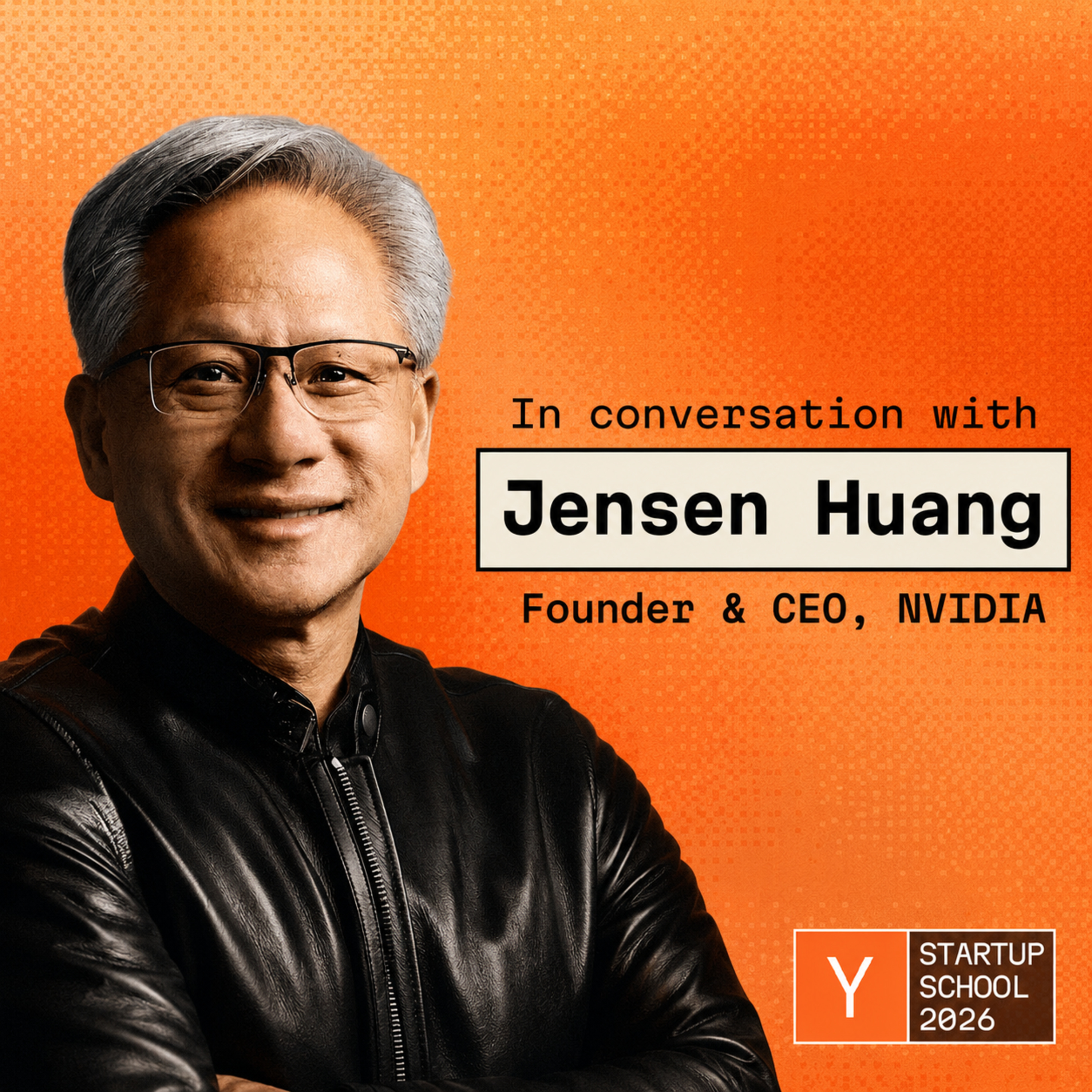
Please join me in welcoming to the stage the founder and CEO of Nvidia, Jensen Hu.
- [00:34]
B
Hey, derek. Hey, everybody. Oh, my God.
- [00:44]
A
This is a surreal moment for me. Thank you. Thank you for being here, Jensen.
- [00:48]
B
I'm delighted to do it. It's great to be here. Apparently, if you're here, you are going to make it, so I'm happy I'm here.
- [01:07]
A
Oh, Jensen. Well, for the students who only know Nvidia at this as a company at the center of AI, what part of the early Nvidia story do they most need to understand?
- [01:19]
B
The thing that most people don't, don't believe is that that the choice of our technology that we started the company with was absolutely wrong. And so we had started with the idea that we would reinvent 3D graphics. Well, the company's philosophy and perspective was that the general purpose computers, the CPUs, were really useful, but if we could augment it with accelerators, we. We could solve problems that otherwise too hard to solve. And one of the first problems we chose was 3D graphics. And during that time, 1993, the PC was just rumored to be coming. And our big idea was that we would turn every single personal computer into a game console, because we grew up in the era of game consoles. And so we thought, what if we could design a system that would fit into the personal computer and it would turn it into a game console? And so we thought we would reinvent the algorithm that would require these large supercomputers and we would fit it into the PC and we came up with some new algorithms. And we were excited about it, we believed in it, we reasoned about it in a thoughtful way, and we went to start the company to go build it. Well, it turns out the algorithm was exactly wrong, and the technology that founded the company turns out to be exactly wrong. And so in 1995, we realized that, and it was almost too late, because by then there were some 35, 40 other companies that were building 3D graphics for PCs. And so we realized that it didn't work. And I went back to the company and we were at the company. I said, what are we gonna do? It doesn't work. And we're all talking about it. And I said, look, we won't have a company if we don't confront the fact that this doesn't work and start working towards the right algorithm. And then somebody told me, it turns out none of us knew how to do it the right way and not Only did we choose the wrong technology. We didn't know how to do it the right way. And so that was a big day for me. I had a couple. Couple of $60, you know, a couple hundred dollars in my pocket. And so I went down to Fry's and I bought three textbooks and. And the textbooks was about OpenGL and how to design OpenGL pipelines. I brought it back to the company, I gave it to the engineers, and here we are. We reinvented computer graphics. We're the world leader in modern computer graphics. We invented most of the major breakthroughs in the last 25 years. Everybody would have thought that Nvidia started out as world leaders in 3D graphics. And we learned it from a textbook. And so we actually started the company, raised money, and bought textbooks, when you think about it. And so the big lesson is that for me is technology is changing all the time. And so long as you're able to confront the reality, so long as you are able to learn, the technology itself actually doesn't matter. And so since then, Nvidia has been, you know, inventing all kinds of technology since all kinds of technology we'd never, never really done before. And we approach everything with the same attitude. You know, this is, if it's important to do, we're going to go learn it and how hard can it be? And it always turns out to be much, much harder than, than we expect. But you go into it with the attitude, how hard can it be?
- [05:06]
A
I mean, backstage we were talking about how, I mean, we were talking with some of the top YC companies, and you were saying that each one has expertise in, like, a domain that you have, you and Nvidia have an expertise in. And they're all just. I forget what you said. It was like an algorithmic domain of a sort. And so it sounds like 3D graphics was merely the first of an algorithmic domain.
- [05:30]
B
That's right.
- [05:30]
A
And it came from a textbook. But then, you know, anyone could have read that textbook.
- [05:35]
B
You created particle physics, fluid dynamics. Yeah.
- [05:38]
A
But you created the thing that people want, like the end product that people want to pay a lot of money for.
- [05:44]
B
The big idea of the company that was spot on is that it is possible to augment the CPU to solve problems that otherwise are too difficult to solve. And molecular dynamics is one of them. Image processing is one of them, inverse physics is another one. And so all kinds of different algorithms. Of course, deep learning is one of the major ones. And in order to create the company that we have today, we realized early on that it's not about building a great chip, it's about accelerating an algorithm domain. And so one of the things that I've always believed in is what makes great companies is a unique perspective about the world that you deeply believe in. It's not so much the technology, it's not so much the market. Even those things all matter. And if you have the right technology for the right market at the right time, your life is going to be a lot easier. A high level vision about the future of some important thing, a perspective about it that's somehow unique, that you deeply believe in. And ideally, pursuing that vision is hard to do. Those are kind of good, good combinations. In our case, we realized that accelerated computing was going to be important and accelerated computing turns out to be very important. And our realization is everything to do with algorithm, not the chip turns out to be exactly right.
- [07:06]
A
So you've said a lot about, I guess, the hardships of a founder. Are there a few stories that really jump out at you? I mean, the people in this room would love to start a company, but you know, are they really prepared for eating glass and you know, possibly having to shut down the company? Like things going wrong? Like, what are some of the pivotal moments that really jump out at you? I think you were just in Japan, right? And yeah, you were sort of honoring Sega was it? So I feel like that was a really powerful story.
- [07:39]
B
The project that led us to realize the algorithm we chose was wrong was a partnership with Sega. Sega had contracted us to build the game console after Saturn that turned out to have been Dreamcast. I don't know if, does anybody know what Dreamcast is? Okay, so we did not build Dreamcast. We were originally supposed to build Dreamcast, but because our algorithm and our technology was fundamentally flawed, I went to Japan and I told Ira Manji san, the CEO at the time, that, that the contract that they gave US was like $12 million contract we will not be able to fulfill because the technology doesn't work. And I told him the reasons why and then I advised that that they choose somebody else to do it. But then I asked them, I told him that I unfortunately still need the money. And he asked me. You could just imagine a conversation. So what you're telling me is what I contract you to do, you can't do, but you would like all the money on the contract. And I said, you got it. That's exactly right. But obviously I was polite, I was humble and he realized that I was honest and, and everything made sense. I, and if he didn't give us the money, we'd be out of business. And I think that this happens in this room. You don't invest in companies, you invest in people. And what Ira Madri recognized was here's, you know, somebody and a company that he trusted in the first place, the contract, and that he believed in and that he would love to see, you know, make it. Make it to the next day. And so that $5 million kept us alive and, you know, gave me enough time to discover what to do.
- [09:37]
A
And then I guess if they held, they sold it for 15 million, I heard.
- [09:40]
B
But, yeah, they sold it the moment we went public. When Nvidia went public, our valuation was $300 million. $300 million in 1999. That was real money.
- [09:55]
A
I think it's north of a trillion dollars now or so.
- [09:57]
B
It's more than trillion. Yeah.
- [09:58]
A
Yeah. That's wild. So you're sort of the core. You know, we like to say that you're. You're the man who controls the spice. You know, before that, you know, I don't think anyone could have really predicted, per se, how important GPUs, and, you know, the technology you built would be for this AI revolution. You know, what did you see? I mean, was it the accelerator and being in the right place, right time, or. Surely there were a lot of things that led up to that that allowed you to sort of capture this position.
- [10:33]
B
Yeah, I saw Alexnet, just like everybody else saw Alexnet. But remember our lens of the world. My view of the world was always looking for algorithms and that algorithm, the algorithm could be namd, the algorithm could be vasp, the algorithm could be opengl, you know, it could be SQL, some domain specific language, some algorithm. And so my lens of the world was always looking for some problem that we might be able to help solve. When Alexnet came along, the algorithm was deep learning. And so the question is, what is this algorithm and why does it matter? Why was it so effective and what else can it do? And if you were to scale algorithms and scale it beyond that, what could it solve that otherwise you can't solve today? The breakthrough for us was realizing that Alexnet was not Alexnet, that Alexnet was an approach with deep learning that allows you to learn any function. And so 15 years ago, I was telling everybody that, hey, guess what? We just learned the universal function approximator. We just discovered the universal function approximator. We can give it. We could, you know, give it the. The answer for almost any function. And it could learn what the function is and For a lot of functions you don't have to be precise. And in fact it's impossible to be precise. And so most of the interesting problems are imprecise in this way. And so the day that we realize we have a universal function approximator, the question then is, what does that do to the computing stack? What does that happen to software? What are the industries that this could impact, so on and so forth. Almost right away we started working on computer vision. Almost right away we started working on robotics, self driving cars. Because that fundamental capability, you could imagine solving some important problems in the area of computer vision and robotics. And so I think the big breakthrough was simply that this is much more foundational than Alexnet. This is a way of doing software. And the implications to the processor, the middleware, the algorithms, the applications, you know, what I now describe as the five layer cake, that entire industrial stack, I imagine reinventing altogether about 15 years ago. And this is simply about asking questions, reasoning about things to first principles, asking questions like if this, then what if this can get better, then so what? You know, asking all of the basic questions about, about something that you observe, that's really impactful.
- [13:30]
A
I mean, one of the things that really jumps out at me is to what degree you go all the way into the weeds, you read the papers, you talk directly to the principal scientists who are sort of coming up with these things. Do you have any advice for people in the audience? I mean, that's like true founder mode. And then at the same time, you probably, you have an organization and you have executives and you have people who say, like, here's the graph, we want to stay on this graph. You know, sometimes it ruffles feathers. Like, do you have any advice for people about an organization and how you navigate that? Really? Like, how do you build an org that allows you to think in first principles? Because if the Fortune 500 did that, like the Fortune 500 will probably look a lot more like Nvidia than not. And it doesn't. Like, you have built a very unique company.
- [14:18]
B
My state of mind, when I'm my state of mind is always starts with curiosity. I have a whole bunch of questions myself and of course, like anybody else, I'll seek the shortest path to the answer. But oftentimes the answers from the people that are near me might not be satisfying and I might have other questions and maybe they're busy doing something and they're pursuing something. And so my first inclination is to go discover the answers to my own curiosity. My second is if I find that the information is, and that the domain of information or particular field could be really important to somebody and could be important to our company. Then my next inclination is how can I learn as much as possible so that I could be of service to the company and share it with everybody else? You know, this is no different than you when you're sharing knowledge. I mean, I watch your podcasts and I watch your videos, and I really enjoy them. You're sharing ideas with everybody else. In a lot of ways, I think a CEO is in service of the company, in service of all the people that are working there, and you want to empower them with some insight. And so that's really where it's coming from. It's not so much a management technique, but a personality technique. You know, I want to empower you, and this is something really important that I just observed. Let me tell you why it's so important. Now, part of. Part of having to be near the ground and be in the weeds, if you will, is because oftentimes the technology is complicated or it's changing really fast. And especially when it's changing fast like our world, unless you have a tactile sensation of what is actually happening, it could either to you feel like it's just moving way too fast to understand. But if you understand the first principles of it over time, then everything kind of makes sense. You know, it's kind of like surfing, I would imagine. I don't know how to surf, but I can imagine it's kind of like surfing. You get out on the wave. To me, it looks like chaos, but to a surfer, you know, somehow they get right. They could read the waves and. And they know how to stay on top of it. And so I think being CEO is very similar to that. You know, you have to learn how to serve in order to learn how to surf. You have to understand the waves, you have to be able to read the wind, and you have to have good timing. And you can't have any of that unless you try and unless you actually do it. And so. So partly is. Is to inform myself. Partly is to try to figure out, you know, what is. Try to break down the problem so that the company can learn it in a way that they can do something about. Part of it is by inspiring other people and, you know, it's all those basic traits of all the people in this room. You don't have to change your personality or your behavior when you become CEO, it is possible for you to continue to be yourself. And one of the things that I. That I learned a long time ago and I have no idea where I saw this, but the CEO or the founders, you're building a car that you are going to race. You're going to build an F1 racer, but you're going to build it in a way that you can drive. You should adapt the car to you. Somebody I think asked me, Jensen, if you, if you don't use conventional management techniques and organizational techniques, you know what's going to happen when you leave the company? Well, you know, when I die on the job someday, you know, I told them they'll just have to reshape the company for the next CEO. And the reason that's wisdom is because we're the F1 drivers, you know, we're the racers and the world is really competitive and we've got to stay, we've got to, you know, we've got to win and we got to achieve our mission. And so whatever it takes to fit the car to you, whatever it takes to fit the organization to you, that's what you ought to do. And the next CEO, whatever the personality is, they can figure it out.
- [18:32]
A
Amazing. I mean it does seem like any change you make to the car will just slow you down and lose you races that you know isn't fit to you.
- [18:42]
B
Yeah, or we're constantly tweaking the car to our needs. And that's really what I'm doing all the time. I'm constantly tweaking the company, constantly reshaping business processes and the way things work so that I can, you know, be more effective for the company. True.
- [18:58]
A
Founder mode.
- [18:59]
B
Yeah, Founder mode. Founder mode could scale for 34 years.
- [19:03]
A
That's right.
- [19:03]
B
From zero to five trillion. No evidence. No.
- [19:12]
A
I'd love to switch gears to like what, you know, what are the, what are the frontier algorithms that you're most interested in now? I mean, I love that you're all the way down into the material science, all the way up into the app level. You know, you're the first to speak on stage about openclaw and now Hermes agent. I wonder if you can sort of like walk us through a day in the life of like how you think about the different stages and I mean going from materials to chips to data centers to even like the app level, like how people are going to work. Like there's sort of this idea of a full stack AI factory.
- [19:50]
B
Well, this is one of the things that is probably going to be the most useful skill in the future. And in fact, just in listening to you talk about technology and your use of it, you know, one of the most important things is systems understanding, systems awareness, system design, system organization, but systems thinking. And the reason for that is because most of the low level things that has to be done are going to be done agentically anyways. They're going to be automated anyhow. And so whether it's, you know, in my generation it's about compiling chips and synthesizing transistors and gates and functional blocks and, and all of that is now synthesized. And so most of our designers are systems designers. In the case of software, most software is going to be done agentically anyhow. So you have to be much more able to think abstractly about systems. What are the problems you're trying to solve, what are the constraints, where's the input, where's the output, where information coming from, what is the rate of information flowing in and out of the system? What are the constraints? You know, and so is it processor, is it memory, is it networking? You know, so understanding these systems problems at a sufficiently technical level is going to be very helpful to all of the people in this room. And I don't think that way of that fundamental knowledge is ever going to be useless. I think it's going to be more and more useful. And so I, I try to understand systems the best I can. One of the things, one of the things, speaking of agents, the fact of the matter is we, we kind of have course level recursive self improvement already and the fact that every time you use it, it improves the markdown files, every time you use it, it updates its long term memory and the long term memory is being processed either compacted or turned into knowledge graphs or you know, so on and so forth. It's been improved all the time, you know, asynchronously. And so the agent's getting smarter and smarter every time still. The problem is, and this is one of the, one of the problems that I think would be helpful for everybody to solve is how can we have very, very specific fine grained control? You know, if not for rags, if not for conditional inputs, if not for our, all of our prompts directly into output was too coarse. And so the fact that we can condition the fact that we can control the agents all the way down to eventually when it comes up with a plan, I change one word in a plan file and that one word makes a delta difference, not complete difference, but specific difference. Maybe it's one pixel, maybe it's one triangle, maybe it's one component in a CAD file, maybe one layer, one via one connection and Then it regenerates everything else. I think that that level of control and that level of collaboration with agents will be game changing. We don't need the agents to be 100% accurate, 100% high quality in order for us to use it. It could literally be 80% and then we help it the rest of the way. Or it could be 99%, we help it the rest of the way. And so I think controllability is probably the single biggest breakthrough that we need for agents at every single level.
- [23:26]
A
Do you think people will, like, I mean, with Hermes or openclaw, it feels like that might actually be somewhat existential. Like people should control their own personal AGI, like they shouldn't outsource that and, you know, have it be just in the cloud and someone else's agent that like kind of tells you what to do. Like you kind of want it to be your own.
- [23:48]
B
Yeah.
- [23:48]
A
Is that part of the thrust behind Nvidia being so involved?
- [23:51]
B
And I think, well, first of all I need to understand agents, because agents is the new software. And how is this new software processed matters a lot to computer architecture. And the more intimate we are about the nature of agents and how it's different than chatbots, which is how different than maybe inference in the very beginning. However we think about these problems, processing layers, the more intimate we are about the nature of the processing, the better we could design systems. We, we kind of have to live in the future five to 10 years, because it takes three or so years just to build a system. Takes a couple years to ramp it up. And you're dealing and you would like them to be able to use the computer for 10 years after. So you kind of have to live in the future for a while. And so agentic systems for us at the first principles is just what is the workload, what's the algorithm, how is it gonna evolve? Where are the bottlenecks, you know, where are the Amdahl's laws problems? And how does it scale? What happens to concurrency? How do you deal with sandboxes? How do you deal with mcp? How do you deal with, you know, working memory, long term memory? How do you have all these autonomous systems, asynchronous systems working all the time? And so what kind of design architecture makes perfect sense for that? And so we have to go and go discover that. And then of course, the second thing is I want to use agents ourselves to make Nvidia go faster. And so we have, you know, Boris is in the back and, and we, we got cloud code Autonomously running in sandboxes all over Nvidia. And that's really fantastic. And some people use codec, some people use cloud code, some people use cursor, some people use cognition. And, and we, we let kind of a thousand flowers bloom, let people select the tools they want to use and then we learn from all of that. And so the second part is just helping the company move faster, use the tools, and the more they use it, the more we're going to learn about how to make it work better in the future. And the last part is discovering the future of solutions, technology for the future. And maybe when we saw the early versions of, of Chain of Thought come out of Stanford is probably a decade ago at this point, maybe eight years ago. You know, the question is how, how effective is that going to be in reasoning and how scalable is it going to be? And what is the implication, for example, in computer vision if we can reason from prior knowledge? And then the big breakthrough, of course, just in thinking through that small little domain, you come to realize that maybe we don't need as much data for cars to train. A self driving car, which led us to creating Alpa Mayo, which is the world's first thinking self driving car. And with just a million miles or so, a couple million miles, it's an incredibly great self driving car. And the reason for that is it's kind of like us, right? We don't need that many miles before we could drive faster fairly well most of our lives. And the reason for that is because we have prior knowledge from our language model and we can decompose a situation we've never seen before and build it up out of things that we understood and know very well. And so that's an example of seeing something and then realizing the impact sometime later when the Agentix systems came along. It's very, very clear that obviously a large language model needs memory, it needs prior knowledge, it needs tools, it needs ways to network with other agents. And so that kind of, you know, that once you see some early indicators and you're able to reason about the future, helps you get a leap, you know, into, into the future.
- [27:55]
A
I feel like there's this pattern that I'm starting to see around Nvidia which you see a problem, there's a new algorithm, there's some new thing happening, and then actually you're right there with open source. I mean, I remember when OpenClaw came out and people said it was unsafe, but you guys came out with a sandboxing sort of toolkit that like surrounds any harness and makes it safe.
- [28:16]
B
And so when I saw openclaw, my first thought was well, first of all I learned about it. And then, and then, you know, without much imagination, you just realized we just designed a modern computer. This is the operating system that's going to hold a large language model. And, and in a lot of ways Open Claw to me was very Linux moment to me.
- [28:39]
A
Yeah.
- [28:40]
B
And now everybody can build their own AI. And I was so excited about that and we contacted Peter and we said hey, you know, all of Nvidia's engineers are your engineers. That's what I told Peter. You've got this battleship outside your house. You, you, you know, break down the problem as you desire and we'll contribute as, as you wish. Same thing with the, the, the Hermes team, you know, and I'm so excited about the work that they're doing. I, I do think that the world needs the ability for everybody to build their own AI. And you could, you could of course and I encourage everybody to, to use cloud services as much as possible. Everybody should use cloud chat, GPT and Claude and.
- [29:23]
A
Right.
- [29:24]
B
Everybody should use that. And, but if you, if you need to build your own AI because you're a company and, and you need to build your own domain specific AIs now you have Hermes and you have Open Claw, you've got all kinds of, you got LangChain, Deep Agent, you got all these different ways. Right. To build your own AI and it's, it's quite frankly relatively easy because the software. Smart.
- [29:47]
A
Yeah.
- [29:47]
B
You know, and so AI is smart and therefore AI must be so smart you could adapt it easily. And so I, I think that, that we want, we want to encourage everybody and every company to build their own AIs and, and, and who knows what innovation will come from the fact that it's open source.
- [30:03]
A
Yeah, I feel like all the alpha is in building your own AI. I mean if someone else is using whatever is off the shelf but you're, you have a thing that can recursively self improve and it is, you know, I mean the mechanic people are very flippant about market markdown files. They say like oh haha, it's just text. But like text is intelligence and we're in a different.
- [30:24]
B
Words are thoughts. Yeah, yeah, words are thoughts.
- [30:27]
A
Yeah. And it turns out you can try
- [30:28]
B
to, try to think without words.
- [30:29]
A
Yeah, that's harder. So switching gears again, I mean a lot of people are, anytime you move the cheese, people get a little worried. Intelligence is going to be on tap, which is really Awesome. I think it bodes well for everyone in this room. What do you think changes about the economy? What do you think happens in sort of a broader sense?
- [30:52]
B
Obviously what I'm going to say is uneven. There are some, you know, we're going to automate tasks. We're going to automate cognitive tasks. If that task is, somebody makes a phone call and sends a bunch of words across the phone to you, and your job is to provide a response. And if all the information is at your fingertip, because you have all the database here and you should be able to answer that question completely, in that case, that task will be automated away. Ignoring that for a second. Not that we ignored this, but my point is, I'm going to answer the question about, about really the great opportunity. And so many tasks will be automated away. Many jobs, every single job will be, will change, and there'll be a whole bunch of new jobs. And that I think we know the bottom line is this. The evidence would show that, and it makes perfect sense that AI and automation is creating jobs everywhere. The narrative about AI destroying jobs is exactly backwards. AI eliminate tasks, AI automates tasks away, but it doesn't necessary, doesn't necessarily eliminate jobs. And the reason for that is because the job of a person has a purpose, and that purpose has many tasks. Some of those tasks could be automated away. Many of those tasks cannot be. And so the evidence suggests that here we are, we've automated coding, which is a task. But the job of a software engineer appears to be growing, right? The number of software engineer jobs year over year has increased 10%. The task of reading radiology scans has been automated, but the number of radiology jobs has increased some 20% in the last several years, even though AI has taken over the whole field. And the reason for that is because the backlog of patients is incredibly high. Now, doctors and hospitals could admit a lot more patients. In order to admit a lot more patients, you need more nurses, more radiologists. And so the same thing with software. The backlog of ideas, the backlog of ambition and aspiration is so high that if we can automate away the task of programming, we could hire more software engineers to do more things. We could be more ambitious. Same thing just across the board. They said Harvey is going to eliminate all of the paralegal jobs and the number of lawyers will be reduced. Turns out paralegals are growing like crazy. And the reason for that is because the backlog of lawsuits is really high. And now these law firms could get a lot more cases through in order to do so, you got to hire more people. And so this is a classic example of productivity increasing growth. Increasing growth drives more employment. This is the reason why there's more employment today than there was when I first came out of school.
- [34:01]
A
So we've been talking a lot about software and agents. Another really exciting thing that Nvidia is all the way out on the edge on is actually physical robots. You know how far out? I think in the past you might have even said this as soon as this year. What's the latest thinking on, you know, when can we expect practical robotics?
- [34:22]
B
Yeah, the moment that I saw us generating video, that was, that was a great moment for me. The moment that, and I start, I saw us generating video. I mean, we did the original work on auto progressive gans, okay. And we did the original work on conditional gans long before the first videos were generated outside that people saw a couple of years earlier inside our labs. We were driving a simulator completely generated by video and computer, completely generated by neural networks. And so the moment I saw us generating articulation, if I can generate video of a finger moving, if I could generate video of a hand picking up a glass, why can I cause a robot to do the same? And so the moment I saw that generative AI happening, I realized that robotics articulation was around the corner. And so now the question is, you know, how is the robot going to understand to generate motions that obey the laws of physics? How does it, how does it understand causality? How does it understand, you know, friction, tension? How does it understand the laws of physics? And so it started us down the journey of creating what we call physical AI now, and everybody calls it physical AI and physical AI, we started working on World foundation model, an AI that understands the laws of physics and how the world works. And we started down the journey of, of working on robotics. I would say the ChatGPT moment of robots happened a couple of years ago already.
- [36:01]
A
Wow.
- [36:02]
B
And the reason for that is, remember when ChatGPT first came out, it didn't do anything productive, it didn't do anything useful, but it opened our imagination about what's possible. And I would say a couple of years ago, robots walking around, that we could do reinforcement learning, fine tune it for and grounded in physics really happened a couple years ago. So now what do we need to do? We need to do all the same things that we're doing now. For Agentix systems, we have to create environments for them to learn in, to eval in, eval against. And so we have to do real, to Sim to create environments we have to do, we have to generate simulators that are based on simulation, grounded physics simulation as well, well as generative physics simulations. And so Isaac Sim cosmos and all the work that we do in that area is related to simulation. And then the last part is sim to real. And so that part is, has something to do with reinforcement learning, grounding it on physics, grounding, grounding on all the electromechanical systems that robots require. And so but these three basic system I think builds up the eval, if you will, the post training of robotics and I think we're going to see it right around the corner.
- [37:24]
A
Amazing. Where does physical AI show up first in a way that's really economically real? Are you seeing that already?
- [37:30]
B
We conjectured that robotics was going to come along and decided that the first application of robotics that has both a large enough market, relatively standardized technology so that we could scale and get the flywheel going and has real economic value was self driving cars. And so inside Waymo are chips from Nvidia. At Tesla, we were in the car, now we're in the data center. Mercedes, we're in the data center, we're in the car with the software stack. We worked on Alpa Mayo and we open sourced it. And the reason why we open sourced the self driving car stack is because you need it for agriculture, you need it for mail delivery, you need it for warehouse AMRs. There's so many different ways that you could apply autonomous navigation and none of those markets are big enough to be a self driving car market. And we thought it was sufficiently diverse that we would create the whole stack for it. And so we're working with autonomous vehicles in all kinds of different places. Our robotics business, autonomous vehicle business, basically physical AI business is probably almost like $10 billion. So it's really, really big already. Likely this will be one of the largest industries in the world and it'll take longer than a couple, two, three years, it'll take less than 10. And so this will, this will be our next $100 billion business.
- [38:59]
A
Amazing. I want to take a moment. I think this is the exact right crowd to maybe as an arena we can. Welcome Jensen to X. Welcome to X. I mean made your first post and thank you for your leadership.
- [39:19]
B
You know, that shows you how introverted I am. It took me until 2026 to have the first post on X. You know, it's, I'm probably the last human on earth that did it, but, but what I posted was too important to me and too important to the, to the industry and too important to the world. And so, so I over overcame my, my shyness and put my first thing out on X.
- [39:48]
A
No, thank you for your leadership. I mean open source, open weights, open source models are incredibly important. Important for, I mean what all of us in this room want to do. Like we want to create startups.
- [39:59]
B
If not for open source, the mobile cloud industry would have never happened. If not for open, if not for Linux, if not for Kubernetes, if not for all of these, you know, platform. If not for TensorFlow or more important, Pytorch. Right the, and the early versions of a cafe, right Torch. I mean all of the Theano, remember the early versions of all those were all open source. If not for all of that, how would we have modern AI?
- [40:27]
A
Well, thank you for your leadership and your voice is incredibly important here. Thank you. Before we go, I feel like we, I just really resonate with your story. I think that everyone here, but I mean, would love the wisdom of, you know, your journey coming here. I mean, what should a young person learn now given all the things that you're seeing, all the algorithms that are going to take hold in society? What should a young person learn now that will still matter based on what you're seeing?
- [41:01]
B
Well, some of the things that I saw today and some of the starters I met today was really, really quite, quite encouraging. And, and the thing that the big takeaway is of course the simple stuff is going to get automated away. And when I say simple stuff, I mean software coding, the idea that you would solve a problem by sitting in front of a computer and you're actually writing code, that concept is obviously going to get automated away. In my generation when I was growing up, we had to do long division. I mean, for God's sakes, who has to learn long division? And so that got coded away, that got automated away. And so I think the simple stuff is going to get automated away. But the hard problems, the hard sciences, physics, chemistry, biology, computer science, computer engineering, systems thinking, you know, all and particularly the domains that are intersecting those hard problems will never go away. And so AI is just an incredible tool that helps us become even more ambitious, even more impatient about solving these extraordinarily large and incredibly hard problems than before. And so, you know, if you, if you look at my generation when I first graduated, a chip designer would design a chip with maybe a thousand transistors and that would be a very large chip. You know, now designing a trillion transistor chips is not even, you know, if somebody would have told Me, Jensen, our next chip is a trillion transistor. I said, okay, you know, it's not a thing. And the reason for that is because we are so ambitious now. The scale of the problem, the scale of the task is no longer a matter of. And so you don't have to worry about how much coding, how many engineers. You don't have to think about those things anymore. You just have to think about what is the problem you have to solve. And so I think that the deep tech stuff, the deep science stuff, understanding the intersection between technology and social issues, understanding market gaps and holes, opportunities, I think all of that still exists. And the better you are at systems thinking so that you could orchestrate millions of agents solving problems autonomously, the better off you are. And so that's why system thinking is going to be so important. But otherwise, I think the world's going to continue to have a lot of great challenges for us to solve. Go to school the same old way, you know, stay in school, stay in school.
- [43:52]
A
I guess I usually like to end with you looking out on the crowd. There are a lot of people who, I mean, I started this, the opener with like, I honestly look in the crowd and I see people who are not different than us per se. You know, we actually just are technical and like love system, you know.
- [44:13]
B
Thank you. Thank you.
- [44:15]
A
What advice would you give to this room of, you know, and do you see yourself in this, in this room? And like, I'm curious what you would say if you could send a telegram, a Message to the 18 to 22 year old version of yourself. What would that be?
- [44:33]
B
I could tell you exactly how I felt when I first, when Nvidia first founded and the three of us started. The thing I felt at the time is there was so much for me to know and so much for me to learn and I didn't know it. And I was telling you earlier, at the time there was no YouTube, there's no YC, nobody's teaching you how to start a company. And so I went to the bookstore and I bought a book and the book said how to start a Company. Unfortunately, the book was like 500 pages long. And so I figured by the time I read it, I'd be out of business and Lori and I'd be out of money. And so there's no sense reading it. But the thing I remember very vividly is that how scared I was to go raise money because I felt that I was about to talk to a bunch of people and I didn't know how to answer Their questions, and it's true. And I barely know how to answer their questions even today. But the thing that I learned is none of that stuff matters, as it turns out. And you're always going to have things that you don't know. And every single day, the world's changing, technology is changing. Obviously, this is the greatest time in the last 60 years to start a company. The whole industry has changed. It's a complete reset. From a technology perspective, the single most important technology in human history, the computer, has been completely reset. And so this is absolutely the single greatest time to start a company. And I'm, I'm, I'm jealous of all of you and, and, and the opportunities you have ahead. I mean, it's going to be incredible. So it's the perfect time on the one hand. On the other hand, the technology is changing so fast. And so the question is, what's the right feeling for you? And eventually, and I told you the story of us, of me buying the other book, the textbook, I think the psychology and the feeling that I have today on all of the new experiences and the new technology and new markets and new dynamics, I look at it and I say, this is important. I've got to go learn it and I've got to go do something about it, and I better get to it as fast as I can. And how hard can it be? I always have this feeling, how hard can it be? And truth be told, it is way harder than you think. But you don't want your mind to be there. You want your mind to be, how hard can it be? And let the suffering come to you a little bit at a time. You know, don't, don't imagine how hard it's going to be and let all of that turn into anxiety and not doing something about it. You want to imagine your head, how hard can it be? You know, I got a whole bunch of a, I got a bunch of AI agents helping me anyways, and so how hard can it be? And then you get going on working on it, and, and so that's probably the attitude of an entrepreneur. You know, you have to learn a bunch of stuff along the way. You believe in your ability to learn, which is, you know, learning is the single greatest superpower. And if you go into it with the attitude, how hard can it be? If anybody can do it, I can do it, and just realize that it will be hard and you just have to have the resilience to overcome it every single day. You don't have to overcome life in one day. You just have to overcome that morning, that morning, you know, you have to overcome today, today. And so it's not a big deal. Just get through today, wait till right, work towards tomorrow, keep following your dreams and the rest of everything if you stick, if you stick with it long enough, you know, Nvidia happens. And so, you know, I think that the wisdom that I can, if there's anything is resilience is probably the single most important thing. And if you believe in something, just get going on it and get your mind, you know, out of, out of keeping your yourself from pursuing it because of, you know, fear or anxiety or lack of confidence or whatever it is and that you're just going to tell yourself I'm going to learn my way there.
- [48:51]
A
Jensen Huang, everybody.
- [48:55]
B
All right, guys, thank you.
- [48:56]
A
Thank you so much.
- [48:57]
B
This is incredible. Thank you guys.