← Zero to Well-Read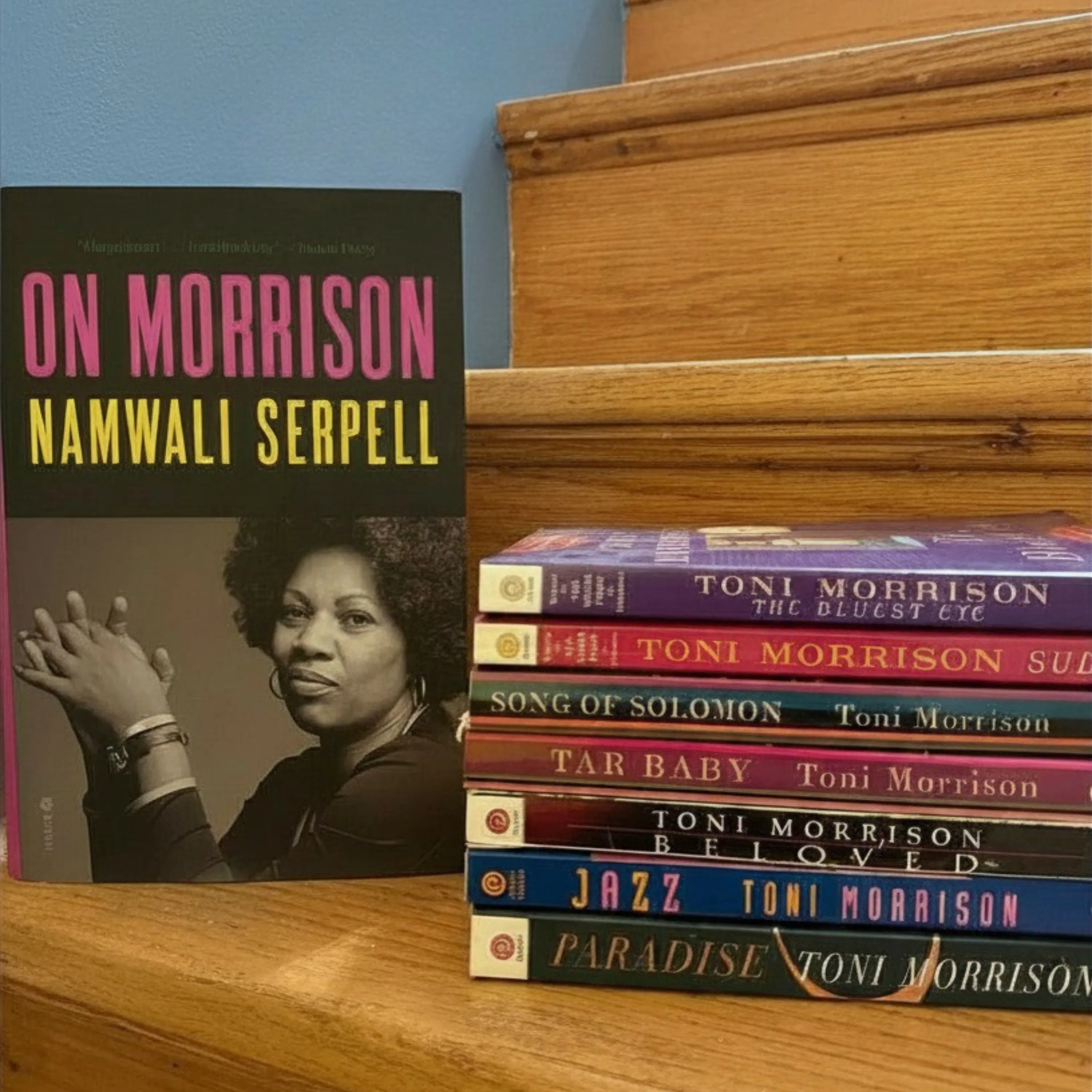
Zero to Well-Read
How to Read Toni Morrison and Where to Start, with Namwali Serpell
00:53:37
Jeff and Rebecca sit down with literary critic and Harvard University professor Namwali Serpell, author of On Morrison, for a conversation about how to approach her famously difficult body of work.
Loading summary
Transcript90 lines
- [00:01]
Jeff O'Neill
This episode of Zero to well Read is brought to you by Thriftbooks.com today. It's a bonus episode with Professor Namwali Serpell talking about how to get in to Toni Morrison. Professor Serpell is a Morrison scholar. She had a book come out this year called On Morrison, which Rebecca and I really liked and got to have a conversation with her about reading Toni Morrison and how you might do that as a beginner. And if you want to do that, the book she suggests is Sula by Toni Morrison. You're hear about why. And on thriftbooks.com there's a whole bunch of editions I'm going to shout, not one here particularly. You can get a hardcover first edition in good condition. So it's probably, you know, got some wear on it for 22, $23. Really cool if you want something in slightly better condition that's a little less expensive. When Sula and Morrison were part of the Oprah Book Club Consortium, there was a re release of the original hardback of Sula with the original cover art and everything that you could get and you can still find it. Now you do have to deal with an Oprah's Book Club sticker, so I'll warn you there. But still a pretty cool find and piece of literary history to find on thriftbooks.com thanks to them for sponsoring this episode of Zero to well Read. Let's get into the show. Welcome to Zero to well Read, a podcast about everything you need to know about the books you wish you'd read. I'm Jeff o'. Neill.
- [01:23]
Rebecca Schinsky
And I'm Revecca Schinsky. Today we're taking on one of the most common questions from Zero to well Read listeners and how and where do you start with Toni Morrison? And we have an expert here to show us the way. Now. Molly Serpell is a fiction writer, a literary critic, and a professor of English at Harvard University. She's the author of On Morrison, a widely acclaimed collection of literary criticism about Toni Morrison's work, which came out earlier this year. And her new limited series podcast Passages captures her in conversation about Morrison's work with writers and thinkers like Tracy K. Smith, Hanif Abdurraqib and Cathy Park Hong that's out today. Namwali welcome to Zero to well Read.
- [01:58]
Namwali Serpell
Thank you so much for having me.
- [02:01]
Jeff O'Neill
So we get asked about Morrison all the time. We've done an episode on the Bluest Eye and it's always tricky because people know Toni Morrison's name, they know a lot of the books and they have a sense of, this is a writer I want to tackle. But they also know that that is not an easy feat. So we're going to get into that a little bit today. But I think first we're curious. You know, what was your own first exposure? Was it in class? Was it at home? You pick it up at the library. Did you hear whispers, like other people about Toni Morrison? How did you come to Morrison's work?
- [02:34]
Namwali Serpell
That's a great question. I have a series of encounters with literature in my life that I think are marked by the privilege of total and utter naivete. I just don't know anything. And part of that is because I'm an immigrant and I didn't really know much about American literature or about African American literature until I started reading it in middle school and high school in classrooms.
- [03:01]
Jeff O'Neill
Interesting.
- [03:02]
Namwali Serpell
My sister. My older sister was a student at Clark University, but she took a semester at Howard University. And I recall being in her apartment and picking up a copy of Beloved from a coffee table. Maybe it was a bookshelf, but I think it was a coffee table. And trying to read the first page and being like, I don't know what this is. Skip to five years later or four years later, maybe. I'm in college and I'm assigned this novel for a class. And so I was reading Morrison's, I think, one of her most complex and difficult books first, but under guidance with, you know, with help from professors. And then I have what I like to think of as my most pure Toni Morrison reading experience, which was when I was in graduate school. I had now read Beloved, Jazz, the Bluest Eye, Song of Solomon, but I had never read sula. And I was house sitting for my advisor, now colleague, Glenda Carpio, and was kind of procrastinating and wandering and browsing her bookshelves. And I saw this old edition of SULA with this amazing cover, a paperback with the yellow rose petals. It's such a beautiful cover. It's one of my favorites. And I was like, oh, I always meant to read this one. And I sat down and I read it in one long, very pleasurable sitting. And I didn't have a pencil in my hand. I didn't have a paper to write. I didn't have an essay that was due or a dissertation chapter. I just was purely immersed in her prose, and I wept. And it was just an incredible reading experience. And those kind of three encounters, I think, Mark, for me, actually, the beauty of coming to Morrison without preconception. Right?
- [04:47]
Jeff O'Neill
Yeah. And then. Go ahead, Rebecca.
- [04:50]
Rebecca Schinsky
I would say that's really similar to my first experience my senior year in college. We had to take a capstone. I minored in English, and there were, like, three options. And I do not remember what the other two were, but one of them was a Toni Morrison seminar. I had never read her. I just knew that Toni Morrison was important, and that sounded better to me than the other two options. And at that time, I believe love had just come out. It was in 2005. So we started with the Bluest Eye, and we read all of Morrison in a row in one semester, which was super intense. And that I felt the same way. That ultimately my not knowing anything about what I was getting into made it an even more powerful experience. But then to come to her later work with the foundation of the classroom, but to be able to encounter it purely like you're talking about it really is so magical.
- [05:36]
Namwali Serpell
Yes, absolutely. There's also a way in which, whether it's in a classroom or not, just having read Toni Morrison helps. You read Toni Morrison, Right. She teaches you how to read her Mere Exposure Therapy.
- [05:47]
Jeff O'Neill
Oh, okay.
- [05:49]
Namwali Serpell
I mean, all of her novels are very different from each other. So it's not as though it's a. It's sort of like learning how to read her language. It's more about learning what approach or stance or posture to take to the work, which is one of, like, just total openness. You just have to be open to what's gonna happen on the page. And you have to be okay with not knowing what's happening on the page. But there's also this kind of sense that even though she's very willing to throw you into total and utter bafflement, there's a kind of guiding hand. You kind of know that you're going to be okay. You know, she talks about how the first line of Tar Baby is, he thought he was safe or he knew he was safe. And she says, I want my reader to feel that, too. Like you're about to jump into the water like Sun Green in that novel. But you're safe. You'll be okay. I got you.
- [06:41]
Jeff O'Neill
Yeah. We often talk about writers with whom we feel like we're in good hands. Now, that doesn't necessarily mean you know what the hell's going on immediately. Right. But you feel an underlying competence and compassion for the reader that they're trying to do something with and for you, versus merely being abstruse or difficult for difficulty's sake or something.
- [06:58]
Namwali Serpell
Exactly. There's always an ethos behind every formal technique that she is putting on the page. One thing that I always say to my students when they're worried about reading overreading or reading too much into Toni Morrison is that it's very unlikely. Because everything there is extraordinarily well designed, well crafted, and well thought through. There's no mistakes. You know, rereading all of her books to teach and then to write my book, I was, like, on the hunt for typos, as I tend to be because I'm a professor of English. And I found, I think, three. And then in the archival research I did, and there's three across 11 novels in the archival research I did, I found that all of them had been inserted by editors or proof proofreaders, that the manuscripts had the right spelling. Yeah, it's really kind of amazing. And she doesn't. So, you know. Yeah. But that level of perfectionism and design and just care. You can absolutely trust that every word on the page is meant.
- [08:02]
Rebecca Schinsky
Yeah. She's one of the just a rare handful of writers that we talk about as if. If you ever are reading this writer and you think you have your arms all the way around it, that's the place that you know you've gone wrong. If you're reading Toni Morrison and you're not always totally sure how to do it or what to make of things, you're having the intended experience that. Or as you write in the introduction to the. Which is called on difficulty, which I just really appreciated that framing that Morrison's work is famously difficult. It's intentionally difficult. She herself was famously difficult in a way that I think is under acknowledged and under celebrated. How do we think about approaching a writer of this stature and a writer whose. Whose body of work advertises itself as. This is going to be hard for you?
- [08:46]
Namwali Serpell
This is a really good question. Right. So there are famously writers who embrace their difficulty and almost gloat about their difficulty. The example that I'm thinking of right now, although I quite delight in this, is James Joyce saying that he was going to have, you know, the critics, you know, hunting through Ulysses, trying to figure out what he was doing for centuries. There's another example that I love, because it's quite subtle, is that John Milton, when he published his poem Lycidas, published it with line numbers because he knew that critics were gonna want to, like,
- [09:24]
Jeff O'Neill
a blank opposing page for the following concordance or something.
- [09:27]
Sponsor Voice
Exactly.
- [09:28]
Namwali Serpell
And of course, T.S. eliot famously published, you know, the Notes to the Wasteland, which are themselves, you know, abstruse and obscure and just lead people down Further rabbit holes, you know. But Morrison talked a lot in interviews and in essays about why she felt that breaking the form, why she felt that ambiguity, or as she called it, gaps and delays in the work of someone like Faulkner or Woolf. Two writers whom she wrote her master's thesis about, in fact, why these were important techniques for her. Not because of trying to befuddle the reader just for the sake of that. For sport, exactly, but that there was a kind of ethos behind it. And I found this extraordinarily helpful for me when I was writing my dissertation, which became my first academic book, which is about literary uncertainty and specifically about the ethical affordances of literary uncertainty that Morrison was able to articulate. Finally, something beyond the aesthetic and beyond the affective, like feeling, but something that's actually about ethics. She connects the open endedness of her work to African folktales in particular, suggesting that literature has a communal function, that it is a story that is told to a group of people in a social context in order that at the end of the story you turn to the reader, you turn to the listener and you say, what do you think? And it prompts a conversation. This way you can actually have dynamic debate engagement. She also connects it to jazz. The notion that when you have a lingering note that actually irritates that doesn't let you settle that, that actually leads you to keep thinking rather than just have that kind of release of feeling or feeling of closure. Closure to her was almost anathema to the purpose of literature. So I think, you know, for her, when you, when you approach Morrison, you have to understand that it's for a reason. You know, it's not simply for the kind of onanistic, you know, masturbatory sense of one's own intelligence, but it's actually a way of pulling people in, engaging them. As she says, I need a participatory read to step into my gaps and spaces, to co create the work together. And then you have a conversation about it, which is one of the reasons it's been so great on my book tour to have conversations about Morrison. And that's the the point of this podcast that we're launching today.
- [12:00]
Sponsor Voice
Today's episode is brought to you by 11 reader, an award winning audio app with more than a hundred thousand premium titles, plus any PDF article or document you bring. So 11 reader is having us rethink what we know about audiobooks in a good way. The new award winning audiobook app comes with more than 100,000 premium titles and the ability to turn any text you want into natural sounding audio. That means eBooks, PDFs, docs, articles, research papers. Anything can become an audiobook. Plus, it's cheaper than Audible and gives you more hours. So you can get 20 hours of premium audiobooks for as little as $8.25 a month. With the annual membership, there are no cred and there's flexibility to switch between books whenever you'd like. You can choose from bestsellers by publishers like HarperCollins, Blackstone and more. There are also hidden gems, niche genres and more. All yours to explore in the app. Start with a free 10 hour trial today and hear the difference. Just visit 11 reader.com that's E L E V E N R E a d e r com thanks again to 11 reader for sponsoring this episode. Today's episode is brought to you by Vault Comics, the best in science fiction, fantasy and horror graphic novels. Publishers of the Laws of Cultivation, Volume one by Craze Code. Now if you're into xianxia, if you like isekai, but make it alchemical, make it magical, this is a graphic novel for you. Okay, in this world, knowledge is power and power is everything. Lujie woke up in a world filled with scheming sex, arrogant young masters in the mad chase for the immortal heavens and he wanted not a drop of it. But his plan to escape the world. The sect is interrupted by an old alchemist's pills that heal him within moments. A magical cure. And these medicines ignite the flame of curiosity to learn true magic in him, rekindling his love of discovery. So Lugier sets out to study the immutable truths hidden within the world and soon finds an all new path of cultivation that could take him to the very top. Now this is a best selling Xianxia fantasy ebook and audiobook series and webtoon sensation. Okay, and now it's a graphic novel for the first time. You're going to want to get involved with this. Okay, make sure to pick up the laws of Cultivation Volume 1 by Craze Code. And thanks again to Vault Comics for sponsoring this episode.
- [14:36]
Jeff O'Neill
I got to see Morrison speak when I was in high school. She came to Kansas City and I drove over as a 17 year old who thought he knew something about something which is always a dangerous position to be in. And she gave a speech and at the end there was a Q and A. And this is shortly after paradise had come out and there was a quite, I would say good hearted listener or respondent asking questions about the end of paradise. What is really distraught that she didn't get it, that she didn't get what was happening. And Morrison was clearly wanting to help her, but also not wanting to give an answer, A. Because there isn't a answer, but also not to, you know, then be sort of the master of the text. She didn't want to be like, the point of this is to figure out this puzzle box of what exactly I meant. And readers have such a hard time with that. Right. You've taught this before. I've taught other readings. Even our own conversations here. People want to quote, unquote, get it. And it can be difficult for people to say, you get it, even if you don't get it. And that feels like a trick. How do your students respond to this sort of, I don't know, aesthetic experience, a moral experience, an interpretive one, which is not. Well, I have read the Cliff Notes, and now I get the Great Gatsby, which even resists its own kind of readings.
- [15:48]
Namwali Serpell
Well, I think one of the reasons I love teaching Morrison is because what happens to students as they actually read these novels that they've heard about or that are, you know, have certain set of connotations or ideas or even identity politics kind of projected onto them in the discourse, as we call it, is that they. They come to realize how. What. What a great gap there, what we say a book is about and what the experience of reading the book is. And that difference between aboutness and experience really helps them zoom in on the only thing that I care about conveying to my students anymore, which is form, which is literary form, that a summary of this novel and what its themes are about, if you were to try to get it, what is the message bears such little relation to the experience of actually reading it, because Morrison has used form to guide and mold and sometimes shatter that experience. Right. And so I find it really, you know, they, they, they, they. They seem to be frustrated at first because the books don't conform to their idea of what the books are supposed to be. And then as they read more and more of them, you see them start to recognize, oh, wow, she's doing this. She's using free indirect discourse here. Oh, wow, this character isn't reliable. Or, oh, wow, the actually kind of undermines what we've just been reading, right? There's really. They start to actually pay attention to the way literary form works. And so to me, it's sort of like an exquisite experience of kind of estranging the novel for them. It defamiliarizes, which is what she wanted us to do with the world.
- [17:36]
Rebecca Schinsky
And it seems like readers on the large readerly scale have this response as well. There's this memeification of Toni Morrison. Like, this happens all over literature. But you get pretty embroidered pills with, if you want to fly, you've got to give up the shit that weighs you down, which just so far from the real heart of what her work is about. How do you, I don't know, address that tendency to reduce Morrison back to something palatable or many readers desires to try to make it simpler than it is?
- [18:08]
Namwali Serpell
Well, I think this is what's so remarkable, is that all you have to do is get people to read it. It's kind of amazing. Like, I just had this big social media kind of podcast pylon slash debate slash discourse about whether. Whether Beloved is a difficult text. And a lot of these. A lot of people were.
- [18:27]
Rebecca Schinsky
That's a question.
- [18:28]
Namwali Serpell
No, but this is what was amazing is a lot of people were saying, I don't. This isn't a difficult text. It's taught in high school. It's taught. And so I sort of off the cuff, gave a pop quiz. Just, you know, some of the questions were sort of like tongue in cheek, you know, kind of yes or no,
- [18:42]
Jeff O'Neill
or, you know, 95 Robbins, but for beloved by Tony Morris.
- [18:46]
Namwali Serpell
But it was. It was really funny because people were like, well, this isn't a. This. This pop quiz is like the answer. I was like, right, that's my point. There is no single answer. But also, where there is even a possible answer, you've gotten it wrong or you haven't read. Or they kept saying, oh, I don't remember. But I still don't think the novel was difficult. And I was like, so this is the thing is like, if you actually read the book. And I loved. There was one moment where someone was sort of going back and forth and saying, but this is not. It's not a difficult book to read. And I was like, I don't mean at the sentence level. What I mean is she is building narrative uncertainty for us by giving us conflicting pieces of information, sometimes delaying or using what she calls quiet language. Someone was saying, I don't think. You know, I don't think it's. It's hard to read sentence by sentence. And then I pointed to my pop quiz and one of the pop quiz questions made her open the book again, and she said, oh, right, I forgot about this. And she screenshot just from the chapter that's narrated by the titular Beloved, which is. Has gaps in spaces, no punctuation, you know, is extremely modernist, fragmentary. And she was like, oh, right. And I was like, right. All you have to do is open the book and you realize you cannot memeify, you cannot simplify, you cannot reduce any of this even to a pop quiz, because at the. And so it's actually very easy to get people to shift away from that tendency toward AI summary of literature by just making them open the book and read it.
- [20:21]
Jeff O'Neill
Yeah, we see that time and again. You know, most of these authors are much stranger than their historical import or their Funko bobblehead version. We have in our mind of Twain or Dickinson or Zora Neale Hurston or something like that. And the texts themselves are much stranger and naughtier and dangerous even today. You know, we were talking about this with Bartleby the scrivener. How alive it still seems. Right? But all you have to do is start. I mean, as soon as your own simplification, essentialization of these figures, these people as icons, evaporates as soon as you try to do something with the text at all.
- [20:55]
Namwali Serpell
Exactly. I mean, it's such a sad fact of my life, but so many questions that I get asked in Q&As, in classrooms by aspiring writers, by people who want to read. My answer is always, just read the book.
- [21:09]
Jeff O'Neill
Read the book?
- [21:09]
Rebecca Schinsky
Yeah, you gotta read the book. You gotta do the homework.
- [21:13]
Namwali Serpell
I often say, read the syllabus, but it's also just like, just read the book, which is on the syllabus. I guess.
- [21:18]
Rebecca Schinsky
Let's take that then into. I'm somebody listening to this podcast. I want to start Toni Morrison, and I've been intimidated about how to get in. Which of her books do you recommend? Somebody starts with. What are a couple of tools that it would be good to have in my back pocket as I'm doing that.
- [21:33]
Namwali Serpell
That's a great question. So many people seem to think that the way to start with Toni Morrison is to begin with the first novel, which is the Bluest Eye. And I actually always dissuade people from that.
- [21:47]
Jeff O'Neill
Damn it, Rebecca, we did it wrong. Sorry.
- [21:49]
Namwali Serpell
No, no, no, it's not wrong.
- [21:50]
Rebecca Schinsky
We actually talked about how it's a tough read.
- [21:53]
Namwali Serpell
I think the thing about. So the thing about the Bluest Eye, that you have to understand is that Morrison is writing it coming out of having done a master's. And on Faulkner and Woolf, who are modernists, who are using these modernist techniques of breaking the text, delaying the disclosure of information, all of that. She's using a lot of that. She's also working as an Editor. And she's also not receiving the kind of editing that she really longed for. So there's various moments in the archives where you find her complaining that she didn't quite get the help that she wanted. She says, I think the BluesI could have been better. There were things I wanted to do that I needed help and I didn't get that help. And so what you have is, I think, a brilliant first book. But it's a book that is coming from a very particular moment. She doesn't yet know who her readers are. Her readers, herself. And she's a very sophisticated reader. Yes, right. So it's actually, I think, her second novel, Sula.
- [22:59]
Rebecca Schinsky
Totally agree.
- [23:00]
Namwali Serpell
That is the first novel that you should read if you want to read Toni Morrison. And I'll say this for a couple of reasons. One, she described that novel as hermetic, which she means is tight and almost crystalline, like a poem. Which means it's extraordinarily tight, constructed. It's very short. But that tight construction also means that you have a kind of aesthetic experience, like reading a poem, where you don't have to understand everything because everything is kind of resonating with each other just
- [23:33]
Jeff O'Neill
for the same pointing in the same direction or something like that.
- [23:36]
Sponsor Voice
Yeah.
- [23:37]
Namwali Serpell
And the other reason is kind of an irony, which is that Morrison provided what she called a lobby into that book. A kind of easy way in, which is, in the actual text itself, a description of the bottom, which is the black community in the made up town of Medallion, Ohio. That opening to the book was something that she later regretted because she said, I was basically translating for the reader outside of this community, which, you know, basically is a white reader. And I was helping them walk into the story. I was kind of holding their hand. And she, of course, she doesn't want to hold your hand, you know, but the fact is she did that. She left it in that novel. She never took it out in later editions. And it helps. It actually does help every reader, I think, because it just lays out, you know, what it is that we're gonna be talking about, what it is we're gonna be looking at. I think it ends by saying that it's going that this novel is going to be about Sula. But we don't actually meet Sula, the character, for quite some time. But it prepares you for that. It says, it's okay, I'm introducing you to this community. Know that we're gonna get to Sula soon. And now I'm gonna give you the kind of wild opening with Shadrach Right. And so I think in that sense, this vestigial aspect of the novel that Morrison later regretted actually makes it the easiest one for one to begin with. I think once you' sula and you kind of start to get a sense of how Morrison presents information, which is often oblique, it's often delayed, so it's presented without context. And then context is filled in later, then you can have the tools to maybe go on. I would say, go on to Song of Solomon, which is a much more rambling, loose text. It's not as tightly sealed or hermetic. But what you know is. What you're confident about when you start Song of Solomon is that she's gonna explain everything eventually. Right. So you can let yourself ride it, which is kind of how I feel about that novel. It's. The last line also invokes that. And so then you have a real. You sort of get more of a grasp on how Morrison works at length and in this wider canvas. Then I think you can go back to the Bluest Eye. And then you're gonna be encountering this very formally experimental, quite fascinating, and really compelling story that's actually told from multiple perspectives. You start to get more of a sense of that. If you start with the Bluest Eye, you imagine it's gonna be just from the perspective of the little girl at its center. And so you get really confused. Why am I with this neighbor? Why am I with the dad? Why am I. But once you actually understand that this is Morrison's way is to walk around and see it in the round, to use a term from. From E.M. forster, then you feel more comfortable with it. So Sula, Song of Solomon, then Back to the Bluest Eye. And then I think you can start to really venture into what's called the Love Trilogy, which is her three books, Beloved, Jazz and Paradise. And I would read them in that order. I think they become. I think they're all difficult in different ways. But I think that once you've read the Bluest Eye and Song of Solomon, I think you have enough under your belt to be able to take on Beloved and really start to think about the way she's working with ambiguity there. Jazz is just super experimental. It's super fun. You just kind of let yourself go with that one. And then paradise is, I think, her attempt to write an epic novel.
- [27:32]
Jeff O'Neill
Yeah.
- [27:34]
Namwali Serpell
And by then, you've gotten the patience down, you understand? You just have to be patient that it will eventually pull off. And her canvas is so large. Right. So that's the order in which I would do it when I've taught the course. I've moved chronologically. But I think in retrospect it makes better sense to start with sula, move forward and then jump back. Those who are interested in Morrison's late work, her post 2000 novels. I would start with Holm. Holm has one very experimental feature, which is that there are italicized first person chapters told from the perspective of Frank Money, the hero of that novel, in which he will contest what the narrator has said about him in the previous chapter. Amazing, right?
- [28:26]
Rebecca Schinsky
Morrison doing Morrison things.
- [28:28]
Namwali Serpell
Morrison doing Morrison things. But once you get a hang of that, the novel is relatively straightforward. Its metaphors are even more connected than those in sula. It's about home at multiple scales. The womb, the body, the physical house, the homeland that is the nation. And once you see that kind of nested metaphor, it's really easy to track what's happening and what's going on. So that's the other one I would. And it's also gorgeous. God, it's just such. It's beautifully written, underrated.
- [28:59]
Jeff O'Neill
You know, the post Paradise One don't really get the same shine up to paradise ones and before usually do. It's a shame. I've got this question for you, and I don't know, there may be nothing or it may be more complicated than I'm asking, I'm sure. In terms of her own biography, her own artistic project, her own history, what are some useful things to know for someone who wants to wade into this water and try to swim around in it?
- [29:24]
Namwali Serpell
So I would say, okay, there are three things that I think are important. And one of them is that when you think about Morrison's identity as a black American who grew up in Lorain, Ohio, in a city that she said was neither ghetto nor plantation, is a Midwest city that at an industrial city right across the water from Canada, you have to understand that her interest in what makes American literature American, what makes black literature black, is very specific to cultural forms and aesthetic form. Right? So you're not going to find that every Morrison novel is about Lorraine, Ohio. In fact, only one is set there. But what you're going to find is that that city, which actually had lots of waves of integration, and that her family within that city, which had a kind of retention of black American forms from the south, which is where her parents are from, really feed into her aesthetic project, which I would say is kind of creolized, actually, and hybridized. She's very interested in storytelling. She's very interested in the Kinds of tales that were told in her kitchen. She's very interested in the nature of that storytelling in that space. What you're not gonna find is kind of one to one mapping of her life or the events of her life in the novels. It's always gonna be about how those feed into her aesthetics. So when the prefaces or the forwards to her novels, and usually I tell students or new readers to a text to skip the forward or preface. But Morrison doesn't really care about spoilers. She often spoils the whole novel in the first paragraph. The first page of the Bluest Eye tells the whole story.
- [31:35]
Jeff O'Neill
Or they shot the white girl first. Okay, great.
- [31:37]
Namwali Serpell
Exactly. That's the end. Yeah, but she. I mean, she printed that first page of the Bluest Eye on the front cover of the first edition. She really doesn't care about spoilers. So I actually think reading the prefaces is totally fine, totally legit. And it can really help you as you understand what it is that she was trying to get at in forming the novels as she did. And in those prefaces, she often talks about the relationship between the story she's telling and the kind of aesthetic cultural traditions that her family brought to her. So in the preface to Song of Solomon, she talks about her father and the role of humor, the role of signifying, the role of the dozens. And that really helps you understand that novel. In the preface to Tar Baby, she talks about her grandmother telling her the tar baby story in her kitchen. Right. So that's one of the ways. I also think it's really important to understand that Morrison was a highly educated woman, but also a woman with a very specific education. Right. So she was an incredibly early reader. She was, I think, immediately a star in her classroom was being asked to teach the students that were coming into the class how to read. When she gets to Howard University, she studies English, but she's also minoring in classics. So she also has a real familiarity with Greek tragedy and with the Greek tradition, which is. Song of Solomon, essentially, is writing back to Homer's Odyssey. Greek tragedy is really important to how beloved structures itself.
- [33:26]
Jeff O'Neill
Medea and.
- [33:27]
Namwali Serpell
Exactly. And Tigone as well. So understand. And the other thing that she's doing at Howard is she's in the Howard Players Club. So she's really into the theater. And understanding that the way Morrison does character, she often described it as being an actor on a stage where you take on a part, I think also helps us understand that her characters are not her. Do you know what I mean? That theatrical model that dramatic model. It also kind of helps you see how often she stages scenes in her fiction. So I think understanding that. And then when she does her master's thesis, it's on Faulkner and Woolf, who at the time were not canonical. This is in the 1950s. Morrison's probably one of the only black women getting a master's degree in English literature at all. Definitely at Cornell University. And even more specifically on those two authors who were not yet part of our canon. And so understanding that she's already thinking in this avant garde way about literary technique, I think also helps when you approach the text. And I really think Toni Morrison is our last modern. She's a modernist. I wouldn't even say she's a postmodernist. She's a modernist through and through. Understanding that I think is also really helpful. So, yeah, I think cultural aesthetic traditions that she's getting from her heritage and from her family, I think her education as a reader is important to know. Reading those prefaces to get a sense of how those come together is also important to know.
- [35:02]
Sponsor Voice
So good.
- [35:02]
Namwali Serpell
So good.
- [35:03]
Rebecca Schinsky
So good.
- [35:04]
Sponsor Voice
Everything you want for summer is at Nordstrom Rack stores now and up to 60% off. Stock up and save on the brands you love, like Vince, Sam, Edelman Frame and Free people. Join the NordicLub to unlock exclusive discounts. Shop new arrivals first and more. Plus buy online and pick up at your favorite Rack store for free. Great brands, great prices. That's why you rack. This episode is brought to you by. Prime Obsession is in session. And this summer, prime originals have everything you want. Steamy romances, irresistible love stories. And the book to screen favorites you've already read twice off campus. Elle Every year after the Love Hypothesis, Sterling Point and more, Slow burns, second chances, chemistry you can feel through the screen. Your next obsession is waiting. Watch only on prime, ready to soundtrack your summer with Red Bull Summer All Day Play. You choose a playlist that fits your summer vibe the best. Are you a festival fanatic, a deep end dj, a road dog, or a trail mixer? Just add a song to your chosen playlist and put your summer on track. Red Bull Summer All Day Play. Red Bull gives you wings. Visit red bull.com brightsummer ahead to learn more. See you this summer.
- [36:26]
Namwali Serpell
And what else about her life? Oh, I think I've got another.
- [36:29]
Jeff O'Neill
I've got another question for you. Maybe I can feed you this one. I've never really known what to do with the fact that she. Toni Morrison is a pen name, right? Other than it's a pen name and that's Interesting. That's meta in its own way. I mean, what would. What do you make of that? Or Rebecca, help me.
- [36:43]
Rebecca Schinsky
I learned about that.
- [36:44]
Jeff O'Neill
What's our best understanding? Yeah.
- [36:45]
Rebecca Schinsky
On the first episode of Namwali's podcast Passages, she and Tracy K. Smith have a wonderful, wonderful conversation about. Well, really about the Bluest Eye. And I was going to say that folks, as you're listening, really do pop over to Passages in your podcast player, because you can hear Namwally and Tracy K. Smith go through the opening pages of the Bluest Eye in a really detailed, close reading that helps you break down some of those modernist forms and experiments with how things are done. But it's not the name that she wanted the book to be published under at all. Right. This is an accident of filing with the Library of Congress.
- [37:18]
Namwali Serpell
Yeah. So the publisher had already sent the book in with her name as Toni Morrison. So Toni comes from her confirmation name when she converted to Catholicism as a teenager because her best friend, cousin was Catholic and because she kind of liked the aesthetics is what she says is what she says. And so she took the confirmation name of St. Anthony, which became very helpful when she got to Howard. And people had trouble pronouncing her real first name, which is Chloe. And so she went by Toni Morrison is her married name. Right. She married an architect whose last name was Morrison. Her surname was Wofford. So in the archives, you'll find some of her early drafts, her juveniles signed Chloe Wofford. Sometimes you'll find it signed Chloe Morrison. Right. And. And I'm not sure whether she would have wanted the Bluest Eye, which was published after her divorce, to be under the name Chloe Wofford or Toni Wofford or Chloe Morrison.
- [38:24]
Jeff O'Neill
And we just have to live with that ambiguity, I guess. We just have to live with. We don't know what to do with that.
- [38:28]
Namwali Serpell
But what we know is that she was not. She was like, basically stuck with Toni Morrison. Wow. But later on, and this is very characteristic of Morrison as well, and maybe this is the third thing I would say is good to know about her, is that she found failure and error productive. She was very interested in the way things that seem to go wrong are, in fact, the things that beauty can spring out of. Just think about the blues. Right. It's about the most heartbreaking thing that ever happened to you. But it's this gorgeous song. And I think she ended up turning the lemon of beauty named Toni Morrison outside of her will into lemonade by saying that she actually came to appreciate this distance between Chloe Wofford, who was herself for her family and her kids and her friends, and Toni Morrison, who was the author. She often said that she felt that Chloe Wofford was kind of walking behind Toni Morrison, kind of watching her back. And that distance became really helpful for her. I think it's useful to keep in mind when we're trying to separate out the person and their identity from the characters that they write and the fiction that they create. Right now there's a lot of elision of those things. We think that the character is the narrator, is the author, is the author.
- [39:47]
Jeff O'Neill
We want to pin something in a book on that, what that author believes, and then hold him to that forever and ever again.
- [39:52]
Namwali Serpell
And Morrison absolutely did not feel that way. So one of my favorite examples of this is we always assume that Morrison identified with Sula, the character in that novel. But there's a wonderful exchange with a fan that's in the archives where she says, I think you like Sula more than I do because for her it was Sula and Nell combined, those two best friends combined that produced. That would have made, she said, the perfect woman. Right. So I think. And there's the same thing with one of the. There are two reverends in paradise who have competing sermons. And she was asked once, you know, which of the two reverends she. You felt closer to. And you would imagine it would be the more modern, more radical reverend with a much more kind of Christ oriented, love oriented contingent. And she was like, no, no, no. I like the reverend who's all about Yahweh and the authority of God and the. You know. So you never know with Morrison, who she. And that's because Chloe Wofford is not the same as Toni Morrison is not the same as those characters that she created a lot of.
- [40:57]
Jeff O'Neill
Yes. Ands in trying to deal with Morrison. Yeah. Was she happy with her work? Morrison? Do you have a sense of. Did she feel like she was doing what she was trying to do? I'm just now thinking back to not getting the editorial Whetstone early. I know she felt better over my memory. She felt better over time about her editorial experience or editors. But how did she feel about her project and what she has put into the world? Was it doing what she wanted to do? And if so, what was it? And if not, what was she missing?
- [41:22]
Namwali Serpell
Well, so. So it's very interesting. I think she absolutely took pleasure in her own work from very early on. There's an interview with her about the Bluest Eye where she mentions the fact that she spoils the novel on the first page. And she said, my hope was that if the reader didn't go on to read it to find out what happened because they already knew what happened, that they would go on to read it to find out why it happened or how it happened. And she said, and if they didn't care about that, at least they would be compelled. The beautiful prose, you know, and there's this other moment where she's. I think. And I think it's Charlie Rose. And she talks about how, I think with Song, Song of Solomon, she says something like, I mean, I always loved it. I always loved. She. He was like, do you feel like you finally achieved this now? Now that you've won these awards? And she was like, no, I always like my work. But she assumed that she would have 200 readers. Maybe she wasn't. She wasn't. Her ambition was to the work and to other. To the tradition.
- [42:23]
Jeff O'Neill
To be a modernist weirdo that like 300 years old.
- [42:25]
Namwali Serpell
Yeah, to the tradition. Right. She's writing. She's writing back to Faulkner, she's writing to Dickinson. You know, she's thinking about that long tradition, but she's not thinking about a specific target audience other than herself, you
- [42:37]
Rebecca Schinsky
know, and she's writing about race at a time that black women were not welcomed into the publishing space to write about race. And she's doing it in such a complex way. You, I think, talked about with Tracy K. Smith and you write about in your book that Morrison has this pursuit of. Of non racist, yet race specific literature. What did that mean 50 years ago? It's very different from what readers might expect today.
- [43:00]
Namwali Serpell
So. Well, interestingly, I think that her project still has the force of that because you still find readers grappling with the way Morrison does race. There's still this question of why does she not write about white people when she actually does write about white people? They're just minor characters. Right?
- [43:22]
Rebecca Schinsky
Right.
- [43:22]
Namwali Serpell
Or, I mean, I got a question in Cleveland in a Q and A in the conversation I have with Courtney Morrow about Paradise, which is in an upcoming episode of Passages, where someone asks, well, why doesn't she write about black men? And it's, well, actually she does. And I answer at length about all of the different black men that she wrote about in these really complex ways. But there's this really interesting way that the kind of intersectional identity, political question continues to haunt in ways that make Morrison still feel really cutting edge. So her short story recitative, which is takes, it's her only published short story, and I have A whole chapter of my book about it, because it is where she's really doing this experiment, right? Where she has a story about a little black girl and a little white girl who become friends at an orphanage and then encounter each other as they grow into young women and then into wives and mothers, and their nickname is Salt and Pepper. So, you know, one of them's black woman, of them's white. But the trick of the story is you never know which is which. And Morrison does the same thing with paradise, right? She says they shoot the white girl first, but you don't know which of the women you go on to learn about is white. And she never tells you, which is to say she completely thwarts our expectation, our anticipation of racial marking in literature, which still, I think it persists in all of the way we still talk about literature. I think that she. I mean, I think she absolutely succeeded in the fact that we're debating whether Twyla or Roberta is black or white in classrooms across America now. We're still thinking about, well, what does it mean to say that one of these women is white but never to actually tell us which one? Doesn't that. Shouldn't that affect how we understand the book? Right. All of these questions are still swirling. So I think, you know, her attempt to kind of break the straitjacket, as she says of racialized language, to open up the form in that experimental way, is still really. And still really relevant. So I think she succeeded for sure. I was gonna say, though, one of the arguments that I make in my book is that you find in the latter works what I call a kind of aesthetic and ethos of reprisal, where she goes back to earlier works that she's written and she sort of is like, well, what if it had ended this way? What if these friends had gotten to reunite and reconcile? Or what. What if the woman hadn't tried to hurt her child but had actually sold her child into slavery? She's trying to figure out, well, if I had followed this forking path, to use the Borges term, in my narrative, what would have happened? And she's doing it also with some of her formal experiments. She's, what if I did this formal experiment of characters and narrators in debate, but more explicitly, you know, so you find her. Actually, I wouldn't say that that's dissatisfactory with her earlier work, but it is a kind of attempt to explore other paths. This is also very important, I think, when it comes to how she represented Native Americans and how she represented queer Folk in her books, A mercy seems to be an effort for her to do something different with that kind of character in her work for the first time.
- [46:44]
Jeff O'Neill
We'll get you out on this. Maybe. What questions, ideas from Morrison's work do you find as a splinter in your own mind? What do you come back to personally as being sources of interest or ongoing questions or complexities that you're still picking at your own fascination with Morrison's work?
- [47:01]
Namwali Serpell
That's a great question. I have a few questions that I wish I had been able to ask her, say, a couple of times in the book. And I do mean it. I do still feel this way, that I feel grateful in some ways that I never met Toni Morrison in person. Partly never meet your heroes, but partly because I really treasure the kind of purely literary relationship that I have with her as a fellow writer and reader. And the gap between us allows me to kind of keep reaching right toward that. But as I did my research, there were moments where I thought, well, I have competing evidence here for the inspiration, for example, for Rectif in the archives and in her interviews. So which one is accurate? Which one is true? Right. And then I have, you know, recently I've had this question, but it's not a question she could have answered, but it's a question that I'm still thinking about and I want to write about. I'm in the process of researching to write about, which is what was. What was Morrison's relationship to Africa? I'm a Zambian writer. I'm a Zambian American citizen now. And I have always felt really stirred and moved and inspired by the fact that Morrison cited African literature as being incredibly important to her formation as a writer who could put aside what she called the white gaze, which was that need to explain to the reader things about your culture that they don't otherwise know. She said, reading Chinua Achebe and reading Bessie Head, reading Kamar Lai, reading the African writers who were writing where blackness is so central that they don't need to explain it or don't feel the need to explain. It was very helpful to give her the confidence to do that herself. Knowing that she was inspired by African writers was very moving to me as someone, as an African writer who's inspired by her. Right. But as I've been doing more research on this, and I've given a couple of talks about this, it's been very interesting to see how Africa emerges in her novels, often through oblique references to African philosophy, African diaspora, kind of cultural forms, but also to realize that she may have been mistaken in her. The one published essay of hers I can find about an African writer, which is about Kamari Lies, the radiance of the king. And so I have more to say about what I think she got wrong there. But what I find most fascinating is that Toni Morrison never went to Africa. And I've been trying to figure out how to articulate how that was both enabling for her in the same way that failures are always productive for her.
- [49:51]
Jeff O'Neill
Or distance, maybe, you know.
- [49:54]
Namwali Serpell
Exactly, exactly. But also how that might have been a registering of a particular fear or ambivalence on her part.
- [50:01]
Rebecca Schinsky
Fascinating.
- [50:02]
Namwali Serpell
And so that's something I've been exploring a little bit more in terms of my. As a writer myself. I'm currently revising a novel, a new novel. I've been thinking a lot about how her experiments with capturing black voice on the page changed over the course of her writing. So Morrison actually never wrote an entire novel in the first person, but she included first person sections, chapters, moments in all of her novels. Basically, if you look at the way she renders black speech in the Bluest Eye through, for example, the point of view of Pauline Breedlove, and then you compare that to the way she registers black speech in her last novel, God Help the Child through the mother of bride who gets the first word and the last word. It's the way that she's actually depicting the grammar, the syntax, the word choices, and even the kind of sound of black speech is so radically different. Part of that is because they're different people, they're different characters from different time periods, different class positions. But part of that, I think is also Morrison figuring out the best way to depict black speech without using what she said, you know, dropping the G on the end of ing word, which she felt was a sort of condescension, and also didn't quite capture the way that black speech actually works. So at a very, very, very, very, very minute level, I've been thinking a lot about how the way she depicted black speech over time changed and what that means for how I depict black speech on the page. And what are the kinds of expectations that my reader is going to come to, knowing also that I've read all of Toni Morrison.
- [51:57]
Rebecca Schinsky
Right. Well, I think inside that is an interesting piece of guidance for who are either approaching Morrison for the first time or you're embarking on a Morrison read where you wanna have sharper tools. One of the things to do is look at how does she depict the speech? Whose perspective is she presenting? And how is she presenting it and what is the authorial intent there? What is she trying to achieve with those choices? And really a way to marry both your approach to Morrison, but your approach to a deeper kind of reading in general.
- [52:27]
Namwali Serpell
Yeah, she was very attuned to the richness of black language. She was like, we are a people who love language. And so I think moving away from seeing any kind of breaking of English or distortion of English or what have you as a kind of flaw, it's actually an opportunity for her aesthetically where she's able to grab onto certain words that we use or certain concepts that we have and really ride them. The word join in beloved, which she sees as very much a black word, becomes so crucial. So thinking also of it as the way that she's plumbing the depths of. Of black speech rather than just sort of trying to transcribe it, I think is also a really good move. Also, a lot of people find listening to the audiobooks really helpful to hear how she read those words, what kind of rhythm she adopted. I recommend doing both, which is to say I recommend rereading Toni Morrison.
- [53:24]
Rebecca Schinsky
Yes, I think we would agree. When we did our episode on the Bluest Eye last year, I went and listened to the opening chapter on October. And hearing her break down the Dick and Jane book in her speech and how it picks up cadence as all the. As the words run together, as the punctuation falls away. But in that still very measured, poetic and serious delivery drove it home in a way that just encountering, looking at words run together without punctuation on the page didn't quite do it. And that's like the fifth time I've read that book. The audio is certainly a special experience. That's such a great tip.
- [53:59]
Jeff O'Neill
Nanwali Serpell's book on Morrison is available wherever books sold. And you can listen to the first episode of Passages, where she talks to former US Poet Laureate Tracy K. Smith about the Bluest Eye is out. Now. How many episodes are those? So this is from your book tour. Can we preview what's gonna come out after this initial episode that people can find?
- [54:18]
Namwali Serpell
So I recorded 20 minute conversations about passages from specific Toni Morrison novels on each of my tour dates. And so there, I think, will be eight episodes total. There' one more event to come, which is going to be with the wonderful Saeed Jones. We're going to be talking about Morrison's criticism, actually, but Tracy K. Smith and I talked about the Bluest Eye. I had conversations with Cathy Park Hong about jazz, with Hanif Abdurra Aqib about Song of Solomon with Angela Flournoy about Tar Baby and so on and so forth. And so you get a kind of 20 minute, 30 minute conversation about a specific passage, which you'll be able to see in the podcast notes and that we had with our audience in front of them. And we're just sort of pulling apart, you know, close reading, as we say in conversation. It's wonderful what we're, what we're, what we're looking at in these Morrison books.
- [55:18]
Rebecca Schinsky
I know the Song of Solomon conversation with Hanif Abdurraqib is the second episode and that's also just these are all going to be worth listening to. I've only had a chance to hear those first two folks as you're listening. Even if you've only read one Toni Morrison book or you're about to pick up your first Toni Morrison book, Naomali dedicates a chapter to each of Morrison's published books in on Morrison. So you can pick it up and have it as your reading companion for SULA as you embark on your Morrison adventure, or to get a deeper reading experience with Beloved or Jazz or paradise or any of them. But you don't need to have read all of the Morrisons to pick up on Morrison. Indeed. It's just a really wonderful buddy to have with you with along along the way.
- [55:56]
Namwali Serpell
Thank you.
- [56:07]
Sponsor Voice
Did you know if your windows are bare, indoor temperatures can go up 20 degrees. Turn the temperature down with blinds.com and get up to 50% off custom window treatments like solar roller shades and more. During the Memorial Day Mega Sale. Whether you want to DIY it or have a pro hit handle everything, we've got you free samples, real design experts and zero pressure. Just help when you need it. Shop up to 50% off site wide and huge savings on door busters Right now during the Memorial Day mega sale@blinds.com rules and restrictions apply.