← Zero to Well-Read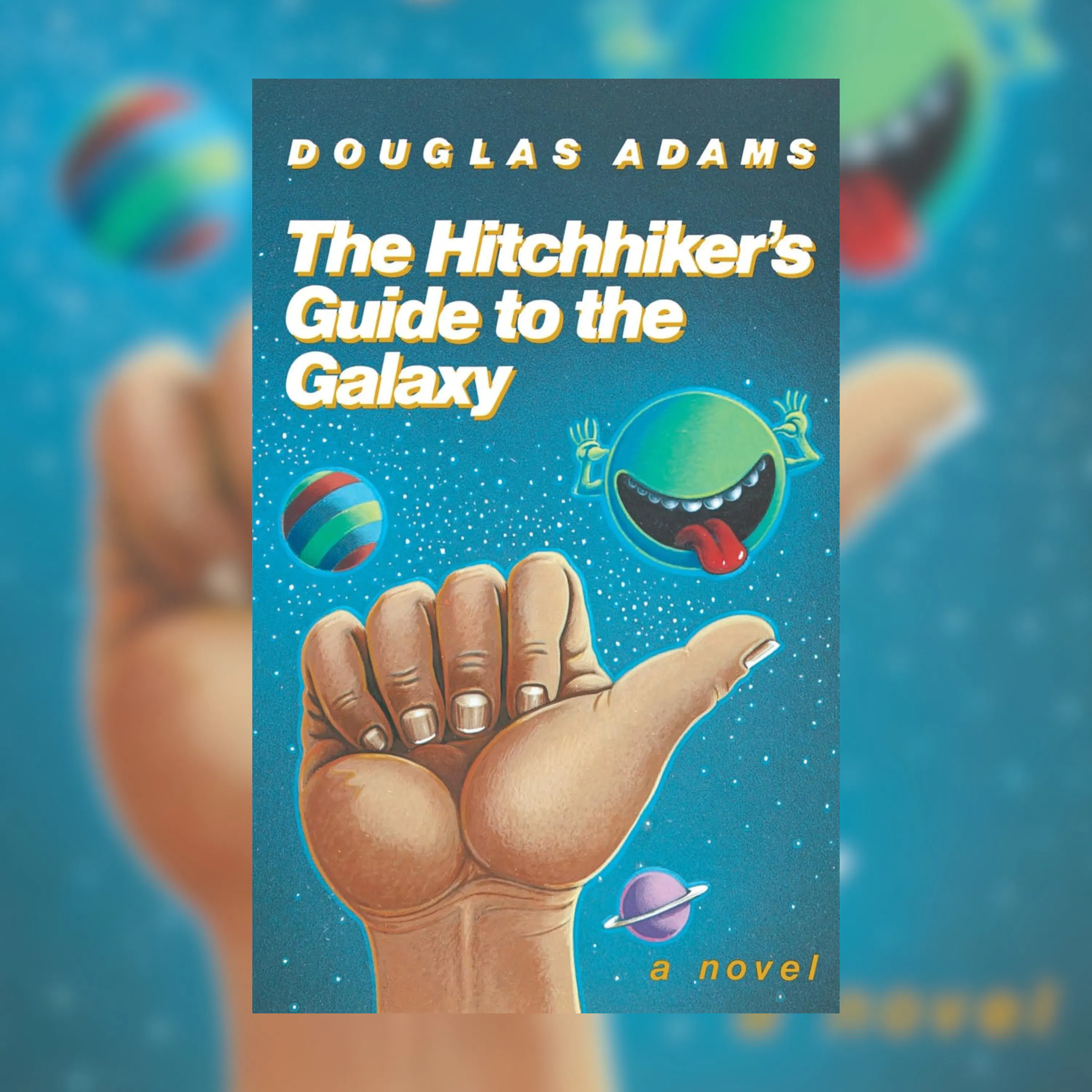
Zero to Well-Read
The Hitchhiker's Guide to the Galaxy by Douglas Adams
01:18:35
Grab your towel, pour yourself a Pan Galactic Gargle Blaster, and whatever you do: Don't Panic.
Loading summary
Transcript226 lines
- [00:00]
A
This episode of Zero to well Read is sponsored by ThriftBooks.com today on the show it's Douglas Adams. Hilarious, Wonderful. The Hitchhiker's Guide to the Galaxy. Originally just one, then two, then three books. We are only talking about the first of the books today, but that is not the edition I'm going to point out to you that you can find on thriftbooks.com what I'm going to recommend is an omnibus edition. It's the ultimate Hitchhiker's Guide to the galaxy which includes the five classic novels from Douglas as beloved Hitchhiker series. This came out on the, wait for it. 42nd anniversary of the Hitchhiker's Guide to the Galaxy. If you know, you know. And if you don't, you're about to find out in the course of this episode. You can get a very good copy for $8.39 right now on throw thriftbooks.com or if you want a new one, you can get it for 1669. Or if you want to go as cheap as you possibly can, you can get one for $6.99 in acceptable condition, 832 pages. You can have it, you can race right through it and you can enjoy all the wonders of the world as presented by Douglas Adams. You will really be a Froude who knows where their towel is if you get this edition. Thanks to Thriftbooks.com for sponsoring this episode of Zero to well Read. Welcome to Zero to well Read, a podcast about everything you need to know about the books you wish you read. I'm Jeff o'. Neill.
- [01:36]
B
And I'm Rebecca Schinsky. Pour yourself a Pan Galactic Gargle Blaster and whatever you do, don't panic. Today we're talking about the Hitchhiker's Guide to the Galaxy by Douglas Adams. A very big day here at Zero to well Read.
- [01:50]
A
I mean we should be releasing this on May 25th. It is May, so at least we're in towel month. But towel day, May 25th. If you know, you know. And if you don't, you're going to find out about why such a thing like tile day might exist. A extremely important book to me as a 13 year old, 14 year old reader and I think a lot of readers like me hit this as a certain age and you know, as on my hot takes here is that it's a very dangerous book to read as a certain age for a lot of kinds of people and artists. And we'll talk about there's some maybe the most powerful non politician in the world is a fundamental misreader of Hitchhiker's Guide to the Galaxy. How do you like that for a tease?
- [02:23]
B
Rebecca there's just so much going on in this book. It's been more than a decade since I went back to it, so really excited to talk about it. Other things that we can tease you all asked. You have been asking and we are finally ready to answer. For as long as the show has been running, which like, let's be real, it's only been about nine months, but we've been hearing from listeners who want some kind of book club or community reading experience. We've been talking about how to do that in a way that that's not just a standard book club, but that brings the special zero to well read Book Club meets English class. Still fun and light hearted approach and so we've decided to launch some guided read alongs. We're going to do them four times a year, roughly once a quarter, available to members of our patreon at the $10 a month level and higher. It'll include some pre reading info, exclusive bonus episodes where we talk about like what this book is and how to get ready to read it. We'll provide some suggested reading schedules. There will be a chat space exclusive for participants available on Patreon as and we'll be in the chat throughout the reading period giving you ideas and suggestions, answering questions so that folks can have a fun reading experience with a little enrichment along the way. We will bring some of the features of the show into those conversations. Really excited about it. We're going to announce the first book in a couple of weeks so if you are not already a member go to patreon.com 02 well read. If you're a member at the free level, make sure you upgrade to that $10 a month and you can participate in these book clubs with us. We're really looking forward to kicking that.
- [03:53]
A
You can find the link in the show notes to our free newsletter or become a member. Patreon.com jodowellred as Rebecca said and if you've got a second if you're mucking about in your podcast player anyway, go over to itunes or Spotify rate or review. The show rating is simple, just bop 5 stars easy and you're done. If you have an extra few minutes, get some really nice reviews over there. Just so you know, it does help the show in a couple different ways. One it feeds the algorithm right so it surfaces to more people. Also it helps us when we're looking for sponsorship or getting guests or doing other kinds of things like that. We often link to the Apple page specifically and the more ratings and the higher the rankings and blah, blah, blah, blah, blah. I don't want to yada yada, the good part, but, you know, all the things that go along with it. That helps as social proof because it's so hard for people to see. Like, what do people think of this show as we're pitching an advertiser or we're pitching a partner or pitching an ad network, or we're just trying to figure out, you know, what we're going to be doing with the show and how to decide what to do with the show. That's very helpful for us. So that'd be a very cool way to pay it forward and get more of what we're doing along there. And you can always email us@02 well read bookriot.com we're getting stories about, you know, first reading experiences, what they like, what they didn't like. If we have a question during the show, you can give us feedback on the format. We're making this thing as we go and we're always interested in what ideas people have and what we might do. A lot of that feedback was about the guided read alongs. Like a lot of people's like, I'd like to do this, or what about this? And here's a book club or here's something that might work. We ignore a lot of it. Not ignore it. We look at it, dismiss. We take in Rebecca.
- [05:24]
B
We consider.
- [05:26]
A
We consider, we consider. And we select very few.
- [05:28]
B
More of y' all than there are of us.
- [05:30]
A
That's right. Yeah. And everyone knows that it's difficult to make something cool. And most of the time you have to say no to do that. It might feel like Douglas Adams didn't say no to any idea in Hitchhiker's Guide to the Galaxy. That is not true, Rebecca. More than maybe any other book, the plot of this really doesn't matter. In fact, it doesn't really have a plot. Stuff just sort of happens. But what does happen?
- [05:52]
B
We gotta talk about what happens. So you have the framework. We're in England. We're in a small town with a very normie dude named Arthur Dent. He thinks he's having a really bad day already because he woke up to the news that his house is about to be demolished. Like today it's going to be demolished to make way for a new bypass. Then his friend Ford Prefect shows up to take him to lunch. It's a short lunch, 12 minutes, but it's very boozy. And Ford tells Arthur that actually, Earth is about to be destroyed by aliens who are called Vogons because they want to build their own bypass through space. It also turns out that Ford is an alien. He's been on Earth for the last 15 years conducting research for a new edition of the Hitchhiker's Guide to the Galaxy, which sounds like a book, but actually functions more like a proto iPhone. It has everything you need to know about life, the universe, and everything in it.
- [06:43]
A
Wikipedia. Kindle, I guess, is the best hydrated. Something like that, yeah.
- [06:47]
B
And this is written in 1979, so that's pretty notable that that's what that looks like. And Ford has snagged himself and Arthur a ride on a flying saucer that's passing by. They have hitchhiked on a flying saucer because in this world, those are totally real. So from there, Arthur and Ford are off. This is a deeply absurd intergalactic adventure. It brings them face to face with the really daffy president of the galaxy named Zaphod Beach. He has stolen a spaceship that's called the Heart of Gold, with his girlfri, Trillian, and Marvin, a chronically depressed and extremely paranoid robot. One of my personal favorites. So this ragtag crew of mostly aliens from different places, they make their way to another planet whose inhabitants once built custom planets for rich people. And that's when Arthur learns the real cosmic joke of the novel, which is that a massive supercomputer called Deep Thought has spent the last seven and a half million years calculating the answer to the ultimate question of life, the universe, and everything. And the answer is 42. The problem is, of course, no one knows what the actual question was, and they never will, because Earth, it turns out, was a massive computer designed to work out the question, and the Vogons destroyed it five minutes before it would have delivered the solution. Everything is meaningless. Jeff, why are we here?
- [08:09]
A
Or is it so pregnant with meaning that it's so hard to navigate? Could be both. And we can talk about that at the same time. Believe it or not, given that synopsis, this thing was a smash from the beginning. Adams himself will talk about in a minute, but it started out as a radio program that he wrote. Well, co wrote, and there's some creative complexity around who was all involved there. It was a smash immediately, But Pan Books then got the rights and published it in 1979, and immediately was a bestseller. So this was one of my hot takes. Straight thoughts, miscellaneous. But I'LL put it right here. Is this the most successful novelization of all time? Can you think of anything even close to this?
- [08:46]
B
Yeah, a book.
- [08:47]
A
I didn't do any research in it, but.
- [08:49]
B
Oh, maybe War of the Worlds.
- [08:52]
A
Was that a novelization that was started
- [08:55]
B
as a radio show? Yeah, it started as a radio show because people thought it was really happening.
- [08:59]
A
No, that was Orson Welles reading the H.G. wells stories that already exist. I think we haven't done our homework. You might be right. Anyway, that word not sure suggests that. No, that is not the most successful. This here is. I know there was some Alan Dean Foster Star wars stuff that was really popular because the. The. I think the Phantom Menace especially. Anyway, a good question if you know of one that more that's more successful than multiple millions of copies instantly. That's a pretty high bar to say at this point.
- [09:25]
B
Quarter of a million copies in the first three months. It hit the million copy mark within five years. And by the time Douglas Adams died in 2001, so 25 years ago already it had sold 14 million. We're estimated to be in the 15 to 20 million range. Now that is rarefied error, very rarefied air.
- [09:43]
A
Especially for a genre that didn't exist at the time, which is a comedy, comedic sci fi. And that's interesting because Adams had been trying to write comedic sci fi for at least a decade. By the time he gets around to writing the radio show. I can only imagine the shadow of Monty Python over British comedy even now is enormous. Was especially huge then. Like he said at one point, Douglas Adams was quite a tall guy and his idol was John Cleese. And he said at one point, like, I was really trying to be John Cleese. But I realized the job was taken, like just to give you some sense of the Python influence. He did write for some Python. He wrote for Doctor who early on, kind of. But this was the thing. The radio program being a hit in England and then making the books. And then really this was his signal franchise to the point it became onerous for him. He wrote in the detective genre later, which is actually kind of great, the Dirk Gently books. But this was a huge hit. Adams is the master of the modern simile. I'm so glad that he failed to be in Monty Python because I think this is the form he probably was ever going to be the best at. Just you have a couple of similes here that just describe his own success. It was like being helicoptered to the top of Mount Everest or having an orgasm without the floorplay and that is just Addams in a nutshell. And I want to talk a little bit more about the relationship of form and content and wit here in a little bit. But that's the kind of guy he is. This was a huge. It was a huge hit. I mean, I think there was a Watersense poll. I have this down the list here in 1996, I think, is what it was of the British favorite novels. And this was like, number four, like, way, way, way.
- [11:16]
B
And it's just been there for decades and it feels fresh still. Like, we'll get more into what does it feel like to read this today? But it really. It captures the inanity and the absurdity, just the deep absurdity of so many aspects of modern life, like bureaucracy. You know, there's a point where somebody to know, like, how come it's Arthur? Like, why didn't you tell me that my house was going to be demolished? And the answer from one of the bureaucrats is the plans were on display, but it turns out they were on display in the cellar because the display department is in the cellar of this building. So, like, where no one goes. Just really absurd bureaucratic stuff. But also the fact that, like, it's impossible to keep track of your ballpoint pins. And he manages to, like, kind of glom onto these parts of daily life and make them really funny. And he introduced this. This whimsy into a genre that has hist. Sci fi takes itself pretty seriously. And introducing whimsy and humor into it was a real invention in 1979. And the seeds, or I guess he sowed the seeds, but the effects of that continue today and, like, in the success of Dungeon Crawler. Carl is one of the great examples of this present moment. But in addition to, like, the whimsy, he also really taps into disillusionment that people feel like talking about how this planet has, or rather had a problem, which was this. Most of the people living on it were unhappy for pretty much all of the time. Just really cuts right to it.
- [12:44]
A
There was a people that were trying to make him or encourage him to write Star Wars. But for jokes, remember Jarwar. Star wars is 1977. This book is published in 79. I think the radio show is 1978.
- [12:54]
B
78.
- [12:55]
A
Douglas Adams and I have the same birthday, March 11th, which is just something that's kind of random. And I was born in 1970. And it means nothing. But I think Douglas Adams would appreciate that.
- [13:03]
B
But it feels like it means a
- [13:04]
A
coincidental relationship to these things. And then just to put some concept what other sci fi was. So there's like, the space opera sci fi of Star wars, which itself was like, hearkening back to the serials, like Buck Rogers of the. Of the 50s. But he was told over and over again early that sci fi feels like the 50s. It felt out of fashion, but the worm was turning. You get Star Wars 1977 and you have, like, Blade Runner in 1982, which is like the really grim, dark sort of version that we get. And this is like just a breath of fresh air. But I don't even think it's sci fi. I think he's just so damn funny and sci fi allows him freedom, especially how he writes it here, because Rebecca gave you the synopsis. But the first thing that actually happens is not that he gets picked up by Ford Prefect and take off the planet, is that he is told by his local council, as Rebecca was referring to, that his house is going to be destroyed that day to make way for, I think, a highway or a bypass or some infrastructure piece. And he is, by the letter of the law, he's been informed of the practicality of. He was not really given an honest chance to advocate on his own behalf. And then the exact same thing happens to Earth. It's so depth because Adams is saying, I'm going to be talking about real Earth things. I have this sort of fractal structure, but we're leaving Earth. So I'm not bounded by the realities of Earth or what's going on or direct political. I don't have to be bounded by that. It's interesting, you and I read a book about creativity and constraints recently. We've talked about the other podcast, and I kept thinking about that here, and I don't really know what the constraint was, and I wonder if that's part of his own writer's block, is that he could go anywhere in the universe. Right. That was maybe something that made it really hard to write well.
- [14:37]
B
And he was writing like one radio show to follow the other radio shows. There was not a master plan. Like, Douglas Adams did not have a red string board with, they're gonna go here and then they're gonna go there. He really was flying by the seat of his pants with it, which can be stressful and difficult and will give to writer's block once you've had a thing become successful, especially that you weren't to be successful, and now you've got to keep doing it. Like when you did not have a master plan charted out because you had no idea how long it would last. Or how big it would be.
- [15:08]
A
Maybe the radio program itself. I haven't read much before this Douglas Adams biography. I know there's a couple of them, but I'd be curious to hear if writing for the radio program, while probably still difficult, was. I don't know if the easier is the right word, but, like, it was regular, it had deadlines and it was short, and you had, like, a space that you were writing to, whereas you open up a word doc or a typewriter page or whatever. It could be anything. So maybe he could bound his own, like, imagination by. I need to do X number of minutes for radio in, like, nine days. You have. You have a great miscellaneous and adapt or trivia that we'll get to here in a second that's related to how he did and didn't navigate deadlines here and it spun out into TV series, video games. He's very interested in video games. Or a lot of video games, too. Comics, like. I guess it's one of my stray thoughts, and I'll put it here. It is kind of the Lord of the Rings, and it hasn't been revived recently in the last couple decades. But like Lord of the Rings, it expanded a universe. Right. Of related things. And it's interesting that it's gone away a little bit now. Rebecca, we didn't really talk about this in putting it together, and I didn't have a place for it on the sheet here. But there's a 2005 adaptation which is like the most recent peak, and it didn't perform very well. And I think there's some reasons we could talk about why adaptations are tough for this. But I feel like maybe there's people out there that haven't read Hitchhikers where 20 years ago I didn't feel like that was the case. Like, everyone I knew had read hitchhikers before.
- [16:31]
B
That's a great point. I think it's because this was a gateway drug for generations of young readers, especially adolescent boys like yourself, you know, in the 70s, 80s, early 90s. And it was a really rare type of book then, but it spawned like a whole genre and young adult fiction has developed at the same time. So I don't think that there's as much urgency concentrated around Hitchhiker's Guide for, like, for especially young boys who are interested in this kind of humor, where this was kind of the only thing for a while that a librarian or a teacher could put into your hands. And now there are just tons of options and they're newer and they don't Draw on the kinds of references. Like there are a lot of Britishisms in Hitchhiker's Guide and there are a lot of kind of dated pop culture references or like subtly dated pop culture references. But the joke about. There's a joke about how many roads must a man walk down? And that's only funny if you know it's a song. But it's a song from the 70s, right?
- [17:26]
A
Yeah, that's a good point. And I think the world that the sensibility, the minds that were shaped by Hitchhiker's Guide to the Galaxy are just so all over the place, you know, I have to believe, say, Family Guy, the Simpsons, like a lot of those kinds of shows were just hugely influenced by this Futurama. I'm sure Andy Weir loved Hitchhiker's Guide to the Galaxy. Right. There's sort of a jokiness, a lightness that he brings to sort of really serious, technically heavy stuff that feels like, you know, galactic spawn from the mind of Douglas Adams too. So I don't know, but they age beautifully. I mean, we'll get to hear what it's like to read it. But I felt that it aged beautifully. This is hugely important for me at the time. And one of the reasons it was for me is if you're 13, 14, 15, and this was especially a young boy kind of a book coded, I don't think it needs to be. There are not great female characters in the series. That's something that he acknowledged and tried to ameliorate a little later in the Dirk Gently series. Having said that, if you're sort of approaching the world and you feel like everything's kind of makes sense, like this is a great book for adolescents because it's saying, yeah, it is nuts out there, man. Like you're not, you're not crazy to think everything is bizarre. But also it's fun, it's gently irreverent, but also fundamentally irreverent, like maybe in the very basic way of like non revering of institutions or ideas or other kinds of ideologies.
- [18:52]
B
And it has been banned and challenged quite, quite a bit for some of those same reasons. For both sort of the attitude of irreverence, it uses some bad language, but also it has this kind of cavalier treatment of Christianity. It's not overtly critical, but there are some, and they're very minor, like little mentions, but there are some references that people did not like. And Adams was raised Christian but later became agnostic. So some of that is coming through in the text, like Again, just a little bit. But he was also friends with Richard Dawkins, the famous atheist writer. And Dawkins joked that Adams might have been his only convert.
- [19:25]
A
Yeah, there's a line in the book too. Like, he abhors religion, if not ideas of transcendence. Right. Because there's a line he says, you know, Jesus was nailed to cross basically for the idea that one should be nice to people. So it's not. It's not taking all the piss out. It's taking all the piss around what goes on about ideologies and how those things get implemented into the real world. I think that's dumb. I think this is about as friendly a book that has ideas that are challenging as you're gonna see there. I was listening to cuss words. So I read this twice for this reading. I did it in print, then I did in audio. Did. What was the cuss word? Was it.
- [19:56]
B
Oh, no, it's. It's not even.
- [19:59]
A
It's not even a George Carlin one. Okay, gotcha.
- [20:01]
B
Yeah, and it's a reference to like some title. It's like the whore of eroticon, something.
- [20:06]
A
Oh, yeah, like this being of a pleasure planet. Yeah, okay. Yeah, whatever. I guess that's it.
- [20:11]
B
It was the 80s. What do you want?
- [20:12]
A
Yeah, and. And then mine. Mine is kind of anecdotal here. Is that mainstream sci fi? Was that even a thing in books before Hitchhiker's Guide to the Galaxy? I'd like to know what the best selling book in sci fi was. Was it Dune? Was it Stranger in the Strange Land by Robert Heinlein? I mean, I don't know.
- [20:32]
B
Lord of the Rings?
- [20:34]
A
Well, that's fantasy.
- [20:35]
B
Oh, that's right.
- [20:36]
A
Yeah, right. Maybe. And even Dune. Dune is space. It's very, very unusual. It inspired a lot of copycats. And one anecdote within the anecdote is Eric Smith, a former book writer who has turned literary agent. I remember this stuck with me. He had on his submissions page where he sort of talks about the kinds of manuscripts he's looking for. Explicitly not looking for Hitchhiker's Guide to the Galaxy. Like submissions.
- [21:01]
B
Yeah. So it's stuck with writers, even if it hasn't been in the general cultural water for a while. That is interesting.
- [21:08]
A
And Adams himself, because of this, I think people recognize, unlike say some other books, you really feel the writer's voice in this. Even more than Tolkien or more than Frank Herbert or more than Octavia Butler. Some of the great genre fantasy world building writers. It's so voicey that he Himself became and has become a sage, a figure, kind of like. And he died young, which gives him sort of the Kurt Cobain, Janis Joplin, Jimi Hendrix kind of mythos, but it's kind of a. Not an uninteresting. But he's like, he wanted to be a comedy writer. Like, that's what he wanted to be like.
- [21:44]
B
He described himself as a twitchy and somewhat strange child. And like, you definitely hear that in the writing. Yeah, it's a little neurotic. Born in Cambridge in 1952, he grew up in London, went to prep school, and he had a Mr. Keating moment. He had a teacher named Frank Halford who had a really profound impact on him. He gave Adams the only 10 out of 10 in the class that he taught for creative writing. And Adams talked later in his life about how that was something he would draw on to help him bust his writer's block throughout his career. Just remembering back to this high school teacher, then he went to St. John's College. As you were saying earlier, he hoped to be a writer and comedy performer in the vein of Monty Python. He did do two brief appearances in Monty Python's fourth series, which is what we would call a season here in the us. Graduated with a degree in English lit, and then he went out to become a TV and radio writer and just got obsessed with trying to marry sci fi and comedy in a single project. And then in 1977, a BBC producer encouraged him to pitch a show, but he'd been actually holding onto the idea for Hitchhiker's Guide for a little while in the early 70s. He himself was hitchhiking around Europe and he was drunk in a field in Innsbruck, Austria. He was. He's holding onto his copy of the Hitchhiker's Guide to Europe that he admits he had stolen from someone else. And he thinks some. He's like looking at the stars and his drunken stupor and he thinks somebody should write a Hitchhiker's Guide to the Galaxy. And that just goes into the back of his brain for five or six years until he gets this opportunity at BBC. And. And it sort of re. Emerges of like, oh, that's the thing that I could call it let's do the Hitchhiker's Guide to the Gal Galaxy.
- [23:23]
A
Yeah, I think it's also, as you. If you've read this or you're going to read this or you just want to understand it, I think his background, training, aspirations in sketch comedy really informs the structure and attitude of this, because there isn't really A plot. There's a series of things happen. He loves this set piece. I think he's no happier than describing some planet with a weird backstory or conditions, or there's some object like the History of the Babel Fish or something like that. Like, that's when he's really having. Seems like he's really in his bag at those moments. I think that is taking an idea, taking to a logical and absurd conclusion is making it as fun as he can, and then you just move on to something else.
- [23:58]
B
Yeah, that's one of the most interesting things, is that there are those really detailed descriptions of particular things, but there's not really world building. Like, we're just in this galaxy bopping around from one planet to another, having these adventures, and you find out a little bit about this planet and a little about this other one, and here's this piece of technology. But, like, those could all be swapped out for completely different things or just called Planet A, Planet B, Planet C. And he would still be having fun, like, giving you descriptions of them. The details of this book, like, really don't matter at all.
- [24:29]
A
No. And it feels like the original idea he pitched was for the radio show, was for an anthology series where in each episode, the Earth was destroyed in a different way. Right. So, like, it was just gonna reset every single time, and then you have to invent everything else like this. I find myself, like, wondering if. What if he actually wrote an abridged Hitchhiker's Guide to the Galaxy, and each one just, like, was an entry, because I feel like that's what he was maybe having the most fun doing. Like, I don't think in this book, I'm now blending the other books, which I didn't reread for this, but I remember a piece of them, so it's kind of mushing in my mind. I don't ever think we get the backstory of the Pan Galactic Gargoyle Blaster, but I found myself really wanting to read the Hitchhiker's Guide entry for the Pan Galactic Gargoyle Blaster, the most potent
- [25:10]
B
cocktail I did find. Recipes for it, I'm sure.
- [25:14]
A
Also, I guess, plus one for Drunken stupors and the inspiration for this pretty
- [25:18]
B
good show for the old. Right. Drunk at its sober moment, perhaps Adams, like this, becomes successful, as we've talked about, almost immediately. They're just off to the races as soon as the first book comes out. And then Adams is kind of trying to figure out what to do with his career, because he's not Douglas Adams. Million copy selling author for another couple of years. He was about to hang it up and he got a gig as a BBC radio producer that he took for the money. He produced one job and then he went on to work on Doctor who. So he's writing Doctor who while he's also writing the subsequent Hitchhiker's Guide books and radio series. And even Adams himself talks about how like no one knows what the canonical Hitchhiker's Guide story is.
- [25:59]
A
There isn't one.
- [26:00]
B
If you thought that things got messy with Game of Thrones because the TV series ended before George R.R. martin has finished the book, this was like radio series, book, book, radio series, book, radio series, book play, game, puzzle, other radio series, other adaptation. And they all have like most of the main pie, but they are not beat for beat the same stories. And like I have no idea how Adams carried all of this around in his head. There are, there's probably like really deep, wonderful, nerdy Internet stuff trying to untangle all of these. But it's, it's just a wild universe.
- [26:35]
A
Yeah, it's unruly. I mean, when you're trying to write the Guide to the Galaxy, I guess it inherently is going to be unruly. And even the title is telling you something about what we're. This is a compendium, this is an exploration. This is not a hero's journey, Joseph Campbell type things even. There is no call to adventure. If there is, it's, you just need to get off this rock and you don't know what's going to happen. Because Arthur Dent, who is putatively, he's sort of our Bilbo Baggins or whatever, is always just confused. He has no agency, he can't do anything. He doesn't know enough to even like volunteer to take the ring. Ford Prefect just says we're going. They're friends in Ford Prefect, you know, that gesture of friendship is the thing that gets him off the planet. But he is subject and subject and subject and that's kind of the story here. So really it's. Adams is the main character. I think his own sensibility, his own creative imagination is the star of the show. And I think that's fine. That's just something you're gonna get on with.
- [27:26]
B
He does become a character in his own right in the world of writing and sci fi fantasy especially. We've mentioned a few times that he suffered terrible writer's block. But there is a famous Adams quote where he says, I love deadlines. I love the whooshing noise they make. As they go by. Like if you've taken a creative writing workshop or even googled your way to like how to write a book, I'm sure you have run into that. But like really bad writer's block. When he was working on the fourth book in the series, he was locked in a hotel room for three weeks with Sonny Meta, who is one of the most legendary editors in literary history, and Meta was just babysitting him to get him to finish the book.
- [28:05]
A
Study and play come together on a
- [28:08]
B
Windows 11 PC and for a limited
- [28:10]
A
time, college students get the best of both worlds.
- [28:14]
B
Get the unreal college deal everything you need to study and play with select Windows 11 PCs. Eligible students get a year of Microsoft 365 Premium and a year of Xbox game Pass ultimate with a custom color Xbox wireless controller. Learn more@windows.com studentoffer while supplies last ends June 30th terms at aka mscollegepc. This episode is brought to you by Prime Obsession is in session. And this summer Prime Originals have everything you want. Steamy romances, irresistible love stories and the book to screen favorites you've already read twice. Twice off campus Elle every year after the Love Hypothesis, Sterling Point and more slow burns, second chances chemistry you can feel through the screen.
- [29:00]
A
Your next obsession is waiting.
- [29:02]
B
Watch only on prime. This summer. Serve up the cookout classics craft mayo and dressing. Toss green salads with delicious ranch dressing or zesty Italian. Serve smooth, craveably creamy potato salads with mayo. We all know it's not a cookout without Kraft.
- [29:24]
A
I'm trying to think of it'd be like if Rick Rubin had to get like Eminem and is like we've gotta finish this and we're gonna sit. I know that happens, but we don't hear this story in books very often.
- [29:33]
B
I would watch a stage play just about those three weeks. Just Douglas Adams and Sunny Mehta in a hotel room.
- [29:39]
A
Kind of a grumpy sunshine dynamic between them where you know something is going on and.
- [29:45]
B
And there's only one bed. There's our fanfic.
- [29:48]
A
And this is the fourth book. This is not like the first book. This is where you've been doing this for a little while.
- [29:52]
B
He just like couldn't.
- [29:54]
A
He gets all mobbed up with the Apple crew. Like he loves an Apple Macintosh. Like he's looking at early word processors. He's someone interested in technology, as you can tell by the books themselves. Skeptical of it, but also fascinated by improbability drives and hitchhiker's guys. Like you can see both Sides. He and Stephen Fry. Stephen Fry, who narrated the unabridged audiobook that was released with the 2005 movie. He and Douglas Adams were the first two people to get the opportunity to buy a Mac in Europe, which is kind of an interesting side note at the same time. And that's like kind of entree into him being a. I don't even know if you call it spiritual, but like a much loved figure in Silicon Valley, in the world of technology, even, even until today, I think Adams would find that pretty funny and disturbing because so much of what he is like is like people are get over their skis about technology. It's just us humans here and we're gonna screw it up.
- [30:50]
B
He's satirizing some of the big personalities in the world of politics in the book, but you can imagine that if he were alive today and writing an updated version of this, he would be satirizing Elon Musk and Sam Altman and those guys who many, like, many of whom especially Musk, are out talking about how much they love Hitchhiker's Guide to the Galaxy and how much Douglas Adam influenced them. And like, talk about like misunderstanding a text.
- [31:14]
A
Yeah, just misreading the room. When Tesla shot that, I don't remember which. Which of the Teslas they shot into space. There was a copy of Hitchhiker's Guide in it, which is just so ham handedly dumb that I can't even describe it. Like, you just, you don't get the subtlety, you don't get the joke at all. Which I think is one of the dangers of reading a book like this is it is so funny on a surface level that I think it can be deceiving. There is a bit of sleight of hand because I think this is actually about things. It may not have a coherent argument, but it certainly has coherent, critical.
- [31:50]
B
Yeah, there's a real perspective. I think that's very well put. You've alluded to it a couple times. So let's just like get into it. Tell me about your first reading of this book and what it meant and how that happened.
- [32:02]
A
So my uncle, who is a. A very interesting person interested in the arts and a doctor, he left me. He was moving between homes, a box of his books from college when he was moving. I was 13 and it was a real grab bag. It was the first four hitchhikers. I don't think not all of them were out at this time. This would have been 91, 92. It had Portnoy's complaint. It had Dog. It had Catcher in the Rye. It had Man Child in the Promised Land by Claude Brown, which no one really talks more. I was talking about that in an earlier episode, just all kind of stuff. And I was a bookish kid. I don't know if I've told this story before, but in sixth grade, I tried to read the 10 longest books in the school library. And, like, the last one was Last of the Mohegans by James Fennel Cooper. And I was just that kind of kid.
- [32:52]
B
You have always loved a project.
- [32:54]
A
I do like a project and this book. I was a huge Star wars fan, right. So a huge Star Trek fan with my family. We watched Star Trek Next Generation. But I also thought of myself as a fun. I like making jokes. Like, I liked humor.
- [33:07]
B
You like wordplay a lot.
- [33:08]
A
I like wordplay a lot. And this felt like a transmission from outer space, like, directly for me. I really did feel like I can't believe this exists. And I didn't know at the time how popular it was. And I don't know if I would have liked or disliked that idea. There was part of me that liked that this was just this box of book. Was I uncovering a gem or something? I found out later. And then my high school friends started reading it later and they'd get it in secondhand bookshops and comic book stores, like, genres, stops or whatever. And we realized, like, okay, this is. This is a cool thing. And then it became a bit of. I don't know, kind of a mark of like, did you. Do you get it or you don't?
- [33:44]
B
Yeah, it's a really. If you.
- [33:45]
A
Are you hip to the vibe or are you not? Are you a fruit who knows where their towel is or are you not? Which we'll talk about here in a second. So. And then I read all four of the books. They were all there, and I just blew through them. I guess you should know about the books. There's a. Would you call it a cliffhanger at the end of Hitchhikers. Like, it leads into the next, but there's no real story. Like, you could keep going or you could stop. Like, if you feel like you've got enough, you've gotten it, you're not going to miss anything. But if you want more, there's more.
- [34:09]
B
Yeah. Classic radio serial situation. Like, we'd like for you to come back tomorrow, but today you had a complete experience.
- [34:15]
A
That's right. Yeah, yeah, yeah. And you came to it a bit later, right? And you did.
- [34:19]
B
Much later. Much later. Because they were not just shoving this into the hands of adolescent girls in the early 90s. It was pretty boycoded, as you said, so I knew that the guys had read it. My husband Bob had read it by the time we met in college. He read it as a teenager, and I knew he liked it. He talked about it, but I just had never. Like, I just. Nobody recommended it to me. I knew it was a big deal, but it didn't feel relevant to my reading life. And then I had heard that the audiobook read by Stephen Fry was stellar. We were going on a road trip in 2014. I checked my reading spreadsheet, and we listened to the Stephen Fry audiobook production, and I was like, oh, I get it. I don't know if I would have had the same experience just picking up a paperback as an adult. This feels to me like such a formative book to read as a young person, that both that audio experience and then this reading of it in print are more anthropological for me than they are about a direct relationship to it. But I. I get it, and I do have a lot of affection for that audiobook. It was a really fun moment. Like, we will still walk through our house just occasionally going slotty Bodfast.
- [35:28]
A
Yeah, the. The. The Fry narrated audiobook is wonderful. As I said, I had never listened to it before this. I've reread the book several times, but it does help you. I think if you're coming into it real cold, it can take you a little while to figure out what the tone is, because it's not as silly or silly. It's whimsical and inventive and strange. But from the beginning, like, the opening few pages about the bulldozer are pretty straight ahead. Like, it's ironical, but you don't get a sense of what you're in for until you're on the Vogon ship. You really don't. So I think it can be hard to find your footing. Whereas the performance by Fry, you get much more of a wry English. This is comedy. There's a version of this that's like a tragedy, right? The Earth is destroyed. Rebecca.
- [36:14]
B
Right?
- [36:15]
A
Like, that just happens in, like, the first five pages. Like, what the hell do you do with that? And the audio gives you a little more clues, so it's just super fun and funny. Like, I think that's the most. The surface level, but also a totally fine takeaway. But it's about some stuff right here. Like, what is this about? Like, what is his point of view? What are we looking for? What is all the jokes at the center of the joking? Tootsie Roll Pop. What is it here it is, I
- [36:39]
B
think, a really interesting question to ask because it's not totally obvious if you're just cruising through the fun and silliness. But the book is not without its arguments. I think Douglas just makes them in such a fun way that the pointedness gets a little hidden or subsumed. But to me it feels like Parks and Rec flavored, like gentle poking fun at things like bureaucratic silliness. Like it's not. Not anger fueled criticism like Pension or Vonnegut, some of the guys who were writing at the same time that Adams was. But he is pointing at some of the same things that. Like the way that governments run is frustrating and often doesn't make sense. Politicians can be really dumb and performative and it can just feel like maybe it's all meaningless out there in the world and yet we all continue to try to make a go of it and to try to protect the Earth, to try to keep our houses going. Like people are unhappy and maybe that's kind of their own fault. And Adams is sort of in on all of that. There's, you know, jokes about like that it turns out that humans are not the most intelligent creatures on Earth. It's the dolphins and humans aren't running Earth, it's mice, it's the lab mice who are in charge the whole time. There's a real, I think just attempt to like expand the aperture of how we look at and talk about humanity. I think Douglas had, or Adams had a great affection for humans, but could see the flaws and was kind of doing a. Like holding up a mirror, but in a gentle and funny way.
- [38:10]
A
Yeah, and not unlike Python, it's extremely interested in deflating, you know, whatever monuments there are to seriousness, to importance, to received and unalterable. I don't know, vessels of meaning, import or status. Right. The Department of Silly Walks or the Holy Hand Grenade. Like they're. They're very much rotating around. Like that's all stuff that is just kind of made up. And let's talk about how it's made up and contingent. I think what's interesting about Adams is like once in comedy of all of that style, once you do that, then what is left, you know, what's left after you do the deflating? What after you take the piss out of that thing? What is left of the vessel in which was containing the piss? Like how much of our lives and our social structures are held up by piss. Then once you do that? I think we reckon with. With like, maybe the bleak atheist. He's not existentialism. He's not a nihilist here. That's not what this book is. But there is a. Oh, no. Now what? It's just us here. If the life, the universe, everything is unknowable or random and it's just us, Suddenly it's our job to figure out how to make meaning. Right. I think that's kind of where we end up with these books.
- [39:24]
B
And he completely refuses to make the meaning for us.
- [39:27]
A
There's no answer here.
- [39:28]
B
Absolutely. The ambiguity behind the question, question and answer drives some people totally nuts. Like, fans have posited all kinds of guesses about what question could have yielded the answer. 42. And Adams stated repeatedly that there was no answer, like, no matter what. But you can. If you're curious, you can Google your way to all sorts of ridiculous and elaborate theories that fans have come up with. There's just a real desire from outside to make this book be about something in addition to what it's already about. So there's also real comparisons to Alice in Wonderland, I think, just because it's plain and he's got these silly sounding creatures. But Douglas Adams was on record as adamantly disliking Lewis Carroll's work and sort of not wanting to play in that same field. But he is turning like bureaucracy and incompetent politicians, they're just this eternal and endless source of frustration and of comedy at the same time. And there's like kind of an eerie trumpy energy to Zaphod Beeplebrock.
- [40:30]
A
Yes.
- [40:31]
B
But that's a nice reminder that these are not new characters on the world scene or on the political stage. Like these kinds of characters and these kinds of people exist, and they are ridiculous and absurd and they do end up with power and in positions where they can cause a lot of harm. And maybe we can, as you were saying, deflate those balloons a little bit by just calling it out. Pointing out that the emperor has no clothes.
- [40:55]
A
Yeah. And, you know, if there. The human gesture or the sentient being to. Sentient being gesture. Not to be speciesist here that initiates the book is Ford looking out for his friend Arthur. He didn't have to say to Arthur, arthur, you know, let's get out of here. Right. He does. He takes him with him. He doesn't have a plan. Arthur's existence is more of a hindrance to Ford's own survival than it would be if he weren't there. But I think there Is a sort of fellow feeling like, okay, if it's a random, absurd universe, let's at least have a pint together while we navigate it. And, you know, while we're going through the multiple dimensional space initiated by use of the Improbability Drive that powers the Heart of Gold, like, at least let's.
- [41:33]
B
Those are words you all just said.
- [41:34]
A
I think that's it, Rebecca. I kind of think that's it.
- [41:36]
B
I think so.
- [41:36]
A
But it's like, remarkably powerful and familiar
- [41:39]
B
that, like, life is absurd and guided by happenstance, but it's not presented in a doomy everything is pointless way. And if it's not that everything is pointless, even though life is absurd and guided by happenstance, what does that mean? And what does. What kind of life does that make for us? And I agree. I think Adams is pointing at a. Like, just like, help each other out and let's go on the ride together.
- [42:02]
A
You have a really good point about how Adams nailed how annoying AI and smart technology would be to interact with. That seemed. That seemed to me the most prescient point. Sort of the operating system, whatever, that governs that you interact with. In the Heart of Gold, which is the. The ship that Zaf Vod Bebrok steals, you can download different personalities, and each one is sort of more insufferable, or at least differently insufferable than the last. And I think the part of that is also how even as great as this technology stuff, or as powerful, I guess as technology is, it's still beings that have to interact with them and we're flawed. Ergo, go, they're going to be flawed. Like, they build this computer to get the right answer, but they don't think to ask the right questions. And then they don't keep track of what's going on and tell the Vogons, don't destroy that planet because we're working on something here. And so we just keep getting in our own way. So I would be super curious what Adams would think of AI in its current instance. My guess would be, and tell me if I'm wrong, It's like, that seems pretty great, but people are still going to people. So I don't know what to tell you.
- [43:01]
B
Right. I think you would be unimpressed with the current state. State of it, but, like, we're using it for dumb things for the most part.
- [43:08]
A
Right.
- [43:08]
B
You know, but if you've had like a shouting match with the AI that answers the phone when you try to call the pharmacy and get a refill,
- [43:16]
A
or that Siri will just pop on your watch, like, when you don't even want to, and you're not even saying anything remotely.
- [43:20]
B
The conversations that they have with the onboard computers and with Marvin the Paranoid Android, like, really just really nailed how all this technology is supposed to be fancy and supposed to be smarter than we are, but can. Can be super obnoxious. Obnoxious and glitchy and, like, it costs you time in the long run, and maybe you're gonna die before you get to that other planet.
- [43:42]
A
Yeah. It's funny that we were talking about braiding sweet grass earlier, because I think if Adams and Kimmerer have a shared affinity at their core, it might be this is that humans thinking of self as the center of whatever, just that doesn't work. Adams became a noted conservationist, and his most. The book he was most proud of was actually a book about conservation in nature. The name escapes me. I've never read, and I've always read meant to. But there's a very much of. If we take some of the piss out of humanism, meaning humans are the center of the universe, there's a lot of interesting things that descend from that. And one of that is we got to think differently about how we interact the world and what we do to the world and to each other at the same time.
- [44:21]
B
The conservation book is called Last Chance to See. It came out in 1990, and he wrote it with zoologist Mark Cowardine, documenting travels to find endangered species.
- [44:32]
A
Yeah, And I'm sure things are better since he wrote that book. We figured out, luckily, you know what it's about the smallness of humanity in our own experience. One of my favorite modes is Adam's describing how big the universe is. Like, this comes up over and over again. And the logic thing that follows that is like, there's a lot out there that isn't us, and we don't even know. We don't know. So humans can't just be that important. Right. Unless you think we're the only ones out there. The next step is there's a lot of things that are not us, that are teeming and sentient and have experiences and cultures and. And foibles. And if you admit that, then that gives you kind of a huge perspective that is radical in its own way. It's certainly radical to a Christian tradition or really any earthly religious tradition. I don't know how, say, Buddhism deals with the idea of life on other planets. I don't want to speak to that, but most of them are pretty. How we live with ourselves on this planet Earth. And Adam is like, well, there's a lot out there, man. Like, so much we can't even think about how big it is. So we really don't matter all that much. These things that we think are so, so important. Most of it is just nothing. And that's interesting. And he loves ideas in science and nature and math and physics. I thought he was like a computer engineer guy when I was doing the bio research. Oh, he's an English major, just like the rest of us dummies. But really developed a love, an interest in science and nature and thinking about probability. And I think he weaves ideas of science in very naturally and funny in a way that's not off putting at all.
- [45:57]
B
Yeah. And it's not wonky at all. Like, especially because a lot of the science is made up that you just kind of can let it gloss over and like, okay, we're on this ship. There's an improbability engine. It helps if you understand probability. You're fine if you don't.
- [46:12]
A
Right. Straight thoughts. Rebecca. What it occurred to you as we were having this experience.
- [46:15]
B
I said it in the intro, but, like, sure. Sounds to me like Douglas Adams invented the smartphone. The Hitchhiker's Guide really sounds like it. This tiny device that has a bunch of icons on a screen and you can tap it and look, learn whatever you want about all the places in the world. Just all the tech stuff is really interesting.
- [46:31]
A
Well, I think the promise of the smartphone. Cause that's what we thought when we were getting the first iPhone. You could know anything. We don't use it for that. We're dumber than ever. And we have the sum total of human experience available to us. And we use it to scroll like people doing dances, which is fun and fine, but it does bring home to me. It's like we do actually have the Hitchhiker's Guide to the Galaxy on our phone. And most of us use it for things. Literally anything other than that is what we use it for. Which. That sounds like a very Adamsian take, actually. You have all the universe, all the information available to anyone that's ever existed in your phone pocket. And you're looking at people who are AI influencers that are yassifying themselves. Like, what a disturbing thought that is. Is that right? Did I get that right at all?
- [47:14]
B
I'm not sure that I really am delighted to hear you say yassify.
- [47:17]
A
Yeah, I've got to be careful out there. My. My knife skills are just good enough to hurt Myself with when it comes to knowledge.
- [47:23]
B
I like spent a lot of time reading this wondering if Douglas Adams would have been a good hanger or totally insufficient. And I think I landed on good hang by the end of his career, but maybe insufferable as a younger man. And I will also fully admit that this is projection about the boys I knew when I was a young person who were obsessed with this book, like it attracts or it used to attract a certain flavor. And not all of them were that way, but enough of them were like. Enough of them became Elon Musk to be like, are we sure? Sure.
- [47:58]
A
That's really well said. We didn't do a great job. And I'll speak for us here. And this is not a defense, but a reason. I think the trick we missed is the point we were just talking about, which is we thought if we were on the Adams train, then we did have it figured out. But the Adams train is really about humility. We missed that part. We missed it. We thought it was being about smart and snide. It is not about that. It is realizing no matter how smart and snide you are, you still don't get it and the universe is big and you should still be a reasonable person. So I apologize. It's tough out there for 14 year olds, but still.
- [48:31]
B
Yeah. And then I also noticed in my research, the book has been translated into dozens of other languages. And I really could not stop thinking, like, what would it be like to read this in like Chinese or Hebrew or a language that is so different from English? Like, how does the wordplay work? What would a translator have to do to capture. Capture that? How do you translate like whimsy from one language into another and capture the vibe of something like not just, you know, a Pan Galactic gargle blaster, but this, the improbability engine and the feeling of these politicians. And some of that is also just specifically Western culture, you know, like 20th century Western culture. How does that adapt to readers around the world? I couldn't find anything from a reader outside of like the US or Britain really talking about the experience of Adams, but I would love to.
- [49:26]
A
Yeah, what is it? What are the Chinese characters for Pan Galactic Gargle Blaster? You have to make some up. Like, I don't know how you've been doing that. Are you writing in Romanized language? Let's see. I've got here. Yeah. Adams would have loved Wikipedia, would have hated social media, and would have been unbelievable at Twitter in the heyday of Twitter. That's my Those are some of my. My thoughts. The one liners are tremendous. We'll get to favorite quotes here. But like, you can. I will just sometimes go read Douglas Adams one liners just for fun. And I don't say that of many writers.
- [49:55]
B
And you have something here in Stray Thoughts that actually was going to hit in hot takes, so I think we should just mention it. The corner that welcome to Night Vale stands on in the podcasting universe like it owes a huge debt to Douglas Adams, but I think he would have been on that corner had he lived into the podcasting age.
- [50:10]
A
Yeah, I was thinking about those like, critical roles. I don't know much about them that are. That are Dungeons and Dragons campaigns essentially. I think he would have had a lot of. Of fun with something like that. At the same time, straight thought that, I don't know, maybe I could. Is there a model for how to be in the universe here? Like we're not supposed to be Ford Prefect or Zafod or Trillian or Marvin or Slaughter Bar. I don't think there's a real answer. Like, much like there's not an answer to the question we don't really get a model for. Okay. If all of this stuff is absurd and everyone sort of is an idiot across the galaxy, even pan dimensional mice travelers, even if they screw it up, what the hell are we supposed to do with it? I don't think there is an answer. I'm not really sure. The only thing I get is if someone's plan is about to get destroyed and they're your friend, you take them with you. That's all I've got. Everything else is, I don't know. Is beyond my understanding. No, no, it's not bad. And maybe that's enough. Certainly, yeah, you have this point. Imperial galactic government is 100% the title Trump would choose for himself. Luckily, Zafod, we're given to understand, is maybe more subversive than that. But he doesn't know why because. Anyway, we're getting into details on that.
- [51:16]
B
Yeah, President of the Imperial Galactic Government. Like right up there with Supreme Commander of Allied Forces. That's a great job title.
- [51:24]
A
Supreme Commander, Allied Forces of Europe. What a job Ike had. And then became President, which was a comedown after Supreme. Yeah, I think this is pretty. I also wondered if this, if this didn't exist today and it presented as a book, I think it still hits. It would be a little bit different. But one thing that translates is usually just funny. They're jokes. They're jokes on jokes on jokes.
- [51:45]
B
I think humor works. And I was talking to a friend who owns a bookstore. We were talking about Dungeon Crawler Carl and he said that they are hand selling Hitchhiker's Guide as a read alike for the people who are powering through now. There's eight Dungeon crawler Carl books, but want more in that zone of funny sci fi. And so it is still hitting. I think you're right. I think there's something timeless about it.
- [52:07]
A
We've kind of danced around. I think notable quotes may be the best way to talk about this book because it's so. So. You know, like I talked about the opening of sort of fractal where you get versions of the same thing. Each sentence is in a way in miniature what Adams does. Right. Like you can kind of divine the whole from the part actually, as they're going to try to do to Arthur Dent's brain at the end. I was just trying to think. That's actually an interesting comparison there. Where do you want to start with Rebecca?
- [52:34]
B
Well, let's just start with Never Change. Goodreads.
- [52:36]
A
Oh, yes. This is so funny. The most live laugh love quote is the one they pick out. They always will.
- [52:43]
B
The quality of any advice anybody has to offer has to be judged against the quality of life they actually lead. Which is a line in this book, but is definitely not meant to go in earnest like this. Some of my favorites. Bureaucratic cock ups. Angry men lying in mud. Indecipherable strangers handing out inexplicable humiliation. And unidentified army of horsemen laughing at him in his head. What a day. Time is an illusion. Lunchtime, doubly so. Then when they land on Magrathea, the planet where they used to make other planets for rich people. Ford Prefect. A man after my own heart. An alien man after my own heart, I guess, looks around and says, desolate hole. If you ask me, not even a hot dog stand in evidence.
- [53:37]
A
It's just so unnecessarily funny at times. Like, I'm not sure what planet is, but like, it's where they happen to have the English words Easter in France, but they mean completely different things. And it's like it just so happens on this planet. The word Easter means small, round and flat. I'm like. Or no, small, brown and flat. I'm like, what? I stared at that. I was like, what does that mean? It's just funny. It's just unnecessarily creative.
- [54:00]
B
Yeah. You've probably seen things branded with. Don't panic. That's a big one. That's what's written on the COVID of Hitchhiker's Guide. This description of Zaphod Bee blocks and the utility of politicians stood out to me. Only six people in the entire galaxy understood the principle on which it was governed. And then later on, the qualities he, Zaphod, is required to display are not those of leadership, but those of finely judged outrage. For this reason, the President is always a controversial choice, always an infuriating but fascinating character. His job is not to wield power, but to draw attention away from from it. Douglas Adams, welcome to 2026.
- [54:37]
A
Yeah, I was going to shout out the first line if we do like a mini close reading moment for here. Just let you see a couple of things. This is not the first line. This is the first two sentences. Far out in the uncharted backwaters of the unfashional end of the western spiral arm of the galaxy lies a small unregarded yellow sun. Orbiting this at a distance of roughly 92 million miles is an utterly insignificant little blue green planet whose eight descended life forms are so amazingly primitive that they still think digital watches are a pretty neat idea. So a funny. Right? But also look how he puts humanity in this unimaginably large. Like he. He starts big and narrows and narrows and narrows it down. I almost. And he does this several times where we'll get big descriptions that like circle and circle and circle and like end at a really specific, almost understated sort of denouement at the end of the. And it's cool. It's just interesting to see him do this over and over again. But also he's a funny guy. But those are quite beautiful sentences. Like it's kind of wonderful and awe inspiring. He can do that if he wants to. He sort of doesn't want to. But that sort of serious in the serial comicness that he's doing. That's the serio part. And the comic is digital watches are a pretty neat idea and like really pinpointing we care about these small technological advantages, advancements still going on. But he's also indicted in this because he's a huge lover of technology himself. So he's not outside of this. I guess that's one thing to say about EMS too. I don't think. I don't feel. I guess you tell me differently. I don't feel that he is outside of the critique of humanity he's making.
- [56:09]
B
Yeah. And I think there's like, there are other versions of critique of humanity that are really negative in the way that they do. Hey, look how Small humans are like, get a hold of yourselves and have some humility. We're just these tiny people on this tiny rock floating through space. But his is really warm, affectionate, and there is like an innate humility, I think, to the approach. And he knows that he's part of it. But it's more of a like, look at these silly humans doing this thing.
- [56:35]
A
Look at us apes at the same time. Also, I want to introduce, if people don't know this literary term, the light oat, which is kind of an opposite of hyperbole, which is exaggeration for effect. So this is something he does a lot. Does a lot. So, like, digital watches are a pretty neat idea. That's an understatement of huge humans fascination with technology and our own sort of techno fascination. So you might look for that. It's a real hallmark of a lot of British humor that to do these little understatements like, well, that was rather difficult, wasn't it? It's like when you just got your arm, it's only a flesh wound from Monty Python. When the black knight gets his arm, it's only a flesh wound. That is a light. It's understatement for effect. So you can take that with you. Welcome to Jeff's Literary Terminology Corner. I think people might like that. I assume people know what hyperbole is. Maybe I shouldn't. That's just exaggeration for effect. So there you go. Where else do you have more quotes? I'm sorry, I'm looking at my question.
- [57:24]
B
I think really kind of sums it up. Kind of comes near the end of the book. Well, I mean, yes, idealism, yes. The dignity of pure research, yes, the pursuit of truth in all its forms. But there comes a point, I'm afraid, where you begin to suspect that if there's any real truth, it's that the entire multidimensional infinity of the universe is almost certainly being run by a bunch of maniacs.
- [57:47]
A
If I write a band, I think a bunch of maniacs, because everyone wants to name their thing after Douglas Adam Things I Might choose Bunch of maniacs. I have a similar one. A common mistake that people make when trying to design something completely foolproof is to underestimate the ingenuity of complete fools.
- [58:04]
B
Great. Just great stuff,
- [58:07]
A
this one. I think this was my conversion moment. It captains right early, and I think about this all the time and it still makes me laugh. This is describing the Hitchhiker's Guide to the Galaxy, the reason why it was published in the form of a micro submason electronic component is that if it were printed in normal book form, an interstellar hitchhiker would require several inconveniently large buildings to carry.
- [58:31]
B
Okay, several inconveniently large buildings.
- [58:35]
A
It's several inconveniently large buildings. This is. I think this is Zafod Beelbrox talking to an alien saying, listen, three eyes, he said, don't you try to out weird me. I get stranger things than you free with my breakfast cereal. You guys are so unhip. You wonder if your it's a wonder your bums don't fall off. That's just straight up wordplay. Like you just are getting better at that. Let's see. Do you remember them? I don't have it written down the exact moment here, but he's describing the Vogon fleet like these giant immovable bowl hanging in space. And he says they hang there in space exactly in the way bricks would. Not like. I didn't know you could do that. I don't even know what that is. All new drinks are now at McDonald's with refreshers like the Strawberry Watermelon Refresher and the Mango Pineapple Refresher with Popping Boba. To crafted sodas like the Sprite Berry
- [59:29]
B
Blast with berry flavors and cold foam.
- [59:33]
A
Who knew ice cold drinks could be so fire? Try them all now at McDonald's. Refreshers contain caffeine. Copyright 2026 the Coca Cola Company Sprite is a registered trademark of the Coca
- [59:44]
B
Cola Company Expedia and visit Scotland. Invite you to come experience the beauty that awaits in Scotland. The sweep of wild coastlines, quiet lochs and untamed landscapes. Fresh cuisine that feels rooted in the land. Come experience the kind of stillness that stays with you long after you leave. Plan your Scottish escape today@expedia.com VisitScotland so good, so good, so good.
- [60:18]
A
Everything you want for summer is at Nordstrom Rack stores now and up to 60% off.
- [60:23]
B
Off.
- [60:23]
A
Stock up and save on the brands you love, like Vince, Sam, Edelman, Frame and Free People. Join the Nordic Club to unlock exclusive discounts. Shop new arrivals first and more. Plus buy online and pick up at your favorite Rack store for free. Great brands, great prices. That's why you rack. Let's see. There is an art, it says, or rather a knack to flying. The knack lies in learning how to throw yourself at the the ground and miss. That's just unbelievable. What else, Rebecca? You have anything you want to get into?
- [60:53]
B
That's. I mean, we could do quotes all day long.
- [60:55]
A
Yeah, I know that's. It's a real problem.
- [60:57]
B
That's a good sampler of what you're going to get with Douglas Adams.
- [61:01]
A
Rebecca, is this for you? Why might it be for you?
- [61:03]
B
I mean, you're into whimsy, you like silly inside jokes, but also you like science and nature and ideas and certainly wordplay. Like you're here for a good time, right?
- [61:15]
A
Maybe not. If you like detailed world building, as you say, you're looking for a clean resolution. If it's going to drive you nuts that the answer is 42 and you don't know what the question is, don't do that. If you care about plot, I'll say if you're a plot driven person, I guess not unlike some of the other things we've talked about. Like if you're not willing to entertain the idea of a godless non supernatural universe, that's going to be a tough beat for you because that's not what's going on.
- [61:39]
B
And I guess like if satire and humor are challenging for you to read, like if you find yourself to be a pretty literal reader, the book is just not going to work.
- [61:47]
A
And I will just say that eventually Douglas Adams writes female characters with some fullness. That is not what happens here. That's just something to know.
- [61:55]
B
Yep.
- [61:56]
A
They're not, they're not even caricatures. Like Trillian is our one really female character and she gets a few lines but there's not, there's not much to it and it's not a character driven thing. Like Arthur Dent is not much of anything. Even Ford Prefect is not much of a character. But Trillian unfortunately is even less of one's so immortal questions that Art asked Rebecca. Which of these are primary here, I'll read them. What is the good life? How do I owe my neighbor? How do I know what I know? Is this all there is? How to deal with the certainty of death? What else might there be? What's the deal with good and evil? Free will, real or no? Kind of all of them Primary Here. That's the problem. Most of these books we're going to talk about are going to whack a lot of these moles.
- [62:38]
B
Primary.
- [62:38]
A
Which mole gets the biggest?
- [62:41]
B
You know? Well, what else might there be is a question that Arthur Dent had not been asking himself until he's on these ships. But then it's right.
- [62:48]
A
That's a really good point. He's not, he's not looking out there for a good. In fact he wants to stay at home, much like Bilbo Baggins. He just wants to sit around and do his thing. But the universe has other plans.
- [62:57]
B
But it becomes kind of a tour of what else there in fact is in this world. A little bit of what's the deal with good and evil. But mostly it's Adam's pointing back to like humans. Just humans, man.
- [63:08]
A
What do you mean people are gonna people?
- [63:11]
B
I think there's really a lot of what do I owe my neighbor? And aside of what is the good
- [63:15]
A
life a little bit. I think that's right. I think the what else might there be is fascinating because it's not the answer to that question is not a truthful one. It's an imaginative one that if we take it as read that the universe is bigger than we can imagine. An ergo can hold more than imagine that says there's so much more that we don't even know what we don't know to quote that old saw. And then what is the ramification of that? It has to be humility. That's the logical conclusion of that reality. Are we sure this isn't about art and writing? I think this is the one that is the least about art and writing of sort of anything we've read so far.
- [63:51]
B
I agree.
- [63:52]
A
Yeah, not very good. Could you get most of the gist from watching the signal adaptation?
- [63:58]
B
Maybe like the journey to the film adaptation was really long and windy. The author bio at the back of my paperback copy even jokes about it and says after Douglas died, the movie went out of development hell into the clear uplands of production. So that film came out in 2005. To quote the book, it's mostly harmless, but I would say nah, like it squeaks by on Rotten Tomatoes. It has a rating of 61% where 59 or lower is rotten. So it's like right on the threshold. However, Sam Rockwell plays Zafod Beeplebrocks and there's a super cut of all of his lines.
- [64:34]
A
Unbelievable casting.
- [64:36]
B
Yeah, it's like 12 minutes of Sam Rockwell and that is delightful. So we'll put a link to that in the newsletter. There's also an updated live action series that's been in development at Hulu since 2019, but it was supposed to air in 2020 and it's never surfaced. So we are back in development hell. I don't think this is easily adaptable.
- [64:55]
A
The coincidence here is that the signal adaptation is actually the book because it's adapting the radio play. So that's weird to say. Loud I have a theory to run by you about why the film screen adaptations are so tricky. Is it is a comedy masquerading at sci fi. In order to put it on screen, you've got to do all these set pieces and CGI and costume design. When really, when it comes down to it, these are funny sentences and ideas on paper and that is enough. You get in. Everything that you're going to do on film is going to get in the way of that and determine. So I just think it works when
- [65:35]
B
we talk about like if you were going to adapt it into a movie, a musical, a TV series or the Muppets, like you could do this in a Futurama type animated series that capture the zaniness, the color characters. Futurama like almost definitely influenced by Hitchhiker's Guide. It's impossible to imagine that those creators don't know this book and like the Muppets would be a chaotic blast. But it really is grounded in the language. For as much as it's not about art, it is really grounded in the writing.
- [66:04]
A
Yeah. Futurama. I've never been much of an animated comedy person. I don't really know why it feels like I should be. I present as a comedy animated Simpsons Futurama BoJack person. I'm really not. But Futurama of the little I Know of almost seems like someone like, what if we made Hitchhiker's Guide but in the Simpsons, what would it actually look like? And it certainly looks like I love the idea of Kermit as Arthur Dent sort of getting pulled along. And then I didn't really do the rest of my casting. I think you probably make Ford Prefect the one human, right? This is our conceit with. With the Muppet versions. Like, you have the one human because he's the central character on the humans and everything.
- [66:39]
B
Zaphod's got two heads and three arms. So he's got.
- [66:43]
A
Maybe he's a couple Muppets. Like, that's both Gonzo and Fozzie. Is Zaphod, Beeble, Brock, something like that. And certainly we know, like there's depressed characters in Marvin the Paranoid Android. There's so much trivia because this has become such a sort of holy document to a certain kind of techno atheist libertarian, unfortunately. Where do you want to go?
- [67:04]
B
Well, let's start with Marvin. My favorite fact about this Slardy Bartfast, who is one of the villains, insofar as there are any, was originally named Farty Fuck. Borals.
- [67:16]
A
Amazing. Those are with PHS sensors. AI Those are with phs ph A,
- [67:20]
B
R, T. I P H U K B O R L Z But it didn't get by the BBC standards department for obvious reasons.
- [67:29]
A
I mean, because you couldn't be like namers. I would like to see in the great if. If Heaven exists and I get to just make things. I would like to see Thomas Pynchon and Douglas Adams in a character name off. Like kind of a rap battle 8 mile style, but of naming characters. That's what I would like to see right now.
- [67:45]
B
It's so interesting because they were writing at the same time so it's not like one of them was reading the other one. They were just doing this.
- [67:53]
A
He doesn't name check the Great tp. I mean he's a Vonnegut Jane Austen. Like it's kind of interesting to look at this. He does a name check but Farty
- [68:00]
B
Fuckborrells absolutely the best thing I learned in my Googles. But other a whole bunch of other fun things. In 1974, Adams wrote a script for a sci fi vehicle that would have starred Ringo Starr of the Beatles. He was a huge Beatles fan. It was rejected by all the American network. So that never happened. And then as you were saying, this has inspired so many things in art and culture. Marvin the Paranoid Android was the inspiration for the radio song called Paranoid Android and the album okay Compute because it referred to the way that Zaphot addressed the onboard computer on Heart of Gold and totally predicted how we were all going to later talk to Google and Alexa and Siri. Two asteroids have been named after Arthur Dent and Douglas Adams. Two fish species and a moth species named after them. Google's artificial intelligence research lab is called DeepMind that was named in homage to Deep Thought. Just a ton of stuff here.
- [68:57]
A
It's amazing. You have this note here and I saw this too. That so there's a bit about Taus about how it's the most most important thing you can take with you because it's so useful, which is a wonderful little Adams being Adam set piece. But this came a real experience when he was on vacation of Greece and he could never find your towel. And I have found when traveling with children a towel like object is extremely useful. And I could add a few more uses if they ever asked me to expand on that. Towel day is the 25th and that's, you know, shortly out of death in 2001. I don't know if we said he died of a heart attack. He was at the gym one day.
- [69:28]
B
40. Nice.
- [69:28]
A
One of those widowmaker heart attacks.
- [69:30]
B
A real sad joke. And then there is a joke in the book about monkeys who want to talk to the intergalactic travelers about the script they're working on for Hamlet. And that set me down a rabbit hole like about. It's called the Infinite Monkey Theorem. And I'm just like, who came up with this? That Douglas Adams was already talking about it in 1979. It's most often credited to a French mathematician named Emile Borel. And he used the scenario in a 1913 essay on prob and statistical mechanics. And then the specific monkey Hamlet phrasing was cemented in pop culture through Arthur Eddington, who used it in a book called the Nature of the Physical World. So I mean, that's the kind of stuff that Adams is paying attention to. Like pretty high minded stuff that he's then distilling down into really funny work.
- [70:20]
A
That's an unbelievable shout from you. I had never thought about there had to be the first person to have the infinite monkeys on Typhoon. It never occurred to me looking at them. Wonderful idea. Emil Berle 1. I mean, and probabilities, of course. Hugely important to this book. Let's see. Hot takes.
- [70:38]
B
I do think that this is better as an audio experience. The text is fun, but Adams would have totally owned the podcasting corner. As we were saying that welcome to Night Vale ended up occupying. And the audiobook is just. It's so stellar.
- [70:51]
A
Yeah. I alluded to one of mine. This is a danger. This is dangerous reading for an aspiring creative person. Feels easy to imitate, but is just super, super hard.
- [71:00]
B
Was probably why Eric Smith is out there being like, don't pitch me on your Hitchhiker's Guide comparisons. I also was thinking a lot of like through this book. Are we sure that Bader Meinhof syndrome is bad? Because like, it sounds like a really good time. Whatever. Zaphod's qualities of mind might include dash, bravado, conceit. He was mechanically inept and could easily blow the ship up with an extravagant gesture. Trillian had come to suspect that the main reason he had had such a wild and successful life was that never really understood the significance of anything he did. That sounds like a good time.
- [71:32]
A
I mean, ignorance is bliss is just another way of putting that, you know, bliss maybe, you know, bliss is the opiate of bliss. I don't. I think apologies to Marx there. I just have the. Adams is up there with Dorothy Parker, pg, Woda House and Oscar Wilde's the funniest writers I've read. I think probably for me, the single funniest. The single. The single hardest Last or the multiple hardest laughs. Probably top 5 of my 15 hardest lapse of reading is Douglas Adams saying things I wouldn't trust him as far as I could spit a rat. Like I don't know why that works for me because every time I'm like, it's just so this. It doesn't get any funnier than this, I don't think. Which makes the read alikes both manifold and wrong because there is nothing like this. But if you're looking for things sort of like this. Rebecca mentioned dungeon crawler Carl. My closest actually spiritually and experientially reading is Tom Robbins, who was also a writer in the 70s 80s who really didn't have plots and wanted to explore ideas. And Zany's. He's much bier. More risque, let's say more embodied if you hear what I'm saying about his subject matter. And I love Tom Robbins as well. Probably the other top five times I've laughed hard would be reading Tom Robbins sentences and histories. Who else do you have?
- [72:43]
B
Okay, well, if you want to hear it for yourself, you can listen to a remastered edition of the original radio serial. It's available on Spotify. We'll put a link to that in the newsletter.
- [72:53]
A
I tried this. I found it a tough hang. Just putting really.
- [72:56]
B
I didn't try. That's good to hear. Terry Pratchett's Discworld series. Pratchett was really heavily influenced by Douglas Adams and I think a fun one. I don't know if she's read Adams. I assume so is Beauty Land by Marie Helene Bertino where a young girl who thinks that she is an alien is growing up in the US in the 70s and she's sending back transmissions to her home planet about humans. And it's stuff like why did humans pick the loudest possible snack to watch at the movies?
- [73:25]
A
Which feels like very Adams observation. A great shout.
- [73:28]
B
Yeah. I also do think like for a really darker side of the everything is absurd coin, you could go to Thomas Pynchon or Vineland specifically. There's a scene in Vineland where there's like a plane that maybe is flying next to aliens. And I thought a lot while reading this about like, what if they existed in the same universe and it was Adams aliens on that plane that Pynchon's characters were hanging out with. But that's a totally. It's a totally different vibe.
- [73:57]
A
I think it's pretty close. I mean it's different but very similar in tone and I think perspective, if not actually execution. But A Long Way to a Small Angry Planet by Becky Chambers 2014 debut science fiction novel the main character joins a crew as a file clerk, kind of an underling and they go throughout the galaxy exploring its manifestations. It's a little more focused on the. The found family aspects, but I think there's a lot of similarities. So if you like this, let's go through the universe and see its resplendent strangeness. It's pretty amazing too. Self published. It has a not dissimilar story from a lot of the books we talk about that are surprises. I wonder. I think about Adams 2 as the. As a self published situation. Given how hard he. What a hard time he had getting stuff off the ground, would he have turned to self publishing? I just don't know. Probably wanted to be on air more than anything else. Cocktail Party Crib Sheet Rebecca three to five takeaways for Hitchhiker's Guide to the
- [74:56]
B
Galaxy well, to think that there's an actual question or answer here is to totally miss the point.
- [75:01]
A
Yes.
- [75:01]
B
So you can just toss that in. If folks are talking about this, I think you're either really going to like this book or really not like it. I don't think there's much in between.
- [75:11]
A
It feels like I know other people out there that don't like it. I don't really get it. I mean that's one. I just miss it. Like I can't even see what I don't see about people that hate this. I mean I could get that they don't like it as much as I do, but I don't see the other side of the coin me. But that's just.
- [75:25]
B
It just doesn't feel to me like something that you're kind of lukewarm on. Like I think you either really get it or you just don't get it. And it's a certain flavor of humor and it's stealthily really insightful about human nature as we've talked about. But just one extra quote that I pulled was if they don't keep on exercising their lips, he thought their brains start working like this is why we gotta just keep talking all the time. Can't be there in our own thoughts.
- [75:50]
A
A hugely influential in some and tech spaces and I think as you say and that most of them completely miss the point as you said above. And the point being is that there sort of isn't one. Like there isn't a big grand story to be told that you can then, you know, I think of this as almost like I Think people do like Adam's washing. Like if you're working on AI for IBM and you name it Deep Thought, I feel like they think like you're in on the joke, but you actually don't get it. The joke is not to work on that. Right. You can't work. You don't get to be on the atom side and work on AI machines. You just don't get to be like. You have to understand that. But missing the point seems to be. Well, techno evangelists sort of miss the point all the time, it seems to me. Zero to well read score. Each one gets a score from 1 to 10, with 10 being the highest historical importance, readability, current relevance, essential questions, book nerd, read credit and oh damn factor. Shockingly high on historical importance.
- [76:39]
B
Yeah, I think a nine.
- [76:41]
A
It has to be an eight or a nine.
- [76:43]
B
Yeah. Just really launched a whole new thing.
- [76:46]
A
Are we going to find something more readability readable than this? If this isn't a 10, what is? Rebecca? That was my thought.
- [76:53]
B
Well, I do think it's.
- [76:54]
A
If you want plot.
- [76:55]
B
If you want plot or like if the, if the silliness just doesn't work, like the tone is not gonna, if you're not gonna pick it up. And I do think clearly because so many people misread it, that it's not.
- [77:07]
A
What's a 10 for readability? I, I'm, I'm not pushing back. It's sort of like if this isn't a 10, what is is a real, not a. It's a non. Rhetorical question. Have we done anything that has a higher readability than this?
- [77:17]
B
I, I'd have to check, but I think like we gave To Kill a Bird a ten. It's really straightforward.
- [77:22]
A
Yeah, okay. I, I'll.
- [77:24]
B
Adams is just not quite straightforward enough. Yeah. Current relevance of central questions 10 or 0.
- [77:29]
A
I think.
- [77:30]
B
So what is central question? Yeah, what if there's not 42. Let's go with 42.
- [77:36]
A
There we go. That's 42. Is that's the answer? Oh, sorry. We both did 42 and book nerd read credit unfortunately low. Well, it might be higher now than it once was.
- [77:45]
B
Yeah, yeah. I think this is generational.
- [77:48]
A
If you are young, let's say you're 48, you get no points for having read.
- [77:53]
B
If you're like a young millennial or younger, it's less common to have read
- [77:59]
A
if you're a 45 year old lady. 14.
- [78:03]
B
Yeah, it's all over the place. This one's hard to pin down. Yeah, I'm going to the odam factor. Okay. Yeah, we'll just put it in the middle.
- [78:13]
A
Well, it can't be a 10 because it's not Shakespeare. Eight and a half.
- [78:17]
B
Sure.
- [78:17]
A
When it's funny it's as really if it's the funniest writer I've ever read and funny is worth anything. It has to be 8 and a 5.
- [78:24]
B
And when it just cracks open young readers in that way, like the oh damn factor is mostly for our younger selves here, I think.
- [78:31]
A
Yeah, well, that's our show. That's been a wonderful time. Worth a reread. We even said this is super short. It's like 250 pages. You can get through it in a couple hours. It reads like a house on fire. You can go to patreon.com jodowellred for details. Show Notes Our free newsletter and membership options is including our forthcoming Guided Read along series. We'll announce that over there first. It also includes an option one of the levels you can hear us talk in our office hours in which we're going to do character rankings and awards. We've realized that we don't spend a lot of time talking about character, but character is really fun to talk about. We didn't have a structure or section for it, so we made one up. And when in doubt making make a ranking as your structure for anything. And we're also going to do some awards. This our first one will be for hitchhikers and we're going to be kind of making it up as we go. So if you want some feedback, we're going to talk about structure and what we want to do with that over there. Where if people want to find us elsewhere, Rebecca, where they can find us.
- [79:26]
B
You can find us on all the socials at zero to well read podcast. Of course you can email us at 02well read bookriot.com thanks to Thriftbooks for sponsoring this season of zero to well read and we are a proud member of the Airwave Podcast Network. Jeff do you know where your towel is?
- [79:44]
A
You know, I like to think if not actually in my heart, I'm a fruit who knows where my towel is. Thanks so much everybody. Rebecca thanks for doing this one. This was a ton of fun.
- [79:52]
B
It was a good time. Capture your favorite summer feeling with Pandora Jewelry. Discover a collection inspired by the sunshine, freedom and moments that make the season unforgettable. From sun kissed metals to personalized pieces ready to be engraved with your summer mantra. Each design moves with you from beach days to golden nights and every memory in between shop Pandora Jewelry's new summer collection in store or online@pandora.net and let your summer unfold.