← #1 The 7 Habits of Highly Effective People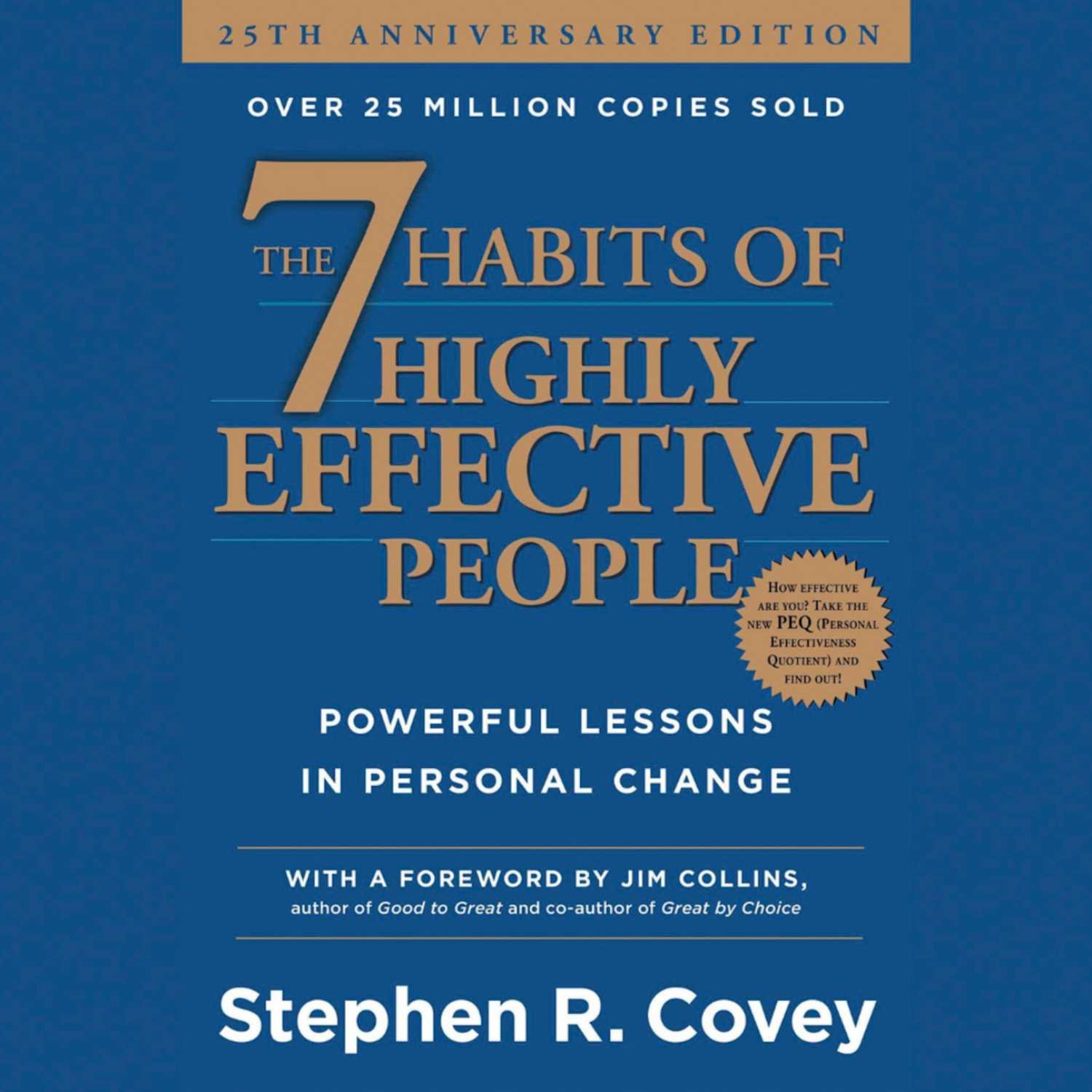
Loading summary
Transcript2 lines
- [00:00]
A
The 7 habits of highly effective people by Dr. Stephen r. Covey. This audio edition includes a special new forward and afterward read and interpreted by the author. It has been 15 years since Simon and Schuster originally published the first edition of the 7 Habits book. Since that time, worldwide sales of the book have exceeded 15 million copies. It has been translated into 28 languages and published in 70 countries. This New York Times number one best seller has also been on the bestseller lists of Business Week, USA Today, and Publishers Weekly for more than five years. Dr. Covey is Vice Chairman of the Board of Directors of Franklin Covey, a premier leadership development authority that aids individuals and organizations in aligning their strategies with proven principles. Here is Dr. Covey.
- [01:13]
B
The world has changed dramatically since the Seven Habits of Highly Effective People was first published. Life is more complex, more stressful, more demanding. We have transitioned from the industrial age into the information knowledge worker age, with all of its profound consequences. We face challenges and problems in our personal lives, our families and our organizations. Unimagined yet even one and two decades ago, these challenges are not only of a new order of magnitude, they are altogether different in kind. These sweeping changes in society and the rumbling shifts in the digitized global marketplace gives rise to a very important question, one that I'm asked fairly often, Are the seven habits of highly effective people still relevant today? And for that matter, will they be relevant 10, 20, 50, 100 years from now? My answer is very simple. The greater the change and the more difficult our challenges, the more relevant the habits become. Why? What's the reason? Why would they become more relevant? Is because our problems and our pain are universal and increasing, and the solutions to the problems are and will always be based upon universal, timeless, self evident principles common to every enduring, prospering society throughout history. I did not invent these principles. I take no credit for them. I have simply identified and organized them into a sequential framework. One of the most profound learnings of my life is if you want to achieve your highest aspirations and overcome your greatest challenges, identify and apply the principle or natural law that governs the results you seek. How we apply a principle will vary greatly and will be determined by our unique strengths, talents and creativity. But ultimately, success in any endeavor is always derived from acting in harmony with the principles to which the success is tied. Many people do not think this way, at least consciously. In fact, you will increasingly find that principled solutions stand in stark contrast to the common practices and thinking of our popular culture. Allow me to illustrate this contrast with a few of the most common human challenges we face first, fear and insecurity. So many people today are gripped with a sense of fear. They fear for the future. They feel vulnerable in the workplace. They're afraid of losing their jobs and their ability to provide for their families. This vulnerability often fosters a resignation to riskless living and to codependency with others at work and at home. Our culture's common response to this problem is to become more and more independent. People say, I'm going to focus on me and mine. I'll do my job, I'll do it well, and then get on to my real joys off the job. Independence is an important, even vital, value and achievement. The problem is we live in an interdependent reality, not an independent one. And our most important accomplishments require interdependency skills well beyond our present abilities. Second, I want it now. People want things and they want them now. I want money. I want a nice big house, a nice car, the biggest and best entertainment center. I want it all, and I deserve it. Though today's credit card society makes it easy to get now and pay later, economic realities eventually set in, and we are reminded, sometimes very painfully, that our purchases cannot outstrip our ongoing ability to produce. Pretending otherwise is unsustainable. The demands of interest are unrelenting and unforgiving. Even working hard is not enough. With the dizzying rate of change in technology and increasing competition driven by the globalization of markets and technology. We must not only be educated, we must constantly re educate and reinvent ourselves. We must develop our minds and continually sharpen and invest in the development of our competencies to avoid becoming obsolete at work. The bosses drive results and for a good reason. Competition is fierce. Survival is always at stake. The need to produce today is today's reality and represents the demand of capital. But the real mantra of success is sustainability and growth. You may be able to meet your quarterly numbers, but the real question are you making the necessary investment that will sustain and increase that success 1, 4, 5 and 10 years from now? Our culture and Wall street screams for results today. But the principle of balancing the need to meet today's demands with the need to invest in the capabilities that will produce tomorrow's success is unavoidable. The same is true of your health, your marriage, your family relationships and your community needs. Third, blame and victimism. Whenever you find a problem, you will usually find a finger pointing of blame. Society is addicted to playing the victim. Such words as, if only my boss wasn't such a controlling idiot. If only I hadn't been born so poor. If only I had lived in a better place. If only I hadn't inherited such a temper from my dad. If only my kids weren't so rebellious. If only the other departments didn't mess up orders all of the time. If only we weren't in such a declining industry. If only our people weren't so lazy and without drive. If only my wife was more understanding. If only. If only. Blaming everyone and everything else for our problems and challenges may be the norm and may provide temporary relief of the pain, but it also chains us to those very problems. Show me a man or woman who is humble enough to accept and take responsibility for their circumstances and courageous enough to take whatever initiative is necessary to creatively work their way through or around their challenges, and I'll show you the supreme power of choice. Fourth Hopelessness. The children of blame are cynicism and hopelessness. When we succumb to believing that we are victims of our circumstances and yield to the plight of determinism, we lose hope, we lose drive, we lose, and we settle into resignation and stagnation. We think I am a pawn, a puppet, a cog in the wheel, and can do nothing about it. Just tell me what I should do. So many bright, talented people feel this and suffer the broad range of discouragement and depression that follows. The survival response to popular culture is cynicism. Just lower your expectations of life to the point that you aren't disappointed by anyone or anything. Expect nothing and you're never disappointed. The contrasting principle of growth and hope throughout history is the discovery that I am the creative force of my life. 5th lack of life Balance. Life in our cell phone society is increasingly complex, demanding, stressful, and absolutely exhausting. For all of our efforts to manage our time, to do more, to be more, and to achieve greater efficiency through the wonders of modern technology. Why is it that we increasingly find ourselves in the thick of thin things, subordinating health, family, integrity, and many of the things that matter most in our lives and to our work? The problem is not our work, which is the sustaining engine of life. It's not the complexity or change. The problem is that our modern culture says, go in earlier, stay later, be more efficient, live with the sacrifice for now. But the truth is that balance and peace of mind are not produced by these. They follow the person that develops a clear sense of his or her highest priorities and who lives with focus and integrity toward them. 6. What's in it for Me? Our culture teaches us that if we want something in life, we have to look out for number one. It says Life is a game, a race, a competition, and you better win it. Schoolmates, work colleagues, even family members are often seen as competitors. The more they win, the less there is for you. Of course, we try to appear generous and cheer for other successes, but inwardly, privately, so many of us are eating our hearts out when others achieve. Many of the great things in the history of our civilization have been achieved by the independent will of a determined soul. But the greatest opportunities and boundless accomplishments of the knowledge worker age are reserved for those who master the art of we, we, not me. True greatness will be achieved through the abundant mind that works selflessly with mutual respect and for mutual benefit. 7. The hunger to be Understood Few needs of the human heart are greater than the need to be understood, to have a voice that is heard, respected and valued, to have influence. Most believe that the key to influence is communication, getting your point across clearly and speaking persuasively. In fact, if you think about it, don't you find that while others are speaking to you that instead of really listening to understand, you are often preparing your own response? The real beginning of influence comes as you sense you are being influenced by them. That is when they really feel understood by you, that you have listened deeply and sincerely and that you are open. But most people are too vulnerable emotionally to listen deeply, to suspend their agenda long enough to focus on understanding only before they communicate their own ideas. Our culture cries out for it, even demands understanding and influence. However, the principle of influence is governed by mutual understanding, born of the commitment of at least one person to deep listening first. 8. Conflict and differences People share so much in common, yet are so magnificently different. They think differently, they have different and sometimes competing values, motivations and objectives. Conflicts naturally arise out of all of these differences. Society's competitive approach to resolving the conflicts and differences tends to center on winning as much as you can. Though much good has come from the skillful art of compromise, where both sides give a little until an acceptable middle point is reached, Neither side ends up truly pleased. What a waste to have differences drive people to the lowest common denominator between them. What a waste to fail to unleash the principles of creative cooperation in developing solutions to problems that are better than either party's original idea. 9. Personal stagnation Human nature is four dimensional body, mind, heart and spirit. Consider the differences and fruits of the two approaches. First, for the body, the cultural tendency is to maintain our lifestyle, to treat health problems with surgery and medication. Now what's the principle? Prevent diseases and problems by aligning your lifestyle to be in harmony with established, universally accepted principles of health. Now let's look at the mind. The culture says, watch television. Entertain me. What's the principle? Read broadly and deeply. Continuous education. Let's look at the heart. The culture says, use relationships with others to forward your personal selfish interests. But what's the principle? Deep, respectful listening and serving others brings the greatest fulfillment and joy. And regarding the dimension of spirit, the culture succumb to the growing secularism and cynicism. The principle is recognize that the source of our basic need for meaning and of the positive things we seek in life comes from principles which natural laws, I personally believe have their source in God. We have just covered nine very common universal human challenges. We could almost go on endlessly. But let's stop at this point because I want to invite you to keep both these universal challenges and your own unique needs and challenges in mind. As you do, you will find enduring solutions and direction. You will also find the contrast between the popular culture's approach and the timeless principled approach of the ages. It will become more and more evident to you. In fact, it will deeply resonate with the deepest part of your own nature. On a final personal note, I want to repeat a question I constantly pose in my teaching. How many on their deathbed wish they'd spent more time at the office or watching tv? Basically, the answer is no one. I have reviewed the deathbed literature. They think about their loved ones, their families and those they have served. Even the great psychologist Abraham Maslow, at the end of his own life, put the happiness and fulfillment and contributions of his posterity ahead of his self actualization, which was the top need of his famous need hierarchy. He called all of this self transcendence. This is so true with me. By far, the greatest and most satisfying impact of the principles embodied in the 7 Habits comes out of the lives of my children and grandchildren. For example, my 19 year old granddaughter Shannon was drawn to serve the orphans of Romania and wrote Sandra and me of an epiphany she had one day after a little sick child threw up on her and then reached out for a hug. In that moment, Shannon inwardly resolved, I don't want to live a selfish life anymore. I must spend my life in service. And as of this writing, she has returned to Romania and is still serving the people. All of our children are married and with their spouses have developed principle based mission statements focused on service. To see them live. These mission statements gives us joy in our posterity. We have also had tens of thousands of people tell us of the significant impact of becoming the creative force of their own lives through internalizing the seven habits, 76 of them shared the details of their fascinating stories of courage and inspiration in the little book Living the Seven Habits, showing the transforming power of the principles in all kinds of personal, family and organizational settings, regardless of their circumstances or their organizational position or their prior life experiences. As you now commence reading the Seven Habits of Highly Effective People, I also promise you an exciting learning adventure. Share with your loved ones what you are learning and most importantly, start applying what you are learning. Because remember, to learn and not to do is really not to learn to know and not to do is really not to know. I have personally found that living the seven habits to be a constant struggle, primarily because the better you get, the very nature of the challenge changes. Just like skiing or playing golf or tennis or any sport does. Because I sincerely work and struggle every day at living these principal embodied habits, I warmly join you in this marvelous adventure. The 7 Habits of Highly Effective People Part 1 Paradigms and principles we will start with the Inside Out Approach David Starr Jordan once stated, there is no real excellence in all this world which can be separated from right living. In more than 25 years of working with people in business, university, and marriage and family settings, I have come in contact with many individuals who have achieved an incredible degree of outward success, but have found themselves struggling with an inner hunger, a deep need for personal congruency and effectiveness, and for healthy, growing relationships with other people. I suspect some of the problems they have shared with me may be familiar to you. Just listen to some of these one. Put it this way, I've set and met my career goals and I'm having tremendous professional success. But it's cost me my personal and family life. I don't know my wife and children anymore. I'm not even sure I know myself. And what's really important to me, I've had to ask myself, is it really worth it? Another Put it I've started a new diet for the fifth time this year. I know I'm overweight, but I really want to change. I read all the new information. I set goals. I get myself all psyched up with the positive mental attitude. I tell myself I can do it, but I don't. After a few weeks, I fizzle. I just can't seem to keep a promise I make to myself. Another I've taken course after course on effective management training. I expect a lot out of my employees. I work hard to be friendly toward them and to treat them right. But I don't feel any loyalty from them. I think if I were home sick for a day, they'd spend most of their time just gabbing at the water fountain. Why can't I train them to become independent and responsible, or to find employees who can be? Another My teenage son is rebellious and on drugs. No matter what I try, he won't listen to me. What can I do? Another there is so much to do and there's never enough time. I feel pressured and hassled all day, every day, seven days a week. I've attended time management seminars. I've tried half a dozen different planning systems. They've helped some, but I still don't feel I'm living the happy, productive, peaceful life I want to live. Another stated I want to teach my children the value of work, but to get them to do anything, I have to supervise every move and put up with complaining every step of the way. It's so much easier to do it myself. Why can't children do their work cheerfully and without being reminded? Another I'm busy, really busy. But sometimes I wonder if what I'm doing will make any difference in the long run. I'd really like to think that there was meaning in my life, that somehow things were different because I was here. Another I see my friends or relatives achieve some degree of success or receive some recognition, and I smile and congratulate them enthusiastically because but you know, inside I'm eating my heart out. Why do I feel this way? Another I have a forceful personality. I know in almost any interaction I can control the outcome. Most of the time I can even do it by influencing others to come up with the solution I want. I think through each situation, and I really feel the ideas I come up with are usually the best for everyone. But I feel uneasy. I always wonder what other people really think of me and my ideas. And finally another put it My marriage has gone flat. We don't fight or anything. We just don't love each other anymore. We've gone to counseling, we've tried a number of things, but we just can't seem to rekindle the feeling we used to have. These are deep problems, painful problems, problems that quick fix approaches can't solve. In fact, a few years ago, my wife, Sandra, and I were struggling with this kind of problem or concern. One of our sons was having a very difficult time in school. He was doing poorly academically. He didn't even know how to follow the instructions on the tests, let alone do well on them. Socially. He was immature, often embarrassing those closest to him. Athletically, he was small, skinny and uncoordinated. Swinging his baseball bat, for example, almost before the ball was even pitched. Others would laugh at him. Sandra and I were consumed with the desire to help him. We felt that if success were important in any area of life, it was supremely important in our role as parents. So we worked on our attitudes and behavior toward him and we tried to work on his. We attempted to psych him up using positive mental attitude techniques. Come on, son, you can do it, we know you can. Now just put your hands a little higher on the bat. Keep your eye on the ball and then don't swing till it gets close to you. And then when he did a little better, we would go to great lengths to reinforce him. That's great, son. Keep it up. When others laughed, we reprimanded them. Leave him alone. Get off his back. He's just learning. And our son would cry and insist that he'd never be any good and that he didn't like baseball anyway. Nothing we did seemed to help and we were really worried. We could see the effect this was having on his self esteem. We tried to be encouraging and helpful and positive, but after repeated failure, we finally drew back and tried to look at the situation on a different level. At this time, in my professional role, I was involved in leadership development work with various clients throughout the country. In that capacity, I was preparing bimonthly programs on the subject of communication and perception for IBM's executive development program participants. As I researched and prepared these presentations, I became particularly interested in how perceptions are formed, how they govern the way we see, and how the way we see governs how we behave. This led me to a study of expectancy theory and the self fulfilling prophecies, or what is sometimes called the Pygmalion effect, and to a realization of how deeply embedded our perceptions are. It taught me that we must look at the lens through which we see the world, as well as at the world we see, and that the lens itself shapes how we interpret the world. As Sandra and I talked about the concepts I was teaching at IBM and about our own situation, we began to realize that what we were doing to help our son was not in harmony with the way we really saw him. When we honestly examined our deepest feelings, we realized that our perception was that he was basically inadequate somehow behind. No matter how much we worked on our behavior and attitude, our efforts were ineffective. Because despite our actions and our words, what we were really communicating to him was, you aren't capable. You have to be protected. We began to realize that if we wanted to change the situation, we first had to change ourselves. And to change ourselves effectively, we first had to change our perceptions. You can imagine the effect that awareness had upon us that we ourselves had to change instead of we needed to change our son, in other words, inside out rather than outside in. Another interesting thing we discovered was that much of our perception was a product of our own motivation regarding how other people would see us in terms of our son's own behavior. When we examined that motivation carefully, we became ashamed. We started to realize that we were into it too much ourself and how we were being perceived. Rather than giving the whole effort and energy to the intrinsic worth and value and potential of this boy, this to us was a key insight in life. Examine your own motivations against your highest values because they impact your perceptions, which then impact your behavior and the results that follow. New Heading the Personality and Character Ethics at the same time I was doing this study of perception, I was also deeply immersed in an in depth study of the success literature published in the United States since 1776. I was reading or scanning literally hundreds of books, articles and essays in fields such as self improvement, popular psychology, and self help. At my fingertips was the sum and substance of what a free and democratic people considered to be the keys to successful living. As my study took me back through 200 years of writing about success, I noticed a startling pattern emerging in the content of the literature. And because of our own pain, and because of similar pain I had seen in the lives and relationships of many people that I'd worked with through the years, I began to feel more and more that much of the success literature of the past 50 years was superficial. It was filled with social image consciousness, with techniques, quick fixes, image building, with social band aids, and aspirin that masked chronic problems and only addressed acute problems and sometimes even appeared to solve them temporarily, but left these underlying chronic problems untouched to fester and resurface time and again. In stark contrast, almost all of the literature in the first hundred and fifty years or so focused on what could be called the character ethic as the foundation of success. Things like integrity, humility, fidelity, temperance, courage, justice, patience, industry, simplicity, modesty, and the Golden Rule. Benjamin Franklin's autobiography is representative of that literature. It is basically the story of one man's effort to integrate certain principles and habits deep within his nature. The character ethic taught that there are basic principles of effective living and that people can only experience true success and enduring happiness as they learn and integrate these principles into their basic character. But shortly after World War I, the basic view of success shifted from the character ethic to what we might call the personality ethic. Success. Success became more a function of personality, of public image, of attitudes and behaviors, skills and techniques that lubricate the processes of human interaction. This personality ethic essentially took two paths. One was human and public relations techniques, and the other was positive mental attitude, PMA. Some of this philosophy was expressed in inspiring and sometimes valid maxims such as, your attitude determines your altitude or smiling wins more friends than frowning or whatever the mind of man can conceive and believe it can achieve. Other parts of the personality approach were clearly manipulative, even deceptive, encouraging people to use techniques to get other people to like them or to fake interest in the hobbies of others in order to get out of them what they wanted, or to use the power look or to intimidate their way through life. Some of this literature acknowledged character as an ingredient of success, but tended to compartmentalize it rather than recognize it as foundational. Catalytic reference to the character ethic became mostly lip service. The basic thrust was quick fix influence techniques, power strategies, communication skills, image building ideas, and positive attitudes. This personality ethic, I began to realize, was the subconscious source of the solutions Sandra and I were attempting to use with our son. As I thought more deeply about the difference between the personality and character ethics, I realized that Sandra and I had been getting social mileage out of our own children's good behavior. And in our eyes, the sun simply didn't measure up. Our image of ourselves and our role as good, caring parents was even deeper than our image of our son and perhaps influenced it. There was a lot more wrapped up in the way that we were seeing our son and handling the problem than our concern for our son's real welfare. As Sandra and I continued to talk, we became increasingly and painfully aware of the powerful influence of our own character and motives and of our perception of him. We knew that social comparison motives were out of harmony with our deeper values and could lead to conditional love and eventually to our son's lessened sense of self worth. So we determined to focus our efforts on us, not on our techniques, but on our deepest motives and our perception of him. Instead of trying to change him, we tried to stand apart, to separate us from him, and to sense his identity, his individuality, his separateness and his worth. Through deep thought and the exercise of faith and prayer, we began to see our son in terms of his own uniqueness. We saw within him layers and layers of Potential that would be realized at his own pace and speed. We decided to relax and get out of his way and to let his own personality emerge. We saw our natural role as being to affirm, enjoy and value him. We also consciously worked on our motives and then independent of him, cultivated internal sources of security so that our own feelings of worth were not dependent upon our children's so called acceptable behavior. As we loosened up our old perception of our son and developed value based motives, literally new feelings began to emerge. We found ourselves enjoying him instead of comparing or judging him. We stopped trying to clone him on our own image or measure him against social expectations. We stopped trying to kindly positively manipulate him into an acceptable social mold because we saw him as fundamentally adequate and able to cope with life himself. We stopped protecting him against the ridicule of others. But you know, he'd been nurtured on this protection. So he went through some withdrawal pains which he expressed and which we accepted but did not necessarily respond to. We don't need to protect you was the unspoken message. You're fundamentally okay. As the weeks and months passed, he began to feel a quiet confidence and affirmed himself. He began to blossom at his own pace and speed. He became outstanding as measured by standard social criteria, academically, socially, athletically at a rapid clip far beyond the so called natural developmental processes. As the years passed, he was elected to several student body leadership positions, developed into an all state athlete and started bringing home straight a report cards. He developed an engaging and guileless personality that has enabled him to relate in non threatening ways to all kinds of people. Sandra and I believe that our son's socially impressive accomplishments were more a serendipitous expression of the feelings he had about himself than merely a response to social reward. This was an amazing experience for Sandra and me and a very instructional one in dealing with our other children and in other roles as well. It brought to our awareness on a very personal level the vital difference between the personality ethic and the character ethic of success. The Psalmist expressed our conviction. Search your own heart with all diligence for out of it flow the issues of life. New heading, primary and secondary greatness. My experience with my son, my study of perception and my reading of the success literature coalesced to create one of those aha. Experiences in life when suddenly things just simply click into place. I was suddenly able to see the powerful impact of the personality ethic and to clearly understand those subtle, often consciously unidentified discrepancies between what I knew to be true. Some things I had been taught many years ago as a child, and things that were deep in my own inner sense of value and the quick fix philosophies that surrounded me every day, I understood at a deeper level why, as I had worked through the years with people from all walks of life, I had found that the things I was teaching and knew to be effective were often at variance with these popular voices. I am not suggesting that elements of the personality ethic, personality growth, communication, skill training, education in the field of influence strategies and positive thinking are not beneficial, in fact sometimes essential for success. I believe that they are. But these are secondary, not primary traits. Perhaps in utilizing our human capacity to to build on the foundation of generations before us, we have inadvertently become so focused on our own building that we have forgotten the foundation that holds it up. Or in reaping for so long where we have not sown, perhaps we have forgotten the need to sow. If I try to use human influence strategies and tactics of how to get other people to do what I want, to work better, to be more motivated to like me and each other, while my character is fundamentally flawed, marked by duplicity and insincerity, then in the long run I cannot be successful. My duplicity will breed distrust, slowly, silently, imperceptibly. And then everything I do, even using so called good human relations techniques, will in the long run be perceived as manipulative. It simply makes no difference how good the rhetoric is or how good the intentions are. If there is little or no trust, there is no foundation for permanent success. Trust is the glue of life. Only basic goodness gives life to technique. To focus on technique alone is like cramming your way through school. You sometimes get by, perhaps even get good grades. But if you don't pay the price day in and day out, you never achieve true mastery of the subject you study or develop an educated mind. Did you ever consider how ridiculous it would be to try to cram on a farm you know, to forget to plant in the spring, play all summer, then cram in the fall to bring in the harvest. The farm is a natural system. The price must be paid and the process followed. You always reap what you sow. There is no shortcut. This principle is also true ultimately in human behavior, in human relationships. They too are natural systems based on the law of the harvest. In the short run, in an artificial social system such as school, you may be able to get by if you learn how to manipulate the man made rules to play the game. In most one shot or short lived human interactions, you can use the personality ethic to get by and to make favorable impressions through charm and skill and pretending to be interested in other people's hobbies. You can pick up quick, easy techniques that may work in short term situations, but secondary traits alone have no permanent worth in long term relationships. Eventually, if there isn't deep integrity and fundamental character strength, the challenges of life will cause true motives to surface and human relationship failure will replace short term success. Many people with secondary greatness, that is social recognition for their talents or wealth or prestige or recognition, may lack primary greatness or goodness in their essential character. Sooner or later you'll see this in every long term relationship they have. Whether it is with a business associate, a spouse, a friend, or a teenage child going through what is often called the second identity crisis, it is character that communicates most eloquently. As Emerson once put it, what you are shout so loudly my ears, I cannot hear what you say. There are, of course, situations where people have character strength, but they lack communication skills. And that undoubtedly affects the quality of relationships as well. But I believe the effects are still secondary. In the last analysis, what we are communicates far more eloquently than anything we say or even do. We all know is the silent radiation of our nature. There are people we trust absolutely because we know their character. Whether they're eloquent or not, whether they have the human relations techniques or not, we trust them and we work successfully with them. In the words of William George, into the hands of every individual is given a marvelous power, for good or evil, the silent, unconscious, unseen influence of his life. This is simply the constant radiation of what man really is, not what he pretends to be. I love the motto of North Carolina. To be rather than to seem. New heading the power of a paradigm. The seven habits of highly effective people embody many of the fundamental principles of human effectiveness. These habits are basic. They are primary. They represent the internalization of correct principles upon which enduring happiness and success are based. But before we can really understand these seven habits, we need to understand our own paradigms and how to make a paradigm shift. Both the character ethic and the personality ethic are examples of social paradigms. The word paradigm comes from the Greek. It was originally a scientific term and is more commonly used today to mean a model, theory, perception, assumption, or frame of reference. In the more general sense, paradise. It's the way we see the world, not in terms of our visual sense of sight, but in terms of perceiving, understanding, interpreting. For our purposes, a simple way to understand paradigms is to see them as maps, we all know that the map is not the territory. A map is simply an explanation of certain aspects of the territory. That's exactly what a paradigm is. It's a theory, an explanation or model of something else. For instance, suppose you wanted to arrive at a specific location in central Chicago. A street map of the city would be a great help to you in reaching your destination. But suppose you were given the wrong map through a printing error. The map labeled Chicago is actually a map of Detroit. Can you imagine the frustration, the ineffectiveness of trying to reach your destination? You might try to work on your behavior. You would try harder. You'd be more diligent. You double your speed. But your efforts would only succeed in getting you to the wrong place faster. You might even work on your attitude. You would think more positively. You still wouldn't get to the right place. But perhaps you wouldn't care. Your attitude would be so positive, you'd be happy and contented wherever you were. The point is, you'd still be lost. The fundamental problem has nothing to do with your behavior or your attitude. It has everything to do with having a wrong map. If you have the right map of Chicago, then behavior or diligence becomes important. And when you encounter frustrating obstacles along the way. Then positive attitudes can make a real difference. But the first and most important requirement is the accuracy of the map. Each of us has many, many maps in our head. Which can be divided into two main categories. Maps of the way things are, or realities. And maps of the way things should be or values. We interpret everything we experience through these mental maps. We seldom question their accuracy. We're usually even unaware that we have them. We simply assume that the way we see things. Is the way they really are or the way they should be. Then our attitudes and behaviors grow out of those assumptions. The way we see things is the source of the way we think and the way we act. And interestingly, if you look at it deeply. The way we see things is often a product of the things we seek or our deeper motivations. It has been useful to me in order to teach this basic idea. To give people an experience where I split a room in half. Showing one picture, let's say, of an old woman to one side. And another picture, let's say, of a young woman to the other side. They only see these pictures for one second. Then I show them a third picture. Which is a composite of both an old woman and a young woman. To everyone again for one second. And ask them what they see, with a few exceptions, on both Sides they see as they were conditioned to see by the first picture. Which reinforces the whole idea that we do not see the world as the world is. We see the world as we are. That is the way we have been conditioned. And how that conditioning experience causes us to interpret the world accordingly. It would be analogous to internalizing a map. Then I have both sides communicate with each other. And encourage them to communicate until they can come to see both the old woman and the young woman. It's always a fascinating experience to watch that process. Because they were aware that there was another person there. They did not see, they were open, and the communication processes worked. And within a short period of time, everyone could see both. But if they were unaware that they had been conditioned. And that the other side saw something else, then the communication processes deteriorated. And people even got into name calling and character assassination. All because of a one second difference. I frequently use this perception demonstration in working with people and organizations. Because it yields so many deep insights into both personal and interpersonal effectiveness. It shows, first of all, how powerful the conditioning in our lives affects our perceptions, our paradigms. If a second can have that kind of impact on the way we see things, what about the conditioning of a lifetime? The influences in our lives? Family, school, church, work environment, friends, associates, and current social paradigms, such as the personality ethic. All have made their silent, unconscious impact on us. And help shape our frame of reference, our paradigms, our maps. It also shows that these paradigms are the source of our attitudes and behaviors. We simply cannot act with integrity outside of them. We simply cannot maintain wholeness if we talk and walk differently than we see. For instance, if you are among the 90, 95% who typically see the young woman in the composite picture. When conditioned to do so, you undoubtedly found it difficult to think in terms of trying to help her cross the street. Both your attitude about her and your behavior toward her had to be congruent with the way that you saw her. This brings into focus one of the basic flaws of the personality ethic. To try to change outward attitudes and behaviors does very little good in the long run. If we fail to examine the basic paradigms from which these attitudes and behaviors flow. This perception demonstration also shows how powerfully our paradigms affect the way we interact with other people. As clearly and objectively as we think we see things, we begin to realize that others see them differently. From their own, apparently equally clear and objective point of view. Where we stand depends on where we sit. Which is a way of saying how our role in life affects our Paradigm which then affects our behavior. The essence therefore of being truly objective is to realize that we are subjective and take steps to compensate for that. The truly subjective person is the one that thinks that he or she is objective. Each of us tends to think that we see things as they are, that we are objective. But this is not the case. We see the world not as it is, but as we are, or as we are conditioned to see it. When we open our mouths to describe what we see, we in effect describe ourselves, our perceptions, our paradigms. When other people disagree with us, we immediately think something is wrong with them. But as the demonstration shows, sincere, clear headed people see things differently, each looking through the unique lens of experience. This does not mean that there are no facts in the demonstration. Two individuals who initially have been influenced by different conditioning pictures, look at the third picture. Together they are now both looking at the same identical facts, black lines, white spaces, and so forth. And they would both acknowledge these as facts. But each person interpretation of these facts represents prior experiences, and the facts have no meaning whatsoever apart from the interpretation. The more aware we are of our basic paradigms, maps or assumptions, and the extent to which we have been influenced by our experience, the more we can take responsibility for these paradigms, examine them, test them against reality, listen to others, be open to their perceptions, thereby getting a larger picture and a far more objective view. This is why good scientists always submit their hypotheses, their methods and their results to other independent scientists to see if their hypotheses are replicatable. New Heading the Power of a Paradigm Shift Perhaps the most important insight to be gained from the perception demonstration is in the area of paradigm shifting, what we might call the AHA experience. When someone finally sees the composite picture in a new and different way. The more bound a person is by the initial perception, the more powerful the AHA experience is. It is though a light were suddenly turned on inside. The term paradigm shift was introduced by Thomas Kuhn in his highly influential landmark book, the Structure of Scientific Revolutions. Kuhn shows how almost every significant breakthrough in the field of scientific endeavor is first a break with tradition, with old ways of thinking, with old paradigms. For Ptolemy, the great Egyptian astronomer, the Earth was the center of the universe. But Copernicus created a paradigm shift and a great deal of resistance and persecution as well by placing the sun at the center. Suddenly everything took on a different interpretation. The Newtonian model of physics was a clockwork paradigm and is still the basis of modern engineering. But it was partial and incomplete. The scientific world was revolutionized by The Einsteinian paradigm, the relativity paradigm, which had much higher predictive and explanatory value. Until the germ theory was developed, a high percentage of women and children died during childbirth, and no one could understand why. In military skirmishes, more men were dying from small wounds and diseases than from the major traumas on the front lines. But as soon as the germ theory was developed, a whole new paradigm, a better improved way of understanding what was happening, made dramatic, significant medical improvement possible. The United States today is a fruit of a paradigm shift. The traditional concept of government for centuries had been a monarchy, the divine right of kings. Then a different paradigm was developed. Government of the people, by the people, and for the people, and a constitutional democracy. He was born, unleashing tremendous human energy and ingenuity and creating a standard of living, of freedom and liberty, of influence and hope unequaled in the history of the world. Not all paradigm shifts are in positive directions, as we have observed. The shift from the character ethic to the personality ethic has drawn us away from the very roots that nourish true success and happiness. But whether they shift us in positive or negative directions, whether they are instantaneous or developmental, paradigm shifts move us from one way of seeing the world to another. And those shifts create powerful change. Are paradigms correct or incorrect? Are the sources of our attitudes and behaviors and ultimately, our relationships with others? I remember a mini paradigm shift I experienced one Sunday morning on a subway in New York. People were sitting quietly, some reading newspapers, some lost in thought, some just resting with their eyes closed. It was a calm, peaceful scene. Then suddenly, a man and his children entered the subway car. The children were so loud and rambunctious that instantly the whole climate changed. The man sat down next to me and closed his eyes, apparently oblivious to the situation. The children were running and yelling back and forth, throwing things, even grabbing people's papers. It was very disturbing. And yet the man sitting next to me did nothing. It was difficult not to feel irritated. I could not believe that he could be so insensitive as to let his children run wild like that and do nothing about it, taking no responsibility at all. It was easy to see that everyone else on the subway felt irritated, too. So finally, with what I felt was unusual patience and restraint, I turned to him and said, sir, your children are really disturbing a lot of people. I wonder if you couldn't control them a little more. The man lifted his gaze as if to come to a consciousness of the situation for the first time, and he said softly, oh, you're right, I guess I should do something about it. We just came from the hospital where their mother died about an hour ago. I don't know what to think. And I guess they don't know how to handle it either. Can you imagine what I felt at that moment? My paradigm shifted. Suddenly I saw things differently. And because I saw it differently, I thought differently, I felt differently, I behaved differently. My irritation vanished. I didn't have to worry about controlling my attitude or my behavior. My heart was filled with the man's pain. Feelings of sympathy and compassion flowed freely. Your wife just died. Oh, I'm so sorry. Can you tell me about it? Is there anything I can do to help? Everything changed in an instant. Many people experience a similar fundamental shift in thinking when they face a life threatening crisis and suddenly see their priorities in a different light. Or when they suddenly step into a new role such as that of husband or wife, parent or grandparent, manager and leader. In fact, I have found the fastest way to change a person's paradigm is to simply give them a new role. For instance, to ask a student to become a teacher of what they are learning, they instantly become a better student. We could spend weeks, months, even years laboring with a personality ethic, trying to change our attitudes and behaviors. And not even begin to approach the phenomenon of change that occurs spontaneously. When we see things differently, it becomes obvious that if we want to make relatively minor changes in our lives, we should focus on our attitudes and behavior. But if we want to make significant quantum changes, we need to work on our basic paradigms. In the words of for every thousand hacking at the leaves of evil, there is one striking at the root, we can only achieve quantum improvements in our lives. As we quit hacking at the leaves of attitude and behavior and get to work on the root the paradigms from which our attitudes and behaviors flow, Seen and being. Of course, not all paradigm shifts are instantaneous. Unlike my instant insight on the subway. The paradigm shifting experience that Sandra and I had with our own son was a slow, difficult and deliberate process. The approach we had first taken with him was the outgrowth of years of conditioning and experience in the personality ethic. It was the result of deeper paradigms we held about our own success as parents as as well as the measure of success of our children. And it was not until we changed those basic paradigms, until we saw things differently, that we were able to create quantum change in ourselves and in the situation. In order to see our son differently, Sandra and I had to be different. Our new paradigm was created as we invested in in the growth and development of our own character. Paradigms are inseparable from character. Being is seen in the human dimension, and what we see is highly interrelated to what we are. We can't go very far into changing our seeing without simultaneously changing our being and vice versa. Even in my apparently instantaneous paradigm shifting experience that morning on the subway, my change of vision was a result of and limited by my basic character. I am sure there are people who, when suddenly understanding the true situation, would have felt no more than a twinge of regret or vague guilt as they continued to sit in embarrassed silence beside the grieving, confused man. On the other hand, I am equally certain that there are people who would have been far more sensitive in the first place, who may have recognized that a deeper problem existed and reached out to understand and help before I did. Paradigms are powerful because they create the lens through which we see the world. The power of a paradigm shift is the essential power of quantum change, whether that shift is an instantaneous or a slow and deliberate process. New heading the principle centered paradigm. The character ethic is based on the fundamental idea that there are principles that govern human effectiveness. Natural laws in the human dimension that are just as real, just as unchanging and unarguably there as laws such as gravity is in the physical dimension. An idea of the reality and the impact of these principles can be captured in another paradigm shifting experience, as told by Frank Knock in Proceedings, the magazine of the Naval Institute. Two battleships assigned to the training squadron had been at sea on maneuvers in heavy weather for several days. I was serving on the lead battleship and was on watch on the bridge as night fell. The visibility was poor with patchy fog, so the captain remained on the bridge, keeping an eye on all activities. Shortly after dark, the lookout on the wing of the bridge reported light bearing on the starboard bow. It is it steady or moving astern? The captain called out. Lookout replied, steady, captain, which meant we were on a dangerous collision course with that ship. The captain then called to his signalman, signal that ship we are on a collision course. Advise you change course 20 degrees back came a signal advisable for you to change course 20 degrees. The captain said, send. I'm a Captain. Change course 20 degrees. I'm a seaman, second class, came the reply. You had better change course 20 degrees. By that time, the captain was furious. He spat out, send. I'm a battleship. Change course 20 degrees back came the flashing light. I'm a lighthouse. We changed course. The paradigm shift experienced by the captain and by us as we read this Account puts the situation in a totally different light. We can see a reality that is superseded by his limited perception, a reality that is critical for us to understand in our daily lives, as it was for the Captain in the fog. Principles are like lighthouses. They are natural laws that cannot be broken. As Cecil B. DeMille observed of the principles contained in his monumental movie the Ten Commandments, it is impossible for us to break the law. We can only break ourselves against the law. While individuals may look at their own lives and interactions in terms of paradigms or maps emerging out of their experience and conditioning, these maps are not the territory. They are a subjective reality, only an attempt to describe the territory. The objective reality, or the territory itself is composed of lighthouse principles that govern human growth and happiness. Natural laws that are woven into the fabric of every civilized society throughout history and comprise the roots of every family and institution that has endured and prospered. The degree to which our mental maps accurately describe the territory does not alter its existence. The reality of such principles or natural laws becomes obvious to anyone who thinks deeply and examines the cycles of social history. These principles surface time and time again, and the degree to which people in a society recognize and live in harmony with them moves them either towards survival and stability or disintegration and destruction. The principles I am referring to are not esoteric, mysterious or religious ideas. There is not one principle taught in this book that is unique to any specific faith or religion, including my own. These principles are a part of most every major enduring religion as well as enduring social philosophies and ethical systems. They are self evident and can easily be validated by any individual. It's almost as if these principles or natural laws are part of the human condition, part of the human consciousness, part of the human conscience. They seem to exist in all human beings, regardless of social conditioning and loyalty to them, even though they may be submerged or numbed by such conditions or disloyalty. I am referring, for example, to the principle of fairness out of which our whole concept of equity and justice is developed. Even little children seem to have an innate sense of the idea of fairness, even apart from opposite conditioning experiences. There are vast differences in how fairness is defined and achieved because of cultural lenses. But there is almost a universal awareness or sense of the idea of fairness. Other examples would include integrity and honesty. They create the foundation of trust, which is essential to cooperation and long term personal and interpersonal growth. You can never really sustain trust without trustworthiness. That is a self evident principle. Another principle is human dignity. The basic concept in the United States Declaration of Independence bespeaks this value or principle. We hold these truths to be self evident that all men are created equal and endowed by their Creator with certain inalienable rights, that among these are life, liberty and the pursuit of happiness. Another principle is service, or the idea of making a contribution. Another is quality or excellence. There is the principle of potential, the idea that we are embryonic and can grow and develop and release more and more potential, develop more and more talents. Highly related to potential is the principle of growth, the process of releasing potential and developing talents with the accompanying need for principles such as patience, nurturance and encouragement. Principles are not practices. A practice is a specific activity or action. A practice that works in one circumstance will not necessarily work in another, as parents who have tried to raise a second child exactly like they did the first can readily attest. While practices are situationally specific, principles are deep, fundamental truths that have universal application and also timeless application. They never change. They apply to individuals, to marriages, to families, to private and public organizations of every kind. When these truths are internalized into habits, they empower people to create a wide variety of practices to deal with different situations. Principles are not values. A gang of thieves can share values, but they are in violation of the fundamental principles we're talking about. Principles are the territory. Values are maps. When we value correct principles, we have truth, a knowledge of things as they are. Principles are guidelines for human conduct that are proven to have enduring, permanent value. They're fundamental. They're essentially unarguable because they are self evident. One way to quickly grasp the self evident nature of principles is to simply consider the absurdity of attempting to live an effective life based on their opposites. I doubt that anyone would seriously consider unfairness, deceit, baseness, uselessness, mediocrity or degeneration to be a solid foundation for lasting happiness and success. Although people may argue about how these principles are defined or manifested or achieved, there seems to be an innate consciousness and awareness that they exist. The more closely our maps or paradigms are aligned with these principles or natural laws, the more accurate and functional they will be. Correct maps will infinitely impact our personal and interpersonal effectiveness far more than any amount of effort expended on changing our attitudes and behaviors. New heading principles of growth and change the glitter of the personality ethic. The massive appeal is that there is some quick and easy way to achieve quality of life, personal effectiveness and rich deep relationships with other people without going through the natural processes of work and growth that makes it possible. It's symbol without substance it's the get rich quick scheme, promising wealth without work, and it might even appear to succeed. But the schemer remains. The personality ethic is illusionary and deceptive, and trying to get high quality results with its techniques and quick fixes is just about as effective as trying to get to some place in Chicago using a map of Detroit. In the words of Erich Fromm, an astute observer of the roots and fruits of the personality. Today we come across an individual who behaves like an automaton, who does not know or understand himself. And the only person that he knows is the person that he is supposed to be, whose meaningless chatter has replaced communicative speech, whose synthetic smile has replaced genuine laughter, and whose sense of dull despair has taken the place of genuine pain. Two statements may be said concerning this individual. One is that he suffers from the defects of spontaneity and individuality, which may seem to be incurable. At the same time, it may be said of him, he does not differ essentially from the millions of the rest of us who walk upon this earth. Close quote. In all of life, there are sequential stages of growth and development. A child learns to turn over, to sit up, to crawl, and then to walk and run. Each step is important, and each one takes time. No step can be skipped. This is true in all phases of life, in all areas of development, whether it be learning to play the piano or to communicate effectively with a working associate. It is true with individuals, with marriages, with families, and with organizations. We know and accept this fact or principle of process in the area of physical things. But to understand it in emotional areas, in human relations, and even in the area of personal character is less common and more difficult. And even if we do understand it, to accept that and to live in harmony with it are even less common and more difficult. Consequently, we sometimes look for a shortcut, expecting to be able to skip some of these vital steps in order to save time and effort and still reap the desired result. But what happens when we attempt to shortcut a natural process in our growth and development? If you are only an average tennis player, but decide to play at a higher level in order to make a better impression, what would result? Would positive thinking alone enable you to compete effectively against a professional? What if you were to lead your friends to believe that you could play the piano at concert hall level, while your actual present skill was that of a beginner? The answers are obvious. It is simply impossible to violate, ignore, or shortcut this development process. It is contrary to nature, and attempting to seek such a shortcut only results in disappointment and frustration on a 10 point skill. If I am at level 2 in any field and desire to move to level 5, I must first take the step toward level 3. Remember, a thousand mile journey begins with the first step and can only be taken one step at a time. If you don't let a teacher know at what level you are at by asking a question or revealing your ignorance, you will not learn or grow. You cannot pretend for long for you. Eventually you will be found out. Admission of ignorance is often the first step in our education. How can we remember our ignorance, which our growth requires when we are using our knowledge all of the time? I recall one occasion when two young women, daughters of a friend of mine, came to me tearfully complaining about their father's harshness and lack of understanding. They were afraid to open up with their parents for fear of the consequences, and yet they desperately needed their parents love, understanding and guidance. I talked with the father and found that he was intellectually aware of what was happening, but while he admitted he had a temper problem, he refused to take responsibility for it and to honestly accept the fact that his emotional developmental level was low. It was more than his pride could swallow to take the first step toward change. To effectively relate with a wife, a husband, friends, children or working associates, we must learn to listen. And this requires emotional strength because listening involves patience, openness and the desire to understand. These are highly developed qualities of character. It is so much easier to operate from a low emotional level and to give high level advice. Our level of development is fairly obvious with tennis or piano playing where it is impossible to pretend, but it is not so obvious in the areas of character and emotional development. We can pose and put on for a stranger or an associate. We can pretend and for a while we can get by with it, at least in public. We might even deceive ourselves. Yet I believe most of us know the truth of what we really are inside, and I think many of those we live with and work with do as well. I have seen the consequences of attempting to shortcut this natural process of growth often in the business world where executives attempt to buy a new culture of improved productivity, quality, morale and customer service with strong speeches, smile training and external interventions, or through mergers, acquisitions and friendly or unfriendly takeovers. But they ignore the low trust climate produced by such manipulations. When these methods don't work, they look for other personality ethic techniques that will all the time ignoring or violating the natural principles and processes on which a high trust culture is based. I remember Violating this principle myself as a father. Many years ago, one day I returned home to my little girl's third year birthday party to find her in the corner of the front room, defiantly clutching all of her presents, unwilling to let the other children play with them. The first thing I noticed was several parents in the room witnessing this selfish display. I was embarrassed, and doubly so because at the time I was teaching university classes in human relationship and I knew, or at least felt the expectations of these parents. The atmosphere in the room was really charged. The children were crowding around my little daughter with their hands out, asking to play with the presents they had just given, and my daughter was adamantly refusing. I said to myself, certainly I should teach my daughter to share. The value of sharing is one of the most basic things we believe in. So I first tried a simple Honey, would you please share with your friends the toys they've given you? No, she replied flatly. My second method was to use a little reasoning. Honey, if you learn to share your toys with them when they are at your home, then when you go to their homes, they will share their toys with you again. She immediately replied, no. I was becoming a little more embarrassed, for it was evident I was having no influence. The third method was bribery. Very softly, secretly, I said, honey, if you share, I've got a special surprise for you. I'll give you a piece of gum. I don't want gum. She exploded for everyone to hear. Now I was becoming exasperated. For my fourth attempt, I resorted to fear and threat. Unless you share, you will be in real trouble. I don't care. She cried. These are my things. I don't have to share. Finally, I resorted to force. I merely took some of the toys and gave them to the other kids. Here, kids play with these. Perhaps my daughter needed the experience of possessing the things before she could give them. In fact, unless I possess something, can I really ever give it? She needed me, as her father, to have a higher level of emotional maturity to give her that experience. But at that moment, I valued the opinion those parents had of me more than the growth and development of my child and our relationship together. I simply made an initial judgment that I was right, she should share, and she was wrong in not doing so. Perhaps I superimposed a higher level expectation on her simply because on my own skill I was at a lower level. I was unable or unwilling to give patience or understanding. So I expected her to give things. In an attempt to compensate for my deficiency, I borrowed strength from my position and authority and forced her to do what I wanted her to do. But borrowing strength builds weakness. It builds weakness in the borrower because it reinforces dependence on external factors to get things done. It builds weakness in the person forced to acquiesce, stunting the development of independent reasoning, growth and internal discipline. And finally, it builds weakness in the relationship. Fear replaces cooperation, and both people involved become more arbitrary and defensive. And what happens when the source of borrowed strength, such as superior size or physical strength, position, authority, credentials, status symbols, appearance, past achievements. What if they change or they're no longer there? Had I been more mature, I could have relied on my own intrinsic strength, my understanding of sharing and of growth, and my capacity to love and nurture, and then allowed my daughter to make a free choice as to whether she wanted to share or not to share. Perhaps, after attempting to reason with her, I could have turned the attention of the children to an interesting game, taking all that emotional pressure off my child. I've learned that once children gain a sense of real possession, they share very naturally, freely, spontaneously. My experience has been that there are times to teach and times not to teach. When relationships are strained and the air charged with emotion. An attempt to teach is often perceived as a form of judgment and rejection. But to take the child alone, quietly when the relationship is good and then to teach would have had much greater impact. It may have been that the emotional maturity to do was beyond my level of patience and internal control at the time. Perhaps a sense of possessing needs to come before a sense of genuine sharing. Many people who give mechanically or refuse to give and share in their marriages and families may never have experienced what it means to possess themselves, their own sense of identity and self worth. Really, helping our children grow may involve being patient enough to allow them the sense of possession, as well as being wise enough to teach them the value of giving and providing the example ourselves. New heading. The way we see the problem is the problem. People are intrigued when they see good things happening in the lives of individuals, families and organizations that are based on solid principles. They admire such personal strength and maturity, such family unity and teamwork, such adaptive, synergistic organizational cultures. And their immediate request is very revealing of their basic paradigm. How do you do it? Teach me the techniques. What they're really saying is give me some quick fix advice or solution that will relieve the pain in my own situation. They will find people who will meet their wants and teach these things. These techniques. And for a short time, skills and techniques may appear to work. They may eliminate some of the cosmetic or acute problems through social aspirin and band aids. But the underlying chronic condition remains and eventually new acute symptoms will appear. The more people are into quick fix and focus on the acute problems and pain, the more that very approach contributes to the underlying chronic condition. You see, the way we see the problem is the problem. Look again at some of the concerns that introduce this chapter and at the impact of personality ethic thinking. Remember this one I've taken course after course on effective management training. I expect a lot out of my employees, and I work hard to be friendly toward them and to treat them right. But I don't feel any loyalty from them. I think if I were homesick for a day, they'd spend most of their time gabbing at the water fountain. Why can't I train them to be independent and responsible, or find employees who can be? The personality ethic tells me I could take some kind of dramatic action, shake things up, make heads roll that would make my employees shape up and appreciate what they have. Or that I could find some motivational training program that would get them committed. Or that I could hire new people that would do a better job. But is it possible that under the apparently disloyal behavior that employees question whether I really am acting in their own best interest? Do they feel like I'm treating them as mechanical objects? And is there some truth to that deep inside? Is that really the way I see them? Is there a chance? The way I look at the people who work for me is part of the problem, perhaps even the biggest part. Remember this. There's so much to do and there's never enough time. I feel pressured and hassled all day, every day, seven days a week. I've attended time management seminars and I've tried a half a dozen different planning systems. They've helped some, but I just don't feel like I'm living the happy, productive, peaceful life I want to live. The personality ethic tells me there must be something out there, some new planner or seminar that will help me handle all these pressures in a more efficient way Way. But is there a chance that efficiency is not the answer? Is getting more things done in less time going to make a difference? Or will it just increase the pace at which I react to the people and circumstances that seem to control my life? Could there be something I need to see in a deeper, more fundamental way, Some paradigm within myself that affects the way I see might I'm my life and my own nature. Remember this one? My marriage has gone flat. We don't fight or anything. We just don't love each other anymore. We've gone to counseling, we've tried a number of things, but we just can't seem to rekindle the feeling we used to have. The personality ethic tells me there must be a new book or some new seminar where people get all their feelings out. That would help my wife better understand me. Or maybe that it's useless and that only a new relationship will provide the love I need. But is it possible that my spouse isn't the real problem? Could I be empowering my spouse's weaknesses and making my life a function of the way I'm treated? Do I have some basic paradigm about my spouse, about marriage, about what love really is that is feeding the problem? Is it possible that love is more a verb than a feeling? Can you see how fundamentally the paradigms of the personality ethic affect the very way we see our problems as well as the way we attempt to solve them? Whether people see it or not, many are becoming disillusioned with the empty promises of the personality ethic. As I travel around the world and work with organizations, I find that long term thinking executives are simply turned off by psychop psychology and motivational speakers who have nothing more to share than entertaining stories, formulas mingled with platitudes. They want substance. They want process. They want more than aspirin and band aids. They want to solve the chronic underlying problems and focus on the principles that bring long term results. New Heading, A New Level of Thinking Albert Einstein observed, the significant problems we face cannot be solved at the same level of thinking we were at when we created them. Listen again to that statement. The significant problems we face cannot be solved at the same level of thinking we were at when we created them. As we look around us and within us and recognize the problems created as we live and interact within the personality ethic, we begin to realize that these are deep fundamental problems that cannot be solved on the superficial level on which they were created. We need a new level, a deeper level of thinking, a paradigm based on the principles that accurately describe the territory of effective human being and interacting to solve these deep concerns. This new level of thinking is what seven Habits of Highly Effective People is about. It's the principle centered character based inside out approach to personal and interpersonal effectiveness. Inside out means to start first with self. Even more fundamentally, to start with the most inside part of self. With your paradigms, your character, your assumptions, and your motives. It says that if you want to have a happy marriage, be the kind of person who generates positive energy and sidesteps negative energy rather than empowering it. If you want to have a more pleasant, cooperative teenager, be a more understanding, empathic, consistent, loving parent. If you want to have more freedom, more latitude in your job, be a more responsible, a more helpful, a more contributing employee. If you want to be trusted, be trustworthy. If you want to have the secondary greatness of recognized talent, focus first on the primary greatness of character. The inside out approach says that private victories precede public victories, that making and keeping promises to ourselves precedes making and keeping promises to others. It says it is futile personality ahead of character to try to improve relationships with others before improving ourselves. Inside out is a process, a continuing process of renewal based on the natural laws that govern human growth and progress. It's an upward spiral of growth that leads to progressively higher forms of responsible independence and effective interdependence. I have had the opportunity to work with many people, wonderful people, talented people, people who deeply want to achieve happ happiness and success. People who are searching, people who are hurting. I have worked with business executives, college students, church and civic groups, families and marriage partners. And in all of my experiences I have never seen lasting solutions to problems, lasting happiness and success that came from the outside in. What I have seen result from the outside in paradigm is unhappy people who feel victimized and immobilized, who focus on the weaknesses of other people and the circumstances they feel are responsible for their own stagnant situation. I've seen unhappy marriages where each spouse wants the other to change, where each is confessing the other's sins, where each is trying to shape up the other. I've seen labor management disputes where people spend tremendous amounts of time and energy trying to create legislation that would force people to act as if the foundation of trust were really there. Members of our family have lived in three of the hottest spots on earth South Africa, Israel, and Ireland, and I believe the source of the continuing problems in each of these places has been the dominant social paradigm of outside in. Each involved group is convinced the problem is out there and if they would shape up or suddenly ship out of existence, the problem would be solved. Inside out is a dramatic paradigm shift for most people, largely because of the powerful impact of conditioning and the current social paradigm of the personality ethic. But from my own experience, both personal and in working with thousands of other people, and from careful examination of successful individuals and societies throughout history, I am persuaded that many of the principles embodied in the 7 habits are already deep within us, in our conscience and our common sense to recognize and develop them and use them in meeting our deepest concerns. We need to think differently, to shift our paradigms to a new, deeper inside out level as we sincerely seek to understand and integrate these principles into our lives. And I am convinced we will discover and rediscover the truth of T.S. eliot's observation. We must not cease from exploration, and the end of all of our exploring will be to arrive where we began and to know the place for the first time. The Seven Habits An Overview Here is a beginning quote from Aristotle. We are what we repeatedly do. Excellence, then, is not an act, but a habit. Our character basically is a composite of our habits. Sow a thought, reap an action. Sow an action, reap a habit. Sow a habit, reap a character, Sow a character, reap a destiny. That's the way the maxim goes. Habits are powerful factors in our lives because they are consistent, often unconscious patterns. They constantly daily express our character and produce our effectiveness or our ineffectiveness. As Horace Mann, the great educator, once habits are like a cable. We weave a strand of it every day, and soon it cannot be broken. I personally do not agree with the last part of his expression. I know that they can be broken. Habits can be learned and unlearned. But I also know it isn't a quick fix. It involves a process and a tremendous commitment. Those of us who watched the lunar voyage of Apollo 11 were transfixed as we saw the first men walk on the moon and return to Earth. Superlatives such as fantastic and incredible were inadequate to describe those eventful days. But to get there, those astronauts literally had to break out of the tremendous gravity pull of the Earth. In fact, more energy was spent in the first few minutes of liftoff, in the first few miles of travel than was used over the next several days to travel half a million miles. Habits, too, have tremendous gravity pull, more than most people realize or would admit. Breaking deeply embedded habitual tendencies such as procrastination, impatience, criticalness, or selfishness that violate basic principles of human effectiveness involves more than a little willpower and a few minor changes in our lives. Lift off takes a tremendous effort, but once we break out of the gravity pull, our freedom takes on a whole new dimension. Like any natural force, gravity pull can work with us or against us. The gravity pull of some of our habits may currently be keeping us from going where we want to go. But it is also the gravity pull that keeps our world together, that keeps the planets in their orbits and our universe in order. It's a powerful force, and if we use it effectively, we can Use the gravity pull of habit to create the cohesiveness and order necessary to establish effectiveness in our lives. New Habits Defined for our purpose we will define a habit as the intersection of knowledge, skill and desire. Knowledge is the theoretical paradigm, the what to do and the why. Skill is the how to do, and desire is the motivation, the want to do. In order to make something a habit in our lives, we have to have all three. I may be ineffective in my interactions with my work associates, my spouse or my children because I constantly tell them what I think. But I never really listen to them unless I search out correct principles of human interaction. I may not even know I need to listen. Even if I do know that in order to interact effectively with others I really need to listen to them. I may not have the skill. I may not know how to really listen deeply to another human being. But knowing I need to listen and knowing how to listen is not enough. What if I don't want to listen because unless I want to listen, unless I have the desire, it won't be a habit in my life? Creating a habit requires work in all three dimensions as presented before the being. Seeing change is an upward being changing seen, which in turn changes being, and so forth as we move in an upward spiral of growth. Similarly, by working on knowledge, skill and desire, we can break through to new levels of personal and interpersonal effectiveness as we break with old paradigms that may have been a source of pseudo security for years. It's sometimes a painful process. It's a change that has to be motivated by a higher purpose, by the willingness to subordinate what you think you want now for what you want later. But this process produces happiness, which someone defined as the object and design of our existence. Happiness can be defined in part at least as the fruit of the desire and ability to sacrifice what we want now for what we want eventually. Think on that again. Happiness is the desire and ability to sacrifice what we want now for what we want eventually. New heading the Maturity Continuum the seven habits are not a set of separate or piecemeal psych up formulas. In harmony with the natural laws of growth, they provide an incremental, sequential, highly integrated approach to the development of personal and interpersonal effectiveness. They move us progressively on a maturity continuum from dependence to independence to interdependence. We each begin life as an infant, totally dependent on others. We are directed, nurtured and sustained by others. Without this nurturing, we would only live for a few hours or a few days at the most. Then gradually, over the ensuing months and years, we Become more and more independent physically, mentally, emotionally and financially. Until eventually we can essentially take care of ourselves, becoming interdirected and self reliant. As we continue to grow and mature, we become increasingly aware that all of nature is interdependent. That there is an ecological system that governs nature, including society. We further discover that the higher reaches of our human nature have to do with our relationship with others. That human life also is interdependent. Our growth from infancy to adulthood is in accordance with natural law. And there are many dimensions to growth. Reaching our full physical maturity, for example, does not necessarily assure us of simultaneous emotional or mental maturity. On the other hand, a person's physical dependence does not mean that he or she is mentally or emotionally immature. On the maturity continuum, dependence is the paradigm of you. You take care of me, you come through for me. You didn't come through, I blame you for the results. Independence is a paradigm of I, I can do it, I am responsible, I am self reliant, I can choose. Interdependence is the paradigm of we, we can do it, we can cooperate. We can combine our talents and abilities and create something greater together. Dependent people need others to get what they want. Independent people can get what they want through their own efforts. Interdependent people combine their own efforts with the efforts of others to achieve their greatest success. If I were physically dependent, paralyzed or disabled or limited in some physical way, I would need you to help me. If I were emotionally dependent, my sense of worth and security would come from your opinion of me. If you didn't like me, it could be devastating. If I were intellectually dependent, I would count on you to do my thinking for me to think through the issues and problems of my life. If I were independent physically, I could pretty well make it on my own. Mentally, I could think my own thoughts. I could move from one level of abstraction to another. I could think creatively and analytically and organize and express my thoughts in understandable ways. Emotionally, I would be validated from within. I would be inner directed. My sense of worth would not be a function of being liked or treated well. It's easy to see that independence is much more mature than dependence. Independence is a major achievement in and of itself. But independence is not supreme. Nevertheless, the current social paradigm enthrones independence. It is the avowed goal of many individuals and social movements. Most of the self improvement materials puts independence on a pedestal. As though communication, teamwork and cooperation were lesser values. But much of our current emphasis on independence is a reaction to dependence to having Others control us, define us, use us, and manipulate us. The little understood concept of interdependence appears to many to smack of dependence. And therefore we find people, often for selfish reasons, leaving their marriages, abandoning their children, and forsaking all kinds of social responsibility, all in the name of independence. The kind of reaction that results in people throwing off their shackles and becoming liberated, asserting themselves and doing their own thing, often reveals more fundamental dependencies that cannot be run away from because they are internal rather than external dependencies, such as letting the weaknesses of other people ruin our emotional lives or feeling victimized by people and events out of our own control. Of course, we may need to change our circumstances, but the dependence problem is a personal maturity issue that has little to do with circumstances. Even with better circumstances, immaturity and dependence often persist. True independence of character empowers us to act rather than to be acted upon. It frees us from our dependence on circumstances and other people and is a worthy, liberating goal. But it is not the ultimate goal in effective living. Independent thinking alone is not suited to interdependent reality. Independent people who do not have the maturity to think and act interdependently may be good individual producers, but they won't be good leaders or team players. They're not coming from the paradigm of interdependence necessary to succeed in marriage, family, or organizational realities. Life, by nature, is highly interdependent. To try to achieve maximum effectiveness through independence is like trying to play tennis with a golf club, or perhaps even more ridiculous, golf with a tennis racket. The tool is simply not suited to the reality. Interdependence is a far more mature, more advanced concept. If I am physically interdependent, I am self reliant and capable. But I also realize that you and I working together can accomplish far more than even I could accomplish alone. At my best, if I am emotionally interdependent, I derive a great sense of worth within myself. But I also recognize the need for love, for giving and for receiving love from others. If I am intellectually interdependent, I realize that I need the best thinking of other people to join with my own. As an interdependent person, I have the opportunity to share myself deeply, meaningfully with others. And I have access to the vast resources and potential of other human beings. Interdependence is a choice only independent people can make. Dependent people cannot choose to become interdependent. They don't have the character to do it. They don't own enough of themselves. That's why? Habits 1, 2 and 3 in the following chapters deal with self mastery. They move a person from dependence to independence. They are the private victories, the essence of character growth. Private victories precede public victories. You can't invert that process any more than you can harvest the crop before you plant it. It's inside out. As you become truly independent, you have the foundation for effective interdependence. You have the character base from which you can effectively work on the more personality oriented public victories of teamwork, cooperation and communication in habits 4, 5 and 6. This does not mean that you have to be Perfect in habits 1, 2 and 3 before working on habits 4, 5 and 6. Understanding the sequence will help you manage your growth more effectively. But I am not suggesting that you put yourself in isolation for several years until you have fully developed habits 1, 2 and 3. As part of an interdependent world, you have to relate to that world every day. But the acute problems of that world can easily obscure the chronic character causes. Understanding how what you are impacts every interdependent interaction will help you to focus your efforts sequentially in harmony with the natural laws of growth. Habit 7 is the habit of renewal, a regular balanced renewal of the four dimensions of life. It circles and embodies all the other habits. It is the habit of continuous improvement that creates the upward spiral of growth that lifts you to new levels of understanding and living. Each of the habits as you come around to them on a progressively higher plane. New Heading Effectiveness Defined the seven habits are habits of effectiveness because they are based on principles. They bring the maximum long term beneficial results possible. They become the basis of a person's character, creating an empowering center of correct maps from which an individual can effectively solve problems, maximize opportunities and continually learn and integrate other principles in an upward spiral of growth. They are also the habits of effectiveness because they are based on a paradigm of effectiveness that is in harmony with the natural law, a principle I call the PPC balance, which many people break against themselves. This principle can be easily understood by remembering Aesop's fable of the Goose and the Golden Egg. This fable is the story of a poor farmer who one day discovers in the nest of his pet goose a glittering golden egg. At first he thinks it must be some kind of a trick. But as he starts to throw the egg aside, he has second thoughts and takes it in to be appraised instead. The egg is pure gold. The farmer can't believe his good fortune. He becomes even more incredulous the following day when the experience is repeated day after Day he awakens to rush to the nest and to find another golden egg. He becomes fabulously wealthy. It all seems too good to be true. But with his increasing wealth comes greed and impatience. Unable to wait day after day for the golden eggs, the farmer decides he will kill the goose and get them all at once. But when he opens the goose, he finds it empty. There are no golden eggs, and now there is no way to get any more. The farmer has destroyed the goose that produced them. I suggest that within this little fable is a natural law, a principle, in fact, the basic definition of effectiveness. Most people see effectiveness from the golden egg paradigm. The more you produce, the more you do, the more effective you are. But as the story shows, true effectiveness is a function of two what is produced, that is the golden eggs and the producing asset or capacity to produce the goose. If you adopt a pattern of life that focuses on golden eggs and neglects the goose, you will soon be without the asset that produces the golden eggs. On the other hand, if you only take care of the goose with no aim toward the golden eggs, you soon won't have the wherewithal to feed yourself or the goose. Effectiveness lies in the balance, what I call the P PC balance. P stands for production of desired results, the golden eggs. PC stands for production capability, the ability or asset that produces the golden eggs. Thus the P PC balance. Production Production capability. New heading. Three kinds of Assets Basically, there are three kinds of assets. Physical, financial and human. Let's look at each one in turn. A few years ago, I purchased a physical asset, a power lawn mower. I used it over and over again without doing anything to maintain it. The mower worked well for two seasons, but then it began to break down. When I tried to revive it with service and sharpening, I discovered the engine had lost over half its original power capacity. It was essentially worthless. Had I invested in PC, that is in preserving and maintaining the asset, I would still be enjoying its P, the mowed lawn. As it was, I had to spend far more time and money replacing the mower than I ever would have spent had I maintained simply was not effective. In our quest for short term returns or results, we often ruin a prized physical asset. A car, a computer, a washer, a dryer, even our body or our environment. Keeping P&PC in balance makes a tremendous difference in the effective use of physical assets. It also powerfully impacts the effective use of financial assets. How often do people confuse principle with interest? Have you ever invaded principle to increase your standard of living to get more golden eggs? The decreasing principle has decreasing power to produce interest or income, and the dwindling capital becomes smaller and smaller until it no longer supplies even basic needs. Our most important financial asset is our capacity to earn. If we don't continually invest in improving our own PC, we severely limit our options. We're locked into our present situation, running scared of our corporation or our boss's opinion of us. Economically dependent and defensive. Again, it simply isn't effective in the human area. The PPC balance is equally fundamental, but even more important because people control physical and financial assets. When two people in a marriage are more concerned about getting the golden eggs, the benefits than they are in preserving the relationship that makes them possible, they often become insensitive and inconsiderate, neglecting the little kindnesses and courtesies so important to a deep relationship. They begin to use control levers to manipulate each other, to focus on their own needs, to justify their own position and look for evidence to show the wrongness of the other person. The love, the richness, the softness and spontaneity begin to deteriorate. The goose gets sicker day by day. And what about a parent's relationship with the child? When children are little, they are very dependent, very vulnerable. It becomes so easy to neglect the PC work, the training, the communicating, the relating, the listening. It's easy to take advantage, to manipulate, to get what you want the way you want it. Right now. You're bigger, you're smarter, and you're right. So why not just tell them what to do? If necessary, yell at them, intimidate them, insist on your way. Or you could indulge them. You can go for the golden egg of popularity, of pleasing them, of giving them their way all the time. Then they grow up without any internal sense of standards or expectations, without a personal commitment to being disciplined or responsible. Either way, you have the golden egg mentality. You want to have your way or you want to be liked. But what happens, meantime, to the goose? What sense of responsibility, of self discipline, of confidence in the ability to make good choices or achieve important goals is a child going to have a few years down the road? And what about your relationship when he reaches those critical teenage years, the identity crises? Will he know from his experience with you that you will listen to him without judging, that you really, deeply care about him as a person, that you can be trusted no matter what? Will the relationship be strong enough for you to reach him, to communicate with him, to influence him? For instance, suppose you want your daughter to have a clean room. That's p or production. The golden egg. And suppose you want her to clean it. That's PC production capability. Your daughter, in a sense, is the goose, the asset that produces the golden egg. If you have P and P C in balance, she cleans the room cheerfully without being reminded. Because she is committed and has the discipline to stay with the commitment, she is a valuable asset, a goose that can produce golden eggs. But if your paradigm is focused on production, on getting the room clean, you might find yourself nagging her to do it. You might even escalate your efforts to threatening or yelling. And in your desire to get the golden egg, you undermine the health and welfare of the goose. Let me share with you an interesting PC experience I had with one of my daughters. We were planning a private date, which is something I enjoy regularly with each of my children. We find that the anticipation of the date is as satisfying as the realization. So I approached my daughter and said, honey, tonight, your night, what do you want to do? Oh, dad, that's ok, she replied. No, no, no, really. What would you like to do? Well, she finally said, what I want to do, you really don't want to do. Really, honey? I said earnestly. I want to do it no matter what. It's your choice, she responded. I want to go see Star Wars. But I know you don't like Star Wars. You slept through it before. You don't like these fantasy movies. That's okay, dad. No, honey, if that's what you like to do, I'd like to do it. Dad, don't worry about it. We don't always have to have this date. She paused and then added, but you know why you don't like Star Wars? It's because you don't understand the philosophy and training of a Jedi Knight. What? You know, the things you teach. Dad, those are the same things that go into the training of a Jedi Knight. Really? Let's go to Star Wars. And we did. She sat next to me and gave me the paradigm. I became her student, her learner. It was totally fascinating. I could begin to see out of a new paradigm the whole way. A Jedi Knight's basic philosophy and training is manifested in different circumstances. That experience was not a planned P experience. It was the serendipitous fruit of a PC investment. It was bonding and very satisfying. But we enjoyed golden eggs, too, as the goose that is the quality of our relationship was significantly. Organizational. PC One of the immensely valuable aspects of any correct principle is that it is valid and applicable in a wide variety of circumstances. Throughout this book, I would like to share with you Some of the ways in which these principles apply to organizations, including families, as well as to individuals. When people fail to respect the PPC balance in their use of physical assets in organizations, they decrease organizational effectiveness and often leave others with dying geese. For example, a person in charge of a physical asset such as a machine, may be eager to make a good impression on his superiors. Perhaps. The company is in a rapid growth stage and promotions are coming fast, so he produces at optimum levels. No downtimes, no maintenance. He runs the machine day and night. The production is phenomenal, costs are down and profits skyrocket. Within a short time, he's promoted golden eggs. But suppose you are his successor on the job. You inherit a very sick goose, a machine that by this time is rusted and starts to break down. You have to invest heavily in downtime and maintenance. Costs skyrocket, profits nose dive. And who gets blamed for the loss of golden eggs? You do. Your predecessor liquidated the asset, but the accounting system only reported unit production costs and profit. The PPC balance is particularly important as it applies to the human assets of an organization. The customers and the employees and the suppliers. I know of a restaurant that served a fantastic clam chowder and was packed with customers every day at lunchtime. Then the business was sold and the new owner focused on golden eggs. He decided to water down the chowder for about a month. With costs down and revenues constant, profits zoomed. But little by little, the customers began to disappear. Trust was gone and business dwindled to almost nothing. The new owner tried desperately to reclaim it, but he had neglected the customers, violated their trust, and lost the asset of customer loyalty. There was no more goose to produce the golden egg. There are organizations that talk a lot about the customer and then completely neglect the people that deal with the customer, the employees. The PC principle is to always treat your employees exactly as you want them to treat your best customers. You see, you can buy a person's hand, but you can't buy his heart. His heart is where his enthusiasm, his loyalty is. You can buy his back, but you can't buy his brain. That's where his creativity is, his ingenuity, his resourcefulness. PC work is treating employees as volunteers, just as you treat customers as volunteers, because that's what they are. They volunteer their best part, their hearts and minds. I was in a group once when someone asked, how do you shape up lazy and incompetent employees? Another man responded, drop hand grenades. Several others cheered. That kind of macho management talk that shape up or ship out supervision approach but another person in the group asked, who picks up the pieces? No pieces. Well, why don't you just do that to your customers? The other man replied, just say, listen, if you're not interested in buying, you can just ship out of this place. The other responded, you can't do that to customers. Well, how come you can do it to employees? Because they are in your employ. I see. Are your employees devoted to you? Do they work hard? How's your turnover? Are you kidding? You can't find good people these days. There's too much turnover. Absenteeism, moonlighting, people don't care anymore. That focus on golden eggs, that attitude, that paradigm is totally inadequate to tap into the powerful energies of the mind and heart of another person. A short term bottom line is important, but it isn't all important. Effectiveness lies in the balance. Excessive focus on P or production results in ruined health, worn out machines, depleted bank accounts and broken relationships. Similarly, too much focus on PC production capability is like a person who runs three or four hours a day bragging about the extra 10 years of life it creates, unaware he's spending them running. Or a person endlessly going to school, never producing, living on other people's golden eggs. The Eternal Student Syndrome to maintain the Wise PPC balance the balance between the golden eggs or production and the health and welfare of the goose. Production capability is often a difficult judgment call, but I suggest it is the very essence of effectiveness. It balances short term with long term. It balances going for the grade and paying the price to get an education. It balances the desire to have a room clean and the building of a relationship in which the child is internally committed to do it cheerfully, willingly, without external supervision. It's a principle you can see validated in your own life when you burn the candle at both ends to get more golden eggs and wind up sick or exhausted, burned out, unable to produce any at all. Or when you get a good night's sleep and wake up ready to produce throughout the day. You can see it when you press to get your own way with someone and somehow feel an emptiness in the relationship. Or when you really take time to invest in a relationship and you find the desire and ability to work together to communicate takes a quantum leap. The P PC balance is the very essence of effectiveness. It's validated in every arena of life. We can work with it or against it, but it's there. It's a lighthouse. It's the definition and paradigm of effectiveness upon which the seven habits in this book are based. New heading how to Use this book before we work on the seven habits of highly effective people, I would like to suggest two paradigm shifts that will greatly increase the value you will receive from this material. First, I would recommend that you do not see this material as a book in the sense that it is something just read once and put on a shelf. You may choose to read it completely through once for a sense of the whole, but the material is designed to be a companion in the continual process of change and growth. It is organized incrementally and with suggestions for application at the end of each habit so that you can study and focus on any particular habit as you are ready. As you progress to deeper levels of understanding and implementation, you can go back time and again to the principles contained in each habit and work to expand your knowledge, skill and desire. Second, I would suggest that you shift your paradigm of your own involvement in this material from the role of learner to that of a teacher. Take an inside out approach and read with the purpose in mind of sharing or discussing what you learn with someone else within 48 hours after you learn it. If you had known, for example, that you would be teaching the material on the PPC balance Principle to someone else within 48 hours, would it have made a difference in your reading experience? Try it now as you read the final section in this chapter, read as though you were going to teach it to your spouse, your child, a business associate, or a friend today or tomorrow while it is still fresh, and notice the difference in your mental and emotional process. I guarantee if you approach the material in each of the following chapters in this way, you will not only better remember what you read, but your perspective will be expanded, your understanding deepened, and your motivation to apply the material increased. In addition, as you openly, honestly share what you're learning with others, you will be surprised to find that negative labels or perceptions others may have had of you tend to disappear. Those you teach will see you as a changing, growing person and will be much more inclined to be helpful and supportive as you work, perhaps together, to integrate the seven habits into your lives. New Heading what you can expect in the last analysis as Marilyn Ferguson observed, no one can persuade another to change. Each of us guards a gate of change that can only be opened from the inside. We cannot open the gate of another either by argument or by emotional appeal. If you decide to open your gate of change to really understand and live the principles embodied in the 7 Habits, I feel comfortable in assuring you several positive things will happen. First, your growth will be evolutionary, but the net effect will be revolutionary. Would you not agree that the PPC balance principle alone, if fully lived, would transform most individuals and organizations? The net effect of opening the gate of change to the first three habits, called the Habits of Private Victory, will be significantly increased self confidence. You will come to know yourself in a deeper, more meaningful way. Your nature, your deepest values and your unique contribution capacity. As you live your values, your sense of identity, integrity, control and inner directiveness will infuse you with both exhilaration and peace. You will define yourself from within rather than by people's opinions or by comparisons to others. Wrong and right will have little to do with being found out. Ironically, you'll find that as you care less about what others think of you, you will care more about what others think of themselves and their worlds, including their relationships with you. You'll no longer build your emotional life on other people's weaknesses. In addition, you'll find it easier, more desirable to change because there is something, some deep core within that is essentially changeless. As you open yourself to the next three habits, the habits of public victory, I.e. habits 4, 5 and 6, you will discover and unleash both the desire and the resources to heal and rebuild important relationships that have deteriorated or even broken. Good relationships will improve, become deeper, more solid, more creative and more adventuresome. The seventh habit, if deeply internalized, will renew the first six and will make you truly independent and capable of effective interdependence. Through it you can charge your own batteries. So whatever your present situation, I assure you that you are not your habits. You can replace old patterns of self defeating behavior with new patterns, new habits of effectiveness, happiness and trust based relationships with genuine caring. I encourage you to open the gate of change and growth as you study these habits. Be patient with yourself. Self growth is tender, it's holy ground. There's no greater investment. It's obviously not a quick fix, but I assure you you will feel benefits and you will see immediate payoffs that will be encouraging to you. In the words of Thomas Paine, that which we obtain too easily, we esteem too lightly. It is dearness only which gives everything its value. Heaven knows how to put a proper price on on its goods. Part 2 Private Victory Habit 1 Be Proactive Principles of Personal Vision Henry David Thoreau once said, I know of no more encouraging fact than the unquestionable ability of man to elevate his life by conscious endeavor. As you read this book, try to stand apart from yourself. Try to project your consciousness upward into the corner of the room and see yourself in your mind's eye reading. Can you look at yourself almost as though you were someone else? Now try something else. Think about the mood you are now in. Can you identify it? What are you feeling? How would you describe your present mental state? Now think for a moment about how your mind is working. Is it quick and alert? Do you sense that you are torn between doing this mental exercise and evaluating the point to be made out of it? Your ability to do what you just did is uniquely human. Animals do not possess this ability. We call it self awareness or the ability to think about your very thought process. This is the reason why man has dominion over all things in the world and why he can make significant advances from generation to generation. This is why we can evaluate and learn from others experiences as well as our own. This is also why we can make and break our habits. You see, we are not our feelings. We are not our moods. We are not even our thoughts. The very fact that we can think about these things separates us from them and from the animal world. Self awareness enables us to stand apart and examine even the way we see ourselves. Our self paradigm, the most fundamental paradigm of effectiveness. It affects not only our attitudes and behaviors, but also how we see other people. It becomes our map of the basic nature of mankind. In fact, until we take how we see ourselves and how we see others into account, we will be unable to understand how others see and feel about themselves and their world. Unaware, we will project our intentions on their behavior and call ourselves objective. This significantly limits our personal potential and our ability to relate to others as well. But because of the unique human capacity of self awareness, we can examine our paradigms to determine whether they are reality or principle based or if they are a function of conditioning and conditions. New heading the social mirror if the only vision we have of ourselves comes from the social mirror, that is from the current social paradigms and from the opinions, perceptions and paradigms of the people around us. Our view of ourselves would be like the reflection in the crazy mirror room at the carnival. You might hear things like this. You're never on time. Why can't you ever keep things in order? You must be an artist. You eat like a horse. I can't believe you won. This is so simple. Why can't you understand? These visions are disjointed and all out of proportion. They are often more projections than reflections. Projecting the concerns and character weaknesses of people. Giving the input rather than accurately reflecting what we are. The reflection of the current social paradigm tells us that we are largely determined by conditioning and conditions. While we have acknowledged the tremendous power of conditioning in our lives. To say that we are determined by it, that we have no control over that influence creates quite a different map. There are actually three social maps, three theories of determinism widely accepted independently or in combination to explain the nature of man. Genetic determinism basically says that your grandparents did it to you. That's why you have such a temper. Your grandparents had short tempers and it's in your DNA. It just goes through the generations. You inherited it. In addition, you're Irish and that's the nature of Irish people. Psychic determinism basically says that your parents did it to you. Your upbringing, your childhood experience, essentially laid out your personal tendencies and your character structure. That's why you're afraid to be up in front of a group. It's the way your parents brought you up. You feel terribly guilty if you make a mistake because you remember deep inside the emotional scripting when you were very vulnerable and tender and dependent. You remember the emotional punishment, the rejection, the comparison with somebody else when you didn't perform as well as expected. Environmental determinism basically says your boss is doing it to you or your spouse or that bratty teenager, or your economic situation or national policies. Someone or something in your environment is responsible for your situation. Each of these maps is based on the stimulus response theory we most often think of in connection with Pavlov's experiments with dogs. The basic idea is that we are conditioned to respond in a particular way to a particular stimulus. How accurately and functionally do these deterministic maps describe the territory? How clearly do these mirrors reflect the true nature of man? Do they become self fulfilling prophecies? Are they based on principles we can validate within ourselves? New heading between stimulus and response in answer to those questions, let me share with you the catalytic story of Viktor Frankl. Frankl was a determinist raised in the tradition of Freudian psychology, which postulates that whatever happens to you as a child shapes your character and personality and basically governs your whole life. The limits and parameters of your life are set and basically you can't do much about it. Frankl was also a psychiatrist and a Jew. He was imprisoned in the death camps of Nazi Germany where he experienced things that were so repugnant to our sense of decency that we shudder to even repeat them. His parents, his brother and his wife died in the camps or were sent to the gas ovens. Except for his sister, his entire family perished. Frankel himself suffered torture and innumerable indignities, never knowing from one Moment to the next, if his path would lead to the ovens, or if he would be among the saved who would remove the bodies or shovel out the ashes of those so fated. One day, naked and alone in a small room, he began to become aware of what he later called the last of human freedoms. The freedom his Nazi captors could not take away. They could control his entire environment. They could do what they wanted to his body. But Viktor Frankl himself was a self aware being who could look as an observer at his very involvement. His basic identity was intact. He could decide within himself how all of this was going to affect him. Between what happened to him or the stimulus and his response to it was his freedom or power to choose that response. In the midst of his experiences, Frankl would project himself into different circumstances, such as lecturing to his students. And after his release from the death camps, he would describe himself in the classroom in his mind's eye and give his students the lessons he was learning during his very torture. Through a series of such disciplines, mental, emotional and moral, principally using memory and imagination, he exercised his small embryonic freedom until it grew larger and larger, until he had more freedom than his Nazi captors. They had more liberty, that is more options to choose from in their environment. But he had more freedom, more internal power to exercise his options. He became an inspiration to those around him, even to some of the guards. He helped others find meaning in their suffering and dignity in their prison existence. In the midst of the most degrading circumstances imaginable. Frankl used the human endowment of self awareness to discover a fundamental principle about the nature of man. Between stimulus and response. Man has the freedom to choose again between stimulus or what happens to us has ever happened to us and our response lies our power and our freedom to choose. And in those choices lie our growth and our happiness. Within that space between stimulus and response are four endowments that make us uniquely human. In addition to self awareness, which we have spoken about, we have imagination, the ability to create in our own minds beyond our present reality. We also have conscience, a deep inner awareness of right and wrong, of the principles that govern our behavior, and a sense of the degree to which our thoughts and actions are in harmony with them. That's our integrity. And finally, fourth, we have independent will, the ability to act based upon our self awareness, free of all other influences. Even the most intelligent animals have none of these endowments. It's not a matter of degree, it's a matter of kind. To use a computer metaphor. They are programmed by instinct and or training Animals can be trained to be responsible, but they can't take responsibility for that training. In other words, they can't direct it. They can't change the programming. They're not even aware of it. That's why they can't reinvent their lives as people can. But because of our unique human endowments, we can write new programs for ourselves totally apart from our instincts and or training. This is why an animal's capacity is relatively limited and man's is unlimited. But if we live like animals, out of our own instincts and conditioning and conditions, and out of our collective memory, we too will be limited. The deterministic paradigm comes primarily from the study of animals. Rats, monkeys, pigeons, dogs and neurotic and psychotic people. While this may meet certain criteria of some researchers because it seems measurable and predictable, the history of mankind and our own self awareness tell us that this map does not describe the territory at all. Our unique human endowments lift us above the animal world. The extent to which we exercise and develop these endowments is empowers us to fulfill our uniquely human potential. Between stimulus and response is our greatest power. The freedom to choose. New heading Proactivity defined. In discovering the basic principle of the nature of man, Frankl described an accurate self map from which he began to develop the first and most basic habit of a highly effective person in any environment. The habit of proactivity. While the word proactivity is now fairly common in management literature, it is a word you won't find in most dictionaries. It means more than merely taking initiative. It means that as human beings, we are responsible for our own lives. Our behavior is a function of our decisions, not our conditions. We can subordinate feelings to values. We have the initiative and the responsibility to make things happen. Just look at the word responsibility. Response. Ability. The ability to choose your response. Highly proactive people recognize that responsibility. They do not blame circumstances, conditions or conditioning for their behavior. Behavior. Their behavior is a product of their own conscious choice based on values, rather than a product of their conditions based on feeling. Because we are by nature proactive, if our lives are a function of conditioning and conditions, it is because we have, by conscious decision or by default, chosen to empower those things to control us. In making such a choice, we become reactive. Reactive people are often affected by their physical environment. If the weather is good, they feel good. If it isn't, it affects their attitude and their performance. Proactive people can carry their own weather with them. Whether it rains or shines makes no difference to them. They are value driven. And if their value is to produce good quality work. It isn't a function of whether the weather is conducive to it or not. Reactive people are also affected by their social environment by what we might call the social weather. When people treat them well, they feel well. When they don't, they become defensive or protective. Reactive people build their emotional lives around the behavior of others, empowering the weaknesses of others to control them. In a sense, they give away their future. Their future is made hostage by their past. The ability to subordinate an impulse to a value is the essence of the proactive person. Reactive people are driven by feelings, by circumstances, by conditions, by their environment. Proactive people are driven by values carefully thought about, selected and internalized values. Proactive people are still influenced by external stimuli, whether physical, social or psychological. But they're respons response to the stimuli, conscious or unconscious, is a value based choice or response. As Eleanor Roosevelt observed, no one can hurt you without your consent. In the words of they cannot take away our self respect if we do not give it to them. It is our willing permission, our consent to what happens to us that hurts us far more than what happens to us in in the first place. It isn't the snake that bites you that does the serious damage. It's chasing that snake that drives the poison to the heart. The greatest harm is that which we do to ourself in response to the seeming harm from the outside by others. I admit this is very hard to accept emotionally, Especially if we had years and years of explaining our misery in the name of circumstance or someone else's behavior. But until a person can say deeply and honestly, I am what I am today because of the choices I made yesterday, that person cannot say, I choose otherwise. Once in Sacramento, when I was speaking on the subject of proactivity, a woman in the audience stood up in the middle of my presentation and started talking excitedly. It was a large audience and as a number of people turned to look at her, she suddenly became aware of what she was doing. She grew embarrassed and sat back down, but she seemed to find it difficult to restrain herself and started talking to the people around her. She seemed so happy I could hardly wait for a break to find out what had happened. When it finally came, I immediately went to her and asked if she would be willing to share her experience. You just can't imagine what happened to me. She exclaimed. I'm a full time nurse to the most miserable and grateful man you can possibly imagine. Nothing I do is good enough for him. He never expresses appreciation. He hardly even acknowledges me. He Constantly harps at me and finds fault with everything I do. This man has made my life miserable. And I often take my frustration out of my family. The other nurses feel the same way. We almost pray for his demise. And for you to have the gall to stand up there and suggest that nothing can hurt me, that no one can hurt me without my consent, and that I have chosen my own emotional life of being miserable, there's just no way I could buy into that. But you know, I kept thinking and thinking and thinking about it. I really went inside myself and began to ask, do I have the power to choose? My response. When I finally realized that I do, that I have that power. When I swallowed that bitter pill and realized I had chosen to be miserable, I also realized I could choose not to be miserable. At that moment, I stood up. I felt as though I was being let out of prison. I wanted to yell to the whole world, I am free. No longer am I going to be controlled by the treatment of some person. It's not what happens to us, but our response to what happens to us that hurts us. Of course, things can hurt us physically or economically and can cause sorrow. But our character, our basic identity does not have to be hurt at all. In fact, our most difficult experiences become the crucibles that forge our character and develop the internal powers, the freedom to handle difficult circumstances in the future and also to inspire others to do so as well. Frankl is one of many who have been able to develop the personal freedom in difficult circumstances to lift and inspire others. The autobiographical accounts of Vietnam prisoners of war provide additional persuasive testimony of the transforming power of such personal freedom and the effect of the responsible use of that freedom on the prison culture and on the prisoners, both then and now. We have all known individuals in very difficult circumstances, perhaps facing a terminal illness or having a severe physical handicap, but who maintain magnificent emotional strength. How inspired we are by their courage and integrity. Nothing has a greater, longer lasting impression upon another person than the awareness that someone has transcended suffering, has transcended circumstance, and is embodying and expressing a value that inspires and ennobles and lifts life. One of the most inspiring times Sandra and I have ever had took place over a four year period with a dear friend of ours named Carol who had a wasting cancer disease. She had been one of Sandra's bridesmaids and they had been best friends for over 25 years. When Carol was in the last stages of the disease, Sandra spent time at her bedside helping her write her personal history. She returned from those protracted and difficult sessions almost transfixed by admiration for her friend's courage and her desire to write special messages to be given to her children at different stages in their lives. Kara would take as little pain killing medication as possible so that she had full access to her mental and emotional faculties. Then she would whisper into a tape recorder or to Sander directly as she took notes. Carol was so proactive, so brave, and so concerned about others that she became an enormous source of inspiration to many people around her. I will never forget the experience of looking deeply into Carol's eyes the day before she passed away and sensing out of that deep, hallowed agony a person of tremendous intrinsic worth. I could see in her eyes a life of character, contribution and service, as well as love and concern and appreciation. Many times over the years I have asked groups of people, how many have ever experienced being in the presence of a dying individual who had a magnificent attitude and communicated love and compassion and served in unmatchable ways to the very end? Usually about one fourth of the audience respond in the affirmative. I then ask how many of them will never forget those individuals? How many were transformed, at least temporarily, by the inspiration of such courage and were deeply moved and motivated to more noble acts of service and compassion? The same people respond almost inevitably. Viktor Frankl suggests that there are three central values in life the experiential, or that which happens to us, the creative, or that which we bring into existence, and the attitudinal, or our response in difficult circumstances such as terminal illnesses. My own experience with people confirms the point Frankl makes that the highest of the three values is attitudinal in the paradigm or reframing sense. In other words, what matters most is how we respond to what we experience in life. It gives a good definition of courage. Courage is not the absence of fear, but the awareness that something else is more important. Difficult circumstances often create paradigm shifts, whole new frames of reference by which people see the world and themselves and others in it and what life is asking of them. Their larger perspective reflects the attitudinal values that lift and inspire us all. New HEADING Taking the Initiative Our basic nature is to act and not to be acted upon. As well as enabling us to choose our response to particular circumstances. This empowers us to create circumstances. Taking initiative does not mean being pushy, obnoxious, or aggressive. It does mean recognizing our responsibility to make good things happen. Over the years I have frequently counseled people who wanted better jobs to show more initiative, to take interest in aptitude tests to study the industry, even the specific problems the organizations they are interested in are facing, and then to develop an effective presentation showing how their abilities can help solve the organization's problems. It is called solution Selling and is a key paradigm in business success. The response is usually agreement. Most people can see how powerfully such an approach would affect their opportunities for employment or advancement, but many of them fail to take the necessary steps. The Initiative to Make It Happen I don't know where to go to take the interest in aptitude tests. How do I study industry and organizational problems? No one wants to help me. I don't have any idea how to make an effective presentation. Many people wait for something to happen or for someone to take care of them. But people who end up with the good jobs are the proactive ones who are solutions to problems, not problems themselves, who seize the initiative to do whatever is necessary, consistent with correct principles to get the job done. Whenever someone in our family, even one of the younger children, takes an irresponsible position and waits for someone else to make things happen or to provide a solution, we tell them, use your R and I. That stands for resourcefulness and initiative. In fact, often before we can say it, they answer their own complaints. I know, I know. Use my R and I. Holding people to the responsible course is not demeaning, it is affirming. Proactivity is part of human nature and although the proactive muscles may be dormant, they are there. By respecting the proactive nature of other people, we provide them with at least one clear, undistorted reflection from the social mirror. Of course, the maturity level of the individual has to be taken into account. We can't expect high creative cooperation from those who are deep into emotional dependence, but we can at least affirm their basic nature and create an atmosphere where people can seize opportunities and solve problems in an increasingly self reliant way. New act or Be Acted upon the difference between people who exercise initiative and those who don't is literally the difference between night and day. I'm not talking about a 25 to 50% difference in effectiveness. I'm talking about a 5,000 plus percent difference, particularly if they are smart, aware and sensitive to others. It takes initiative to create the PPC balance of effectiveness in your life. It takes initiative to develop the seven habits. As you study the other six habits, you will see that each one depends on the development of your proactive muscles. Each puts the responsibility on you to act. If you wait to be acted upon, you will be acted upon and growth and opportunity consequences attend either road. One time I worked with a group of people in the home improvement industry. Representatives from 20 different organizations who met quarterly to share their numbers and problems in an uninhibited way. This was during a time of heavy recession and the negative impact on this particular industry was very heavy, heavier than on the economy in general. These people were fairly discouraged. As we began the first day, our discussion question was what's happening to us? What's the stimulus? Well, many things were happening. The environmental pressures were powerful. There was widespread unemployment. Many of these people were laying off even friends just to maintain the viability of their enterprises. By the end of the day, everyone was even more discouraged. The second day we addressed the question, what's going to happen in the future? We studied environmental trends with the underlying reactive assumption that those things would create their future. By the end of the second day, we were even more depressed. Things were going to get worse before they got better and everyone knew it. So on the third day, we decided to focus on the proactive question. What is our response? What are we going to do? How can we exercise initiative in this situation? In the morning we talked about managing and reducing costs. In the afternoon we discussed increasing market share. We brainstormed both areas, then concentrated on several very practical, very doable things. A new spirit of excitement, hope and proactive awareness concluded the meetings. At the very end of the third day, we summarized the results of the conference in a three part answer to the question, how's business? Part one. What's happening to us is not good and the trends suggest that it will get worse before it gets better. But what we are causing to happen is very good for we are better managing and reducing our costs and increasing our market share. Part 3 Therefore, business is better than ever. Now what would a reactive mind say to that? Oh, come on, face the facts. You can only carry this positive thinking and self psych approach so far. Sooner or later you have to face reality. But that's the difference between positive thinking and proactivity. We did face reality. We face the reality of the current circumstance and also of future projections. But we also face the reality that we had the power to choose a positive response to those circumstances. And projections not facing reality would have been to accept the idea that what's happening in our environment had to determine us. Businesses, community groups, organizations of every kind, including families, can be proactive. They can combine the creativity and resourcefulness of proactive individuals to create a proactive culture within the organization. A culture of responsibility rather than a culture of blame and victimism. The organization does not have to be at the mercy of the environment. It can take the initiative to accomplish the shared values and purposes of the individuals involved. New heading. Listening to our language because our attitudes and behaviors flow out of our paradigms, if we use our self awareness to examine them, we can often see in them the nature of our underlying maps. Our language, for example, is a very real indicator of the degree to which we see ourselves as proactive people. The language of reactive people absolves them of responsibility. Well, that's me. That's just the way I am. Is basically saying, I am determined. There's nothing I can do about it. He makes me so mad that saying, I'm not responsible. My emotional life is governed by something outside my control. I can't do that. I just don't have the time. In other words, something outside me that is limited time is controlling me. If only my wife were more patient. In other words, someone else's behavior is limiting my effectiveness. I have to do it. In other words, circumstances or other people are forcing me to do what I do. I'm not free to choose my own actions. Let's just contrast reactive and proactive language to help us get a better handle on this power of language. Reactive. There's nothing I can do. Proactive. Let's look at the alternatives. Reactive. That's just the way I am. Proactive. I can choose a different approach. Reactive. He makes me so mad. Proactive. I control my own feelings. Reactive. They won't allow that. I can create an effective presentation. I have to do that. I will choose an appropriate response. I can't. I choose. I must. I prefer reactive. If only proactive, I will. The reactive language comes from a basic paradigm of determinism and the whole spirit of it is the transfer of responsibility. I am not responsible. Not able to choose my response. One time a student asked me, will you excuse me from class? I have to go on a tennis trip. I asked, you have to go or you choose to go? He answered, well, I really have to. I asked, what will happen if you don't? He responded, why? They'll kick me off the team. I asked, how would you like that consequence? He responded, I wouldn't. And I responded, in other words, you choose to go because you want the consequences of staying on the team. What will happen if you miss my class? I don't know. Think hard. What do you think would be the natural consequence of not coming to class? Well, you wouldn't kick me out, would you? No, that would be a social consequence. That would be Artificial. If you don't participate on the tennis team, you don't play. That's natural. But if you don't come to class, what would be the natural consequence? I guess I'll miss the learning. That's right. So you have to weigh that consequence against the other consequence and make a choice. I know if it were me, I'd choose to go on the tennis trip. But never say you have to do anything. And he meekly replied, I choose to go on the tennis trip and miss my class. I replied in mock disbelief. A serious problem with reactive language is that it becomes a self fulfilling prophecy. People become reinforced in the paradigm that they are determined and they produce the evidence to support the belief. They feel increasingly victimized and out of control, not in charge of their life or their destiny. They blame outside forces, other people, circumstances, even the stars, for their own situation. Can you see what I mean when I say they give away their future? Yesterday holds tomorrow hostage. At one seminar where I was speaking on the concept of proactivity, a man came up and said, stephen, I like what you're saying, but every situation is so different. I mean, look at my marriage. I'm really worried. My wife and I just don't have the same feelings for each other as we used to have. I guess I just don't love her anymore and she doesn't really love me. I don't know what to do. The feeling isn't there any more. I asked. That's right, he reaffirmed. And we have three children we're really concerned about. What do you suggest? Love her? I replied, I told you, the feeling just isn't there anymore. Lover. I reaffirmed. You don't understand, he answered. The feeling of love just isn't there. Then love her. If the feeling isn't there, that's a good reason to love her. But how do you love when you don't love? My friend, love is a verb. Love. The feeling is the fruit of love, the verb. So love her, serve her, sacrifice for her, listen to her, empathize with her, appreciate her, affirm her. Are you willing to do that? In the great literature of all progressive societies, love is a verb. Reactive people make it a feeling. They are driven by feelings. Hollywood has generally scripted us to believe that we are not responsible, that we are a product of our feelings. But the Hollywood script does not describe the reality. If our feelings control our actions, it is because we have abdicated our responsibility and empowered them to do so. Proactive people make love a verb. Love is something you do. The sacrifices you make the giving of self like a mother bringing a newborn into the world. If you want to study love, study those who sacrifice for others, even for people who offend or who do not love in return. If you are a parent, look at the love you have for the children you've sacrificed for. Love is a value that is actualized through loving actions. Proactive people subordinate feelings to values. Love. The feeling can be recaptured New Heading Circle of Concern Circle of Influence Another excellent way to become more self aware regarding our own degree of proactivity is to look at where we focus our time and energy. We each have a wide range of concerns our health, our children, problems at work, the national debt, nuclear war, and so forth. We could separate those from things in which we have no particular mental or emotional involvement by creating a circle of concern. Our circle of influence is almost always smaller than our circle of concern. As we look at those things within our circle of concern, it becomes apparent that there are some things over which we have no real control, and also that there are others that we can do something about. We could identify those concerns in the latter group by circumscribing them within a smaller circle of influence. By determining which of these two circles is the focus of most of our time and energy, we can discover much.