← American History Hotline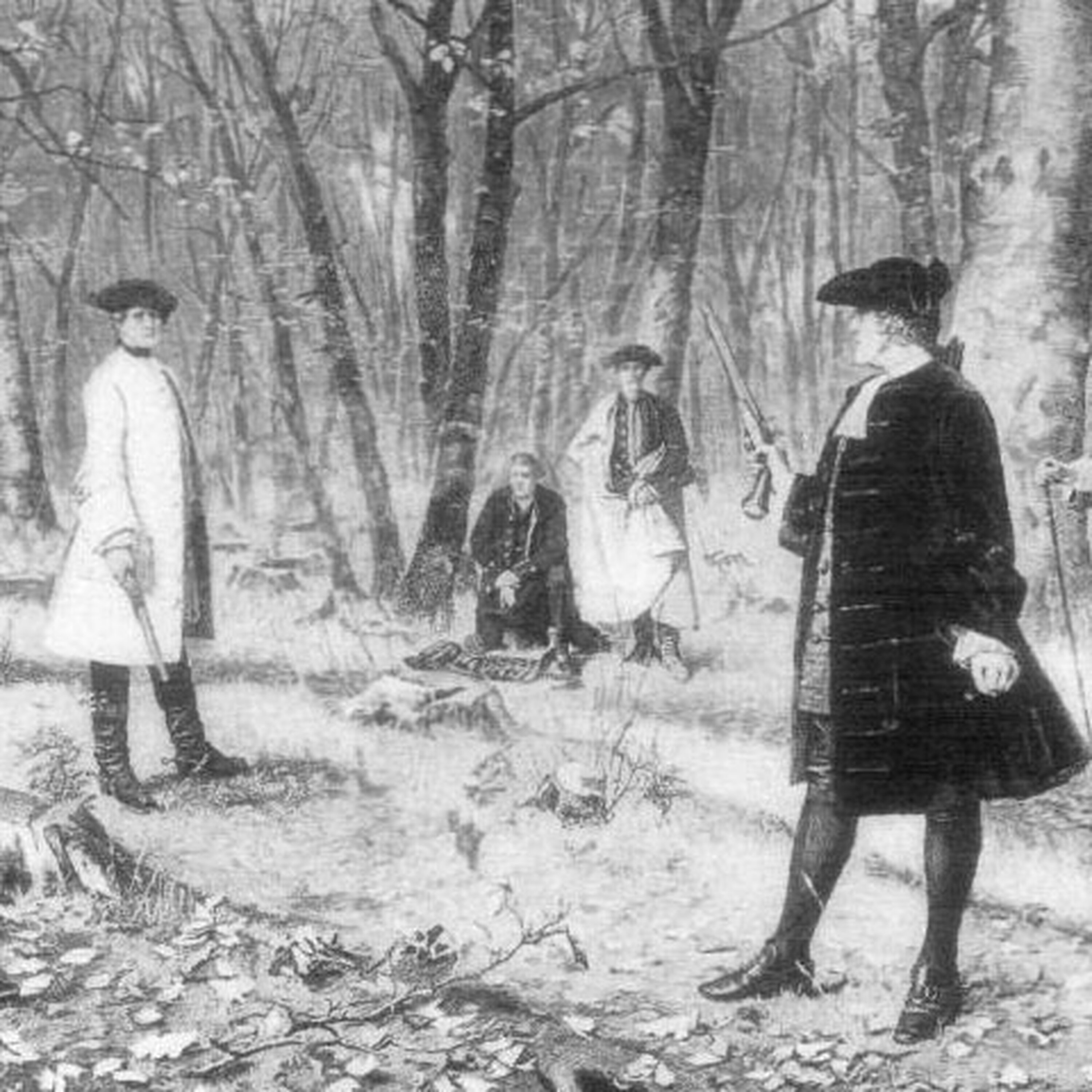
American History Hotline
Dueling in Early America: Hamilton, Burr, and Honor Culture with Lindsay Chervinsky
00:18:14
Loading summary
Transcript48 lines
- [00:00]
Bob Crawford
Did Burr ever say, I could shoot a man on Fifth Avenue and can get away? Because he kind of did in weehawking. He's like, I could shoot a man in weehawking and get away with it. You've reached American History Hotline. You ask the questions, we get the answers. Leave a message. Hey there, American History Hotliners. Your host, Bob Crawford here. Welcome back. You know the drill by now. Send your questions and I'll find you some answers. That email is americanhistoryhotlinemail.com that's americanhistoryhotlinemail.Com. okay, let's get on with it. Today we're welcoming back to the show our good friend Lindsey Chervinsky. She's a presidential historian and executive director of the George Washington Presidential Library. She's also the author of the book Making the John Adams and the Precedents that Forged the Republic. Hey, Lindsay, welcome back to the show.
- [01:01]
Lindsey Chervinsky
My pleasure. Thank you for having me.
- [01:03]
Bob Crawford
I hope you can help us answer a question we got from a listener. They asked, was dueling a really big part of American history, or was it just something that happened in a few famous instances like Burr and Hamilton?
- [01:18]
Lindsey Chervinsky
That is a great question. Happy to answer it. So dueling was much more prevalent than just a couple of instances. It did tend to shift over time and was more prevalent in certain areas than others, especially as American history progressed.
- [01:35]
Bob Crawford
So was it normal for people to die in the duels? I mean, I've read somewhere that sometimes they would throw their shot away.
- [01:44]
Lindsey Chervinsky
Yeah. So this is a great question. So a lot of dueling culture, we actually inherited, like, so many things from European culture, especially British culture. And the point of a duel was not actually to kill someone. It was to avenge your honor or to prove that you were a man of honor. And that didn't require death. It didn't even require necessarily hitting flesh. It just required a demonstration that you were willing to engage in this activity. And there were a lot of rules that regulated how people participated, participated in this. If anyone is a fan of Hamilton the musical, the. The dueling commandments were real things. And there was actually a book that was published in England that had all of these dueling commandments. They didn't call them commandments at the time. That was a Lin Manuel Miranda edition, which I enjoy a great deal. So the idea was you would engage in what was called an affair of honor. Joanne Freeman, a wonderful historian, has written a great deal, had written, wrote a book about affairs of honor, and you would have a second who was sort of like your co conspirator and they would negotiate the terms. And oftentimes most affairs of honor did not actually get to the dueling field. So they would negotiate an honorable out or a way that both sides were okay with whatever disagreement being solved. There were also then different ways that you could fight a duel. So there was. There were sword duels, there were pistol duels. There were a lot of different ways that you could engage in this type of activity. In fact, I think Abraham Lincoln engaged in a sword duel. I think he selected swords for that particular engagement. Most duels, again, did not end in death. Oftentimes you would go, you would show up, and you would fire into the air. And the point was, again, just to demonstrate that you were man enough to show up to this thing, not to try and kill the other person. So when there was death or there was injury, that was actually more the aberration than the norm.
- [03:44]
Bob Crawford
So it kind of sounds like, to me, it's the old grade school, high school, three o' clock high thing, where you just had to show up. If the bully said, you and me, three o', clock, outside in the parking lot, you just really had to show up to preserve your honor. You also mentioned that these dueling guy, this dueling guide, came from England. Sounds like the. Was it the whole tradition, the whole exercise of dueling, Is that something that we, of course, got from England?
- [04:16]
Lindsey Chervinsky
Yes, absolutely. So in the medieval period, dueling was actually part of the justice system. It was a way to get justice for certain wrongs, and it was a way to solve discrepancies or. Or disputes in a way that if there wasn't evidence. So there was a movie about the last duel that came out a couple of years ago that was duel that was fought in this part of the justice system. And then it became more of a social custom. And it sounds kind of crazy to us, but if we think about society at the time, you didn't have a Social Security number, you didn't have a credit check that could demonstrate that you were a reliable person. Instead, what you had was your honor or your reputation and your name. What was associated with that honor and reputation was how you could have business partners, was how you could get into school, was how you could make a good marriage, friends, associates. So really, anything that you wanted to do in society, you had to have a good reputation in order to do it. And so people were very touchy about their reputation. And for men in particular, and in certain cultures, this was especially prevalent. Your honor was a huge part of your reputation. So especially in military cultures. So among the. The military set, the officers in the Continental army, honor was really essential. And then as American history progressed, honor became an especially big part of southern culture. And there was a lot of overlap because a lot of elite southerners also served in the military. So we can't say that it was just one thing, but that honor, the defending the honor, was a huge part of maintaining your reputation as a man in American history.
- [06:01]
Bob Crawford
When Tocqueville came to America, he had dinner with John Quincy Adams and he asked him about slavery.
- [06:10]
Lindsey Chervinsky
And.
- [06:11]
Bob Crawford
And Adams said that essentially that slavery created equality in southern white culture, created southern quality, but it also bred laziness. Adams said that they devote themselves to bodily exercise, to hunting, to racing. They are vigorously constituted, brave, full of honor. What is called the point of honor is more delicate there than anywhere else. Duels are frequent.
- [06:42]
Lindsey Chervinsky
Yeah, absolutely. I mean, he was totally right. And I think partially this is a reflection of his New England sensibility. So the first duel was actually fought in Massachusetts, because that was one of the early colonies, of course. But by the time John Quincy Adams was alive, New New England tended to have fewer duels. Not that they had none, but this sense of honor had kind of gone on the outskirts, and some of the states had started to take action to try and limit who could duel, where they could duel. And so it was frowned upon in some of the New England states. And as it shifted farther south, you tended to see more of these duels. And especially by the time John Quincy Adams was in public service in the 1820s and 1830s, it was much more prevalent in the south than in the North.
- [07:33]
Bob Crawford
So our listener really wants us to talk about the Burr Hamilton duel. So what was behind that? How did that transpire?
- [07:42]
Lindsey Chervinsky
So Burr and Hamilton had known each other for a very long time. They had run in similar circles for a very long time. They had gone to similar educational institutions. They had both been in the Continental army. They both made their home in New York. So this was a long standing relationship. And initially, all accounts suggest they were on pretty good terms. But then over the years, they tended to compete a lot when it came to politics, when it came to elections. So, for example, in 1800, Burr was really running the Republican ticket, or what we call the Democratic Republican ticket. They referred to themselves as Republicans. And Hamilton was running the Federalist ticket for the state electors and the state representatives in the New York City area. And when Burr's ticket won, it really swung the state to Jefferson in the upcoming presidential election. And Hamilton was extremely resentful he blamed Burr for this action. A lot of people blamed Burr and also blamed Hamilton. Hamilton had been pretty instrumental in making sure Burr had lost his reelection campaign for the state legislature a couple years earlier. So this was a long standing thing. Once. Once the election of 1800 was over and Burr and Hamilton continued to live in New York City, the big shift I think occurred in their relationship when there was a contested election and Burr and Jefferson were tied in 18 this is early 1801, and Hamilton really pushed his fellow Federalists to support Jefferson because he felt like Burr had no principles. That's a pretty damning statement, especially for someone who cares about their honor. And the conflict only continued to escalate over the next couple of years, and that was really sort of the background behind their dueling behavior.
- [09:32]
LG XBoom Advertiser
Stop settling for weak sound it's time to level up your game and bring the boom. Hit the town with the ultra durable LG X Boom portable speaker and enjoy vibrant sound wherever you go. Elevate your listening experience to new new heights because let's be real, your music deserves it. The future of sound is now with LG XBoom and for a limited time save 25% at LG.com with code Fall25 Bring the Boom XBoom.
- [10:02]
WashablesOfAs.com Advertiser
Tired of spills and stains on your sofa? WashablesOfAs.com has your back featuring the Annabe Collection, the only designer sofa that's machine washable inside and out. Where designer quality meets budget friendly prices. That's right, sofas start at just $699. Enjoy a no risk experience with pet friendly stain resistant and changeable slipcovers made with performance fabrics. Experience cloud like comfort with high resilience foam that's hypoallergenic and never needs fluffing. The sturdy steel frame ensures longevity and the modular pieces can be rearranged anytime. Check out washablesofas.com and get up to 60% off your Anna Bay sofa backed by a 30 day satisfaction guarantee. If you're not absolutely in love, send it back for a full refund. No return shipping or restocking fees. Every penny back. Upgrade now@washablesofas.com Offers are subject to change and certain restrictions may apply.
- [11:04]
Lowe's Advertiser
Pro Savings days are back at Lowe's. Mylo's Pro Rewards members save even more with limited time doorbuster deals save $5 on 24 count. Contractor's choice 42 gallon trash bags now just 1478 plus get your choice. Select Dewalt Elite series saw blades for $9.98 not a pro Rewards member. Join for free today at Lowe's. Valid through 9 17. Selection varies by location while supplies last loyalty program. Subject to terms and conditions. See lowe's.com terms for details. Subject to change.
- [11:33]
Oregon Home Care Jobs Advertiser
You can make a difference in someone's life, including your own with a job in home care. These jobs offer flexible schedules, health care, retirement options and free training. They also provide paid time off and opportunities for overtime. Visit oregonhomecarejobs.com to learn more and apply. That's oregonhomecarejobs.com.
- [12:02]
Bailey Zimmerman Tour Promoter
Country's rising star Bailey Zimmerman just announced his biggest tour yet, the 2026 different night, same rodeo tour, hitting over 30 cities across the US and Canada. He's coming off a sold out 2020 and now he's back with a new album and a massive arena show, the Starz sophomore album. Different Night, Same Rodeo is out now featuring the number one hit Backup Plan with Luke Combs and fan favorites like Lost, Holy Smokes and Holding On. Want More? Fans can upgrade with VIP packages that include premium seats, exclusive merch and access to Bailey's pre show sound check Party tickets on sale now@livenation.com it's resonant to.
- [12:39]
Bob Crawford
Today where you will have certain politicians that were traditionally of of one ideology and one party who will support a candidate that they would never have agreed on other than thinking that the democracy was at stake. What happened to Burr after the duel here? He's killed one of the founders, one of the men instrumental with founding the nation and setting up the economic system at least. So what happens to a vice president after that?
- [13:15]
Lindsey Chervinsky
Yeah, so that, that little bit you just threw in there is pretty essential to this. He was vice president while this duel happened and went on to remain vice president through the end of that term. He was then replaced. Jefferson replaced him because he didn't want him to be vice president.
- [13:32]
Bob Crawford
Did Burr ever say I could shoot a man on, on Fifth Avenue and can get away? Because he, he kind of did in Weehawking. He's like, I can shoot a man in Weehawking and get away with it.
- [13:42]
Lindsey Chervinsky
Yeah, I mean he, he legally got away with it. He was not. And he, he stayed out of New Jersey because there was a question about whether or not charges were going to be brought up against him for killing Alexander Hamilton. So he did not really go back to that area, but there were no legal repercussions. But it certainly had political repercussions. So Jefferson had already wanted to replace Burr, but that made it very easy to do so. It was a very easy thing to point to. And Burr's later years were equally dramatic. He went on to maybe commit treason. It's not totally clear. There was a scheme to try and start sort of a new republic out west. And charges were brought against him and then they kind of were quashed. And Jefferson really wanted him to be convicted and John Marshall sort of interfered. It's a very complicated story. It's still very complicated today because the truth of the matter is sort of lost to us. And so we can put together our best guess. Whatever it was, he was up to no good. And so he was sort of a pariah. And he went out west, he did all sorts of things, but his life was never the same and his political stature was never the same.
- [14:53]
Bob Crawford
Who was our most duelingest president?
- [14:56]
Lindsey Chervinsky
Oh, that's a good question. So I think Andrew Jackson actually fought the most duels, but James Monroe is a close runner up in how many duels he almost got in. He almost had a duel with Hamilton in 1797, I believe. And he was then pretty instrumental in preventing another duel later. But he was. He had a tendency to get close. But I believe it was Andrew Jackson who fought the most duels. And he actually killed someone in one.
- [15:24]
Bob Crawford
Of his duels over horse racing. Or was that. Did he. Did a guy not die over that?
- [15:30]
Lindsey Chervinsky
There was, you know, I don't remember the details of that, but he. What was interesting, and to get back to the initial question is it was held against him that this person died in the duel, because that was. Unless you really had antagonism, that was not really the point. And so people often referred to him as a murderer in a way that they would not. For someone else who had engaged in a duel because of this outcome.
- [15:55]
Bob Crawford
Any other famous duels, or at least public political duels that come to mind?
- [16:02]
Lindsey Chervinsky
Well, I don't know if they actually classified this as a duel, but one of the ones that I think probably does account for that was the famous Lyon Griswold fight, which took place in Congress in the. The spring of 1798, if I'm remembering my dates correctly. So Roger Griswold and Matthew Lyon were both in the House of Representatives. And I think. And Roger Griswold had accused Matthew Lyon of cowardice of leaving the field of battle during the Revolution. And again, for military men, this is one of the big strikes against your honor if you're accused of cowardice. So Matthew Lyon then spat in his face, which was a response according to this, you know, code of Conduct was one of the responses that you would give to someone who is not your equal. It was very insulting. It's almost like if you were to slap someone today, like if it's a real man, you punch them. If it's someone beneath you, you slap them. So he, he spat in Roger Griswold's face. Griswold waited to see if Congress would do anything about it. And when they neglected to punish Lyon, he then started beating Lyon with a cane. And then I think Lyon picked up a fireplace tong. And they were basically having like a full, full on brawl in the floor of Congress, which involved many of their other supporters as well. So, you know, we think Congress is bad today. And I'm certainly not saying it's Congress's best moment, but for the moment, there have been no brawls with canes and fireplace tongs in a bit.
- [17:37]
Bob Crawford
Fireplace tongs, they were a popular implement back in the day.
- [17:42]
Lindsey Chervinsky
It's a handy weapon if you need a fire all the time to stay warm.
- [17:46]
Bob Crawford
That's right. When did dueling come to an end? And could I even ask, like, thinking of today, why, why did it come to an end?
- [17:56]
Lindsey Chervinsky
Yeah, so a lot of states started to pass laws that made dueling illegal. And they were, you know, that started actually fairly, fairly early, but it spread over the states over time. Eighteen states had outlawed dueling by 1859. So right before the Civil War, dueling was outlawed in almost all of the north, but it was still regularly practiced in the south, in the West. I don't know when the like, last recorded duel is because my guess is it was probably somewhere out west and it was still illegal, but people were still doing things. And just because it was legal, as we know, doesn't mean that people don't always do do it.
- [18:39]
Bob Crawford
I think it still goes on with every day at the playground. Every day.
- [18:43]
WashablesOfAs.com Advertiser
Yeah.
- [18:43]
Lindsey Chervinsky
Well, it's a great point. I mean, and if we think about like in, in modern culture, when there were the various, you know, rap battles and, you know, different feuds between west coast and East Coast, a lot of that behavior could actually really be classified as dueling behavior.
- [19:00]
Bob Crawford
And what about like gunfights in the Wild west, like Showdown at the OK Corral and something like that?
- [19:06]
Lindsey Chervinsky
Exactly. Now I think that maybe did have the intended purpose of killing someone. So maybe the goals of the duel was slightly different. But certainly the idea of showing up to demonstrate your manliness and your courage is something that has, I think, remained an integral part of American culture.
- [19:26]
Bob Crawford
Could I challenge someone to a duel today or would I go to jail?
- [19:32]
Lindsey Chervinsky
So you would, I believe, go to jail because, well, let me back that up and say, probably depends on the circumstance. A lot of states have what is considered to be stand your ground laws. So if someone comes into your home, you can defend yourself in your home with guns. But if you were to say to someone, I challenge you to a duel and you actually shot them, then yes, you would go to jail. So probably don't do that. But you know, if you're interested, there's always fencing as an option, and that's a perfectly sanctioned way to play with swords.
- [20:09]
Bob Crawford
We'll just settle it, you know, on the social media site. That's where arguments are to be settled or not settled. Lindsey Chervinsky, thank you so much for speaking with us today.
- [20:21]
Lindsey Chervinsky
Thank you for having me.
- [20:26]
Bob Crawford
You've been listening to American History Hotline, a production of Iheart Podcasts and Scratch Track Productions. The show's executive producer is James Morrison. Our executive producers from iHeart are Jordan Runtal and Jason English. Original music composed by me, Bob Crawford. Please keep in touch. Our email is americanhistoryhotlinemail.com if you like the show, please tell your friends and leave us a review in Apple Podcasts. I'm your host, Bob Crawford. Feel free to hit me up on social media to ask a history question or to let me know what you think of the show. You can find me at bobcrawford Bass thanks so much for listening. See you next week.
- [21:20]
LG XBoom Advertiser
Stop settling for weak sound. It's time to level up your game and bring the boom. Hit the town with the Ultra durable, durable LG XBoom portable speaker and enjoy vibrant sound wherever you go. Elevate your listening experience to new heights because let's be real, your music deserves it. The future of sound is now with LG XBoom and for a limited time save 25% at LG.com with code Fall25. Bring the boom X Boom Tired of.
- [21:51]
WashablesOfAs.com Advertiser
Spills and stains on your sofa? WashablesOfAs.com has your back. Featuring the Annabe collection, the only designer sofa that's machine washable inside and out. Where designer quality meets budget friendly prices. That's right, sofas start at just $699. Enjoy a no risk experience with pet friendly stain resistant and changeable slipcovers made with performance fabrics. Experience cloud like comfort with high resilience foam that's hypoallergenic and never needs fluffing. The sturdy steel frame ensures longevity and the modular pieces can be rearranged anytime. Check out washablesofas.com and get up to 60% off your annabe sofa backed by a 30 day satisfaction guarantee. If you're not absolutely in love, send it back for a full refund. No return shipping or restocking fees. Every penny back Upgrade now@washablesofas.com Offers are subject to change and certain restrictions may apply.
- [22:50]
Reasonable Doubt Hulu Advertiser
Witness the new season of Reasonable Doubt Streaming on Hulu September 18th. LA's most successful attorney, Jack Stewart, defends a young actor accused of murder. Follow Emma Yachty Coronaldi, Morris Chestnut, Joseph Socorro and guest stars Cash Doll and Lori Harvey as they face off in the year's most sensational trial in the pursuit of justice. Every move counts. Reasonable Doubt Season 3 is streaming on Hulu and Hulu on Disney September 18th. Hulu on Disney for bundle subscribers, terms apply.
- [23:23]
NFL Shop Advertiser
A new NFL season means a fresh start and fresh styles. @nflshop.com you'll find the latest jerseys, hats and sideline gear to rep your team all season long. From rookies making their debut to legends, NFLShop.com has it all Score exclusive styles you won't find anywhere else and show up ready for every kickoff and big play. Fan like a pro and shop now@nflshop.com.
- [23:53]
Belvita Advertiser
Every day has a to do list, but adding Enjoy Belvita to yours can help you knock out the rest of it. Belveda Breakfast Biscuits are a tasty and convenient breakfast option when paired with low fat yogurt and fruit that provide steady energy all morning while Belvita Energy Snack Bites give you the perfect mid morning refuel. Best part? They both taste great, so make the most out of your morning with a bite of Velveeta. Pick up a pack of Belvita at your local store today.