← American History Hotline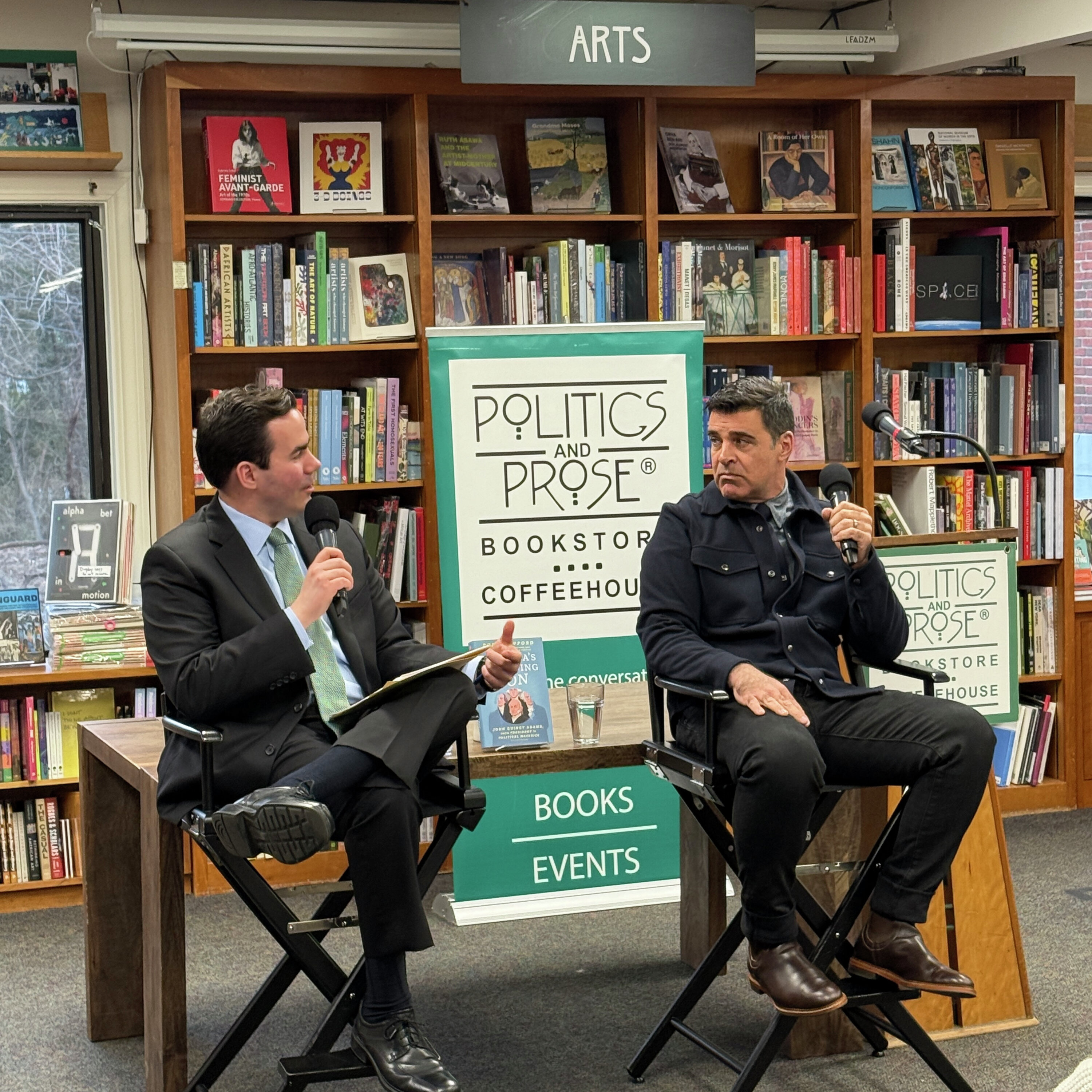
American History Hotline
John Quincy Adams: From President to Anti-Slavery Firebrand (Live in DC)
00:33:44
Loading summary
Transcript60 lines
- [00:00]
Moderator
Your book is not just about John Quincy Adams. It's about a time in America where populism, like it is now. That idea of populism was flaring in the public debate. Are there any lessons to be learned for our own time?
- [00:17]
Bob Crawford
You've reached American History Hotline. You ask the questions, we get the answers. Leave a message.
- [00:25]
Bob Crawford (Host/Announcer)
Hey there, American History Hotliners. I am super excited to announce that my new book is out. It's called America's Founding John Quincy Adams From President to Political Maverick. I'm currently on a whirlwind tour of the country talking about the book and sharing insights about my favorite president, ex president public servant, John Quincy Adams. I'm sure I've seen some of you at these events. It's been a ton of fun talking
- [00:54]
Bob Crawford
with you and meeting so many of you. You guys are the real rock stars. Thank you so much for your support.
- [01:01]
Bob Crawford (Host/Announcer)
But for those of you who haven't made it to any of these events, even for those of you who have, I thought I'd share a great conversation I had recently in Washington, D.C. my good friend Robert Costa of CBS News interviewed me at the bookstore Politics and Prose. It was an amazing discussion. Here it is.
- [01:21]
Bob Crawford
I hope you enjoy.
- [01:26]
Moderator
Thanks, everyone, for coming out tonight. We appreciate it. What do your bandmates make not only of the publication of this wonderful book, but of you over the last few years being obsessed with John Quincy Adams as you go on tour around the country.
- [01:40]
Bob Crawford
They are somehow very supportive of me. And yeah, it's. This would make perfect sense to them. Like, it's just knowing me, you know.
- [01:50]
Moderator
Explain your problem. I always call me the nerd bus. You wrote this on the nerd bus?
- [01:54]
Bob Crawford
Yes, I did. We have. So we tour. We don't own it. Any buses. We lease them per year. And on my bus, it's. It's me and Bonnie Avet Rey, their sister, Scott and Seth's sister, and Joe Quan. And we are the nerd bus. We are the. It's like, nice and quiet and. And Joe and Bonnie are often like. There's a front lounge with couches on either side and a tv. And often, like the lights are off and they're watching a movie or something or, you know, we're all sitting there reading our books. And they were so. Well, I mean, I got seniority, so they didn't really have a say in the matter, but they were. They were very sweet with me carrying, like, tubs of books into the lounge and taking over the desk or taking over the back lounge and doing, doing Work.
- [02:46]
Moderator
This is such an interesting topic for you to pick because I've been following your work since you started to delve into a lot of public affairs and, and history and so many Americans. We know about John Adams. There's an HBO series that's terrific with Paul Giamatti. There's the David McCullough book. And we know a lot about George Washington, John Adams, and then the Civil war in the mid-1860s. You decide though, to settle on the nation's sixth president, the son of John Adams, John Quincy Adams. How did you just decide to fixate on him as your first big historical project?
- [03:24]
Bob Crawford
Because when I studied that period between the Revolution and the Civil War, and I'm going to say, I will only say Sean Wood Lentz's name one more time. He wrote a book called the Rise of American Democracy, Jefferson to Lincoln. And if you haven't read it, I recommend everyone pick up a copy and it just covers that period. Right. We're taught in school about the Revolution and then we're taught about the Civil War. We don't, you know, what happened in between the Civil War just didn't fall upon us. And when you read this period, and if you read it chronologically, Adams keeps popping up again. He's Monroe's Secretary of State for two terms. He's the architect of the Monroe Doctrine. You continue to read. He's standing for president in 1824. It's a crazy election. It's. Believe it or not, we live in 2026. But I think 1824 may be the craziest election we've ever had, or at least one of them. But he wins that election in a vote in the House. But then he has a failed one term presidency. You continue to read. He pops up again, but this time he's in Congress. He's a congressman, you know, you continue to read. And there's this rule passed in Congress where you can't mention slavery on the House floor. And here he is fighting against it. You continue to read. And here he is defending these enslaved captives on a ship called the Amistad. You continue to read. And he actually dies at his desk in Congress. And so, you know, when I'm reading this and I'm thinking, how do we not all know about this guy? He, he is our greatest public servant. He of the 19th century for sure. Maybe in the history of this country, he is the greatest public servant. We think of the presidency as being the top. You know, you work to get to the top. What do you do after you get paid A lot of money to write a book and give speeches, or it's not about getting to the top. It's about preserving and protecting our democracy and doing that, serving your fellow citizens in any way you can. And that's what Adams exemplifies.
- [05:44]
Moderator
How did he create his own reputation, his own career, and escape the shadow of his father? He went into diplomacy early on. We hear a lot about the Monroe Doctrine or the Donroe Doctrine these days. And so the echoes of the past are with us even now. John Quincy Adams had his fingerprints all over the Monroe Doctrine, but he's often not associated, at least in the convention of wisdom in our current culture, with
- [06:10]
Bob Crawford
it, with the Monroe Doctrine. Well, so he gives a speech, Monroe Doctrines, 1823. It was in Monroe's seventh annual message to Congress, which we would think of as the State of the Union. And on July 4, 1821, Adams is asked to give an oration on July 4th. And he is Secretary of State. He accepts this honor. But to differentiate himself as being a member of the Cabinet, he wears his professor robe to give the address. He gives it here in D.C. and in that, in that speech, he asked the question, what has America. First part of the speech, he reads the Declaration of Independence. This. Then the second part, he asked this question, what has America given to the world? This is 1821. It's not been around very long. What has America given to the world? He talks about freedom and independence and self government. Then he says this line that we've heard in the news at least twice in the past two weeks. But she does not go. But she does not go abroad in search of monsters to destroy. A couple Saturdays ago, when the bombing started in Iran, I turned on my threads and Rand Paul. There was a quote of a Rand Paul tweet where he writes that line,
- [07:49]
Moderator
quoting John Quincy Adams.
- [07:50]
Bob Crawford
Quoting John, that very line. Four or five days later, Hegseth gives an address on South American at that South American event. South America event. And he says the same line, he quotes the same line for trying to put it into a completely different context. So this is Adam's thinking as the doctrine is being developed, essentially as the Monroe Cabinet is throwing about some kind of a statement about American dominance of the Western Hemisphere. And we're not going to get. I love going down rabbit holes. I'm going to try to be brief here. Britain at one point. So there's the Holy Alliance. It's Russia, Austria and Prussia, British. That's the Monroe. The idea of the Monroe Doctrine is saying, you guys, no More colonies in the Western Hemisphere. Okay. Around the same time we're formulating this idea, Britain reaches out to us through diplomatic channels and they say, hey, look, how about we go in on the old Spanish colonies, Cuba Port, Puerto Rico, let's go in together on this. And Monroe shares this with Jefferson, who's retired ex president at this point. He loves the idea. He's like, yeah, this is great. Which is kind of crazy because he didn't always love Britain. Madison, everything Monroe did, he checked with Jefferson and Madison, and Madison's into it. James Calhoun, he's the Secretary of War, he's into it. The cabinet's into it. Adam says, no, no, we're not doing that. This is. Britain's out. The Holy alliance is out. This is our territory. And so he was the architect of. It's funny. William Henry Seward, Secretary of State for Lincoln. No, wait, sorry. Yeah, he was. But then he was Secretary of State for Johnson, right? Seward would give Johnson advice. He'd be like, well, Mr. President, I think this is how you want to play this, blah, blah, blah. And Johnson would never listen to him. Monroe always listened to John Quincy Adams. And so that Monroe Doctrine is the John Quincy Adams Doctrine. One final thing, everybody wanted Cuba. The United. Jefferson always wanted Cuba to be part of the United States. This is going to recur again and again and again over in throughout American history. Adams says, right in the same time period. He's like, if we try to get Cuba right now, we're going to risk a war with Spain and maybe a war with Britain. We don't need this. We really. We're not up for this right now. But then Adams says, in the fullness of time, Cuba will be part of the United States. So I think J. Rubio will start quoting this in about a week or two. You will be hearing about John Quincy Adams at the annexation ceremony in Havana in about three weeks.
- [11:17]
Moderator
Nice if some people in the administration quote the Avett Brothers. Not just John Quincy Adams on the Monroe Doctrine, but Bob and I had the opportunity a few days ago at the New York Public Library to look over John Quincy Adams original documents and letters. And he has left a treasure trove to the United States with his very comprehensive diary. And Bob Crawford spent an enormous amount of time when he wrote this book going through the diary and thinking about John Quincy Adams not only as this diplomat and statesman and president, but as a human being. And one thing that really comes through in your book, Bob, is you try to reveal the humanity of this person who's mostly Unknown to many Americans, including his struggle as a parent, his struggle as a father. And you've been candid, Bob, about your own experience as a father, different challenges in your family. What was it like put aside being a musician and someone who's well known and someone very interested in being a historian? What was it like just to read John Quincy Adams diary and to think about him as a person?
- [12:30]
Bob Crawford
Yeah, and he kept a. It was a 14,000 page diary. I have not read every page from the time of being a teenager to close to his death at the age of 80. And he would. If he. If he missed a day, like, so he would. There would be like a day where he'd go, I spent the morning. He would go back over the past three weeks, like, say he missed like, days or weeks. He would, like, spend time and just like, go back over it. And there was. He kept an index. He made an index of his diary. And there are certain entries that you realize he's struggling with depression. One, he says he's going, I can't sleep. I'm not eating much. I have strange and unnameable pains. The things I typically enjoy don't give me pleasure. Like, he's kind of working through it. He loses two sons in adulthood, he loses a daughter in infancy, and then he loses two sons in adulthood. And my favorite entry that I think exhibit that kind of illustrates all of this is November 2, 1837, and he's visited by a guy named Thomas Monroe. And he and Monroe have known each other for 30 years, and they're both now in their 70s. And Monroe was the longtime postmaster of Washington, D.C. but he lost his job when Andrew Jackson came to office and fired all the civil servants. And Mr. Monroe has lost two sons, or a son and a daughter in adulthood, both under tragic circumstances. His wife's very sick. And he comes to Adams, and Adams is describing him as a hypochondriac in his diary. And he comes to Adams and he's like, you know, they tell me what I have is a case of the Blue Devils. Have you ever suffered from the Blue Devils? And Adam says, yes, yes, I know the Blue Devils. And I know the only remedy for the Blue Devils. It's vigorous exercise. It's hard work. It's involving yourself in projects and trifles. Only in that can you deal with the Blue Devils. He asked Monroe. He's like, have you tried horseback riding? And the guy's like, yeah, you know, I do that. I like that. He's like, have you tried swimming? Adams loved to swim in the Potomac. He's like, yeah, I've done some of that, but I really can't do that like I used to. He says, what about company? Do you enjoy company? And this guy Monroe says, ah, I really don't enjoy company and I really don't enjoy family company from family. But, but I just, I've always felt really connected to that particular particular diary entry.
- [15:38]
Podcast Promo Voice
This is an I Heart podcast.
- [15:41]
Reese Witherspoon (Ad Voice)
Guaranteed human Picture this me, Reese Witherspoon in London ordering fish and chips so often they might start wrapping me in paper. I'm traveling with my Wells Fargo Autograph Journey card, so I earn rewards wherever I book travel five times points with hotels, four times with airlines, three times on restaurants and other travel and one point on other purchases. Imagine getting rewarded for eating a toad in the hole. Wait, what is a toad in a hole?
- [16:08]
Public Investing Ad Voice
Visit wells fargo.com autographjourney Terms apply support for the show comes from Public, the investing platform for those who take it seriously. On Public you can build a multi asset portfolio of stocks, bonds, options, crypto, crypto and now generated assets which allow you to turn any idea into an investable index. With AI. It all starts with your prompt. From renewable energy companies with high free cash flow to semiconductor suppliers growing revenue over 20% year over year, you can literally type any prompt and put the AI to work. It screens thousands of stocks, builds a one of a kind index and lets you back test it against the S&P 500. Then you can invest in a few clicks. Generated assets are like ETFs with infinite possibilities, completely customizable and based on your thesis, not someone else's. Good to public.com podcast and earn an uncapped 1% bonus when you transfer your portfolio. That's public.com podcast paid for by Public Investing Brokerage Services by Open to the Public Investing Inc. Member FINRA and SIPC Advisory services by Public Advisors llc SEC Registered Advisor. Generated Assets is an interactive analysis tool. Output is for informational purposes only and is not an investment recommendation or advice. Complete disclosures available at public.com disclosures fatigued
- [17:15]
Inner Balance Ad Voice
mood changes, skin shifts. Labs say everything's normal. You're not alone. Most estrogen or progesterone topical and oral treatments only work about 20% Oestra from inner balance is a prescription strength bioidentical hormone cream for menopause and perimenopause relief. Vaginal HRT like Oestra offers better absorption, effective symptom relief, fewer side effects. Stop juggling multiple products. Feel balanced again. Visit innerbalance.com feel like yourself again, that's
- [17:43]
CarMax Ad Voice
innerbalance.com do you want to find a stress free way to buy your next car? Start at CarMax and shop your way. If you want to browse with confidence, get pre qualified online with no impact on your credit score and shop cars within your budget. From luxury cars to family rides, CarMax has options for almost every price range, including more than 25,000 cars priced under $25,000. So, hey, want to get started? Just head to CarMax.com for details and get pre qualified today. Want to drive CarMax?
- [18:18]
Moderator
You've mentioned President Andrew Jackson. President Trump has obviously talked about President Jackson throughout the past decade.
- [18:28]
Bob Crawford
You mean Steve Bannon explained to President Trump that he's like Andrew Jackson. And President Trump said, I'm like Andrew Jackson.
- [18:37]
Moderator
I remember in 2017 when President Trump was in his first year of his first term, they made a big show of putting up the Andrew Jackson portrait inside the Oval Office. And there has been an effort by President Trump and his allies to cast him as this populist figure. And we hear that word a lot now, populism, the word nationalism. But your book is not just about John Quincy Adams. It's about a time in America where populism, like it is now, that idea of populism was flaring in the public debate. How do you understand the populism of Jackson's time? Are there any lessons to be learned for our own time?
- [19:16]
Bob Crawford
Yeah, I don't. Andrew Jackson and Donald Trump are two very different people and very different types of leaders. But I don't think it's totally off to compare some of that and those times. You know, Jackson rode to power at a time after a financial crisis, after a terrible financial crisis. And the right to vote was being extended to all white males, not just property owners anymore. And a lot of these, a lot of these men, they, they were moving their families south and west and they wanted the government off their back. They didn't want to pay taxes for anything. They, they thought that this, the, this is the, the generation after the founding. So it's like the next generation always wants to redefine what democracy is for themselves and for their generation. So I don't think we are too far off. But the populism of Andrew Jackson in those times was very much this generational shift. And it was a matter of, see, Jackson was popular because he was a war hero. He was the greatest war hero since George Washington due to the Battle of New Orleans. And he was almost a folk hero to the level of a folk hero. So people you know, all the elements were there. There was financial. The world was out of joint in the country. There was a lot of financial paranoia and a lot of anx. And this man, you know, on horseback, Andrew Jackson, just appealed to a lot of people.
- [21:08]
Moderator
So when you're reading your book, it's clear that for many decades, the early decades of John Quincy Adams, his life was. He was more cautious. He was a statesman. But then in 1831, after he's president, he decides to come back to Washington in the House of Representatives, and he has this reinvention of himself. And I know you're not John Quincy Adams, but I found in knowing you and covering you over the years and getting to know you well, you are someone who's had enormous success with the Avett Brothers in the music world. Now, in your early 50s, you've decided to turn to history. I know you've been working on it for over a decade, doing the John Quincy Adams podcast, doing the Road to Now. This is not just something you jumped into in the past year, but was there something about Adams decision to come back to Congress, to reinvent himself, to think about shattering the norms about who he is that appealed to you as someone who often, I'm sure, unfairly, is just boxed in as a musician? And you obviously have more to offer than just being a musician. He had more to offer than just being a former president.
- [22:26]
Bob Crawford
Yeah, I've always had a lot of interests. You know, I just. I've always been like that. You know, I've never, ever in my life just pursued one thing or thought about myself in one way. And so this project for me and my journey on history, it's been a long, slow, but very secure, like, building on one step and then to the next step and never knowing exactly where it's going to lead. But I just knew that I was finding joy in it. Like, I was. It was, you know, my home life is. Can. It can be very tough with a special needs child. And you can't just deny that stress. And you can't. You can't cover it up or paper over it. And you need. It's draining, right? It's physically and emotionally draining. But so what I have found to cope is to involve myself in trifles and vigorous study and exercise in those things. And that's why, like, working on this book for me and working on the podcast, it's just a place that my. My mind can go that is, you know, just, you know, I'm not leaving. I'm not. I'm not like Denying my troubles or the things that. That. That we need to deal with, that are hard. But I'm. I'm also taking a step away and taking a deep breath. I don't know how many times I have been at my house and I've had a podcast to do in, like, 15 minutes, and there's just chaos in my. It's just chaos. And I'm thinking, how can I just. I can't do this. I got to cancel this thing. And then I get in the room and I shut the door and then get on the zoom and start talking to somebody, and they've written this incredible book or they're this amazing economist or this or that, and I'm just. I'm with them. I'm present here, you know, and it just seems to fill me up.
- [24:36]
Moderator
One of the first times I ever came across John Quincy Adams, who here has ever seen the Steven Spielberg movie Amistad? And John Quincy Adams features in that as an antagonist towards slavery. In the 1820s, it seems like John Quincy Adams saw trouble on the horizon with the Missouri debates. What did he see happening in the country? And why did he become this figure during the Amistad episode, during his time in Congress, who really was anti slavery?
- [25:09]
Bob Crawford
There's a direct. First of all, there's a direct connection between his failed presidency and his success defending the Amistad captives. I'm gonna get to that in one second. In 1820, when there was debate in this country about what to do with Missouri territory. Missouri wanted to come into the Union. It was ready. It was going to be a slave state. A congressman from New York put an amendment on their statehood bill. It passed in the House, and then Congress adjourns for a year. And so this thing's hanging over the country. And since the Constitution, we really didn't talk about slavery in the public square. It wasn't part of the political language of this country, the political debate of this country. But now it's all anyone could talk about. And it was ripping the country apart in town hall meetings and state legislatures, north and South. You know, in the south, they were like, okay, don't deny. If you deny Missouri slaves to be a slave state, we're leaving. Adams would confess to his diary. He's Secretary of State. He doesn't have a vote in this, but he's at this time, he's writing in his diary, and it's actually one of his first times he really writes about. He hadn't written about slavery in years in his diary, and he says the only way that we can end slavery in this country will be through a civil or servile war. And he's very eloquent in it. And I don't. I'm not going to open the book and find the page. I'll be happy to read it if anybody finds the page. But he does this repeatedly in this time period, as the Missouri crisis is building and building and building and it's being debated around the country. He, you know, I said he's friends with John C. Calhoun. Like, when I first wrote the draft of this, I wrote that. So John C. Calhoun's war secretary. He's Secretary of State. John C. Calhoun's from South Carolina. He will become. He. At this point, he's a nationalist. He'll become a nullifier. And before he dies in 1852 or whatever it was, he has put the South, South Carolina in particular, on the path to secession. He is the intellectual mind behind the Confederacy. But at this point, he and Adams are pretty good friends. Massachusetts Historical Society, who I totally love and respect, they're like, adams didn't have any friends. They weren't friends. But it seems like. So they're having a lot of conversations, Calhoun and Adams, while this Missouri thing's going on. And so you have a Massachusetts guy and a South Carolina guy talking, you know, having, like, just casual walking talks, right? And. And Adams comes to the realization that the men of South Carolina are never going to give up their slaves. They're never going to do it. Calhoun tells Adams. He says, our enslaved people make all whites equal because any white man who does menial labor, that means he would not be equal to a wealthy white man. And what gives white men in the south equality is that they have enslaved property to do these menial tasks for them. And Adams just couldn't believe it. He couldn't believe someone who believed in the Declaration of Independence and the Constitution could have these thoughts. So Adams, he was incredibly prophetic about what he knew was going to happen.
- [28:56]
Moderator
Writing a book can be so daunting, especially your first book. And we all bring our own skill sets to that process. I was a newspaper journalist when I first started working on mine years ago with Bob Woodward, and I brought that skill set to the process because that's all I knew. You're someone who's had experiences few, if any people in this room have ever had. To be on stage at a place like Red Rocks and to know what it takes to excel at the highest level of live performance and music, to know what it's like to write a song or co. Write a song that's heard by millions of people. The acumen it takes, the dedication to the craft. Is there an overlap in the creation of a song, the performance of a song, and the creation of a book?
- [29:43]
Bob Crawford
Yeah, I think editing is like the defining skill set or. Well, it's the skill I seek. Like, I mean writing songs, painting a painting, writing a book. You know, I think to learn the skill of editing or to, you know, search for it and try to adhere to it. Editing is like the. Editing is writing. In my, my opinion, editing is creating.
- [30:16]
Moderator
Was there anything that was tough to, to let go?
- [30:19]
Bob Crawford
I, so I'd never done this before and I got to a point at the end where I think I began to over edit. Well, I just, I would just read over things. See, I didn't know this until I was way through the process, but I had a historian tell me, oh, well, people send their stuff off to their friends and they send their stuff off to other readers and they, they get a lot. They get feedback. They get feedback. And I hadn't sought much, if any feedback. And I'm getting down to the wire and I sent it to a friend of mine who is a new. He's a, he's a journalist, he's a ghostwriter and he's a magazine editor. And he, he gave me, he read through it and he gave me a few, a few ideas and pointers and they were really, actually really helpful. But he also affirmed some things, you know, and I reached out to some other historians and people who had written books and they gave me feedback and they also helped affirm things for me. So if I do this again, I think I know how I can be more efficient. And yeah, I guess that's what I have to say about that.
- [31:38]
Moderator
So we're going to move to the question and answer period in a minute. If you have a question, you can start lining up at the microphone here. But before we, as we conclude this portion of the discussion, perhaps it's best to talk about the conclusion of John Quincy Adams life. What a dramatic story. The end of his life. I mean, rest in peace, but what a way to go. Can you tell us the story of how he left?
- [32:04]
Bob Crawford
Yes. So he has a stroke in 1846, but he comes back to Congress. He's 80 years old. It's 1848 now, February, and the war in Mexico is beginning to wind down. And there's a. Adams never supported it. He was always against the war in Mexico. He, along with a freshman congressman who was serving alongside him, Another Whig from Illinois named Abraham Lincoln. They were both in agreement. This is the beauty of Adams. Right? This is why he's so. One of the reasons why he's so confident, compelling, is George Washington appoints him to his first diplomatic post, and he serves alongside Abraham Lincoln in Congress. And if you're talking about the pulling two eras of American history together, or if you're looking for a through line, that's John Quincy Adams. So Adams is on the floor. They are. I think. I think what was before the House was. Was a kind of a. What do they call it when it's not like an important bill, but just to offer accommodations, accommodations for Mexican war generals. And Adams had shouted out no when they first called the bill. And then it was time. It was getting down, close to time to vote. And Adams. Other congressmen notice him. He's, like, trying to stand up. He puts his hand in the corner of the desk and his hand shaking, and. And he falls over, and he's caught by another congressman. And somebody yells, Adams is dying. Mr. Adams is dying. And they. They bring over a couch, and they place him on a couch, and they place him in what was then the Speaker's chamber. And he's. He's barely conscious, and he says, these are the greatest last words. We should all remember these last words and say them when we pass away. This is the end of Earth. I am composed. And he loses consciousness. And Henry Clay comes over from the Senate, and he's, like, holding his hand, and he's weeping, and so he lays on that couch for two days, and then he passes away. He dies in the Capitol. He dies in the very sanctuary he had spent his whole life trying to preserve in the seat of our democracy, which is really crazy. I know. My friend James Morrison and co producer James Morrison is here. James. And I got to sit on that couch. It is still here. It's been reupholstered. It is in the Congressional Women's Powder Room, which is right off of Statuary Hall. Right. And I was told that on January 6th, that was like. Because you kind of don't know it's there. Really?
- [35:09]
Moderator
No, it was where people hid out.
- [35:10]
Bob Crawford
People hid out in that room. But it's all still there in the Capitol. So. Yeah. The greatest death. I don't know. Greatest death in American history.
- [35:20]
Moderator
Definitely dramatic.
- [35:21]
Bob Crawford
I mean, really. Yeah. And fitting for him for a dramatic life. Yeah.
- [35:30]
Bob Crawford (Host/Announcer)
You've been listening to American History Hotline, a production of Iheart podcasts and Scratch Track Productions. The show's executive producer is James Morrison. Our executive producers from iHeart are Jordan Runtal and Jason English. Original music composed by me, Bob Crawford. Please keep in touch. Our email is americanhistoryhotlinemail.com if you like the show, please tell your friends and leave us a review in Apple Podcasts. I'm your host, Bob Crawford. Feel free to hit me up on social media to ask a history question
- [36:07]
Bob Crawford
or to let me know what you
- [36:09]
Bob Crawford (Host/Announcer)
think of the show.
- [36:10]
Bob Crawford
You can find me bobcrawford Bass. Thanks so much for listening. See you next week.
- [36:23]
Podcast Promo Voice
At cvs. It matters that we're not just in your community, but that we're part of it. It matters that we're here for you when you need us, day or night, and we want everyone to feel welcomed and rewarded. It matters that CVS is here to fill your prescriptions and here to fill your craving for a tasty and, yeah, healthy snack. At cvs, we're proud to serve your community because because we believe where you get your medicine matters. So Visit us@cvs.com or just come by our store. We can't wait to meet you. Store hours vary by location.
- [36:57]
Paramount Plus Ad Voice
Paramount is now the home of all your BET favorites.
- [37:01]
Bob Crawford
What?
- [37:01]
Paramount Plus Ad Voice
Yes, with all new episodes of Tyler Perry's Divorce.
- [37:04]
Bob Crawford
Sisters you've always liked, a little drama,
- [37:06]
Paramount Plus Ad Voice
plus a whole new world of movies like Gladiator 2.
- [37:09]
Bob Crawford
Now I will control an empire.
- [37:12]
Paramount Plus Ad Voice
Original series like the Shy.
- [37:13]
Bob Crawford
Just make sure we protect each other
- [37:15]
Paramount Plus Ad Voice
in live sports like ufc.
- [37:17]
Bob Crawford
Welcome to the history books.
- [37:20]
Paramount Plus Ad Voice
New home, same family. Your BET favorites are now on Paramount Plus. Subscribe now.
- [37:27]
Sean Duffy
I'm U.S. transportation Secretary Sean Duffy. We all seem to be in a rush these days, from work to driving our kids around. But when you're behind the wheel, please do not speed. A few minutes saved by going faster is never worth the risk. So follow the speed limit, enjoy the drive, maybe bring some snacks for the kids. And know that along the way, you're getting quality time with your family. Paid for by nhtsa.
- [37:57]
Inner Balance Ad Voice
Fatigued mood changes, skin shifts. Labs say everything's normal. You're not alone. Most estrogen or progesterone topical and oral treatments only work about 20% Oestra from inner balance is a prescription strength bioidentical hormone cream for menopause and perimenopause relief. Vaginal HRT like Oestra offers better absorption, effective symptom relief, fewer side effects. Stop juggling multiple products. Feel balanced again. Visit innerbalance.com feel like yourself again. That's innerbalance.com this is an iHeart podcast.
- [38:30]
Podcast Promo Voice
Guaranteed human.