← American History Hotline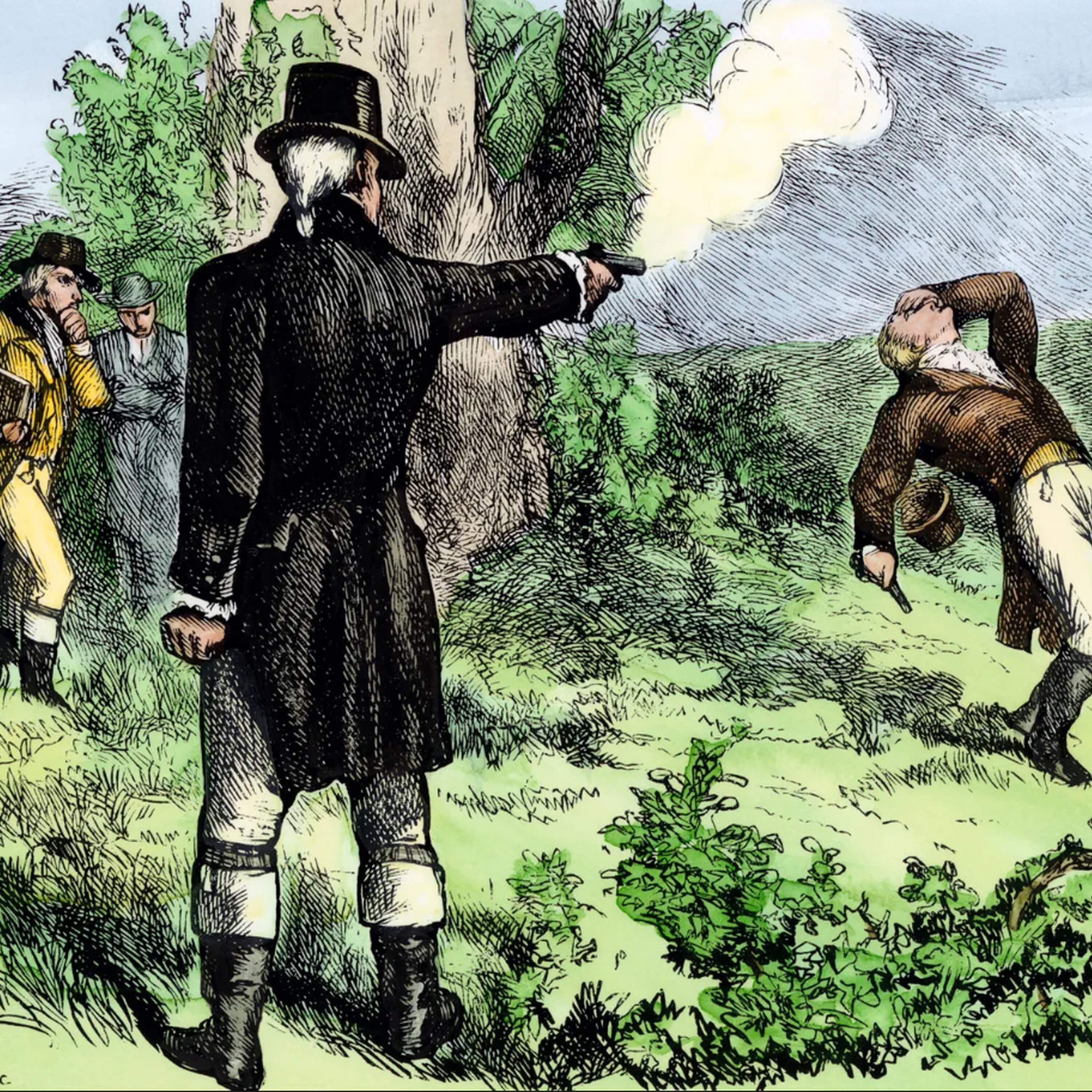
Loading summary
Transcript163 lines
- [00:00]
Joanne Freeman
Burr's friends said, essentially, you gotta leave town. Burr left town. His second left town. The boatman who rode them across left town. Like anyone associated with Burr, we're out of here.
- [00:16]
Bob Crawford
You've reached American History Hotline. You ask the questions, we get the answers. Leave a message. Hey there, American History Hotliners. Bob Crawford here. Thrilled to be joining you again from for another episode of American History Hotline. It's the show where you ask the questions. And the best way to get us a question is to record a video or a voice memo on your phone and email it to AmericanHistoryHotlinemail.com that's AmericanHistoryHotlinemail.com okay, today's question comes from Ellen in Connecticut. She asks what happened to Aaron Burr after the duel with Alexander Hamilton. Was he tried for murder? Ellen, this is a great question, and I found the perfect guest to answer it. Joining me now is Joanne Freeman, a professor of history and American studies at Yale. She's also the author of many books, including one of my favorites, the Field of Blood, Violence in Congress, and the Road to Civil War. She's also edited the book the Essential Letters and Other Writings. Joanne, it is such a pleasure to have you today.
- [01:34]
Joanne Freeman
I am so happy to be able to be here.
- [01:36]
Bob Crawford
We're so glad that you're here with us. Okay, before we get to the aftermath of the Hamilton Burr duel, I want to talk a little bit about honor culture in the early Republic. You know, you've written a book, affairs of National Politics in the New Republic. Why was dueling such a thing in early America?
- [01:58]
Joanne Freeman
This is the question. Why was dueling such a thing? Because it makes no sense if you think about it, right? So I insult you and your response is to invite me to a field so we can shoot at each other. And this does not resolve the insult. But the idea was, and not every insult deserved a duel. There were. There were some. If I call you a liar or a coward, then I know that probably bad things will happen. But the idea of dueling wasn't so much, and this will be counterintuitive, wasn't so much the shooting as being willing to stand up and be shot at to defend your reputation. So personal reputation, particularly for a gentleman in this time period and really particularly for, for a political person in this time period, reputation was everything. Reputation was a possession. And in a period when you don't really have political parties for a while, early America, you're voted in or seen as a leader because of your reputation. So it matters a lot. And so if you're insulted, many men felt compelled to invite the person who insulted them, invite the person who insulted them to a dueling ground, and they would go through. You know, in some ways, it's kind of like the movies. They don't go back to back and then spin. There's one duel I found out where there was the whole spinning thing and the, the balls from the guns went all over the place. Didn't work well, but kind of like the movies, you shoot at each other. But the point, as I suggested a moment ago, is to stand there and be willing to die for your honor. And because of that, the vast majority of duels, people don't get killed. The point of a duel is actually not to kill the person you're shooting at, which I realize doesn't entirely make sense.
- [03:47]
Bob Crawford
Right.
- [03:47]
Joanne Freeman
But it's about showing yourself to be a leader.
- [03:53]
Bob Crawford
So then what was it between Burr and Hamilton? Like, what precipitated their duel?
- [03:59]
Joanne Freeman
The question, okay, so they had been colleagues and friends of a sort for a while. They moved in the same circle and they sometimes practiced, defended clients together as lawyers. But Hamilton saw Berg as a real political opportunist. And along those lines, Burr ousted Hamilton's father in law from Congress, ran for Congress, and ousted Hamilton's father in law. As time went on and it became clear to Hamilton at least Bird didn't really seem to have guiding principles. He seemed to be, you know, sort of spur of the moment kind of guy, which is really helpful in politics, but not particularly trustworthy if you're in an era where everybody has some kind of guiding ideology.
- [04:49]
Bob Crawford
Yeah.
- [04:50]
Joanne Freeman
Hamilton came to really distrust him, really distrust him. And so generally speaking, he was, you could count on him to come forward in one way or another to try and get people to not support Burr. Now this became a big deal in the election of 1800 when we didn't have like the modern day. We don't have separate, like a ticket that has vice president and president on it. You just voted for all the candidates, and whoever gets the most votes wins. And whoever gets the second most votes is vice president. In 1796, that resulted in a Republican Jeffersonian Republican president and a Federalist vice president. In 1800, the two candidates for the Democratic Republicans tied. And although Aaron Burr was clearly intended to be the vice presidential candidate, his attitude was basically, well, you know, I'm not going to campaign, but if I get elected, I'll take the presidency. And he almost saw it like an insult. Right. How dare you say that I am not worthy of the presidency if I should get enough votes. For obvious reasons, this did not thrill Thomas Jefferson, who becomes president. So Burr is the vice president for Jefferson's first term. He's ousted after that. So now, and I should say, Hamilton did not turn that election. I know the Hamilton musical suggests it was all Hamilton. He tried. He tried really hard. It's not a lot of evidence that people really listened to him because by that point he was trouble himself. But at any rate, Burr goes back to New York because now he's like, okay, I think the national stage is not working so well for me. Go back to New York and I'll run for office there. So he runs for governor, and guess who appears out of the shadows to prevent him from becoming governor? Alexander Hamilton. Who once again, there he is saying, no, don't vote for this guy. And in this case, Hamilton was speaking, as he did so freely and easily about negative things about Aaron Burr that some of it made a newspaper. And one of Burr's supporters handed that newspaper, that clipping to Burr. And there's actually a pamphlet by one of Burr's supporters. And his logic for handing this over was he said, you know, I trust, I follow Burr, he's a leader, I'm behind him. But if the guy can't win any office, why are we following him? So the idea was he's going to have to do something to prove himself. And if he doesn't, he might not really be a political leader after this point. So now Burrs lost that election, he's off the national stage, and he has in his hand a newspaper in which Hamilton is insulting him. So that ends up leading to the duel.
- [07:56]
Bob Crawford
I don't want to get bogged down in this, but is this why we have the 12th amendment? Is this because of what happened with Burr?
- [08:05]
Joanne Freeman
Ultimately, yeah. Ultimately, yes.
- [08:08]
Bob Crawford
Precipitates that?
- [08:09]
Joanne Freeman
Ultimately, yes. So after the 1800 election, they realized that the whole presidential election thing was a little scary. The response of national politicians was, wow, we didn't really rethink that one because the whole nation divided between first between political ideology and then between two people. And that was really bad. Maybe we shouldn't do that again. And they were trying to come up with other ways to elect presidents. So, yeah, ultimately that's where you get the amendment from.
- [08:43]
Bob Crawford
The two Burr and Hamilton decide to meet on the field of honor.
- [08:49]
Joanne Freeman
Yes, we do.
- [08:50]
Bob Crawford
Which is in Weehawken, New Jersey. And what happens? What happens? Take us there.
- [08:57]
Joanne Freeman
Ooh, on the spot. You are there. So it's unclear even now whether Hamilton did or didn't shoot at Aaron Burr. They were positioned, facing each other. Their seconds loaded their dueling pistols. The command was given, 1, 2, 3, present. And in the end, Burr was not struck. Hamilton was hit in the abdomen. I think it went through his liver and lodged in his spine, and he dropped. Now, before the duel, and the Hamilton musical makes it more interesting and more complicated to talk about this because everybody knows some basic facts. His son had fought a duel three years earlier, Philip. And Hamilton had told his son, a good Christian doesn't shoot at another man in this way. And so based on that, and based on the fact that Hamilton told his friends he was not going to shoot at Burr, he actually said, I am not going to shoot at him the first time. But if Burr says honor isn't satisfied, if there's a second round of shots, then everything's off the table. But at any rate, he was telling people he wasn't going to shoot at Burr. And some of Hamilton's friends left town because they thought this is just going to be bad, like, whatever happens and it's probably not going to be good for Hamilton. So they decide to displace themselves. And indeed, Hamilton is fatally wounded. He dies the next day. Again, as I said, it's not clear whether he actually did or didn't shoot the gun. Supposedly, when he was being rowed back across the river to Manhattan from Weehawken, New Jersey, he glanced at the gun and said, be careful of that. It might go off. If that happened, that suggests something. But in the end, the 2 seconds wrote up accounts of the duel, which is normally what happened after a duel, and they didn't agree on what happened. And at some point in my research at the New York Historical Society, I found. So Burrs second was tried for his participation in the duel, and he took notes of his own trial. And the doctor, David Hosak, who was there tending to them, testified at the trial. This is a document I found at New York Historical that had eyewitness accounts of the Burr Hamilton duel, which, as far as I know, had not been found before because the date was 1805 and not 1804. At any rate, David Hosak says, okay, I had my back to the dueling ground, which cut, say people who know the Hamilton lyrical. Let me back up for people who know the Hamilton lyrics. In the 10 dual commandments, when the lyric says they turn their back, they doctor turns his back so he can have deniability. That comes from the document I found.
- [12:02]
Bob Crawford
Right.
- [12:03]
Joanne Freeman
And that's the only place where that's revealed in that way. Hosak says he heard a shot, a pause and a shot, which first of all means there were two shots, but then complicates it further as to what really happened. So at any rate, the important point is Hamilton dies.
- [12:24]
Bob Crawford
Hamilton dies. What does Burr do when he finds out that Hamilton has died?
- [12:30]
Joanne Freeman
So this is a big deal. First of all, I missed an important point, which is Aaron Burr was Vice president at the time. Right. So the Vice President just killed.
- [12:40]
Bob Crawford
He was a sitting vice president who knew he wasn't going to stand again for vice President. He knew his days as the Veep were numbered, probably.
- [12:50]
Joanne Freeman
And so it's a big deal. You know, it would have been a big deal if there had been any duel between important people with the Vice President as one of them. Bigger deal with one of them seemingly fatally wounded. They were putting up like, bulletins in lower Manhattan announcing how Hamilton was doing. Burr's friends said, essentially, you got to leave town. Burr left town. His second left town. The boatman who rowed them across left town. Like anyone associated with Burr. We're out of here.
- [13:20]
Bob Crawford
Because it's illegal to duel.
- [13:23]
Joanne Freeman
Well, it's illegal to duel, it's illegal to send a challenge. It's illegal in different ways in different states, but pretty much everywhere it was illegal to send a challenge, and Hamilton died. So now there's murder potentially at hand. So in one way or another, Burr and his friends leave town, Burr goes to South Carolina, and they're happier with dueling.
- [13:47]
Bob Crawford
Of course he does.
- [13:48]
Joanne Freeman
Yes. And why is it always, anyway, he goes south and he stays with a friend in the south, they're pretty much okay with dueling and they're not so okay with Hamilton. So that was probably a smart maneuver. And he hides there for a while, and then he comes back to Washington and takes back his seat presiding over the Senate as Vice President, which is pretty remarkable. And people who were there acknowledged that he looked a little strained. His facial expression. He looked a little. A little strained. But supposedly Jeffersonian Republicans came up and shook his hand to show that he was a. Okay. Particularly because he'd killed off this important Federalist. Right. So obviously Federalists were outraged and others noticed and weren't outraged.
- [14:42]
Bob Crawford
How did the Southern press handle it? Like, because I remember reading accounts of Charles Sumner's caning, you know, in the Senate at the hands of a South Carolinian congressman. And in this, in this is, at this point, they have, like, telegraph and. And it's kind of immediate. And the Boston newspapers are talking about the tragedy that has happened. And then like, the Richmond Inquirer is like, ah, you should hit him again. Like, yeah, yeah, good job. Like, what was it like in the south in the. In the aftermath of this?
- [15:16]
Joanne Freeman
Well, it was complicated because unlike 1856 and the caning of Sumner and slavery being the issue, and Sumner being this guy who was constantly attacking slavery and the south, in this case, a lot of people, or a reasonable amount of people dueled. So some of Burr's friends, when people are trying to figure out ways to find him guilty under the law, some of them argued. There was actually a group of members of Congress who put together a petition that basically said, we never bring people to trial for dueling. So many of us have dueled. Why are you punishing Aaron Burr? So it's a different thing.
- [15:59]
Bob Crawford
Everybody does it.
- [16:01]
Joanne Freeman
Everybody. Well, a lot of. Everybody's. A lot of somebodies do it. And so some in the south were not distressed. Some in the south understood that dueling probably is something that should be quashed. So anti dueling sentiment rose in a number of places, even a little bit in the South. So the big dealness of the duel had kind of a mixed impact. But for sure, the north had the sort of outraged response. And the Federalist north, because the Federalists are pretty much a northern party, quote, unquote, at that point, they had a lot to say.
- [16:43]
Bob Crawford
Ultimately, Burr is charged with something, Right?
- [16:48]
Joanne Freeman
Well, so he's charged with sending a challenge, I believe. I don't think he's charged for murder. And he's charged in both New Jersey and. And New York because the duel is fought in New Jersey, but the challenge was sent in New York. There's a reason when you're researching dueling, you almost never see the challenge letter. Almost never. Because they destroy them because that's the crime. One time I saw a challenge letter and I went rushing up to the librarian and they probably didn't know. I was like, it's a challenge letter. Look, yeah, no one would understand but me why that mattered. But at any rate, so he gets charged, he is not found guilty of whatever, and he flees.
- [17:36]
Bob Crawford
He's not found guilty.
- [17:38]
Joanne Freeman
He is not found guilty.
- [17:39]
Bob Crawford
Well, I mean, and there was no immunity. Like, he's the sitting vice president. There's no immunity.
- [17:45]
Joanne Freeman
Burr did not have immunity because he was vice president. Shocking, right? No immunity.
- [17:51]
Bob Crawford
So did anyone. Was anyone convicted for anything involving this, the death of Alexander Hamilton?
- [17:59]
Joanne Freeman
I don't believe so, shockingly. Which tells you something about dueling as being a hated practice by many, but still an acceptable practice. And it's the lawmakers breaking the law by dueling. The place where I found the document about the doctor turning his back so he can have deniability. That was the trial of Aaron Burr. Second. So he gets brought to trial, too. But I don't think people are convicted of anything. What I don't know, and I would have to check sometimes you lost the franchise, right? You lost your right to vote, or they found some way to punish you in that way. But in this case of this duel, I don't think anybody really suffers serious fate.
- [18:43]
Bob Crawford
But Burr loses his reputation.
- [18:46]
Joanne Freeman
Well, Burr is basically in trouble now because he's immediately depicted as an evil murderer who savagely killed Alexander Hamilton. And people make up stories about him that he. Like, he wore a silk jacket which is bulletproof, and people actually believe that. But anyway, that was one of the rumors that he was practicing for days so he'd be sure to kill Hamilton. Evidence suggests that Burr didn't intend to kill Hamilton, which, you know, certainly Burr's enemies were not going to allow to exist. So what he sees is all of his enemies, both from Jeffersonian Republicans and the Federalists, ganging up to just crush him in some way. So he is like the ultimate evil enemy, despite the fact that dueling is acceptable. And Hamilton doesn't help matters by leaving behind a last statement in which he explains why he felt the need to duel with Aaron Burr.
- [19:45]
Bob Crawford
Did he write this before the duel or in the period between getting shot and dying, which was like, 36 hours?
- [19:52]
Joanne Freeman
Oh, good question. No, before the duel, he. He put together a collection of things. You know, if I die. Here you go.
- [19:59]
Bob Crawford
Because he thought of everything. Like, that was Hamilton. Right? He thought of everything.
- [20:03]
Joanne Freeman
That is totally Hamilton. But Bird did a similar thing. No one ever gives him credit for that. But if you're gonna fight a duel, you might. You're probably not gonna die, but you might. That's the whole point of it. So. And in his. This final statement, you know, he explains why he felt the need to oppose Burr. He explains that after an entire career of opposing Burr, he can't now say, I'm sorry, which would be ridiculous. And then he says something along the lines of, this is gonna be a bad paraphrase. In those future crises of our nation, which seemed likely to happen, I felt the need to be available, to be called upon. What he's saying is, if I don't fight the duel, I'll be dishonored and I won't be able to come to the aid of my country in the future crises that seem likely to happen. And Hamilton believed on a certain level that the Constitution was ultimately going to fall.
- [21:00]
Bob Crawford
Right.
- [21:00]
Joanne Freeman
So he thinks there's going to be a crisis and he can't be the guy coming forward to help in his mind, if he doesn't fight the duel.
- [21:10]
Bob Crawford
I'm Clayton Eckerd. In 2022, I was the lead of ABC's the Bachelor.
- [21:15]
Stephanie Young
But here's the thing. Bachelor fans hated him.
- [21:18]
Bob Crawford
If I could press a button and rewind it all, I would.
- [21:21]
Stephanie Young
That's when his life took a disturbing turn. A one night stand would end in a courtroom.
- [21:28]
Bob Crawford
The media is here.
- [21:29]
Stephanie Young
This case has gone viral.
- [21:31]
Bob Crawford
The dating contract.
- [21:32]
Stephanie Young
Agree to date me, but I'm also suing you.
- [21:36]
Bob Crawford
This is unlike anything I've ever seen before.
- [21:38]
Stephanie Young
I'm Stephanie Young. Listen to Love trapped on the iHeartRadio app, Apple Podcasts, or wherever you get your podcasts. What if mind control is real?
- [21:48]
Bob Crawford
If you could control the behavior of anybody around you, what kind of life would you have?
- [21:51]
Stephanie Young
Can you hypnotically persuade someone to buy a car?
- [21:54]
Joanne Freeman
When you look at your car, you're gonna become overwhelmed with such good feelings.
- [21:59]
Stephanie Young
Can you hypnotize someone into sleeping with you?
- [22:01]
Bob Crawford
I gave her some suggestions to be sexually aroused.
- [22:05]
Stephanie Young
Can you get someone to join your cult?
- [22:06]
Joanne Freeman
NLP was used on me to access
- [22:08]
Stephanie Young
my subconscious mind games. A new podcast, exploring nlp, AKA neuro linguistic programming. Is it a self help miracle, a shady hypnosis scam? Or both? Listen to mind Games on the iHeartRadio app, Apple Podcasts, or wherever you get your podcasts. Then she says, have you seen a photo of my son? And I'm like, who is this person?
- [22:31]
Boys and Girls Podcast Host
Welcome to the boys and girls podcast. Arranged marriage is basically a reality show and you're auditioning for your soulmate and who's judging? Only your entire family. I sacrificed myself to this ancient tradition, hoping to find love the right way. And instead I found chaos, comedy and a lot of cringe. Listen to boys and Girls on the iHeartRadio app, Apple Podcasts, or wherever you get your podcast.
- [22:56]
Joanne Freeman
It's the new me and it's the old them.
- [22:59]
Amber Grimes
This woman's history month, the podcast if you knew better with Amber Grimes spotlights women who turn missteps into momentum and lessons into power.
- [23:07]
Stephanie Young
My, like, tunnel vision of like, I
- [23:09]
Joanne Freeman
gotta achieve this was off. The strengths of, like, I wanna make
- [23:11]
Stephanie Young
a better life for us.
- [23:13]
Amber Grimes
If you knew better brings real talk from women who've lived it unpacking, career pivots, relationship lessons and the mindset shifts that changed everything. Listen to if you knew better with Amber grimes on the iHeartRadio app, Apple Podcasts or wherever you get your podcasts.
- [23:27]
Stephanie Young
WSECU isn't just one of Washington's best credit unions. We're a Forbes Best in State five years running.
- [23:34]
Joanne Freeman
Why?
- [23:35]
Stephanie Young
Because we put you first. Lower fees, early paydays, financial guidance and service second to none. As a member owned corporation cooperative, we love Washington as much as you do. From the Olympic mountains to the rolling Palouse. Join us and discover how much we care about your financial well being because what we really do best is invest in you. Visit wsecu.org today to learn more. Washington let's credit union.
- [24:03]
Bob Crawford
This is American History Hotline. I'm your host, Bob Crawford. Today my guest is Joanne Freeman, a professor of history and American studies at Yale. She's also the author of many books, including one of my favorites, the Field of Blood, Violence in Congress and the Road to Civil War. She's also edited the book the Essential Letters and Other Writings. We're talking about what happened to Aaron Burr after he killed Alexander Hamilton in a duel. Remember, if you have any burning questions about history, record yourself using the voice memo app on your phone and email it to AmericanHistoryHotlinemail.com that's AmericanHistoryHotlinemail.com now back to the show. So Burr finishes his term as vp. He beats the murder rap. What does he do next?
- [24:57]
Joanne Freeman
So what does he do after the duel? Now he has a problem already. The national stage is off limits to him. He tried to run for governor and Hamilton prevented that. So state politics don't seem like they're good. So now he decides the west, national stage, not so good. State politics, not so good. But the West, I could do something in the West. I could earn glory in the West. I could. It's not entirely clear ultimately what he thinks he's doing in the west, but he very clearly heads west, organizes some kind of expedition with young men who were impressed with him, sort of trailing after him. He talked with the British minister. He suggests maybe he can break off part of the West.
- [25:51]
Bob Crawford
And are we talking about Texas? Are we talking about or what would become the state of Texas?
- [25:58]
Joanne Freeman
What would become the state of Texas? Parts of Louisiana, part of the Louisiana Purchase, which is, you know, new.
- [26:06]
Bob Crawford
So I remember reading about another famous American duelist and he crosses paths with Aaron Burr as a young man.
- [26:16]
Joanne Freeman
Yes.
- [26:17]
Bob Crawford
Andrew Jackson, indeed. Who was no stranger to a duel.
- [26:21]
Joanne Freeman
No.
- [26:21]
Bob Crawford
And he carried around the lead for the rest of his life to prove it.
- [26:25]
Joanne Freeman
Indeed.
- [26:25]
Bob Crawford
And he was also in pain most likely because of it. So how does. So Aaron Burr, he flees the north, he goes west. He's think he has maybe some grand designs on starting his own country. Maybe. How does he cross paths with Andrew Jackson?
- [26:45]
Joanne Freeman
Well, he's meandering all over the place, in part to collect people to come along on my glory expedition to do something that I'm not going to be clear about. And in the course of meandering around out west, he meets Andrew Jackson. He likes Andrew Jackson. Andrew Jackson liked Burr. Somehow this is not surprising. I think Burr liked the aspects of Jackson that like he was just going to go out for what he wanted. You know, he wasn't a shy guy, he was a bold guy. Jackson liked Burr and I think saw him to some degree as a man ahead of his time for taking the opportunity and making the bold move. So they actually got along pretty well, liked each other pretty well, which totally fits. I think people generally don't see Aaron Burr and Andrew Jackson as existing in the same time period, never mind endorsing each other to a certain degree. But that is how he meets.
- [27:48]
Bob Crawford
And this has got to be before the Battle of New Orleans, like This is before 1815.
- [27:55]
Joanne Freeman
Yes, it is. And he had a piece of advice for Jackson which was so Jefferson and James Madison essentially made sure that he wasn't president and then did not help him much after that election.
- [28:12]
Bob Crawford
Persona non grata.
- [28:14]
Joanne Freeman
Exactly. So apparently he said to Jackson, never trust a Virginian. But wait.
- [28:21]
Bob Crawford
Okay, now and again, I only know pieces of this and that's why I'm hoping you can fill this in. Monroe was a. Was kind of friendly with Burr. Right. Well, correct me if I'm wrong on
- [28:33]
Joanne Freeman
this, they were Revolutionary War veterans together. So Monroe has some friendships that aren't necessarily typical of a Virginian.
- [28:41]
Bob Crawford
Right. Because Monroe had a. Dueling. He had a hot head. Right. He had a temper as well.
- [28:47]
Joanne Freeman
He almost dueled with Hamilton. There's an amazing account. I don't remember if it's in my essential Hamilton, but the other Hamilton writings book that's bigger has the document in there. Hamilton thinks that Monroe leaked news of the Reynolds pamphlet
- [29:14]
Bob Crawford
and Reynolds is the affair.
- [29:17]
Joanne Freeman
Maria, Reynolds is who he had an affair with. And later. And the people who discovered it, the Jeffersonian Republicans who discovered it, all promised not to say anything about it. And then lo and behold, it becomes news. And Hamilton goes to the three men who came to him and said, are you messing with money or is there something else And Hamilton says something else, I'm committing adultery. The other two people say, I didn't leak it. And Monroe won't say that. So then Hamilton decides he must be the one who leaks it. So he goes to meet with Monroe and brings with him a second, which means, okay, we're in dual territory. And Monroe has a second there as well. So already we're in a bad place. And one of the seconds transcribed their conversation, which is amazing if you're talking and trying to understand dueling, what you see in the conversation is Monroe getting chillier and chillier and Alton getting more and more red faced. So, you know, Hamilton keeps, you know, Monroe keeps interrupting and Hamilton says, you know, if you let me finish. And Monroe, you know, and every time he says, if you let, would you let me finish? Hamilton goes back to the beginning and says, I will start again. So this is not going well. And ultimately they insult each other. Hamilton says very carefully, if you are saying you didn't leak the Reynolds affair quote, that as your representation is totally false. He doesn't use the L word, liar. But he accuses Monroe of being a liar. And Monroe says, are you accusing me of being a liar? You are a scoundrel. And that's another dueling word. And essentially Hamilton says, I'm ready to meet you as a gentleman. And Monroe says, I'm ready to meet you as a gentleman. And they start talking about weapons, where are your weapons? And the two seconds step in and say, whoa, like this should not be happening here. And it's ultimately settled with nobody admitting they did anything wrong. But yes, Monroe had a hothead.
- [31:32]
Bob Crawford
Okay, so, so I've taken this down a rabbit hole, which I love rap personally.
- [31:36]
Joanne Freeman
I love rabbit holes.
- [31:38]
Bob Crawford
I have another one, but we're not going to go down it. Yeah, but, so let's get back to Burr. So Burr's in the West. He's, he's making some moves. Whatever happens of these little, these plots, if we want to call them that,
- [31:51]
Joanne Freeman
not a lot happens with the plots. He's meandering around with men, he has canoes, they're armed. It's unclear what he's doing. He never openly confesses about what it is he's doing. In the end, what happens is not a lot happens out west at all. But one of the people who started out helping him, James Wilkinson, who I believe at the time was commander in chief of the army, if I have that correct, leaks. He realizes this isn't going well and he leaks this. And news gets to President Jefferson. And now Burr is seemingly guilty of what they are saying at the time, treason. He's trying to break off part of the west or seize part of the west and, and make his own country like, pardon me here, but what the hell.
- [32:45]
Bob Crawford
Right. And a little foreign interference as well going on.
- [32:49]
Joanne Freeman
Right. He had talked to a British ambassador, I think he. I don't remember if he met with a Spanish ambassador, but he'd been mingling with the Spanish. So, yeah, it's. Whatever's happening, it's not good. So he is beginning to be brought up on charges for what he's doing out west where he's acquitted again and again and then he once again gets charged with something that he did ultimately when he was meandering around Virginia and he's charged with treason and brought to Richmond, Virginia for his trial. Supposedly, you know, he wasn't wandering around like a gentleman in, you know, a frock coat. He was, you know, I don't know if he's wearing buckskin, but he's wandering around out there looking, you know, a little rough and ready, not like his normal self. Supposedly wherever he was caught, they found him, they captured him, they grabbed him and he looked to people and said, they're coming to take me. Someone stand up for me. And nobody did. And he was then grabbed and put on a horse to be taken east. Supposedly he was crying because it was so humiliating. And then there is indeed the treason trial of Aaron Burr in Richmond, Virginia in 1807. I have to make the point here. He kills Hamilton in 1804. We're only in 1807 at this point.
- [34:15]
Bob Crawford
It seems like he's coming apart is what it seems like. It seems like he has no compass, no north star at this point and he's trying to reconstitute his fortunes and it's just not happening for him. It, you know, and now he looks like Gary Busey or something being. This is what I imagine being captured.
- [34:43]
Joanne Freeman
Wow. Yeah, I might save that image. Yeah.
- [34:49]
Bob Crawford
So is he convicted of treason?
- [34:51]
Joanne Freeman
Not.
- [34:52]
Bob Crawford
He is not acquitted. And what's remarkable is another bullet.
- [34:56]
Joanne Freeman
Another. But what's remarkable about this is Thomas Jefferson as president talks about the coming trial hasn't happened yet, and declares Berg guilty before the trial.
- [35:11]
Bob Crawford
Sounds like somebody else I know.
- [35:14]
Joanne Freeman
You mean messing with justice.
- [35:16]
Bob Crawford
Yeah.
- [35:18]
Joanne Freeman
What a shock. So anyway, despite that, and it's. It's a big deal trial, maybe not quite an O.J. simpson trial, but a big, big deal trial. But he's acquitted. But now national stage, not so good. State politics, not so good. The west, really not so good. So he goes to Europe. He puts himself in exile.
- [35:46]
Bob Crawford
In exile. So where in Europe does he go?
- [35:50]
Joanne Freeman
He mostly hovers in England and France, one of the. And he befriends some people there and hangs out with them. So he's kind of hanging out with some celebrity figures. My favorite is in 1800 when Hamilton is trying to get people to not support Burr. William Godwin was a political philosopher of the time and he basically thought that laws and the state imposed on people's general sense of what was right and wrong. Now he might be called an anarchist. And Hamilton says in trying to get people to not like Burr, Godwin, he's preaching Godwin. This is Godwinism. So who does Burr connect with in England? William Godwin. And they're friendly and they hang out together. To Burr's credit, he's one what I've seen so far as a scholar, the only elite gentleman, political gentleman that I've come across who read Mary Wollstonecraft's writing on the rights of women and wanted to discuss it. And he says at one point I couldn't find any man willing to talk about that with me. So he's actually intrigued with women's rights. He kind of shows that in his education and the way he treats his daughter Theodosia, that's to his benefit. Mary Wollastonecraft by this point has died, but she was the wife of William Godwin.
- [37:29]
Bob Crawford
Aaron Burr is such a tragic figure. He feels like a tragic figure.
- [37:34]
Joanne Freeman
Right.
- [37:34]
Bob Crawford
And he had a great ambition and some major accomplishments and he was, he was part of this founding generation. He was like, he served in, in the Revolution and did he go to Princeton? I think he wasn't a classmate.
- [37:49]
Joanne Freeman
College of New Jersey.
- [37:50]
Bob Crawford
Yeah, College of New Jersey. But he was plagued by self imposed bad luck, I guess. I don't know. He, you know, they say you make your own luck. Do you make your own bad luck?
- [38:02]
Joanne Freeman
Well, if you are exceedingly ambitious, which Hamilton was too, and you do have that streak of opportunism in you, who you'll make bold moves and do whatever it takes to get what you want, then yeah, you're making your own bad luck. This is what Hamilton says in letter after letter. You know, he has no theory, he has no ideology in the election of 1800. And what some federalists say to each other is, well, when you're engaging in politics, it's really handy to have a guy who has no theory, no ideology, because he's willing to do anything. So yeah, he, he basically makes his own. His Own bad luck.
- [38:48]
Bob Crawford
How should we view Aaron Burr as a person and as a historical figure?
- [38:56]
Joanne Freeman
Before I get to that, I have to give you the final tragic end.
- [39:00]
Bob Crawford
Oh, please.
- [39:01]
Joanne Freeman
Of Aaron Burr. So he hangs out in Europe for a while and then finally comes back to the United States, goes back to New York, tries to restart his law practice, but he's basically. This is a little extreme, but not quite.
- [39:20]
Bob Crawford
What year is this, would you say? Roughly?
- [39:24]
Joanne Freeman
18, 17, maybe. Tries to start his law practice back up, and he basically becomes a tourist attraction. Meaning people show up at his law office to look through the windows and say that they saw Aaron Burr. People who walk by him on the street avert their eyes because they don't want to meet the eyes of Aaron Burr. So he is a tragic figure. Despite the fact that he makes all his own luck or unluck, he ends up being this scorned figure and, you know, ultimately dies in New York, refusing really to explain why he did what he did, even refusing to acknowledge whatever his religious beliefs were. Someone says, what were your religious beliefs? And he says, on that subject, I am coy, doesn't offer explanation, and dies in 1836. So the question, the original question, I know it's pretty long, long way after the founding period.
- [40:31]
Bob Crawford
He outlives or almost outlives Madison. Right?
- [40:34]
Joanne Freeman
I mean, does outlive them.
- [40:35]
Bob Crawford
Yeah.
- [40:36]
Joanne Freeman
They die in 1826, he lives, outlives them by 10 years. He's the guy who's still hanging around. But that's in a way, when your question about how should we think about him or what should this tell us? He becomes this symbol of the Founding, who is out of time, who no longer fits, really, who represents some aspects of the Founding, I suppose you could say that, that are, if not admirable, then notable. You know, he is part of the Founding. He fought in the Revolution, he was vice President of the United States. But also all of the things that he did that were really not admirable are kind of a reminder that we should bear in mind more often than we do that the Founding isn't some golden glory period. It's complicated. It's full of things that the United States claimed and didn't live up to and didn't intend to live up to. There was glory and there was sin. And in a way, Aaron Burr lingering on some kind of stage like that can be a reminder of that. Most people don't know what happened to him, which is why that was such a good question. But he's kind of a symbol of that.
- [42:00]
Bob Crawford
I'VE been talking to Joanne Freeman, a professor of history and American Studies at Yale. She's the author of many books, including one of my favorites, the Field of Violence in Congress and the Road to Civil War. She's also edited the book the Essential Letters and Other Writings. Joanne, thank you for joining us today on the American History Hotline.
- [42:22]
Joanne Freeman
Thank you so much for having me. This was great fun.
- [42:25]
Bob Crawford
It's big fun for me. Thank you. You've been listening to American History Hotline, a production of iHeart podcasts and Scratch Track Productions. The show's executive producer is James Morrison. Our executive producers from iHeart are Jordan Runtal and Jason English. Original music composed by me, Bob Crawford. Please keep in touch. Our email is americanhistoryhotlinemail.com if you like the show, please tell your friends and leave us a review in Apple Podcasts. I'm your host, Bob Crawford. Feel free to hit me up on social media to ask a history question or to let me know what you think of the show. You can find me at bobcrawford Bass. Thanks so much for listening. See you next week. I'm Clayton Eckerd. In 2022, I was the lead of ABC's the Bachelor.
- [43:28]
Stephanie Young
But here's the Bachelor. Fans hated him.
- [43:31]
Bob Crawford
If I could press a button and rewind it all, I would.
- [43:33]
Stephanie Young
That's when his life took a disturbing turn. A one night stand would end in a courtroom.
- [43:40]
Bob Crawford
The media is here.
- [43:41]
Stephanie Young
This case has gone viral.
- [43:43]
Bob Crawford
The Dating Contract Agree to date me,
- [43:46]
Joanne Freeman
but I'm also suing you.
- [43:48]
Bob Crawford
This is unlike anything I've ever seen before.
- [43:50]
Stephanie Young
I'm Stephanie Young. Listen to Love trapped on the iHeartRadio app, Apple Podcasts, or or wherever you get your podcasts. What if mind control is real?
- [44:00]
Bob Crawford
If you could control the behavior of anybody around you, what kind of life would you have?
- [44:03]
Stephanie Young
Can you hypnotically persuade someone to buy a car?
- [44:07]
Joanne Freeman
When you look at your car, you're going to become overwhelmed with such good feelings.
- [44:11]
Stephanie Young
Can you hypnotize someone into sleeping with you?
- [44:13]
Bob Crawford
I gave her some suggestions to be sexually aroused.
- [44:17]
Stephanie Young
Can you get someone to join your cult?
- [44:19]
Joanne Freeman
NLP was used on me to access
- [44:21]
Stephanie Young
that's my subconscious Mind Games, a new podcast, Exploring nlp, AKA Neuro linguistic Programming. Is it a self help miracle, a shady hypnosis scam? Or both? Listen to mind Games on the iHeartRadio app, Apple Podcasts, or wherever you get your podcasts. Then she says, have you seen a photo of my son? And I'm like, who is this person?
- [44:43]
Boys and Girls Podcast Host
Welcome to the boys and girls podcast. Arranged marriage is basically a reality show and you're auditioning for your soulmate and who's judging? Only your entire family. I sacrificed myself to this ancient tradition, hoping to find love the right way, and instead I found chaos, comedy, and a lot of cringe. Listen to boys and Girls on the iHeartRadio app, Apple Podcasts, or wherever you get your podcasts.
- [45:09]
Joanne Freeman
It's the new me and it's the old them.
- [45:11]
Amber Grimes
This Women's History Month. The podcast if you Knew Better with Amber Grimes spotlights women who turn missteps into momentum and lessons into power.
- [45:19]
Stephanie Young
My, like, tunnel vision of like, I
- [45:21]
Joanne Freeman
gotta achieve this was off the strengths of like, I want to make a
- [45:24]
Stephanie Young
better life for us.
- [45:25]
Amber Grimes
If youf Knew Better brings real talk from women who've lived it, unpacking career pivots, relationship lessons, and the mindset shifts that changed everything. Listen to if youf Knew Better with Amber grimes on the iHeartRadio app, Apple Podcasts, or wherever you get your podcasts.
- [45:39]
Stephanie Young
Welcome to Dirty Rush, the Truth About Sorority Life, the Good, the Bad and the Sisterhood with your hosts, me, Gia Giudice, Daisy Kent, and Jennifer Fessler.
- [45:50]
Joanne Freeman
The reality of Greek life has been a mystery for those outside the sorority circles until now.
- [45:56]
Stephanie Young
Is it really a supportive sisterhood that's simply misunderstood, or is there something more scandalous happening on campuses across the country? Let's get dirty. Listen to Dirty rush on the iHeartRadio app, Apple Podcasts, or wherever you get your podcast.