Loading summary
Transcript66 lines
- [00:00]
Vincent Cannato
You know, there's a famous story of the immigrant, the Jewish immigrant named Sean Ferguson who arrives in America. The inspector says, what's your name? He answers in Yiddish, Schonfergessen, which is I forgot. And then the inspector writes, shawn Ferguson, here you go. Here's your new paperwork. Well, that just didn't happen.
- [00:23]
Bob Crawford
You've reached American History Hotline. You ask the questions, we get the answers. Leave a message. Hey there, American History Hotliners. Bob Crawford here. Happy to be joining you again for another episode of American History Hotline. It's the show where you ask the questions. And you can send us a question by recording a voice memo or a video on your phone and sending it to AmericanHistoryHotlinEmail.com that's AmericanHistoryHotlinEmail.com Today's question is about immigration. Here to help me answer this question is Vincent Cannato, author of American the History of Ellis Island. Vincent, thanks for joining me today.
- [01:09]
Vincent Cannato
Thanks for having me on the show.
- [01:11]
Bob Crawford
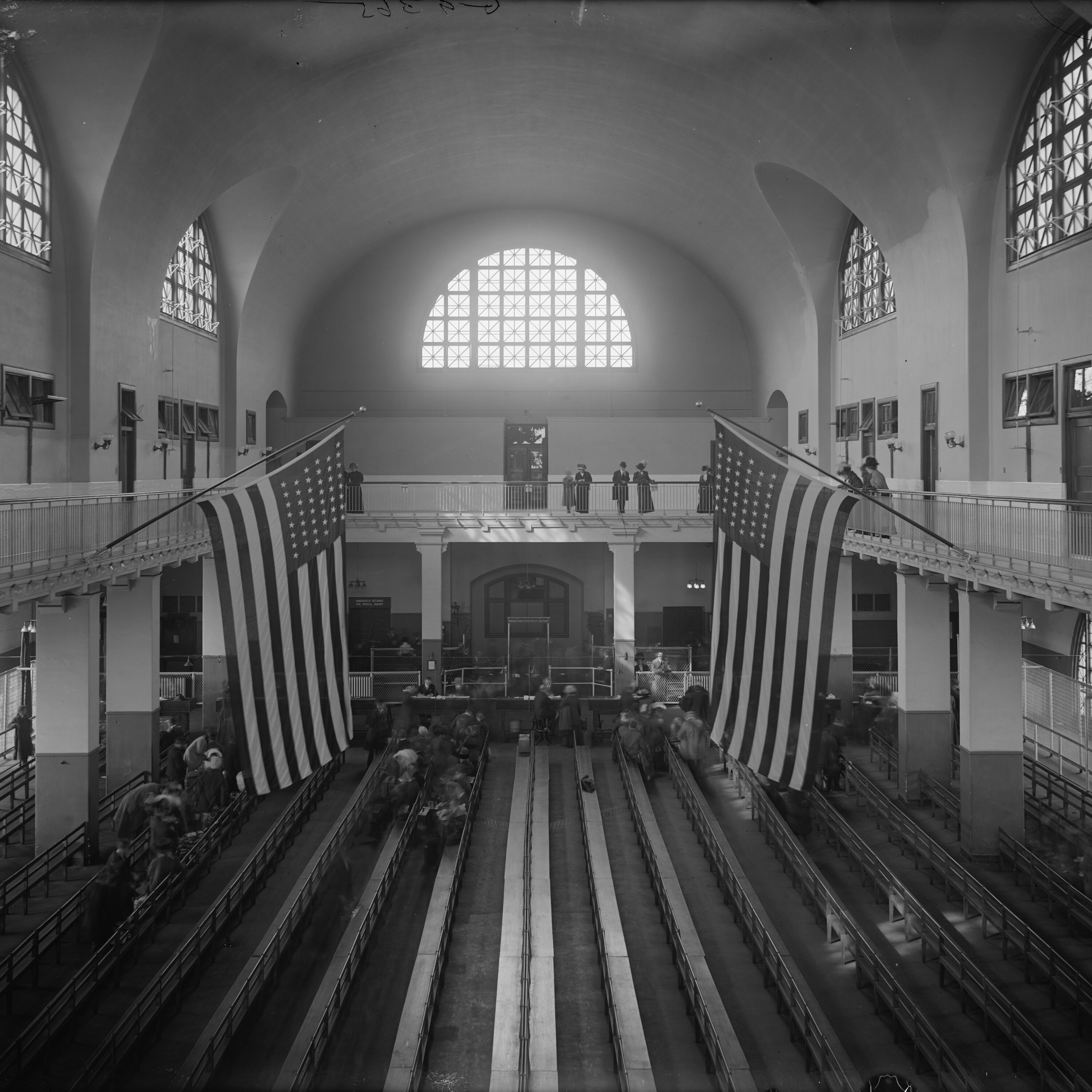
Okay, Vincent, here's the question we were hoping you could help us answer. It's from Beth. She writes, I hear so many stories about Ellis island as the main place for immigrants to America, but I've never been to visit. What was it like to come through Ellis island as an immigrant? Now, Vincent, let's start with the origins of Ellis Island. Where exactly is it and why did it become a port of entry for immigrants to America?
- [01:42]
Vincent Cannato
So Ellis island is a small island that's in New York harbor, so at the end of the Hudson river, right between Lower Manhattan and New Jersey. And it was a small island, probably about three acres, big. It's been expanded to about maybe six or seven times that today through landfill. And it became the main immigration port in America in the early 1890s. What happened was New York City, being the largest city in America at the time, was also the biggest port. So you had the most immigrants coming to America coming through New York by the early 1900s. You're talking about 70 to 75% of immigrants to America coming through New York, and they would be processed and inspected at Ellis Island. And so because there were so many immigrants coming to New York, Ellis island becomes the immigrant station in America.
- [02:40]
Bob Crawford
So who exactly are coming through Ellis Island? Where are they coming from?
- [02:46]
Vincent Cannato
So by this period, we're talking about late, so 1890s to 1920s, this is the period of Italian, Eastern European Jews, Southern Europeans, Greeks, Central Europeans, like Czechs and Poles and Hungarians and Slavs. So eastern and southern Europeans are the largest group coming to America during This period, there are still some Irish and some Germans and some British and some Scandinavians. There'll be some African black immigrants from the Caribbean, from places like Jamaica coming into this time. But the largest numbers are going to be those eastern and southern Europeans at this period.
- [03:30]
Bob Crawford
I thought I saw a video of you in an interview kind of saying that Ellis island represents the federalization of immigration in the United States. Can you expand on that?
- [03:44]
Vincent Cannato
So today we're kind of used to the idea that immigration is a federal preserve. So ICE is in the news today. That's the federal government's Immigration and Customs Enforcement. So they are in charge of immigrants, both visas, deportation, anything having to do with immigrants. Prior to, let's say, the 1880s, immigration was not a federal issue. It was left up to the individual states. So each state or most of the port states would have had their own laws and were responsible for their own enforcement. And in New York, immigration enforcement is at a place called Castle Garden, which is at the tip of Lower Manhattan in Battery Park. There's still, if you go there today, it's where you buy your tickets for the Statue of Liberty. Ellis island ferry, it's an old fort. It's been sort of retrofitted back to the old fort. So that was the State of New York's inspection station. But by the 1880s, it was clear that this was not a good system, that America was becoming a large, after the Civil War, united country, a large national country, a larger economy, and so that immigration would have to be a federal issue, not something left up to the states.
- [05:02]
Bob Crawford
Walk me through the experience. I'm on a ship for months. Then I see Lady Liberty slowly start to grow on the horizon. I'm full of hope. I'm really tired. I'm probably dirty. I step off the ship onto Ellis Island. What happens next?
- [05:20]
Vincent Cannato
Well, there's a few things. First of all, by this period, we're talking about modern steamships. So the ride would have been from Europe about 10 to 14 days. Still a long.
- [05:33]
Bob Crawford
Yeah, but that's not bad.
- [05:35]
Vincent Cannato
But, yeah, It's. In the mid-1800s, it was, you know, it was a lot longer. And when the ships entered into the New York harbor between the Narrows, if you're familiar with New York, the Narrows are between Brooklyn and Staten island. And that opens into the harbor. The ship would have gone into through the Narrows and would have been stopped for an initial inspection. There would have been inspectors coming on to look at the first and second class passengers. Remember, if you've seen the Titanic, you know that there Are classes on these ships. There's first class, second class, third class. Most immigrants were in the third class or steerage. But what a lot of people don't realize is that the ship would first dock in Manhattan. These are huge steamships, so they couldn't dock in Ellis island and in Manhattan. As long as these individuals were healthy. First and second class passengers were free to go. They would get off the ship in Manhattan and leave. If there was some issue with them, then they would be sent to Ellis Island. But for the most part, Ellis island was. Was for those immigrants in steerage or third class, they would get on a ferry after the big steamship in lower Manhattan and then take the ferry past the Statue of Liberty and dock at Ellis Island. They would get off the ferry and probably from the minute they got off the ferry, they would be watched. Doctors and inspectors were looking at the immigrants. They would come in with their bags, they would set their bags down. People would watch them to see, you know, are they out of breath, do they seem sickly? They would go into these single file lines past doctors and inspectors who would inspect them if there was some. And this is a very quick inspection. You're talking about thousands of immigrants during the peak periods coming through a day. Each individual immigrant does not get his or her own medical exam. They get a cursory exam. If the doctor or inspector thinks there's a problem, they take a piece of chalk, mark their coat, and they are set aside for further inspection. The rest of the immigrants go through the line and then they eventually get to the registry clerk. This is a clerk who is basically going to interview them based on their information that's on the ship's manifest. A ship's manifest is basically a list of cargo for immigrants. It's a list of every immigrant on the ship and then answers to certain basic questions. How old they are, where were they born, where are they going to? Can they read, can they write? So they're interviewed. If everything seems fine, then they're free to go. To give you a sense, about 80% of immigrants went through. Through pretty quickly, maybe in a couple of hours they were done. 20% were set aside for more hearings, inspections, medical exams, and that would take a bit longer.
- [08:25]
Bob Crawford
So what were some of the. Of the diseases and the specific tests they would go through as far as physically?
- [08:32]
Vincent Cannato
So early in the 1890s, there were some. There was cholera, a couple of outbreaks of cholera on these ships, Pretty serious diseases. Typhoid fever, typhus. But for the most part, as we get into the early 20th century. The two diseases that were most commonly found among immigrants was trachoma, which was. It's kind of a bad form of conjunctivitis, which is on the back of your eyelid. It's contagious. It could lead to blindness. The other one was a hair disease that would cause you to lose your hair. These were. Were the most common diseases because they were easily spotted by doctors. But I found some people sent home for heart problems. I mean, there was. There was no EKG machines, There's no fancy machines, but they would use. They would look at fingernails. Fingernails can tell you a lot about health. But people have to remember that before immigrants got to Ellis island, they had to be inspected at the European ports they were leaving from. They were being inspected by the steamship companies. And if the steamship company thought that there was a problem with the immigrant, they would not be allowed to buy a ticket. So sickly, unhealthy immigrants could generally not be able to buy a ticket to come to America when.
- [09:50]
Bob Crawford
If someone came through and they didn't pass inspection, what happened to them?
- [09:56]
Vincent Cannato
So if someone did not pass inspection, so they. And perhaps they had a disease. Now, even those who had a disease would go to the hospital, and if they could recuperate, they would come in other people who were deemed to fall under another classification for exclusion. Those individuals would then be sent back. The steamship companies would be on the hook to send back those immigrants. They would have to pay to send them back. And this would be really tough for those immigrants because most likely they had sold everything in their homeland. Many of them had nothing to return to, but they would be forced to go back on a ship, back to the port that they left from. And what happened after that. Some of them went back home to rebuild their lives. Some of them ended up in another country. There were other countries that accepted immigrants during this period, places like Australia, Brazil, Argentina, England. So they might have ended up at another country.
- [10:57]
Bob Crawford
I. I've done a lot of reading about the Irish immigration and the German immigration of the 1840s.
- [11:03]
Vincent Cannato
Oh, yeah.
- [11:04]
Bob Crawford
And, you know, that was the. Again, again, it wasn't federalized at this point. But that was. The big nativist argument, was that these people were coming over, they were bringing diseases, they were a strain on our poverty, our poverty systems. And so it's very interesting.
- [11:26]
Vincent Cannato
Yep, definitely. And still with us today. The arguments are still.
- [11:32]
Bob Crawford
Still with us today. It's still with us today. So much of it is. Yeah, for sure. There's all these stories that we hear about names being changed Mistakenly, sometimes at Ellis Island. Was that really a thing?
- [11:47]
Vincent Cannato
That is one of the biggest myths about Ellis island, that. That there is. I mean, I've given, you know, a couple of hundred talks on this, and every single time I've gotten a question on this, and it's. It's important because, I mean, I've heard it, and I think most people have heard it. We can say for. For. For certain, almost 99.7% certainty that no names were changed to Ellis Island. The reason for that is it was not a place that created any kind of legal documentation. So immigrants came in. There wasn't a person there saying your name. Those names were already written in the manifests, the ship. That's what was being used. Those are not legal documents. Those have all kinds of misspellings of names. That's not a legal document. There's a famous story of the Jewish immigrant named Sean Ferguson who arrives in America. The inspector says, what's your name? He answers in Yiddish, Schoenfergessen, which is, I forgot. And then the inspector writes, shawn Ferguson, here you go. Here's your new paperwork. Well, that just didn't happen. There weren't people writing down names and giving you your new name. Most immigrants change their own names. They change their own names to Americanize for a variety of reasons. But, yeah, they want to simplify their names, Americanize their names. Some of them just wanted to leave behind their past and just create new identities for themselves. So the myth of name change is at Ellis island continues. It's tough to debunk, because who wants to tell someone's grandmother or grandfather that they're wrong, that their stories they heard is wrong? But this is almost certainly a myth, just a curiosity.
- [13:38]
Bob Crawford
When an American would go to Europe and return, did they go through Ellis island or they were kind of taken off that first.
- [13:49]
Vincent Cannato
Excellent question. No. So if the immigrant was not a citizen. So say you had someone who. And this happened often. An immigrant comes to America, works for a few years, and decides to go back to Greece to visit family. When they returned to America, if they were not a citizen, they would have to go through Ellis island again. If they had become a citizen while they were here, they would not have to go through Ellis Island. If they came in first or second class, they probably would not have to go through Ellis island.
- [14:21]
Bob Crawford
This is an iHeart podcast.
- [14:23]
Vincent Cannato
Guaranteed Human.
- [14:27]
Paramount Plus Announcer
During Memorial Day at Lowe's Shop Household must haves for less. Save $80 on a char broil performance series four burner grill to chef up something special. Plus get up to 45% off. Select major appliances to keep things fresh. Our best lineup is here at Lowe's. Lowe's we help you save valid through 527 while supplies last selection varies by location. See Lowes.com for details.
- [14:51]
Inner Balance Advertiser
Visit your nearby Lowes.
- [14:55]
Starbucks Advertiser
What's up, y'?
- [14:56]
Vincent Cannato
All?
- [14:57]
Starbucks Advertiser
Summer's got a different tempo. Everything's a little looser, brighter. One plan turns into another. You hear something, you stay a little longer. Next thing you know, you're somewhere you didn't plan to be. It's those in between moments. That's where the ideas hit. Conversations stretch out. Little memories sneak up on you. Sometimes it's just about what's in your hand. That color. That chill. The new Tropical Butterfly Refresher from Starbucks. Guava and passion fruit flavors with mango Pineapple flavor Crunch Pearls. Yeah, that feels like summer before you even taste it. Funny how one small stop becomes the best part of the day. Start your summer rhythm with Starbucks. Try the new Tropical Butterfly Refresher from Starbucks.
- [15:44]
Chase Sapphire Advertiser
When you own your own business, you need to keep things moving. Need to book a last minute flight? Earn a $300 travel credit to cover that. Need to take a meeting before takeoff? Do it from the comfort of the Chase Sapphire Lounge by the club. Need to catch your breath before you board? Done. Chase Sapphire Reserve for Business, the business card that gives back all you put in. Visit chase.com ReserveBusiness to learn more. Cards issued by JPMorgan Chase bank and a member FDIC, subject to credit approval terms apply.
- [16:14]
Kohler Ambassador
When Kohler, global design leader and luxurious kitchen and bath products, asked me to be their ambassador for timeless, elegant, durable cast iron, I said, I'm in. Soon after, I was in their Kohler Wisconsin foundry watching molten iron poured, enamel applied by hand, and the beautiful finished pieces ready to ship. Since 1883, Kohler cast iron has been crafted by incredible artisans, and seeing it firsthand gave me a whole new appreciation for their craftsmanship. Now I'm proud to lend my stamp of approval to my favorite Kohler cast iron products for their durability, beauty and enduring style. Shop my curated pics@kohler.com as the Kohler Cast Iron Ambassador, I say, long live Cast Iron.
- [17:11]
Bob Crawford
This is American History Hotline. I'm your host, Bob Crawford. Today my guest is Vincent Canato, author of American the History of Ellis Island. We're talking about Ellis island and immigration. Remember to send us your burning questions about American history. You can record yourself using the voice memo app on your phone and email it to americanhistoryhotlinemail. Dot com. That's americanhistoryhotlinemail.com now back to the show. You see movies like Gangs of New York. European Americans who were born in the US Are down at the docks hurling rocks at new immigrants. Others are being registered to vote as soon as they get off the boat. What was it like finally stepping on shore in Manhattan, if that's where people came ashore?
- [18:05]
Vincent Cannato
Yeah, I mean, immigrants would either come back if they were past inspection, they would take the ferry back to Manhattan or to Jersey, where there were trains to take them out west to Pennsylvania, Ohio, wherever they were. You know, there would not have been gangs of people by this period of time kind of throwing rocks at them. The train station was pretty orderly, and they would have gone out. Immigrants would have arrived in Manhattan. Most immigrants who came to America had family already here. So they would have had family members or friends to greet them, to take them in. One thing to realize is that women could not leave the island by themselves. They had to be escorted by a male relative, a husband, a father, a brother, an uncle. That was designed in this period to, quote, unquote, protect women from being taken advantage of. So, but if they arrived in New York, you know, they arrived in a bustling, large, bustling, chaotic city, they would most likely either in, get on a train. Maybe if they were going to Boston, they would get on a train, head up there, or they're going upstate New York or Connecticut, or if they stayed in New York, they would end up in one of these neighborhoods that was filled with people just like them from their hometowns and from their homelands. And that's where they would settle, at least initially.
- [19:27]
Bob Crawford
So what do we know about, like, my. My grandfather came through ellis island in 19 teens, late teens, early 20s, and he was from Scotland, and my grandmother was from Ireland. And they settle in Atlantic City. They have family. They settle in Atlantic City, New Jersey. What do we know about where numbers of people and where they. How many people settled in the Midwest or would make their way to the west coast or to the south that came through Ellis Island? Because we kind of imagine them all staying in the Northeast.
- [20:05]
Vincent Cannato
Yeah, I mean, and a lot of them did. A lot of them stayed in New York, the New York metropolitan area. Some came up to New England, they would come up to New England. Others would head out to places like Pennsylvania and Ohio. Remember, this is the second Industrial Revolution. The reason so many immigrants came, one of the reasons was because there was lots and lots of factory jobs. There were jobs in mines, steel mills. And those would have been out in places like Ohio and Pennsylvania. And lots of them would have gone out to those air, to those states, those regions. Not a lot heading down to the south, yes, Atlantic City, Jersey, but not a lot heading south of the Mason Dixon Line. There's some New Orleans had some, some immigrants. I mean, they had immigrants coming through the port of New Orleans, but for the most part you're looking at immigrants in the Northeast or the upper Midwest. Some were, some would become farmers, but most would be engaged in either industrial work or what we call blue collar labor, you know, construction jobs, building bridges, building tunnels, basic unskilled, semi skilled work.
- [21:14]
Bob Crawford
So we know that Ellis island wasn't the only port of entry. I was shocked recently when I was reading that actually a lot of people came through the Port of Galveston, Texas. People also came through San Francisco's Angel Island. Can you compare angel island to Ellis Island?
- [21:34]
Vincent Cannato
Yeah, those are the two most famous ports of entry today and they're very different. Ellis island has a lot of, there's a lot of nostalgia associated with Ellis Island. A lot of people like you, like me, who have ancestors through there have generally positive experiences, although there were some who had negative. But at angel island it was a lot different because there a lot of, not all, but a lot of the immigrants coming through angel island were Chinese immigrants. And during this period there was something called the Chinese Exclusion act. That didn't mean that all Chinese were barred from entry, but it meant a much, much higher bar. So Chinese immigrants coming through angel island were subjected to far more scrutiny, far more inspection. They were detained for far longer and they had higher rates of rejection. The rate of rejection at El silo was about 2%, maybe a little under 2%. At a place like angel island, it was something like 25%. So this is a much more difficult experience. And for Chinese Americans, Asian Americans today, Angel island is not a place filled with warm nostalgia. It's a much more complicated place.
- [22:48]
Starbucks Advertiser
Right.
- [22:49]
Bob Crawford
And so when we think of, but when we think of the west coast and the Asians who settled in California, San Francisco, I know a lot number made out to Denver. They probably all came through at one time or another. Angel island, correct?
- [23:05]
Vincent Cannato
Yeah. So from there, I mean, some, some Chinese, some Asians did stay in San Francisco and California, but as you said, others went out, they kind of follow, they went to mines, they went out, they did. A lot of them did laundry work. A lot of them built restaurants catering out in west to either miners or people working ranchers. I found one case of one Chinese immigrant who was a Cook for, for some ranchers out in Wyoming. So, so yes, so they sort of spread out along the west coast and into the kind of Rocky Mountain West.
- [23:41]
Bob Crawford
How did these main ports of entry shape the way people of different ancestry are distributed in America today?
- [23:48]
Vincent Cannato
Yeah, no, that's, that's a good question. So if you look at, let's say the Northeast, the New York metropolitan area, places like Connecticut, Rhode island, they have large percentages of ancestors from their Italians, Italian immigrants that settled in this area, Jewish immigrants in New York, especially the New York metropolitan area. And these were the descendants of those Jews leaving the pogroms in Russia, leaving Poland. So when you get out to the Midwest, outer Midwest, you know, a lot of Scandinavians went out to places like Minnesota, Wisconsin, the Dakotas, Germans went out that way as well. So it's a much heavily, much more heavily Germanic influence and Scandinavian influence out there. A lot of them went to become farmers. So kind of a different, different aspect there. Immigrants tended to go where their fellow countrymen and women were. There are some exceptions, obviously, but for the most part, most of them would travel to places where they had friends, they had relatives. They are communities of people who spoke the same language, ate the same food. This is important. So you get kind of towns and cities and the same thing today where you get initial immigrants coming in from a certain place and then other people from that, that country, even that town will come to that place, settle in that place.
- [25:18]
Bob Crawford
When did Ellis island finally close its doors and what precipitated that?
- [25:24]
Vincent Cannato
So Ellis island closed its doors in the 1950s, but really its heyday ends in the 1920s. What ends the heyday of Ellis island in the 20s are the immigration quotas. So now the number of immigrants coming to America is lowered. In addition to that, the visa system is created in 1924. Now, immigrants had to get a visa before they came to America. So they were almost pre inspected by US Consulates abroad. So they would arrive with a visa and there was much less need for an inspection, a formal inspection for that. So Ellis island remains from the 20s, 30s, 40s, as kind of a detention center, a place where those who were selected to be deported would go to before deportation. There were some other high profile cases after World War II of suspected communists who were being detained there. But by the early 1950s, it kind of loses its. It loses its function. Has lost its function. And it also, because of all the detentions, it takes on a kind of a negative, a negative vibe, so to speak. And the Eisenhower administration quietly closes it. They close it up without much fanfare and it remains abandoned for about 30 years.
- [26:46]
Bob Crawford
Wow. So it becomes the tourist site in the 80s.
- [26:51]
Vincent Cannato
Yes, early 90s, I think. It starts to get renovated in the 80s, and I believe it opens 1990, 91 as a museum and becomes an incredibly popular museum. But what happens is there's the anniversary, the 100th anniversary of the Statue of Liberty. And that attracted the most attention that needed a complete refurbishing. And then Ellis island kind of gets attached to that and money is raised and it was a lot of work because it had been abandoned for 30 years. And even to this day there are large parts of the island that are not open to the public because they're still in bad shape. And, and there's an organization working to kind of rehab that and to create a space for visitors on the south side of the island.
- [27:34]
Bob Crawford
I've been talking with Vincent Cannato, author of American the History of Ellis Island. Vincent, thank you for joining us today on American History Hotline.
- [27:43]
Vincent Cannato
Thanks for having me on. Enjoyed it.
- [27:49]
Bob Crawford
You've been listening to American History Hotline, a production of of iHeart podcasts and Scratch Track productions. The show's executive producer is James Morrison. Our executive producers from iHeart are Jordan Runtal and Jason English. Original music composed by me, Bob Crawford. Please keep in touch. Our email is americanhistoryhotlinemail.com if you like the show, please tell your friends friends and leave us a review in Apple Podcasts. I'm your host, Bob Crawford. Feel free to hit me up on social media to ask a history question or to let me know what you think of the show. You can find me at bobcrawford Bass, thanks so much for listening. See you next week.
- [28:42]
Bethany Frankel
This is Bethany Frankel from Just Be with Bethany Frankel. Most dog food is marketing, not nutrition. That is why Biggie and Smalls eat just food for dogs. Real 100% human grade food with ingredients I actually recognize. And yes, I do see the difference. Better digestion, healthier skin, more energy, dogs that feel better. My babies. If you've been on the fence about switching, stop overthinking it. What's more important than your furry babies and their health? Go to justfoodfordogs.com right now and get 50% off your first box. No code needed. Just try it.
- [29:18]
Inner Balance Advertiser
If you're feeling off fatigue, mood changes, skin shifts, yet your labs say everything's normal. You're not alone. Meet Oestra from Inner Balance, the first all in one prescription strength bioidentical hormone cream. That's natural and effective and only takes one drop 10 seconds a day. Oestro replaces five to six products women typically use to treat symptoms and is third party tested to ensure the highest quality. Visit innerbalance.com today to start feeling like yourself again. That's innerbalance.com Paramount plus is now the
- [29:52]
Paramount Plus Announcer
home of all your BET favorites.
- [29:54]
Vincent Cannato
What?
- [29:54]
Paramount Plus Announcer
Yes, with all new episodes of Tyler Perry's Divorce Sisters you've always liked, a little drama, plus a whole new world of movies like Gladiator 2.
- [30:02]
Vincent Cannato
Now I will control an Empire original
- [30:05]
Paramount Plus Announcer
series like the Shy.
- [30:06]
Starbucks Advertiser
Just make sure we protect each other
- [30:08]
Paramount Plus Announcer
in live sports like uf ufc.
- [30:10]
Vincent Cannato
Welcome to the history books.
- [30:13]
Paramount Plus Announcer
New home, same family. Your BET favorites are now on Paramount plus. Subscribe now.
- [30:20]
Grainger Advertiser
If you're a maintenance supervisor at a manufacturing facility and your machinery isn't working right, Grainger knows you need to understand what's wrong as soon as possible. So when a conveyor motor falters, Grainger offers diagnostic tools like calibration kits and multimeters to help you ident, identify and fix the problem. With Granger, you can be confident you have everything you need to keep your facility running smoothly. Call 1-800-granger clickranger.com or just stop by Granger for the ones who get it done.
- [30:50]
Bob Crawford
This is an iHeart podcast.
- [30:52]
Vincent Cannato
Guaranteed Human.