← American History Tellers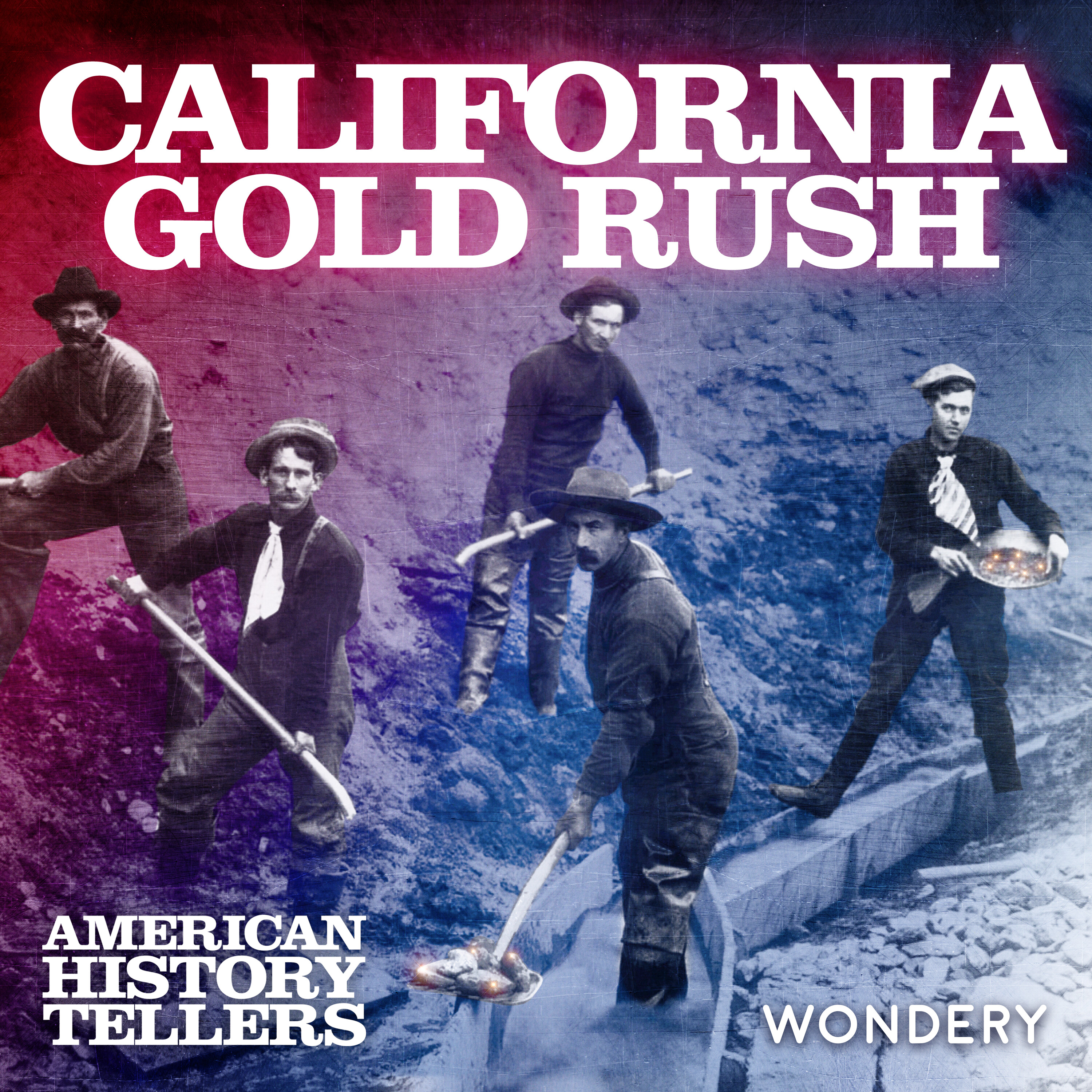
Loading summary
Transcript20 lines
- [00:01]
Lindsey Graham
As we explore the triumphs and tragedies that shaped America, we're always striving to paint a vivid, nuanced picture of the past. And with Wondery plus, you can experience that vision in its purest form. Enjoy ad free episodes, early access to new seasons, and exclusive bonus content that illuminates the human stories behind the history. Join Wondery in the Wondery app or on Apple podcasts and see American history through a whole new lens. Imagine it's April, 1849. You're a tailor from upstate New York. But after a five week journey, you and your cousin arrived in St. Louis just yesterday. It's a stop on your way to the gold fields of California and hopefully to riches. While your cousin is buying some supplies you'll need at a nearby store, you watch the crowds bustling around you. There are more people here than you've seen in your life. All of them would be miners like you. They're buying shovels, lanterns, food, everything they'll need when they stake their claims in California. There's more competition for gold than you realize. Soon, your cousin emerges from the store, but he's empty handed. Where are the supplies? Bad News. He's asking $40. $40 for three barrels of pork? That wouldn't be more than $20 back home. I know. That's what I told him. I refuse to pay such a ridiculous price. But other people are forking over for it. The store shelves are nearly bare. What do we do now? Between you and your cousin, you have just $50 left. If you pay what this store is asking, it will just about wipe you out. But you're worried about wasting time searching for cheaper prices? Well, I. I don't think we have a choice. We have to pay the $4. You can't be serious. What other option do we have? I mean, we need to get going. Look at these people. Even an hour's delay could mean the difference between staking a good claim and getting stuck with a barren one. Your cousin shakes his head in disgust, but you can tell he knows you're right. So together, you head back inside the store and get in line. When you reach the counter, the owner looks you and your cousin up and down. You swallow hard. Well, we'd like three barrels of pork. All right, that'll be $50. Fifty? You told my cousin here 40. Well, now I'm saying 50. Sir, I've left my wife and my whole family back home. If I return empty handed, we're finished. Please. This is all the money we've got. Look, I get the same story ten times a day. See that line behind you? They got money. So if you can't pay, step aside. The store owner crosses his arms. You're sputtering mad. You could punch him right in the teeth. But there's nothing you can do. You've got to get to the gold fields and fast. So you reach into your pocket and grab your last $50. The owner snatches it out of your hand. You hope like hell those three barrels of pork will be enough to sustain you till you can reach California and hopefully get your hands on some of that gold.
- [03:11]
Hellman's Flavored Mayo Advertiser
You know that person in your life who just can't stand Mayo? Call them dramatized. Call them close minded. We get it. They're stuck in their ways. But here's the thing. They just haven't tried Hellman's Flavored Mayo. We're talking bold flavors that will flip even the biggest skeptics. Spicy mayo that adds the perfect kick to your burger. Garlic aioli that transforms ordinary fries into something extraordinary. Chipotle mayo that turns your basic wrap into a smoky sensation. So to all the mayo haters out there, yes, we're looking at you. It's time to eat your words. Because with mayo this flavorful, any hater is just a mayo lover waiting to be convinced. Hellman's Flavored Mayo get ready to eat your words.
- [03:55]
Sleep Number Advertiser
Why Choose a sleep number Smart bed.
- [03:57]
Lindsey Graham
Can I make my sight softer? Can I make my sight firmer?
- [04:00]
Hellman's Flavored Mayo Advertiser
Can we sleep cooler?
- [04:02]
Sleep Number Advertiser
Sleep number does that cools up to eight times faster and lets you choose your ideal comfort on either side. Your sleep number setting it's the sleep number Biggest sale of the year all beds on sale up to 50% off the limited edition Smart bed Limited time all sleep number Smart beds offer temperature solutions for your best sleep. Check it out at asleepnumber store or sleepnumber.com today.
- [04:31]
Lindsey Graham
From Wondery I'm Lindsey Graham, and this is American Historytellers. Our history your story in late 1848, President James Polk announced the discovery of gold in the Sierra Nevada mountains of California. Soon, gold fever swept across the United States. Tens of thousands began streaming across the country with dreams of striking it rich. Throughout 1849, they embarked in droves and came to be known as 40niners. But many would be prospectors found themselves unprepared for the dangers of the journey west. Any route they chose to California involved traveling thousands of miles. They risked disease, starvation, and the threat of violence along the way. And even when they did reach the gold mines, their dreams of riches rarely came true. But a lucky few found themselves with more money than they could hope to earn in a lifetime. Between their sudden wealth and the mass migration west, the gold rush reshaped America, creating a more powerful nation with growing cities on both coasts. This is episode two, the 49ers. Travelers heading west in 1849 first had to make a crucial decision. Which route to follow for the long, arduous journey to California. Anyone coming from the eastern United States had to choose between traveling overland or taking one of two routes by sea. But regardless of which they chose, each journey came with challenges. The first route by sea involved sailing around the southernmost point of South America, Cape Horn. It was a slow, tedious journey of 15,000 miles that could take up to six months. Passengers were often crammed into small commercial vessels like whalers or converted cargo ships, and conditions were crowded and uncomfortable. Instead of cabins or hammocks, many people slept on the hard deck, side by side in small rectangles marked out in chalk. There were often rats as well as stale or sometimes rotten food. A second, shorter sea route existed, but it was also arduous. Travelers sailed down the eastern seaboard and through the Caribbean to the Isthmus of Panama in Central America. The Panama Canal had yet to be built, so passengers disembarked on the Caribbean coast and navigated 50 miles of winding rivers on small boats, followed by a 20 mile trek through dense jungles to the Pacific. From there, they could sail north up the coast to California. Among those that would choose to take this Panama shortcut was Jessie Fremont, the high spirited daughter of a US senator from Missouri. In 1839, at just age 16, she had fallen in love with the western explorer and soldier, John C. Fremont. Her father initially opposed the match, but Jesse would not be denied, and she and Fremont soon eloped. In October 1848, her husband left for California, and a few months later, Jesse set out from New York with her infant daughter to meet him. Like many others, she soon found that crossing the Isthmus of Panama was treacherous. On many days, drenching rain soaked her and her fellow travelers as they rode mules across steep mountain trails. Other days, temperatures soared to 130 degrees, and every day brought snakes, rats and mosquitoes to harass them at every step, with malaria and yellow fever also as constant threats. But Jesse and her daughter managed to reach the Pacific coast of Panama alive. Still, they found themselves there, stranded amid hordes of other people seeking passage to California. There simply weren't enough ships to carry everyone. But finally, Jessie and her daughter boarded a ship and arrived in San Diego in May 1849, battered and bruised but alive. A few weeks later, she made her way up the coast to monterey, where she finally reunited with her husband, john. All told, her journey had taken about three months. Jessie Fremont was fortunate to be able to take the expensive and relatively short Panama route. The shortcut across the isthmus saved travelers about 8,000 miles versus the long route around cape horn. But it cost at least $300, roughly 12,000 in today's money, and sometimes it could cost much more. When demand was high, a ticket for the final leg of the trip from Panama to California could go for $1,000. The Cape Horn route, by comparison, Typically only cost about $150. But however miserable and expensive, the sailing routes had one big advantage over travel by land. A head start. Ships could sail early in the year and did not have to wait for spring in order to depart. Overland travel relied on pack animals that needed to be grazed. So would be miners had to wait until spring grass started before they could set out. As a result, miners traveling by sea began arriving in California several months ahead of their overland counterparts. But the majority of gold seekers couldn't afford the high cost of sea travel. They had no choice but to undertake the long, grueling journey by land. Many found themselves stuck for weeks in cities at the edge of the frontier, like St. Louis, while they waited for the spring thaw. But some St. Louis merchants took advantage of these new arrivals, Charging outrageous prices for food and livestock. The migrants usually paid up, eager to get on their way, Many assuming that they'd soon be making hundreds of dollars a day in gold. So finally, in late spring, By May, the gold seekers began to crowd the trails heading west. Some traveled in wagons pulled by oxen. Others rode on mules, which traveled lighter and faster and covered more ground per day. But many would be miners were leaving jobs as office clerks or other white collar professions, and soon were overwhelmed by the physical demands of life on the trail. Even for the hardier laborers and farmers, the harsh conditions began to wear on them. After a few weeks, and at every turn, every traveler faced dangerous obstacles in their path. Imagine it's July 1849. You're a farmer from near chattanooga, Tennessee, heading west to mine gold, and you're wary from your long weeks on the trail. But you've just conquered your greatest challenge yet, Crossing the mighty platte river, which is a swollen, muddy mess from recent heavy rains. You weren't sure your mule team was going to make it across, but somehow you managed. Now you look behind you and see another family isn't so lucky. Their wagon has gotten stuck in the middle of the churning waters. You turn and call out to your travel partner, hey, we gotta help them. Your partner looks over and sees a young mother in a blue dress and two children inside the wagon, crying like mad. Her husband is out front with the oxen, trying to coax them to cross. The river is up to his chest and in horror. You and your partner both watch as he loses his footing and is swept away in the fast current. The oxen too are torn from their traces and soon follow him down river. The time to move is now. So you call out to the wife over the roar of the river, hey, hold on. We'll be there soon. Your partner looks at you wide eyed. What are we supposed to do? Grab a rope, tie it to our mule team? I'll carry the other end to the wagon. No, I'll go with you. You'll never be able to stand up in that current on your own. Let's bring two ropes just in case. With the help of some other settlers, you secured the lengths of two ropes to your mules. Then, holding onto each other for support, you and your partner feel your way forward through the water. Feet sink the thick, heavy mud, making each step a challenge. When you finally reach the wagon, the water is almost up to your shoulders. All right, let's tie one rope in back and one in front. That doesn't make sense. We should concentrate the force in one spot. Well, I'm worried it'll tip over. Let's try this first. Partner goes splashing around to the back while you reach down and bind your rope to the wagon. Tongue on the front. Look up at the young mother sitting in the wagon watching her children take terrified. Just hold on tight, man. We're going to get you to shore. She nods wide eyed. When your partner finishes securing his knot, he gives you a nod. You turn to the other settlers on shore. Wave your arm. All right, pull. The mule team begins to drive forward. For a moment it looks like the wagon is moving, but it doesn't get far. Ropes grow taunt and the mules are straining with all their might. The wagon is stuck. Partner calls over Nah, this isn't working. We need both ropes tied to the front. Wait there. Well hurry. I think the river's rising and indeed the water is up to your neck now. The current is fierce. White water sprays your partner's face as he carries the second rope back to the front of the wagon. Quickly, you tie a new knot and Wave toward the men on shore. Again, home mules strain once more, but this time you can feel the wagon moving. It's just a few inches at first and it lurches free. Grab the rope and hold on tight as you and the stranded family are dragged towards shore. 49ers who headed west over land mainly followed the same route. After leaving St. Louis, they traveled across Missouri, then followed the Platte river northwest through present day Nebraska and into Wyoming. There they crossed through the South Pass at a low point in the Rocky Mountains. This pass marked the halfway point from St. Louis, a thousand miles down and 1,000 to go. From Wyoming, they proceeded through parts of Idaho, Utah and Nevada along various routes. The final obstacle was the towering Sierra Nevada mountains of California. Most days on the trail were monotonous. Settlers usually awoke before sunrise and managed a quick breakfast, often just coffee. Then they hitched up their wagons or loaded their mules and tried to make as many miles as they could before stopping for lunch at midday. Then they'd continue on until dusk when they would make a quick camp, cook dinner and fall fast asleep. Most people walked alongside the wagons mile after endless mile to choking on dust kicked up by the animals hooves and the rumbling wagon wheels. At times, travelers had to ford treacherous rivers flooded by heavy rains. The currents and debris could strand their wagons midstream or tip them over, topping all of their possessions into the rushing water. Other migrants lost their lives to injury, one of the many illnesses that always seemed to follow them. But perhaps the greatest danger of all was other settlers. After months of traveling together, people's patience wore thin. Men might come to blows over the last pat of butter or the way someone smelled. Other times, travelers were outright spiteful. Alonzo Delano, emerging from Illinois, noted that most 49ers were forced to abandon possessions to lighten their loads, but would often deliberately sabotage what they left. They might soak a sack of sugar and turpentine, or chop spare wagon parts into pieces. In one case, some travelers even set a meadow on fire to prevent the parties behind them from using it to graze their livestock. Delano later wrote. The waste and destruction of property was enormous. In this, the selfish nature of man was plainly exhibited. It seems some 49ers were willing to do anything to ensure that they got to the gold fields first. But despite all the dangers and hardships, settlers kept coming. And every one of them who arrived in California came with a remarkable story of endurance and survival. American Historytellers is sponsored by Wayfair. It's hard to believe that summer is winding down. My daughter goes back to school in just three weeks, and that's crazy. So that means getting back into the groove and settling into a routine again. It also means that we have just three weeks to plan for that routine and get ourselves organized and ready for success with Wayfair. If we need a new desk, Wayfair's got it. A new bookcase, a new task chair, a new lunchbox. Even Wayfair's got it. And to make our weeknight dinners a little more cohesive, we refresh our cutlery. No more mismatched forks. Sometimes it's the little things that make life more enjoyable. Wayfair makes it easy to tackle your home goals with endless inspiration for every space and budget. Plus, they offer free and easy delivery, even on the big stuff like sofas, dining tables, beds, desks, and more. Find all your must haves from furniture and decor to appliances and cookware, all in one convenient place. Get organized, refreshed, and back to routine for way less. Head to Wayfair.com right now to shop all things home. That's W A Y f a I r.com wayfair every style every home the.
- [17:34]
Anna Richardson
Town of Agda in France is famous for sun, sand, sea and sex. But lately, life on the coast has taken a strange turn. The town's mayor, a respectful captive pillar of the community, has been arrested for corruption. His wife claims he's been bewitched by a beautiful clairvoyant. Then there's the mysterious phone calls that local people have been getting.
- [18:00]
Lindsey Graham
I am the Archangel Michael.
- [18:02]
Anna Richardson
The whole town has been thrown into.
- [18:04]
Lindsey Graham
Chaos as the mayor is unable to carry out his duties. I would like to address you. All legal proceedings have been initiated.
- [18:14]
Anna Richardson
Join me, Anna Richardson and journalist Leo Chic for the mystic and the Mayor as we investigate a story of power, corruption and magic Binge. All episodes of the mystic and the Mayor exclusively and ad free right now on Wondery Plus. Start your free trial in Apple podcasts, Spotify or the wondery app.
- [18:39]
Lindsey Graham
In 1849 alone, 90,000 people made their way to California, but not every 49er went willingly. Some travelers undertook the journey with great reluctance, especially enslaved servants, children and wives. One of them was a young mother named Sarah Royce. Sarah set out for California from Iowa in the spring of 1849, along with her two year old daughter and husband, Josiah. When Josiah heard about gold in California, he was determined to get his share. Sarah begged him not to uproot the family, but he refused to listen. So they all headed west in a wagon pulled by Six oxen. The Royces joined up with a party of several other families. But having company was little comfort for Sarah. The first night on the open prairie terrified her. The land seemed vast and empty, almost vertigo inducing. And when she woke up after the first night, all of their oxen had wandered off. They wasted hours searching for them and didn't retrieve all of them until noon. As their journey continued, Sarah agreed to care for an old man in her party who had been struck with cholera. Generously, she let him crawl into the bed in her family wagon and ride between her and her daughter. She could only watch helplessly as spasms wracked his whole body. Diseases like cholera were a constant worry. Outbreaks killed hundreds of would be 49ers in St. Louis, then followed the settlers on the trail west. They called the disease the monster, in part because it attacked so quickly. People would feel fine at breakfast, then get the first rumblings of illness at noon, collapse with convulsions and vomiting at sunset, and be dead by midnight. The old man that Sarah cared for eventually became another of cholera's victims. Quickly, she cleaned the soil, blankets and bed linens, and she could only pray that her family wouldn't catch the monster themselves and die because of their generosity. Moving farther west, Sarah's group neared the deserts of Utah and Nevada. These were dangerous stretches of land with very little water and temperatures that could soar above 100 degrees by day and plummet below freezing at night. By October, Sarah's family had reached Salt Lake City. They decided to rest their oxen for 10 days, letting the families they had been traveling with proceed without them. They would make the last desperate leg of the journey alone. They asked a group of Mormons for directions and were strongly advised to stay in Salt Lake City and wait the winter out. Just a few years prior, the infamous Donner party had been stranded in the Sierra Nevada mountains over the winter and resorted to cannibalism to stay alive. By leaving Salt Lake City so late in the year, the Royces faced the same fate. But Josiah refused to wait. There was gold to get to. So now, alone on the trail, the Royces emptied their straw mattresses to feed the oxen, then began abandoning personal items to lighten their wagon. All along the trail, they saw piles of possessions that had been left this way by settlers before them, alongside dead mules and other livestock. When they reached the Sierras, they nearly got trapped in the snow like the Donner party before them. But luckily, the Royces were rescued by a government relief party which had been established to Prevent any further Donner like tragedies. Upon reaching the far side of the mountains in late October, the Royces headed north to a mining town called Weaverville. There they joined the hordes of other settlers in a new ordeal, One almost as challenging as the journey west. The grueling, backbreaking task of mining California's richest gold fields lay 40 miles east of modern Sacramento, In a strip of land that ran through the western foothills of the Sierra Nevada mountains. People called it gold country, and when it came to staking claims there, it was first come, first serve. The most desirable mining spots lay along streams or rivers because the water scoured away the topsoil and exposed the gold rich earth underneath. Miners especially coveted bends in rivers where flakes of gold tended to sink and collect on the bottom in slower moving water. After the initial discovery of gold in 1848, many miners found they simply had to bend over. They would find gold nuggets they could collect by hand Even as more miners arrived. Throughout that year, Many found gold. With no more equipment than a wash pan, they dredge up rocks and muck from a creek bed and whisked the pan vigorously in a circle. Water and sand sloshed out over the sides, and the heavier gold remained in the pan. But by 1849, the days of easy pickings were over. By some estimates, miners now made up as much as 60% of California's entire population. So competition was fierce. And by the fall of 1849, most miners had to go farther up into the hills and dig deeper to find gold. Instead of panning in rivers, they now had to break up the hard topsoil with picks and shovels to reach the so called pay dirt beneath. Stumbling across major deposits or mother lodes was rare. Instead, most miners had to sift through tons of rock, dirt and mud just to find a few flakes. And to do this, they needed bigger, more sophisticated tools Than just a simple wash pan. Most settled on a tool called a cradle, A long bin with an iron grate on the bottom, which sat on two rockers above a sluice. Miners shoveled their diggings into the bin, Poured in water, and then rocked the whole contraption back and forth like a child's cradle. The water broke up the mud and carried finer, heavier particles, like gold flakes through the iron grate and down into the sluice, which was lined with ridges that would, in theory, collect the gold. This cradle device saved the miners some labor, but digging the holes and shoveling the wet dirt into the cradle Was still backbreaking. Imagine it's the fall of 1849. You're a blacksmith who left a good job back in Cincinnati to become a miner. Today, you're six feet down in a hole, digging. Your hands are blistered and your arms and shoulders ache. Every time you lift a shovel of muck, your partner reshuffles it into a cradle and dumps water over it to wash the gold flakes out. That is, if there is any gold. You call up to your partner. Spot anything? No. Nothing but mud. You sigh, exhausted. It's not just the work. You haven't eaten a vegetable all month. Your teeth feel loose in your gums, and that's a sign of scurvy. Your partner must be exhausted too, because suddenly he stumbles, dropping his shovel and bumping against the water bin. Gallons of filthy water spill out right into the hole you're standing in. God, you damn idiot. Partner peeks over the edge. Sorry, friend. Sorry's not gonna cut it. I'm tired. I quit. Oh, come on. We're probably just a scoop away from the motherlode. Can't quit now. I sure as hell can. I regret ever coming here. You grab the edge of the hole to hoist yourself out, but the edge just crumbles. You can't get a grip and keep slipping backward. Embarrassed, you finally look up at your partner. Can you give me a hand here? With a regretful look, he reaches down and grabs your arm. As soon as you're out of the hole, you grab your few a tin plate, pair of socks and a Bible. You start to stomp away, your wet boots squishing with every step you take. But your partner calls after you. Oh, it'll kill me if you leave. This is a two man job. Where am I supposed to find someone to replace you? Everyone's digging their own claims. Come on. I know we're close. Oh, you know we're close. Close to what? All I've seen is mud, dirt and rocks. Look around us. Mountains, pine forests. I've barely seen any of it. I spend all day, every day down in that filthy hole. I've had enough. You turn again to leave, but then you hear something. It's coming from the next claim, over 50 yards away. You look over to see a fellow with a red beard jumping up and down, shouting with joy. He's clutching a gold nugget so large you can see it from here. You can feel the jealousy well up inside you. But then your mood shifts. If the next claim over is full of gold, yours might be too. So you Set down your belongings and turn to your partner. Well, all right. I guess I can stay one more day. But if we don't find any gold by tomorrow, I'm quitting. And I mean it this time. Your partner just grins. Well, that's the spirit. Tell you what, I'll take a turn in the hole. You work the cradle. He climbs down into the mud, still grinning. You just shake your head. Part of you is disgusted with yourself for staying. But you have to admit there's another part of you that still feels that same flutter of excitement you felt on your first day. Who knows? Maybe you are only a shovelful away from finding your own fortune. Competition was fierce among miners, and not just for gold. Even basic staples that miners subsisted on, like fried potatoes and flapjacks, were expensive. Many miners couldn't afford to fill their bellies unless they found gold on a regular basis. But the most expensive foods were fruits and vegetables. There were very few farms in California, so even common crops like tomatoes and cabbage were scarce. One farmer described miners buying his onions and biting into them like apples. In times of real desperation, others resorted to eating grass. The miners who couldn't afford fruits and vegetables often fell victim to scurvy, a disorder caused by lack of vitamin C. Miners with scurvy grew too weak to work and began losing teeth as their gums softened. Eventually, their flesh would turn black, and for some miners, scurvy could be fatal. Between disease like scurvy, poor nutrition and accidents, about 1 in 6 49ers died within six months of arriving in California. Many had come to the gold fields alone and were left to die alone, cut off from family and friends who never received word of their demise. But those who persevered and survived sometimes found a sort of camaraderie with their fellow prospectors. The Illinois merchant Alonzo Delano and his accounts of mining marveled at the mingled of different classes in gold country. He saw lawyers, farmers, mechanics, soldiers, and even a former member of Congress all digging and panning side by side, thrown together in a shared pursuit of gold. Delano took special delight in teasing a judge who he found sitting on bare dirt with a needle and thread in his hands. He was trying without success to patch a huge hole in his pants. Seeing him, Delano asked, well, judge, what's on the docket today? But keeping a sense of humor in the mining camps was not easy. Conditions were miserable. Miners generally slept in cheap canvas tents or lean tos made of pine branches. Some just tossed blankets over low tree branches and slept beneath those Using their boots for pillows. Regardless of what shelter they could find, Men generally slept in their flannel shirts and never removed them. Upon waking up, they would splash dirty water on their faces and pull on damp overalls and wet socks. Everything they owned was smeared with mud and reeked of stale sweat. And because every hour not spent mining was considered an hour wasted, no one bothered building latrines or even burying waste. Every miner's goal was the same. To strip gold out of the ground as quickly as possible, then move on to the next claim. That frantic pace made mining an exhausting occupation, and it could be mentally challenging. Alonzo Delano called mining a cruel lottery, declaring, there seems to be but one way to work in the mines, and that is to stick to it till your turn and time comes and not be discouraged because you are getting nothing while the man within three feet of you is taking out a hundred dollars per day. Facing such hard work and uncertainty, many miners, like Delano quickly became disillusioned. But the thought of quitting too early and missing out on a strike kept them working. Those who never struck it rich sometimes slinked back home. Though not everyone admitted defeat, some managed to eke out a decent living in the end. And there were a few lucky ones who found themselves wealthier than they'd ever imagined, bringing home enough money to be able to provide for their families. Start businesses, live lives of decadent luxury. But few of those who got rich in the gold fields realized that along with their newfound wealth would come a whole new set of challenges.
- [31:23]
Hellman's Flavored Mayo Advertiser
Looking to refresh the style in your home? Here at Mathis home, we can help you find exactly what you need during our spring style event. Whether you're looking for a rustic farmhouse classic or modern and eclectic, we have all the latest looks that will leave your home feeling brand new. Whatever your style, we can help you find it at the lowest price. Because not only do we want you to feel good in your home, we know that to earn your business, our prices have to be the best. So come to the spring style event at your furniture superstore, Mathis Home.
- [31:55]
Lindsey Graham
In 1925, 18 year old Howard Hughes inherited a fortune, and he wasted no time putting it to use. With a million dollars burning a hole in his pocket, he headed west, determined to conquer America's booming new capital of entertainment, Hollywood. Hi, I'm Lindsey Graham, host of Wondry show Business movers. We tell the true stories of business leaders who risked it all, the critical moments that define their journey, and the ideas that transform the way we live. Our lives. In our latest series, Howard Hughes clashes with Hollywood's power players as he fights to see his name in lights. But Howard has deep pockets and even deeper ambitions, and he revolutionizes the movie business by breaking rules and spending big. Because for how the best way to level Hollywood's playing field is to explode the entire industry. Follow Business Movers on the Wondery app or wherever you get your podcasts. You can listen to new episodes of Business Movers early and ad free right now by joining Wondery. Plus. As 1849 drew to a close, miners continued to pour into California from land and sea. Despite all the misery in the mining camps, the boom continued, and some prospectors did strike it rich, either through skill in selecting which claims they mined or sheer dumb luck. The richest claims yielded up to $17,000 a week, roughly $340,000 today. One camp worked by six white men and 50 local Native Americans yielded 273 pounds of gold. The largest single nugget reportedly weighed 195 pounds. But even those who didn't make these obscene amounts of money could still unearth several thousand dollars worth of gold, which for most was a life changing amount. Back East, a cook might make $2 a day, or a ditch digger half of that, so stories of people making thousands of dollars in an instant kept hopefuls pouring into the gold fields. Unfortunately, many miners who did strike it rich were not prepared to handle their newfound wealth. Many succumbed to the temptation of gambling or were lured into investing in shaky financial schemes, and some even found more dubious ways to spend their riches almost as quickly as they gained them. Imagine it's December 1849. You're a bartender in a Sacramento saloon that caters to miners. The ceilings are low and wooden, and sawdust covers the floor to mop up spilled drinks or blood from the fist fights, which are too common. The air is thick with cigar smoke, and the chatter of miners tells unlikely stories. You have a few regulars, but mostly it's a rotating cast of scruffy, smelly men from all over the world. Tonight, though, it's fairly sleepy until a blonde man in denim overalls burst through the door carrying a burlap gunny sack and shouting at the top of his lungs, well, I did it. I finally struck it rich. You smile when you see it's someone you know, a regular named Jake. You've let him sleep on the floor in the back a few times when he was down on his luck. You know he has a pregnant wife back in Georgia, Sarah Ann. You think her name is the Other miners cheer Jake and raise their glasses. And then Jake spots you and grins. Watch this, fellas. He strides up to you at the bar. Gimme a whiskey glass. Sure thing, Jake. How much you want? Instead of answering, Jake reaches into his gunny sack and you stare as he pours a large handful of gold dust into the glass. When the glass is almost full, he slides it back to you. I'll take the same height of whiskey. Jake looks around, making sure everyone's watching. Some of the other patrons laugh, but you groan. You've seen this before. Miners do stupid things like this to show off their newfound wealth over tipping the bartender with gold dust. But you've never seen someone blow as much as Jake is about to. You hesitate, but he eggs you on. Well, go on. Take it and fill it up. I'm thirsty. Well, Jake, I think you might be a bit foolish right now. What if Sarah Ann was here? Jake flushes red. He looks embarrassed. Just fill the glass already. Oh, come on. Have some sense. Blow a hundred dollars if you want and I'll take it. But don't throw everything away in one night. You don't know more's coming your way. I said just fill the damn glass. I'm thirsty. The room is now silent and everyone's staring at you two. You sigh and shake your head. You don't want any trouble. After all, it's your job to serve drinks, not give financial advice. So you take out another glass and fill it until the whiskey is even with gold dust. You serve it to Jake and watch him chug it. When he's done, he slams the glass down, then raises his bag of gold dust triumphantly over his head. Gentlemen, tonight the drinks are on me. Grinning, Jake shakes more gold dust out onto the bar top. You'd be a fool not to accept his generosity, even if it comes at a price of his family back in Georgia. You just hope he passes out before he blows through his entire strike. As the gold rush continued, stories of lavish spending and squandered fortunes were common in the towns and cities around the mines. Those who struck it rich wasted thousands of dollars on extravagant food like lobster salad and turtle soup. Others gorged themselves on frontier rarities like cans of corn and peas for $6 each, washed down with champagne. Gambling was another popular pastime. Casinos sprung up offering cards, dice games and roulette wheels. Fortunes could be made or lost on every bet. One miner reported seeing a gambler put down a £1 sack of gold on a single hand of cards. When he lost, the gambler Put down a six pound bag of gold, Removed his pistol from the belt and pointed it at the dealer. He won the next hand. In 1849 alone, miners extracted 17 tons of gold from the mountains of California. By the following year, California was producing as much gold as the rest of the world combined. The influx of so much wealth transformed the cities around the mines. San Francisco, the nearest seaport to the gold fields, saw its population swell from 800 to 30,000 in just three years. Other cities in northern California, like Sacramento and Stockton, grew rapidly as well. But the vast majority of the residents in these cities are were just passing through. Most were miners, either down on their luck or only in town to spend their money in the saloons, gambling dens and brothels. Very few intended to live in the towns long term. They were 49ers who had homes elsewhere and planned eventually to return. As a result, there was little motivation to invest in construction or infrastructure. Most buildings were ramshackle and made of cheap, flimsy materials. Many people slept in tents or lean tos even in cities and crime was rampant. It wasn't uncommon to hear gunfire both in town and in the gold fields. But even in the dangerous, ramshackle cities, there was money to be made. Savvy business owners catered to miners not only with gambling and alcohol, but with dry goods stores, restaurants, laundries and other services. One of those who thrived in this way was a New Yorker named Lyman Bradley. After toiling away for months in the mines, Bradley had little to show for it. Eventually, he decided he could make more money plying his old trade as a sign painter than he could in the mines. He hopped on a mule and set out for San Francisco the next day, ignoring the pleas of his partners to stay. And just as he anticipated, Bradley did a booming business. New stores, new restaurants and new saloons were opening every hour. And they all needed signs. Often people were in such a rush to open, they would hang the signs before the paint dried. Bradley worked so fast, he ended up doing what he considered to be second rate work. But despite his rushed, haphazard signs, he made far more money than he ever had before, later saying you could have almost any prize your conscience allowed you to ask. Ex miner Alonzo Delano also found a niche. After quitting the mines, he began painting portraits of other miners. And in just three weeks, he earned $400. Some of his portraits ended up in newspapers and magazines, where coverage of the gold rush was in high demand. And thanks to images like Delano's, the 49ers became an iconic part of American culture. Back east, many men even deliberately cultivated a gold miner look, sporting denim clothes and bushy beards. Delano charged his portrait sitters 1 oz of gold dust per head. Such a payment system was common, and merchants used to dealing with coins or paper currency had to adapt to dust. Sarah Royce, the reluctant wife from Iowa, ended up opening a store of her own with her husband. So many people wanted to pay with gold dust that she bought a jeweler's scale to take payments. But the person who made the most money from gold in California was probably Sam Brannan, who kicked off the rush by strutting into San Francisco with a jar of gold dust. Brannan made a killing by speculating in real estate and selling overpriced goods from a string of general stores. This strategy of making money off the prospectors themselves became known as mining the miners. And in this way of making a living, some groups that had faced discrimination and even violence in the gold fields fared better. Chinese immigrants in particular often found success running laundries, boarding houses, and restaurants. But others were not as fortunate, especially one group that faced more hostility during the Gold Rush than any other the Native Americans. As more and more white miners flocked to the gold fields, the ancestral homelands of California's indigenous population were overrun, threatening not only Native American people's way of life, but their very existence. From Wonderee this is episode two of the California Gold Rush from American Historytellers. In the next episode, clashes between white miners and Native Americans spiral out of control, devastating indigenous communities and leading to a forgotten genocide. If you like American Historytellers, you can binge all episodes early and ad free right now by joining Wondery plus in the Wondery app or on Apple Podcasts. Prime members can listen ad free on Amazon Music. And before you go, tell us about yourself by filling out a short survey@wondering.com survey if you'd like to learn more about the Gold Rush, we recommend the Age of Gold by HW Brands and Roaring Camp by Susan Lee Johnson. American Historytellers is hosted, edited and produced by me, Lindsey Graham for Airship Audio editing by Molly Bach Sound design by Derek Behrens Music by Lindsey Graham this episode is written written by Sam Keane Edited by Dorian Marina Produced by Alida Rozanski Our managing producer is Matt Gant. Senior managing producer is Tonja Thigpen. Our senior producer is Andy Herman Executive producers Jenny Lauer Beckman and Marshall Louie for wondering.
- [43:10]
Lawless Planet Narrator
How hard is it to kill a planet? Maybe all it takes is a little drilling, some mining and a whole lot of carbon pumped into the atmosphere. When you see what's left, it starts to look like a crime scene.
- [43:22]
Lindsey Graham
Are we really safe? Is our water safe? You destroyed our tap.
- [43:26]
Lawless Planet Narrator
And crimes like that, they don't just happen.
- [43:29]
Lindsey Graham
We call things accidents. There is no accident. This was 100% preventable.
- [43:35]
Lawless Planet Narrator
They're the result of choices by people. Ruthless oil tycoons, corrupt politicians, even organized crime. These are the stories we need to be telling about our changing planet. Stories of scams, murders, and coverups that are about us and the things we're doing to either protect the Earth or destroy it. Follow Lawless Planet on the Wondry app or wherever you get your podcasts. You can listen to new episodes of Lawless Planet early and ad free right now by joining Wondry in the Wondry App, Apple Podcasts or Spotify.