← American History Tellers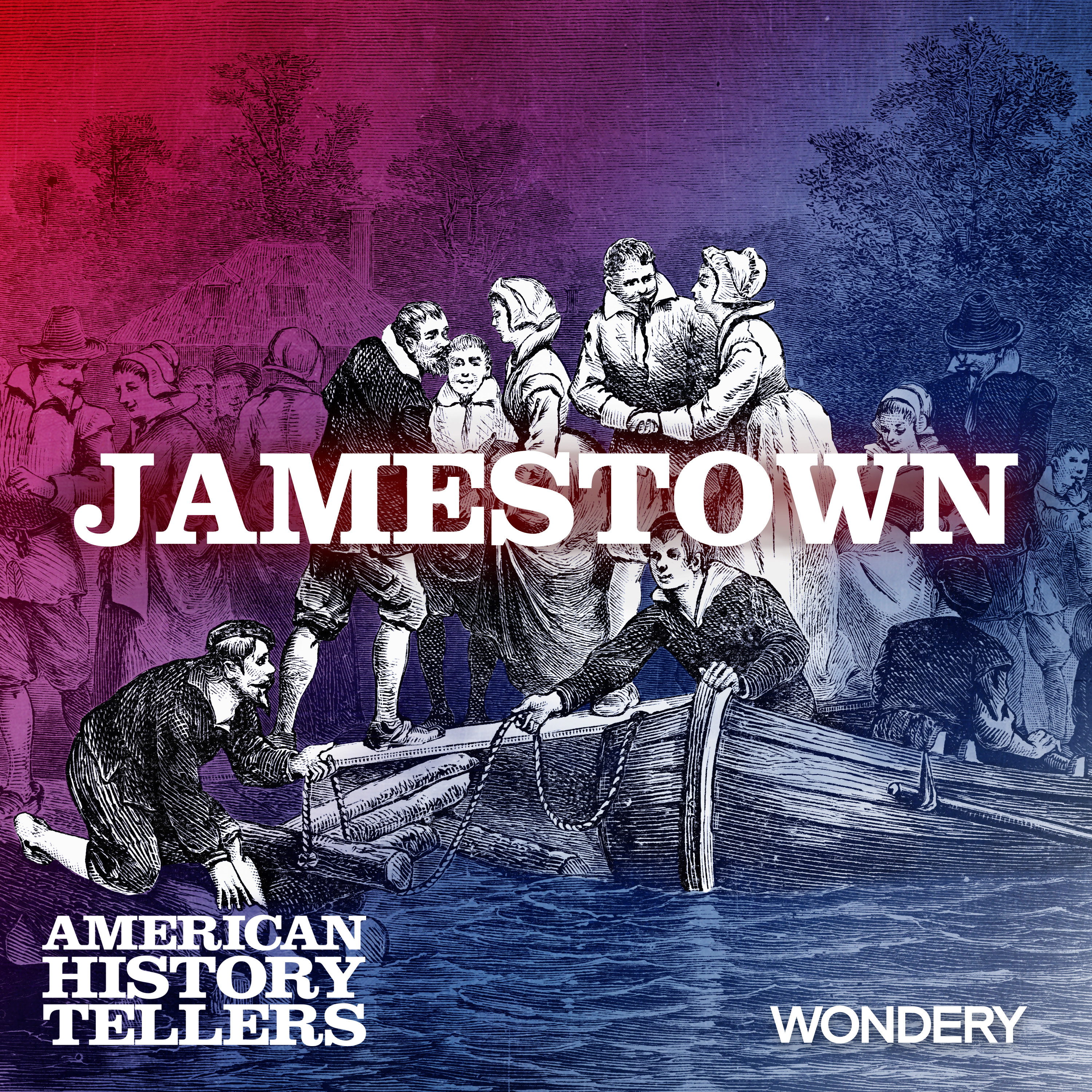
Loading summary
Transcript71 lines
- [00:01]
Lindsey Graham
Wondery plus subscribers can binge new seasons of American History Tellers early and ad free right now. Join Wondery plus and the Wondery app or on Apple Podcasts. We're excited to announce that American History Teller's Legacy Season, the Space Race, is now available in full video on the American History Teller's YouTube channel. Relive the fierce competition between the superpowers and witness history as it unfolds in a whole new way. Subscribe to the American History tellers channel on YouTube and let us know what you think. Imagine it's July 1613, in Oropax, a small outpost deep in the forest where your father, Powhatan, has recently moved his court. The afternoon sun beats down on your back as you pace outside his longhouse, waiting for him to finish meeting with his council. Your thoughts are consumed by your fears for your younger sister, Pocahontas. At last the men file out, and you duck your head to pass through the low doorway. As your eyes adjust to the dim interior, you find your father sitting on a woven reed mat. He's now in his 70s, but his formidable presence still fills you with awe.
- [01:18]
John Rolfe
Father?
- [01:20]
Lindsey Graham
You also sit down on a mat, crossing your legs. His sharp gaze meets yours, and he gestures for you to speak.
- [01:27]
John Rolfe
Three months have passed since the English abducted Pocahontas, and still you refuse to respond to their demands. Isn't it time you bring her home?
- [01:37]
Lindsey Graham
For a brief moment, a flicker of sadness crosses his face, but his expression quickly hardens.
- [01:43]
John Rolfe
I have no intention of giving up our English prisoners or their weapons and tools in exchange for her release. I'm worried for Pocahontas safety. Who knows what those men are doing to her? She's a clever, brave girl. She will survive. Don't you see? We have a rare opportunity. As long as she stays close to the English commander, she can gather information about their plans.
- [02:08]
Lindsey Graham
Despite yourself, you feel a flush of anger rising in your chest.
- [02:12]
John Rolfe
She's not a tool to be used. She's my sister. Your daughter. How long do you plan to abandon her? My son, I love Pocahontas dearly, but I must put those feelings aside. These are delicate times. As much as I want her back, I cannot have these strangers see me as weak. Too much is at stake to surrender. My trophies would be to admit defeat. And what of our people? What will they think to see you surrender your own daughter?
- [02:44]
Lindsey Graham
Your father's shoulders slump. It's a rare glimpse of vulnerability. You're suddenly aware of how old he looks today. He picks up his clay pipe, turning it over in his hands.
- [02:56]
John Rolfe
Strength comes in many forms. We must be patient.
- [03:02]
Lindsey Graham
His firm tone tells you that the conversation is over, so you rise to your feet and exit the longhouse. As the heat of the blazing sun envelops you once more, you're struck by the risk your father is taking. You know that the longer your sister remains captive, the more tenuous Powhatan's hold over his own people will become. Apple Card is the perfect card for your holiday shopping. When you use Apple Card on your iPhone, you'll earn up to 3% daily cash back on every purchase, including products at Apple like a new iPhone 16 or Apple Watch Ultra. Apply now in the Wallet app on your iPhone, subject to credit approval. Apple Card issued By Goldman Sachs USA Salt Lake City Branch terms and more at applecard.com American History Tellers is sponsored by T Mobile 5G Home Internet. With new home Internet plus from T Mobile, you can get Internet right where you want it so you can boost your connection to places it hasn't reached before and transform your home. Turn your backyard into a movie theater. Turn your basement into a home office. For a limited time, get a free upgrade to T Mobile Home Internet plus while supplies last. Home Internet plus starts at just 50 bucks a month with autopay and any voice line. Check availability@t mobile.com and get Internet right where you want it. During congestion, customers on this plan may notice speeds lower than other customers and further reduction if using greater than 1.2 terabytes per month due to data prioritization. After $20 bill credit plus $5 per month without autopay, debit or bank account required. Regulatory fees included for qualifying accounts. $35 connection charge applies. From Wondery I'm Lindsey Graham and this is American History Tellers. Our history Your Story In April 1613, English colonists in Jamestown, Virginia abducted Pocahontas, the daughter of paramount chief Powhatan. They had hopes of making a deal to end years of bloody warfare with the kidnapping, and the colonists offered her return in exchange for stolen weapons, English captives and corn. But Powhatan refused to negotiate. Relentless raids and attacks had taken their toll on both the Powhatan and the English. The colonists needed to end the bloodshed if Jamestown was going to survive. They had staked life and limb to come to Virginia in pursuit of gold and profit, but six years after the founding of Jamestown, their existence remained precarious. Saving the colony from collapse would take radical reforms that would ultimately plant the seeds of American democracy. This is episode four, the Great Reforms. By July 1613, Pocahontas had spent three months in English captivity before Powhatan finally responded to the colonists demands. He sent seven English prisoners back to Jamestown with a handful of broken muskets. He offered the remaining guns, 500 bushels of corn and a promise of peace upon his daughter's safe return. But Jamestown's acting governor, Sir Thomas Dale, refused Powhatan's offer, insisting that Pocahontas would remain with the English until all weapons were returned. This demand was met by silence. By 1613, Powhatan's power was beginning to wane due to his failure to dislodge the English from Virginia. Many of the tribes under his authority had grown weary of endless warfare. But Powhatan feared that surrendering the English weapons would be a show of weakness. And despite his desire to retrieve his daughter, he may have seen a strategic benefit to her abduction. He knew there was a chance she could be gathering valuable intelligence about the colonists. And indeed, while Pocahontas remained in captivity in the English settlement of Henrico, the colonists placed her in the care of a reverend who was tasked with converting her to Christianity and teaching her English. But Pocahontas was already acquainted with the colonists as a young girl. She got to know John Smith when Powhatan placed him in captivity in the winter of 1607. And in the early years of English settlement, Pocahontas sometimes traveled to Jamestown to take part in trade negotiations on her father's behalf. Now, six years later, while attending services in the Henrico church, she became friendly with another Englishman. And for him, his relationship with Pocahontas triggered a profound crisis of conscience, causing him to question his deepest beliefs. Imagine it's February 1614, and you're in your church in Henrico, Virginia. The winter sun has already gone down and cold air seeps through the gaps in the wooden walls. You're hunched over a small table near the altar, preparing this Sunday sermon. The meager flame of a flickering candle casts shadows on your papers. You glance up to see John Rolfe enter the church. He's one of the most devout members of your congregation, and as he walks down the aisle, you notice the dark circles under his eyes. You close your Bible and put down your quill.
- [08:21]
John Rolfe
John, what brings you here at this hour?
- [08:24]
Lindsey Graham
Rolf hesitates, rocking back and forth on his heels.
- [08:28]
John Rolfe
Reverend, I need your counsel. I can see that. What troubles you?
- [08:33]
Lindsey Graham
Rolf closes his eyes and swallows.
- [08:36]
John Rolfe
It's about Pocahontas. I find myself drawn to her. I wish to make her my wife.
- [08:45]
Lindsey Graham
His words hang heavily in the air. He tried to control Your expression, so as not to betray your surprise.
- [08:51]
John Rolfe
I see.
- [08:53]
Lindsey Graham
You can see shame color Rolf's face. He casts his eyes downward.
- [08:58]
John Rolfe
I fear that I will provoke God's wrath, for Pocahontas is a heathen. How can I, a true Christian, possibly consider such a union? I understand your fears, but I have spent nearly a year teaching the girl English in the ways of our faith. I've seen her earnest desire to learn, her genuine curiosity about our Lord. She has demonstrated a willingness to embrace God. But the Bible warns against marriage to strange wives. Would I not invite sin into my life if I were to marry her?
- [09:34]
Lindsey Graham
You lean back in your chair, considering his point and thinking of the opportunities a potential marriage would create.
- [09:40]
John Rolfe
The Bible does caution against such unions. But consider this. You were created to labor in the Lord's vineyard, to sow and nourish its fruits. As long as Pocahontas renounces her people's gods and is baptized into our faith, I don't see why you should not marry her. There is no sin in guiding a willing soul towards the light of salvation.
- [10:04]
Lindsey Graham
Relief now floods Rolf's face. He bows his head in gratitude.
- [10:08]
John Rolfe
Thank you, Reverend. I will seek Governor Dale's permission for the marriage. Remember, John, Pocahontas is not just any convert. She's the daughter of the paramount chief.
- [10:23]
Lindsey Graham
Rolf nods his head and walks toward the door. You return to your sermon with a renewed sense of purpose, taking satisfaction in the knowledge that if this marriage takes place, you will finally begin to civilize this savage land. Like many of his fellow colonists, John Rolfe sailed to Virginia because he saw an opportunity to make a fortune. He arrived in Jamestown in 1610 as a member of the group of colonists who spent more than nine months shipwrecked in Bermuda, where his wife and newborn daughter died. After that, he traveled on to Jamestown alone. He carried Caribbean tobacco seeds with him that were a sweeter variety than the tobacco native to Virginia, which one colonist described as poor and weak and of a biting taste. And by 1612, Rolfe had begun to plant the sweeter strain of tobacco in Virginia soil. As he experimented with his tobacco crop, the 29 year old Englishman became close with Pocahontas, who was 12 years his junior. In a letter to Governor Dale, he declared, it is Pocahontas to whom my hearty and best thoughts are, and have been for a long time. So entangled and enthralled in so intricate a labyrinth that I could not unwind myself. But Rolf was extremely pious. For weeks he agonized over his desire to marry Pocahontas, fearing he would provoke God's anger for wanting to wed a woman with manners he described as barbarous. Writing to Dale, he insisted that he was motivated not by the unbridled desire of carnal affection, but by the good of the colony, the honor of our country and the glory of God. Pocahontas's feelings toward Rolf remain a mystery. But after nearly a year in captivity, she had made up her mind to live with the English. No word had come from her father, Powhatan. He made no attempts to reclaim her, and she could not know what her future would entail. But she was aware that if she married Rolfe, she would no longer be a pawn in negotiations between her people and the English. But before Governor Dale would give his permission for the marriage, he wanted to break the deadlock with Powhatan. In late March 1614, he traveled to the paramount chief's residence in the town of Matchet with Rolfe, Pocahontas and another 150 armed colonists. As they sailed upriver, they encountered a hail of arrows. The English fought back, killing several warriors, burning nearby villages and seizing corn. This show of force was a powerful reminder of the strength of English weaponry. And when the English arrived in Matchet, two of Pocahontas brothers came forward and demanded to see their sister. They were relieved to find her unhurt, but Pocahontas was furious. She told her brothers that if her father had loved her, he would not value her less than old swords, pieces or axes. And much to her brother's surprise, she then announced that she wanted to live with the English, declaring that they loved her. But despite the English desire to meet with Powhatan, he was away. So Rolfe and another Englishman went to meet with his brother, Opeconkano. After negotiating, the two sides struck a peace deal. Opechancanough promised to give the English corn and to return their weapons and tools within 15 days. And he agreed to allow Pocahontas to remain with the colonists. Surprisingly, when he heard of the deal, Powhatan soon sent word approving it. He knew he was not in a strong position to negotiate, as he was now in his 70s, and he recognized that his power had dwindled. He wanted peace for his people. So days later, Pocahontas married John Rolfe in the Jamestown church. She was baptized as Rebecca, after the biblical Rebecca, described as the mother of two peoples. And with this marriage, five years of deadly and destructive warfare came to an end. The English and Powhatan could now move forward without living in constant fear of attack. And the desire for peace extended beyond Powhatan's people as well. Soon after the wedding, an independent tribe, the Chickahominy, appealed to the English for peace as well, and a second deal was made. But continuing cultural and linguistic differences meant that Powhatan and the colonists had separate interpretations of their truths. From Powhatan's perspective, the peace agreement merely ended the war and signaled his reluctant acceptance of English occupation on some of his land. In his mind, his people were not a conquered nation. But the English believed that they had finally subjugated the Indians. They controlled much of the land surrounding the James River. They had made peace with the Powhatan and the Chickahominy, and they were certain that the marriage of Rolfe and Pocahontas would pave the way for widespread conversion of the Indians to Christianity. So, after years of hardship and war, the English could now focus on exploiting the land's precious resources, expanding their holdings, and finally turning a profit. John Rolfe was convinced that tobacco would become the cash crop that would put the colony on solid economic footing. Over the next two years, he focused on perfecting methods to grow and cure tobacco so it could be transported to England without spoiling. Because since the late 1500s, the English Market for tobacco had rapidly expanded. While both King James and the Virginia Company opposed the cultivation of tobacco in Virginia, the Virginia Company was determined to create a mixed economy in the colony and to not rely on a single crop, so they discouraged widespread tobacco planting. Nevertheless, Rolfe had faith that tobacco was the future. In order to promote this idea, in the spring of 1616, Rolfe and Pocahontas sailed to England with her infant son, Thomas. The Virginia Company paid their expenses, hoping their visit would drum up more investment in the colony. Rolf carried samples of his tobacco with him, too, so he could market the crop to London merchants. And when they arrived in London, the couple was an instant sensation. The company outfitted Pocahontas in English clothing to symbolize her conversion to Christianity. High society flocked to catch a glimpse of the strange woman they saw as an Indian princess. And Pocahontas was swept up in a whirlwind of balls and dinners and even met the king and queen. Then, in the fall of 1616, the Rolfe family moved to rural Brentford, England, where Pocahontas briefly reunited with John Smith. They had not seen each other in at least seven years, since Smith's rivals exiled him from the colony. Ever since his return to London, he had made repeated attempts to return to Virginia, but had not succeeded. Virginia company leaders also refused to reemploy him, blaming him for the colony's early struggles. He eventually gave up and turned his focus to exploring a different region, New England. By 1616, he was in the middle of planning a second expedition to Plymouth, where four years later, pilgrims sailing on the Mayflower would establish a colony in the name of religious freedom. But in his meeting with Pocahontas, Smith found her overcome with emotion. She had long believed Smith to be dead, so was delighted to see him doing well. But she also chastised him for failing to honor the agreements he had made with her father. Ultimately, the two parted after an uncomfortable conversation, never to see each other again. Then, a few Months later, in March 1617, Pocahontas, Rolf, and their son set sail back to Virginia. But shortly after their departure, Pocahontas became ill. The family went ashore to the town of Gravesend, England, where Pocahontas soon died. After giving her a Christian funeral, Rolfe left their son in the care of a guardian and returned to Virginia alone. Back in Jamestown, he resumed his work cultivating tobacco. By the time he returned, tobacco farming had spread rapidly across the colony. The colonists had planted the crop wherever they could, even in Jamestown's streets and cemetery. It was an indication that things were turning around for Jamestown. By that spring, a decade had passed since the colony's founding, and though the colonists had failed to fulfill their original goals of finding gold en route to the Pacific Ocean, the region was at peace. The colonists were planting enough food to sustain themselves, and they had at last secured a firm foothold in Virginia. There were now six settlements, all specializing in the production of different crops and goods. Over the course of the decade, more than 1500 settlers had braved the journey from England to Virginia. The by 1617, only 350 remained. So it was clear to Virginia Company leaders that they would need to attract more settlers quickly if the colony was going to last. Virginia was in dire need of radical overhaul, and it would be one that would come to shape America's future for centuries. Hey prime members, have you heard? You can listen to your favorite podcasts ad free. That's good news. With Amazon Music, you have access to the largest catalog of Ad Free top podcasts included with your prime membership. To start listening, download the Amazon Music app for free or go to Amazon.com adfreepodcasts that's Amazon.com ad free podcasts to catch up on the latest episodes without the ads. American History Tellers is sponsored by Audible. I read Malcolm Gladwell's Tipping Point when it came out. The book that made him famous and introduced ideas like expertise takes 10,000 thousand hours of practice. But there was a backlash. It's not rigorous. It's oversimplified. Who does he think he is? I'll tell you exactly who he is. The kind of irreverent, limber thinker that addresses the controversy with Revenge of the Tipping Point, Overstories, Superspreaders, and the rise of Social Engineering. I couldn't hit Listen now fast enough in my Audible app. There's more to imagine when you listen and as an Audible member, you choose one title a month to keep from their entire catalog. New members can try audible free for 30 days. Visit audible.com tellers or text tellers to 500500 When John Rolfe returned to Virginia in May 1617, he was joined by 150 new settlers, the first large group to sail to the colony in six years. And they would become some of the first beneficiaries of a new Virginia company policy expanding private land ownership. To nearly every colonist. The policy was known as the headright system. Designed by company treasurer Sir Edward Sands, the system granted 100 acres to each settler who had arrived in Virginia before 1616, known as ancient planters. For those who arrived after 1616, the company assigned 50 acres to each person who paid his or her own way to Virginia, and another 50 acres for each additional person they brought along before, the company owned land directly or granted tracts to groups of wealthy investors in the form of plantations. But now cheap land was widely available to ordinary people. This expansion of English settlement would mean more encroachment on Powhatan land. But Sands hoped that guaranteed land ownership would attract thousands of new men and women to the colony, people who were needed to exploit Virginia's land and natural resources to their full extent. So this headright system was formalized in the company's new charter and approved by the king in November 1618. But sand still feared that the colony's martial law regime discouraged potential settlers. He knew the famously draconian legal code was at odds with the laws and liberties that prevailed in England. So in late 1618, he and his colleagues instructed colony leaders to establish a laudable form of government and introduce just laws for the happy guiding and governing of the people. The colonists would now be allowed to elect their own General assembly, which would have full authority to enact laws on all matters concerning the colony, subject to veto by the colonial governor and company officials. These changes became known as the Great Reforms and aimed to establish an Effective government and civil society grounded in the rule of law, with a respect for private property and political freedoms for white men. Company leaders envisioned a model commonwealth that would promote the common good of people from all walks of life. It would be a diverse and harmonious society in which white farmers, laborers and servants would live side by side with converted Indians. And the first step was to allow the colonists to have a hand in governing themselves. And in the sweltering heat of the summer of 1619, two events took place in Jamestown that would forever alter the course of history. On July 30, 1619, the first representative body in the Western Hemisphere convened in the choir of the Jamestown Church. The company appointed governor joined 22 elected representatives chosen by free white men from across the colony. Together they agreed to a set of procedures and heard various complaints and petitions. They debated recommendations for encouraging the Powhatan to convert to Christianity, ordered all settlers to attend church on the Sabbath and set the price of tobacco. Tobacco. Then they laid down rules against excessive drinking and gambling. After six days, they concluded their business and adjourned for the year. Having inaugurated a new era of self government in America, Virginia's General assembly has met continuously ever since this moment. Then, in late August 1619, just a few weeks after the General Assembly's first meeting, a battered English privateer ship called the White lion docked at Point Comfort at the mouth of the James River. While sailing in the Caribbean, the White lion and its sister ship, the Treasurer, had battled a Portuguese slave ship bound for Mexico. The privateers plundered the slave ship and carried off dozens of enslaved men and women who had been kidnapped by Portuguese slave traders in Angola. When the White lion docked at Jamestown, John Rolfe noted the arrival of 20 and odd Negroes who were brought ashore. The crew of the White lion traded these men and women to Virginia's governor and another official in exchange for provisions. A few days later, the other ship, the Treasurer, briefly stopped at Point Comfort and possibly sold additional captives. These men and women were the first enslaved people to be forcibly transported to mainland English America. Many of these Africans were sold to wealthy planters scattered throughout the James river valley. And in the years that followed, slavery would develop slowly in Virginia. By 1620, there were 32 recorded Africans in the colony. Five years later, there were only 23. And for decades, the number of white indentured servants dwarfed the number of enslaved people. So it was not until the end of the century that racial slavery would become entrenched. But the men and women who came ashore in 1619 were the first of Hundreds of thousands sold into slavery in English speaking America. So over the course of a few weeks in the summer of 1619, Jamestown saw the birth of American democracy and the start of American slavery. From the beginning, American freedom and self government were haunted by human bondage and exploitation. But the colonists had little knowledge of the significance of these events. At the time, the Virginia Company was focused on the short term. The great reforms had their intended effect, sparking an influx of new settlers. And by early 1620, there were 1200 colonists living in more than two dozen settlements along the James river, with the Virginia Company allocating tens of thousands of acres to colonists. At the same time, tobacco strengthened its hold on the colony. One colonist commented, all our riches for the present do consist in tobacco. Because in 1620, £40,000 of tobacco were exported to England. Two years later, farmers exported 50% more. So finally, after years of struggle, the colonists had found a reliable source of profit. And peace had still prevailed ever since the marriage of Pocahontas and John Rolfe. Powhatan had died in 1618, and his warrior brother, Opeconkano became paramount chief. But Opeconkano was far more friendly in his relations with the English than his brother, at least outwardly. He even expressed interest in learning about Christianity. In January 1622, one of Jamestown's leaders informed the Virginia Company that the colony was in very great amity and confidence with the natives. But resentment still simmered beneath the surface. Over the years, Opeconkanough and his people had watched as the English appropriated more and more land for tobacco cultivation. The surge of newcomers had depleted Virginia's resources, so the great warrior bided his time, quietly crafting a plan to punish the English for the land they had stolen. Ever since war ended in 1614, the English had grown accustomed to the Powhatan people coming and going from their settlements. Many embraced the Indians, trading with them and employing them to work on their farms. Some had even taken in young Indian children and converted them to Christianity. Opeconkano would use this familiarity to his advantage as he put a plan into motion to drive the English from his dominions once and for all. Imagine it's the night of March 21, 1622. You're in the sitting room of your tobacco plantation on the James river, just across from Jamestown. You pull yourself out of your favorite chair by the hearth, grab an iron rod, and stir the ashes of a dying fire. Just as you're beginning to ponder going to bed, a soft creak from the doorway catches your attention. You Crane your neck to see the teenage Indian boy you've taken in and converted to Christianity. He stands hesitantly in the doorway, so you beckon him closer.
- [28:02]
John Rolfe
What's wrong, William?
- [28:03]
Lindsey Graham
He takes a step forward. His eyes are wide and he's biting his nails. You sigh.
- [28:09]
John Rolfe
I told you to stop that nasty habit. Now come in. Spit it out, boy.
- [28:14]
Lindsey Graham
He quickly removes his hand from his mouth and then swallows hard.
- [28:18]
John Rolfe
I'm sorry to bother you, sir. It's just that, well, my brother visited tonight and what did he want? He said. He said he wants me to kill you.
- [28:29]
Lindsey Graham
Your legs give way and you collapse back into your chair, staring at him in shock.
- [28:34]
John Rolfe
What? Why would he say such a thing? Is he still here? I'll have him thrown in jail for such talk. The sheer impudence.
- [28:44]
Lindsey Graham
William shakes his head fervently.
- [28:47]
John Rolfe
No, sir. He's gone. But he said the command came from our king. From Opechancano. What are you talking about? Opechancano is a friend of the English. You're not making any sense. Sense?
- [29:00]
Lindsey Graham
The boy shifts uncomfortably, avoiding your gaze.
- [29:04]
John Rolfe
Tomorrow at dawn, Opie Cano's warriors are going to attack. I don't believe it. It's true, sir. They've been planning this for a long time. But where are they going to attack? Everywhere.
- [29:16]
Lindsey Graham
You feel as though the ground has shifted beneath your feet.
- [29:19]
John Rolfe
Are you sure? Yes, sir. They've been making plans in secret. It's all been decided.
- [29:25]
Lindsey Graham
Terror courses through you, cold and paralyzing, and for a moment you're unable to move, unable to think. You take a deep breath, trying to steady your racing pulse.
- [29:35]
John Rolfe
Go to bed, lock the door, and stay inside.
- [29:41]
Lindsey Graham
With a nod, William scurries out of the room. You grip the armrests of your chair and turn to stare at the dying embers in the fireplace. But as you look up at the clock on the mantel, you know you're running out of time. You need to alert the governor as fast as possible, so you rush out of the room, furious with yourself for being so naive. You trusted these people. You believed they could change. Now you realize that that belief may cost you everything. On the evening of March 21, 1622, an Indian boy living on a James river plantation warned his master of Opeconkano's plans to attack the English. The planter rode across the river to alert the colony's governor, who quickly mounted a defense for Jamestown itself. But it was too late to warn the other settlements. At dawn, hundreds of Powhatan gathered in plantations and settlements up and down the James River. They carried deer, fish, furs and other goods to trade, just like any typical visit. But they were not there to trade. Instead, they took up the settlers own tools and weapons. And as the sun rose over the valley, the killing began. The Powhatan marched into homes, yards and fields. They surprised the unsuspecting settlers at their breakfast tables and barns wielding knives, axes and farm tools. Over the course of the day, the Powhatan brutally massacred 347 people, nearly one third of the total English population of Virginia. Opeconkano's goal was to kill as many men, women and children as possible, and he largely succeeded. Then, as the remaining English fled in panic, Opeconkano's warriors moved in and set fire to the settlements. Jamestown was unscathed, but the others were left in ruins. The colonists had underestimated the Powhatan and the depths of their resentment toward the English. They had suffered a devastating blow. But rather than flee, the colonists resolved to mount their revenge.
- [31:44]
William
Did you know that parents rank financial literacy as the number one most difficult life skill to teach? Meet Greenlight, the debit card and money app for families. With Greenlight, you can send money to kids instantly. Set up chores, automate allowance, and keep an eye on your kids spending with real time notifications, kids learn to earn, save and spend wisely. And parents can rest easy knowing their kids are learning about money. With guardrails in place, sign up for greenlight today@greenlight.com wondery that's greenlight.com wondery Etsy.
- [32:19]
Anne
Knows these aren't the sounds of holiday gifting. Oh. Or ah. Okay, thank you. Well, they're not the sounds you're hoping for. You want squeals of delight like this?
- [32:39]
William
Ooh.
- [32:40]
Anne
And spontaneously written songs of joy. I am so happy. Oh, yeah. Oh, yeah. To get those, make everyone on your list feel heard with gifts like personalized jewelry, custom artwork, vintage pieces and home decor. For original gifts that say I get you, Etsy has it.
- [33:08]
Lindsey Graham
In the spring of 1622, news of the Powhatan uprising triggered widespread shock and outrage in England. Virginia company leaders were stunned by the killings, but they were also frustrated with the colonists failure to prepare themselves for the attack. They wrote, we have extreme grief over the great massacre executed on our people in Virginia, and that in a manner more miserable than the death itself to fall by the hands of men so contemptible to be surprised by treachery. When Opechancanough launched his plot, he likely did not expect to expel the English from Virginia in a single day. But he did hope that by destroying their farms and food supplies, they would be so weakened that they would feel no alternative but to abandon the colony, as they always did during the starving time in 1609. But instead of giving up, the Virginia Company sent more settlers and more armor and weapons to the colony. They abandoned their previous goals of conversion and friendship for a new objective. Eliminating the Powhatan from Virginia entirely. Company leaders declared, let them have a perpetual war without peace or truce. So in the summer and fall of 1622, English raiding parties sailed up and down the rivers of tidewater Virginia, torching Powhatan villages, stealing their corn and burning their fields. The Powhatan responded with their own raids and attacks. Then a disappointing fall harvest caused severe food shortages, forcing the English to endure a second starving time. That winter, the Company sent hundreds of new settlers to replace those who died in Opeconchano's attack. But these newcomers brought scurvy, dysentery and other diseases to the colony. And as hundreds more colonists succumbed to disease, one Englishman wrote, we live in the fearfullest age that Christians ever lived in. So Opeconchanough held out hope that the rising death toll might finally convince the English to give up on Virginia. But in the spring of 1623, the colonists came up with a plan to lure their enemies into a trap. In May, English soldiers traveled to Pamunkey territory to rescue a dozen captives. After securing their release, they distributed wine for a toast in the name of peace and friendship. But the wine was poisoned and as many as 200 Indians fell sick. Then the English attacked, killing dozens. The following year, the English fought elite Pamunkey warriors in a decisive two day battle that ended with the Pamunkey retreating. Fighting would continue for another eight years, but the balance of power had shifted in favor of the English. The defeat of the Pamunkey marked the first step in the fall of the Powhatan empire. But while war raged in Virginia across the Atlantic, the Crown was investigating reports of the Virginia Company's mismanagement. Company leaders were feuding amongst themselves, and Crown officials worried that the massacre of 1622 had revealed the Company's inability to defend its interests. And the King vowed to intervene to save the colony from destruction. Imagine it's October 1623 in Jamestown, Virginia. You're the colonial governor and you're walking through the center of town with Captain John Harvey, the head of a commission sent by the Crown to investigate your colony. You dodge a muddy puddle and glance sideways at Harvey's stern expression.
- [36:27]
John Rolfe
My colleagues and I have Reviewed a mountain of evidence. Official company records, eyewitness accounts, and the testimony of dozens of former planters and merchants. All of it has painted a grim picture. The Virginia Company is practically bankrupt. And now that I'm here, well, I'm sorry to say that the conditions on the ground are far worse than I expected.
- [36:50]
Lindsey Graham
You sigh, shaking your head.
- [36:52]
John Rolfe
I disagree, Captain. The colony is improving every day. Just look at our profits from tobacco exports. Yes, tobacco is doing well. But you must acknowledge that efforts to create a diverse economy have failed. Look around you.
- [37:07]
Lindsey Graham
He gestures to a robe. Dilapidated homes held up by rotting timber.
- [37:12]
John Rolfe
These houses are little more than shanties. The people are malnourished and the Indian attacks have not stopped.
- [37:19]
Lindsey Graham
You nod, conceding the point.
- [37:21]
John Rolfe
Last winter was hard.
- [37:24]
Lindsey Graham
Harvey stops in his tracks and turns to face you.
- [37:27]
John Rolfe
From what I've heard, the summer was even worse.
- [37:31]
Lindsey Graham
Sudden wailing pierces the air. Across the street, a carpenter delivers a coffin to the smithy. A woman stands out front, weeping. Ari's eyes follow your gaze.
- [37:41]
John Rolfe
Who is she? What happened to her? That's Anne, the blacksmith's wife. Her husband died last night.
- [37:49]
Lindsey Graham
Harvey's face hardens.
- [37:51]
John Rolfe
How many people have died in the last year you screwed?
- [37:54]
Lindsey Graham
Scratch your beard and look down at the ground.
- [37:57]
John Rolfe
It's difficult to say how many.
- [38:01]
Lindsey Graham
You sigh again and reluctantly meet his gaze.
- [38:04]
John Rolfe
Perhaps 1000. But the circumstances were unique. I have every confidence that things will turn around soon.
- [38:13]
Lindsey Graham
Harvey closes his eyes and pinches the bridge of his nose.
- [38:17]
John Rolfe
I cannot in good conscience recommend the Virginia Company continue to oversee the affairs of this colony. Please, we are making progress. We just need time. I'm sorry, but the evidence of mismanagement is overwhelming.
- [38:36]
Lindsey Graham
With a curt nod, Harvey turns on his heel and walks away. You fear that despite your best efforts, your time as governor will soon be over. And what's worse, the dream of a prosperous Virginia seems to be slipping away. In May 1623, the Crown formed a commission to investigate the Virginia Company. Five months later, four Crown appointed inspectors traveled to Virginia to assess the colony firsthand. Their findings were damning. They discovered that of the 6,000 people who had sailed from England since 1607, only 1,200 were still alive. In the previous year alone, at least a thousand colonists had perished. The Company was bankrupt, and efforts to diversify the colony's economy had failed. Public works were crumbling and Indian attacks persisted. The commissioners concluded that the colonists live, for the most part, in great want and misery. After reviewing this evidence, King James asked his Attorney General to sue the Virginia company. And on May 24, 1624, the court sided with the Crown and revoked the company's charter. The Crown then assumed direct control of the colony, and the Virginia Company collapsed. It was the end of 17 years of struggle. During that time, most of the company's investors lost their capital, and most of the settlers who ventured to Virginia lost their lives. But the colony the Virginia Company founded lived on, though it remained unstable. War with the Powhatan continued until 1632, when by then, the English had expelled all Indians from the peninsula between the James and York rivers. And despite continually high death rates, the population slowly grew. Roughly 1,000 new settlers arrived in Virginia every year, each one of them risking their life in search of economic opportunity. And in the end, it was tobacco that was Virginia's salvation. Exports of tobacco increased dramatically, from £300,000 in 1630 to 1 million in 1640 to almost £30 million by the end of the century. But tobacco was a labor intensive crop. The tobacco economy was powered at first by the labor of white indentured servants, and then later by enslaved Africans. And these dynamics meant that a very different type of society than Jamestown's founders envisioned was growing in Virginia. Efforts to produce a variety of goods for export failed. Wealth and political power were concentrated in a small group of planters who relied more and more on slavery to increase their profits. Meanwhile, England would go on to claim more land than Jamestown's founders ever imagined. Over the course of the 17th century, colonization spread far beyond just Virginia. The transatlantic trade in tobacco and other commercial goods fueled an explosive growth in population and wealth in English colonies up and down the eastern seaboard of North America. But colonization exacted a heavy toll. The hostilities between the English and the Powhatan marked only the start of a legacy of violence, exploitation, and theft that devastated native populations, not just in Virginia, but across the continent. And as the decades passed and slavery became entrenched, colonization condemned generations of black men, women and children to bondage. Against all odds, Jamestown was the first permanent English settlement in America that lasted. Had it not survived, English colonization of America may have been abandoned, and English language, laws and customs may not have spread across the continent. But Jamestown was not just the birthplace of America. Because of the cross English settlers planted in the ground in the spring of 1607, or because of their perseverance through starvation, shipwreck, violence and disease, the experiences of the early colonists set a complicated pattern that endured when marked by the relentless pursuit of land and profit, the flowering of democracy, and the oppression of Indians and enslaved Africans on the banks of the James river, two civilizations collided and a new one was forged from Wonder E this is episode four of our four part series Jamestown for American History Tellers. In the next episode I'll speak with Dr. James Horn, President and Chief Officer of the Jamestown Rediscovery Foundation. We'll talk about the life and legacy of one of the Powhatan leaders, Opecano, and his years of resistance to the encroachment of the Jamestown colonists. If you like American History Tellers, you can binge all episodes early and ad free right now by joining Wondery plus in the Wondery app or on Apple Podcasts. Prime members can listen ad free on Amazon Music. And before you go, tell us about yourself by filling out a short survey@wondery.com survey American History Tellers is hosted, edited and produced by me, Lindsey Graham for Airship Audio editing by Christian Paraga Sound design by Molly Bach Music by Lindsey Graham Voice acting by Joe Hernandez Kolsky this episode is written by Ellie Stanton Edited by Dorian Marina Produced by Alita Rozanski Managing producers are Desi Blaylock and Matt Gantt Senior Managing Producer Ryan Moore Senior Producer Andy Herman. Executive producers are Jenny Lauer, Beckman, Marshall Louie and Aaron O'Flaherty for wondering.
- [43:58]
Jason Kelce
What'S up everybody? It's Jason Kelce and I'm here with my slightly famous little brother Travis, AKA Big Yeti Kelsey.
- [44:04]
Lindsey Graham
Ladies and gentlemen, boys and girls, we're here to bring you a next level entertainment experience with our show New Heights.
- [44:10]
Jason Kelce
We're covering all the hardest hitting topics in order of importance, UFO sightings, the ideal PB&J combo, and of course next level access to life inside the NFL.
- [44:17]
Lindsey Graham
And in the booth.
- [44:18]
Jason Kelce
Listen and watch New Heights wherever you get your podcasts and if you want to listen to us first without any interruptions and get Bonus content, join One3Plus in the Wondery app, Apple Podcasts or Spotify.