← American History Tellers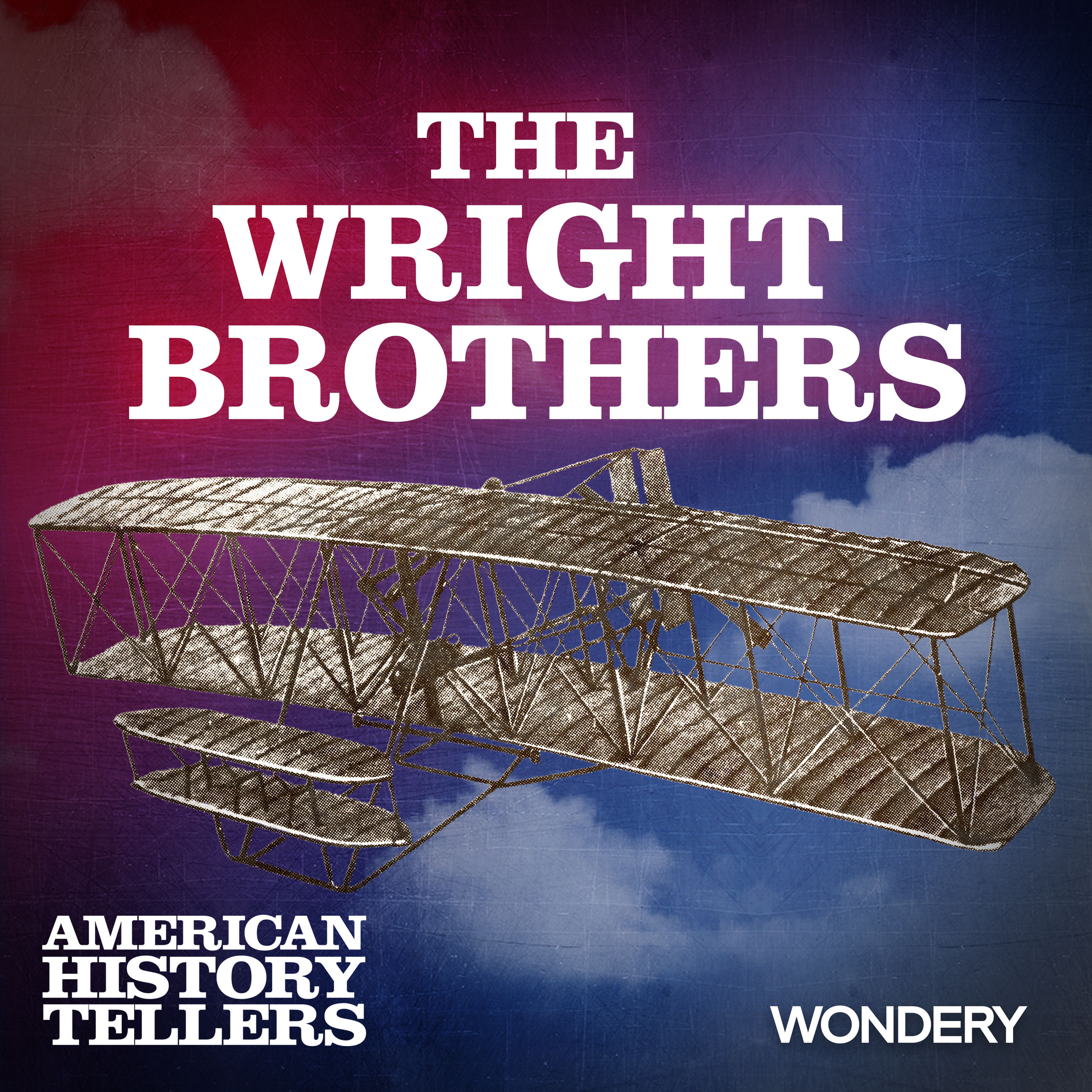
Loading summary
Transcript16 lines
- [00:00]
Lindsey Graham
Picture this. You're transported back in time, witnessing history unfold right before your eyes without any modern day interruptions. That's the magic of Wondery. Immerse yourself in the stories that shaped our nation with ad free episodes, early access to new seasons and exclusive bonus content. Join Wondery plus in the Wondery app or on Apple Podcasts and experience American history like never before. Imagine it's late afternoon on December 8, 1903. You're sitting atop a houseboat on the icy Potomac River a few miles south of Washington D.C. you're a mechanic and test pilot, and you're about to climb into the cockpit of an experimental flying machine called the Aerodrome. The brainchild of your boss, Samuel Langley of the Smithsonian Institution. You previously tried to launch the steel framed bird with its 48 foot wingspan back in October, but back then, it dove straight into the river. So today you're hoping the engine you built will propel the aerodrome into the sky and into the record books. But unfortunately, the wind has kicked up. I'm not sure about this wind, boss. Maybe we'd be safer to postpone. No. With this cold, if we wait any longer, the river might ice over completely. And maybe we should wait till spring. Not a chance. I've spent four years and $50,000 of public funding on this. Plus another $20,000 I raised myself. The investors and the public want to see something. You look out at the crowds lining the shore and boats filled with the journalists, scientists and military officers Langley invited. So it's now or never. Yeah. If we wait until spring, the funding will have dried up entirely. We have to fly now. But you're not in a hurry because of the Wright brothers, are you? You and Langley have both been following the success of the Wright brothers, who've been flying their homemade gliders off the dunes of North Carolina's Outer Banks. Bicycle makers from Ohio. They've had some luck. Yeah, but they're amateurs. It will be well funded scientists and engineers like you and me that will lead the way. All right then, Professor. Guess we should go ahead and fly this beast. Langley climbs down a ladder and shoves off in a small boat. You turn to your assistant, fire up the engine. In an instant, the 52 horsepower engine you helped build is humming beautifully. Then you raise your right arm. All right. When I drop my arm, pull the release. Okay, let her go. The Aerodrome rolls down the 60 foot catapult track. But as soon as it clears the rails, you feel it jerk backwards. Looking up at the dark winter skies, it flip over. A sudden blur of noise and splintering wood. The cold water of the river engulfs you. You're wearing a cork jacket for flotation, but it's snagged on a piece of metal and the sinking machine is pulling you under. You rip off the jacket and kick toward the surface, swimming through a tangle of wires and wood and finally into open water. You see Langley's small boat up ahead begin to swim for it. He reaches out towards you, pulls you aboard. Then Langley throws a blanket over your shivering shoulders. You see the look of shock and disappointment on his face. For the second time in two months, this machine has failed miserably. You know if you're going to compete with the Wright brothers, you'll need to build a better flying machine fast.
- [03:35]
Greenlight
This message comes from Greenlight. Ready to start talking to your kids about financial literacy? Meet Greenlight, the debit card and money app that teaches kids and teens how to earn, save, spend wisely, and invest with your guardrails in place. With Greenlight, you can send money to kids quickly, set up chores, automate allowance, and keep an eye on your kids spending with real time notifications. Join millions of parents and kids building healthy financial habits together on Greenlight. Get started risk free@greenlight.com each morning it's.
- [04:10]
NPR
A new opportunity, a chance to start fresh. Up first from NPR makes each morning an opportunity to learn and to understand. Choose to join the world every morning with Up First, a podcast that hands you everything going on across the globe and down the street, all in 15 minutes or less. Start your day informed and anew with up first by subscribing wherever you get your podcasts.
- [04:34]
Unknown
From.
- [04:34]
Lindsey Graham
Wondery I'm Lindsey Graham and this is American Historytellers. Our History. Your story through the end of the 19th century, daring inventors had made progress in the pursuit of human flight by developing balloons, kites and gliders that soared through the sky. But by the early 1900s, the challenge had become creating a self propelled machine that could be controlled in the air by a pilot. At Kitty Hawk, North Carolina, Wilbur and Orville Wright had flown their gliders longer and farther than any other pilots, but tried to keep the details of their flights and their flying machine largely under wraps. Meanwhile, in Europe, other inventors and adventurers were launching their own experimental aircraft, often in full view of the public. And elsewhere in the United States, a highly publicized and well funded machine known as the Aerodrome, built by Samuel Langley of the Smithsonian Institution, was making headlines. But in 1903, Langley's $70,000 aerodrome crashed into the Potomac river, nearly Taking its pilot with it. Just days later, the Wright brothers would make history. This is episode two of our three part series on the Wright brothers. Flyers or liars? By early 1903, Wilbur Wright and his younger brother Orville had begun working on a new glider which they planned to test at Kitty Hawk later that same year. But it was going to be different from the gliders they'd flown the previous three years at North Carolina's Outer Banks. Instead of being carried by the strength of the wind alone, it would have propellers that were powered by a gasoline engine. The brothers knew that if it succeeded, they'd become the first inventors to achieve motorized heavier than air flight. But first they needed a powerful lightweight engine. In January of 1903, the Wrights began contacting automobile makers. But none of them could provide an engine that could be mounted onto the wing of a glider. Then they got some unexpected help. Several years earlier, the brothers had hired Charlie Taylor, a farm mechanic from Illinois to help around their bicycle shop. When the brothers started traveling to North Carolina for their glider experiments, Charlie Taylor stayed in Dayton to help the Wright's sister Catherine run the bike shop. But Catherine did not appreciate the help. She thought Taylor was an insufferable know it all and would Wright to complain to her brothers that Taylor, who she called the hired man, was making her too weary for words. But it was Taylor who came to the Wright's rescue after they failed to find a suitable engine. By offering to build a small for a four cylinder engine from scratch. Using tools the brothers had amassed in their workshop, including a drill press and metal lathe, Taylor managed to craft a noisy, smoky 150 pound gas powered motor that could deliver 8 horsepower. Taylor had provided the Wrights an engine, but now the brothers had to design and craft something entirely new to them. Propellers which would spin like fans and carry their glider into the air. But the challenge of crafting the propellers became the source of argument between the brothers. Charlie Taylor and sister Catherine Wright witnessed many loud and heated exchanges between Orville and Wilmer. At one point, Catherine threatened her brothers, if you don't stop arguing, I'll leave home. But the brothers kept at it, arguing constantly while they studied boat propellers and conducted research at the Dayton Library. By the summer of 1903, they had crafted two eight foot propellers made of hand shaved spruce. These propellers would be mounted behind the wings of their glider and were designed to spin in opposite directions, one clockwise, one counterclockwise. Propelled by engine driven chains. The brothers were growing confident that their engine and propellers would work so that same summer, when the Wright's friend and supporter, Octave Chanute, invited Wilbur to give a talk to the Western Society of Engineers, Wilbur chose not to mention their work on a powered glider. He wanted to make sure it worked first before telling other inventors, because the Wright brothers knew they weren't the only ones working toward the first powered flight. For years, Samuel Langley, an astrophysicist and engineer at the Smithsonian Institution in Washington, had been experimenting with motorized gliders. By 1903, Langley and his team had built a large multi winged machine with a 52 horsepower engine that he dubbed the Aerodrome. On October 7, 1903, Langley watched as his test pilot and engineer, Charles Manley, took the controls and attempted to launch the aerodrome into the sky above the Potomac river outside Washington. Unfortunately, the machine instantly crashed into the river. Two months later, on December 8, Manley tried again, but with the same result. This time, though, Manley nearly drowned in the wreckage and Langley was ridiculed in the press for his costly failures. By that time, the Wrights were back at Kitty Hawk. They had spent the entire fall working out kinks in their new machine, but experienced setbacks. The engine kept breaking and at one point, Orville had to travel back to Dayton to get more parts. He was on his way back to Kitty Hawk when he learned about Langley's latest crash. But rather than join in ridiculing Langley, Wilbur and Orville defended their competitor, crediting Langley for his moral courage and for advancing the progress of aviation and influencing their own work. Langley would die three years later, humiliated by his failures and Wilbur would decry the shameful treatment of him by the press. And perhaps to avoid their own mistreatment in the press, the Wright brothers continued making their test flights in the remote dunes outside Kitty Hawk, far from the reporters and photographers whose news stories had mocked Langley. But they did want evidence of their success. So they purchased a state of the art camera that captured images on 5 by 7 inch glass plates and brought it with them to Kitty Hawk in order to take photos of their test flights. And by mid December, after a stormy October and a snowy November, they were finally ready to launch in their New Flyer. At 600 pounds, it was more than 10 times heavier than the glider they'd tested in 1900. But as in years past, they still planned to drag it up to the top of the high dunes known as Kill Devil Hills. But they couldn't carry the heavy glider themselves. So they enlisted the help of three lifeguards from the Kill Devil Hills Life Saving station. Imagine it's 10am on December 17, 1903. It's a freezing cold morning on the sandy bluffs above Kitty Hawk. And you and two other men from Kill Devil Hills Life saving station have just helped the Wright brothers carry their 600 pound glider up the big hill. Now you're hanging around eager to see them take it out for a spin. Orville approaches you. Thanks for your help today. We finally got the new engine working. We flipped a coin and I'll be the one to fly first. But we need someone to take a photograph. We want solid evidence of our first powered flight. I was hoping you might know how to operate a camera. I think you may be asking the wrong crew. I've never even seen a camera, any of you. You turn to the other lifeguards who just shrugged. Well, it's not as difficult as it might sound. Let me show you. Orville leads you to the camera. A leather covered box on top of a wooden tripod near the end of the launch track. Now this camera works by capturing images on glass slides that fit into the back here. What do I do? Pretty simple. When I get into the air, all you need to do is squeeze this bulb here. The bulb sends a pulse of air that opens the shutter for a split second. And the image gets captured on the glass plate. That's it. Just squeeze the bulb. That's it. It's all set up and aimed in the right direction. Just wait until I've left the launch track and gained some altitude. You give the contraption a once over and decide to give it a shot. Well, seems simple. I guess. I'm ready when you are. You take the bowl from Orville and watch him walk uphill to the top of the launch track. You're excited to be helping the brothers at what could be an important moment in history. But you're also nervous. You don't know about this camera business and you. You hope you don't miss the shot. You watch the brothers start the engine, then shake hands. Orville makes some adjustments and then climbs aboard and lays flat on the lower wing. He then yells out to you ready? I'm about to release the restraining rope. Yeah, I'm ready. In an instant, Orville is sliding down the track while Wilbur runs alongside. It's thrilling and terrifying because suddenly Orville is in the air. And that's when you remember to squeeze. Squeeze the shutter ball. You just hope you weren't too late. At 10:35am on December 17, 1903, at Kitty Hawk, North Carolina, Orville Wright pulled a rope that released the machine named flyer down its 60 foot launch track. Wilbur held the end of one wing and ran alongside his brother, keeping the machine steady as it slid into a strong headwind. As Orville reached the end of the track, he he pulled on the rudder and the machine lifted. It rose, then dipped. Rose, then dipped again. Then a wing hit the sand and it landed hard. John T. Daniels, the lifeguard they enlisted to take a photograph, cheered and clapped along with his companions. Orville had traveled just 120ft, but the 12 second journey would stand as the first controlled powered flight in history. Afterward, Orville rushed over to Daniels to ask if he got the photograph. Daniels had been so excited, he said he wasn't sure and the glass plate couldn't be developed until the brothers got back to their darkroom in Dayton in a few weeks. Wanting to be certain they captured evidence of their achievement, Orville loaded the camera again and the brothers made three more flights, this time operating the camera themselves. Wilbur made the longest flight that day, covering 852ft in 59 seconds. At one point, lifeguard John Daniels was helping drag the aircraft back uphill for another flight when a gust of wind caught it and tossed him in the plane. Daniels got tangled in the machine but escaped without serious injury. In his diary that night, Orwell wrote his escape was miraculous as he was in with the engine and chains. But for Daniel, he would later boast that he had survived the world's first plane crash. The flyer, however, was ruined and would never lift off again. At the end of the day, Orville and Wilbur walked four miles to the Kitty Hawk weather station to send a telegram to their father. In abbreviated language it read, Success4Flights Thursday informed press home for Christmas. At home in Dayton, Bishop Wright received the telegram from his sons and showed it to his daughter Catherine. They were so excited they rushed to send their own telegram to Octave Chanute. Meanwhile, a telegraph operator in Norfolk, Virginia intercepted the Wright brothers telegram and passed it on to a reporter reporter friend at the local newspaper, the Virginian Pilot. The next day a front page story appeared beneath a headline that declared Flying machines soars three miles in teeth of high wind over sand hills and high waves at Kitty Hawk. This story was then picked up by the Associated Press and appeared in dozens of newspapers across the country, though it was filled with inaccuracies which infuriated the Wright brothers. But despite the reporters fabrications, the story's first line rang true. The problem of aerial navigation without the use of a balloon has been solved at last. After their achievement, the Wrights returned to Ohio in late December, they hoped to be able to see the photos they had taken, but they discovered that the water pipes at home had frozen, which prevented them from developing the glass plate negatives. When they were finally able to print the photographs in early January, they found that the images they had taken themselves were blurred. But the picture snapped by lifeguard John Daniels was perfect, but they decided not to share it with the press or the public right away. Instead, on January 6, 1904, the Wrights issued a press release to counter the many inaccuracies that had been reported in what they called a fictitious story. Incorrect in almost every detail. In their release, the brothers described the events of December 17, but also stated, we do not feel ready at present to give out any pictures or or detailed description of the machine. The brothers had discussed whether or not to share details during the long train ride home from North Carolina. They calculated that they had spent roughly $1,000 building their flying machines and traveling to Kitty Hawk over the years, but the bicycle shop had been struggling. They wanted to turn their flying hobby into a business and find a buyer for their invention, but to do that, they would need to fly more regularly, stop traveling so far from home to do it, and build a stronger and more reliable aircraft. Their financial future, their reputation, and the future of flight was at stake. American Historytellers is sponsored by Acorns. Every new year, many of you will set goals like lose weight or get healthy. I have those goals too, but they're hard. We have to make the right choices every day, often several times a day. It would be so much easier if you could just hit a button and automatically carve off a few calories or contract a few muscles. But you can't. Not with your body, but with your money you can. And if you have money goals for 2025, Acorns makes it easy to start automatically saving and investing so your money has a chance to grow for you, your kids and your retirement. You don't need to be an expert. Acorns will recommend a diversified portfolio that fits you and your money goals. You don't need to be rich. Acorns lets you invest with the spare money you've got right now. You can start with $5 or even just your spare change. Head to acorn acorns.com tellers or download the Acorns app to start saving and investing for your future today. Paid non client endorsement compensation provides incentive to positively promote Acorns tier 2 compensation provided investing involves risk. Acorns Advisors LLC and SEC registered investment advisor view important disclosures@acorns.com tellers they say.
- [18:49]
Unknown
Hollywood is where dreams are made, a seductive city where many flock to get rich, be adored and capture America's heart. But when the spotlight turns off, fame, fortune and lives can disappear in an instant. When TV producer Roy Raiden was found dead in a Canyon near LA in 1983, there were many questions surrounding his death. The last person seen with him was Lainey Jacobs, a seductive cocaine dealer who desperately wanted to be part of the Hollywood elite. Together, they were trying to break into the movie movie industry. But things took a dark turn when a million dollars worth of cocaine and cash went missing. From Wondery comes a new season of the hit show Hollywood and Crime. The Cotton Club Murder. Follow Hollywood and the Cotton Club Murder on the Wondery app or wherever you get your podcasts. You can binge all episodes of the Cotton Club Murder early and ad free right now by joining Wondery plus.
- [19:55]
Lindsey Graham
In early 1904 weeks after their successful flight at Kitty Hawk, Wilbur and Orville Wright began building a new aircraft, which they would call the Flyer two. They again turned to the manager of their bicycle shop, Charlie Taylor, to build them a new engine. The brothers wanted the new plane to be heavier, sturdier and more powerful than the prototype they'd left behind at Kitty Hawk. Charlie Taylor would later say that the brothers were always thinking of the next thing to do. They didn't waste much time worrying about the past. And now in 1904, as Wilbur later put it, they were at a fork in the road. For years they had divided their time between running the bicycle shop and building and testing their flying machines. But the brothers decided it was time to turn day to day management of the bicycle shop over to Charlie Taylor. They also hired a lawyer to help them file a patent that would protect their investment. This lawyer advised the Wrights not to publicly discuss their flying machine with the press or any potential competitors until the patent was granted. This put a strain on the Wrights relationship with their friend and mentor Octave Chanute, who encouraged the brothers to give public demonstrations and talks and write articles about their success. But the Wright brothers had resolved to keep their machine under wraps until they had the patent in hand. The brothers also decided to stop traveling to North Carolina. With the success of their machine and its engine powered propellers, they decided they no longer needed the sandy slopes and gusty winds of Kitty Hawk. Instead they set out to find a flat, open testing ground closer to home and soon chose a 100 acre cow pasture less than 10 miles northeast of Dayton. This field called Huffman Prairie was owned by Torrance Huffman, president of Dayton's Fourth National Bank. He agreed to let the Wrights use his pasture free of charge, as long as they moved his cows and horses into an adjacent field when they flew. But Huffman had his doubts about these flying experiments, telling a nearby farmer, they're fools. And what at first seemed like an ideal location did turn out to have some issues. Wilbur and Orville soon discovered that the Huffman prairie was full of gopher holes. So through the spring of 1904, the brothers spent hours trudging around the field with shovels and scythes, knocking down gopher mounds, then building a shed on the property. By May, they finally had a level Runway and were ready to start flying. They found that the plane took off reasonably well on windy days, but they wanted to develop a launch system that would, as Wilbur put it, render us independent of wind. Their solution was to build a 250 foot launch track with a small lip at the end designed to provide a boost and help the machine lift into the sky. Yet by mid summer 1904, they were still managing to make only short flights just a few feet off the ground. Wilbur would later say they'd become a little rusty. Charlie Taylor, who observed these attempts, was convinced the brothers were fearless, but also reckless. With each flight he watched, Taylor wondered if it would be their last. But other observers were less impressed by the flights themselves than by the brothers patient perseverance, their calm faith in ultimate success, and their mutual consideration of each other. The local high school teacher who wrote these words also said the brothers always took turns, and he felt they were getting nearer and nearer to sustained flight. And now that Wilbur and Orville were flying closer to home, their father Milton, and sister Catherine began to play a bigger role, often making their way out to Huffman Prairie to watch the brothers in action. Imagine it's August 24, 1904. Today, you and your father have traveled to visit the field where your brothers have been testing their latest flying machine. You're standing with a group of spectators, including a few newspaper reporters, watching your brothers tool with the aircraft they call the Flyer two. Your father wanders off to speak with a member of his church, and that's when you notice the man next to you is taking notes in a small notepad. Excuse me. Are you a journalist? Yes, managing editor of the Daytona Journal. Are you a subscriber? No. Actually our family prefers the Dayton Daily News. But what brings you here? I teach a writing class twice a week at a school nearby, and I usually stop Here after class to watch. Oh, I'm a teacher as well. I teach Latin and English at Steel High. Oh, that's a good school. What brings you here then? You decide not to let on that you're related to the Wright brothers? Oh, just curious, I suppose. Yeah, I've been hearing about the rights ever since the news broke last year. Yes, well, they were very successful in North Carolina. Not so much this summer, I'm afraid. The engine of the Flyer two revs up and you notice your brother Wilbur is taking off. You and the newspaper man both watch as the Flyer II accelerates down the track and launches, but only gets about 8ft off the ground. After 10 yards of flight, Wilbur lands hard in a spray of dirt and grass. Well, I guess they're still working out the kinks. The newspaper man smirks. Yeah, I feel sorry for them. They seem like decent young men. And they're persistent, I'll give them that. But I'm surprised they keep coming here day after day to waste their time on that ridiculous machine. And why is it ridiculous? You know, you people in the press are always, always ridiculing or ignoring my brothers. Ah, so you're the sister. I am. And I'm proud to be their sister. Because you'll see, someday they'll make you eat your words. Look, Miss, I'm happy to be proven wrong, but I hear there's great progress being made in Britain and France. It's clear by comparison your brothers are just hobbyists. They're amateurs. You're about to protest some more, but then you see that your brother Orville is taking a turn in the machine. He rockets down the Runway, lifts up into the air and it's beautiful. You smile smugly at the reporter until a sudden gust of wind kicks up and you watch or will struggle to maintain control. Your face falls as you realize he's going to crash. Many of the Wright brothers early flights at Huffman Prairie were only short hops, barely making it off the ground. But on August 13, Wilbur finally managed to fly a distance of 1,000ft. The brothers longest flight up to that point. But then 11 days later, Orville was hit by a gust of wind and crashed at 30 miles an hour while his sister Catherine looked on. He was bruised and badly shaken and couldn't fly for a month. The Wrights had hoped their new engine would be powerful enough to fly without the aid of the steady winds of Kitty Hawk, but they couldn't get the momentum they needed. They knew they would have to think of something else to get them the height and speed to really fly. So they came up with an ingenious solution they called a starting apparatus. Made with tall wooden poles, it used a system of weights, ropes, and pulleys to propel the Flyer II down the launch track. By early September, their catapult system was working, and Wilbur was able to make longer flights, even on days with light wind. Then, on September 15, with Orville still on the sidelines, recovering from his recent injuries, Wilbur took off and managed to stay airborne for an astounding half a mile. Five days later, he did even better. He flew his first ever complete circle, a flight that lasted nearly a mile. Unfortunately, there were no reporters to witness this feat. The press had stopped coming to Huffman Prairie to watch, and only one writer still seemed interested in the Wright brothers experiments. Amos Root was an eccentric and deeply religious beekeeper from outside Cleveland who wrote essays and travel articles for a beekeeper's trade journal. And in his 60s, he developed an interest in scientific inventions. Root had begun exchanging letters with the wrights in early 1904, and later that same year started visiting Huffman Prairie. In December, Root got the Wright brothers permission to publish an article about them in his beekeeper's journal. Root's breathless account of the flights he witnessed at Huffman Prairie became one of the first comprehensive stories about the Wright brothers, describing watching Wilbur fly four complete circles around the field as one of the grandest sites of his life. Root also sent a copy of his story to Scientific American, offering to let them reprint it. But his article was ignored, and the mainstream press continued to shun the Wright brothers, many believing they were merely cranks and could not really be achieving anything of significance. Despite this lack of public recognition, though, the brothers felt confident that the new machine they were building, the Flyer iii, would be their first truly reliable aircraft, a machine someone might actually want to buy. Although they received some initial interest from the British government, the brothers really hoped to sell their machine to the United States. And in early 1905, they met with a local congressman, Robert Nevin, seeking his advice on how they might promote their flyer to the US Military. Nevin encouraged them to write a letter describing their aircraft, and he'd deliver it to then secretary of war and future president William Howard Taft. But Taft's war department declined to buy the rights machine, stating that it has not yet been brought to the stage of practical operation. Meanwhile, the brothers waited a response to their patent request, and they began to perform longer and more complicated flights, achieving circles and figure eights and increasing their distance from 10 to 15 and then 20 miles. On October 5, Wilbur circled the pasture 29 times. Later that month, their father was on hand to watch Wilbur make a 24 mile flight, their longest yet. Their achievements during the summer and fall of 1905 at Huffman Prairie further convinced the brothers of the commercial value value of their invention. The press was turning around too. They had all but drifted away in 1904, but now, a year later, began to pay attention again. The Dayton Daily News described witnessing one of the brothers soar away like an eagle. And a correspondent from a German aeronautical journal came to write a series of articles. But by the end of 1905, despite this newfound interest in the press, commercial possibilities seemed to be waning. The interest from the British army had stalled. And even though the Wrights again wrote to the US War Department stating we do not wish to take this invention abroad again, they were rejected. But then, just days after Christmas, the Wrights received a visit from a French businessman expressing an interest in buying their Wright Flyer on behalf of the French military. The deal was contingent on the Wrights demonstrating their machines abilities. But if it went through, they could receive up to a million francs or US$200,000. An astounding offer worth around 7 million today. But the brothers remained determined to wait until their patent was approved before giving any official demonstrations to potential buyers. As a result, the French representatives hesitated. They wanted proof that this machine actually worked the way Wilbur and Orville said it did. But wary of others infringing on their designs, the Wrights refused to give demonstrations until any potential buyer offered a contract for first. This hesitancy prompted the Paris Herald to publish an editorial publicly questioning the Wright's claim, saying the Wrights are in fact either flyers or liars. It is difficult to fly. It is easy to say we have flown. So with many openly doubting they had a machine capable of actually flying and lucrative contracts on the line, the two inventors would be forced to become businessmen in order to keep their dream alive.
- [31:19]
Unknown
Hello, ladies and germs, boys and girls. The Grinch is back again to ruin your Christmas season with Tis the Grinch Holiday Podcast. After last year, he's learned a thing or two about hosting and he's ready to rant against Christmas cheer and roast his celebrity guests like chestnuts on an open fire. You can listen with the whole family as guest stars like Jon Hamm, Brittney Broski and Danny DeVito try to persuade the mean old Grinch that there's a lot to love love about the insufferable holiday season. But that's not all. Somebody stole all the children of Whoville's letters to Santa, and everybody thinks the Grinch is responsible. It's a real Whoville whodunit. Can Cindy Lou and Max help clear the Grinch's name? Grab your hot cocoa and cozy slippers to find out. Follow Tis the Grinch Holiday Podcast on the Wondery App or wherever you get your podcasts. Unlock weekly Christmas mystery bonus content and listen to every episode ad free by joining Wondery in the Wondery App, Spotify or Apple Podcasts.
- [32:19]
Lindsey Graham
Hi, I'm Lindsey Graham, the host of Wondery Show. American Scandal we bring to life some of the biggest controversies in US History. Presidential lies, Environmental disasters, corporate fraud. In our latest series, NASA embarks on an ambitious program to reinvent space exploration with the launch of its first reusable vehicle, the Space shuttle. And in 1985, they announced they're sending teacher Christa McAuliffe into space aboard the space shuttle Challenger, along with six other astronauts. But less than two minutes after liftoff, the Challenger explodes, and in the tragedy's aftermath, investigators uncover a series of preventable failures by NASA and its contractors that led to the disaster. Follow American Scandal on the Wondery app or wherever you get your podcasts. Experience all episodes ad free and be the first to binge the newest season only on Wondry. You can join Wondry in the Wondry App, Apple Podcasts, or Spotify. Start your free trial today. In 1906, the Wright brothers were approached by more potential buyers. But after years spent in isolation trying to build and refine flying machines, they struggled with the business side of aviation. Years earlier, Wilbur had written to his older brother Loren, that he felt that he and Orville weren't aggressive enough to be good businessmen. He described business as a form of warfare in which each combatant strives to get the business away from his competitors and at the same time, keep them from getting what he already has. But by May 1906, the US Patent Office had finally approved the applications the Reitz had filed for three years earlier. They had already received patents in England, France, and Belgium and were waiting on one in Germany. And with this development, new potential investors began to emerge. A New York firm called Flint Company, which sold guns, cars, and submarines in Europe, approached the Wrights and offered them $500,000 for the exclusive right to sell their plane outside the U.S. then Germany floated an offer of the same amount for 50 Wright Flyers. These offers, each worth roughly 17 million today, seemed absurd for a pair of bike makers who so far had only built one airplane At a time. Nevertheless, the brothers traveled to New York to negotiate a deal with the head of the Flint Company, Charles Flint. But before an agreement could be reached, the Flint Company's European representative insisted that one or both brothers come to Europe to meet with potential buyers in Germany and France. It was decided that Wilbur would make the journey by himself. So in April, Shortly after his 40th birthday, Wilbur traveled to Paris. The French viewed Wilbur as a bit of an oddity. He didn't smoke or drink and showed little interest in women. And he faced tough questions from potential buyers in France, who also insisted that the Wrights demonstrate their plane before any deal be struck. But Wilbur was encouraged by all the interest being shown in their flying machine. As he traveled to assorted meetings that summer, he reported to Orville by letter. The pot is beginning to boil pretty lively. In late July, Orville joined Wilbur in Paris, but their father, Bishop Wright, wrote to his sons warning them to avoid the temptations the city offered. Orville wrote back to jokingly reassure him that they'd been well behaved, saying, we have been in a lot of the big churches and haven't gotten drunk yet. While in Europe, the brothers met with more prospective buyers in France and Germany. But by November, they still had not secured a deal. Finally, they decided it was time to go back home. And confident that they'd return and finalize a sale in the new year, they left their Flyer III in its crates inside the Customs House west of Paris. In late 1906. Orville and Wilbur were by no means the only people in the flying machine game. They had stiff competition. Aviators in France had made their own progress developing dual and single wing planes powered by engines and propellers. And unlike the Wright brothers, these pilots often flew in public before large crowds. French Brazilian aviator Alberto Santos Dumont had given public demonstrations, making short hops and one 700 foot long flight outside Paris, becoming an aviation hero in France. And in late 1907, just before the Wright brothers left Europe, Orville had joined a crowd outside Paris to watch cycling champion Henri Farman fly a dual wing aircraft a distance of almost 5,000ft, nearly making a complete circle. Meanwhile, the Wright brothers had yet to give any official public demonstration, and many people remained skeptical. But in 1908, the brothers finally got an offer from the US War Department of $25,000 for one flyer machine. And a month later, the brothers signed an agreement with a French company. But again, both the French and the US Buyers insisted on a public demonstration first. By this point, the brothers hadn't flown since late 1905 years prior. So they traveled back to Kitty Hawk for some much needed pract. They had a newly built Flyer similar to the one sitting in crates in France. But this one included a few modifications. Instead of being controlled by a pilot lying prone on the lower wing, this Flyer had two upright seats side by side. And soon enough, this model was ready for its debut. On May 6, 1908, the press descended on Kitty Hawk to witness Wilbur flying with the first ever passenger, a local lifeguard sitting in the seatbelt beside him. Collier's magazine would soon publish a photograph of the Wrights in flight, the first picture to ever be shared publicly of their machine in action. The brothers had finally proved to remaining skeptics in the US that their aircraft actually flew. Now Wilbur headed back to Europe to prepare for more demonstrations, knowing that the future of the company and the brothers reputation rested on his success. Imagine, at 6 o'clock on July 4, 1908, you're a car manufacturer and aviation enthusiast in Le Mans, France, and for two weeks you've been watching Wilbur Wright reassemble his Flyer 3 machine, which has been in storage for the past year. You've let Wright use a warehouse next to your car factory so he can work in private, away from curious newsmen. You've also loaned him one of your factory workers. But Wright doesn't speak French and mostly prefers to do all the work himself. You've been amazed at his work ethic and meticulous focus. Tonight he's got the engine mounted, and in a few weeks he's scheduled to give flying demonstrations. The European public will finally get their first look at the Wright brothers machine in action. And now it has two seats. You've been secretly hoping for a ride. Ah, Wilbur. I don't suppose he'd let a big man like me fly with with you, would you? Well, I'm afraid not. I want to make these first flights alone. Maybe later. Sure. Yeah. I just know I'm happy to help. What I really need help with is keeping those reporters away. I didn't ask them to come here. They're just being protective of French flyers. They're dubious about what you and your brother have done. Yeah, what is it they call us blue for? Well, in a few weeks we'll show them we're not bluffing. Suddenly, the room filled with the roar of the engine, much louder than the engines on your factory's automobiles. Ah. Is it always this loud? It's in rough shape. I got damaged by custom agents when it was sitting in store. You watch as Wilbur adjusts A radiator hose on the engine. Suddenly, the hose breaks loose and shoots a jet of steaming water, scalding Wilbur's arm and chest. You rush over and help him to the ground, then get up to grab a first aid. Wilbur. Wilbur, stay still. This is a vial of picric acid. We keep it on hand for burns. It will help, but it will also hurt. You dab the acid on his red and blistered left arm, then wrapped the burn in a bandage. We need to get you to a doctor. I think you're right, but just make sure no French reporters see me. They'll have a field day. I will try to make sure they don't hear anything about it. You're relieved that Wilbur wasn't more badly hurt. But still, you can't help but wonder, with these burns, will he be able to fly? When Wilbur returned to Europe in 1908 to finally give his first flying demonstrations on the continent, he was shocked to find his flyer, which had been in storage since the previous year. Badly damaged pieces were cracked or missing, the wings torn, the radiator smashed. Custom agents had opened the crates and damaged the parts. But despite this apparent sabotage, he found others who were keen to show their support. Leon Bolle, a wealthy automobile manufacturer, offered Wilbur workshop space to reassemble his aircraft. But in late July, while testing the engine, a radiator hose broke and sprayed Wilbur with scalding water, badly burning his arm and chest. Bolle treated Wilbur's wounds, but it took weeks for his arm to heal. By August 4, he was not quite fully recovered, but his flyer was in good enough shape to be moved in the middle of the night. To avoid any press attention, Bolle helped Wilbur tow the aircraft to a racetrack five miles outside the town of Le Mans. For weeks, Wilbur had been followed everywhere by reporters. Some found him and his work habits amusing, and still more had nicknamed him Villier Buret, or Old Oil Can. He lived up to this name when impatient reporters kept asking him when he would fly, and he snapped, I did not ask you to come here. I shall go when I'm ready. Wilbur was, in fact, eager to begin flying, but bad weather during the first few days of August kept him grounded. Then on August 8, he announced, Gentlemen, I'm going to fly. There was a brief delay when the press complained about Wilbur's insistence that no photographs be taken. But by 6:00 that evening, he and the press were ready. Wilbur turned his cap backwards, started the engine, then climbed into the left side seat. Spectators observed that Wilbur wore no special pilot's helmet or jacket, just his regular gray suit and starched high collar shirt. Minutes later, he pulled a cord that released a weight that catapulted him and his aircraft down the launch track. The Flyer III became airborne. At first, it seemed headed straight for a row of tall poplar trees, but at the last moment, Wilbur pulled up and banked to the left, making a graceful turn before swooping back around toward the crowded grandstand. As cheers arose, he made another banked turn and sailed back to where he started, landing just 50ft from the launch spot. He had stayed in the air for a minute and 45 seconds, covering just under two miles. Stunned spectators were amazed at his control of the aircraft and his ability to make banked turns and to land so gently. They erupted in cheers and rushed onto the field waving hats in the air. French aviator Louis Bleriot was in the crowd and declared that a new era of mechanical flight has commenced. Over the next few days, Wilbur made a series of technically challenging flights before large crowds, including figure eights, demonstrating his skills as a pilot and the capability of his flying machine. The press went wild. Some reporters actually cheered and shouted, this man has conquered the air and he is not a bluffer. Rapturous headlines appeared declaring it a triumph of aviation and a marvelous performance. European skepticism has dissipated, and for Old Oil Can, Wilbur's testy demeanor was softened a bit by the rapturous response. He now smiled at reporters and was even seen whistling. He wrote to his sister Catherine, I cannot even take a bath without having a hundred or two people peeking at me. But while Wilbur was celebrating his successful flights in Europe, Orville was preparing to give his own demonstration for US Military officials in Virginia. Wilbur wrote to his brother advising Orville to avoid all unnecessary personal risk, further cautioning him to not let yourself be forced into doing anything before you were ready. These were wise words, and Orville took them to heart. But still, a violent crash and a high profile casualty would threaten to destroy everything the Wright brothers had built. From Wondery this is episode two of our three part series, the Wright Brothers from American Historytellers. In our next episode, an accident in Virginia casts doubt on the Wright brothers success. They find further headwinds in patent fights and lawsuits, and a million spectators show up in New York harbor to witness a thrilling flight. If you like American Historytellers, you can binge all episodes early and ad free right now by joining Wondery in the Wondery app or on Apple Podcasts. Prime members can listen ad free on Amazon Music. And before you go, tell us about yourself by filling out a short survey@wondery.com survey if you'd like to learn more about the Wright brothers, we recommend the Wright brothers by David McCullough and Bird Men by Lawrence Coldstone. American Historytellers is hosted, edited and produced by me, Lindsey Granford. Airship Audio editing by Christian Ferraka Sound design by Molly Bach music by Lindsey Graham. This episode is written by Neal Thompson. Edited by Dorian Marina Produced by Alida Rozanski Managing producers Desi Blaylock and Matt Gant senior managing producer Ryan Moore senior producer and Herman executive producers are Jenny Lauer, Beckman, Marshall Louie and Aaron O'Flaherty. For wondering.
- [46:03]
Unknown
He was hip hop's biggest mogul. The man who redefined fame, fortune and the music industry.
- [46:08]
The first male rapper to be honored on the Hollywood Walk of Fame, Sean Diddy Cohen.
- [46:16]
Diddy built an empire and lived a life most people only dream about.
- [46:21]
Lindsey Graham
Everybody know ain't no party like a Diddy party. So, yeah, that's what's up.
- [46:25]
Unknown
But just as quickly as his empire rose, it came crashing down. Today I'm announcing the unsealing of a three count indictment charging Sean Combs with racketeering, conspiracy, sex trafficking, interstate transportation for prostitution.
- [46:40]
Lindsey Graham
I was up and I hit rock bottom. But I made no excuses. I'm disgusted. I'm so sorry. Until you're wearing an orange jumpsuit, it's not real. Now it's real.
- [46:50]
Unknown
From his meteoric rise to his shocking fall from grace from law and crime, this is the rise and fall of Diddy. Listen to the rise and fall of Diddy. Exclusively with Wondery.