Podcast
Anglofuturism
Hosted by Tom Ough and Calum Drysdale · EN
29episodes
Episodes
Newest firstAll episodes

A postmortem of Britain's housing crisis
3w ago01:32:45Summary readySpace is tight in the King Charles III Space Station’s dining room this week — ten million pounds a square metre, the collapse in housebuilding having consequences even in orbit — which is fitting, because coming through the airlock are two men who tried harder than most to fix it. Jamie Rumbelow and Henry Dashwood founded Tract, the venture-backed startup that set out to speed Britain’s planning system up with software. Two years later they returned the capital and wrote the postmortem everyone in British tech has read. But this episode isn’t about that postmortem. It is about what Jamie and Henry learned when they pulled back the curtain on the people who are meant to be building Britain’s homes. With sincere apologies from production, this interview has sat in our backlog since last autumn. Nevertheless it is, perhaps unsurprisingly given the subject, utterly timeless. Our thanks to Henry and Jamie for being so patient.The episode explores* How Jamie was radicalised by The Housing Theory of Everything* Why £1,600 a month makes housing a moral issue* What a land promoter actually does: title deeds, unanswered letters to farmers, and a month of knocking before anyone will talk* Twenty thousand pounds a hectare until planning permission touches it* Forty types of document for a small builder, versus the 1990s red-line sketch that got you an agreement* The land-banking myth: housebuilders aren’t hoarding, they’re terrified of paying subcontractors to do nothing* NIMBYs have a legitimate point: traffic, GP waiting times, and Section 106 as a feudal tribute system* Abolish stamp duty first — the quickest win in housing, and the one that sorts everyone into the right house* Why not Birmingham?* Reading every single Paul Graham essay, making all the same mistakes anyway, and the unglamorous responsibility to build a very big company very quickly* Victorian railways approved by committees of six MPs forbidden from owning land on the route* Thirty million Londoners at the density of Paris, “we could be Taiwan”, and the ten-storey Sloaney PonyJamie and Henry’s postmortem of Tract is at buildwithtract.com. Henry writes at henrydashwood.com and Jamie is at jamierumbelow.net. Anglofuturism remains open to sponsors — get in touch with aeron@anglofuturism.co. This is a public episode. If you'd like to discuss this with other subscribers or get access to bonus episodes, visit anglofuturism.substack.com/subscribe
Summary
South Atlantic Superclásico
3w ago00:58:12Summary readyNo guest at the airlock this week — no radar contact at all, in fact, because Tom is patching in from a French heatwave, leaving Calum alone in the captain’s seat. Domestic matters first: the long-foretold big score has finally materialised (34 runs, since you ask), and England are in a World Cup semi-final.Which turns out to be geopolitically relevant, because Britain’s principal adversary this century could well be Argentina. The last country to declare war on us has a standing claim on the Antarctic Peninsula and a date circled for 2048, when the treaty system parking everyone’s claims comes up for review.Elsewhere: Tom, broadcasting from a continental-sized armpit at nearly forty degrees, discovers France is having a full culture war about air conditioning while Britain quietly makes cooling near-impossible to permit and calls the heat character-building. And a new Acemoglu paper hands the show a victory lap on a long-running thesis: labour scarcity forces innovation.The episode explores:* Why Britain’s principal adversary this century might be Argentina, with 2048 circled in the diary* “The Antarctic Peninsula is British and it shall remain British. I am sending a task force to Port Lockroy” — the duelling Thatcher impressions* The dream of an episode entitled simply Gotcha* Why there is still no British city on the Falklands despite ten trillion pounds of oil in the neighbourhood* Harry Kane, the Chagos Islands, and the Diego Garcia tattoo* How England should handle Messi (flood the midfield; he doesn’t run very much)* France’s aircon culture war: Le Pen promising cooling for all, Mélenchon scandalised* Air conditioning as civilisational technology — the most important thing Lee Kuan Yew did for Singapore’s civil service* Barocal, the Cambridge spinout doing solid-state barocaloric cooling with no refrigerant and 2-3x the efficiency of commercial HVAC* The Acemoglu natural experiment: wartime labour loss, 9.1 per cent higher GDP per capita fifty years on* The automated car wash you never build while labour stays artificially cheap* The Motor Car Act, the Isle of Man TT, and what the CAA could accidentally do for drones * Politics as downstream of TFR: pensions eating the state and Luttwak’s end of the heroic generationThis one is a salon for our paid subscribers — thank you for keeping the station pressurised. Anglofuturism remains open to sponsors: get in touch with aeron@anglofuturism.co. This is a public episode. If you'd like to discuss this with other subscribers or get access to bonus episodes, visit anglofuturism.substack.com/subscribe
Summary
King, country, and a sword called Arondite
3w ago01:15:34Summary readyThere is a knock at the airlock this week, and the King Charles III Space Station’s radar detected nothing incoming. The undetected arrival is Will Blyth: major in the Army for twelve years, infantry platoon commander in the Rifles in Afghanistan, then Palantir, then Helsing, and now founder of Arondite, the London company building Cobalt, the command-and-control layer for the robot-heavy battlefield. He has come to upgrade the station’s defences and, first, to show off: the hosts spend the opening stretch war-gaming a Donovian invasion of Wales on Cobalt’s live map — Donovia being NATO training doctrine’s standard enemy, nothing whatsoever to do with Russia — adding javelin viewsheds and enemy units to the Brecon Beacons and marvelling that government software now ships in dark mode. Behind the toys sits the serious claim: the modern battle space has hundreds of sensors, drones and robots built by manufacturers who never expected them to work together, and the question is how you orchestrate all of it, plus the humans, at machine speed.Will’s answer starts in Helmand in 2009, where his patrol base sat a kilometre or three from the next one and, if that base was on a different VHF net, “you really never spoke to them, ever” — an information black hole courtesy not of Taliban electronic warfare but of British procurement. Fifteen years on, the reconnaissance patrol of six plucky infantrymen is three robots from three different companies, the drone you bought six months ago is already the wrong drone, and Ukraine has proved you can own ten thousand airframes and still not know where to send them. Cobalt is the answer to the common data fabric that was, in Will’s words, literally laughable in 2009 — and he wants Britain to garden its way there, with the centre setting data standards and the edges buying fast.Britain built its entire post-war security apparatus on the belief that America would be there when it mattered, and Will — emphatic that betting against the United States is historically a losing trade — argues that recent behaviour means things can never be the same again. It is not a cheerful conversation — the ghosts of 1915 and 1937 both make appearances — but it is, in the end, a romantic one: Arondite is Lancelot's sword, unsheathed in the name of Arthurian Anglofuturism.The episode explores* War-gaming a Donovian invasion of Wales, live, from the Brecon Beacons down* How British procurement, not the Taliban, made a kilometre of Helmand an information black hole* Why the six-man reconnaissance patrol is now three robots from three companies — and why Will remains long on plucky chaps* A weapons programme as HS2 with an active adversary, and whether Arondite has a drone for NIMBYs* Drones as ammunition: Britain’s wartime ramp-up maths for 5.56mm and its total absence for the munition that defines Ukraine* The 1915 shell crisis as political dynamite waiting to be re-detonated* Procurement as gardening: data standards at the centre, fast buying at the edges* Why a country whose infrastructure is struck day after day changes its politics very quickly — and the national conversation about sacrifice Will wants started now* 1939, minus the rearmament programme* The one thing that hasn’t gone wrong with Ajax* Fifty years out: keep NATO strong, reassure the Americans, move one notch — just one — towards the French model* Muddy boots at VC events, Lancelot’s sword, and the ideals of CamelotAre you a general with C2 problems — and not a Donovian? Arondite is at arondite.com. Anglofuturism remains open to sponsors — get in touch with aeron@anglofuturism.co. This is a public episode. If you'd like to discuss this with other subscribers or get access to bonus episodes, visit anglofuturism.substack.com/subscribe
Summary
Jilly Cooper's Rivals, Cosine's sovereign AI, and Shabana Mahmood's spaceport gambit
Jun 3001:08:56Summary readyCalum and Tom are back in the King Charles III Space Station bar, and this week they have a hit piece to enjoy. Prospect has run two thousand words on the online right under the headline “decline porn”, filed Anglofuturism alongside the doom-scrolling aesthetics accounts, and decided the whole project is aestheticised cope that lets the right avoid thinking seriously about Britain’s future. Best of all, it commissioned an illustration: five enormous, union-jack-tattooed Anglofuturists emerging from the darkness to menace the magazine’s readers.Meanwhile, Anthropic’s Mythos, said to be the best hacker in the world several times over, has been held back, and the US government has now banned roughly all non-citizens from its other model, Fable — a ban that reaches even the AI Safety Institute, the British body that built a world-famous testing capability and can no longer run evals on the leading models. Calum’s gloss is the line of the episode: if it is not your national model, you are going to be a vassal. From there it is a tour of what sovereign capability actually looks like — Cosine, the British startup fine-tuning air-gapped coding models for banks still running on COBOL no one dares replace, and Lumen Sovereign, the mixture-of-experts model it is building with government money on the Isambard supercomputer in Bristol so that British firms can use frontier coding without shipping proprietary code overseas. There is a clear-eyed detour through the new national labs, BOLD and FAIR, through continual learning and the transformer’s attention mechanism, and through the uncomfortable fact that the straight lines on the graphs are still holding up — that something like 65 per cent of Anthropic’s own code is now written by Anthropic’s own models.And in politics, Shabana Mahmood’s asylum reforms are about to enter Parliament, and behind the asylum headlines sits the Boriswave and indefinite leave to remain — a settlement the hosts price at something like £292,000 a person across perhaps two million people, done thoughtlessly to hold inflation down and now a permanent liability. Immigration is a futurist issue, Tom argues, because the decisions governments make about migration have effects that run not for years but for generations, and Calum puts it more bluntly: it is the thing most likely to prevent the future they want. Hence the title. If Britain wants high-productivity, high-GDP-per-capita, spaceport-building wealth, it has to decide what it can afford, and prioritise spaceports or pensions. Nothing we talk about on this podcast is impossible, a great deal of it has been done elsewhere, and all it takes is will. Other countries, after all, have massive spaceports. Be the Anglofuturist Prospect Magazine thinks you are.The episode explores— Prospect’s illustration of five muscle-bound, union-jack-tattooed Anglofuturists emerging from the darkness to menace its readers, and why the hosts take it as a compliment— The US government bans non-citizens from Anthropic’s Fable, the AI Safety Institute is locked out of the leading models, and the line that follows: “if it’s not your national model, you are going to be a vassal”— Cosine’s air-gapped, fine-tuned coding models, the Lumen mixture-of-experts on the Isambard supercomputer, and why Britain’s banks are still maintained in COBOL by people who refuse to retire— The BOLD and FAIR national labs, continual learning, and the claim that 65 per cent of Anthropic’s code is now written by Claude— Why “many on the right have abandoned conservatism with a small c” — and why the real status-quo party is now Labour— The left-wing case against the Boriswave: a few million arrivals unused to first-world wages suppress the bargaining power of workers— Japanese private railways, natural monopolies, and a country with “no state capacity and yet huge state liabilities”— Shabana Mahmood’s asylum reforms, indefinite leave to remain, and settlement priced at £292,000 a head — Why immigration is a futurist issue rather than a distraction from one — “a thing that might prevent the future we want”— Rivals as Anglofuturist Valhalla: a world of post-AGI abundance where the only meaningful competition is for status, not wealth— The striving middle class as “the destroyers of all that is England”, and the correct etiquette for stealing your co-host’s kimchiAnglofuturism is looking for sponsors and is at an exciting point in its growth — it has just hit number six in the UK tech charts. Get in touch with producer Aeron at aeron@anglofuturism.co. This is a public episode. If you'd like to discuss this with other subscribers or get access to bonus episodes, visit anglofuturism.substack.com/subscribe
Summary
James Wise: This is how Britain wins the AI race
Jun 2601:24:13Summary readyDocking at the King Charles III Space Station this week is James Wise: partner at Balderton Capital, author of Startup Century, and now the chair of the government’s Sovereign AI unit — a man who has spent twelve years giving exceptional people money to build companies and has now taken a tour of duty to do something stranger, which is to make the British state behave a little more like an investor and a little less like a grant machine. Tom and Calum want to know the obvious thing first: inside government, is anyone freaking out enough about AI? The good news, James says, is that most people are freaking out less than he is. That “British calm” is reassuring in a crisis and maddening in a transformation, and the real task is not getting one department to understand AI but getting the idea to diffuse across the whole of Whitehall the way a technology diffuses across an economy. Direction of travel is good. “But it’s a vector. We probably need to increase the speed.”Sovereignty, James argues, is not autarky — it is leverage, and it comes in three levels. There is resilience, the floor, which simply means nobody can turn off your chips overnight: you don’t need British-only silicon, you need three or four suppliers. There is economic sovereignty, where Britain and ordinary Britons actually capture some of the upside — which is why he pushes back on DeepMind as a simple tale of loss, given the income taxes, the retained team, and the billions of Alphabet’s money that built it here. And there is the full-stack version, the flag on the building, legal and regulatory alignment with the British state. The naive dream — every electron and every wafer made between Somerset, Swindon and Glasgow — collapses on contact with the facts: a single token generated by a GPT model draws on something like 35 countries, ASML’s lithography machines are atom-level miracles the Americans and Chinese are pouring unlimited money into merely replicating, and the quartz comes from one mine in North Carolina. Doing the whole stack ourselves would be “beyond a Manhattan project” — it “would make Bletchley Park look like a weekend crossword.” ARM is the lesson: best in the world, and still unable to make a single chip alone. Sovereignty “is not end to end. It is having enough power to mean no one can turn you off.”SovAI runs like a venture fund — taxpayer takes the loss, taxpayer keeps the upside — and the criticisms come from both sides at once: that the state should stay out entirely, and that £500m is far too small to matter. James thinks both are partly fair. But the deeper problem he keeps returning to is capital. Anthropic just raised $65bn in a single round; no institution in Britain, and barely any in Europe, could write that cheque. A faltering London Stock Exchange means our best companies IPO abroad, and because UK pension funds have been driven out of equities, Britain’s venture scene quietly “feeds promising companies to the US.” The culprit, on his telling, is a well-meaning fee cap that treated a decade of patient, board-level company-building exactly like a hedge fund pressing a button to buy a share. The human cost is concrete: a coal-miners’ pension fund and a supermarket-workers’ pension fund put one or two percent into his early fund as a last hurrah before winding down, rode Revolut, GoCardless and Depop, and left their members thousands — maybe tens of thousands — of pounds better off. Since then, Canadians and Danes and Americans have shared in Britain’s winners. Very few Brits have. “And it’s really sad that that’s happened.”James is an avowed Schumpeterian who thinks the model-builders themselves are catastrophically bad at describing a good future, too “obsessed with the dystopian.” When Calum raises the spectre of Schumpeter’s tornado — what if all cognitive and manual work is automated? — James calls it an extremist argument: the tractor once did the work of fifty men, a calculator already beats you at maths, and the countries that navigated those shifts well saw gains never before seen in human history. The most tangible place Britain will feel the upside, he insists, is healthcare. Most of medicine has been “getting better at guessing”; now we have the best predictive model of human health ever built, able to target the drug to the cancer killing your loved one — and serious parties polling in double digits want to keep it out of the NHS, which is like throwing out the calculators and the blood tests. He reaches for Florence Nightingale, who brought data visualisation to the Crimea and had her own dissenters, as the British template: the scientific entrepreneur. The NHS, the largest single-goal workforce on Earth, is the asset. Forget that we have no NVIDIA — “what happens if we had AstraZeneca 2.0, or next-generation Nightingale?” And Jensen Huang, getting treated here for his cough, “is not going to turn the chips off.”Most things, James believes, are downstream of culture, and Britain’s culture got caught in a post-war “pincer movement” that offered two respectable lives — big state or big corporate, a job for life and a predictable mortgage, the Volvo moving slowly up the cul-de-sac. That settlement is over: automation thins the big employers, “the maths doesn’t math anymore on a massive state,” and the way out is entrepreneurship — except the whole system, from university debt to mortgage underwriting, is rigged toward the salaried path. He wants a Britain where more people are willing “to build, to ship, to fail, to rebuild,” with risk capital available to anyone. He is genuinely heartened by the fourteen-year-olds running Depop stores and disheartened by a youth politics that sees opportunity only in taking from others — “not a very British” solution. And he ends on an idea from Startup Century: since half of all student loans are never fully repaid, the state is already in the high-risk-capital business, so offer the same money as a no-recourse loan to start a company — “which is venture capital, by the way.” Want to do an English degree? Great. Want to explore a new use of radar for cricket? Here’s £50k. Have a go.The episode explores— What the Sovereign AI unit actually is: a state venture fund that takes the loss and keeps the upside, not a grant-and-forget machine— Why getting AI right means diffusing the idea across all of Whitehall, not briefing one department — “it’s a vector; we need to increase the speed”— The three levels of sovereignty: resilience, economic benefit, and full-stack legal alignment — and why “we can’t have someone turn off our chips overnight”— Why DeepMind is not a simple story of loss when you count the taxes, the retained team, and Alphabet’s billions— The single GPT token that needs 35 countries, ASML’s near-impossible machines, and the one North Carolina quartz mine— Why doing the whole stack ourselves “would make Bletchley Park look like a weekend crossword,” and why ARM proves sovereignty is leverage, not end-to-end control— The capital bottleneck: a $65bn Anthropic round, a faltering LSE, and pension rules that make Britain feed its best companies to America— The fee cap that treated a decade of company-building like a hedge fund pressing a button — and the coal-miners’ pension fund that rode Revolut and Depop— Why the people building AI are the worst at describing a good future, and what Schumpeter does and doesn’t tell us— Most of medicine has been guessing — and why keeping AI out of the NHS is like throwing out the calculators— “Most things are downstream of culture”: the post-war pincer, and how to make Britain entrepreneurial againJames Wise is the author of Startup Century (available from Amazon, Waterstones and others; the audiobook, he notes ruefully, was read by an American) and a partner at Balderton Capital. Read about the government’s work at the Sovereign AI website. This is a public episode. If you'd like to discuss this with other subscribers or get access to bonus episodes, visit anglofuturism.substack.com/subscribe
Summary
059. Dominic Cummings: Whitehall's war against the future
Jun 2001:38:44Summary readyDominic Cummings is the former director of Vote Leave, former chief adviser in Downing Street, and the man most likely to tell you, with no apparent pleasure, exactly which official in which committee killed the thing you wanted to build. He arrives not as a Westminster memoirist but as a diagnostician. The post-1945 order — UN, NATO, WTO, WHO, IMF, the European project — was built for a world that no longer exists, and his frame for the whole conversation is brutally simple: the institutions and the ideas gradually drift out of alignment with reality, and then you have crisis. We are, on this account, somewhere in the gap between the drift and the crisis.He starts with the technology because that is where the gap is widest. The people who predicted the most success for machine learning have turned out to be the most accurate predictors of the future, the straight lines on the graphs have stubbornly kept being true, and the political world is doing what it always does, which is practise deliberate blindness to the whole thing. Stack the exponentials together — frontier AI, democratised biological engineering, models improving month on month, and what he calls completely crackers agencies regulating all of it — and you get a state of the world that Westminster treats as a fourth-order junior-minister hobby. Technologically it is increasingly China and California that dominate, and Europe, he says flatly, is not in the game: a mix of stagnation and anti-growth bureaucracy dedicated to Leninist centralism in Brussels. Britain’s one accidental piece of luck is that, through sheer inertia, it has not yet adopted every EU regulation and so has not quite shot itself in both feet the way Brussels has.Through Little Dorrit and the Circumlocution Office, through Northcote-Trevelyan, through the room in summer 1914, Cummings builds the case that the rot is structural and old: by Cummings’s reckoning, 1795 Whitehall was better at procurement than 2025 Whitehall by a massive, massive factor. The Cabinet Office is now the centrepiece. The two things everybody at its founding agreed would be a disaster if it ever happened are now, he says, literally its official functions. Cabinet itself has become a Potemkin process; the real decisions are taken by some director-general or task force, and everyone on the other side of the Number 10 door knows the old system is fake.The mechanism is everywhere. Officials write memos saying legal advice forbids the sensible thing; ask to see the legal advice and there is no document. Very few MPs have ever hired or fired anyone or built anything, so they cannot grip the machine even when they want to. And the machine has a worldview: in the Cabinet Office, Cummings claims, it is explicit that you cannot talk about personal responsibility, because that is bullying, or fascism. The whole apparatus is designed to programme the prime minister psychologically so that he does not even know what his own powers are — a huge amount of theatre, the Friday box of appointments, a steady drip of “you just can’t do that.” Calum presses on whether this is simply what modern democracies are, and gets the counterintuitive optimism in return: in practical terms it is far easier to do real regime change in Britain than in America or anywhere in Europe, if anyone wanted to.The prescription is that science and technology must become a fundamental aspect of the prime minister’s job — a top-three priority embedded in economy, security and institutional reform, not a fourth-order issue handed to a junior minister. Britain’s aerospace past demonstrates why. Britain genuinely had frontier aerospace ideas, the Barnes Wallis lineage, the engineers, the possibility — and from the sixties Whitehall shut down the entire way of thinking that says Britain might produce frontier things itself. Tom names the law of the whole episode here: when technology comes up against an ideological commitment from the governance class, technology loses. The idea of Britain building something genuinely futuristic, Cummings says, brings out an allergic reaction in Whitehall, and the fact that it works only makes them more determined to stop it. There is a great deal of talent here and a great many things that could actually be done. The people responsible for budgets and power are actively hostile to doing them.The episode explores— Why the post-1945 order drifted out of alignment with reality, and what happens in the gap before the crisis arrives— The straight lines on the AI graphs that kept being true, and why the people who predicted the most success have been the most accurate— Democratised biological engineering, exponentially improving models, and the completely crackers agencies meant to be regulating all of it— Why China and California dominate the frontier, Europe is not in the game, and Britain’s only luck is the EU regulations it was too inert to copy— Little Dorrit, the room in summer 1914, and the claim that 1795 Whitehall beat 2025 Whitehall at procurement by a massive factor— How the Cabinet Office became the exact two things everyone agreed at its founding would be a disaster— Why “I take full responsibility” in Parliament now means “I take zero responsibility”— The memos that cite legal advice forbidding the sensible thing — and the legal advice that turns out not to exist as a document— Why talking about personal responsibility inside the Cabinet Office gets reclassified as bullying, or fascism— The Friday box and the theatre that programmes a prime minister not to know what his own powers are— Why science and technology has to be a top-three prime-ministerial priority rather than a junior-minister hobby— Barnes Wallis, the British space plane, and Whitehall’s standing view since the seventies that very big, very futuristic projects are Britain’s out— A state so broken it has failed four separate times to restart sewage monitoringDominic Cummings writes on AI, science, procurement and state capacity at his Substack. This is a public episode. If you'd like to discuss this with other subscribers or get access to bonus episodes, visit anglofuturism.substack.com/subscribe
Summary
058. Halcyon Robotics: Building the world's most dextrous hand
Jun 1701:11:21Summary readyThere is no King Charles III Space Station this week. There is a flat in Saffron Walden — Saf Francisco, as Calum insists on calling it — with a half-built humanoid torso left behind in California and what its makers reckon is the world’s most dextrous robot hand sitting on the table between the beers. Into the flat come Oli and Ivor of Halcyon Robotics, two Saffron Walden schoolfriends who have known each other since they were fourteen. Oli is the roboticist: cybernetics, a mechatronics degree, a master’s thesis spent trying to rebuild the most dextrous hand on earth, then a stint as a one-man army building the hands at 1X. Ivor is the convert: a chemist who taught himself to code, spent the best part of a decade as what he calls a plumber for software engineers, got absolutely shook by ChatGPT in 2022, and concluded that the only safe ground left to stand on is hardware.The thesis is simple and the engineering is not. Robotics solved walking — Spot the dog, the old Toyota machines that could just about manage the stairs, the endless parade of humanoids doing backflips — but avoided the thing that would actually make a robot useful, which is the hand. Oli’s framing is that you see a great many robots doing backflips and very few doing anything useful. Put a motor in every finger joint and it overheats. Move the motors back to the palm, as Figure does, and the robot can only lift light packages. Do it properly and you end up running forty-odd tendons over the wrist with near-zero friction for a million cycles, which Oli cheerfully calls a mechanical engineering nightmare and the exact place where everyone, Tesla included, is stuck. Elon Musk reckons half the engineering in Optimus is the hands. Halcyon thinks that is an underestimate. The human hand, by contrast, took billions of years, learned to throw a spear, and used that to take over the planet — and surgeons still tend to fuse the bones in a broken wrist rather than repair them, because the biomechanics are so poorly understood. The proudest achievement of Halcyon’s hand, the one Oli says nobody gets, is turning a dial.What makes a two-person company plausible is the same thing that made Ivor nervous. AI is eating software, so the convert’s logic is to run at the one thing software cannot yet touch — the physical world — and the irony is that AI is exactly what lets two people attempt it. Between Claude and a 3D printer, Oli and Ivor span CAD, circuit boards, firmware and operating-system-level control that used to need a building full of specialists. When their toilet broke they printed the part. And the moment Oli decided Ivor was co-founder material was a fortnight in Greece, where Ivor built an endoscope-and-tape contraption rigged to a laptop to fish a dropped phone out of a wall void, lost it to a marauding snake, and got it back several days later. This is a robot, Oli told him. You’ve built a robot. This is the guy.From there the conversation climbs. The case for a human-shaped robot is that the world is already built around human hands — every object was designed around the average finger — even though, as the founders happily concede, you would never march a humanoid with a scythe into a wheat field when a combine harvester exists. Calum, who builds specialised robots himself, presses the point, and the reply is that the clothes everyone is wearing were fed through the sewing machine by a human hand while towels are fully automated. The deeper bet is that dextrous hands turn all manual labour into the next thing to automate, the cost of labour falls towards zero, almost everything becomes nearly free, and you are left wondering whether capitalism still works. Oli, who is at pains to point out he would like to keep capitalism for as long as possible, reaches for Alfred North Whitehead on civilisation advancing by the number of operations it can perform without thinking about them. But Halcyon is leaving Saffron Walden for San Francisco, and the reason is less tax than psychology: in SF everyone you bump into is building something and is unembarrassed about optimism. Americans, Ivor says, believe they are making history every day, while Europeans believe history has already happened — and Calum reaches for the word hypermnesiac, a country with so much history it can no longer move. The British specifics are familiar to this audience and no less damning for it: the Town and Country Planning Act, Victorian infrastructure still doing all the work, energy priced for failure, a neighbour who believes he has a right to your land. They call it losing the mandate of heaven. The close is a clean split — either abundance and a space-faring civilisation of ringworlds and Dyson spheres where everyone owns their own means of production, or a hyper-centralised future where whoever controls the most GPUs and humanoid robots controls everyone at no cost to themselves.The episode explores— Why locomotion was the easy part and the hand is where humanoid robotics actually breaks— Motors in the fingers overheat and motors in the palm cannot lift, so the answer is forty tendons threaded over the wrist a million times without friction— Elon Musk thinks half the engineering in Optimus is the hands, and Halcyon thinks that is an underestimate— The proudest achievement of the world’s most dextrous robot hand: turning the dial on an oven— “Claude, make me a billion dollar company, make no mistakes” — how two people now span CAD, circuit boards, firmware and operating systems— Ivor spends two weeks in Greece building a robot out of wood, string, tape and an endoscope to fish his phone out of a wall, a snake sabotages it, and Oli decides this is the man to start a company with— Why the clothes you are wearing were sewn by a human hand and your towels were not— What happens to capitalism when the cost of labour falls to zero, and whether “work gives life meaning” is just a very Protestant cope— Why software people forget that physics matters, and the robot olympics where the best gripper is still seventeen times slower than a hand— Britain as a nation of hypermnesiacs, too freighted with history to act, versus Americans who think they are making history every day— The Town and Country Planning Act, Victorian infrastructure, and the neighbour who believes he has a right to your land— A Second Amendment for humanoid robots, ringworlds and Dyson spheres, and the case for owning your own means of production before someone owns all of themHalcyon Robotics is building the dextrous hand the humanoid industry needs. Find Oli and Ivor at halcyonrobotics.io. This is a public episode. If you'd like to discuss this with other subscribers or get access to bonus episodes, visit anglofuturism.substack.com/subscribe
Summary
057. Mat Dryhurst: Speculative aesthetics in the algorithmic age
Jun 601:31:07Summary readyWe are not in the King Charles III Space Station this week. We are in Harriet Green’s sister station, which is a less reliable bit of lore but a more useful studio. Into it comes Mat Dryhurst: English conceptual artist, Berlin resident, collaborator with Holly Herndon, co-founder of Spawning AI, and the rare guest willing to tell Anglofuturism that Greek statues of ourselves might be a sign of stuckness rather than civilisational vigour.The episode explores* Why Greek statues in the space station might be a symptom of Anglofuturist stuckness* Strange Rules in Venice and the end of art as a separate autonomous category* Michael Levin, two-headed worms, and why everything starts to look like a communication protocol* Ken Stanley, PickBreeder, and why greatness cannot be planned* Aston Villa, the Europa League, and why old forms stop meaning what they once meant* Instagram and the infinite feed as the actual cultural event of the past 20 years* Oman banning advertising and the politics of cognitive security* The Call, choirs, consent, and participatory AI* Why Bauhaus was not a look, and why commissioning “a future aesthetic” misses the point* Progressive elitism, Channel 4, Chris Morris, and institutions taking punts before the public asks for them* The new weirdos who look normal until they start talking about prediction markets* Spawning AI, machine-readable permissions, and why copyright is too small for model culture* The 30-year question: which low-status interaction now becomes the future’s obvious value layer? This is a public episode. If you'd like to discuss this with other subscribers or get access to bonus episodes, visit anglofuturism.substack.com/subscribe
Summary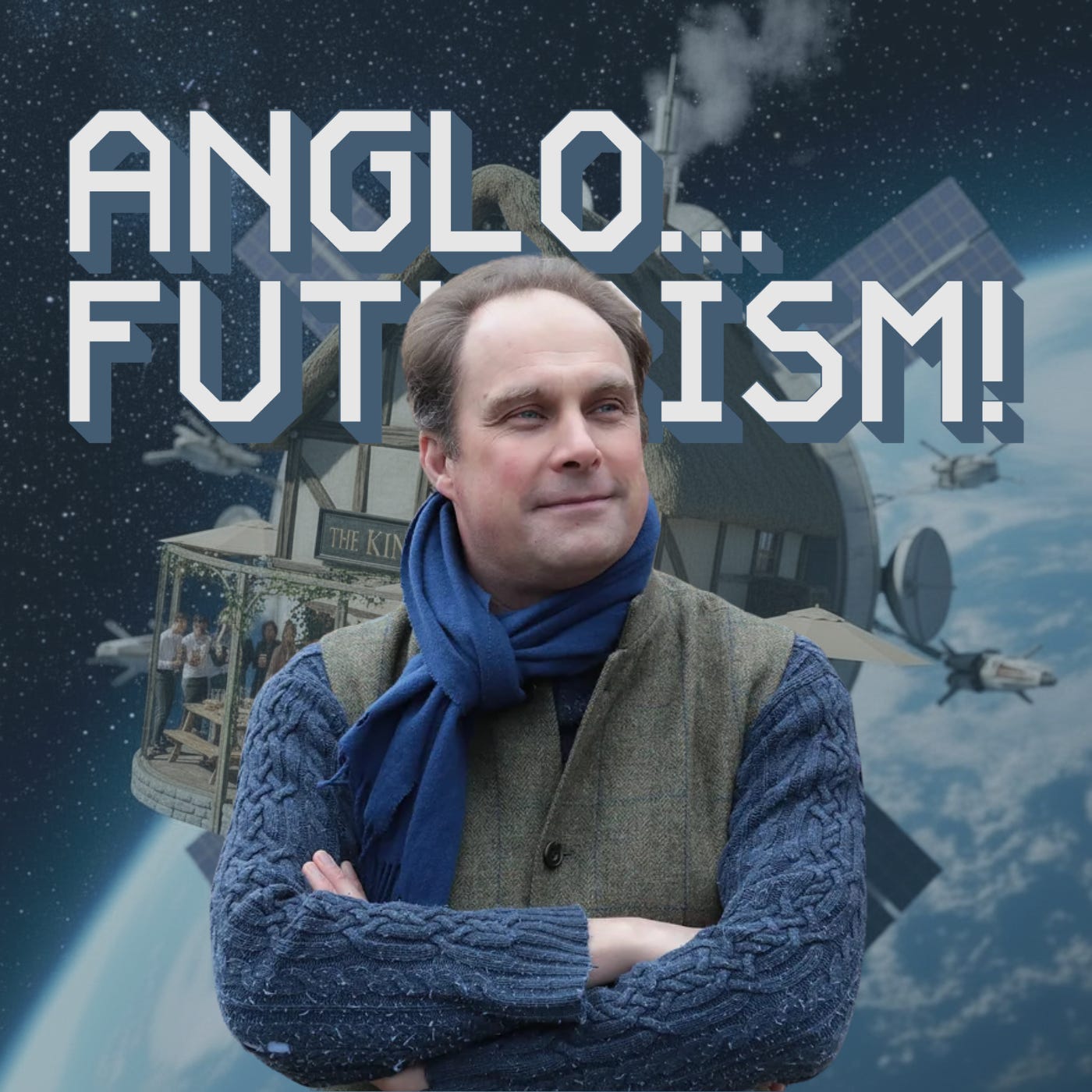
056. Nicholas Boys Smith: How to build a city on the moon
May 2401:10:01Summary readyFrom the thatched-roofed orbital pub of the King Charles III Space Station — a structure Nicholas Boys Smith gamely declines to call a pastiche — Tom and Calum welcome the campaigner for architectural beauty, founder of Create Streets, and former co-chair, alongside Roger Scruton, of the government’s beauty commission. The opening question is whether you could ever build a city worth living in on the Moon, and his answer is more practical than you would expect: in large part, we already know how.Boys Smith’s case is that human settlements take remarkably similar shapes wherever you go — Stockholm, Marrakesh, Malta, a town in the north of Norway — and only the proportions change. Hot climates produce narrow streets and high walls to dodge a murderous sun, a logic later codified in the Quran; cold ones spread their streets out to chase the light. Once you have breathable air on the Moon, he argues, you would end up with something startlingly close to how we already live, only built from moon rock, rendered and quite possibly painted in pastel pinks and yellows, like a Cornish village in orbit. The same goes for the British Antarctic Territory, which Tom is delighted to point out is mostly exposed rock rather than ice.On the Moon as in a Cornish village, his instinct is to build from what is to hand. Granite, he notes, was the original sustainable material — cheap, durable and loved — until canals and railways made it viable to drag stone and brick across the country, the same shift that once made coal in London cost several times what it did in Newcastle. And building well is not a luxury. Across visual preference surveys in Britain, America, Holland and Norway, large majorities, often 70 to 90 percent, prefer the same things — texture, gentle symmetry, a coherent complexity that rewards a second look — and people who live somewhere they find attractive turn out to be measurably healthier in body and mind, across party, region and race. The striking exception is architects: Boys Smith revives a near-forgotten study by David Halpern showing that while everyone agrees on which faces are beautiful, architecture students’ favourite building tends to be precisely everyone else’s least favourite, and the longer the training, the wider the gulf.How did a civilisation that once built like this forget how? He points to the mid-century caesura, when architecture schools across the West binned several hundred years of accumulated craft, in some cases literally throwing the plaster casts students used to draw from into the skip. But recovering that inheritance is not pastiche: you can always tell a Victorian Gothic church from Salisbury Cathedral, and Selfridges is a steel-framed modern building wearing classical dress. The Victorians, he suggests, were the original Anglofuturists — Joseph Paxton, a self-trained gardener, throwing up Crystal Palace; military engineers raising the Royal Albert Hall on a steel dome they were genuinely afraid would collapse. All of which makes the proposed £39 billion restoration of the Palace of Westminster, not a typo, the more dispiriting, complete with a scheme to scoop out the interior and refit it in what he calls Ikea-pastiche modernism. His counter-proposal, aired in The Critic, is to demolish the Queen Elizabeth II Centre, raise a fifteen-storey Gothic tower in its place, and let the luxury flats inside pay for Parliament’s visitor centre.The back half ranges gloriously: a Star Wars taxonomy worked out with his son over the summer holidays, in which the Death Star is the apotheosis of functionalist modernism and Naboo is conspicuously on the side of good; a brisk dismissal of the charge that a fondness for columns makes you a neo-Nazi, on the grounds that he doesn’t believe in dressing up and invading other countries; and a genuinely moving account of co-chairing the beauty commission with a dying Roger Scruton — funny, kind, disarming, and armed with a lethal bureaucratic trick of asking anyone with an unhelpful idea to go away and write a two-page memo on it.The episode explores:* Why human settlements take the same shapes from Stockholm to Marrakesh, and what that means for building on the Moon* Lunar Cornwall: pastel-rendered moon rock and the case for local stone everywhere* Beauty as a public health measure rather than a luxury, and why the data holds across party, region and race* The Halpern study, or why architecture students are the only people on Earth who prefer ugly buildings* The mid-century caesura, when architecture schools binned centuries of craft along with the actual plaster casts* Why copying the past doesn’t make a pastiche, with Selfridges as a steel-framed building in classical dress* The Victorians as the original Anglofuturists, from Paxton’s Crystal Palace to the Albert Hall dome nobody was sure would stay up* Build a Gothic tower, don’t spend £39 billion turning Parliament into a 21st-century building* Whether rebuilding the burned-down Clandon Park is genuinely “dishonest,” as the National Trust insists* Why “neo-Nazi” gets hurled at anyone who likes a column, and why stripped classicism was mostly an American state project* The Star Wars theory of architecture: the Death Star is pure modernism, and Naboo is on the side of good* Roger Scruton’s trick for killing an unhelpful meeting This is a public episode. If you'd like to discuss this with other subscribers or get access to bonus episodes, visit anglofuturism.substack.com/subscribe
Summary
055. Hyperculture, hypermnesia, and the Clarion-Clipperton Zone
May 401:14:52Summary readyThe US has broken with decades of international consensus by issuing its own mining permits for the Clarion-Clipperton Zone, a potato field of metallic nodules the size of Western Europe at the bottom of the Pacific. Tom, who has found his next Antarctica-level obsession, reveals that Britain has quietly sponsored two exploration licenses. The age of saying “that’s mine” appears to be back.Calum reports from Singapore. The city-state is remarkable — a nation summoned into being in 60 years through ethnic quotas, mandatory housing integration, and the relentless repetition of founding mantras. But it is now haunted by the ghost of Lee Kuan Yew, whose historically contingent decisions are being ossified into dogma. The TFR has fallen to 0.87. Entrepreneurialism is lacking. And the ethnic ratios that once stabilised the state are now preventing the emergence of a true Singaporean people.The lesson Calum draws is not about policy but about method: if Britain wants cultural renewal, it needs hyperculture — the willing use of state formation tools to remake national identity. Charles Wesley did this for Anglicanism among the newly urbanised working class. Singapore did it with light shows and peanut shells on the floor at the Raffles Hotel. The question is whether Britain is willing to do the same.The episode explores:* King Charles’s US visit and why the special relationship is a wasting asset* The Koh-i-Noor diamond and the rise of third worldism in American politics* Deep sea mining in the Clarion-Clipperton Zone and Britain’s quiet play for it* The return of the frontier: space, Antarctica, the ocean floor* Calum’s Singapore dispatch: what LKY built and what is now ossifying* Why Singapore’s TFR of 0.87 is a failure of Lee Kuan Yew’s own eugenics programme* The most photographed barn in America as a model for state formation* Charles Wesley as the Pink Pantheress of his time* Hyperculture: the case for a full spectrum British cultural renewal* Bismarck, repeatedly and without apology This is a public episode. If you'd like to discuss this with other subscribers or get access to bonus episodes, visit anglofuturism.substack.com/subscribe
Summary