Podcast
Anglofuturism
Hosted by Tom Ough and Calum Drysdale · EN
29episodes
Episodes
Newest firstAll episodes
054. Louis Elton: Anglofuturist aesthetics beyond podcræft
May 100:52:13Summary readyPart two begins, as promised, with Louis pulling down his trousers. The underpants in question — a toile de joie printed with pastoral scenes labelled Seductio, Commiditas, Protectio — turn out to be the origin story of the entire British Cræft Prize. What started as a quest to produce bespoke boxer shorts from Northern Irish linen eventually mutated into a £60,000 national prize for maverick craftsmen.The conversation then turns to whether cræft can serve as a binding agent for a country that no longer shares an informational commons. Louis presents his framework of 16 Dreams of Britain — from Royal Britain and Workshop Britain through to Silly Britain (Mr Blobby, cheese rolling, Paddington Bear as psychopomp) and New Britain (Stormzy’s stab vest, Oswald Boateng’s BA uniforms). His claim is that excellence in making — the deep hand-eye-mind entanglement of cræft — cuts across all of them. Calum pushes back hard: these are competing aesthetic and moral universes, not fragments of a whole.Submit to the British Cræft Prize. £60,000. Deadline: 31 August 2026. [link]The episode explores:* The boxer shorts to national prize pipeline, via Saint Pantalone* Why Irish linen is grown in Flanders* The 16 Dreams of Britain and whether they can coexist* Calum’s objection: competing aesthetic universes cannot be synthesised by goodwill* Kenneth Frampton’s critical regionalism and Paul Ricœur’s defining question* Hiroki Azuma’s database animals and the collapse of the grand narrative* The Magdalen College library debate: homage or imposition?* Why the Anglofuturist typeface has borrowed from five traditions and still doesn’t have a full alphabet* The Peter Thiel two-by-two and why definite pessimism has no joy* Sprezzatura as the missing ingredient in British national renewal This is a public episode. If you'd like to discuss this with other subscribers or get access to bonus episodes, visit anglofuturism.substack.com/subscribe
Summary
053. Louis Elton: Cræft, the English antidote to slop
Apr 2801:01:53Summary readyFrom the King Charles III Space Station — whose thatch is in a worrying state of disrepair — Tom and Calum welcome Louis Elton, founder of the Cræft Prize, a new £60,000 national award for maverick craftsmen, makers and technologists who fuse heritage crafts with cutting-edge technology.Louis begins with the crisis: Britain’s heritage crafts are dying. The handmade cricket ball is officially extinct in the UK. Thatchers, stained glass makers and stonemasons are retiring without apprentices. The economic model is broken and the younger generation all went to university. But the answer isn’t pure revival. Louis traces the word cræft back to King Alfred’s translations of Boethius, where it meant something closer to virtue — a deep entanglement of hand, eye, mind, body and material intelligence, all forged into excellence.The conversation then turns to whether new technologies can produce genuinely new aesthetics rather than endless pastiche. Louis points to Carmelite monks in Montana building a monastery with CNC-milled stone, a Chinese studio using robotic bricklaying to create patterns no human could construct, and a children’s clothing brand applying origami principles to make garments that grow with the child. The enemy throughout is slop — content without form, without virtue, produced to satisfy a single metric. The default setting of modernity is the slop machine. Cræft is the antidote.The episode explores:* The Anglo-Saxon meaning of cræft and why it matters more than craft* Why the handmade cricket ball is dead and what that tells us about British manufacturing* AI slop versus cræft as opposing forces in modern culture* CNC monks, robotic bricklaying, and 3D-printed Cornish lobster pots* Whether Silicon Valley’s obsession with taste is just pattern recognition* The trad wife aesthetic as craft pornography* Iranian AI Lego propaganda as an unlikely signal of the future* What humans are actually for in a post-AGI world* The Cræft Prize: £60,000 for inventions that fuse heritage wisdom with frontier technologyKing Alfred's translation of Boethius' De consolatione philosophiaeGeeks, MOPs, and sociopaths in subculture evolutionNot Quite Past — AI Delftware in Stoke-on-TrentMonumental Labs / Gondor IndustriesAki Union — Shanghai parametric brick galleryAtelier Missor This is a public episode. If you'd like to discuss this with other subscribers or get access to bonus episodes, visit anglofuturism.substack.com/subscribe
Summary
052. Louise Perry: Artemis II and populating the solar system
Apr 901:29:47Summary readyFrom the King Charles III Space Station, Tom and Calum welcome Louise Perry — reactionary feminist, space romantic, and descendant of Second Fleet convicts — to discuss Artemis II, the furthest humans have ever travelled from Earth.Louise makes the case that enthusiasm for space exploration is an overwhelmingly Anglo phenomenon, something between an anthropological pathology and a civilisational birthright. But the last great age of exploration coincided with an incredible cheapness of life, a tolerance for suffering and death that modern societies have entirely lost. Can you be expansionist with a 0.7 birth rate and no appetite for risk?This leads into Louise’s theory of the century: that birth rate collapse is not a policy failure but an evolutionary bottleneck. The people who make it through — more religious, more conservative, more willing to bear the costs — will inherit the Earth. Democracy probably can’t survive the gerontocracy that’s coming. The state pension certainly won’t. Your best hedge, she argues, is several children.The episode explores:* Why space exploration is an Anglo pathology — and why that’s glorious* The Moral Maze’s case against Artemis II, including the claim that astronauts are defiling Navajo ancestors on the moon* Whether modernity has made us too comfortable to be expansionist* Louise’s infant mortality theory of everything: low death rates cause low birth rates* The evolutionary bottleneck and why wokeness is demographically doomed* The techno-theocracy: orienting innovation towards the Christian good* Why your pension won’t exist and children are a better investment* The overview effect as a threat to chauvinistic adventure* Mars as tax haven, Noah’s Ark selection criteria, and the Bishop of MarsThank you for supporting Anglofuturism. This is a public episode. If you'd like to discuss this with other subscribers or get access to bonus episodes, visit anglofuturism.substack.com/subscribe
Summary
051. Josh Lavorini: The new aristocrats building drones in an Oxford kitchen
Apr 200:50:44Tap to summarizeBack from the break and fuelled by Diet Coke, Tom and Calum push Josh on the harder questions. If HomeDAO is selecting for a new elite — relentless, agentic, indifferent to the rules of polite society — what kind of elite is it? The aristocrat as leader, or the aristocrat as exploiter?Josh mounts a defence of Pump.fun against charges of exploitation, arguing that the real narrative distortion comes from Silicon Valley incumbents who control both capital and media. Google is an advertising company. Revolut’s revenue is almost entirely from crypto trading. The difference is that Pump.fun never needed to take venture capital from the people who set the terms of respectability.The conversation then turns to what good companies actually do. Josh’s framework: they automate layers of the civilisational stack, freeing people to focus on higher-leverage work — the same logic that runs from the Black Death through the Industrial Revolution to self-driving cars. Britain’s declining birth rate, he argues, could be a blessing in disguise if it forces investment in automation rather than cheap labour. But the automated cavalry isn’t coming on its own. Someone has to build it.The episode closes on aesthetics: why Anglofuturism’s AI-generated thatched cottages on the moon are a cry for something better, why the answer might be neo-neo-Gothic, and how Tom once stole a brick from Keble College.In this episode* The aristocrat as leader versus the aristocrat as exploiter — and where startup founders fit* Why Pump.fun is more honest than most of Silicon Valley* Josh’s framework for social value: automate the civilisational stack* The Black Death as the bullish case for declining birth rates* Grammar schools, nuclear energy, and the policies that might actually matter* Why Anglofuturism needs a coherent aesthetic — and what neo-neo-Gothic triple-glazed stained glass might look likeThis conversation took place in November 2025 and was delayed in publication due to triggering an Environmental Impact Assessment from Oxfordshire County Council. This is a public episode. If you'd like to discuss this with other subscribers or get access to bonus episodes, visit anglofuturism.substack.com/subscribe
Transcribe →
050. Britain's growth obsession is delusional
Apr 100:02:09Tap to summarizeFrom a hand-dug allotment in Stroud, Tom and Calum announce a fundamental change of direction for the podcast. After eighteen months of speaking to founders, technologists, and policy thinkers, they have come to an uncomfortable conclusion: it was all wrong. Growth is a trap. GDP is a fiction. The SMR under the village green was never going to save us. What Britain needs is less.The conversion happened gradually, then all at once. Calum attended a silent retreat in Totnes where a man named Giles explained that fusion energy would simply allow humans to destroy the biosphere more efficiently. Tom read a pamphlet about doughnut economics on the FlixBus from London to Oxford and wept. They have since decommissioned the King Charles III Space Station and replaced it with a community pottery studio.The episode explores:* Why GDP is a meaningless number and Britain should stop chasing it: Every guest on this podcast has said something like “Britain needs to grow.” But what is growth? More cars? More data centres? More Georgian townhouses? Tom and Calum now believe that true prosperity is measured in leisure time, hedgerow density, and the number of independently owned bookshops per capita. “We looked at the data and realised we’d been measuring the wrong things. The happiest people we’ve ever met were on Pitcairn Island.”* The case for shutting down Britain’s tech sector and replacing it with cooperatively owned farms: Technology has given humanity targeted advertising, algorithmic anxiety, and a website where you can bet on meme coins named after dogs. Britain’s attempt to replicate this is not a national strategy — it is a cry for help. What if, instead of incubators, we had more allotments? What if, instead of AI, we had more canal boats? Calum explains why the Coase theorem actually supports a return to subsistence agriculture if you think about it hard enough.* Deindustrialisation was actually good and we should finish the job: The listeners of this podcast have spent two years complaining about deindustrialisation. Tom and Calum now believe it didn’t go far enough. Why does Britain still manufacture anything at all? Every factory is a moral injury to the landscape. The Lake District doesn’t need a semiconductor fab. It needs to be left alone.* Immigration, but for trees: Britain’s real population crisis is botanical. There are fewer mature oaks in England than at any point since the Domesday Book. Tom proposes a radical visa programme for ancient woodland — expedited planning approval, no environmental impact assessment, immediate indefinite leave to remain. “If we treated trees the way we treat care workers, the New Forest would have a unicorn by now. But it wouldn’t need one, because it’s a forest.”* Why this podcast will now be released quarterly, on handmade paper, delivered by bicycle courier: The subscription model is itself a form of growth ideology. Anglofuturism will henceforth be an Anglopastoralism zine, printed on recycled copies of The Economist, available at selected zero-waste shops in Frome and Hebden Bridge. Calum will illustrate each edition with potato prints.Plus: why notice periods are actually too short, why the overseas territories should be returned to the seabirds, the case for replacing the House of Lords with a citizens’ assembly selected exclusively from people who have never read a Substack, and whether Georgian townhouses on the moon were, in retrospect, a warning sign.Tom and Calum recorded this episode by speaking into a hollowed-out gourd connected to a length of twine. The audio quality reflects this. They will not be taking questions. Aeron has been fired. This episode was recorded on 1 April. Normal service will resume once we get the biodiesel engines back up and running. This is a public episode. If you'd like to discuss this with other subscribers or get access to bonus episodes, visit anglofuturism.substack.com/subscribe
Transcribe →
039. Andrew Kramer & Rebecca Wray: A very Anglofuturist Christmas
Dec 24Tap to summarizeTom and Calum recorded this Christmas special aboard Theatre Ship on the Thames with two guests whose bosses have already graced the podcast: Andrew Kramer from Isembard (the manufacturer re-industrializing the West) and Rebecca Wray from Looking for Growth (the grassroots movement fighting Britain’s decline). What follows is a chaotic celebration of British manufacturing, temperate rainforests, and the extended Anglofuturism universe—complete with a disastrous “Just a Minute” game about life in Britain 50 years from now.We learn that Isembard is scaling from one machine and one camp bed to 25 factories by end of 2026. That Germany lacks Britain’s incredible F1 supply chain (material stockholders can deliver exotic metals in hours, not weeks). That Rebecca waded through a mysterious Oxford rubbish pile in white trainers for content. And that the entire progress community is coalescing into something that might actually save Britain—if they can avoid getting arrested or bogged down in debates about rewilding the Peak District with stunted oaks.Tom and Calum discuss with Andrew and Rebecca:* The Isembard explosion: From one Park Royal site with one CNC machine to four factories (soon to be 25 by end of 2026), expanding into the US and potentially continental Europe. They’re moving beyond precision machining into assembly, sheet metal, and other manufacturing methods,* Why Britain’s F1 supply chain is a secret superpower: German customers ask Isembard how many weeks they factor in for raw materials. The answer? Hours. The F1 industry created a hub where money is no object and parts need to be ready overnight—which means Britain has material stockholding for exotic metals that Germany simply doesn’t have,* The Oxford rubbish pile mystery: Someone got arrested. Rebecca went to investigate in white trainers. It was wet, soggy, disgusting, possibly council waste (needs more investigation). The important thing is LFG got there fast and got footage,* “Designed by Apple in California, Made in China” was always a fallacy: Andrew argues you cannot separate design and manufacturing—the embedded tacit knowledge in the manufacturing process is integral to innovation. This is why we’re going to make iPhones in Britain,* The average machine shop owner is nearing retirement: Decades of underinvestment and outsourcing to China hollowed out British manufacturing. But there’s cause for optimism—young apprentices are now running successful factories. Isembard’s Exeter GM started his apprenticeship just five years ago,* Defence as the wedge: Re-industrialization is easier in defence because there’s an obvious need for sovereign production. But it’s not where you finish—Isambard is already doing consumer parts. The goal is total re-industrialization across all sectors,* Culture is downstream of decline (and upstream of revival): Rebecca argues Britain is stuck in a “doom loop” and needs a cultural reset about what we want the future to look like. Andrew says reindustrialisation is downstream of telling positive stories about British manufacturing—F1, electronics, the incredible companies already doing extraordinary things,* Rebecca wants to rewild England: Specifically with temperate rainforests. She’s from the Peak District and is a moss and fern aficionado (”ferns are really prehistoric plants”). Calum: “Sorry to realise you’re a Natural England plant.” The ingredients for rebuilding Britain: moss and metal,* The Jacquard loom question: Calum was talking with friends about building a Jacquard loom (early programmable looms with punch cards that inspired Babbage and Lovelace). He got shouted down—”No, we should build drones instead.” Russians coming over the horizon > nice fabric,* LFG’s origin story: Rebecca met Lawrence two years ago during the Bully campaign and thought “this is what’s been missing—very focused campaigns that highlight why things are so f*****g wrong.” She went to the first LFG meetup, got asked to do a podcast, said no initially, then said yes,* The extended Anglofuturism universe is real: Everyone at LFG events knows each other. There’s a genuine community forming between LFG, Anglofuturism, and others. It’s becoming a coordinated movement rather than isolated initiatives. “I think we’ve got a good chance to save Britain.”,* Isembard needs your entrepreneurial engineering friends: They’re hiring and recruiting heavily. Send your drawings and step files. They can do thermoplastics, exotic materials, titanium radar-absorbent Antarctica models if needed,* The disastrous “Just a Minute” game: Andrew manages 20 seconds describing flying taxis and lab-grown Full English breakfasts in his Georgian townhouse on the moon. Rebecca gets to “I see the bright lights of Chesterfield” before repeating “Leeds” twice. Tom delivers a masterclass: thatched orbital space stations, English wool pyjamas, bangers and mash in microgravity, billowing smoke from Northern chimney stacks, and the Shackleton Colossus in British Antarctic Territory.Plus: Why Aeron should bring a soundboard to live recordings, why the podcast is “quite camp actually,” the mystery guest who messaged at 4:37am to say he wasn’t in a suitable condition, and Calum’s Druidic ritual of reawakening these Britannic majestic isles (before immediately eliminating himself for repetition).Part 2 coming soon. Let’s f*****g go. This is a public episode. If you'd like to discuss this with other subscribers or get access to bonus episodes, visit anglofuturism.substack.com/subscribe
Transcribe →
036. John Fingleton's nuclear revolution, sacred cows, and why Shabana Mahmood is all talk
Dec 5Tap to summarizeTom and Calum dissect John Fingleton’s damning nuclear regulatory review, play Sacred Cow with the greenbelt and Zone 1 council housing, and explain why Shabana Mahmood’s “tough on immigration” reforms are actually quite soft. Plus: nuclear policy specialist Robert Boswall drops by fresh from the pub to explain why the ONR reports to the Department for Work and Pensions, and why Birmingham City FC’s new chimney-adorned stadium might be the most important piece of architecture in Britain.Tom and Calum discuss:* The Fingleton nuclear report: Santa came down the chimney with a huge sack of regulation-cutting proposals—£700 million fish discos, eight different regulators for defence projects, and the revelation that civil servants defer to regulators who defer back to civil servants in an endless loop of inaction,* Robert Boswall’s pub celebration: Fresh from carousing over the nuclear report, nuclear policy specialist Robert Boswall explains why tolerability of risk matters, why the ONR bizarrely reports to the Department for Work and Pensions, and why his favourite regulation to abolish is “regulatory justification”—a random EU inheritance that costs millions and achieves nothing,* Sacred Cow carnage: Calum slaughters the greenbelt (”most of it is disused petrol stations”), executes Zone 1 council housing without hesitation, but spares Christmas and national parks. Tom meanwhile shows his kindness towards farm animals,* Shabana Mahmood’s immigration mirage: Blue Labour are delighted by her “tough” reforms—20-year wait for asylum seekers!—but there are carve-outs everywhere (jewellery confiscation exempt if “sentimental”), new safe and legal routes opened up, and asylum seekers can choose the 10-year track instead. Chris Bayliss in The Critic calls it out as vibes over substance,* Elite defectors and vibe shifts: Tom argues that Westminster consensus on immigration is cracking and elite opinion is shifting against mass migration. Calum counters that this means nothing if Reform sweeps in on northern Red Wall seats while London dinner parties stay the same,* Birmingham City FC’s chimney stadium: Thomas Heatherwick’s design with 12 enormous brick chimneys evoking Birmingham’s industrial past. Tom loves it as history finding echo in architecture. Calum worries it’s pastiche—until Tom destroys him with facts and logic about Houses of Parliament crenellations.Thank you for being a supporter of Anglofuturism. This is a public episode. If you'd like to discuss this with other subscribers or get access to bonus episodes, visit anglofuturism.substack.com/subscribe
Transcribe →
031. Sam Adlen: The British company putting solar panels in space
Nov 4Tap to summarizeDon’t forget to sign up for November’s Anglofuturism meet-up in London. Check the blog for more information.Tom and Calum visit Space Solar at Harwell to meet co-founder and co-CEO Sam Adlen, who’s attempting to solve Britain’s energy crisis by putting massive solar arrays in geostationary orbit and beaming the power down as microwaves. No new physics required—just the unglamorous work of becoming the Toyota of space infrastructure.In the episode:* Why space-based solar delivers 13 times more energy than ground panels and provides baseload power 24/7, making it economically competitive with terrestrial solar even at today’s launch costs,* The technical solution: kilometere-scale satellites made of hundreds of thousands of coffee table-sized modules that beam power down using phase conjugation, with no moving parts and power density a quarter of midday sun (safe enough that birds won’t cook),* How Space Solar’s system works like a “giant interconnector in space”—instantly switching beams between countries to balance grids, support renewables when wind dies, and redirect power where it’s needed, potentially saving over a billion pounds annually in UK energy system costs,* Why they’re not trying to invent new physics but rather optimise industrial process—the challenge is manufacturing a million modules, perfecting logistics, and automating assembly in space using robotics that construct truss structures in orbit,* Britain’s fatal flaw: brilliant at innovation, terrible at scaling, with orders of magnitude less investment going into space than AI or fusion despite space being “bigger than AI” and strategically critical as the new waterways for global power,* The regulatory reality: UK space regulators have been “superb” and energised, even on grid connections that normally take 15 years—the real bottleneck is financing early-stage infrastructure rather than venture capital’s preference for low-capex software,* Sam’s vision for 2075: Britain as a leader in space infrastructure, power no longer a constraint, and a generation with genuine abundance ahead—but only if we move now, because “there’s no second mover role” when barriers to entry spike after first movers climb the cost curve,* Why Starship’s success is the step change moment for space: 24 launches in 24 hours transforms everything from orbital data centers to asteroid mining, and Britain needs to commit two orders of magnitude more investment immediately or watch others colonise the economic high ground. This is a public episode. If you'd like to discuss this with other subscribers or get access to bonus episodes, visit anglofuturism.substack.com/subscribe
Transcribe →
030. Pingu nationalism, Hope not Hate, and British space lasers
Oct 15Tap to summarizeAfter being featured in a Hope Not Hate report linking Robert Jenrick to Anglofuturism, Tom and Calum reflect on their newfound infamy while developing their theory that Pingu represents English settler colonialism, discussing plans to rebuild Britain’s castles, and making the case for British domination of space.Tom and Calum on:* Their appearance in a Hope Not Hate exposé as “the most intellectual vision” of Anglofuturism, despite the organisation’s history of libel cases and treating any immigration scepticism as fascism,* The Straussian reading of Pingu: why the show is clearly about English settlement of Antarctica, with Pingu as a third-generation settler family complete with nuclear family structure and grandparents—”indomitable, curious, restless, resourceful,”* The Pendragon Foundation’s plan to rebuild Britain’s crumbling castles as living cultural centres rather than preserved ruins, learning from French château restoration and Japanese craft traditions that maintain skills through continuous building,* Why buildings must evolve rather than be frozen in amber—the challenge isn’t preservation but having the confidence that new additions enhance rather than damage, avoiding both museum-ification and CBeebies-style vandalism,* Boris Johnson’s continued defence of mass immigration despite acknowledging integration has failed, and why his generation of Tories remains traumatised by the “nasty party” narrative and temperamentally incapable of restriction,* How cultural narratives around immigration and integration have shifted over generations, and why the smartphone age presents challenges for assimilation,* Why no financial incentive can solve Britain’s birth rate crisis when market logic has made children economically irrational, and the grim possibility that medical technology is amplifying fertility problems,* Britain’s new orbital defence sensors against Russian laser attacks, and why now is the moment for some bloody-minded figure to champion British domination of space warfare before the opportunity passes—defending satellites today, commanding the high ground tomorrow.With additional audio from Calum’s appearance on Hugo Rifkind’s Times Radio show and an excellent YouTube clip. This is a public episode. If you'd like to discuss this with other subscribers or get access to bonus episodes, visit anglofuturism.substack.com/subscribe
Transcribe →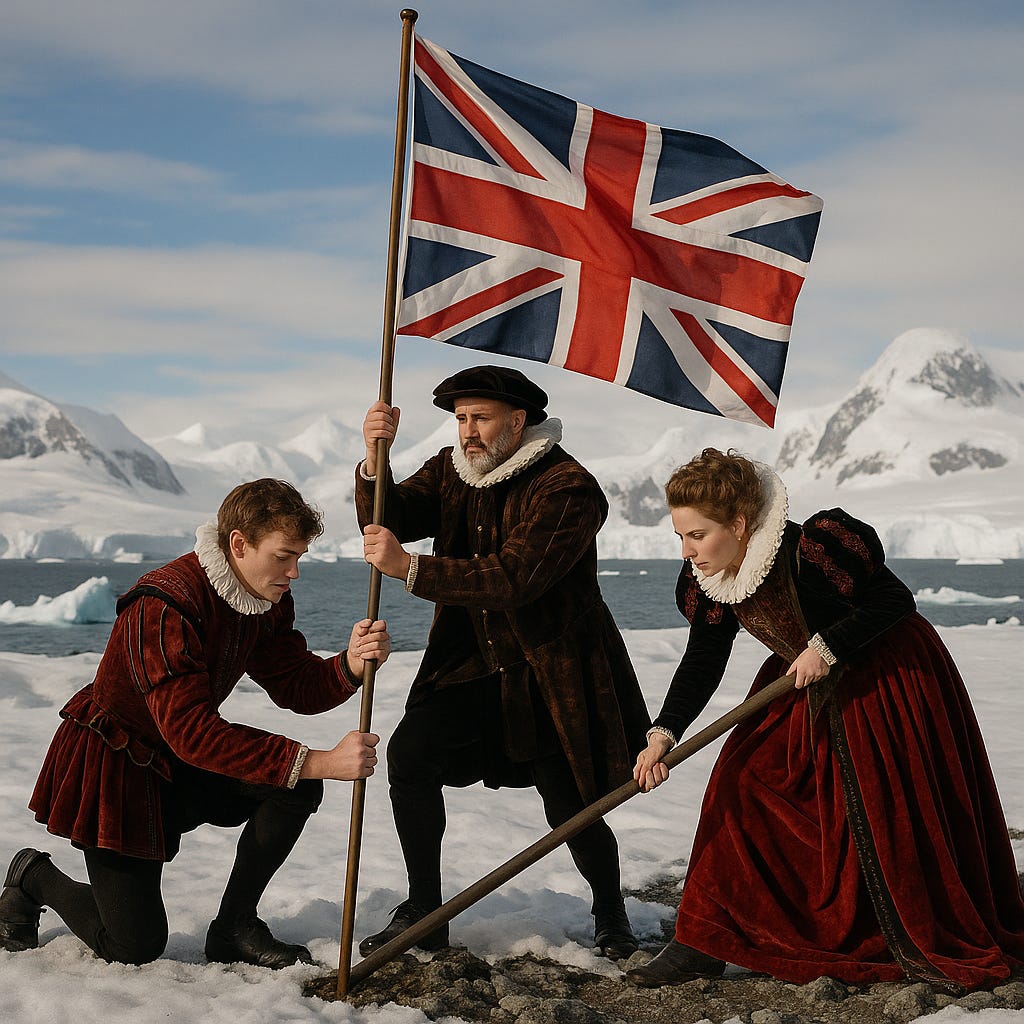
025. Now & England, The Anti-Catastrophe League, and neo-Elizabethan allegations
Aug 14Tap to summarizeTom and Calum reflect on 25 episodes of the podcast that allegedly influenced Robert Jenrick to declare himself an Anglofuturist, while grappling with accusations of dangerous nostalgia from Southampton academics.Tom and Calum on:* How Robert Jenrick's declaration that he's “what you would call an Anglo-futurist” at a Westminster nationalism conference proves their growing influence* Defending themselves against Francesca Melhuish's academic paper attacking the “nostalgic politics of Anglofuturism”* Why talk of British civil war misses the point - the real question is whether there's a genuine constituency for radical change beyond angry WhatsApp groups and hotel protests,* Tom's new book, and his journey from effective altruist malaria-net maximizer to someone worried about civilizational collapse,* The thrilling prospect of geoengineering our way out of climate change through stratospheric aerosol injection and iron ocean fertilizationThe Anti-Catastrophe League: The pioneers and visionaries on a quest to save the worldA new Elizabethan age: The Advanced Research and Invention Agency (ARIA) and the nostalgic politics of Anglofuturism This is a public episode. If you'd like to discuss this with other subscribers or get access to bonus episodes, visit anglofuturism.substack.com/subscribe
Transcribe →