← Becoming UnDone® with Dr. Toby Brooks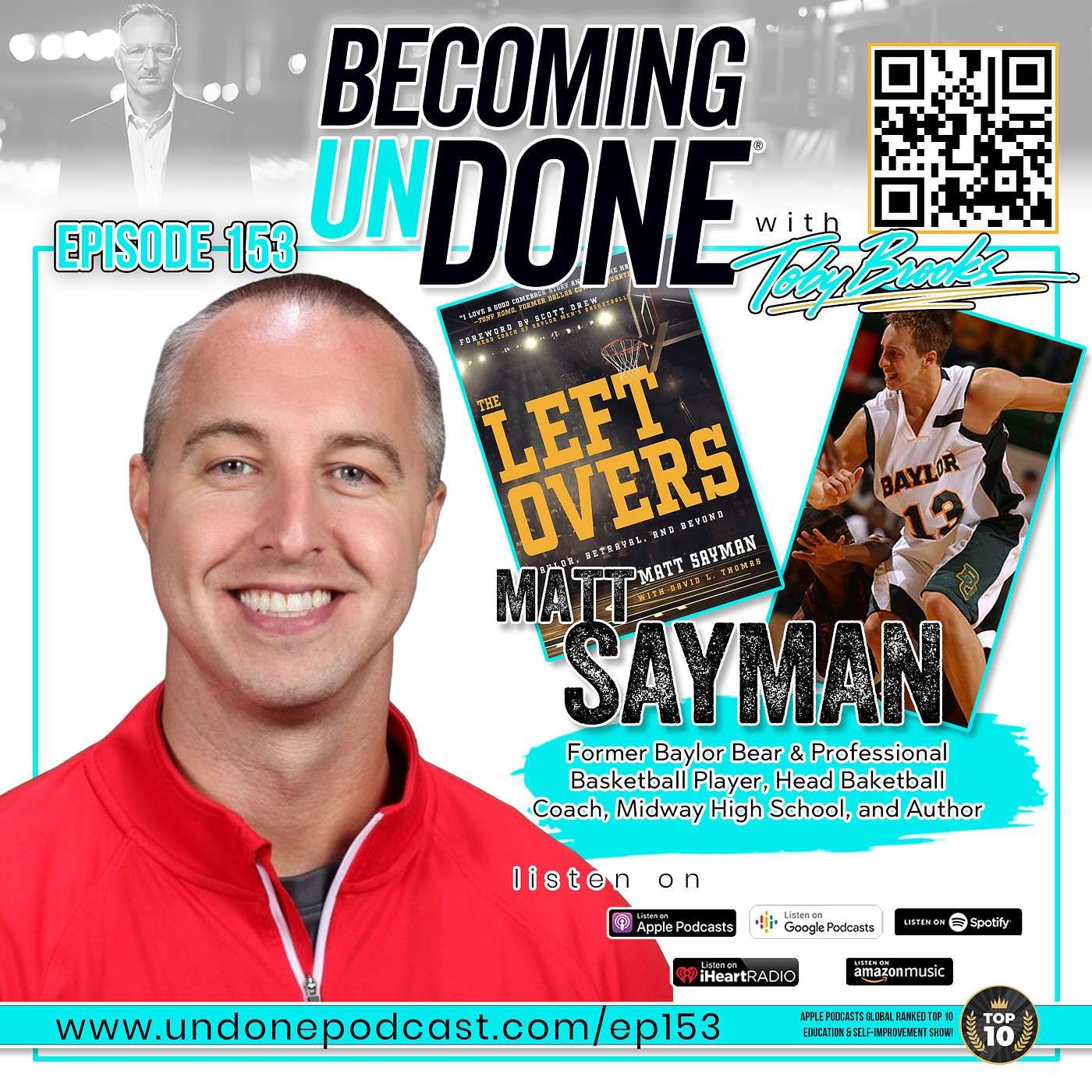
Becoming UnDone® with Dr. Toby Brooks
153 | Matt Sayman's Journey from Baylor Basketball Scandal to Redemption
01:28:43
About the Guest Matt Sayman is the head boys basketball coach at Midway High School in Waco, Texas, and a former professional basketball player in Iceland. Previously, he played collegiate basketball at Baylor University during one of its most tumultuous periods, amidst a major scandal. He is the author of "The Leftovers: Baylor, Betrayal, and Beyond," which chronicles his experiences during this challenging period. Additionally, Sayman was a Division 1 athlete who played a significant role i...
Loading summary
Transcript116 lines
- [00:00]
Unknown Intro Speaker
Foreign.
- [00:04]
Matt Saman
This is becoming undone. I. I just really wanted, I think, to go somewhere that I was wanted. And he told me that I was going to be one of the pillars of the Baylor basketball program. I mean, what kid doesn't want to hear that from a coach? And so on the way home from that visit, I, I told my mom that that's. I want to go there. I mean, tears just welling up in her eyes because she, she wanted that too. And it was a Friday afternoon. I had just come in from playing sand volleyball out of Sterling. And so every day was pretty much in the summer. A little bit of class, weights and some basketball and then sand volleyball. And it's just such a sweet time, living the dream. That's what I felt like I was doing. And one of my professors called and said, man, what's going on with your team? And I was like, oh, I don't know. I played with a lot of knuckleheads, I think is a nice way to put it over the years. And he said, no, you need to turn on the tv. They're talking about that there are Baylor basketball players missing and a possible homicide and that Baylor basketball players might be involved. Like, I get why Baylor and our media guys wanted me to do it because I was the only one that was a four year guy and I think the only one that they trusted would say the right things because they needed somebody at that moment to be pro. Baylor, pro, the basketball program. Excited about the future. But inside, I was the exact opposite. Wanted to get out of there. Matt Saman here, and I am undone.
- [01:54]
Toby Brooks
Hey, friend. I'm glad you're here. Welcome to yet another episode of Becoming Undone, the podcast for those who dare bravely risk mightily and grow relentless.
- [02:02]
Hello, everybody.
- [02:02]
I'm Toby Brooks, a speaker, author, professor, and performance scientist. I spent much of the last two decades working as an athletic trainer and a strength coach in the professional, collegiate and high school sports settings. Over the years, I've grown more and more fascinated with what sets high achievers apart and how failures that can suck in the moment can end up being exactly the push we needed to propel us along our path to success. Each week on Becoming Undone, I invite new guests to examine how high achievers
- [02:28]
can transform from falling apart to falling into place.
- [02:31]
This episode is Baylor focused, but I'd like to emphasize that this show is entirely separate from my role at Baylor University. But it's my attempt to apply what
- [02:38]
I've learned and what I'm learning and
- [02:40]
share with others about the mindsets of high achievers. You know, it is March Madness time, and sadly, the Baylor Bears didn't even make the tournament this year. Although as of this moment right now, my Arizona Wildcats are still looking pretty strong. Their last Final Four was in 2001, and they won it all in 97. The year before I got there for grad school and for work as an athletic trainer For Baylor, 2021 was the culmination of an incredible comeback story that you'll hear a bit more about in a minute. But it all got me thinking. You know, we love stories about championships. We love the confetti, the nets getting cut down, the moments where everything comes together and makes sense. But what we don't see, what we rarely talk about, is what comes before all of that. The part where it doesn't look like it's working, the part where it feels like it doesn't matter at all. The part where you're not even sure anyone's ever going to remember anything you did at all. Because long before Baylor basketball became a national champion, it was something else entirely. It was broken. And for a small group of players who lived through that season in 2003, 2004, there was no guarantee of what came next. No roadmap, no momentum for a while, not even a coach. Just a decision. Show up anyway or walk away. Today's guest knows a thing or two about all that. Today, Matt Tayman is the head boys basketball coach at Midway High in Waco. But in 2003, he was just minding his own business, enjoying a summer of living the good life, playing some basketball and lifting weights and playing beach volleyball, prepping for a senior year at Baylor, where he and his teammates were heading into a season with high hopes. They had aspirations of a Big 12 title and a March Madness run of their own. And then the unthinkable happened. What's fascinating to me about this conversation with Matt was is this. At the time, as he was going through that senior year, he thought that season didn't matter. He thought it was just a dark chapter that people would forget. But years later, watching Baylor win a national championship, he started to realize something different. That's what they did. The showing up, the staying, the competing, when everything around them was falling apart. That was the foundation for that championship. Not the highlight, the foundation. And that's the tension we're going to explore in this episode. Because most of us don't get to choose whether we go through hard seasons, but we do get to choose who we become within them. And sometimes the seasons that feel the most insignificant. Those are the ones that matter the most. I hope you'll enjoy my conversation with Matt saman in episode 153. Let's get into it. Greetings, and welcome back. Becoming Another is a podcast for those who dare bravely risk mightily and grow relentlessly. Join me at Toby Brooks as I invite a new guest each week as we examine how high achievers can transform
- [05:48]
from falling apart to falling into place.
- [05:51]
This week, I'm stoked.
- [05:52]
I've finally got a Baylor guest on here, Matt Saman joining me. He's the head basketball coach at Midway High School, and he's got a heck of a story. Also an author and a successful collegiate basketball player. So, Matt, thanks so much for joining me.
- [06:07]
Matt Saman
Yeah, thank you so much for having me.
- [06:09]
Toby Brooks
Yeah, my boss, West Knoll, kind of put me on the trail. I wasn't aware of your book, and. And my wife and I were having this conversation last week, and we said. Remember when I said, under no circumstances would I go to Baylor? First there was the Patrick Denny's situation, then there was the Art Briles situation. And, you know, the Lord certainly likes to. To challenge me on the things I say I won't do, so here we are. But you were there for Scott Drew's first season and also all the things that transpired before that. So we'll get into that in just a minute. But I know you were a successful high school and college basketball player, still holding some Baylor records, if I'm not mistaken. And so I always like to start at the beginning, what you want to be growing up and why.
- [06:58]
Matt Saman
Yeah, I love that. When I was nine years old, I had a skills coach up in Pennsylvania, where I was from. And one day he sat me down and he said, matt, I want. What are your goals? And I. I had no clue what he was talking about as far as goal setting. And so I said, all. All of the things that. That kids say and. And no order to them, no plan for executing them at all. And he said, no, let's look at this in. In a couple years when you get to high school. What would you like to see? Where would you like to be with basketball? And I said, okay, I like to make my freshman A team. And so I wrote that down. I'm 9 or 10 years old. And they said, okay, what's the next step? After that I said, well, I think I'd like to make varsity as a sophomore. And so I wrote that down. And then the last one was to play Division 1 basketball and wrote that Down. And he just helped me kind of a step by step approach to goal setting that I thought was really unique because over the years I've talked to plenty of kids that say, I want to play in the NBA. Okay, great goal. How do you get there? I don't know. I have no idea. And so there's this. That approach really helped me as I really got. I played a lot of sports growing up, but really loved basketball. That was kind of the thing that I always was doing. That was my main sport, but fell in love with skill work. Pistol Pete Maravich videotapes that his homework. Basketball really got me loving the part of the game that is sometimes boring for players, which is you and a ball alone just doing drills. But just created this workout over the years called Jimote that stands for just a matter of doing it. And it just grew and grew. And then he's kind of fast forward a few years. I'm living in Pennsylvania, but I come down right before my freshman year in high school to go to a basketball camp in Texas. And I met a guy named Tommy Thomas who is the head coach at the Colony High School. I was about 5, 6, 5, 7, very average in everything, but pretty skilled and very serious about the game. Told him my three goals, and he said, matt, that can happen for you down here in Texas. And so I flew back up to Pennsylvania, where all of our family is from. Told my parents on the way home from the airport that I need to move to Texas so I can be a college basketball player. And asked my little sister, they asked my little sister, is that something that you want to do? She said, let's do it. And we, we changed our lives.
- [09:40]
Toby Brooks
I'm going to force my way in here early. Hope I don't get into foul trouble along the way. But man, I absolutely love this story. From the age of nine, a young Matt loves basketball. And with the help of a skills coach, he's able to plot his course to accomplish some pretty impressive dreams, I like to say. Strategic and purpose, relentless and pursuit better every day. And at 9, Matt's got a strategy then he's relentless in the pursuit of it. And as he continues to grow, he happens to head to a camp in Texas where coach takes an interest and convinces him that if he wants to make those dreams come true, his path would be better served in Texas rather than Pennsylvania. After talking it over with his family, and this is the remarkable part, they agree. Just like that, the family moves to Texas so Matt can chase his dreams. Maybe you've got parents like that. Or maybe you didn't have parents at all. What I'm reminded of here is just how important it is to have our people when you've got great big dreams, to have people around you who not only believe in you, but they're willing to help you make your dreams a reality. Sure, where there's a will, there's a way. A strong will can get you moving, but the right people can make you soar. For Matt, it was his family. And time would tell that their sacrifices not only helped Matt turn his dreams into reality, they also helped shape the college he'd end up at, not to mention the man he would become.
- [11:06]
Matt Saman
My dream. So my dream became my parents dream. And the only reason I can imagine that they would do that is that they saw how serious I was about it. It wasn't just a hobby, something that I picked up and put down. And so they got all behind that dream. And that, that, that's, I think what makes what happened at Baylor even more difficult was this wasn't just something that fell into our lap. You know, being a college basketball player is something that was really planned for and I worked really hard to get there.
- [11:41]
Toby Brooks
Yeah, that's an incredible story and certainly one that, you know, you gotta be thankful to your parents for making that dream happen. But you're putting in the work, you're
- [11:50]
investing the time and connecting with coaches.
- [11:54]
You don't just fall out of bed and become a Division 1 basketball player. What led to you actually signing at Baylor and being, you know, D1 player that you dreamed of back in nine, 10 years old?
- [12:05]
Matt Saman
Yeah, the crazy thing about those goals that Coach Zella was his name asked me to put down was they happened in that order. And when I got to the Colony it was I was from a small town in Pennsylvania where actually football was king. So if I was trying to get somewhere where football wasn't big, then I came to the wrong state. But if football was really big where I was from in Berwick and coming down to the colony, it was a 5A high school, 600 plus kids in the class, in each class. And I, I, it was just a very much a culture shock from where I had grown up and where I had lived. But basketball, at least the skill part, I mean that translated, you know, that it didn't matter where, what you're used to, who you're used to living with or being around and, and, and the type of place and, and freshman 18 and, but I was still small, size 13 shoe. And then my sophomore year, I grew five or six inches over the summer because my dad's six three and my mom's tall. So everybody was thinking it's gonna happen. But it was just, I mean super late and. But I hit my growth spurt was really skinny but still skilled. But I made varsity as a sophomore, got into the weight room and really focused on that into my junior year and just exploded. The skill was there, but then the athleticism hit and height. I was about 62 and then had a great junior and senior year. Halfway through, well, the summer going into my senior year, I noticed some coaches that were starting to follow our select team. But we had a really Good select team. 10, 11, D1 guys on there. I didn't even start on that select team, but I, I had seen a Baylor coach, his name was Doug Ash, had a lot of our games, but I actually thought he was looking at maybe one of my teammates instead. But then sure enough, they asked me to come down and my mom on a visit and Coach Bliss met us along the highway at a gas station to leave our car and he was going to escort us around and he had the Bible, a Bible in his back seat. And my mom still thinks to this day that it was on purpose because of who we were. I mean we, I was known for that. My family, we were known as believers. And it was in very much well known of. That's. That's how we live. And so he, I think, definitely wanted my mom and I to know that this was a place where I could live out my faith openly and. But also he was the kind of coach that would guide me in that direction as well. Man, I loved the university. Loved, loved. One thing he did really well is because I'd gone on another visit to SMU and I never saw the head coach until the very end. It was very rushed and I felt like I wasn't their choice. In fact, they even alluded to we're looking at a couple other guys, your same position. And I knew them and I was there. I was thinking, okay, they're better than me. I got and. But Coach Bliss made me feel like I was the only one. And every time he introduced me to somebody, he. I felt super special, like he could, he was telling them if, if Matt could be here, this is going to be incredible. And. And then in our last meeting, he showed me some film. It's funny, he showed me some film of some offense that we never used. But he. I don't know if he was trying to wow me or maybe it's something that he wanted to do, but we never used what he was showing. But he sold me on that because I'm not from Texas. I didn't really understand universities down here who was big and who's not. I knew Big 12 was a good conference, but I just really wanted, I think to go somewhere that I was wanted. And he told me that I was going to be one of the pillars of the Baylor basketball program. I mean, what kid doesn't want to hear that from a coach? And so on the way home from that visit, I, I told my mom that that's. I want to go there. I mean, tears just welling up in her eyes because she, she wanted that too. And so it was really this kind of the, the nine year old dream all coming together and it actually happening. Like what are the odds of that? And especially when your. I always joke around that. I think part of the reason for writing the book was to give people an inside look of what is it like to be a part of a college basketball program, but not as a star, but as a role player. Like somebody that just survives for four years because Zion's one year at Duke and my four years I think are very different experiences and how we work. But yeah, it was just, it was really cool to see that happen from a guy that's not athletically special. I'm 6:3, which isn't that tall for that level and not that fast, can't jump that high. And so how do you actually do it? And, and it was, it's pretty cool to see that, that, that God allowed and helped all that those things to happen.
- [17:20]
Toby Brooks
Yeah. According to my research, you hold a record that I think it's safe to say will never be broken in this nil era. School record for career games played at 118.
- [17:30]
Matt Saman
I'm going to stop you there. I, I appreciate you, you doing your homework and I did have that record for a few years, but Baylor got so good that those guys back in the mid 2000s, mid 2 10s were playing into postseason and playing for a long time and for four years. So I don't know where I am on it now, but I mean I have the ball that proves that at one point I did hold it.
- [17:57]
Toby Brooks
Right. Well, I think it's safe to say that wherever you are on that list, it's probably pretty firm at this point. A lot of one and dones just. Yeah, we see the, you know, the entire roster turned over last season. There's talk that it might happen again. But regardless, that was a different era. And you were obviously contributing early and often and, and have to think that your dreams are coming true.
- [18:23]
If we were to ask 19 year old Matt, what's your identity?
- [18:27]
How would you define yourself in that freshman, that sophomore year, what would you have said then before all the calamity started?
- [18:36]
Matt Saman
Yeah, that, that's a great question. I think, I think I would have given you the answer that I'm supposed to say, which is, I'm a Christ follower first. I was pretty, I was good at that. I knew the right things to say. I think I knew all those answers. And there was a part of me, I mean it was how I was raised. Baptized when I was five. I just all, I can't remember a lifetime where we didn't go to church or part of my life and the Bible wasn't a part of my life. And so I would have said that. Now the honest answer is basketball. And the only way I know that now is because when that summer hit and basketball is kind of ripped apart, I realized I don't have an identity. And the identity I thought I had or I told people I had, I really had been walking away from that for quite some time. And I think if you rip open my chest, I think there was a basketball there. And then, you know, the danger of that is for any athlete or really any professional, it could even be a relationship that you hold really, that's really dear to you, that you're putting that person even on a pedestal to put your all your value and effort into a sport, a job or a relationship. What happens if it breaks apart? Yeah, and, and I just, I just learned that, you know, the hard way that sports will let you down. Basketball, your job, your profession, everything will let you down. And hopefully God puts people in your life that won't. But we're flawed. And so I, I, yeah, I think that's the answer I would have given.
- [20:29]
Toby Brooks
You've maybe seen those videos on Instagram or TikTok that say, quote, subtle foreshadowing, end quote, where the dude's like trying to open up a bottle or loosen up a drain plug on an oil pan and there's quick little brief clips inserted where he's covered with it.
- [20:46]
Right?
- [20:46]
This is that Matt acknowledges that for that time in his life, he was
- [20:51]
a college basketball player.
- [20:53]
He loved Baylor because it was a place where he could be vocal about his faith, he could live it out, he could be authentically Christian. However, in the summer of 2003, the world would learn a lot about Baylor and Matt would learn a lot about himself. There are moments in a career where everything you thought you were building suddenly gets stripped away. And for that Baylor program, in the wake of the Baylor University basketball scandal, it was a metaphor. It was real. If you're not familiar with that moment in college basketball history, I'd say it's one of the darkest stories in the history of college sport. A Baylor player, Patrick Dennehy, was tragically murdered by a teammate, Carlton Dotson. In the aftermath, it was revealed that head coach Dave Bliss had instructed players specifically to lie in order to cover up NCAA violations, including improper payments, pinning the blame on the slain Dennehy, making him out to be a drug dealer who was the source of the money that had actually been handed out against NCAA rules by Bliss. What started first as a tragedy quickly exposed something deeper. A culture that had horribly lost its way. And when it all came to light, the program that had been on the rise and was expected to make a run at a Big 12 title absolutely cratered. Scholarships were slashed, players transferred, coaching staff gone. The season was essentially forfeited. Baylor basketball became, for a moment, the example nobody wanted to be. And it's been the subject of more than one documentary. And to this day, it's a stain on the fabric of a school that has long heralded itself as unapologetically Christian. And if you're Matt Saman in that moment, your career hangs in the balance because the thing you committed to the system you trusted suddenly isn't there anymore. Then enters Scott Drew Young, full of energy, unproven, walking into what a lot of people called the worst job in college basketball at the time. And he didn't walk in just promising wins. He walked in promising a rebuild from the ground up, even mentioning championships in his initial press conference. People across the country listened and maybe even laughed as this young guy, out of nowhere, took the helm of a program with an active murder investigation ongoing from last year's roster. And he's talking about winning championships. But that's where this becomes more than just a story about a scandal. Because for Matt, this wasn't about bouncing back. It was about deciding who he was going to put be when everything else around him was unstable. Under Bliss, whatever that program had become, it had broken. But under Drew, with most of last year's talent either gone or incarcerated or murdered, it didn't immediately get better. Matter of fact, it got harder. Fewer players, fewer wins, more uncertainty. A long road with no guarantee at the end of it. And in that space, Matt had a choice that every high performer eventually faces Do I leave because this no longer serves me? Or do I stay and let this refine me? Because staying meant buying into something you couldn't yet see. No proof, no payoff. Just belief and a willingness to endure. We celebrate Baylor men's basketball now in 2021. Scott Drew made good on that promise people laughed at in 2003 as the Bears defeated Gonzaga in the national championship. But for Matt, none of that was visible then. But what was visible was chaos. And what he chose to do in that chaos, that's what actually shapes a career. Not when things are clear, but when things are not. That's where becoming undone actually happens. But for Matt, there would be more than one undoing yet to come.
- [24:52]
Yeah, well, I appreciate that. Transparency. I think for a lot of folks, we wear masks. We. We want to. And I can say for myself, there's lots of times when I might give an answer that I wish were more true, when in fact, if I really got honest and vulnerable and shared the truth in that season, it might be a little bit different. So I appreciate you sharing that. So the wheels start falling off and the unthinkable. I mean, we've got a murder on a college basketball team and the coaching staff implodes. The program is in disarray, and you're one of the few. The title of your book, the Leftovers, and the subtitle there, Baylor Betrayal and Beyond. So talk me through that season and what it was like in Waco and what it was like inside the basketball program. And maybe what Matt's thinking at this point, Do I transfer? Do I stick it out? Like what. What are you thinking in that season?
- [25:51]
Matt Saman
I think just to rewind a little. It was. What made it even harder was the direction we were heading nit my freshman year, and so I already got a taste of post season. Like this can happen at Baylor with Coach Bliss. We were super young my sophomore year, but competitive. Older and super competitive and right on the edge my junior year. But everybody feeling and knowing like we're about to do this. You got role players like me, RT Gwynn, Terrence Thomas that were going to be seniors. You got future pros like John Lucas and Lorris Roberts. And Kenny Taylor was our best shooter. I mean, it's really coming together. I kind of looked at that we could be in the top four in the Big 12, which is top 25 usually, which means March Madness, which I. I'm a Duke fan and always grew up a Duke fan. Got. Went to Duke basketball camp and practiced. Christian Laettner shot out in the driveway, falling into the snow.
- [26:48]
Toby Brooks
You breaking my heart right now, Matt. I was a Kentucky fan growing up, so that turnaround jumper at the free throw line is stuff, a nightmare.
- [26:56]
Matt Saman
All of those great. All those great March Madness moments, filling out brackets over the years. And, you know, when you and I are talking right now, it's, it's. It's coming up this weekend. It's still a special. It's the. The most special sporting event to me, you know, that we have. But to. To be a part of that is the ultimate goal, I feel like, of every college basketball player and coach. And so it was about to happen, and it was a Friday afternoon. I had just come in from playing sand volleyball out of Sterling. And so every day was pretty much in the summer. A little bit of class, weights and some basketball and then sand volleyball. And it was just such a sweet time, living the dream. That's what I felt like I was doing. And one of my professors called and said, man, what's going on with your team? And I was like, oh, I don't know, like what? I played with a lot of knuckleheads, I think is a nice way to put it over the years. And he said, no, you need to turn on the tv. They're talking about that there are Baylor basketball players missing and a possible homicide and that Baylor basketball players might be involved. And I lived a pretty charmed life to that point. I can't remember a significant death in my family. Parents were still together. This idea of I have this dream I have for basketball. God in my mind was making it all happen the way that I wanted. Kind of my own theology of like a genie. And this was the first time that that was derailed or there's a hiccup in it at all. And over the course of that summer, it was two months. What if two months of new revelation after new revelation and learning right along with everybody else would have felt like, yeah, it was the world. Because fast forward to I'm after my senior year in Baylor, I'm playing in Iceland. My first practice there. One of my teammates asked, where'd you play? I said, baylor, thinking that they've never seen a Big 12 player before in. In Yardvik, Iceland. And. And I said, puzzled, look, he goes, don't they kill people there?
- [29:18]
Toby Brooks
Oh, wow.
- [29:19]
Matt Saman
And. And so like that, that story followed me. But, yeah, that summer I wanted to get out of Waco Waco. To me, I loved being on campus. In fact, at that time. What's that movie? Van Wilder? It's not a great movie. But he wanted, he was on campus for six or seven years and was like I love it here. I'm keep saying I, that was my vision of grad school and just saying I'm just going to stay here. I look and so. But that, that campus just started to close in on me and my teammates. It was no longer about basketball. It was what do you know? What can you tell us? I'm driving from Dallas back to Waco and I get a call from New York Times that'd be really cool if they were wanting to know about our team and how great we were going to be and what's it feel like to be in a top 25. No, it was what can you tell us? What don't we know yet? I would go to the Student Life center, the slick and which I'd done thousands, felt like thousands of times and there were news crews waiting out there. I don't think they knew I was going to show up but they saw me and then that was their chance to talk to an insider. And another thing formed which was and I get it like I get why Baylor and our media guys wanted me to do it because I was the only one that was a four year guy and I think the only one that they trusted would say the right things because they needed somebody at that moment to be pro, baler, pro, the basketball program excited about the future. But inside I was the exact opposite. Wanted to get out of there. Didn't think that they would even be able to hire a coach and didn't know who that would be. I did try. I called two and I talk about this in the story. I called two colleges, one that had used to, that had been recruiting me before but that coach was no longer there. And then I called because a buddy of mine that we had gone to Baylor together, Logan Kosmalski, he had played for two years, went to Davidson after sophomore year. I begged him to stay. I said Logan, don't you get it? Like we got something special here, man, let's he that he goes to Davison and has a great normal career and I'm a part of the leftovers. And so maybe Logan didn't know, but I called Logan. I was like, hey, do you think Coach McKill McKillop would take me? And he's like, oh man, I'll put you in touch. I had a 10 minute phone call with coach. He was super kind to me. But I'm a, I'm a six three average athleticism, athleticism player that averaged four and a half points a game. And I take charges and I dive on the floor and I'm a really good teammate. And he just was kind and said, you know, we don't really take one year guys. Which I totally understood at that time because transferring wasn't the same as it is today. You typically aren't doing it for good reasons. And the guys that did come, they would sit out a year and it would take them so long to get in the mix for one year. Some never did. In fact, I played over some of those guys and I never. I don't think I should have, but it just was hard. And so I just knew that was. I was staying at Baylor. The coaching staff that I played almost 100 games for, they found out that they were doing a lot of things wrong, and I didn't know about that. And there's some interactions with Coach Bliss that were really tough over that summer. That I had always believed in coaches. My parents taught me to trust them, and it was the first time I felt like I was really had been lied to by them. And then on top of it, Patrick Dennehy, I mean, he was a red shirt my junior year, so kind of in and out. Red shirts aren't always at practice, aren't always around. But we knew how good he was going to be and that he was going to really help us next year. And he was always really kind. I never had an issue with Patrick at all, but for him to be gone and one of my teammates, Carlton, who I actually really liked and was a couple lockers down from me, and we would kind of. Our pat. Our paths of playing time were sometimes along the same lines to where I felt like we kind of had each other's back and would encourage each other and never saw that coming. And I lost 10 teammates that summer. And so you're just going into your senior year as a. I'm a 21 year old that's really been living this kind of charmed life, and now everything is crashing down. And so to go back to your question earlier of identity, I was just completely lost.
- [34:04]
Toby Brooks
Yeah. Yeah. That has to be tough. And, you know, you've got expectations, thinking that team's going to be kind of moving onward and upward or on the threshold of doing some great things, and all that comes crashing down, not to mention a DES and NCAA issues. So you get this coach that no one had probably ever heard of. Scott Drew comes to town, and you're part of a very few who stick around, and you're the leftovers. What do you remember about your first real interaction with Coach Drew?
- [34:37]
Matt Saman
I was driving, so I tried to do my best to get out of Waco as much as I could. That summer, especially the bubble, it was different. There's even. There were news stories interviewing other students where they were frustrated because of what basketball players had done, because it was another stain on our university. And even mentioned having to be careful about being around basketball players. And I felt that. I felt that walking around the campus and so tried to get out as much as I could. And I'm driving back and a buddy calls me and says, hey, you got a new coach. And I'm thinking, who would take that? Why would you take this? Like, you can't be very good. You have to be escaping something. Or like, this is your eighth chance at something. And they're like, Scott Drew. I said, never, never heard of him. I don't know who that is. He was 32 years old when he took over and I was 21. And so. And there was only one other assistant that was. He had a couple assistants that are a little older than him, but the oldest assistant was 40. So it was a super young staff. And we were meeting him for the first time right before, right before his press conference, I think around that time. And he walked in. But before he walked in, I was just surveying our team and I use kind of quotes like for team because it was me and two other seniors. But Terrence had only been there for a year. RT for two years. This is my fourth. We had a couple freshmen that were sophomores now that didn't play much as freshmen. And then a freshman that did decide to come because a lot had decided not to come anymore and some walk ons. And I just remember thinking, I know what we're about to go up against in a Division 1 Big 12 high level schedule that coach Bliss had made for a top 25 team and not alone and let alone the Big 12 and all of the hall of Fame coaches that were there and NBA players at that time. And I was just down in the dumps about this is. How did this happen? And he comes in almost jogging. I felt like so much energy and bouncing around, hands out, big smile, thanking us for being there. And then he kept saying this, that we're building something for the future. And I didn't want to hear that. Like, I don't want to. That's not. I don't want to be a part of that. I, this is the future is now. And everything he was saying was Right. And he was doing all the right things. He even met with us one on one. And when he met with us, for me, he was thanking me and asked me to be even a bigger leader and to go out and meet with the guys one on one and to really get him on board. And the tough thing is I became used to being the guy that the coaches are all just happy with and don't have to ask me of anything or tell me anything. I show up and I work really hard. I give them my best. I'm a leader when I'm there. But I don't hang out with guys outside of basketball. And it kept me out of the police investigation. I only had to go once because I didn't really hang out with them that much. And. But that just wasn't my thing. I had other friends. And how. Why are you asking me to do this? To spend more time with guys that. For something now that deep down I don't think I care much about. And so I was very guarded. And I've told him this, so this isn't new. And I apologized over the years to him. I wish I would have been more open. I wish I would have given him more of a chance. But there was such a sting from what the previous coach had said and done, and then what had come out in the newspapers and all those things that I was just so guarded and the fact that we weren't even allowed to play in postseason play. So it was. It'd be like you and I before we get. We get our new job. And they say, hey, you're going to work hard, you're going to do all these things, but we're not going to pay you. Where do you sign? Like, that's. I'm not doing that. And so before we, you know. But then I had to be up in front of everybody, talking in front of the media, saying, hey, happy to be here. You know, glad. Glad that Coach Drew is here, excited for this season. We get to go to Hawaii. That's fun. But all in my head, I'm thinking it. None of it matters. We don't even. Even if we were hypothetically, had been good, we couldn't play. And as somebody that was just working like that was, to me, the big carrot at that time. I didn't want to play in after college. I was planning on going to grad school and staying on staff. Yeah. It just. It just wasn't the picture that I thought. And. And even the start that year, it was just rough.
- [39:43]
Toby Brooks
Yeah. Well, I gotta wonder I mean, Coach Drew is now famous for being a guy that builds culture. And he comes here and in his opening press conference, you know, and I
- [39:53]
Matt Saman
was sitting in that. In that. In that gym because they show it at the Baylor, you know, every time before they play, they show them there.
- [39:58]
Toby Brooks
And I just.
- [39:58]
Matt Saman
I remember because my wife and I went and watched Arizona. Them in Arizona a few weeks ago, and they're showing that it was kind of like a crazy. I was there. But what a different mindset I had at that moment.
- [40:11]
Toby Brooks
No, I mean, the flames are still kind of burning around this program. And here comes a guy that again, you hadn't heard of. Young, full of energy, but still unproven, largely. And he's talking about winning championships, and not just conference championships, national championships. And it ends up being prophetic, like it does happen. But I have to wonder, was that an eye roll moment for you or were you thinking almost.
- [40:36]
Matt Saman
Almost a laugh out loud in my, in my mind, like, like, are you coach. Like, that's not happening, man. Yeah, you know, and it was just because we're so. We were so talent wise and even depth. So far from that. In fact, the team that I thought like that was last year's team, you know, the team that we were supposed to have could possibly do that. And another thing too is I think you mentioned culture. I think Coach Drew was on the cutting edge of how a majority of people talk about being today or want to be today. He was doing that at. We had music in practice. I remember walking in like, what are we doing here? Why are jock jams in practice? This isn't serious. You know, they're. They're beating drums before games. Tang is beating the A trash can. And May. They're jumping up and down, they're doing things. They're hugging, they're smiling. And I'm like this. I was used to a Bobby Knight type of environment in practice because Coach Bliss was Bobby Knight's first assistant coach and very much alike in their discipline. My first. My first practice with Coach Bliss and Coach Drew could not be more different. Our first interactions, Coach Bliss literally looked at us and said, I'm not your friend. You have enough friends. I'm here to coach you basketball. And then he said, baylor here, you're here. And he had this huge gap in between the two. And it was like, okay, we get it. The assistants, that. And Coach Drew and the assistants were way more. They were positive. They were physical with like hugging and touching. And I, I mean, I. I don't know if I ever Hugged Coach Bliss, like, just. I don't even know what I mean. A couple handshakes and it was just such a different dynamic that now, like, that's what I try to do with my players. Like, I want that and I think it's become way more popular or. But because of the results that it has of that type of positive culture where people feel like they're cared for. It's just not what I wanted, which is silly because you should want that. But when you're, I mean, three years, you know, over a thousand days of hard nosed, fear based leadership. Yeah, you get used to that almost to the point where like, this is serious. You're not a serious program if you're not doing that.
- [43:06]
Toby Brooks
Yeah. In my research, I mean, teaching and coaching share lots in common. And much of the work that I've done talks about the apprenticeship of observation and how whether you're an athlete or a student student, you are on the receiving end of coaching and teaching. And that has a way of kind of settling into our beliefs about what it means to be a coach and to be a teacher. And if you've spent a lot of time under an authoritarian coach, you kind of tend to become an authoritarian coach. And a lot of judgment comes in when we experience someone that's, that's different from our own. So I have to think that that, yeah, Coach Drew is known for building culture, but for you it was a culture shock and maybe not in a, in a good way initially. So you managed to make it through that season and basketball's over. Lots of times in this show we talk about that transition and you mentioned you played professionally. So talk me through where you were psychologically when your collegiate playing days had ended and you're considering what's coming next.
- [44:10]
Matt Saman
We'll be back after this quick message.
- [44:12]
Toby Brooks
Have you ever looked in the mirror and thought, what in the hell just happened to my life? When the career shifts, when the relationship ends, when the identity you've built your
- [44:25]
whole life around disappears overnight, that's not failure. That's what I call a purpose storm. And most high achievers aren't prepared for it because no one ever taught us how to train for a comeback.
- [44:39]
Dr. Toby Brooks and I built the
- [44:41]
science of the comeback for people who refuse to stay broken. Inside the app, you'll find research backed resilience training, daily prompts and guided reflection tools, performance psychology frameworks, identity rebuilding exercises,
- [44:54]
and personalized structured pathways to move from
- [44:57]
burnout and confusion to clarity and momentum. It's not hype, it's Neuroscience, it's performance
- [45:04]
science and it's hard won experience.
- [45:06]
If you're listening to becoming Undone, I created a special offer just for you. For the next three months. You can get full access for just 49 bucks for an entire year or just 5 bucks a month with no obligation. You can cancel at any time. That's less than the price of a cup of coffee to start rebuilding your life on purpose. Your comeback isn't accidental, it's intentional.
- [45:28]
Start yours today@scienceofthecumback.com and if you don't
- [45:33]
Matt Saman
mind, just to kind of jump a year back from that moment when it, when it was over. Because we talked a lot about identity earlier and when basketball was the thing that I was working towards and pursuing and then when that wasn't that important anymore. I think athletes or competitors in general are always looking for an outlet for that Michael Jordan kind of every once in a while an article will come up where he just talks about how empty he is because he has nowhere to place that competitiveness. And it, nothing feeds it. Not the golf, not the gambling, not owning teams, not anything like playing did for him. And so when that I'm not that level of competitor, but a competitor. And when it's not, I don't find joy in that or any interest. Well, you have to put that somewhere. And I put it into the party scene. And that had never been a part of my life up into that summer now, I mean I, I had, when I turned 21, I started to maybe, you know, it's kind of funny where you can kind of see where sin creeps in in little ways. It had kind of been creeping in, but very subdued, very not the same, but then blew the doors wide open on that all season long. It was my idea of I'm just going to keep having fun off the floor, do whatever I can to find some joy, to laugh a little bit because we're losing. This isn't fun. This doesn't make any sense to me. And even though in that season the Leftovers book for anybody, it's not depressing. It's an underdog story because we end up halfway through that season. My teammates, Terrence Thomas, he's the hero of the book, of the story. And we band together and we start to buy into this coach Drew idea of every night's our championship. Let's enjoy each other, let's play hard for each other, let's come together and we do that and we end up being really competitive in a big 12 that where we have no business being I mean there were, I think at that time, seven or eight hall of Fame coaches, you know, in there in that league. And we beat some teams. We beat A and M twice, we beat Iowa State. We were up 14 at Oklahoma with Kelvin Sampson, you know, and we lost that game. But so many great moments. But after that season. But the pro. The thing is, even when basketball got good, those habits didn't go anywhere that I was, that I developed and so I just think kind of basketball and that those habits kept moving along. Well, by the end of the season and I. After that Oklahoma game on the back of the bus on the way home, we're up 14. We end up losing because inevitably we just got tired like we did every game because we're playing six guys and we're role players. And I was so done. I wanted nothing to do with basketball. And so about two months go by, I don't touch a ball and then just happen to be up at the student Life center slick and there's all this basketball. I'll go play a little pickup. And just one game of pickup and I was like, oh man, I'm not done. I want to keep playing. So went over to Iceland and coach Driscoll helped me get that. One of the assistants helped me get that because I was a hard sell for pro basketball. Aver 8 1/2 points a game my senior year. But I was playing 38 minutes. Like you should average more than that if you're good. And. But I had some assists and I was a bigger sized point guard. And so went over to Iceland and really threw myself into training three times a day. It was so much fun. And Icelandic people were incredible in basketball. It was. There's a big difference from Big 12 play where those guys were all more athletic. All of a sudden I was the athletic one. And so I was playing really well. And my off court habits though followed me there. And we had an apartment that they had given me to live in. And you know, one night we had a really big party there and the owners of the club came to me and said, Matt, you can't do that again. Like that's not what this is up for. And I was just so arrogant, lost, just thought invincible maybe. And a couple nights later had even a bigger one. And the next night they came, next day they came and hand me a plane ticket. And at that point the home. And at that point I was averaging a triple double. We had won the Icelandic Cup. I had offers to go to other European countries and play, but I wanted to Stay in Iceland where I was, because I'm a loyal guy and they asked me to leave and I completely understand why they did. When I came home from that, I was about 22 then at the time and completely lost. I mean, I went to Abercrombie and Fitch and was a manager there for a year. Like I have a Baylor degree, I played college basketball for Matt.
- [50:32]
Toby Brooks
He manages to weather the storms of Baylor, both external in the campus community and media, in the wake of one of the largest scandals in college basketball history. Not to mention the internal turmoil where it feels like the love of the game is gone. In a season that started as a disappointment before it even began, with a depleted roster and NCAA sanctions making even an unlikely successful season ensure that postseason aspirations were impossible. But one pickup game back at the campus rec center and some help from an assistant coach and he finds himself on the other side of the world as a pro basketball player. And it's going well for a while. Matt's a star in Iceland, but his partying habits that had taken root during his senior year ultimately spell the end of his professional career. It would mark the end of his dreams as an athlete and send him straight into the teeth of a purpose storm. With time and again, with some help from someone who believed in him at this point, perhaps more than he believed in himself, he sets off in a new direction, finding a new purpose along the way. Not to mention a divine appointment with a beautiful young lady. But more on that in just a sec.
- [51:43]
Matt Saman
And I'm folding jeans. No offense to people in retail. It was just, I, I just didn't know what to do. I tried nine different jobs in about three years and then luckily, and I think it's a God thing, but a guy, my high school coach called me and said, hey, there's a guy that's opening a gym, wants a director of basketball operations in, in Dallas and you should go meet with them. And I did that, met with him and then part of my task there was to go to create an 8th grade boys select team for his son. And that group of boys coached them. It was my first time to ever do that and I fell in love with it. And so that was kind of my journey from playing to being lost for about two, three years almost, and then getting in two years and then getting into coaching at that point.
- [52:35]
Toby Brooks
Yeah, what a story, what a journey. Literally around the globe you're seeing kind of some consequences of sin that had creeped into your life at that point. Where were you spiritually and, and how was your Faith helping or maybe pulling you in, in different directions.
- [52:56]
Matt Saman
Yeah, I was completely running away. Just, just wanted. When I say nothing to do with it, there's a tremendous, I felt tremendous guilt for how I was living. But then the anger of why I was there, it was misplaced. I took no responsibility. It was all about how could you let that happen? And then really trying to drown out that, that, that Holy Spirit feeling of what you're doing won't fulfill you. It won't work. You're trying to escape this, but it's not, it's not going to go anywhere. And, and I knew I, that's where it's kind of like I'm so thankful to my parents for raising me the way that they did and giving me that foundation and for, for, for Christ coming into my life at a young age because even though I went a poor direction and made some bad choices, I always knew what I was doing was wrong and that this wasn't the life that God had for me. But there was that anger piece of like, well then why'd you let that stuff happen? But that's not how this, that's not how it works. And that's that young person's idea of who God is or what it is to be a Christian. And what I wish is I could go back to that time when that all happened and really figure out, okay, God, what can I learn from this? How can I be a light during this time? How can I serve others? How can I help others that are struggling right now? I did none of that. I became completely selfish and only focused on my happiness, pleasure and joy. And man, that will take you down horrible roads. So really from that summer to my 30th birthday, I was a high school coach at the time, varsity assistant. And I wish I could apologize to some of those early on players because I was good at the basketball part but didn't horrible at the culture part. I was way more like Coach Bliss early on and just really angry and transactional, not transformational, which is I think what we want to be as coaches. And then on my 30th birthday, I was alone in my apartment in McKinney, just completely frustrated of why, how where I was in life and how this was happened and ended up. I hadn't been to church in years and ended up the next Sunday going to a random church in Plano that I didn't attend. I just saw, drove by it and I knew it was there and I sat in the back of the, of the, of the church and Listened to a sermon that I felt like I had heard, you know, thousands of times and filled out a visitor card. They threw that card around. I never filled out a card before because I'd never been a visitor at a church before. I'd always just been an attender. And so I filled out that card, I said, I'm angry and I have questions and gave my information on there. Never thought I'd hear back from anybody. And a little bit of time goes by, but I got an email from a lady at the church saying, hey, love to connect you with our pastor, come on in. And we set up a time. She met me out, she opened the door for me, walked me in, and we sat and talked for a little bit. I was waiting for the pastor and then basically shared the story like I kind of did with you right here. And he said, matt, like, why, why do you think all of these things have happened? Or he said, no. He said, matt, you. You've got to give up control. And I said, no, I did that already. I'm already saved. Like, I've done that. I. Give me something else. He's like, no, no. Like when those bad things happen, you took control of your life, of your happiness, of your identity, of everything. And he said, how's that going for you? And he basically, he told me, you got to look and take accountability for the decisions that you've made, which I never had done up to that point. And so pretty cool life changing moment there. But to me, it felt more like coming back home. It was familiar. It wasn't like a, like, oh, I've. I didn't know any of these things. It was more. It was more of like really allowing God to live through me or move in my life and, and you know, change some of those bad habits because it may be over times I'd be like, all right, I'm done. I'm not doing that anymore. And inevitably I would when I got upset or angry. And then another cool thing that I wasn't looking for when I walked into church that day was the lady that answer the email and open up the door. We got married a year later, and then now we celebrated, I think 13 or 14 years for 13, married 14, knowing her. But Jana, God put her there that day for a catalyst for, for change. And I'm so thankful for that.
- [58:23]
Toby Brooks
Yeah. Wow. A non believer would just say, wow, you're really lucky that you just happened upon that.
- [58:28]
Matt Saman
That's right. Right.
- [58:29]
Toby Brooks
But what a co. Yeah.
- [58:32]
Yeah. Well, I love the redemption. That's kind of baked into that and how there's kind of a full circle moment there where the faith that led you to Baylor and may have wavered ultimately a strengthened and you, you once again kind of understand and maybe are living out that answer of when someone asked about your identity. Man, it's, it's so much better when we can actually be the thing we claim to be. Speaking of redemption arcs, though, that same bright eyed, brash, happy coach with his arms wide talking about national championships at Baylor actually wins one. Talk to me about how you and the leftovers, like, do you claim some ownership in that process? Where do you see yourself in the Baylor story and specifically with Scott Drew, you know, do you think that that season ultimately helped lay the foundation for what was to come at Baylor? Well, okay.
- [59:31]
Matt Saman
Sitting by my wife, holding her hand, watching Baylor win it in 2021, incredible. Tearing up the whole time when it's when we realize, okay, they're actually going to hold Gonzaga off because I thought the whole time Gonzaga was going to storm back. Like there no way are we going to hold this 20 point lead for this long. And, but man, we did. And over the years I've had some people thank me, thank some of my teammates, I'm sure, for staying in what we did for years after that, that my senior year, I thought nobody cared, that it was just this horrible dark time that we don't want to think about or get past. I was even reluctant to come back to campus for a few years after, which was silly. That was all in my head. And a few years after, I think maybe 2008 or 2009, I'm not sure about that date, but I was going to American Airlines to watch Baylor play Gonzaga actually, and early on in their year. And Pastor Weibel, I saw him, he was our chaplain my senior year and I saw him and he gave me this huge bear hug and he said, matt, look out at the floor. And at that time it was Perry Jo. They had future NBA players already already. It was probably 2010 or so, but. And he said, look out the floor. And he said this wouldn't be possible if not for what you guys did that year. And it's been, it's been cool to hear that. It's humbling to hear that. Funny thing is Terrence, Terrence really took the situation that happened to us back then and he made his life better from it. He's stayed connected. The program, all the, all the players in the last 20 years, for the most part know Terrence because he's around and and, but he called me because a few years ago, I don't know who did it, but somebody did a story about the foundation, and the foundation for them was Henry Dugas. Curtis Jarrell's. I think Mamadou is probably in that. You know, there it was kind of that class or that group of guys calling them the foundation. I. I get it. Because they were the first team to win and really take us from like obscurity or a team that's just hanging around and playing hard to. We're in March. We're in the dance now. They, I mean, they, they made it to March Madness five years after. That's the testament to coach Drew and his staff. How incredible. Building teams, getting guys to come in and building that culture that people want to be a part of after we've only had six dudes and all that scandal, five years, that's incredible. But Terrence called me. He's like, can you believe that we're the foundation? We are. That's a terrorist. Like, I. I appreciate that, buddy. Like, I think only you and I care about that, you know, but to be a small part of that championship is. Is humbling. Really cool. Especially when that year, for almost the entire season, I thought it didn't matter. I didn't think what we did would ever mean anything to anybody.
- [63:00]
Toby Brooks
I got a box out. I got to wedge myself back in here one more time. Matt says, quote, I didn't think that what we did would ever mean anything to anybody. End quote. Even the title of his book, the Leftovers, which we'll get to in a minute, gives testimony to how Matt felt like he'd worked his whole life. Being that gritty, tough leadership first glue guy who might only get you single digit points for 38 minutes of work, but he'd also take three charges and two dives on loose balls and double digit assists. He did all the little things, things, only to have all of that go so horribly wrong and stolen away just weeks before. It culminated with that senior season that had transformed almost overnight from promise and opportunity to tragedy and hopelessness. The whole thing had stolen Matt's love for the game, and he turned to a party scene to dull the pain. In that he created habits that would haunt him for years. But looking back now, through trials and experience and growth and grace, he can now see the role he played in a Baylor program that went from the ashes and the tragedy of a murdered teammate and an unspeakable awfulness in its wake to a national championship less than two decades later. And it all Started with those leftovers and with that smiling, clapping, encouraging young coach by the name of Scott Drew.
- [64:27]
Matt Saman
And over the years I've just found that to be so false and that people really do care that we showed up, we played hard, we were coachable, we, we believed in each other and we competed. And I think, I think Terence is right in the fact that I, I think we've gotten our, our just due. Like I don't think we're owed anything else. He, but, but no, we were definitely a part of it. And then other Baylor guys have just, they just took it to other levels with all of the winning. Even before the championship, our program had a 10 year run or so. That was just incredible.
- [65:07]
Toby Brooks
Yeah. Again, talking with Matt Saman, he's the head boys basketball coach at Midway High School here in Waco and also the author of the Leftovers, Baylor Betrayal and Beyond. Matt, talk to me about how this idea to write the book came about and what was that process like for you and how do you feel like your life up to that point prepared you to be an author?
- [65:26]
Matt Saman
And I love that and I don't talk about this a lot, so thank you for asking that. Never once dreamt to be an author. Truly my only goal as a young person was to be a college basketball player. I had no plan B. There was nothing after that. When I was asked to take what major? I just asked what Logan, my roommate, what he was doing, give me all of his. I literally for two years had his same schedule. Think he was so sick of me because I, I, and then, and then I, you know, even when they said you have to choose a major, I asked some of my, some of the seniors on the team, what should I choose? I said, oh, Speech Communications, it's the easiest one. So I, I chose that and, and I had nothing besides basketball and never thought of putting a book together. And then I was at Naaman Forest. It was my first high school coaching teaching job and somehow I'd gotten a, somebody had recommended a book called Life at the End of the Bench by Alan Williams and it was about his, it's called the Walk on Life at the End of the Bench. And it's about his four years either at Wake Forest or Georgia Tech, not sure which one, but four years in college and I'm reading this and it's like speaking right to me of this is your same story, it's the same battle, except he was a walk on. I was on scholarship. But my freshman year to sophomore year, they recruited over me and got better And I had to find a new way. My sophomore and junior year, they recruited over me and got better, and I had to find a new role. And so I knew exactly what he was feeling, going. Going through. And then when I was thinking about his story and how his ended, it got to his senior year. And I then thought, whoa, mine takes a huge shift at that point. And so I just started to research, like, what was, you know, because you kind of. You're in it, but you don't. It was one of. Probably because of how I was living at the time, but it was also just very cloudy of. Of what it was really like. And I just. I tried never to think about it. And so I just started going back through and researching from day to day what was happening during that time. And then. And then I got to the point where, okay, it's. We're.
- [67:57]
Toby Brooks
We're.
- [67:57]
Matt Saman
Now we're getting together, and we're actually playing well against Purdue, who was number 22 in the country, had beaten Duke earlier, where we lost by three or four points to them. Okay, there's something to what we did that year. I mean, really going back through the story, I would encourage everybody to kind of do that. Maybe not in a book form, but look back over your story. And I was able to really see a little bit more of the path of how I had gotten to where I was. So I wanted the book to be really three things. One is for the kid that wants to be a college basketball player. Okay, what's the blueprint? And you're not Zion. You're not six, eight. As an eighth grader, you're average. Can you do it? And so what's the manual? What. What were my workouts like? What was the time investment? What did my family and I sacrificed to do that? And then. And all through high school, and then what's it like to actually survive at that level and not be a student and just make it, but. But be able to kind of create your own role and that role shift. Because my freshman year, I scored a lot, or not a lot, but I scored sophomore, junior year, I barely shot. I was a defensive player. So you kind of have to morph and move and then the leftovers part. But the funny thing was, is until Jana, I really didn't have the end of the book because it would have read like this. Like, how do you get to college? Okay, how do you survive? Ooh, the.
- [69:36]
Toby Brooks
The.
- [69:37]
Matt Saman
This leftover story. And then, oh, but he's still miserable now. He's still. He's still Broken now.
- [69:46]
Toby Brooks
Yeah.
- [69:47]
Matt Saman
And searching. And then Jana. And then that was the. It was able to have an end to it of. Okay. Looking back, I see how God's hand was still with me through all of those times, still with our program with everybody involved and. But I had 10. It took me five years to write it because I'm. I can barely speak clearly as you can. As you could tell. And so hard to hard to write it wanted to get everything right and I had had 10 different people edit it and. And. And actually tried the ghostwriter thing first and. But I really wanted it. If anybody ever reads I wanted them to read it like this is a dude that knows basketball that really lived it and it has to sound like that. And when the ghostwriter did his first little like chapter, it was just the. The Matt walked into the gym and he heard the swish of the net and I was like, nope, nope, no, that's not me. That's not it. So went and actually wrote it. Had a lot of people help with that. My mom was one of the editors and she marked off all the things that she didn't like, but had to make a choice to be transparent about the things I was struggling with because I either make it something not real and authentic or I go all in and not hold anything back. And I never go into detail on things, but just to share the struggles. And then when we wanted in 21 a Christian publisher, Whitaker contacted me about republishing it. So I self published first and then they actually came out and going through that process was really cool because they made it.
- [71:31]
Toby Brooks
They.
- [71:31]
Matt Saman
We took 60 pages or so out and made it very like a lot more clean. Everything with that was. Was just so cool to be a part of.
- [71:41]
Toby Brooks
Yeah, that's awesome. I know that reflection is a critical part of learning and just the process of going back through your story and maybe processing those emotions that, you know, we're guys like, we're. We don't think about how we feel a whole lot.
- [71:56]
And being forced to do that.
- [71:59]
I can say for myself, I've got a book I've been working on for a while and there are times when I'm just not feeling it like the. The emotional toll that it takes to
- [72:10]
remember what that season felt like.
- [72:12]
I. I've often used the analogy if you've ever had an aquarium and it looks clean how. And you stir those rocks at the bottom and all that fish goop like gets up in the water, it's like, maybe I just need to leave those rocks alone. Like I don't want to stir up that, that. That mess. It can be tough, it can be a heavy load. But there's wisdom and those lessons that wouldn't otherwise land on us. Sometimes without that reflection, I want to
- [72:40]
be conscious every time.
- [72:41]
I've got two left for you here. One is one I've asked of. Of all my guests, if we were to watch a mont life, what song would you pick to play in the background and why?
- [72:52]
Matt Saman
I've never had that question and I may steal that from my speed round with my Jamoti podcast. Oh, man, I don't know why. Jeremy Camp. I can't believe. Jeremy Camp, Take my life,
- [73:14]
Toby Brooks
Take my
- [73:14]
Matt Saman
life or take my.
- [73:16]
Toby Brooks
Or take my soul take my will
- [73:19]
Matt Saman
Cuz I am just.
- [73:26]
Toby Brooks
Okay.
- [73:27]
Love it.
- [73:27]
Matt Saman
It is a early 2000s Jeremy Camp song when he was way more rock. But there's so many. It's like because there's a fierceness to that song. And when I was a player, I was in Iceland, they called me Matis Krati, which means Matt the devil, which don't like that part. But because I had a brand of playing that was fierce and intense. And then with coaching, I have to kind of be careful with that and I have to let that guy out sometimes, but in the right way. But that song, Jeremy Camp, take my life. A lot of great moments in that. Yeah, yeah. I give it all to you. He says that repeatedly and I like that.
- [74:15]
Toby Brooks
Yeah, no, I. That. That's a jam. I have a playlist that I put together with all of my guests picks. So you'll. You'll get dropped into that mix. And then I'll also drop the YouTube video of that. That song into the. The sounds good.
- [74:30]
Matt Saman
That's really good.
- [74:32]
Toby Brooks
Last one. I know you're fairly new in your role at Midway, but the question I ask of. Of all my guests, the kind of. The other one, what for Matt is left undone, you know, a few years ago.
- [74:45]
Matt Saman
So I was at Grapevine Faith Christian school for 12 years and got to. That was my first head coaching job. Got to coach my son through high school. He just graduated last spring. And one. They were doing some interviews there about legacy. And I wasn't trying to be annoying to him, and I'm not trying to be annoying to you either by answering your question this way. But he asked about legacy. What do you want your legacy to be? And I. And I think I just had finally gotten to the point with coaching, with culture and things like that. I told him I don't worry or care about that. And he kind of went like this. I was like, well, no, no. Obviously, when it's all said and done, I'd like for it to be a good one, but my only. My only focus is on being the best I can right now, not focusing on things in the future that I can't control. And. And so it's kind of to. Your question is, you asked, say it again.
- [75:53]
Toby Brooks
What.
- [75:53]
Matt Saman
What's still left undone.
- [75:54]
Toby Brooks
Yeah.
- [75:55]
So the idea behind the show is sometimes when you feel like life is pulling us apart and we are unraveled and we feel like we've come apart and we're undone, but then a high achiever is different from others. They don't just sit in that wreckage. They recognize that the Lord, or if they're a non believer, maybe they. They find something, but they realize they have a purpose left yet unfulfilled. And so that undone goes from being a negative to it's. It's a purpose that you're driving forward. I love that.
- [76:27]
Matt Saman
And I. I actually will take that first part of it. And I think I'm just becoming. I don't. I. And I'm becoming the coach that God wants me to be. I'm becoming the husband that he wants me to be. And the only way that I know how to do that is just to try to be faithful each day. So at Midway, in my first year, I just tried to do my very, very best to show up and give those guys my best that day. To not leave any moment out and to leave each day thinking, okay, whether we won or lost, successful or not, I gave them everything. I think if I keep doing that just day after day, then I'll keep becoming. And I'm not trying to be deep here. That's just how I feel. Because, yeah, state championship would be nice. I don't see myself retiring. I can't. What else am I going to do? I love coaching and I love basketball. I really just want to spend as much time with my wife, Jana as I can. It's my favorite thing to do. And then I want to continue to grow my relationship with the Lord through daily Bible reading and reading other good books and staying in the Word and memorizing more. I want to memorize more verses and like, so I don't know. But if I don't win a state championship, I know that that doesn't make me a failure. If I could see it being at Midway for a really long time, it's a great school. This is an awesome place to live, and we've Got great parents and great kids, great students. So it's kind of a unique place. I'm 44. Yeah, 44. And I don't really have anything because, well, my childhood dream. I did it, you know, I. And not many people. There's a great little. This aside note, but great little video by Randy Pausch called the Last Lecture. And in that last lecture, he talks about he has six months left to live and he knows that he's a professor. Six months left to live and he has. Does this last lecture about no regrets. What brick walls are really in our lives for is to let us know how badly we want something. And he. And he goes through all this childhood dreams and how he was over his lifetime achieving them even. He wanted to be in. He wanted to be an astronaut. So he went on that plane that takes you up and you're, you know, floating for like 10 seconds and then comes back down. But all of those things, I kind of feel like I did that. That like I, I did achieve. I didn't expect to write a book or all those things or. But those childhood dreams. So now I, Yeah, I just want to be faithful each day and work really hard. That led me to Midway because if you would have told me in March of last year that I would. That I'd be down here, I would have probably said, I don't think so. So just being open and faithful to whatever he wants me to do, give my very, very best to whoever he has me leading at the time and then, man, enjoy all the time I have with Jana. I'm sorry if that's a boring answer.
- [79:54]
Toby Brooks
No, I love it.
- [79:55]
I think sometimes we can.
- [79:57]
We can over program that answer and we can be so driven by the assignment that just like you said about Coach Drew, like, win the day. Every game is your champion. I mean, those. Yeah, those things can add a lot of moments of joy so that it doesn't feel like drudgery. It doesn't feel like something I have to do. It feels like something I get to do. And it's pulling me instead of feeling like something is kind of pushing me as I dig my heels in. So I love that you mentioned you've got a podcast. I know your book's available on Amazon, so give me some socials. Where can my listeners go to follow your work and stay connected with what you're doing?
- [80:34]
Matt Saman
It's a good question. I am active and let's see, I think it's on X and Instagram. Just attsaman. You can get the book on Amazon. It's the best way. And then the podcast. Yeah, the Jamoti podcast. I've been doing it for five years. I put out one episode a week, and it's just about leadership and culture. But I interview coaches and leaders, and most of the time, they're basketball coaches. But it's just been talk about becoming. Every time I listen or have one of those talks, I feel like, Ali, I'm so far from, you know, where.
- [81:15]
Toby Brooks
Where.
- [81:15]
Matt Saman
Where you. Where you can be or where coach some coaches are. Which is. Okay. Not. Not comparing, because that's the thief of all joy, but just knowing that there's more that we can learn and do. But that's been such a. A fun hobby that has ended up really being important. Yeah.
- [81:32]
Toby Brooks
Tremendous.
- [81:34]
Matt Saman
Matt, same in here. And I am undone.
- [81:46]
Toby Brooks
You know, there's something that Matt said in this conversation that I just keep coming back to. For most of that season, he thought it. It didn't matter, that it was just this dark chapter that people would want to forget. And yet, years later, he's sitting there watching Baylor win a national championship and realizing that what they did mattered more than he ever understood in the moment. Not because of the wins, but because they stayed. They showed up, they competed. They believed in something that didn't yet exist. And I think that's part of this story that resonates for me the most, because most of us have seasons like that. I know I have seasons where it feels like nothing we're doing is even moving the needle. Seasons where it feels like we're just grinding away in isolation and obscurity, where we start to wonder if any of it is even worth it at all. And what this conversation reminds us is this. Those might be the very seasons that are laying the foundation for everything that comes next. Even if you can't see it yet, even if nobody's clapping, even if it feels like it doesn't matter, it does. So wherever you are right now, if you find yourself in one of those seasons, stay, keep showing up, keep doing the work, because you might not be in the highlight reel right now, but you might be building the foundation. I'm thankful to Matt for dropping in, and I hope you enjoyed our conversation. For more info on today's episode, be sure to check it out on the web. Simply go to undonepodcast.com etc to see the notes, links, and images related to today's guest, Matt Saeman. Some quick updates about the show. We dropped a ton since the last episode, but we've bounced back kind of. After consistently being at number four in both education and self improvement categories, tied for the best standing in show history. We dropped down to eighth before rebounding, and as of this morning, I'm happy to say that we're back at number four. At the same time, sadly, across all categories, we dropped out of Apple's top 200 for the time being, but a little setback or adversity has never been reason to complain around these parts. Just means there's an opportunity ahead. So I'm hoping to get back in there between now and the next time we meet. If you want to follow along and see our progress for yourself, you can now go to undonepodcast.com rankings and cheer me on. In the last month we've had more than 14,000 downloads and we aren't done yet. If you'd be so kind as to share the show with a friend or leave a comment or a review that would be so sincerely appreciated. Last episode I introduced something new that I plan to be doing each episode. It's kind of weird, but I call it the Teal of the Week. If you listen to my multi part Larry Johnson series, you heard me talk about how my deep love for Teal started back in high school school with LJ and the Hornets. It's not just a 90s staple to me, it's a trademark. It's my signature color. And if you're watching on video, you'll notice that although the new studio is brim and full of color, for this episode I was just wearing black T shirt. But now as I record this commentary for this episode, I am wearing my current absolute favorite shirt that lives in my closet. It's a long sleeve Jordan Brand Charlotte Hornets shooting shirt. Nature and I love how it feels. I love how it fits. I'm a performance scientist and I like to let my data do my deciding. So over the years, and the data backs me up on this, I've learned that the environments that we create, right down to how we decorate our space, what we choose to wear, all those things can influence how we show up. So for me, teal has become that cue. For me, it's become this subconscious signal that represents clarity and energy and feeling. Focus. It's a small but consistent way to signal to myself. It's time to be present. It's time to be intentional. It's time to do this and do it well. So each week I'll be wearing a different Teal shirt, usually tied to a team or a program. Just as a way to keep that rhythm and that consistency. So this week. It's one of my first teal teams, the Hornets. Back in the day I had an original Hornet starter jacket, Charlotte windbreaker, one of those super cool Magic Johnson all over print Hornets tees. I've been looking for one of those on ebay for a minute, but they are rare and when I find them they're like 150 bucks for a 30
- [86:23]
year old t shirt.
- [86:24]
I just can't force myself to do it. I actually have a senior picture in my cheap knockoff Larry Johnson Hornets replica jersey. But all that to say the Hornets and I go way back. So when I slip on this particular shirt, whether I'm headed to the office to knock out some work, headed to the gym to lift, or headed to the court to play, I just feel better. And as primetime maybe said it best
- [86:49]
Unknown Intro Speaker
years ago, I have a famous quote that you recognize. It said look good, feel good, feel good, play good, play good, you pay good. See, you thought that quote was all about sports. It's not. That quote is about you and it's about life. Because if you look good, you feel good. If you feel good, you perform good. If you perform good, what comes next? They pick you. So never underestimate that look, that presence, that Genesis quality you're trying to attract because you got it. Don't give up on you. But it all starts with you. You got to look.
- [87:39]
Toby Brooks
Coming up on the show, I've got former Division 1 strength coach turned pastor Chris McCormick. I've also got a couple of other guests that I'm super excited about, but I'm not going to jinx myself till I get those interviews recorded, keeping them to myself. So let's just say there's more incredible conversations headed your way on Becoming Undone. Becoming Undone is an ITRAP creative production written and produced by me, Toby Brooks. Tell a friend about the show and follow along on Facebook, Instagram and LinkedIn at becomingundonepod. And follow me, Obi Brooks, Ph.D. on Facebook, Instagram and LinkedIn. Check out my link tree at linktr EE tobybrooksphd Listen, subscribe and leave me a review on Apple Podcasts, Spotify, iHeartRadio, or wherever you get your podcasts. Till next time, Keep getting better Here.