← Becoming UnDone® with Dr. Toby Brooks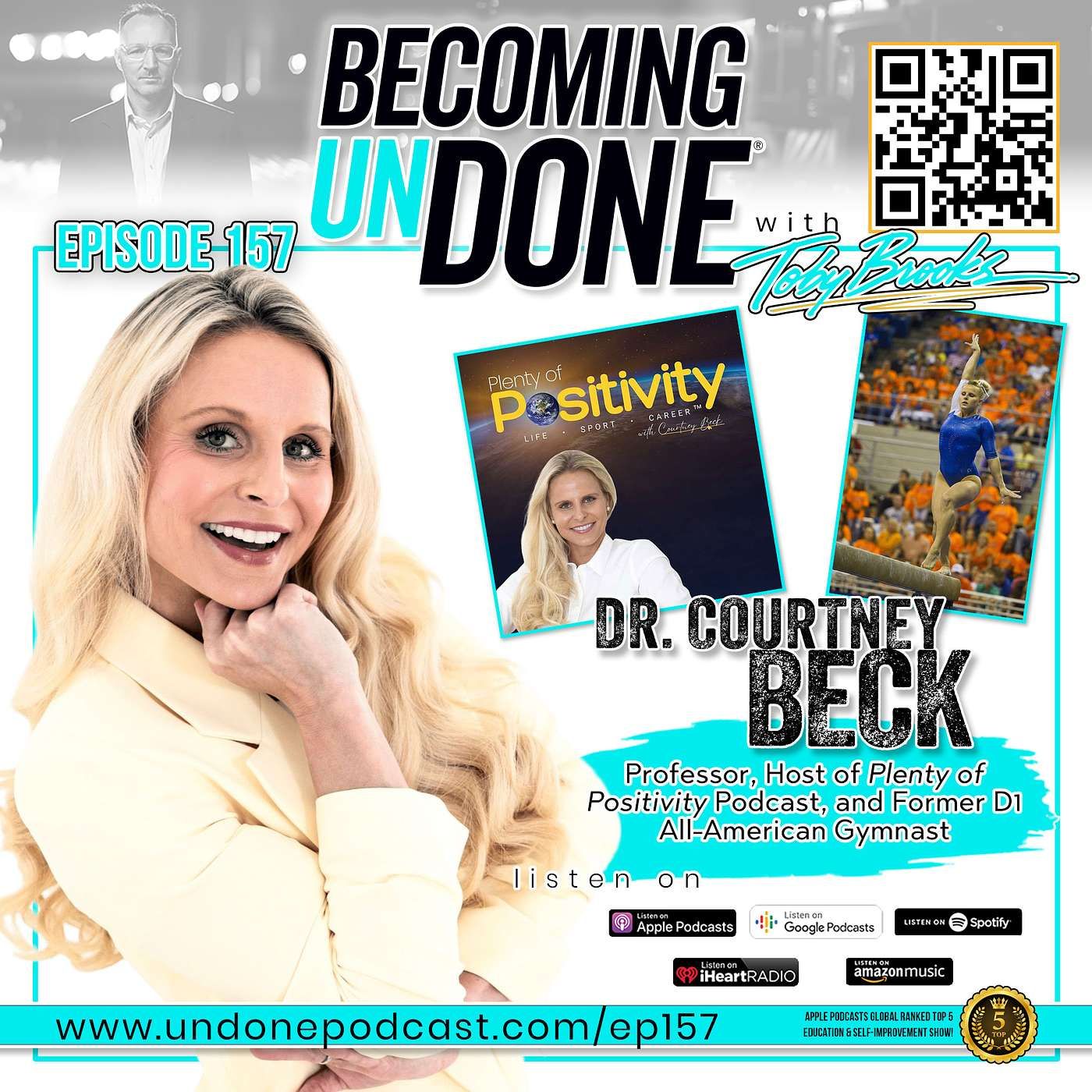
Becoming UnDone® with Dr. Toby Brooks
157 | Finding Identity Beyond Achievement: Courtney Beck Dreams Big, Goes Bold
01:11:35
About the Guest Courtney Beck is a former elite gymnast and NCAA All-American at the University of Florida, where she was a part of two SEC championship teams. A high achiever in academics as well, she has earned multiple master's degrees and a PhD in sport management. In addition to her impressive athletic and academic achievements, Courtney is a corporate leader and founder of the "Plenty of Positivity" podcast. Currently, she serves as an adjunct professor and is an esteemed voice on posit...
Loading summary
Transcript50 lines
- [00:04]
A
This is becoming undone. I walked through those doors of the gym. I'm, what, 17 at the time? And I remember approaching my. My main coach, Jeff Wood, and I was so nervous. Toby, I was so nervous. And I remember approaching him and we honestly, we both kind of laughed at this because he was even like, thinking, he's like, you know, Courtney, you know, as you know, to come back even from a summer is difficult, let alone three years. He goes, well, tell me your plan. And thankfully, my mindset just on that whole idea of muscle memory, it started coming back and I gained my strength back. I started contributing to the team pretty much my sophomore year, then junior and senior. But it was a bold move, but it taught me a very, very good less in life as I would move forward that never be afraid to take that first step. And if it was not for her allowing me to walk onto that team, I don't quite know if I would have that sense of fearlessness or really that sense of, like, boldness. My athletic identity, just the concept of it was so real. I was completely lost after college. I did not prepare as well as I probably should have, but on the other side of the coin, so to speak, you didn't have a lot of time. I will say that it looks very fluid on, you know, my resume, so to speak, that you just transition out and you're moving forward. But deep down, I was really lost without the small sport of gymnastics and trying to figure out that new identity. Hi, my name is Courtney Beck, and I am Undone.
- [02:18]
B
Hey, friend. I'm glad you're here. Welcome to yet another episode of Becoming Undone, the podcast for those who dare bravely risk mightily and grow relentlessly. I'm Toby Brooks, a speaker, author, professor, and performance scientist. I've spent much of the last two decades working as an athletic trainer and a strength coach in the professional collegiate and high school sports settings. And over the years, I've grown more and more fascinated with what sets high achievers apart and how failures that can suck in the moment can end up being exactly the push we needed to propel us on our path to success. Each week on Becoming Undone, I invite a new guest to examine how high achievers can transform from falling apart to falling into place. I'd like to emphasize this show is entirely separate from my role at Baylor University, but it's my attempt to apply what I've learned and what I'm learning and to share with others about the mindsets of high achievers. It's great to be back with you. This episode of Becoming undone is about what happens when the life that looks successful on paper no longer feels aligned in your soul. My guest today is Dr. Courtney Beck. She's a former elite gymnast, high achieving academic, corporate leader, and founder of Plenty of Positivity podcast. From the outside, her journey looked polished, disciplined and impressive. And it is. But underneath the accolades was a struggle that so many high performers know intimately, that search for identity beyond achievement. In this conversation, Courtney opens up about the difficult transition out of elite athletics, the perfectionism that followed her into adulthood, and the quiet unraveling that can happen when your worth becomes tied to performance. We talk about fear, reinvention, purpose, and what it really means to rebuild your life when the old version of you maybe no longer fits. If you've ever found yourself asking, who am I? Without the title, the role, the win, or the applause, then this, my friend, is a conversation for you. I hope you'll enjoy my conversation with former Division 1 gymnastic, podcaster, professor and entrepreneur Courtney Beck in episode 157. Let's get into it. Greetings, friends. Welcome back. Becoming Unknown is a podcast for those who dare bravely risk mightily and grow relentlessly. Join me, Toby Brooks, as I invite a new guest each week where we examine how high achievers can transform from falling apart to falling into place. This in the business is what we call a home. And home. I had the privilege of being on Courtney Beck's Power of Positivity podcast and was just really inspired by her journey journey and her story and lots of similarities in the the work that we do. So background in elite athletics to corporate success. Today's guest has lived a life that most people would call impressive to say the least. But behind that path was a deeper question, that search for meaning and alignment and something more than just achievement. So that search led her to step away from what was working and to build something that she felt mattered. She's the founder of Plenty of Positivity and her story is something I think we can all be inspired by. So Joining me tonight, Dr. Courtney Beck. Welcome to Becoming Undone.
- [05:15]
A
Toby, I am so excited for our conversation and truly an honor to be here tonight.
- [05:21]
B
Yeah, well, I know your story a little bit. I mean, I've done my homework. But before we get into that, I always start at the beginning. What did you want to be growing up and why?
- [05:31]
A
Great question. So growing up, you know, it really did. It started with athletics and academics. That was my whole life, through my childhood, adolescence. And I would have to say I really did. I wanted to stay near sports because it really was such a large part of my life, made it to the elite level in gymnastics, and we could certainly talk about that, and went into collegiate gymnastics, and I fell in love, Like, I've always been in love with the sport, me and college gymnastics. I wish it could have gone on forever. And so there I was, and I really did. I took so many different paths that were very unexpected from the beginning, because, as I said before, I did want to stay close to sport. I initially thought I would go into coaching. Just that's really all I knew about sport, was, okay, once you're done, you become a coach. And so that's where I thought I would start. But sure, literally, it's taken a different path, right?
- [06:44]
B
Well, I don't want to presume anything, but I spent a couple of seasons working in college gymnastics in the PAC 10, not the SEC, but still worked with a lot of gymnasts. And I think it's safe to say that the sport at the highest levels anyway, it all but demands perfectionism. Like, you are judged, and anything short of perfection shows up on a scoreboard, right? And in college gymnastics, it's not just you. It's your teammates who are counting on that score.
- [07:12]
A
And.
- [07:12]
B
And I've talked with a lot of former athletes who have told me about how difficult it is to kind of navigate from that mindset of perfectionism. And in many cases, I mean, in healthy environments, a coach who's demanding. And we all know the horrible stories in gymnastics where they're not always healthy. When you look at your life now and to read your bio, it is completely logical to come to the conclusion that Courtney's always had it together. Where would someone who made that assumption be completely wrong?
- [07:47]
A
Great question. So, you know, I would say first to really go down the path of perfectionism, without a doubt. I mean, at the collegiate level, it is. It's all about that perfect 10. And so throughout my life in the sport of gymnastics, just constantly striving for that, each skill trying to perfect it, you know, the hours upon hours that you would spend in the gym. But I loved every second of, like, when I was in the gym and even through those difficult times. But, you know, to. To answer your question, you know, as I would kind of go on from gymnastics, it was this idea where my athletic identity, just the concept of it was so real, I was completely lost after college. I did not prepare well, as I probably should have. But on the other side of the coin, so to speak, you didn't have a lot of time, as you know, and so I did. I came out and I really did. It's like you try to keep it together and you try to keep the ball moving forward, but there I was, I was at home and my father was even asking me, he's like, if you're going to be under my roof again, he goes, you got to do something like, what are you going to do? And so I did. I ended up going back to pursue a master's degree in communication. But I will say that it looks very fluid on, you know, my resume, so to speak, that you just transition out and you're moving forward. But deep down I was really lost without the sport of gymnastics and trying to figure out that new identity.
- [09:43]
B
I sincerely appreciate Courtney's transparency here, and I think this is a critical fact that too many of us tend to overlook. On paper, Courtney had it all. She was a committed student and a former elite level gymnast who would go on to become an All American at the University of Florida. During her time with the Gators, she was a member of two SEC championship team titles, as well as a member of this Southeastern Conference academic honor roll each and every semester of her collegiate years. She then went straight into a Master's degree at the University of Central Florida, which to an outsider looking in, seems just like the next logical step, right? Except it wasn't quite so simple. Courtney acknowledges that once gymnastics was over and she'd finished that bachelor's degree in advertising, she found herself somewhat adrift at sea, looking for purpose and living back at home. It was through conversations with her dad that she was able to plot a course for the next step in her growth. But it was far from a season of certainty for so many of us. I think it's easy to look at the stories of others and think that we're somehow different, that we are outliers, that we're less than, because we judge ourselves by our thoughts and we assess others by their actions. But it's the normalizing of the fact that a high achiever like Courtney didn't always have it all worked out either, that we can learn to give ourselves just a little bit of grace. And we can also learn from her example. Because even in the midst of a purpose storm, even a relatively mild and short lived one following graduation from undergrad, she kept moving forward. It's a reminder to me that we don't always have to know each and every twist and turn in the journey ahead. We just need enough faith to take the next step. And that's exactly what she did. How?
- [11:27]
A
Like what types of career paths would even remotely at least closely match it if it was not coaching. And I found a little bit of the relation with sales. So at that time, I'm just finishing my master's and my father was in medical sales for a large portion of his life. And I thought to myself, well, I kind of know the lingo there, so why don't I kind of head maybe in that direction? Well, the door opened more so in pharmaceutical sales, so not necessarily, of course, equipment sales and medical sales. And I loved relationship building. I really did. Sales just lit me up, the competition. But all of that to say that's really was where it started, where it looks very nice on paper, if you will. But deep down, I really did struggle after college.
- [12:26]
B
Yeah, yeah. So many times I've heard guests kind of lament, whether they're athletes or entrepreneurs or artists, that transition and that, that seasonality and something that was so core to their identity. In a gymnast case, you started at the age of three or four, probably, if you're like most gymnasts and compete all through and your schedule is set and in many cases nutrition is set and your training is set and everything is provided to you. And it can be jarring when now suddenly you've graduated, you're out of eligibility, and now it's Courtney's responsibility to get out of bed or to show up for things or do all those things. Was that season particularly jarring for you? And if so, how did you navigate that?
- [13:15]
A
Yeah, so absolutely. I feel that even in my personal life, if you will, looking at exercise now for simply my health and not training for that next season, getting pumped up, you know, going through very difficult conditioning sessions to now I was, you know, back to normal. And how do I still maintain my health but still have a level of a little bit of excitement? Like, what was that going to look like? So I did. I struggled on that aspect for sure, trying to find a sense of structure because I really did thrive with the routine I had literally my whole life. I mean, we, from the beginning, I mean, I look back and we would get out of school even early 12:30 to make it on a 1:30 practice and literally train till 6:30, sometimes even 7:30 at night. And that was what I knew. I knew that I had to get my homework done on weekends. And so fast forward, yes, now that I was out, I was holding on to how do I still pulled the quote, exercise as my form of gymnastics and sense of sport into it. And then alongside, now I'm obviously in my professional career and I did find that over time, if you will, when I was in pharmaceutical sales, that this was my new life. As far as you know, that was the last chapter and here we did, we turned to the new chapter. So it was, I think it was a transition for sure. But at the same time I acknowledge and accepted that that chapter actually had ended like a fairy tale quite frankly, because I had returned to the sport and out of three years of being out of the sport and then would compete in college. So I, I was always able to look back with such a, like happy memories but then also knowing that this was the next chapter and what could I take as far as learning lessons from pharmaceutical sales? It was a brand new thing. But I love, I love the sense of new, I love trying new things, I love learning new lessons. So it was, it was a kind of a flip, you know, of the book as far as entering a new chapter and accepting that.
- [15:55]
B
Yeah, I love that approach. A very healthy exit from sport. I know you were an elite gymnast, you were an all American at Florida. And I have to presume that leaving that if your experience at Florida was anything like what the team I worked with at Arizona, there was not just community on the team, there was community in the entire intercollegiate athletics program. Like if you were a student athlete at Arizona or at Florida, you were part of something bigger than yourself. And then to graduate from that, your community is, I mean you're a NARP at that point. You know, you're the non athletic, regular person. You don't have the key card access into that, that life, that world. And I've often said this as an athletic trainer, I am there when you've sprained your ankle or pulled your hamstring or if you're like most gymnasts when your back hurts, I'm there to help. Right when you graduate and you're out of eligibility, you don't have that medical, psychological, whatever support network that you had during that time. And it's dawned on me that at a time when a student athlete is perhaps more vulnerable psychologically than they've ever been, they have fewer resources than they've ever had. Talk me through how you navigated whether it was the depression, the sadness, just sorting through the emotions that were associated with that first meet where you saw the girls run out in their warm up suits and you're not there.
- [17:32]
A
That's so true. You know, I look back and so many memories just as you're speaking, I could tell you so many different stories, so I'll start with this one. But you're right. Like, during my four years, there was nothing like running out of the Gator head for a home me. I mean, the music is blaring. They did a phenomenal job with just the. It really was. It was such a great family. I don't know how to explain it. Like, the. The whole gymnastics meet itself was family friendly. There was so many people. There was thousands. There was like, sometimes upwards to 10,000 people. And so that transition out. This. This is a funny story, Toby. So there I was, I think it was like 2013, three years out at that point, and I decide to come back to coach a camp, just a summer g. And I will never forget how the girls, the young girls are just fascinated by the girls who are still in the sport, right? They know all the names, they went to the meets, and here I am removed three years. And you can remember it was like, one young girl and she's like, oh, were you a gymnast here? I was like, oh, my gosh. And so it really did. It was a sense of humility in that way, because you're right. Like, when you were in it, everybody. I mean, even on campus, you wear your, you know, Florida gymnastics sweatshirts and people are looking literally at you. But, you know, ever since that time, I really knew that was my almost like a defining moment, that that chapter really had ended. And when you talk about emotions at that point, I think it's very healthy to reflect. Like, I really did. I couldn't have asked for a better collegiate experience. I mean, you know, I really do. I have to shout out to Rhonda Fain, both of my assistant coaches, and they really did. They provided me an opportunity that, had they not allowed me to walk on, I don't think as a young woman at that time, I would have developed a sense of confidence to have that sense of almost fearlessness in my career that if you do make a mistake, it's not the end of the world, but keep moving forward. So, you know, to answer your question, yes, there was a range of emotions that I dealt with. But I will say that along the way, I had, like, just a great support system. You know, those girls really were my sisters. I'm only child. So those girls, we. We still stayed in touch. I have a strong, you know, family support system, especially at that time, you know, growing up. And I think that's really important. I would say that, like, going through, you know, new or grasping onto new identities in life, but having a strong sense of support system. The people who, like, really, really know you and that could sometimes only be like, a couple people. Like I said, my family, like, is really, really small. I don't have any siblings, like, but my father was always there to support me at that time in my life. And I think that's what really helped, like, propel me forward in a positive light and not to choose, you know, anything that was maybe going down more dark path.
- [21:14]
B
Yeah, I love that. And that's, that's a testament and a praise for sure. It's easy to look at your bio and say, you know, after sport, you didn't slow down. If anything, you press the accelerator even harder. Two master's degrees, a PhD, a career in pharmaceutical sales, now a podcaster and a professor. You didn't slow down after sport. I, I think it's safe to say you doubled down degrees. All those things. I've heard high achievers say sometimes there was a pull toward those kinds of things. Like, I wanted that. And others would say that it was kind of a way of masking perhaps grief, perhaps deeper seated insecurities about self, and that they would say that their achievements weren't necessarily motivated by or from the healthiest places. So when you look back on that journey now, would you say that that was growth or would you, with vulnerability, say that in a sense it was hiding?
- [22:18]
A
Oh, that's a really good question. I, as I reflect back, I do believe that gymnastics had simply instilled in me that sense of driving. No matter what I would be pursuing, I would pursue it 150%. And I think that's just simply my nature from the very beginning. And so, you know, for example, when you mentioned some of those degrees, like going into the mba, I, I always knew, like, deep down that I wanted to get an MBA because of the challenge it would present to me. I did not have a major in my undergraduate years of business, and so it was always kind of lingering. I enjoyed learning business, and that was kind of when, when was it going to be the right time? And so that was the motivation behind the M was simply the challenge. Now, one thing that's very interesting, as I would move Forward into my PhD in sport management, that was actually Toby, like, not even in the cards whatsoever. And so I was finishing my mba, and I remember feeling kind of like, yikes, the next chapter's coming up. It was like, I think it was October or something, and I was graduating in December. And at that point I'm like, yikes, am I going to work in an athletic department? Am I going to do something remote? Like, what is this going to look like, well, I went to a sport management conference there at the university, or here, should I say Florida State University. And I remember thinking to myself, okay, this is at least the right step to put myself in this environment. And lo and behold, I speak to a professor. Not even like a 10 minute conversation. And she's like, hey, what are your thoughts on maybe pursuing more academics with sports, y'?
- [24:28]
B
All, I love this revelation. Right here again, Courtney is giving us a glimpse behind the curtain into her innermost thoughts as she was seeking to find her way in the world. She's nearly finished with her second master's degree, this time in business. She feels that pressure that you feel when you're nearing the end of one season of life. Without the clarity that she wanted for where she was headed next, she finds herself at a sport management conference at Florida State University. It's a field that she admits at the time she wasn't really even familiar with. At a university that's a sworn enemy of her Florida gator pedigree, a 10 minute conversation is all it took with a professor, and it opened her mind to the possibilities of a PhD in sport management. And over time, that small little seed of an idea would take root and it would send her life's work in a completely new direction. For me, the lesson here on the receiving end, at least for Courtney as the student, is to put myself in places with people who can speak with clarity about new and exciting opportunities. Courtney wasn't stewing home alone, wondering about her next step. She was actively seeking out information, building connections that could inform her. What's more, she also wasn't surrounding herself with negative influences either. Sometimes the best thing we can do to propel ourselves forward is to be careful about the voices that we're allowing in. And for Courtney, that most influential voice was a professor who would go on to impact her life deeply in the future. So for me, on that giving end of the conversation, now, I'm reminded to be present, to seek out that next generation and do my best to support them. For Courtney, it was an idea that came in the right place at the right time, and it allowed her to mold and meld together her love for sport. As a former college athlete, with her work and education and communications, marketing, business, it was a perfect fit. And it was all because she had the courage and wisdom to show up and make herself available for that 10 minute conversation that has pretty much positively impacted her life every day since.
- [26:35]
A
We'll be back after this quick message.
- [26:37]
B
Have you ever looked in the mirror and thought, what in the hell just happened to my life? When the career shifts, when the relationship ends, when the identity you've built your whole life around disappears overnight, that's not failure. That's what I call a purpose storm. Most high achievers aren't prepared for it because no one ever taught us how to train for a comeback. Dr. Toby Brooks and I built the Science of the Comeback for people who refuse to stay broken. Inside the app you'll find research backed resilience training, daily prompts and guided reflection tools, performance psychology frameworks, identity rebuilding exercises, and personalized structured pathways to move from burnout and confusion to clarity and momentum. It's not hype, it's neuroscience. It's performance science. And it's hard won experience. If you're listening to Becoming Undone, I created a special offer just for you. For the next three months, you can get full access for just 49 bucks for an entire year or just 5 bucks a month with no obligation. And you can cancel at any time. That's less than the price of a cup of coffee to start rebuilding your life on purpose. Your comeback isn't accidental, it's intentional. Start yours today@scienceofthecumback.com I'm like, I didn't
- [27:58]
A
even know there was a sport management degree, as silly as that sounds, for a Ph.D. and so it just kind of stuck with me, Toby, after that conversation. And I told myself, I'm like, you know, if this is really meant to be, I will apply, I will get in. If it's not meant to be, then yes, that's not the right direction. Well, I ended up getting in. And so I hope this answers your question because it really was, I think it was always that sense of drive simply from the sport of gymnastics, that kind of all or nothing mentality to pursue something. Like I said, just, just too. I don't want to say to the extreme, but it really was, it was like when I invest myself in something, it's either going to be 150% or nothing at all. And at least I know if I do end up, quote, failing because I don't like to use that word, I don't believe in it, but at least I know I gave it my all. So it wasn't a sense of masking per se, but I think more so of just kind of following my intuition at that point.
- [29:03]
B
That's again, I'm not surprised someone with a podcast called Plenty of Positivity would go at it from that direction, but it's always refreshing to hear. I love that take on something that some people would view perhaps in a negative light or feel shaken or jarred by that uncertainty. And I love that perspective. That said, and you're not off brand if you answer this in anything other than the affirmative, but was there ever a moment when everything looked good to the outside world, but internally you had a sense that this isn't aligned? There's something else.
- [29:43]
A
Yes. Yes. So I could, I could remember it like it was yesterday. So I started the PhD program and I knew going into it, obviously as you know, it's going to be challenging, no doubt about it. But when I was in it, I was thinking to myself, it's, it's interesting to me because yes, you knew you were going to be teaching in the program, but I did not realize how much I loved teaching. And I could just remember the stage to me, like as far as being up at the front of the class really was that gymnastics stage, that floor, so to speak, of like a sense of performance. And I just lit up. And I could remember thinking to myself, I really want to hold on to that. And I would love to offer the life lessons alongside, of course, like the academic material, but the things that I've learned along the way and to help the next generation because I was very reserved, very reserved, very shy when I was in college. And so I wanted to be that professor that was always open and willing to speak with students about even career, not just the, like, course material. And so I mentioned that because as I was going through the program, you know, one thing leads to another year into your dissertation. I like to pile things onto my plate, Toby, that I probably like a little too much. And I found myself coaching. I was in coaching from 2019 to 2022 with the FSU club gymnastics team and they were phenomenal. And what I, I want to like, really paint the picture here of the timeline because as I was coaching them, I also started Women in Sports Associations simply from my lived experience. I pitch it to the chair and I said, hey, like, you know, I wish that I had a network, a sense of community as a young woman before I moved on into my professional career. So make a long story short, I end up starting. It's like a student led organization. I'm coaching, I'm also pursuing the PhD, and of course, as you know, you're also teaching. And my head was spinning, Toby. I could remember I loved everything, but it was just, oh my gosh, it was swallowing me whole. And I learned a very valuable lesson that I did. I put way too much on my plate. And I knew that I was going to have to either drop coaching or drop the association that I had just started. And I thought to myself, well, that was the vision, and I have coached before. So I had to make a decision. I did not want to leave the girls. I felt absolutely terrible. But it was just. It was a decision I had to make. Well, I end up stopping coaching and Toby, two months later, they win their first national title for sports. And, you know, I. I can't take any of the credit. They did a phenomenal job and all the credit to them, but it really was. I think it was in that moment where something was not right. I was. I was pushing too hard. And I feel things in life when you're forcing things, that's probably not the path. Maybe, like, I don't want to say that all the time, but I just felt deep inside of me that maybe there was something more. And so I did. I ended up graduating in December of 23. And this is the moment to really answer your question. Where I did, I was. I was already moving into an adjunct professor role automatically, right there, January, starting or beginning January. But I also. I always love to look at things from, like, a multidisciplinary approach where, yes, my whole life was sport. I just graduated with a PhD in sport management. But what else was happening in the world around me? And I did. I started looking into other realms, and I figure out, like, just for one factor, just to present a point. But the former US Surgeon General, like Dr. Vivek Murthy, he had declared an epidemic on isolation and loneliness. And so I began to start thinking at large, like, how was I feeling in this world? What was it like when I literally went out, even to a store? How were people around me interacting, communicating? And so that got me on that path of really focusing on, I call it the three Cs of plenty of positivity. But it's our communication and our connection with one another, especially after Covid and then leading into community.
- [34:54]
B
I'm guessing you're taking notes, and if not, you probably should be. So I'm gonna pause right here and give you a little breather and restate this knowledge bomb that Courtney just dropped on all of us. Her work today is heavily focused on the power of positivity and how, if we let it, it can reshape not only how we see the world, but how we show up for the people that we love and that we serve. Courtney's three Cs here, communication, connection, and community, those are bedrock to a positive life. I'd presume that each of us probably naturally align with at least one or maybe even two of them. Less likely all three. But her experiences as an athlete, as a student, even as a coach, as a leader, as an entrepreneur, they've all made her uniquely equipped to help other people learn and hone these skills and these facets of life. Life. I'm inspired by Courtney just in talking with her. She's a skilled communicator, no doubt. And I'll say, as a podcast host, the connection that she forms and maintains throughout our interview and calling me by name and saying, quite possibly, some of the sweetest words any podcast host can hear.
- [35:58]
A
Great question. Great questions. Oh, that's a really good question.
- [36:04]
B
That shows her ability to form a fast connection and that community piece. Through her work, she's mobilized national championship winning teams, professional groups, through her work in founding the Women in Sports association at fsu, and now with our growing podcast community, plenty of positivity. In short, she practices what she preaches, and you can't help but be inspired.
- [36:27]
A
So it really was, I think it was at that point, after the Ph.D. that I thought to myself, I feel like there's something out there that's going to be totally different. Unconventional path.
- [36:39]
B
Yeah, absolutely. That's really something we haven't explored much in this show is, is how high achievers tend to overload, overwhelm the idea of the best. Yes. And how there can be six great things. How do I choose the best of those? And how do I protect my time, my sanity, my. My excellence in other things? Because ultimately, it can come at the expense of. Of the other things I've already said yes to. So I love the way you framed that. So your podcast is titled Plenty of Positivity, and understandably, you talk a lot about positivity, but what forced you to pursue that? Because people don't build movements out of comfort. What were you personally navigating when you decided to, and I'm quoting from your website, Uplift Humanity.
- [37:29]
A
Yes. So, great question. You know, Toby, just to your point, my mind goes 100 miles per hour sometimes and many different directions, and the whole concept behind Plenty of Positivity was other than the factor I had just mentioned. But I would log on, you know, just Internet, pull up my first page in the morning, and I just felt like every story I was reading was sheer negativity. And I am not ignorant to algorithms, but I thought to myself, I'm like, there's. There's something that's really interesting about this, like, what is going on and if it's affecting me, because I'm generally speaking of pretty positive person, it has to be affecting other people. And so I'm sitting here and I'm thinking about, like, okay, if I, if I were to start something, what is this going to look like? Well, I love talking about life lessons. I love talking about, obviously, sports and my experience in sport and career experiences. So the light bulb went off and I thought, well, if I'm going to talk about it, why don't I start a podcast? And so I'm thinking of names and like I said, you know, another negative story. And I said, that's it. It's plenty of positivity. So I did, I searched the Internet. I, I did, I got an attorney just to ensure that it was not registered yet. And I launched it at that point at plenty of positivity with the three components of life, sport, and career. So it really was, it was a sense of pulling together, like with that creative mindset of how I could pull the uniqueness and the meaning behind my own lived experience, but then also to be able to serve others and to allow them to share their own story and to even extend it out into education. I have a book club, and a lot of the people that do come on my podcast, they are authors, and so they have their own book. So it's just really promoting education on that side, but then really forming community. And the uplifting humanity part that you mentioned, it really stems from the fact of, yes, life is not all positivity. Certainly, certainly realize that. But I think it's important, as you mentioned, even on your podcast, but like, it's that in between that we acknowledge that sometimes when we look on paper, it's. It's perfect. It's like, wow, they have their life together. Why don't I have my life together? But when we have people on podcast, I think that's when you really, it allows you to think, wow, in between, there could be so many ups and downs, so many emotions. And so let's talk about the positive side. How do we overcome those challenges? And how did others, of course, overcome challenges? So that's where that uplifting humanity part came in.
- [40:29]
B
I love that that's such a, A, such a refreshing and and needed message in today's world. Again, we're talking to Courtney Beck, PhD, educator, entrepreneur, podcaster, high achiever, during COVID I remember this probably better than I should, and my daughter will scold me if she's listening, but we were on lockdown so this was. This would have been April or May of 2020. We've pivoted to online learning. I'm teaching all my classes from my home office in a pole barn, essentially. My daughter's a junior in high school. My son is an eighth grader, and my wife is working remotely. And I said in that moment, I'm like, you know, people are sad. There's a lot of. A lot of uncertainty in the world. We weren't sure how this was going to end. So I actually sat down and I hammered out some growth goals. I said, I don't know when we're going back, but when we go back, I've got goals. And I've hammered those out. And I always build it around. Luke 2:52, Jesus grew in wisdom, stature, favor with God, man, mental, physical, spiritual, social. So I had all these goals, and so proud dad. I go to my family and I say, here are my goals. You guys have to build your own and turn them in. I need to see your growth goals for this lockdown. And my daughter, bless her heart, she was 17 at the time, she just looks at me and she rolls her eyes and she's a high achiever. Don't get me wrong, she said, dad, this is the most toxic positivity I've ever seen. Like, we don't have to grow through this. Like, it's okay to just pause and not be actively growing, right? So when. When you talk about toxic positivity or this is a topic that comes up frequently when we talk about positivity, is. Is it authentic or is it toxic? How do you define real positivity versus toxic?
- [42:24]
A
Yeah, that's a great question. So, you know, even when I speak about positivity, I truly believe it begins with a choice. For example, every morning when we wake up, we have a choice when it comes to the mindset, when it comes to our attitude and the effort that we exert in that day. And so when I think about the whole idea behind, like, for example, toxic positivity, it was. It kind of motivated me of going in that direction that I was. I was just talking about where it is more about explaining, allowing others to explain their journey and to understand that yes, one could have a positive mindset, but also things could also go wrong in their life that maybe they didn't plan for, or maybe they get injured if they're an athlete or they get laid off in a job. And I think that's the important part, at least. Like, what I focus on with the podcast is to acknowledge those Setbacks and the challenges that we do not see on a resume, for example. And so the whole idea of toxic positivity is, would be more along the lines of me just saying, like, but no, just maintain positivity, you know. And so I, I do, I have that nature of definitely being high energy, but I also have the realistic mindset that, yes, things happen in our life and life is not always, quote, fair, but how do we get through those difficult times? And then the positivity part comes from, you know, let's focus on the inspiration and the encouragement that we could offer others by sharing our story. The good, the bad, the ugly, but everything in between.
- [44:17]
B
So, yeah, that's a great perspective. As you're talking and as I looked over your bio, I'm incredibly impressed. First of all, I mean, the things that you've done, the things you've accomplished are remarkable. There's a natural tendency when you've got this big thing. An MBA is a big thing. A PhD is a big thing. When you complete that, there's almost a void where now what? Okay, so I want to shift gears here a little bit and talk about who you, Courtney, are becoming. What version of you are you still in the process of maybe letting go of or maybe what are some aspects of your journey that you've had to unlearn and let go of so that you could continue to grow and develop and flourish?
- [45:00]
A
That's such a good question because as I look back, distinctively, it was practically like almost the day of graduation and I had had family here. And it was the sense of once again an identity shift when you're introducing yourself. It's no longer, I'm pursuing a PhD. That was then, this is now. Like, who, like, to your point, like, who are you now? And as I mentioned, I knew at that point that my quote, identity, if I were to explain a title or that where that ego comes into play, it was because I'm an adjunct professor at Florida State University. But also, I think that was the key part of letting go of the ego and the titles and everything else and setting that aside. And what did I, what, what did I really feel in that moment, like, called to do? And I explain it on my website. It. I don't know how to really put it into words, but it was a really deep sense of feeling compelled to go in this direction that really, as we know, coming out of a PhD program, you either go full time teaching, of course, or full time research. And I felt called to go down this direction, figuring out, like, I Said that creativity, like, pulling everything together, but that this unconventional path was kind of rolling out and yet get back to the titles. Like, I didn't really have a title quite yet. I wasn't necessarily yet the founder of Plenty of Positivity. And even if so, even when people hear it, they're like, what is that? And so I do, I think it was, I think it was letting go of the, the title, the prestige and who am I, Courtney Beck, like, as a person, what do. What is my heart really calling me to do and to be able to take that step into complete uncertainty? And I, I really did. I'm so happy that I did go in that direction and, and obviously here now, because by following what I call just a sense of, like, intuition, I. It opened up a whole new world, if you will, of going down a path that I would say if I had to, like, develop a concept, for example, it was more social entrepreneurship, if you will. I never thought that I was going to quote, like, become an entrepreneur in that capacity, but more along the lines letting go of those titles and just thinking. And this was something I also did too, and I've mentioned before, but after the PhD, I had time to really decompress and I could actually think clearly. I could hear my thoughts. When I went out on a walk, I wasn't rushing back to finish that paper and to do this. And so I could, I could really do just, you know, I know what you're saying. And so I, I really, I would go out on these walks and I wrote blogs about, like, just nature and what was so interesting. And I just highly recommend if anybody is perhaps lost on their path or trying to figure out what that next chapter is going to be. But when you remove the noise and the distractions and it's just you out there perhaps listening to birds chirp, that's what. Who would have ever thought I would have enjoyed that and. Or at least I enjoy that now, but it really was, it was that sense of just being one with myself and letting go of that ego, letting go of all the titles when I would introduce myself, but feeling comfortable in the unknown.
- [48:54]
B
Yeah. Yeah, that's so well said. I think when, when we first got on, you were so kind in complimenting my space. I have spent a lot of time on this branding stuff and, and your website is tremendous as well. So I know in this space where, where we want to curate this image, we. We want people to see us as professionals and as someone who's really thoughtfully considered all aspects and, and branding is A thing. I mean, I love your logo. All those things. If your life had a message, though not the polished, curated, like trying to land big speaker gigs, but the real one, if your life had a message, the gritty, honest, raw, authentic. Courtney. Becky, what is it?
- [49:39]
A
That's a great question I would have to resort to. Like, my main quote is dream big, be bold and take action. Because it really does paint a picture of my life story. Being fearless, like, taking that first step. And trust me, there's a lot of nerves behind that. There's a lot of. Yes, like what? What are people going to think of me if I go down this path. Path. But I do believe it comes with maturity and age, where that slowly starts slipping away. And just the. The gift of life that every day, in my opinion, it's. It's a gift that is given and I want to amplify that day as. As best as I can. And if I look into the future and God willing, I'm sitting in a rocking chair, I always give this image. I'm 80 years old, say, looking back on my life, did I go for the goals that I wanted to pursue? Did I go for all those dreams? Was I bold enough to take that first step? And so that image in itself propels me forward, no matter what the external environment may say about that next, next step that I take. But if it's with good intent and to help others in this world, you know you're on that right path and things will come together. It may take time. And I think that's another point of focusing more so on delayed gratification versus what society really kind of forces, almost as this sense of instant gratification. But it's that delayed gratification for going for things that are going to take a long time. Accepting that, but understanding, you're also growing yourself. I mean, personal growth, your characters developing throughout your life and what that journey may hold at the end. Maybe it is success, maybe it is not necessarily success, but you've learned the lessons that you were meant to learn.
- [51:52]
B
That's great. I'm reminded of. I'm hoping it takes root. It did for a while, and it's kind of cooled off. But when I was teaching as a program director in a graduate program, I talked frequently to my students about doors and how some doors you walk out of for the last time. And that can be. Sometimes that's liberty, that's freedom. Other times it's sadness. You didn't want to walk out of the gym the last time. You would hope that it could last a little longer, Longer. And then there are other doors we walk through and whether that's a new career, whether that's a new geographical location, new address, those things. But those doors are representative of change in our life. And I want to call out, I mean, you say be bold. To show up in Gainesville at an SEC school as a walk on, on the gymnastics team as a college freshman takes guts. That's boldness. And to stick it out and become a contributing member of that team, I don't think people really recognize to be a recruited athlete, you've been invited and incentivized to be a part of that team, and that invitation has been extended to earn your place on a team as a walk on takes. Takes a different set of courage. So I just want to kind of pull at that thread. Talk me, talk me through what kind of boldness it took to be a walk on as a freshman and maybe the imposter syndrome that can sometimes accompany that.
- [53:29]
A
Oh, absolutely. So there I was. I'm going to take it back even a step further. But it's my senior year of high school and it's about like January, February. I had just got accepted to the University of Florida academically, and there was something so strong, Toby, that really tugged me in the direction and said, you have one more chance if you're going to do this. And I knew I was not going to be going to the Olympics. And I knew that, quote, one chance would potentially be college gymnastics. And so it was a voice within me. So I was thinking, how am I going to show back up at my club gymnastics facility, both of my coaches still there, and present to them that I had, they knew, obviously, but I had been out of the sport for three years and I'm going to show up and I'm going to have this magical plan that hopefully they don't laugh at. And so I did. I walked through those doors of the gym. I'm walking, what, 17 at the time? And I remember approaching my, my main coach, Jeff Wood, and I was so nervous, Toby. I was so nervous. And I remember approaching him and we honestly, we both kind of laughed at this because he was even like thinking, he's like, you know, Courtney, you know, as, you know, to come back even from a summer is difficult, let alone three years. He goes, well, tell me your plan. And I go, well, you know, realistically, I'm not gonna like, jump into all around, but perhaps maybe like two specialty events. I feel like if I could get my strength back and I think a lot of athletes who are listening could certainly relate to this. But it really, a lot of it is muscle memory. So you, once you gain the strength back, you could remember, for example, in gymnastics, like the air sense where everything felt. But with three years off, it was going to be difficult. Well, there I was. And he goes, okay. He goes, well, like, let's see how this actually goes. And so I did. I had to meet with the head coach of the University of Florida at the time, Rhonda Fain, in her office during summer of 2006. I will never forget it. And I was so nervous. Toby, I remember, and I could remember, remember walking into her office. And I don't know where this confidence came from, but I said something along the lines, Toby, of if you provide me this opportunity to walk onto the team, I know I'll be able to contribute to this team in a positive way. And I walked out and I'm like, I. At this time, I also want to add, Toby, when I was coming back, okay, 17 years old, I still had my elbow injury that I had to take care of to the point if I was going to make the comeback back, it was still clicking. I had to get surgery. So here I am. I am, I'm literally coming out of surgery, okay, I'm in her office and I'm entering the University of Florida potentially as a walk on, doing not even a cartwheel.
- [56:42]
B
I think this deserves a little context. If you're familiar with gymnastics, you'll know how incredible this scenario is. And if you aren't, let me try to put some perspective on this. For Courtney is an elite level gymnast who stepped away from the sport. Competitive gymnastics is governed by levels 1 through 10, plus an additional elite level. Now, I did a little digging. Most D1 gymnasts are level 10s, with many also coming from the elite, some from the level 9 ranks. But although Courtney has a history as an elite gymnast, she hasn't competed in three years. Meanwhile, Florida is known as as a powerhouse program. It's in one of the strongest conferences in the country. The SEC to make this attempt at a comeback in and of itself is remarkable. I often joke that I was initially terrified as an athletic trainer working with college gymnasts, because one of the first things I noticed was that every piece of equipment in the facility had a warning label slapped right on it that had the words injury and death in all caps. Gymnastics is a sport that is particularly unforgiving. It requires strength and explosiveness and skill for sure, but the timing and the spatial awareness, those are aspects that are not only hard to maintain, they're quickly lost and they're difficult to regain once a young gymnast steps away from the sport, even for a time. So the simple fact that Courtney thought that she could walk on to a D1 SEC gymnastics team after three years of off, that's a lifetime in the sport. It is by itself an audacious goal. Then you throw in the fact that she was injured at the time, she needed surgery before she could even begin, and the odds of success here were devastatingly low. But never count out a high achiever, especially one who would later go on to found a movement called plenty of positivity. Just like that community she mentioned earlier in the show. Courtney might not have made it through to the other side of her big dreams without the incredible support of her future coaches and teammates in the orange and blue.
- [58:48]
A
We are talking ground zero. Completely like the bottom of the bottom, starting fresh. And she did. She goes, well, you know, there is going to be a tryout process. This isn't just an automatic. So I thought to myself, oh my goodness, like, to your point, like, like, maybe what did I get myself into? Like, I can be royally embarrassed, even in front of the girls. And what was so nice though, I, I just have to mention this, There was some girls, like even in the summer and they took me under their wings, some of them upcoming seniors. I of course was a freshman and they were so supportive. And as I mentioned, you know, I don't have any sisters of my own and that teenage was such a blessing. I mean, walking into it and to have that sense of support and them literally understanding I physically could not do gymnastics when I first came back, even in August. And she gave me that first full year and of course the assistant coaches as well, a first full year to really get my strength back. And thankfully my mindset just on that whole idea of, you know, muscle memory, it did, it started coming back and I gained my strength back. I started contributing to the team pretty much my sophomore year, then junior and senior. But it was a bold move. But it taught me a very, very good lesson in life as I would move forward that never be afraid to take that first step. And if it was not for her allowing me to walk onto that team, I don't quite know if I would have that sense of, of fearlessness or really that sense of like boldness to take that step.
- [60:34]
B
That's so powerful. Two things. 17 year old Courtney, like the audacity, right? Like you hadn't competed in three years, you're injured and you Walk in and just confidently tell an SEC head coach that you're going to and your words positively, positively impact her team. That's awesome.
- [61:00]
A
It was literally, it was something along the lines I said I know I will be able like to contribute to this team. And we're both like kind of looking at it. And I couldn't even believe I said it but I knew there was something inside of me saying Courtney, you have to be confident if you want this opportunity, even like the slightest opportunity that she was going to even give me, me this, you know, potential to prove myself. I had to show confidence behind my decision and I had to show a sense of really determination that if she gave me this chance, you know, also too she was kind of putting herself out on the line too as far as even my character, everything else to either mold with the team or be obviously a cancer to the team.
- [61:47]
B
So that's the other thing I to want to touch on is the fact that the culture of that team was such that you weren't shamed or othered or. I've been on teams where walk ons get treated like fourth class citizens. Like they're ridiculed like before they've ever done anything athletically. The assumption is if you're a walk on, you're less than. And the fact that those senior leaders would take you under their wing and enable you and encourage you and inspire you to come alongside them is that's awesome. And that comes from the top. It comes from within. That's a healthy culture.
- [62:25]
A
I was very grateful and to your point Toby, I have certainly heard so many stories of walk ons but Rhonda had built such a strong culture there and I remember to your point, like walking in like just the team dynamic, I felt at home yet again. And there was something that, that feeling I'll, I'll never, I'll never forget and even the assistant coaches giving me a chance and at least having like, you know, no pun intended here but like a positive outlook that hey, maybe there is a chance she could get back to the level that she was once at. I didn't quite get to that 13 year old Courtney at the peak of my career, but nevertheless so grateful to compete at the collegiate level. So very grateful for all those coaches and to your point, for the gymnast to provide that support.
- [63:20]
B
Yeah, well I also want to be cautious here and this is, this is a compliment of the highest order. Like to be a walk on and to navigate that early transition where you're earning the credibility among your peers and then to be a contributor, like, at. At that. I've. I've definitely seen that where a walk on is. Is kind of the gritty, like, they've earned it, and by the time they're a senior, like, they are a linchpin of the culture themselves because they had to earn it in a way that others haven't. So kudos to you for just a tremendous journey. Last one. I asked this of all my guests. What for? Courtney Beck remains undone.
- [64:02]
A
I would say Courtney Beck is a work in progress, Toby. I consider myself a work in progress at all times. Even as I'm building plenty of positivity, there's still so much yet to learn. You know, we spoke in this podcast, obviously, about, you know, education and titles and how ego could, you know, kind of slip in, but knowing that as you move forward in life and especially the world we live in today, ever so changing, for that matter, as far as, like, rapid change, but how important it is to continuously learn. And I really do, I think as I. As I go on this journey, it's just kind of discovering, like I said, just this next chapter, like, who is Courtney Beck in this next chapter of life? After physically finishing sport, finding that sense of, you know, going back to the very beginning, that sense of purpose behind my exercise, I just took up running recently, so that's exciting. Trying to find something. Something of structure, you know? Yeah. Yes, exactly. Exactly. But, yeah, I would just have to answer your question by just saying, you know, there's. There's no doubt about it that I have learned so much along the way. I've accepted lessons that I've had to learn, both, like, great sometimes, and then also lessons that, hey, it's just part of life. Learn the lesson and move on. And so I'm just really excited for what this next chapter holds.
- [65:35]
B
Tremendous. Well, Courtney, it's been such a pleasure to have you on. I really do appreciate your insights. Where can listeners connect and follow the work that you're doing?
- [65:44]
A
Oh, thank you, Toby. And thank you so much for having me on this podcast. I have definitely enjoyed our conversation. I wish it could keep going. You have excellent questions. Absolutely. But for. For listeners who are listening who maybe want to contact me, I am on socials. LinkedIn is my primary one. You could find me courting. There are a lot of Courtney Bucks. So look for adjunct professor at Florida State, founder of Plenty of Positivity, and also to email courtney@plentyofpositivity.com and of course, my website, where all my socials are, including even Instagram and YouTube, but www.plentyofpositivity.com awesome.
- [66:24]
B
I will share all those in the show Notes in the description hi, my
- [66:28]
A
name is Courtney Beck and I am Undone.
- [66:41]
B
What I appreciate most about Courtney's story is that it reminds us that reinvention rarely happens all at once. More often it begins in those quiet moments when we finally admit that achievement by itself isn't enough to sustain us. Her journey from elite athletics to corporate success to building something rooted in purpose is a powerful example of what it looks like to stop performing a life that no longer fits and to start creating one that actually aligns. And I think so many of us, especially the high achievers, can relate to that tension between external success and internal fulfillment. Courtney's willingness to speak honestly about identity, perfectionism, fear and growth. It's exactly the kind of conversation that this show exists to have. It's a space for it. Because becoming undone is rarely the end of the story. More often it's the beginning of becoming who we were actually meant to be. I'm thankful to Courtney for dropping in and I hope you enjoyed our conversation. For more info on today's episode, be sure to check it out on the website web. Simply go to undonepodcast.com ep157 to see the notes, links and images related to today's guest, Courtney Beck. Some quick updates about the show We've managed to claw our way back up the charts a little bit, at least in the self improvement and Education categories on Apple Podcasts, where we're currently sitting at 5 and 6 in the world respectively, still trying to claw our way back into that elusive Apple top 200 across all categories. If you want to follow along and see our progress for yourself, you can go to undonepodcast.com rankings cheer me on. In the last month we had just to tick over 10,000 downloads, but we aren't done yet. So if you'd be so kind as to share the show with a friend, leave a comment or a review, I would really appreciate it. This week's Teal of the Week week is just a standard issue dry fit Teal Nike T shirt. If you listen to my multi part Larry Johnson series, you heard me ramble on about my deep love for teal. It's not just a 90s staple to me, it's a trademark. It's become my signature color. And if you're watching on video, I'm wearing one of my favorite short sleeve tees. Just a plain old dry fit Nike shirt in teal. As a performance scientist, I've spent most of my career trusting the evidence over instinct. And one thing both the research and my own experience continue to show me is that the environment shapes the behavior. The spaces that we occupy, the routines we build, even the colors we surround ourselves or my case wear can subtly influence how we think, feel and perform. For me, that color has become teal. Somewhere along the way, it stopped being a design choice and it became a cue. It was a reminder to me to slow down, lock in, and show up with intention. It's also a signal to myself that this moment matters, that I need to be fully present, fully engaged, and ready to give my best. Now, ordinarily, in this space, I give a shout out to the teal team that I'm wearing for the interview this week. It's just a standard small swoosh on a shirt, and honestly, that's cool. Sometimes it's better to lock in with subtlety rather than shouting. Coming up on the show, I'm working on a new solo episode I think you'll enjoy about the fourth quarter. It's an idea that came to me in a recent conversation with guest Chris McCormick in episode 154. I'm also trying to lock down former college basketball player turned fitness expert and now stroke survivor and advocate Leroy McClure. This is more Coming up on Becoming Undone. Becoming Undone is a Nitrohype creative production written and produced by me, Toby Brooks. Tell a friend about the show. Follow along on Facebook, Instagram and LinkedIn at Becoming Undone pod and follow me at Toby Brooks, Ph.D. on Facebook, Instagram and LinkedIn. Check out my linktree at linktr EE tobybrooksphd Listen, subscribe and leave me a review on Apple Podcasts, Spotify, iHeartRadio, or wherever you get your podcasts. Till next time, friend. Keep getting better. Sam.