← Becoming UnDone® with Dr. Toby Brooks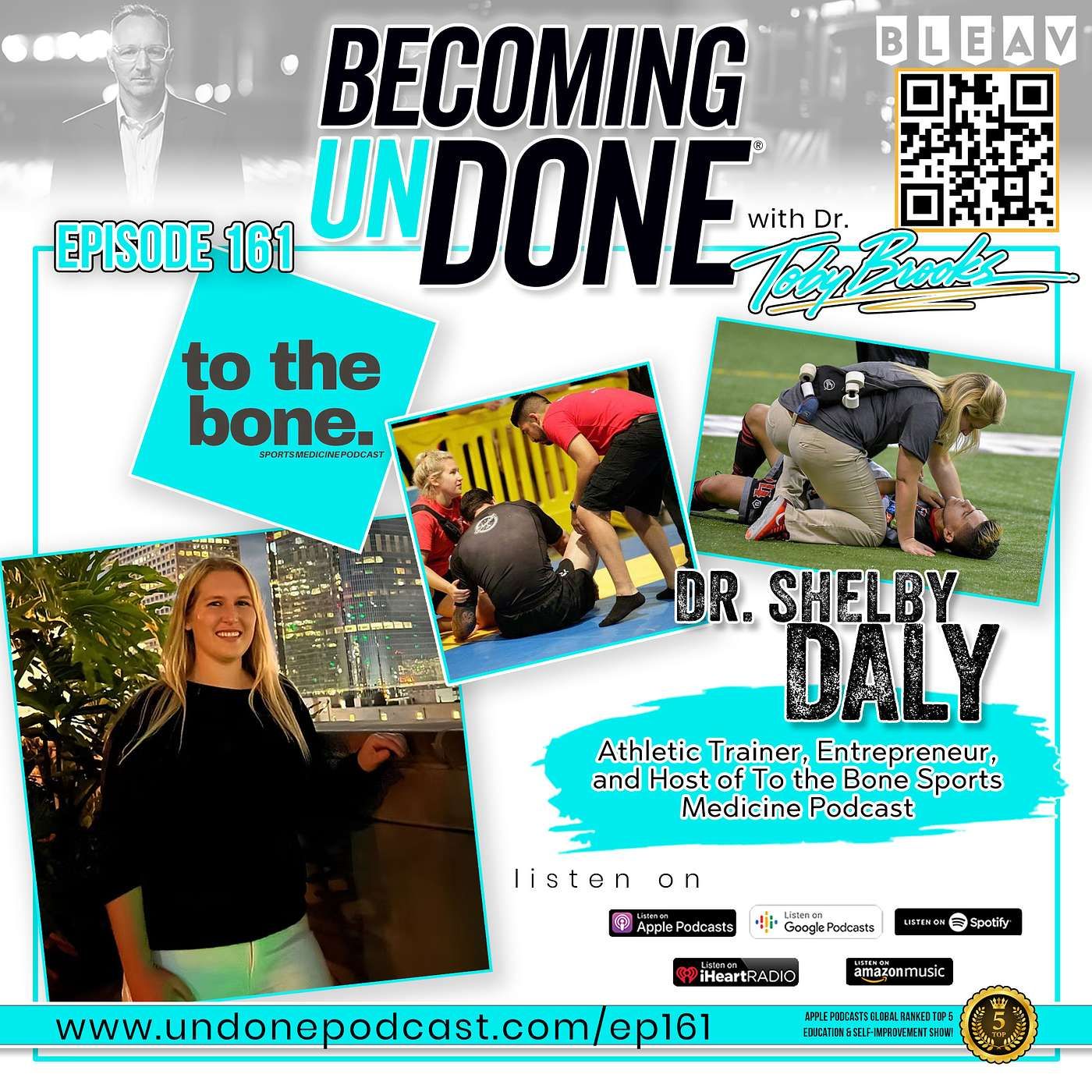
Becoming UnDone® with Dr. Toby Brooks
161 | Navigating Burnout and Career Identity in Athletic Training with Dr. Shelby Daly
01:03:55
About the Guest Dr. Shelby Daly is an accomplished leader in the field of sports medicine with a Doctorate in Athletic Training, specializing in leadership, entrepreneurship, and globalization. She hosts the To the Bone Sports Medicine Podcast, where she discusses topics crucial to athletic trainers and sports medicine professionals. Dr. Daly is recognized for her insightful commentary on leadership, burnout, and professional identity within the athletic training field. Dr. Toby Brooks ...
Loading summary
Transcript64 lines
- [00:00]
Dr. Toby Brooks
Foreign this is Becoming Undone.
- [00:10]
Dr. Shelby Daly
I love LinkedIn, but there's a lot of broad stroke stuff and I obviously just finished my DAT in leadership, entrepreneurship and globalization. But it was all the positive things. When things are going well and nobody actually coaches or teaches you well, what happens when it's not going well? How do you actually have a case study of this person's non compliant? They're not doing what you're doing. There's pushback on how you're presenting ideas. The situations I keep encountering is I feel like I'm meeting people halfway, but I don't think people are meeting me halfway. I guess I'm always kind of in that extrovert category of all these disc tests and all these other measurables. But you know, I feel like I have to be selfish sometimes and be like, well do I always have to everybody else and accommodate their things? And I think that's where it's getting frustrated as I get further into my career and the profession of athletic training is I'm supposed to keep giving, but when do I get to be given to
- [01:18]
Dr. Toby Brooks
hey friend, I'm glad you're here. Welcome to yet another episode of Becoming Undone, the podcast for those who dare bravely risk mightily and grow relentlessly. Toby Brooks, speaker, author, professor, and Performance scientist I spent much of the last two decades working as an athletic trainer and a strength coach in the professional, collegiate and high school sports settings, and over the years I've grown more and more fascinated with what sets high achievers apart and how failures that can suck in the moment can actually end up being exactly the push we needed to propel us on our paths to success. Every week on Becoming Undone, I invite new guests to examine how high achievers can transform from falling apart to falling into place. I'd like to emphasize that this show is entirely separate from my role at Baylor University, but it's my attempt to apply what I've learned and what I'm learning and to share with others about the mindsets of high achievers. You know, every once in a while an episode comes along that doesn't fit the normal Becoming Undone format, and this one is one of those episodes. Today's conversation is a crossover with my friend Dr. Shelby Daly, host of the to the Bone Sports Medicine podcast. And instead of walking through Shelby's personal story in the usual way, we decided to open the door on a conversation that's been happening behind the scenes for quite a while. Shelby and I both spend a lot of time thinking, writing, posting, talking about athletic training, sports Medicine, leadership, pay burnout, professional identity. All the stuff that happens when people who care so much about their work start asking the hard questions about whether the system they serve is actually serving them back. And we come at it from slightly different angles. Shelby's built her whole platform that speaks very directly to athletic trainers and sports medicine professionals from the ground up. I've spent more time talking more broadly about purpose and leadership and career drift and what happens when the thing you once loved starts costing you more than you expected. But underneath it all, we're both circling the same question. How do we keep people from burning out, checking out, or walking away from work? This still matters. This episode is honest, and it's a little raw in places. It's not a polished list of solutions. It's definitely not a corporate leadership seminar that's dressed up like a podcast conversation. It's two people who love the profession enough to critique it, who are frustrated enough to say some things out loud, and who still believe that there has to be a better way forward. We talk about the culture of always being available and the difference between coverage and performance, the rising cost of entry in athletic training, whether advanced credentials actually ever get rewarded, the need for better business thinking in sports medicine, and why negative conversations seem to spread a lot faster than the constructive ones. But we also talk about possibility, because the goal isn't just to complain. The goal is to name what's broken clearly enough that we can start imagining what might be rebuilt. So whether you're an athletic trainer, sports medicine professional, a coach, a leader, anyone working in athletics for that matter, just somebody who's ever wondered, why am I the one always expected to give more? I think there's something in this conversation for you. I hope you'll enjoy my crossover conversation with my friend Dr. Shelby Daly of To the Bone in episode 161. Let's get into it.
- [04:27]
Dr. Shelby Daly
Well, welcome back to to the Bone and Becoming Undone. Today we have a crossover episode with Toby Brooks and Shelby Daly. Today we're going to go over some leadership things. I don't even know how this is just a riff episode, we decided. So I've come across a few situations where I've bounced it off. Toby, with all of his knowledge and the work that he's doing, and I thought that, you know my situation. There's a lot of people in sports medicine that are dealing with it and you think you're the problem. So I don't know. Toby, we can start with my situation. You can give a little roll into how I reached out to you and what you've been provid. I don't know.
- [05:11]
Dr. Toby Brooks
Yeah. Shelby, I thank you for reaching out. I think this is timely and it's important. I know it is something that's near and dear to your heart and has been at the forefront of your experience. I have also similarly been applauded and discouraged at the same time, depending on who, for being vocal about the profession of athletic training and about how we need to do better. And so I find it interesting that there are loud voices on both sides of this argument, and it's not who I would have expected. Like, the people that have pushed back against the things I've said are not just old folks that, you know, did this 30 or 40 years ago. So I think this is a timely conversation. I think it's. I appreciate and I really do respect the platform that you've built, and I'm honored to be here today.
- [06:07]
Dr. Shelby Daly
Yeah, well, and I mean, you've been a great mentor with all of your years of experience and even your podcast. I mean, I still don't think a lot of athletic trainers know what you're doing, and I wanted to definitely loop them in on the projects that you have going on and how you're coaching and helping people out. But, you know, since you've kindly helped me out and been a sounding board, you know, I want to try to get more people in your space and so that they can figure out and be better athletic trainers or just people in general.
- [06:37]
Dr. Toby Brooks
Yeah. It's funny, I was thinking about this when you reached out. It feels like we're both kind of peeking in opposite sides of this problem from our own windows. And you've built a platform that's almost exclusively ats, but definitely sports medicine adjacent folks and have really spoken into this issue very specifically. And I've kind of gone the other way. When I first started, I didn't even really mention that I was an athletic trainer. These were just kind of issues that I saw in the broader kind of corporate and athletics and art areas where we get a few years into a career and we wonder what now, like, this isn't. I'm here and I don't feel better for it. And so I have tried to kind of loop ATS into this conversation. So I've been broad and trying to kind of niche down. You've been niche, and I think your message and the things that you're touching on do extend far beyond athletic training.
- [07:36]
Dr. Shelby Daly
Yeah, well, and it's trying to associate the situation with common things. You know, how can we get people to relate and actually see, oh, this does interact with my life and how I'm making decisions in my profession. I love LinkedIn, but there's a lot of broad stroke stuff and I obviously just finished my D A T in leadership, entrepreneurship and globalization. But it was all the positive things. When things are going well and nobody actually coaches or teaches you well, what happens when it's not going well? Yeah. How do you actually have a case study of this person's non compliant? They're not doing what you're doing. There's pushback on how you're presenting ideas. I know I had approached you with the situations I keep encountering is I feel like I'm meeting people halfway but I don't think people are meeting me halfway. And I guess I'm always kind of in that extrovert category of all these disc tests and all these other measurables. But I feel like I have to be selfish sometimes and be like, well, do I always have to meet everybody else and accommodate their things? And I think that's where it's getting frustrated as I get further into my career and the profession of athletic training is I'm supposed to keep giving, but when do I get to be given to?
- [08:59]
Dr. Toby Brooks
Yeah. I don't know if you're a fan of the Taylor Sheridan cinematic universe. Yes. But we were watching Dutton Ranch last night and Rip has taken over as the ranch foreman at a competing ranch. And I looked over my wife like he just comes out and he's just gruff and foul language and he's just like, you know, get on your effing horses and let's get to. And the leadership side of that, I'm like, how liberating would it be to be able to just tell people to do their job and, and on the, even on the receiving end, like not veiled in corporate speak, not, you know, HR sensitive. Like could we just communicate like human beings and be our authentic self and how much better would it be? But no, we have to dress it up and make it kind. And it sounds bad like I'm, as I'm saying this out loud, people that don't know me are going to be like what an a hole this guy is. But I just feel like that authenticity is so missing. And that's what I love about athletics is we still have vestiges of that where you can, you can get on somebody and you can coach them up and you can be kind of a, an unvarnished, non sugar coated version of yourself. But yeah, it seems like that's Fewer and further in between. And I get it. I mean, there are also instances where that's toxic and that can lead to a really bad work environment. So I don't know what I'm saying, but I'm jealous of Rip and his leadership style.
- [10:37]
Dr. Shelby Daly
Well, that's the emotional intelligence is obviously important. And finessing how you talk to people and, you know, how they receive, you know, in school these days is you have to figure out different ways to teach something. You know, there's the hands on, there's reading, there's the verbal, tactical, all those types of things which I think are very important. But that's what I was kind of saying before, is I have to accommodate for how they like to do things every single time. It feels like. But nobody. It feels like they ask me what I prefer. And I don't know if it's that directness of. Oh, Shelby's easy to read because she's just direct. She likes the information clear. But that's the hard thing in business and athletic training is you have to be direct and make sure things are clear cut, or else that's where confusion, misdirection, you know, time sensitive things get screwed up. Is that okay? We're going to accommodate for all these personal things that are going on in someone's life. Either you take the time off and deal with it, or you kind of have to buck up and do it because there is money, there are contracts, there's timelines. You know, in athletics, we should know that the best because we're trying to get someone back and playing as quick as possible. So we understand that from a personnel standpoint, but from a business standpoint, we just seem to kind of miss the boat on those things and we don't understand it.
- [12:04]
Dr. Toby Brooks
Yeah, I think you're spot on. I think there's an urgency that it's just enculturated in the profession and to our own detriment. I think there are, you know, practice gets moved and we adjust and we get everything over to field four instead of field one. And we make it work.
- [12:23]
Dr. Shelby Daly
Yeah.
- [12:23]
Dr. Toby Brooks
And we live in that urgency so often that when we find ourselves in places where that's not normal, it can feel unresponsive, like we're lacking agility, those kinds of things. But I love what you're saying in that. Why am I always expected to be the person that gives and everyone else takes? When does that come the other direction? When can I be allowed to be my authentic self? When can you meet me on my terms? Once in a While and man, that is a sentiment that resonates with me. I totally get that.
- [12:58]
Dr. Shelby Daly
Yeah, well, and you brought up Dutton Ranch. I think I told you when I texted you is like if you've seen the F1 movie with Brad Pitt. I identify with Brad Pitt, but I never feel like I have leadership that understands what I'm doing. I'm doing the grunt work, the groundwork to make sure that all the systems are actually working and gonna flow later down the line. Kind of the big picture, small detail portions. So I'm all about efficiency. And people think that I don't like talking to people or interacting. I actually do. But there's so much capacity and bandwidth that I can actually give that it's. How do I put systems in place where people can be self sufficient? And that's another thing that athletic trainers I think are starting to understand. But at the same time we are so self dependent in our identity of working with the athlete one on one, you know, while other things are going on and multitasking. But we feel that their success, their ability to get back is so dependent on us and our decisions and being able to touch base all the time, having to be at every practice, every game. You know, this identity that we've built up that we always have to be available, I think is where we are stabbing ourselves in the back and why, you know, the work life balance, overworking, work life harmony, whatever you want to call it. I think that's where we're having some strain is that we've built these cultures that aren't self sustaining. I don't think that most doctors or physical therapists are on call 247 and they don't need to be, you know, obviously with insurance they are paying for attention. So it is one on one. But I don't think that we've stepped back far enough to show that we can make our athletes or patients capable of dealing with their program. And I can do other stuff or you know, the practices that the weightlifting sessions. I don't think somebody is really going to injure themselves. You know, I think we're just so anxious and anxiety ridden that we're burnt out that we think there's going to be an injury at any weird time. We're not prepping our staff to be able to deal with it. Staff as in coaches or strength and conditioning, giving them resources to be self sufficient. So that's kind of where my mind goes. But yeah, yeah.
- [15:32]
Dr. Toby Brooks
I think if I'm really honest about this and I've thought a lot about this since you texted me and we've had some of these conversations. Early in my career, I think even within my own heart, there were times when I stood on a sideline and wondered, like, what can I really do here if no one gets seriously injured? What's my role? If I'm just standing at practice and no one's out and I'm just watching and no one gets hurt? Did it matter if I was here? The sales side of things, you know, I want every coach and every athletic director and every school board administrator, all those people, I want them to realize that having sports without an at present is asking for trouble. But within my own self, like, as long as nothing serious happens, I could get away with not being there. There's just one of me. And if there are four athletic events, I can't be in four places at one time. I was at a junior college one time where there was even a rank order list of priorities, where if there were concurrent events, this was where I was expected to be. And, you know, depending on who was playing or what was going on, then I would consult the list so that they would know where I would be at any given time. What's that mean for the other three concurrent events? Well, as long as nobody gets hurt, we kind of got away with it, right?
- [16:51]
Dr. Shelby Daly
Yeah.
- [16:52]
Dr. Toby Brooks
But I think where the future really needs to be for us is to get away from coverage mindset and get to performance mindset. Like, if I'm at practice and no one's out but someone's at 85%, what can I do to get them to 100%? What can I do in other parts of the day that are ultimately going to help that patient athlete recover faster? And I don't think we've done a good job of documenting or drawing attention to those types of things. I had Dr. Tyler Lesher on my show last week, and he's kind of a new generation that is carving their own area. Like, he's a performance coach. He refers to himself as a performance therapist for a single NBA player. And he can kind of do all the things he maybe wanted to do but was constrained from doing as the head basketball at ucla. And he can document how he's helping his patient get better and melding the sports performance side of things and the analytics side of things and the data collection. That's not something we've done a good job of as athletic trainers. We kind of know in our heart that our job's important and we hope that everybody else notices. Well, that's not a viable Way to really make the claim or the case that we're a critical part of your operation.
- [18:17]
Dr. Shelby Daly
Yeah, yeah. And even for the ROI debate and all that stuff is, yeah, we can keep putting numbers from the ICD codes, but we still aren't necessarily quantifying, well, who's the best at the rehab, who's the best at medical response. Like, me and my mom were talking yesterday and I had recently post about how the N A T A wasn't necessarily advocating to access to athletic training programs, cheaper with the rise legislation for student loans and stuff, and how the ROI on that doesn't make sense because you're just increasing the cap of what a college or university can charge you for a program. You still have to pay that back and interest, so you're making it more expensive. But we were talking about if anybody looks at my LinkedIn or my resume, I mean, that's the first thing they notice is all the sort of certifications, certificates, all those different things that I've done to try to set myself apart when I go into an interview. Nobody's ever offered me more money for those ever. Or even made a note of like, well, we're giving you, this is how we're going to structure your pay and that you have all these experience, you can do these different manual therapies. We're going to give you a chunk of money just for that.
- [19:46]
Dr. Toby Brooks
Shelby is absolutely right here. I think many fall victim to this mindset, myself included in some ways. At the very least, it's a worker bee mindset that we were told when we were younger and we've embraced. I know. I was specifically told by my high school guidance counselor that the path to success and earning power was a college degree. And if you want to be able to help your employer more and serve your patients better, then get more degrees, more credentials, more certifications, more everything. And oftentimes at our own expense. I like to say not a year older, but a year better. You've heard me talk about my decision to pursue my MBA that started right here on this show with guest and former student Dr. Ram Hadassah. What I didn't tell you back then were the specifics. My employer at the time had a program that would pay for a related degree up to $15,000. You had to apply and get pre approval, but it was a pretty straightforward process. The one condition was that unless you stayed for at least two years following completion, you'd have to pay it back. I looked pretty extensively for an AACSB accredited MBA program that was flexible and affordable. And I finally settled on Louisiana State University, Shreveport. I was fully prepared to pay for all my classes myself, but I went ahead and applied for that reimbursement program and it got approved. And every semester I'd register for classes, I'd use my credit card and pay out of pocket and then I'd get reimbursed by my school along the way. I really appreciated it and honestly, I still appreciate it today. What I didn't appreciate was how it all went down after I resigned. I looked at it like this. I had stalled out on the career ladder at my previous school. I wanted to grow and I thought the MBA was the way to do it. I hoped that the MBA would open new doors for me if I ended up getting a job somewhere else. And I finished ahead of that two year exception. And I was basically getting a no interest loan to pay for the degree up front, but I'd still need to pay it back. On the other hand, if I stayed, I'd get the degree for free. Either way, I thought it was a good deal. All's great, right? I did get a new job offer and I did end up leaving my previous school with one class still left to finish up that MBA, which I finished in the summer of 2024. I expected to hear from the school at some point about the repayment specifics. I didn't expect to walk away scot free after I submitted my resignation. After 15 years and some of the best work I could have possibly done, literally at 8am the next day, I didn't get a congrats or a thank you or anything else. I got a bill the next day, the entire amount due in full within six months where the institution would, and I'm not kidding, quote, pursue legal remedy. Holy cow. Seriously. I mean, come on. I get it. I knew the rules and I chose to leave. I expected I was fully prepared to pay back all that money, especially once the household I'd pay it in full. I was going to give a lump sum, but there's a way to treat people with respect and there's a way to treat them with disrespect. And I would submit to you that I got the latter. I paid the entire amount back plus $0.01 just to see if anyone was paying attention. They weren't. So for the record, they still owe me a penny. Now that's petty, right? I say all that to say this. I love learning. I thoroughly enjoyed earning my MBA and I'm enjoying earning my Ms. In Exercise Physiology right now. But those degrees have come at personal expense, whether it's books, whether it's tuition, sometimes both. My previous employer proved that whatever I had done as a member of my quote unquote team was not nearly as important as being sure that I paid back every penny. So, like Shelby said, no one paid me extra to earn those degrees, and they won't. But in our scarcity and our poverty mindsets, it's what we've told ourselves was a differentiator. And to that I'd say if you're learning because you love to learn, then get after it.
- [23:36]
Dr. Shelby Daly
Do it.
- [23:36]
Dr. Toby Brooks
You won't be sorry. But if you're doing it because you think someone's making a hiring decision or a salary decision and they're going to notice, I'm afraid I've got some bad news for you. It probably won't make much of a difference.
- [23:48]
Dr. Shelby Daly
We'll be back after this quick message.
- [23:51]
Dr. Toby Brooks
Have you ever looked in the mirror and thought, what in the hell just happened to my life? When the career shifts, when the relationship ends, when the identity you've built your whole life around disappears overnight. That's not failure. That's what I call a purpose storm. Most high achievers aren't prepared for it because no one ever taught us how to train for a comeback. I'm Dr. Toby Brooks and I built the Science of the Comeback for people who refuse to stay broken. Inside the app you'll find research backed resilience training, daily prompts and guided reflection tools, performance psychology frameworks, identity rebuilding exercises, and personalized structured pathways to move from burnout and confusion to clarity and momentum. It's not hype, it's neuroscience. It's performance science and it's hard won experience. If you're listening to Becoming Undone, I created a special offer just for you. For the next three months you can get full access for just 49 bucks for an entire year or just 5 bucks a month with no obligation. You can cancel at any time. That's less than the price of a cup of coffee to start rebuilding your life on purpose. Your comeback isn't accidental, it's intentional. Start yours today@scienceofthecumback.com the only thing that
- [25:11]
Dr. Shelby Daly
I've gotten a raise for is my cscs and that's when I was going back to my previous job during COVID when they're rehiring and I made a stink about it of we don't have a strength and conditioning coach and I'm the only one on staff with this certification. So they gave me like five grand. Not that much at the end of the day. But we haven't figured out how to reward athletic trainers for the extra certifications, knowledge specialties that they're gaining. And that's where I'm worried. You know, we haven't been able to put a price on that. And we're going down this road with the BoC doing specialty certifications, but they don't have any research or evidence that that's going to definitely get them a pay bump. If somebody has that, it just qualifies you for a position at the end of the day. So I don't know where I was going with that thought, but it kind of circles back into this conversation somehow.
- [26:10]
Dr. Toby Brooks
No, I think you're right. The move to masters as the entry level, I think, yeah, that's great. We're trying to keep pace with initially chiropractors, but eventually OTs and PTs and we want to be esteemed as comparable to those fields. But the job market didn't really support that. It's not like graduates today with master's degrees two more years at minimum. And the incurred cost, if you were to compare an entry level salary in 2000, when it was bachelor's required to now with master's required, there's no. You're not getting a pay bump because you're. You have a master's degree. In some cases, we might have even lost ground. Salaries have gotten a little better, but inflation is insane. And so, you know, 50k today, I don't know how that stacks up to 30k when you got a bachelor's degree, but I know that the modern clinician has more time and more money invested in being eligible for that job. Yeah, I'm at Baylor. It's a private school. It's 90k a year to go here, you know, full sticker price.
- [27:19]
Dr. Shelby Daly
Yeah.
- [27:19]
Dr. Toby Brooks
And you have to wonder like, how many years of labor as an AT will it take you just to pay back the privilege of being able to work as an at? The ROI just is not there. Also, going back to what I spoke about previously, about, you know, how we don't necessarily see the value in what we offer. The differentiator for my generation was you put in more hours. If you and I are comparable as clinicians, then how can I set myself apart and be likely to be next in line for the promotion or for the next best job? Well, I just work myself to the bone. That that work ethic was kind of my lone differentiator because I can wrap a bag of ice on an athlete just as well as you Can. I can do quad sets just like you can. I can do some stretching routine. But. But am I really bringing value? Am I getting athletes back on the field faster? I don't know. I mean, in that case, plug and play. Like, if someone leaves, we. We stick someone else in the role, and we're no better or worse for it. If they're willing to work more hours, then we benefited from it. And so I think we really. To your point about the differentiators and having specialty certifications, being able to dry needle, being able to do various types of advanced clinical skills, that's the key, and we know that, but we haven't done a great job of convincing the people making the hiring decisions that that's a differentiator.
- [28:56]
Dr. Shelby Daly
Well, and I mean, probably professional sports is the only place that really headhunts for athletic trainers. I don't know, Division one. I mean, if you're with a coach, usually they'll take you with them wherever they go, which gives some value. But it's very subjective at the end of the day. And that's even just hiring practices in athletic training in general, it's very much who you know, not necessarily the skills that you're presenting. And I still think that's kind of a weird flag that nobody's really caught on to. I know when I graduated, everybody was kind of scrambling to just get a job to start paying back their loans where I had set my standards of I need to go out and meet people. I did this while I was in the program, too. And I think from what I've heard, Katie's kind of diminished that opportunity to network while you're a student of volunteering and getting out and seeing other things other than your clinical rotation. That's the best way to network and get to know people. And if they're not an approved clinical preceptor or whatever it needs to be, they kind of. They really don't like the students doing that. And this may not be true or whatever, but this is what I've heard. But I. I went out and worked a bunch of free events because all the cool events in Southern California were volunteer at that time anyway. So I was doing professional beach volleyball with the avp. I was doing professional BMX, skateboarding, surf. The US Open. US Soccer was paying for people to go out and do camps. It wasn't a lot, but that was a great experience to try to get my foot in the door for professional soccer. And that's where I wanted to be. So, you know, people thought I was very Flighty. And it was, no, I'm trying to go create a network. And that network has paid off for me. At the end of the day, it's given me a lot of experiences, great contacts. I mean, the show is floated by those contacts that I have made, basically. So that's one of the things I don't think we've realized in athletic training is no one's really being compensated for their specialties. And that's where I think, you know, with Tyler Lesher is. He's driving that path, which is great. And I think there are some other athletic trainers that are starting to do the private care, private client care. And that's how we're gonna start defining athletic training is, you know, I'm more on the strength and conditioning side, but, you know, I have the medical background to back it, or I'm more doing manual therapy, nutrition performance, whatever it may be. And I think that's where I think the BOC is trying to achieve with the specialty certifications. But at the same time, that's where I have a hard time with our professional organizations. They keep creating stuff, but they're not getting those background things to support it at the same time.
- [31:48]
Dr. Toby Brooks
Yeah. To your point about Katie and accredited programs, when I was program director and then also for a while as a clin ed coordinator, my contention was always, it's a free country. If a student wants to go out, especially during the summer, they're not bound to be on campus. They don't have classes. And that's what I did. I interned with the Raiders. I interned with USA Baseball. There were, you know, you sought those things out. The institution didn't have anything to do with that. That was me making a relationship with an 80 that I respected at a place that I aspired to be. And you can't stop what Katie has attempted to do. And I get it, like, there's a legal exposure potentially there. If there's no documented contractual reason why random Toby student can show up at the Las Vegas Raiders practice. There's a liability there. Yeah, but the downside of that is, well, now we've got lawyers involved. University council. There's an agreement. At my previous institution, I think our contracts were nine or 10 pages to get the site. And then the preceptor had to do preceptor training, and they had to consent to our documentation procedure. Like, to get a student an experience went from being something I'm willing to do if. If I'm in that position. I'll give you an example. We had an at who was in the Los Angeles Anaheim Angels organization and he was willing to have a student. But because of the Katy restrictions, we literally had a student on a plane getting ready to go and we weren't like we were still struggling with the legality. The contract wasn't signed.
- [33:22]
Dr. Shelby Daly
Yeah.
- [33:23]
Dr. Toby Brooks
And it ultimately went through, but if it hadn't, that student would have been out. The cost of the airfare, the. The disappointment of thinking I'm going to work in pro baseball for spring training and now I'm not. And all we've done is impose this burden on a clinician who was out of the kindness of their heart offering a learning experience for a student. And that's what's lost in this is, I get it, there needs to be protection and the legality side of things, both for the program and for the student and for the clinical site. But man, I think it's closed a lot of doors. We have sites that took students for years that they don't want to mess with it, so they don't take. And when I say we. This is at a previous institution. So what are you going to do? Like, we've closed opportunities for students to get exposure to those types of settings.
- [34:12]
Dr. Shelby Daly
Yeah. Well. And that's when I worked jiu jitsu with Dr. Ethan Kriesworth was. It was event coverage. So it was the per diem space that we were really doing. But the next best thing for combat experience was probably wrestling. And wrestling still does not get as many touch points as jiu jitsu. Jiu jitsu, a weekend is worth as much as a whole clinical rotation at the end of the day for emergency care. You got blood runs, you got quick evaluations, you have to make a return to play decision. Concussions, choke outs, fractures, you know, you get it all in probably a two to three days, which you probably don't get in many clinical rotations. So I was always a big advocate of let's get the students in here. You know, if they're comfortable enough. You have an athletic trainer with you, a certified. But you know, it just all the touch points in a 12 hour span was amazing. And I don't think a lot of programs took advantage of that. And it was a great networking opportunity because it was per diem. It was a random shift of athletic trainers every day or every shift, whatever it was broken up to. So, you know, we had people that were working U.S. soccer or national teams. We had professional sports athletic trainers coming through. We had UCLA athletic trainers coming through. What a great way to get in front of someone and do an informal interview basically, or elevator speech of what you're trying to do as a student and what other connections they can get you to on what you want to achieve. So we've almost shut down that little community of athletic training, of just getting in front of people nonchalantly.
- [36:03]
Dr. Toby Brooks
Yeah. I think far too often it's, it's easy. Maybe I'm a pessimist by nature, but it's easy for me to, to see all the things we're doing wrong. And you even pointed out like the NATA and, and they're advocating for at being considered a professional degree. Well, that's a little misleading. They're not saying that we're not professionals. It's. It's a classification that speaks to how much money you can borrow to do it.
- [36:30]
Dr. Shelby Daly
Yeah.
- [36:31]
Dr. Toby Brooks
It's not the disrespect that people thought it was. And in many ways I feel like it's a protection against the government allowing a student to get so in over their head with, with student loans to pursue a career that's never going to have the roi.
- [36:46]
Dr. Shelby Daly
Yep.
- [36:46]
Dr. Toby Brooks
It's the government stepping in to make a logical decision that perhaps the student's emotions wouldn't allow them to see. Like, am I really going to incur. What's the threshold of 250k? I don't know. I don't remember.
- [37:02]
Dr. Shelby Daly
Something crazy like that.
- [37:03]
Dr. Toby Brooks
Yeah. Am I going to borrow that much money so that I can make 45 or 50k a year starting out? Like, that's foolish.
- [37:12]
Dr. Shelby Daly
Yeah.
- [37:12]
Dr. Toby Brooks
But we all know and we all did it. Like as a ga, I made eight grand a year with a certification working, working on my master's degree because I wanted to be in D1 sports. So instead of constantly focusing on the negative that bubbles right to the top of my consciousness, I've been trying to be better about. Okay, what are some positive ways that I can speak into this? What are some things I could suggest to a young professional that isn't going to just result in them leaving the professional together? Because as negative as I may come across about at sometimes all the best lessons about my work and my work ethic and my passion for serving other people, those were forged one patient at a time working as an athletic trainer. And I wouldn't trade it for anything. So there's, there's plenty of growth to be had, even though there are some negatives to it.
- [38:07]
Dr. Shelby Daly
Yeah. Well, and that's where I hope my platforms don't come off as, I don't know, bitching. I was really trying to set apart myself for addressing these issues or things that we don't talk about in a professional manner because I saw people that were addressing it very poorly and too emotionally, where I really try to present the information as objectively as possible. I mean, this last one where I just said this is an advocacy probably came off very rash. But I do, I do think advocacy has been overused in the last few years, especially with the political climate. And I don't think people understand what the meaning of that word is anymore. I mean, I could be an anarchist, I could be an advocate. Who knows what day you get Shelby Daly on. But you know, it's just athletic trainers keep forging on and just working and we all talk about most of these subjects, but are we really getting to the root of what it means to address it? And that's why I just had to bluntly say this isn't advocacy anymore. Like what are you trying to do with this project of addressing the rise loan stuff? If you're trying to get more people into the profession, you're just going to get a lot of more pissed off athletic trainers because at the end of the two years they've taken out how many loans and they're not able to pay it back with the culture of athletic training's compensation. So, you know, as I thought about it, how, I don't know if the N A T A can do it, they obviously have some scholarships, but how have they not partnered with many of the companies that sponsor NATA and create bigger scholarships, more scholarships, so that we can start marketing to the high schoolers? You don't have to give it to them obviously after they graduate high school because they have four years, but they have the availability to access those scholarships when they actually commit to a program and get through their first semester or whatever. I know that's a really long term game that they'd be playing, but you know, you give them a scholarship and then from the business standpoint they get a percentage off of their orders once they enter the profession for, you know, the five years that they're working, their first five years so that they're a loyal customer to the scholarship that you've provided them. And I just, I don't think we're thinking those long games and big games of how do we make it easier and bring in the companies that are supporting sports medicine to create more drive to push people into the universities or the athletic training programs.
- [40:56]
Dr. Toby Brooks
At the end of the day, yeah, that's, that's genius. Honestly, I love that idea as you're talking. I quickly did the Math. In my three years at Arizona, I worked alongside 18 certified athletic trainers. Eighteen different certified athletic trainers. All of them had bachelor's degrees, so no master's degrees. This was pre master's degree. I need to step in here quickly and clarify. Many had master's degrees, but what I meant was that at the time, all of us had bachelor's degrees in athletic training in order to get certified. So this was a time, an era, before the master's degree was required to sit for the exam. So once you were certified back in the day, then you'd usually go on to get a master's degree in a related field, exercise science or kinesiology or education. Point I was making was even though all of us had four year degrees to get there, the realities of the job eventually pulled us out. And on to other things. In 2026, one of them is still in clinical practice with a bachelor's degree. If you advocate for, let's allow people to take out an unlimited amount of money to pursue this career. And they are quickly brought to the reality of what that master's degree avails them to in terms of a salary, how long are they going to stay in the profession? Like, these are people that chose to leave the profession. Yeah, the pay was poor, but it wasn't like they were missing student loan payments. It wasn't like they were not able to pay their rent in 2026. You have to pay for the degree. Housing costs. Don't even get me started. So, I mean, it's, it's kind of a perfect storm to create a whole generation of ats, former ats, they're, they're, they're either going to let their cert expire and go on to do other things, or maybe they keep it current because of nostalgia or. But there's just. It's so difficult to justify that initial. And we're not even talking about how hard it is. Like, these programs are not just a walk in the park. Like, this is a challenging, rigorous credential with a national certification and a master's degree. And where's the payoff? How can I, I mean, as a program director, when my daughter was in high school, and she's like, I think I'm gonna pursue. I'm gonna take athletic training for my PE credit. I'm like, no, you're not. Like. And that check in my spirit was like, wow, how can I keep doing this if I wouldn't let my own kids do it? And, and that's That's a bad place to be. Yeah, but it was true. Like I, I, I felt like I worked with so many bright people who invested years of their lives to pursue this and they weren't being compensated, they were being worked to death, their marriages were suffering, they were missing out on things that I saw coaches with zero years of experience hiring in at double their salary. That's hard to swallow. Now with nil, we're seeing 18 year olds making double and triple the salary. Yeah, that's hard to reconcile.
- [44:18]
Dr. Shelby Daly
Yeah. Well, and while you're talking, I had thoughts. I think that's the compensation is obviously the biggest thing. And I'm not sure if it's really human resources setting it. I don't know if it's leadership, like an athletic director. I don't know if it's the head athletic trainer who is having these conversations to educate how this is supposed to work out. And I don't know why we keep getting dogged in these departments. This is classic athletic training at a college level. That's usually where my examples are coming and rooting from because that's the highest employment, you know, in the past few years. But I just, I don't understand how we're not able to spearhead this problem of educating how the pay scale should work. I shouldn't be getting a 3% raise because that's the federal minimum wage increase in every year. We haven't set KPIs very well. And I don't think we have very good examples of what KPIs we can implement into our practice of performance measures. What you're achieving, what programming you're putting in, you know, did you really decrease the injuries? We're not keeping those data points like you said. When I was in Southern California, I worked for Santa Ana College and they actually had the stair step progression of if you have a master's degree, if you have a doctorate degree, you qualify for this amount of pay. How many years experience? I think they had that stair step, so they actually had the equations to do that. And I don't know how a community college, I'm sure because it's a state ran college, public school, that's how they got away with that. But for private institutions and other places, they still haven't really lobbed onto that. While I was at ucla, I feel like half the staff is very concrete, not really moving very good, they're getting watched out for. But then the other half, it's like an open door policy of people just trying to get experience to move on to the next place. Which I think is odd since, you know, UCLA is prestigious, it's well known for its athletics. It's always in the national news. People bet a lot of money on those things. So they still didn't really, even with that concrete group. When I was there, their head athletic trainer for football was being subsidized by doing research for a concussion platform. They couldn't even figure out how to get his pay increased at that time. And I think that's very odd. And yeah, I just, I'm not sure where to address this pay stuff. It's a common problem and it still has not been fixed and the proper people have not been educated on it.
- [47:08]
Dr. Toby Brooks
Yeah, I'm taking a sports psych class this summer. We were just talking about this today, about how if we focus on the negative, it becomes really resilient. And even if, you know, if I say 30% likelihood that a surgery fails, then you're going to view that very negatively. Even if I come back after the fact and say, but if you think about it in this way, you know, 70% chance that it's successful, it's still perceived as negative.
- [47:35]
Dr. Shelby Daly
Yeah.
- [47:35]
Dr. Toby Brooks
Whereas if we come immediately with the positive and say 70% likelihood that this surgery will address your problem, positive, and then if we come back and say, well, you know, if you think about it like this, a 30% chance that it won't, well, that's negative. So coming with the negative sticks, I just watched a TED Talk on this as well. But what I've noticed, and maybe you can speak to this as well, if I poke post something that's somewhat negative and provocative, it gets shared, it gets liked, it gets commented on. I came up with kind of a. I felt guilty. Like all I'm doing is talking negative. Like, what can I do to suggest or speak into this in a positive way? And I'm like, what if we did like a glass door, like a ranking system? Or what if we spotlighted the programs that are paying really well and you know, regardless of KPIs or anything else, what are the five best paying Division 1 jobs in America? We don't know that. I don't know that. Nobody's publicizing that, but we know that there are five best paying D1 places.
- [48:43]
Dr. Shelby Daly
Well, they keep popping up on the NATA salary survey, but they don't want to tell you who's actually in that hundred grand range.
- [48:50]
Dr. Toby Brooks
Yeah. And so that type of post gets no traction. Coming up with an equity index where quality of life and how likely is a position to turn over in a given. Like, we could actually develop some pretty elegant metrics to show what jobs are good jobs and what jobs are not so good jobs. But that never gets shared. I think we all just kind of like to wallow in the mud and moan about it, but the potential solutions to this don't have nearly as much traction. And I'm not saying that's the answer, but it was one and I was pretty excited. I'm like, I'm going to hammer this out. I think it got like two shares, but me bitching about something gets a hundred shares.
- [49:34]
Dr. Shelby Daly
Yeah, well, that's me calling out that it wasn't advocacy. Like, that went a little viral. And my original reason how I got into this was what, two and a half years ago now, I posted about the NATA salary survey and I said, how am I making as much as a bachelor's in athletic training when I got my master's to differentiate myself and be more competitive in the job market? Now that it's a standard, is it really worth anything more if I'm making as much as a bachelor's person? Obviously there are still some variables that go into that. They could have got a master's in something else, I don't know. But that's where I built my platform was because I critiqued what the heck the profession was doing. It wasn't necessarily the pay. It was that I couldn't be competitive anymore with what I was pursuing.
- [50:28]
Dr. Toby Brooks
Yeah. And I don't know where you land with that, but it's like, at some point I'm tired of just rattling the bars. Like, yeah, yeah, we need awareness to this, but can we solve this? Because this is too cool of a job for me to look a 19 year old in the eye and be like, don't major in that. Like, I don't want to say that. Like, it's the coolest job I ever had and it was the most miserable job I ever had. And those two things were true at the same freaking time.
- [50:58]
Dr. Shelby Daly
Yeah, well, and I do think it's the business aspects. And I had brought that up with the this is an advocacy post is financially, we are not enabling our students, our new professionals, with adequate information. We're just saying, yeah, take the loan to get this education. But financially, what are the repercussions of taking that loan? And that's where, you know, the idea of these company sponsorships partnering with the NATA came from Washington. Well, how do you solve that problem? How do you get people away from having to take loans and how do you get more scholarships out? And that's, I mean, when I was doing my dat, one of my goals was to try to get a scholarship while I was there. That is the toughest thing. Even though one girl in the program got like 10 to 15 scholarships while she was in the program. But I don't think they were necessarily at specific either. And many scholarships don't support doctorate level students either. So I know during my program we had a project for, I think non profit projects, you know, philanthropy. Is that how you say it?
- [52:08]
Dr. Toby Brooks
You got it.
- [52:10]
Dr. Shelby Daly
And that was one of the projects. I still haven't figured out how to fund it for to the bone was how to push out more athletic training, specific scholarships for students and certifieds to be able to go out and do continuing education. Some of these big ticket courses that, you know, a lot of employers don't cover. So it was, you know, how do I give back to the community? Because I know that I was blessed at Caltech with their professional development funding. But I know that there are a lot of people that would like to take possibly like a leadership conference course or you know, some of these other things, manual therapy that are thousand dollar price tags. How can I get to be excited about going and doing continuing education? And I think that's one of the things that was very eye opening while I was at Caltech was we basically had about $7,000 plus in continuing education. There was different buckets and I was the only one maxing those out every single year. Yeah, nobody else really looked into those professional development funds because it was too much work or whatever. I don't have time to do it. And it was like, holy crap. They're giving you $10,000 to go better yourself in some sort of way and you have not looked into that?
- [53:26]
Dr. Toby Brooks
Yeah, I wasn't aware of those things. I'm starting in the fall at the University of Florida. They have an online program in applied physiology and kinesiology. And the thing I love about it is it's, there's, it's a sports science. Basically one of the courses that I'm taking as a prep for the cpss. There's four different courses that are kind of leveraging AI for analytics. And people have asked me, they're like, why are you signing up for this will be my fourth master's degree. And I'm like, none of this existed when I was working on my first master's degree. Why are you not? Is kind of the question I want to ask them. And sadly, I mean this is all out of pocket cash for service. One class is like 1500 bucks, and that's. That's a big cash outlay. The whole program is 17 grand, something like that. I won't get it done in a year. I'll just kind of chip away at it. But there's no incentive to do that. I won't get a pay raise for doing it. I just. I feel like if sports science would have existed when I was pursuing athletic training, that's probably the direction I would have headed, but I wouldn't change it. Yeah, but that said, if this entire industry has sprouted up within the span of my career and I haven't learned about it, I'm ignorant to it, So I just assumed that there was no grant or. Or scholarship opportunities for an old like me, so I've just kind of resigned myself to paying out of pocket for it.
- [54:54]
Dr. Shelby Daly
Yeah, well, I mean, that's why I got my business entrepreneurial certificate from University of Alaska Anchorage. It was online. You know, there was funding for it, and I was like, I don't have to take a full course load, but I can chip away at it. And, you know, they had scholarships because I was still technically an Alaskan resident, but, you know, we don't have to audit that ever. But, you know, it was trying to get the cost down so I could just maximize the experience and what was available to me. And I don't know if we're taking advantage of some of those things that our employers are providing us. You know, we bitch about the compensation, and that's such a small part of what an employer is actually providing you. And I don't think people understand how expensive it is to provide those benefits for you at the end of the day. And not that we're being, I don't know, gracious or expressing gratitude, but I don't think we're smart. Smart enough at the end of the day to look at what your whole package is actually offering you and what you can do to decrease costs. I mean, some places pay for your cell phone bill. Are you actually taking advantage of that? I don't know. Yeah.
- [56:09]
Dr. Toby Brooks
Well, Shelby, I appreciate you reaching out. This is a great conversation. I can always talk shop with you if. Maybe we should do this more frequently. Maybe we could come up with more positive things so that we could do a little PR resuscitation for both of our respective platforms.
- [56:28]
Dr. Shelby Daly
Yeah, that would probably be good, but. Yeah. So. Well, thanks for jumping on and talking. You know, I'm sure that we can keep going forever, and we'll have to do another one in a month or so and talk more about so for
- [56:44]
Dr. Toby Brooks
my listeners that are new to you, point them in the right direction.
- [56:49]
Dr. Shelby Daly
To the Bone Sports Medicine podcast on Spotify, Apple podcast and YouTube. And then I'm very vocal on LinkedIn. My personal one. Shelby Daly D A L Y I pose a lot of questions about leadership business specific to sports medicine, but I put some general stuff out there too. And then, you know, I have Instagram, I have an X account. I don't know how that all works, but I have one of those too. And I have Facebook. I'm trying to do a better job of putting my blogs out, which are all honed@www.and then Toby, back at you if somebody wanted to look more into your stuff.
- [57:31]
Dr. Toby Brooks
Yeah, appreciate that. Becoming Undone is on Spotify, Apple, all the major platforms. The website is undonepodcast.com my personal stuff is all@doctor toby brooks.com and all my socials are @doctor toby brooks. That's Instagram, LinkedIn, Facebook. Those are the primary I think I have an ex and a TikTok, but I don't really feel like those are places for someone of my age.
- [57:59]
Dr. Shelby Daly
Exactly. So. Well, thank you so much for being on and I'm thinking we'll post this on both of our platforms so get spread out much further.
- [58:09]
Dr. Toby Brooks
Yep. I think what I appreciate most most about this is that it refused to settle for either extreme. It wasn't athletic training is broken, so everybody should leave and it wasn't. This is just how the profession works, so quit complaining and grind harder. The truth is, somewhere in the tension between those two things, this is still meaningful work for so many of us. Athletic training shaped how we work. I know it did for me. It shaped how we serve, how we lead, how we solve problems. And frankly, the people that underestimate that in us just don't understand the profession or they would have a much deeper appreciation for how we're coming at things. They don't necessarily understand how we show up for people when things are hard. And friend, I wouldn't trade those lessons for anything. But meaningful work still has to be sustainable work. A profession cannot keep asking people to give endlessly without eventually asking whether the system itself is giving anything back. We can't keep confusing availability with value, exhaustion with commitment, or low compensation with loyalty. And we can't keep hoping people will simply know how much athletic trainers matter if we aren't willing to measure it, communicate it, and build better structures around it. That's why conversations like this matter if you ask me. Not because Shelby and I have all the answers we don't, but because sometimes the first step towards something better is saying the true thing out loud, even when it's uncomfortable. So My thanks to Dr. Shelby Daily for inviting me into this cool crossover conversation for the platform she has built with to the Bone, and for continuing to ask the hard questions on behalf of people who often feel like they're caring more than anybody sees. For more info on today's episode and guest, be sure to check it out on the web. Simply go to undonepodcast.com ep161 to see the notes, links and images related to today's guest, Dr. Shelby Daly. Some quick updates about the show we are currently number six in the world on Apple for self improvement and education and number 164 overall on Apple's top 200. We peaked this week and tied our all time high at number 151. If you'd like to keep tabs on the show and how we're doing and podcast rankings, head on over to undonepodcast.com rankings and cheer me on. The single biggest thing you can do to help is share an episode with a friend and leave a rating or a review. Every one of those things helps more than you know for this week's Teal of the Week as longtime listeners know, Teal of the Week exists because somewhere along the way, teal stopped being a color and became part of the becoming undone ecosystem system. Was that intentional branding? Maybe. Was it an oddly specific personal fixation that somehow became recurring content? Also, maybe. Is it possible that the whole segment is just an excuse for me to justify buying more teal gear? Much to my wife's chagrin, following teal adjacent teams and pretending that there's some kind of deeper philosophical meaning behind it all? Absolutely. This week we turn our attention to the Greensboro Spring Swarm, NBA G League affiliate of the Charlotte Hornets. Because apparently my life has reached a point where I am now emotionally invested in the color palette of NBA G League affiliates friends, growth is not always linear. Now, I'll be honest, when you're looking for teal out in the wild, the Swarm make it pretty easy. They carry over that Hornets inspired Teal and Purple colorway, but they've also built an identity of their own around development and opportunity and a proven ground for basketball. And this year, they gave us a pretty good reason to notice. The Swarm captured their first NBA G league championship in 2026, sweeping the Stockton Kings in the finals and giving Greensboro its first title in franchise history Tosan Ev Baumon earned Finals MVP honors and later saw his contract waived in July. Yikes. And the win also made the Hornets organization the first first to claim both an NBA Las Vegas Summer League title and G League championship in the same season. So this week we salute the Greensboro Swarm, Teal Purple player development and a championship buzz worthy of the spotlight. Stick around friend. Coming up on the show, I've got Millionaire next door and former occupational therapy faculty member Dr. Matt Getty talking about financial strategies for long term success. And then just today I got the chance to sit down and down with eight time MLB All Star and four time World champion Daryl Strawberry who talks about his path from superstardom through addiction and prison to now serving as a pastor, author and speaker. You will not want to miss that one, so stay tuned. This and more coming up on Becoming Undone. Becoming Undone is a night drive Creative production written and produced by me, Toby Brooks Intro and outro music by Mark Payne Tell a friend about the show and follow along on Facebook, Instagram and link LinkedIn at Becoming UN pod and follow me at Dr. Toby Brooks on Facebook, Instagram and LinkedIn. Check out my link tree at linktr EE backslash Dr. Toby Brooks that's Dr. Toby Brooks. Listen, subscribe and leave me a review on Apple Podcasts, Spotify, iHeartRadio or wherever you get your podcasts. Till next time. Everybody keep getting better.
- [63:29]
Dr. Shelby Daly
Sam.