← Becoming UnDone® with Dr. Toby Brooks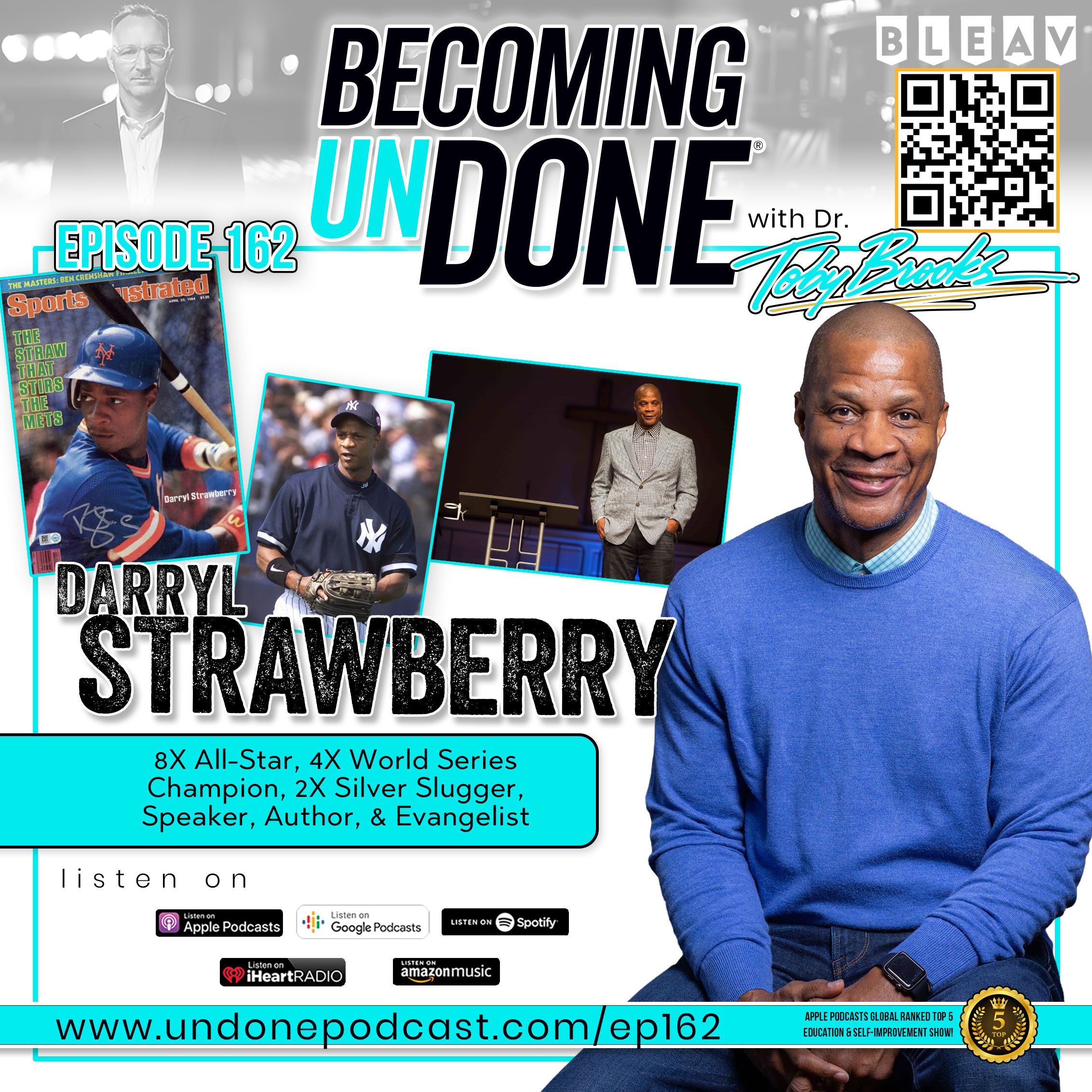
Becoming UnDone® with Dr. Toby Brooks
Darryl Strawberry: From Baseball Greatness to Personal Redemption Journey | 162
00:56:51
Darryl Strawberry, a legendary MLB All-Star and World Series champion, opens up about his tumultuous journey from childhood adversity to professional success, and the personal struggles that came with it. Dr. Toby Brooks explores Strawberry's path to redemption, highlighting themes of addiction, faith, and forgiveness. Darryl discusses the critical role of his wife Tracy, self-discovery beyond the baseball field, and the impact of divine purpose on his life. This episode delves into transformation, resilience, and finding hope amid the past's shadows.
Loading summary
Transcript62 lines
- [00:01]
A
Every team, every topic, everywhere. This is believe.
- [00:11]
B
This is becoming undone.
- [00:15]
A
I did not because of growing up in a very dysfunctional home, a broken family with a father being an alcoholic, and there was a lot of just dysfunction night after night, you know, him coming home drunk again and them for the final time. When I was about 14 years old, he comes home and pulls out a shotgun drunk and says he's going to kill the whole family. So me and my brothers went into action. And it could have been a tragedy that night had it not been for my mother getting us out of the house. And, you know, I always tell people brokenness is real. Trying to figure out life on its own as a man, what it is to be a man, what most of the time, none of us really know until we actually overcome a lot of things. But I had to go through this whole journey believing in myself to be successful, to play Major League Baseball, having a dream. When I was after my father was out of the house and saying this is what I wanted to do, I would say my pain led me to my greatness. See, pain is real. It can lead you into doing great things. My greatness would eventually lead me to my destructive behavior. Because of accumulating all this stuff, people think, well, it makes you well. Living behind community gates, having money, cars, homes, you would think all that would make you well. That cannot make you well. It just make you feel good for the moment. But being well is something that has to be delivered from on the inside. Hey, this is Darryl Strawberry, and I am Undone.
- [01:51]
B
Hey, friend. I'm glad you're here. Welcome to yet another episode of Becoming Undone, the podcast for those who dare bravely risk mightily and grow relentlessly. Toby Brooks, a speaker, author, professor, and performance scientist. I spent much of the last two decades working as an athletic trainer and a strength coach in the professional, collegiate and high school sports settings. And over the years, I've grown more and more fascinated with what sets high achievers apart and how failures that can suck in the moment can end up being exactly the push we needed to propel us on our path to success. Each week on Becoming Undone, I invite new guests to examine how high achievers can transform from falling apart to falling into place. I'd like to emphasize that this show is entirely separate from my role at Baylor University, but it's my attempt to apply what I've learned and what I'm learning and to share with others about the mindsets of high achievers. Welcome back. It's a hot one in Waco, Texas, today, and I'm excited to bring you a new episode. This one's been a long time coming, but I'm thrilled to bring it to you today. You know, there are some people whose accomplishments are so extraordinary that their names become inseparable from what they've achieved. Daryl Strawberry is one of those people. He was the first overall pick in the Major League Baseball draft, an eight time MLB All Star and a four time World Series champion. One of the most feared and electrifying power hitters of his entire generation. From the outside, he had reached the place so many special spend their entire lives chasing. But achievement can change your circumstances without healing your wounds. Behind all the home runs and the championships, the magazine covers, the roaring crowds, was a young man still carrying the pain of a violent and dysfunctional childhood. And as his fame grew, so too did his addiction, his broken relationships, legal troubles, illness, and questions about who he really was. When the uniform came off, Daryl told me that his pain led him to greatness, but that his greatness eventually led him toward destruction. It's a powerful warning for every high achiever who's ever believed that the next accomplishment might finally make us whole. But this is not ultimately a story about destruction. It's a story about redemption. Today, Darrell is no longer most passionate about discussing what he accomplished on the baseball field. Alongside his wife, Tracy, he travels the country sharing a message of faith, recovery, reconciliation and hope to people in churches, prisons, treatment centers, and communities that are desperate to believe another life is still possible. In this conversation, we talk about the emptiness that can exist beneath extraordinary success, the courage that it takes to make amends, the challenge of forgiving yourself, the loss of identity that comes when a career ends and why no one is ever too far gone to be restored. Daryl Strawberry's greatest victories didn't happen beneath the lights of Shea Stadium or Yankee Stadium or Dodger Stadium. That happened after the cheering stopped. I hope you'll enjoy my conversation with Daryl strawberry in episode 162. Let's get into It. Greetings and welcome back. Becoming Undone is a podcast for those that dare bravely risk mightily and grow relentlessly. Join me, Toby Brooks, as I invite a new guest each week, where we examine how high achievers can transform from falling apart to falling into place. Today, I'm honored to welcome someone whose story is known by millions, but whose greatest victories actually happened long after the final out. Darrell Strawberry is a four time World Series champ, eight time Major League Baseball All Star, and one of the most electrifying power hitters of the game. Remember Him? Well, from back in my childhood. He rose to superstardom with the New York Mets, helped lead championship teams with both the Mets and the Yankees, and he seemed to be living the dream that so many people spend their lives chasing. One of my earliest memories of Sports Illustrated was the issue with you on the COVID that April 1984, the straw that Stirs the Mets. It was one of seven covers that he would have on the magazine. But behind the home runs, the championships, the fame, was a man fighting a battle that no amount of success could overcome. Addiction, broken relationships, cancer, loss, and the search for identity. Today, Darrell's passion is not talking about baseball. It's talking about hope. Alongside his wife, Tracy, he leads Strawberry Ministries, encouraging people around the world with a message of faith, redemption, recovery, and second chance. Darrell, it is an absolute honor to have you joining today. Welcome to Becoming Undone.
- [06:07]
A
Well, thank you so much for having me, Toby. I appreciate you taking time out to reach out for me and sit down and let's just chop it up.
- [06:15]
B
Yeah, for sure. Well, I'm super grateful you're here. I've always believed that the most interesting people aren't the ones that never fail. They're the ones who survive the fall. And your story is one of incredible highs, heartbreaking lows, and one of the most remarkable stories of redemption, honestly, that I've ever come across. And I think there's something in that journey that somebody needs to hear today. So let's take it back to the beginning. I know you grew up in la. You graduated from Crenshaw High School before you were selected first overall in 1980 MLB Draft. What was Daryl Strawberry before all that? When you look back, you think about, did you have any idea about the journey that you were about to take?
- [06:56]
A
I did not. Because of growing up in a very dysfunctional home, a broken family with a father being an alcoholic. And it was a lot of just dysfunction. Night after night, you know, him coming home drunk again. And then for the final time when I was about 14 years old, he comes home and pulls out a shotgun drunk and says he's going to kill the whole family. So me and my brothers went into action. And it could have been a tragedy that night had it not been for my mother getting us out of the house. And, you know, I always tell people, brokenness is real. People don't know why people end up and the places they end up, because we don't really know what happens. We may look good on the outside, but the inside is really where it all counts. And from that point, my Father was never in our life again. So there it is growing up a young man without a father, without a male figure in the house. And so you have to learn all these lessons of life on your own. And I said to myself that no one was going to ever control me again like that. The way he controlled us, not only with just pulling out the shotguns, but, you know, the beatings and telling us we would never become anything. That's very hard for a kid when he's grown up and have to deal with those type of things. So you end up trying to figure out life on its own as a man, what it is to be a man, what most of the time none of us really know until we actually overcome a lot of things. But I had to go through this whole journey believing in myself to be successful, to play major league Baseball, having a dream when I was after my father was out of the house and saying this is what I wanted to do. Started watching baseball on television and watching the Dodgers growing up in LA and started seeing the Dodgers in the Cincinnati Reds playing. And I saw the Cincinnati Reds play. And I liked this one particular player and his name was Pete Rose. And I liked him because of Charlie Hustle, the way he hustled and the way he played. And I mean, the man uniform was dirty. And I said to myself, this is what a baseball player looked like. So that's kind of what led me into that direction of wanting to do something for myself and also do something for my mother from the pain that she suffered. Because the pain was, is always still there until you get set free from it, until you get restored.
- [09:19]
B
I'm going to jump in right here and pause for just a moment because it would be easy to hear the rest of Daryl's story and begin with the first overall draft pick, the home runs, the championships. But his journey didn't begin under the bright lights of a major league stadium. It began in a home marked by fear. When a child grows up in dysfunction, survival often becomes their first great skill. They learn how to read the room. They learn how to stay alert, how to protect themselves and others, how to become independent long before they probably are ready. Sometimes that pain can become fuel. Sometimes that pain creates a determination to succeed, to escape, or to prove every person wrong who made them feel small. And from the outside, lots of times that drive can look like confidence and ambition and greatness. But survival and healing aren't the same thing. You can outrun your circumstances without ever escaping what those circumstances placed within you. You can build a remarkable life and still carry that frightened child who first learned that the world wasn't safe. Darrell said his pain led him to greatness. But as we'll hear, greatness couldn't heal his pain. Perhaps that's the most important truth in his story. Achievement can reveal our strength, but it can't repair the parts of us we're still afraid to face. Well, I know it was a meteoric rise from the outside looking in. First overall pick in 1980. 84. You're on the COVID of Sports Illustrated. It was. Was quite an ascension. You're. You're an athletic, young, exciting player. Lots of people that would look at your story, they seem to believe that whether it's money, whether it is success in any way, like, if I could just get a little bit more, then I'll be happy. Yet your greatest struggles happened after. I mean, that's a tough upbringing, but you get all the accolades and the financial things that come along with that, the notoriety, the fame, and yet struggle landed at your door. So if your greatest struggles happened after the world said you would be happy, what is there for us to learn from that? What were those years of success like for you?
- [11:29]
A
Well, I would say my pain led me to my greatness. See, pain is real, and it can lead you into doing great things. But my greatness would eventually lead me to my destructive behavior because of. Yeah, accumulating all this stuff, people think, well, it makes you well. Living behind community gates, having money, cars, homes, you would think all that would make you well. That cannot make you well. It just make you feel good for the moment. But being well is something that has to be delivered from on the inside. I think it all looks great on the outside to everyone. And everyone said, well, you have everything. Yeah, I have everything, but I really have nothing. I just accumulated stuff. And I mean, the success was great because I wanted to play ball and I wanted to elevate myself to the highest level and that I had opportunity to do that because my father saying, I, I wouldn't become anything, but I wanted to prove him wrong. So I guess I proved that point by excelling so well at sports. But then the reality of life is still there. Who am I? I have accomplished all this stuff. I've won championships. And you have everything that everyone, every athlete or every person think is the dream of life. And that's why you see so many athletes fall through the cracks, because they accumulate this great career and everything. But who am I? A lot of us don't even know who we are because we've never deal with what really, what's really going on on the inside. And this is what I try to give to people, everyday people, it doesn't matter what you accompl is what's, what's going on on inside. Are you dealing with the real things, the real issues that are going to affect you somewhere along the line because the stuff wears off. And then what is your identity when that wears off?
- [13:33]
B
So much to unpack here, but this is incredible insight from someone who has been to the pinnacle of worldly achievement and yet still found himself struggling with the simple question of who am I? Darrell's childhood shaped him in a way that no reasonable person would have chosen. But the pain served a purpose, at least for a little while. Pain can become fuel. It can create ambition and sharpen our focus and drive us to accomplish things that we never would have believed possible. But fuel is not the same as healing. When our identity becomes organized around escaping our past, proving someone wrong, or ensuring that we never feel powerless again, success might move forward without ever setting us free. We can reach the destination and discover that the wound came right along with us. Eventually the question changes. It's no longer what can my pain help me accomplish? It becomes who am I when I no longer need my pain to propel me? Darrel had proven that he could succeed, but no amount of success could answer the deeper question for him. And that search for purpose would eventually lead him down some very dark roads
- [14:48]
A
when that wears off. And that's what happens to so many people. And I'm no different. You know, the high profile platform of playing in New York City and winning and at the top, if you can make it there, you can make it anywhere. That's what they say. And I made it there, but I still have not been completed yet. I just made it through a place of performing and achieving and still searching for the true identity of who I am.
- [15:24]
B
Yeah, well, I want to compliment you. You've been really forthright and vulnerable in sharing your story of addict. You've also had cancer. I mean, there's a number of things in your journey that would certainly lead someone to a crisis. I spent a lot of time studying what I call a purpose storm. Those moments when life feels like it's falling apart and it forces us to ask now who am I? Looking back, what was the moment when you knew that you had finally hit rock bottom, if not publicly, but just internally within yourself?
- [15:59]
A
I mean, there were so many moments of, of the rock bottom and I just didn't look at it. You Know, I ended up with so. So many different situations. You know, being incarcerated, that could have been one. Ended up in the Florida State Prison. I would have T17169 because of addiction. And that still didn't stop me after I got out, after I did 11 months, you know, and I still came out, and I struggled even more with it, with addiction, and hadn't let go of it because I hadn't really dealt with the broken pieces of. Of me on the inside. And I think that's what happened to so many people. We. We cover up everything with everything that we think is good. It may look good, may sound good, but it's a really good. At the time it is, but it doesn't set you free. So I go on this journey of struggles in my life, and then there's always. My mother always gave me this. It's not important to be important, but she gave me this message about people helping people. And that's how you really get to where you need to get to. And that's how I got to where I am today. Been here for a long time. It was because of other people helping me. When you're through the process of the addiction part. But then there was my wife, Tracy, that really came in, and she was the really turning point, you know, after two marriages, failed marriages, the third one, just like three strikes in the ball game, you know. You know, this time. This time I didn't want to strike out. So I made the right decision. I allowed her to come into my life, and she was the turning point. She was what? The point of where God would step into my life and she would lead me back into church, and then my life would change completely.
- [17:55]
B
Yeah, the. The baseball lover in me, you know, two strikes. Got to have an approach, right? Like you. You have. You've managed to step to the plate and. And you have an approach now for sure. You've said. I've read a lot of your writing. You've said God didn't just save your life, that he transformed it. For somebody that's listening today who's convinced that they're too far gone or they've made too many mistakes, they've hurt too many people. What advice them to hear coming from you?
- [18:25]
A
No one is too far gone where God cannot reach you because he created you. And. And that's part of the learning lessons that we have to learn for ourself. And it's not until you actually dive into, you know, his will for your life, and then you will find out the purpose of why you're here. There's a great purpose for every last fun of it. And it had nothing to do with baseball. That was just a platform. The other part of who you are is to be used by him, you know, once you submit yourself to him. And, and that's what I had to go through. I had to go through this long journey of discipleship and, and, and studying and learning the word of God and, and sitting. You know, I sat for seven years. Like I say, a lot of people can't even sit for seven minutes without trying something else to try to fix themselves. So it's, it's what you call discipline. You know, I discipline myself in, and being with God. And then he transformed me from the inside to the outside. That's what I look like on the inside more than with the outside because outside can look great. But what is your inside really all about? And that's where the transformation comes in. And he does a work inside of you and he sets you in a position to be a vessel for him to encourage people. No matter how far you have fallen down, he still can pick you up and use you for his glory. And that's what most people fail to realize. You can be used. It doesn't matter what you've done and where you at, right where you at. Even behind a prison gate, what places I go, you still could be transformed. Because at the end of the day, that's his greatest gift is, is to transform us and bring your story from the mess to the message to help somebody else.
- [20:22]
B
We'll be back after this quick message. Have you ever looked in the mirror and thought, what in the hell just happened to my life? When the career shifts, when the relationship ends, when the identity you've built your whole life around disappears overnight, that's not failure. That's what I call a purpose storm. Most high achievers aren't prepared for it because no one ever taught us how to train for a comeback. I'm Dr. Toby Brooks and I built the science of the comeback for people who refuse to stay broken. Inside the app you'll find research backed resilience training, daily prompts and guided reflection tools, performance psychology frameworks, identity rebuilding exercises and personalized structured pathways to move from burnout and confusion to clarity and momentum. It's not hype, it's neuroscience. It's performance science and it's hard won experience. If you're listening to becoming undone, I created a special offer just for you. For the next three months, you can get full access for just 49 bucks for an entire year or just 5 bucks a month with no obligation. You can cancel at any time. That's less than the price of a cup of coffee to start rebuilding your life on purpose. Your comeback isn't accidental, it's intentional. Start yours today@scienceofthecumback.com yeah, that's so well said. I'm reminded of several guests I've had on this show, whether they're former military. I've had Navy Seals, you know, high level Olympic athletes, NFL, mlb, Grammy award winning artists. Different in all walks of life, but a consistent story about what? Being at that summit, being at that mountaintop. You are one of the most recognizable figures in all of sport at the, at the peak of your career. But a lot of times it's performative. You know, you are Darryl Strawberry the man. Or are you Darryl Strawberry the baseball player? Are you Darryl Strawberry the celebrity? Talk me through what that kind of peak of your celebrity was like for you internally. Maybe the things that people wouldn't have known about you in that moment, in that season.
- [22:31]
A
Well, I'm just Daryl Strawberry the baseball player with a man with a uniform on. And the uniform belongs to the Mets, Yankees, Dodgers, Giants, whichever uniform you wear. So the identity of who you are is existent athlete. But you always question yourself and well, me personally, I did. Well, who am I? You know, what's the purpose of this? Because I can do all these great things and have this ability to excel at such a high level and perform and people cheer and people boo and you go through all these, you know, different levels of things and you're still trying to figure out who are you and what's, what's the reason for life. You reach that point when you get older and realize at some point that sports is going to be over one day, uniform is going to be off one day. Now you truly have to find out who you are. You have to identify yourself. Not I'm not what I used to do. I am who I am today. And I've identified myself at a whole different place of, you know, being set free and, and being rescued, redeemed and restored and being able to share the true meaning of life to people. That you can go through things, but it doesn't mean your life is over. You still have the ability to allow your life to be changed, to go back and really be able to encourage and help the multitude of people. Because when we live in the culture we live in, there's a lot of brokenness out there and people are searching for so many things to try to make them well, if I had just a little bit more of this, a little bit more that. Know if you truly find Christ in your life and find peace in your life, then you will become the person that you always wanted to be. That's what I sit here and feel about myself today. It's not that I try to throw my faith on anybody. It's just what I always wanted to be. This is what I was looking for when I was playing baseball. I saw it in other players, but I just wasn't doing what they were doing. And I was always doing the opposite. And when you're doing the opposite, there's consequences behind your actions. When you're doing the opposite of what you really need to be doing.
- [24:58]
B
Consequences. Darrell mentions the word more than once. He's a man who's been to the top and stayed there for a good long while. An otherworldly talent who came from a tough upbringing in LA to the brightest lights of New York City early in their careers in the 1980s, Daryl Strawberry and his teammate Dwight Gooden seemed to represent the limitless future of baseball in New York. They were a new generation. Darrell was National League Rookie of the year in 1983, and Gooden followed with the same honor in 1984. Just one season later, and at only 20 years old, he won the Cy Young Award after one of the most dominant pitching seasons the game had ever seen. They were two bright stars on the same roster, both destined for greatness. They weren't just successful. They were young and brilliant, famous, seemingly destined to define a whole new era. The talent doesn't exempt anyone from consequences. Both of them were carrying things that applause could kind of conceal, but it couldn't cure. And when pain remains unaddressed, destructive choices rarely stay isolated. They compound. One decision creates another. One secret demands another. Eventually, what begins as escape starts taking things away from us. For Darryl, those consequences touch nearly every part of his life. Addiction, suspensions, broken marriages, legal troubles, health care with cancer, probation violations, and eventually prison. That's the difficult truth about consequences. They don't care how gifted you are. They don't disappear because your intentions were good, because our pain was real, or because we once stood at the top of the world. But consequences don't have to be the final chapter. Darrell's turning point wasn't another comeback at the plate. It was finally becoming willing to confront what was broken within him. With third wife Tracy's persistence, a return to his faith, years of patient discipleship, he stopped trying to escape his pain and began allowing it to Be transformed. He couldn't undo everything he had done. None of us can. But he could take responsibility. He could make amends. He could become a different husband and father and man. And he could use the very story that once brought him shame to carry hope into churches, treatment centers, prisons, and into the lives of people who believe they've gone too far to come back. Consequences may explain where we are, but they don't have to determine who we become. I know what I've read of your story. Certainly there were seasons of tremendous setback, drug addiction and the incarceration, those types of things. And certainly a story of redemption. I've watched videos of you speaking at churches and sharing with others about what this journey has done. But one thing I don't think we talk about enough is self forgiveness. And a lot of times in Christian circles it's easy to believe that God forgives us. At least this has been my experience. But yet harder still for us to forgive ourselves. Talk to me about that. Was that part of your journey? Have you done work with reconciling with perhaps the people or the things that you've done in your past that might have led others to pain?
- [28:14]
A
Of course. I think that's the most important part of it. You have to go back and extend that to others and ask them to forgive you. That's how you forgive yourself. Because we have wrong someone too wrong don't make a right. And I think a lot of times that's what people think was their fault. They did this to me and I did this. But we both did something. It's the one that has the courage to go back and say I'm sorry, I'm wrong. And I did that with my first wife. I did it with my second wife. I made amends to them and told him, told them. And then I went and extended it to my father too. Even even though the fact that he may have been wrong, I was wrong too for keeping him out of my life, in my career and not knowing his grandkids. So that's pretty selfish of myself. So that doing all that, that's how you get free and that's how the freedom comes. And I think a lot of people don't ever experience that because of freedom. Guess what? They always holding somebody else hostage for what they have done. And we always forget that we have done something too. And self forgiveness only comes when you release other things that you have done to others.
- [29:32]
B
Yeah, otherwise it's just kind of a get out of jail free card. I mean you have to do that inner work in order for that to really matter. I recently encountered a. I think it's a Hawaiian tradition where we share with others. Thank you. I love you. I forgive you. Will you forgive me? And it's such a simple, concise way of reconciliation and how it can be used to connect us to others. Selfishly, I'm an athletic trainer. I worked briefly in minor league baseball, worked in the NFL. This is kind of an oddball question, but what's the best memory you have of an athletic trainer in your life back in your playing days?
- [30:12]
A
I think the best thing I could say about trainers is they keep you, they keep you well. And that's the most important thing as an athlete is staying well, staying healthy. And I was one of those guys that they kept me well. I stayed away from a lot of injuries because of that, the stretching and, you know, just the different things that they do to take care of you, take care of your body because your body goes through a lot. And if you don't take care of it and you don't allow the trainers to help you through that process, you're going to find yourself having a lot of injuries. And a lot of guys end up with a lot of injuries because they don't do enough with the trainers. And I was always grateful for the fact that I can go in and allow the trainers to dig into those knots in my shoulder or neck or back because I needed to get them out. Because of running out there every day, it's physically hard on your body. And I think most people don't realize how important trainers are. They're more important than sometimes the coaches. The coaches are great, but if you're not healthy, the coaches can't help you. So, I mean, I always looked at the trainers as the person that's going to keep me on the field and keep me going. Right?
- [31:32]
B
Yeah, that old adage, can't make the club in the tub. Got to get right to stay right again. We're talking with eight time all star, four time World Series champion, Daryl Strawberry. Daryl, the name of the show is Becoming Undone. It really came about, you mentioned broken pieces earlier and it came about with this idea that sometimes life can break us and we're pulled apart. It's like we've been undone. Right? And where the true meaning and the purpose in our life is when we realize that we've got something left unfulfilled, a purpose left undone. So when you hear that phrase becoming undone, what, what would that trigger within you? What's that mean to you personally? To become undone.
- [32:12]
A
I'm grateful because it's all part of life, it's all part of the journey that everyone that comes here is going to have to go through something. You're going to have to face some challenges, you're going to have to face some adversities. And if you can't deal with them, you can't overcome them, you will become undone. It will defeat you. And I think that was the most important thing that I learned is even though I'm going through some things, you don't quit because you never know what the miracle could be on the other side. I think everything here in life that we have to go through is part of the lessons that we have to learn. And I think a lot of times people don't want to learn the lessons and they, they give up as those that don't give up are the ones that win. And I think that's why I'm sitting here today in the winners chair of life is because I didn't give up. Yes, I went through a lot of things publicly, but the platform I have now publicly is greater than what I went through. And so that's why I would encourage people, don't ever allow yourself to say, well, why me? Why not me? Because you never know what your victory will turn into. And when you do receive your victory of life now you're able to help the multitude of other people for those that are struggling out there.
- [33:48]
B
Yeah, well, we'll definitely get to what you're doing today. But before we go there, you went from first overall pick and this meteoric rise and, and a lot of athletes, they might know when their contract is up, but you don't necessarily know when it's really going to end and kind of way leads to way you find yourself playing minor league ball. Talk me through the latter stages of your career and what that was like for you psychologically as you were kind of navigating a career that had kind of peaked and was headed toward its end.
- [34:22]
A
I mean, I was kind of okay due to the fact that because I had such great success and I had achieved a lot and that's the, that's the main goal of, of getting into playing sports is to be able to achieve and excel and everybody's not going to have that and everybody's not going to feel probably the way I was at the time when it was coming to down to the end part of it. And I kind of knew I was there at the end and realized that I was going to have to do something different. I was going to have to start over in life and I was going to have to reinvent myself. And I think a lot of athletes don't do that. They don't, they don't take the uniform off, they keep the uniform on. The uniform I had to remove from myself and I had to, I had to step up and become a man, a real man, you know, which I talk about. I had to become a husband, I had to become a father. Because a lot of times when you're playing, you think you're a husband, you think you're a father, but most time your focus is always on what you're trying to achieve. And once you have done that, you realize that it's over. Now next I have to cross over into a new life for myself and become a much better person than I was when I had a uniform on.
- [35:41]
B
Yeah, I've had guests talk about they ended their military career and they go from being, you know, this, this high ranking person in the military on a Friday to just being a citizen on a Monday. And that's really stuck with me. And I've heard this from athletes like you go from being this superstar on one day to just being air quotes, just being, you know, a regular non athletic person. Did you have a take the jersey off kind of moment? Was there, was there a, a grieving or a separation from that athletic identity or were you on to that next thing?
- [36:22]
A
I don't think it was a grieving. I think it was a reality, you know, that the day is finally here and now I need to learn how to deal with life on life terms. And it's a struggle. It's not easy. It wasn't easy for me. It's not easy for anyone at any level. The military or whatever, wherever you at, when you have to say goodbye to something that you have been a part of for a very long time, but at the same time you still have life left. Have you been through things? Yes, of course. But that doesn't mean it's over. Are you still alive? Are you waking up every day? Yes. So that means you have to either enter into life or stay in a place of grieving and never getting over what could have been or should have been. It's supposed to be what it's supposed to be. I think every, every got to realize that at, at some point in your life, everybody's not going to make it to say the hall of Fame or everybody's not going to make it to the top of this, but you have achieved and you still have Breath inside of you. You still have life inside of you. You still have something to give back because of all the things that you've experienced in life are right there for you to be able to share with somebody else. And I think a lot of times people miss that point because people are paid to be vulnerable and let people know that they've been through some things. And that's how you help people when you share that you have been through the fight and now that you not a victim. I didn't sit here and I didn't have a victim mentality of what I went through. I want to become an overcomer. So I had to fight for that and work on that to become an overcomer. And I did.
- [38:15]
B
Yeah, I love that. And it's true. I've seen evidence of your work over years. So with that said, talk to us a little bit about what you're up to today. I think you've got a new book coming out. Where can people connect with you and follow along to the work that you're doing?
- [38:30]
A
Well, I do have a new book coming out, Another Life, which I'm excited about. It's my last book. I didn't really want to write a book, but the Lord wanted me to write this book because to show people that you can have another life. You can do something different than what you've done in your career. And that's what Another Life is about. It's about going into different communities with my writer and helping people in the communities help young people overcome drug addiction and the struggles that they are and sharing with them and telling them the stories of how it is a dead end, where it leads you to going into the prison, going into death row, not trying to change anyone, but going in there and bringing love, the love of God into people life. I have it in my life because of everything that I experienced in life brought me to this place and brought me to the place of God calling me, calling me to preach the gospel and never going to school. I mean it could meet you right where you at. And I think a lot of times people don't think that could happen. It happened to me, it happened to so many others. And you have a message to carry. Not for yourself, but for God and people to show that his grace is sufficient no matter what you've been through. I'm prying example of that. And you know, if folks want to follow me, you, you can follow me on Darryl Strawberry18, my Instagram. You know, I. I try to create positive affirmations for people to Help people and encourage people and show that once upon a time I was down in the pit and God took me from the pit and put me into the pulpit. The priesthood's message, which is the good news, the gospel, to bring love to people. Love that.
- [40:16]
B
That's so well said. I'm rolling this one out just for you. I'm 160 plus episodes deep in the show, but I've never done this before, so bear with me. This is rapid fire. I'm just gonna list a question. I want you to just give me whatever comes to mind. You ready?
- [40:33]
A
Yeah, we're ready.
- [40:34]
B
All right. What's something people would be surprised to learn about you?
- [40:37]
A
That I'm very humble.
- [40:39]
B
Awesome. What makes you laugh every single time?
- [40:42]
A
My kids.
- [40:42]
B
If you weren't a baseball player, what do you think you would have been?
- [40:45]
A
That's a good one. I don't. I really don't know because I never, never thought about that.
- [40:49]
B
What's one thing you're terrible at?
- [40:51]
A
Golf.
- [40:52]
B
Right there with you. What's something that your wife Tracy teases you about regularly?
- [40:57]
A
She doesn't really tease me about it. She's just. She always encouraged me more than anything because I'm always, always laying around and just lazy, you know, being lazy.
- [41:09]
B
What's one guilty pleasure TV show that you're watching right now?
- [41:12]
A
I don't watch it. I watch the Big Bang Theory every night. Every day. Love it.
- [41:19]
B
That's a great one. Last one. What's one thing today that 25 year old Daryl Strawberry would never have believed about the man that he's become?
- [41:28]
A
I would never believe that I would be called and have a platform to stand on and preach God's word and never been to school. He called me completely where he called me from and qualified me to do it. That's pretty amazing. I would have never thought of that at the age of 25. But that's where I would be from the career and the trials and the tribulations. But God takes all that and he uses all that for his good.
- [41:54]
B
Well, Darrell, I want to thank you so much. You're doing great things. I watched the, all the smoke with you and you know, just the, the platform that you've built. I always say this. A lot of my guests, you wouldn't have chosen the path that you had to go to get there. But that's made you uniquely a one of one. You're. You're able to, to speak to things that other people can't. So I really want to applaud you for that. Last one that I ask of all my guests. If we were to watch a montage of your life, what song would you pick to play in the background? And why.
- [42:28]
A
Oh, what song will I pick? I don't know. I'm just.
- [42:35]
B
It's.
- [42:36]
A
It's hard to. Hard to pick a song now, you know, because I'm. I'm more. More into faith than, you know, I was just. I would. I would pick a song that I've been something like. I've been redeemed. So I'll shake off these heavy chains
- [42:54]
B
Wipe away every stain I'm not who I used to be I am redeemed
- [43:07]
A
A song like that more than anything because of, you know, everything that everybody saw. And my life has been, you know, really transformed and redeemed to stay on the platform and, you know, to love. Love people and bring hope.
- [43:22]
B
Yeah, I love that. What was your go to walk up back in the day?
- [43:26]
A
I did not have a go to walk up. I just wanted to walk up, and I want to get. I wanted to get busy. It wasn't really allowed to walk up.
- [43:33]
B
Songs do the job.
- [43:34]
A
Yeah. Yeah. It wasn't really a lot of walking
- [43:36]
B
songs before that era, huh?
- [43:38]
A
Yeah, it was just kind of really think about the. I didn't really think about. Think about a song or anything like that. I thought about just taking care of
- [43:45]
B
business, just doing the job. I appreciate that.
- [43:48]
A
Hey, this is Daryl Strawberry, and I am undone.
- [43:57]
B
Daryl Strawberry's story is easy to understand if we reduce it to either side of the contrast. It's not simply the story of a baseball superstar who lost his way. And it's not the story of a broken man who found his face. It's the story of what can happen when extraordinary talent carries unresolved pain into extraordinary opportunity. It's a reminder that success can amplify what's already inside of us, but it can't heal it. Fame can introduce us to the world without ever helping us understand ourselves. Daryl reached nearly every height his sport could offer, yet the most important work of his life only after he was willing to confront the consequences of his choices and the wounds underneath him. What stands out to me the most from his transformation was not instantaneous. It required humility, discipline and accountability and reconciliation. Years of sitting still for long enough to become somebody different. He couldn't rewrite his childhood. He couldn't reclaim every lost opportunity to erase the pain that his choices caused. But he could decide what those experiences would become. They could remain evidence of his destruction, or eventually, they could become instruments of redemption. Today, Darrell's no longer relying on a uniform, a stat line, or a championship ring to tell him who he is. He's found identity in something deeper, and he's using that platform that baseball gave him to reach people in places where applause rarely finds them. His story reminds us that consequences are real, but they aren't always final. Our worst decisions may become part of our story without being allowed to write its ending. There may still be another life ahead, not a return to who we once were, but an invitation to become who we were always meant to be. Daryl Strawberry is still becoming, and so are we. I'm thankful to Daryl for dropping in, and I hope you enjoyed our conversation. For more info on today's episode, be sure to check it out on the web. Simply go to undonepodcast.com ep162 to see the notes, links and images related to today's guest, Daryl Strawberry. Before we get into this week's recurring spots, I want to tell you a couple of things that I think are super important. First of all, we got picked up by the Believe Podcast network. I'm super excited about this, so you'll notice that logo in all the episode artwork. And when you go to the show, that's the culmination of more than three years worth of work. So I'm excited about potential guests and collaborations that are to come. But I wanted to announce that to you today. Super stoked about. Also, I want to tell you about something that I think is going to be genuinely useful for you. I've put together what I've called the State of your life survey. It's a free assessment, takes just a few minutes to complete and it'll give you a real honest look at where you actually are across key domains of your life. Not where you think you are, not where you want to be, but where you actually are right now. When you complete the survey, you'll receive a free personalized in depth assessment report via email from me personally specific to your results, your situation, your life. Simply go to drtobybrooks.com assessment I'll put the link in the show notes, but go do it. It's totally free. It's fast. Might take me a couple of days to get back to you. It's not a faceless, mindless survey. I actually do the work of creating that for you, but I'll get it to you, I promise. Next up, some quick updates about the show. We are currently at number four in the world in Apple for self improvement, number five in education, and number 143 overall in Apple's top 200. Those mark either ties or new all time highs. If you'd like to keep tabs on how we're doing in the podcast rankings, Simply go to undonepodcast.com rankings cheer me on. If you enjoy the show, the single biggest, best thing you can do is share the episode with a friend or leave a rating or review. Every one of those helps more than you know. Now it's time for this week's Teal of the Week. This week we're heading to Southeast Arkansas to recognize the seaark Sharks. Now, I will admit that my process for selecting these teams is not particularly scientific. There's no committee, there's no advanced analytics, no complicated scoring system. I see a teal team, I order their stuff. Mostly I just see teal and immediately decide that these are my people. And so the Sea Ark Sharks absolutely understood the assignment. Teal Sharks cool logo. Honestly, at this point I'm not sure whether I'm highlighting sports programs or just slowly assembling some kind of teal colored aquatic army. Either way, the Sharks are in so a big Becoming undone shout out to the Sea Arc Sharks. Keep competing, keep building, and most importantly, keep making highly defensible color choices. Sea Arc Sharks this Week's Teal of the Week. Reminisce okay, a new spot I'm adding this week is called Reminisce. I've long asked my guests what song they'd play in the background of a montage of their life and why, but the truth is, I personally didn't really have a great answer of my own. And that changed this weekend. My wife, Christy, and I helped our daughter Brendan with her move out of Lubbock to Fort Worth, where she'll be starting a master's degree in opera and vocal performance in the fall. Now, with the exception of her freshman year of college that she spent in Norman, Oklahoma, at the University of Oklahoma, Brynn's been in Lubbock ever since she was in second grade. It's been home for my family. And this move out is one more change in what has felt like an endless stream of changes from me over the past two years. So yesterday I was trying to impart some fatherly wisdom and inspire my girl before I left her essentially alone in a new city. I said something to the effect that as long as you stay focused on the good that lay ahead of you, you won't get dragged into the sadness of what now lives behind you. But even as I was saying it, I realized my error we don't and shouldn't be so future focused that we neglect or ignore the past. We celebrate it. So I thought it might be fun to build out a recurring spot to honor my old memories in a new weekly recurring section called Reminisce in honor of the song I now know for certain that I would pick as the backup to the montage of my life they reminisce over you by Pete Rock and CL Smooth so this week it's probably fitting if I reminisce and tell you a little bit about how I first fell in love with the song. I ordered the CD either from BMG or Columbia House. I can't remember which. They were pretty much interchangeable tangible at the time. If you're old enough, you remember it was one of those CDs for $0.01 deal. I didn't really have MTV consistently, so my criteria for ordering discs, I pretty much just ordered everything that those two places had in their rap and R B sections. This particular CD came out in 1992, which was my junior year of high school. I torn my ACL and I'd had surgery. I was laid up in bed, pretty much just pouting and sulking about how my season was over and whether or not I would ever recover. Then I got two CDs in the mail that changed the trajectory not just of my mood, but my whole recovery. One was Third Base's Derelicts of Dialect and the other was Pete Rock and CL Smooth and their disc Mecca and the Soul Brother. I've used third bass and their song Word to the Third in my podcast, and until now I haven't used reminiscent. One day I was out in the garage working on my truck. I was laid up under the dash messing with some wiring, and I had Pete Rock that CD that I just gotten not long before I was playing it loud. Those horns and the drums of Reminisce, they're just perfect. I remember this for a spell. So I'm working away. It's a metal pole barn, right? And the music is so loud that the sheet metal of the building is buzzing and rattling along to the base. To this day, this is how I like to be in my element. 40 acres, hundreds of yards between me and the neighbors who I might be bothering with my loud music. And my music turned up very loud. So while I'm under the dash, unbeknownst to me, my dad comes out and he goes straight to the stereo and immediately turns it down and he says, what is this? Shaking his head in disgust. I'm sure I didn't see it, but that's, that's probably what happened. Now in his defense, I had had reminisce on single track Repeat on my CD Boombox for at least 45 minutes, maybe an hour at that point. I loved this song, but to everybody else it probably felt like some sort of 90s Waco style ATF induced audio torture. So kind of surprised and jolted out of what I was doing by the sudden silence and my dad and just now realizing he was in the shop, I reflexively barked back, that's the good shit dad, turn it back up. He laughed and he shook his head and he turned it up a little bit, but not as loud or as good as I had before. Now I've heard my dad say thousands of cuss words in my life, but I'm pretty sure that's the first time I can remember him hearing me say one. So that's this week's Reminisce Mailbag. Now it's time for something else new here at Becoming a Nun. The Mailbag. One of the best parts of doing this show is hearing from people on the other side of the microphone. Your messages, your questions, your reactions and stories remind me that these conversations don't end when I drop a new episode. So each week, if there's enough, I'm gonna pull a few notes from listeners and share them here. Some may be thoughtful, some may be encouraging, some may challenge me. Either way, I'm here for it. So let's open up this week's Becoming Undone Mailmag. First up, I got a text from former Cooper Pirate, Jackson State Tiger and Colorado Buffalo Long snapp Jacob Palit. Jacob says, quote, listening to your podcast, man, it's super cool. I'm very appreciative of you and your support. Critical times in my life, end quote was part of a cool program that the Lubbock Cooper High School had back in the day where I got to be a mentor for Jacob and it's been thrilling to see the fantastic things he's gone on to do. So to that I thank you Jacob. Keep being awesome and let me know if I can ever help help you. Next up, I got a message from Arizona State Professor. Never met him before. Gabriel Shivey sent an email connecting me to his longtime friend Steve Gobriel. Gabe writes, quote, I continue to enjoy and be inspired by your podcast. All the best and keep up the amazing work. End quote. Thank you Gabe for the connection and for the support. Next up, I got a LinkedIn message from athletic trainer Cherie Baldwin Colson among other things. Cherie rides Quote I've been following you on LinkedIn and listening to Becoming Undone recently. Some of your content has truly resonated. I'm an athletic trainer currently at a crossroads in my career. Thank you for what you're doing for our profession and others. End quote. Sincerest thanks Cherie, and I'm here to help if you need me. Lastly, from my friend in Coastal Carolina baseball, athletic trainer Tanner Costein. Go Chance soon to be a Teal of the Week. I got a text with a screenshot of his podcast rankings. Quote Been on a Becoming Undone King kick. You're officially number one on my podcasts list. End quote Tanner, you're officially number one on my favorite fan list thanks to that little note of encouragement. That's it from the mailbag. If you have a question or comment, reach out. I'd love to hear from you whichever way you prefer. Text email tobyndonpodcast.com DM me on any of my socials. I'd love to read your message on the air and honor you for inspiring me. Thanks to this week's crew, Jacob, Gabriel, Cherie and Tanner. Coming up on the show, I've got the millionaire next door, former occupational therapy faculty member Dr. Matt Getty. Be taking a week off for some family time at the end of this month, so I'll see you back here in August. But stay tuned. This and more coming up on Becoming Undone. Becoming Undone is a night trap, creative production and a proud member of the Believe Podcast Network. Written and produced by me, Toby Brooks. Intro and outro music by Mark Payne. Tell a friend about the show and follow along on Facebook, Instagram and LinkedIn at becoming undone Pot and follow me at Drtoby Brooks on Facebook, Instagram and LinkedIn. Check out my link tree at linktr.ee Dr. Toby Brooks. Listen, subscribe and leave a review on Apple Podcasts, Spotify, iHeartRadio or wherever you get your podcasts. Till next time, everybody. Keep getting better.
- [57:00]
A
If you like the show, please take
- [57:02]
B
a moment to rate, review and subscribe. It really does help the show to grow. Thank you for listening.