Podcast
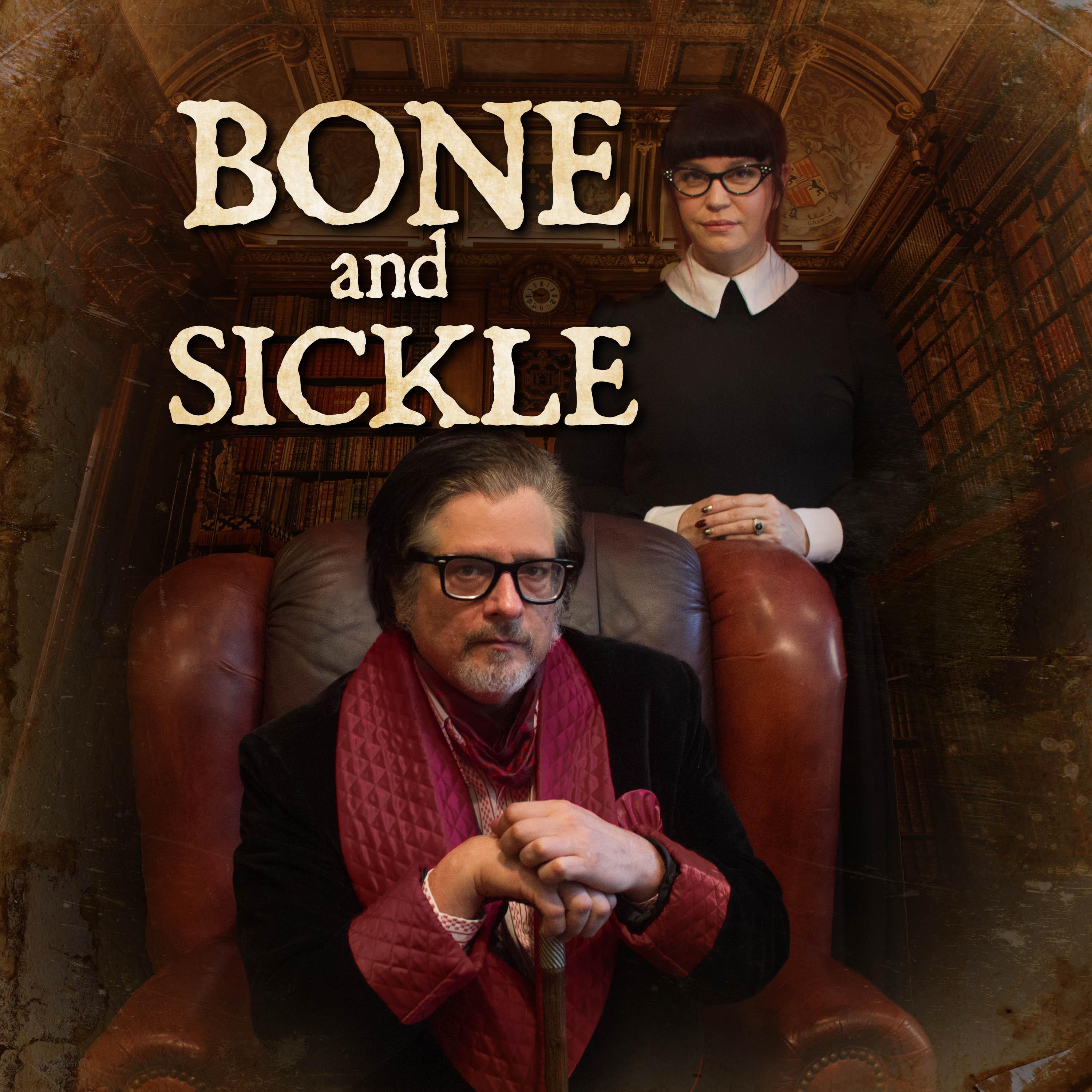
Bone and Sickle
Hosted by Al Ridenour · EN
BONE AND SICKLE explores historical topics related to folklore and horror. With acerbic wit and a scholarly penchant for the grotesque, rogue folklorist Al Ridenour delves into a wide but carefully curated range of topics illustrated by stories from historical texts. Narratives are given dramatic readings by “Mrs. Karswell” (Sarah Chavez) backed by richly produced soundscapes blending original music, sound design and effects. The source books, though real enough, are said to be pulled from an imaginary library on Ridenour’s imaginary estate situated somewhere in the neighborhood of Charles Addams and Edward Gorey. Each episode begins with our hosts briefly discussing goings-on in this world before diving into the topic to be explored. Occasional alternate-format episodes are devoted to readings of classic horror stories or curious texts of antiquarian interest. Ridenour is the author of “The Krampus and the Old, Dark Christmas” (2016) and “A Season of Madness: Fools, Monsters, and Marv
24episodes
Episodes
Newest firstAll episodes
Spirit Boards
Oct 17, 202400:38:37Tap to summarizeOuija boards, or more generally, “spirit boards” have antecedents going back to the very first days of the Spiritualist movement. We begin our show with a seasonally spooky visit to the cottage of the Fox sisters in Hydesville, New York, where the ghost of a murdered pedlar supposedly began communicating with the family through a series of mysterious knocking sounds. While the method used by the Fox sisters to translate these knocks into messages anticipates the process of pointing out letters on a Ouija board, the evolution of spirit boards was not so straightforward. We learn how the planchette, used on board as a pointer, appeared long before any boards were printed and was initially used as a writing device. It was equipped with a pencil inserted through it like a third leg. As the planchette was guided by the user (supernaturally and/or unconsciously), “spirit writing” was produced. We next hear from a number of contemporaneous accounts describing the pencil planchette as if it were inhabited by a ghostly presence and how these devices first appeared in Paris and London. Once imported to America, the homeland of the Spiritualist movement, merchants in Boston and New York did brisk business in producing versions of their own. By the 1880s, the planchette was finally beginning to be used as a pointer, and W. S. Reed Toy Company of Massachusetts became one of the first merchants to produce boards printed with letters. Reed’s model was known as the “Witch-board.” Along the way, we hear of an unexpected connection between President Grover Cleveland and Witch-boards. We then go to Baltimore, where former fertilizer salesman Charles W. Kenner partners with attorney Elijah to create their own version of the ghostly spelling board, one they name Ouija. Lore around the naming of the board (through a seance) and peculiar happenings at the US Patent office in Washington DC are discussed along with the passing of rights to manufacture the novelty to William Fuld, who manufactured the Ouija board from 1897 to his untimely death in 1927. We discuss the phenomenon of “Ouija-mania,” which generated a number of songs and (questionable) literary works. Ouija-mania also generated a certain degree of misery among unstable users. Several absurd and tragic stories from newspapers of the day are read by Mrs. Karswell, and we close with a particularly dramatic story told in a letter preserved in the William Fuld archives. It conceives of the Ouija as a tool of the Devil, something we will explore more in our next episode.
Transcribe →Announcement Trick-or-Treat By Mail
Oct 9, 2024Tap to summarizeA special short announcement regarding the October 20 deadline for Trick-or-Treat-by-Mail for listeners joining our Patreon. Find out how you can receive a hand-packed candy bag from the home of Bone and Sickle Podcast. Each bag this year contains a special MYSTERY ITEM from Egypt! Visit: https://www.patreon.com/boneandsickle
Transcribe →“Young Goodman Brown”
Sep 21, 202400:45:10Tap to summarizeWe’re getting into the spirit of the season with a classic tale of witchcraft set in 17th-century Salem Village, Nathaniel Hawthorne’s short story, “Young Goodman Brown.” Written in 1835 for New England Magazine, it later appeared in the 1846 collection, Mosses from an Old Manse, which also includes the excellent supernatural story, “Rappaccini’s Daughter.” Hawthorne regarded “Young Goodman Brown” as his most impactful short story, and it received high praise from his contemporary, Edgar Allan Poe. Two more Halloween-themed episodes (historical explorations) await you next month.
Transcribe →Hellfire Clubs, Part One
Mar 30, 2022Tap to summarizeThe Hellfire Clubs of 18th-century Great Britain were gatherings of upper-class libertines dedicated to hedonism, blasphemous jests and taboo activities expressing a cultural and political opposition to the Church. They were also the subject of lurid rumor and legend. In this episode and the next we attempt to tease out Hellfire Club fact from folklore. We begin with a nod to the Hellfire Club of pop culture: a clip or two from a 1966 episode of the British espionage show, The Avengers, which imagines a Hellfire Club recreated in swinging London. As a bit of context to the discussion, we then consider 18th-century Britain’s mania for forming clubs and fraternal orders, including London’s Kit-Cat Club, Beefsteak Clubs, and the Calf’s Head Club, the last celebrating the execution of Charles I with stunts and feasts organized around a calf head representing that of beheaded monarch. We also take a moment to consider the “rake,” (from the word “rakehell”) a distinctively 18th-century breed of aristocratic hell-raiser dedicating himself to womanizing, drinking, and gambling. Hellfire Club members were drawn almost exclusively from this class. Broadsheet representing London Hellfire Club ca 1721 History’s first Hellfire Club was founded sometime around 1720 by Philip Wharton, 1st Duke of Wharton. His case seems to be one of the apple not falling far from the tree, as we hear of some outrageous incidents of church vandalism in which is father, Tom Wharton, engaged. While father and son shared anticlerical sentiments, young Philip’s rebellion against parental expectations allied him with the very Jacobites battled by his father, and resulted in a secret engagement to young girl beneath his class, as well as a stunt involving a bear cub. Wharton’s connection to the Hellfire Club, (like what we know of the club itself) is extrapolated from rumors circulating in the popular press of the day. We hear some examples of this, claims about “Holy Ghost Pie” blasphemy at taverns, members serving diplomatic functions in hell, and the like. However much the press tended to fictionalized the group, it was real enough to have drawn the ire of George I, who issued an edict in 1721 against the formation and meeting of clubs dedicated to blasphemy. Public opinion so strongly associated Wharton with such groups, that when the edict cae before the House of Lords (where he also served), he found it necessary to address the rumors, denying that they could apply to him, but at the same time voting against the measure. Little mention was made of the Hellfire Club after this, and it seems Wharton redirected his interest to Freemasonry going on to become to Grand Master of the Premier Grand Lodge of England. However, his obstreperous nature soon saw him booted from this organization. Thus inspired, he went on to found another order, the Gorgomons, one which instead of mocking the Church, ridiculed Freemasonry. We hear a bit about that group from the text of organization a comical pamphlet illustrated by William Hogarth. Dublin also was home to a Hellfire Club, founded in 1735 by Richard Parsons, 1st Earl of Rosse, an English-born member of the gentry of Ireland. More specifics are known in the case of this club, including core members (rakes all!) who are represented in a 1735 painting of the group meeting around a punch bowl. The presumptive location of this scene would be The Eagle Tavern on Dublin’s Cork Hill, and the drink likely scaltheen, a milk-punch strongly associated with the club. Montpelier lodge believed to have been used by Dublin club. Photo: Joe King Because Parsons owned an old hunting lodge on Montpelier, a mountain on the outskirts of the city, it’s also commonly presumed the group gathered there. While there’s no contemporary documentation confirming this, the romantic nature of the site all but demanded it be incorporated into the folklore. The building was in a state of partial ruin even in Parson’s day, and was constructed from stone quarried from an ancient pagan burial cairn on the hill. We hear a few of the legends associated with Hellfire gatherings of Montpelier, including a longer tale of a devilish black cat related by Mrs. Karswell from the 1907 book, Sketches of Old Dublin. The end of this Irish Hellfire Club seems to have had much to do with the vile reputation of a particular member, Henry Barry, 4th Baron of Santry. We hear of the homicide charges leveled against him as well as of another murderous incident, which may be the stuff of legend. We also hear of a sort of spiritual resurrection of Dublin’s club in 1771 under the ironic name, “The Holy Fathers.” Despite the dark rumors swirling around this group, its founder, Buck Whaley was a popular character thanks to his larger-than-life adventures. We hear some tales of his extraordinary wagers and of the foolhardy journey that earned him the nickname, “Jerusalem Whaley.” Though it’s not another Hellfire Club, we make a brief side trip to discuss, The Beggar’s Benison, an equally scandalous club — and not just by 18th century standards. Founded in 1732 in the Scottish town of Anstruther on the Firth of Forth, the Beggar’s Benison was a men’s fraternity obsessively devoted to sex, the sharing of erotic art and literature, dirty songs and toasts, and the presentation of frank lectures on sexual topics. We hear the tale told of is legendary founding by a particularly rakish version of James V, of the club’s rather shocking initiation rites, and of of the membership’s peculiar obsession with pubic hair. We close with two tales detailing the ends of Philip Wharton of London’s Hellfire Club and Richard Parsons of Dublin — one tragic and the other comic. <img loading="lazy" decoding="async" class="size-full wp-image-2364" src="https://www.boneandsickle.com/wp-content/uploads/2022/03/painting.jpeg" alt="" width="1515" height="1155" srcset="https://www.boneandsickle.com/wp-content/uploads/2022/03/painting.jpeg 1515w, https://www.boneandsickle.com/wp-content/uploads/2022/03/painting-300x229.jpeg 300w, https://www.boneandsickle.com/wp-content/uploads/2022/03/painting-1024x781.jpeg 1024w, https://www.boneandsickle.com/wp-content/uplo...
Transcribe →