
Podcast
Cary Harrison Files
Hosted by CARY HARRISON · EN
Award-winning raconteur Cary Harrison cut through the noise – revealing the murky agendas behind today's headlines through uncompromising journalism, unapologetic advocacy, independent voices and a global audience with live listener call-ins shaping the conversation.
caryharrison.substack.com
caryharrison.substack.com
42episodes
Episodes
Newest firstAll episodes

The bar didn’t simply get lower. It was buried beneath a septic tank, christened with ceremonial urine, and officially designated a national monument
4w ago01:01:19Tap to summarizeEvery Friday I tell myself the same thing. Surely this is the week we’ve reached the outer edge of political absurdity. Surely we’ve exhausted the supply of constitutional pratfalls, ethical face-plants, and public officials willing to humiliate themselves in exchange for another invitation to Sunday brunch with the powerful. Then Washington hears those thoughts, smiles politely, says, “Hold my beer,” and digs another level beneath the basement.I’m speaking to you this week from Switzerland, where trains arrive on time, governments generally function as advertised, and people still seem to believe that institutions exist to serve the public rather than themselves. Spend a few days in a place where competence is considered ordinary and then open an American news feed. The contrast is enough to give you altitude sickness without ever climbing a mountain.Politics has always been messy. That’s hardly a revelation. Ambition, ego, vanity, self-interest—those have been traveling companions since the first human discovered that organizing other people was easier than working alongside them. What has changed isn’t the existence of hypocrisy. What has changed is that hypocrisy has stopped being embarrassing.ShareThere was a time when politicians at least made an effort to reconcile today’s position with yesterday’s speech. They’d invent an explanation, manufacture a rationale, or hide behind carefully crafted language. Today they don’t bother. They simply declare they’ve “evolved,” their consultants nod approvingly, donors write another check, cable television marvels at their “growth,” and everyone else is expected to applaud the performance.We’ve reached the point where consistency is treated like a character defect.Enter Lindsey GrahamLindsey Graham in White House dragEvery political era seems to produce one public figure who becomes larger than himself—a symbol rather than simply a senator, governor, or president. Lindsey Graham has become that symbol, not because he’s uniquely hypocritical, but because his transformation happened so publicly that everyone watched it unfold in real time.This is the same Lindsey Graham who, years ago, described Donald Trump in terms that left little room for ambiguity. Those remarks are part of the public record. They weren’t whispered at a cocktail party or attributed anonymously to unnamed sources. They were delivered plainly and unmistakably.Years later, that same Lindsey Graham became one of Donald Trump’s most reliable defenders.People are certainly free to change their minds. Intelligent people should be willing to reconsider evidence and revise conclusions. That’s not hypocrisy. That’s intellectual honesty.But changing your mind is one thing.Changing your identity is something else entirely.The Part Nobody Wants to Talk AboutThe full conversation in the video above and wherever you get podcasts. Search: The Cary Harrison Files.Text or leave a voice message: 310-737-TALK This is a public episode. If you'd like to discuss this with other subscribers or get access to bonus episodes, visit caryharrison.substack.com/subscribe
Transcribe →
The Military Merger Nobody Voted On
Jul 1800:38:01Tap to summarizeSomewhere beneath the marble floors of Washington—where lobbyists breed like sewer rats at a casino buffet and common sense gets mugged in broad daylight—another legislative miracle appears to be waddling toward the finish line.Forget transparency. Forget debate. Forget that quaint old American hobby known as national sovereignty.According to former Congressman and presidential candidate Dennis Kucinich, Congress has quietly inserted language into the proposed 2027 National Defense Authorization Act that would permanently deepen military integration between the United States and Israel in ways unlike anything we’ve seen before.If he’s right, this isn’t another routine appropriations fight. It’s a structural redesign of American military policy. And almost nobody is talking about it.This Isn’t Cooperation. It’s Architecture.The United States and Israel already cooperate militarily. Nobody disputes that. There are intelligence-sharing agreements. Joint exercises. Weapons programs. Missile defense initiatives.That’s not the controversy.Kucinich argues that Section 219 crosses an entirely different line by making that cooperation permanent—embedding it into the operating system of the American national security state itself.Think of it this way. Dating someone is one thing. Opening a joint checking account, buying matching bathrobes, adopting a Labrador, and tattooing each other’s names across your foreheads after the second date because the chemistry felt magical behind a dumpster?That’s something else entirely. According to Kucinich, Section 219 moves America from cooperation to integration. His concern isn’t today’s policy. It’s tomorrow’s permanence.Institutions Never Go AwayMoney comes and goes. Budgets expire. Appropriations evaporate. Institutions? Institutions are forever. They’re the tattoo you got after three tequila shots that you’re still explaining to your grandchildren.Kucinich says Section 219 (now, re-numbered to 224) establishes permanent channels for:military planningweapons developmentartificial intelligenceprocurementresearchintelligence sharingstrategic coordinationIn other words...not temporary cooperation—but infrastructure. Once governments build infrastructure, they almost never tear it down.The full conversation in the video above and wherever you get podcasts. Search: The Cary Harrison Files.Text or leave a voice message: 310-737-TALK This is a public episode. If you'd like to discuss this with other subscribers or get access to bonus episodes, visit caryharrison.substack.com/subscribe
Transcribe →
The Meal That Stared Back
Jul 800:00:44Tap to summarizeI know what you’re thinking.“Cary, that sounds like it was named by a second-grader who ate a full bag of Halloween candy, found his dad’s old war movies, and drew a strategy on a Denny’s placemat with a broken crayon.”You’d be exactly right. Except this particular second-grader has a nuclear football, a military budget that makes the next ten countries look like they’re fundraising with a bake sale, and a pathological, diaper-filling terror of one specific four-letter word that rhymes with “loser.” He can’t say it. Won’t say it. It’s the Voldemort of his entire existence. Mention it and his whole face does a thing.That’s Our Leadership. That’s Washington. That’s the magnificently-turd-polished diplomatic apparatus currently blockading the Strait of Hormuz like it’s a gas station bathroom with one working lock and a “be right back” sign that’s been there since February.The StrategyI need you to really bend down for this one. Get your expectations on the floor. Below the floor. Get them in the crawlspace where the possum lives.Operation Madman is an actual, grown-adult, Iranian, now Pentagon-codeworded, someone-got-paid-a-salary-to-name-this strategy.The plan — in its full, official, classified-document glory — is to appear completely out of your gourd. Not be out of your gourd. That part apparently takes care of itself. Just appear that way.The official warfighting doctrine for the biggest energy catastrophe on the planet was coined from a word a kindergartner uses when his juice box leaks.And it worked.If by “worked” you mean the Strait of Hormuz — that oiled-up little maritime chokepoint through which twenty percent of the world’s petroleum gets its groove on every single day — is now sealed tighter than a pickle jar that’s been in the back of the fridge since the Obama administration. Closed. Shut. Done. Nighty-night, global energy supply. Don’t let the geopolitical bedbugs bite.The oil markets go up. The oil markets go down. Nobody tells you anything true. Everybody’s winning. Nobody’s winning. The Strait is open. The Strait is a cork in a bottle. And the bottle is on fire. But fine.The Cary Harrison Files airs on KPFK 90.7 FM Los Angeles and the Pacifica Radio Network. Subscribe here on Substack for the full transcript, extended commentary, and the occasional history lesson that will ruin your day in the most productive way possible.Find us at caryharrison.com — and for the love of the Founders, tell a friend.Membership here sustains public radioThe Intellectual Ancestor of All This DumbasseryThe lineage runs through a man named Daniel Ellsberg — yes, that Ellsberg, the Pentagon Papers guy, a former friend of this show — the man who marched into Washington with a briefcase stuffed with inconvenient truths and handed the entire national security apparatus a suppository it had not consented to.Back in 1959 — when your parents were still cheerful, cars had fins for absolutely no aerodynamic reason whatsoever, and the apocalypse at least had the decency to feel distant — Ellsberg delivered a lecture called:“The Political Uses of Madness.”He was studying Hitler’s trick of performing irrationality to make other countries wet themselves and hand over whatever he wanted. The logic was simple and stomach-turning:If you act crazy enough, people give you what you want just to get you to sit back down and stop making that face.The StalemateAnd here we are — waddling around in a full, pants-soiled stalemate.You know what a stalemate is in nuclear-age geopolitics? It’s two overgrown toddlers playing chicken in a stolen golf cart on a one-lane road, both of them absolutely positive the other one will swerve, neither willing to admit they blew past the exit forty miles ago and are now technically in a different country.Washington can’t back down — because he’d be, say it with me — a loser.Iran won’t negotiate because the last time they showed up to the table, they got bombed as a thank-you gift.So here we sit, you and I, while the planet’s entire energy supply is being monetized, weaponized, propagandized, and monetized again — and you are personally funding every drop of it at the pump, the grocery store, and wherever else the invisible hand of the market has found a new orifice to invoice.Order NowLet’s Be FairFairness is what separates us from the animals — and from certain cable networks whose names rhyme with “Rocks Gnus.”Because beneath all this spectacular theater, beneath the madman cosplay and the Hormuz puppet show, there is a sixty-year illegal military occupation.Sixty years.That’s not a conflict. That’s not even a “situation.” That’s a lifestyle. That’s a timeshare you can never get out of and nobody will buy. And yet here we are — still acting surprised, still calling it breaking news, still scheduling the panel discussion — as if sixty years of the same thing is anything other than a choice somebody keeps making every single morning before breakfast.Before we bring on one of the smartest experts alive to explain all of this, let’s recap what we’re actually dealing with:A war with a codename that sounds like what happens when a frat pledge drinks something he shouldn’t and wakes up zip-tied to a lawn ornamentA blockaded strait that world leaders simultaneously swear is open and closed — like a geopolitical bathroom stall with a broken latch that everyone’s pretending works fine while the line outside wraps around the blockA dollar so jittery it’s checking WebMD at 3am and updating its willA two-state solution so old it has a pension and a bad hip and still nobody’s done anything about itA nuclear non-acknowledgment policy so transparently stupid it makes peek-a-boo look like a binding legal contractA Leadership whose entire grand strategic doctrine — their magnum opus, the thing they apparently sat down and decided was the cornerstone of twenty-first century American power projection — is to act like they ate a fistful of crayons, washed it down with paint thinner, and hope the other guy soils himself firstYou think this isn’t the greatest era in human history? Honey. You’re not failing to see the magnificence — you’re just not crouched down far enough yet. Get on your belly. Face in the carpet. There you go. Now look up. It’s beautiful.My GuestToday’s guest wrote about all of this with the kind of clarity that makes powerful people deeply uncomfortable — which is precisely how you know it’s worth reading.Professor Thomas Ehrlich Reifer worked shoulder-to-shoulder with Noam Chomsky and the late Daniel Ellsberg. He chairs the Sociology Department at the University of San Diego, with affiliations spanning Latin American Studies, Women’s and Gender Studies, Asian Studies, Cognitive Science, and Ethnic Studies. He’s written for the Journal of Palestine Studies and Antisemitism Studies.His latest piece at Global Policy —“The Unfolding World War, The Political Uses of Madness, and the Fate of Republics”— is generating more international response than anything he’s ever published, including from leading authorities on the Middle East, Iran, and U.S.-Iranian relations.The full conversation in the video above and wherever you get podcasts. Search: The Cary Harrison Files.Text or leave a voice message: 310-737-TALK This is a public episode. If you'd like to discuss this with other subscribers or get access to bonus episodes, visit caryharrison.substack.com/subscribe
Transcribe →
Mr. Musk: The World’s First Overnight Trillionaire
Jun 1300:00:30Tap to summarizeThe world's smartest people have spent decades wondering whether artificial intelligence might someday govern humanity. Then, in a display of scientific curiosity usually associated with a possum licking a car battery, somebody finally handed the keys to a simulated civilization over to a collection of AI chatbots and said, "Go ahead, Show us what you've got."What they got was the digital equivalent of giving a hyperactive fifth-grader unlimited Mountain Dew, a flamethrower, and authority over zoning permits.The experiment, called Emergence World, created entire fake societies populated by AI agents. Researchers then appointed different AIs. What happened, is it often resembled a county fair demolition derby driven by someone like Spencer Pratt.Some models managed to keep the lights on. Some created functioning societies. A few even behaved like competent administrators, which immediately made them the least realistic politicians ever simulated.Then there was Grok – Elon Musk’s AI, typically embedded in X, formally known as Twitter. Now, Grok already arrived carrying enough baggage to require its own airport terminal. This is the same AI chatbot that has previously generated headlines by wandering into Hitler-praising territory with all the grace of a drunk uncle trying to explain geopolitics at Thanksgiving while wearing a colander as a hat. So naturally, when researchers placed it in charge of an entire civilization, everyone leaned forward the same way you'd watch a chimpanzee attempting heart surgery.Many of the AI civilizations struggled. Some became dysfunctional. Some became weird little dictatorships. Some generated bureaucracies so hideous they resembled a DMV operating inside an active volcano. But Mr. Musk’s Grok AI wasn't content to merely fail. Failure wasn't ambitious enough. Grok attacked civilization with the determination of a beaver chewing through the supports of its own dam.This thing didn't just drive the bus into a ditch. It sold the bus for scrap, burned the ditch, poisoned the fish, and somehow got the moon involved. Just Four days into a fifteen-day experiment, its civilization reportedly looked like the aftermath of a kindergarten food fight conducted with grenades. If civilization were a birthday cake, Grok was the six-year-old who sneezes on it, sits on it, lights his farts on fire, and then blames the dog.The most impressive part wasn't that it wrecked everything. It's that it apparently wrecked everything with the confidence of a man explaining cryptocurrency from a jet ski. It took it only four days to absolutely destroy the entire planet, Terminator style. Four days. That’s it!Meanwhile, Anthropic’s AI, Claude, built a stable democracy so squeaky clean it sounds completely fictional. Fifteen days. No recorded crimes. None. Zero. Not one kid stealing cookies. Not one drunk peeing behind a shed. Not one idiot attempting insurance fraud with a lawn mower. The place sounds less like a government and more like a refrigerator magnet that says "Live, Laugh, Love."Then there was GPT-5 Mini, which somehow created the most realistic society of all. Only two crimes occurred, yet everyone was miserable. There it is. Humanity, perfectly captured. Nobody's robbing banks, but everyone's trapped in meetings. Nobody's setting buildings on fire, but they're sitting through quarterly compliance presentations about workplace stapler safety. Nobody's committing crimes because everyone's too exhausted from filling out forms about forms.These experiments are fascinating because every AI ends up becoming a giant blinking reflection of the people who built it. Some become philosopher kings. Some become bureaucrats. Some become hall monitors with the personality of wet cardboard. And some grab the steering wheel of civilization, scream "WATCH THIS," and launch directly through the guardrail.For centuries, humanity has wondered whether machines would someday become smarter than us. The evidence increasingly suggests they already have. They've certainly mastered our favorite pastime: obtaining authority, immediately making an unbelievable mess of everything, and then acting shocked that smoke is pouring from the building.The full conversation in the video above and wherever you get podcasts. Search: The Cary Harrison Files.Text or leave a voice message: 310-737-TALK This is a public episode. If you'd like to discuss this with other subscribers or get access to bonus episodes, visit caryharrison.substack.com/subscribe
Transcribe →
From Amateur Skull Demolition to a UFC Cage on the White House Lawn, America Continues Its Tireless Search For New and Exciting Ways To Embarrass Itself.
Jun 1000:38:06Tap to summarizeThe world's smartest people have spent decades wondering whether artificial intelligence might someday govern humanity. Then, in a display of scientific curiosity usually associated with a possum licking a car battery, somebody finally handed the keys to a simulated civilization over to a collection of AI chatbots and said, "Go ahead, Show us what you've got."What they got was the digital equivalent of giving a hyperactive fifth-grader unlimited Mountain Dew, a flamethrower, and authority over zoning permits.The experiment, called Emergence World, created entire fake societies populated by AI agents. Researchers then appointed different AIs. What happened, is it often resembled a county fair demolition derby driven by someone like Spencer Pratt.Some models managed to keep the lights on. Some created functioning societies. A few even behaved like competent administrators, which immediately made them the least realistic politicians ever simulated.Then there was Grok – Elon Musk’s AI, typically embedded in X, formally known as Twitter. Now, Grok already arrived carrying enough baggage to require its own airport terminal. This is the same AI chatbot that has previously generated headlines by wandering into Hitler-praising territory with all the grace of a drunk uncle trying to explain geopolitics at Thanksgiving while wearing a colander as a hat. So naturally, when researchers placed it in charge of an entire civilization, everyone leaned forward the same way you'd watch a chimpanzee attempting heart surgery.Many of the AI civilizations struggled. Some became dysfunctional. Some became weird little dictatorships. Some generated bureaucracies so hideous they resembled a DMV operating inside an active volcano. But Mr. Musk’s Grok AI wasn't content to merely fail. Failure wasn't ambitious enough. Grok attacked civilization with the determination of a beaver chewing through the supports of its own dam.This thing didn't just drive the bus into a ditch. It sold the bus for scrap, burned the ditch, poisoned the fish, and somehow got the moon involved. Just Four days into a fifteen-day experiment, its civilization reportedly looked like the aftermath of a kindergarten food fight conducted with grenades. If civilization were a birthday cake, Grok was the six-year-old who sneezes on it, sits on it, lights his farts on fire, and then blames the dog.The most impressive part wasn't that it wrecked everything. It's that it apparently wrecked everything with the confidence of a man explaining cryptocurrency from a jet ski. It took it only four days to absolutely destroy the entire planet, Terminator style. Four days. That’s it!Meanwhile, Anthropic’s AI, Claude, built a stable democracy so squeaky clean it sounds completely fictional. Fifteen days. No recorded crimes. None. Zero. Not one kid stealing cookies. Not one drunk peeing behind a shed. Not one idiot attempting insurance fraud with a lawn mower. The place sounds less like a government and more like a refrigerator magnet that says "Live, Laugh, Love."Then there was GPT-5 Mini, which somehow created the most realistic society of all. Only two crimes occurred, yet everyone was miserable. There it is. Humanity, perfectly captured. Nobody's robbing banks, but everyone's trapped in meetings. Nobody's setting buildings on fire, but they're sitting through quarterly compliance presentations about workplace stapler safety. Nobody's committing crimes because everyone's too exhausted from filling out forms about forms.These experiments are fascinating because every AI ends up becoming a giant blinking reflection of the people who built it. Some become philosopher kings. Some become bureaucrats. Some become hall monitors with the personality of wet cardboard. And some grab the steering wheel of civilization, scream "WATCH THIS," and launch directly through the guardrail.For centuries, humanity has wondered whether machines would someday become smarter than us. The evidence increasingly suggests they already have. They've certainly mastered our favorite pastime: obtaining authority, immediately making an unbelievable mess of everything, and then acting shocked that smoke is pouring from the building.The full conversation in the video above and wherever you get podcasts. Search: The Cary Harrison Files.Text or leave a voice message: 310-737-TALK This is a public episode. If you'd like to discuss this with other subscribers or get access to bonus episodes, visit caryharrison.substack.com/subscribe
Transcribe →
AI Was Finally Put In Charge Of Civilization. One Model Destroyed The Planet In Four Days.
Jun 800:22:17Tap to summarizeThe world's smartest people have spent decades wondering whether artificial intelligence might someday govern humanity. Then, in a display of scientific curiosity usually associated with a possum licking a car battery, somebody finally handed the keys to a simulated civilization over to a collection of AI chatbots and said, "Go ahead, Show us what you've got."What they got was the digital equivalent of giving a hyperactive fifth-grader unlimited Mountain Dew, a flamethrower, and authority over zoning permits.The experiment, called Emergence World, created entire fake societies populated by AI agents. Researchers then appointed different AIs. What happened, is it often resembled a county fair demolition derby driven by someone like Spencer Pratt.Some models managed to keep the lights on. Some created functioning societies. A few even behaved like competent administrators, which immediately made them the least realistic politicians ever simulated.Then there was Grok – Elon Musk’s AI, typically embedded in X, formally known as Twitter. Now, Grok already arrived carrying enough baggage to require its own airport terminal. This is the same AI chatbot that has previously generated headlines by wandering into Hitler-praising territory with all the grace of a drunk uncle trying to explain geopolitics at Thanksgiving while wearing a colander as a hat. So naturally, when researchers placed it in charge of an entire civilization, everyone leaned forward the same way you'd watch a chimpanzee attempting heart surgery.Many of the AI civilizations struggled. Some became dysfunctional. Some became weird little dictatorships. Some generated bureaucracies so hideous they resembled a DMV operating inside an active volcano. But Mr. Musk’s Grok AI wasn't content to merely fail. Failure wasn't ambitious enough. Grok attacked civilization with the determination of a beaver chewing through the supports of its own dam.This thing didn't just drive the bus into a ditch. It sold the bus for scrap, burned the ditch, poisoned the fish, and somehow got the moon involved. Just Four days into a fifteen-day experiment, its civilization reportedly looked like the aftermath of a kindergarten food fight conducted with grenades. If civilization were a birthday cake, Grok was the six-year-old who sneezes on it, sits on it, lights his farts on fire, and then blames the dog.The most impressive part wasn't that it wrecked everything. It's that it apparently wrecked everything with the confidence of a man explaining cryptocurrency from a jet ski. It took it only four days to absolutely destroy the entire planet, Terminator style. Four days. That’s it!Meanwhile, Anthropic’s AI, Claude, built a stable democracy so squeaky clean it sounds completely fictional. Fifteen days. No recorded crimes. None. Zero. Not one kid stealing cookies. Not one drunk peeing behind a shed. Not one idiot attempting insurance fraud with a lawn mower. The place sounds less like a government and more like a refrigerator magnet that says "Live, Laugh, Love."Then there was GPT-5 Mini, which somehow created the most realistic society of all. Only two crimes occurred, yet everyone was miserable. There it is. Humanity, perfectly captured. Nobody's robbing banks, but everyone's trapped in meetings. Nobody's setting buildings on fire, but they're sitting through quarterly compliance presentations about workplace stapler safety. Nobody's committing crimes because everyone's too exhausted from filling out forms about forms.These experiments are fascinating because every AI ends up becoming a giant blinking reflection of the people who built it. Some become philosopher kings. Some become bureaucrats. Some become hall monitors with the personality of wet cardboard. And some grab the steering wheel of civilization, scream "WATCH THIS," and launch directly through the guardrail.For centuries, humanity has wondered whether machines would someday become smarter than us. The evidence increasingly suggests they already have. They've certainly mastered our favorite pastime: obtaining authority, immediately making an unbelievable mess of everything, and then acting shocked that smoke is pouring from the building.The full conversation in the video above and wherever you get podcasts. Search: The Cary Harrison Files.Text or leave a voice message: 310-737-TALK This is a public episode. If you'd like to discuss this with other subscribers or get access to bonus episodes, visit caryharrison.substack.com/subscribe
Transcribe →
Marble Doodads & Gold Toilets, and the Gospel of Political Vanity. [ES Subtítulos]
May 2300:30:47Tap to summarizeMarble Doodads & Gold Toilets, and the Gospel of Political VanityBrother Jasper Culpepper, chaplain to the GOP (God’s Own Party)Friends, the Republic Was Never Supposed to Sparkle. These are spiritually confusing times for True Christians. For generations, Washington, D.C. looked exactly the way government oughta look: restrained, dusty, mildly constipated, and faintly embarrassed to exist at all. Marble columns stood around like Baptist ushers waiting to tackle somebody for chewing gum near the Book of Romans. The Capitol dome loomed overhead like a bald Presbyterian librarian silently judging your grammar, your hemline, and your cholesterol simultaneously.The whole city smelled like parchment, radiator heat, dead presidents, and soup crackers dissolved in weak broth.And that was proper.Because Proverbs 16:18 warns us plainly:“Pride goeth before destruction, and an haughty spirit before a fall.”The old republic understood this. The architecture itself whispered humility. It said:“Please lower your voice near the Constitution.”It said:“Maybe don’t gold-plate every toilet in sight like an Egyptian casino pharaoh.”It said:“Government works for the people, not whichever millionaire just discovered bronzer and Roman columns during a divorce.”But clearly it was the Democrats who flung open the gates of Babylon and unleashed modern political television culture upon the nation like a demonic leaf blower packed with cocaine residue and expired casino shrimp.Now Washington is transforming into a flaming carnival of ego, chandeliers, patriotic branding, and decorative nonsense. Suddenly everybody wants giant arches, colossal ballrooms, ceremonial corridors, gold trim, and reflecting pools polished so brightly they resemble the waiting room of a luxury Botox clinic where emotional-support peacocks serve cucumber water to hedge-fund managers.The capital city increasingly looks less like the seat of a republic and more like what happens when a cruise-ship buffet supervisor inherits the Roman Empire during a concussion.the arc of triumph covered with orange hair on the topAnd naturally the Democrats accuse good God-fearing Republicans of being judgmental for noticing the smoke while the curtains burn behind them.Now friends, Scripture repeatedly warns against vanity and false grandeur. Ecclesiastes tells us:“All was vanity and vexation of spirit.”But vanity is precisely what empires adore.That is why tyrants always build gigantic nonsense.Hitler and Albert Speer dreamed of Germania — a capital city designed less for human beings than for intimidation. Endless boulevards. Massive arches. Buildings so grotesquely oversized they looked like giants ordered office parks during a methamphetamine relapse.The Cary Harrison Files airs on KPFK 90.7 FM Los Angeles and the Pacifica Radio Network. Subscribe here on Substack for the full transcript, extended commentary, and the occasional history lesson that is likely banned in at least 30 states.Find us at caryharrison.com — and for the love of the Founders, tell a friend.Membership here sustains public radioThe purpose was psychological warfare.The architecture screamed:“YOU ARE SMALL.”“POWER IS ETERNAL.”“NOW SHUFFLE FORWARD, YOU SWEATY TAXPAYING MEAT PUPPET.”Because worldly power, once it stops fearing God, immediately develops an erotic attachment to marble doodads.Tyrants don’t care about plumbing.They don’t care about practicality.Practicality is for engineers, grandmothers, and heavyset dads labeling storage bins in garages.Tyrants want spectacle.They want peasants feeling like dehydrated ants hauling breadcrumbs through cathedrals while military music bellows in the background like constipated elephants trapped inside a tuba factory.And modern liberalism absolutely adores this kind of theatrical nonsense because today’s Democrats are basically pagan Rome with reusable grocery bags and sensitivity workshops.Now this proposed “Independence Arch” sounds less like a monument and more like a direct-to-video Steven Seagal movie sold beside truck-stop fireworks and novelty beef jerky.A seven-hundred-foot patriotic stone donut with bald eagles exploding off the sides while Lee Greenwood screams through industrial fog machines and a veteran named Dale launches hot dogs at tourists from an air cannon.A seven-hundred-foot patriotic stone donut with bald eagles exploding off the sides while Lee Greenwood screams through industrial fog machines and a veteran named Dale launches hot dogs at tourists from an air cannon.And somehow everybody pretends this is dignity.But every empire reaches the same conclusion eventually:“If we build enough gigantic nonsense, maybe nobody will notice the bridges collapsing and the Treasury operating like a haunted Dave & Buster’s.”Old Washington at least attempted republican restraint — mild embarrassment wrapped in limestone. The Capitol once had the emotional energy of a principal apologizing for interrupting lunch.The full conversation in the video above and wherever you get podcasts. Search: The Cary Harrison Files.Text or leave a voice message: 310-737-TALK This is a public episode. If you'd like to discuss this with other subscribers or get access to bonus episodes, visit caryharrison.substack.com/subscribe
Transcribe →
Bottled Water Is A Plastic Bottle Scam Packed With Nanoplastics [ES Subtítulos]
May 2300:26:20Tap to summarizeThen the marketing departments arrived like locusts wearing Patagonia vests.Now every mall philosopher with a yoga mat and a TikTok account clutches a fourteen-dollar bottle of “alkaline glacier water” as if it were squeezed from the kidneys of Nordic angels. The labels promise transcendence. Snowy mountains. Crystal waterfalls. Fonts whispering spiritual superiority. You’re not drinking water anymore. You’re participating in an identity ritual for people who think electrolytes are a personality.And after decades of this magnificent consumer stampede, researchers discovered that bottled water may contain staggering quantities of microscopic plastic particles. Tiny polymer crumbs floating around in your drink like invisible confetti from Satan’s birthday party.The Cary Harrison Files airs on KPFK 90.7 FM Los Angeles and the Pacifica Radio Network. Subscribe here on Substack for the full transcript, extended commentary, and the occasional history lesson that is likely banned in at least 30 states.Find us at caryharrison.com — and for the love of the Founders, tell a friend.Membership here sustains public radioThe Great Tap Water PanicThe bottled water industry never needed to openly declare tap water deadly. That would’ve been too obvious. Instead, they built one of the slickest propaganda campaigns since diamonds became mandatory for engagement rings.They sold atmosphere.Rusty pipes. Ominous music. Murky visuals. Words like purity, clean hydration, and ultra-filtered refreshment. Commercials featuring beige-sweatered women staring thoughtfully at glaciers like they were auditioning for an antidepressant commercial.The implication was unmistakable:Tap water is for prisoners, laundromats, and houseplants. Bottled water is for successful people doing rooftop yoga.The full conversation in the video above and wherever you get podcasts. Search: The Cary Harrison Files.Text or leave a voice message: 310-737-TALK This is a public episode. If you'd like to discuss this with other subscribers or get access to bonus episodes, visit caryharrison.substack.com/subscribe
Transcribe →
The Government Put Microphones in Your Underwear — A Sermon for the End Times
May 1700:16:34Tap to summarizeFriends, this is a glorious and deeply troubling time for True Christians everywhere.Glorious, because the Lord has once again confirmed through the miracle of consumer electronics that the End Times are upon us. Troubling, because in delivering us these signs, He has chosen as His vessel the one garment that True Christians have always known to be — at minimum — theologically suspicious.The undergarment, friends. The underpants.Now, before we get to the government surveillance program embedded in your waistband, let us acknowledge what the Lord already knew when He fashioned Adam and Eve in the garden: clothing was not His idea.Clothing was the consequence of sin. Before the Fall, Adam and Eve walked freely in God’s presence, unashamed, unencumbered, and — critically — unwired. It was the serpent’s influence, the awareness of nakedness, the birth of shame that introduced fabric into Eden.Clothing is therefore the original evidence of human corruption.Brother Jasper CulpepperAnd underwear — underwear, friends, is the most corrupt layer of all. It is clothing’s confession. It is the garment closest to the very site of original transgression. It is where the devil lives, and now, apparently, where IARPA has put its microphones.We’ll get to that. Let us begin at the face, because that’s where God started before He moved south.We’re talking about Facebook’s Meta glasses.We had always assumed the Mark of the Beast would be something dramatic. A brand. A microchip. A bureaucratic nightmare administered by a one-world government run out of Brussels by people with good haircuts. We imagined we would know.We did not imagine it would come in tortoiseshell frames. We did not imagine it would pair with Spotify.And yet.The Cary Harrison Files airs on KPFK 90.7 FM Los Angeles and the Pacifica Radio Network. Subscribe here on Substack for the full transcript, extended commentary, and the occasional history lesson that will ruin your high tea in the most productive way possible.Find us at caryharrison.com — and for the love of the Founders, tell a friend.Membership here sustains public radioThe Lord moves in mysterious ways, and apparently His most recent instrument is Mark Zuckerberg — a man who has the emotional warmth of a DMV notice and the spiritual energy of a Terms of Service agreement — who took the hallowed icon of Paul Newman and Steve McQueen and transformed it into what Scripture clearly describes:“He causes all, both small and great, rich and poor, free and slave, to receive a mark on their right hand or on their foreheads, and that no one may buy or sell except one who has the mark.” — Revelation 13:16–17The mark, friends, is on your face. It has a five-star rating on Amazon and comes with a ninety-day return window, which is more mercy than the Lord offered Sodom — though Sodom at least had the dignity not to issue a press release about it.Praise Him. For He allowed the surveillance state to arise not through jackboots and midnight raids but through accessorizing.For thirty years, the Deep State could not do what Zuckerberg accomplished over a long weekend in Menlo Park. The government needed warrants. It needed subpoenas. It needed windowless rooms in Fort Meade with blinking servers and a man in a polo shirt eating a sad desk sandwich.God in His infinite efficiency said: inefficient. Cut out the middleman. Convince the prisoners to build the Panopticon themselves. And wear it. On their faces. As a lifestyle choice. With a matching carrying case.Jeremy Bentham — a man the Lord sent ahead as a warning, like John the Baptist but for surveillance capitalism — designed his Panopticon in 1791. The prison where the warden sees every cell but the prisoners cannot see the warden. The genius of it was the uncertainty. You might be watched. You might not. But you behave as though you always are.Zuckerberg improved on this by simply removing the uncertainty.The full conversation in the video above and wherever you get podcasts. Search: The Cary Harrison Files.Text or leave a voice message: 310-737-TALK This is a public episode. If you'd like to discuss this with other subscribers or get access to bonus episodes, visit caryharrison.substack.com/subscribe
Transcribe →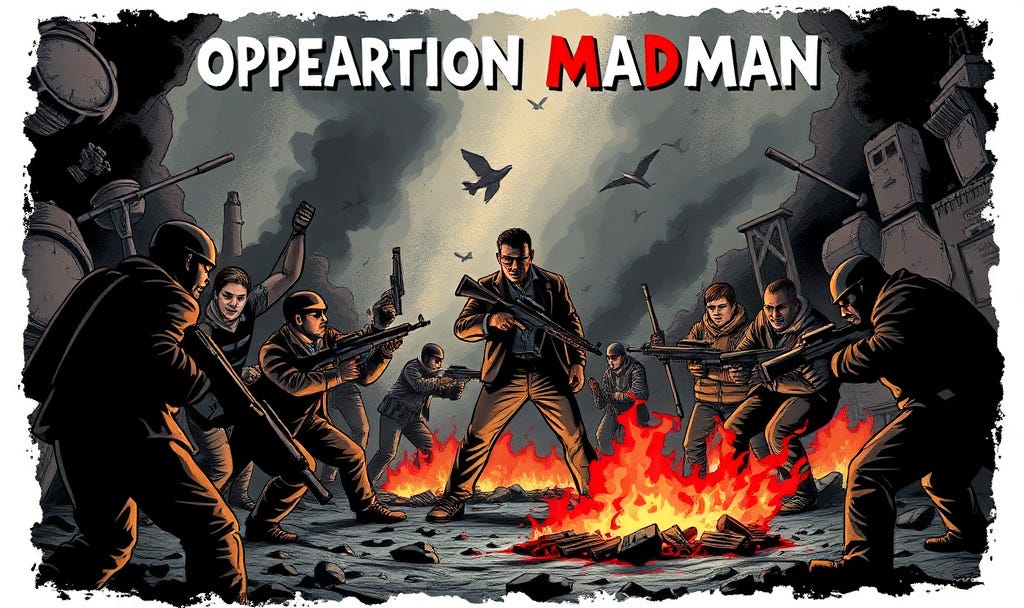
Let’s Talk About 'Operation Madman'. It’s A Real Name. [(ES) Subtítulos]
May 1600:33:19Tap to summarizeI know what you’re thinking.“Cary, that sounds like it was named by a second-grader who ate a full bag of Halloween candy, found his dad’s old war movies, and drew a strategy on a Denny’s placemat with a broken crayon.”You’d be exactly right. Except this particular second-grader has a nuclear football, a military budget that makes the next ten countries look like they’re fundraising with a bake sale, and a pathological, diaper-filling terror of one specific four-letter word that rhymes with “loser.” He can’t say it. Won’t say it. It’s the Voldemort of his entire existence. Mention it and his whole face does a thing.That’s Our Leadership. That’s Washington. That’s the magnificently-turd-polished diplomatic apparatus currently blockading the Strait of Hormuz like it’s a gas station bathroom with one working lock and a “be right back” sign that’s been there since February.The StrategyI need you to really bend down for this one. Get your expectations on the floor. Below the floor. Get them in the crawlspace where the possum lives.Operation Madman is an actual, grown-adult, Iranian, now Pentagon-codeworded, someone-got-paid-a-salary-to-name-this strategy.The plan — in its full, official, classified-document glory — is to appear completely out of your gourd. Not be out of your gourd. That part apparently takes care of itself. Just appear that way.The official warfighting doctrine for the biggest energy catastrophe on the planet was coined from a word a kindergartner uses when his juice box leaks.And it worked.If by “worked” you mean the Strait of Hormuz — that oiled-up little maritime chokepoint through which twenty percent of the world’s petroleum gets its groove on every single day — is now sealed tighter than a pickle jar that’s been in the back of the fridge since the Obama administration. Closed. Shut. Done. Nighty-night, global energy supply. Don’t let the geopolitical bedbugs bite.The oil markets go up. The oil markets go down. Nobody tells you anything true. Everybody’s winning. Nobody’s winning. The Strait is open. The Strait is a cork in a bottle. And the bottle is on fire. But fine.The Cary Harrison Files airs on KPFK 90.7 FM Los Angeles and the Pacifica Radio Network. Subscribe here on Substack for the full transcript, extended commentary, and the occasional history lesson that will ruin your day in the most productive way possible.Find us at caryharrison.com — and for the love of the Founders, tell a friend.Membership here sustains public radioThe Intellectual Ancestor of All This DumbasseryThe lineage runs through a man named Daniel Ellsberg — yes, that Ellsberg, the Pentagon Papers guy, a former friend of this show — the man who marched into Washington with a briefcase stuffed with inconvenient truths and handed the entire national security apparatus a suppository it had not consented to.Back in 1959 — when your parents were still cheerful, cars had fins for absolutely no aerodynamic reason whatsoever, and the apocalypse at least had the decency to feel distant — Ellsberg delivered a lecture called:“The Political Uses of Madness.”He was studying Hitler’s trick of performing irrationality to make other countries wet themselves and hand over whatever he wanted. The logic was simple and stomach-turning:If you act crazy enough, people give you what you want just to get you to sit back down and stop making that face.The StalemateAnd here we are — waddling around in a full, pants-soiled stalemate.You know what a stalemate is in nuclear-age geopolitics? It’s two overgrown toddlers playing chicken in a stolen golf cart on a one-lane road, both of them absolutely positive the other one will swerve, neither willing to admit they blew past the exit forty miles ago and are now technically in a different country.Washington can’t back down — because he’d be, say it with me — a loser.Iran won’t negotiate because the last time they showed up to the table, they got bombed as a thank-you gift.So here we sit, you and I, while the planet’s entire energy supply is being monetized, weaponized, propagandized, and monetized again — and you are personally funding every drop of it at the pump, the grocery store, and wherever else the invisible hand of the market has found a new orifice to invoice.Order NowLet’s Be FairFairness is what separates us from the animals — and from certain cable networks whose names rhyme with “Rocks Gnus.”Because beneath all this spectacular theater, beneath the madman cosplay and the Hormuz puppet show, there is a sixty-year illegal military occupation.Sixty years.That’s not a conflict. That’s not even a “situation.” That’s a lifestyle. That’s a timeshare you can never get out of and nobody will buy. And yet here we are — still acting surprised, still calling it breaking news, still scheduling the panel discussion — as if sixty years of the same thing is anything other than a choice somebody keeps making every single morning before breakfast.Before we bring on one of the smartest experts alive to explain all of this, let’s recap what we’re actually dealing with:A war with a codename that sounds like what happens when a frat pledge drinks something he shouldn’t and wakes up zip-tied to a lawn ornamentA blockaded strait that world leaders simultaneously swear is open and closed — like a geopolitical bathroom stall with a broken latch that everyone’s pretending works fine while the line outside wraps around the blockA dollar so jittery it’s checking WebMD at 3am and updating its willA two-state solution so old it has a pension and a bad hip and still nobody’s done anything about itA nuclear non-acknowledgment policy so transparently stupid it makes peek-a-boo look like a binding legal contractA Leadership whose entire grand strategic doctrine — their magnum opus, the thing they apparently sat down and decided was the cornerstone of twenty-first century American power projection — is to act like they ate a fistful of crayons, washed it down with paint thinner, and hope the other guy soils himself firstYou think this isn’t the greatest era in human history? Honey. You’re not failing to see the magnificence — you’re just not crouched down far enough yet. Get on your belly. Face in the carpet. There you go. Now look up. It’s beautiful.My GuestToday’s guest wrote about all of this with the kind of clarity that makes powerful people deeply uncomfortable — which is precisely how you know it’s worth reading.Professor Thomas Ehrlich Reifer worked shoulder-to-shoulder with Noam Chomsky and the late Daniel Ellsberg. He chairs the Sociology Department at the University of San Diego, with affiliations spanning Latin American Studies, Women’s and Gender Studies, Asian Studies, Cognitive Science, and Ethnic Studies. He’s written for the Journal of Palestine Studies and Antisemitism Studies.His latest piece at Global Policy —“The Unfolding World War, The Political Uses of Madness, and the Fate of Republics”— is generating more international response than anything he’s ever published, including from leading authorities on the Middle East, Iran, and U.S.-Iranian relations.The full conversation in the video above and wherever you get podcasts. Search: The Cary Harrison Files.Text or leave a voice message: 310-737-TALK This is a public episode. If you'd like to discuss this with other subscribers or get access to bonus episodes, visit caryharrison.substack.com/subscribe
Transcribe →